British Gas Joins Forces With Samsung To Help Customers Power Smarter Energy Use
The title of this post, is the same as that of this press release from Centrica.
This is the sub-heading.
British Gas and Samsung have today announced the exciting first step in a long-term venture – aimed at helping customers better manage their energy use and increase the adoption of low carbon heating technologies in homes across Britain.
These are the first two paragraphs.
The collaboration will see British Gas integrate with Samsung’s SmartThings app to help customers optimise their home appliances to use energy when the cost and demand are lower. This is now possible through the integration of SmartThings Energy and British Gas’ PeakSave demand flexibility scheme informing customers (by sending notifications via their smartphone, TV or other compatible devices) of the best times to use household appliances to save money.
The PeakSave scheme includes PeakSave Sundays, running every Sunday until the end of February with half-price electricity from 11am to 4pm for British Gas customers and PeakSave Winter events which encourages customers to move their electricity use out of peak times when there is high demand on Britain’s energy grid.
As a Graduate Control Engineer, I believe that this could make optimising your energy use much easier.
- It would surely be a lot easier to check usage on your phone rather than a smart meter, when you perhaps cook a ready meal, so that you can see if your microwave or traditional cooker is cheapest.
- Suppose you and everybody, who lives with you are out for supper and British Gas want to cut off your gas for a reward, you can make an appropriate decision.
- Hopefully, if you have the right controls, you’ll be able to switch lights and appliances off and on.
The possibilities are endless.
I shall certainly be looking at the reviews of this app.
There is a section in the press release called Scaling Up Low Carbon Heating Opportunities, where this is said.
The collaboration will also help support customers in their journey to decarbonising their homes by introducing smart technologies in a way that is simple and empowering. From early 2024, British Gas will include Samsung heat pumps in its offering to British households to support the UK’s commitment to reach net zero by 2050.
The venture will see specially trained British Gas surveyors and engineers working with consumers to explain the benefits of heat pumps and then conducting the installations on-site. Samsung will be supporting workforce training as part of their efforts to upskill the heating industry to ensure there are enough installers to service the expected growing demand.
British Gas also offers customers the chance to purchase heat pumps through flexible financing methods. This, combined with the recently increased UK Government Boiler Upgrade Scheme grant of £7,500, creates an attractive package of financing options to help people make the transition more affordable.
Various plumbers, who I would trust, have given me different views about heat pumps.
I suspect the Samsung’s SmartThings app might be able to simulate your energy usage with or without the heat pump, as it would know your energy use with your current boiler.
I was doing similar calculations for chemical plants in the early 1970s at ICI, using a PACE 231-R computer.

Consider.
- It may look rather old fashioned, but it could solve a hundred simultaneous differential equations in one go.
- Two similar computers linked together were the analogue half of NASA’s moon mission simulator.
- Without these wonderful machines, NASA would not have been able to re-calculate the dynamics of Apollo 13 and the mission would be remembered as a disaster, rather than the first space rescue.
The average current smart phone has more computing power than a PACE 231-R.
What’s In It For Samsung?
I have a Samsung television, but unfortunately it has a screen fault because of age. So if I had the Samsung app and liked it, I might buy another Samsung TV.
Similarly, the app might give me a financial reason to buy a Samsung heat pump.
Samsung will sell more equipment.
What’s In It For Centrica?
Centrica would appear to be a loser, as bills will fall and they could be paying customers to not use energy.
But they are surely hoping that their market share will increase and I’m sure Samsung will give them a commission.
What’s In It For The Consumer?
Hopefully, they’ll get lower energy bills.
But also they might get a lot of convenience controlling their appliances and heating.
Conclusion
Using energy is becoming a computer game with monetary rewards.
Is the deal between Centrica/British Gas and Samsung another deal that has been brought to fruition by the Korean President’s visit to the UK?
It looks like this is the third recent deal signed between UK and Korean companies, after these two.
- South Korea, UK Strenghten Offshore Wind Ties
- UK And South Korea Help Secure Millions For World’s Largest Monopile Factory
I suspect, there might be a few more deals, if Charles and Camilla really turned on the charm.
In Mersey Tidal Project And Where It Is Up To Now, I wrote about talks between Liverpool City Council and Korea Water about a tidal barrage of the Mersey. This project must surely be a possibility!
This is said in the Wikipedia entry for Korean Air under Fleet Plans.
At the Association of Asia Pacific Airlines Assembly in 2018, Korean Air announced that it was considering a new large widebody aircraft order to replace older Airbus A330, Boeing 747-400, Boeing 777-200ER and Boeing 777-300. Types under consideration for replacement of older widebody aircraft in the fleet include the Boeing 777X and Airbus A350 XWB. At the International Air Transport Association Annual General Meeting (IATA AGM) in Seoul, Chairman Walter Cho said Korean Air’s widebody order is imminent and it is considering an extra order of Airbus A220 Family including developing version, Airbus A220-500.
Note.
- Airbus A350 XWB have Welsh wings and Rolls-Royce engines.
- Airbus A220-500 are made in Canada with wings and composite parts from Belfast. Rolls-Royce may have a suitable engine.
Could a deal have something in it for the UK?
Although Korea has its own SMR program, I wonder, if there could be a link-up between Korean industry and Rolls-Royce over SMRs?
Price Framework Paves Way For Vast Electricity Storage Scheme
The title of this post, is the same as that of this article on The Times.
This is the sub-heading.
SSE welcomes step forward in plans to build the £1.5bn Coire Glas hydroelectric project
These two paragraphs outline the article.
Ministers have provisionally agreed to a power pricing framework that could pave the way for more pumped storage hydroelectricity projects in Britain, including a gigantic £1.5 billion scheme from SSE that is starting to take shape in the Scottish Highlands.
The Department for Energy Security and Net Zero said it intended to develop a “cap and floor” pricing mechanism that would advance the Coire Glas storage project being developed by SSE, the energy company, and could unlock further pumped storage power stations.
Coire Glas will be one of the largest renewable power projects ever built in the UK.
- It will have a power output of 1.5 GW, which is comparable with some of the large wind farms in the North Sea or four gas-fired power station or Rolls-Royce SMRs.
- It will be able to store 30 GWh of electricity and provide 1.5 GW for twenty hours.
- Coire Glas has a web site.
- Coire Glas will more than double pumped storage hydroelectric capacity in the UK.
Bath County Pumped Storage Station in Virginia, US claims to be the world’s largest battery, but Coire Glas will be able to store more electricity.
You wait decades for one of these monsters to come along in the UK and SSE also have another on the way.
- Loch Sloy hydroelectric power station is the largest conventional hydroelectric power station in the UK.
- It has an output of 152 MW.
- It opened in 1950 and was largely built by German and Italian prisoners-of-war.
SSE plan to convert Loch Sloy power station into a pumped storage hydroelectric power station.
- It will be able to store 25 GWh of electricity.
- Loch Sloy will be the upper lake.
- Loch Lomond will be the lower lake.
- The existing dam, upper lake, pipes and powerhouse will be retained.
- The developments have a web page.
The project is aimed at a commissioning date of 2028.
This paragraph explains how the ‘cap and floor’ mechanism works.
In the scheme, operators would be guaranteed a minimum level of revenue, while consumers would be protected by a price ceiling, above which surplus revenue would be returned to them.
And these two paragraphs give SSE’s reaction.
Finlay McCutcheon, 46, director of onshore Europe at SSE, said the pricing framework was welcome news. He said that a deal for Coire Glas was needed by the end of this year to secure a firm investment decision by early 2026. Planning for the project started in 2007.
“Given the time taken to reach this point, much work is now needed to ensure an effective mechanism is finalised and put in place as early as possible to enable Coire Glas to take final investment decisions and move into construction,” he said.
I believe that the negotiations between the Government and SSE will lead to a monster on Loch Lochy and another one on Loch Lomond.
Conclusion
There are also these pumped storage hydroelectric schemes under development.
- Balliemeanoch Pumped Hydro – 1.5 GW/45 GWh
- Balmacaan Pumped Hydro – 600 MW/15-20 GWh
- Corrievarkie Pumped Hydro – 1.5 GW/14.5 GWh
- Fearna Pumped Hydro – 1.8 GW/37 GWh
- Glenmuckloch Pumped Hydro – 400 MW/1.6 GWh
- Loch Earba Pumped Storage Hydro – 900MW/33 GWh
- Loch Kemp Pumped Storage Hydro – 300MW/9 GWh
- Loch Na Cargeach/Red John Pumped Storage Hydro – 450 MW/2.8 GWh
These total up to 7.4 GW/100+ GWh.
This page on the Strathclyde University web site, gives these GWh figures for the possible amounts of pumped-storage that can be added to existing schemes.
- Errochty – 16
- Glasgarnock – 23
- Luichart – 38
- Clunie – 40
- Fannich – 70
- Rannoch – 41
- Fasnakyle – 78
- Tummel – 38
- Ben Lawers – 12
- Nant – 48
- Invermoriston – 22
- Invergarry – 41
- Quoich – 27
- Sloy – 20
That is a total of 514 GWh.
Scotland will be the Saudi Arabia of energy storage.
Would You Buy A Battery Energy Storage System From Rolls-Royce?
I don’t often click on adverts that appear in web pages.
But I had to click on one from Rolls-Royce mtu, which advertised Battery Energy Storage Systems.
I wonder what the Honourable Charles Rolls would have thought of adverts on the Internet for the company he jointly founded?
I suspect he would have liked the idea, as Rolls was very much a promoter of motoring and aviation and opened one of the first car dealerships in the UK, according to his Wikipedia entry.
The Wikipedia entry for his business partner; Sir Henry Royce starts with this sentence.
Sir Frederick Henry Royce, 1st Baronet, OBE (27 March 1863 – 22 April 1933) was an English engineer famous for his designs of car and aeroplane engines with a reputation for reliability and longevity.
He is also described as a perfectionist.
This sentence from the Wikipedia entry, describes how he started the design of the legendary “R” engine.
In October 1928, he began design of the “R” engine while walking with some of his leading engineers on the beach at West Wittering, sketching ideas in the sand. Less than a year later, the “R” engine, designed in his studio in the village, set a new world air speed record of 357.7 miles per hour and won the Schneider Trophy of 1929.
Later with help from the maddest person my father ever met (his words, not mine!) ; Lady Houston, the Supermarine S.6B won the trophy in 1931 and then broke the world speed record at over 400 mph. Not bad for a seaplane. Take the floats off an S.6B and you almost have a Spitfire.
The Wikipedia entry also describes how the “R” engine was developed into what many engineers believe was the finest internal combustion engine of all time; the Rolls-Royce Merlin.
Following the success of the “R” engine, it was clear that they had an engine that would be of use to the Royal Air Force. As no Government assistance was forthcoming at first, in the national interest they went ahead with development of what was called the “PV-12” engine (standing for Private Venture, 12-cylinder). The idea was to produce an engine of about the same performance as the “R”, albeit with a much longer life. Rolls-Royce launched the PV-12 in October 1933 and the engine completed its first test in 1934, the year after Royce died. The PV-12 became the Rolls-Royce Merlin engine.
Where would we have been in the Battle of Britain without the Merlin engine?
Since 1969, the engineers at Rolls-Royce have followed Sir Henry’s example of perfection and developed the revolutionary RB-211 into the modern day Trent, which is now about to take a big leap into a low-carbon future with the UltraFan.
If the quality of Rolls-Royce mtu’s Battery Energy Storage System matches the levels of perfection Rolls-Royce achieved with the Merlin and the Trent, then I suspect that Sir Henry would have given his approval.
This picture is shown on the web page for the Battery Energy Storage System.

These two paragraphs introduce, what Rolls-Royce mtu are calling the mtuEnergyPack.
In today’s world of economic growth and increasing populations, the demand for electricity is soaring. Governments and industries globally shift to distributed renewable energy, challenging centralized grids. To adapt to this changing energy landscape, the mtuEnergyPack offers an ideal solution.
It integrates renewable sources like solar and wind power, paving the way for future-ready sustainable power systems. The mtu EnergyPack is a scalable, all-in-one solution for autonomous off-grid facilities. It ensures reliable power through peak shaving, load-shifting, and grid stabilization, making it suitable for various applications.
These are my thoughts.
What Is The Output And The Storage Capacity?
This paragraph on this page gives this answer.
It efficiently stores electricity from distributed sources and delivers on demand. The mtu EnergyPack is available in different sizes: The QS and the QL, ranging from 200 kVA to 2,000 kVA, and from 312 kWh to 2,084 kWh, and the QG for grid scale storage needs, ranging from 4,400 kVA and 4,470 kWh to virtually any size.
It seems that you specify your requirements and Rolls-Royce mtu should be able to satisfy it.
What Devices Can Be Connected?
This paragraph on this page gives this answer.
The mtu EnergyPack serves as a key component in enhancing the reliability and profitability of microgrids and energy systems. It stores electricity generated by distributed power sources, including gensets, wind turbines, or solar panels, and delivers it when needed.
In the 1970s, when I was working at ICI, others in the section were working on a system called MEDIA, where every sensor on a chemical plant was connected to the central computer, through its own analog-to-digital computer. It would now be called plug-and-play by some.
I believe that Rolls-Royce mtu are using similar ideas to connect equipment to the control computer.
These are my thoughts about connecting various equipment.
- Hydrogen-powered generators and electrolysers as Rolls-Royce mtu are using at Duisburg, which I wrote about in Rolls-Royce Makes Duisburg Container Terminal Climate Neutral With MTU Hydrogen Technology.
- Could Rolls-Royce’s beer keg-sized 2.5 MW electrical generator based on a Super Hercules engine, be connected?
- Could a Rolls-Royce Trent be connected?
- Could one of Rolls-Royce’s small modular nuclear reactors be connected?
- In Rolls-Royce To Play Key Role In US Department Of Defense Nuclear Microreactor Program, I talk about developing a 1-5 MW nuclear reactor for US Department of Defense. Could these be connected?
I don’t see why every device can’t work to the same protocol.
What Is The Power Density Like?
This paragraph on this page gives this answer.
The mtu EnergyPack’s compact battery system designs suit projects with limited space and logistical restrictions.
In ‘Spirit of Innovation’ Stakes Claim To Be The World’s Fastest All-Electric Vehicle, I talked about Rolls-Royce’s record-breaking electric plane called Spirit of Innovation.
Has what has been learned about energy storage in the confined spaces of an aeroplane been applied to a Battery Energy Storage System?
What Do Rolls-Royce mtu Consider To Be Important Features?
On this page, they list these features.
- Power Density
- Digitally Connected
- Multilevel Safety
- Black Start Capability
- Scalability
- Ultra-Fast Response
- Flexible Use
- Plug-And-Play Installation
The design seems to have everything covered.
Can Similar Systems Be Designed By Others?
I would expect that similar systems can be designed, as technology like batteries is available to all and the operation is only as good as the software controlling the various components of the system.
But similar systems will be without the famous Rolls-Royce logo.
Could One Of These Systems Decarbonise A Village?
I once lived in a village with about fifty houses and perhaps a hundred inhabitants.
- There was an old World War Two airfield, that could probably accommodate a small wind farm of perhaps 20 MW.
- There were a couple of barns and large sheds, that could have solar panels similar to those I described in Bedford Depot’s Massive Solar Roof Helps Thameslink On Way To Net Zero.
I suspect an mtuEnergyPack could control all these inputs and provide the village with the following.
- Enough electricity to power all the needs of the inhabitants, businesses and their vehicles.
- If an electrolyser were to be provided, it could probably produce enough hydrogen to power every boiler and hydrogen-powered vehicle.
Note.
- Farmers would like the local availability of hydrogen, as it will be ideal for tractors and agricultural machinery.
- I actually believe that if a village had a reliable and affordable hydrogen supply, that a large proportion of the inhabitants would switch to hydrogen-powered vehicles.
There would still be the National Grid there for backup.
Conclusion
If I needed an mtuEnergyPack, I’d certainly give one a close look.
Is Sizewell C Needed?
I am generally pro-nuclear, but I am not sure if building a large nuke at Sizewell is the right action.
Consider.
- East Anglia has 3114 MW of offshore wind in operation.
- East Anglia has 6772 MW of offshore wind under construction, with Contracts for Difference or proposed.
- Vattenfall are considering abandoning development of their large wind farms off the Norfolk coast, which are proposed to have a capacity of 3196 MW.
- If the two Vattenfall wind farms don’t get built, it is likely that East Anglia will have around 6700 MW of offshore wind capacity.
- Sizewell C has a proposed nameplate capacity of 3260 MW. Some might argue, that to back up East Anglia’s offshore wind power, it needs to be larger!
- Norfolk and Suffolk no large electricity users, so are Vattenfall finding they have a product no one wants to buy.
- National Grid is developing four interconnectors to bring power from Scotland to the Eastern side of England, which will back up wind power in the East with the massive Scottish pumped storage, that is being developed.
- National Grid and their Dutch equivalent; TenneT are developing LionLink to connect the UK and the Netherlands to clusters of wind farms between our countries in the North Sea.
- Kent and East Anglia have several gas and electric interconnectors to Europe.
- Sizewell is well-connected to England’s grid.
These are my thoughts.
Energy Storage At Sizewell
Consider.
- Sizewell is well connected to the grid.
- It has the sea on one side.
- It could easily be connected to the large offshore wind farms, thirty miles out to sea.
If large energy storage could be built on the Sizewell site or perhaps under the sea, then this energy could be recovered and used in times of low wind.
Perhaps the technology of the STORE Consortium, which I discussed in UK Cleantech Consortium Awarded Funding For Energy Storage Technology Integrated With Floating Wind, could be used.
In this system, energy is stored in 3D-printed concrete hemispheres under the sea.
A Small Nuclear Reactor Cluster At Sizewell
Rolls-Royce are proposing that their small modular reactors will have a capacity of 470 MW.
Perhaps a cluster of seven small modular reactors at Sizewell, with a building schedule matched to the need to back up wind farms would be better and easier to finance.
I also feel a cluster of SMRs would have less risk and would be less likely to be delayed.
Where Is Generating Capacity Needed In The UK?
These areas already have large amounts of offshore wind in operation or proposed to be built before 2030.
- Celtic Sea
- North Wales
- Liverpool Bay
- Cumbria
- Scotland
- Scotland’s Offshore Islands
- North East England
- Humberside
- Lincolnshire
- East Anglia
- Thames Estuary
- Kent
- Sussex
Amongst the back up for these wind farms, there are only two modern nuclear stations; Sizewell B and the still-to-open Hinckley Point C.
If you look at a map of England and its power generation, there is a tremendous gap of capacity South of a line between Hinckley Point and Brighton, with little or no offshore wind and no nuclear.
There is probably a need for a large nuke near Weymouth.
Alternatively, perhaps several SMRs could be built underneath places like Salisbury Plain, Dartmoor and Exmoor!
Conclusion
We probably need the nuclear electricity from another Hinckley Point C-sized nuclear power station, so that we have adequate back-up for offshore wind.
But I am not sure that Sizewell is the right place to build it.
Suffolk: Sizewell C To Explore ‘Innovative’ Waste Heat Lido
The title of this post, is the same as that, of this article on the East Anglian Daily Times.
This is the sub-heading.
The developers of the new Sizewell C nuclear power station have expressed an interest in an “innovative” plan to use waste heat from the plant to heat a new lido.
And this is the first paragraph.
Creating the outdoor pool was one of a number of ideas contained within the Leiston masterplan – a blueprint for transforming the Suffolk town – and now the Sizewell C company has pledged to explore the proposal with the town council.
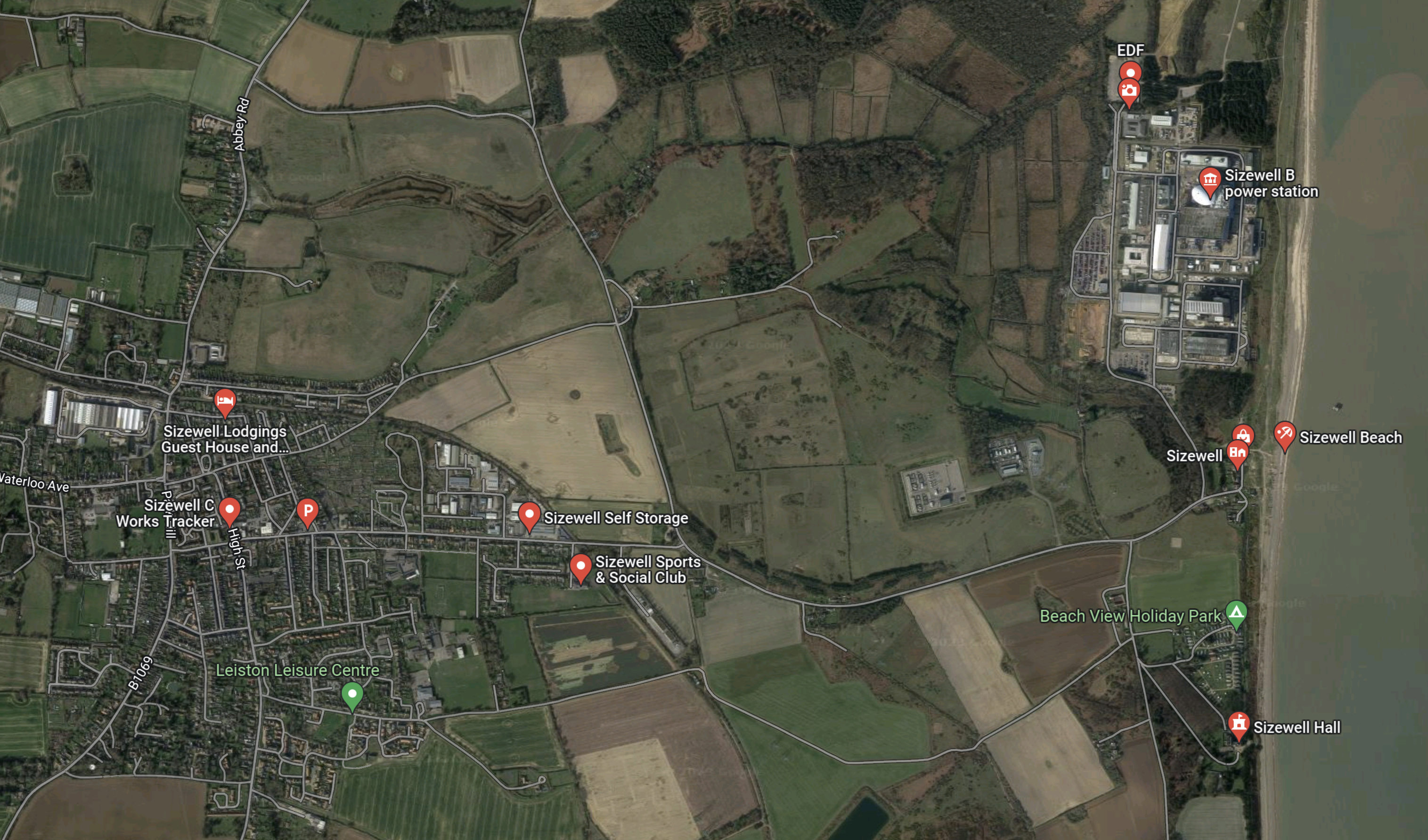
This map shows the town of Leiston and the Sizewell power stations site.
Note.
- Leiston is in the South-West corner.
- The power station site is in the North-East corner.
I have a few thoughts.
Pink Hydrogen
Pink hydrogen is zero-carbon hydrogen produced using nuclear power.
The production of hydrogen is already part of the plans for Freeport East, which I wrote about in Ryze Hydrogen’s Suffolk Freeport Hydrogen Vision Takes Shape.
In that article, I said this.
This would mean that Sizewell’s 6 MW electrolyser could be producing around a thousand tonnes of hydrogen per year or 2.6 tonnes per day.
The more efficient high temperature electrolysis can be used, using some of the waste heat from the nuclear power station. I wrote about this in Westinghouse And Bloom Energy To Team Up For Pink Hydrogen.
I also suspect that it may be more efficient to use seawater to produce the hydrogen.
Could high temperature electrolysis be used at Sizewell?
District Heating
The waste heat can also be used for district heating.
A Train Service To Ipswich
This Google Map shows the railway through Leiston, which is currently used to bring fuel to Sizewell B power station and remove waste.

Note.
- The railway starts in the North-West corner of the map.
- The green dot in that corner marks Leiston cemetery.
- The railway then goes East before turning to the South-East corner of the map.
- In that corner, there are two sidings for loading and unloading the flasks.
Surely, Leiston also needs a new railway station, with at least an hourly service to Saxmundham, Wickham Market, Woodbridge and Ipswich. And possibly even Aldeburgh!
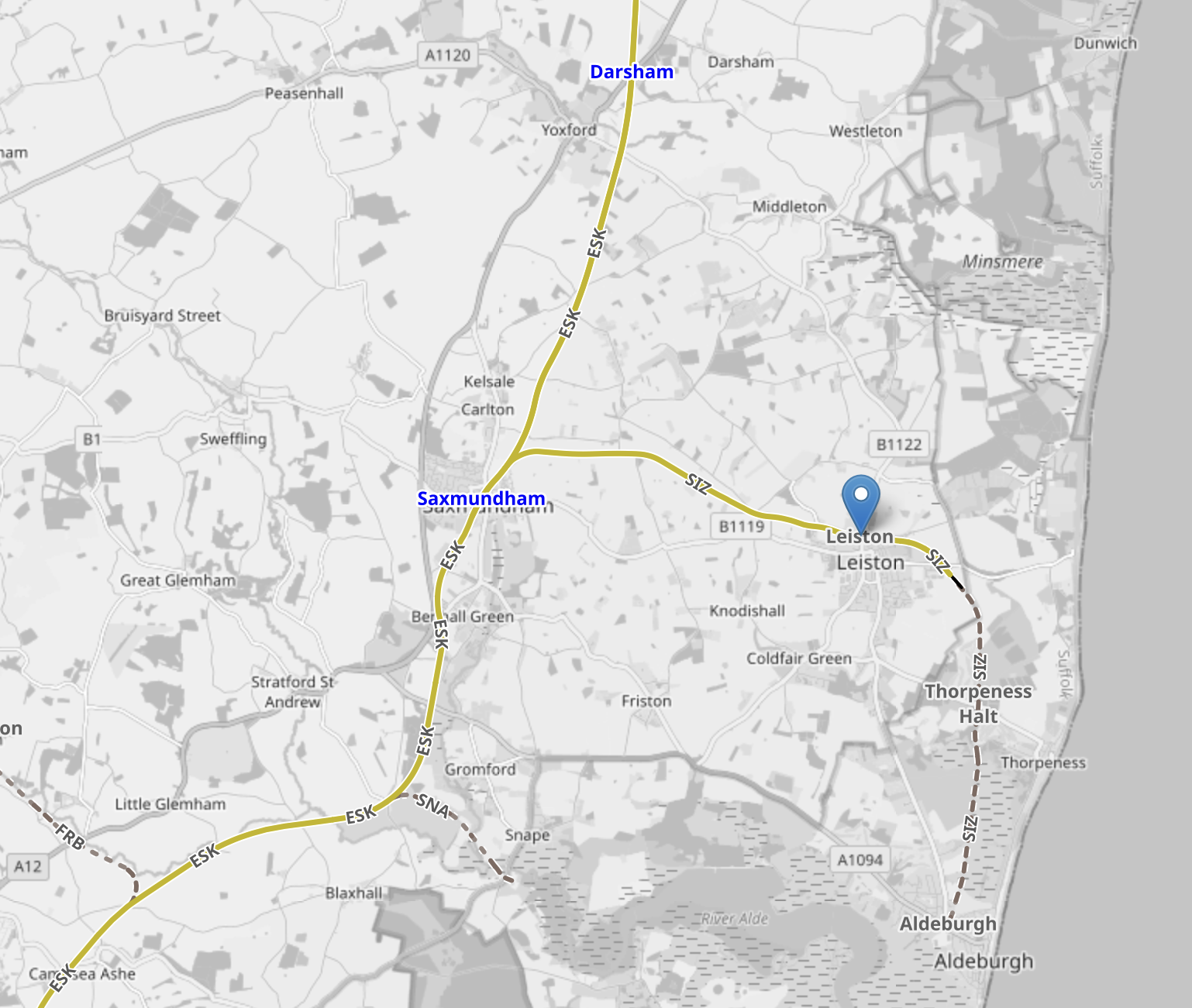
This map from OpenRailwayMap shows the route of the Aldeburgh branch.
Note.
- The North-South yellow line is the East Suffolk Line.
- Their were three stations; Leiston, Thorpeness Halt and Aldeburgh.
- Leiston station was in the North of the town.
The intact section of the branch is shown in yellow.
There would be no need for any electrification, as Stadler, who built Greater Anglia’s Class 755 trains, are the masters of battery-powered trains and could convert these trains to battery operation. Recently, one of the smaller metro trains, that Stadler are building for Liverpool, ran for nearly 90 miles on battery power alone, which I wrote about in New Merseyrail Train Runs 135km On Battery.
An hourly train service would double the frequency of the train service between Saxmundham and Ipswich.
Does the Leiston masterplan include a train service?
And if it does, does it terminate at a new Aldeburgh station?
Conclusion
Integrating development around a nuclear power station could be a way of levelling up.
It would bring electricity, heat, a rail link and jobs to an area.
Will Rolls-Royce use these benefits to sell one of their SMRs to those living around a site?
Reports: Ineos In Talks With Rolls Royce To Build Nuclear Plant At Grangemouth Refinery
The title of this post, is the same as that of this article on The Chemical Engineer.
These are the first two paragraphs.
INEOS is reportedly in talks with Rolls Royce about using its small modular nuclear reactor (SMR) technology to power the Grangemouth refinery in Scotland.
The Sunday Telegraph first reported the story, citing sources with knowledge of the discussions who claimed that early-stage talks between the companies have centred on the technology and that commercial negotiations are yet to take place.
This paragraph, also gives a useful summary of how large scale chemical plants can use low carbon energy.
Ineos is not the first chemicals major to explore using new nuclear plants to provide low-carbon power to help decarbonise its heavy operations. Options include raising low-carbon heat for use in chemicals processing and electrolysing water to produce hydrogen for use as chemical feedstocks. In August, Dow announced it will install SMRs from X-energy to provide power and process heat for its chemicals production on the US Gulf Coast.
It is interesting to note that Dow are also exploring the use of SMRs to power a large chemical plant.
This paragraph gives an assessment of the possible view of the Scottish government.
Scotland has set a target to achieve net zero emissions by 2045 – five years earlier than UK legislation. While the Scottish Government is opposed to new nuclear using current technologies it has said that it will assess how novel technologies might contribute to Scotland’s low carbon future.
So perhaps it is not the total opposition, that some would expect.
In the 1960s, when I worked at ICI, I can remember reading an article in a serious magazine about nuclear plants being used in chemical plants and for steelmaking. This application has taken a long time to come to fruition.
Small Nuclear Power Plants To Replace Gas In Quest For Net Zero
The title of this post is the same as that of this article on The Times.
I was very much involved in the writing of project management software in the last three decades of the last century and if there’s one thing we’re generally good at in the UK, it’s complex project management.
Usually problems arise because of political or ignorant senior management meddling.
Our Energy Saviours
I believe our two energy saviours will be floating offshore wind and small nuclear reactors (SMRs) and both need good project management to be built successfully on production lines.
So I don’t see any reason, why we can’t build large numbers of floating offshore wind farms to supply our electricity.
They are also complimentary, in that the fleet of SMRs back up the wind.
Floating Wind First
Floating wind is likely to be developed at scale first, as certifying anything involving nuclear will take an inordinate time.
The electricity from floating wind farms will keep us going, but it is also starting to develop a nice line in exports.
This press release from Drax is entitled Britain Sending Europe Power Lifeline – Report, where this is the sub-title.
For the first time in over a decade, Britain became a net exporter of electricity to its European neighbours, making around £1.5bn for the economy in three months.
Note.
- The report was written by Imperial College.
- Two new interconnectors; Viking Link and NeuConnect between the UK and Europe are under construction.
- Several large wind farms are under construction and will be commissioned in 2023/24 and could add over 4 GW to UK electricity production.
Exports will only get better.
A Sprint For Wind
So we must have a sprint for wind, which will then provide the cash flow to allow the SMRs to roll in.
Or will that be too much for the ultra-greens, who would object to cash-flow from GWs of wind being used to fund SMRs?
Should The World Call A Halt To Large Nuclear Power Stations?
When I left Liverpool University in the 1960s with an engineering degree, my fellow graduates and myself felt that nuclear power would be a sensible way to provide the electricity we need. Aberfan and other disasters had ruined coal’s reputation and not one of my colleagues joined the National Coal Board.
Over the intervening years, nuclear power has suffered a greater proportion of adverse events compared to other forms of electricity generation.
Large nuclear has also suffered some of the largest time and cost overruns of any energy projects.
My optimism for nuclear power has declined, although I do hope and feel, that small modular factory-built reactors, like those proposed by Rolls-Royce and others, might prove to be as reliable and economic as gas-fired, hydro-electric and tidal power stations, or solar and wind farms.
The smaller size of an SMR could be advantageous in itself.
- Smaller factory-built power stations are more likely to be built on time and budget.
- The amount pf nuclear material involved is only about twenty percent of that of a large nuclear station.
- A smaller site would be easier to protect from terrorists and Putinistas.
- Would the risk of a serious accident be reduced?
- SMRs would be less of a blot on the landscape.
- SMRs would not need such a high-capacity grid connection.
- An SMR integrated with a high temperature electrolyser could be the easiest way to generate hydrogen for a large customer like a steelworks.
Overall, I believe an SMR would be involve less risk and disruption.
Zaporizhzhya
Zaporizhzhya is probably the last straw for large nuclear, although the incident isorchestrated by an evil dictator, who is much worse, than any of James Bond’s cruel adversities.
I doubt Putin would get the same leverage, if Zaporizhzhya were a gas-fired or hydroelectric power station.
Conclusion
I feel, the world must seriously question building any more large nuclear power stations.
The Rolls-Royce SMR Web Site
Rolls-Royce now have a web site for their proposed small modular reactor (SMR) design.
This page is entitled Why Rolls-Royce SMR?, has this outline of the reactor program.
Rolls-Royce SMR offers a radically different approach to delivering nuclear power, we have drastically reduced the amount of construction activities and transformed the delivery environment, from a large complex infrastructure programme into a factory built commoditised product.
Our design has evolved in response to a definitive set of market driven outcomes, this is not technology for technology’s sake, but innovation, to create a transformational clean energy solution that will deliver clean affordable energy for all.
This would appear to be an approach driven by proven engineering principles and excellence, good low-risk design, backed up by the best project management.
These are all traditions inherent in the Rolls-Royce DNA.
But I also believe that Rolls-Royce have looked at the world market for nuclear reactors and designed a product to fit that market.
This paragraph is in a long section entitled Global & Scalable.
The compact footprint increases site flexibility and maximises potential plant locations, including replacement for existing coal or gas-fired plants.
Many things said on the Rolls-Royce SMR Web Site, appear to be very much market led.
In my view, this is the web site of a product designed to dominate the world market for nuclear energy.
Rolls-Royce Chief Warren East Spies Rebound For Air Travel
The title of this post, is the same as that of this article on The Times.
It is a must-read article.
This is the first paragraph.
Warren East, the outgoing chief executive of Rolls-Royce, has sounded a bullish note on aviation’s recovery from Covid-19, reporting increased demand from the jet-engine maker’s airline customers and expressing his belief that China will gradually open up to international travel.
Certainly, with all the chaos at the Channel this weekend, people are starting to travel again.
Support For The Military
This is a paragraph in the article.
Tom Bell, head of Rolls-Royce Defence, said the company was in talks with the US and UK militaries about supplying “deployable” reactors for military bases.
I’m sure that a reactor would have advantages to a large diesel or gas-turbine generator to power a military base.
- Military bases need a lot of power.
- It would not need refuelling every day.
- It could be connected to an electrolyser, to generate hydrogen for vehicles.
- It would be a lot quieter.
- I wonder, if it could be transported in a large transport aircraft.
But I feel, it might have other applications.
- It could provide power support after a large earthquake or natural disaster.
- It could provide power in remote or difficult locations.
- If the only power station for a remote community had a catastrophic failure, a deployable reactor could be brought in.
- It could provide power for a large construction site, which would help to decarbonise the construction.
- Power would be zero-carbon at point of generation.
The reactors might even be rail-transportable, so they could be moved to where they are needed safely and quickly.
But I don’t think they would necessarily be the same size as the Rolls-Royce SMRs, which are 470 MW.
A Scalable Reactor
This is a paragraph in the article.
Rolls also has a contract with the UK Space Agency to develop a “micro reactor” for space vehicles and satellites, Bell added. “These are really exciting opportunities for us to not only perpetuate our business undersea, at sea, on land, in the air, but also to go to space,” he said. East noted the advantage of nuclear reactors in space: “You can’t have air-breathing engines on the moon.”
Note.
- East is Warren East, who is the outgoing Chief Executive of Rolls-Royce.
- Nuclear power sources have been used in space before, usually by using an isotope, that gives out heat, as it decays.
- How small is micro?
- The US deployed a 1.75 MW nuclear power plant in Antarctica under the Army Nuclear Power Program. That reactor also provided heating and hot water. It is worth reading the Wikipedia entry, especially the section about the MM-1 reactor.
It does seem that Rolls-Royce are designing a reactor that can be scaled in size, to cover a whole spectrum of applications.
 The Anonymous Widower