Sepp Blatter Eviscerates Gianni Infantino Over Trump, Ronaldo And Saudi Arabia
The title of this post, is the same as that of this article on the Daily Telegraph.
This is the first paragraph.
Sepp Blatter can no longer bring himself to say Gianni Infantino’s name. Instead, the Swiss administrator – who ran Fifa from 1998 to 2015 until he left amid an enormous corruption scandal – refers to Infantino only as “my successor” and “the leader” as he takes his adversary to task ahead of Friday’s World Cup draw.
The article is worth a full read and the video is worth watching.
UK Government Sets 8-Hour Minimum For LDES Cap-And-Floor Scheme
The title of this post, is the same as that of this article on Energy Storage News.
This is the sub-heading.
The UK government has published a Technical Decision Document confirming crucial aspects of its long duration electricity storage (LDES) cap-and-floor scheme, which includes increasing the minimum duration required from six hours to eight.
These three paragraphs give more details.
The document, released by regulator Ofgem on 11 March, details the final overarching rules and requirements for the scheme as well as how it will be implemented, though significant detail still remains to be worked out.
The scheme will provide a cap-and-floor revenue protection for 20-25 years that will allow all capital costs to be recoverable, and is effectively a subsidy for LDES projects that may not be commercially viable without it. Most energy storage projects being deployed in the UK today are lithium-ion battery energy storage systems (BESS) of somewhere between 1-hour and 3-hour in duration (very occasionally higher).
One of the most significant new details of the scheme is that, following industry feedback, the minimum duration for projects to qualify has been increased from six hours to eight hours of continuous rated power.
As a control engineer, I believe this is all good stuff and is a good improvement on the previous regime.
The whole article is a must read and I believe that more investors, will invest heavily in energy storage.
But then the UK, with its massive potential for offshore wind, has the resources to create and fill many GW of energy storage.
Boris once said, that we would become the Saudi Arabia of wind!
Hyundai Heavy Sets Sights On Scottish Floating Offshore Wind
The title of this post, is the same as that of this article on offshoreWIND.biz.
This is the sub-heading.
Major South Korean shipbuilder, HD Hyundai Heavy Industries, has signed a Memorandum of Understanding with two Scottish enterprise agencies which is expected to unlock expertise in the design and manufacture of floating offshore wind substructures.
These are the first three paragraphs.
Scottish Enterprise (SE) and Highlands & Islands Enterprise (HIE) signed the MoU with Hyundai Heavy in Edinburgh, described as a “vote of confidence” in Scotland, committing each other to pursue opportunities for floating offshore wind projects in Scotland.
This is the South Korean company’s first agreement in Europe on floating offshore wind manufacturing.
HD Hyundai Heavy Industries is the world’s largest shipbuilding company and a major manufacturer of equipment such as the floating substructures that form a critical part of the multi-billion offshore wind supply chain.
To say this is a big deal, could be a massive understatement, as my history with large Korean companies could say otherwise.
Around 1980, one of the first prestigious overseas projects, that was managed by Artemis was in Saudi Arabia.
- This may have been something like the King Khaled City, but I can’t be sure.
- Most of the hard work on the project was done by labour imported by Hyundai from South Korea.
After a few years, the Korean running Hyundai’s part of the project returned to Korea and he indicated that he would help us break into the Korean market.
Our salesman; Paul, with responsibility for Korea, who sadly passed away last year, told me this tale of doing business in the country.
Our Korean friend had bought a system for Hyundai in Korea and he organised a meeting for important Korean companies, so that Paul could present the system.
Everything went well, with our friend doing the necessary pieces of translation.
When he had finished, Paul asked if there were any questions.
The most common one was “Can we see the contract?”
Contracts were given out and after a cursory read, the leaders of Korean industry, all started signing the contracts.
So Paul asked our Korean friend, what was going on.
After a brief discussion, Paul was told. “If it’s good enough for Hyundai, it’s good enough for my company!”
And that was how we broke the Korean market.
Conclusion
In UK And South Korea Help Secure Millions For World’s Largest Monopile Factory, I talked about Korean company; SeAH Wind’s new monopile factory on Teesside.
In South Korea, UK Strengthen Offshore Wind Ties, I talk about a developing partnership.
In Mersey Tidal Project And Where It Is Up To Now, I talk about Korean involvement in the Mersey Tidal Project.
The Koreans are coming and Hyundai’s endorsement will help.
Price Framework Paves Way For Vast Electricity Storage Scheme
The title of this post, is the same as that of this article on The Times.
This is the sub-heading.
SSE welcomes step forward in plans to build the £1.5bn Coire Glas hydroelectric project
These two paragraphs outline the article.
Ministers have provisionally agreed to a power pricing framework that could pave the way for more pumped storage hydroelectricity projects in Britain, including a gigantic £1.5 billion scheme from SSE that is starting to take shape in the Scottish Highlands.
The Department for Energy Security and Net Zero said it intended to develop a “cap and floor” pricing mechanism that would advance the Coire Glas storage project being developed by SSE, the energy company, and could unlock further pumped storage power stations.
Coire Glas will be one of the largest renewable power projects ever built in the UK.
- It will have a power output of 1.5 GW, which is comparable with some of the large wind farms in the North Sea or four gas-fired power station or Rolls-Royce SMRs.
- It will be able to store 30 GWh of electricity and provide 1.5 GW for twenty hours.
- Coire Glas has a web site.
- Coire Glas will more than double pumped storage hydroelectric capacity in the UK.
Bath County Pumped Storage Station in Virginia, US claims to be the world’s largest battery, but Coire Glas will be able to store more electricity.
You wait decades for one of these monsters to come along in the UK and SSE also have another on the way.
- Loch Sloy hydroelectric power station is the largest conventional hydroelectric power station in the UK.
- It has an output of 152 MW.
- It opened in 1950 and was largely built by German and Italian prisoners-of-war.
SSE plan to convert Loch Sloy power station into a pumped storage hydroelectric power station.
- It will be able to store 25 GWh of electricity.
- Loch Sloy will be the upper lake.
- Loch Lomond will be the lower lake.
- The existing dam, upper lake, pipes and powerhouse will be retained.
- The developments have a web page.
The project is aimed at a commissioning date of 2028.
This paragraph explains how the ‘cap and floor’ mechanism works.
In the scheme, operators would be guaranteed a minimum level of revenue, while consumers would be protected by a price ceiling, above which surplus revenue would be returned to them.
And these two paragraphs give SSE’s reaction.
Finlay McCutcheon, 46, director of onshore Europe at SSE, said the pricing framework was welcome news. He said that a deal for Coire Glas was needed by the end of this year to secure a firm investment decision by early 2026. Planning for the project started in 2007.
“Given the time taken to reach this point, much work is now needed to ensure an effective mechanism is finalised and put in place as early as possible to enable Coire Glas to take final investment decisions and move into construction,” he said.
I believe that the negotiations between the Government and SSE will lead to a monster on Loch Lochy and another one on Loch Lomond.
Conclusion
There are also these pumped storage hydroelectric schemes under development.
- Balliemeanoch Pumped Hydro – 1.5 GW/45 GWh
- Balmacaan Pumped Hydro – 600 MW/15-20 GWh
- Corrievarkie Pumped Hydro – 1.5 GW/14.5 GWh
- Fearna Pumped Hydro – 1.8 GW/37 GWh
- Glenmuckloch Pumped Hydro – 400 MW/1.6 GWh
- Loch Earba Pumped Storage Hydro – 900MW/33 GWh
- Loch Kemp Pumped Storage Hydro – 300MW/9 GWh
- Loch Na Cargeach/Red John Pumped Storage Hydro – 450 MW/2.8 GWh
These total up to 7.4 GW/100+ GWh.
This page on the Strathclyde University web site, gives these GWh figures for the possible amounts of pumped-storage that can be added to existing schemes.
- Errochty – 16
- Glasgarnock – 23
- Luichart – 38
- Clunie – 40
- Fannich – 70
- Rannoch – 41
- Fasnakyle – 78
- Tummel – 38
- Ben Lawers – 12
- Nant – 48
- Invermoriston – 22
- Invergarry – 41
- Quoich – 27
- Sloy – 20
That is a total of 514 GWh.
Scotland will be the Saudi Arabia of energy storage.
South Korea, UK Strengthen Offshore Wind Ties
The title of this post, is the same as that of this article on offshoreWIND.biz.
This is the sub-heading.
The Republic of Korea (ROK) and the UK have signed a memorandum of understanding (MoU) concerning cooperation on offshore wind energy
These three paragraphs outline the MoU.
The UK and ROK already have a proven relationship in offshore wind, with large-scale investments in the UK’s supply chain and in the development of ROK’s offshore wind sector.
This MoU emphasises the will to build on this existing cooperation to accelerate deployment, address barriers to trade, and encourage mutual economic development through regular government-to-government dialogue and business-to-business cooperation, according to the partners.
The participants will support the UK and ROK’s offshore wind deployment by sharing experience and expertise from their respective sectors.
These are my thoughts.
The British And The Koreans Have A Long Record Of Industrial Co-operation
My own experience of this, goes back to the last century, where one of the biggest export markets for Artemis; the project management system, that I wrote was South Korea.
We had started with Hyundai in Saudi Arabia, where the Korean company was providing labour for large projects.
I can remember modifying Artemis, so that it handled the Korean won, which in those days, came with lots of noughts.
The Korean, who managed their Saudi projects returned home and luckily for us, wanted a system in Korea.
Paul, who was our salesman for Korea, used to tell a story about selling in Korea.
Our Korean friend from Hyundai had setup a demonstration of Artemis with all the major corporations or chaebols in Korea.
Paul finished the demonstration and then asked if there were any questions.
There was only one question and it was translated as “Can we see the contract?”
So Paul handed out perhaps a dozen contracts.
Immediately, after a quick read, the attendees at the meeting, started to sign the contracts and give them back.
Paul asked our friendly Korean, what was going on and got the reply. “If it’s good enough for Hyundai, it’s good enough for my company!”
The King Played His Part
King Charles, London and the UK government certainly laid on a first class state visit and by his references in his speech the King certainly said the right things.
I always wonder, how much the Royal Family is worth to business deals, but I suspect in some countries it helps a lot.
With Artemis, we won two Queen’s Awards for Industry. Every year the monarch puts on a reception to which each company or organisation can send three representatives. I recounted my visit in The Day I Met the Queen.
For the second award, I suggested that we send Pat, who was the highest American, in the company.
Later in his career with the company, when he was running our US operations, Pat. found talking about the time, he met the Queen and Prince Philip, very good for doing business.
I wonder how many business and cooperation deals between the UK and Korea, will be revealed in the coming months.
This Deal Is Not Just About The UK And Korea
This paragraph widens out the deal.
In addition, participants accept to promote business activities and facilitate opportunities for UK and ROK companies to collaborate in ROK and the UK, as well as joint offshore wind projects in third countries, according to the press release from the UK Government.
An approach to some countries without the usual bullies of this world may offer advantages.
Has One Secondary Deal Already Been Signed?
This paragraph talks about a recent deal between BP, Dutch company; Corio and the South Koreans.
The news follows the recent announcement from South Korea’s Ministry of Trade, Industry and Energy that two UK companies, Corio Generation and BP, submitted investment plans for offshore wind projects in South Korea totalling about EUR 1.06 billion.
This deal was apparently signed during the state visit.
There’s A Lot Of Wind Power To Be Harvested
These last two paragraphs summarise the wind potentials of the UK and Korea.
The UK has the world’s second-largest installed offshore wind capacity, with a government target to more than triple this capacity by 2030 to 50 GW, including 5 GW of floating offshore wind.
Back in 2018, the South Korean Government set a 2030 offshore wind target of 12 GW in its Renewable Energy 3020 Implementation Plan, which was reaffirmed by the now-former South Korea’s president Moon Jae-in in 2020. Since 2022, it has been reported that the country has a target of reaching 14.3 GW of offshore wind power by 2030.
Note that the UK’s population is almost exactly 30 % bigger than Korea’s.
So why will the UK by 2030, be generating three-and-half times the offshore wind power, than Korea?
Twenty days ago, I wrote UK And Germany Boost Offshore Renewables Ties, where I believe the sub-plot is about long-term power and energy security for the UK and Germany.
Long term, the numbers tell me, that UK and Irish seas will be Europe’s major powerhouse.
Australia’s Offshore Wind Market Could Significantly Benefit from Collaboration with UK Suppliers, Study Says
The title of this section, is the same as that of this article on offshoreWIND.biz.
This is the sub-heading.
A new study has been launched that highlights significant opportunities for the UK to share its wind farm expertise with Australia’s emerging offshore wind market
These three paragraphs outline the study.
The Australian Offshore Wind Market Study, conducted by Arup, evaluates potential Australian offshore wind markets and analyses the strengths, weaknesses, and opportunities for UK support.
Key findings indicate that the Australian offshore wind market could “substantially” benefit from collaboration with the UK suppliers, given the UK’s 23 years of experience and its status as the second largest offshore wind market globally, boasting 13.9 GW of installed capacity as of 2023, according to the UK Government.
Currently, Australia has over 40 offshore wind projects proposed for development.
I believe that the Australians could be a partner in the deal between the UK and Korea, as all three countries have similar objectives.
Conclusion
The Korean and German deals. and a possible Australian deal should be considered together.
Each country have their strengths and together with a few friends, they can help change the world’s power generation for the better.
- Just as the UK can be Europe’s powerhouse, Australia can do a similar job for South-East Asia.
- Any country with lots of energy can supply the green steel needed for wind turbine floats and foundations.
I would have felt the Dutch would have been next to join, as their electricity network is solidly connected to the UK and Germany. But after this week’s Dutch election, who knows what the Dutch will do?
Saudi Arabia Railways (SAR) Partners With Alstom To Showcase The World’s First Passenger Hydrogen Train In The Kingdom Of Saudi Arabia
The title of this post, is the same as that as this press release from Alstom.
These are the three bullet points.
-
World’s first hydrogen-powered train demo in the Middle East and Africa
-
Alstom’s Coradia iLint train will be used for the demo in the Kingdom
-
Saudi Arabia Railways (SAR) and Alstom highlight their commitment to sustainable mobility and carbon emission reduction in the Kingdom
These are the first two paragraphs.
Saudi Arabia Railways (SAR), in partnership with Alstom, a global leader in smart and sustainable mobility, will operate and demonstrate the world’s first passenger hydrogen-powered train, the Coradia iLint in Riyadh in the month of October. This ground-breaking demonstration marks the first-ever introduction of a hydrogen-powered train in the Middle East and Africa. The collaboration between SAR and Alstom signifies a strong focus by the Kingdom to identify and test innovative sustainable mobility solutions to reduce carbon emissions from transport and meet Vision 2030 targets set by the Kingdom’s leadership.
The planned demonstration follows the memorandum of understanding signed by SAR and Alstom in September 2022 to develop or adapt hydrogen solutions for the needs of the Kingdom. Alstom’s Coradia iLint, a hydrogen-powered passenger train will embark on a first-of-its-kind journey in the Kingdom, travelling 10 to 20 kilometres on Riyadh’s East Network’s Line 1 or Line 2.
Note.
- Hopefully, this is not just green-washing?
- Will the train be powered by green hydrogen?
At least, Alstom will get their trains tested in an atmosphere full of sand.
The EuroAsia Interconnector
The Wikipedia entry for the EuroAsia Interconnector, introduces the project like this.
The EuroAsia Interconnector is a proposed HVDC interconnector between the Greek, Cypriot, and Israeli power grids via the world’s longest submarine power cable (310 kilometres (190 mi) from Israel to Cyprus and 898 kilometres (558 mi) from Cyprus to Greece, for a total of 1,208 kilometres (751 mi)). Connecting Kofinou, Cyprus to Hadera, Israel and Korakias, Crete, Greece and stated to finish construction in 2023.
When completed it will have a capacity of 2 GW.
From Wikipedia, it appears that at least initially, Israel will export electricity produced in gas-fired power stations from their own more than adequate supplies of natural gas.
In Andrew Forrest’s Fortescue Future Industries Inks Deal With Kingdom of Jordan For Green Hydrogen Study, I published this Google Map of Jordan.
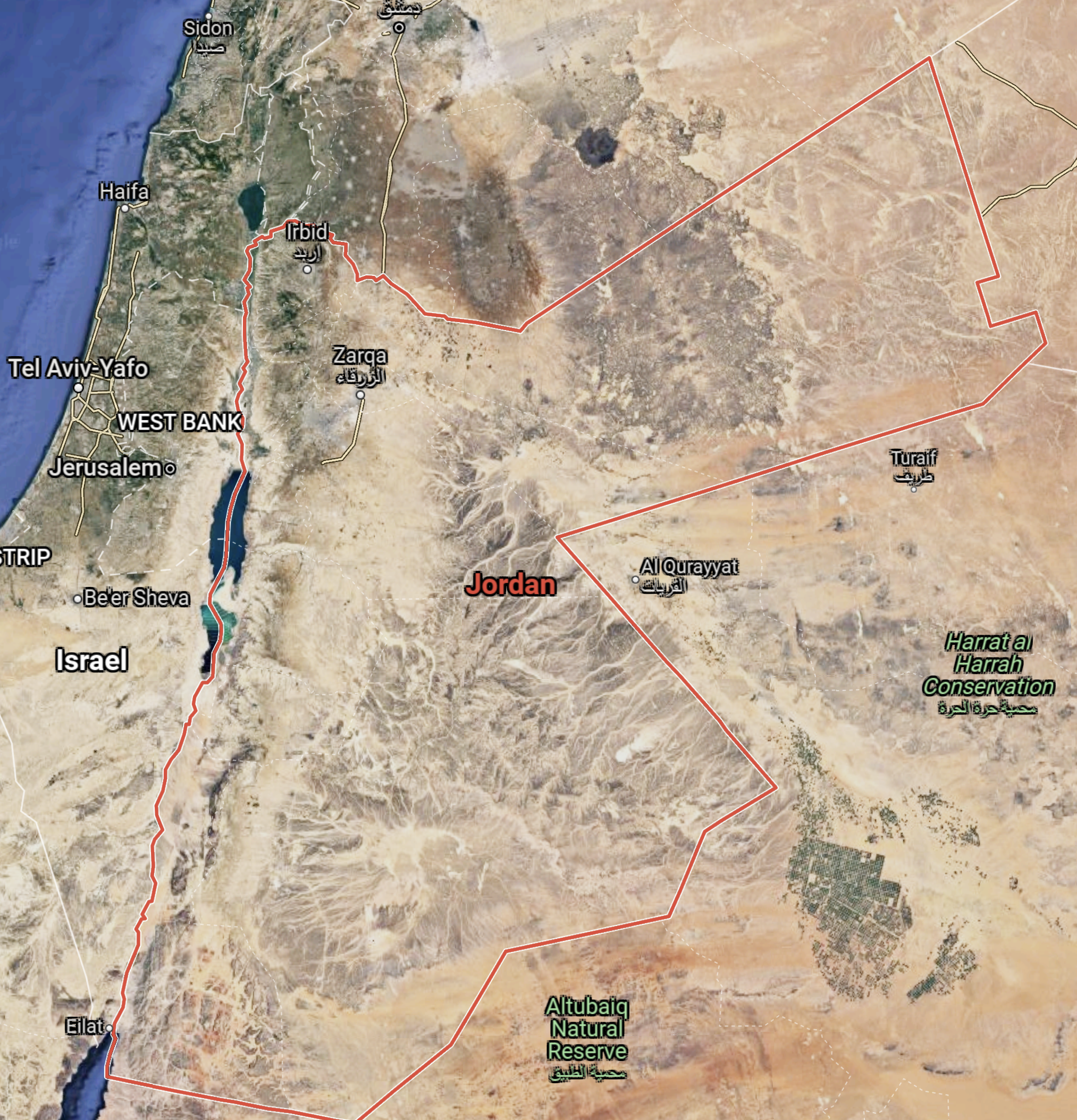
Surely, in the future, the EuroAsia interconnector could be carrying solar generated green electricity from Iraq, Jordan and Saudi Arabia to Cyprus and Greece.
As, according to Reuters, Greece covers about 40% of its annual energy needs with Russian gas, this can’t be good for Vlad the Mad and his bloodstained gas.
Will We See More Multi-Country Renewable Energy Deals?
In this blog, I have talked about various deals, where two or more countries and/or companies are getting together to generate electricity in one country and transfer it to another, either as electricity or as hydrogen
Examples include.
- The Asian Renewable Energy Hub, which I first wrote about in Vast Australian Renewable Energy Site Powers BP’s Ambitions.
- The Australia-Asia PowerLink, which I first wrote about in Sun Cable’s Australia-Asia PowerLink.
- Fortescue Future Industries will convert cattle stations in Western Australia into renewable power stations.
- The EuroAfrica Interconnector is a HVDC interconnector and submarine power cable between the Greek, Cypriot, and Egypt power grids, which I first wrote about in The EuroAfrica Interconnector.
- The EuroAsia Interconnector is a proposed HVDC interconnector between the Greek, Cypriot, and Israeli power grids via the world’s longest submarine power cable, which I first wrote about in The EuroAsia Interconnector.
- Icelink is a proposed electricity interconnector between Iceland and Great Britain, which I first wrote about in Is Iceland Part Of The Solution To The Problem Of Russia?
- The Morocco-UK Power Project, which I first wrote about in Moroccan Solar-Plus-Wind To Be Linked To GB In ‘Ground-Breaking’ Xlinks Project.
- Namibian Green Hydrogen, which I first wrote about in Namibia Is Building A Reputation For The Cheapest Green Hydrogen.
There are also all the hydrogen deals done by Fortescue Future Industries.
Where Are There Possibilities Of More Multi-Country Renewable Energy Deals?
These are a few serious possibilities.
Argentina
This is an extract from this page on Wind Energy International, which is entitled Argentina.
Argentina has an estimated technical wind energy potential of 300 GW. In southern Patagonia (Chubut and Santa Cruz provinces), average wind speeds range between 9.0 and 11.2 m/s, whereas in the north (Neuquén and Río Negro provinces), wind speeds range from 7.2 to 8.4 m/s. The general average capacity factor for Argentina is 35% and in the Patagonia region it ranges between as much as 47% and 59%. Especially in Northwest Patagonia, locally known as the Comahue region, hydro and wind may seasonally complement each other and.benefit both technologies. One other promising region for wind power development is the Atlantic sea coast.
As I wrote in Australia’s FFI Plans $8.4 Billion Green Hydrogen Project In Argentina, it appears that Andrew Forrest and FFI are already on the ground.
Australia
There are already three major schemes based on Australia and I am certain they will be more. Especially, as Japan, Korea, Malaysia and Singapore will need the zero-carbon energy.
It would appear that except for the Australia-Asia PowerLink, the energy will be transferred as liquid hydrogen or liquid ammonia.
Bangladesh
Bangladesh wouldn’t be on the lists of many, where ideal countries for renewable energy are being discussed.
But, this report on Energy Tracker Asia is entitled The Renewable Energy Potential of Bangladesh, where this is said.
A report investigating the renewable energy technical capacity of Bangladesh found that the country could deploy up to 156 GW of utility-scale solar on 6,250 km2 of land and 150 GW of wind. Offshore wind power would account for 134 GW of this total capacity.
I wouldn’t be surprised to see Bangladesh, supplying renewable energy to the East, with international companies and organisations developing the renewable infrastructure.
I think it should be noted that international companies flock to countries, where the investment opportunities are good. That has happened in the UK, with offshore wind, where many wind farms have been developed by companies such as Equinor, Iberola, RWE and Wattenfall.
Chile
Chile has started to develop the 100,000 square kilometres of the Atacama Desert for solar power and I wrote about this in The Power Of Solar With A Large Battery.
This sentence in the Wikipedia entry for Energy In Chile, illustrates the potential of solar power in the Atacama Desert.
In 2013, Total S.A. announced the world’s largest unsubsidised solar farm would be installed with assistance from SunPower Corp into Chile’s Atacama desert.
I also wrote Chile Wants To Export Solar Energy To Asia Via 15,000km Submarine Cable, about Chile’s ambitions to supply Asia with energy.
Ethiopia
Andrew Forrest of Fortescue Future Industries is on the case, as I wrote in Fortescue Future Industries Enters Ethiopia to Produce Green Energy.
North Africa
Consider.
- The major North African countries of Morocco, Algeria, Tunisia, Libya and Egypt, all have and depend on to a certain extent on fossil fuels.
- There are gas pipelines to Spain and Italy.
- Morocco will be the Southern end of the Morocco-UK Power Project, if it gets developed.
- All five countries have some nuclear power stations.
- All five countries have lots of sun for solar power.
- Some Saharan countries to the South of Morocco, Algeria and Libya could also provide energy from the sun.
- Egypt has substantial hydro-electric power on the River Nile.
- Egypt will be connected to Greece through the EuroAfrica Interconnector.
I believe that a well-designed and co-ordinated project could generate a lot of electricity and hydrogen for Europe and bring much-needed income and employment to North Africa.
I feel that if the Morocco-UK Power Project can be successfully built, then this could create a flurry of activity all over North Africa.
Saudi Arabia
Saudi Arabia has a problem. As the rest of the world moves away from fossil fuels in the next few decades, they will see the revenues from oil and natural gas come under pressure.
But as a rich country, with 2.15 million km² of land and lots of sun, they must have some potential to generate solar electricity.
In the Wikipedia entry for Solar Power In Saudi Arabia, this is said.
The Saudi agency in charge of developing the nations renewable energy sector, Ka-care, announced in May 2012 that the nation would install 41 gigawatts (GW) of solar capacity by 2032.[2] It was projected to be composed of 25 GW of solar thermal, and 16 GW of photovoltaics. At the time of this announcement, Saudi Arabia had only 0.003 gigawatts of installed solar energy capacity. A total of 24 GW of renewable energy was expected by 2020, and 54 GW by 2032.
Wikipedia also says that Saudi Arabia also has nuclear ambitions.
I can see that Saudi Arabia will replace some of their oil and gas exports with green hydrogen.
Andrew Forrest’s Fortescue Future Industries Inks Deal With Kingdom of Jordan For Green Hydrogen Study
The title of this post, is the same as that of this article on The West Australian.
I can’t read the contents without subscribing, but I assume the title says it all.
However, I have a few thoughts.
This Google Map shows the Kingdom of Jordan.
Jordan is outlined in red.
The map suggests how hydrogen could be produced.
- I would assume that there is plenty of sun in Jordan and there appears to be plenty of space for solar panels.
- What is the potential for wind energy in the desert?
- It would appear to me, that there are two routes to export the hydrogen. By pipeline across Israel to the Mediterranean Sea or by tanker from a port on the Red Sea, which just creeps onto the map in the South-West corner.
- Perhaps, a giant electrolyser and export terminal could be built near Aqaba, which is Jordan’s only seaport.
What I like about this plan, is that to the North-East and South-East of Jordan, lie the deserts of Iraq and Saudi Arabia. Could these in future be carpeted with solar panels, where the electricity is fed to Aqaba to create more green hydrogen?
Andrew Forrest is a busy man and seems to be organising a one man project to provide the world with green hydrogen.
- I wrote about his deal with Argentina in Australia’s FFI Plans $8.4 Billion Green Hydrogen Project In Argentina.
- I wrote about his deal with JCB in JCB Signs Green Hydrogen Deal Worth Billions.
He is the second richest Australian according to Wikipedia.
I wouldn’t be surprised to see some more hydrogen deals at COP26, where Andrew Forrest is involved.
Hyundai And Ineos To Co-operate On Driving Hydrogen Economy Forward
The title of this post, us the same as that of this article on Yahoo News.
This is the introductory paragraph.
Chemicals giant Ineos has announced a new agreement with Korean car firm Hyundai aimed at developing the production of hydrogen.
I find this an interesting tie-up between two large companies.
I first came across Hyundai, when they were working on large projects in Saudi Arabia in the early 1980s, where Artemis was being used for the project management.
From what it says in the article, the two companies are a good fit for the hydrogen market.
- Hyundai has the hydrogen fuel cell technology, that INEOS needs for its Land-Rover Defender-type vehicle.
- INEOS has the hydrogen production technology.
- INEOS produces 300,000 tonnes of hydrogen per year.
This deal could be a a small deal over technology or a large deal that could transform the manufacture and fuelling of hydrogen-powered transportation from small cars to large ships with trains, buses and trucks in between.
 The Anonymous Widower