Metocean Measurement Campaign To Start At 1 GW Scottish Floating Wind Farm Site
The title of this post, is the same as that of this article on offshoreWIND.biz.
This is the introductory paragraph.
Partrac will soon deploy a floating LiDAR Buoy at the site of the Buchan floating wind project offshore Scotland, which is being developed by Floating Energy Allyance (FEA), a consortium comprising BW Ideol, Elicio, and BayWa r.e.
It appears, that the Buchan floating wind farm is the first of the floating Scotwind Leasing round of projects to get going in a meaningful way.
The article details some of the design details of the wind farm.
- The site is located some 75 kilometres to the northeast of Fraserburgh on the Aberdeenshire coast,
- The Floating Energy Allyance consortium plans to build a floating offshore wind farm with a capacity of approximately 1 GW, whose wind turbines will be installed on BW Ideol’s Damping Pool floating foundations.
- This page on the BW Ideol web site describes their Damping Pool technology.
- The patented square barge-like floats can be used for offshore wind turbines, substations and hydrogen electrolysers.
BW Ideol appear to be a French company with projects in France, Japan, Taiwan and now Scotland.
The home page of the BW Ideol web site opens with a promotional and explanatory video of their technology.
Accelerating The Delivery Of Offshore Wind Farms
It is one of Kwasi Kwarteng’s ambitions to accelerate the delivery of offshore wind farms.
In The Growth Plan 2022, these groups of wind farms are mentioned.
- Remaining Round 3 Projects
- Round 4 Projects
- Extension Projects
- Scotwind Projects
- INTOG Projects
- Floating Wind Commercialisation Projects
- Celtic Sea Projects
My thinking in this post, will probably apply to all of these groups.
These are my thoughts.
Accelerating Delivery Of A Wind Farm
This will have these positive effects.
- Electricity will be delivered earlier.
- Customers will have a more secure supply of electricity.
- The wind farm owner will start to be paid for their electricity.
- The Crown Estate will start to be paid for their leases. Although, these might start at signing.
- National Grid will be paid for the transmission of the electricity.
- An energy storage company could be paid for storing surplus electricity.
- Construction teams and engineers can move on to the next project.
- Expensive construction hardware like ship-mounted cranes will no longer be needed.
- I also suspect that the government will raise some taxes from the various companies involved.
It looks like it’ll be winners all round.
How Will Delivery Be Accelerated?
These are some thoughts.
Overall Project Time
In How Long Does It Take To Build An Offshore Wind Farm?, I came to these conclusions.
- It will take six years or less from planning consent to commissioning.
- It will take two years or less from the start of construction to commissioning.
I suspect that as we have been building offshore wind farms for some years, that it will be very difficult to reduce these times significantly.
But as some wind farms take quite a few years to progress from the initial proposal to planning consent, I suspect that improvements to the planning process may speed up the overall construction time of a wind farm.
Project And Resource Management
Good project and resource management will always help.
Better Design And Construction Methods
I always remember in the early days of North Sea Oil, being told by a very experienced project manager that construction of production platforms was accelerated by the availability of larger and more powerful cranes.
Are we approaching the design of the ultimate wind farm? I doubt it, as in the last few months, I’ve seen two very radical new designs.
In Hexicon Wins UK’s First Ever CfD Auction For Floating Offshore Wind, I show this image of one of their TwinHub turbine installations being towed into place.
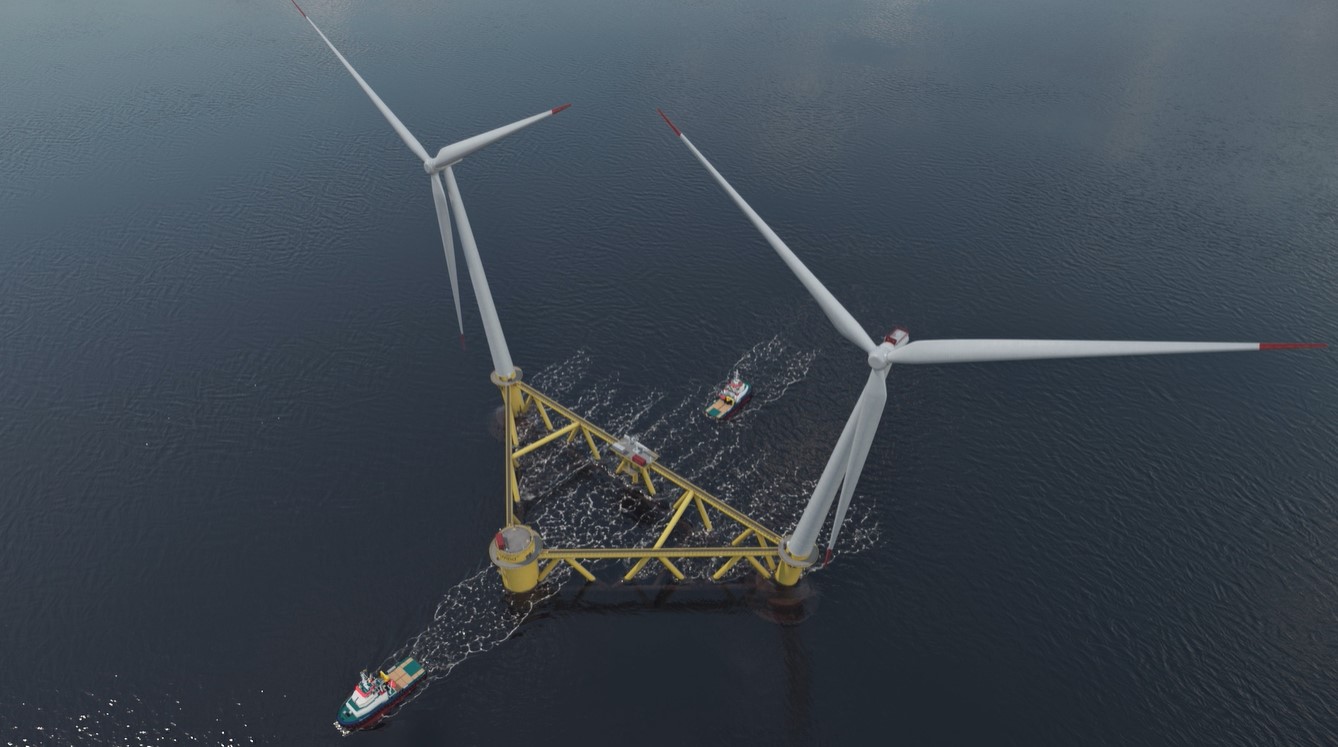
The TwinHub home page has a title of The First Floating Offshore Wind Project in The Celtic Sea.
This is the description on the page.
The TwinHub offshore wind demonstration project intends to prove how Hexicon’s innovative design with two turbines on one floating foundation can further reduce the Levelized Cost of Energy (also referred to as LCoE) before large scale commercialisation. The TwinHub project is a stepping stone to help kick-start floating wind in the Celtic Sea, an area identified as a hotspot for floating wind by the UK Government. It will pave the path for larger and larger projects to help support The Crown Estates’ ambitious target of 4GW of floating wind in the Celtic Sea.
Scroll the page down and there is a fascinating short video of a pair of wind turbines in operation.
- It appears that when there is no wind, it automatically goes into a safe parked mode.
- As the wind rises, one turbine starts up.
- The second turbine starts up and the float turns so they face the wind.
It appears to be a classic example of disruptive innovation.
I have a feeling that this type of installation might have generation, assembly and cost advantages over a single turbine mounted on a single float.
RCAM Technologies are also creating interesting designs for mounting turbines and energy storage using 3D-printed concrete.
What Ts The UK Government Doing To Accelerate Projects?
This article on offshoreWIND.biz, was published in late September 2022 and is entitled BREAKING: UK Puts Massive Amount Of New Offshore Wind Capacity On Fast Track and this is the first paragraph.
The UK will speed up planning and development consent processes for projects from the recently completed, currently ongoing, and upcoming (floating) offshore wind leasing rounds to bring new energy capacity online faster and facilitate economic growth and job creation.
The article is based on what Kwasi Kwateng said on the 23rd of September about speeding up projects in the 2022 Growth Plan.
A Quick Summary Of Our Wind Energy
The article has this paragraph, which summarises our wind energy.
For the UK, which currently has around 14 GW of offshore wind capacity in operation and 8 GW under construction, the projects from the listed auction rounds could bring well beyond the targeted capacity for 2030, which was recently raised to 50 GW.
I can see the target being raised again to at least 60 GW.
An Update To Will We Run Out Of Power This Winter?
My Methods
Project Timescales For Wind Farms
In How Long Does It Take To Build An Offshore Wind Farm?, I came to these conclusions.
- It will take six years or less from planning consent to commissioning.
- It will take two years or less from the start of construction to commissioning.
I shall use these timescales, as any accelerations by the government, will only reduce them.
Dates
If a date is something like 2024/25, I will use the latest date. i.e. 2025 in this example.
The Update
In Will We Run Out Of Power This Winter?, which I wrote in July this year, I did a calculation of how much renewable energy would come on stream in the next few years.
I summarised the amount of new renewable energy coming on stream like this.
- 2022 – 3200 MW
- 2023 – 1500 MW
- 3024 – 2400 MW
- 2025 – 6576 MW
- 2026 – 1705 MW
- 2027 – 7061 GW
This totals to 22442 MW.
But I had made two omissions.
- Hornsea 3 wind farm will add 2582 MW in 2026/27.
- Hinckley Point C nuclear power station will add 3260 MW in 2027.
Ørsted have also brought forward the completion date of the Sofia wind farm to 2023, which moves 1400 GW from 2024 to 2023.
The new renewables summary figures have now changed to.
- 2022 – 3200 MW
- 2023 – 2925 MW
- 3024 – 1326 MW
- 2025 – 6576 MW
- 2026 – 1705 MW
- 2027 – 13173 MW
This totals to 28554 MW.
Note.
- The early delivery of the Sofia wind farm has increased the amount of wind farms coming onstream next year, which will help the Winter of 2023/2024.
- It will also help the Liz Truss/Kwasi Kwarteng government at the next election, that should take place in early 2025.
- Hornsea 3 and Hinckley Point C make 2027 a big year for new renewable energy commissioning.
By 2027, we have more than doubled our renewable energy generation.
The Growth Plan 2022
In this document from the Treasury, the following groups of wind farms are listed for acceleration.
- Remaining Round 3 Projects
- Round 4 Projects
- Extension Projects
- Scotwind Projects
- INTOG Projects
- Floating Wind Commercialisation Projects
- Celtic Sea Projects
I will look at each in turn.
Remaining Round 3 Projects
In this group are the the 1200 MW Dogger Bank B and Dogger Bank C wind farms, which are due for commissioning in 2024/25.
Suppose that as with the Sofia wind farm in the same area, they were to be able to be brought forward by a year.
The new renewables summary figures would change to.
- 2022 – 3200 MW
- 2023 – 2925 MW
- 3024 – 3726 MW
- 2025 – 5076 MW
- 2026 – 1705 MW
- 2027 – 13173 MW
This totals to 28554 MW.
It looks like if Dogger Bank B and Dogger Bank C can be accelerated by a year, it has four effects.
- The renewables come onstream at a more constant rate.
- SSE and Equinor, who are developing the Dogger Bank wind farms start to get paid earlier.
- The UK gets more electricity earlier, which helps bridge the gap until Hornsea 3 and Hinckley Point C come onstream in 2027.
- The UK Government gets taxes and lease fees from the Dogger Bank wind farms at an earlier date.
Accelerating the remaining Round 3 projects would appear to be a good idea.
Round 4 Projects
According to Wikipedia’s list of proposed wind farms, there are six Round 4 wind farms, which total up to 7026 MW.
Accelerating these projects, is probably a matter of improved government regulations and pressure, and good project management.
But all time savings in delivering the wind farms benefits everybody all round.
This document from the Department of Business, Industry and Industrial Strategy lists all the Contracts for Difference Allocation Round 4 results for the supply of zero-carbon electricity.
Many of these projects are smaller projects and I suspect quite a few are shovel ready.
But as with the big wind farms, there are some projects that can be brought forward to everybody’s benefit.
Norfolk Boreas
Norfolk Boreas wind farm is one of the Round 4 projects.
The wind farm is shown as 1400 MW on Wikipedia.
On the web site, it now says construction will start in 2023, which could mean a completion by 2025, as these projects seem to take about two years from first construction to commissioning, as I showed in How Long Does It Take To Build An Offshore Wind Farm?.
The new renewables summary figures would change to.
- 2022 – 3200 MW
- 2023 – 2925 MW
- 3024 – 3726 MW
- 2025 – 6476 MW
- 2026 – 1705 MW
- 2027 – 11773 MW
This still totals to 28554 MW.
This acceleration of a large field would be beneficial, as the 2025 figure has increased substantially.
I would suspect that Vattenfall are looking hard to accelerate their Norfolk projects.
Extension Projects
I first talked about extension projects in Offshore Wind Extension Projects 2017.
The target was to add 2.85 GW of offshore wind and in the end seven projects were authorised.
- Sheringham Shoal offshore wind farm – 719 MW with Dudgeon
- Dudgeon offshore wind farm – 719 MW with Sheringham Shoal
- Greater Gabbard offshore wind farm
- Galloper offshore wind farm
- Rampion offshore wind farm – 1200 MW
- Gwynt y Môr offshore wind farm – 1100 MW
- Thanet offshore wind farm – 340 MW
These are the best figures I have and they add up to an interim total of 3359 MW.
I suspect that these projects could be easy to accelerate, as the developers have probably been designing these extensions since 2017.
I think it is reasonable to assume that these seven wind farms will add at least 3000 MW, that can be commissioned by 2027.
The new renewables summary figures would change to.
- 2022 – 3200 MW
- 2023 – 2925 MW
- 3024 – 3726 MW
- 2025 – 6476 MW
- 2026 – 1705 MW
- 2027 – 14773 MW
This now totals to 31554 MW.
Accelerating the extension projects would be a good idea, especially, as they were awarded some years ago, so are probably well into the design phase.
ScotWind Projects
I first talked about ScotWind in ScotWind Offshore Wind Leasing Delivers Major Boost To Scotland’s Net Zero Aspirations.
It was planned to do the following.
- Generate 9.7 GW from six wind farms with fixed foundations.
- Generate 14.6 GW from ten floating wind farms.
But since then three more floating wind farms with a total capacity of 2800 MW have been added, as I wrote about in Three Shetland ScotWind Projects Announced.
I suspect that some of these projects are ripe for acceleration and some may well be generating useful electricity by 2030 or even earlier.
INTOG Projects
I wrote about INTOG in What Is INTOG?.
I can see the INTOG Projects contributing significantly to our fleet of offshore wind turbines.
I have already found a 6 GW/£30 billion project to decarbonise oil and gas rigs around our shores, which is proposed by Cerulean Winds and described on this web page.
If the other large INTOG projects are as good as this one, then we’ll be seeing some sensational engineering.
Floating Wind Commercialisation Projects
This page on the Carbon Trust website is entitled Floating Wind Joint Industry Programme (JIP).
They appear to be very much involved in projects like these.
The page has this description.
The Floating Wind Joint Industry Programme is a world leading collaborative research and development (R&D) initiative dedicated to overcoming technological challenges and advancing commercialisation of floating offshore wind.
This graphic shows the partners and advisors.
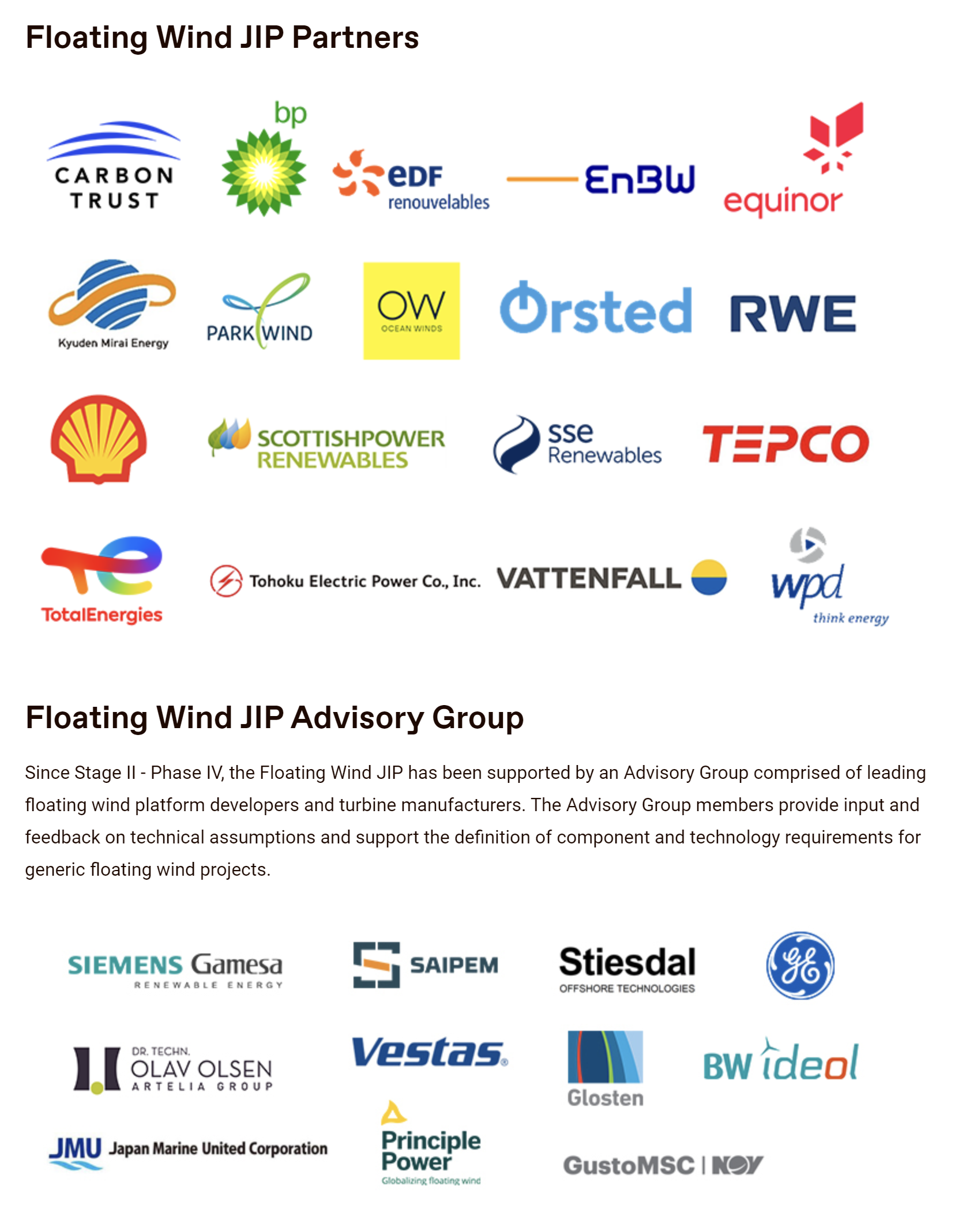
Most of the big wind farm builders and turbine and electrical gubbins manufacturers are represented.
Celtic Sea Projects
The Celtic Sea lies between South-East Ireland, Pembrokeshire and the Devon and Cornwall peninsular.
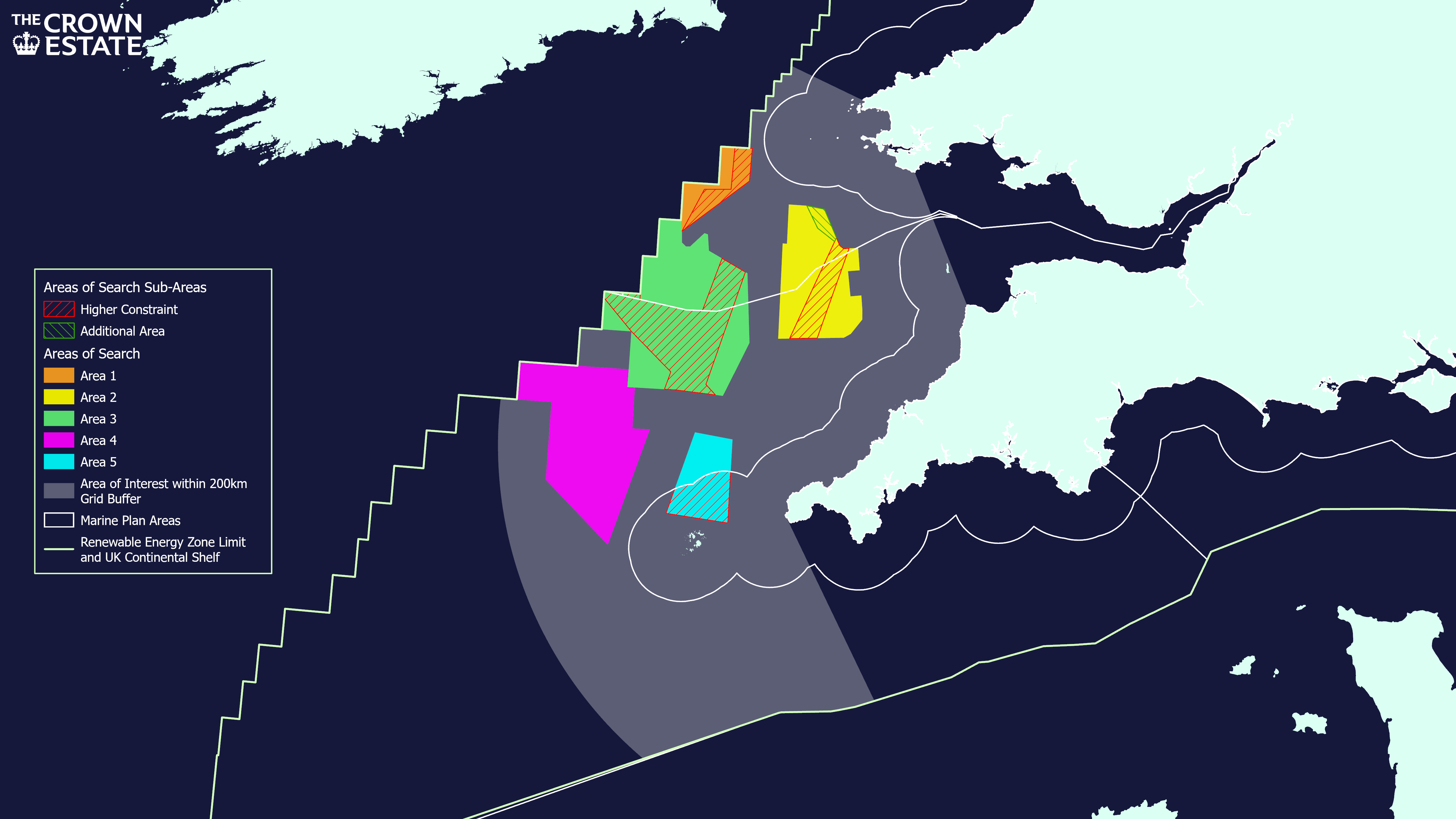
The Crown Estate kicked this off with press release in July 2022, that I wrote about in The Crown Estate Announces Areas Of Search To Support Growth Of Floating Wind In The Celtic Sea.
This map shows the five areas of search.
One Celtic Sea project has already been awarded a Contract for Difference in the Round 4 allocation, which I wrote about in Hexicon Wins UK’s First Ever CfD Auction For Floating Offshore Wind.
Other wind farms have already been proposed for the Celtic Sea.
In DP Energy And Offshore Wind Farms In Ireland, I said this.
They are also developing the Gwynt Glas offshore wind farm in the UK sector of the Celtic Sea.
- In January 2022, EDF Renewables and DP Energy announced a Joint Venture partnership to combine their knowledge and
expertise, in order to participate in the leasing round to secure seabed rights to develop up to 1GW of FLOW in the Celtic Sea. - The wind farm is located between Pembroke and Cornwall.
The addition of Gwynt Glas will increase the total of floating offshore wind in the UK section of the Celtic Sea.
- Blue Gem Wind – Erebus – 100 MW Demonstration project – 27 miles offshore
- Blue Gem Wind – Valorus – 300 MW Early-Commercial project – 31 miles offshore
- Falck Renewables and BlueFloat Energy – Petroc – 300 MW project – 37 miles offshore
- Falck Renewables and BlueFloat Energy – Llywelyn – 300 MW project – 40 miles offshore
- Llŷr Wind – 100 MW Project – 25 miles offshore
- Llŷr Wind – 100 MW Project – 25 miles offshore
- Gwynt Glas – 1000 MW Project – 50 miles offshore
This makes a total of 2.2 GW, with investors from several countries.
It does seem that the Celtic Sea is becoming the next area of offshore wind around the British Isles to be developed.
How do these wind farms fit in with the Crown Estate’s plans for the Celtic Sea?
I certainly, don’t think that the Crown Estate will be short of worthwhile proposals.
Conclusion
More and more wind farms keep rolling in.
How Long Does It Take To Build An Offshore Wind Farm?
These are some timescales and costs for the construction of some wind farms.
East Anglia One
East Anglia One is a 714 MW offshore wind farm, which consists of 102 turbines on fixed foundations, in a maximum water depth of 53 metres.
- Planning consent – June 2014.
- Contracts – April 2016
- Offshore construction – June 2018
- Commissioned – July 2020
It is expected to cost £2.5 billion.
Hornsea One
Hornsea One is a 1200 MW offshore wind farm, which consists of 174 turbines on fixed foundations, in a maximum water depth of 30 metres.
- Planning consent – April 2014.
- Contracts – March/April 2016
- Offshore construction – January 2018
- Commissioned – March 2020
It is expected to cost £4.2 billion.
Hornsea Two
Hornsea Two is a 1400 MW offshore wind farm, which consists of 165 turbines on fixed foundations, in a maximum water depth of 30 metres.
- Planning consent – August 2016.
- Offshore construction – 2020
- Commissioned – August 2022
I can’t find any costs.
Moray East
Moray East is a 950 MW offshore wind farm, which consists of 100 turbines on fixed foundations, in a maximum water depth of 50 metres.
- Planning consent – 2014.
- Financial Close – December 2018
- Offshore construction – July 2020
- Commissioned – July 2022
It is expected to cost £2.6 billion.
Keadby Wind Farm
Keadby Wind Farm is a 68 MW onshore wind farm, which consists of 34 turbines.
SSE says this about its construction timescale.
After receiving planning permission in 2008, construction began in 2012 and the first turbine foundation was complete in February 2013. The final turbine was assembled on 11 December 2013 and the project was completed in summer 2014.
I can’t find any costs.
Can I Deduce Anything?
Two things are similar on the four fixed-foundation offshore wind farms.
Planning Consent To Commissioning Seems To Take About Six To Eight Years
Moray East took eight years and the other three took six.
In addition Keadby onshore wind farm took six years.
This indicates to me, that any improvements to the planning process for wind farms could shorten the planning process for many wind farms and allow offshore construction of these wind farms to start earlier.
The Start Of Offshore Construction To commissioning Seems To Take About Two Years
It surprised me that it takes twice as long to go from planning to the start of offshore construction, than to actually build and commission the offshore components of the project.
In addition Keadby onshore wind farm took two years.
How will these two observations affect floating wind farms, which could be more numerous in the future?
The home page of the Principle Power web site, shows a floating wind turbine being constructed and floated out.
- The turbine and its float are assembled in a deep water dock, using a large crane mounted on the dock.
- This dockside assembly must be less dependent on good weather, than doing assembly onto a fixed foundation forty miles or more out to sea.
I wouldn’t be surprised to find that floating wind farms may have substantial health and safety, and construction advantages, but I doubt they’d save much time on the current two years of offshore construction.
But I suspect, they would be one of these types of project that would only rarely be late.
Assembly And Project Management Issues
As with many types of construction, I suspect good project management will be key to building both fixed-foundation and floating offshore wind farms.
For fixed-foundation wind farms, a steady stream of turbines, foundations, substations and connecting cables would need to be delivered to a tight schedule to the assembly point offshore, where turbines, foundations, substations and connecting cables would be lifted into place by a crane mounted on a barge or ship.
For floating wind farms, a steady stream of turbines, floats and probably some connecting cables would need to be delivered to a tight schedule to the assembly dock in a convenient port, where turbines would be lifted onto floats by a crane mounted on the dock. Once complete, the floating wind turbines would be towed into position, anchored and connected to the offshore sub-station.
- No large offshore crane would be needed.
- The dockside crane could be sized for the largest turbines.
- Floating turbines would be brought back to the dockside for major serving and updating.
- One assembly dock could serve several wind farms during construction and operation.
Given that in the latest ScotWind leasing round, there was 17.4 GW of floating wind farms and 9.7 GW of fixed-foundation wind farms, which is 64/36 % split, I can see that the proportion of floating wind farms will increase.
Good project management, with particular attention to the rate of the production of critical components will be needed for both fixed-foundation and floating offshore wind farms.
Perhaps it would help, if we reduced the numbers of types of each components?
Would it be too far to imagine a British Standard float, that could handle any manufacturer’s turbine with a standard connecting cable? This is Plug-and-Play at the very heavy end.
Conclusion
Consider.
- As the floating wind technology matures, I can see the designs getting more affordable and the proportion of floating wind farms increasing dramatically.
- I also believe that in the future, it will take a shorter time to install, connect up and commission a wind farm.
This leads me to think, that in future, it is reasonable to make the following assumptions.
- It will take six years or less from planning consent to commissioning.
- It will take two years or less from the start of construction to commissioning.
Note.
- I’m assuming that better project management and improved government legislation, will tend to level down the times.
- Floating or fixed foundations doesn’t seem to make much difference.
The UK will become Europe’s zero-carbon power station.
Thoughts On The Mini-Budget
This article on the BBC is entitled At A Glance: What’s In The Mini-Budget?.
If nothing else KK has whipped up a storm, with the most tax-cutting budget in decades.
But!
According to my calculations in Will We Run Out Of Power This Winter?, the planned offshore wind that will be installed between 2022 and 2027 will be at least 19 GW. About 3 GW of this offshore wind is already producing electricity.
To this must be added 3.26 GW for Hinckley Point C, 2 GW for solar and 0.9 GW for onshore wind in Scotland, which will be developed by 2027.
So we have 25.2 GW for starters.
Following on from this is the 27.1 GW from ScotWind, about 4 GW from the Celtic Sea, 3 GW from Morecambe Bay and 10 GW from Aker’s Northern Horizons. All of these are firm projects and some are already being planned in detail.
These wind and solar farms are the collateral for KK’s borrowing.
The corporate tax changes will hopefully attract world class energy and manufacturing companies to set up UK-domiciled subsidiaries to develop more offshore wind farms and manufacture the turbines and the electrical gubbins close to where they will be installed.
As more wind farms are built, many GW of electricity and tonnes of hydrogen will be exported to Europe.
Note that 1 GW for a day costs around £ 960,000 and for a year costs £350.4 million.
A big benefit of all this electricity, will be that we won’t need to frack.
Technologies like green hydrogen, that will be created by electrolysis will reduce our need for gas.
We might develop a gas field like Jackdaw, to give us gas for a backup with a few gas-fired power stations, for when the wind doesn’t blow, but gas will only have a minor roll.
The force of the maths is with KK!
UK Cleantech Consortium Awarded Funding For Energy Storage Technology Integrated With Floating Wind
The title of this post, is the same as that of this page on the UK Government’s Catapult Offshore Renewable Energy Web Site.
This is the introductory paragraph.
STORE, a UK-based cleantech consortium led by RCAM Technologies Limited, has been awarded £150,000 of funding to develop an advanced subsea energy storage technology manufactured using 3D printed concrete that could help offshore wind farms produce a steady and predictable energy output to the electricity grid.
This paragraph talks of the concept of Marine Pumped Hydro.
STORE is assessing the feasibility of integrating Marine Pumped Hydro (MPH) technology, which stores energy using hollow concrete spheres fitted with a hydraulic turbine and pump, with floating offshore wind plants in UK waters. In addition, the project advances the design of MPH systems and plans a prototype demonstration in the UK.
Note.
- The hollow concrete spheres are 3D-printed in concrete using the technology of RCAM Technologies.
- Spheres are structurally very strong.
- 3D printing of concrete is now mainstream technology and has been extensively used on the Elizabeth Line as I wrote about in The Story Behind The Concrete Panels On The Elizabeth Line.
- There is a visualisation on the Catapult web page, which shows several floating turbines, a floating sub station and several concrete hemispheres sitting on the seabed.
- The energy storage medium is sea water and air, which must be environmentally-friendly.
The technology is described in detail on this page of the STORE consortium web site.
- The spheres are fifteen metres across.
- The spheres can be installed at depths between 150 and 2000 metres.
- The system has a round-trip efficiency is up to 70%, which is similar to pumped storage hydro.
- The design life is 50 to 80 years.
I think that this system has possibilities.
This last paragraph in the Catapult web page gives a look into the future.
As well as improving the reliability and predictability of energy to the electricity grid, the project will support the cross sector transfer of UK offshore expertise and port infrastructure for use in renewable energy and create high-value UK jobs in engineering, construction, and operations and maintenance. This energy storage solution is ideally suited to coupling with floating wind plants and for powering offshore oil and gas assets from renewable energy. The 3D printed concrete also facilitates localized manufacturing and enables low cost fabrication of new and complex shapes that were previously not practical.
I also feel that if the concrete sphere energy storage can be made to successfully work, then the technology can surely be fitted to any offshore wind farm, by just adding the right number of spheres and connecting them to the offshore sub station.
The STORE Consortium
The STORE consortium has a web site, which has a heading of Innovative Subsea Energy Storage.
It describes the technology in this paragraph.
STORE is advancing a subsea energy storage technology called Marine Pumped Hydro (MPH). MPH uses large hollow concrete spheres on the seafloor to store mechanical energy in the form of pressure. MPH charges when seawater is pumped out of the spheres and releases energy to the grid when high-pressure water flows back into the spheres through a turbine. MPH features a patent-pending multi-sphere pod to increase the amount of energy stored and uses efficient 3D concrete printing to reduce manufacturing costs.
It sounds like an engineer with children, has been playing with them and their plastic toys in a bath and has had an Archimedes moment.
The project and its funding is described in this paragraph.
STORE was awarded £150,000 from the Department for Business, Energy & Industrial Strategy Longer Duration Energy Storage Demonstration (LODES) competition. Phase 1 will deliver a Feasibility Study focused on the design and analyses for the UK. Phase 2, if awarded, will design, manufacture, and operate a prototype system at TRL 6.
Note that TRL 6 is Technology Readiness Level 6 and is fully defined on this NASA web page, as having a fully functional prototype or representational model.
There is also an interesting link to the ScotWind N3 wind farm. that I wrote about in ScotWind N3 Offshore Wind Farm.
- This is an unusual floating wind farm with a floating substation.
- Technip and Loch Kishorn port are involved in both the wind farm and STORE.
- Loch Kishorn has a history of building immense concrete structures.
I wouldn’t be surprised if this wind farm would be the location of the prototype system.
Conclusion
This is a brilliant concept.
- It is the ideal energy storage system for offshore wind, as it can turn a wind farm with a variable output into one with a much more constant output.
- It can be retrofitted to existing offshore wind farms.
- It will work with both fixed and floating wind farms.
- The concrete storage spheres can be fully assembled with all their electrical gubbins on shore and towed out, before sinking in the required position.
It also looks like the Department for Business, Energy & Industrial Strategy have got involved and helped with the funding. Someone there seems to know a good idea, when they see it!
Biden-Harris Administration Announces New Actions To Expand U.S. Offshore Wind Energy
The title of this post is the same as that of this fact sheet from the White House briefing room.
This is the sub-title.
Departments of Energy, Interior, Commerce, and Transportation Launch Initiatives on Floating Offshore Wind to Deploy 15 GW, Power 5 Million Homes, and Lower Costs 70% by 2035.
Some points from the fact sheet.
- The President set a bold goal of deploying 30 gigawatts (GW) of offshore wind by 2030, enough to power 10 million homes with clean energy, support 77,000 jobs, and spur private investment up and down the supply chain.
- Conventional offshore wind turbines can be secured directly to the sea floor in shallow waters near the East Coast and the Gulf of Mexico.
- However, deep-water areas that require floating platforms are home to two-thirds of America’s offshore wind energy potential, including along the West Coast and in the Gulf of Maine.
- Globally, only 0.1 GW of floating offshore wind has been deployed to date, compared with over 50 GW of fixed-bottom offshore wind.
- The Floating Offshore Wind Shot will aim to reduce the costs of floating technologies by more than 70% by 2035, to $45 per megawatt-hour.
- The Administration will advance lease areas in deep waters in order to deploy 15 GW of floating offshore wind capacity by 2035.
This all seems to be ambitious!
But!
- In ScotWind Offshore Wind Leasing Delivers Major Boost To Scotland’s Net Zero Aspirations, I looked at Scotland’s latest round of offshore wind leases.
- If the lessors carry out their proposals Scotland will add 9.7 GW of fixed-foundation offshore wind farms and 14.6 GW of floating offshore wind farms, which I estimate will be built by 2035.
- In Three Shetland ScotWind Projects Announced, I looked at three floating wind farms to the East of Shetland, which are a secondary deal after ScotWind, which could generate 2.8 GW by 2035.
- In Is This The World’s Most Ambitious Green Energy Solution?, I describe an ambitious plan called Northern Horizons, proposed by Norwegian company; Aker to build a 10 GW floating wind farm, which will be 120 km to the North-East of the Shetlands.
It could be possible that little Scotland installs more floating wind farms before 2035, than the United States.
And what about England, Wales and Northern Ireland?
- England hasn’t announced any floating wind farm projects, but has around 17 GW of fixed-foundation offshore wind farms under development in the shallower waters along the East and South coasts.
- In Two Celtic Sea Floating Wind Projects Could Be Delivered By 2028, I looked at prospects for the Celtic Sea between Wales, Ireland and Devon/Cornwall. It is possible that a GW of floating wind could be developed by 2028, out of an ultimate potential of around 50 GW.
- Northern Ireland is a few years behind England and Scotland and might eventually make a substantial contribution.
But Biden’s aims of a strong supply chain could be helped by Scotland, as several of the floating wind farms in Scotland are proposing to use WindFloat technology from Principle Power, who are a US company. The Principle Power website has an explanatory video on the home page.
Stromar, Broadshore And Bellrock
The ScotWind wind farms, that I described in ScotWind Offshore Wind Leasing Delivers Major Boost To Scotland’s Net Zero Aspirations, are starting to be more than numbers in documents.
This map shows the various ScotWind leases.

Note, that the numbers are Scotwind’s lease number in their documents.
- 3 is now Bellrock and 1,200 MW
- 8 is now Broadshore and 900 MW
- 10 is now Stromar and 1,000 MW
Falck Renewables, who have now been renamed Renantis, and BlueFloat Energy are involved in all three projects, with Ørsted also involved in Stromar.
This article on Renewable Energy Magazine is entitled Companies Partner on Floating Offshore Wind In Scotland, where this is said.
Together the three areas could accommodate a total of approximately 3.0 GW of offshore wind capacity, with the projects scheduled to be operational by the end of the decade, subject to securing consent, commercial arrangements and grid connections.
Dates for ScotWind seem to be emerging and 2030 seems to cover several.
The Future Is Blowing In The Wind
In Can We Move The Equilibrium Point Of The Energy Market?, I have been adding up all of the renewable energy to be commissioned in the next few years.
I am only looking at schemes that are being built or are consulting the public, have contracts and are by reputable and reliable developers, like BP, Equinor, Orsted, Scottish Power, Shell, SSE and Wattenfall
The numbers are not small.
This year 3.2 GW, should be commissioned, with another 2.3 GW in 2023. But the total between now and 2028 is at least 30 GW plus Hinckley Point C. In fact it could be higher, as I have ignored nearly all of the 25 plus GW of the Scotwind projects in the seas around Scotland.
As the UK needs about 23 GW to wash its face and we already have 25.5 GW of renewables installed, by the mid point of the decade, we should be able to reorganise our energy, by cutting gas usage for power generation and exporting surpluses to Europe.
The future is blowing the wind!
Can We Move The Equilibrium Point Of The Energy Market?
Equilibrium In Systems
As a Control Engineer, I believe that most systems eventually end up in a state of equilibrium.
How many football batches have you watched between two evenly-matched teams that have ended, where the statistics are even and the match has ended in a nil-nil draw or a win by one goal.
Now suppose one manager makes an inspired substitution, one important player gets injured or one player gets sent off.
One team will have an advantage, the statistics will no longer be even and one team will probably win.
The equilibrium point will have been shifted.
Zopa’s Stable Peer-to-Peer Lending System
I used Zopa’s peer-to-peer lending system for several years and found it a very stable system, that over the years paid a steady return of between four and five percent before tax.
I even developed a method to maximise my savings income, which I wrote about in The Concept Of Hybrid Banking.
It was a sad day for me, when Zopa closed its ground-breaking peer-to-peer lending system.
As a Control Engineer, I believe that Zopa’s strength was a well-written computerised algorithm, that matched lenders and borrowers and spread the risk.
- There was no bias in the system, introduced by personal prejudices.
- The algorithm was agnostic and judged all borrowers on their profiles and credit ratings alone.
- Money was allocated under fair rules for borrowers.
- I never borrowed from Zopa, but from my experience of owning half of a finance company, their terms were the most customer-friendly I’ve ever seen.
Someone will go back to the basics of peer-to-peer lending and it can’t be soon enough for both savers and borrowers.
Zopa In Troubled Times
Over the years that I invested in Zopa, my returns stayed very much the same, as the algorithm seemed to be able to maintain sufficient difference between lenders’ returns and borrowers’ rates. I also suspect the dynamics of savvy lenders and borrowers helped to stabilise both the system and the difference between rates.
It even worked through the Banking Crisis of 2008 and other mini-hiccups along the way.
My Conclusion About Zopa
As someone, who knows computing well, I would rate Zopa, one of the best computer systems, I’ve ever seen.
But it showed how a large transactional system can work well.
One of the keys to its success and smooth operation was that the computer was totally in control and it took all transaction decisions without direct human intervention.
The Energy Market
The energy market is a network of energy providers and users.
It is controlled by complicated rules and it has settled into an equilibrium, which involves.
- Importation of energy, which I suspect is not at a low price
- Some high priced energy generators, based on gas, which has a high-price, due to Putin’s war.
- Waste of wind energy due to lack of energy storage.
- The intermittency of renewable sources.
- A lack of gas storage, means that we probably get the wrong end of fluctuations in the gas price.
This results in a high price to consumers.
Can We Move The Equilibrium Point Of The Energy Market?
And we also need to move it quickly to a more favourable place, which benefits everybody!
As a Control Engineer, I believe that there are five ways to move the equilibrium point.
- Stop Putin’s war.
- Increase gas storage.
- Generate more low-cost electricity.
- Increase electricity storage.
- Improve the control algorithm.
I will now look at each in more detail.
Stopping Putin’s War
Giving in to Putin’s ambitions, would be an easy way to solve our energy crisis. But at what cost?
My parents generation, watched as Nazi Germany took over Austria and Czechoslovakia, whilst the world did nothing.
- We mustn’t repeat that mistake.
- We must not flinch in our support of the Ukraine.
- We must be ready to support Moldova, Finland and the Baltic States if Putin expands his ambitions.
I do wonder, if Boris will turn up with Churchillian-style anti-Putin rhetoric all over Eastern Europe.
Increasing Gas Storage
The major gas storage facility is Rough, which is handily close to the Easington gas terminal.
The facility needs maintenance and this paragraph from the Wikipedia entry gives the current status.
In May 2022, the Secretary of State for Business, Energy and Industrial Strategy, Kwasi Kwarteng, began talks with the site’s owners with a view to reopening the site to help ease the ongoing cost-of-living crisis in the United Kingdom. In June 2022, owners Centrica submitted an application to the North Sea Transition Authority (NSTA), the licencing authority for the UK Government, to reopen the facility. Approval was granted in July. Subsequently, Centrica indicated that they are working hard to restore storage operations at Rough which would depend on securing subsidies from the British government. Centrica was aiming to have some capacity available for the winter of 2022/23 against an overall plan to increase storage capacity gradually over time.
Note.
- Rough can store around 2832 million cubic metres of gas.
- This article on Energy Live News is entitled Reopening Of Rough Storage Gets The All-Clear.
Less well-known is SSE and Equinor’s Aldborough Gas Storage.
These three paragraphs from SSE web site, describe the gas storage.
The Aldbrough Gas Storage facility, in East Yorkshire, officially opened in June 2011. The last of the nine caverns entered commercial operation in November 2012.
The facility, which is a joint venture between SSE Thermal (66%) and Equinor, has the capacity to store around 330 million cubic metres (mcm) of gas.
SSE Thermal and Equinor have consent to increase the storage capacity at the Aldbrough site (Aldbrough Phase 2) and during the last couple of years have been working to involve the local community where appropriate to refine aspects of this project, which has not been progressed to date due to market conditions.
Future plans for the facility, may include converting it to one of the world’s largest hydrogen stores.
In the grand scheme of things, Rough and Aldborough, when you consider that the UK uses 211 million cubic metres of gas every day, will only keep us going for a few days.
But it should be noted, that the Easington gas terminal is connected to the Norwegian gas fields, by the Langeled pipeline.
So Yorkshire and Humberside will be alright.
Generating More Low-Cost Electricity
The only low-cost electricity of any size to come on stream will be wind-power.
This article on Renewables Now is entitled UK Hits 25.5 GW Of Wind Power Capacity.
These wind farms seem to be coming on stream soon or have been commissioned recently.
- Dogger Bank A – 1200 MW – Commissioning 2023 expected
- Dogger Bank B – 1200 MW – Commissioning 2024/25 expected
- Dogger Bank C – 1200 MW – Commissioning 2024/25 expected
- Hornsea Two – 1386 MW – Commissioned 2022
- Moray East – 950 MW – Commissioning 2022 expected
- Neart Na Gaoithe – 450 MW – Commissioning 2024 expected
- Seagreen – 1075 MW – Commissioning 2023 expected
- Triton Knoll – 857 MW – Commissioning 2022 expected
That is expected to be over 5 GW of offshore wind by the end of 2023.
In case there is some double counting, I’ll only say that wind power capacity could be near to 30 GW by December 2023, with perhaps another 3 GW by December 2024.
Other large wind farms in the future include.
- Berwick Bank – 4100 MW – Commissioning 2028 expected
- East Anglia Two – 900 MW – Commissioning 2026 expected
- East Anglia Three – 1400 MW – Commissioning 2027 expected
- Inch Cape Phase 1 – 1080 MW – Commissioning 2027 expected
- Hornsea Three – 2800 MW – Commissioning 2027 expected
- Moray West – 294 MW – Commissioning 2027 expected
- Morgan and Mona – 3000 MW – Commissioning for 2028 expected
- Morven – 2900 MW – Commissioning for 2028 expected
- Norfolk Boreas – 1400 MW – Commissioning 2027 expected
- Norfolk Vanguard – 1400 MW – Construction start planned for 2023
- Sofia – 1400 MW – Commissioning 2026 expected
That is over 14 GW of wind power.
I should also take note of solar and onshore wind power detailed in this document from the Department of Business, Industry and Industrial Strategy that lists all the Contracts for Difference Allocation Round 4 results for the supply of zero-carbon electricity.
It gives these figures and dates.
- Solar – 251 MW – Commissioning 2023/24 expected
- Solar – 1958 MW – Commissioning 2024/25 expected
- Onshore Wind – 888 MW – Commissioning 2024/25 expected
I can now build a yearly table of renewables likely to be commissioned in each year.
- 2022 – 3193 MW
- 2023 – 2275 MW
- 2024 – 701 MW
- 2025 – 5246 MW
- 2026 – 2300 MW
- 2027 – 6974 MW
- 2028 – 11400 MW
Note.
- Where a double date has been given, I’m taking the latter date.
- I have assumed that Norfolk Vanguard will be commissioned in 2028.
- I have ignored Hinckley Point C, which should add 3.26 GW in mid-2027.
- I have only taken into account one of the Scotwind wind farms in Scotland, some of which could be commissioned by 2028.
- I have assumed that BP’s Mona, Morgan and Morven will all be commissioned by 2028.
This is a total of 32 GW or an average of nearly 5 GW per year.
Increasing Electricity Storage
Big schemes like the 1.5 GW/ 30 GWh Coire Glas and 600 MW Cruachan 2 will help, but with 32 GW of renewable energy to be installed before 2028 and energy prices rocketing, we need substantial energy storage in the next couple of years.
One feasible plan that has been put forward is that of Highview Power’s CEO; Rupert Pearce,, that I wrote about in Highview Power’s Plan To Add Energy Storage To The UK Power Network.
The plan is to build twenty of Highview Power’s CRYOBatteries around the country.
- Each CRYOBattery will be able to store 30 GWh.
- Each CRYOBattery will be one of the largest batteries in the world.
- They will have three times the storage of the pumped storage hydroelectric power station at Dinorwig.
- They will be able to supply 2.5 GW for twelve hours, which is more output than Sizewell B nuclear power station.
Note.
- The first 30 GWh CRYOBattery is planned to be operational by late 2024.
- 600 GWh distributed around the country would probably be sufficient.
I believe that as these batteries are made from standard proven components, they could be built fairly quickly.
Paying For The Energy Storage
This press release from Highview Power is entitled New Analysis Reveals Extent Of UK Renewable Energy Waste, which makes these three bullet points.
- Enough renewable energy to power 500,000 homes a day wasted since the energy crisis began.
- 8 out of 10 Britons want more investment in boosting Britain’s energy resilience.
- UK spent £390 million turning off wind farms and using gas since September 2021.
Note.
- As the press release was published in July 2022, was the £390 million for ten months.
- Will this level of spend continue, as we’re not creating any electricity storage or building any factories that will start in a year or so, that will need large amounts of electricity?
- The Germans are at least building the NeuConnect interconnector between the Isle of Grain and Wilhelmshaven.
- As we’re adding up to 5 GW per year to our renewable energy systems, this problem will surely get worse and we’ll spend more money switching off wind turbines.
We have the money to build a very large amount of energy storage.
Improving The Control Algorithm
A better control algorithm would always help and politicians should only be allowed to set objectives.
Conclusion
There is a chance we’ll have an oversupply of electricity, but this will have effects in the UK.
- Gas-fired power-stations will be retired from front-line service to produce electricity.
- Some will question the need for nuclear power.
- Gas may even be used selectively to provide carbon dioxide for agricultural, scientific and industrial processes.
- Industries that need a lot of electricity may build factories in the UK.
- We will have a large supply of green hydrogen.
But it should bring the price of electricity down.
 The Anonymous Widower