Is There A Need For A Norfolk-Suffolk Interconnector?
The coast of East Anglia from the Wash to the Haven Ports of Felixstowe, Harwich and Ipswich is becoming the Energy Coast of England.
Starting at the Wash and going East and then South, the following energy-related sites or large energy users are passed.
Bicker Fen Substation
Bicker may only be a small hamlet in Lincolnshire, but it is becoming increasingly important in supplying energy to the UK.
Nearby is Bicker Fen substation, which connects or will connect the following to the National Grid.
- The 26 MW Bicker Fen onshore windfarm.
- The 1,400 MW interconnector from Denmark called Viking Link.
- The proposed 857 MW offshore wind farm Triton Knoll.
This Google Map shows the location of Bicker Fen with respect to The Wash.
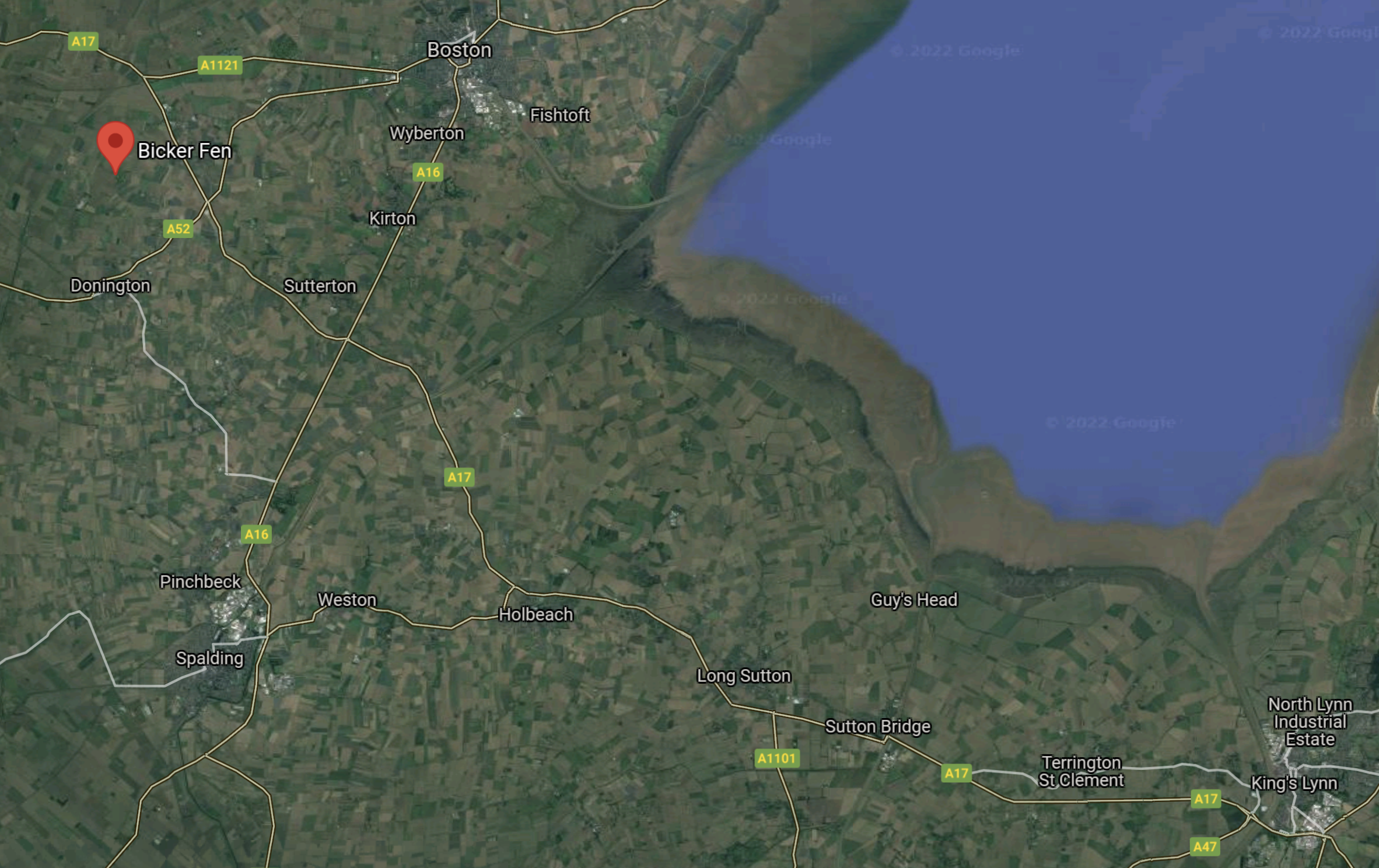
Bicker Fen is marked by the red arrow.
The Google Map shows the substation.
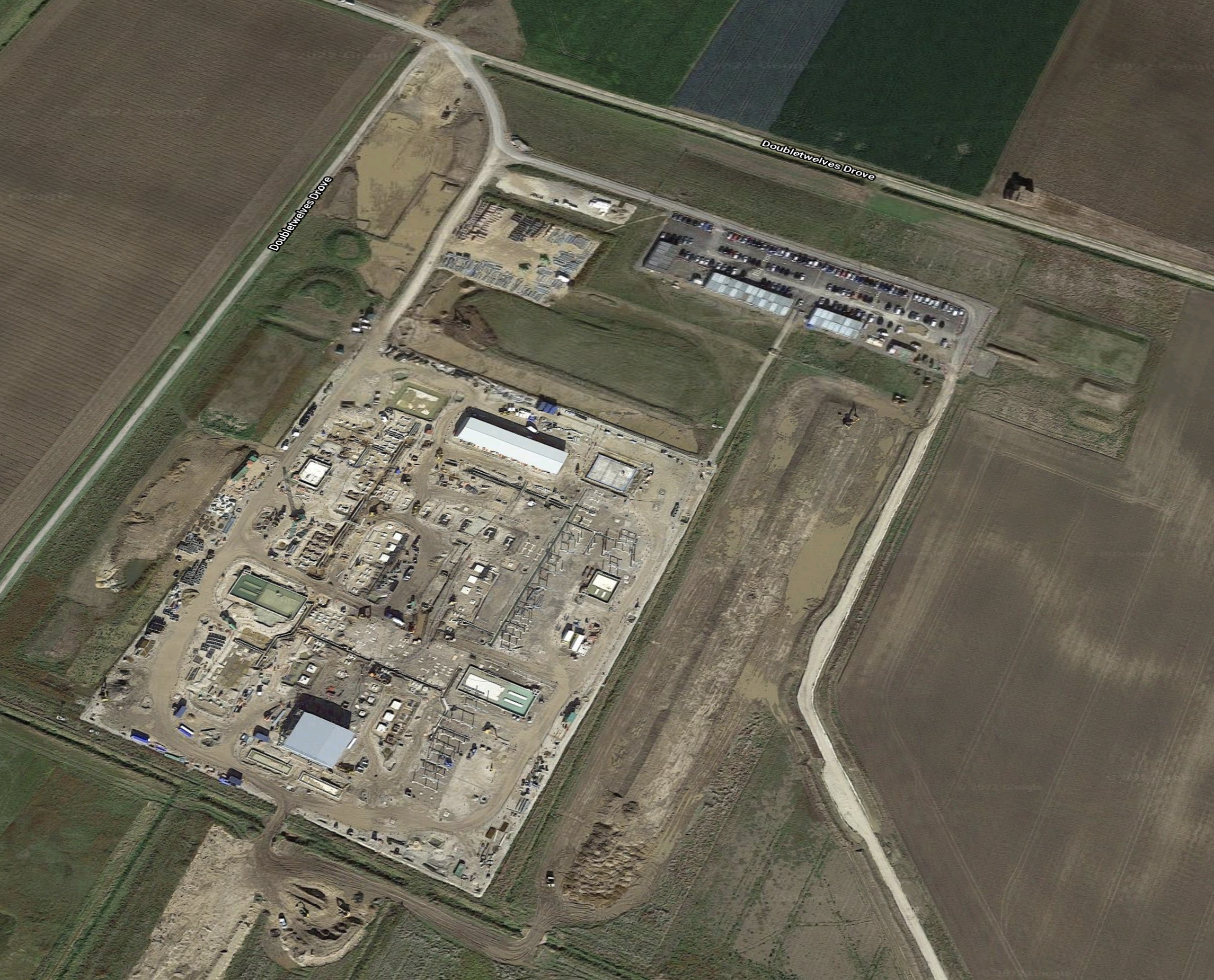
It must be sized to handle over 2 GW, but is it large enough?
Dudgeon Offshore Wind Farm
The Dudgeon offshore wind farm is a 402 MW wind farm, which is twenty miles off the North Norfolk coast.
- It has 67 turbines and an offshore substation.
- It is connected to the shore at Weybourne on the coast from where an underground cable is connected to the National Grid at Necton.
- It became operational in Oct 2017.
- Equinor and Statkraft are part owners of the windfarm and this is the home page of the wind farm’s web site.
- Equinor is the operator of the wind farm.
This Google Map shows the location of Weybourne on the coast.
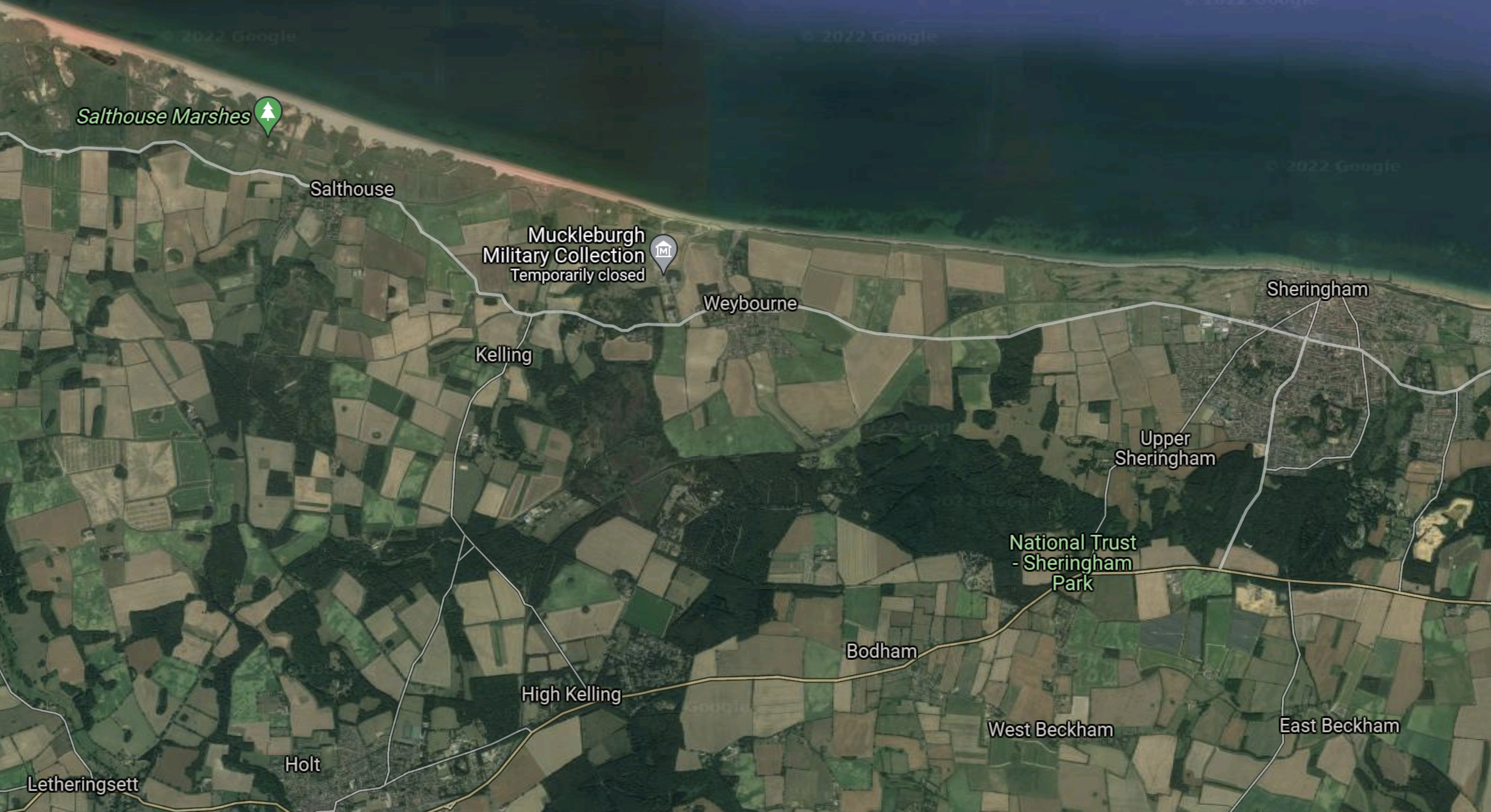
Note.
- Weybourne is in the middle on the coast.
- Sheringham is on the coast in the East.
- Holt is on the Southern edge of the map almost South of Weybourne.
This second map shows the location of the onshore substation at Necton, with respect to the coast.
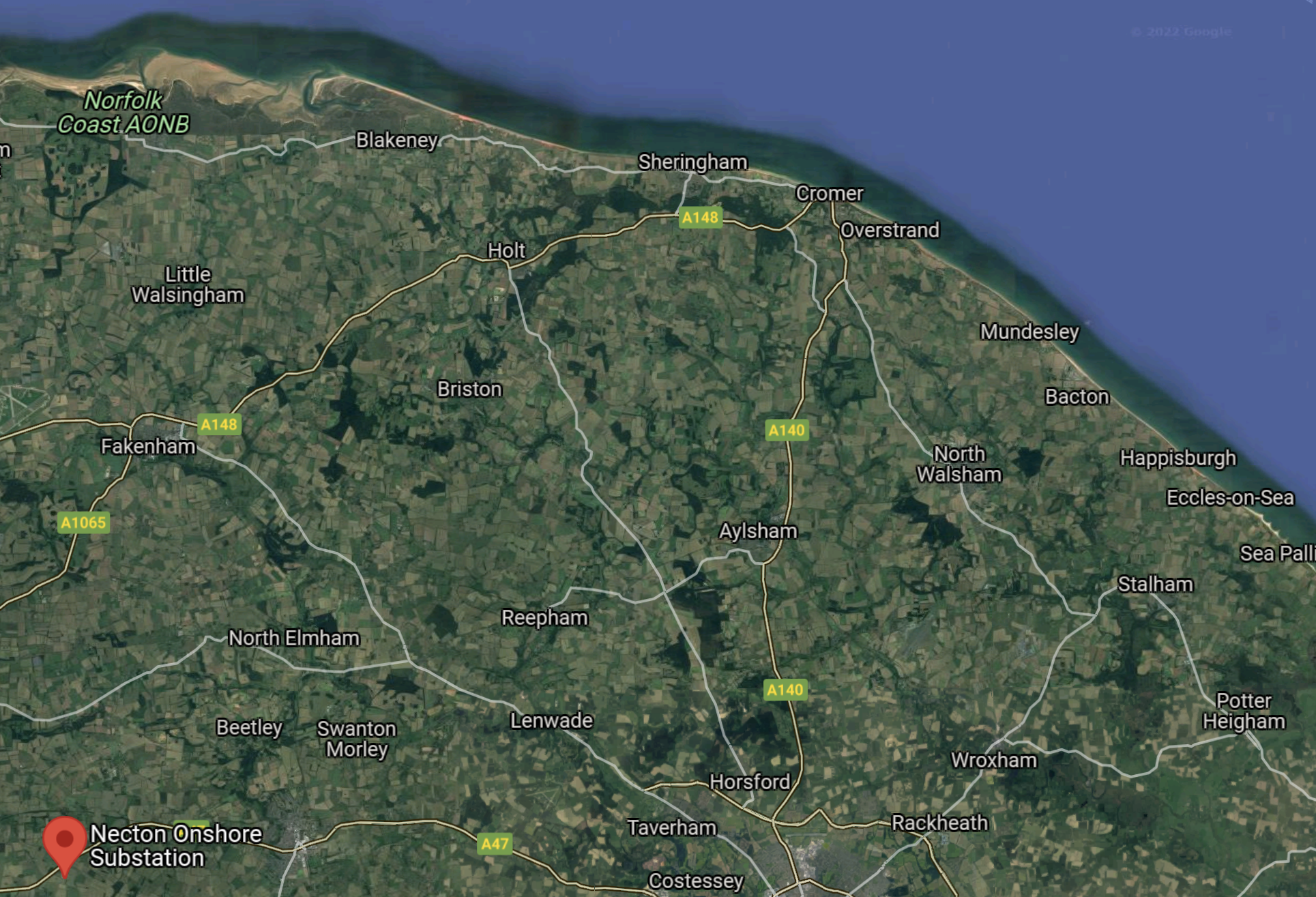
Note.
- The Necton substation is marked by a red arrow.
- Holt and Sheringham can be picked out by the coast in the middle.
- Weybourne is to the West of Sheringham.
- Necton and Weybourne are 35 miles apart.
Digging in the underground cable between Necton and Weybourne might have caused some disruption.
Looking at Weybourne in detail, I can’t find anything that looks like a substation. So is the Necton substation connected directly to Dudgeon’s offshore substation?
Sheringham Shoal Offshore Wind Farm
The Sheringham Shoal offshore wind farm is a 316.8 MW wind farm, which is eleven miles off the North Norfolk coast.
- It has 88 turbines and two offshore substations.
- As with Dudgeon, it is connected to the shore at Weybourne on the coast.
- But the underground cable is connected to an onshore substation at Salle and that is connected to the National Grid at Norwich.
- It became operational in Sept 2012.
- Equinor and Statkraft are part owners of the windfarm and this is the home page of the wind farm’s web site.
- Equinor is the operator of the wind farm.
This second map shows the location of the onshore substation at Salle, with respect to the coast.

Note.
- The Salle substation is marked by a red arrow.
- Holt, Weybourne and Sheringham can be picked out by the coast in the middle.
- Weybourne is to the West of Sheringham.
- Salle and Weybourne are 13.5 miles apart.
Could the following two statements be true?
- As the Sheringham Shoal wind farm was built first, that wind farm was able to use the shorter route.
- It wasn’t built large enough to be able to handle the Dudgeon wind farm.
The statements would certainly explain, why Dudgeon used a second cable.
Extending The Dudgeon And Sheringham Shoal Wind Farms
Both the Dudgeon And Sheringham Shoal web sites have details of the proposed join extension of both wind farms.
This is the main statement on the Overview page.
Equinor has been awarded an Agreement for Lease by the Crown Estate, the intention being to seek consents to increase the generating capacity of both the Sheringham Shoal Offshore Wind Farm and the Dudgeon Offshore Wind Farm.
They then make three points about the development.
- Equinor is proposing a joint development of the two projects with a common transmission infrastructure.
- As part of the common DCO application, the Extension Projects have a shared point of connection at the National Grid Norwich Main substation.
- These extension projects will have a combined generating capacity of 719MW which will make an important contribution to the UK’s target of 30GW of electricity generated by offshore wind by 2030.
This statement on the Offshore Location page, describes the layout of the wind farms.
The Sheringham Shoal Offshore Wind Farm extension is to the north and the east of the existing wind farm, while its Dudgeon counterpart is to the north and south east of the existing Dudgeon Offshore Wind Farm site. The proposed extension areas share the boundaries with its existing wind farm site.
They then make these two important points about the development.
- Equinor is seeking to develop the extension project with a joint transmission infrastructure. A common offshore substation infrastructure is planned to be located in the Sheringham Shoal wind farm site.
- The seabed export cable which will transmit the power generated by both wind farm extensions will make landfall at Weybourne.
There is also this map.

Note.
- The purple line appears to be the UK’s ten mile limit.
- The Sheringham Shoal Extension is outlined in red.
- The Dudgeon Extension is outlined in blue.
- The black lines appear to be the power cables.
I suspect the dotted blue lines are shipping routes sneaking their way through the turbines.
This statement on the Onshore Location page, describes the layout of the offshore and onshore cables.
A new seabed export cable will bring the electricity generated by both the Sheringham Shoal and Dudgeon Offshore Wind Farm extensions to shore at Weybourne, on the coast of Norfolk.
They then make these two important points about the development.
- From there a new underground cable will be installed to transmit that power to a new purpose built onshore substation, which will be located within a 3km radius of the existing Norwich main substation, south of Norwich. This will be the National Grid network connection point for the electricity from both wind farm extensions.
- The power will be transmitted from landfall to the substation using an HVAC system which eliminates the need for any relay stations along the onshore cable route.
There is also this map.
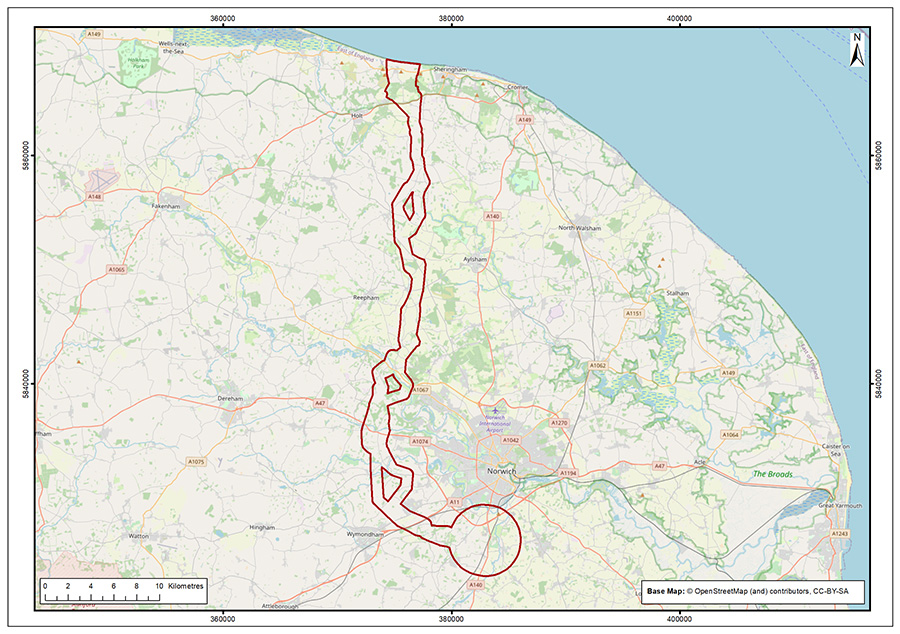
It will be a substantial undertaking to build the underground cable between Weybourne and South of Norwich.
Bacton Gas Terminal
The Bacton gas terminal is a complex of six gas terminals about ten miles East of Cromer.
- It lands and processes gas from a number of fields in the North Sea.
- It hosts the UK end of the BBL pipeline to The Netherlands.
- It hosts the UK end of the Interconnector to Zeebrugge in Belgium.
- The Baird and Deborah fields, which have been developed as gas storage, are connected to the gas terminal. They are both mothballed.
This Google Map shows the location of the terminal.
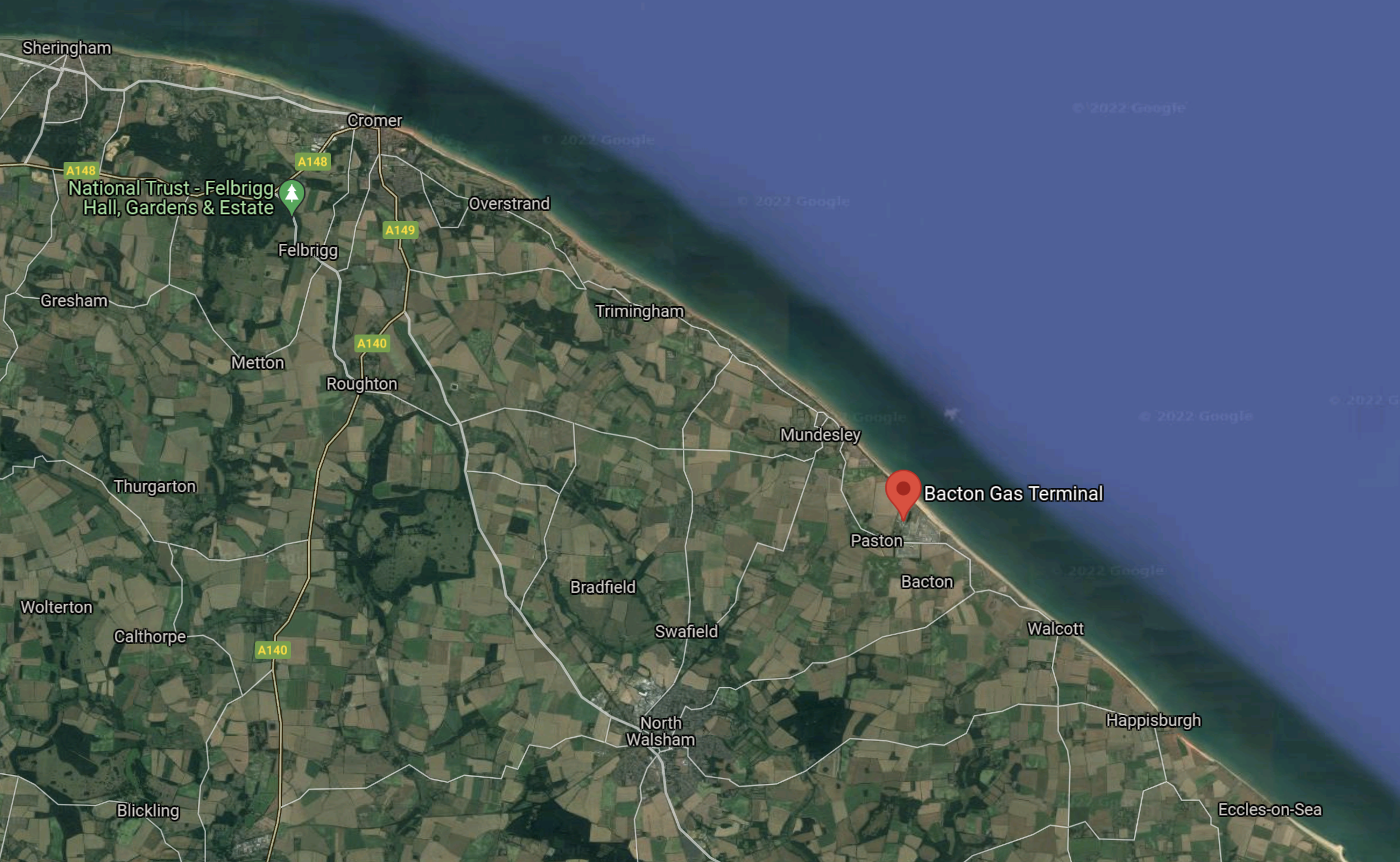
Note.
- The Bacton gas terminal is marked by a red arrow.
- Sheringham is in the North West corner of the map.
- Cromer, Overstrand, Trimingham and Mundesley are resort towns and villages along the coast North of Bacton.
This second map shows the Bacton gas terminal in more detail.
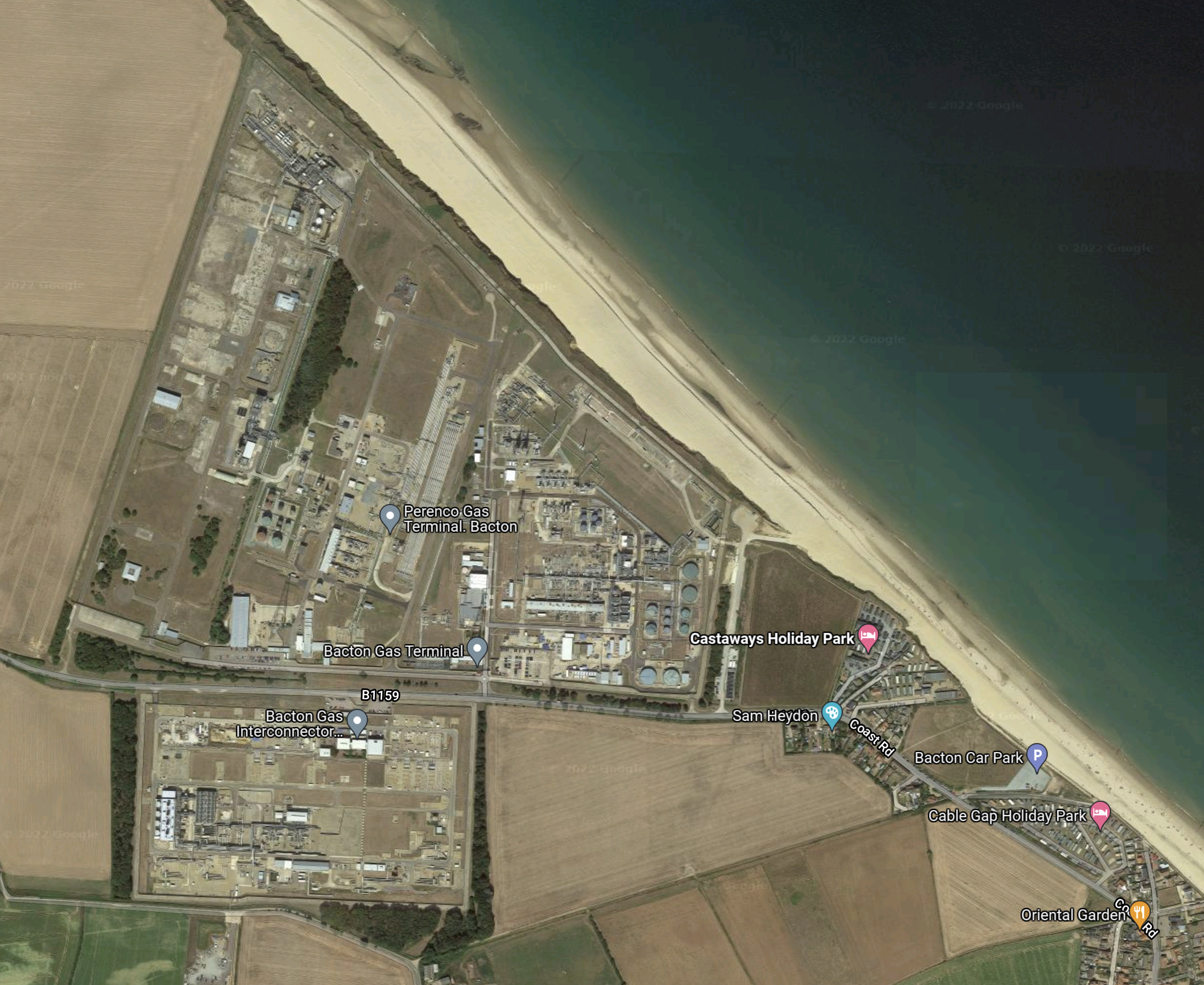
Would you want to have a seaside holiday, by a gas terminal?
Norfolk Boreas And Norfolk Vanguard
Norfolk Boreas and Norfolk Vanguard are two wind farms under development by Vattenfall.
- Norfolk Boreas is a proposed 1.8 GW wind farm, that will be 45 miles offshore.
- Norfolk Vanguard is a proposed 1.8 GW wind farm, that will be 29 miles offshore.
This map shows the two fields in relation to the coast.
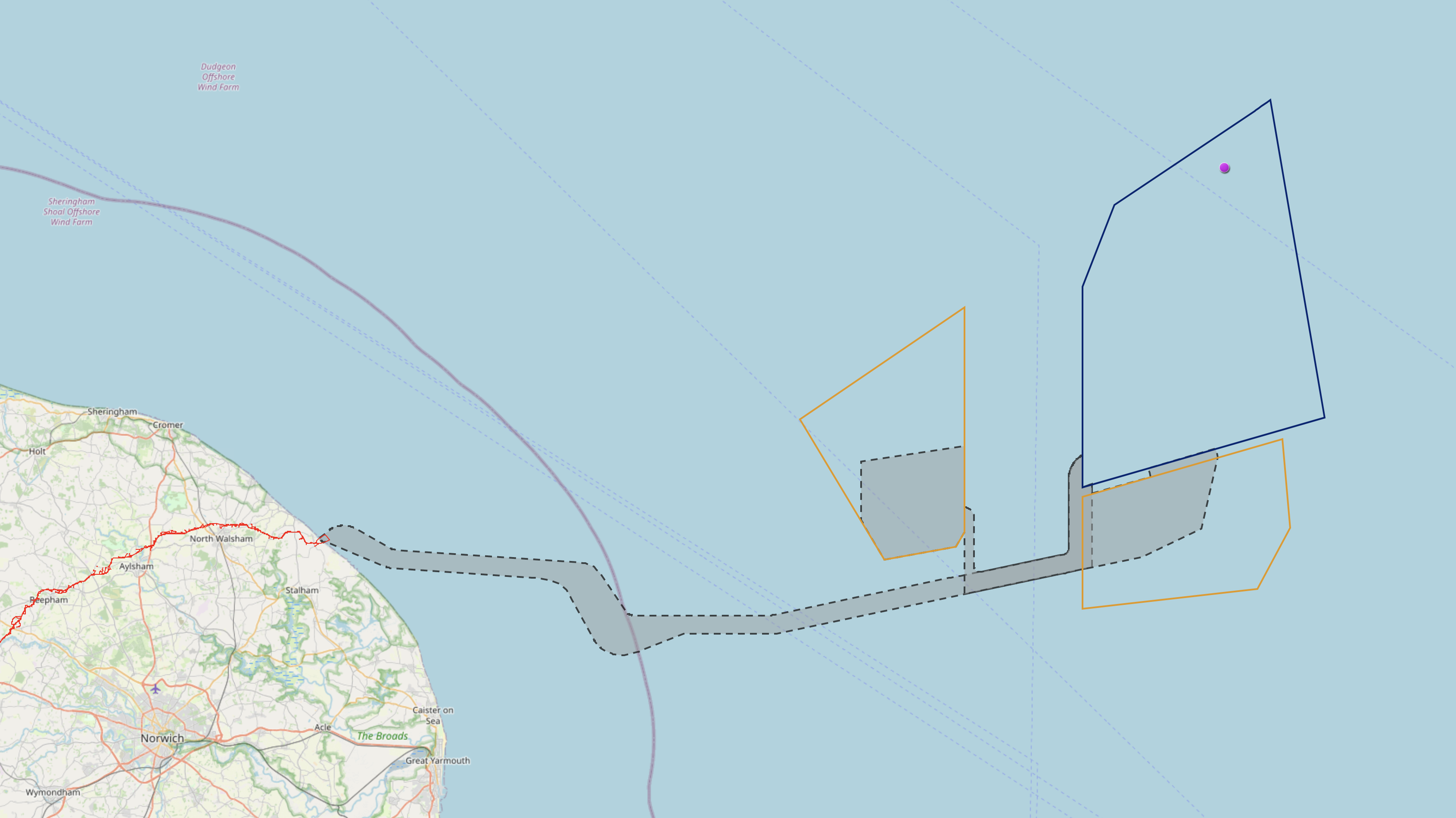
Note.
- The purple line appears to be the UK’s ten mile limit.
- Norfolk Boreas is outlined in blue.
- Norfolk Vsnguard is outlined in orange.
- Cables will be run in the grey areas.
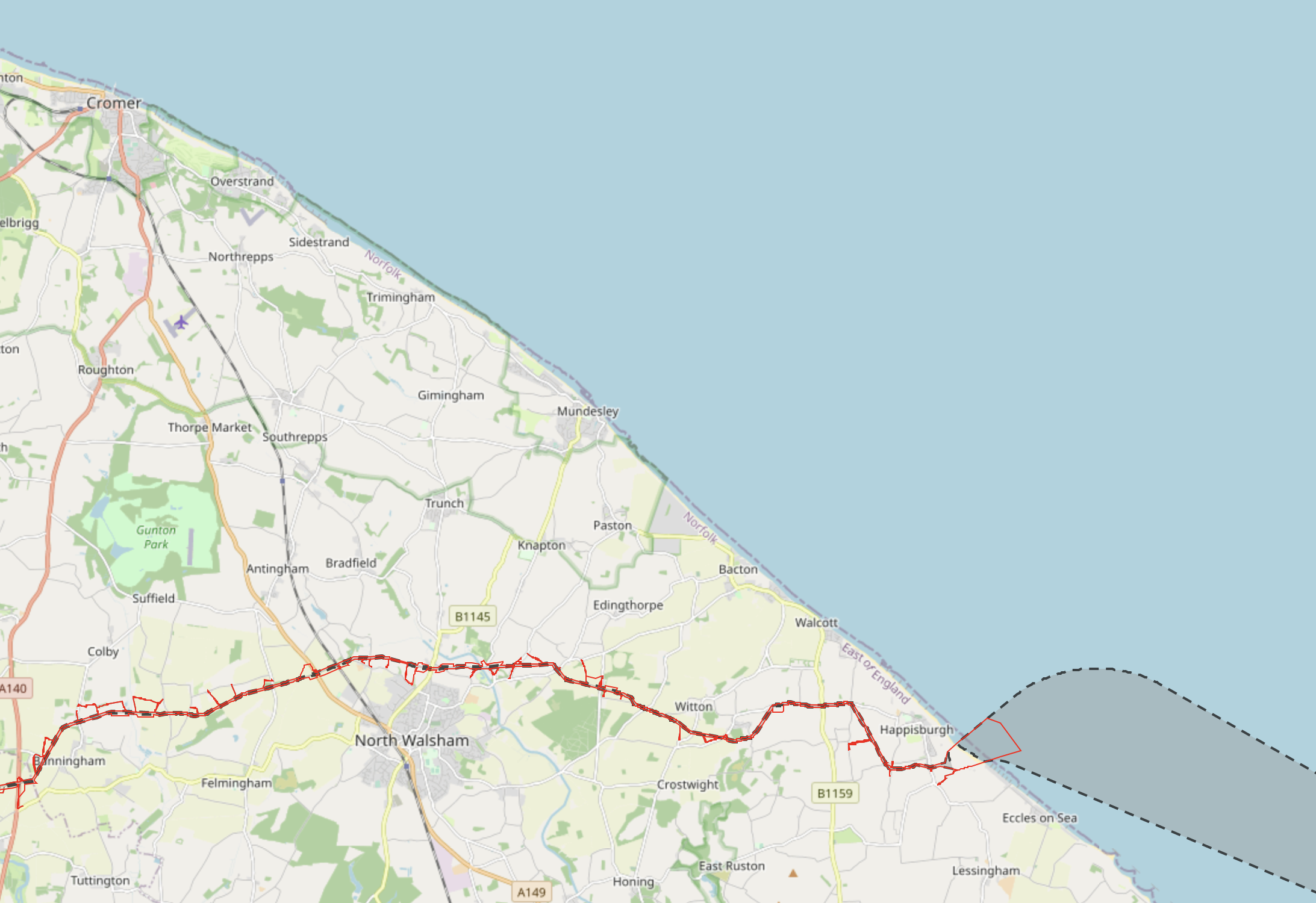
This second map shows the onshore cable.
Note.
- The cables are planned to come ashore between Happisburgh and Eccles-on-Sea.
- Bacton gas terminal is only a short distance up the coast.
- The onshore cable is planned to go from here across Norfolk to the Necton substation.
But all of this has been overturned by a legal ruling.
This article on the BBC is entitled Norfolk Vanguard: Ministers Wrong Over Wind Farm Go-Ahead, Says Judge.
These are the first four paragraphs.
A High Court judge has quashed permission for one of the world’s largest offshore wind farms to be built off the east coast of England.
The Norfolk Vanguard Offshore Wind Farm was granted development consent in July by the Secretary of State for Business, Energy and Industrial Strategy (BEIS).
But Mr Justice Holgate overturned the decision following legal action from a man living near a planned cable route.
A Department for BEIS spokeswoman said it was “disappointed by the outcome”.
I bet the spokeswoman was disappointed.
Vattenfall and the BEIS will go back to the drawing board.
But seriously, is it a good idea to dig an underground cable all the way across Norfolk or in these times build a massive overhead cable either?
Perhaps the solution is to connect the Norfolk Boreas And Norfolk Vanguard wind farms to a giant electrolyser at Bacton, which creates hydrogen.
- The underground electricity cable across Norfolk would not be needed.
- Bacton gas terminal is only a few miles up the coast from the cable’s landfall.
- The UK gets another supply of gas.
- The hydrogen is blended with natural gas for consumption in the UK or Europe.
- A pure hydrogen feed can be used to supply hydrogen buses, trucks and other vehicles, either by tanker or pipeline.
- Excess hydrogen could be stored in depleted gas fields.
The main benefit though, would be that it would transform Bacton gas terminal from a declining asset into Norfolk’s Hydrogen Powerhouse.
Great Yarmouth And Lowestoft
Great Yarmouth Outer Harbour and the Port of Lowestoft have not been the most successful of ports in recent years, but with the building of large numbers of wind farms, they are both likely to receive collateral benefits.
I wouldn’t be surprised to see the support ships for the wind farms switching to zero-carbon power, which would require good electrical connections to the ports to either charge batteries or power electrolysers to generate hydrogen.
Sizewell
Sizewell has only one nuclear power station at present; Sizewell B, but it could be joined by Sizewell C or a fleet of Small Modular Reactors (SMR).
The Sizewell Overhead Transmission Line
Sizewell also has a very high capacity overhead power line to Ipswich and the West.





I doubt, it would be possible to build an overhead transmission line like this today.
Sizewell And Hydrogen
EdF, who own the site are involved with Freeport East and may choose to build a large electrolyser in the area to create hydrogen for the Freeport.
East Anglia Array
The East Anglia Array will be an enormous wind farm., comprising up to six separate projects.
It will be thirty miles offshore.
It could generate up to 7.2 GW.
The first project East Anglia One is in operation and delivers 714 MW to a substation in the Deben Estuary, which connects to the Sizewell high-capacity overhead power line.
Most projects will be in operation by 2026.
Freeport East
As the Freeport develops, it will surely be a massive user of both electricity and hydrogen.
Problems With The Current Electricity Network
I don’t believe that the current electricity network, that serves the wind farms and the large energy users has been designed with the number of wind farms we are seeing in the North Sea in mind.
Every new windfarm seems to need a new connection across Norfolk or Suffolk and in Norfolk, where no high-capacity cables exist, this is stirring up the locals.
There is also no energy storage in the current electricity network, so at times, the network must be less than efficient and wind turbines have to be shut down.
Objections To The Current Policies
It is not difficult to find stories on the Internet about objections to the current policies of building large numbers of wind farms and the Sizewell C nuclear power station.
This article on the East Anglia Daily Times, which is entitled Campaigners Unite In Calling For A Pause Before ‘Onslaught’ Of Energy Projects ‘Devastates’ Region is typical.
This is the first paragraph.
Campaigners and politicians have called on the Government to pause the expansion of the energy industry in Suffolk, which they fear will turn the countryside into an “industrial wasteland” and hit tourism.
The group also appear to be against the construction of Sizewell C.
I feel they have a point about too much development onshore, but I feel that if the UK is to thrive in the future we need an independent zero carbon energy source.
I also believe that thousands of wind farms in the seas around the UK and Ireland are the best way to obtain that energy.
Blending Hydrogen With Natural Gas
Blending green hydrogen produced in an electrolyser with natural gas is an interesting possibility.
- HyDeploy is a project to investigate blending up to 20 % of green hydrogen in the natural gas supply to industrial and domestic users.
- Partners include Cadent, ITM Power, Keele University and the Health and Safety Executive.
- Natural gas naturally contains a small amount of hydrogen anyway.
- The hydrogen gas would be distributed to users in the existing gas delivery network.
I wrote about HyDeploy in a post called HyDeploy.
Thje only loser, if hydrogen were to be blended with natural gas would be Vlad the Poisoner, as he’d sell less of his tainted gas.
An Interconnector Between Bicker Fen And Freeport East
I believe that an electricity interconnector between at least Bicker Fen and Freeport East could solve some of the problems.
My objectives would be.
- Avoid as much disruption on the land as possible.
- Create the capacity to deliver all the energy generated to customers, either as electricity or hydrogen.
- Create an expandable framework, that would support all the wind farms that could be built in the future.
The interconnector would be a few miles offshore and run along the sea-bed.
- This method of construction is well proven.
- It was used for the Western HVDC Link between Hunterston in Scotland and Connah’s Quay in Wales.
- Most wind farms seem to have existing substations and these would be upgraded to host the interconnector.
Connections en route would include.
Dudgeon Offshore Wind Farm
The interconnector would connect to the existing offshore substation.
Sheringham Shoal Wind Farm
The interconnector would connect to the existing offshore substation.
Dudgeon and Sheringham Shoal Extension Offshore Wind Farms
These two wind farms could be connected directly to the interconnector, if as planned, they shared an offshore substation in the Sheringham Shoal Extension offshore wind farm.
Bacton Gas Terminal
I would connect to the Bacton Gas Terminal, so that a large electrolyser could be installed at the terminal.
The hydrogen produced could be.
- Stored in depleted gas fields connected to the terminal.
- Blended with natural gas.
- Exported to Europe through an interconnector.
- Supplied to local users by truck or pipeline.
After all, the terminal has been handling gas for over fifty years, so they have a lot of experience of safe gas handling.
Norfolk Boreas And Norfolk Vanguard
These two wind farms could be connected directly to the interconnector, if they shared an offshore substation.
It would also help to appease and silence the objectors, if there was no need to dig up half of Norfolk.
Great Yarmouth And Lowestoft
It might be better, if these ports were supplied from the interconnector.
- Either port could have its own electrolyser to generate hydrogen, which could be.
- Used to power ships, trucks and port equipment.
- Liquefied and exported in tankers.
- Used to supply local gas users.
- Hydrogen could be supplied to a converted Great Yarmouth power station.
Both Great Yarmouth and Lowestoft could become hydrogen hub towns.
Sizewell
This site has a high-capacity connection to the National Grid. This connection is a big eyesore, but it needs to run at full capacity to take electricity from the Energy Coast to the interior of England.
That electricity can come from Sizewell B and/or Sizewell C nuclear power stations or the offshore wind farms.
East Anglia Array
There would probably need to be a joint offshore substation to control the massive amounts of electricity generated by the array.
Currently, the only wind farm in operation of this group is East Anglia One, which uses an underground cable connection to the Sizewell high-capacity connection to the Bullen Lane substation at Bramford.
Freeport East, Ipswich And Bullen Lane Substation
This Google Map shows the area between Ipswich and the coast.
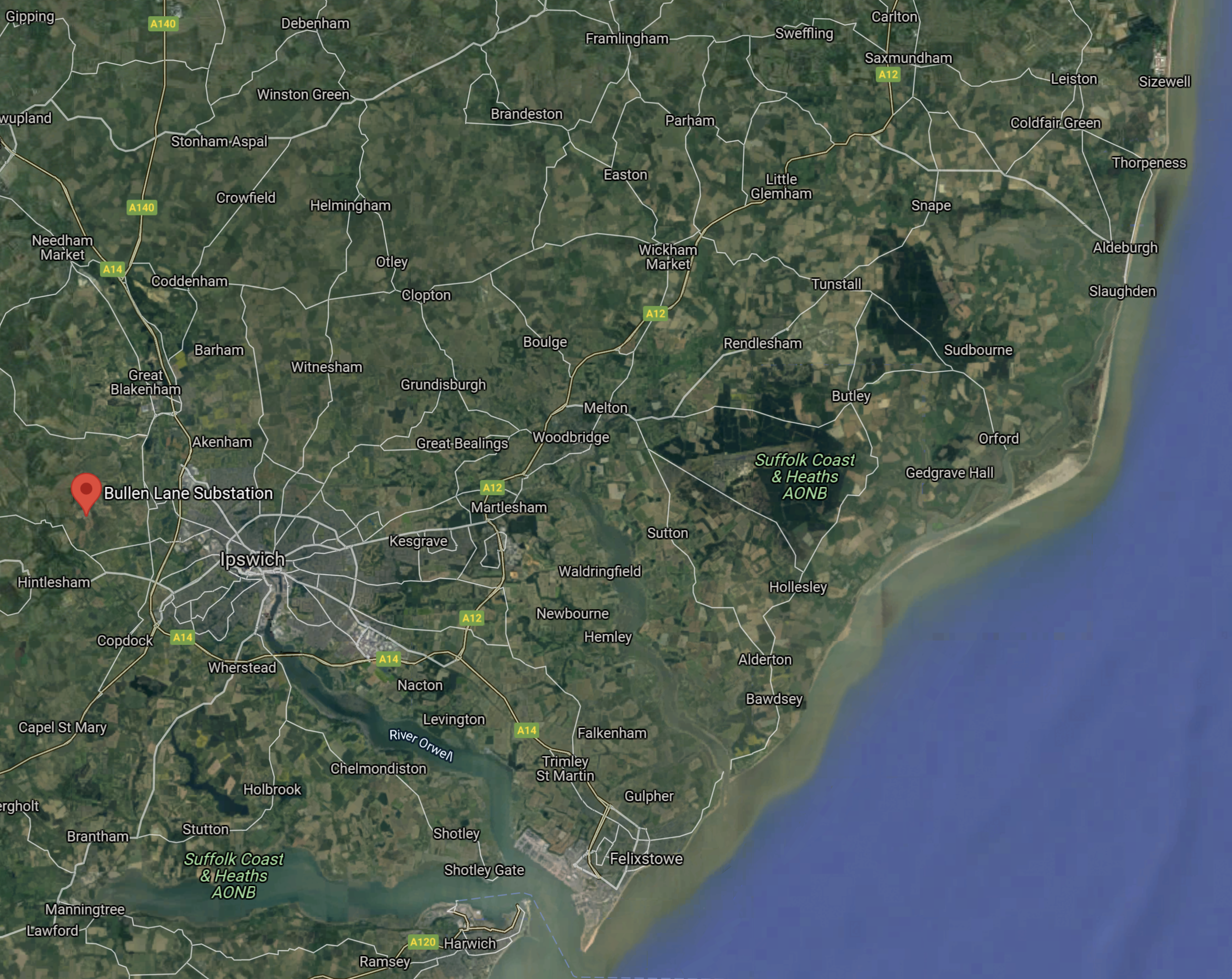
Note.
- Sizewell is in the North-East corner of the map.
- Felixstowe, Harwich and Freeport East are at the mouth of the rivers Orwell and Stour.
- The Bullen Lane substation is to the West of Ipswich and shown by the red arrow.
I would certainly investigate the possibility of running an underwater cable up the River Orwell to connect the Southern end of the interconnector Between Bicker Fen And Freeport East.
This Google Map shows the Bullen Lane Substation.
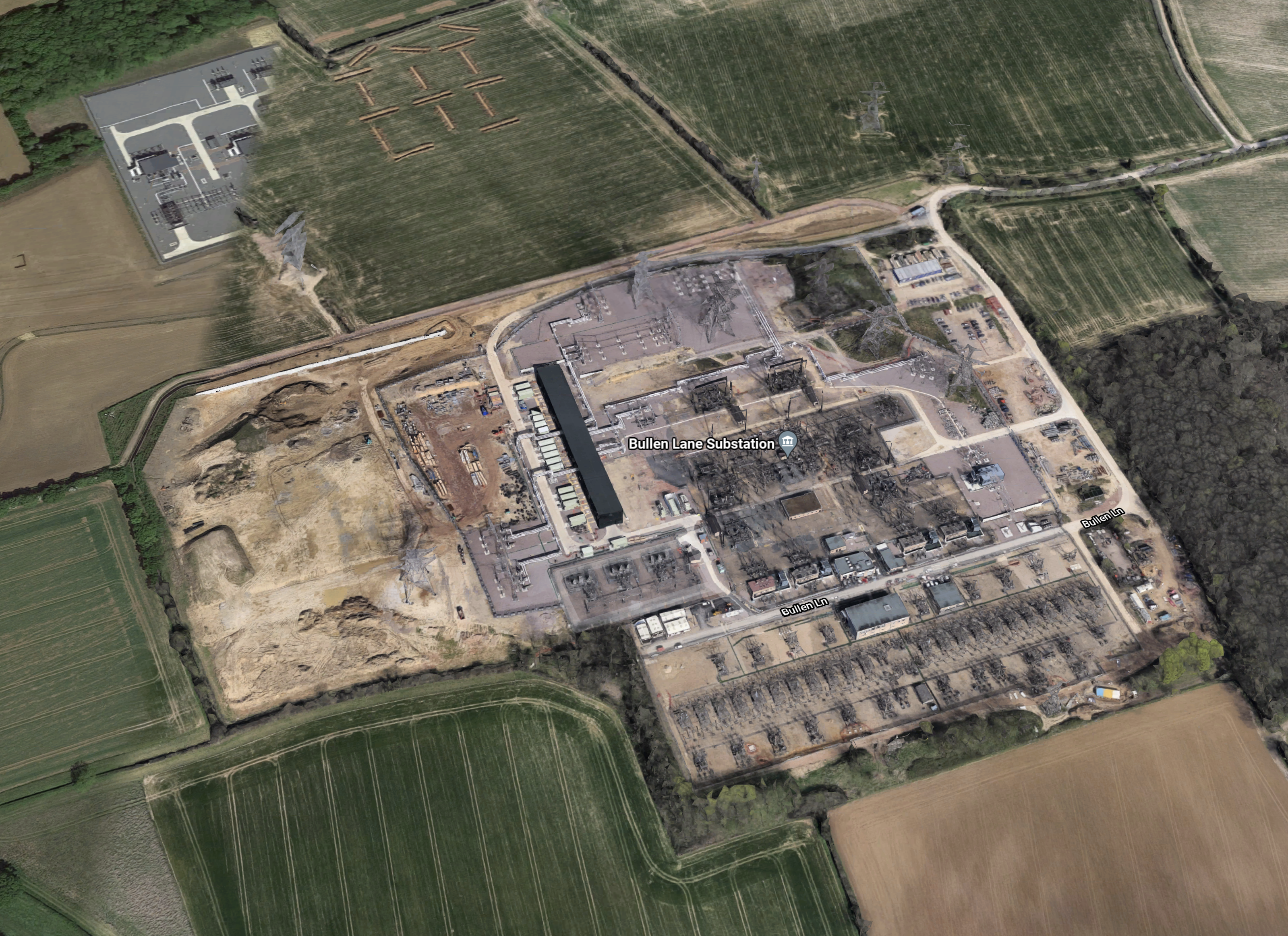
It looks impressive, but is it big enough to handle all the electricity coming ashore from the offshore wind farms to the East of Suffolk and the electricity from the power stations at Sizewell?
Conclusion
I believe there are a lot of possibilities, that would meet the threeobjectives, I stated earlier.
- Avoid as much disruption on the land as possible.
- Create the capacity to deliver all the energy generated to customers, either as electricity or hydrogen.
- Create an expandable framework, that would support all the wind farms that could be built in the future.
In addition, simple mathematics says to me, that either there will need to be extra capacity at both Bicker Fen and Bullen Lane substations and onward to the rest of the country, or a large electrolyser to convert several gigawatts of electricity into hydrogen for distribution, through the gas network.
Could Norfolk And Suffolk Be Powered By Offshore Wind?
This week this article on the BBC was published, which had a title of Government Pledges £100m For Sizewell Nuclear Site.
These are the first three paragraphs.
The government is putting up £100m to support the planned Sizewell C nuclear plant in Suffolk, Business and Energy Secretary Kwasi Kwarteng has announced.
The investment marks the latest stage in efforts to build the £20bn reactor on the east coast of England.
However, it does not commit the government to approving the project, which is still subject to negotiations.
My view of the proposed Sizewell C nuclear plant is that of an engineer, who used to live within thirty minutes of the Sizewell site.
- Hinckley Point C power station, which is currently being constructed, will have a nameplate capacity of 3.26 GW.
- Sizewell C would probably be to a similar design and capacity to Hinckley Point C.
- Sizewell C would likely be completed between 2033-2036.
- Sizewell B is a 1250 MW station, which has a current closing date of 2035, that could be extended to 2055.
- East Anglia and particularly the mega Freeport East, that will develop to the South at the Ports of Felixstowe and Harwich will need more electricity.
- One of the needs of Freeport East will be a large supply of electricity to create hydrogen for the trains, trucks, ships and cargo handling equipment.
- Sizewell is a large site, with an excellent connection to the National Grid, that marches as a giant pair of overhead cables across the Suffolk countryside to Ipswich.
But.
- We still haven’t developed a comprehensive strategy for the management of nuclear waste in the UK. Like paying for the care of the elderly and road pricing, it is one of those problems, that successive governments have kept kicking down the road, as it is a big vote loser.
- I was involved writing project management software for forty years and the building of large nuclear power plants is littered with time and cost overruns.
- There wasn’t a labour problem with the building of Sizewell B, as engineers and workers were readily available. But with the development of Freeport East, I would be very surprised if Suffolk could provide enough labour for two mega-projects after Brexit.
- Nuclear power plants use a lot of steel and concrete. The production of these currently create a lot of carbon dioxide.
- There is also a large number of those objecting to the building of Sizewell C. It saddened me twenty-five years ago, that most of the most strident objectors, that I met, were second home owners, with no other connection to Suffolk.
The older I get, the more my experience says, that large nuclear power plants aren’t always a good idea.
Small Modular Nuclear Reactors
In Is Sizewell The Ideal Site For A Fleet Of Small Modular Nuclear Reactors?, I looked at building a fleet of small modular nuclear reactors at Sizewell, instead of Sizewell C.
I believe eight units would be needed in the fleet to produce the proposed 3.26 GW and advantages would include.
- Less land use.
- Less cost.
- Less need for scarce labour.
- Easier to finance.
- Manufacturing modules in a factory should improve quality.
- Electricity from the time of completion of unit 1.
But it would still be nuclear.
Wind In The Pipeline
Currently, these offshore wind farms around the East Anglian Coast are under construction, proposed or are in an exploratory phase.
- East Anglia One – 714 MW – 2021 – Finishing Construction
- East Anglia One North 800 MW – 2026 – Exploratory
- East Anglia Two – 900 MW – 2026 – Exploratory
- East Anglia Three – 1400 MW – 2026 – Exploratory
- Norfolk Vanguard – 1800 MW – Exploratory
- Norfolk Boreas – 1800 MW – Exploratory
- Sheringham Shoal/Dudgeon Extension – 719 MW – Exploratory
Note.
- The date is the possible final commissioning date.
- I have no commissioning dates for the last three wind farms.
- The East Anglia wind farms are all part of the East Anglia Array.
These total up to 8.13 GW, which is in excess of the combined capacity of Sizewell B and the proposed Sizewell C, which is only 4.51 GW.
As it is likely, that by 2033, which is the earliest date, that Sizewell C will be completed, that the East Anglia Array will be substantially completed, I suspect that East Anglia will not run out of electricity.
But I do feel that to be sure, EdF should try hard to get the twenty year extension to Sizewell B.
The East Anglia Hub
ScottishPower Renewables are developing the East Anglia Array and this page on their web site, describes the East Anglia Hub.
This is the opening paragraph.
ScottishPower Renewables is proposing to construct its future offshore windfarms, East Anglia THREE, East Anglia TWO and East Anglia ONE North, as a new ‘East Anglia Hub’.
Note.
- These three wind farms will have a total capacity of 3.1 GW.
- East Anglia ONE is already in operation.
- Power is brought ashore at Bawdsey between Felixstowe and Sizewell.
I would assume that East Anglia Hub and East Anglia ONE will use the same connection.
Norfolk Boreas and Norfolk Vanguard
These two wind farms will be to the East of Great Yarmouth.
This map from Vattenfall web site, shows the position of the two wind farms.
Note.
- Norfolk Boreas is outlined in blue.
- Norfolk Vanguard is outlined in orange.
- I assume the grey areas are where the cables will be laid.
- I estimate that the two farms are about fifty miles offshore.
This second map shows the landfall between Eccles-on-Sea and Happisburgh.
Note the underground cable goes half-way across Norfolk to Necton.
Electricity And Norfolk And Suffolk
This Google Map shows Norfolk and Suffolk.
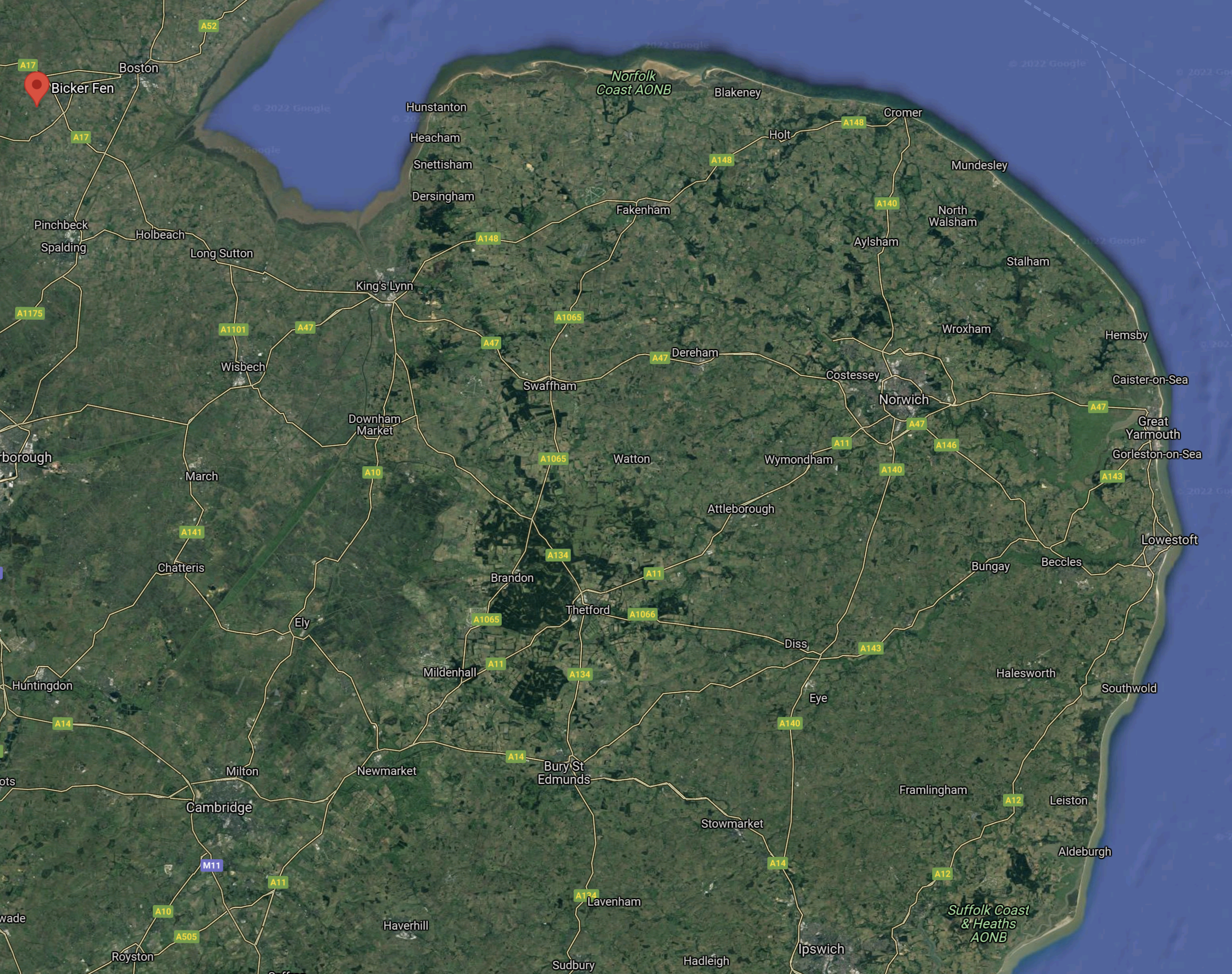
Note.
- The red arrow in the North-West corner marks the Bicker Fen substation that connects to the Viking Link to Denmark.
- The East Anglia Array connects to the grid at Bawdsey in the South-East corner of the map.
- Sizewell is South of Aldeburgh in the South-East corner of the map.
- The only ports are Lowestoft and Yarmouth in the East and Kings Lynn in the North-West.
There are few large towns or cities and little heavy industry.
- Electricity usage could be lower than the UK average.
- There are three small onshore wind farms in Norfolk and none in Suffolk.
- There is virtually no high ground suitable for pumped storage.
- There are lots of areas, where there are very few buildings to the square mile.
As I write this at around midday on a Saturday at the end of January, 49 % of electricity in Eastern England comes from wind, 20 % from nuclear and 8 % from solar. That last figure surprised me.
I believe that the wind developments I listed earlier could provide Norfolk and Suffolk with all the electricity they need.
The Use Of Batteries
Earlier, I talked of a maximum of over 7 GW of offshore wind around the cost of Norfolk and Suffolk, but there is still clear water in the sea to be filled between the existing and planned wind farms.
Batteries will become inevitable to smooth the gaps between the electricity produced and the electricity used.
Here are a few numbers.
- East Anglian Offshore Wind Capacity – 8 GW
- Off-Peak Hours – Midnight to 0700.
- Typical Capacity Factor Of A Windfarm – 20 % but improving.
- Overnight Electricity Produced at 20 % Capacity Factor – 11.2 GWh
- Sizewell B Output – 1.25 GW
- Proposed Sizewell C Output – 3.26 GW
- Largest Electrolyser – 24 MW
- World’s Largest Lithium-Ion Battery at Moss Landing – 3 GWh
- Storage at Electric Mountain – 9.1 GWh
- Storage at Cruachan Power Station – 7.1 GWh
Just putting these large numbers in a table tells me that some serious mathematical modelling will need to be performed to size the batteries that will probably be needed in East Anglia.
In the 1970s, I was involved in three calculations of a similar nature.
- In one, I sized the vessels for a proposed polypropylene plant for ICI.
- In another for ICI, I sized an effluent treatment system for a chemical plant, using an analogue computer.
- I also helped program an analysis of water resources in the South of England. So if you have a water shortage in your area caused by a wrong-sized reservoir, it could be my fault.
My rough estimate is that the East Anglian battery would need to be at least a few GWh and capable of supplying up to the output of Sizewell B.
It also doesn’t have to be a single battery. One solution would probably be to calculate what size battery is needed in the various towns and cities of East Anglia, to give everyone a stable and reliable power supply.
I could see a large battery built at Sizewell and smaller batteries all over Norfolk and Suffolk.
But why stop there? We probably need appropriately-sized batteries all over the UK, with very sophisticated control systems using artificial intelligent working out, where the electricity is best stored.
Note that in this post, by batteries, I’m using that in the loosest possible way. So the smaller ones could be lithium-ion and largest ones could be based on some of the more promising technologies that are under development.
- Highview Power have an order for a 50 MW/500 MWh battery for Chile, that I wrote about in The Power Of Solar With A Large Battery.
- East Anglia is an area, where digging deep holes is easy and some of Gravitricity’s ideas might suit.
- I also think that eventually someone will come up with a method of storing energy using sea cliffs.
All these developments don’t require large amounts of land.
East Anglia Needs More Heavy Consumers Of Electricity
I am certainly coming to this conclusion.
Probably, the biggest use of electricity in East Anglia is the Port of Felixstowe, which will be expanding as it becomes Freeport East in partnership with the Port of Harwich.
One other obvious use could be in large data centres.
But East Anglia has never been known for industries that use a lot of electricity, like aluminium smelting.
Conversion To Hydrogen
Although the largest current electrolyser is only 24 MW, the UK’s major electrolyser builder; ITM Power, is talking of a manufacturing capacity of 5 GW per year, so don’t rule out conversion of excess electricity into hydrogen.
Conclusion
Who needs Sizewell C?
Perhaps as a replacement for Sizewell B, but it would appear there is no pressing urgency.
Felixstowe And Harwich Ports Submit Bid For ‘Freeport’ Status
The title of this post is the same as this article on the BBC.
These are the first three paragraphs.
A bid for “freeport” status for two existing ports has been submitted after the project was approved by a council.
East Suffolk Council unanimously backed the bid for the Port of Felixstowe and Harwich International to become one of 10 freeport facilities across the UK.
Freeport East would see owners Hutchison operate a single custom zone covering both coastal ports.
I think, some will think this a bit cheeky, but I think it is a product of the characters of the counties of Essex and Suffolk.
I was conceived in Suffolk and have probably spent half my life in the county.
It’s a county that thinks big.
- Is there another woman, who as Boudica did, assembled an army of hundreds of thousands and attempted to throw an unwelcome invader out of her country?
- The history of her tribe; the Iceni is closely tied, according to some historians, to the development of the thoroughbred racehorse at New Horse Market or Newmarket as it is known today!
- Newmarket is to horse racing as St. Andrews is to golf.
- The town is home of about 3,500 horses and is a major centre for horse and animal health.
- Newmarket Heath is a Site of Special Scientific Interest and is to be the largest area of mown grass in the world.
- Suffolk sheep are one of the most numerous sheep breeds in the world, having been exported all over the world.
- Suffolk is the only county in England with its own breed of sheep, cattle (Red Poll) and horse (Suffolk Horse)
- Bury St. Edmunds Abbey was one of the largest churches in England.
When I was about seven, the Port of Felixstowe was just a small dock exporting grain and now it the busiest container port in the UK and the eighth in Europe.
It is no surprise to me, that Felixstowe and Harwich want to be a Freeport, so they can expand further.
There have already been related news and media reports.
Freeport East Web Site
The Freeport East web site is at www.freeporteast.com.
Read these sections.
It is an ambitious vision. As someone, who believes we must innovate, this paragraph from the Innovation section strikes the right tone.
Beyond the energy sector, Freeport East will also contribute to wider innovation in the technology sector. Hutchison Ports is already working with Cambridge University and Three UK to develop innovative 5G applications. Hutchison Ports is also working with the New Anglia LEP, Tech East and BT’s research centre at Adastral Park on new telecommunications infrastructure. Freeport East will embed these technological innovations at its heart and help to make the UK a world leader in technological innovation
The web site, also talks about the ports becoming major centres for the development and servicing of renewable energy in the North Sea.
A Little Help From Their Friends
I notice that in some reports, they have joined forces with the University of Cambridge. As Cambridge colleges are big local landowners, this can only be to the benefit of the concept.
A Hydrogen Freeport
This article on the Eadt Anglian Daily Times is entitled Top Ports Could Be Powered By Hydrogen In Major Project.
The project is well-described in the article with this infographic, that shows how nuclear power from Siewell and wind power from the North Sea can come together to decarbonise shipping and the port.
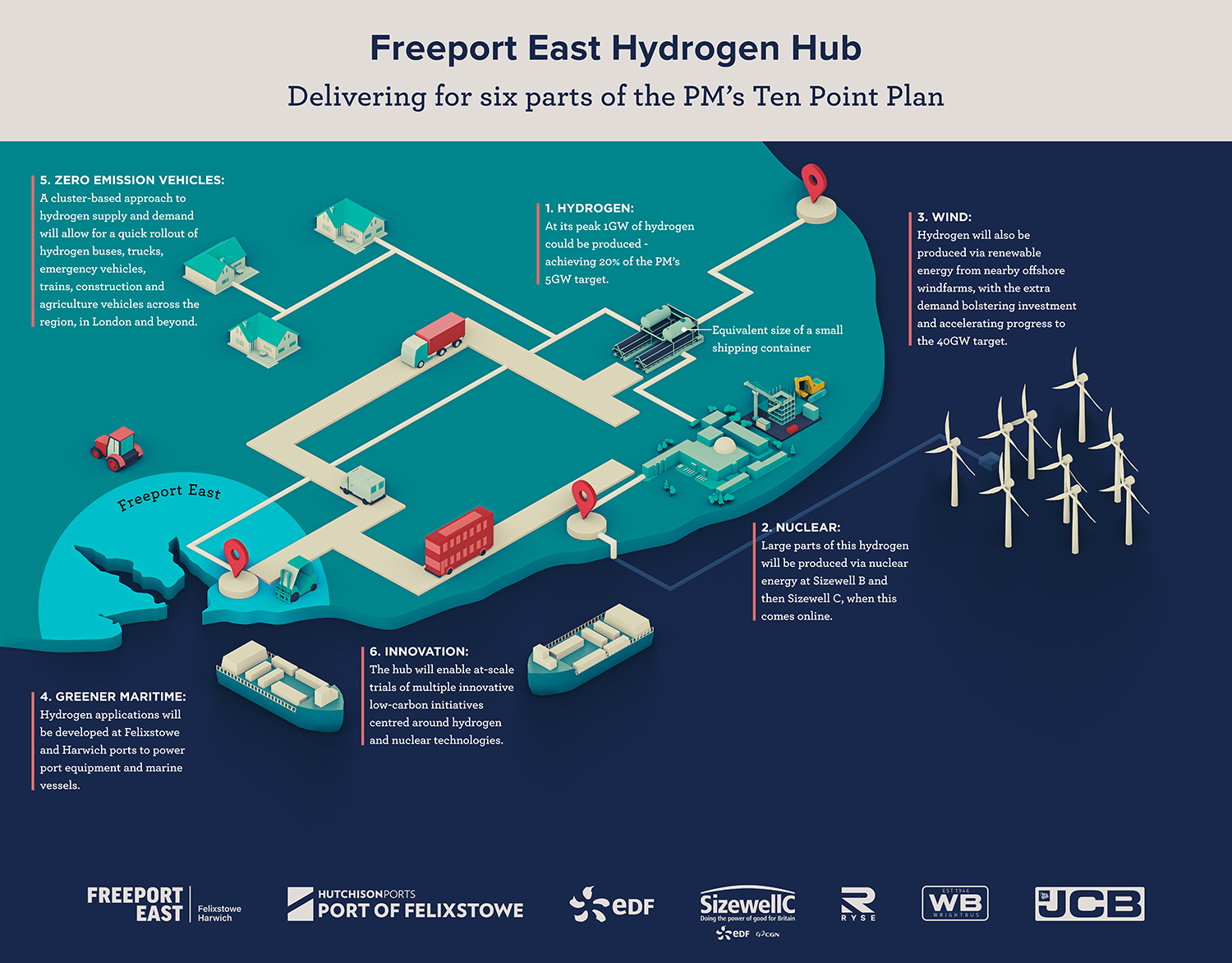
This paragraph sums up the hydrogen project.
At its peak, the power project, which will be delivered in partnership with Ryze-Hydrogen and EDF, developers of the proposed Sizewell C nuclear power station, will produce 1GW of hydrogen – 20% of the 5GW target in the Prime Minister’s Ten Point Plan for a Green Industrial Revolution.
Suffolk is thinking big again!
It certainly does appear, that several ports are following the hydrogen route. On this blog I have mentioned Antwerp, Holyhead and Portsmouth recently.
So what will the hydrogen be used for?
The East Anglian article says this.
The clean fuel would be used to power port equipment, ships, trucks and trains.
Port Equipment
I think the interesting one is port equipment.
- The chairman of JCB is Anthony Bamford.
- His son; Jo Bamford owns Ryze Hydrogen.
- JCB have recently released a hydrogen-powered digger.
- JCB is mentioned on the infographic.
Could we be seeing a range of hydrogen-powered port equipment, that has been developed by JCB?
Other companies like Hyster are certainly developing hydrogen-powered port equipment.
Ships
Decarbonisation of ships is difficult, as they need a lot of power and it usually comes from that most noxious of fuels; bunker oil.
The Wikipedia entry for bunker oil, has a section called Environmental Issues, where this is said.
Emissions from bunker fuel burning in ships contribute to air pollution levels in many port cities, especially where the emissions from industry and road traffic have been controlled. The switch of auxiliary engines from heavy fuel oil to diesel oil at berth can result in large emission reductions, especially for SO2 and PM. CO2 emissions from bunker fuels sold are not added to national GHG emissions. For small countries with large international ports, there is an important difference between the emissions in territorial waters and the total emissions of the fuel sold.
A lot of work is being done to power ships with hydrogen.
Provide refuelling for hydrogen-powered ships and you’ll get the business.
Trucks
Diesel trucks hauling goods to and from ports contribute to the pollution in the port, but if they are powered by hydrogen, the pollution for workers and neighbours is less.
I can see some freight terminals adopting a policy of No Hydrogen – No Load, with hauliers.
In Holyhead Hydrogen Hub Planned For Wales, I talked about a hydrogen hub at Holyhead. Will the ports of Dover, Felixstowe and Immingham need to have hydrogen refuelling facilities to handle hydrogen trucks hauling goods between the island of Ireland and Europe?
Trains
It is my belief, that hydrogen freight locomotives will be developed, so Felixstowe will need facilities to fuel the trains.
Imagine two highly-automated ports at Felixstowe and Holyhead, both with large supplies of hydrogen.
- A hydrogen-powered freight train would link the two ports.
- Hydrogen-powered handling equipment would load and unload the containers.
How many trucks would that take off the roads between Holyhead and Felixstowe?
Conclusion
The Port of Felixstowe is going to use hydrogen to become more efficient and zero-carbon, and make it more attractive to shippers wanting to pay more than lip-service to decarbonisation.
The EU have constantly accused Boris of turning the UK into Singapore-on-Thames!
But here we are creating Singaport-on-the-Haven.
The EU has freeports, so I guess it’s OK.
Is Sizewell The Ideal Site For A Fleet Of Small Modular Nuclear Reactors?
As someone who spent forty years in project management, the Small Modular Nuclear Reactor or SMR could be a project manager’s dream.
Suppose you were putting a fleet of SMRs alongside Sizewell B.
This Google Map shows the current Sizewell site.
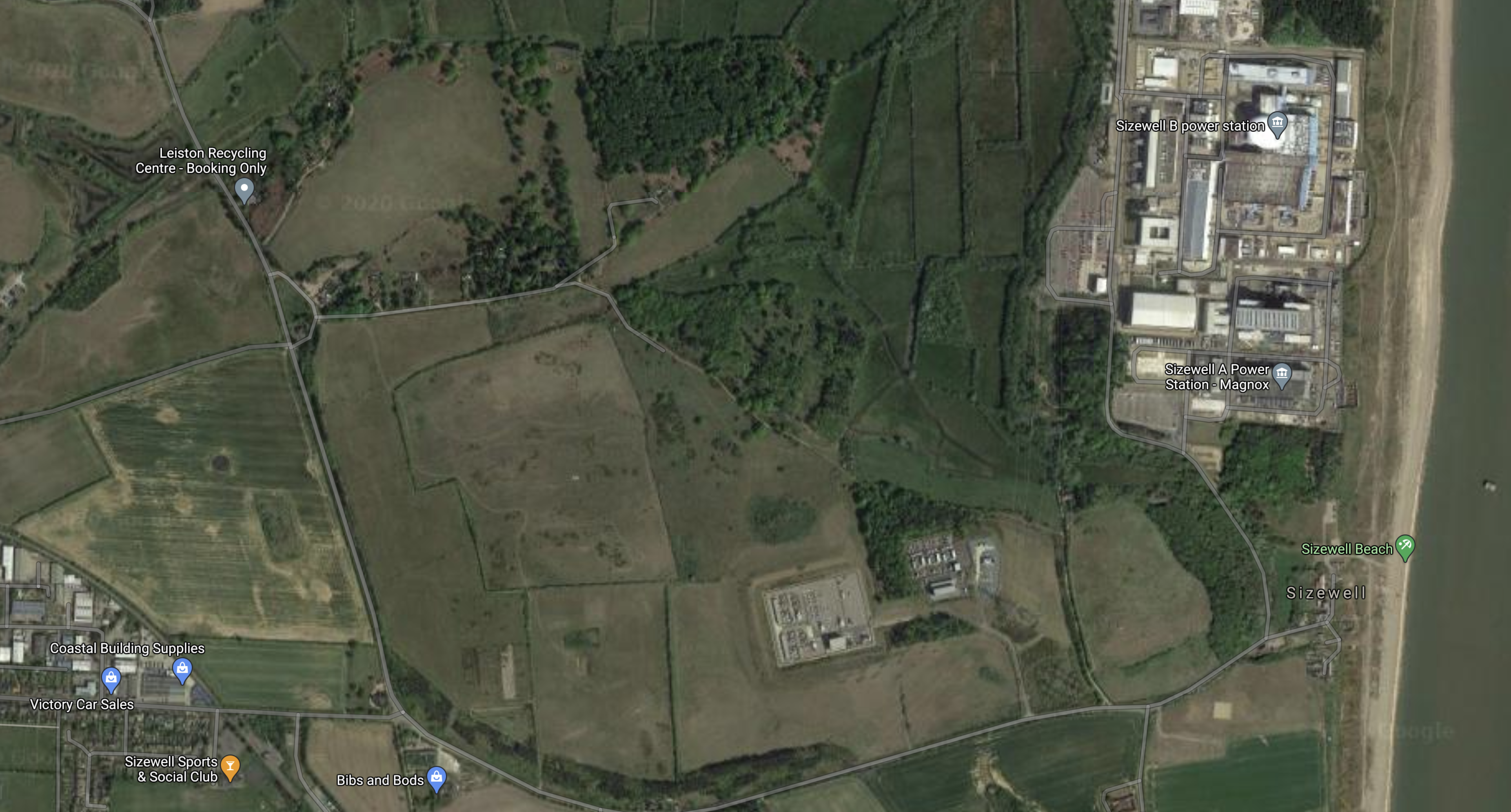
Sizewell A power station, with Sizewell B to its North, is on the coast.
This second Google Map shows the power stations to an enlarged scale.
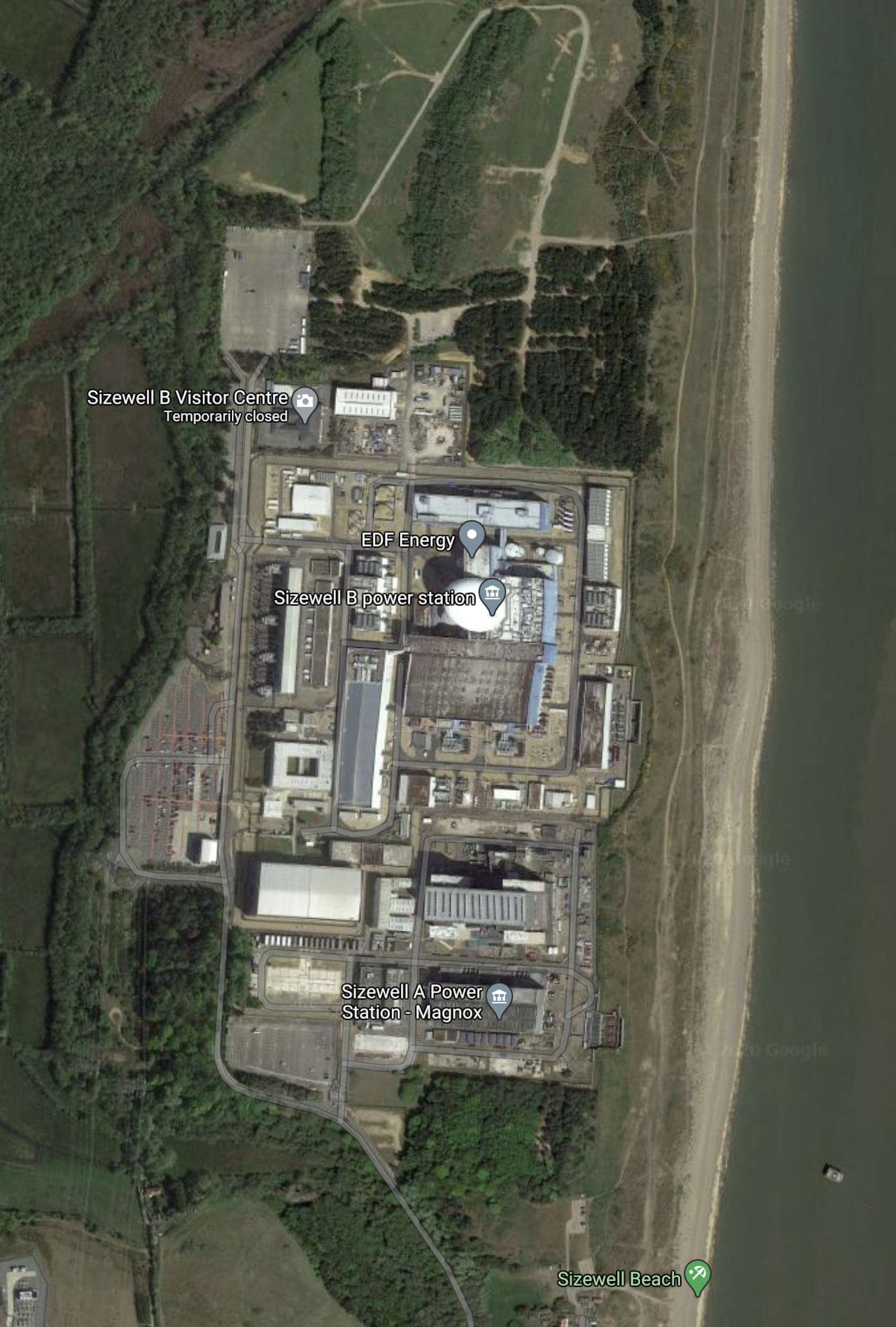
Note the white dome in the middle of Sizewell B.
Sizewell A
Sizewell A power station was shut down at the end of 2006 and is still being decommissioned, according to this extract from Wikipedia.
The power station was shut down on 31 December 2006. The Nuclear Decommissioning Authority (NDA) is responsible for placing contracts for the decommissioning of Sizewell A, at a budgeted cost of £1.2 billion. Defuelling and removal of most buildings is expected to take until 2034, followed by a care and maintenance phase from 2034 to 2092. Demolition of reactor buildings and final site clearance is planned for 2088 to 2098.
Only a few of those, reading this post, will be around to see the final end of Sizewell A.
Note that the size of the Sizewell A site is 245 acres.
It appears to me, that if any power station will be able to be built on the cleared site of Sizewell A, until the late 2080s or 2090s.
Sizewell B
Sizewell B power station opened in 1995 and was originally planned to close in 2035. The owner; EDF Energy, has applied for a twenty-year extension to 2055.
Sizewell C
Sizewell C power station is currently under discussion.
- It will be built by the French, with the help of Chinese money.
- It will have an output of 3260 MW or 3.26 GW.
- It will cost £18 billion.
- It will take twelve years to build.
This Google Map shows Sizewell B and the are to the North.
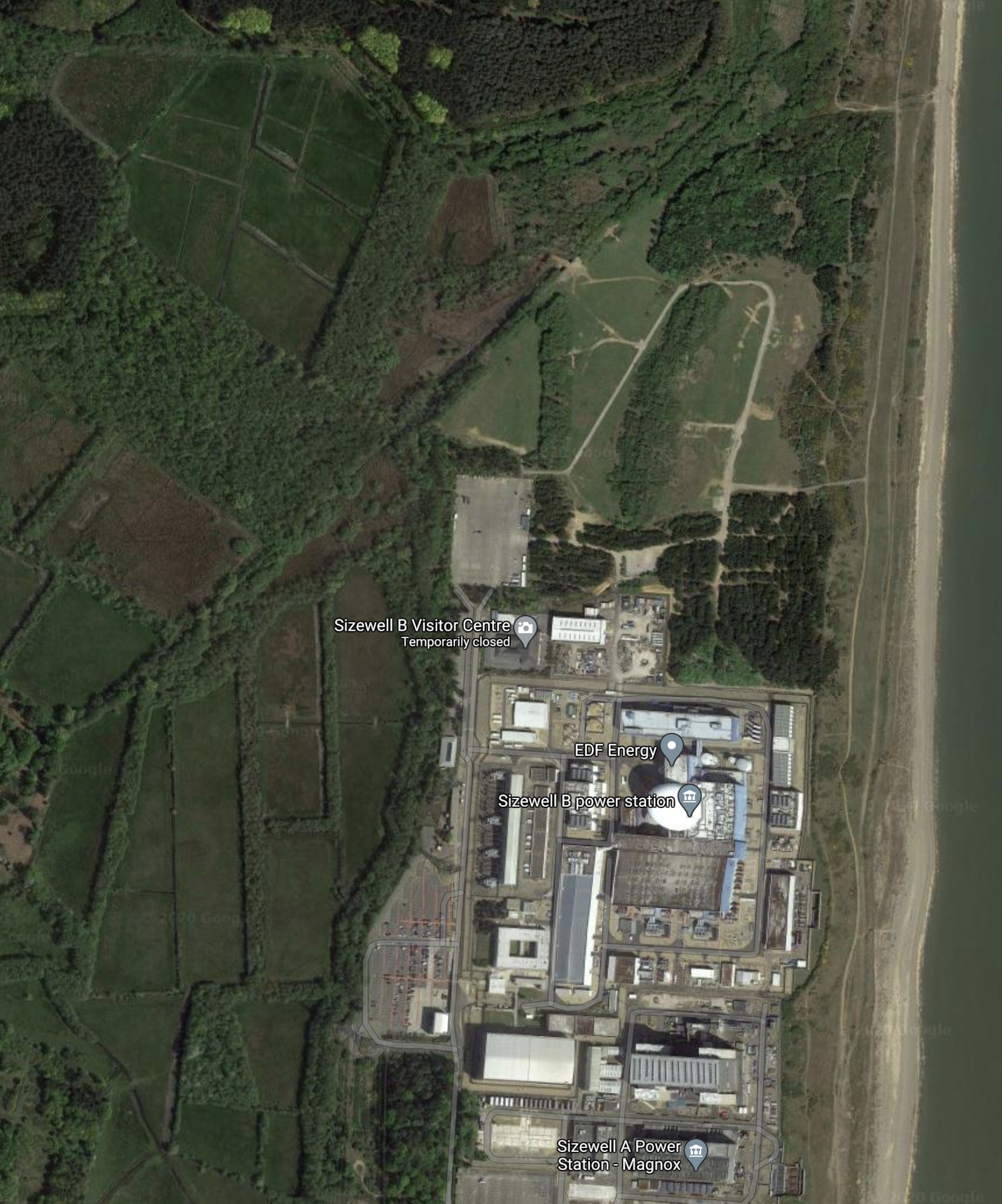
I would assume it will be built in this area.
A Fleet Of Small Modular Nuclear Reactors
These are my thoughts on building a fleet of SMRs at Sizewell instead of the proposed Sizewell C.
Land Use
In Rolls-Royce signs MoU With Exelon For Compact Nuclear Power Stations, I gave these details of the Rolls-Royce design of SMR.
- A Rolls-Royce SMR has an output of 440 MW.
- The target cost is £1.8 billion for the fifth unit built
- Each SMR will occupy 10 acres.
- Eight SMRs would need to be built to match the output of Hinckley Point C, which will occupy 430 acres.
It looks on a simple calculation, that even if the SMRs needed fifteen acres, the amount of land needed would be a lot less.
Connection To The National Grid
The transmission line to the National Grid is already in place.
This Google Map shows the sub-station, which is to the South-West of Sizewell A.
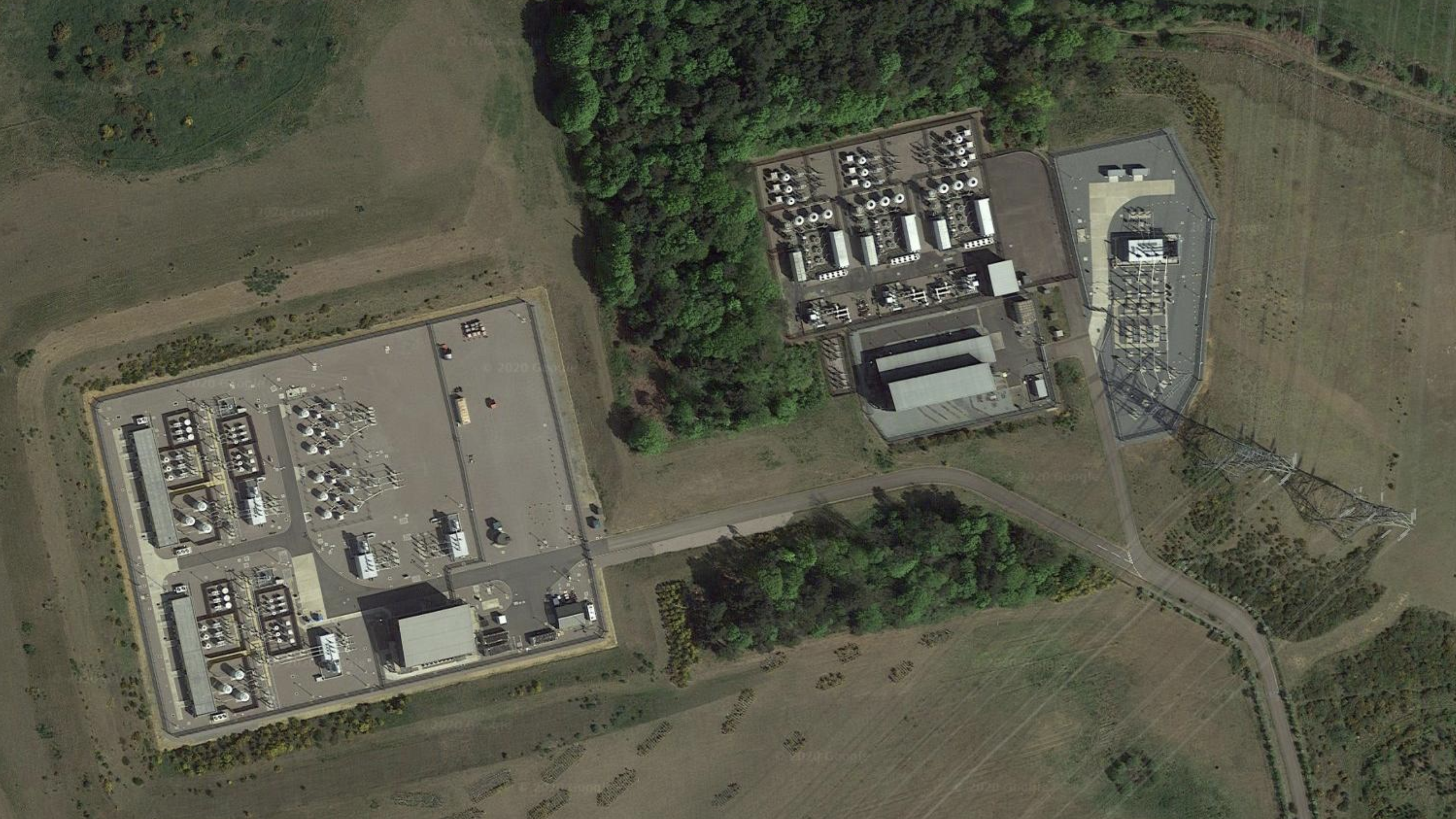
From Sizewell, there is a massive twin overhead line to Ipswich.
This Google Map shows the overhead line as it crosses Junction 53 of the A14 to the West of Ipswich.
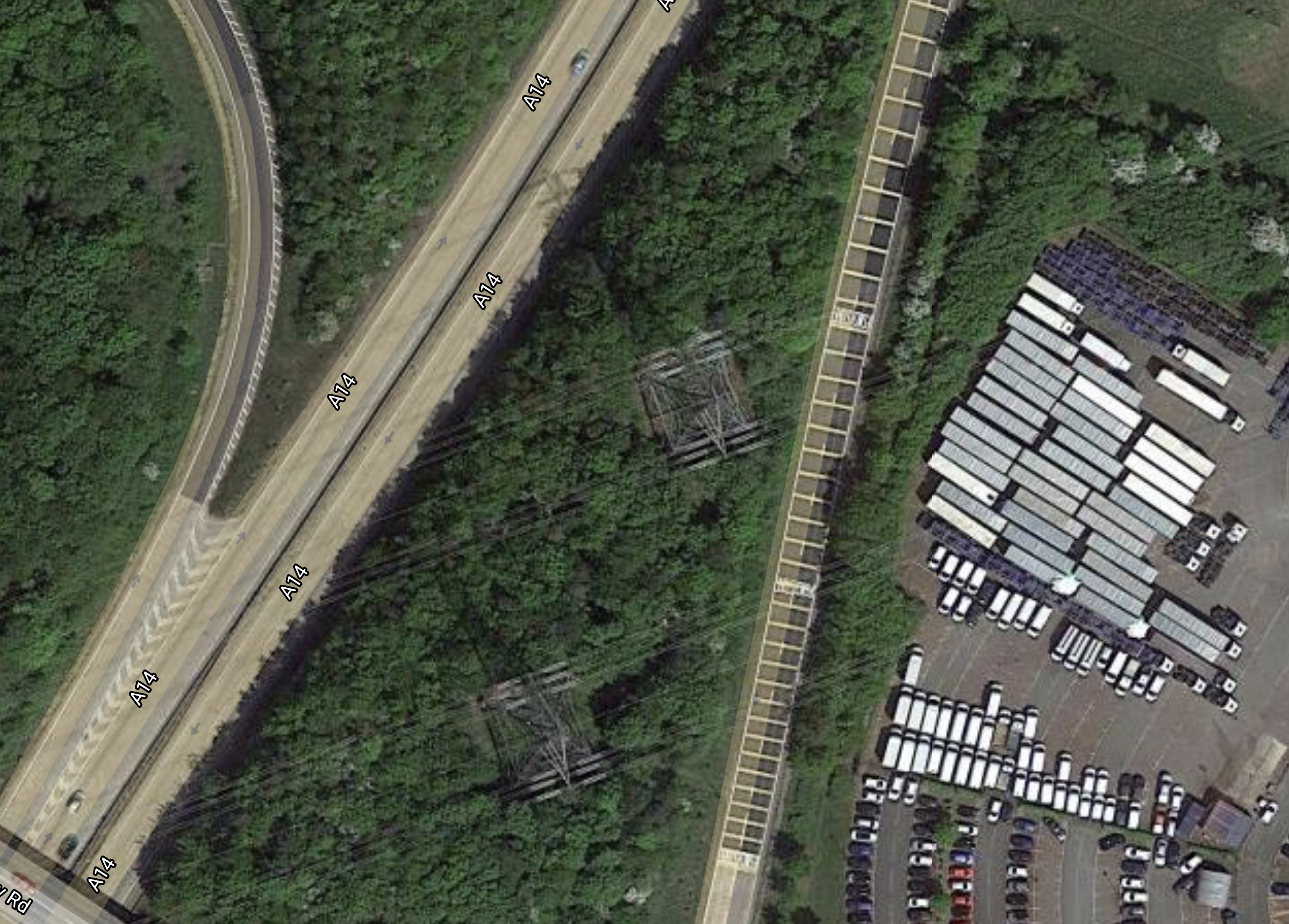
The pylons are in the centre of the map, with the wires going across.
The line has been built for a massive amount of nuclear power at Sizewell.
The Sizewell Railhead
This Google Map shows the railhead at Sizewell.
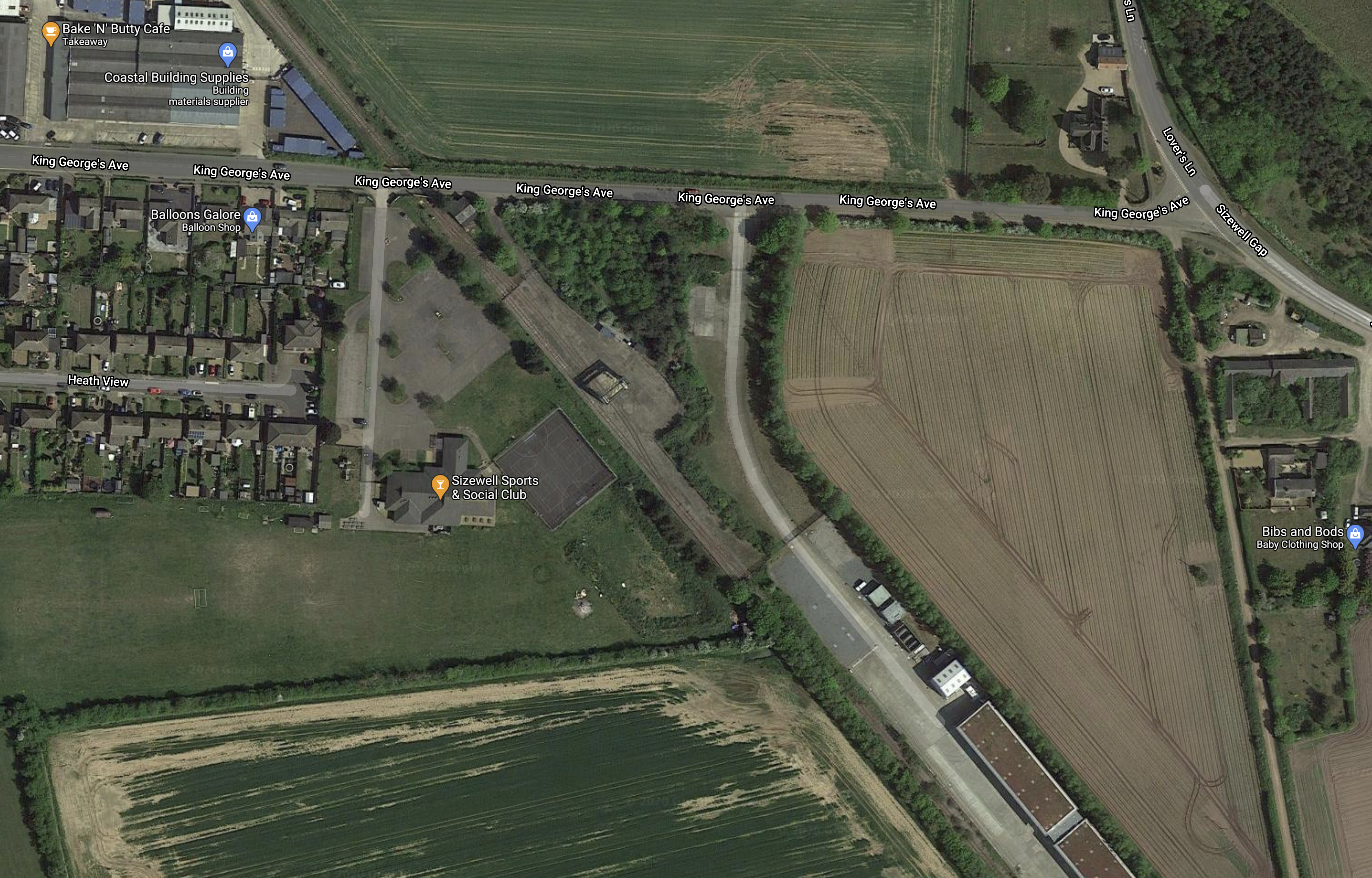
It can also be picked out in the South West corner of the first map.
- The railhead is used to take out spent fuel for processing.
- In the past, it brought in construction materials.
- Wikipedia suggests if the Sizewell C is built, the might be a new railhead closer to the site.
- If a fleet of SMRs were to be built, as the modules are transportable by truck, surely they could be move in by rail to avoid the roads in the area.
- I am an advocate of reinstating the railway from Saxmundham to Aldeburgh, as this would be a way of doubling the frequency on the Southern section of the East Suffolk Line between Saxmundham and Ipswich stations.
I hope that whatever is built at Sizewell, that the rail lines in the area is developed to ease construction, get workers to the site and improve rail services on the East Suffolk Line.
Building A Fleet Of SMRs
One of the disadvantages of a large nuclear power station, is that you can’t get any power from the system until it is complete.
This of course applies to each of the individual units, but because they are smaller and created from a series of modules built in a factory, construction of each member of the fleet should be much quicker.
- Rolls-Royce are aiming for a construction time of 500 days, from the fifth unit off the production line.
- That would mean, that from Day 501, it could be producing power and earning money to pay for its siblings.
- If the eight units were built in series, that would take eleven years to build a fleet of eight.
But as anybody, who has built anything even as humble as a garden shed knows, you build anything in a series of tasks, starting with the foundations.
I suspect that if a fleet were being built, that construction and assembly would overlap, so the total construction time could be reduced.
That’s one of the reasons, I said that building a fleet could be a project manager’s dream.
I suspect that if the project management was top-class, then a build time for a fleet of eight reactors could be nine years or less.
Resources are often a big problem in large projects.
But in a phased program, with the eight units assembled in turn over a number of years, I think things could be a lot easier.
Financing A Fleet Of SMRs
I think that this could be a big advantage of a fleet of SMRs over a large conventional large nuclear power station.
Consider
- I said earlier, that as each unit was completed, it could be producing power and earning money to pay for its siblings.
- Hinckley Point C is budgeted to cost £18 billion.
- Eight Rolls-Royce SMRs could cost only £14.4 billion.
I very much feel that, as you would get a cash-flow from Day 500 and the fleet costs less, that the fleet of smaller stations is easier to finance.
Safety
SMRs will be built to the same safety standards as all the other UK reactors.
In this section on Wikipedia this is said about the Rolls-Royce SMR.
Rolls-Royce is preparing a close-coupled three-loop PWR design, sometimes called the UK SMR.
PWRs or pressurised water reactors are the most common nuclear reactors in the world and their regulation and safety is well-understood.
This is from the History section of their Wikipedia entry.
Several hundred PWRs are used for marine propulsion in aircraft carriers, nuclear submarines and ice breakers. In the US, they were originally designed at the Oak Ridge National Laboratory for use as a nuclear submarine power plant with a fully operational submarine power plant located at the Idaho National Laboratory. Follow-on work was conducted by Westinghouse Bettis Atomic Power Laboratory.
Rolls-Royce have a long history of building PWRs, and Rolls-Royce PWRs have been installed in all the Royal Navy’s nuclear submarines except the first. The Royal Navy’s second nuclear submarine; HMS Valiant, which entered service in 1966, was the first to be powered by a Rolls-Royce PWR.
How much of the design and experience of the nuclear submarine powerplant is carried over into the design of the Rolls-Royce SMR?
I don’t know much about the safety of nuclear power plants, but I would expect that if there was a very serious accident in a small reactor, it would be less serious than a similar accident in a large one.
Also, as the reactors in a fleet would probably be independent of each other, it is unlikely that a fault in one reactor should affect its siblings.
Local Reaction
I lived in the area, when Sizewell B was built and I also went over Sizewell A, whilst it was working.
From personal experience, I believe that many in Suffolk would welcome a fleet of SMRs.
- Sizewell B brought a lot of employment to the area.
- House prices rose!
- Both Sizewell A and B have been well-run incident-free plants
Like me, some would doubt the wisdom of having a Chinese-funded Sizewell C.
Conclusion
Big nuclear has been out-performed by Rolls-Royce

