A Thought On The Texas Floods
I asked Google AI, if Texas is bad for natural disasters.
This was the reply.
Yes, Texas is known to be susceptible to a high number of natural disasters, particularly when compared to other states in the US. Texas experiences a wide variety of natural hazards, including hurricanes, floods, wildfires, tornadoes, hail storms, sinkholes, and droughts. The state has also experienced earthquakes, potentially linked to the extraction of natural resources like oil and gas.
I certainly wouldn’t want to live there, as my one experience of a bad storm in the UK nearly killed me. I wrote about my experiences in The Great Storm.
Trump’s Tax Bill To Cost 830,000 Jobs And Drive Up Bills And Pollution Emissions, Experts Warn
The title of this post, is the same as that of this article on The Guardian.
This is the sub-heading.
Bill will unleash millions more tonnes of planet-heating pollution and couldn’t come at a worse time, say experts
This first paragraph adds a bit more detail.
A Republican push to dismantle clean energy incentives threatens to reverberate across the US by costing more than 830,000 jobs, raising energy bills for US households and threatening to unleash millions more tonnes of the planet-heating pollution that is causing the climate crisis, experts have warned.
After that the news gets worse for the planet and the sooner Tamworth retires or is retired, the better!
Hyundai Unveils Upgraded Xcient Hydrogen Fuel Cell Truck
The title of this post, is the same as that of this article on Automotive Powertrain International.
This is the sub-heading.
Hyundai Motor Company has unveiled the upgraded Xcient fuel cell class-8 heavy-duty truck, which features advanced hydrogen technologies and advanced driver assistance systems (ADAS) tailored for the North American market.
The article is worth a full read, as it shows how the largest American trucks, can be replaced with zero-carbon hydrogen fuel cell trucks.
This is the Hyundai Xcient truck web site.
Another Headache For Fossil Fuels: Liquid Air Energy Storage
The title of this post, is the same as that of this article on Clean Technica.
This article is an honest American look at Highview Power’s liquid air batteries and a must-read.
This is the first paragraph.
Whatever happened to liquid air energy storage? The UK startup Highview Power was going to bring its new liquid air system to the US back in 2019, providing the kind of scaled-up and long duration energy storage needed to support more wind and solar power on the grid. Highview switched gears and headed back home where the grass is greener. Our loss is the UK’s gain…
They first wrote about Highview Power in 2011, which shows how long some of these projects take to come to fruition.
The article also has this view on the state of offshore wind in the United States today.
Perhaps it’s just as well that Highview dropped its US plans when it did. Offshore wind stakeholders in the US were just beginning to find their footing along the Atlantic coast when President Trump took office on January 20 and promptly sent the offshore industry into a death spiral.
If I lived in the US today, I’d thinking about leaving given Trump’s barmy energy policies.
This paragraph from Highview Power’s web site, discloses their backers.
The £300 million funding round was led by the UK Infrastructure Bank (UKIB) and the British multinational energy and services company Centrica, alongside a syndicate of investors including Rio Tinto, Goldman Sachs, KIRKBI and Mosaic Capital.
So at least some American companies believe in Highview Power. KIRKBI is the investment vehicle of the family, that invented Lego.
Wrightbus To Build 1,000 Zero-Emission Buses
The title of this post, is the same as that of this article on The Times.
This is the sub-heading.
Northern Ireland company to ramp up production by 40% and recruit hundreds more employees as it also develops the UK’’s first long-distance hydrogen coach
These are the first two paragraphs, which add more detail.
Wrightbus, the Northern Ireland bus manufacturer, could be supplying as many as 1,000 zero-emission vehicles to depots around the UK as it increases production by 40 per cent over a two-year period and takes on hundreds more workers.
The company, best known for the redesigned 21st century take on the Routemaster ordered by the former mayor of London Boris Johnson, also announced it is to spend £5 million developing the UK’s first long-distance hydrogen coach capable of travelling 1,000km (621 miles) on a single recharging of its fuel cells.
These two paragraphs describe their production and employment plans.
Jean-Marc Gales, the former senior Peugeot director who is Wrightbus’s chief executive, said production at its Northern Ireland plant would go from 1,000 vehicles last year to 1,200 this year and 1,400 in 2026.
Over the same period the company’s workforce will grow from 1,500 to 2,500.
Peter Kyle, the secretary of state for science, innovation and technology, said this.
The level of innovation at Wrightbus and their quality standards have been recognised.
That is surely rare praise for a private company from a Labour Minster.
I first wrote about Wrightbus’s new hydrogen coach in early March, when I wrote Wrightbus Goes Back To The Future As It Relaunches The Contour Coach, which was based on this Wrightbus press release, which has the same title.
I said this in my post.
Wrightbus is entering the coach market for the first time in more than 30 years with the launch of two new vehicles in the next 18 months.
The first vehicle to hit the market is the Contour, a low-emission 55-seater coach that was launched at a customer showcase event today (March 5).
It’s a case of back to the future for Wrightbus, which last produced a Contour coach in 1987 before retiring the vehicle.
The second vehicle, a zero-emission hydrogen coach – which is under development in Ballymena, Northern Ireland – will be added to the Wrightbus coach range within the next 18 months to help drive decarbonisation of the sector.
The low emission Contour has a lead time of just six months from order, which is considerably faster than the current one-to-two-year average wait customers have come to expect from the sector. Featuring a Cummins Euro 6 400BHP X11 engine and a ZF automatic gearbox, the modern-day Contour has been built with comfort in mind, with up to 55 reclining seats – each with its own USB port – alongside other modern safety features. Competitively priced and available with or without PSVAR compliance, there is also the option of the vehicle being ‘pre-prepared’, protecting the vehicle’s ‘second life’ and flexibility.
The coach has a range of bespoke options for customers to choose from and is designed to maximise luggage space and functionality.
The low emission Contour coach was to have been built in China.
But events have moved on fast in the last month, with Trump and China trading insults on tariffs almost daily.
From today’s article in The Times and a press release from the Government, which is entitled Science Secretary Hails Wrightbus As Company Pledges £25 million To Bolster UK’s Green Transport Revolution And Drive Growth, it appears that the Chinese coach has been dropped.
Could the plan now be something like this?
- The low emission Contour coach will either be dropped, built in Ballymena or perhaps even built on JCB’s site in Texas.
- It might possibly be advantageous to build the coach in the United States to balance the tariffs and target the North American market.
- I would feel, that North America could be a lucrative market for the larger thousand kilometre coach.
- With the low emission Contour coach, Cummins get a chance to show the United States their excellent hydrogen technology.
- Trump can claim, that he’s brought jobs back to the United States.
- If Wrightbus and/or JCB build the low emission Contour coach, they could probably create a better product and get it to market earlier.
I suspect we’ll learn more of Wrightbus’s plans in the next few weeks.
Arriva Group Invests In New Battery Hybrid Train Fleet In Boost To UK Rail Industry
The title of this post, is the same as that of this news item from Arriva Group.
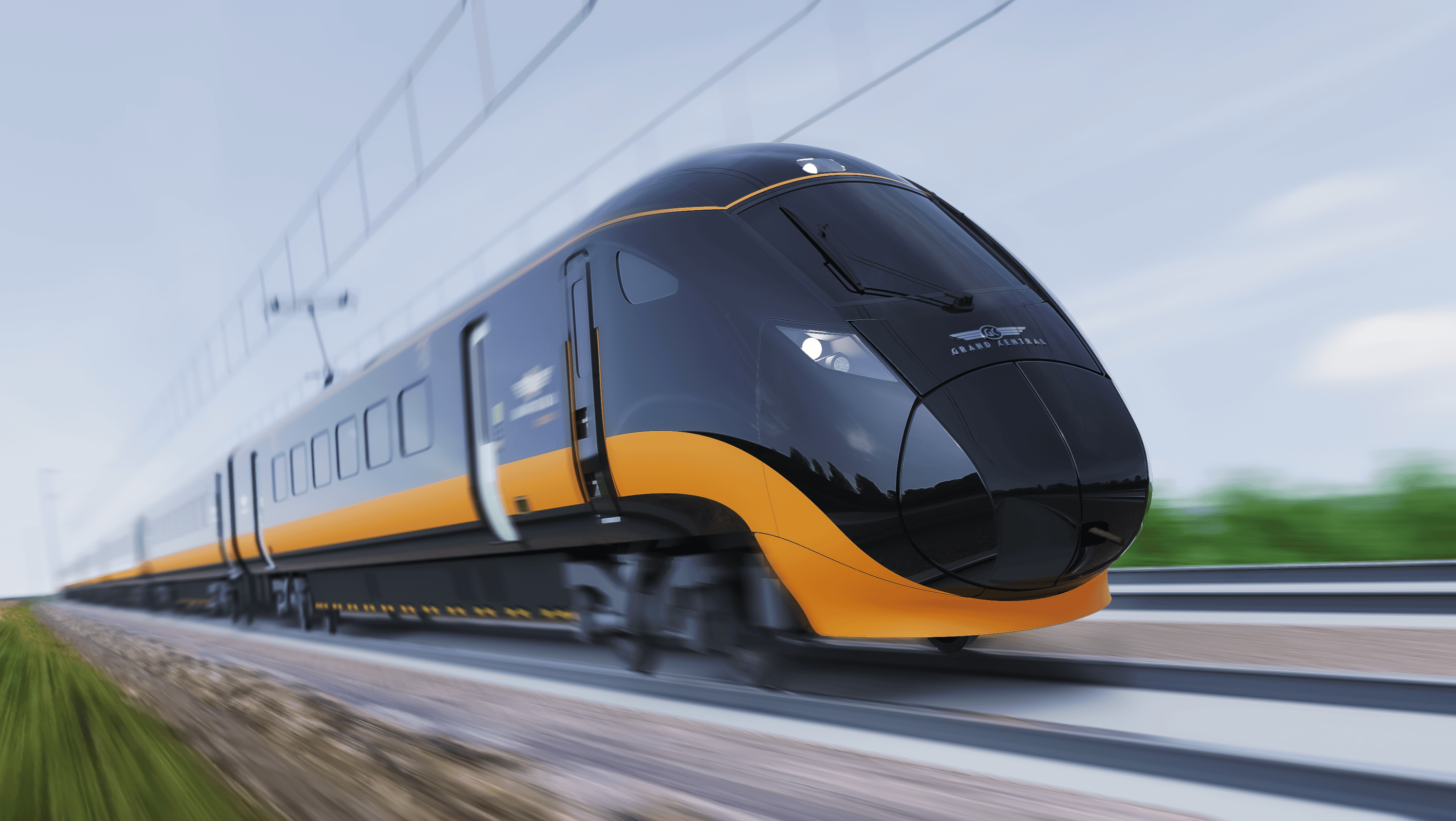
These four bullet points act as sub-headings.
- Order worth around £300 million for fleet of new trains, which will increase seats by 20 per cent, improving capacity and connectivity.
- 45 rail cars to be manufactured at Hitachi Rail in the North East and financed by Angel Trains, helping secure highly skilled jobs and unlocking a new advanced manufacturing opportunity for rail.
- State-of-the-art ‘tri-mode’ train technology has proven its ability to cut emissions and fuel costs by around 30 per cent to support UK Government’s decarbonisation agenda.
- Announcement is made from Hitachi’s Newton Aycliffe factory and attended by the Secretary of State for Transport, Heidi Alexander MP.
These three paragraphs give more details.
Arriva Group announced today an order for nine cutting-edge battery hybrid trains to replace its entire Grand Central fleet, providing a major boost to regional economies and offering passengers more comfortable, greener travel options.
The order for 45 Hitachi Rail ‘tri-mode’ cars, which have the flexibility to run on electrified and non-electrified tracks, along with a 10-year maintenance contract, represents an investment of around £300 million. Tri-mode means the trains can be powered using electricity, battery or diesel.
It follows approval by the rail regulator for extended track access rights for Grand Central’s existing services through to 2038, with the investment underpinning Arriva’s long-term commitment to UK rail and to delivering sustainable public transport solutions to communities up and down the country and across Europe.
The trains will be built by Hitachi at Newton Aycliffe.
I have some further thoughts and questions.
What Distances Will The Trains Run Away From Electrification?
The distances that the various services will run away from electrification are as follows.
- King’s Cross and Bradford Interchange – Doncaster and Bradford Interchange – 52.1 miles.
- King’s Cross and Cleethorpes – Doncaster and Cleethorpes – 52.1 miles.
- King’s Cross and Sunderland – Longlands junction and Sunderland – 48.5 miles.
It would appear that a train with a range away from electrification of 55 miles would be enough, if there were to be charging at all the destinations.
Will The Trains Be Able To Take The Great Northern And Great Eastern Joint Line (GNGE) Diversion Via Lincoln On The East Coast Main Line?
I discussed using this diversion in detail in London And Edinburgh By Lumo Using the Joint Line Diversion.
In that post, I said this.
The January 2024 Edition of Modern Railways says that the diversion is approximately 90 miles or 145 kilometers.
If the trains have a 90 mile capability on batteries and/or diesel, they will be able to use the diversion.
As Hull Trains, LNER and Lumo all need this ability to take the GNGE Diversion, I suspect, it will be a tick-box on the order form for the trains.
When Will The Trains Be In Service?
The news item says this.
The trains will be delivered in 2028 under a 10-year leasing arrangement, in partnership and financed by Angel Trains.
Will The New Trains Be Faster?
They might save a couple of minutes, if Doncaster is the first stop.
Will The New Trains Be Quieter?
The news item says this about noise and emissions.
State-of-the-art ‘tri-mode’ train technology has proven its ability to cut emissions and fuel costs by around 30 per cent to support UK Government’s decarbonisation agenda.
Hitachi have said that the diesel engines will not run in stations.
Could The Trains Run Grand Central’s Routes Carbon-Free?
In The Data Sheet For Hitachi Battery Electric Trains, I came to these conclusions
- The battery pack has a capacity of 750 kWh.
- A five-car train needs three battery-packs to travel 100 miles.
- A nine-car train needs five battery-packs to travel 100 miles.
- The maximum range of a five-car train with three batteries is 117 miles.
- The maximum range of a nine-car train with five batteries is 121 miles.
As battery technology gets better, these distances will increase.
If I was choosing the trains for Grand Central, the trains would be able to operate these routes without using diesel.
- Doncaster and Bradford Interchange and return.
- Doncaster and Cleethorpes and return.
- Longlands junction and Sunderland and return.
Passengers might not like to have noisy passengers.
Probably, the best insurance policy to avoid running out of battery power, would be to have perhaps fifty metres of electrification at terminal stations. Hitachi claim they can offer a nice line in short lengths of electrification.
Quiet Trains Should Attract Passengers
I’ve seen it before and also with buses.
The Number Of Trains Ordered
The basic order is for nine trains, but Railway Gazette says this.
Arriva welcomed the ‘swift decision-making’ by ORR and the backing of the Department for Transport and Network Rail. It has also submitted applications to run more trains to Bradford and introduce services to Cleethorpes, and has an option to buy more trains if these are approved.
I’ve read somewhere that the option is for three extra trains.
So that’s a total of twelve, which would replace the ten Class 180 trains and two Class 221 trains, that Grand Central Trains currently run.
What About Chiltern Railways And CrossCountry?
Train operating companies Chiltern Railways, CrossCountry and Grand Central Trains are all wholly owned subsidiaries of Arriva Trains UK, who are described like this in the first paragraph of their Wikipedia entry.
Arriva UK Trains Limited is the company that oversees Arriva’s train operating companies in the United Kingdom. It gained its first franchises in February 2000. These were later lost, though several others were gained. In January 2010, with the take-over of Arriva by Deutsche Bahn, Arriva UK Trains also took over the running of those formerly overseen by DB Regio UK Limited
Arriva is ultimately owned by American infrastructure investment company; I Squared Capital.
Both Chiltern Railways and CrossCountry have trains, that are coming to the date, when they will need to be replaced and similar trains to those ordered by Grand Central could be suitable. to replace some.
Chiltern Railways have six rakes of Mark 3 coaches, that are hauled by diesel locomotives between London Marylebone and Birmingham Moor Street stations, These rakes of coaches could be replaced by Hitachi tri-mode trains, of perhaps five or six cars.
Chiltern Railways also have about sixty assorted diesel multiple units totalling up to about 150 carriages.
CrossCountry Trains have twenty-nine two- or three-car Class 170 trains and sixty-one four- or five car Class 220 or 221 trains. All these ninety trains were built this century and are diesel-powered.
The Government’s policy of net-zero by 2050, would probably mean a significant number of these smaller diesel multiple units need to be replaced by 2030.
If the Grand Central Trains new Hitachi trains are a success, then changing the longer four-, five- and six-car trains for similar Hitachi trains, would be a low-risk replacement strategy for I Squared Capital, that could be applied at Chiltern Railways and CrossCountry.
I can also see a need for a two-, three- or four-car tri-mode train for Chiltern Railways and CrossCountry.
Was The Date Of The Announcement Significant?
In October 2020, I wrote Hitachi Targets Export Opportunities From Newton Aycliffe and I believe that tri-mode trains like these that Grand Central have ordered could have export opportunities.
One country for exports has possibilities and that is the United States.
- Hitachi AT-300 trains like these don’t need expensive high-speed tracks and there are probably many lines in the United States, where these trains could fit existing tracks.
- This page on the Hitachi Rail web site is entitled Hitachi Rail in the USA and Canada.
- In the UK, companies like GWR, LNER, Southeastern and TransPennine Express effectively use theHitachi trains as fast commuter trains on some routes.
- Trump’s tariffs would only be 10 % on these trains.
- The Grand Central version looks very stylish!
- Hitachi’s battery technology is owned by Turntide Technology, who are a US company.
- For some routes, the trains would probably only need to be battery-electric.
Has the experience of running Chiltern Railways, CrossCountry and Grand Central Trains convinced I Squared Capital, that running railways is a good investment?
Have I Squared Capital identified some railroads in the United States, that could follow a similar upgrade path to Chiltern Railways?
Was it significant that the order was announced the day after Trump’s tariffs?
.
Trump’s Tariffs Threaten To Wipe Out UK’s Economic Growth
The title of this post is the same as that of this article on The Times.
This is the sub-heading.
Rachel Reeves could be forced to raise taxes or cut spending after the US president announced plans for tariffs of up to 25 per cent on cars
These three paragraphs add more detail.
Rachel Reeves faces having to raise taxes or cut spending if President Trump follows through on his threat to impose tariffs on Britain next week, the official budget watchdog has warned.
The chancellor was forced to announce a £14 billion package of cuts to repair the public finances in her spring statement after the Office for Budget Responsibility halved growth forecasts.
But the budget watchdog warned that there was a 50 per cent chance that Reeves would be forced to return with further cuts or tax rises as soon as October amid concerns that the UK’s economic outlook will deteriorate still further.
So I will hit back in the only way I can and avoid buying any goods made by US companies.
I have started by removing any US-owned products from my Ocado order on Saturday.
Back To The Dark Ages In West Virginia?
This article on WBOY is entitled West Virginia Senators Aim To Revitalize Coal Industry.
These are the introductory paragraphs.
If you’re tired of rising utility bills, you are not alone. West Virginia senators say they share the same feelings and believe the answer is right under our feet.
Revitalizing West Virginia’s coal industry and bringing down utility costs for customers is the goal of two pieces of legislation originating in the Senate.
A resolution known as the Coal Renaissance Act aims to keep current coal operations running as well as open up new opportunities for the industry, expanding mining in West Virginia.
According to Senators in support of the act, the optimum capacity factor for coal plants to run at is 69%. Currently, industry leaders say that number is down to around 30% to 40%.
A new bill known as the Reliable and Affordable Electricity Act incentivizes utility companies to rely on West Virginia coal.
There is also going to be a Senate bill, that will abolish tax breaks for wind farms.
In the UK, it is my belief, that coal died with the Aberfan disaster in 1966, which is described in this first paragraph of the disaster’s Wikipedia entry.
The Aberfan disaster (Welsh: Trychineb Aberfan) was the catastrophic collapse of a colliery spoil tip on 21 October 1966. The tip had been created on a mountain slope above the Welsh village of Aberfan, near Merthyr Tydfil, and overlaid a natural spring. Heavy rain led to a build-up of water within the tip which caused it to suddenly slide downhill as a slurry, killing 116 children and 28 adults as it engulfed Pantglas Junior School and a row of houses. The tip was the responsibility of the National Coal Board (NCB), and the subsequent inquiry placed the blame for the disaster on the organisation and nine named employees.
I do have memories of coal mining in my brain.
- As a young child, I can remember being driven past the Kentish collieries and seeing the blackened landscape of the Garden of England.
- Newspapers of the 1950s and 1960s published, their share of mining disasters.
- In the 1980s, I drove through coal mining country in the United States and was appalled at all the fumes and smoke from the coal-fired power stations and the trucks delivering coal. Nothing as civilised as a merry-go-round train was used.
- In 2015, I visited Katowice and wrote An Excursion In Katowice. The air was thick with coal smoke from the coal-fired power stations.
I also remember at the Jobs Fair, when I left Liverpool University in 1968, seeing the recruiter from the National Coal Board sitting there alone, as if he’d got the plague. Graduates had decided, that no way, were they going to work in the coal industry.
The West Virginia senators, should be certified, if they want to bring back coal.
Thoughts On The Washington National Air Tragedy
I flew light aircraft for over twenty years as a hobby and to get about on business. I flew mainly in the UK, but flew for perhaps fifty to a hundred hours in Australia, France, Ireland, Italy and the United States. I flew planes on to islands like the Scillies in the UK, the Lido in Venice and the Barrier Reef in Australia. It was great fun and I enjoyed it immensely.
I had a friend, who had been an RAF Air Traffic Controller, who would be horrified at Trump’s remarks on diversity, as although he was white, he had been born in Tobago and had many ATC colleagues who were not white.
Flying around the world, most ATC personnel, try to smooth you on your way, even in France and Italy. But American ATC seems to work under unnecessary pressure because they allow planes to where British, French and Australian ATC wouldn’t.
I was told in the 1970s, that aviation experts, wanted to close National Airport, but the politicians wouldn’t allow it.
If I was Trump, I would bring in outside experts from somewhere like Australia, where in my opinion, they do ATC so much better than the Americans.
US President Trump Issues Executive Order Suspending Offshore Wind Leasing
The title of this post, is the same as that of this article on offshoreWIND.biz.
This is the guts of the article.
US President Donald Trump has issued an Executive Order pausing offshore wind leasing on the US Outer Continental Shelf (OCS) and mandating a review of the federal government’s leasing and permitting practices for wind projects. The Order also stops all relevant agencies from issuing approvals, either new or renewed, for both onshore and offshore wind projects until the review is completed.
The following was the response from someone with intelligence, sense and authority.
After the White House issued the Executive Order, Liz Burdock, founder and CEO of the US offshore renewable energy industry organisation, Oceantic Network, said.
Today’s executive order pausing offshore wind leasing and permitting is a blow to the American offshore wind industry and hurts the hundreds of U.S. supply chain companies and thousands of workers already building more American energy. While under a National Energy Emergency created by an unprecedented rise in energy demand, we should be working to quickly bring generation online instead of curtailing a power source capable of providing base load generation and creating new jobs across 40 states.
I wouldn’t be surprised to see some of those companies and their equipment ending up in the UK and Scotland in particular.
 The Anonymous Widower