Two Celtic Sea Floating Wind Projects Could Be Delivered By 2028
The title of this post, is the same as that of this article on offshoreWIND.biz.
This is the first paragraph.
Falck Renewables and BlueFloat Energy have said that they are looking at early delivery of their two floating wind projects in the Celtic Sea, called Llywelyn and Petroc, which have grid connections secured and almost a year’s worth of bird surveys already completed.
These would add two extra 300 MW wind farms to the Celtic Sea.
In Enter The Dragon, I indicated the potential of renewable energy around Wales based on this article on the Engineer is entitled Unlocking The Renewables Potential Of The Celtic Sea. This sentence from the article talks about the possibilities of offshore wind in the Celtic Sea.
The Celtic Sea – which extends south off Wales and Ireland down past Cornwall and Brittany to the edge of the continental shelf – is estimated to have around 50GW of wind generating capacity alone.
The article also talks about Blue Gem Wind and their Erebus and Valorous wind farm projects in the Celtic Sea, that I wrote about in Blue Gem Wind.
There now appears to be four floating wind farms under development in the Celtic Sea between the South-West corner of Wales and the Devon and Cornwall Peninsular.
- Blue Gem Wind – Erebus – 100 MW Demonstration project – 27 miles offshore
- Blue Gem Wind – Valorus – 300 MW Early-Commercial project – 31 miles offshore
- Falck Renewables and BlueFloat Energy – Petroc – 300 MW project – 37 miles offshore
- Falck Renewables and BlueFloat Energy Llywelyn – 300 MW project – 40 miles offshore
But they do create a starter for a GW.
Both consortia seem to have similar objectives.
- To use a stepping-stone approach, gradually building in size.
- To involve the local community in creating a supply chain.
- Create long-term benefits for the region.
If these and other consortia fill the Celtic Sea with 50 GW of floating wind turbines, then we’ll all benefit.
How Britannia With Help From Her Friends Can Rule The Waves And The Wind
The Government doesn’t seem to have published its future energy plans yet, but that hasn’t stopped the BBC speculating in this article on their web site, which is entitled Energy Strategy: UK Plans Eight New Nuclear Reactors To Boost Production.
These are the first two paragraphs.
Up to eight more nuclear reactors could be delivered on existing sites as part of the UK’s new energy strategy.
The plan, which aims to boost UK energy independence and tackle rising prices, also includes plans to increase wind, hydrogen and solar production.
Other points include.
- Up to 95% of the UK’s electricity could come from low-carbon sources by 2030.
- 50 gigawatts (GW) of energy through offshore wind farms, which would be more than enough to power every home in the UK.
- One of the big points of contention is thought to have been the construction of onshore wind turbines.
- Targets for hydrogen production are being doubled to help provide cleaner energy for industry as well as for power, transport and potentially heating.
- A new licensing round for North Sea oil and gas projects.
- A heat pump accelerator program.
In this post I shall only be looking at one technology – offshore wind and in particular offshore floating wind.
Who Are Our Friends?
I will start with explaining, who I see as our friends, in the title of this post.
The Seas Around Us
If we are talking about offshore winds around the the UK, then the seas around the UK are surely our biggest and most-needed friend.
The Island Of Ireland
The seas are shared with the island of Ireland and the UK and the Republic must work together to maximise our joint opportunities.
As some of the largest offshore wind farm proposals, between Wales and Ireland involve a Welsh company called Blue Gem Wind, who are a partnership between Irish company; Simply Blue Energy, and French company; TotalEnergies, we already seem to be working with the Irish and the French.
The City Of London
Large insurance and pension companies, based in the City of London like, abrdn, Aviva, L & G and others are always looking for investments with which to provide income to back their insurance business and our pensions.
In World’s Largest Wind Farm Attracts Huge Backing From Insurance Giant, I describe why and how, Aviva back wind farms.
Germany
Germany are certainly on our side, despite being in a mess of Mutti Merkel’s making, because she got the country too deeply dependant on Vlad the Mad’s tainted gas.
- German utilities are providing finance to build wind farms in British waters.
- German company; Siemens is manufacturing turbine blades in Hull.
- Germany wouldn’t mind buying any electricity and hydrogen we have spare. Especially, as we haven’t invaded them since 1944.
I suspect a mutually-beneficial relationship can be negotiated.
Norway
I have customised software for a number of countries, including Iran, Saudi Arabia, South Korea and the United States and despite selling large numbers of systems to Norway, the Norwegians never requested any modifications.
They are generally easy-going people and they are great friends of the UK. They were certainly a fertile country for the sale of Artemis systems.
Just as the UK worked together with the Norwegians to deliver North Sea Oil, we are now starting to work together to develop renewable energy in the North Sea.
In UK To Norway Sub-Sea Green Power Cable Operational, I describe how we have built the North Sea Link with the Norwegians, which will link the British and Norwegian energy networks to our mutual benefit.
In Is This The World’s Most Ambitious Green Energy Solution?, I describe an ambitious plan called Northern Horizons, proposed by Norwegian company; Aker Solutions to build a 10 GW floating wind farm, which will be 120 km to the North-East of the Shetlands.
Floating Wind Turbines
This is the introduction of the Wikipedia entry for floating wind turbines.
A floating wind turbine is an offshore wind turbine mounted on a floating structure that allows the turbine to generate electricity in water depths where fixed-foundation turbines are not feasible. Floating wind farms have the potential to significantly increase the sea area available for offshore wind farms, especially in countries with limited shallow waters, such as Japan, France and US West coast. Locating wind farms further offshore can also reduce visual pollution, provide better accommodation for fishing and shipping lanes, and reach stronger and more consistent winds.
At its simplest a floating wind farm consists of a semi-submersible platform, which is securely anchored to the sea-bed to provide a firm platform on which to erect a standard wind turbine.
There are currently two operational floating wind farms off the East Coast of Scotland and one in the Atlantic off the Portuguese coast.
- These wind farms are fairly small and use between three and five turbines to generate between 25-50 MW.
- The largest current floating turbines are the 9.5 MW turbines in the Kincardine Wind Farm in Scotland, but already engineers are talking of 14 MW and 20 MW floating turbines.
- Experience of the operation of floating wind turbines, indicates that they can have capacity factors in excess of 50 %.
- Floating wind turbines can be erected on their floats in the safety of a port using a dockside crane and then towed into position.
- Floating wind turbines can be towed into a suitable port for servicing and upgrading.
Many serious engineers and economists, think that floating wind farms are the future.
The Energy Density of Fixed Foundation And Floating Wind Farms
In ScotWind Offshore Wind Leasing Delivers Major Boost To Scotland’s Net Zero Aspirations, I summarised the latest round of Scotwind offshore wind leases.
- Six new fixed foundation wind farms will give a capacity of 9.7 GW in 3042 km² or about 3.2 MW per km².
- Ten new floating wind farms will give a capacity of 14.6 GW in 4193 km² or about 3.5 MW per km².
Note.
- Floating wind farms have a small advantage in terms of energy density over those with fixed foundations.
- Suppose these energy densities are achieved using 14 MW turbines.
- Engineers are talking of 20 MW turbines.
- Using large turbines could increase the energy density by 20/14 or 43 %
We could see in a few years with 20 MW turbines, fixed foundation turbines having an energy density of 4.6 MW per km², with floating turbines having 5 MW per km².
The Potential Of A Ten-Mile Square In The Seas Around Us
I will assume.
- It is at least 100 km from land.
- The water would be at least 100 metres deep.
- There are no structures in the area.
And calculate.
- The area will be a hundred square miles, which is smaller than the county of Rutland.
- This will be 259 square kilometres.
If it were to be filled with floating wind turbines at a density of 5 MW per km², the capacity would be 1300 MW or 1.3 GW.
There must be hundreds of empty ten-mile squares in the seas around us.
Offshore Hydrogen Production And Storage
I believe in the near future, that a lot of offshore wind energy will be converted to hydrogen offshore.
- Electrolysers could be combined with wind turbines.
- Larger electrolysers could be combined with sub-stations collecting the electricity.
- In Torvex Energy, I discuss a method to create hydrogen from seawater, without having to desalinate the water. Surely, this technology would be ideal for offshore electrolysis.
Hydrogen would be brought to shore using pipelines, some of which could be repurposed from existing gas pipelines, that are now redundant, as the gas-fields they served have no gas left.
I also suspect that hydrogen could be stored in a handy depleted gas field or perhaps some form of specialist storage infrastructure.
Combining Wind And Wave Power In A Single Device
Marine Power Systems are a Welsh company, that has developed a semi-submersible structure, that can support a large wind turbine and/or a wave-power generator.
This is the mission statement on their home page.
Marine Power Systems is revolutionising the way in which we harvest energy from the world’s oceans.
Our flexible technology is the only solution of its type that can be configured to harness wind and wave energy, either as a combined solution or on their own, in deep water. Built on common platform our devices deliver both cost efficiency and performance throughout the entire product lifecycle.
Our structurally efficient floating platform, PelaFlex, brings excellent stability and straightforward deployment and maintenance. The PelaGen wave energy converter represents market-leading technology and generates energy at an extremely competitive cost of energy.
Through optimised farm layout and the combination of wind and wave energy, project developers can best exploit the energy resource for any given area of seabed.
We are unlocking the power of oceans.
There is a link on the page to more pages, that explain the technology.
It looks to me, that it is well-designed technology, that has a high-chance of being successful.
It should also be noted that according to this news page on the Marine Power Systems web site, which is entitled MPS Lands £3.5M Of Funding From UK Government, the UK government feel the technology is worth backing.
I certainly believe that if Marine Power Systems are not successful, then someone else will build on their original work.
If wind and wave power can successfully be paired in a single float, then this must surely increase the energy production at each float/turbine in the floating wind farm.
Energy Storage In Wind Turbines
The output of wind farms can be very variable, as the wind huffs and puffs, but I believe we will see energy storage in wind turbines to moderate the electricity and deliver a steadier output.
Using lithium-ion or other batteries may be possible, but with floating offshore turbines, there might be scope to use the deep sea beneath the float and the turbine.
Hybrid Wind Farms
In the latest round of Scotwind offshore wind leases, one wind farm stands out as different. Magnora ASA’s ScotWind N3 Offshore Wind Farm is described as a floating offshore wind farm with a concrete floater.
I can see more wind farms built using this model, where there is another fixed or floating platform acts as control centre, sub-station, energy store or hydrogen electrolyser.
How Much Electricity Could Be Produced In UK And Irish Waters?
I will use the following assumptions.
- Much of the new capacity will be floating wind turbines in deep water.
- The floating wind turbines are at a density of around 5 MW per km²
This Google Map shows the British Isles.
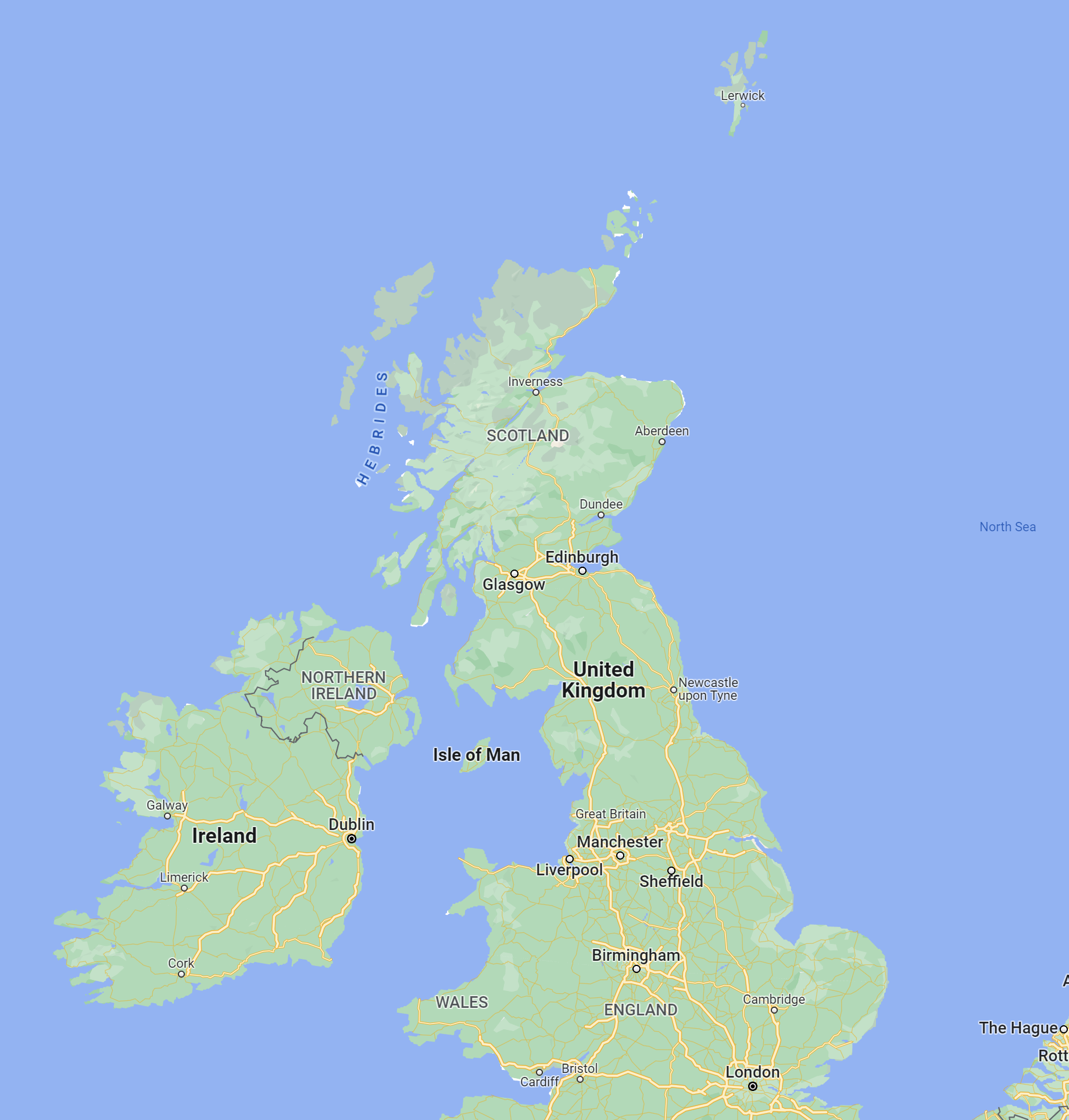
I will look at various seas.
The Celtic Sea
The Celtic Sea is to the South-West of Wales and the South of Ireland.
In Blue Gem Wind, I posted this extract from the The Our Projects page of the Blue Gem Wind web site.
Floating wind is set to become a key technology in the fight against climate change with over 80% of the worlds wind resource in water deeper than 60 metres. Independent studies have suggested there could be as much as 50GW of electricity capacity available in the Celtic Sea waters of the UK and Ireland. This renewable energy resource could play a key role in the UK meeting the 2050 Net-Zero target required to mitigate climate change. Floating wind will provide new low carbon supply chain opportunities, support coastal communities and create long-term benefits for the region.
Consider.
- The key figure would appear 50 GW of electricity capacity available in the Celtic Sea waters of the UK and Ireland.
- Earlier I said that floating turbines can have a wind turbine density of 5 MW per km².
- According to Wikipedia, the surface area of the Celtic Sea is 300,000 km².
To accommodate enough floating turbines to generate 50 GW would need 10000 km², which is a 100 km. square, or 3.33 % of the area of the Celtic Sea.
This wind generation capacity of 50 GW would appear to be feasible in the Celtic Sea and still leave plenty of space for the shipping.
The Irish Sea
According to Wikipedia, the surface area of the Irish Sea is 46,000 km².
Currently, there are ten wind farms in the Irish Sea.
- Six are in English waters, three are in Welsh and one is in Irish.
- None are more than sixteen kilometres from the coast.
The total power is 2.7 GW.
I feel that the maximum number of wind farms in the Irish Sea would not cover more than the 3.33 % proposed for the Celtic Sea.
3.33 % of the Irish Sea would be 1532 km², which could support 7.6 GW of wind-generated electricity.
I can’t leave the Irish Sea without talking about two wind farms Mona and Morgan, that are being developed by an enBW and BP joint venture, which I discussed in Mona, Morgan And Morven. This infographic from the joint venture describes Mona and Morgan.

That would appear to be a 3 GW development underway in the Irish Sea.
Off The Coast Of South-East England, East Anglia, Lincolnshire And Yorkshire
These wind farms are proposed in these areas.
- Hornsea – 6 GW
- Triton Knoll – 900 MW
- Dogger Bank – 3.6 GW
- Norfolk Boreas – 1.8 GW
- Norfolk Vanguard – 1.8 GW
- East Anglia Array – 7.2 GW
- Rampion Extension – 1.2 GW
Note.
All wind farms have comprehensive web sites or Wikipedia entries.
The total capacity of these wind farms is 22.5 GW
The North Sea
According to Wikipedia, the surface area of the North Sea is 570,000 km².
Would it is reasonable to assume, that perhaps a tenth of this area would be available for new wind farms in UK waters?
3.33 % of the available North Sea would be 1898 km², which could support 9.5 GW of wind-generated electricity.
On The East Coast Of Scotland
In Wind Farms On The East Coast Of Scotland, I summarised the wind farms off the East coast of Scotland, that are being built in a cluster in the First of Forth.
This map shows the proposed wind farms in this area.
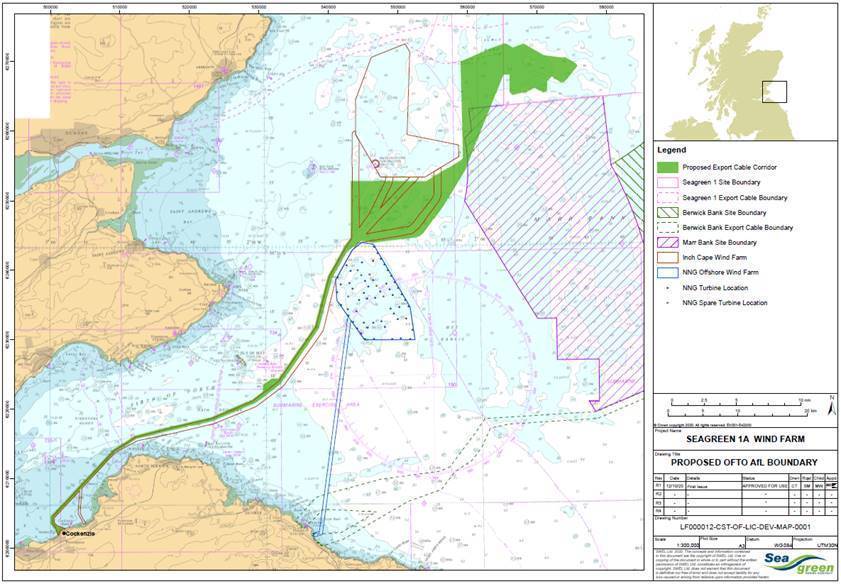
There are five wind farms in the map.
- The green area is the cable corridor for Seagreen 1a
- Inch Cape is the odd-shaped wind farm to the North and West of the green area
- Seagreen at the top of the map, to the North of Inch Cape.
- Marr Bank with the pink NE-SW hatching
- Berwick Bank with the green NW-SE hatching
- Neart Na Gaoithe is edged in blue to the South of the green area.
Berwick Bank and Marr Bank are both owned by SSE and appear to have been combined.
The capacity of the wind farms can be summarised as follows.
- Seagreen – 1075 MW
- Neart Na Gaoithe – 450 MW
- Inch Cape – 1000 MW
- Berwick Bank and Marr Bank – 4100 MW
This gives a total of 6625 MW or just over 6.6 GW.
Around The North Of Scotland
This map shows the latest successful ScotWind leases.

Note.
- Several of these proposed wind farms have detailed web sites.
These seventeen leases total up to 24.3 GW.
An Interim Total
I believe these figures are realisable.
- Celtic Sea – 50 GW
- Irish Sea – 7.6 GW – 3 GW already underway
- South East England, East Anglia, Lincolnshire And Yorkshire – 22.5 GW
- North Sea – 9.5 GW
- On The East Coast Of Scotland – 6.6 GW
- Around The North Of Scotland – 24.3 GW
Note.
- I have tried to be as pessimistic as possible.
- Irish and North Sea estimates are based on Blue Gem Wind’s professional estimate for the Celtic Sea.
- I have used published figures where possible.
My estimates total up to 120.1 GW of extra wind-power capacity. As I write this, current UK electricity production is around 33 GW.
Vikings Will Invade
This Google Map shows the Faroe Islands, the North of Scotland, Norway and Denmark.
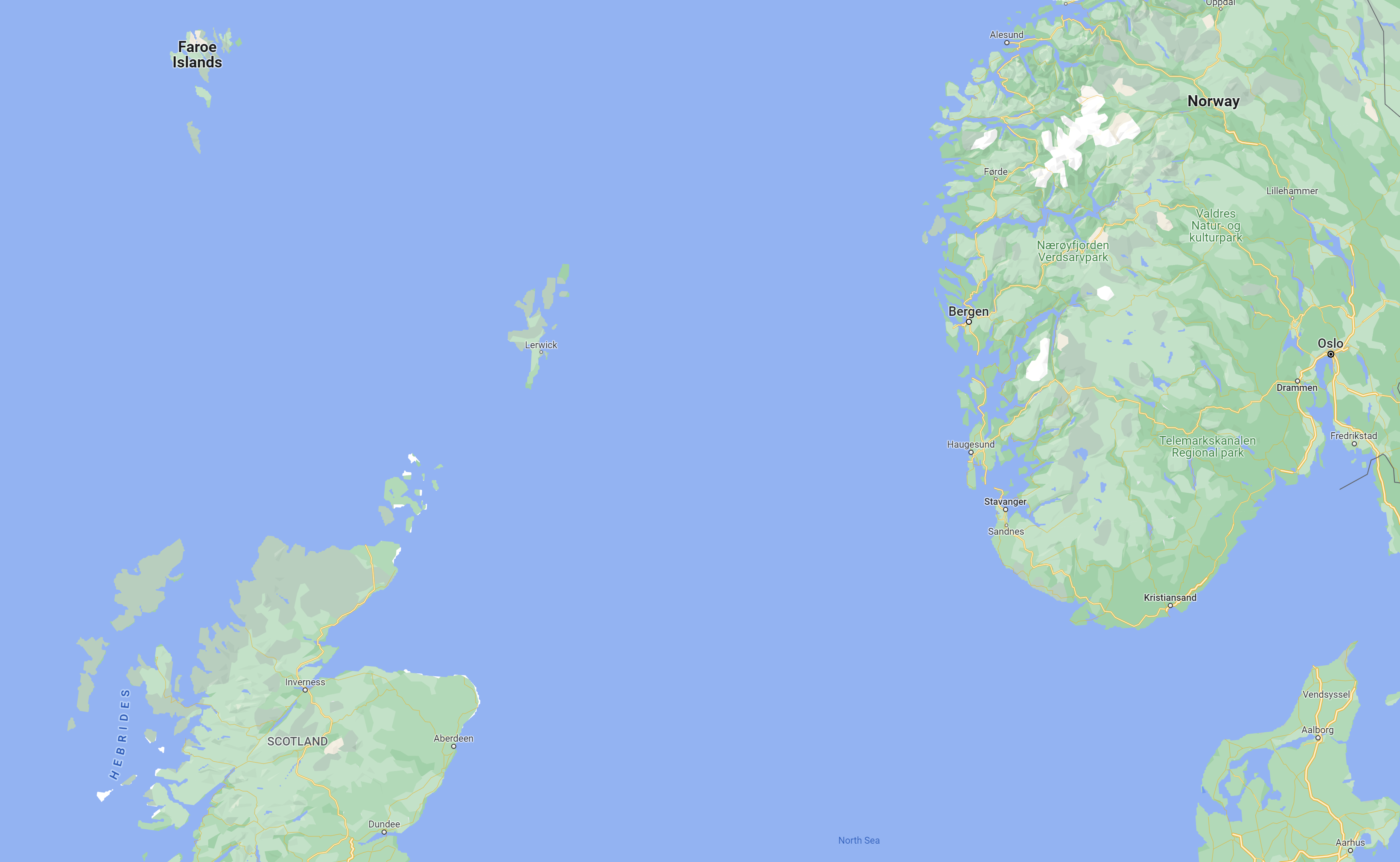
To get an idea of scale, the Shetland Isles are around 70 miles or 113 km. from North to South.
In Is This The World’s Most Ambitious Green Energy Solution?, I talked about Norwegian company; Aker Solutions’s plan for Northern Horizons.
- It would be a 10 GW offshore floating wind farm 136 km to the North-East of the Shetlands.
- This position would probably place it about halfway between the Faroes and the Norwegian coast.
- The project is best described in this article on the Engineer, which is entitled Northern Horizons Plans Clean Energy Exports For Scotland.
- In the article, there is a good graphic and a video.
This will be offshore engineering of the highest class, but then I first came across Norwegian offshore engineering like this in the 1970s, where nothing was too difficult for Norwegian engineers.
There are two major points to remember about the Norwegians.
- They have the Sovereign Wealth Fund to pay for the massive investment in Northern Horizons.
- They need to replace their oil and gas income, with a zero-carbon investment stream.
I feel that Northern Horizons will not be a one-off and the virgin sea in the map above will be liberally carpeted with more floating wind farms.
- On Shetland, electricity can be fed into the UK grid.
- On Norway, electricity can be fed into the Norwegian grid or stored in Norwegian pumped storage systems.
- On Scotland, more pumped storage systems can be built to store energy.
- Hydrogen can be piped to where it is needed to decarbonise heavy industry and transport.
- Norwegian fjords, Shetland harbours, Scottish lochs and possibly Scapa Flow would be ideal places to assemble and service the giant floating turbines and build the other needed floating infrastructure.
- I can also see Denmark getting in on the act, as they will probably want to decarbonise the Faroe Islands.
I estimate that between the Faroes, Scotland and Norway, there are 510,000 km² of virgin sea.
With a potential of 5 MW per km², that area has the potential to create an amazing amount of both electricity and hydrogen.
Exporting Power To Europe
There will need to be more interconnectors from the UK to Europe.
These are already working.
- BritNed – 1 GW – Isle of Grain and Rotterdam
- ElecLink – 1 GW – Through the Channel Tunnel
- HVDC Cross-Channel – 2 GW – England and France
- IFA-2 – 1 GW – England and France
- NemoLink – 1 GW – Kent and Belgium
- North Sea Link – 1.4 GW – Blyth and Norway
- Viking Link – 1.4 GW – Lincolnshire and Denmark
These are proposed.
- GridLink – 1.4 GW – Kent and Dunkirk
- NeuConnect – 1.4 GW – Isle of Grain and Germany
- North Connect – 1.4 GW – Scotland and Norway
There are also gas interconnectors, that could be converted to hydrogen.
This press release from National Grid, which is entitled Undersea Electricity Superhighways That Will Help Deliver Net Zero Move A Step Closer, has these bullet points.
- Positive progress on plans for £3.4bn electricity super-highway projects – Scotland to England Green Links.
- Ofgem opens consultation that recognises the “clear case” and “consumer benefit” of two subsea high voltage cables to transport clean between Scotland and England.
- The cables form part of a planned 16 project £10 billion investment from National Grid to deliver on the government’s target of 40GW of offshore wind generation by 2030.
This paragraph expands on the work by National Grid to meet the third point.
These projects are part of National Grid’s work upgrading the electricity transmission system to deliver the UK government’s target of 40GW of offshore wind generation by 2030. In addition to the Eastern Links, it is developing 14 major projects across its network to facilitate the target representing a £10 billion investment. This includes two further Scotland to England high voltage links (also in partnership with the Scottish transmission network owners) and proposals in the Humber, Lincolnshire, East Midlands, North of England, Yorkshire, North Kent, as well as four in East Anglia (one of which is a proposed offshore link between Suffolk and Kent).
I think we can assume, that National Grid will do their part to allow the UK government’s target of 40GW of offshore wind generation by 2030 to be met.
Will The UK Have 40 GW Of Offshore Wind Generation By 2030?
In the Wikipedia entry for Windpower In The UK, this is the opening sentence.
The United Kingdom is one of the best locations for wind power in the world and is considered to be the best in Europe. By the beginning of March 2022, the UK had 11,091 wind turbines with a total installed capacity of over 24.6 gigawatts (GW): 14.1 GW of onshore capacity and 10.4 GW of offshore capacity.
It would appear an extra 30 GW of wind power is needed.
In An Interim Total earlier, I gave these figures.
- Celtic Sea – 50 GW
- Irish Sea – 7.6 GW – 3 GW already underway
- South East England, East Anglia, Lincolnshire And Yorkshire – 22.5 GW
- North Sea – 9.5 GW
- On The East Coast Of Scotland – 6.6 GW
- ScotWind – 24.3 GW
The wind farms in South East England, East Anglia, Lincolnshire And Yorkshire and ScotWind and Mona and Morgan are either being planned or under construction, and in many cases leases to construct wind farms are being paid.
I would feel, that at least 30 GW of these 56.4 GW of wind farms will be completed by 2030.
Conclusion
Boris’s vision of the UK becoming a Saudi Arabia of wind is no fantasy of a man with massive dreams.
Standard floating wind turbines, with the possibility of also harvesting wave power could be assembled in ports along the coasts, towed into position and then connected up.
Several GW of wind-power capacity could probably be added each year to what would become the largest zero-carbon power station in the world.
By harvesting the power of the winds and waves in the seas around the British Isles it is an engineering and mathematical possibility, that could have been developed by any of those great visionary Victorian engineers like Armstrong, Bazalgette, Brunel and Reynolds, if they had had access to our modern technology.
Up Yours! Putin!
Enter The Dragon
Look at this map of UK offshore wind farms. clipped from Wikipedia.
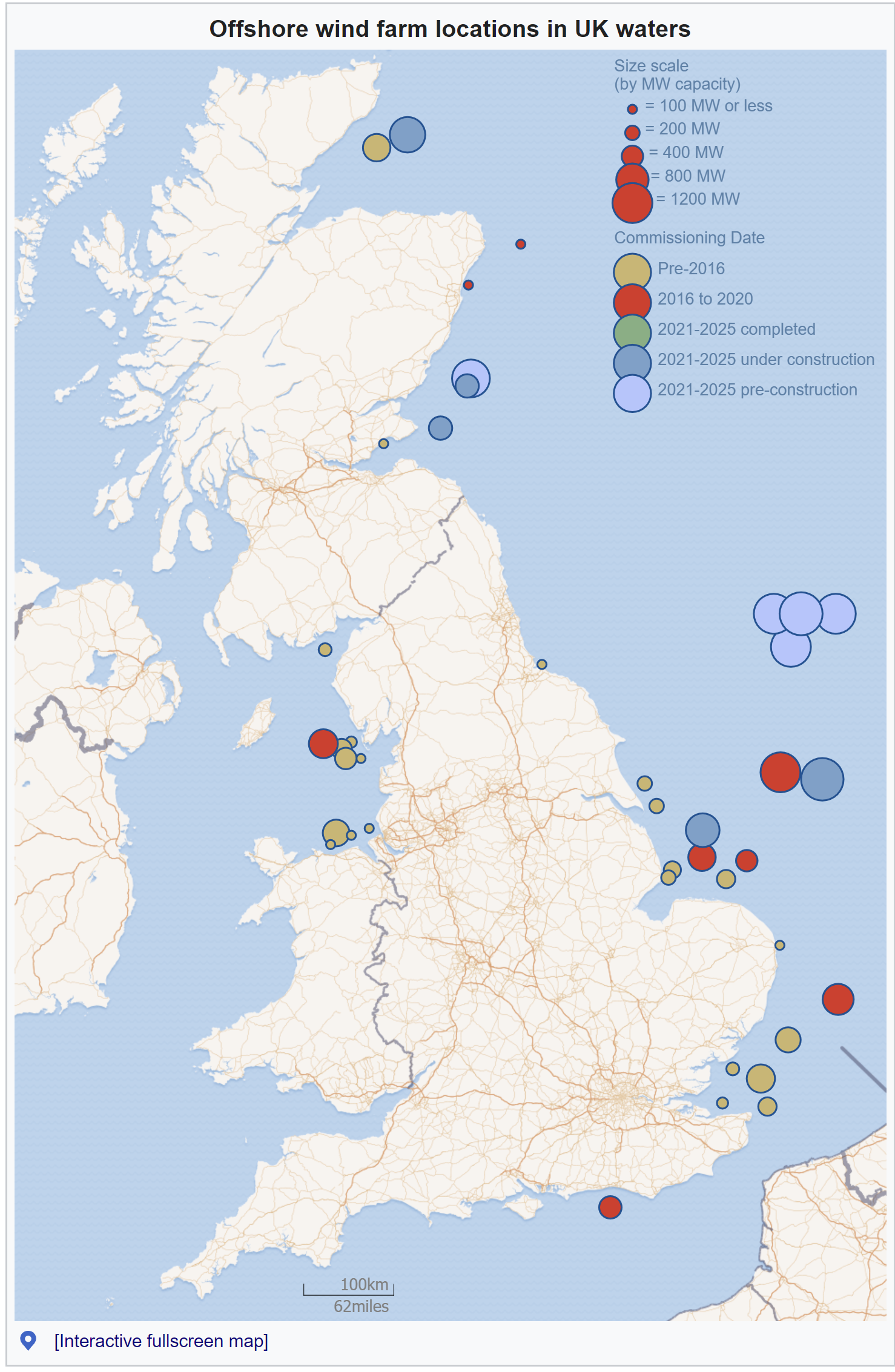
It is only a crude map, but it does show the lack of offshore wind farms around the coasts of Wales and South-West England.
This article on the Engineer is entitled Unlocking The Renewables Potential Of The Celtic Sea.
The article starts with these two paragraphs.
Over the last decade, the UK has become a global leader in renewable marine energy, tapping into the vast resources its coastal geography offers. Offshore wind, in particular, has flourished, with gigawatt-scale projects being deployed off the east coast of England and Scotland, at Hornsea, Dogger Bank and Moray.
However, looking at a map of existing and proposed wind farms, what’s perhaps most striking is the complete absence of projects in the southwest of Britain, off the rugged shores of Wales, Devon and Cornwall, shaped by the fierce North Atlantic. The Celtic Sea – which extends south off Wales and Ireland down past Cornwall and Brittany to the edge of the continental shelf – is estimated to have around 50GW of wind generating capacity alone. What’s more, it also delivers some of the highest tidal ranges in the world, alongside some of the best waters in Europe for generating wave energy. In a country blessed with renewable resources, the Celtic Sea may well be its biggest prize.
The article then discusses how the challenge of developing renewable energy around Wales is being met.
- It describes the relevance of Floating Offshore Wind (FLOW).
- It quotes someone who says. “Eighty per cent of the world’s wind resources are in waters deeper than you would traditionally go with fixed offshore wind.”
- It talks about Blue Gem Wind and their Erebus and Valorous wind farm projects, that I wrote about in Blue Gem Wind.
- It talks of how expertise from offshore oil and gas is being used to develop floating offshore wind.
The article then goes on to talk about tidal power.
The Welsh Government Tidal Lagoon Challenge is mentioned.
- The article notes “The IP for the Swansea Bay Tidal Lagoon has been purchased by a consortium led by Bridgend’s DST Innovations and has been reborn as Blue Eden.”
- Blue Eden is described on this page of the DST Innovations web site. The project is not in the least bit timid or small.
- The article also introduces to the Morlais Tidal Energy Scheme, which has its own web site.
The article then finishes with a few paragraphs about how wind, wave and tidal power can be combined in a single scheme.
Conclusion
The article finishes with this paragraph.
For now, Wales may be lagging slightly behind its Celtic cousin to the north, but if the true potential of the Celtic Sea can be unleashed – FLOW, tidal stream, lagoon and wave – it looks set to play an even more prominent role in the net zero pursuit.
The Red Dragon is entering the battle to replace Vlad the Mad’s tainted energy.
Blue Gem Wind
Principle Power are the designers of the WindFloat.
The Projects page of the Principle Power web site led me to a project called Erebus. This is Principle Power’s description of the project.
The Celtic Sea, located between the United Kingdom and Ireland, holds an estimated 50 GW of offshore wind resource. The 96 MW Erebus project, located offshore Pembrokeshire, Wales, is a flagship project planned by Blue Gem Wind, a joint venture between Total and Simply Blue Energy, to unlock the potential of this region.
The project will feature between 7 and 10 turbines on WindFloat® floating platforms located approximately 44 km southwest of the Pembrokeshire coastline.
The Erebus project will see the deployment of a fully industrialized WindFloat® and represents a stepping stone that will allow the local supply chain to build capabilities for the delivery of larger projects under development in the Celtic sea region.
Note.
- Developing 50 GW of offshore wind in the Celtic Sea is not a small amount of wind power.
- The 96 MW Erebus project would appear to be the first project in the Celtic Sea.
- The turbines would be between 9.5 and 14 MW.
- The Principle Power website states that the water depth of the Erebus wind farm is seventy metres.
- The deployment of a fully industrialized WindFloat.
- The Erebus wind farm is being developed by Blue Gem Wind.
It would be larger than the current world’s largest floating wind farm, which is the Kincardine Wind Farm.
Who Are Blue Gem Wind?
Blue Gem Wind have a web site, with a picture of three turbines riding on WindFloats and a couple of support boats and this mission statement.
Floating Offshore Wind
A new generation of energy in the Celtic Sea
The Our Projects page shows a good picture and says this.
Floating wind is set to become a key technology in the fight against climate change with over 80% of the worlds wind resource in water deeper than 60 metres. Independent studies have suggested there could be as much as 50GW of electricity capacity available in the Celtic Sea waters of the UK and Ireland. This renewable energy resource could play a key role in the UK meeting the 2050 Net-Zero target required to mitigate climate change. Floating wind will provide new low carbon supply chain opportunities, support coastal communities and create long-term benefits for the region.
A header indicates a stepping-stones approach to assist the local supply chain and says this.
We believe that a stepping stone approach to the development of floating wind in the Celtic Sea brings a number of benefits. Starting with smaller demonstration and early-commercial projects, increasing in size, will help to capture the highest local supply chain content. It will also maximise knowledge transfer and facilitate a sustainable transfer to a low carbon economy.
Because of this focus on stepping stone projects we have proposed Erebus, a 96MW test and demonstration project followed by Valorous, a 300MW early-commercial project.
These links give more details of the two projects.
- Erebus – 100MW Test & Demonstration project in the Celtic Sea
- Valorous – A 300MW Early Commercial project in the Celtic Sea
It appears that the company is taking a sensible approach.
- They are starting small and building up deployment.
- They are using proven WindFloat technology.
- They are developing a local supply chain.
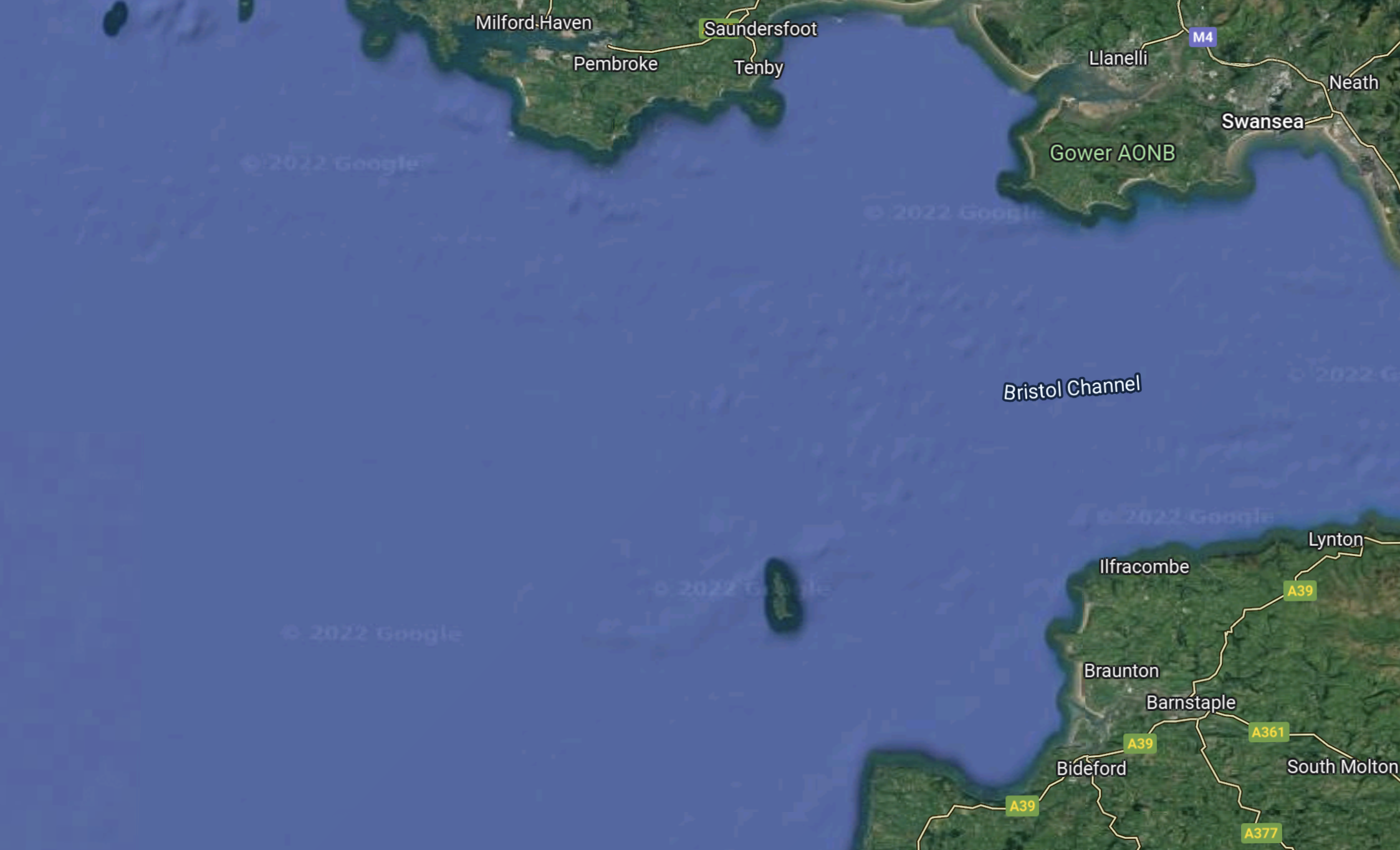
This Google Map shows the area of the two wind farms.
Note.
- Pembroke in the middle at the top of the map.
- Barnstaple and Bideford in Devon in the South-East corner of the map.
- Lundy Island off the Devon coast.
I estimate that the two wind farms will be about the Western edge of this map, with Erebus to the North of Valorous. They wouldn’t want to be too far to the West, as that would put them in the shipping lanes between Ireland and France.
Will The Turbines Be Assembled In The Milford Haven Waterway?
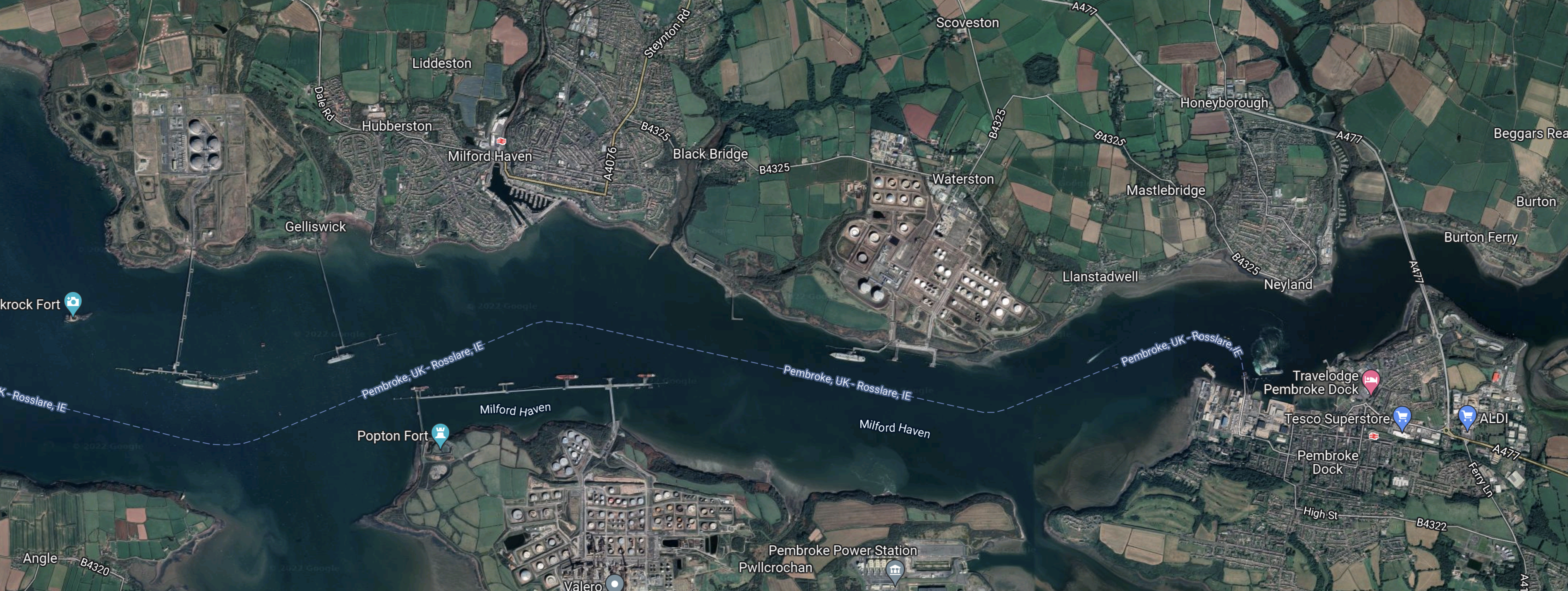
This Google Map shows the Milford Haven Waterway.
Note.
- Pembroke Dock, where Blue Gem Wind has its offices, is at the Eastern end of the map.
- The oil refineries and LNG terminals.
- Milford Haven on the North side of the waterway.
- The 2.2 GW gas-fired Pembroke power station on the South side of the waterway.
- The ferry route between Rosslare and Pembroke Dock.
But as the waterway is one of the deepest natural harbours in the world, I wouldn’t be surprised to find, that the turbines will be lifted on to the WindFloats in this waterway.
The turbines would be brought in by sea and the WindFloats would be towed in from their manufacturing site.
Where Will The WindFloats And Turbines Be Built?
There could be enough space to build the WindFloats in the Milford Haven Waterway, but I suspect they will be built in a shipyard, which is close to a supply of steel. South Wales is an obvious possibility.
I estimate that for the two wind farms between twenty-eight and forty turbines would be needed and these would probably be brought in by sea and then lifted onto the WindFloats somewhere in the Milford Haven Waterway.
It could be a very efficient process.
Will Pembroke Power Station Have A Future Role?
Consider.
- Pembroke power station is the largest gas-fired power station in Europe.
- It has a capacity of 2.2 GW.
- It was only completed in 2012, so it has many years of life yet!
- It is also probably young enough, to be able to be converted to run on hydrogen.
- It obviously will have a very good connection to the National Grid.
I would suspect that initially, the power cable from Erebus and Valorous, would use the same grid connection as the power station.
But in the future there must be some interesting ways that the wind farms and the power station can work together.
- A large electrolyser could be built to create hydrogen for heavy transport and industrial uses, from excess electricity.
- Could the oxygen from the electrolyser be used for steelmaking in South Wales?
- As natural gas is phased out the power station could be converted to hydrogen power.
- In times of low wind, the power station could make up the shortfall.
- The wind farms could be used as the primary electricity source, with the power station adding the extra power needed to meet demand.
There are certainly ways, the wind farms and the power station can work together.
Conclusion
These two related wind farms seems a good way to start wind developments between the UK and the island of Ireland.
Plan For New Nuclear Reactors At Wylfa And Trawsfynydd A Step Closer As Natural Resource Wales Looks At Designs
The title of this post, is the same as that of this article on nation.cymru.
These are the first two paragraphs.
Plans for new nuclear power stations at Trawsfynydd and Wylfa have taken a step closer after the UK Government asked government regulators to assess designs for the reactors.
Natural Resources Wales will be among those assessing the designs by Rolls-Royce, with both Wylfa and Trawsfynydd have been named as potential sites for housing them within the UK.
These are points about the reactors.
- They will cost £1.8 billion each.
- They are capable of powering a city the size of Cardiff, which has a population of about half-a-million.
- I’ve read elsewhere that the reactors are planned to have a nameplate capacity of 470 MW.
The article did mention, that the Nimbys were lining up.
The Wylfa Site
The original Wylfa power station was a Magnox nuclear station generating 980 MW, that was decommissioned in 2015.
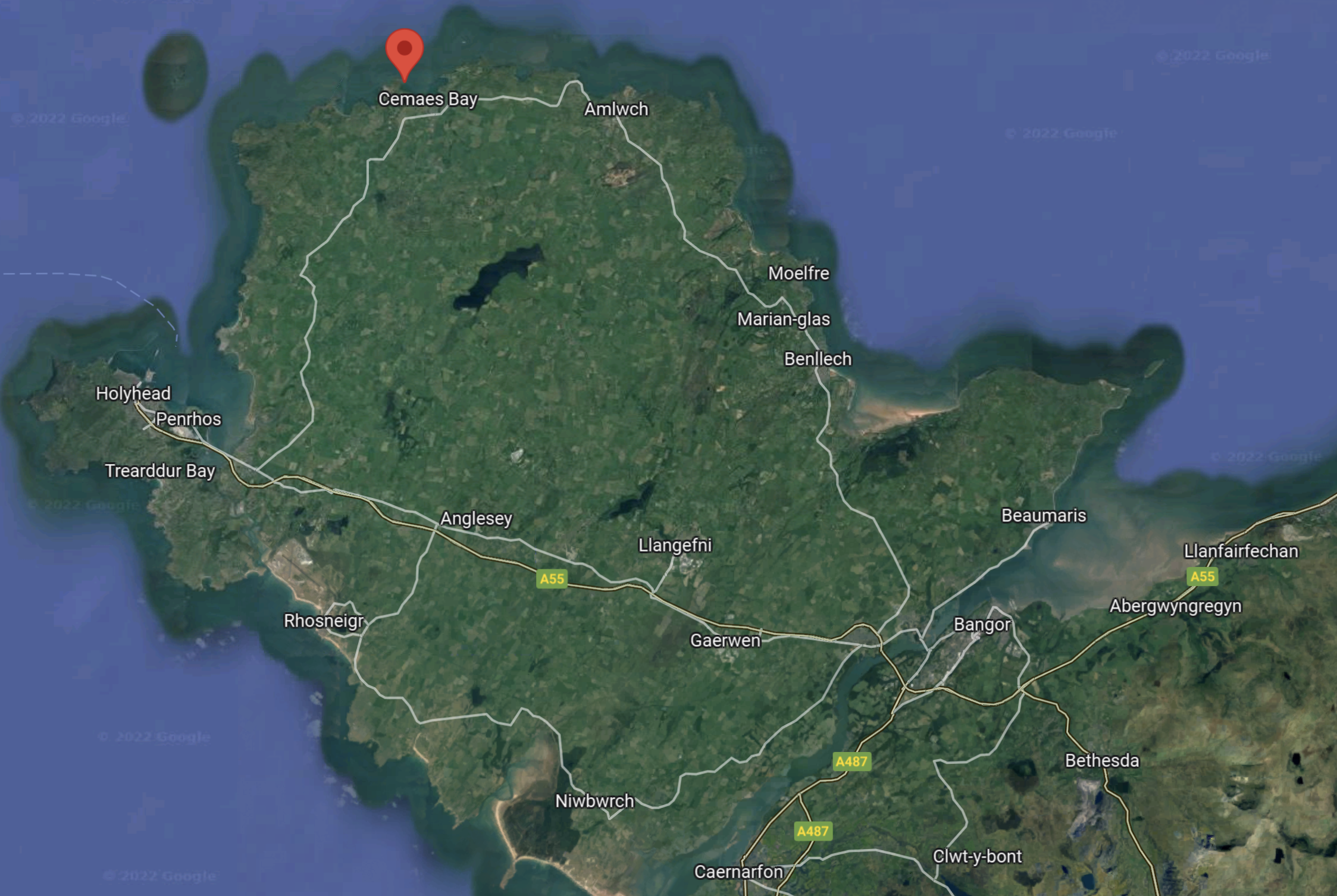
This Google Map shows the location of the site on Anglesey.
This second Google Map shows the site in more detail.
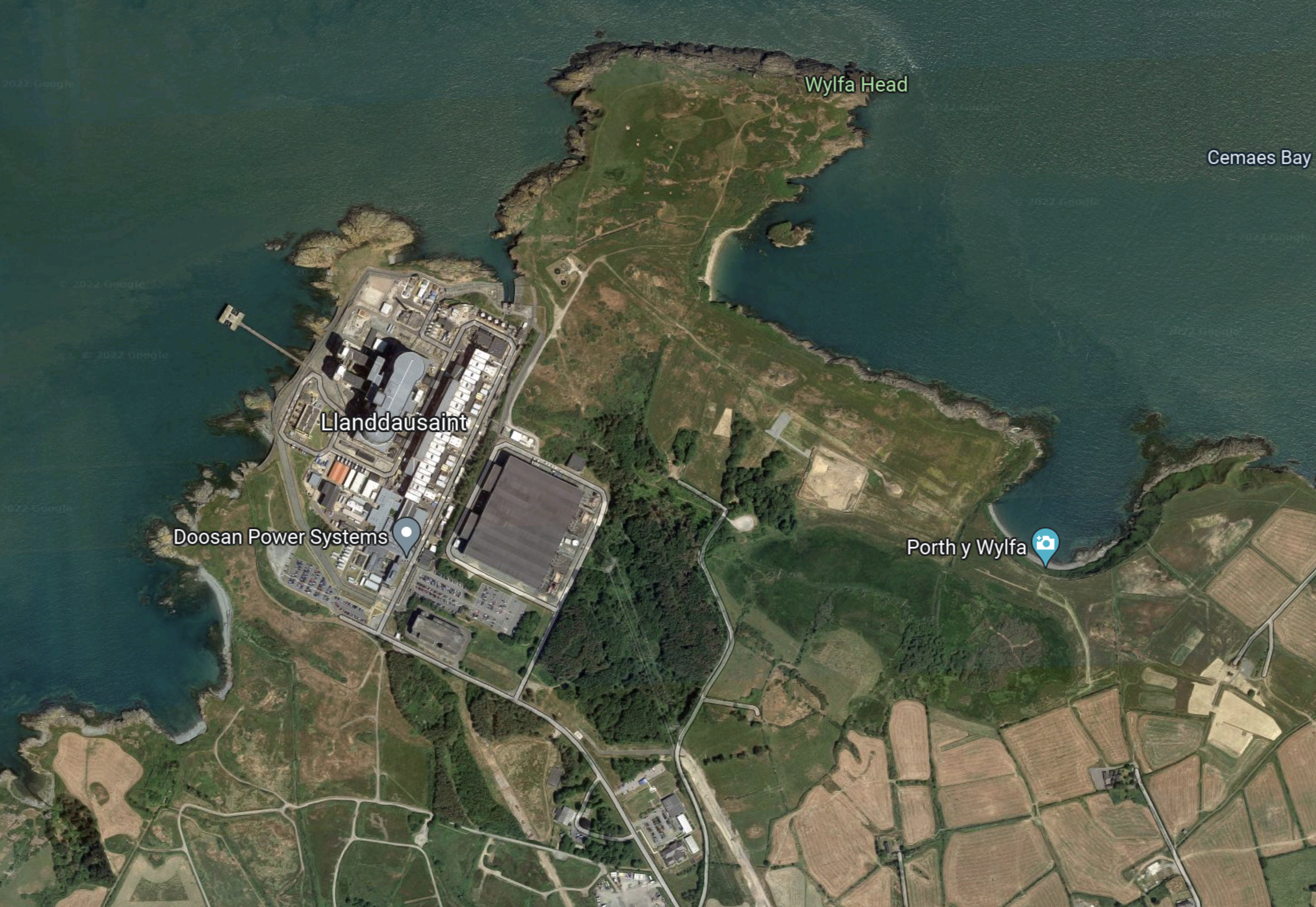
The power station doesn’t appear to have had a rail link, but there is a railway line a few miles away, with sidings that might have been used to handle fuel flasks.
There has been a proposal for a hybrid plant consisting of a wind farm and small modular nuclear reactors, which is described in this Wikipedia section, where this is said.
In January 2021, Shearwater Energy presented plans for a hybrid plant, to consist of a wind farm and small modular reactors (SMRs), to be installed adjacent to the existing Wylfa power station but separate from the proposed Wylfa Newydd site. Shearwater has signed a memorandum of understanding with NuScale Power for the SMRs. The plant could start generation as early as 2027 and would ultimately produce up to 3 GW of electricity and power a hydrogen generation unit producing up to 3 million kg of hydrogen per year.
Note.
- Wylfa Newydd was a proposal by Hitachi to build a nuclear station on the site.
- Shearwater Energy is a UK developer of energy opportunities.
- NuScale Power is an American company with its own design of small modular nuclear reactor.
In Holyhead Hydrogen Hub Planned For Wales, I talked about hydrogen and the port of Holyhead.
The Trawsfynydd Site
The original Trawsfynydd power station was a Magnox nuclear station generating 470 MW, that was decommissioned in 1991.
This Google Map shows the location of the site in North Wales.
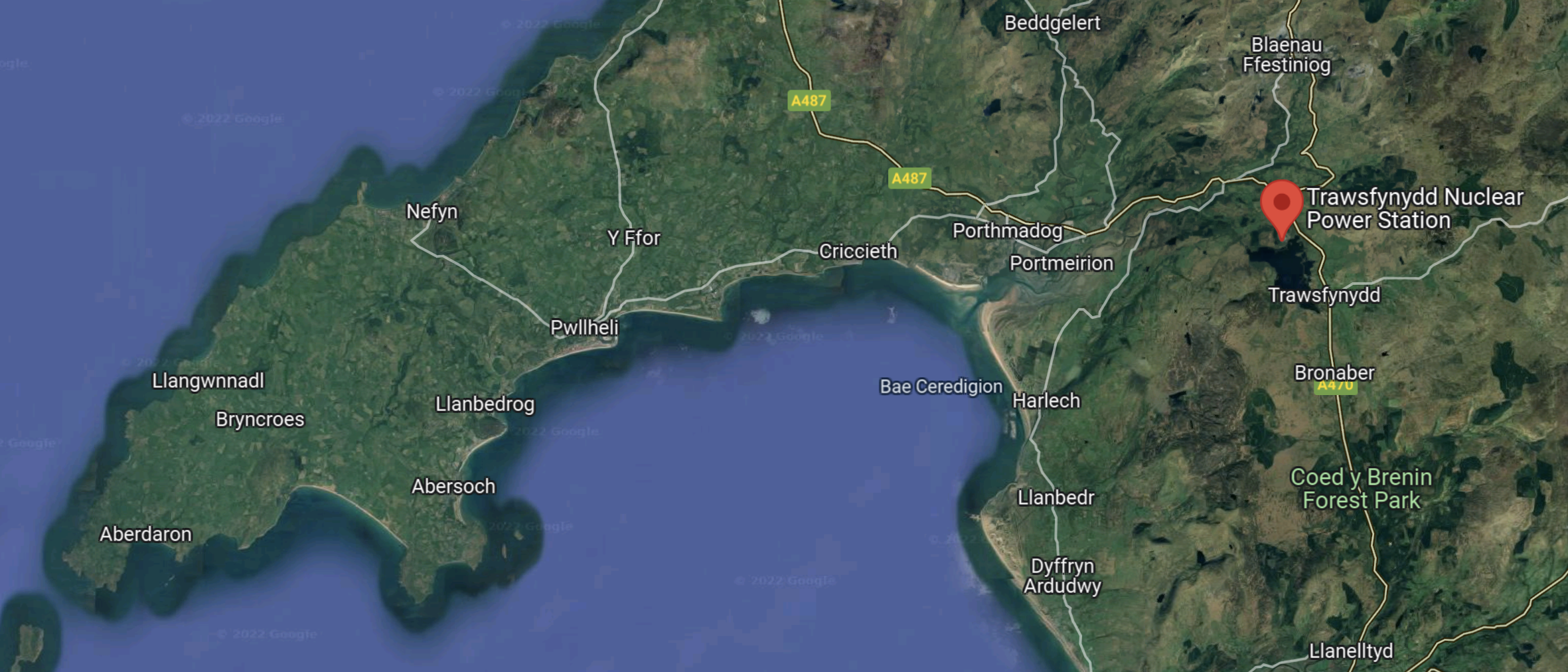
This second Google Map shows the site in more detail.
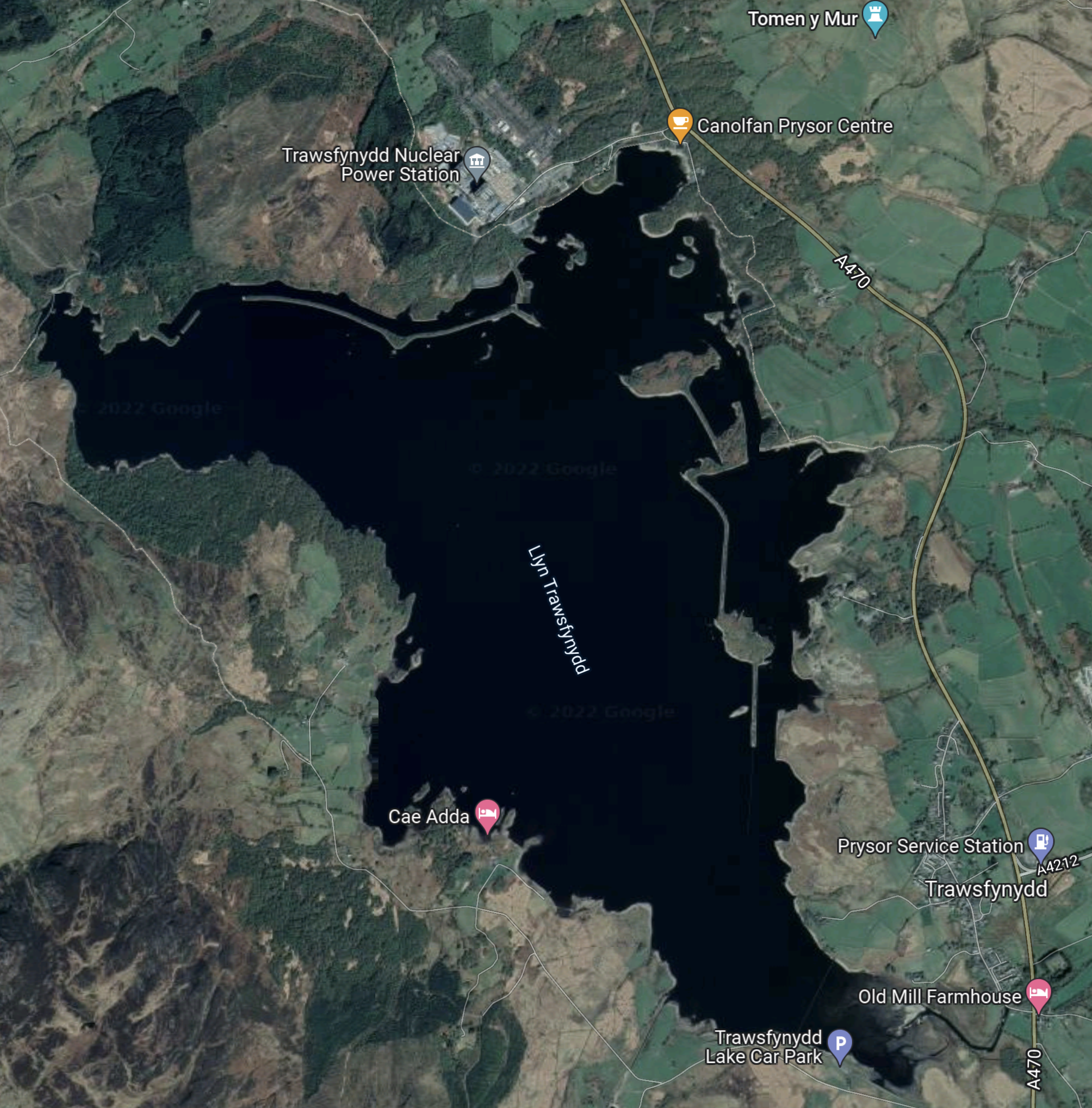
Note.
- The power station was built on the Northern shore of Llyn Trawsfynydd.
- Llyn Trawsfynydd is a man-made lake, that was built in the 1920s to supply water to the 24 MW Maentwrog hydro electric power station.
- There is a railway from near the site, that connects to the Conwy Valley Line at Blaenau Ffestiniog.
The Trawsfynydd site is a lot more than just a decommissioned Magnox power station.
Pumped Energy Storage In Snowdonia
Currently, there are two existing pumped storage in Snowdonia.
- Dinorwig power station, which is often called Electric Mountain, which has a capacity of 9.1 GWh.
- Ffestiniog power station, which has a capacity of around 1 GWh. If anybody has a better figure let me know!
A third scheme is under development at Glyn Rhonwy, which could have a capacity of 700 MWh.
Looking at the size of Llyn Trawsfynydd, I do wonder, if it could be the top lake of a future pumped storage scheme.
- Llyn Trawsfynydd, contains 40 million tonnes of water.
- There is a head of 190 metres.
That could give energy storage of 20 GWh. That sounds a lot of GWhs! But with two possible small modular nuclear reactors at possibly 500 MW each nearby and some help from windfarms, it could be filled within a day, if there is a suitable low-level reservoir.
Rolls-Royce And The Duisburg Container Terminal
In Rolls-Royce Makes Duisburg Container Terminal Climate Neutral With MTU Hydrogen Technology, I showed how Rolls-Royce and its subsidiary were providing an innovative climate neutral solution for Duisburg Container Terminal in Germany.
A North West Wales Powerhouse
Could Rolls-Royce be planning a Duisburg-style solution for North West Wales.
- Small modular nuclear reactors at Wylfa and Trawsfynydd.
- Hydrogen electrolysers to create hydrogen for the Port of Holyhead and heavy transport.
- Adequate pumped hydro storage for surplus energy.
But there could be little serious above-ground construction.
Conclusion
Something is awakening in North West Wales.
Young Break For The Border To Ring In The New Year
The title of this post, is the same as that on this article on The Times.
This a subtitle to the report, above a picture of five Scots girls enjoying themselves in Newcastle.
Revellers from Scotland and Wales dodging Covid restrictions at home flocked to clubs and bars in England
It will be interesting to see how the Scottish and Welsh Covid statistics pan out in the next few days.
As a trained Control Engineer, I am totally against lockdowns, except as a very last resort.
It’s like trying to ride a bike only turning the handlebars full left and full right.
Try it and you will soon fall off.
Covid in Wales: Groups Of Six Allowed To Meet In Pubs
The title of this post, is the same as that of this article on the BBC.
This is the first paragraph.
Groups of no more than six people will be allowed to meet in pubs, cinemas and restaurants in Wales from 26 December, the first minister has said.
I’m glad I don’t live in a nanny socialist state like Wales.
We should be treated like adults and allowed to develop our own rules.
- I am doubly-vaccinated with AstraZeneca
- I have recently had a booster Pfizer vaccine.
- I generally wear a mask, when I’m outside my house.
- I avoid crowded places when I’m outside my house.
- I only invite a selected group of people into my house.
- I obey social distancing rules.
But my biggest protection comes from being coeliac on a long-term gluten free diet, which gives me an immune system, which is immensely strong.
I’ve yet to meet or hear of any coeliac on a long-term gluten-free diet, who has had a serious dose of the Covids.
Could The Morocco-UK Power Project Be Developed Into A Western Europe And Africa Interconnector?
This page on the Xlinks web site, describes the Morocco-UK Power Project, which is proposed to generate solar and wind power in Morocco and deliver it to the UK.
- The plan envisages 10.5 GW of electricity being generated.
- There will be a 5GW/20GWh battery in Morocco.
- They will export 3.6 GW of electricity to the UK for at least twenty hours per day.
- The electricity will be exported to the UK by an Interconnector that skirts to the West of Spain, Portugal and France.
- The interconnector will be 3,800 kilometres long.
I described the project in detail in Moroccan Solar-Plus-Wind To Be Linked To GB In ‘Ground-Breaking’ Xlinks Project.
This Google Map shows Western Europe And North Africa.

Note.
- The light blue of the Continental Shelf
- The darker blue of deeper water.
- The Southern end of the Morocco and the UK interconnector will at Guelmim Oued Noun in the South of Morocco, which is indicated by the red arrow.
- The UK end of the cable will be at Alverdiscott between Barnstaple and Bideford in North Devon.
- Southern Morocco and Algeria look to be mainly in the Sahara Desert.
If we look at the route of the cable, it connects a lot of possible renewable energy sources.
- Morocco – Solar and wind
- Spain – Solar and wind
- Portugal – Solar and wind
- France – Nuclear, tidal and wind
- UK – Nuclear and wind.
Could the UK and Morocco interconnector be developed into a bigger power project?
- Solar and wind power from Algeria could be added.
- Tidal power from a Severn Barrage could be added.
- Connections could be added to Gibraltar, the Irish Republic and Wales.
I believe that there could be a large amount of electricity developed on the Western costs of Europe and Africa.
An interconnector would move it to where it is needed.
Denmark Hill Station – 4th September 2021
The article on Rail Technology Magazine is entitled Denmark Hill Station First To Use Innovative Solar Technology In Europe.
The first two paragraphs describe the technology.
Denmark Hill station has become the first train station in Europe to have BIPVco’s Flextron thin film technology installed, on top of other upgrades, following a £7.5m extension.
The sophisticated and flexible solar panels are different from traditional ‘glass like’ panels, requiring no additional weight support, and will be used across other stations going forward.
Note.
- In the application of the technology at Denmark Hill station, a surplus of electricity is returned to the grid.
- BIPVco is a company based in South Wales, that evolved from research by Tata Steel and Swansea University, with the backing of the Welsh Government.
- The panels are lightweight, flexible, durable and self-cleaning.
Many years ago, I put up a barn based on timber beams, which had a sheet steel roof. These panels would be ideal for many agricultural buildings, like the one I commissioned.
These are pictures I took at Denmark Hill station, this morning.


Note.
- The original station was designed by Charles Henry Driver.
- The new entrance displays a high degree of craftsmanship, especially in the brickwork.
- The coffee and gluten-free cake I had in FCB Coffee were excellent.
- The station has its own pub; The Phoenix.
According to Network Rail, it has already been nominated for two architectural awards.
What Will Wales’ Proposed World-Class Rail Testing Centre Deliver?
This question is answered in this article on Rail Technology Magazine.
As yet, there is no Wikipedia entry.
 The Anonymous Widower