Germany Pinpoints 36.5 GW Of Offshore Wind Areas, Publishes Development Plan
The title of this post is the same as that of this article on offshoreWIND.biz.
This is the sub-heading.
Germany’s Federal Maritime and Hydrographic Agency (BSH) has published a new area development plan for the expansion of offshore wind energy. The plan maps out the build-out of offshore wind by 2030, by when the country is to reach 30 GW of capacity connected to its grid, and sets the stage for further deployment of wind turbines at sea, with the 2035 target of 40 GW estimated to be exceeded.
30 GW of offshore wind by 2030 and 40 GW by 2035 are ambitious targets, but how do we compare?
This news story on the UK Government web site is entitled UK Signs Agreement On Offshore Renewable Energy Cooperation, contains this statement.
The initiative is expected to support the UK’s ambitious targets to increase offshore wind fivefold to 50GW, and deliver 18GW of electricity interconnector capacity – up from 8.4 GW today – by 2030.
I don’t think we compare badly.
UK Round 4 Offshore Wind Winners To Start Paying Option Fees With Lease Agreements Now Signed
The title of this post, is the same as that of this article on offshoreWIND.biz.
This is the sub-heading.
The Crown Estate has signed Agreements for Lease for all six offshore wind projects selected in the UK’s Round 4 offshore wind seabed leasing. This enables the developers to now further progress their plans and also kicks off the period in which they will be paying annual option fees of almost GBP 900 million to The Crown Estate and HM Treasury.
The article then lists the wind farms.
- RWE’s Dogger Bank South East & West (3 GW).
- EnBW and BP’s Morgan and Mona (3 GW).
- TotalEnergies and Corio Generation’s Outer Dowsing (1.5 GW).
- Cobra and Flotation Energy’s Morecambe (480 MW).
This is just under 8 GW.
The article then goes on to show what developers will pay to the Crown Estate.
These two paragraphs explain the fees paid.
By signing the Agreements for Lease, which can be in effect for a maximum of ten years, the developers have committed to at least three years of option payments and will pay an annual option fee for each project until they are ready to enter into a lease for the seabed site.
The option payments, totalling some GBP 979 million per year, reduce as a project moves into a lease, or leases, and cease when a lease(s) for the maximum capacity/whole site is granted, at which point developers will move to paying rent.
It looks to me that developers will pay nearly a billion pounds per year for at least a minimum of three years and not more than ten years.
Once a project moves into a lease, rent will be paid.
It seems to be a very profitable occupation to own loads of empty sea!
Nucor Introduces Elcyon(TM), First Sustainable Steel Product Engineered Specifically For Offshore Wind Energy Applications
The title of this post, is the same as that of this press release from Nucor Corporation.
This is the first paragraph.
Nucor today introduced Elcyon™, the Company’s new sustainable heavy gauge steel plate product made specifically to meet the growing demands of America’s offshore wind energy producers building the green economy and its necessary infrastructure. Nucor will manufacture Elcyon at the company’s new, $1.7 billion state-of-the-art Nucor Brandenburg steel mill in Kentucky , which produced its first steel plate at the end of December 2022.
It sounds impressive, but it should be if $1.7 billion has been spent.
This paragraph, says more about the process.
Elcyon is a clean, advanced steel product made using Nucor’s recycled scrap-based electric arc furnace manufacturing process. Nucor’s circular steelmaking route has a greenhouse gas emissions intensity that is one fifth the global blast furnace extractive steelmaking average, based on Scope 1 and 2 emissions. Utilizing Thermo-Mechanical Controlled Processing (TMCP) at the new mill, Elcyon, the only steel of its kind in the United States was created specifically to meet the rigorous quality standards of offshore wind energy designers, manufacturers and fabricators. Along with meeting Euronorm specs, Elcyon is characterized by larger plate dimensions, improved weldability and excellent fracture toughness, as compared to competing products.
What more can a steelmaker want?
- It uses steel scrap to make new steel.
- The process could be powered by green electricity.
- The process cuts emissions to twenty per cent.
- The steel is what customers want.
- The steel has better properties than competing products.
These two paragraphs talk about the prospects for Elcyon.
Nucor Steel Brandenburg is the first steel plant in the world to pursue certification under LEED v4 from the U.S. Green Building Council, the highest standard for sustainable building design, construction, and operation. The new mill is located in the middle of the largest steel plate-consuming region in the country and will be able to produce 97% of plate products consumed domestically, with a potential output of 1.2 million tons of steel annually.
Elcyon and the Brandenburg mill both draw upon Nucor’s 50 years of industry leadership in sustainable steel production. From last year’s launch of Econiq™, the world’s first net-zero steel available at scale, to recently becoming the first major industrial company to join the United Nations 24/7 Carbon-Free Energy Global Compact, Nucor has consistently worked to meet the needs of its customers and other stakeholders while protecting the well-being of our planet.
Nucor have certainly done their market research and appear to be very scientifically green.
In the About Nucor section of the press release, this is the last sentence.
Nucor is North America’s largest recycler.
This is some statement to make, if it weren’t true! Wikipedia says this about the company.
Nucor operates 23 scrap-based steel production mills. In 2019, the company produced and sold approximately 18.6 million tons of steel and recycled 17.8 million tons of scrap.
The home page of the Nucor web site also makes this claim.
North America’s Most Sustainable Steel And Steel Products Company
Perhaps, the UK government needs to ask Nucor to build one or more of their scrap-based steel production mills in the country to produce all the steel plate we will need for our growing offshore wind industry.
We certainly have the GW to power the arc furnaces.
Conclusion
Nucor is a big beast to watch!
European Company To Make All Wind Turbine Blades 100 % Recyclable, Plans To Build Six Recycling Factories
The title of this post, is the same as that, of this article on offshoreWIND.biz.
This sub-heading outlines what the company plans to do.
A Denmark-based company Continuum plans to make all wind turbine blades fully recyclable and stop landfilling and their emissions-intensive processing into cement with six industrial-scale recycling factories across Europe, backed by investment from the Danish venture capital firm Climentum Capital and a grant from the UK’s Offshore Wind Growth Partnership (OWGP).
Other points in the article include.
- Continuum plan six factories.
- The first factory will open at Esbjerg in Denmark in 2024 and will be able to accept end-of-life blades this year.
- The second factory will be in the UK and it will be followed by others in France, Germany, Spain, and Turkey.
- Each factory will have the capacity to recycle a minimum of 36,000 tonnes of end-of-life turbine blades per year.
This paragraph describes, what will happen to the recycled turbine blades.
The company will recycle wind turbine blades into composite panels for the construction industry and the manufacture of day-to-day products such as facades, industrial doors, and kitchen countertops.
Looking at their description of their mechanical separation process, I suspect that they could recycle other products and manufacture lots of others.
Wind Generation Sets New Record In UK Surpassing 21 GW
The eye-catching title of this post, is the same as that of this article on Renewables Now.
I regard anything over 20 GW as very good, as the UK’s average daily consumption is typically around 23 GW, so surely we can find a couple of gigawatts of biomass, gas, hydro or nuclear.
The Renewables Now article says this about UK electricity generation.
According to National Grid ESO, on Monday, January 9, wind accounted for 50.2% of British electricity, nuclear for 15.9%, gas for 13.1%, imports for 10%, biomass for 4.8%, hydro for 3.8%, solar for 1.3% and coal for 1.1%. Tuesday’s wind record may undergo slight adjustments in expectation of all data for yesterday.
I shall be following these figures.
- Especially, as Wikipedia says another 3 GW will be installed this year.
But it does seem that we’re getting there with renewable electricity.
A Thought On Energy Storage
I also think that if we are generating large amounts of electricity at times, which are more than we need, then we had better crack on and build lots of energy storage.
If we don’t need the energy and Europe or Ireland doesn’t want it, then we must store it, so that if the wind isn’t blowing we can recover it for a useful purpose, even if it is only selling it to the Germans to make hydrogen, which is used to replenish their stores.
Would A Solar Roof With Added Vertical Turbines Work?
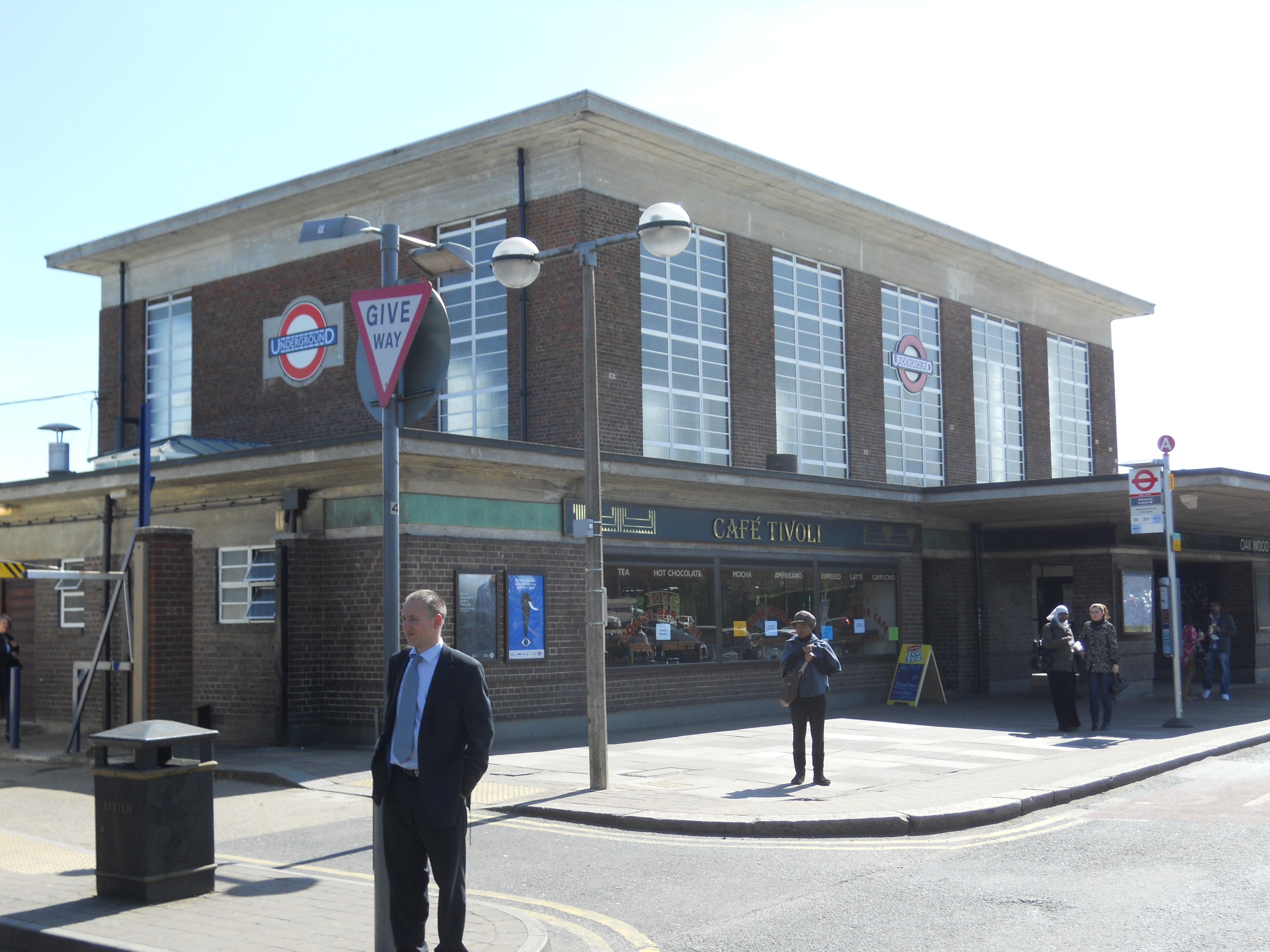
This picture shows Oakwood station on the Piccadilly Line.
Note.
- The station is the second most Northerly on the line.
- It opened in 1933.
- It is a classic Charles Holden design.
- It is a Grade II* Listed building.
- The station is on top of a hill and has an elevation of 71 metres above sea level.
This Google Map shows a close-up of the roof.
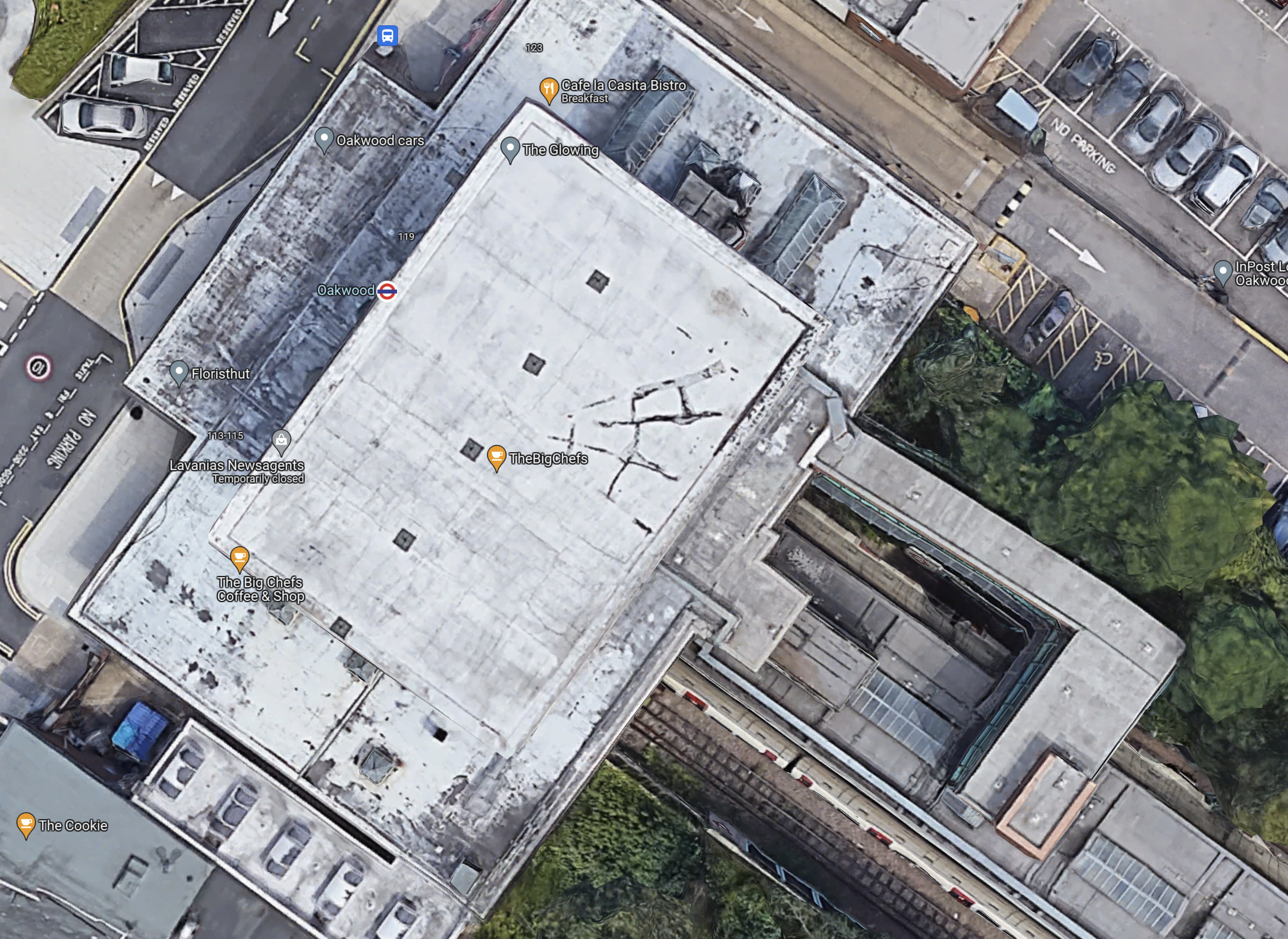
There might be a few aerials on the roof, but no solar panels.
Oakwood’s Location And Weather
I used to live near Oakwood station and it had its disadvantages.
- Cycling home was always up a steep hill.
- It could get very cold at times.
There even used to be a plaque at the station, which said that if you flew East, the first land you would hit would be the Urals.
Oakwood station could be an ideal renewable power station.
- The concrete and brick box of the station is probably exceedingly strong.
- Solar panels could cover the flat roof.
- SeaTwirls or other vertical turbines could be mounted around the solar panels.
- There could still be spaces for the aerials.
- I wonder what the reaction of English Heritage would be.
Should we call this mixed solar and wind power generation, hybrid renewable energy? Or do we overdo, the use of hybrid?
London Underground have other stations of a similar design including Sudbury Town and Acton Town.
The Wider Area To The West Of Oakwood Station
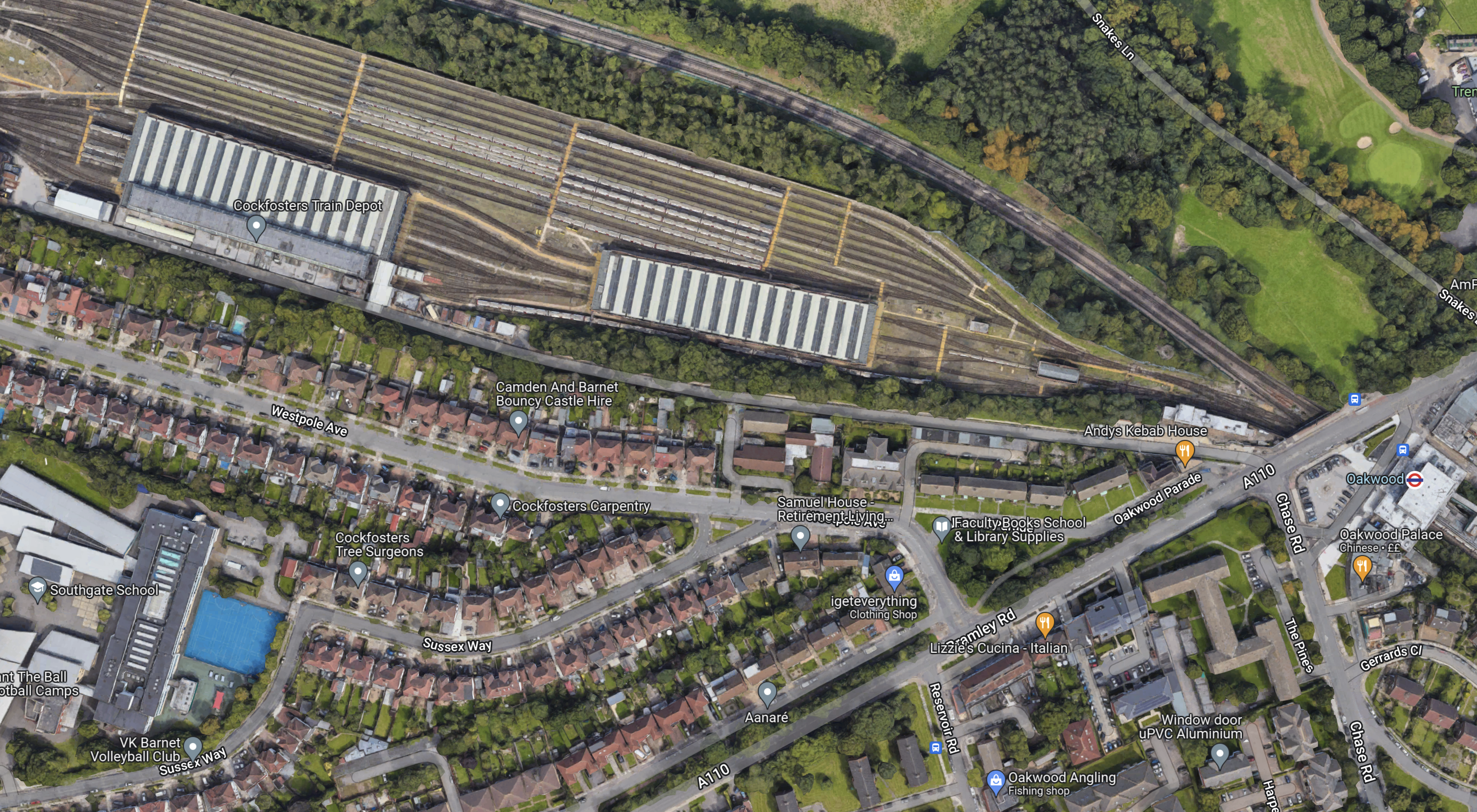
This Google Map shows the area to the West of Oakwood station.
Note.
- The striped roofs at the top of the map, with sidings for trains to the North, is Cockfosters Train Depot for the Piccadilly Line..
- The large building in the South-West corner is Southgate School, which I watched being built in the early 1960s, from my bedroom window in our house opposite. It is a concrete frame building typical of the period.
- Oakwood station is at the East side of the map and indicated by a London Underground roundel.
I think the possibilities for hybrid power generation in this area are good.
Cockfosters Depot
Cockfosters Depot could be an interesting site to develop as a renewable power station.
- There’s no way the site could be developed for housing, as it’s in the Green Belt.
- Road access is bad, but access for trains is good.
- I estimate that the depot is an area of at least five square kilometres.
- It’s still windy in the depot.
But it could have a solar roof and a few vertical wind turbines over the whole depot as designs and panels improve.
Southgate School
Southgate School could have a similar setup to Oakwood station.
Opportunities At Cockfosters Station
This Google Map shows a 3D image of Cockfosters station and the buildings around it.

Note.
- Cockfosters station is indicated by the roundel.
- The station is a Grade II Listed building.
- The station has an elevation of 97 metres.
- Half of the station car park is going to be turned into housing.
- Trent Park lies to the North of the station.
- The road in front of the station is Cockfosters Road, which to the North joins the M25 at Junction 24.
- The building between Cockfosters Road and the railway used to be offices, but it is now being converted into housing.
That high roof of the housing development, must be an ideal candidate for solar panels and vertical wind turbines.
Conclusion
I have tried to show the potential of just one of the small hills that ring London.
The Ultimate Bus Stop
London has very comprehensive bus stops as these pictures show.








Note.
- Most bus stops have a pole mounted roundel, that can be seen from a reasonable distance. In many cases, anybody with reasonable sight can see the roundel for the next stop.
- Where space permits, bus stops have a shelter with seats, maps and instructions on ticketing.
- Some stops have been extended into the road, so that it is a level step into and out of the bus.
- As shown in the pictures, so bus stops have displays showing the next ten buses, that will be arriving.
But I do think, they could be improved, with extra features.
Internet Connectivity
I feel strongly, that all bus stops should have good internet connectivity.
This could be 4G, 5G or just wi-fi, but I believe this could help with the safety of people on the street.
Comprehensive Lighting
To contribute to safety, I also feel that all bus stops should be well lit.
CCTV Issues
I also feel that all bus stops should have provision for CCTV, so if there was a need, it could be quickly fitted. But if the bus stop had good internet connectivity, then this shouldn’t be a problem.
Phone Charging
New buses have this feature, so why not at the stops?
Power Supply Issues
If we add all these features, we could be needed an uprated power supply.
- So could we see bus stops, with solar panels on the roof.
- Perhaps even a mini wind turbine?
- I think a vertical wind turbine, which was similar to a SeaTwirl, but smaller, could be ideal!
- Could it be called a StreeTwirl?
- A self-powered bus could be created with the addition of a battery.
Self-powered bus stops might be easier to install.
Conclusion
Bus stops will have more features in the future.
Lützerath: German Coal Mine Stand Off Amid Ukraine War Energy Crunch
The title of this post, is the same as that on this article on the BBC.
This is the sub-heading.
From her tiny wooden treehouse, which sways precariously in the winter wind, a young woman watches an enormous mechanical digger tear into the earth below, its jaws edging ever closer to the village which she’s determined to save.
And these two paragraphs outline the protest.
Lützerath, in western Germany, is on the verge – literally – of being swallowed up by the massive coal mine on its doorstep.
Around 200 climate change activists, who are now all that stand in the way of the diggers expanding the Garzweiler opencast mine, have been warned that if they don’t leave by Tuesday they’ll be forcibly evicted.
But this is not about coal or bituminous coal, as we know it in the UK, this mine will produce lignite or brown coal.
Read both Wikipedia entries linked to the previous sentence and you find some choice phrases.
For bituminous coal.
- Within the coal mining industry, this type of coal is known for releasing the largest amounts of firedamp, a dangerous mixture of gases that can cause underground explosions.
- Extraction of bituminous coal demands the highest safety procedures involving attentive gas monitoring, good ventilation and vigilant site management.
- The leading producer is China, with India and the United States a distant second and third.
For lignite.
- It has a carbon content around 25–35%. and is considered the lowest rank of coal due to its relatively low heat content.
- When removed from the ground, it contains a very high amount of moisture which partially explains its low carbon content.
- The combustion of lignite produces less heat for the amount of carbon dioxide and sulfur released than other ranks of coal. As a result, environmental advocates have characterized lignite as the most harmful coal to human health.
- Depending on the source, various toxic heavy metals, including naturally occurring radioactive materials may be present in lignite which are left over in the coal fly ash produced from its combustion, further increasing health risks.
- Lignite’s high moisture content and susceptibility to spontaneous combustion can cause problems in transportation and storage.
I don’t think, that we’ve ever burned lignite in the UK for electricity, as it is just too filthy.
This map shows the mine.

Note.
- The autobahn at the West of the map, is a six-land highway, so gives an idea of the scale.
- The village of Lützerath is towards the bottom of the map in the middle.
- What has been left after the mining, is going to take a lot of restoration.
It almost appears that some of the scenes of devastation, we are seeing in the Ukraine are also happening in Germany due to the frantic search for energy.
A 1960s-Educated Engineer’s Attitude To Coal
I was one of about four-hundred engineers in my year at Liverpool University in the 1960s.
- Quite a few of those engineers were from coal-mining areas and some were children of miners.
- I remember the graduate recruitment fair at the University in 1968, where the representative from the National Coal Board sat there alone, as if he’d got the 1960s version of Covid-19.
- Some went and talked to him, as they felt sorry for him.
- As far as I know, not one of us, went to work for the National Coal Board.
Engineers and other graduates of the 1960s, didn’t feel that coal was the future.
Had Aberfan and the other pit disasters of the era killed coal as a career, amongst my generation of the UK population?
What Should The Germans Do?
It is my view that whatever the Germans do, burning brown coal, should not be on the list. It’s just too polluting.
This article on euronews is entitled Germany And Poland Have A Dirty Big Secret – An Addiction To Brown Coal.
A few years ago, I was in Katowice on Poland and I have never seen such pollution in Europe, since the smogs of the 1950s.
The euronews article says this.
In eastern Germany some members of a little-known group claim they are being ethnically cleansed, not by militia groups, but by the coal mining industry.
Bulldozers have so far destroyed over 130 Sorb villages to make way for the mining of Europe’s dirtiest kind of fossil fuel – brown coal, or lignite as it is also known.
Brown coal mines are open cast and devour vast tracts of land. As well as whole villages farming and wildlife are destroyed.
The Penk family live in the village of Rohne. They feel their whole culture is also being destroyed.
Note that the Sorbs have a Wikipedia entry, which says there are 60,000 Sorbs in Germany.
One thing the Germans are doing is investing in the UK renewable energy industry.
- RWE own or part-own over 7 GW of offshore wind farms in the UK, some of which are under development.
- enBW and BP are developing 3 GW of offshore wind farms in the UK.
- Over twenty offshore wind farms use Siemens Gamesa turbines.
- The NeuConnect interconnector is being built between the Isle of Grain and Wilhelmshaven.
Would it not be better for the physical and mental health of German citizens, if they abandoned their dirty love of brown coal and spent the money in the North Sea?
Norwegian Companies To Explore Using Aluminium In Floating Offshore Wind Turbines
This is based on this press release from World Wide Wind, which is entitled WORLD WIDE WIND AS and HYDRO ASA Signs Letter Of Intent Aiming At Using Aluminium In Offshore Floating Wind Turbines.
This is the first paragraph.
Hydro, the world leading Norwegian aluminium and energy company and World Wide Wind AS, a Norwegian company developing a floating wind turbine, have signed a Letter of Intent (LoI) to explore the use of aluminium in the renewable wind industry. The two Norwegian companies are partnering up to develop floating wind turbines with a design specifically meant for offshore conditions. The goal is to use sustainable and recyclable materials in the construction, including aluminium.
In Do All Wind Turbines Have To Be Similar?, I said this about the radically different turbines of World Wide Wind.
I’ll let the images on the World Wide Wind web site do the talking.
But who would have thought, that contrarotating wind turbines, set at an angle in the sea would work?
This is so unusual, it might just work very well.
As aluminium is lighter, it might be a factor in the success of the design.
This is the last paragraph of the press release.
World Wide Wind’s integrated floating wind turbines are scalable up to 40MW – 2,5 times current wind turbines – and will use less materials and have a smaller CO2 footprint than conventional turbines. It is World Wide Wind’s ambition that these turbines will represent future design for floating wind turbine design.
40 MW is a very large turbine. This is definitely a case of handsome is as handsome does!
Another Renewable Power Idea From Sweden
I have posted some ideas from Sweden on this blog including.
- H2 Green Steel – H2 Green Steel Plans 800 MW Hydrogen Plant In Sweden
- HYBRIT – Sweden’s Grand Plan To Make Zero-Carbon Steel
- Minesto – Is This The World’s Best Renewable Energy Video?
- TwinHub – Hexicon Wins UK’s First Ever CfD Auction For Floating Offshore Wind
And now there’s the SEATWIRL, which the company says is the future of offshore wind.
In the Areas Of Use, there is a section with a heading of SeaTwirl For Niche Markets, where this is said.
SeaTwirl has now identified markets where wind turbines of the size of 1 MW can meet a clear market demand and sees a possibility to build a business aimed at these niche markets in parallel with its main target. That can mean revenues for the company sooner than was originally planned.
The niche markets that have been identified are islands and remote seaside villages, fish farms and desalination plants. These are business and places that today are run mainly on electricity from diesel generators, which is both expensive and emits CO2.
One of the places I would use these turbines, is on the apex of four-beam steel portal frame buildings. The original concept for these buildings had been developed at Cambridge University during World War Two and one of the team, had set up a business in Warwickshire, constructing these buildings for barns, factory units and other purposes.
He had programmed a simple computer program, which he ran on a time-shared computer system. I was hired to improve the computer program.
What surprised me was the strength of these buildings and I believe they could support vertical turbines like SeaTwirl along the apex.
I feel there are many other applications, especially if they are designed to be part pf a bigger system.
Conclusion
I like the concept of SeaTwirl.
 The Anonymous Widower