The Next Generation Of Fixed Foundation Wind Farms
This article on offshoreWIND.biz, is entitled Offshore Wind Turbines In 2022: 15 MW Prototypes Starting To Spin In Europe, Chinese Rolling Out 16 MW Models, Windcatcher And VAWTs Secure Demo Projects.
The title itself, shows 15-16 MW wind turbines and the text lists three European 15 MW and two Chinese 16 MW wind turbines, that are being developed.
This paragraph also indicates that Siemens Gamesa are in the running for orders.
So far, the SG 14-236 DD wind turbine has been selected as a preferred option for the Norfolk Vanguard and Boreas wind farms offshore the UK, as well as for the MFW Bałtyk II and MFW Bałtyk III wind farms in the Polish Baltic Sea.
Large turbines with a capacity of 15 MW and upwards appear to be becoming the new normal.
Water depths for these large turbines are forecast to be deeper than the two Norfolk wind-farms, which are between 22 and 40 metres.
This means that foundations will get much larger and heavier.
This article on offshoreWIND.biz, is entitled New Monopile Installation Method Attracts Major Backer, describes a new generation of monopiles as 100-130 metres in length, 12-15 metres in outer diameter, and a weight of up to 5,000 tonnes.
Installing these long and heavy objects safely in deep waters, is not a job for the faint-hearted.
The article describes a new method of installation, which I feel is very elegant.
- The XXXL monopiles are built horizontally.
- They are moved on to the jack-up ship by self-propelled modular transporters (SPMT).
- It appears at least two or possibly up to four monopiles can be carried on the ship.
- They are lifted into the vertical position by a lifting beam.
Note.
- No cranes are involved in the process.
- The lifting beam method of erecting the 5,000 tonne XXXL monopile is simple and very efficient.
- Self-propelled modular transporters were used to install the 2000 tonne subway at Hackney Wick station.
- Rollers are fitted on the ship to ease handling of the monopiles.
I can certainly see this specialised jack-up ship speeding up the installation of these giant monopiles.
Consequences For Floating Wind
I do wonder, if this method of installing fixed foundation wind farms, will allow larger foundations and these may mean that there is less need for the more complex floating wind farms.
Norway’s Answer To Wind Power Intermittency Lies Offshore – Study
The title of this post, is the same as that of this article on offshoreWIND.biz.
This is the first paragraph.
SINTEF has revealed in its recent study that there is no statistical covariation or systematic correlation in time between the occurrence of offshore wind conditions in southern and northern Norway, and adds that this knowledge will increase the commercial value of Norwegian offshore wind energy.
It does seem lucky for the Norwegians, that their wind farms appear to be able to supply a more constant amount of electricity, than many of those against wind farms would have you believe.
I hope that a reputable UK agency or university, is doing a similar analysis for UK wind farms.
World’s First Floating Offshore Wind Farm Celebrates Five Years Of Operation
The title of this post, is the same as that of this article on offshoreWIND.biz.
This is the sub-heading.
Hywind Scotland, the first floating offshore wind farm in the world, has passed five years in operation since its commissioning in 2017.
And this is the first paragraph.
According to Equinor, Hywind Scotland is the world’s best-performing offshore wind farm, achieving a capacity factor of 54 per cent over its five years of operations.
Note.
- Hywind Scotland is a 30 MW wind farm with five turbines.
- The capacity faction is much higher than a windfarm with fixed foundations.
- The water depth is between 95 and120 metres.
- The wind farm is 30 km. off Peterhead.
There is at least 15 GW of floating wind farms being planned in UK waters before 2030.
Conclusion
The wind farm has made a good start for the first floating wind farm.
Danes Talk 62 MW Offshore Wind Turbines For North Sea Energy Island
The title of this post, is the same as that of this article on Offshore Energy.
The Danes may talk 62 MW, but that four times larger than one of the biggest today, that I wrote about in Vestas 15 MW Prototype Turbine Produces First Power.
This paragraph says a bit more about the 62 MW turbine.
According to the DEA’s framework document for the draft plan for the strategic environmental assessment (SEA), this could be a 500-metre-tall wind turbine with a rotor diameter of 480 metres and a capacity of up to 62 MW.
This turbine is bigger in terms of capacity, than than some whole farms.
Vestas 15 MW Prototype Turbine Produces First Power
The title of this post, is the same as that of this article on offshoreWIND.biz.
This is the introductory paragraph.
Vestas’ V236-15.0 MW prototype wind turbine has produced its first kWh after being fully assembled at the Østerild National test centre for large wind turbines in Western Jutland, Denmark.
The first of the four wind farms in the Hornsea wind farm complex to be developed is Hornsea One.
- It has a capacity of 1218 MW.
- It is comprised of 174 Siemens SWT-7.0-154, which each have a generating capacity of 7 MW.
If 15 MW turbines could have been used on Hornsea One, it would have more than doubled the generating capacity to 2625 MW.
But obviously, larger turbines have longer blades, so they may need to be placed further apart.
In Vattenfall Boosts Capacity For Norfolk Offshore Wind Zone, I write about how Vattenfall are increasing the size of their Norfolk wind farms, by proposing to use larger turbines.
Conclusion
Turbines will get larger and 15 MW turbines will be commonplace.
A possible advantage is that you only need sixty-seven turbines for a GW, as opposed to a hundred 10 MW turbines, so there are possibilities to optimise the most profitable way to build a wind farm.
Neptune Energy, Ørsted And Goal7 Explore Powering Integrated Energy Hubs With Offshore Wind
The title of this post, is the same as that of this press release from Neptune Energy.
These four paragraphs outline the agreement.
Neptune Energy today announced it has signed a Memorandum of Understanding with Ørsted and Goal7 to explore powering new integrated energy hubs in the UK North Sea with offshore wind-generated electricity.
Integrated energy hubs have the potential to combine multiple energy systems, including existing oil and gas production assets, carbon storage and hydrogen production facilities. They could extend the life of producing fields and support the economic case for electrification with renewable energy, to keep carbon emissions low.
The agreement will see the companies examine the potential to supply renewable electricity from Ørsted’s Hornsea offshore windfarm projects to power future Neptune-operated hubs in the UK North Sea.
Goal7 will provide project management support and technical input.
Note.
- Neptune Energy has three oil and gas fields in the UK North Sea; Cygnus (operational), Isabella (exploration) and Seagull (development)
- Gas from Cygnus comes ashore at the Bacton Gas Terminal.
- Ørsted owns the Hornsea wind farm, which when fully developed will have a capacity of around 6.5 GW.
- Cygnus and Hornsea could be not much further than 50 km apart.
- Seagull and Isabella are further to the North and East of Aberdeen.
- Ørsted has an interest in the Broadshore wind farm, which was numbered 8 in the ScotWind Leasing round.
These are my thoughts.
The Cygnus Gas Field And The Hornsea Wind Farm
This could be like one of those stories where boy meets the girl next door and they hit it off from the first day.
This page on the Neptune web site says this about the Cygnus gas field.
The biggest natural gas discovery in the southern North Sea in over 30 years is now the largest single producing gas field in the UK, typically exporting over 250 million standard cubic feet of gas daily. Cygnus contributes six per cent of UK gas demand, supplying energy to the equivalent of 1.5 million UK homes. It has a field life of over 20 years.
Two drilling centres target ten wells. Cygnus Alpha consists of three bridge-linked platforms: a wellhead drilling centre, a processing/utilities unit and living quarters/central control room. Cygnus Bravo, an unmanned satellite platform, is approximately seven kilometres northwest of Cygnus Alpha.
In 2022, we plan to drill two new production wells at Cygnus, with the first of these expected to come onstream in 4Q. The second well is due to be drilled in the fourth quarter and is expected onstream in the first quarter of 2023, with both wells helping to maintain production from the field and offset natural decline.
Gas is exported via a 55 km pipeline. Cygnus connects via the Esmond Transmission System (ETS) pipeline to the gas-treatment terminal at Bacton, Norfolk. Neptune Energy has a 25% minority interest in ETS.
Note.
- Cygnus with a twenty year life could be one of the ways that we bridge the gap until we have the two Cs (Hinckley Point and Sizewell) and a few tens of offshore wind gigawatts online.
- The two extra wells at Cygnus will help bridge the gap.
- The gas field has a pipeline to Bacton.
So what can the gas field and the wind farm, do for each other?
Hornsea Can Supply The Power Needs Of Cygnus
Typically, ten percent of the gas extracted from the wells connected to a gas platform, will be converted into electricity using one or more gas-turbine engines; which will then be used to power the platform.
So, if electricity from the Hornsea wind farm, is used to power the platform, there are two benefits.
- More gas will be sent through the pipeline to Bacton.
- Less carbon dioxide will be emitted in recovering the gas.
Effectively, electricity has been turned into gas.
Electricity Can Be Stored On The Sea-Bed
The Hornsea One wind farm has an area in the order of 150 square miles and it is only one wind farm of four, that make up the Hornsea wind farm.
I would argue that there is plenty of space between the turbines and the wells of the Cygnus gas field to install some form of zero-carbon underwater battery to store electricity.
But does this technology exist?
Not yet! But in UK Cleantech Consortium Awarded Funding For Energy Storage Technology Integrated With Floating Wind, I described a technique called Marine Pumped Hydro, which is being developed by the STORE Consortium.
- Energy is stored as pressurised water in 3D-printed hollow concrete spheres fitted with a hydraulic turbine and pump.
- The spheres sit on the sea-bed.
- This page on the STORE Consortium web site, describes the technology in detail.
- The technology is has all been used before, but not together.
I think it is excellent technology and the UK government has backed it with £150,000 of taxpayers’ money.
I also believe that Marine Pumped Hydro or something like it, could be the solution to the intermittency of wind farms.
Excess Electricity Can Be Converted Into Hydrogen
Any spare electricity from the wind farm can drive an electrolyser to convert it into hydrogen.
The electrolyser could be mounted on one of the Cygnus platforms, or it could even float.
The hydrogen produced would be blended with the gas and sent to Bacton.
Carbon Dioxide Can Be Stored In The Depleted Cygnus Gas Field
As the gas field empties of natural gas, the gas pipes to the Cygnus gas field can be reversed and used to bring carbon dioxide to the gas field to be stored.
The Cygnus gas field has gone full circle from providing gas to storing the same amount of carbon that the gas has produced in its use.
These are two paragraphs from the press release.
Neptune Energy’s Director of New Energy, Pierre Girard, said: “The development of integrated energy hubs is an important part of Neptune’s strategy to store more carbon than is emitted from our operations and the use of our sold products by 2030.
“Neptune has submitted three applications under the recent Carbon Dioxide Appraisal and Storage Licensing Round, and securing the licences would enable us to develop future proposals for integrated energy hubs in the UK North Sea.
I can envisage a large gas-fired power-station with carbon capture being built in Norfolk, which will do the following.
- Take a supply of natural gas from the Cygnus gas field via the Bacton gas terminal.
- Convert the hydrogen in the gas into electricity.
- Convert the carbon in the gas into carbon dioxide.
- Store the carbon dioxide in the Cygnus gas field via Bacton.
- I also suspect, that if a Norfolk farmer, manufacturer or entrepreneur has a use for thousands of tonnes of carbon dioxide, they would be welcomed with open arms.
Would the ultra-greens of this world, accept this power station as zero-carbon?
The Isabella And Seagull Gas Fields And The Broadshore Wind Farm
Could a similar set of projects be applied to the Isabella and Seagull gas fields, using the Broadshore wind farm?
I don’t see why not and they could work with the Peterhead power stations.
Vattenfall Hails Uncrewed Vessels
The title of this post, is the same as that of this article on offshoreWIND.biz.
This is the sub-heading.
Swedish energy company Vattenfall conducted large-scale seabed surveys with uncrewed surface vessels at several of its offshore wind farms in Denmark, Sweden, and the UK earlier this year.
The article is a must-read and is describes how automation will be used in the future in the offshore wind industry.
Scotland’s Renewable Energy Jackpot: Hydrogen Exports Alone Could Be worth £25 Billion A Year By 2045
The title of this post, is the same as that of this article on the Edinburgh News.
This is the sub-heading.
Scotland is a phenomenally energy rich country. For decades the largest oil-producing nation in the European Union, it is now set to trail-blaze as a leader in renewable energy.
The title and sub-heading say it all for Scotland.
But these words could equally well apply to Anglesey, Cornwall, Devon, East Anglia, Humberside, Liverpool and Morecambe Bays, the Severn Estuary and Pembrokeshire.
We also mustn’t forget the Dogger Bank!
Ramboll To Develop Offshore Wind-To-Hydrogen Concept
The title of this post, is the same as that of this article on offshoreWIND.biz.
This is the sub-heading.
Ramboll has been selected to investigate the feasibility of producing hydrogen offshore at a multi-gigawatt scale with NortH2 in the Dutch part of the North Sea.
Note.
- NortH2 has a web site.
- There is a very rich About NortH2 page.
- NortH2 is a consortium made up of Equinor, Eneco, Gasunie, Groningen Seaports, RWE and Shell Netherlands.
- The consortium aims to use 4 GW to produce hydrogen by 2030 and 10 GW by 2040.
The world needs more ambitious projects like this.
Offshore Wind Turbines Need To Be Standardised, Energy Transition Industrialised To Reach Targets, Says Siemens Energy VP For Western Europe
The title of this post, is the same as that of this article on offshoreWIND.biz.
This is the sub-heading.
Governments need to move from talking about policies to implementation, the offshore wind industry needs to employ standardisation, and clear rules and regulations need to be set for green hydrogen in order to move faster with large-scale deployment and achieve meaningful progress in limiting global warming to 1.5 degrees Celsius.
The guy has a point, as mass production of anything is generally more efficient and creates more units in a given time.
But can a diverse group of politicians, agree on a standard for turbines, fixed foundations, floaters, cables and sub-stations and then make sure all are identical and clip together like Lego? I doubt it!
And how would you fit innovative designs like TwinHub into a standard.
This image shows one of their TwinHub turbine installations being towed into place.
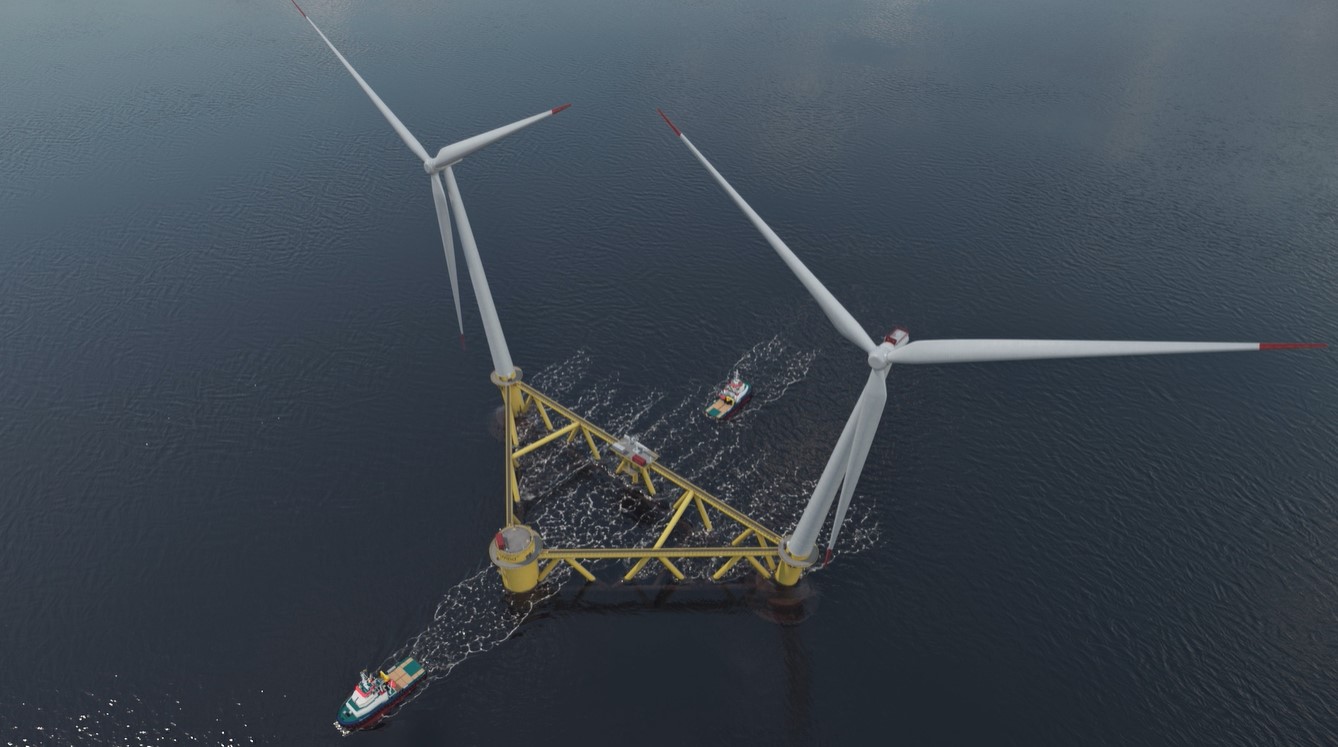
At least it could be built to hold two standard turbines.
 The Anonymous Widower