Is The Eastern Leg Of High Speed Two Under Threat?
This page on the High Speed Two web site is entitled HS2 Phase 2b Eastern Leg.
These are the opening three paragraphs.
Earlier this year the government made clear in its response to the Oakervee Review its commitment to Phase 2b of HS2, ensuring we boost capacity, improve connectivity between our regions and share prosperity.
As part of this, the government plans to present an Integrated Rail Plan for the North and Midlands by the end of the year, informed by an assessment from the National Infrastructure Commission, which will look at how to deliver HS2 Phase 2b, Northern Powerhouse Rail, Midlands Rail Hub and other rail programmes better and more effectively.
In the meantime, the government has asked HS2 Ltd to pause work on the Eastern Leg. We recognise that this causes uncertainty and our Eastern Leg community engagement teams remain in place to support you.
The page then says that the work on the Western Leg should proceed, with the aim of a Western Leg Bill in early 2022.
In Northern Powerhouse Rail – Significant Upgrades Of The East Coast Main Line From Leeds To Newcastle (Via York And Darlington) And Restoration Of The Leamside Line, I showed that the current and future upgrades to the East Coast Main Line, required by the East Coast Main Line, Northern Powerhouse Rail and High Speed Two, will greatly reduce the times on services from London Kings Cross to Doncaster, Yorkshire, the North East and Scotland.
I said this on timings on the East Coast Main Line.
- London Kings Cross and Doncaster could be around an hour.
- London Kings Cross and Leeds could be around one hour and thirty minutes, using the current Doncaster and Leeds time, as against the one hour and twenty-one minutes for High Speed Two.
- London Kings Cross and York could be around one hour and twenty-three minutes, using the current Doncaster and York time, as against the one hour and twenty-four minutes for High Speed Two.
- Timings between York and Newcastle would be the same fifty-two minutes as High Speed Two, as the track will be the limitation for both services.
- High Speed Two’s timing for York and Newcastle is given as fifty-two minutes, with York and Darlington as twenty-five minutes.
- London Kings Cross and Darlington could be around one hour and forty-nine minutes
- London Kings Cross and Newcastle could be around two hours and sixteen minutes.
- London Kings Cross and Edinburgh would be under three-and-a-half hours, as against the proposed three hours and forty-eight minutes for High Speed Two.
LNER’s Azuma cavalry will hold the fort for as long as is needed.
I’ll now look at how various stations, will be affected if the Eastern Leg of High Speed Two is not built, until a couple of decades in the future.
Leeds
Current Long Distance Services At Leeds Station
Leeds station has the following long distance services in trains per hour (tph)
- CrossCountry – 1
- LNER – 2
- TransPennine Express – 5
It is a bit thin compared to say Birmingham or Manchester.
Northern Powerhouse Rail And Leeds
Northern Powerhouse Rail has plans for Leeds with these services to other Northern cities.
- Hull – two tph in 38 minutes
- Manchester – six tph in 25 minutes
- Newcastle – four tph in 58 minutes
- Sheffield – four tph in 28 minutes.
From what they have written, the following could also be possible.
- Bradford – six tph in a few minutes
- Liverpool – four or more tph in 51 minutes
- Manchester Airport – four or more tph in 35 minutes
It is an ambitious plan.
High Speed Two And Leeds
High Speed Two is planning to run the following trains to Leeds in every hour.
- Birmingham Curzon Street and Leeds – 200 metre train
- Birmingham Curzon Street and Leeds via East Midlands Hub – 200 metre train
- London Euston and Leeds via Old Oak Common and East Midlands Hub – 200 metre train
- London Euston and Leeds via Old Oak Common and East Midlands Hub – 400 metre train
- London Euston and Leeds via Old Oak Common, Birmingham Interchange and East Midlands Hub – 400 metre train
Timings will be as follows.
- Birmingham Curzon Street and Leeds – 49 minutes.
- London Euston and Leeds – One hour and 21 minutes.
There will be about 1000 seats per hour between Birmingham Curzon Street and Leeds and 2500 seats per hour Between London Euston and Leeds.
High Speed Two And Leeds Via Manchester
This report on the Transport for the North web site, is entitled At A Glance – Northern Powerhouse Rail.
This map shows Transport for the North’s ideas for connections in the West linking Crewe, Liverpool, Manchester, Manchester Airport, Warrington and Wigan.

A black line goes East from Manchester to link it to Leeds via Huddersfield and Bradford.
- This is proposed as a route shared between High Speed Two and Northern Powerhouse Rail.
- High Speed Two are promising that London Euston and Manchester will be timed at one hour and eleven minutes.
- London Euston and Manchester will have a frequency of three tph and will all be 400 metre High Speed Two Full Size trains, with about a thousand seats.
- Northern Powerhouse Rail have an objective of a twenty-five minute journey time between Manchester and Leeds.
I would also build the Manchester and Leeds route with the following characteristics.
- As a full-size tunnel capable of taking High Speed Two Full Size trains and the largest freight trains.
- Intermediate and underground stations at Huddersfield and Bradford.
- It could be built as a base tunnel, like the similarly-sized Gotthard base tunnel in Switzerland.
- The Swiss tunnel has a maximum operating speed for passenger trains of 125 mph.
If it can be built for a reasonable cost and in a reasonable time-scale, it could be a way of doing the following.
- Creating a straight 150 mph plus route across the Pennines, with a capacity of 18 tph.
- Running high-capacity fast trains between London Euston and Leeds via Manchester Airport and Manchester.
- Running freight trains between the two sides of the Pennines.
- Creating a high frequency route between Liverpool and Hull via Manchester Airport, Manchester, Huddersfield and Bradford and Leeds.
The passenger service between Liverpool and Hull could be the world’s first high speed metro.
If the London Euston and Manchester trains, were to be extended to Leeds, London Euston and Leeds would take one hour and thirty-six minutes, which would only be fifteen minutes slower, than is promised for the route going via the Eastern Leg of High Speed Two.
London Kings Cross And Leeds
When the in-cab digital signalling is complete between London Kings Cross and Leeds, I am fairly confident that with a few other improvements and more zoom from the Azumas, that a London Kings Cross and Leeds time of one hour and fifty minutes will be possible.
But will two nine-car or pairs of five-car trains per hour (tph), be enough capacity? Especially, as pairs of five-car trains will split and join to serve a wider catchment area, which will harvest more passengers.
LNER will in a couple of years have an extra path every hour into Kings Cross.
I would feel that best use of this path would be to run between London Kings Cross and Edinburgh via Leeds and Newcastle.
- Leeds and Newcastle could be the only intermediate stops.
- Leeds would be the ideal place to change to Northern Powerhouse Rail for anywhere in the North of England.
- My estimates, say it could run between London Kings Cross and Edinburgh in around three-and-a-half hours.
- It would run non-stop between London Kings Cross and Leeds, Leeds and Newcastle and Newcastle and Edinburgh.
It would increase capacity, between the four major destinations on the route; London Kings Cross, Leeds, Newcastle and Edinburgh.
It could start running, once the digital signalling and current improvements to the East Coast Main Line are complete.
London St. Pancras And Leeds
I discussed, Northern Powerhouse Rail’s plan for Sheffield and Leeds in Northern Powerhouse Rail – Connecting Sheffield To HS2 And On To Leeds.
This could see the following new infrastructure.
- Electrification between Clay Cross North Junction and Sheffield station of the route shared by the Midland Main Line and High Speed Two.
- Electrification through Sheffield and on to Leeds, via the Wakefield Line
- New stations for High Speed trains at Rotherham and Barnsley Dearne Valley.
I could see East Midlands Railway taking advantage of this route, with their new Class 810 trains and running a regular Leeds and St. Pancras service.
- It would call at Wakefield Westgate, Barnsley Dearne Valley, Rotherham and Meadowhall. between Leeds and Sheffield stations.
- It would take twenty-eight minutes between Leeds and Sheffield, if it met Northern Powerhouse Rail’s objective.
- Perhaps one of the two tph between London St. Pancras and Sheffield could be extended to Leeds.
As the current time between London St. Pancras and Sheffield, is a few minutes under two hours, I can see a time of comfortably under two-and-a-half hours between London St. Pancras and Leeds.
A Summary Of Journey Times Between London And Leeds
I can summarise my estimates, between London and Leeds.
- High Speed Two – Direct via Eastern Leg – One hour and twenty-one minutes.
- High Speed Two – via Manchester – One hour and thirty-six minutes.
- East Coast Main Line – via Doncaster – One hour and thirty minutes.
- Midland Main Line – via Derby and Sheffield – Two hours and twenty minutes.
The direct High Speed Two route is the fastest., but others could be viable alternatives for some passengers.
Bradford
Consider.
- Under current plans Bradford won’t be getting any high speed service from High Speed Two.
- The best it can get under current plans is several direct services per day, between Bradford Forster Square and London Kings Cross in perhaps two hours.
- The layout of the city and its two stations doesn’t give good connectivity.
Bradford, Harrogate, Huddersfield and Skipton could probably be served by trains to and from London Kings Cross that join and split at Leeds.
But if Northern Powerhouse Rail goes for a tunnel between Manchester and Leeds with Bradford as an underground station, it could be served by High Speed Two services going between London Euston and Leeds via Manchester.
I would estimate that if London Euston and Leeds via Manchester took around one hour and thirty-six minutes, London Euston and Bradford could take around an hour-and-a-half.
Darlington
I can summarise my estimates, between London and Darlington.
- High Speed Two – Direct via Eastern Leg – One hour and forty-nine minutes.
- High Speed Two – via Manchester and Leeds – Two hours and six minutes.
- East Coast Main Line – via Doncaster – One hour and forty-nine minutes.
Improvements on the East Coast Main Line, needed to enable and speed-up High Speed Two services to York, Darlington and Newcastle; will speed up East Coast Main Line services to Darlington.
Edinburgh
I can summarise my estimates, between London and Edinburgh.
- High Speed Two – Direct via Western Leg – Three hours and forty minutes.
- High Speed Two – via Manchester and Leeds – Three hours and forty-eight minutes.
- East Coast Main Line – via Doncaster – Three hours and thirty minutes.
Improvements on the East Coast Main Line, needed to enable and speed-up High Speed Two services to York, Darlington and Newcastle; will speed up East Coast Main Line services to Newcastle.
Harrogate
Consider.
- Under current plans Harrogate won’t be getting any high speed service from High Speed Two.
- The best it can get under current plans is several direct services per day, between Harrogate and London Kings Cross in perhaps two hours.
Bradford, Harrogate, Huddersfield and Skipton could possibly be served by trains to and from London Kings Cross that join and split at Leeds.
Huddersfield
- If Huddersfield is served by underground platforms beneath the current Huddersfield station, a lot of what I said for Bradford would apply to Huddersfield.
- The timings would probably be around an-hour-and-a-half from London Euston.
Bradford, Harrogate, Huddersfield and Skipton could possibly be served by trains to and from London Kings Cross that join and split at Leeds.
Hull
Hull is an interesting destination.
- Reaching Hull from the current High Speed Two network will need a change at Leeds or another station.
- Using Northern Powerhouse Rail’s objectives on timings, London Euston and Hull via Manchester on High Speed Two, would be a few minutes under two-and-a-half hours.
- I strongly feel, that London Kings Cross and Hull via Selby could be reduced to below two hours.
Hull would also make a superb Eastern terminal station for both Northern Powerhouse Rail and a High Speed Two service from London via Manchester and Leeds.
You pays your money and takes your choice.
Middlesbrough
Reaching Middlesbrough from the proposed High Speed Two network will need a change at York or another station.
But a time of two hours and twenty minutes, should be possible using the East Coast Main Line via Doncaster.
Improvements on the East Coast Main Line, needed to enable and speed-up High Speed Two services to York, Darlington and Newcastle, will speed up East Coast Main Line services to Middlesbrough.
Newcastle
I can summarise my estimates, between London and Newcastle.
- High Speed Two – Direct via Eastern Leg – Two hours and seventeen minutes.
- High Speed Two – via Manchester and Leeds – Two hours and thirty-four minutes.
- East Coast Main Line – via Doncaster – Two hours and sixteen minutes.
Improvements on the East Coast Main Line, needed to enable and speed-up High Speed Two services to York, Darlington and Newcastle; will speed up East Coast Main Line services to Newcastle.
Nottingham
I will compare average speeds on the Midland Main Line between London St. Pancras and Nottingham and on the East Coast Main Line, between London Kings Cross and Leeds.
Currently.
- London St. Pancras and Nottingham services, over the 126 mile route, take one hour and fifty minutes. which is an average speed of 69 mph.
- London Kings Cross and Leeds services, over the 186 mile route, take two hours and thirteen minutes, which is an average speed of 94 mph.
Note.
- The two routes are of similar character and are fairly straight with large sections of 125 mph running and quadruple tracks.
- The East Coast Main Line to Leeds is fully electrified, whereas the Midland Main Line is only partially electrified.
- Both routes have a small number of stops.
- In a few years time, services on both routes will be run by different members of the Hitachi AT-300 train family.
I don’t feel it would be unreasonable to assume that a London St. Pancras and Nottingham service could be run at an average speed of 94 mph, if the Midland Main Line were upgraded to the same standard as the East Coast Main Line.
This could mean a time of around one hour and twenty-one minutes between London St. Pancras and Nottingham, or a saving of twenty-nine minutes.
Is that possible?
- The new Class 810 trains, will have four engines instead of the normal three for a five-car AT-300 train. Will they be able to be closer to the 125 mph line-speed on diesel power, where it is available on the Midland Main Line.
- The trains will be able to use electrification between London St. Pancras and Market Harborough.
- There have been hints, that more electrification may be installed on the Midland Main Line.
- Hitachi have announced a battery electric version of the AT-300 train called an Intercity Tri-Mode Battery Train, where one or more of the diesel engines are replaced by battery packs.
- The new trains will be ready to accept in-cab ERTMS digital signalling, so they could be able to run at up to 140 mph, if the track were to be upgraded.
I certainly feel, that substantial time savings could be possible between London St. Pancras and Nottingham.
Eighty-one minutes would be very convenient, as it would comfortably allow a three hour round trip, which would mean just six trains or more likely pairs of trains would be needed for the current two tph service.
Eighty-one minutes would not be the fifty-two minute service promised by High Speed Two!
But!
- The new trains are planned to be introduced from 2023.
- Who knows, when High Speed Two will arrive at the East Midlands Hub station?
- They won’t need any new substantial infrastructure to replace the current trains.
I also suspect the new trains will have more seats, but, the capacity of the Class 810 train, has not been published.
Nottingham could also be served by a high speed service from London Kings Cross via Grantham, which I estimate would take about one hour and twenty minutes.
Sheffield
A lot of what I said for Nottingham can be applied to Sheffield.
- Currently, London St. Pancras and Sheffield services, over the 165 mile route, take two hours, which is an average speed of 82.5 mph.
- High Speed Two is promising a journey time of one hour and twenty-seven minutes.
- An average speed of 90 mph, would mean a journey time of one hour and fifty minutes.
- This would allow a four hour round trip, which would mean just eight trains or more likely pairs of trains would be needed for the current two tph service.
It would be very convenient for the operator.
It looks like if pairs of trains were to be run on both the Nottingham and Sheffield routes, that twenty-eight trains would be needed to run both services.
This fits well with a fleet size of thirty-three trains.
The only caveat, is that to get the required journey times, it might be necessary to rebuild and electrify the tracks, between Sheffield and Clay Cross North Junction.
- These tracks will be shared with the future Sheffield Branch of High Speed Two.
- It would only be 15.5 miles of double-track to rebuild and electrify.
- It could be rebuilt to allow 140 mph running. Several minutes could be saved!
The electrification could allow Hitachi’s Intercity Tri-Mode Battery trains to be able to run the Sheffield service.
These trains would certainly be a way of avoiding the tricky electrification of the Derby and Clay Cross section of the route, which goes through the World Heritage Site of the Derwent Valley Mills.
Sheffield could also be served by a high speed service from London Kings Cross via Doncaster, which I estimate would take about one hour and thirty minutes.
Skipton
Consider.
- Under current plans Skipton won’t be getting any high speed service from High Speed Two.
- The best it can get under current plans is several direct services per day, between Skipton and London Kings Cross in perhaps two hours.
Bradford, Harrogate, Huddersfield and Skipton could possibly be served by trains to and from London Kings Cross that join and split at Leeds.
Sunderland
Reaching Sunderland from the proposed High Speed Two network will need a change at York or another station.
But a time of two hours and thirty minutes, should be possible using the East Coast Main Line via Doncaster.
Improvements on the East Coast Main Line, needed to enable and speed-up High Speed Two services to York, Darlington and Newcastle, will speed up East Coast Main Line services to Sunderland.
York
I can summarise my estimates, between London and York.
- High Speed Two – Direct via Eastern Leg – One hour and twenty-four minutes.
- High Speed Two – via Manchester and Leeds – One hour and forty-two minutes.
- East Coast Main Line – via Doncaster – One hour and twenty-four minutes.
Improvements on the East Coast Main Line, needed to enable and speed-up High Speed Two services to York, Darlington and Newcastle; will speed up East Coast Main Line services to York.
I believe strongly, that York would be about as fast from London, by either of the direct routes, but both would serve different intermediate destinations.
Conclusion
My first conclusion is a surprising one, but the promised timings from High Speed Two and the current timings in the timetable make it clear.
To achieve the required timings for High Speed Two, major improvements must be made to existing track and these improvements will mean that existing services will be competitive with High Speed Two on time.
These improvements fall into this category.
- Improving the East Coast Main Line between York and Newcastle, will make East Coast Main Line services to York, Darlington, Durham and Newcastle competitive with High Speed Two services.
- Improving the East Coast Main Line between York and Newcastle, may also mean that London Kings Cross and Edinburgh will be faster than the High Speed Two service between London Euston and Edinburgh.
- Electrifying the route shared between Sheffield and Clay Cross North Junction, will speed up London St. Pancras and Sheffield services and make them more competitive with High Speed Two.
I suspect there may be similar mutual improvements on the Western leg of High Speed Two.
Other smaller conclusions from my analysis of the improvements include.
- These improvements will create some extra capacity on the East Coast and Midland Main Lines, by removing bottlenecks and improving line speeds.
- Electrification, even if it is only partial or discontinuous, will improve services on the Midland Main Line.
- Some places like Harrogate, Middlesbrough and Skipton will never be served directly by High Speed Two, but are easily served by East Coast Main Line services from London Kings Cross.
- Northern Powerhouse Rail is very much part of the North-South capacity for England.
- In-cab ERTMS signalling will play a large part in increasing capacity and line speeds.
Perhaps in our planning of High Speed Two, we should plan all the routes in the North and Midlands in a much more holistic way.
If we look at the capacity between London and the North, I feel that with the addition of Phase 1 of High Speed Two to Birmingham in 2029-2033 and hopefully Phase 2a soon afterwards, that Phase 2b will not be needed for reasons of speed and capacity until years later.
So, I would pause most construction of the Eastern Leg of High Speed Two until Phase 1 and Phase 2a are complete.
I would make exceptions for the following.
- Improvements to the shared section of the East Coast Main Line and High Speed Two, between York and Newcastle.
- Building a high speed connection between Leeds and York for the use of Northern Powerhouse Rail and the East Coast Main Line.
- Rebuilding and electrification of the shared section of the Midland Main Line and High Speed Two, between Clay Cross North Junction and Sheffield.
- Improve and electrify the route between Sheffield and Leeds.
But I would continue with the design, as I feel that East of Leeds is very much sub-optimal at the present time.
The route of the Eastern leg of High Speed Two would be safeguarded.
But the biggest problem with the Eastern Leg of High Speed Two to Leeds, is that however it is built travellers to and from Leeds, York and further North will not see any improvements for some years, but improving the East Coast Main Line wouldn’t exactly see jam tomorrow, but tons of it by 2024.
Could The Madrid And Lisbon High Speed Line Become Iconic?
This article on Railway Gazette International is entitled ADIF AV Agrees EIB Loan As Extremadura High Speed Link Makes Progress.
This sentence in the first paragraph gives details of the route.
The loan will support completion of the 282 km high speed line between Talayuela, Plasencia Cáceres, Mérida and Badajoz.
It will carry both passengers and freight and eventually link Madrid and Lisbon.
The article shows a spectacular bridge under construction.
So I got out my helicopter and decided to go and look for the bridge.
These are some sections and stations along the line.
The Railway Gazette article says this about the route to the East of Plasencia.
East of Plasencia however, land acquisition and preparatory works have proceeded more slowly. On this section, broad gauge tracks are to be laid as far as Talavera de la Reina, where there would be a junction with the conventional network and a gauge-changer. Passenger trains would then continue over 1 435 mm gauge tracks to join the existing Toledo – Madrid high speed line south of the capital.
Note.
- As I started from the East, it’s the other way round.
- If there is a gauge change and Iberian (broad) gauge to the West of Talavera de la Reina, is this to make it easier to connect to the Portuguese network?
- On the other hand, I thought, that all European-funded lines, as this one is, are supposed to be standard gauge.
- Will freight trains use gauge-change to get through?
As the Spanish do gauge-change well, I suspect they know what they’re doing, even if I don’t!
Two Routes From Madrid
Consider.
- Currently, trains between Madrid and Talavera de la Reina, use a single track line.
- The only sections of double-track are in stations and on the approaches to Madrid, after the trains pass Humanes de Madrid EMU depot.
- Plans appear to exist to link the new high speed route to Madrid, by using the existing Madrid and Toledo high speed line.
- This would reduce journey times and possibly increase capacity.
This Google Map shows the area between Msdrid and Toledo.
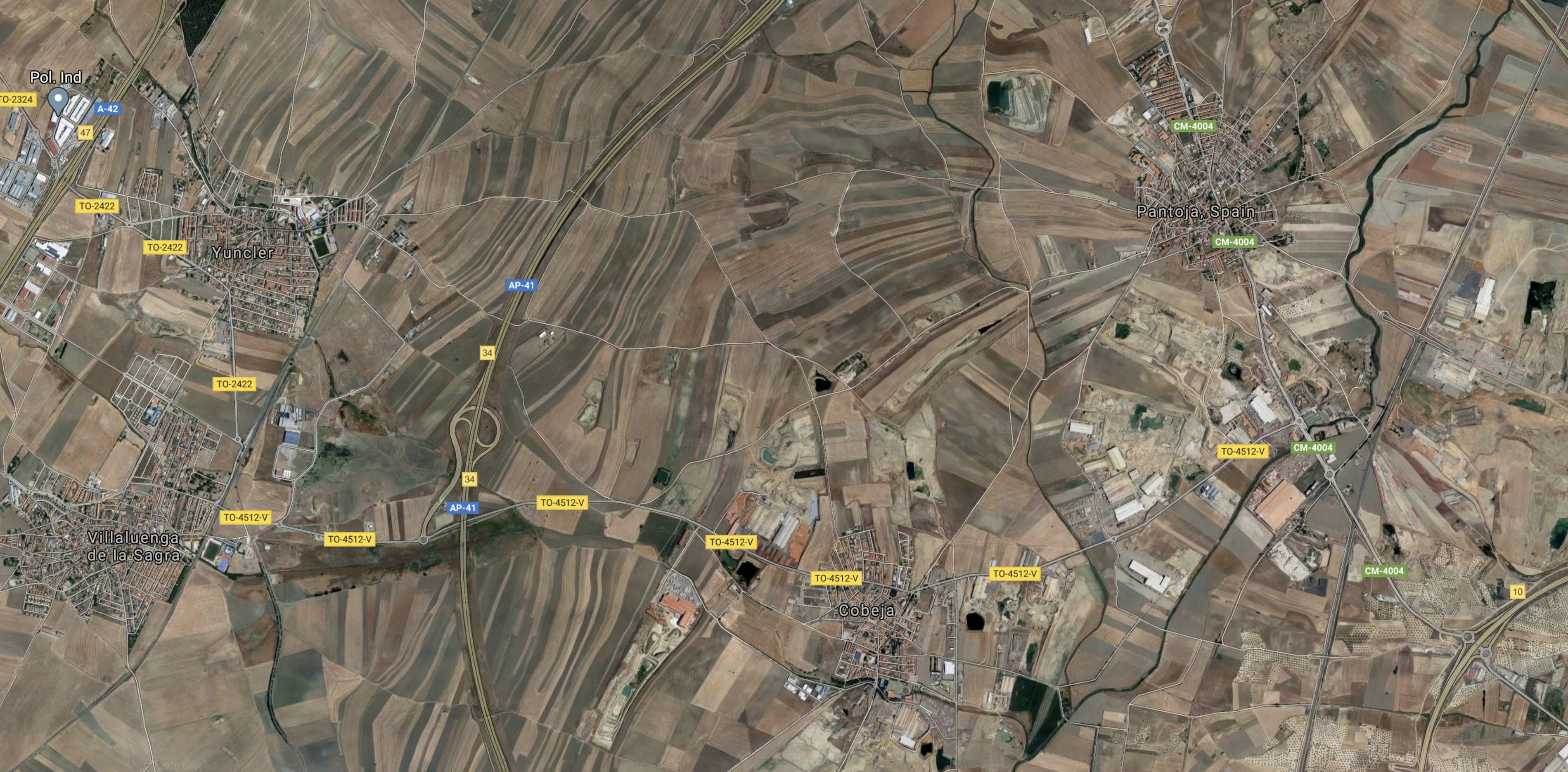
Note.
- The current single-track line between Madrid and Talavera de la Reina leaves the map in the South-Western corner.
- The line goes to the West of Villa Luenga de la Sagra and Yuncler before going to Madrid in a NNE direction.
- The Madrid and Toledo high speed line, runs diagonally in a SSW direction from the North-East corner of the map.
- The high speed line passes to the West of Cobeja and Pantoja.
Looking at the map, I don’t think it would be impossible to create a link between the two lines.
The Area Is Mainly Agricultural
This Google Map shows the mainly agricultural nature of the land.

Between Madrid and Talavera de la Reina, it also appears to not be very challenging and there doesn’t appear to be a major river, that would need to be crossed.
This should make construction easier!
Talavera de la Reina
This Google Map shows the railway station at the city of Talavera de la Reina.

Note.
- Madrid is to the East using standard gauge tracks.
- Badajoz is to the West using broad gauge tracks. Or does the standard gauge continue?
- The gauge change will be needed somewhere and it looks like it will happen here.
I can’t find any work here concerned with building the new high speed tracks.
Oropesa de Toledo
This Google Map shows the railway station in the town of Oropesa de Toledo.
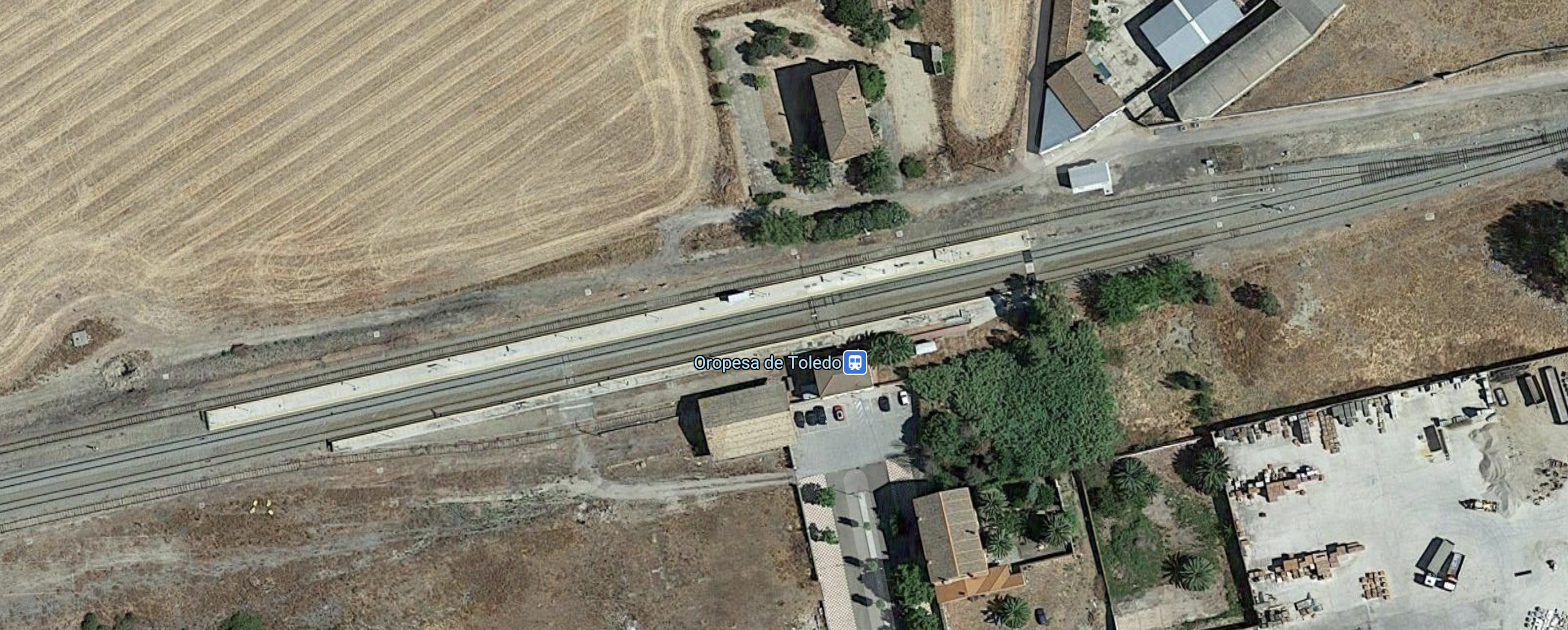
There is no sign of the high speed line.
Note.
- The high speed line stops rather abruptly. Will it continue in a tunnel?
- The current single-track railway, at the top of the map.
- The border between the two provinces at the right of the map.
No clues as to the gauge of the high speed lines.
Navalmoral de la Mata
The current line goes through the municipality of Navalmoral de la Mata.
This Google Map shows the station.

There appeared to be no sign of the new high speed line. On one of my maps it is shown to the North.
The Eastern End Of The High Speed Line
The first sight of the new high speed line was at the border of Extremadura.

Note.
- The high speed line stops rather abruptly. Will it continue in a tunnel?
- The current single-track railway, at the top of the map.
- The border between the two provinces at the right of the map.
No clues as to the gauge of the high speed lines.
Casatejada
This Google Map shows the municipality of Casatejada.
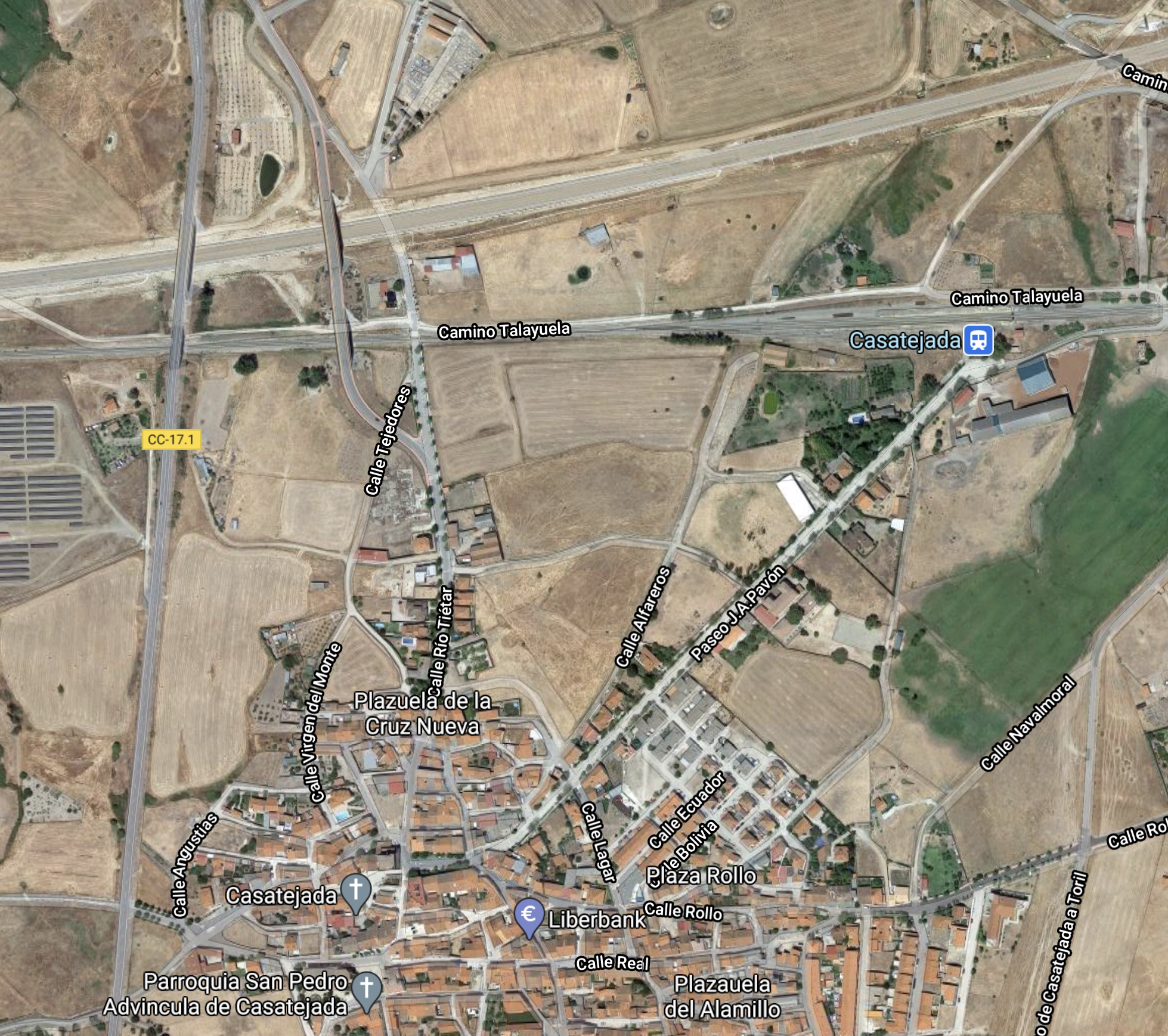
Note.
- The route of the new high speed line to the North.
- Wikipedia doesn’t say much about it.
It may have a station, but it doesn’t have too many trains.
The section of the high speed line ends just to the West of Casatejada, as this Google Map shows.
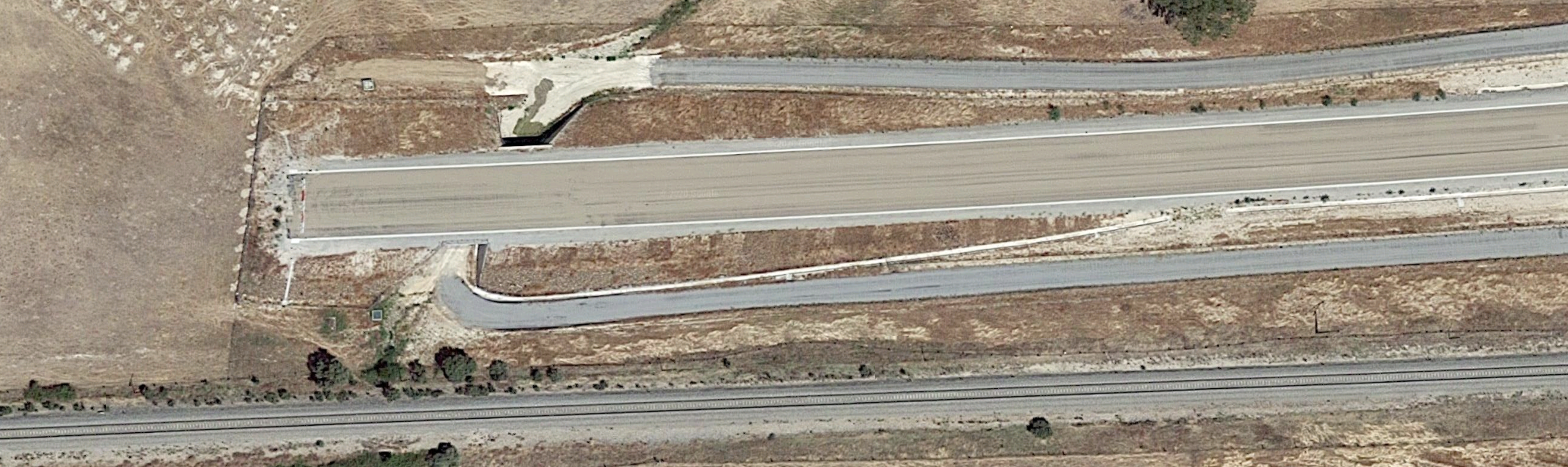
This section of the high speed line would seem to go all the way to the Eastern edge of Extremadura, which I showed in a previous section.
La Bazagona
This Google Map, shows the area of La Bazagona.
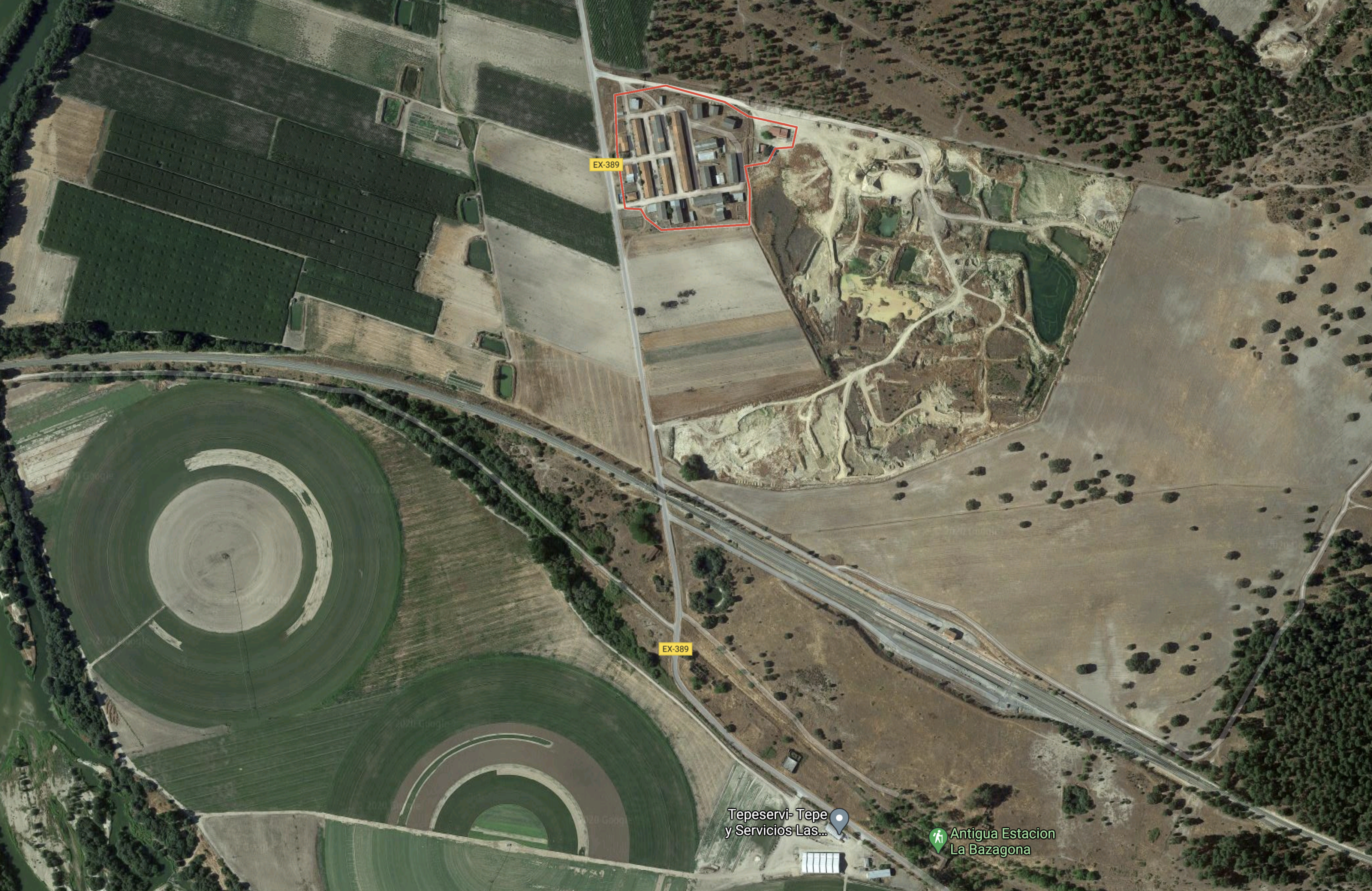
Note.
- The current railway curving across the map to the South-East corner.
- The two circle farms.
- Is a new community being built here?
It certainly looks like a new station is being built to serve the area.
West Of La Bazagona
Consider.
- West of La Bazagona, except for the current line, that goes via Monfrague, Mirabel and Cañaveral.
- My European railway atlas, indicates the new high speed route goes between Monfrague and Plasencia and calls at a station called Plascencia Fuenteduñas.
- I can’t locate Plascencia Fuenteduñas.
This Google Map shows the area to the West of La Bazagona.
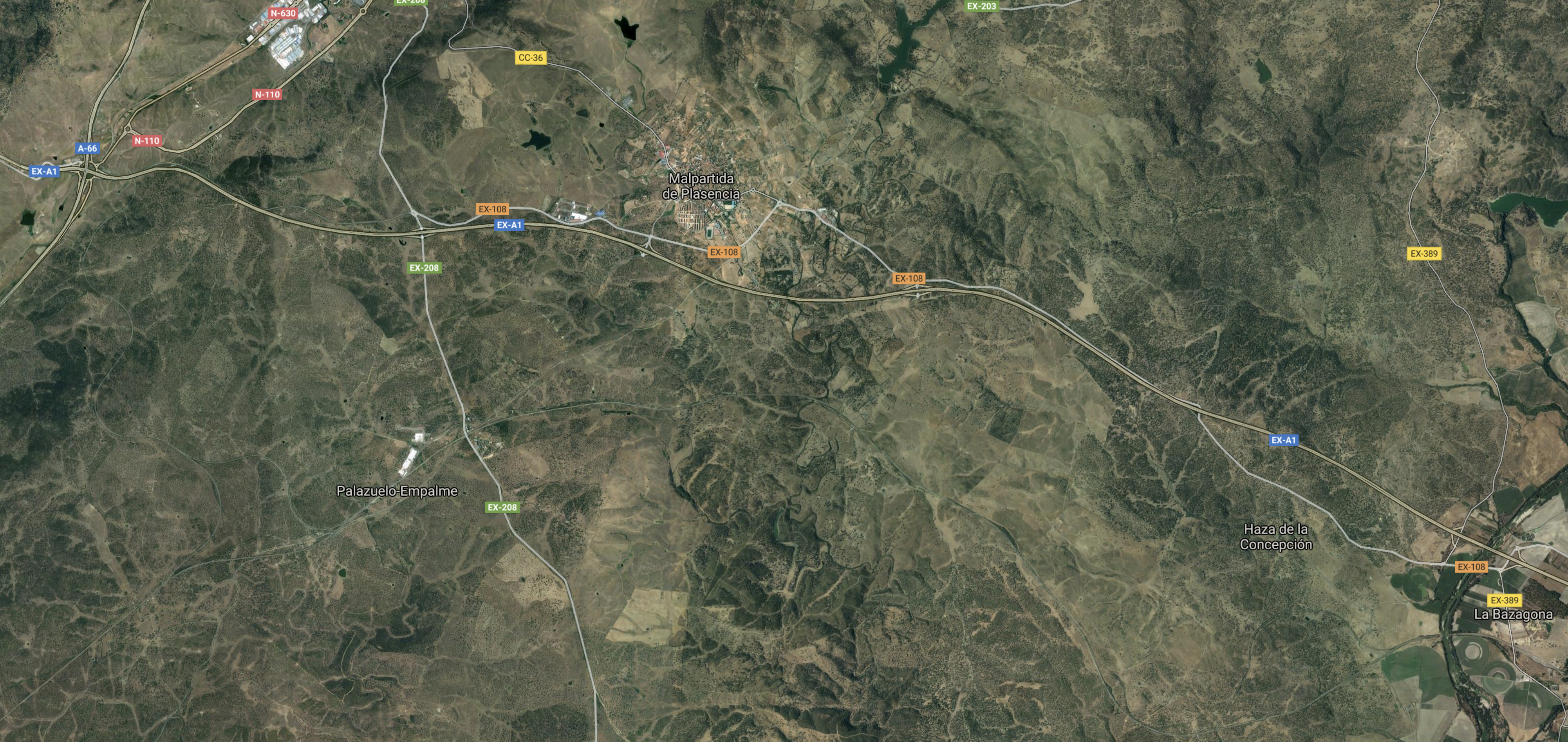
Note.
- La Bazagona is in the South-East corner of the map.
- Plasencia is creeping into the map in the North-West corner.
- The location of the current Monfrague station appears as a white dash and dot and to the West of the North-South road.
The current railway runs East West between La Bazagone and Monfrague.
Monfrague
This Google Map shows that except for a tobacco factory, there’s not much near Monfrague station.
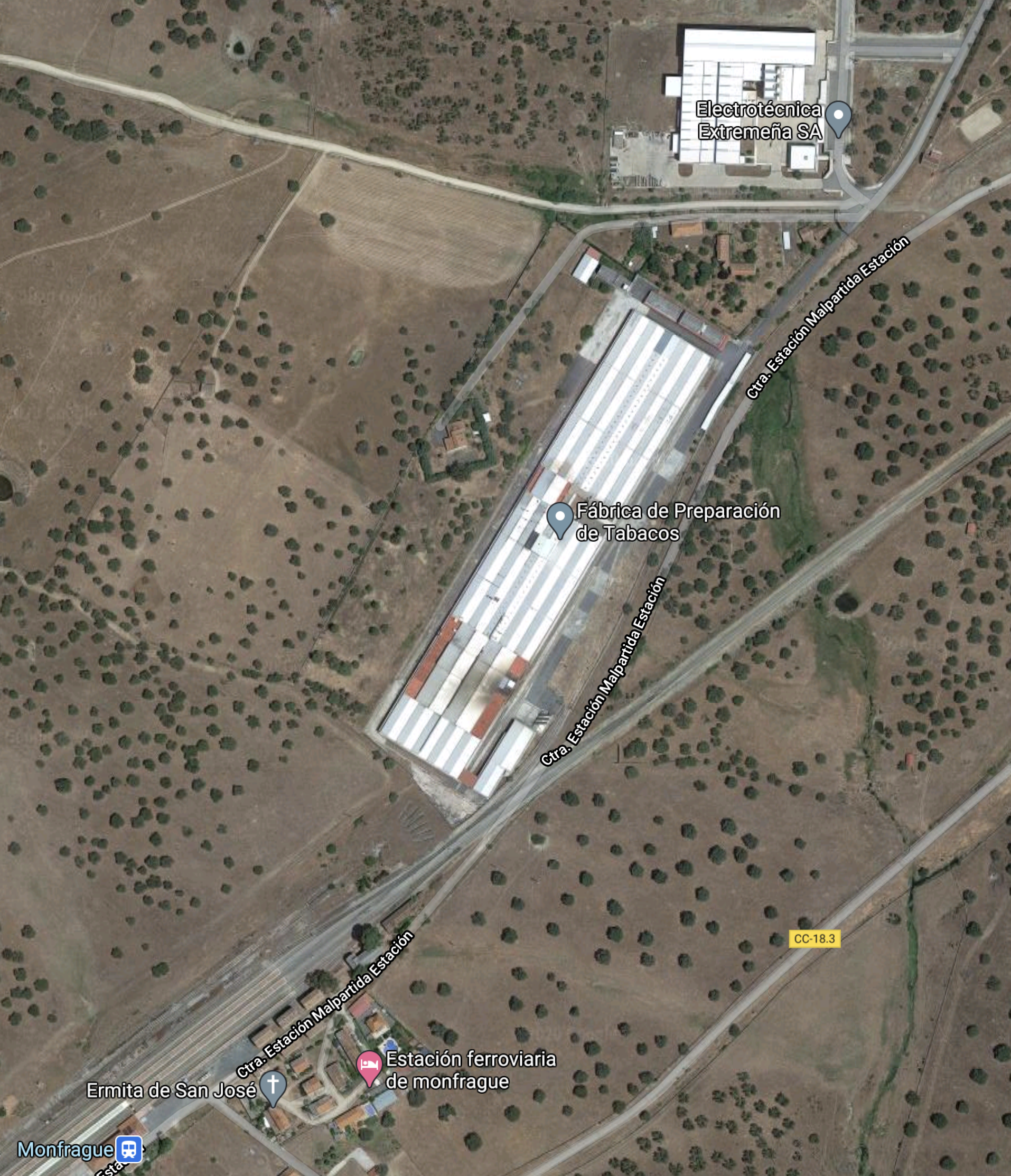
On other maps, where it is to a smaller scale, the station and the surrounding buildings appear as a dash and a dot.
It appears the station only has one train per day. But it was December, when I checked.
Mirabel
Mirabel is a municipality on the current line, that is shown in this Google Map.

From Wikipedia it appears to be worth a visit.
A Diversion of the Current Route
Between Mirabel and Cañaveral, the old route takes a diversion to the East.
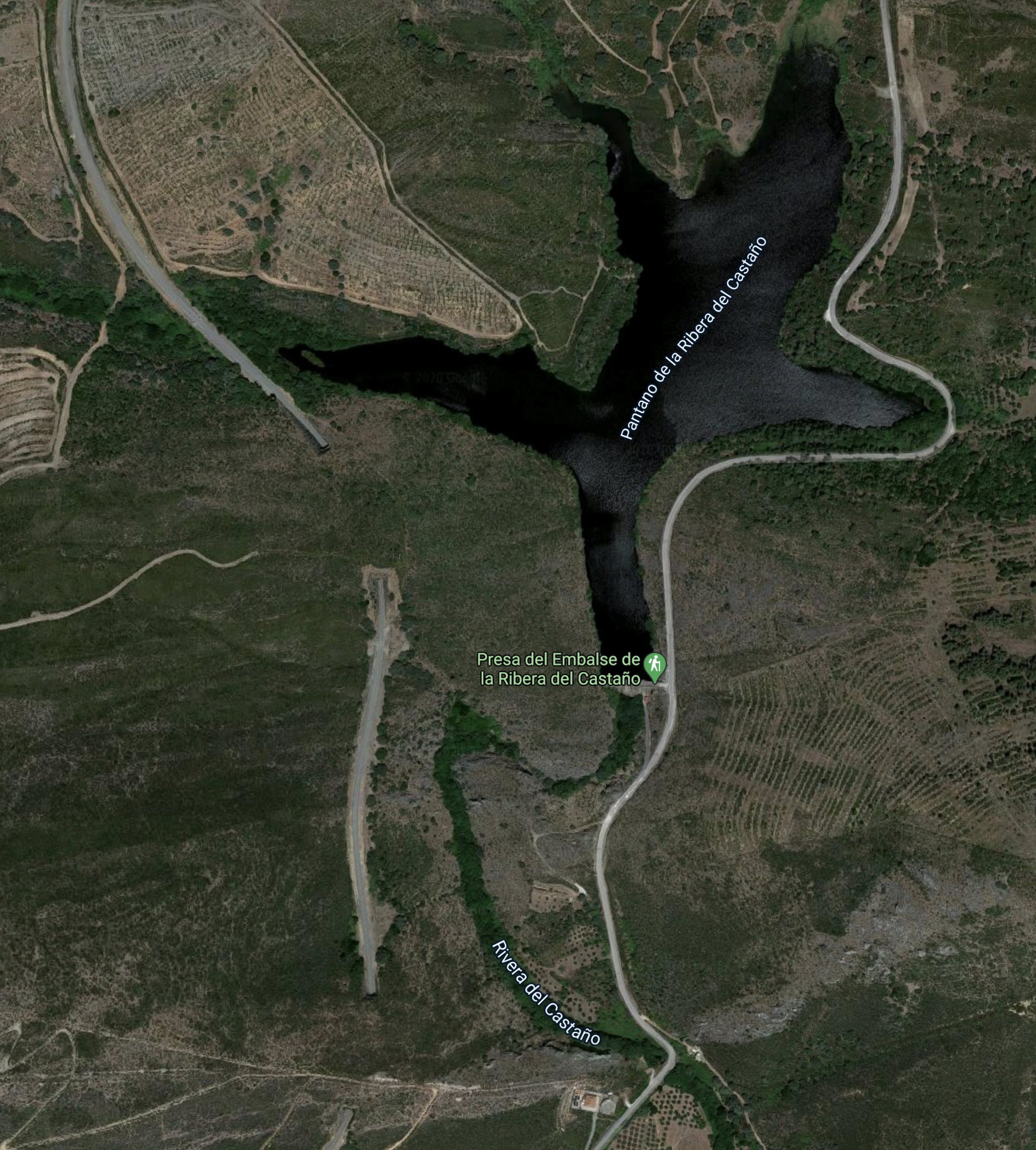
The railway goes to the West of the lake.
The green label indicates, it’s a hiking area.
The High Speed Line Becomes Visible Again
Since La Bazagona, I have followed the current route, but this Google Map shows where construction starts again for the new high speed line.
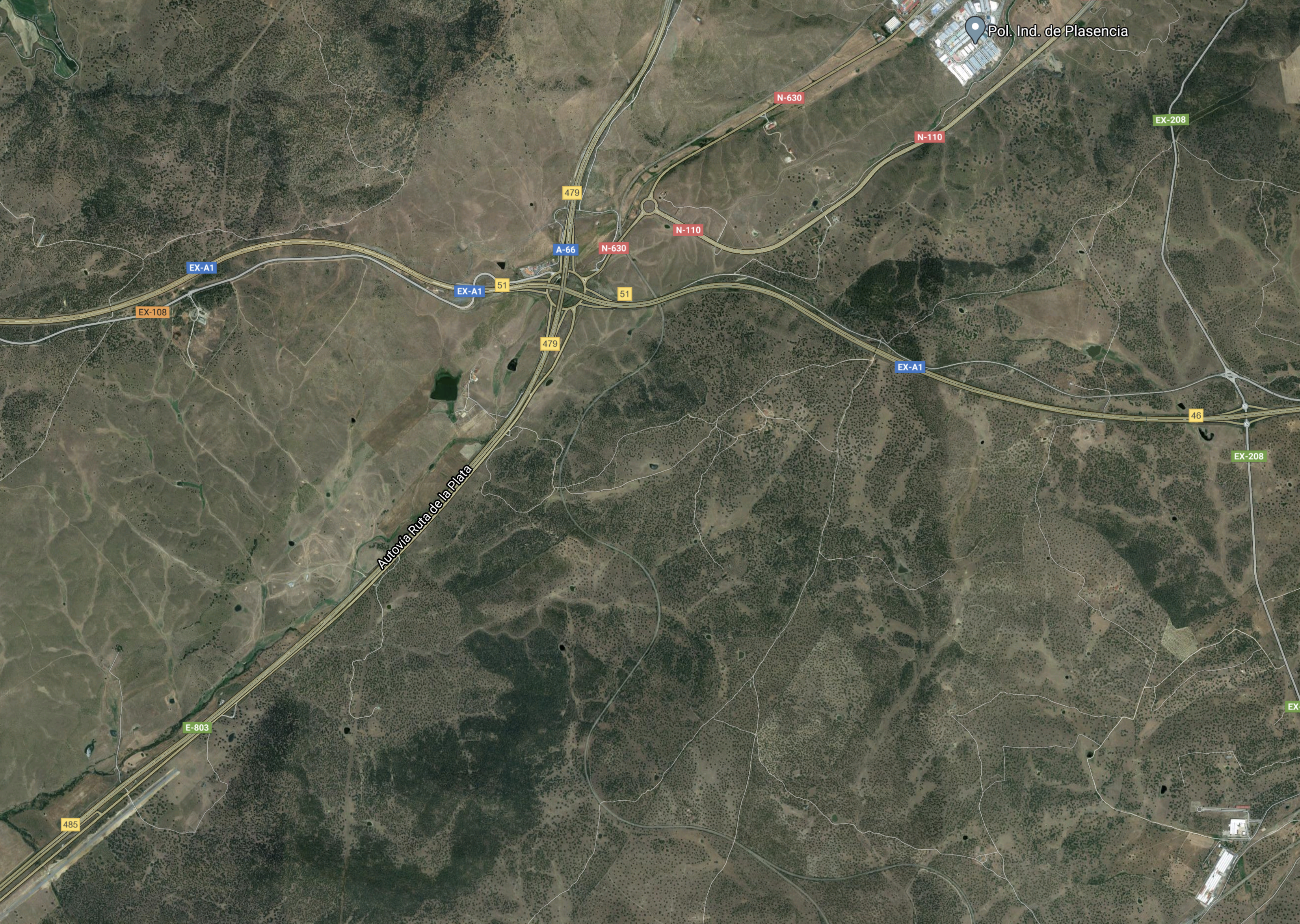
Note,
This is an enlargement of the South-West corner of the map.

Note the new high speed line, which stops abruptly.
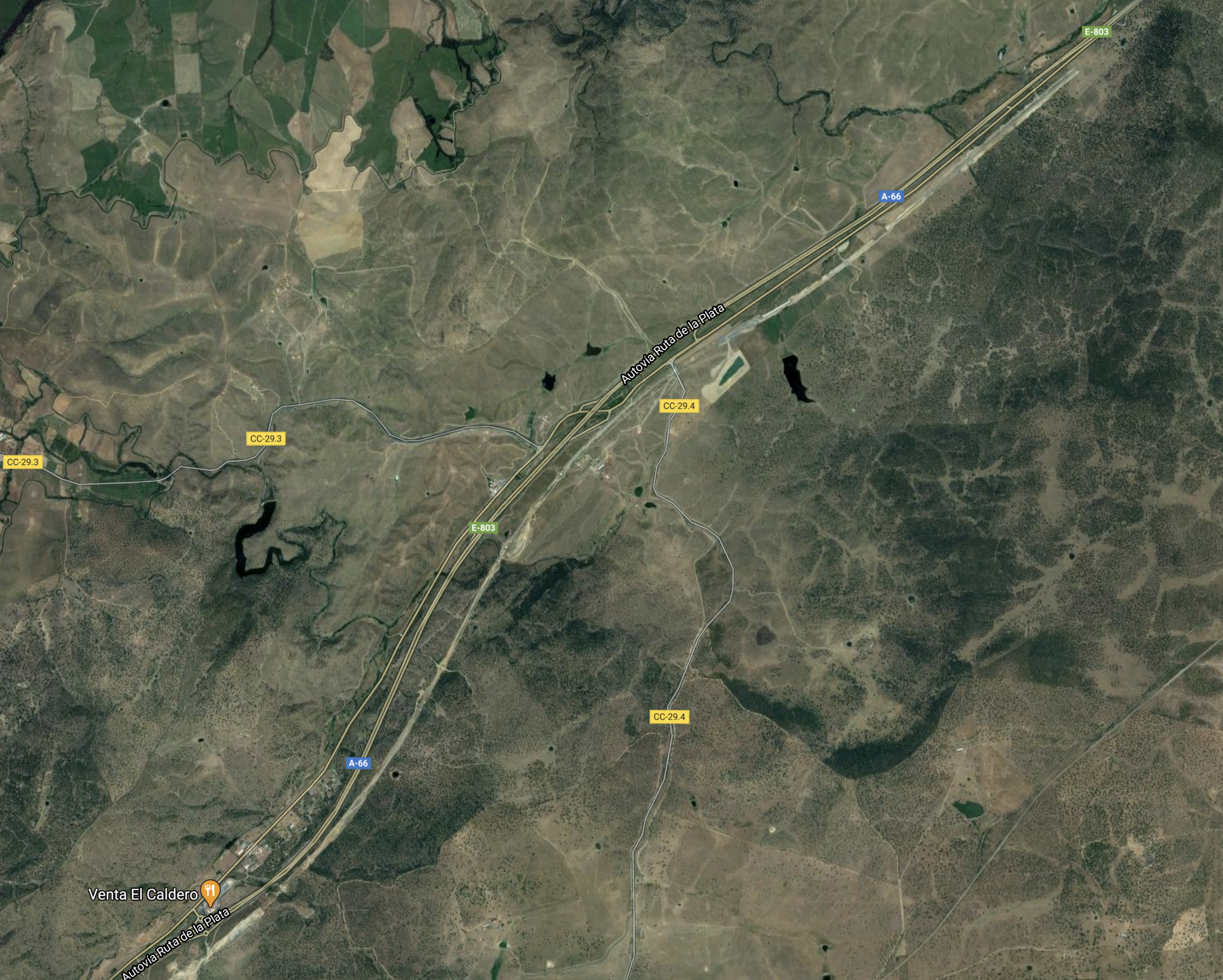
North and South Of Venta El Caldero
This map shows the construction to the North of Venta El Caldero.
And this map shows the construction to the South of Venta El Caldero.
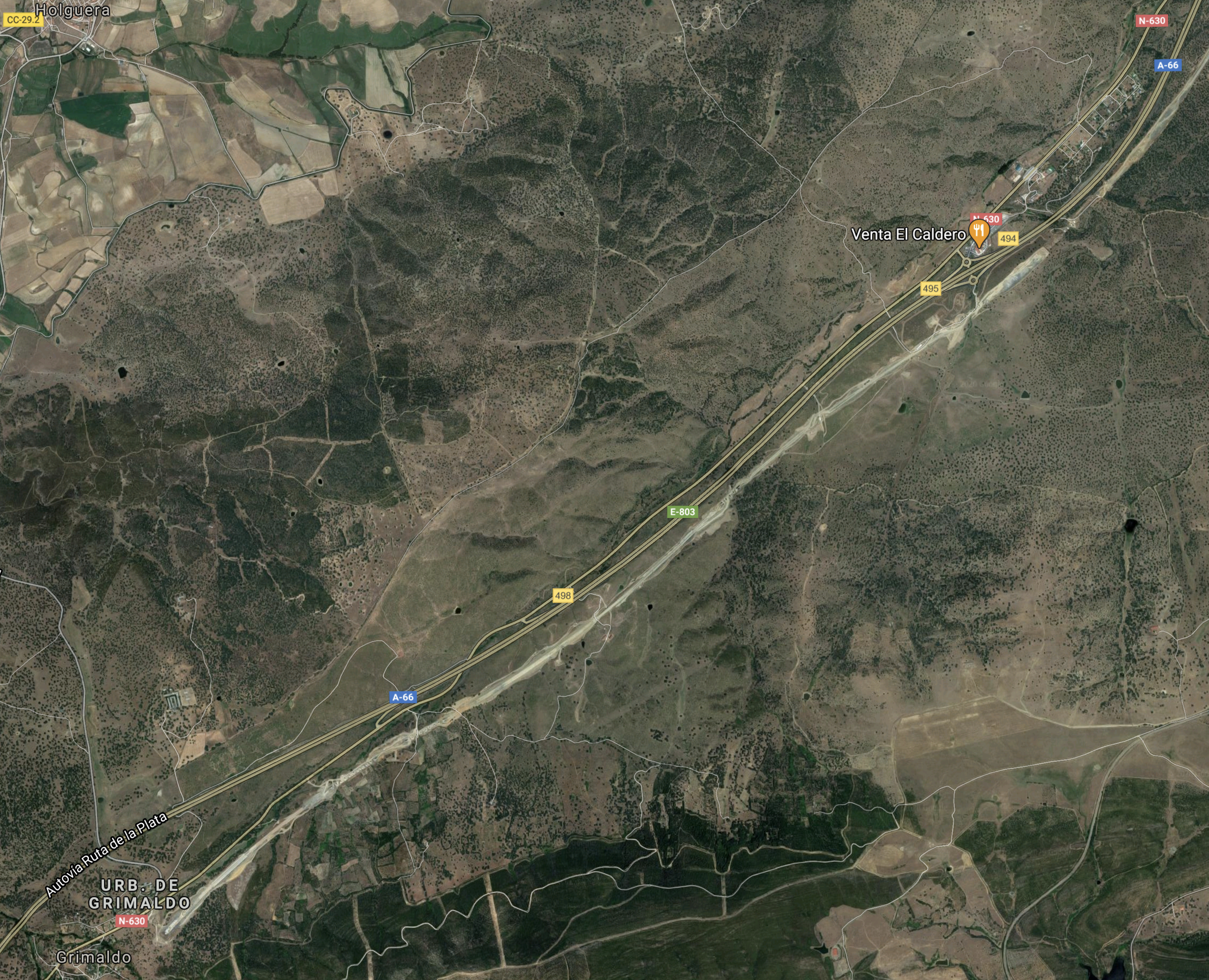
Note.
- The scar new railway is to the East of the A66 road.
- The railway construction stops abruptly North of Venta El Caldero.
Grimaldo is in the South-West corner of the map.
Grimaldo To Cañaveral
This Google Map shows the route of the high speed line from Grimaldo to Cañaveral.
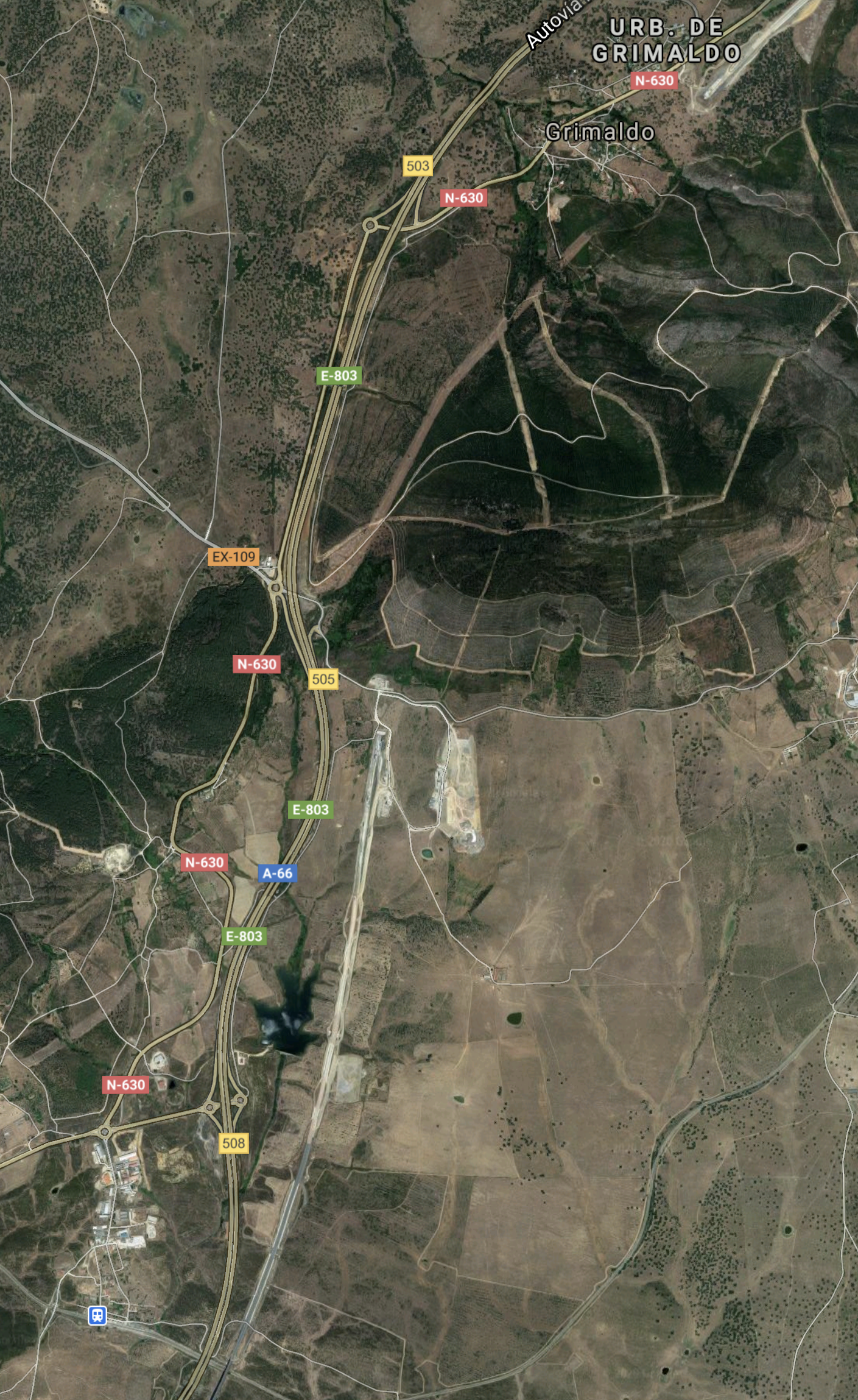
Note how the scar of the railway construction is to the East of the A66 Motorway.
Cañaveral
This Google Map shows Cañaveral station on the current line and the track of the new high speed line.
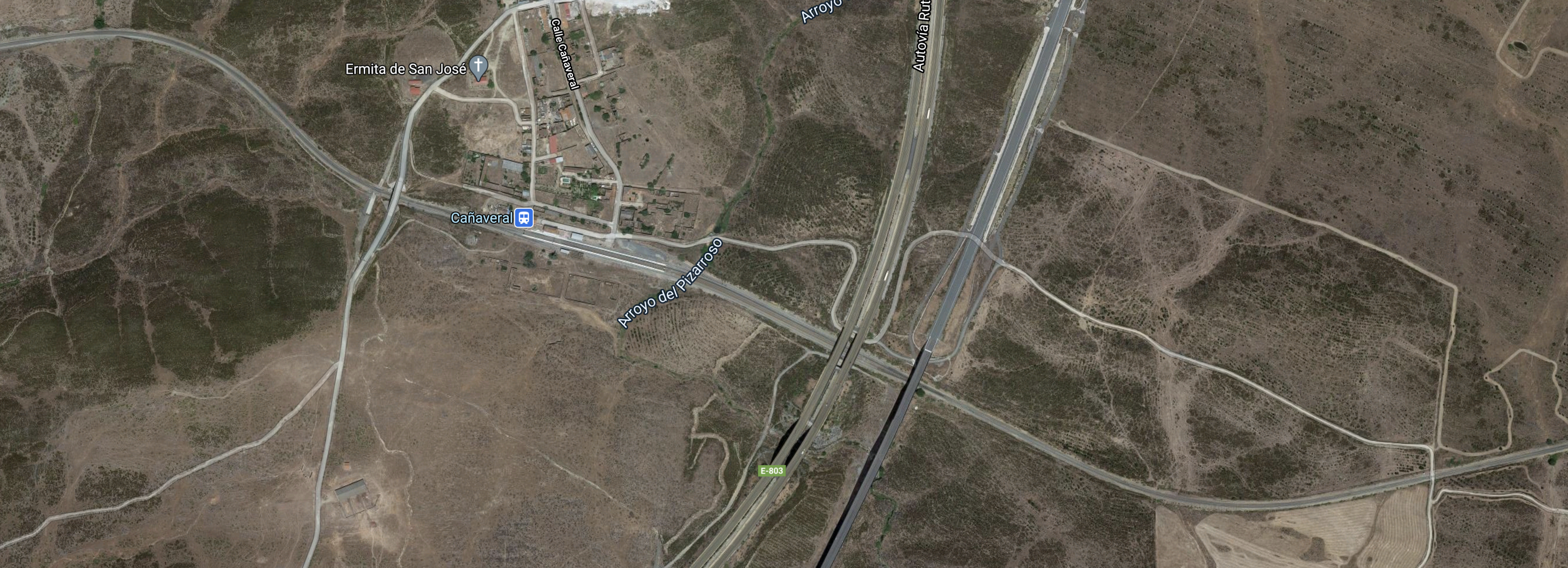
This map illustrates how the new high speed line is so much more direct, which in itself will save time.
From Cañaveral To The Tagus
This map shows the scar of the construction of the high speed line from Cañaveral to the Tagus.
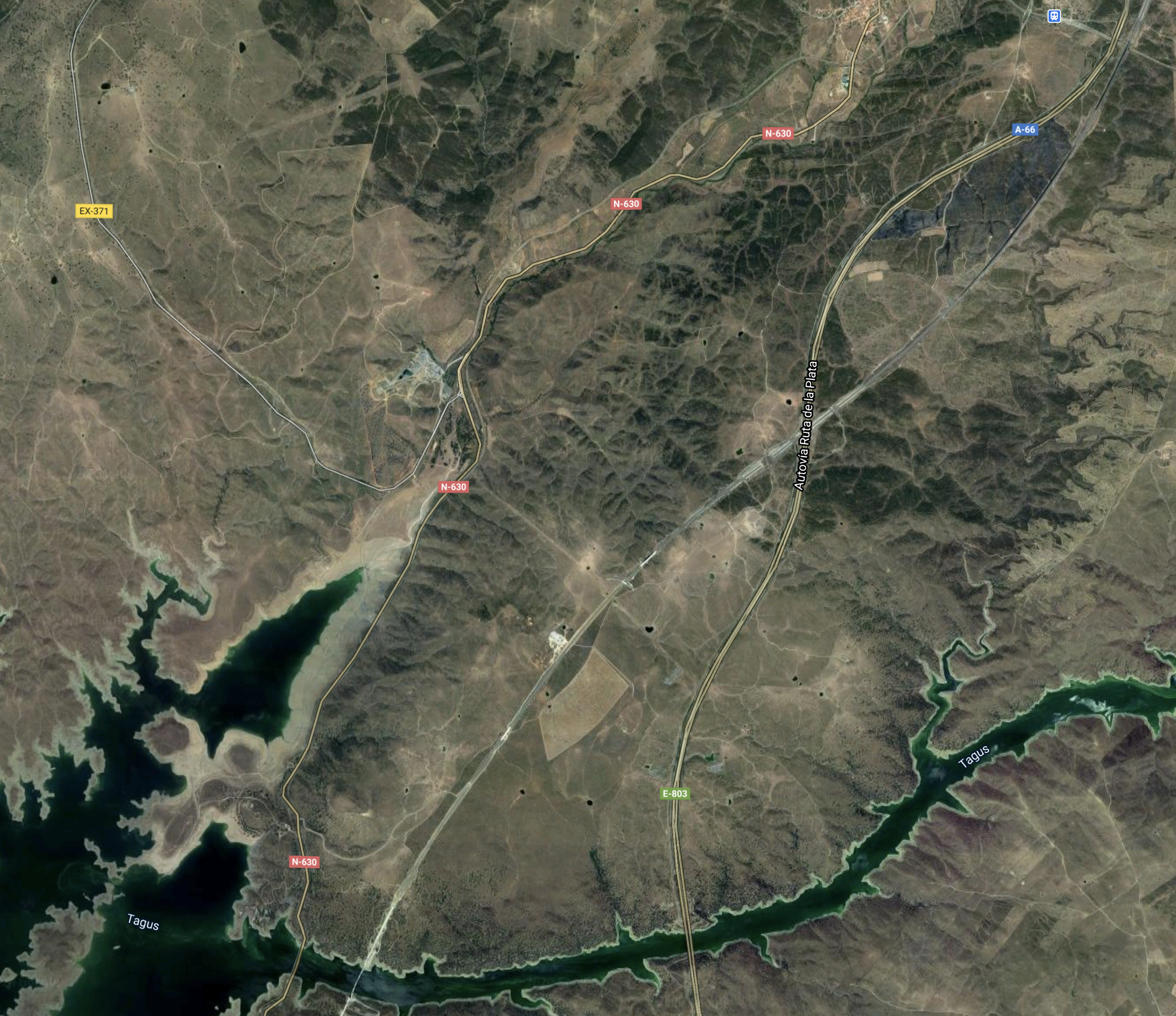
Note.
- The River Tagus across the bottom of the map.
- Cañaveral is in the North-East corner of the map.
- The scar of the railway construction running North-Easterly across the map.
A lot of the features, as the railway crosses the River Tagus, will come clearer in the next section.
Crossing The Tagus
This Google Map shows where the railway crosses the River Tagus.
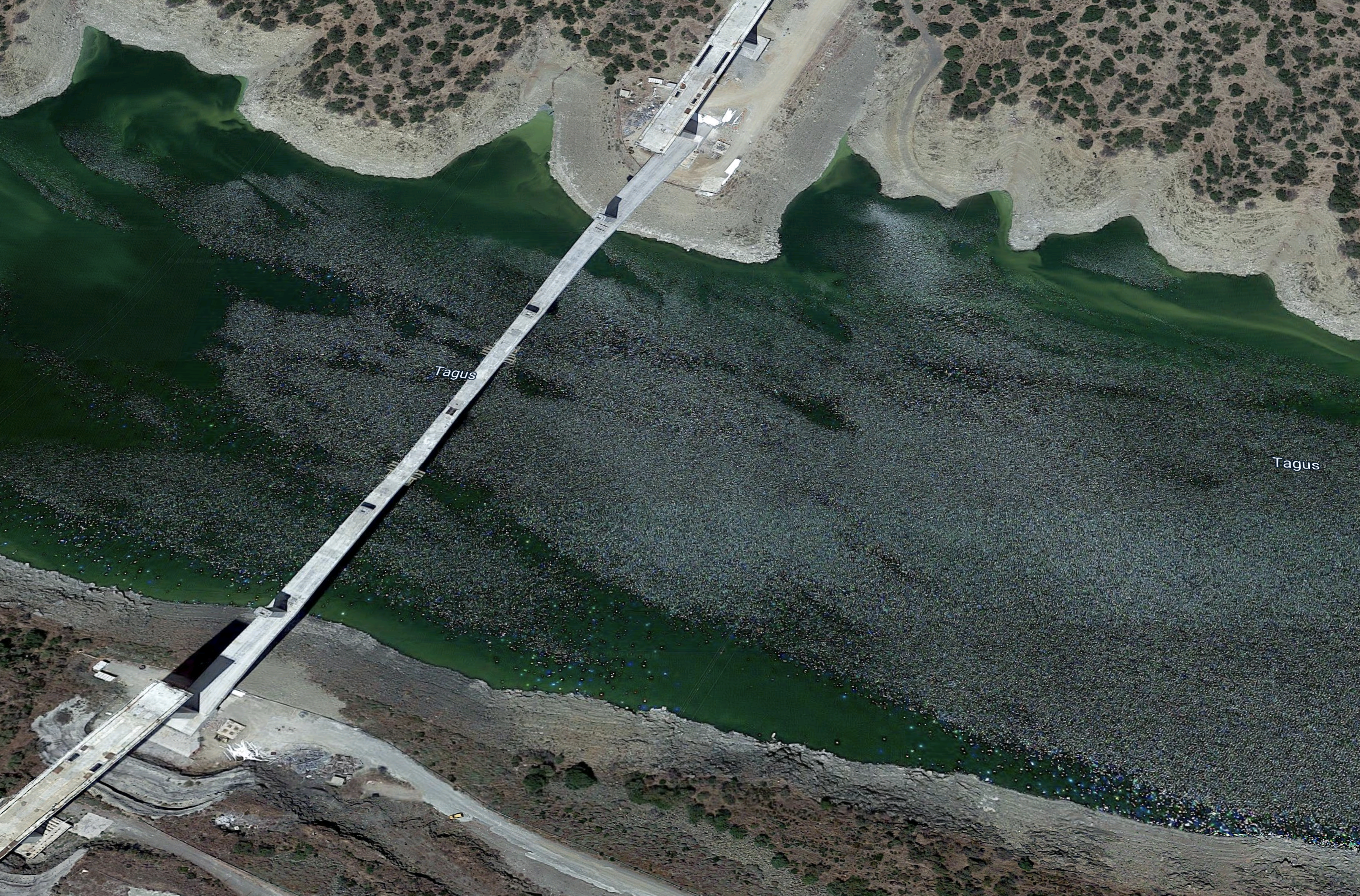
This second map shows the Northern end of the bridge on a larger scale.
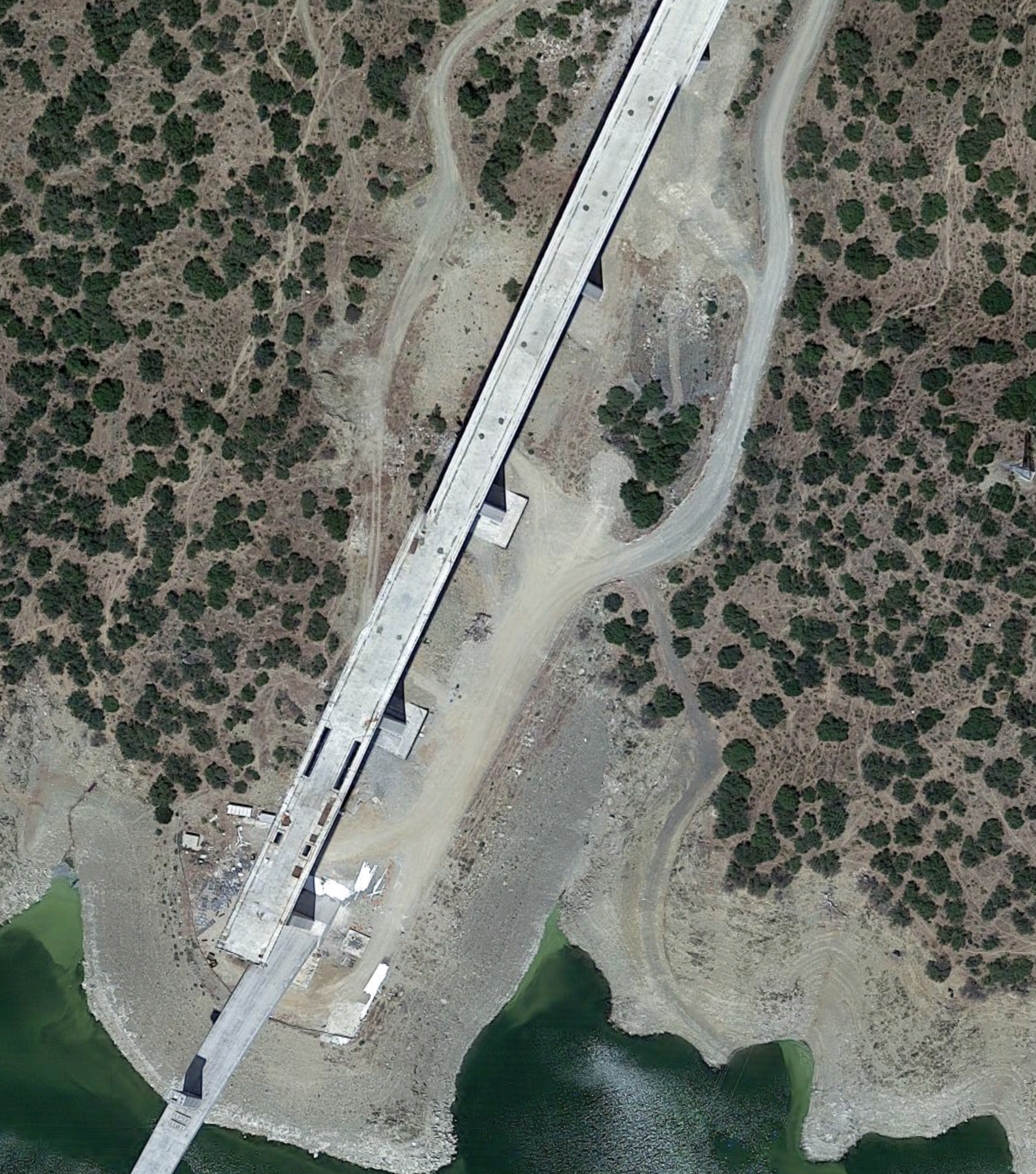
Is this bridge a double deck bridge with a road underneath a rail track?
Almonte River Railway Viaduct
This Google Map shows the viaduct over the Almonte river.
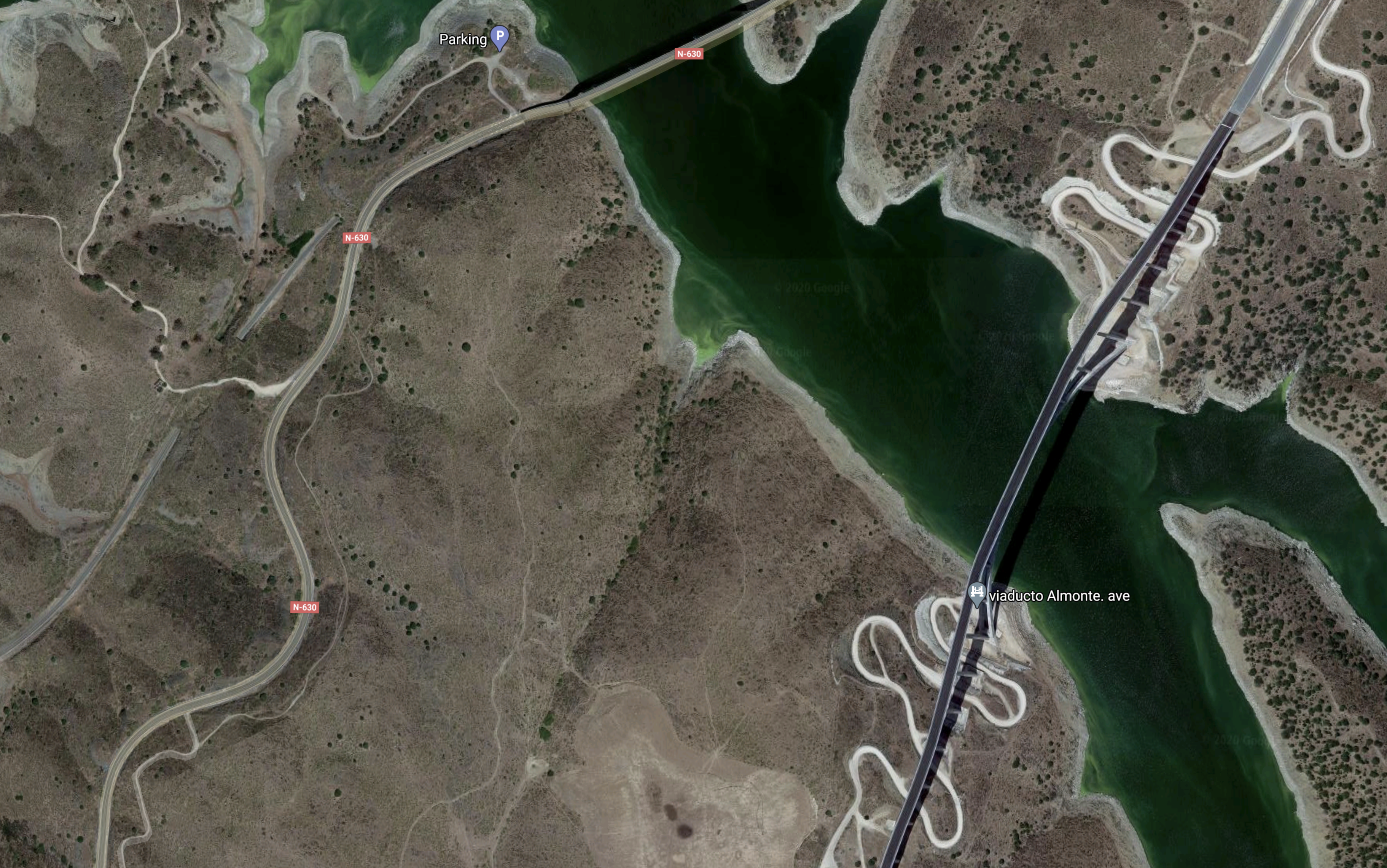
Note.
- It is the Eastern bridge on the map.
- It will carry a double-track high speed railway.
- At 384 metres it is the longest railway arch bridge in the world.
- It is seventy metres high, so the views should be good.
- It is 54 metres longer than the Silver Jubilee bridge over the Mersey.
The other bridge to the West is shown in this Google Map.
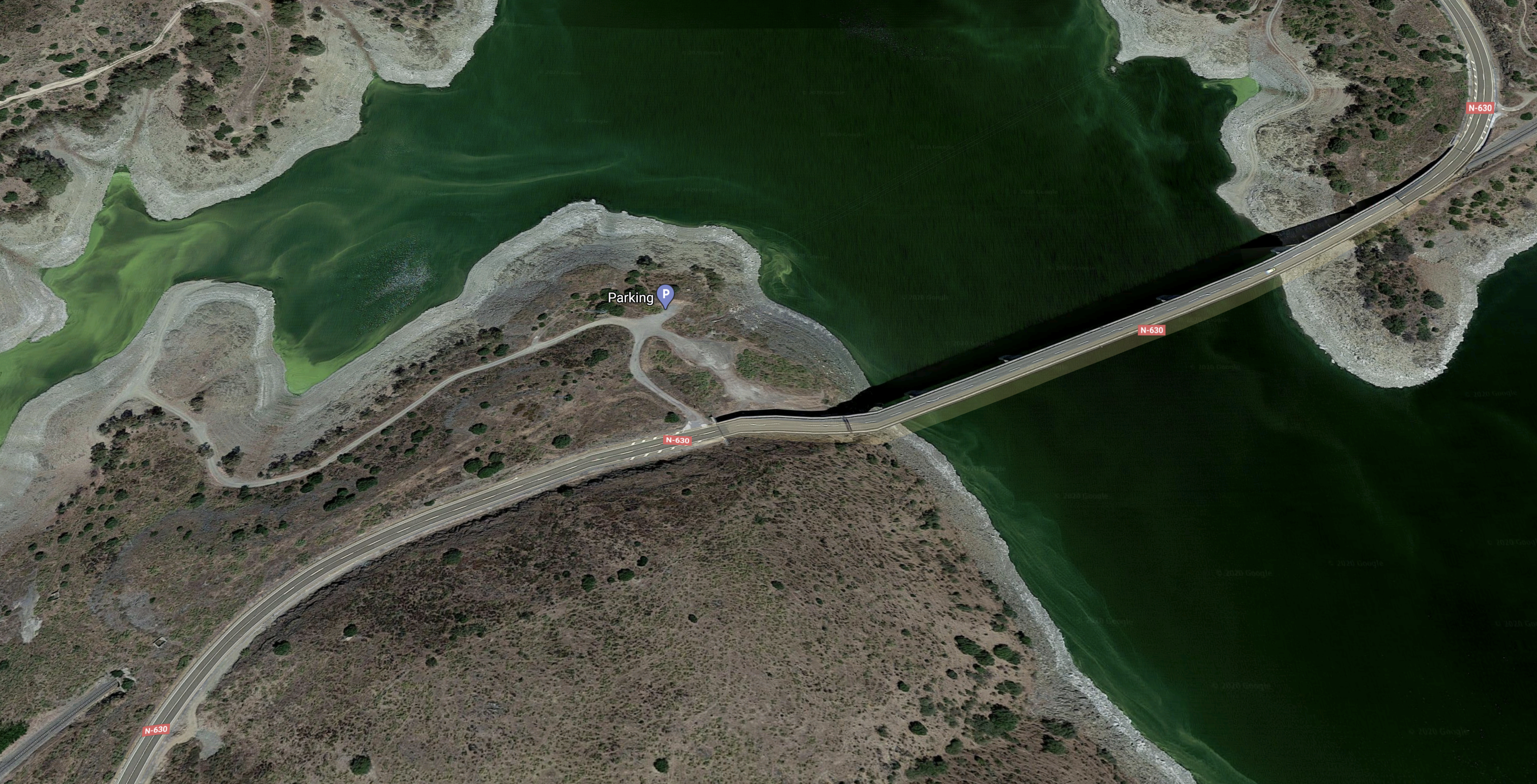
It appears to be a double-deck bridge, with a road on top of as single track railway.
This third Google Map clearly shows the arch.
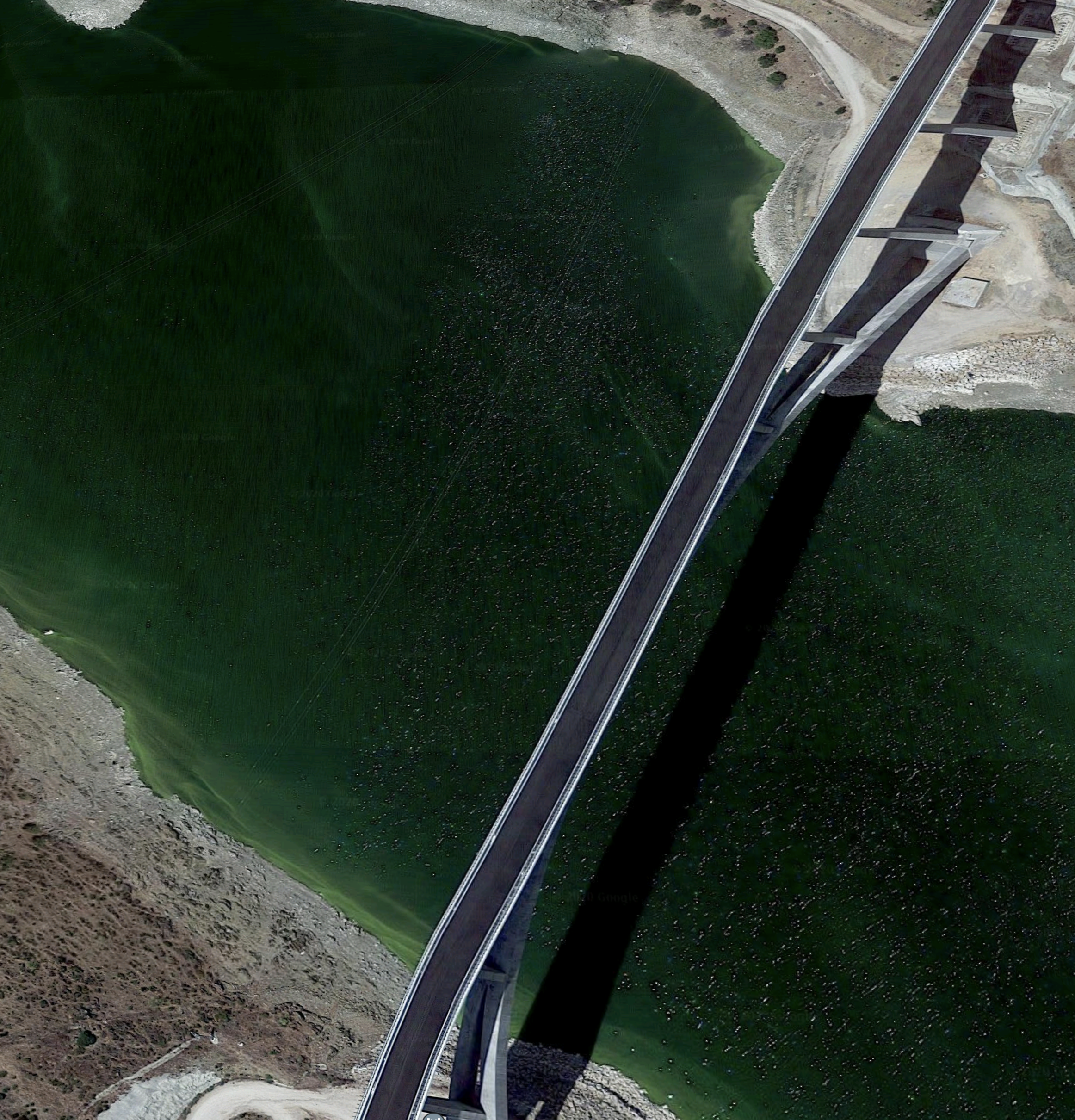
It certainly is a bridge I want to experience.
The Old And New South Of The Almonte
I had to include this Google Map.

Note.
- The old and the new bridges over the Rio Almonte.
- The current railway meanders about.
- A lot of the track-bed of the new railway is complete.
There would appear to be a viewpoint and parking to explore the area.
Cáceres
This Google Map shows the joining of the old and new lines to the Nothe of the Cáceres
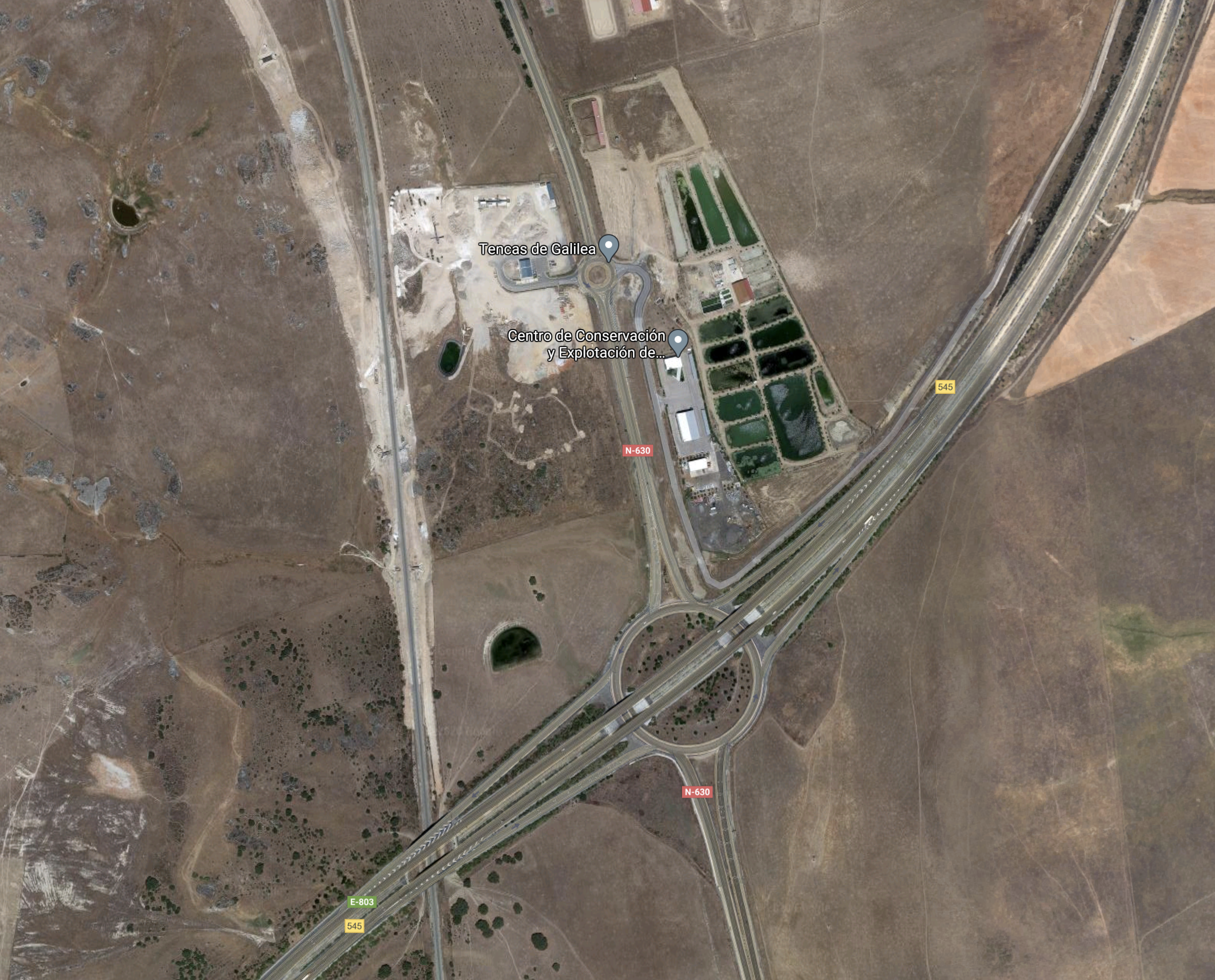
Note.
- The most Westerly line is the scar of the conscruction of the new high speed line.
- Next to it, is the current line.
The lines would appear to join to go through Cáceres. This must surely mean, they are the same gauge.
This second map shows the station in the city of Cáceres.
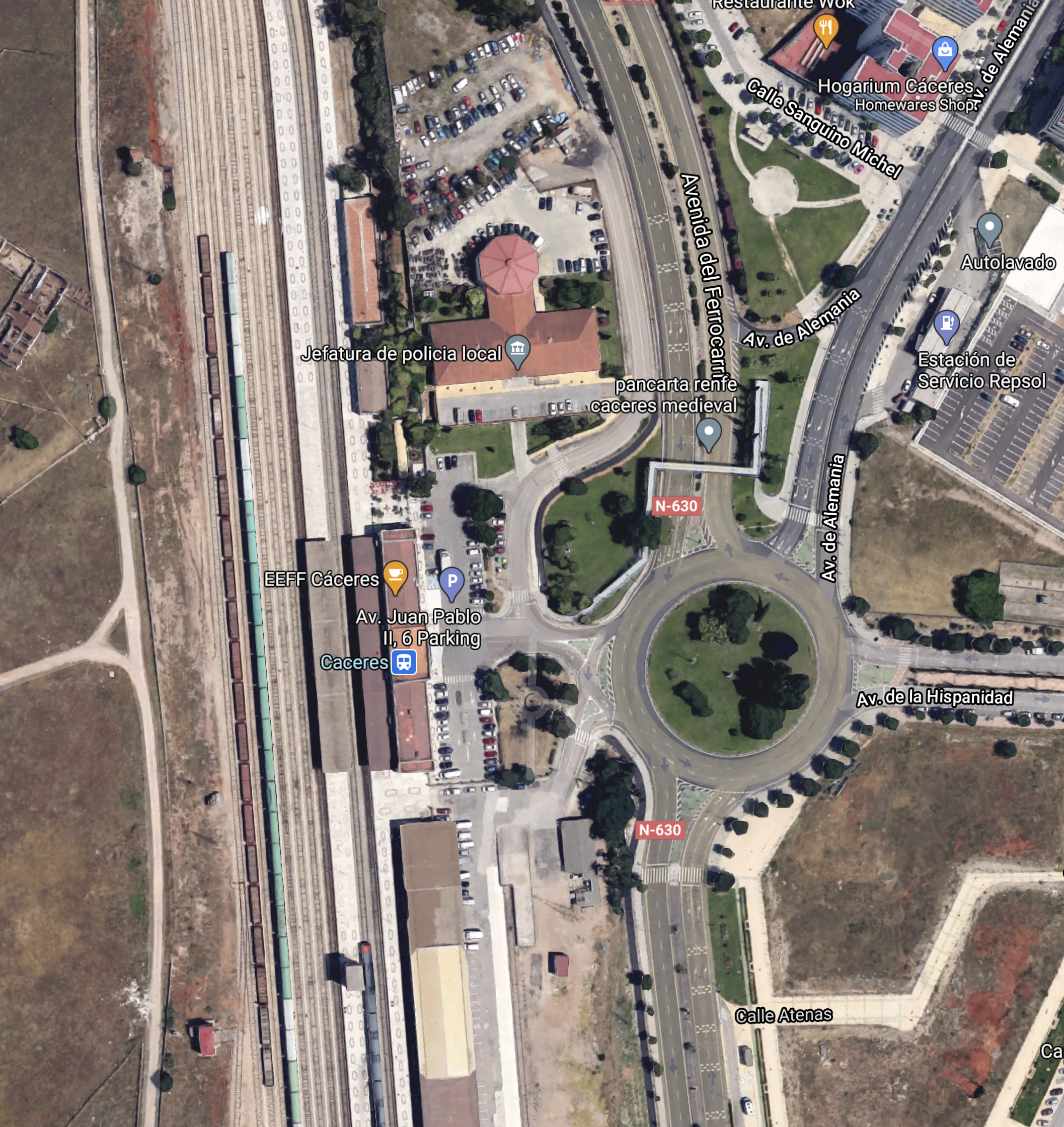
Reading Wikipedia, it looks to be the sort of place for an overnight stop or more.
Building The New Line South Of Cáceres
A new double-track High Speed Line is being built alongside the existing single track, as this Google Map shows.
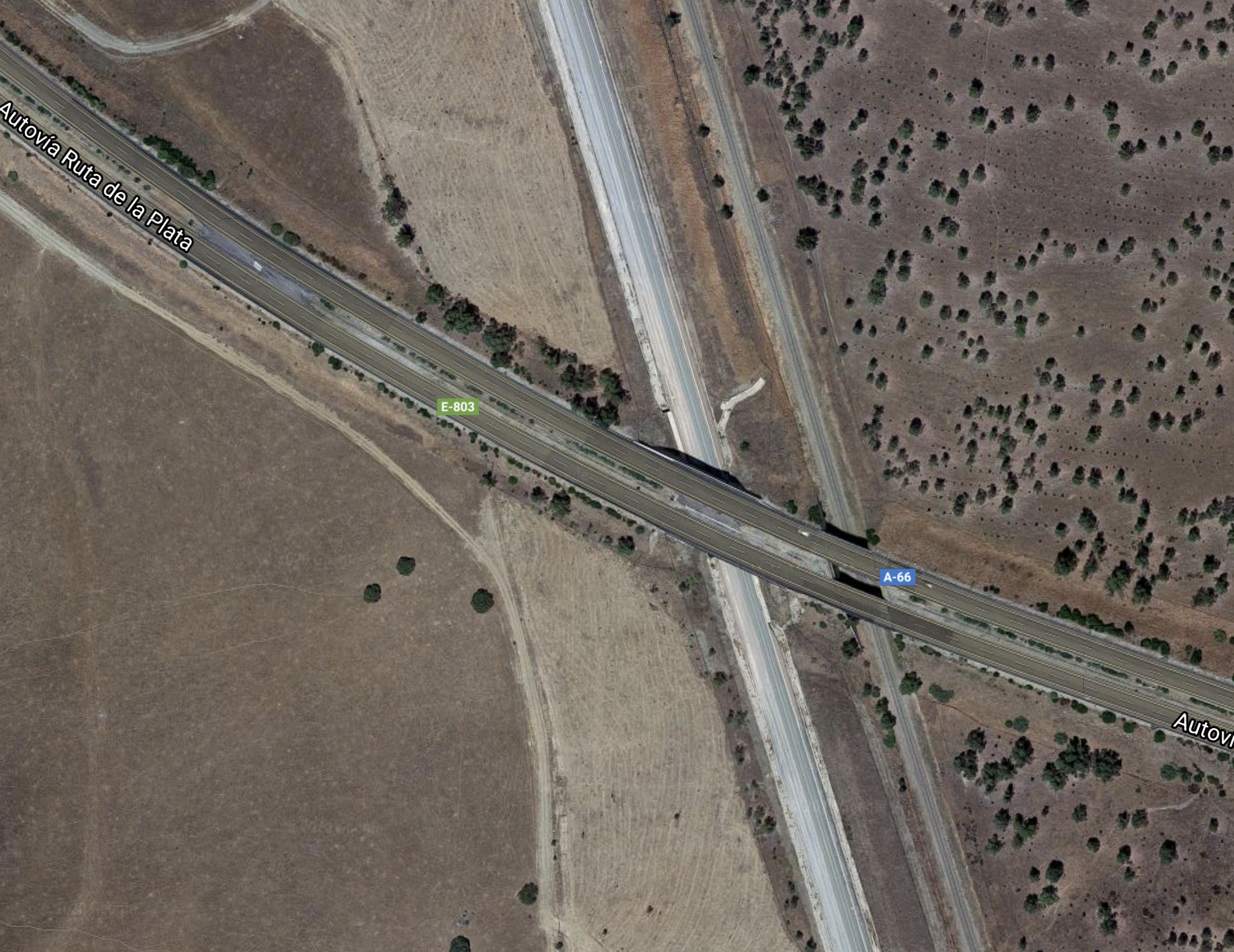
Note.
- The road is the A66.
- The new railway is on the Western side, with the old one on the East.
This second map, taken in the same area, appears to show rail and railway being constructed along the same route.

The third map shows a tunnel on the route.
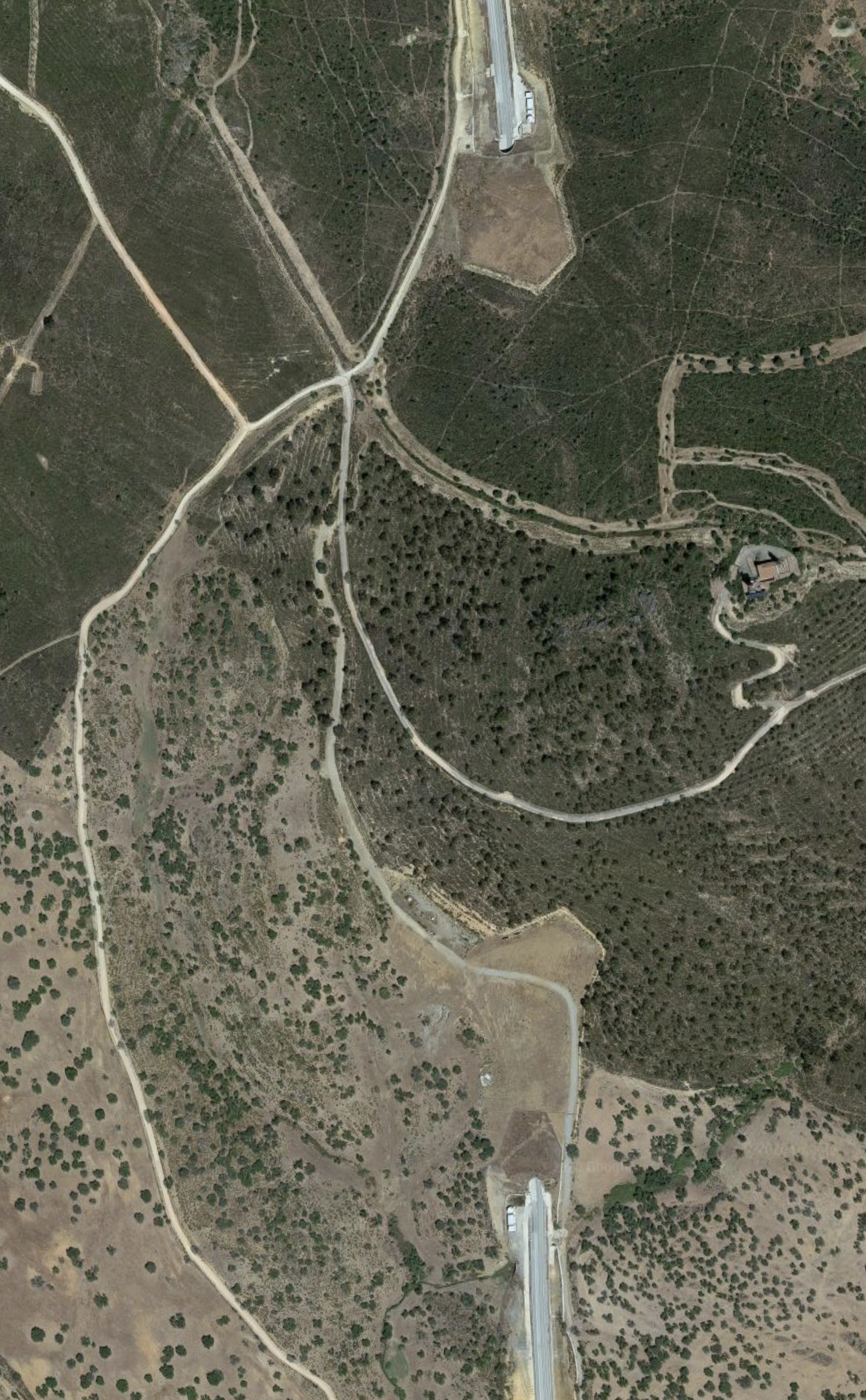
It goes straight through a range of mountains.
Aljucén
This Google Map shows the track layout at Aljucén.
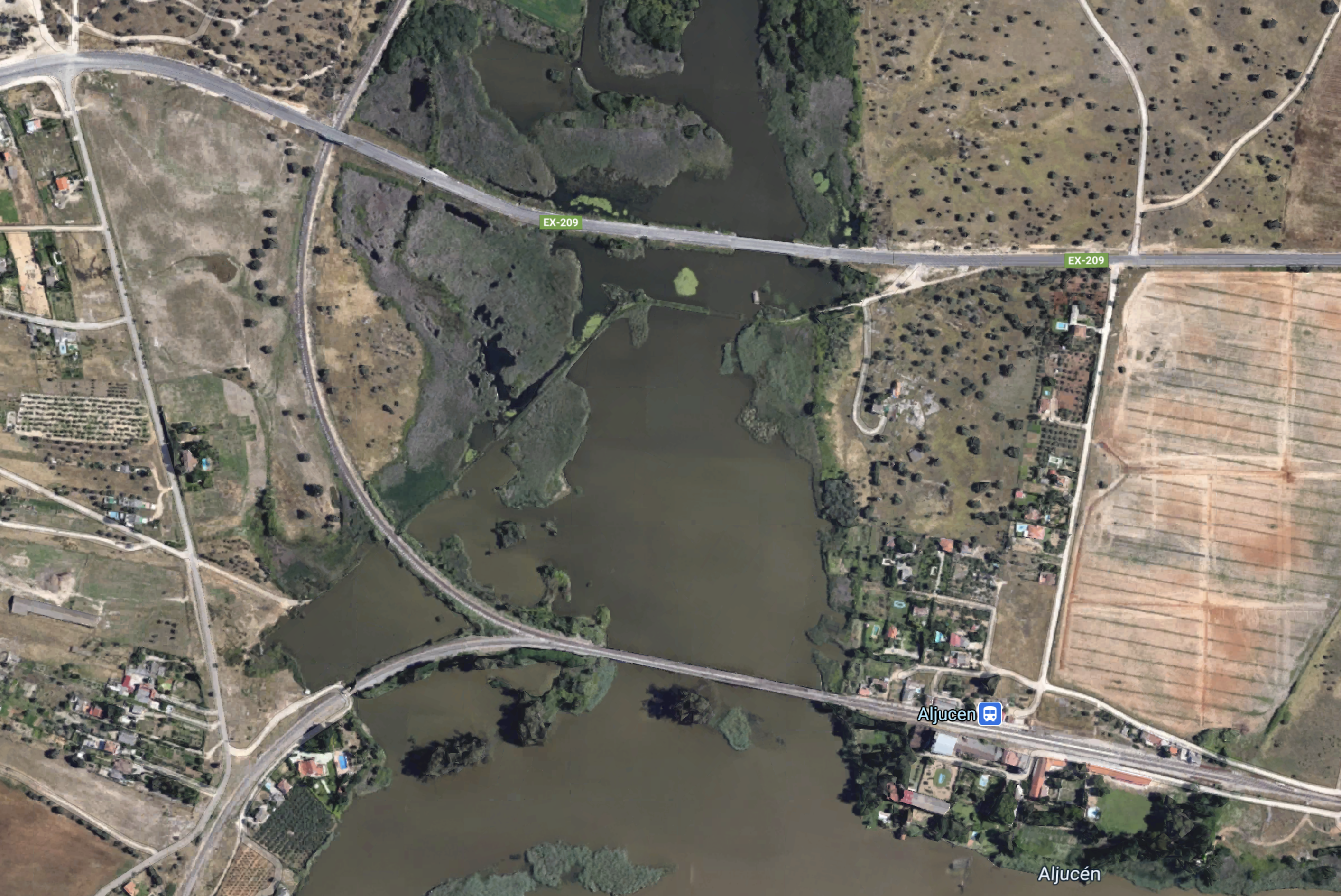
Note.
- Aljucen station is on the East bank of the river.
- The North branch of the railway goes North to Caceres.
- The South branch of railway goes West to Badajoz.
Trains between Caceres and Badajoz, may go East to Mérida to reverse.
Mérida
As I said, the city of Mérida is to the East of Aljucén.
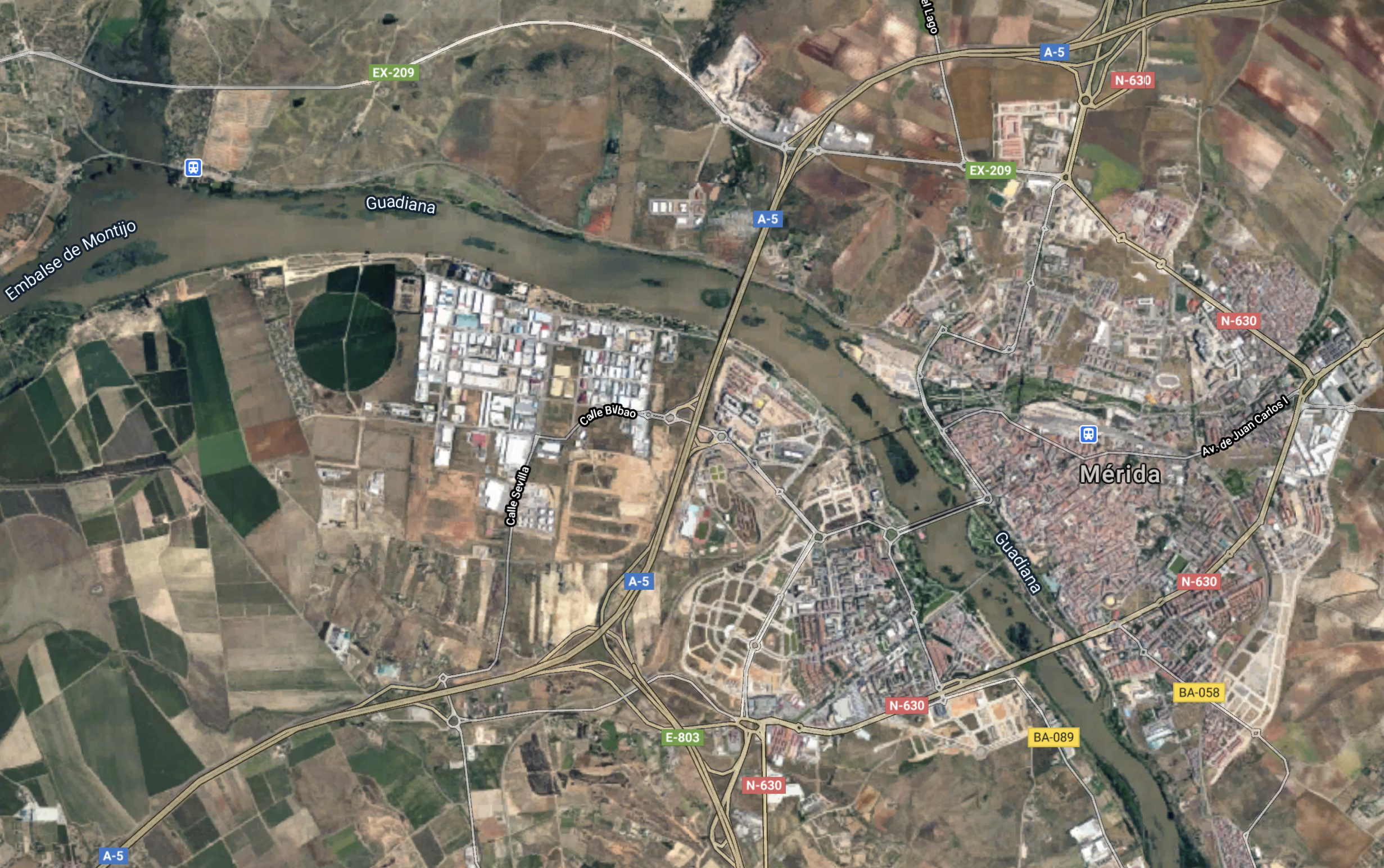
This Google Map shows the area between Aljucén and Mérida .
This second map, shows the large railway yard and the station at Mérida .
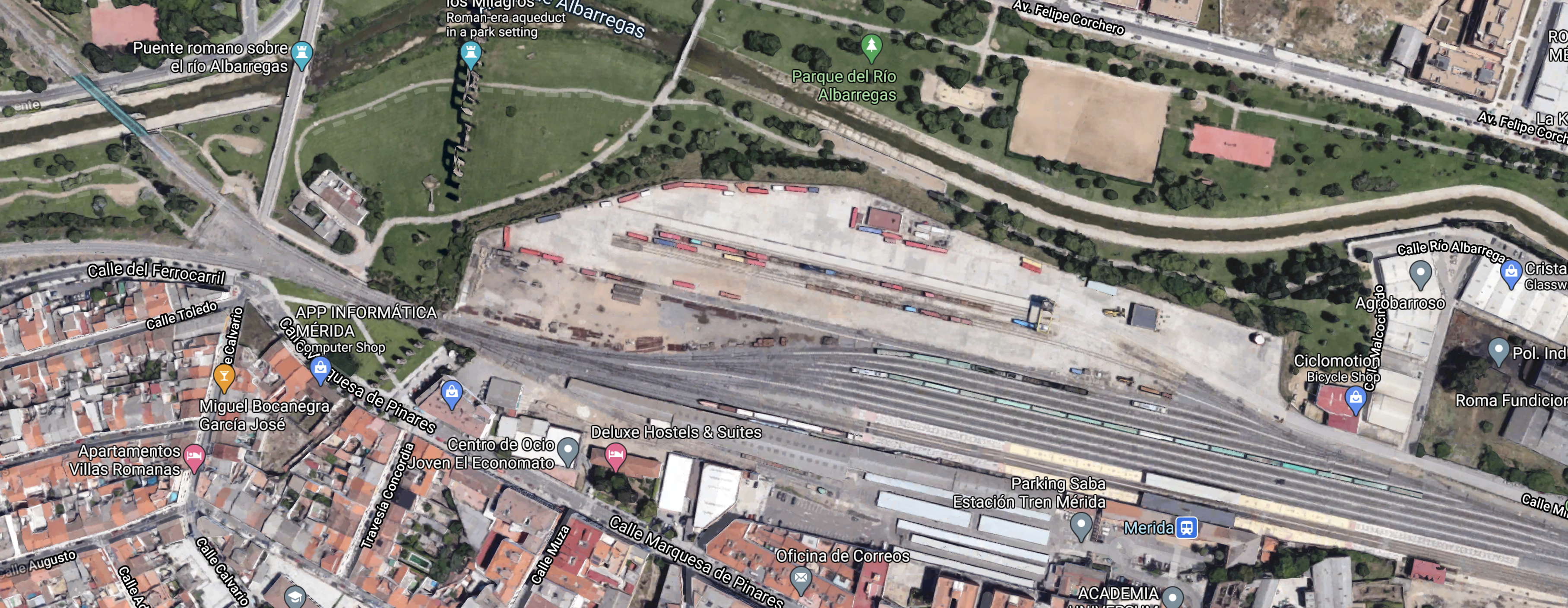
Note how the railway splits into two at the West of the station. One line takes the North side of the river and the other the South.
Onward To Badajoz
The Railway Gazette article says this about the section of the railway between Cáceres and Badajoz.
By late November, the 58∙8 km of double track between Plasencia and Cáceres was complete, while a single track has been built over the 80 km between Cáceres, Mérida and Badajoz. At Montijo, between Mérida and Badajoz, a junction is to be built to link the high speed line and the adjacent conventional line, which is to be electrified as part of work to modernise the east-west route across Extremadura between Badajoz and Puertollano.
Puertollano is to the East.
- The city lies on the main high speed rail line between Madrid and Seville.
- Trains take four hours between Puertollano and Badajoz.
- It has a solar thermal power station.
It looks to me, that if I was going to Badajoz, I’d fly to Seville and take the train, with a change at Puertollano.
Guardiana del Caudillo
This Google Map around Guadina del Caudillo station is typical of much of the route between Aljucén and Badajoz.
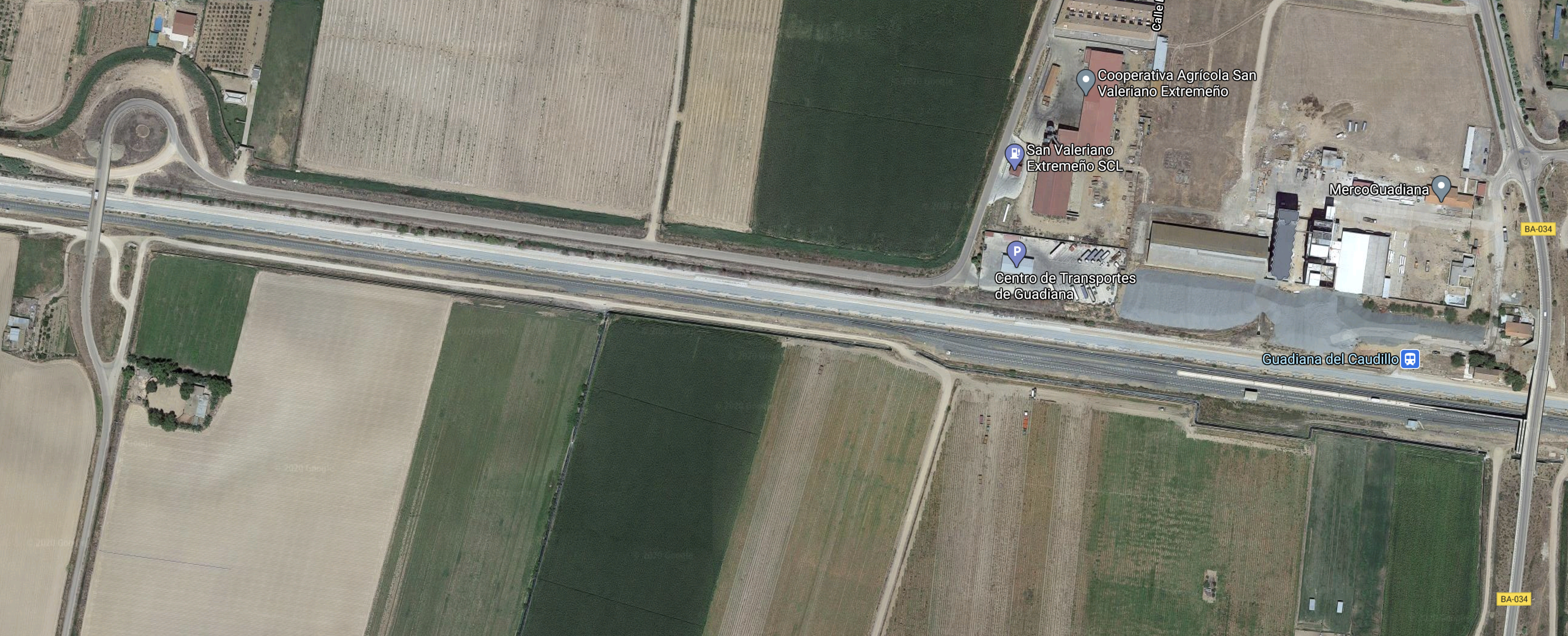
It appears that a double-track high speed railway is being built alongside the current single track.
Badajoz
This Google Map shows the current single-track railway passing North-West South-East through the city of Badajoz.
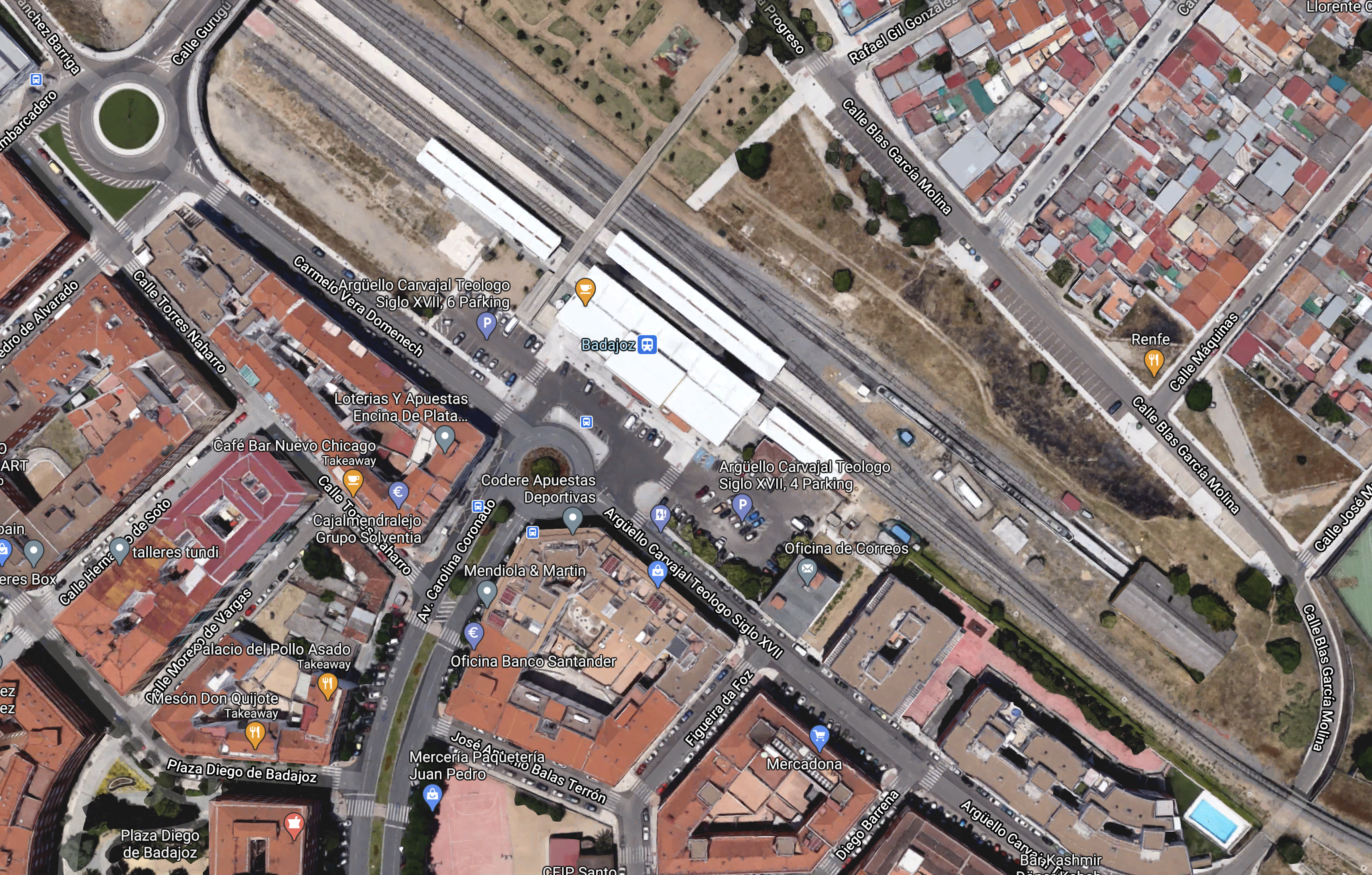
Note.
- Portugal is a few miles to the North-West.
- The station appears to be in the centre of the city.
This second map shows the border.

Note.
- The single-track curving around the South-West corner of the map.
- Underground water must be good, as they’re farming in circles.
Given the closeness of Badejoz to the border, the Spanish city could be a good place to break a journey.
Conclusion
This high speed line would appear to be easier to build than High Speed Two in some ways.
- A rail route already exists and in many places, the Spaniards are using a similar route.
- The population density appears low.
- The route is only about as long as London and Sheffield.
On the other hand, there are some tunnels and hills and some substantial river crossings.
Writing, this has made me want to visit, this part of Spain, where I’ve never been.
I would fly to Lisbon and gradually work my way back, stopping in places like Badajoz, Caceres and Toledo, before taking a train back to London.
Could The Madrid And Lisbon High Speed Line Become Iconic?
I think it could, as it will be a line with beautiful scenery between two of Europe’s must-visit capitals.
Start-up Bags $7m To Bring Tourists To Edge Of Space On A Balloon
The title of this post is the same as that of this article on SiliconRepublic.
This paragraph describes it.
The start-up aims to use a series of space balloons – attached with a pressurised capsule – to fly equipment and tourists to the edge of space on a six hour flight. The company’s first test flight of its Neptune 1 craft is expected towards the end of Q1 2021 from NASA’s Kennedy Space Center Shuttle Landing Facility. While the first test will consist of an uncrewed, unpressurised capsule, Space Perspective hopes to begin crewed operations by 2024.
What a concept!
- It’s affordable edge of space travel for all!
- Learn more from their web site.
- From the pictures, it looks like each trip would carry about ten passengers, in normal clothes,
- I can see lots of these installed over the world.
- When can I book, a trip on one of these from Central London? Or from somewhere in say the mountains of Switzerland?
On this page of their web site, they describe a typical flight.
Flown by a pilot, Neptune takes up to eight passengers called “Explorers” on a six-hour journey to the edge of space and safely back, where only 20 people have been before. It will carry people and research payloads on a two-hour gentle ascent above 99% of the Earth’s atmosphere to 100,000 feet, where it cruises above the Earth for up to two hours allowing passengers to share their experience via social media and with their fellow Explorers. Neptune then makes a two-hour descent under the balloon and splashes down, where a ship retrieves the passengers, the capsule, and the balloon. Neptune’s commercial human spaceflight launches are regulated by the FAA Office of Commercial Spaceflight.
Note.
I’ve already flown at 60,000 feet in an aircraft. In Concorde!
Even a humble Airbus A320 can fly at 41,000 feet.
Splashdown in the Thames Estuary or Lake Geneva? Why not?
No-one ever had a worthwhile idea or made a useful fortune by thinking with the herd.
Greater Anglia Trains Hit 10-year High For Punctuality
The title of this post is the same as that of this article on North Norfolk News.
This is the first two paragraphs.
Greater Anglia has recorded its best figures for punctuality in a decade, latest figures have revealed.
More than nine out of every ten trains ran on time in November, helping the company achieve its best punctuality result for 10 years and second-best of the past 20 years.
That is very good, with punctuality figures very close to a hundred percent.
What the article doesn’t mention, is that Greater Anglia’s trains in Norfolk and Suffolk are now typically step-free, with those in wheelchairs to be able to roll in without a ramp.
How much has this feature contributed to the outstanding punctuality?
Arcola Energy Introduces A-Drive Fuel Cell Powertrain Platform
The title of this post, is the same as that of this article on NGTNews.
This is the introductory paragraph.
Arcola Energy, a company that specializes in hydrogen and fuel cell systems, has developed a proprietary hydrogen fuel cell (HFC) powertrain platform – designed for vehicle applications requiring high-duty cycle capabilities and fast refueling.
\we will see more hydrogen powertrains produced by big companies; like Cummins and Daimler and small companies like Arcola.
Many of the smaller ones, will perish. just like many smaller car companies did in the first seventy years of the twentieth century. Who remembers names like Allard, Borgward, Humber, Panhard and Riley?
I suspect, that in the near future, wherever you live and you come up with an idea, that needs zero-carbon motive power, there will be a convenient company to provide you with that power, using hydrogen.
One of my clients with Daisy used to be Cummins Engines. They told me most firmly, that if I ever needed a diesel engine to provide power for an application, they would customise one of their engines to fit my application.
Now that Cummins have gone into hydrogen in a big way with the purchase of Hydrogenics, will we see a similar philosophy?
Full Steam Ahead For Second Entrance At Hackney Central Overground Station
The title of this post is the same as that of this article on the Hackney Gazette.
The first paragraph says it all.
A second entrance at Hackney Central Overground station could be up and running by the end of 2021, after receiving planning approval yesterday.
I’m pleased and this was my comment to the article.
I am 73 and live between Dalston Junction and Highbury Corner, so if I’ve been to the Eastfield Shopping Centre and am coming home with a heavy parcel, I sometimes find it heavy going, as I either have to cross the footbridge at Hackney Central and get a 38 bus or do a bit of shuttling about to get one of the buses from Dalston Junction.
This entrance will mean I can get out at Hackney Central and get the bus in Graham Road.
Provided of course, the pedestrian crossings are arranged with the new entrance and the buses.
I don’t think we can ever have too many station entrances.
Thoughts On Mass Vaccination
We should steal an idea from the French.
In the first wave of the virus, they had to move seriously ill patients all over the country and to Germany, where there was bed space.
So they converted a TGV to a hospital train.
This page on the SNCF web site, is entitled Covid-10: Behind the Scenes Of Our High-Speed Hospital Train.
Could we not create a Vaccination Train using one of the recently withdrawn InterCity 125s?
They are easily shortened to any convenient length and the carriages have a very smooth ride.
The French converted their hospital train in 48 hours, so surely we can do as well!
The trains have the advantage, that they are certified go to over ninety percent of UK main line railway stations.
Network Rail have a track inspection train, called the New Measurement Train, that works a pattern all over the UK. It is based on an InterCity 125 and is full of delicate instruments, designed to keep the railways of the UK safe.

The picture shows Network Rail’s New Measurement Train at Westbury station.
The Vaccination Train or Trains could be based at a convenient central location, where the vaccine would be safely stored.
- Trains would be loaded overnight with the vaccine and other stores and locate early to their site for the day.
- Sites would typically be stations, where a platform existed that was long enough for the train.
- Staff to both process the vaccine and treat patients could either go on the train or be drawn from local medical staff, or be a mixture of the two.
- Specialists handling the vaccine would probably come from the centre, as this would ensure totally correct handling of the vaccine.
- They would set up at a suitable site and handle the patients booked for the day.
- Injections could even take place on the train, in specially fitted out carriages.
I would think, that the train would be self contained and generate all its own electricity.
Go-ahead For £900m London Bishopsgate Goodsyard
The title of this post, is the same as that, of this article on Construction Enquirer.
It seems a good scheme.
- Mixed-use urban quarter.
- 500 homes, half affordable.
- 1.4m sq ft of workspace
- Public park sitting on top of restored historic railway arches
- Six acres of public realm.
There is only one major problem, as far as I can see. – If Crossrail is still running late, this project could further delay it, by stealing the resources needed to finish the job.
Yet again, the Mayor has given planning permission to a project that could delay Crossrail, by stealing its resources.
Planning permission, should be conditional on Crossrail being finished.
A Central Line Connection To The East London Line At Shoreditch High Street Station
Shoreditch High Street station will be very close to the development.



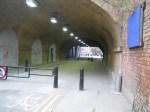
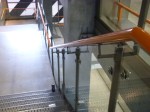

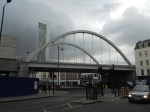
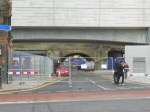
There will be twenty trains per hour (tph) on London Overground’s East London Line.
Under Future Proposals in the Wikipedia entry for the station, this is said.
There have also been discussions of creating an interchange with the Central line between Liverpool Street and Bethnal Green which runs almost underneath the station. However, this would not be able to happen until after the Crossrail 1 project is complete, due to extreme crowding on the Central line during peak hours.
I think it will be a good idea, to create the connection.
Is This A Simple And Affordable Solution To Providing Step-Free Access At Essex Road Station?
The access to and from the platforms at Essex Road station, is not the best.
There is a set of tunnels beneath the two platforms.
- The tunnels are connected to the surface, by a pair of large lifts and an emergency spiral staircase.
- The tunnels are connected to the platforms by two wide sets of stairs.
- One set of stairs is for passengers leaving the station and the others are for those arriving.
This set of pictures shows some of stations underground features.
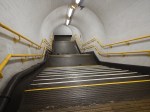
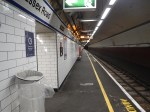

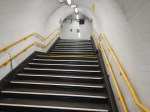



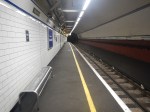
It looks to be a difficult station to make step-free.
- The platforms are narrow.
- There is very little space in the station building to add more lifts direct to the platform.
- I’m not sure,but the rail tunnels might be under the Canonbury Road, which runs outside the station.
Unless its possible to use the Greenford solution.
This picture shows the inclined lift/stairs and escalator installation at Greenford station.
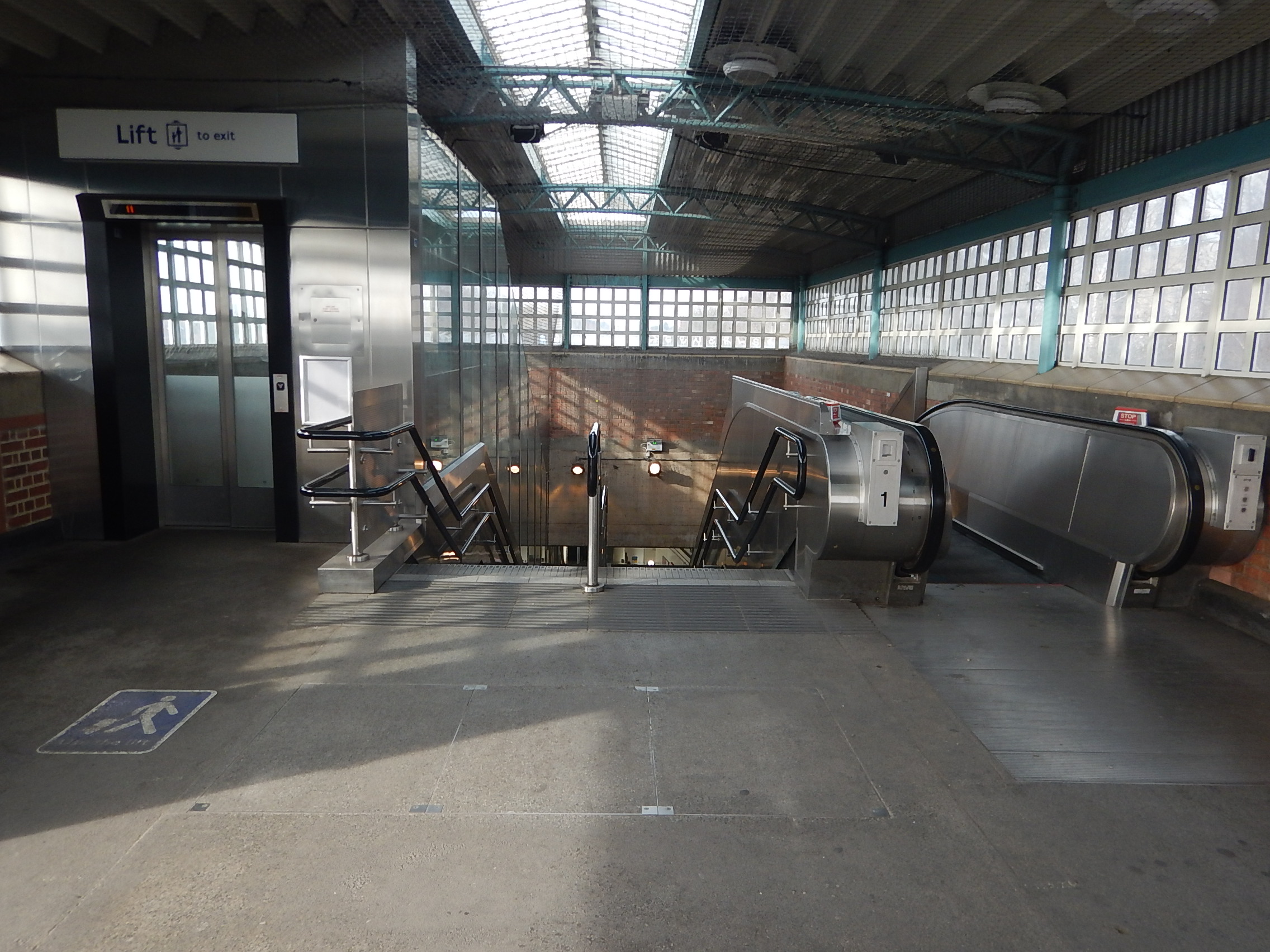
Note.
- The inclined lift has a capacity of about 4-6 people in normal times.
- The staircase is double, with a handrail up the middle.
- The escalator is permanently set to up.
It should be noted that Greenford station has two Central Line platforms and one National Rail platforms.
Could this type of installation be used at Essex Road station?
I will look at a few points and issues.
Station Usage
It should be said, that despite the different natures of the station, we are not comparing apples with oranges, as to get between the street and platforms at both stations, passengers have to use the stairs at Essex Road station or the multi-mode installation at Greenford station.
Entries and exits to Essex Road station over the last four years are as follows.
- 2016-17 – 811,000
- 2017-18 – 861,000
- 2018-19 – 857,000
- 2019-20 – 768,000
The average is 824,000
National Rail entries and exits to Greenford station over the last four years are as follows.
- 2016-17 – 230,000
- 2017-18 – 151,000
- 2018-19 – 153,000
- 2019-20 – 170,000
The average is 176,000
Central Line entries and exits to Greenford station over the last four years are as follows.
- 2015 – 4,720,000
- 2016 – 4,810,000
- 2017 – 4,680,000
- 2018 – 4,250,000
The average is 4,615,000
The total for Greenford station is 4,791,000 or nearly six times as much as Essex Road station.
In fact, the difference is bigger than that as Essex Road station could have a pair of installations, so the capacity of each of the Essex Road installations, would only need to be a twelfth of that of the Greenford installation.
The Simplest Installation
The simplest installation would surely be to fit an inclined lift at the side of one of the existing staircases.
The staircase would probably be halved in width, but quite frankly they are not safe for anybody encumbered with a pushchair or a heavy suitcase.
There would also need to improvements to the routes between the main lifts and the inclined lift.
London’s Single Escalators
London has several single escalators.

Three pictures are from Moorgate and the other one is at Greenford.
Could Pairs Of An Inclined Lift And An Escalator Be Fitted In At Essex Road Station?
It would be tight to fit a pair in one staircase, but I’m sure it would be possible. Especially, if the shaft could be widened a bit.
If they could be made to fit, then a simple program of works could be applied.
- Close one staircase and use the other staircase for both entry and exit. As there is a cross-tunnel, passengers would be able to walk between the lifts and the platforms, by walking about an extra thirty metres or so.
- The closed tunnel would then be gutted and an inclined lift and escalator would be fitted and tested.
- Once complete and tested, it would be opened to passengers.
- The station would now be entrance-only or exit-only, whilst the second lift and escalator were fitted and tested.
Being entrance-only or exit-only would not be the greatest problem, as the 271 bus parallels the rail route between Highbury & Islington and Moorgate stations.
Could An Inclined Lift And A Pair Of Escalators Be Fitted?
In this installation, one shaft would be fitted with a pair of escalators and the other with an inclined lift.
A similar program of works to that I laid out previously would be applied.
Conclusion
Essex Road station could be made step-free.
Because of the bus routes in the area and the 271 in particular, it wouldn’t cause the greatest of inconveniences to close the station for some time.
Why I’ll Delay Having The Coronavirus Vaccine
The vaccines are coming for the covids, but I won’t be having a jab, if one is offered to me, in the first round. I may not be offered one, as I am only 73 and in good health.
But there are many out there, who need the vaccine more than I do, who will be given lower priority than myself.
So I’ll wait!
I am also a diagnosed coeliac on a gluten-free diet and my statistical researches and news reports, show that communities and groups with high levels of undiagnosed coeliacs have suffered badly from the covids.
These communities and groups include.
- Anybody born before 1960, as there was no test for coeliac disease in children before then.
- Ashkenazi Jews. My coeliac genes come from an ancestor in this group.
- Irish
- Caribbean. West Africans have a tendency to coeliac disease and what better way to bring it out, than starve them on slave ships and feed them on only bread and water.
I have also found a research paper, that shows, that India could now experience a coeliac disease epidemic, caused by modern strains of wheat. See Coeliac Disease: Can We Avert The Impending Epidemic In India?
Coeliacs on a gluten-free diet, are an interesting group, in that according to peer-reviewed research by Joe West of Nottingham University, they are 25 % less likely to suffer from cancer.
How can one disease protect you from another?
My coeliac disease was indicated by low-levels of B12, as gluten was damaging my gut and stopping it absorbing vital vitamins. By removing the gluten from my diet, my B12 levels returned to normal.
So it’s the diet that protects my health.
If you think, you are coeliac, don’t be put off by horror stores of multiple endoscopies and the difficulty of sticking to a gluten-free diet. I may have been one of the first individuals tested, by the current genetic method, which is now used by most GPs. A blood sample is sent off for a test and that is generally all that is done in most cases. I heard in 48 hours.
So why is it beneficial in the case of cancer?
It can only be, that with all those vitamins, coeliacs on a gluten-free diet have a very healthy immune system.
So does, this immune system, help protect coeliacs from the covids?
Until proven otherwise, my statistical research, thinks it does!
So I believe, that I can afford to wait.
Has Good Project Management Helped The UK Get The Vaccine Early?
Professor Van-Tam, this morning on BBC Breakfast, praised the planning of the drug companies and the various health bodies in charge of certification of the vaccines.
As someone, who was at the heart of the Project Management Revolution in the 1970s and 1980s, this cheers me.
Looking back, my biggest contribution to project management, was to prove that you didn’t need to use a large mainframe computer and software would work on a small desk-sized machine and ultimately on a personal computer, thus bringing project management to everyone.
 The Anonymous Widower