WES Starts Testing Combined Floating Wind And Wave Energy Models
The title of this post, is the same as that of this article on offshoreWIND.biz.
This is the sub-heading.
Wave Energy Scotland (WES) has started a series of tank tests of floating wind and wave energy structures at the University of Edinburgh’s FloWave facility to explore the potential benefits the synergy between the two technologies could bring.
These two paragraphs introduce the technology.
The tank tests currently being completed by WES use sea states which are representative of one of the future floating wind lease sites on the west coast of Scotland, leased through the ScotWind program and which has an appropriate water depth and wave resource for large-scale wave energy exploitation.
The physical model used for the testing incorporates multiple identical wave energy absorbers mounted onto a semi-submerged, triangular floating platform.
Have we got enough research facilities to test devices like these?
I can find these.
With Edinburgh, that makes five.
First Turbines Up At World’s Biggest Offshore Wind Farm
The title of this post, is the same as that of this article on offshoreWIND.biz.
This is the sub-heading.
The first two wind turbines have been installed at Dogger Bank A, the first of the three phases of the UK’s 3.6 GW Dogger Bank Wind Farm, the world’s biggest offshore wind farm under construction.
It is a good article that documents how a fixed-foundation wind farm is assembled.
The Dogger Bank wind farm will contain these separate wind farms.
- Dogger Bank A – 1235 MW – 95 x 13 MW – Under Construction – Commission in 2023
- Dogger Bank B – 1235 MW – 95 x 13 MW – Pre-Construction – Commission in 2024
- Dogger Bank C – 1218 MW – 87 x 14 MW – Pre-Construction – Commission in 2025
- Dogger Bank D – 1320 MW – Early Planning
- Dogger Bank South – 3000 MW – Early Planning
Note.
- The Dogger Bank wind farms are currently planned to be a shade over 8 GW.
- I have used data from Wikipedia’s List of offshore wind farms in the United Kingdom.
This family of wind farms could provide almost a third of our electricity or as I showed in The Mathematics Of Blending Twenty Percent Of Hydrogen Into The UK Gas Grid, it could provide enough hydrogen to blend 20 % of hydrogen into the UK gas grid.
Conclusion
Dogger Bank will have moved from a joke in the Shipping Forecast to one of our most important natural resources.
Heathrow Southern Rail Link Gets Boost As London Mayor Gives Backing
The title of this post, is the same as that of this article on Rail Technology Magazine.
These were the two introductory paragraphs.
The Railway Industry Association has welcomed the backing from London Mayor, Sadiq Khan for the proposed Heathrow Southern Rail Link.
Speaking at the London Assembly recently, Mr Khan said: “I welcome the useful role that a Southern Rail Link to Heathrow could play in supporting a shift to sustainable modes, while transforming access to Heathrow Airport for passengers and staff from south London, Surrey and Hampshire.
I introduced the Heathrow Southern Railway in November 2016 in Why I Like The Heathrow Southern Railway Proposal.
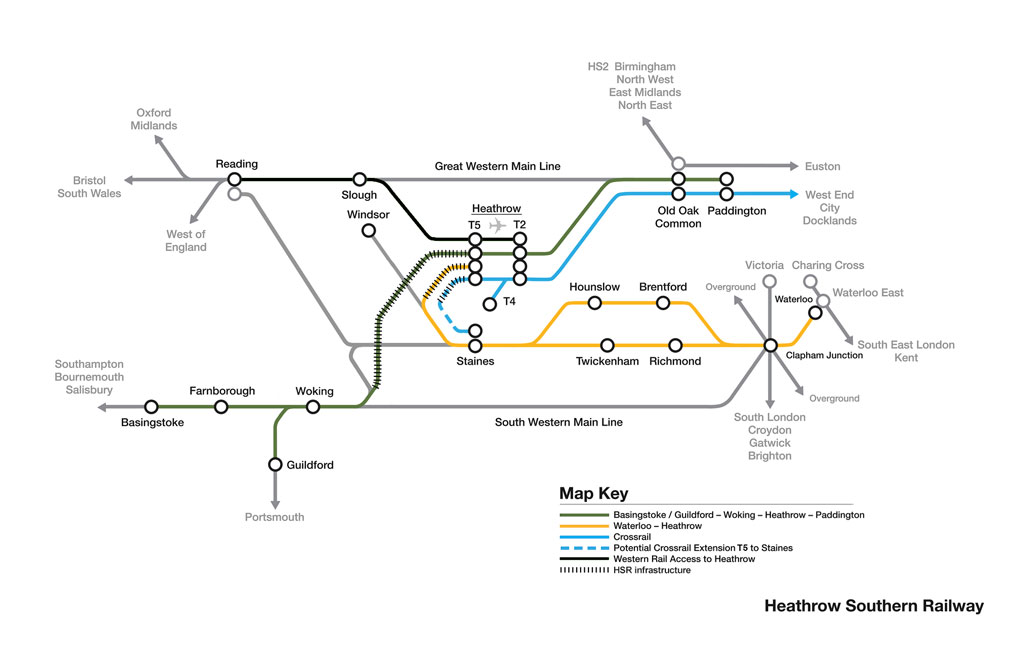
I still like it and we now have more information, which includes this map.
Note.
- The blue line is the Elizabeth Line.
- The yellow line is a direct link from Waterloo to Heathrow.
- The station in a six pointed star is Clapham Junction.
On the Heathrow Southern Railway web site there is a section called Service Opportunities.
It details two routes.
- Heathrow and Waterloo via Staines and Clapham Junction
- Basingstoke/Guildford and Paddington via Woking and Heathrow
These are a few random thoughts.
A ULEZ Avoiding Line
If the Elizabeth Line is extended to Staines, then Heathrow Southern Railway provides a ULEZ avoiding route for Heathrow employees to help get the Mayor out of a hole. A station guy at Staines told me a lot of Heathrow staff take buses to the airport from Staines station.
West London Orbital Railway
I believe that the West London Orbital Railway would make sense to give lots of other routes for Heathrow staff and passengers.
Conclusion
I’ve always liked the Heathrow Southern Railway and I hope this interest from the Mayor moves the project forward.
Cummins Agrees To Integrate Its Hydrogen ICE Technology Into Terex® Advance Trucks
The title of this post, is the same as that of this article on H2 View.
These three paragraphs outline the deal.
Cummins and Terex® Advance have signed a Letter of Intent (LoI) to integrate hydrogen internal combustion engines (ICE) into Terex’s Commander Series.
The Commander Series trucks are currently powered by Cummins’ diesel engines, but the company will now provide its X15H hydrogen ICE when series production of the technology begins later this decade.
The X15H is based on familiar combustion engine technology, with integration into the truck chassis being straightforward and doesn’t require a major overhaul of vehicle design or business operations.
Note.
This page is the Terex Advance web site.
This page on the Terex web site shows the Terex Advance Commander series.
I think it is true to say to UK and European eyes, these trucks are an unusual design.
In Cummins Fuel-Agnostic X Series Platform, there is a link to a Cummins video, which explains Cummins multi-fuel technology.
This is a side view of the top-of-the-range monster.

Note.
- Front is to the right.
- I suspect the driver doesn’t have to get out of the cab to discharge the concrete.
- The engine is at the rear with vertical exhausts.
- All axles are driven.
You’d certainly notice one of these if they were to be used in the City of London.
And this is the baby of the range.
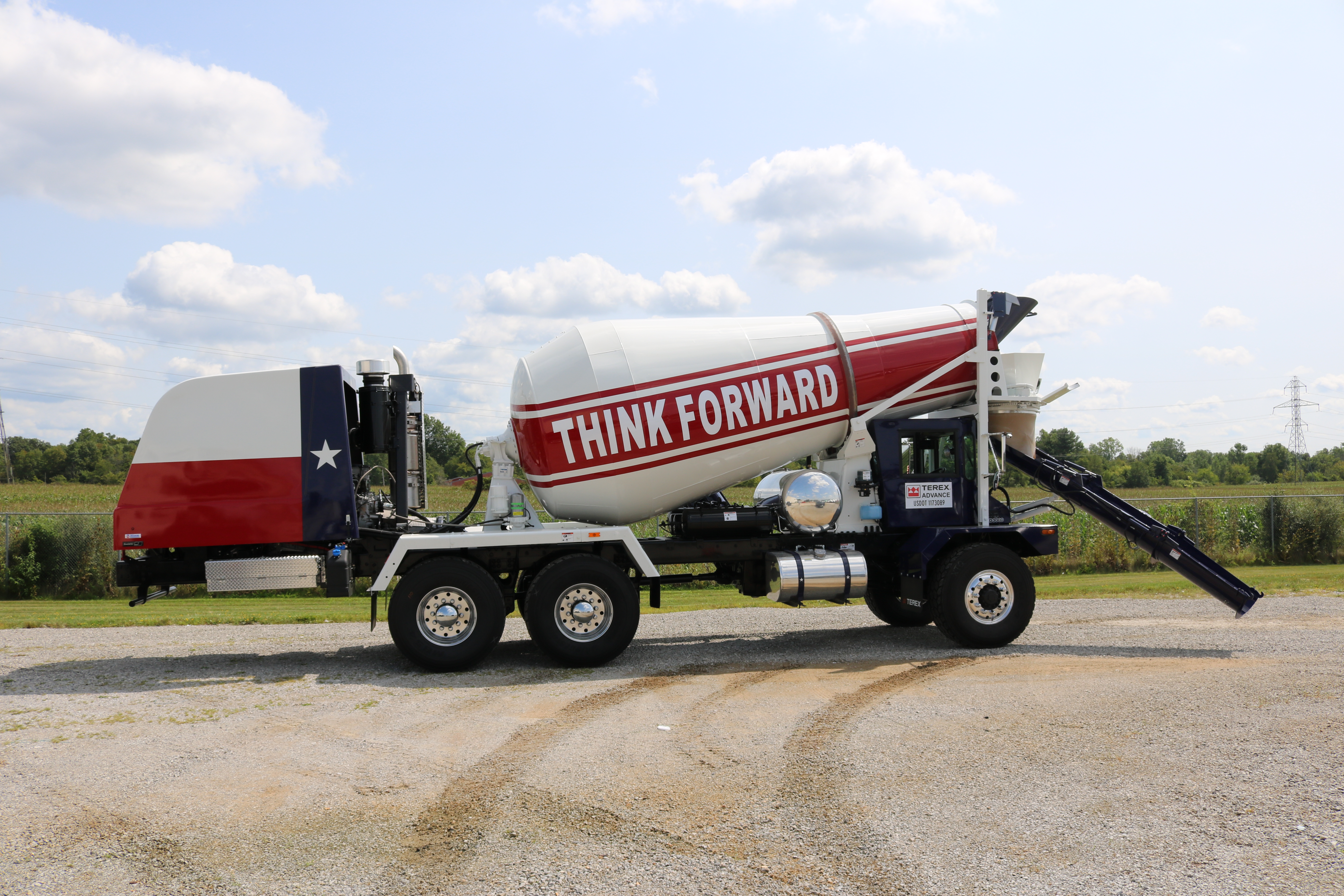
Three axles is normal for the UK. so I wonder if this machine will ever make it across the pond.
This last paragraph in the article describes the X15H hydrogen internal combustion engine.
The X15H was showcased at the Advanced Clean Transportation (ACT) Expo in May (2023), along with its hydrogen ICE-powered concept truck. The X15H features a 700-bar pressure 80kg capacity hydrogen storage system and a range of more than 500 miles, with up to 500 horsepower.
Could one of these trucks really deliver ready-mix concrete from London to Manchester and return?
Conclusion
The article says that integration of the hydrogen technology is straightforward and if you watch the Cummins video, the animation says it is.
But surely the big advantage on construction sites, is that all the workers will not get the dose of pollution, that they would currently get from a diesel cement mixer delivering a load of ready-mixed concrete, that had to be distributed and laid.
I think this could be a very neat application of hydrogen technology and Cummins will be looking for more applications of a similar nature.
German Police Probe ‘Political Motive’ In Railway Fires
The title of this post, is the same as that of this article on DW.com.
This is the sub-heading.
A series of fires hit rail infrastructure on the main line between Hamburg and Berlin overnight, leading to widespread train disruptions. Police say they suspect a politically motivated act of sabotage.
This is the first two paragraphs.
German police are investigating a suspected political motive behind an alleged act of sabotage targeting a major train route connecting the port city of Hamburg to the capital, Berlin.
Fire broke out overnight at three locations in the northern Hamburg region, affecting shafts holding railway cables.
This paragraph describes a claim for responsibility.
An anonymous letter published on the far-left website Indymedia claimed responsibility for the incident, describing it as an act of “sabotage.” The letter said it was a protest against “neo-colonial exploitation and earth destroying extraction of raw materials.”
I don’t think we want anything like this in the UK.
Heat And The City
As I do on many Saturdays, I took the bus to Moorgate to have a late breakfast and do some food shopping in the Marks & Spencer department store.
To say it was hot would be an understatement and it must have been over thirty, so I retreated into an air-conditioned restaurant for my brunch, with my son and a friend.
I know that area well and although, I’m normally there on a weekday, I’ve never seen so much display of female flesh, with bare shoulders, cleavage and tummies everywhere. At least some were wearing white, which surely was prudent, but others were suffering in black and other darker colours.
After eating, I did my shopping.
I didn’t need much, but I did need some beer. As I’d miscalculated my consumption in the hot weather, it was a priority.
At home, I generally drink Adnams 0.5% alcohol Ghost Ship, which my body attests to be gluten-free. Normally, the store stocks it, but I couldn’t find any, so I asked an assistant, who was restocking the shelves. She said that they didn’t have any, but they did have the Adnams-brewed M & S own-brand, of which I’ve drunk dozens of bottles and my body also attests is gluten-free. So a couple of bottles, went into my shopping basket.
Interestingly, the assistant was rearranging shelves and it appeared, she was moving zero-alcohol bottles from the floor into the refrigerated end of a large display.
Could the heat be creating a high demand for customers needing to drink something to cool down? And many felt that zero-alcohol beer was acceptable in the heat of the City.
On Monday, I went back to take this picture of the display.

Note the Marks & Spencer own label brewed by Adnams in the middle!
And this was the price label for the beer.

No Alcohol – No Gluten – £1.90 a bottle – What more can a coeliac, who’s on Warfarin after a stroke need?
Hydrogen Fuel Cell-Electric Coach Driveline Coming From Wrightbus
The title of this post, is the same as that of this article on RouteOne.
These are the first two paragraphs.
Wrightbus has been awarded up to £534,000 of government funding via the Advanced Propulsion Centre (APC) for the development, testing and validation of a hydrogen fuel cell-electric coach driveline.
The Ballymena manufacturer will receive the money from an £11 million pot administered by APC as a second round of the Advanced Route to Market Demonstrator scheme (ARMD2), which itself is part of over £50 million of public funding towards 30 “cutting edge manufacturing projects” in the UK.
I have never driven a coach, but I do feel that this project could be a winner.
- From riding in hundreds of their products over the years, I’m sure Wrightbus could produce a coach that satisfies the demands of coach companies and their passengers.
- Long routes like London and Scotland are popular coach routes and are of the order of 400 miles. Would passengers tolerate a thirty minute stop halfway to charge the batteries on an electric coach?
- Through, the experiences of the vehicle leasing company, I owned, I know that finance for quality coaches is not hard to come by and they are a good investment.
I also believe that a hydrogen-powered coach could be a flagship product for the hydrogen-powered transport sector.
We’ve all been on a motorway and seen coaches in the fast lane at 70 mph.
What effect will that have if the coach was emblazoned with “Green Hydrogen Coach – London-Glasgow Non-Stop In 7 Hrs”?
Trying To Watch The Rugby World Cup, But All I Get Is Adverts
At least I could watch the athletics on the BBC, whilst waiting for the match to start.
As all matches would appear to be on ITV, I doubt I’ll be watching many of the matches.
Airbus, Rolls-Royce, EasyJet Headline Formation Of UK Hydrogen Alliance
The title of this post, is the same as that of this article from Future Flight.
These two paragraphs outline the story.
A group of leading companies in the UK aviation and renewable energy sectors including EasyJet, Rolls-Royce, and Airbus has established the Hydrogen in Aviation (HIA) alliance to accelerate the delivery of zero-carbon aviation, the companies said Tuesday. HIA, whose partners also include Ørsted, GKN Aerospace, and Bristol Airport, said decarbonization efforts involving hydrogen should assume more urgency at a time when sustainable aviation fuel and batteries have drawn so much of the sector’s attention.
Working with government, local authorities, and the aviation and hydrogen sectors, the group plans to draw on members’ expertise to propose “a clear and deliverable pathway” to achieving hydrogen-powered aviation. Efforts center on clearing a pathway for preparing the needed infrastructure as well as policy, regulatory, and safety frameworks.
This Airbus infographic describes the aircraft in Airbus’s ZEROe project.
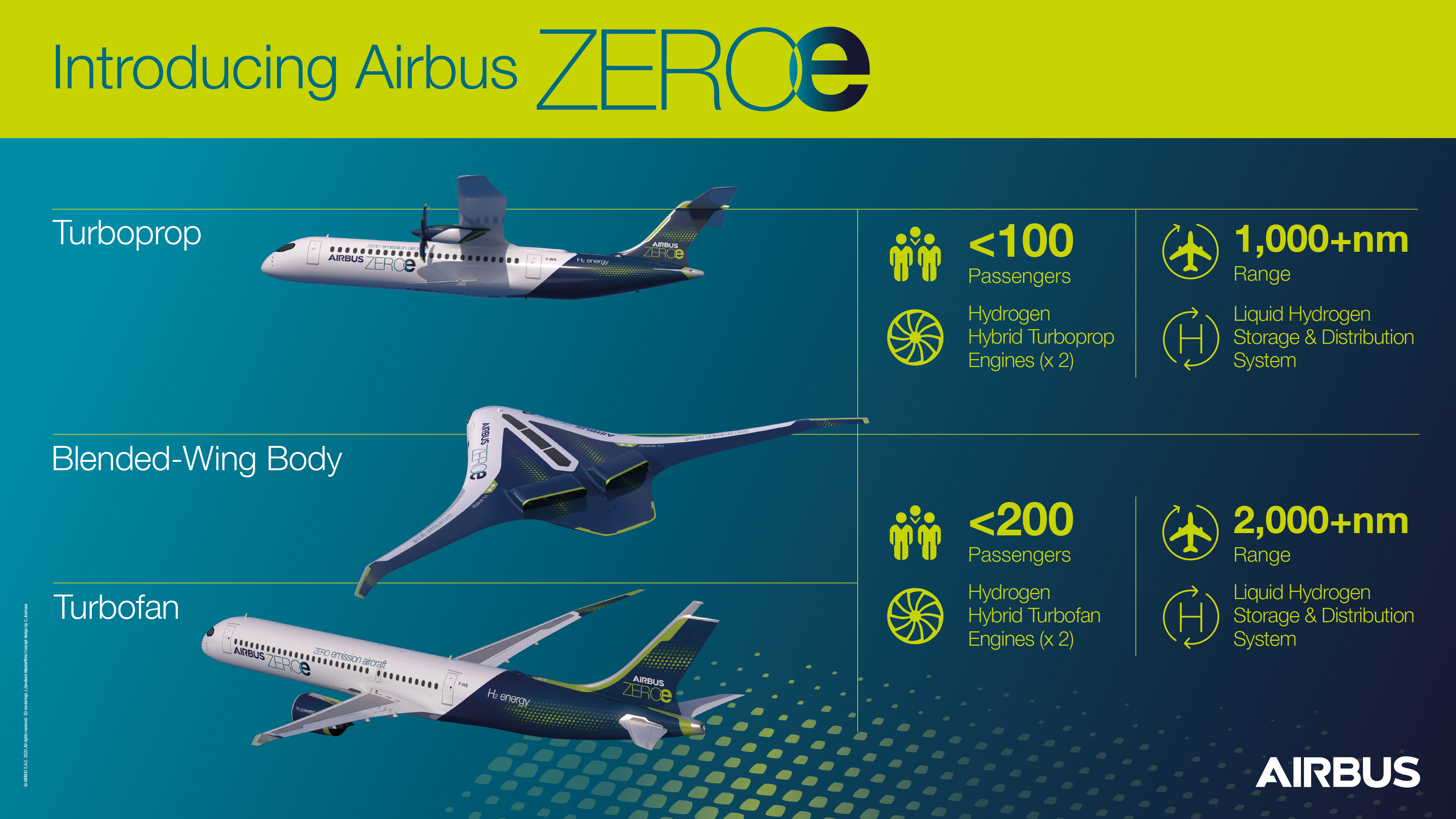
Discover the three zero-emission concept aircraft known as ZEROe in this infographic. These turbofan, turboprop, and blended-wing-body configurations are all hydrogen hybrid aircraft.
These are my thoughts.
Do The ZEROe Turboprop And The ZEROe Turbofan Have Similar Hydrogen Systems?
This is Airbus’s summary of the design of the ZEROe Turboprop
Two hybrid-hydrogen turboprop engines, which drive eight-bladed propellers, provide thrust. The liquid hydrogen storage and distribution system is located behind the rear pressure bulkhead
This screen capture taken from an Airbus video, shows a rear view of the plane.

Note the sizeable cone-shaped rear end to the fuselage with no windows.
This is Airbus’s summary of the design of the ZEROe Turbofan
Two hybrid hydrogen turbofan engines provide thrust. The liquid hydrogen storage and distribution system is located behind the rear pressure bulkhead.
This screen capture taken from an Airbus video, shows the plane.
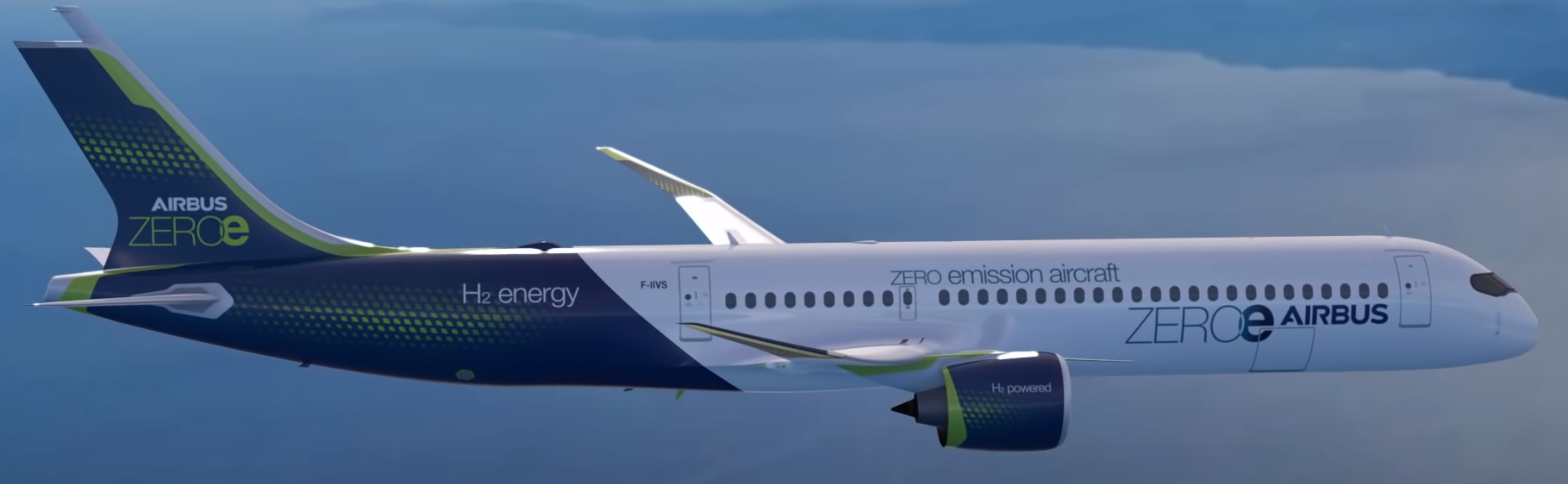
Note how there are no windows at the back of the fuselage, as the hydrogen tank doesn’t need them.
It looks to me, that similar cone-shaped tanks for hydrogen, customised for each aircraft could be placed behind the rear bulkhead.
There would probably be space for any pumps needed to distribute the hydrogen to the engines.
All the stored hydrogen and its gubbins could be safely sealed behind the rear bulkhead.
I am fairly certain that the ZEROe Turboprop and the ZEROe Turbofan will have similar hydrogen systems.
Do The ZEROe Turboprop And The ZEROe Turbofan Have Auxiliary Power Units?
The auxiliary power unit or APU in an aircraft that provides energy for functions other than propulsion.
In Airbus To Trial In-flight Auxiliary Power Entirely Generated By Hydrogen, I wrote about Airbus’s development of APU’s based on fuel cells and running on hydrogen.
This surely could be a way to go.
- A battery could store power.
- Fuel cells are proving to be reliable.
- The plane would have two independent electrical systems.
Power would always be available for the cockpit, flying controls and to restart the engines, just as it is in any airliner today.
Do The ZEROe Turboprop And The ZEROe Turbofan Have The Same Cockpit?
The cockpits of the A 320 neo and the A 320 ceo seem to have a similar profile, but the cockpit of the ZEROe Turbofan seems to have been reprofiled.
In ZEROe – Towards The World’s First Zero-Emission Commercial Aircraft, I showed these front on views of the cockpits of the ZEROe Turboprop and ZEROe Turbofan.


I questioned if the two cockpits were related.
- A single cockpit for both aircraft would surely ease manufacture, maintenance and pilot training.
- I’m no aerodynamicist, but it certainly looks that the new cockpit will reduce drag and fuel consumption.
This common cockpit concept was used for the Boeing 757 and the Boeing 767 in the 1980s, so it is not a new concept.
Although the cockpit, appears to be being used in the ZEROe for the first time, I would expect it is already under development and might feature in any later version of the A 320 neo.
Do Airbus Have A Preferred Development Order?
Consider.
- My product development experience indicates that the development of the ZEROe Blended-Wing Body will involve more flight testing and aerodynamic checks than the other two aircraft, so I would make it the last aircraft to enter service.
- The ZEROe Turboprop appears to be a development of the ATR 72.
- The ZEROe Turbofan appears to be a development of an A 320 neo.
- The ZEROe Turboprop and ZEROe Turbofan would appear to have similar designs of cockpit, hydrogen systems and auxiliary power units.
- It looks to me that either of the ZEROe Turboprop or ZEROe Turbofan could be developed first.
I would develop the ZEROe Turboprop first, as it is the smaller aircraft.
Why Bristol Airport?
This page on the Airbus web site is entitled Airbus In The United Kingdom, where this is the first paragraph.
Building on a proud 100-year British aviation heritage, Airbus is part of the very fabric of the UK – which is one of the company’s four home markets, alongside France, Germany and Spain. Its 11,000-strong UK workforce is part of a global family of 125,000 employees.
This is said under Commercial Aircraft.
The sites at Filton and Broughton design, test and manufacture the wings for all Airbus’ A320 family, A330 and A350 commercial aircraft, directly sustaining more than 8,000 full-time jobs and hundreds of apprenticeships.
A220 family wings are designed and built by Spirit AeroSystems in Belfast, Northern Ireland.
Broughton has a proud tradition of aerospace manufacturing dating back 80 years, having supplied the RAF with vital aircraft during the Second World War. Employing almost 5,000 people, Broughton is a global centre of excellence for manufacturing and delivers over 500 wing sets per year for the A320 family, A330 and A350. Airbus has invested more than £2 billion in the Broughton plant over the past 10 years.
Core activities at Filton, where an additional 3,000 people work, are the design, engineering and support for Airbus wings, fuel systems and landing gear systems. Teams also work on aerodynamics research, development and test facilities, including our future zero-emissions programme, ZEROe, while wings for the A400M transporter are assembled on site.
It would appear that Filton in Bristol, is a very important part of Airbus’s operations in the UK.
- It appears to have major responsibility for all Airbus wings except the smallest.
- It has a large responsibility with respect to the ZEROe family of aircraft.
- Filton Airfield is now closed.
- Filton can do substantial assembly if required.
So was it just a logical decision to phone up Bristol Airport and ask, if they’d like to join the project?
In addition.
- Bristol Airport has a 2000 metre East West asphalt runway.
- The airport can handle a Boeing 787 Dreamliner and Airbus A330.
- It is the eighth busiest airport in the UK.
- It is a busy general aviation airfield.
- There is plenty of electricity in the area and Hinckley Point C will open down the road in a couple of years.
Bristol Airport is probably typical of many provincial airports around the world.
Why EasyJet?
These paragraphs from the Future Flight article help to explain.
“There is no doubt that the UK has the potential to become a world leader in hydrogen aviation, which could bring with it a £34 billion per annum boost to the country’s economy by 2050, but in order to capture this opportunity, rapid change is needed and the time to act is now,” said Johan Lundgren, CEO of EasyJet and HIA’s first chairman.
“We must work together to deliver the radical solutions required for a hard-to-abate industry like aviation so we can protect and maximize the benefits that it brings to the UK economy and society and that we know British consumers want to be preserved.”
Under its Zero-E program, Airbus aims to bring to market the first hydrogen-powered narrowbody commercial airplane by 2035. Separately, a partnership between Rolls-Royce and EasyJet signed last year saw the companies test hydrogen fuel in gaseous form in an adapted AE2100-A turbine, the engine that powers the Saab 2000 regional airliner. The November 2022 test, which used hydrogen produced in the Orkney Islands by the European Marine Energy Centre using renewable energy, marked the first run of a modern engine using hydrogen.
EasyJet seems to be enthusiastic about hydrogen and their CEO will be the HIA’s first chairman.
EasyJet also has a series of routes from Bristol Airport.
- Alicante – 907 miles
- Amsterdam – 326 miles
- Athens – 1592 miles
- Antalya – 1981 miles
- Barcelona – 733 miles
- Basel/Mulhouse – 530 miles
- Belfast–City – 259 miles
- Belfast–International – 269 miles
- Berlin – 694 miles
- Bilbao – 559 miles
- Bodrum – 1772 miles
- Bordeaux – 462 miles
- Catania – 1295 miles
- Chania – 1719 miles
- Copenhagen – 694 miles
- Corfu – 1356 miles
- Dalaman – 1981 miles
- Dubrovnik – 1155 miles
- Edinburgh – 316 miles
- Enfidha – 1241 miles
- Faro – 1026 miles
- Fuerteventura – 1687 miles
- Funchal – 1473 miles
- Geneva – 536 miles
- Gibraltar – 1060 miles
- Glasgow – 317 miles
- Gran Canaria – 1749 miles
- Grenoble – 556 miles
- Heraklion – 1768 miles
- Hurghada – 2526 miles
- Ibiza – 887 miles
- Innsbruck – 693 miles
- Inverness – 429 miles
- Isle of Man – 203 miles
- Kefalonia – 1451 miles
- Kos – 1770 miles
- Kraków – 991 miles
- La Rochelle – 366 miles
- Lanzarote – 1649 miles
- Larnaca – 2126 miles
- Lisbon – 925 miles
- Lyon – 529 miles
- Madrid – 755 miles
- Málaga – 1020 miles
- Marrakesh – 1393 miles
- Marseille – 662 miles
- Menorca – 863 miles
- Milan–Malpensa – 682 miles
- Murcia – 945 miles
- Mykonos – 1670 miles
- Nantes – 251 miles
- Naples – 1085 miles
- Newcastle upon Tyne – 256 miles
- Nice – 704 miles
- Olbia – 929 miles
- Palma de Mallorca – 859 miles
- Paphos – 2087 miles
- Paris–Charles de Gaulle – 285 miles
- Paris–Orly – 290 miles
- Pisa – 808 miles
- Porto – 755 miles
- Prague – 746 miles
- Preveza/Lefkada – 1421 miles
- Pula – 885 miles
- Reykjavík–Keflavík – 1121 miles
- Rome–Fiumicino – 968 miles
- Rovaniemi – 1436 miles
- Salzburg – 745 miles
- Santorini – 1726 miles
- Sharm El Sheikh – 2507 miles
- Sofia – 1359 miles
- Split – 927 miles
- Tenerife–South – 1766 miles
- Toulouse – 569 miles
- Turin – 645 miles
- Venice – 798 miles
- Zakynthos – 1484 miles
Note.
- There are nine routes under 400 miles, which might enable a round trip without refuelling in a ZEROe Turboprop.
- There are nine routes under 800 miles, which might enable a round trip without refuelling in a ZEROe Turbofan.
- There are only four routes over 2000 miles, which might make a single trip difficult in a ZEROe Turbofan.
- Bristol and Toulouse is a convenient 569 miles for Airbus and its employees, customers and contractors.
It does appear that, EasyJet’s routes fit the 1000 mile range of a ZEROe Turboprop and the 2000 mile range of a ZEROe Turbofan exceedingly well.
Conclusion
Bristol will be important in the development of Airbus’s three ZEROe aircraft.
SSE And RWE Tweak North Falls Project Following Public Input, DCO Application Now Expected In 2024
The title of this post, is the same as that of this article on offshoreWIND.biz.
This is the sub-heading.
RWE and SSE Renewables have made a number of changes to the North Falls offshore wind project in the UK, a proposed extension to the existing 504 MW Greater Gabbard, whose implementation will likely move the planned date for filing a development consent order (DCO) application into 2024. The most significant changes to the project plans include removing the northern array area and reducing the number and height of wind turbines.
These two paragraphs introduce the article.
The developers are tweaking the project following a review of the feedback received from the North Falls statutory consultation held during the summer.
Initially, North Falls comprised two offshore array areas totalling 150 square kilometres and will now have a single array occupying 95 square kilometres. This also moves the wind farm farther offshore, with its closest point to shore now being 42 kilometres, 20 kilometres farther out at sea than proposed originally.
It looks like RWE and SSE Renewables have listened to the public and acted.
But then the developers are two of the most experienced in the UK.
 The Anonymous Widower