Man Finds Prehistoric Handaxe On His Tea Break
The title of this post, is the same as that of this article on the BBC.
This is the sub-heading.
A man discovered a prehistoric handaxe while he was “kicking his feet” on the ground during a tea break.
These are the first three paragraphs, which add some detail to the story.
Colin Cooley, 57, from Otley, Suffolk, works as a dumper driver on the Sizewell C excavation site.
Toward the end of a tea break, he noticed a piece of rock that he believed looked like a handaxe.
“All hell broke loose” when it was confirmed to be between 36,000 and 59,000 years old, and Hadley Sharman, an archaeologist working on the site, added it was a “blinder” of a find.
I suppose that the Nimbies will use the find to stop the power station getting built!
On the other hand Crossrail has used archaeology to make friends with the public, as I pointed out in Bison To Bedlam Or How To Make Friends.
Global Offshore Wind Capacity Reaches 83 GW, 100 GW More To Be Awarded in 2025-2026, New Report Says
The title of this post, is the same as that of this article on offshoreWIND.biz.
This is the sub-heading.
According to a new market report from the Global Wind Energy Council (GWEC), there are now 83 GW of offshore wind capacity installed globally, with 48 GW more in the construction phase worldwide as of May this year.
The first paragraph is a quote from Rebecca Williams, Deputy CEO at GWEC.
Our report finds that there is now already 83 GW of offshore wind installed worldwide, keeping the lights on for 73 million households, and powering countries’ economic development. There is currently a further 48 GW of offshore wind [under] construction worldwide. With its unique position in the marine space, and ability to produce large amounts of reliable, homegrown power, nations around the world are pushing forward the technology to enhance their energy independence and autonomy
I doubt Ms. Williams will be on the Donald Trump’s Christmas card list.
The article is worth a full read, as it contains some interesting statistics.
This is the last paragraph of the article.
Global Wind Energy Council’s 2024 global offshore wind outlook for total additions in the 2025-2029 period was 156.72 GW, which has now been downgraded to 118.56 GW.
These are my estimates for the amount of offshore wind in the UK.
- Currently Installed – 16, 035 MW
- To Be Installed in 2025 – 1,235 MW
- To Be Installed in 2026 – 4,907 MW
- To Be Installed in 2027 – 5,750 MW
- To Be Installed in 2028 – 480 MW
- To Be Installed in 2029 – 1,363 MW
The UK should be installing 13,735 MW, which would.
- Lift total offshore wind capacity to 29.8 GW.
- This is an 86 % increase in capacity from July 2025.
- As I write this, we are using 29.3 GW.
- We would be adding 11.6 % of the global additions for 2025-2029, which isn’t bad for such a small country.
All this wind will need to be backed up, for when the wind doesn’t blow.
So I asked Google AI how much electricity storage we will have by 2029 and got this AI Overview.
In 2029, the UK is expected to have a significant amount of battery energy storage capacity, with estimates ranging from 27 to 29 GW, according to the House of Commons Library and Cornwall Insight. This capacity is crucial for supporting the UK’s transition to a clean energy system and ensuring a stable electricity supply.
Obviously, Google AI isn’t that intelligent, as it made the mistake made by many electricity storage companies of just giving the output of the battery, as it sounds better, rather than both the output and the storage capacity.
Consider.
- Most Battery Energy Storage Systems (BESS) can provide two hours of output.
- Highview Power’s big batteries are 200 MW/2.5 GWh, so will provide 12.5 hours of output.
If I assume that the average storage is just two hours, that means the available storage will be at least 54 GWh.
Given that we also had 16 GW of solar power in June 2024 and if this increases at a similar rate to offshore wind power, it will certainly be able to help fill the energy storage, I think we’ll have enough renewable energy to play a big part in the next election.
About The Global Wind Energy Council (GWEC)
I asked Google AI for a summary about GWEC and got this AI Overview.
The Global Wind Energy Council (GWEC) has its global headquarters in Lisbon, Portugal. Additionally, they have offices in Brussels, Belgium; Singapore; and London, UK.
GWEC’s presence is not limited to these locations, as they have a global network of experts working across different continents, according to the organization’s website. Their flagship report, the Global Wind Report, is launched annually in London. For example, the 2025 report launch took place in London.
Unsurprisingly, it doesn’t mention an office in the United States.
The report, which forms the basis of this post, can be downloaded from the GWEC web site.
Reform Declares War On County’s Net-Zero Projects
The title of this post, is the same as that of this article on the BBC.
This is the sub-heading.
Reform UK leaders in Lincolnshire say they have “declared war” on green energy projects.
These three paragraphs outline their policies.
Boston and Skegness MP Richard Tice, Greater Lincolnshire’s mayor Dame Andrea Jenkyns and Councillor Sean Matthews, who leads the county council, launched a campaign at a press conference held in Boston earlier.
They said they opposed wind and solar farms and battery storage facilities, with Tice adding: “It is an absolute outrage what the madness of net stupid zero is doing to our county, as well as to our country.”
The government said green energy was vital in delivering energy security, while Labour MP Melanie Onn argued Reform’s stance posed a risk to thousands of jobs.
It should be noted that Lincolnshire has a lot of projects, that will be concerned with renewable energy.
Lincolnshire is one of the UK counties, with the highest level of wind power.
- There are over 7 GW of wind farms, that already do or will land their electricity in the county including 5.5 GW from the world’s largest offshore wind farm; Hornsea.
- There is approaching 300 MW of onshore wind in the county, which includes England’s largest onshore wind farm at Keadby, which is 68 MW.
I asked Google how much solar there was in the county and I got this AI Overview.
Lincolnshire has a significant amount of solar power capacity, with several large solar farms and numerous smaller installations. The county is a major location for solar energy development, with some projects aiming to power tens or even hundreds of thousands of homes.
In the real world of wind and solar energy, all of this renewable energy will need backup and the county has it in hundreds of megawatts.
- Keadby One is a 732 MW gas-fired power station owned by SSE Thermal.
- Keadby Two is a 849 MW gas-fired power station owned by SSE Thermal.
- Keadby Three will be a 910 gas-fired power station, fitted with carbon capture, that is being developed by SSE Thermal.
- Keadby Next Generation Power Station is a 1800 MW hydrogen-powered power station, that is being developed by Equinor and SSE Thermal. I wrote about it in Consultation On Plans For Keadby Hydrogen Power Station To Begin and it will generate 900 MW of zero-carbon electricity.
Now that it what I call backup.
Conclusion
Lincolnshire generates a lot of renewable energy and Reform UK want to throw it all away.
As I showed in US Gov’t Withdraws All Offshore Wind Energy Areas, Trump’s policies against renewable energy and wind in particular are not good for investment and employment.
We don’t want Trump’s policies in the UK.
And especially in Lincolnshire, where all this energy can attract jobs.
US Gov’t Withdraws All Offshore Wind Energy Areas
The title of this post, is the same as that of this article on offshoreWIND.biz.
This is the sub-heading.
The US Bureau of Ocean Energy Management (BOEM) has rescinded and de-designated all Wind Energy Areas (WEAs) on the US Outer Continental Shelf (OCS). The WEAs are areas in the US federal waters that BOEM previously identified as suitable for wind energy development and, following a multi-stage process, designated Wind Energy Areas for which a lease sale may be proposed.
This first paragraph adds more details.
“By rescinding WEAs, BOEM is ending the federal practice of designating large areas of the OCS for speculative wind development, and is de-designating over 3.5 million acres of unleased federal waters previously targeted for offshore wind development across the Gulf of America, Gulf of Maine, the New York Bight, California, Oregon, and the Central Atlantic”, the US agency said on 30 July.
Trump may not be able to do anything about windmills in Scotland, but he has certainly killed them off in the seas around the United States.
The last paragraph of the article contains the words of Stephanie Francoeur, SVP of Communications & External Affairs at Oceantic Network, who are a US offshore renewable energy industry organisation.
“This will result in even higher energy costs, increased blackouts, job loss, and billions of dollars in stranded investments, further delaying shovel-ready projects supported by a domestic heavy manufacturing supply chain renaissance that spans 40 states. Crippling affordable and reliable wind energy makes no economic sense and undermines the administration’s “all-of-the-above” energy strategy. We urge the Department to adopt policies which put all sources of American energy on an even playing field.”
Donald! The lady has warned you! And she seems angry!
Could This Decision Be Beneficial To Other Wind Projects Around The World?
I wouldn’t be surprised, as there will now be a lot of quality resources and assets in the United States, that will be looking for work.
Singapore’s First Hydrogen-Powered Data Center Launched By DayOne Using SOFC Technology
The title of this post, is the same as that of this article on Fuel Cell Works.
These two bullet points act as sub-headings.
- DayOne has broken ground on its first AI-ready hyperscale data center in Singapore, a 20MW facility set to be operational in 2026. The project integrates 100% renewable energy, SOFC-based hydrogen power generation, and cutting-edge hybrid cooling technologies.
- Strategic partnerships with Sembcorp and NUS will drive green energy adoption and R&D in sustainable tropical data center innovation, aligning with Singapore’s AI and digital infrastructure goals.
This data centre and the companies and the technologies behind it, are certainly ones to watch.
The R & D and innovation behind it could allow data centres to be built in more tropical places than is currently possible.
British Gas Owner Mulls Mini-Nuke Challenge To Rolls-Royce
The title of this post, is the same as that of this article in The Telegraph.
This is the sub-heading.
Centrica is looking to follow Rolls-Royce in developing small modular reactors
These are the first three paragraphs.
The owner of British Gas is considering investing in mini nuclear power plants in the UK as it seeks to cash in on burgeoning demand for the technology.
Centrica is in early talks with the Government about a potential future deal that could see the energy giant participate in the development of so-called small modular reactors (SMRs).
It comes after Ed Miliband, the Energy Secretary, last month announced billions of pounds in funding for SMRs, which will form part of a new “golden age” for atomic energy.
In Centrica Really Can’t Lose At Sizewell, I looked at Centrica’s involvement in Sizewell C and in particular the financing of the nuke and what Centrica would do with their share of the electricity, that the nuke will produce.
I listed these uses for hydrogen in the East of England.
- Transport – Buses, Coaches and Trucks
- Large Construction Projects
- Rail
- Ports
- Airports
- Agriculture And The Rural Economy
- Exports
I do wonder, if Centrica made the investment in Sizewell C, when they realised that there were a lot of uses for hydrogen and producing hydrogen using the electricity from a nuclear power station was a good way to generate hydrogen.
- Sizewell B is a 1.2 GW nuclear powerstation.
- Sizewell C is a 3.2 GW nuclear powerstation.
- Their investment in HiiROC surely gives them access to the technology to generate hydrogen.
- Centrica have a lot of experience of selling natural gas to customers, who need energy.
- There were also substantial government guarantees involved.
- Hydrogen made by a nuclear reaxtor is generally referred to as pink hydrogen.
- In Westinghouse And Bloom Energy To Team Up For Pink Hydrogen, I describe how two American companies have formed a partnership to make pink hydrogen.
Before they invested in Sizewell C, they would have done detailed financial and technical due diligence.
Did Centrica then scale the calculations to see if funding a Small Modular Reactor (SMR) to make hydrogen was a viable deal?
- SMRs are typically around 400-500 MW.
- The article mentions Rolls-Royce, but other companies are developing SMRs.
- Centrica use Rolls-Royce mtu generators for some of their installations.
- Some SMR/HiiROC systems could be built close to steelworks or other high energy users.
This is a very interesting development in taking the UK to net-zero.
Scotland’s 450 MW Neart na Gaoithe Offshore Wind Farm Fully Operational
The title of this post, is the same as that of this article on offshoreWIND.biz.
This is the sub-heading.
The 450 MW Neart na Gaoithe (NnG) offshore wind farm has become fully operational, with Scotland’s First Minister John Swinney visiting Eyemouth on 24 July to mark the launch of the country’s newest offshore wind project.
These first three paragraphs give more details.
Located 15.5 kilometres off the coast of Fife, NnG is co-owned by EDF power solutions UK and Ireland and ESB. The wind farm’s 54 turbines are now generating up to 450 MW of clean electricity, which is enough to power around 375,000 homes and will offset over 400,000 tonnes of CO2 emissions each year, according to the developer.
The installation of Siemens Gamesa 8 MW turbines was completed in April 2025, while the project produced its first power in October 2024.
Electricity generated by Neart na Gaoithe is transmitted via the subsea export cable from the offshore substation to Thorntonloch Beach, where the underground onshore export cable feeds it to the national grid.
This Google Map shows the mouth of the Firth of Forth.

Note.
- The red arrow indicates Torness power station.
- The Fife Coast is at the top of the map.
- The most Easterly island is the Isle of May.
- The wind farm is located 15.5 kilometres off the Fife Coast.
This second Google Map shows the Fife Coast and the Isle of May.

Note.
- The red arrow indicates Fife Ness lighthouse.
- The island in the South-East corner of the map is the Isle of May.
- Leven station is in the South-West corner of the map, which I described in Leven Station – 15th May 2025.
From this map, I estimated that Fife Ness lighthouse and the Isle of May are around ten kilometres apart.
This third Google Map shows Torness nuclear power station on the other side of the Firth of Forth.

Note.
- Torness nuclear powerstation is indicated by the red arrow.
- The A1 road between Edinburgh and the South crossing the map diagonally.
- The East Coast Main Line following a similar route to the A1.
- The beach below the power station is Tgortonlock, where the cable from Neart na Gaoithe wind farm comes ashore.
Consider.
- Torness nuclear powerstation was built in 1988.
- It has a capacity of 1290 MW.
- Neart na Gaoithe wind farm has a capacity of 450 MW.
This is said in the Wikipedia entry for the Torness nuclear powerstation about its closure.
In December 2024, in response to concerns over energy security following delays to the opening of Hinkley Point C, EDF announced that the life of Torness would be extended two years until March 2030.
In January 2025, EDF stated that “their ambition is to generate beyond these dates [of March 2030], subject to plant inspections and regulatory oversight”
It looks like more power is needed at Torness to cover the closure of the nuclear powerstation.
I asked Google to give me an AI Overview of what wind farms will connect to the grid at Torness and I was given this answer.
Several wind farms are planned to connect to the grid near Torness, with the largest being the Berwick Bank Wind Farm. This offshore wind farm, located 40km off the coast, will connect to the National Grid at Branxton, near Torness. Another project, Eastern Green Link 1 (EGL1), will also connect to the grid near Torness, specifically at the Torness substation, and then link to Hawthorn Pit in County Durham. Additionally, the Neart na Gaoithe offshore wind farm is also being developed in the area.
As Berwick Bank wind farm and EGL1 have capacities of 4.1 and 2 GW respectively, I am fairly sure that Torness can be safely decommissioned.
Centrica Really Can’t Lose At Sizewell
The title of this post, is the same as that of this article in The Times.
This is the sub-heading.
Centrica’s £1.3 billion investment in Sizewell C guarantees substantial returns, even with cost overruns.
These two-and-a-half paragraphs explain the funding.
Now we know what Ed Miliband means by his “golden age of nuclear” — golden for the companies putting their money into Sizewell C. Yes, reactor projects have a habit of blowing up private investors. But maybe not this one. It looks more like an exercise in transferring risk to consumers and the taxpayer.
Sure, nobody builds a £38 billion nuke on a Suffolk flood plain without a frisson of danger. But the energy secretary and his Treasury chums have done their bit to make things as safe as possible for the companies putting in equity alongside the government’s 44.9 per cent stake: Canada’s La Caisse with 20 per cent, British Gas-owner Centrica (15 per cent), France’s EDF (12.5 per cent) and Amber Infrastructure (7.6 per cent).
For starters, nearly all the debt for the 3.2 gigawatt plant, three-quarters funded by loans, is coming from the state-backed National Wealth Fund. It’s bunging in up to £36.6 billion, with £5 billion more guaranteed by a French export credit agency.
It looks to me that between them the British and French governments are providing £41.5 billion of loans to build the £38 billion nuke.
These are my thoughts.
Hydrogen And Sizewell C
This page on the Sizewell C web site is entitled Hydrogen And Sizewell C.
Under a heading of Hydrogen Buses, this is said.
At Sizewell C, we are exploring how we can produce and use hydrogen in several ways. We are working with Wrightbus on a pilot scheme which, if successful, could see thousands of workers transported to and from site on hydrogen double decker buses. You can read more about the pilot scheme in our press release
Firstly, it could help lower emissions during construction of the power station. Secondly, once Sizewell C is operational, we hope to use some of the heat it generates (alongside electricity) to make hydrogen more efficiently.
This would appear to be a more general statement about hydrogen and that the following is planned.
- Hydrogen-powered buses will be used to bring workers to the site. A press release on the Sizewell C web site, talks about up to 150 buses. That would probably be enough buses for all of Suffolk.
- Hydrogen-powered construction equipment will be used in the building of the power station.
- It also talks about using the excess heat from the power station to make hydrogen more efficiently. I talk about this process in Westinghouse And Bloom Energy To Team Up For Pink Hydrogen.
This is a substantial investment in hydrogen.
Centrica And Electricity From Sizewell C
The article in The Times, also says this.
Even so, there’s a fair bit of protection for the likes of Centrica, which has also agreed a 20-year offtake deal for its share of Sizewell’s electricity. The price of that is not yet known.
Nothing is said in the article about the size of Centrica’s electricity offtake.
- If they get 15 % of Sizewell C, that would by 480 MW.
- If they get 15 % of Sizewell B + C, that would by 660 MW.
If they use their share to generate hydrogen, Suffolk would have a massive hydrogen hub.
To power the buses and construction of Sizewell C, Sizewell B could be used to provide electricity to create the hydrogen.
How Would The Hydrogen Be Produced?
Centrica, along with other companies, who include Hyundai and Kia, are backers of a company in Hull called HiiROC, who use a process called Thermal Plasma Electrolysis to generate hydrogen.
On their web site, they have this sub-heading.
A Transformational New Process For Affordable Clean Hydrogen
The web site also describes the process as scalable from small modular units up to industrial scale. It also says this about the costs of the system: As cheap as SMR without needing CCUS; a fraction of the energy/cost of water electrolysis.
If HiiROC have achieved their objective of scalability, then Centrica could grow their electrolyser to meet demand.
How Would The Hydrogen Be Distributed?
Consider.
- Currently, the Sizewell site has both road and rail access.
- I can still see in my mind from the 1960s, ICI’s specialist articulated Foden trucks lined up in the yard at Runcorn, taking on their cargoes of hydrogen for delivery all over the country.
- As that factory is still producing hydrogen and I can’t remember any accidents in the last sixty years, I am fairly sure that a range of suitable hydrogen trucks could be developed to deliver hydrogen by road.
- The road network to the Siewell site is being updated to ensure smooth delivery of workers and materials.
- The rail access to the Sizewell site is also being improved, for the delivery of bulk materials.
I believe there will be no problems delivering hydrogen from the Sizewell site.
I also believe that there could be scope for a special-purpose self-propelled hydrogen tanker train, which could both distribute and supply the hydrogen to the vehicles, locomotives and equipment that will be using it.
Where Will The Hydrogen Be Used?
I have lived a large part of my life in Suffolk and know the county well.
In my childhood, there was quite a lot of heavy industry, but now that has all gone and employment is based on agriculture, the Port of Felixstowe and service industries.
I can see hydrogen being used in the following industries.
Transport
Buses and heavy trucks would be powered by hydrogen.
The ports in the East of England support a large number of heavy trucks.
Large Construction Projects
Sizewell C is not the only large construction project in the East of England, that is aiming to use low-carbon construction involving hydrogen. In Gallagher Group Host Hydrogen Fuel Trial At Hermitage Quarry, I talked about a hydrogen fuel trial for the Lower Thames Crossing, that involved JCB and Ryse Hydrogen.
Hydrogen for the Lower Thames Crossing could be delivered from Sizewell by truck, down the A12.
Rail
We may not ever see hydrogen-powered passenger trains in this country, but I do believe that we could see hydrogen-powered freight locomotives.
Consider.
- The latest electro-diesel Class 99 locomotives from Stadler have a Cummins diesel engine.
- The diesel engine is used, when there is no electrification.
- Cummins have developed the technology, that allows them to convert their latest diesel engines to hydrogen or natural gas power, by changing the cylinder head and the fuel system.
- Access to the Port of Felixstowe and London Gateway needs a locomotive with a self-powered capability for the last few miles of the route.
A Class 99 locomotive converted to hydrogen would be able to run with out emitting any carbon dioxide from Felixstowe or London Gateway to Glasgow or Edinburgh.
Ports
Ports have three main uses for hydrogen.
- To power ground-handing equipment, to create a pollution-free atmosphere for port workers.
- To fuel ships of all sizes from the humblest work-boat to the largest container ships.
- There may need to be fuel for hydrogen-powered rail locomotives in the future.
There are seven ports with excellent road and/or rail connections to the Sizewell site; Felixstowe, Great Yarmouth, Harwich, Ipswich, London Gateway, Lowestoft and Tilbury.
The proposed Freeport East is also developing their own green hydrogen hub, which is described on this page on the Freeport East web site.
Airports
Airports have two main uses for hydrogen.
- To power ground-handing equipment, to create a pollution-free atmosphere for airport workers.
- In the future, there is likely to be hydrogen-powered aircraft.
There are three airports with excellent road and/or rail connections to the Sizewell site; Norwich, Southend and Stansted.
Agriculture And The Rural Economy
Agriculture and the rural economy would be difficult to decarbonise.
Consider.
- Currently, most farms would use diesel power for tractors and agricultural equipment, which is delivered by truck.
- Many rural properties are heated by propane or fuel oil, which is delivered by truck.
- Some high-energy rural businesses like blacksmiths rely on propane, which is delivered by truck.
- Electrification could be possible for some applications, but ploughing the heavy land of Suffolk, with the added weight of a battery on the tractor, would probably be a mathematical impossibility.
- JCB are developing hydrogen-powered construction equipment and already make tractors.
- Hydrogen could be delivered by truck to farms and rural properties.
- Many boilers can be converted from propoane to run on hydrogen.
I feel, that hydrogen could be the ideal fuel to decarbonise agriculture and the rural economy.
I cover this application in detail in Developing A Rural Hydrogen Network.
Exports
Consider.
- Sizewell B and Sizewell C nuclear powerstations have a combined output of 4.4 GW.
- A rough calculation shows that there is a total of 7.2 GW of wind farms planned off the Suffolk coast.
- The East Anglian Array wind farm alone is said in Wikipedia to be planned to expand to 7.2 GW.
- The Sizewell site has a high capacity connection to the National Grid.
Nuclear plus wind should keep the lights on in the East of England.
Any excess electricity could be converted into hydrogen.
This Google Map shows the location of Sizewell B in relation to Belgium, Germany and The Netherlands.
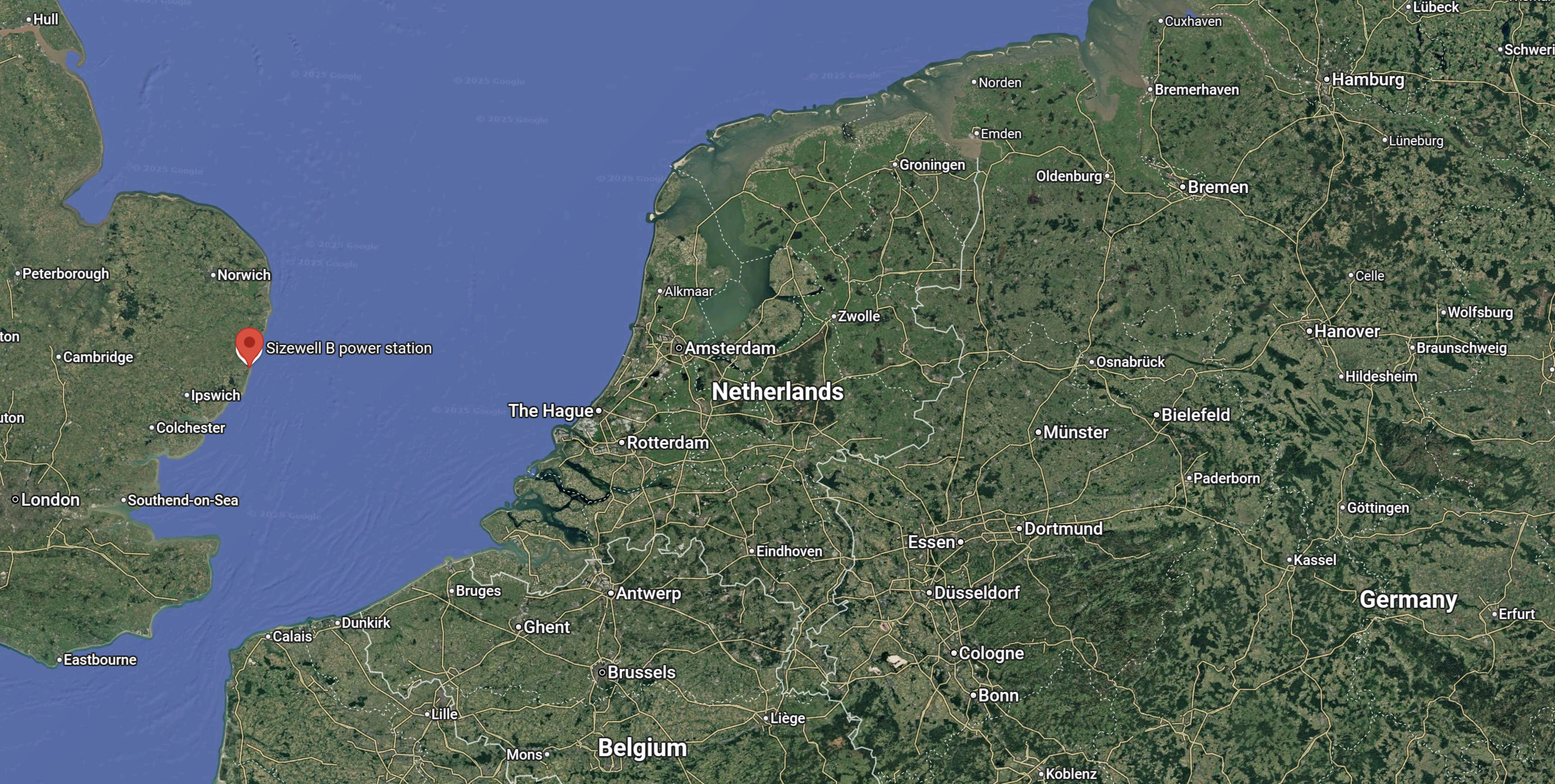
The Sizewell site is indicated by the red arrow.
The offshore oil and gas industry has used technology like single buoy moorings and coastal tankers to collect offshore natural gas for decades.
I don’t see why coastal hydrogen tankers couldn’t export excess hydrogen to places around the North Sea, who need the fuel.
It should be born in mind, that Centrica have a good reputation in doing natural gas trading. This expertise would surely be useful in hydrogen trading.
Conclusion
I believe that a hydrogen hub developed at Sizewell makes sense and I also believe that Centrica have the skills and technology to make it work.
Three Applications Submitted In Malta’s First Offshore Wind Tender
The title of this post, is the same as that of this article on offshoreWIND.biz.
This is the sub-heading.
The Maltese government has received three submissions in the pre-qualification period for the country’s first offshore wind tender, which will award a concession for a floating wind project with an installed capacity of around 300 MW.
These first two paragraphs add more detail.
The Ministry for the Environment, Energy, and Public Cleanliness said on 22 July that the submission phase for the Preliminary Qualification Questionnaire (PQQ), launched in December 2024, had concluded, with three companies and consortia looking to participate in the process: Code Zero Consortium, led by SEP (Malta) Holding; Atlas Med Wind, a consortium led by Italy’s GreenIT SpA; and MCKEDRIK Sole Member, a sole applicant based in Greece.
In December last year, Malta opened the PQQ period, seeking to pre-qualify potential developers who will then be invited to participate in the next stage(s) of the tender to build Malta’s first floating wind farm. The project is planned to have an installed capacity of between 280 MW and 320 MW
Note.
- Despite being Malta’s first offshore wind farm, it will be a floating wind farm.
- It is a medium-sized wind farm, which will probably give the Maltese chances to supply some services.
- The consortia seem to have some local involvement.
Malta appears to be taking a sensible route.
I asked Google AI, what was Malta’s electricity generating capacity and got this reply.
Malta’s total electricity generation capacity is approximately 0.83 million kilowatts, according to TheGlobalEconomy.com. This value represents the latest data from 2023. The majority of this capacity comes from conventional power plants, with a smaller but growing contribution from renewable sources.
As 0.83 million kilowatts is 830 MW, these offshore wind farms could replace up to 36 % of Malta’s current generating capacity.
From my experience of the island Malta is not a bad place to live, so recruiting the specialist engineers, that are needed shouldn’t be a problem.
I can also see other small countries following a similar route to Malta.
The Power Of Buildings To Come
I took this picture on Bishopsgate in London.
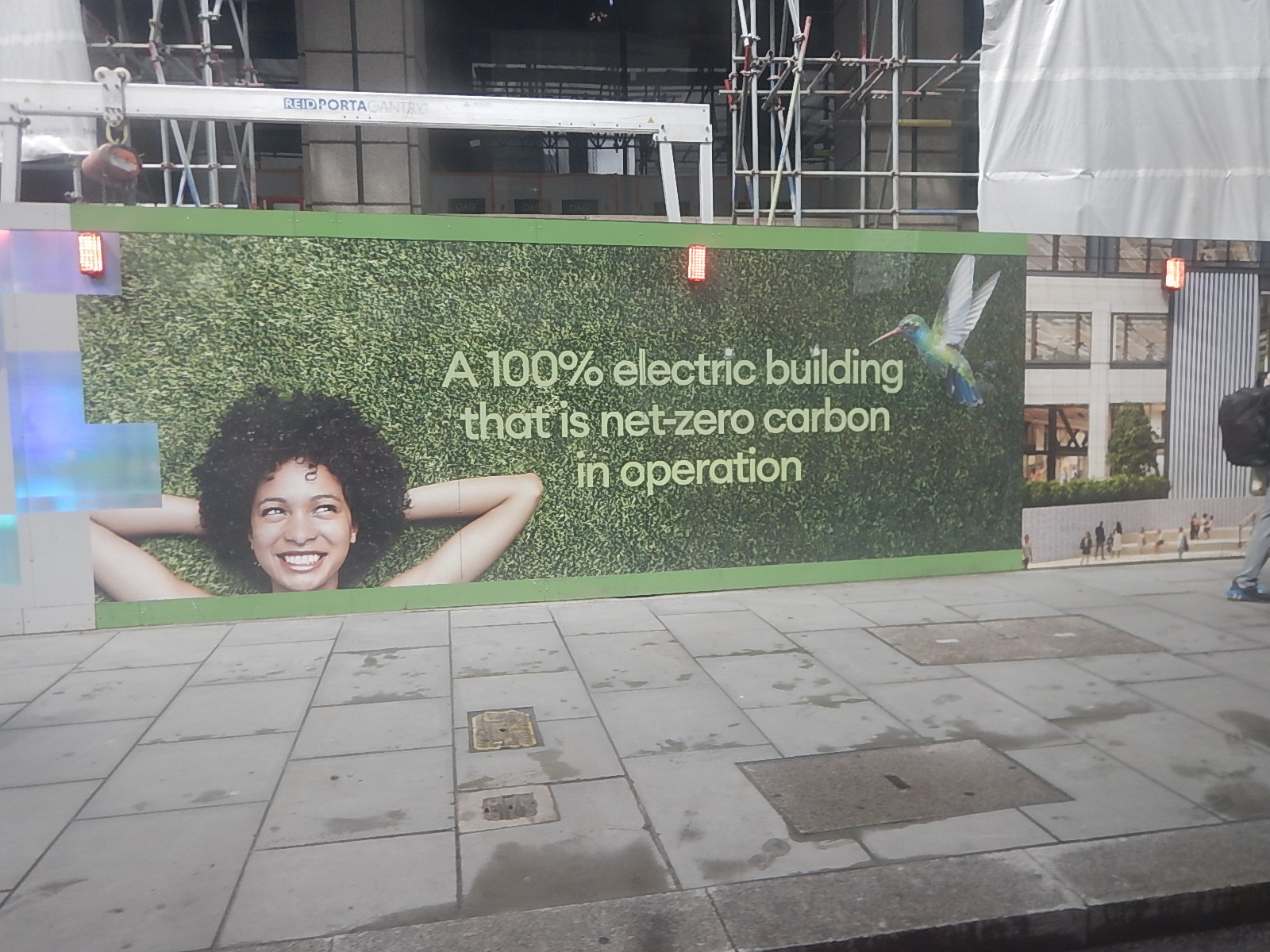
It’s advertising the building, which is being built behind the hoarding called One Exchange Square.
 The Anonymous Widower