Offshore Service Facilities
Some years ago at a wedding in The Netherlands, I got talking to a Dutch engineer, who had a lot to do with the creation of the Delta Works.
Also in The Netherlands, I visited the Watersnoodmuseum, which describes the floods in the Netherlands, that brought about the Delta Works.
So I was not surprised to see the spectacular offshore construction ideas talked about on the Offshore Service Facilities web site.
The site talks about a project to create a four GW wind farm, eighty kilometres off the coast, all serviced from an artificial island.
This is their overview of what they call the IJVER project.
IJmuiden Ver (IJVER) is one of the designated wind farm areas under the Dutch offshore wind road map 2030. With a capacity of at least 4 GW and a distance to shore of approximately 80 km, it is currently the largest foreseen Dutch wind farm zone, and the furthest from shore. The area also includes legacy oil & gas asset, including several gas pipelines that can be retrofitted to transport other gasses such as hydrogen or for CCS-purposes.
Note.
- 80 km. is not far offshore, when you consider the UK’s Dogger Bank C wind farm is 196 km from Teesside.
- There are depleted gas fields for storage and pipelines to transport gases to and from the shore.
This page describes the concept, starting with this introductory paragraph.
A multi-purpose island provides additional benefits over fixed offshore platforms (so-called jackets). It stimulates the energy transition, drives down the costs of the renewable energy transition, creates room for nature inclusive island design, facilitates Research & Development (R&D) and innovation, creates a safe working environment, as well as additional economic opportunities.
One feature they are proposing is an interconnector to the UK.
In Is There A Need For A Norfolk-Suffolk Interconnector?, I suggested that Bacton, Sizewell and Felixstowe could be places, where wind power from the North Sea were to be landed.
Distances to the IJVER island would be as follows.
- Bacton – 85 miles
- Sizewell – 77 miles
- Felixstowe – 92 miles
These distances are feasible for an interconnector.
There is this explanatory video.
Conclusion
My experience of the Dutch, their civil and marine engineers and their creations, indicates to me, that the Dutch could build an island like this.
Once you have built the island and it can stand up to the weather, you could of course fit it out how you want. Even with a football pitch, as shown in the video.
As with many ideas, the realisation of this concept will depend on the costs involved.
It should be noted, that some UK wind farms have been built with offshore substations, but nothing appears to be as ambitious as this idea and is probably based on proven oil and gas platform technology.
The Dutch also have plans with the Germans and the Danes to create the North Sea Wind Power Hub in the middle of the North Sea.
- This would probably connect to the UK’s Dogger Bank wind farms.
- It would feed electricity as required to the countries around the North Sea.
- Hydrogen could be created on the hub.
- Over a hundred GW of electricity could be generated according to some forecasts.
I like the concept of the North Sea Wind Power Hub and suspect that the Dutch will see it built.
Dogger Bank C In UK Offshore Wind First To Provide Reactive Power Capability
The title of this post, is the same as that of this press release from the Dogger Bank wind farm.
This paragraph gives an explanation.
Dogger Bank Wind Farm has secured a UK power first by becoming the first offshore wind farm project to win a tender from National Grid ESO to provide reactive power capability. The sector-first contract will help deliver a greener grid, maintain a stable voltage power supply, and help drive down UK consumer costs by millions of pounds.
Note that the three Dogger Bank wind farms; A, B and C will each have a capacity of 1.2 GW and that Hartlepool nuclear power station has a capacity of 1.32 GW. The latter is due to be decommissioned in 2024.
So the wind farms will effectively replace the nuclear power station.
This paragraph describes the contract.
Under new £22.5m Pennines Voltage Pathfinder contracts announced today, National Grid ESO has awarded a 10-year power contract to Dogger Bank C that will see its onshore converter station at Lazenby in the North-East of England provide 200 MVAr* of reactive power capability between 2024 and 2034. This marks the first time that an offshore wind transmission asset has been awarded a contract through a reactive power tender by National Grid ESO.
I suspect that there will need to be some form of energy storage added to the system somewhere, either at Lazenby or could we see a system like one of Highview Power’s CRYOBattery installed offshore?
It should be noted that CRYOBatteries are no more complicated, than some of the equipment installed on offshore gas and oil platforms.
The Lackenby Substation
It does seem that there has been a mix-up between the two nearby villages of Lazenby and Lackenby.
I can’t find a Lazenby substation, but I can find one at Lackenby.
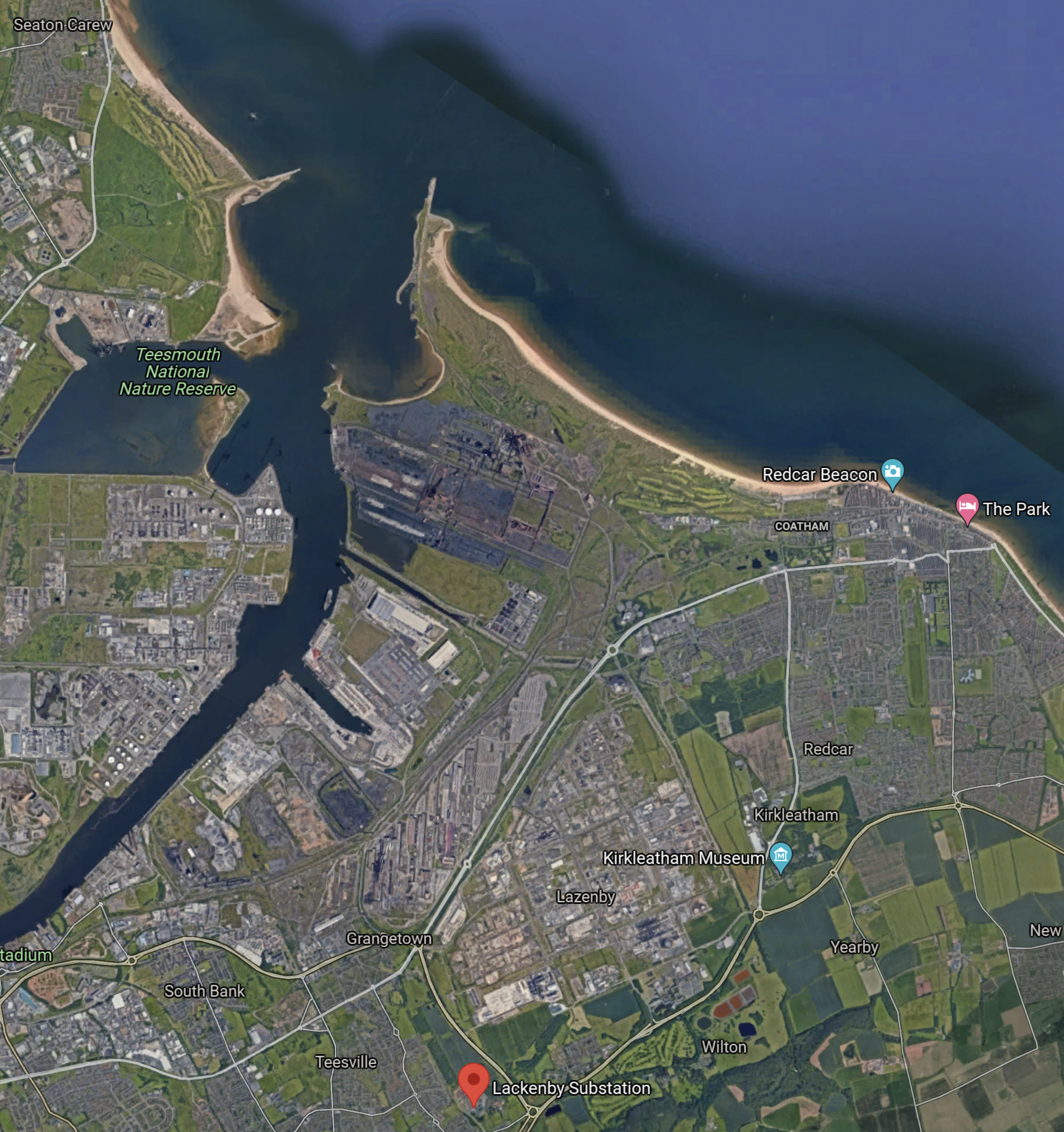
This Google Map shows that the location of the Lackenby substation.
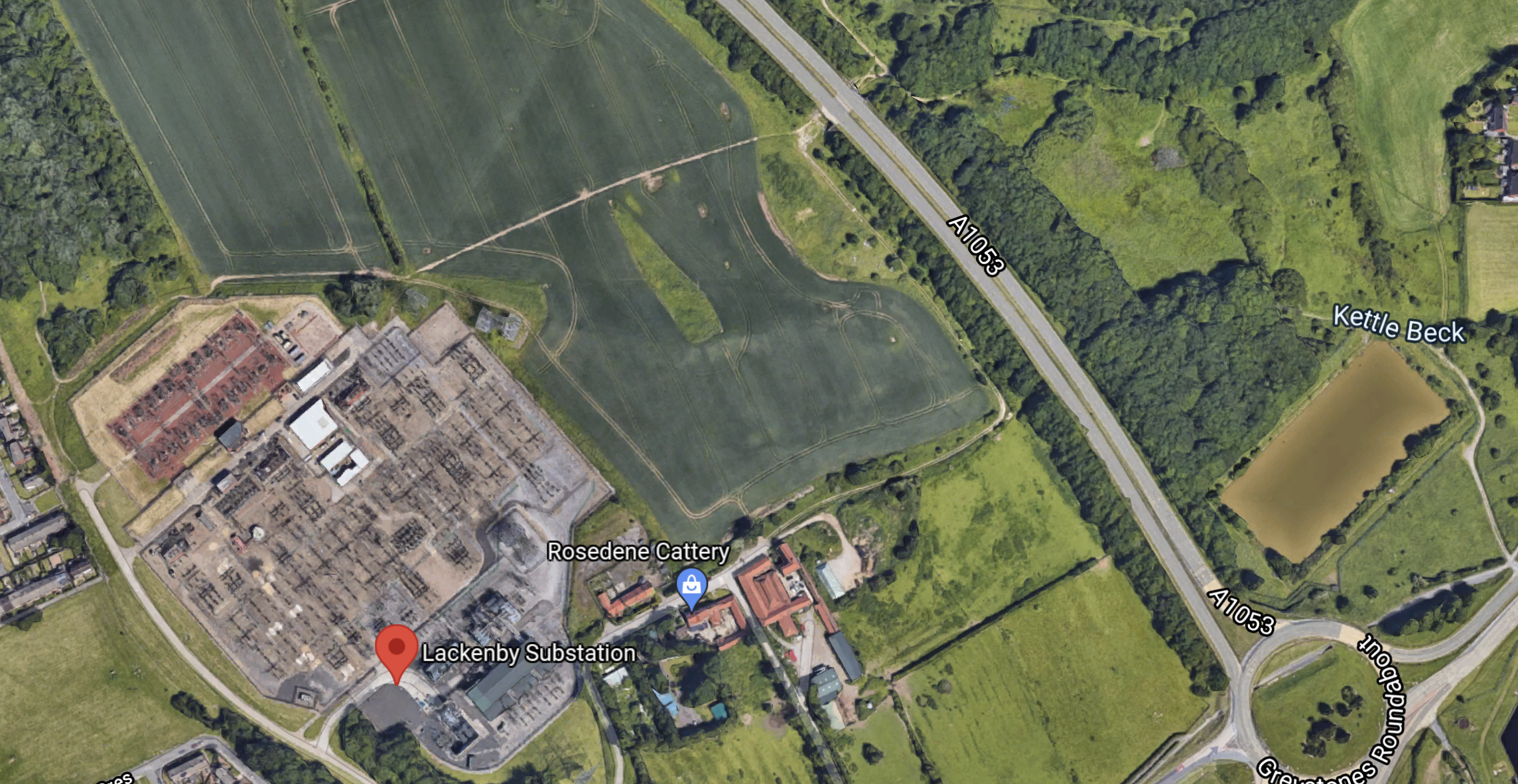
This second map shows the substation in more detail.
Note.
- There are a lot of large chemical works on both banks of the Tees.
- I can find nothing on the route of the cable from Dogger Bank C to Lackenby substation.
- Perhaps, it’s planned to go up the River Tees or it could come ashore South of the mouth of the River Tees.
Plans must be published soon, so that the substation can be updated before the wind farm is commissioned.
The Mathematics Of Blending Twenty Percent Of Hydrogen Into The UK Gas Grid
HyDeploy is a project, that is investigating blending hydrogen into the UK’s natural gas supply to reduce the amount of carbon dioxide produced by the burning of natural gas in power stations, industrial processes and in our homes and other buildings.
To find out more about the project, visit the HyDeploy web site.
This is a paragraph from this page on the HyDeploy web site, which describes the current progress of the project.
HyDeploy is progressing well. The HSE gave the go ahead for a live demonstration, at Keele University, of blended hydrogen and natural gas which began in Autumn 2019 and completed in Spring 2021. The HSE are satisfied that the blend of gas will be as safe as the gas we all currently use. The hydrogen content will be up to 20% and has so far reached 15%.
Note that HSE is the Health and Safety Executive, who are closely involved.
HyDeploy has now moved on to Phase 2 in the North East.
For our North East demonstration, we have contacted everyone who will be involved in that demonstration – more than 650 homes – and arranged for our engineers to carry out Gas Safe checks on their gas appliances and gather information on the range of appliances in the demonstration area. The Gas Safe checks were free of charge. Almost 90% of those homes have engaged with us.
What would be the effects of 20 % of hydrogen blended into natural gas?
Will current boilers, cookers and other gas-powered devices work on a blend of hydrogen and natural gas?
This is one for the scientists and it is one of the objectives of the HyDeploy trial to understand how every use of gas performs if instead of natural gas, the fuel is a mixture of eighty percent natural gas and twenty percent hydrogen.
I will assume that these problems are solvable.
I am not just hoping, but I can remember in the early 1970s, when our elderly gas cooker was successfully converted from town gas, which was typically a mixture of hydrogen (50%), methane (35%),carbon monoxide (10 %) and ethylene (5%), to natural gas, as North Sea gas started to flow.
This document from the UK government is entitled Fuels: Natural Gas, which contains a section entitled Material Properties Relevant To Use, where this is said.
Natural gas is a combustible gas that is a mixture of simple hydrocarbon compounds. It contains primarily methane, along with small amounts of ethane, butane, pentane, and propane. Natural gas does not contain carbon monoxide. The by-products of burning natural gas are primarily carbon dioxide and water vapour. Natural gas is colourless, tasteless and odourless. Because it is odourless, an odorant (80% tertiarybutyl mercaptan, 20% dimethyl sulphide) is added to the gas, to give the gas a distinctive smell. Other beneficial properties of natural gas are a high ignition temperature and a
narrow flammability range, meaning natural gas will ignite at temperatures above 593°degrees and burn at a mix of 4 – 15% volume in air (St. Lawrence Gas, 2015)
As ethane (C2H6), butane (C4H10), pentane (C5H12) and propane (C3H8) are all similar simple hydrocarbons to methane, which burn to produce carbon dioxide and water, I will assume in this analysis, that natural gas is all methane (CH4).
It is reasonable to assume, that currently we use a fuel which is equivalent to 100 % methane and that in the future we could use 80 % methane and 20 % hydrogen. Also in the past, we used to use a fuel, that was 50 % hydrogen and 35 % methane. The carbon monoxide is a poison, so I’ll ignore it, but ethylene (C2H4) is another of those simple hydrocarbons, which burn to release just carbon dioxide and water.
So if we were able to go from town to natural gas fifty years ago, by just adjusting gas equipment, surely we can go partly the other way in the Twenty-First Century.
I can certainly see the UK gas supply containing twenty percent hydrogen, but wouldn’t be surprised to see a higher level of hydrogen in the future.
How Much Hydrogen Needs To Be Added?
This page on worldodometer says this about UK gas consumption.
The United Kingdom consumes 2,795,569 million cubic feet (MMcf) of natural gas per year as of the year 2017.
I will now calculate the weight of hydrogen needed to be added.
- 2,795,569 million cubic feet converts to 79161.69851 million cubic metres.
- I will round that to 79161.7 million cubic metres.
- Twenty percent is 15832.34 million cubic metres.
- A cubic metre of hydrogen weighs 0.082 Kg, which gives that in a year 1,298.25188 million kilograms will need to be added to the UK gas supply.
This is 1,298,251.88 tonnes per year, 3,556.85 tonnes per day or 148.2 tonnes per hour.
How Much Electricity Is Needed To Create This Amount Of Hydrogen?
In Can The UK Have A Capacity To Create Five GW Of Green Hydrogen?, I said the following.
Ryze Hydrogen are building the Herne Bay electrolyser.
- It will consume 23 MW of solar and wind power.
- It will produce ten tonnes of hydrogen per day.
The electrolyser will consume 552 MWh to produce ten tonnes of hydrogen, so creating one tonne of hydrogen needs 55.2 MWh of electricity.
To create 148.2 tonnes per hour of hydrogen would need 8,180.64 MW of electricity or just under 8.2 GW.
How Much Carbon Dioxide Would Be Saved?
This page on the Engineering Toolbox is entitled Combustion Of Fuels – Carbon Dioxide Emission and it gives a list of how much carbon dioxide is emitted, when a fuel is burned.
For each Kg of these fuels, the following Kg of carbon dioxide will be released on combustion.
- Methane – 2.75
- Gasoline – 3.30
- Kerosene – 3.00
- Diesel – 3.15
- Bituminous coal – 2.38
- Lignite 1.10
- Wood – 1.83
Engineering Toolbox seems a very useful web site.
I will now calculate how much carbon dioxide would be saved.
- In 2017, UK methane consumption was 79161.7 million cubic metres.
- One cubic metre of methane weighs 0.554 Kg.
- The total weight of methane used is 43,855,581.8 tonnes.
- Multiplying by 2.75 shows that 120,602,849.95 tonnes of carbon dioxide will be produced.
As twenty percent will be replaced by hydrogen, carbon dioxide emission savings will be 24,120,569.99 tonnes.
That seems a good saving, from a small country like the UK.
The UK would also reduce natural gas consumption by twenty percent or 15832.34 million cubic metres per year.
How many other countries with good renewable and zero-carbon electricity resources like Australia, Chile, Denmark, France, Iceland, Ireland, Jordan, Morocco, Norway, Sweden and the United States will take this route, as it seems a good way to save large amounts of carbon?
There is also the collateral benefit, that countries with a good supply of hydrogen can use hydrogen to decarbonise the heavy transport sectors of rail, road and sea freight transport.
The big winners would appear to be those companies like ITM Power, who manufacture electrolysers and those companies like Fortescue Future Industries, who are prospecting, developing and promoting the hydrogen resources of the planet.
The losers will be countries, who are reliant on importing large amounts of gas and other fossil fuels, who don’t have access to large amounts of renewable energy like geothermal, hydro, nuclear, solar and wind.
Germany’s energy policy of no nuclear, more coal and Russian gas seems to have been a mistake.
But I’m sure, if Olaf Sholz talked nicely to Boris, there is a deal to be made.
- German utilities have already arranged to fund BP’s move into wind farms in Morecambe Bay and the North Sea.
- Norfolk’s gas terminal at Bacton is less than three hundred miles from Germany’s new hydrogen terminal at Wilhelmshaven.
The biggest loser could be Vlad the Poisoner.
SSE Renewables Launches 1.5GW Coire Glas Construction Tender
The title of this post, is the same as that of this article on renews.biz.
These are the first two paragraphs.
Hydro construction companies have been invited to submit tenders for construction of SSE Renewables’ proposed 1500MW pumped hydro storage scheme at Coire Glas, in Scotland.
Coire Glas, on the shores of Loch Lochy near Invergarry, would be the first large-scale pumped hydro storage scheme to be built in the United Kingdom for more than 30 years.
There appears to be global interest and six shortlisted bidders.
- The ANDRITZ HYDRO and Voith Hydro partnership
- The Bechtel, Acciona Construcción and Webuild S.p.A consortium
- The BAM Nuttall, Eiffage Génie Civil and Marti Tunnel consortium
- The Dragados and BeMo Tunnelling UK consortium
- GE Hydro France
- STRABAG UK
Bidders like these probably wouldn’t bother to get involved unless they knew that funding of the project was in place and it was pretty certain that the project will be constructed.
In World’s Largest Wind Farm Attracts Huge Backing From Insurance Giant, I talk about how Aviva are funding the Hornsea wind farm.
I believe, that insurance and pension companies like abrdn, Aviva and L & G could find a way of financing a scheme like Coire Glas.
Conclusion
It looks to me, that it’s almost certain that Scotland will get a 1.5GW/30 GWh pumped-storage system at Coire Glas.
Coire Glas could supply slightly more power than Sizewell B nuclear power station for twenty hours.
Now that’s what I call backup!
Bill Gates Invests In Verdox’s Carbon Capture Technology
The title of this post, is the same as that of this article on The Times.
This is the first paragraph.
Bill Gates has invested in a carbon capture start-up. His Breakthrough Energy Ventures fund has taken part in an $80 million fundraising for Verdox, a Massachusetts-based business whose technology aims to remove carbon dioxide directly from the air.
I have my doubts that this technology will ever be economic, especially as plant, trees and in particular rain forests, do a good job at using the carbon dioxide. Planting trees is also one of those feel-good community activities.
This last paragraph gives a few details of the process.
Verdox, which is a spinout from the Massachusetts Institute of Technology, claims that its system is cheaper and more efficient. It uses a special plastic, which when charged with electricity, can extract CO2 from a mixture of gases. A change in voltage releases the CO2.
It is a process with a good pedigree, but you’ve still got to find a way to store or use the carbon dioxide.
Plants worked out how to do that eons ago.
Power Storage Is The Next Big Net Zero Challenge
The title of this post, is the same as that of this Opinion from Bloomberg.
This is the sub-heading.
Britain’s pioneering plans for renewable energy show the global need could be massive. The means don’t yet exist.
The opinion is very much a well-written must-read.
One new project the article mentions is a 30 GWh pumped storage project at Coire Glas in the Scottish Highlands, that is planned by SSE.
I discuss this scheme in The Coire Glas Pumped Storage Scheme.
Bloomberg didn’t say it, but this pumped storage scheme could give the UK energy security.
BP Snaps Up 30 Per Cent Stake In Green Biofuels Ltd
The title of this post, is the same as that of this article on Business Green.
So why would BP take a stake in Green Biofuels?
This paragraph in the Wikipedia entry for BP, outlines the company’s future philosophy.
From 1988 to 2015, BP was responsible for 1.53% of global industrial greenhouse gas emissions. BP has set a goal to cut its greenhouse gas emissions to net-zero by 2050. BP plans to increase its investments in renewables 10 times and reduce oil production by 40% from current levels by 2030.
BP is doing things like developing wind and solar farms to achieve these aims.
BP also seems to be investing in both blue and green hydrogen.
But possibly, the two hardest products to decarbonise are diesel for heavy transport and aviation fuel.
Looking at Green Biofuels web site, the Wikipedia entry for Hydrotreated Vegetable Oil (HVO) and other sources, Green Biofuels product; GD+ seems to make a good fist of reducing carbon emissions and pollution, if it replaces diesel.
DB Cargo UK and HVO
DB Cargo UK have a fleet of nearly two hundred large diesel locomotives in the UK.
DB Cargo UK have been experimenting with HVO, as I wrote about in Powered By HVO.
The company has issued a press release on these trials of HVO, from which this is an extract.
DB Cargo UK’s Head of Asset Management and Maintenance Steve Wilkinson said the company was collaborating with one of the UK’s leading suppliers of HVO fuel which already worked with high-profile brands like Caterpillar, John Deere, Volvo and Mercedes-Benz.
“We are very pleased with the initial performance of the HVO fuel which we could use instead of or alongside traditional red diesel. The fact it is compatible with our existing diesel means investment in new storage and fuelling facilities would also be kept to a minimum,” he added.
“On top of that, it performs well at low temperatures, has a longer lifespan and is biodegradable,” he added.
DB Cargo UK currently operates 228 diesel and electric locomotives that transport in the region of 37 million tonnes of freight each year across the UK and into Europe.
It uses approximately 45 million litres of red diesel a year.
Was one of the UK’s leading suppliers of HVO fuel, a company called Green Biofuels?
Note that DB Cargo UK’s spokesman makes these points about the fuel.
- They are very pleased with initial performance.
- It is a straight swap for red diesel and it appears locomotives can run on either. He doesn’t say it but can it run on one fuel contaminated with the other? I suspect it’s a possibility.
- Current storage can be used for HVO.
- I get the impression that swapping from red diesel to HVO wouldn’t be the most challenging of operations.
- It performs well at low temperatures. One train-driver told me, that one of the worse parts of the job, is picking up a train from a depot high in the Pennines on a cold day in the winter. That must apply to locomotives.
- It has a longer lifespan.
- It is biodegradable. I haven’t walked through an engine shed, since I used to bunk them as a child to get engine numbers, but they were filthy places, with oil and diesel all over the floor.
That sounds to me, like DB Cargo UK have decided that HVO is an excellent fuel and for them to swap to HVO, would be no more difficult than to swap between red diesel from BP to red diesel from Shell.
This is an extract from the Business Green article.
Founded in 2013, Green Biofuels is the UK’s largest provider of HVO, having delivered over 55 million litres of HVO products to the UK market over the past two years.
If DB Cargo UK wanted to swap from red diesel to HVO, they would need nearly all of Green Biofuels current production.
So have Green Biofuels run to BP and said can you help us out?
Red Diesel Replacement
This document on the Government web site is entitled Reform Of Red Diesel And Other Rebated Fuels Entitlement.
There is a section, which is entitled Policy Objective, where this is said.
In June 2019, the UK became the first major economy in the world to pass laws guaranteeing an end to its contribution to global warming by 2050. The target will require the UK to bring all greenhouse gas emissions to net zero by 2050, compared with the previous target of at least an 80% reduction from 1990 levels. The government also launched in 2019 an ambitious new strategy to clean up the air and save lives, given air pollution is one of the biggest continuing threats to public health in the UK.
Red diesel is diesel used mainly for off-road purposes, such as to power bulldozers and cranes used in the construction industry, or to power drills for oil extraction. It accounts for around 15% of all the diesel used in the UK and is responsible for the production of nearly 14 million tonnes of carbon dioxide a year. Red diesel used in the construction and infrastructure building sectors was also estimated to have caused 7% of nitrogen oxide emissions and 8% of PM10 emissions (a type of particulate matter) in London in 2018.
At Budget 2020, the government therefore announced that it would remove the entitlement to use red diesel and rebated biodiesel from most sectors from April 2022 to help meet its climate change and air quality targets. The tax changes will ensure that most users of red diesel use fuel taxed at the standard rate for diesel from April 2022, like motorists, which more fairly reflects the harmful impact of the emissions they produce. Removing most red diesel entitlements will also help to ensure that the tax system incentivises users of polluting fuels like diesel to improve the energy efficiency of their vehicles and machinery, invest in cleaner alternatives, or just use less fuel.
It doesn’t say, but I have found references to the fact that HVO pays the same tax rate as diesel, despite the evidence, that it appears to be more environmentally friendly.
If I was the Chancellor, I would certainly adjust the tax system, so that red diesel users who changed to HVO and other fuels, paid tax in proportion to the emissions and pollution they caused.
So have BP decided that Green Biofuels is the best interim solution to reduce emissions from diesel fuel and taking a stake, is the best way to get the required access to the product?
Could BP be thinking about replacing red diesel with a better green diesel?
- Red diesel and GD+ could be acceptable to all diesel vehicles and equipment. So farmers for rxample, could run tractors and combines on the same fuel as their truck or Range Rover.
- Businesses, like farmers, who often have tanks for both red diesel and normal diesel, would only need one tank.
- Businesses with a green profile, would surely like it for their vehicles.
- Organic farmers would like it for their tractors.
- The availability of a green diesel would enable red diesel users to change to hydrogen or battery operation, at the optimal time.
I can see Prince Charles handing out green stars all round.
Disused Coal Mine Could Host Gravity Energy Storage Project
The title of this post, is the same as that of this article on Power Engineering International.
It does seem that Gravitricity has made a breakthrough, with the announcement of a full-size demonstration project in the Czech Republic.
- The project is based at the mothballed Staříč coal-mine in the Moravian Silesian region.
- They have backing from the European Investment Bank.
- This project will be delivered through the European Commission’s Project Development Assistance scheme.
- The Czech Republic seem to have carried out checks, with their own consultants.
It looks to me, that Gravitricity have passed the due diligence procedures of some high-powered agencies.
But this paragraph from the article must be important.
Gravitricity estimates there are around 14,000 mines worldwide which could be suitable for gravity energy storage.
If they can successfully store energy in one mine in the Czech Republic, how many of the 14,000 will be suitable for use?
I doubt it will be a small number, as mining engineers tend to be a conservative bunch and most of those mines will have been built to similar rules by similar machines and techniques.
A search of the Internet indicates that Staříč coal-mine has a depth of over a kilometre.
Using Omni’s Potential energy calculator, 12,000 tonnes and a kilometre give a figure of 32.69 MWh.
32 MWh may seem a small amount, but it would power one of these 4 MW Class 90 locomotives for eight hours.

At their typical operating speed of 100 mph, whilst hauling eight coaches, they’d travel a distance of eight hundred miles or from London to Edinburgh and back!
Gelion To Trial Battery At Spanish Solar Plant
The title of this post, is the same as that of this article on renews.biz.
This is the first two paragraphs.
Gelion has signed a test and supply contract with European renewables supplier Acciona Energia to trial its zinc-bromide battery technology at a solar plant in Spain.
Acciona Energia’s Montes del Cierzo photovoltaic solar plant in Navarra, northern Spain, will trial the energy storage system, following a competitive process launched in September 2020.
As Gelion’s Chief Executive indicates, this must be a show of confidence in their technology.
There is a full press release on the Gelion web site.
I just wonder, if Gelion could be a technology to be successful.
Shell’s New Filling Station For Electric Cars
I took these pictures of Shell’s new filling station for electric cars in Fulham, yesterday.










It’s got eleven chargers, a Little Waitrose and a Costa Coffee. What more couple Fulham want?
I’m surprised the Council allowed a Costa!

