After Coronavirus, What’s Next? China: More Coal, US: More Oil, EU: More Renewables
The title of this post, is the same as that of this article on CleanTechnica.
The title says it all, but read the article to get the detail.
Hawaii’s Renewable Tender To Deliver Major Solar And Storage Push
The title of this post, is the same as that of this article on PVTech.
This is the introductory paragraph.
The largest renewable tender in Hawaii’s history has chosen its winners, contracting a solar and storage pipeline that exceeds anything the US state has ever seen.
The article gives a lot of information about the order and Hawaii’s energy.
- A fleet of 400 MW of solar panels and 3 GWh of energy storage will be installed, with some running in 2022.
- Another fleet of 260 MW of solar panels and 1 GWh of energy storage is in the pipeline, for delivery in 2021.
- The strike price appears to be 9.38 US dollar cents per KWh or $93.80 per MWh. We’re paying £92.50 per MWh for electricity at Hinckley Point C nuclear power station.
- Hawaii aims to be full-powered by renewable energy by 2045.
- Two fossil-fuel plants will shut by 2024.
From this document on the Hawaii State Energy Office, I have found that in 2018, these renewable energy sources contributed to the state’s electricity.
- Geothermal sources – 2.9%
- Wind – 4.9%
- Hydro – 0.9%
- Biomass – 2.8%
- Small-scale solar – 9.3%
- Utility-scale solar – 3.9%
These add up to 24.7%.
I’ll be interested to see, what the percentage will be in 2024!
What Exactly Is Upside Energy?
On Friday, August 9th, 2019, there was a massive power cut in the South of England, that is described in this article on the BBC, which is entitled Lightning Strike ‘Partly To Blame’ For Power Cut.
This is the introductory paragraph.
A lightning strike and the sudden loss of two large electricity generators caused nearly a million people to lose power in England and Wales earlier this month, an interim report has found.
So what exactly happened?
This article on Wired is entitled How Batteries Stopped The UK’s Power Cut Being A Total Disaster, was written after the report into the cut had been written.
This is the third paragraph of the article.
But it could have been even worse. Within seconds of problems hitting the grid, a fleet of batteries dotted around Great Britain were able to pump power into the system, preventing a rapid drop off in transmission frequency.
Is fleet the right collective noun for storage batteries? But it will do for the time-being.
This is the next two paragraphs.
Upside Energy is one firm that lent a helping hand by supplying six megawatts (MW) from five large lithium-ion batteries located on a solar farm near Luton Airport. “Those batteries responded immediately – actually it was sub-second,” says the firm’s chief executive Devrim Celal.
Six megawatts may not sound like much. It’s about the same capacity as a single medium-sized wind turbine, but in the context of national electricity supply that can make a difference, says Tim Green, co-director at Imperial College London’s Energy Futures Laboratory. “A home on average is consuming about two kilowatts – six megawatts gets you 3,000 homes maybe.”
But every little helps!
So who are Upside Energy?
If you look at their web site, this is the headline on the home page.
Smart Energy Management Systems
There is also this description.
Our award-winning cloud-based platform provides our customers with a way to capitalise on new opportunities, while supporting an acceleration in the use of renewable technologies, and overall helping to create a more sustainable and efficient power network.
From what I can gather with further reading, it almost looks like a peer-to-peer network for energy, akin to how Zopa is one for money.
- If you or your company, built a battery or a solar farm, then Upside Energy would control it, in the most efficient way.
- As the Wired article states, they also have a few batteries of their own.
On another page they describe the system as a cloud-based platform can connect with a multitude of devices across commercial, industrial and domestic sites. They give the following examples of devices.
- Battery storage systems.
- \electric-vehicle charging points.
- Uninterruptible power supplies
- Heating and cooling systems.
They then say a bit about how it works.
It uses advanced algorithms and artificial intelligence to match energy demand with the available supply, helping the electricity grid deal with fluctuations and times of peak usage. Supporting the grid in this way, opens the doors to additional revenue streams for our customers, who also benefit from significant reductions in energy costs and carbon emissions.
The platform can manage demand response for more than 100,000 devices running in parallel.
As a Control Engineer, whose friend went on to manage ICI’s power networks in the North West, I know management of these complex networks was difficult even in the 1970s.
It is interesting to look at their funding page.
- Legal & General is an investor.
- systemiQ is an investor.
- Innovate UK is present, as they are in many British technology developments.
Funding would appear to be typical for a company like this.
Conclusion
If I was a farmer, who was investing in a solar farm on a piece of land, I would check out Upside Energy.
But I’m not!
Over eight years ago, I wrote Stability in Financial Systems, where I used my Control Engineering and mathematical experience to postulate that Zopa might have found a way to create a system with an equilibrium between saving and borrowing, that responded to politics, the economy and unforeseen circumstances.
Could Upside Energy have created a system that balances energy production, storage and use, which navigating the perils of the modern world?
Majority Of Ready-to-Build UK Battery Storage Projects Are Bigger Than 30MW
The title of this post is the same as that on this article on Energy Storage News.
This is the introductory paragraph.
There are 1.3GW of read-to-build battery storage projects in the UK, with the majority between 30MW and 49.9MW power output per project, according to new analysis from Solar Media Market Research.
There is certainly a lot of energy storage being developed in the UK.
But then Wind Power In The UK is set to rise substantially to at least 40GW, in the next few years.
Funding Award to Supply An 8MW Electrolyser
The title of this post, is the same as that of this Press Release from ITM Power.
This is the main body of the Press Release.
ITM Power, the energy storage and clean fuel company, is pleased to announce it has signed an agreement to supply an 8MW electrolyser in the UK. The agreement, including associated project costs, has a total value of £10m and funding will fall across FY2021 and FY2022. Further details will be announced in due course.
I bet they’re pleased!
To get a hold on what 8 MW looks like, these Class 90 locomotive each have a power output of just under 4 MW and are capable of hauling an eight-coach express train at 110 mph.

Working at full rate, the electrolyser will be able in a year to convert 70 GWh of electricity into hydrogen.
Why Would You Want An 8MW Electrolyser?
These are a few ideas.
Green Hydrogen For Humberside
This is a project described in this ITM Power Press Release.
This is the first three paragraphs.
ITM Power, the energy storage and clean fuel company, is pleased to announce that it has won, with partner Element Energy, a first stage deployment project in the UK Government’s Industrial Strategy Challenge Fund competition “Decarbonisation of Industrial Clusters” to assess the feasibility and scope of deploying green hydrogen with some major industrial partners in Humberside.
“Green Hydrogen for Humberside” will lead to the production of renewable hydrogen at the Gigawatt (GW) scale distributed to a mix of industrial energy users in Immingham, Humberside. Decarbonisation of this cluster is critical in reaching the UK’s legally binding 2050 net zero emission targets. Humberside, the UK’s largest cluster by industrial emissions, (12.4Mt of CO2 per year), contributes £18bn to the national economy each year and has access to a large renewable resource from offshore wind in the North Sea.
The project will work with customers in the region to establish the feasibility of switching to renewable hydrogen and justify a number of 100MW deployments of electrolysers. The project will cost the supply of hydrogen to these end users. This includes the electricity supply to the electrolyser, the hydrogen production facility, hydrogen distribution across the Humber and conversion of existing processes to use renewable hydrogen.
The study talks about a number of 100 MW deployments of electrolysers.
Will the 8MW electrolyser be a demonstrator for this project?
To Convert Surplus Renewable Energy Into Hydrogen Which Is Injected Into The Gas Grid
The Wikipedia entry for ITM Power has a section entitled Energy Storage Power To Gas. This is the first paragraph.
Power-to-Gas is a methodology of introducing such hydrogen to the natural gas network, essentially converting renewable electrical power to a clean gas that can be more conveniently stored using existing assets. There are two main Power-to-Gas mechanisms. The first involves metering pressurised hydrogen into the gas network directly. The second involves combining hydrogen with carbon dioxide via a methanation process to produce synthetic natural gas prior to introduction to the grid.
The electrolyser could be used to convert a lot of electricity into zero-carbon hydrogen for use in the UK gas network.
Improving The Resilience Of The UK Gas Network
This article on the BBC is entitled Major Power Failure Affects Homes And Transport and it describes a major power failure, when two generators failed in August 2019.
Could the 8MW electrolyser be part of the solution to make the UK power network more robust, if parts of the network fail?
To Create Feedstock For An Oil Refinery Or Petro-Chemical Plant
Hydrogen can be used as a feedstock for an oil refinery or petro-chemical plant.
This ITM Power Press Release, describes such a project, where wind power from the North Sea is used to create hydrogen for Phillips 66 Limited’s Humber Refinery.
As Part Of An Experimental Steel-Making Plant
This is pure speculation on my part, but steel-making creates lot of carbon-dioxide.
I do believe that using hydrogen to make steel is possible and ITM Power are based in the steel-city of Sheffield.
On the other hand look at the HYBRIT web site.
This is the introductory paragraph.
In 2016, SSAB, LKAB and Vattenfall joined forces to create HYBRIT – an initiative that endeavors to revolutionize steel-making. HYBRIT aims to replace coking coal, traditionally needed for ore-based steel making, with hydrogen. The result will be the world’s first fossil-free steel-making technology, with virtually no carbon footprint.
During 2018, work started on the construction of a pilot plant for fossil-free steel production in Luleå, Sweden. The goal is to have a solution for fossil-free steel by 2035. If successful, HYBRIT means that together we can reduce Sweden’s CO2 emissions by 10% and Finland’s by 7%.
This page on their web site is entitled Steel Making Today And Tomorrow. This image compares traditional blast furnace steelmaking with HYBRIT.
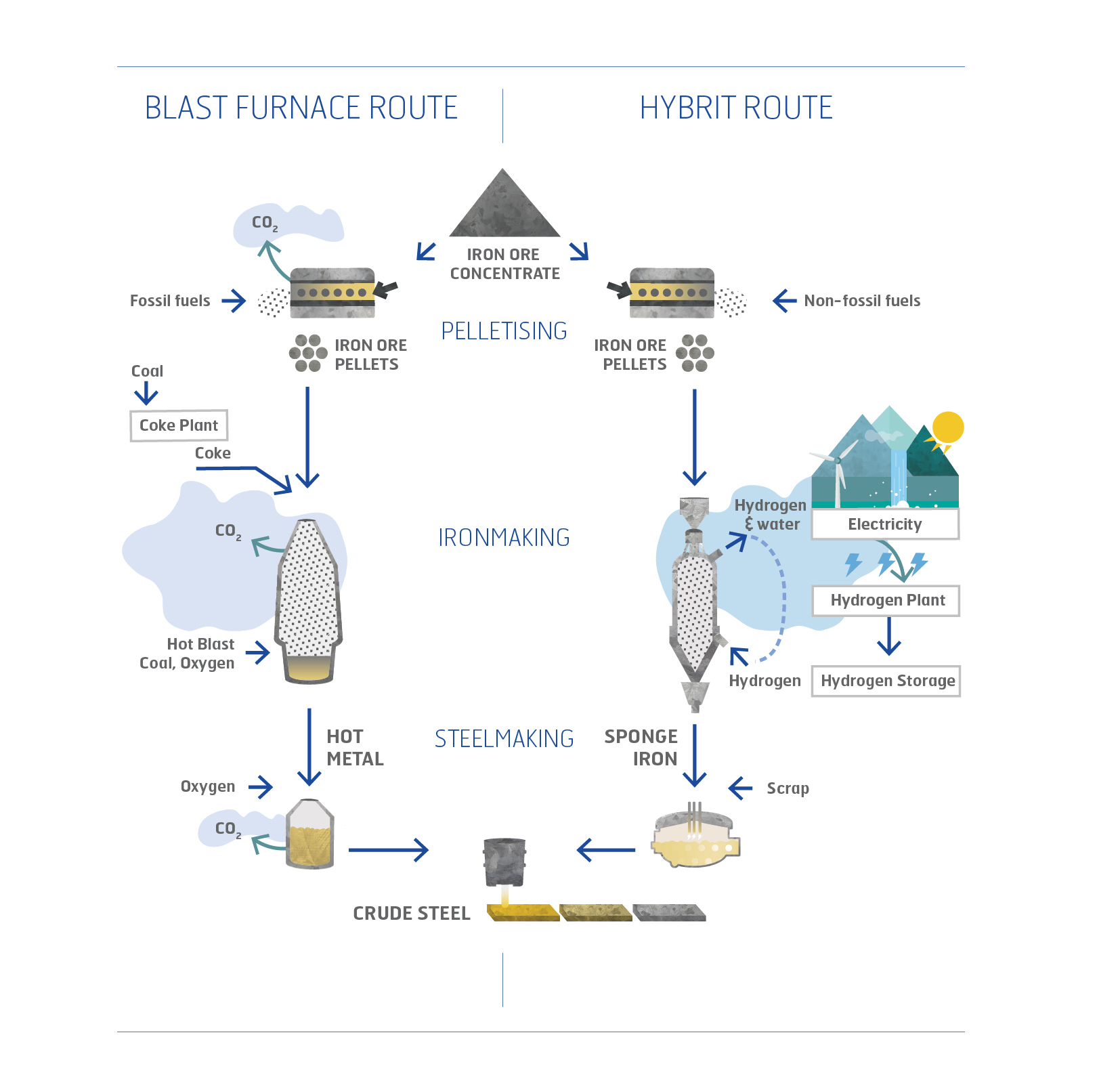
Note that at the heart of the process is the production of hydrogen from renewable electricity. This process will need a large electrolyser.
Could someone be doing something similar in Sheffield or more likely, Scunthorpe?
- British Steel may be owned by the Chinese, but it has a record of innovation.
- We will need a lot of long steel products, like railway rails and girders, in which British Steel specialise.
- In a few years, Humberside will have enough renewable electricity from North Sea wind to create an electro-magnetic gun to fire space capsules at Mars.
I will be watching out for hydrogen steelmaking.
Is Jim Ratcliffe Up To Something?
Jim Ratcliffe is a very rich man and the chairman and CEO of INEOS, which has a turnover of $83billion.
Consider.
- INEOS must know about hydrogen.
- I read some years ago, how they were using waste hydrogen to generate electricity on Teesside.
- I have a feeling that they have backed a hydrogen fuel-cell company.
- They own the hydrogen factory in Runcorn, where I worked in 1970.
- They have extensive interests in the North West, North East and Scotland.
- The company probably has an enormous carbon-footprint, that they’d probably like to reduce, by perhaps using hydrogen instead of natural gas as a feedstock for some processes, like production of ammonia.
But above all the cost of an 8MW electrolyser would be small change and probably cost a lot less, than running the cycling team.
The Fallback
It could of course be used to produce a large amount of hydrogen to power buses, cars and trains.
Highview Power And Railway Electrification
In Encore Joins Highview To Co-Develop Liquid Air Energy Storage System In Vermont, I gave brief notes about a proposed Highview Power CRYOBattery in Vermont.
- The system will supply 50 MW for eight hours.
- The total capacity will be 400 MWh.
Other articles have suggested, that the system could be built on the site of a demolished coal-fired power station, which still has a good connection to the electricity grid.
In other words, I believe that a CRYOBattery can be considered to be a small 50 MW power station.
- It could be charged by local excess renewable energy during the day.
- It could be charged by excess renewal energy from the electricity grid during the night, when there can be large amounts of wind energy, that needs a home.
- Intelligent control systems, would balance the output of the CRYOBattery to the needs of the electricity grid.
It would be used in very much the same way as gas-turbine power-stations are used in electricity grids all over the world.
The Braybrooke Feeder Station
The National Grid is providing a feeder station at Braybrooke to support the Midland Main Line electrification.
This page on the Harbough Rail Users site is entitled Electrification Substation Plan for Braybrooke.
It gives this description of the sub-station.
Electrification of part of the Midland Main Line has moved a tentative step closer with the plans being prepared by National Grid for a feeder substation at Braybrooke, just outside Market Harborough. The location is where a high-voltage National Grid power-line crosses over the railway and the plan is for a substation and associated equipment plus an access road from the A6. The substation is due to be completed by October 2020 and is intended to feed the power supply for the Corby line pending electrification of the main line through Market Harborough.
This Google Map shows the rough area, where it will be located.
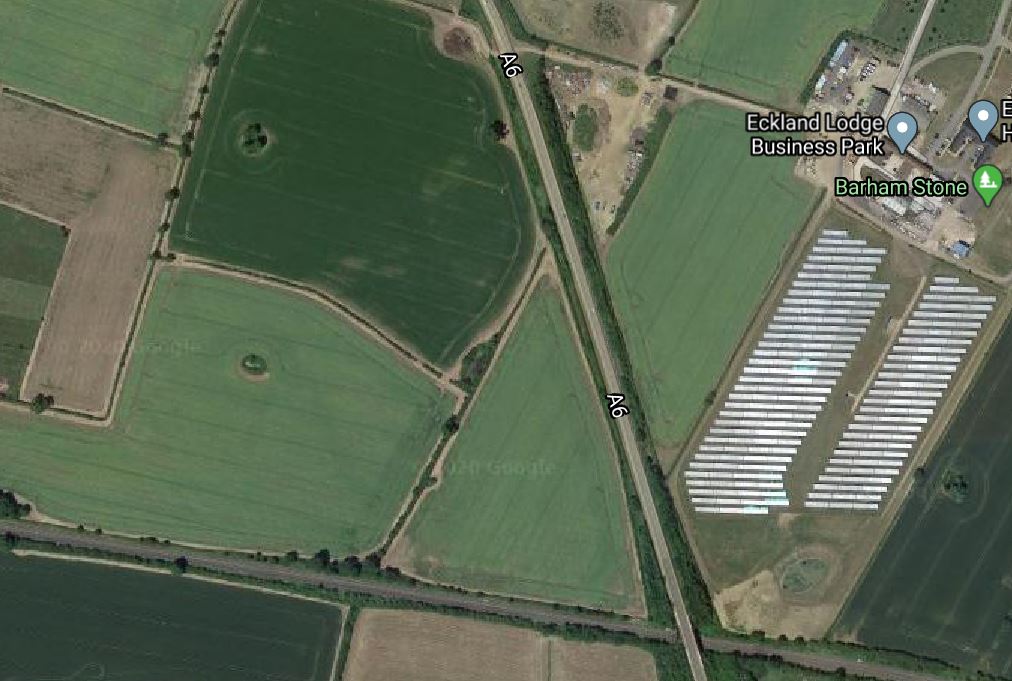
Note.
- The A6 crossing the Midland Main Line.
- The solar farm in the South-facing field, which has a 3MW capacity, according to the Eckland Lodge Business Park web site.
- Various planning documents say the transformers on the substation will be 400/25 kV units.
- This means that the power-line in the area must be a 400 kV.
Unfortunately, I can’t pick out the line of 400 kV pylons marching across the countryside. But they are rather large.
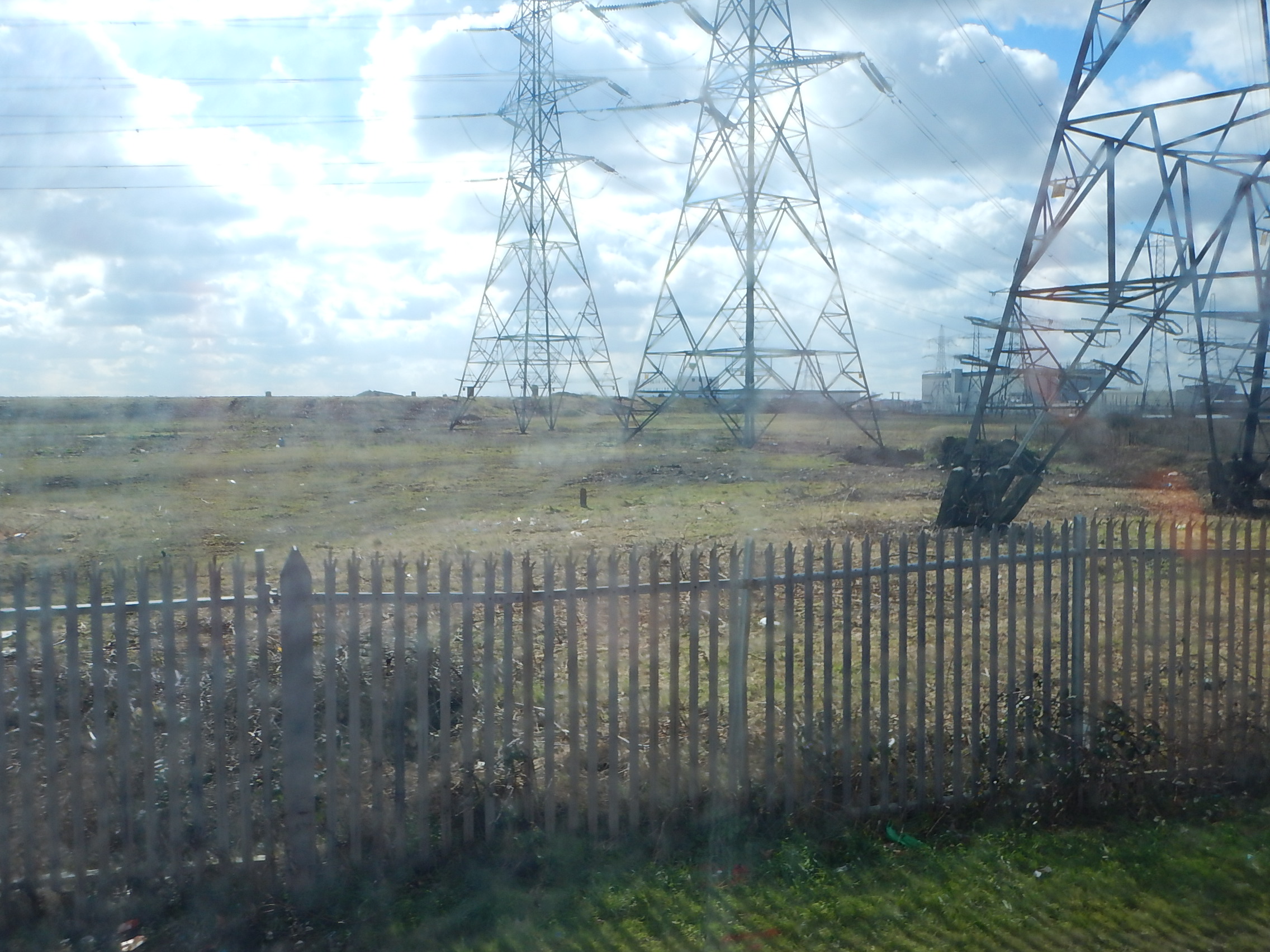
The pictures show a group of 400 kV pylons near Barking.
- The Midland Main Line at Braybrooke certainly seems to be getting a solid supply of electricity.
- It was originally planned, that the electrification would go all the way, but it was cut back to Kettering and Corby a couple of years ago.
- But to power, the electrification to Corby, it is being extended all the way to Braybrooke, so that the electrification can act as a giant extension lead for the Corby Branch Line.
The page on the Harborough Rail Users Site says this.
The Braybrooke substation is still planned, however, and the DfT has advised that the bi-mode trains will be able to switch power mode at speed. They would therefore be able to continue running electrically north from Kettering as far as Braybrooke before ‘pan down’
It would appear, that the end of the electrification will be at Braybrooke, but the sub-station seems to have enough power to extend the electrification further North if that is ever planned.
I also think, that is rather an efficient and affordable solution, with very little modification required to the existing electricity network.
But not all electricity feeds to railway electrification have a convenient 400 kV line at a handy site for installing all the needed transformers and other electrical gubbins.
How Much Power Will Needed To Be Supplied At Braybrooke?
This can probably be dismissed as the roughest or rough calculations, but the answer shows the order of magnitude of the power involved.
Consider.
- Braybrooke must be sized for full electrification of the Midland Main Line.
- Braybrooke will have to power trains North of Bedford.
- If there is full electrification of the Midland Main Line, it will probably have to power trains as far North as East Midlands Parkway station, where there is a massive power station.
- Trains between Bedford and Market Harborough take thirty minutes.
- Trains between Bedford and Corby take around thirty minutes.
- Four trains per hour (tph) run between Bedford and Market Harborough in both directions.
- The system must be sized to handle two tph between Bedford and Corby in both directions.
- The power output of each Class 360 train, that will be used on the Corby route is 1,550 kW, so a twelve-car set will need 4.65 MW.
- I can’t find the power output of a Class 810 train, but an InterCity 125 with similar performance has 3.4 MW.
- A Class 88 bi-mode locomotive has a power output of 4 MW when using the electrification.
I estimate that Braybrooke could have to support at least a dozen trains at busy times, each of which could need 4 MW.
Until someone gives me the correct figure, I reckon that Braybrooke has a capacity to supply 50 MW for trains on the Midland Main Line.
A Highview Power system as proposed for Vermont, would have enough power, but would need a lot more storage or perhaps local wind or solar farms, to give it a regular charging.
Riding Sunbeams
Riding Sunbeams are a company, who use solar power to provide the electricity for railway electrification.
I’ll let their video explain what they do.
It’s a company with an idea, that ticks a lot of boxes, but would it be able to provide enough power for a busy electrified main line? And what happens on a series of rainy or just plain dull days?
Highview Power
Could a Highview Power energy storage system be used?
- To store electricity from local or grid electrical sources.
- To power the local electrification.
If required, it could be topped up by affordable overnight electricity, that is generated by wind power.
The Highview Power system could also be sized to support the local electricity grid and local solar and wind farms.
Conclusion
I think that Riding Sunbeams and Highview Power should be talking to each other.
Highview Power Keeping Up Momentum
The title of this post is the same as that of this article on Gas World.
This is the introductory paragraph.
It’s full steam ahead for Highview Power as the energy storage provider’s CEO and President today updated on operations.
It does look thatHighview are optimistic since their partnership with Sumitomo Heavy Industries was announced, that I wrote about in Japanese Giant Sumitomo Heavy Invests In Liquid-Air Energy Storage Pioneer.
I am optimistic too!
- Highview’s system uses no difficult technology or rare materials.
- The system can provide large amounts of storage, which we are going to need with all the wind farms we are developing.
- From my Control Engineering and mathematical modelling experience, I believe, these systems can be used to boost power, where it is needed, in the same way gas-fired power stations do.
But above all, Highview Power has created a standalone energy storage system for the Twenty-First Century, that catches the needs and moods of the Age!
Our energy system is changing and it not expressed any better, than in this article on Physics World, which is entitled Does The UK Need 40 GW Of Firm Capacity?
This is the opening sentence.
Whether it comes from nuclear plants or fossil fuel-fired power stations with carbon capture and storage (CCS), the UK will need 30-40 GW of new “firm” low-carbon baseload generation by 2050 to meet the net-zero emissions target, Greg Clark reportedly said.
I don’t think that the country will allow any Government of the UK to build that much nuclear capacity and I have my doubts about the feasibility of large scale CCS. I also don’t think, the public will allow the building of large coal-fired power stations, even with CCS. And they don’t like nuclear either!
On Wikipedia, Wind Power in the UK, says this about the current Round 3 of proposals for wind farms.
Following on from the Offshore wind SEA announced by the Government in December 2007, the Crown Estate launched a third round of site allocations in June 2008. Following the success of Rounds 1 and 2, and important lessons were learnt – Round 3 was on a much bigger scale than either of its predecessors combined (Rounds 1 and 2 allocated 8 GW of sites, while Round 3 alone could identify up to 25 GW).
If you think UK politics is a lot of wind and bluster, that is pussy-cat’s behaviour compared to the roaring lions around our shores.
Wikipedia then lists nine fields, with a total power of 26.7 GW, but some are not being built because of planning.
But we ain’t seen noting yet!
Wikipedia says this about Round 4.
Round 4 was announced in 2019 and represented the first large scale new leasing round in a decade. This offers the opportunity for up to 7GW of new offshore capacity to be developed in the waters around England and Wales.
The Agreements for Lease will be announced in 2021.
Wikipedia then makes these points.
- Nuclear power stations have funding and technical problems.
- Since the Fukushima nuclear disaster public support for new nuclear has fallen
- The UK government increased its previous commitment for 40 GW of Offshore wind capacity by 2030, in the Queen’s Speech in December 2019.
- In 2020, this represents a 355% increase in ten years.
- It is expected the Crown Estate will announce multiple new leasing Rounds and increases to existing bidding areas throughout the 2020-2030 period to achieve the governments aim of 40 GW.
- The Scottish Government has plans to chip in 6 GW.
I will add these feelings of my own
- I have ignored the contribution, that better wind-power technology will make to get more GW for each billion pounds of investment.
- I can see a day, in the not too distant future, when on a day in the summer, no electricity in the UK comes from fossil fuel.
- There will be a merging between wind power and hydrogen generation, as I described in ITM Power and Ørsted: Wind Turbine Electrolyser Integration.
- Traditional nuclear is dead, although there may be applications for small nuclear reactors in the future.
- In parallel to the growth of wind power, there will be a massive growth of solar power.
But we will need to store some of this energy for times when the wind isn’t blowing and the sun isn’t shining.
- Pumped storage hydroelectric schemes, as at Electric Mountain in Snowdonia may have a part to play as I described in The New Generation Of Pumped Storage Systems. But sadly, the UK doesn’t have the terrain for another 9.1 GWh scheme.
- A lot of electricity will be converted to hydrogen to power industrial processes and augment and possibly replace natural gas in the UK’s gas network.
- Some electricity will be stored in batteries in houses and vehicles, when it is most affordable and used, when it is more expensive.
- Companies and funds, like Gresham House Energy Storage Fund will fund and build storage facilities around the UK.
- Traditional lithium-ion batteries require a lot of expensive raw materials controlled by the Chinese!
- But if we develop all these options, and generate tens of GWs using renewables, the UK will still need a substantial amount of GW-scale affordable energy storage systems.
It is my belief, that Highview Power is the only practical GW-scale affordable energy storage system.
My only worry about their system, is that the idea could be ripped off, by an unscrupulous country with a solid process plant industry!
HyDeploy
I could have called this post; What Do You Do With Surplus Electricity?.
Believe it or not, one thing you can do is inject it into the gas main, by converting it into hydrogen first.
The Project
The concept is being tested in a project called HyDeploy at Keele University.
- The project has its own web site, from where I have obtained much of the information on this post.
- Keele University has its own gas network.
- Keele has a campus population similar to a small town.
- Keele University has a reputation for research excellence.
This paragraph outlines the project.
HyDeploy is a pioneering energy demonstration to establish the potential for blending hydrogen, up to 20%, into the normal gas supply so that we can reduce carbon dioxide (CO2) emissions.
A 10 month live demonstration of blended gas is taking place on part of the Keele gas network and will finish in August 2020.
HyDeploy will help to determine the level of hydrogen which can be used by customers safely and with no changes to their existing domestic appliances.
The HyDeploy project has been split into the following phases.
- Phase One will be live test using the Keele University gas network to learn about injecting hydrogen into a natural gas network.
- Phase Two will move to a larger demonstration on public network in the North East.
- Phase Three will be another large demonstration in the North West.
Once the evidence has been submitted to Government policy makers, we very much expect hydrogen to take its place alongside other forms of zero carbon energy in meeting the needs of the UK population.
The Electrolyser
ITM Power are providing the 0.5 MW electrolyser to turn electricity into hydrogen.
It’s only a small one, but this is about proving the technology.
Battery Storage Paves Way For A Renewable-Powered Future
The title of this post is the same as that of this article on Modern Diplomacy.
This is the introductory paragraph.
Battery storage systems are emerging as one of the key solutions to effectively integrate high shares of solar and wind renewables in power systems worldwide. A recent analysis from the International Renewable Energy Agency (IRENA) illustrates how electricity storage technologies can be used for a variety of applications in the power sector, from e-mobility and behind-the-meter applications to utility-scale use cases.
The article then goes on to outline a good summary of the uses and expected growth of battery storage.
Australia’s New Community Solar, Solar-Storage, ‘Solar Hydro’ And Solar Hydrogen Projects
The title of this post is the same as that of this article on Energy Storage News.
This is the introductory paragraph.
In the past couple of weeks, national and state government organisations in Australia have announced various stages of consideration for solar projects with a range of advanced and innovative storage solutions attached.
The article then goes on to describe some projects.
RayGen’s PV Ultra System
This paragraph describes the PV Ultra system.
The fully dispatchable power plant would use RayGen’s own technology PV Ultra, which is a combination of photovoltaic (PV) solar generation with the more expensive and engineering-intensive concentrated solar technology using angled mirror towers (heliostats). The PV Ultra system would generate both electricity and heat.
It’s obviously using what Australia has a lot of; sun to advantage.
RayGen’s Innovative Thermal Storage
This paragraph outlines the principle of RayGen’s thermal method of storage.
This generation technology would in turn be co-located and connected to a ‘Thermal Hydro’ energy storage facility, with 17 hours of storage, which again is based on a technology RayGen is developing. Unlike pumped hydro energy storage which uses two reservoirs at different heights, relying on gravity to drive turbines, the Thermal Hydro plant would use a hot reservoir and a cold reservoir, linked together.
The principle of operation is described in this second paragraph.
The PV Ultra solution will therefore cool one reservoir using photovoltaic power and grid power when needed, while also heating the other reservoir using the heliostats. The difference in temperature would then generate electricity, via an Organic Rankine Cycle engine, a device which uses thermodynamic cycles to convert steam into mechanical energy and is widely used for biomass, waste incinerators and other existing generation types.
The article states that an Organic Rankine cycle engine has an efficiency of about seventy percent. I have linked to Wikipedia, which gives a good explanation of the Organic Rankine cycle, which is typically used in waste heat recovery and biomass power plants.
RayGen’s Flagship Project
RayGen’s flagship project will be rated at 4 MW, with a storage capacity of 50 MWh. It will be used to provide power in the West Murray region.
New South Wales Community Projects
The article then describes a group of community projects that are being set up in New South Wales.
This is the introductory paragraph
Elsewhere in Australia, the government of New South Wales approved grants earlier this month to assist the development of seven solar projects, all but one of which will include energy storage. Notably, five out of the seven will also be community distributed energy projects, including one standalone shared battery energy storage site.
Some points from the article include.
- The total solar power is rated at 17.2 MW.
- The energy storage is rated at 39.2 MWh
- One site is co-located with hydrogen electrolysis and storage,
New South Wales has certainly launched an ambitious plan.
Conclusion
I like RayGen’s system and the New South Wales initiative.
I also think, that both projects could find applications in some of the hotter places in the world.
Could solar power systems like these solve power supply problems in Africa, India and other sun-rich places>
 The Anonymous Widower