Eden Project Morecambe Revealed In New Images
The title of this post, is the same as that of this article on the BBC.
This is the sub-heading.
New images of what the long-awaited ecotourism attraction Eden Project Morecambe will look like have been released.
These three paragraphs add more detail.
The shell-inspired structure, sister site to the original Eden Project in Cornwall, is due to open in late 2028 and is expected to attract thousands of people to the Lancashire town.
CGI images, by architects Grimshaw, show how the design will look on the edge of Morecambe Bay promenade.
The project team said the structure would be “instantly recognisable” as an “emblem of sustainability” with a “deep connection to place” and complimenting heritage landmarks nearby.
The BBC article contains a selection of stunning images.
I have never been to the original Eden Project in Cornwall, as I don’t drive and it is difficult to get to by train.
But Morecambe from Euston is an easy sub-three hours train journey and not much over an hour from Liverpool and Manchester.
So the Eden Project Morecambe will be much easier to get to and will surely bring in the visitors.
But it needs a better train between Lancaster and Morecambe than this.

Note.
- The train is a British Rail-era Class 156 diesel train, that was built in the late 1980s.
- A diesel train to an eco-project is probably not the right image.
- If they get all the visitors by rail, that I think they will, a two-car train will probably not have enough capacity.
- The platform appears to be electrified and be around 70-80 metres long.
- The Lancaster and Morecambe service is less than five miles.
But I believe, that this platform could be used to charge a battery-electric train through a pantograph.
This train would then be able to trundle silently all day between Lancaster and Morecambe stations.
ENGIE And CDPQ To Invest Up To £1bn In UK Pumped Storage Hydro Assets
The title of this post, is the same as a news item from ENGIE.
These four bullet points act as sub-headings.
- Refurbishment programme to extend life of plants at Dinorwig and Ffestiniog will ensure the UK’s security of supply and support the transition to a low carbon energy future
- ENGIE owns 75% of the plants via First Hydro Company, a 75:25 joint venture with Canadian investment group CDPQ
- The two pumped storage hydro plants are the UK’s leading provider of power storage and flexibility, with 2.1GW of installed capacity
- They represent 5% of the UK’s total installed power generation capacity and 74% of the UK’s pumped storage hydro capacity
These three paragraphs give more details.
The preparation of a 10-year project of refurbishment at *ENGIE’s Dinorwig pumped storage station has begun, following an 8-year refurbishment at Ffestiniog, enabling the delivery of clean energy whenever needed.
These flexible generation assets, based in North Wales, are essential to the UK Government’s accelerated target of achieving a net zero carbon power grid by 2030. Together they help keep the national electricity system balanced, offering instant system flexibility at short notice. The plants are reaching end of life and replanting will ensure clean energy can continue to flow into the next few decades.
Re-planting could see the complete refurbishment of up to all six generating units at Dinorwig – a final investment decision is still to be made on the number of units to replace – while the re-planting at Ffestiniog will be completed at the end of 2025. The program also involves the replacement of main inlet valves – with full drain down of the stations – and detailed inspections of the water shafts.
It also looks like the complete refurbishment at Dinorwig will take ten years, as it seems they want to keep as much of the capacity available as possible.
When the replanting is complete, the two power plants will be good for twenty-five years.
Hopefully, by the time Dinorwig has been replanted, some of the next generation of pumped storage hydroelectric power stations are nearing completion.
The news item says this about Dinorwig.
Dinorwig, the largest and fastest-acting pumped storage station in Europe, followed in 1984 and was regarded as one of the world’s most imaginative engineering and environmental projects.
Dinorwig must be good, if a French company uses those words about British engineering of the 1980s.
Exceptionally Low River Levels Raise Fears Over Water Supplies
The title of this post is the same as that of this article on the BBC.
This is the sub-heading.
Many of the UK’s rivers have hit exceptionally low levels and that could worsen in the next three months, according to the Centre for Ecology & Hydrology (CEH), raising questions over supplies to households, farmers and businesses.
These three introductory paragraphs add more details.
The warning comes after the driest spring in England since 1961, with northern regions experiencing the driest start to the year in nearly a century.
Almost all of the UK is expected to have below normal or low river levels in May, apart from the south-west of England.
The Environment Agency has said that the UK is at medium risk of drought and warned households of the risk of water restrictions.
In the 1970s, I was involved in a marginal way, in the planning of the water supply network in the UK, by the then Water Resources Board. My software called SPEED was used to solve the hundreds of differential equations involved.
Since the 1970s, I have felt, that as water supply in the UK has been fairly good, that the engineers, planners and mathematicians of the Water Resources Board didn’t do a bad job.
I don’t think, I can remember a period as long as this without rain.
I am drinking heavily to keep hydrated and I’m already today on my second bottle of Adnams Ghost Ship 0.5 % Beer.
But it just seems to go straight out through my skin, which I talked about in My Strange Skin.
I am Jewish in my father’s male line and Huguenot in my mother’s, so I have lots of ancestors, who lived in poor living conditions. So did Darwinian selection produce my leaky skin, that also heals itself quickly, in the harsh living conditions.
But on the other hand does it make me dehydrated all the time? And also create lots of red spots all over my body?
It’s not something new, as I can remember feeling this this as a child and helping my mother to count all the spots.
I hope that I will be fine, when we get some rain.
Government Approval For Large Solar Farm
The title of this post, is the same as that of this article on the BBC.
This is the sub-heading.
A large solar farm in East Yorkshire has been given the go ahead by the government.
These two introductory paragraphs add more detail.
The 3,155 acre (1,277 hectares) site will be built on land around Gribthorpe, Spaldington and Wressle and Howden.
Its developers said it would produce 400 megawatts of electricity – enough to power 100,000 homes.
Note.
- This solar farm is five square miles or a 2.2 mile square.
- Due to the size of the scheme the planning application was handled by the Planning Inspectorate as it was classed as national infrastructure.
- Ed Miliband may have been involved in the final decision.
- The solar farm would connect to the National Grid at the Drax substation in North Yorkshire.
But the solar farm is not without opposition, as these last three paragraphs indicate.
George McManus, spokesman for East Riding Against Solar Expansion (ERASE), said the approval “brings us a step closer to enormous swathes of agricultural land being blanketed in a million, Chinese manufactured, solar panels.”
He added: “Other projects in the pipeline will see another 20,000 acres disappear under glass.
“The East Riding is being industrialised and people need to wake up to that.”
Nothing is said about where Reform UK’s Mayor for Hull and East Yorkshire sits.
Berkeley Scientists Finally Solve 10-Year Puzzle Enabling Efficient CO2-to-Fuel Conversion With Major Climate Impact Potential
The title of this post, is the same as that of this article on Sustainability Times.
This is the sub-heading.
In a groundbreaking advancement, scientists at Lawrence Berkeley National Laboratory and SLAC National Accelerator Laboratory have unveiled the critical mechanisms behind the degradation of copper catalysts, a revelation that promises to revolutionize the production of sustainable fuels by enhancing the efficiency and stability of CO2 conversion processes.
This paragraph gives more details.
Scientists from the Lawrence Berkeley National Laboratory and SLAC National Accelerator Laboratory have made a groundbreaking discovery in the field of artificial photosynthesis. By utilizing advanced X-ray techniques, they have uncovered the critical factors that limit the performance of copper catalysts in converting carbon dioxide and water into useful fuels. This revolutionary insight could significantly enhance the stability and efficiency of catalysts in CO2 conversion processes, potentially accelerating the production of ethanol and ethylene. The research, which tackles a decades-old puzzle, offers promising avenues for the development of more durable catalyst systems, paving the way for future advancements in sustainable energy solutions.
I first came across catalysts in my working life, when I was working at ICI. I was modelling a chemical process called sulphonation for a guy who was trying to find an efficient way to create the monomer of building block for a new engineering plastic.
Some feel that all plastics are bad for the environment, but I think that, if the plastic is designed to replace another material in a long-lasting application, then plastic is good for the environment.
This picture shows my wonderful Sheba cutlery.

Note.
- C and I bought it in the 1960s, when we got married.
- Some have been used every day for over fifty years.
- The important bits are Sheffield stainless steel, with the handles formed of black Delrin plastic.
- Some of the handles have been in the dishwasher too many times and have faded.
- From what I have seen on the Internet, the average worth of pieces could be as much as a tenner.
Perhaps, when I pass on, all the pieces should be divided between my grandchildren.
I have digressed and I will return to my modelling project with one of ICI’s catalyst experts.
I remember him telling me, that if you could improve the way catalysts worked, you would open up whole new areas of chemistry.
It looks to me, that the scientists at Berkeley may have opened up a route to turn carbon dioxide into fuel.
Whether that is a good route to decarbonisation is another long discussion.
Zenobē Lands Financing For 400MW Eccles Project
The title of this post, is the same as that of this article on Solar Power Portal.
This is the sub-heading.
Battery energy storage system (BESS) developer/operator Zenobē has announced that it has successfully financed its Eccles BESS project in Scotland, in one of the biggest finance rounds in European history.
These two paragraphs add more details.
The total debt raised for the 400MW/800MWh project was £220 million, which the company says is one of the largest finance raises for a standalone BESS project ever made in Europe. The funding was provided by a group of lenders organised by National Westminster Bank and KKR Capital Markets Partners LLP. Additionally, Zenobē has announced that construction on the Eccles BESS—the company’s largest battery project to date—has begun.
The Eccles BESS is the final part of the firm’s £750 million investment in Scotland. Zenobē’s Blackhillock BESS, a 200MW/400MWh project located near Inverness, recently began commercial operations, and is set to expand to 300MW/600MWh later this year.
Zenobe seem to be able to finance these projects, without too much difficulty.
Construction seems to have started. But then, I suspect there are wind turbines in the vScottish Borders already lined up to use the batteries.
This Google Map shows an Eccles substation.
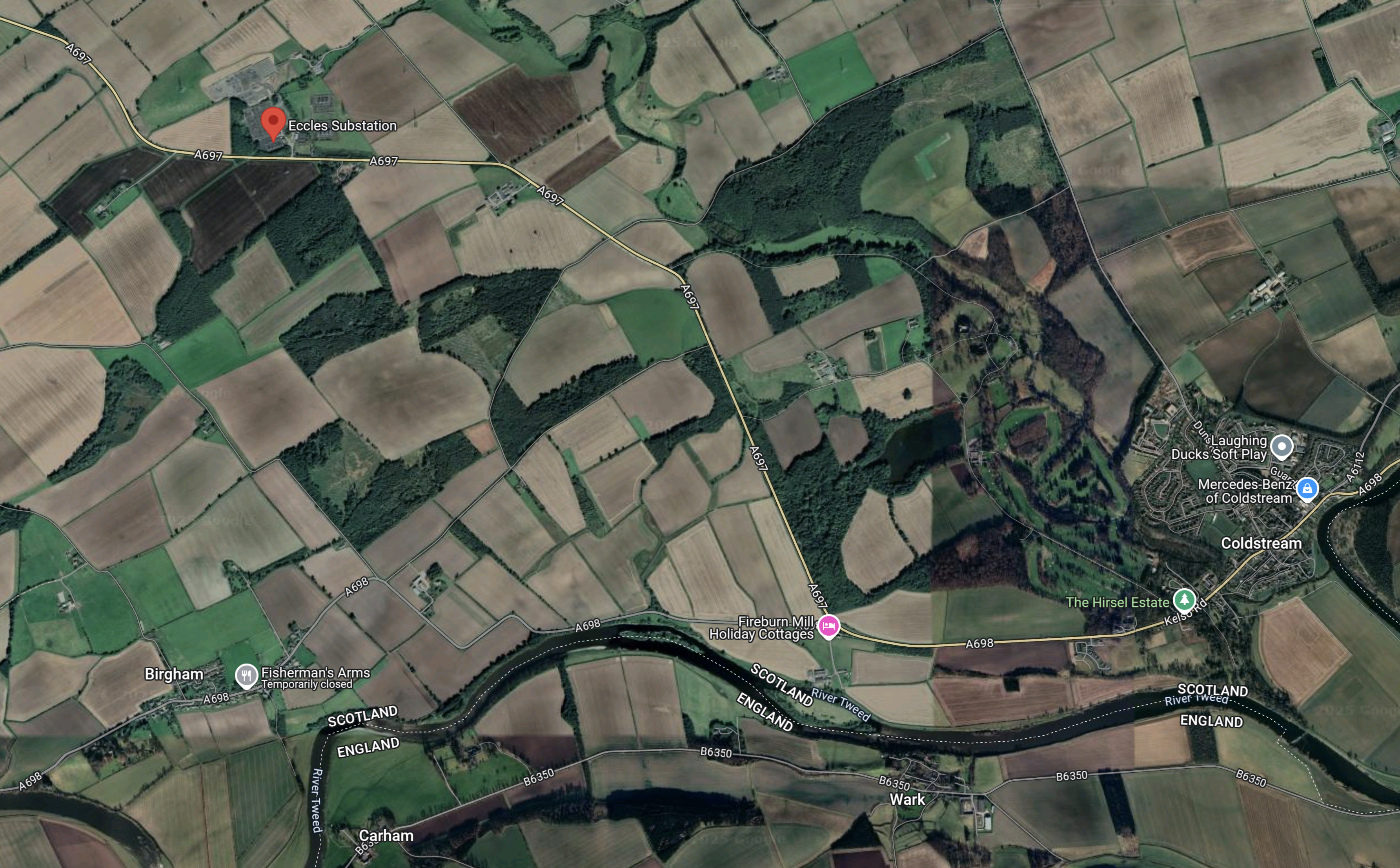
Note.
- The Eccles substation is marked by the red arrow.
- The town at the East edge of the map is Coldstream.
- The England-Scotland border is clearly marked.
This second Google Map shows a closer view of the Eccles substation.
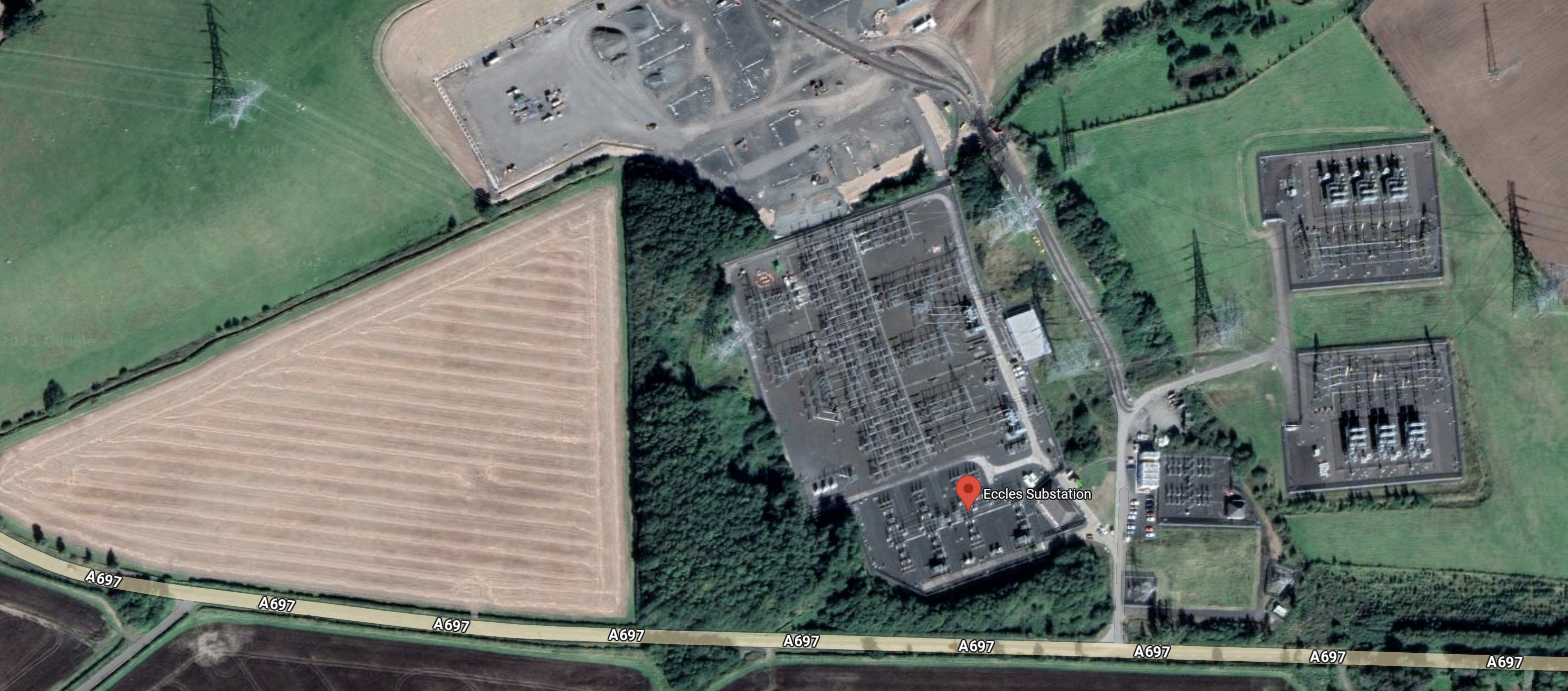
Note.
- t looks to be a substantial substation.
- There would appear to be plenty of space for a large battery.
- It is close to the A 597 road for the delivery of heavy equipment.
I suspect this substation could be the location of the battery.
It’s also right in the heart of Scottish onshore wind territory.
It is also according to the Solar Power Portal a £220 million project.
A project of this size will deliver substantial benefits in terms of work to the local community.
It will likely have a community benefit fund or something similar.
So you would expect the project would be welcomed into the local area.
But you would be wrong, if this article on the BBC, which is entitled Village ‘Heart Ripped Out’ By Battery Site Plans, is typical of the feeling about the batteries.
This is the sub-heading.
A rural community in the Borders is warning that Scotland’s renewable energy revolution is coming at a cost.
These three paragraphs add more detail.
Residents of Leitholm – a village between Coldstream and Greenlaw – claim the heart is being ripped out of their community with the arrival of battery storage facilities.
If all six proposed facilities are approved, more than 200 acres of farmland will be turned over to concreted compounds within a three-kilometre radius of their village.
Retired nursery owner Seonaid Blackie said: “This is not the place it used to be – people are worried sick.”
The residents view is balanced by industry expert Professor John Irvine, from St Andrew’s University, believes energy storage has a vital role to play in reaching net-zero targets.
My view is what is needed is an energy storage system, that can be built substantially underground.
If you look at large Battery Energy Storage Systems (BESS), they are best described as container parks.
We need energy storage systems, that fit in a single tennis court, rather than thirty football pitches.
Gravitricity is one possibility, who are also Scottish, who store energy using weights in disused mine shafts.
The French system; DELPHY is also a vertical system for storing hydrogen in a custom-built hole.
Practically, I believe the solution adopted will be to spread the batteries out and spend money on surrounding them with trees and other camouflage.
Back To The Dark Ages In West Virginia?
This article on WBOY is entitled West Virginia Senators Aim To Revitalize Coal Industry.
These are the introductory paragraphs.
If you’re tired of rising utility bills, you are not alone. West Virginia senators say they share the same feelings and believe the answer is right under our feet.
Revitalizing West Virginia’s coal industry and bringing down utility costs for customers is the goal of two pieces of legislation originating in the Senate.
A resolution known as the Coal Renaissance Act aims to keep current coal operations running as well as open up new opportunities for the industry, expanding mining in West Virginia.
According to Senators in support of the act, the optimum capacity factor for coal plants to run at is 69%. Currently, industry leaders say that number is down to around 30% to 40%.
A new bill known as the Reliable and Affordable Electricity Act incentivizes utility companies to rely on West Virginia coal.
There is also going to be a Senate bill, that will abolish tax breaks for wind farms.
In the UK, it is my belief, that coal died with the Aberfan disaster in 1966, which is described in this first paragraph of the disaster’s Wikipedia entry.
The Aberfan disaster (Welsh: Trychineb Aberfan) was the catastrophic collapse of a colliery spoil tip on 21 October 1966. The tip had been created on a mountain slope above the Welsh village of Aberfan, near Merthyr Tydfil, and overlaid a natural spring. Heavy rain led to a build-up of water within the tip which caused it to suddenly slide downhill as a slurry, killing 116 children and 28 adults as it engulfed Pantglas Junior School and a row of houses. The tip was the responsibility of the National Coal Board (NCB), and the subsequent inquiry placed the blame for the disaster on the organisation and nine named employees.
I do have memories of coal mining in my brain.
- As a young child, I can remember being driven past the Kentish collieries and seeing the blackened landscape of the Garden of England.
- Newspapers of the 1950s and 1960s published, their share of mining disasters.
- In the 1980s, I drove through coal mining country in the United States and was appalled at all the fumes and smoke from the coal-fired power stations and the trucks delivering coal. Nothing as civilised as a merry-go-round train was used.
- In 2015, I visited Katowice and wrote An Excursion In Katowice. The air was thick with coal smoke from the coal-fired power stations.
I also remember at the Jobs Fair, when I left Liverpool University in 1968, seeing the recruiter from the National Coal Board sitting there alone, as if he’d got the plague. Graduates had decided, that no way, were they going to work in the coal industry.
The West Virginia senators, should be certified, if they want to bring back coal.
The New Station With Wildflowers And No Car Park
The title of this post, is the same as that of this article on the BBC.
This is the sub-heading.
A new railway station with solar panels and wildflowers on the roof and no car park has been hailed as an example of sustainable transport
These three paragraphs, explain the thinking behind the design.
Cambridge South station, on Francis Crick Avenue, at the city’s Biomedical Campus, is expected to be completed by early 2026.
Designer and architect Jan Kroes said the site, which sits next to a nature reserve, would “fit in within the green belt”.
Network Rail said the site would be next to a guided busway system and connect with local cycleways and footpaths.
Regularly, when I lived nearly twenty miles from Cambridge, I would drive to Whittlesford Parkway station, which has 348 parking spaces and take the train to London.
This Google Map shows the area to the South-East of Cambridge.
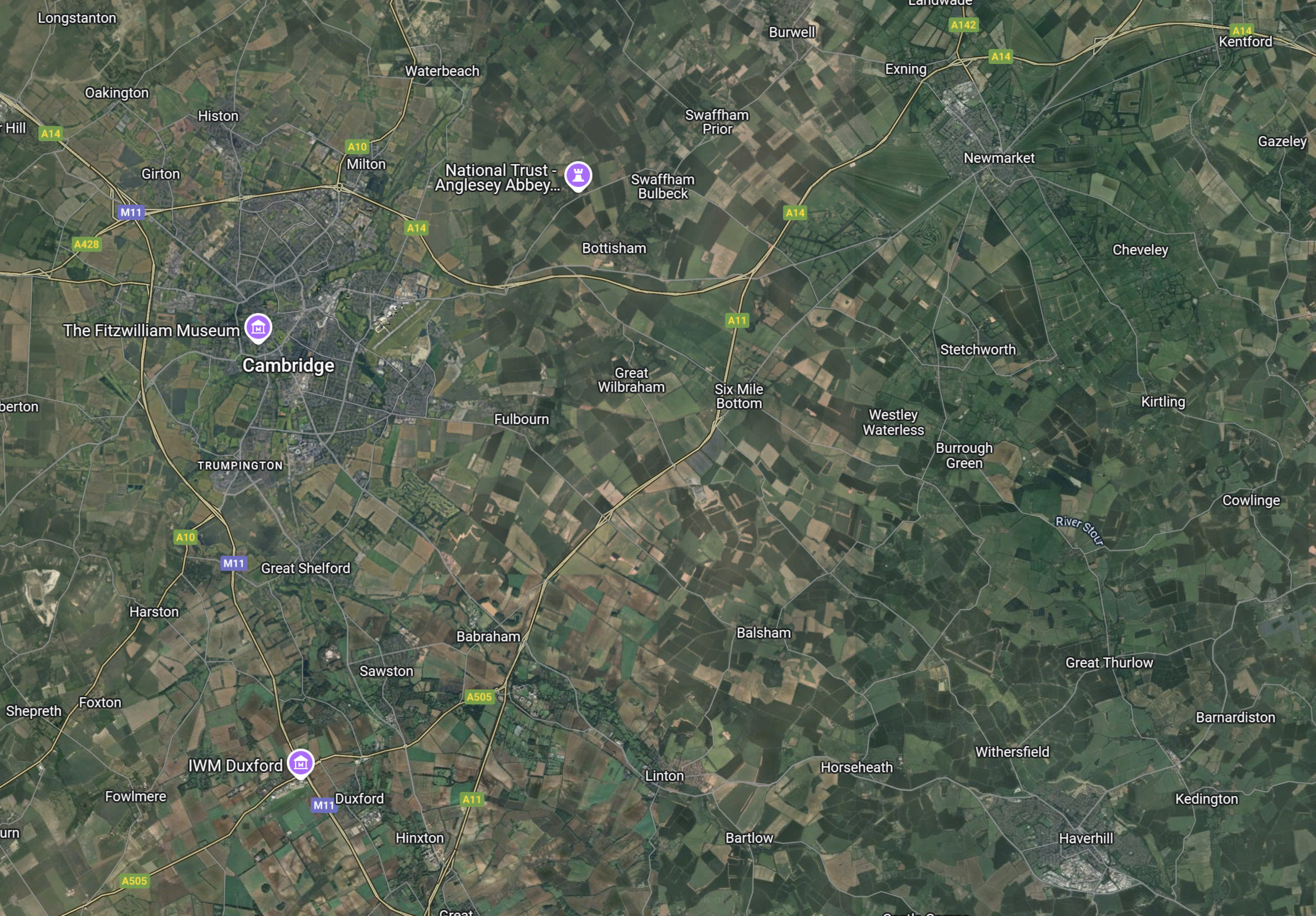
Note.
- Cambridge is towards the North-West corner of the map.
- Newmarket, which has a population of nearly 16,000, is towards the North-East corner of the map.
- Haverhill, which has a population of nearly 30,000, is towards the South-East corner of the map.
- Whittlesford Parkway station, is towards the South-West corner of the map close to the Imperial War Museum at Duxford
- I used to live at Great Thurlow between Newmarket and Haverhill.
The only railway stations on this map are Cambridge, Cambridge North, Dullingham, Newmarket, Shelford and Whittlesford Parkway.
As bus services are pretty thin on the ground, if you live to the bSouth-East of Cambridge, I can understand if there has been surprise, at the lack of parking at the new Cambridge South station.
- If you are travelling to London or Stansted Airport, you can still use Whittlesford Parkway, which has parking.
- But if when the East West Railway opens, you will need to use Cambridge or Cambridge South stations.
- Now that Cambridge North station is open, travelling to Norwich by train may be easier, unless there is not enough parking at Cambridge North station.
When I lived in the area, the most common excuse for not using the train, was the problems of parking at the stations.
I predict, that parking will be added to Cambridge South station.
How To Keep The Lights On When The Wind Doesn’t Blow
The title of this post, is the same as that of this article in The Times.
This is the sub-heading.
Britain came close to a blackout this month. Gas is being phased out and renewables are intermittent, so can energy storage stop us going dark?
These are the first two paragraphs.
It was 8.29pm on the first Tuesday in January when the alert was issued by the electricity control room. Freezing temperatures had coincided with unusually low wind speeds, and it was making the National Energy System Operator (Neso) jittery.
Engineers forecast a 1.6GW shortfall — the requirement for about 1.5 million homes — for a three-hour period from 4pm the following afternoon. “System operators are requested to notify Neso of any additional megawatt capacity,” the message said.
Luckily, the plea worked.
The article then goes on to describe the various technologies that are being deployed.
The article starts by talking about pumped storage hydroelectricity.
This paragraph gives a superb illustration about how things have changed in energy and energy storage in the UK in the last few decades.
In the past, when coal provided the bulk of British power, this system was used to meet fluctuating demand levels. But now it is also required to meet fluctuating supply levels from renewable sources. Martin Pibworth, chief commercial officer at SSE, started with the company as a trainee in 1998. “Back then, at our Foyers pumped storage plant [at Loch Ness] we would switch modes, from pumping to not pumping and back again, maybe 600 to 700 times a year. Last year we switched modes there 6,500 times. It’s an insight into how the market has changed and how much more flexibility is needed, and how responsive that has to be.”
We have to be more agile, with our handling of storage to back up the various methods of generation.
 The Anonymous Widower