Electric Cars Are A Dead End!
When you introduce any product to the general population, you must think of all the consequences.
I found these statistics on the RAC Foundation web site.
There were 33.2 million cars (81.3 per cent), 4.63 million LGVs (11.3 per cent), 0.54 million HGVs (1.3 per cent), 1.46 million motorcycles (3.6 per cent), 0.15 million buses & coaches (0.4 per cent) and 0.84 million other vehicles (2 per cent) licensed at the end of September 2022.
Could anybody please tell me how the average guy or gal, who owns one of those 33.2 million cars is going to be able to afford to replace it, find a convenient place to park and charge it and go and visit their mum in say Scunthorpe from Plymouth?
We are going down a massive dead end!
The only sensible alternative is internal combustion engines running on hydrogen, many of which could be converted from existing diesel engines.
But only a few councils have a hydrogen policy, with the biggest disgrace being London, where the Mayor’s hydrogen policy, is to ignore it and hope it will go away.London has an air quality problem, which is not helped by large numbers of HGVs in the centre.
The technology exists to convert HGVs to hydrogen and it would be possible to insist that all vehicles over a certain weight were zero-carbon. But as London has no plans for hydrogen, it can’t happen.
Vote Hydrogen for Mayor in May 2024, to improve London’s air quality.
Notes.
- To replace 33.2 million cars with electric ones would cost 1660 billion pounds, assuming each electric car costs fifty grand.
- As most electric cars are not made in the UK, what would happen to our balance of payments?
- On average an electric car needs 63 kilos of lithium for its battery, so 33.2 million will need over two million tonnes of lithium.
£100m Boost For Biggest UK Hydro Scheme In Decades
The title of this post, is the same as that of this article on the BBC.
This is the sub-heading.
A giant hydro scheme which would double the UK’s ability to store energy for long periods is taking a leap forward with a £100m investment by SSE.
These are the first three paragraphs.
The proposed 92m-high dam and two reservoirs at Coire Glas in the Highlands would be Britain’s biggest hydroelectric project for 40 years.
Scottish ministers approved the 1.5 GW pumped storage facility in 2020.
But power giant SSE wants assurances from the UK government before finally signing it off.
There are two major problems with this scheme.
Why The Forty Year Wait?
I am an Electrical and Control Engineer and it is a scandal that we are waiting forty years for another pumped storage scheme like the successful Electric Mountain or Cruachan power stations to arrive.
Petrol or diesel vehicles have batteries for these three main purposes.
- To start the engine.
- To stabilise the output of the generator or alternator.
- To provide emergency power.
As to the latter, I can’t be the only person, who has dragged a car out of a ford on the starter motor. But think of the times, you’ve used the hazard warning lights, after an accident or an engine failure.
The nightmare of any operator of a complicated electricity network like the UK’s is a black start, which is defined by Wikipedia like this.
A black start is the process of restoring an electric power station or a part of an electric grid to operation without relying on the external electric power transmission network to recover from a total or partial shutdown.
Hydro electric power stations and especially those that are part of pumped storage schemes are ideal for providing the initial power, as they are often easy to start and have water available. Cruachan power station has a black start capability, but at 440 MW is it big enough?
Over the last few years, many lithium-ion batteries have been added to the UK power network, which are used to stabilise the grid, when the sun isn’t shining and the wind isn’t blowing.
There are four pumped storage hydro-electric schemes in the UK.
- Cruachan – 440 MW/7 GWh – 1965
- Dinorwig (Electric Mountain) – 1800 MW/9.1 GWh -1984
- Ffestiniog – 360MW/1.44 GWh – 1963
- Foyers – 300 MW/6.3 GWh – 1974
Note.
- I always give the power output and the storage capacity for a battery, if it is known.
- According to Wikipedia, Scotland has a potential for around 500 GWh of pumped storage.
- The largest lithium-ion battery that I know, that is being planned in the UK, is Intergen’s 320 MW/640 MWh battery at Thames Gateway, that I wrote about in Giant Batteries Will Provide Surge Of Electricity Storage. It’s smaller than any of the four current pumped storage schemes.
- The Wikipedia entry for Coire Glas says that it is a 1.5 GW/30 GWh pumped storage hydro-electric power station.
I very much feel that even one 1.5 GW/30 GWh pumped storage hydro-electric power station must make a big difference mathematically.
Why have we had to wait so long? It’s not as though a pumped storage hydro-electric power station of this size has suffered a serious disaster.
Drax Needs Assurances Too?
The BBC article says this.
Scotland’s only other pumped storage scheme, operated by Drax Group, is housed within a giant artificial cavern inside Ben Cruachan on the shores of Loch Awe in Argyll.
The North Yorkshire-based company plans to more than double the generating capacity of its facility, nicknamed Hollow Mountain, to more than 1GW, with the construction of a new underground power station.
But both Drax and SSE have been reluctant to press ahead without assurances from Whitehall.
It looks like the right assurances would open up at least two pumped storage hydro-electric power station projects.
But it could be better than that, as there are other projects under development.
- Balliemeanoch – 1.5GW/45 GWh
- Corrievarkie – 600 MW/14.5 GWh
- Loch Earba – 900 MW/33 GWh
- Loch Kemp – 300 MW/9 GWh
- Red John – 450 MW/2.8 GWh
This totals to 3750 MW/104.3 GWh or 5850 MW/134.3 GWh with the addition of Coire Glas and the extension to Cruachan.
Getting the assurances right could result in large amounts of construction in Scotland!
What Assurances Do Power Giants SSE And Drax Want Before Signing Off?
This news item on SSE Renewables, which is dated 18th March 2022, is entitled Ministerial Roundtable Seeks To Unlock Investment In UK Energy Storage.
These three paragraphs gives details of the meeting.
Business leaders have met with UK Energy Minister the Rt Hon Greg Hands MP to discuss how the government could unlock significant investment in vital energy storage technologies needed to decarbonise the power sector and help ensure greater energy independence.
The meeting was organised by the Long-Duration Electricity Storage Alliance, a new association of companies, progressing plans across a range of technologies to be first of their kind to be developed in the UK for decades.
Representatives from Drax, SSE Renewables, Highview Power and Invinity Energy Systems met with The Rt Hon Greg Hands MP, Minister of State for Business, Energy and Clean Growth [yesterday].
But they still don’t seem to have come up with a funding mechanism.
- In this case, it seems that multiple politicians may not be to blame, as Greg Hands was the Minister of State for Business, Energy and Clean Growth until the 6th of September 2022, when he handed over to Graham Stuart, who is still the incumbent.
- Could it be that civil servants for this problem need to be augmented by a Control Engineer with mathematical modelling skills from a practical university?
It is the sort of problem, I would love to get my teeth into, but unfortunately my three mentors in accountancy and banking; Bob, Brian and David, who could have helped me, have all passed on to another place to help someone else with their problems.
I’ve just had a virtual meeting with all three and they told me to look at it like a warehousing system.
Consider.
- It would be very easy to measure the amount of water stored in the upper reservoir of a pumped storage hydro-electric power station.
- It would also be easy to measure the electricity flows to and from the pumped storage hydro-electric power station.
- A monetary value could be placed on the water in the upper reservoir and the flows, depending on the current price for electricity.
So it should be possible to know that a pumped storage hydro-electric power station, was perhaps storing energy as follows.
- 10 GWh for SSE
- 8 GWh for RWE
- 6 GWh for Scottish Power
- 6 GWh is not being used
And just as in a warehouse, they would pay a fee of so much for storing each GWh for an hour.
- The system would work with any type of storage.
- Would competition between the various storage sites bring down prices for storing electricity?
- Pumped storage operators would get a bonus when it rained heavily.
- Just as they do now, electricity generators would store it when prices are low and retrieve it when prices are high.
A lot of the rules used to decide where electricity goes would still work.
BW Ideol In Talks To Raise EUR 40 Million For Floating Wind Development
The title of this post, is the same as that of this article on offshoreWIND.biz.
This is the sub-heading.
Norway-headquartered BW Ideol and French state-owned investment company ADEME Investissement have agreed to enter into exclusive negotiations for EUR 40 million in funding by ADEME Investissement for BW Ideol’s project development activities.
The rest of the post is all about the clever, but I suspect legal ways, that the € 40 million is raised.
When I needed any advice in that area, I used to consult my late friend the banker; David, who is mentioned in Diversifying A US$200 billion Market: The Alternatives To Li-ion Batteries For Grid-Scale Energy Storage.
When he needed computing advice, that is another story.
Is Match Of The Day Better Without The Chattering?
The BBC have just announced that last night’s Match of the Day-Lite had a million more viewers than last week’s full-fat edition.
I watched last night’s program and enjoyed it.
Perhaps, if the BBC wants to save money, they could go to a lite-format for MotD.
And whilst, they’re at it if they want more viewers, why not do MotD editions for the three other divisions?
Diversifying A US$200 billion Market: The Alternatives To Li-ion Batteries For Grid-Scale Energy Storage
The title of this post, is the same as that of this article on Energy Storage News.
This is the introductory paragraph.
The global need for grid-scale energy storage will rise rapidly in the coming years as the transition away from fossil fuels accelerates. Energy storage can help meet the need for reliability and resilience on the grid, but lithium-ion is not the only option, writes Oliver Warren of climate and ESG-focused investment bank and advisory group DAI Magister.
Oliver starts by saying we need to ramp up capacity.
According to the International Energy Agency (IEA), to decarbonise electricity globally the world’s energy storage capacity must increase by a factor of 40x+ by 2030, reaching a total of 700 GW, or around 25% of global electricity usage (23,000TWh per annum). For comparison, this would be like swelling the size of the UK’s land to that of the USA.
Similar to how “nobody ever gets fired for buying IBM”, lithium-ion holds a similar place in grid scale electrical storage today.
And just as IBM did in the last decades of the last century, the builders of lithium-ion will fight back.
He then lists the problems of grid-scale lithium-ion batteries.
- Shortage of cobalt.
- Toxic and polluting extraction of some much needed metals and rare earths from unstable countries.
- Lack of capacity to load follow.
- Limited lifespan.
He does suggest vehicle-to-grid can provide 7TWh of storage by 2030, but it has similar problems to lithium-ion grid scale batteries.
Finally, he covers these what he considers several viable methods of energy storage in detail.
He introduces them with this paragraph.
No single killer application or technology exists to get the job done. Diversification is key with success dependent on the wide-scale adoption of multiple grid-scale energy storage solutions.
- Energy Dome – Italy – Stylish Use of CO2
- Augwind Energy – Israel – Stores Energy As Compressed Air Underground
- Cheesecake Energy – UK – Stores Energy As Heat And Compressed Air
- Highview Power – UK – Stores Energy As Liquefied Air
- Ocean Grazer – Netherlands – Ocean Battery
- RheEnergise – UK – High Density Hydro
- Lumenion – Germany/Japan – Stores Energy As Heat
- Energy Vault – Switzerland – Raising And Lowering Of Weights
Note.
- All systems are environmentally-friendly and use readily-available materials like air, water, sea-water, steel and concrete for their systems.
- The most exotic materials used are probably in the control computers.
- Some systems use readily-available proven turbo-machinery.
- Most systems appear to be scalable.
- All systems would appear to have a working life measured in decades.
- I would expect that most well-educated teenagers could understand how these systems worked.
Only Augwind Energy and Lumenion are new to me.
He finally sums up the economics and the market potential.
Our ability to expand energy storage capacity is one of the most pressing issues that will determine whether this defining ‘transitional’ decade is a success. But we’ll need to invest wisely into the right technologies that get the greatest bang for the buck (in terms of GWh capacity and return on capital) given the limited lifespan of Li-Ion and the decarbonisation of the grid.
At a current capital cost of US$2,000 per kW quoted by the US National Renewable Energy Laboratory (NREL) for 6-hour Li-ion battery storage, the 700GW of capacity needed by 2030 equates to around a US$1.5 trillion market over the coming decade, making it worth nearly US$200 billion a year.
The Energy Storage News article is a comprehensive must read for anyone, who is considering purchasing or investing in energy storage.
I have some further thoughts.
From My Experience Would I Add Any Other Systems?
I would add the following.
- Form Energy, because its iron-air battery is well-backed financially.
- Gravitricity, because it can use disused mine shafts to store energy and the world has lots of those.
- STORE Consortium, because its 3D-printed concrete hemispheres, that store energy using pressurised sea-water can be placed within a wind farm.
I also suspect that someone will come up with an energy storage system based on tidal range.
Finance
When we started Metier Management Systems, finance to breakout from the first initial sales was a problem. We solved the problem with good financial planning and an innovative bank manager who believed us all the way.
David, was a rogue, but he was a rogue on the side of the angels. Long after Metier, he even came to my fiftieth birthday party.
David would have found a way to fund any of these systems, as they tick all the boxes of demonstrated, environmentally-friendly, safe and understandable. They are also likely to be bought by companies, governments and organisations with a high net value, a very respectable reputation and/or large amounts of money.
I also think, that just as we did with the original Artemis project management system, some of these systems can be leased to the operators.
Second-Use Of Systems
Several of these systems could be moved on to a new location, if say they were supporting an industry that failed.
That would surely help the financing of systems.
Floating Offshore Wind Could Reach Full Commercialisation By 2035, Research Says
The title of this post, is the same as that of this article on offshoreWIND.biz.
This is the sub-heading.
Floating offshore wind could reach full commercialisation by 2035, said 60 per cent of respondents in the latest research that was done by DNV, with 25 per cent believing it will be as early as 2030.
I’ll go along with that, but as a serial disruptive innovator, I believe full commercialisation could be earlier than 2027.
It will be for these reasons.
Capacity Factor
There is reason to believe from the figures from existing floating wind turbines, that the capacity factor is very good and could be higher than those of turbines with fixed foundations.
Wikipedia says this about the world’s first commercial floating offshore windfarm; Hywind Scotland.
In its first 5 years of operation it averaged a capacity factor of 54%, sometimes in 10 meter waves.
If other floating technologies show as good capacities as this, then the technology may well find it easier to attract finance.
Design
We have only seen a couple of designs deployed; Hywind and WindFloat.
There will be plenty more to come.
This visualisation shows five D-Floaters being transported on a ship.
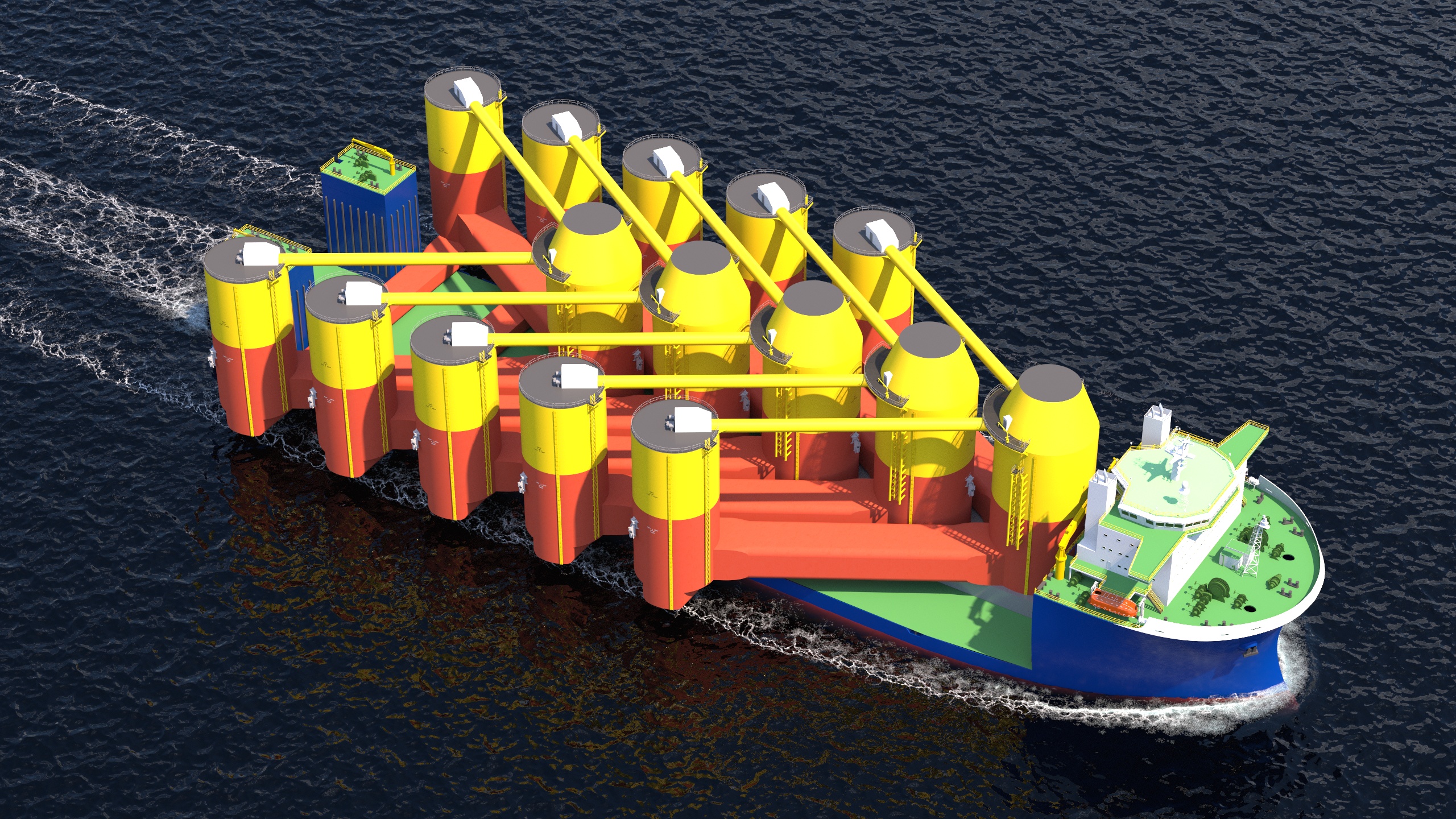
Note.
- D-Floaters are being developed by Bassoe Technology.
- As many floats will be manufactured, a long way from their final mooring, why not make them easy to transport.
- Other companies are developing floats that can be bolted or welded together from standard components.
I wouldn’t be surprised if one design came to dominate the market.
This might be a good thing, as it would surely speed up deployment of floating wind farms.
Construction And Installation
This video shows the construction and installation if Principle Power‘s, Windfloat prototype.
Note.
- All the construction and assembly is done in a dock with a suitable crane.
- This is much easier than doing it the assembly out at sea, as has to be done with turbines with fixed foundations.
- I suspect that with the best design of float and turbine, high rates of turbine assembly can be achieved.
- Health and Safety will prefer this type of assembly.
I suspect other floating wind turbines will be similarly assembled.
Suppose you were assembling 15 MW floating turbines at a rate of one per day, that would be a production rate of over 5 GW of turbines per year from just one dock.
Early Delivery Of Power
I suspect that to build a floating wind farm, one of the first things to be towed out would be the substation to which all the turbines will be connected.
- This could even be floating.
- I’ve seen floating sub station designs, that incorporate energy storage and hydrogen production.
Once the substation is fully-installed and tested, floating turbines could be towed out, anchored, connected to the substation and immediately start to produce electricity.
I have built a lot of cash-flow models in my time and I believe that one for say a 2 GW floating wind farm would be very friendly to proposers, investors and operators.
There’s A Lot Of Sea Out There!
And after nearly sixty years of offshore semi-submersible platforms in UK water, we now how to work in the conditions.
In ScotWind Offshore Wind Leasing Delivers Major Boost To Scotland’s Net Zero Aspirations, I said this, about the total capacity, that will be developed under the ScotWind leasing round.
- Adding up these fixed foundation wind farms gives a capacity of 9.7 GW in 3042 km² or about 3.2 MW per km².
- Adding up the floating wind farms gives a capacity of 14.6 GW in 4193 km² or about 3.5 MW per km².
Note.
- You appear to get ten percent more capacity in a given area of sea with floating wind farms.
- The energy density of floating wind farms is 3.5 MW per km².
I suspect investors will prefer the floating wind farms.
Lower Visibility
Floating wind farms will generally be further out to sea and less likely to be objected to, than installations nearer to land.
Maintenance And Updating
Floating wind farms can be towed into port for servicing and updating, which must ease the process.
Project Management
I believe that floating wind farms, are projects, that would benefit highly from good project management.
Sometimes, I wish I was still writing project management software and I am always open to offers to give my opinion and test anybody’s software in that area!
Finance
I can see that floating wind farms could offer better cash flows to investors and this will make them invest in floating wind farms at the expense of those with fixed foundations.
Conclusion
For all these reasons, but with my instinct telling me that floating wind farms could offer a better return to investors, I wouldn’t be surprised if floating wind farms came to dominate the market.
Elizabeth Line: More Than 100 Million Journeys On Elizabeth Line, Says YouGov
The title of this post, is the same as that of this article on the BBC.
These three paragraphs introduce the article.
More than 100 million journeys have been made on London Underground’s new Elizabeth Line since it opened last May, according to a survey.
The YouGov poll suggested 45% of the capital’s residents had also used the line from Reading, Berkshire, to Abbey Wood and Shenfield in Essex.
Transport for London (TfL) said on 1 February it had completed about 600,000 daily journeys.
That is all well and good, but to me, this is the most significant paragraph.
TfL said the railway was “on track to break even” based on operating costs by the end of the 2023/24 financial year.
So it looks like that the planners got the modelling of the operation of the railway correct.
From my experience of project management, I believe that the Elizabeth Line project could have been considered as five main projects.
- The boring of the Central Tunnel
- The updating of the existing branches to Abbey Wood, Heathrow, Reading and Shenfield
- The building of the Class 345 trains
- The signalling
- The fitting out of the stations in the Central Tunnel
Delivery though was a bit patchy!
These are my thoughts on each sub-project.
The Boring Of The Central Tunnel
I was told, that early on, it was realised by the contractors that they didn’t have enough workers, who were certified to work underground.
So the Tunneling and Underground Construction Academy or TUCA in Ilford, was built to train more workers.
This helped the Central Tunnel to be completed on time.
Since then, two more tunnels; the Thames Tideway and the London Power Tunnel have been successfully completed on time and on budget, thus vindicating the building of TUCA.
The Updating Of The Existing Branches To Abbey Wood, Heathrow, Reading and Shenfield
There were a few hiccups, but generally the branches were updated and were operating into Paddington and Shenfield before the line opened.
The Building Of The Class 345 Trains
This wasn’t perfect and Bombardier’s financial state didn’t help, but the trains had good tests running out of Liverpool Street and Paddington.
The Signalling
A lot of commentators have said the signalling was too complicated. But eventually, it all seems to be working.
Was enough testing done away from the Elizabeth Line?
My feeling is that a new UK test track should have been built in the early 2010s, so that some testing could have been done professionally away from London.
The Fitting Out Of The Stations In The Central Tunnel
This was certainly a cause of late handover of stations like Bond Street, Farringdon, Whitechapel and others.
I heard tales, where other projects in London, were offering more money, so consequently workers were moving with the money, thus delaying the completion of stations.
I certainly heard a tale, where all the electricians on one station project moved en masse to complete the new Tottenham Hotspur stadium.
Some of the projects were office projects, paid for by sovereign wealth funds with bottomless projects, so they could make sure their project finished on time.
There were also the problems caused by Brexit, the pandemic and major projects running late in Germany and Europe.
It is my view that Elizabeth Line should have been given more priority, by delaying commercial projects, so that the pool of available labour wasn’t exhausted.
Some of the forest of projects around Elizabeth Line stations, should have been given planning permission, that meant they couldn’t start until Elizabeth Line was finished.
In the 1960s, there was certainly a similar labour problem in Aberdeen. I was told, that the oil majors, who nearly all used the project management system; Artemis, that I had written, talked to each other to make sure the situation didn’t get any worse.
I wonder, if someone was watching the labour shortage problems in City Hall?
Conclusion
I believe that if Elizabeth Line had been given the priority it should have been, that it would have been opened earlier and just as it is now, it would be showing a sensible cash flow.
Now it is a question of catching up financially.
Denmark’s Bank Robbers Count The Cost Of Cashless Society
The title of this post is the same as that of this article on The Times.
This is the second paragraph.
Figures from Finans Danmark, an industry association, show the number of attacks has collapsed in recent years as the shift towards online transactions has led many Danish banks to abandon cash services in branches. While there were 221 bank robberies in 2000, the number of hold-ups in Denmark fell to 121 in 2004, before declining to one in 2021 and none last year.
There were also no attacks on ATM machines.
Doing away with cash certainly cuts crime and it must be twelve years, since a Unite representative on Manchester buses told me he wanted cashless ticketing on Manchester’s buses and trams, as since it had been introduced in London, attacks on staff had declined dramatically.
I also wonder by how much the Income Tax take would rise?
Grand Union Sets Out Stirling Ambitions
The title of this post, is the same as that of an article in the December 2022 Edition of Modern Railways.
This is the first paragraph.
Grand Union Trains has updated its plans to operate services between Stirling and London Euston. It is targeting a 10-year track access agreement with services starting in May 2025.
I have a few thoughts.
The Route
The route between Stirling and Euston is as follows.
- Trains will call at Larbert, Greenfauds, Whifflet, Motherwell, Lockerbie, Carlisle, Preston, Nuneaton and Milton Keynes.
- Station upgrades are proposed for Larbert, Greenfauds, Whifflet and Lockerbie.
- The route is fully-electrified.
- There will be four trains per day in both directions, with a slightly reduced service on Saturday evenings and Sunday mornings.
This sentence from the article sums up the philosophy of Grand Union Trains.
The company says the aim is to link towns which have no or limited long-distance services and to improve connectivity for some station pairs on the West Coast Main Line.
Note.
Currently Larbert, Greenfauds and Whifflet don’t have services running past Stirling or Motherwell.
- Currently, Nuneaton and Milton Keynes have no Scottish services.
- Nuneaton is well connected to Peterborough and the East.
- Milton Keynes will be on the East-West Railway to Oxford and Cambridge.
It looks to be a service that has been well-planned and offers good possibilities for travel.
The Trains
The article says this about the trains.
New bi-mode rolling stock would be used and GUT says discussions with potential suppliers and manufacturers are ongoing.
Why Are Bi-Mode Trains Needed?
I can think of these reasons.
- Grand Union Trains want to run their South Wales services with the same trains.
- They might want to extend Scottish services from Stirling to perhaps Perth or Dundee.
- They want to offer a reliable service, when the electrification is damaged.
Bi-mode trains will certainly offer flexibility and reliability.
How Long Will The Trains Be?
Consider.
- An eleven-car Class 390/1 train is 265.3 metres long.
- A pair if five-car Class 802 trains is 260 metres long.
I suspect a train has a maximum length of 260 metres and these can be run between London Euston and Stirling.
Could it be that station upgrades are needed for Larbert, Greenfauds, Whifflet and Lockerbie, is that these stations have short platforms?
Could the trains and platforms start short and grow with the business?
The Trains Will Have Three Classes
These classes will be offered.
- First Class in compartments
- Standard in a 2+1 arrangement
- Standard Economy in a 2+2 arrangement
You pays your money and you make your choice.
Vanload Freight May Be Carried
Consider.
- There has been a lot of speculation and some serious train conversions, looking at the possibilities of high speed freight.
- Imagine a train of perhaps five passenger cars and one freight car for containerised freight.
- I suggested earlier, that the trains might grow with the business.
- As business develops, extra cars can be added as appropriate.
- If business booms, then it might be best to run separate passenger and freight services.
Modern trains and refurbished older ones, offer a multitude of solutions.
The Finance
The article says this about finance.
Grand Union Trains has linked with European independent investment firm Serena Industrial Partners to support its ambitions for its new Great Western service, and the project is supported by Spanish operator RENFE.
Serena Industrial Partners are Spanish, so does that mean, that the trains could be Spanish too?
 The Anonymous Widower