Large Scale Hydrogen Storage Sites Could Reduce Customer Energy Costs By £1bn Per Year
The title of this post, is the same as this press release from Centrica.
These four paragraphs summarise the report.
Centrica and FTI report finds that hydrogen storage would help balance the UK’s energy system and reduce bills.
A net zero scenario including large scale hydrogen storage – specifically, a redeveloped Rough gas storage facility – would reduce energy costs by an additional £1bn per year by 2050.
Report also finds that a UK energy system focused on renewable generation risks high levels of intermittency without an established hydrogen market. By 2050, electricity generation from renewables could exceed total demand around 15% of the time.
Electricity generation from renewables could also rise or fall by as much as 100GW over the course of a single day. More than twice current levels of peak demand on winter evenings and the equivalent energy output from over 30 Hinkley Point C nuclear power stations.
Note.
- Hydrogen Central entitles their article about the Centrica press release Centrica Says Hydrogen Can Reduce Household Bills by £35 a Year. That’s almost a bottle of my favourite Adnams beer a week!
- I talked about the redevelopment of the Rough facility into hydrogen storage in Aberdeen’s Exceed Secures Centrica Rough Contract.
- Generating hydrogen from excess electricity and storing it until it is needed, must be an efficient way of storing electricity or powering industrial processes that need a lot of energy, if storing hydrogen makes £1bn per year!
- It should be noted that Centrica have a large interest in HiiROC, who are developing an efficient way to generate hydrogen from any hydrocarbon gas from chemical plant off-gas through biomethane to natural gas. In a perfect world a HiiROC system in a sewage works could capture the biomethane and split it into hydrogen and carbon black. The hydrogen could be used to refuel vehicles and the carbon black would be taken away to someone, who has need of it.
In some ways, it is surely sensible to have enough energy in a store, if the renewables fail. As Rough is already there and functioning, it is surely one of the easiest routes to redevelop Rough, so that it is in top-quality condition.
It should also be noted, that Rough is not far from the Aldbrough Gas Storage, which SSE are converting to a second massive hydrogen store.
So Humberside will have two of the largest hydrogen stores in the world, which Centrica and SSE will use to maxise energy security in the wider Humberside and East Yorkshire area, and I suspect to maximise their profits as well.
This video shows the structure of AquaVentus, which is a pipeline system, that the Germans are building to bring much-needed hydrogen to German industry from electrolysers in the North Sea and other countries like Denmark, Norway, the Netherlands and the UK.
I clipped this map from the video.

Note how a branch of AquaVentus makes landfall around the Humber estuary at a UK label.
Will Centrica and SSE be trading hydrogen from Rough and Aldbrough with the Germans through AquaVentus? You bet they will, as the Germans are short of both hydrogen and hydrogen storage.
Wrightbus StreetDeck Ultroliner Next-Gen To Get Cummins Power
The title of this post, is the same as that of this article on Route One.
These three paragraphs give more details.
Wrightbus will utilise Cummins power in its StreetDeck Ultroliner diesel double-decker for the first time in a next-generation variant of that model.
Those vehicles will be powered by the six-cylinder B6.7 engine rated at 250bhp or 300bhp, driving through the Voith DIWA.8 seven-speed automatic gearbox. Such an approach will further reduce emissions, and the new model will be Ultra-Low Emission Bus accredited by Zemo Partnership, the manufacturer says.
The existing StreetDeck Ultroliner, which is powered by the Daimler OM 934 four-cylinder engine, will continue to be available. The first Cummins-powered examples are to be supplied to Isle of Man operator Bus Vannin.
As a hydrogen version of the the Cummins six-cylinder B6.7 engine is available, at some point in the future, these buses will be convertible to zero-emission hydrogen power.
Wrightbus have already set up a division called New Power to do the conversion of existing buses, as I reported in Wrightbus Launches NewPower In Bicester.
The Versatile Substance That Is Carbon Black
I suspect very few of us think much about carbon black.
In an over fifty-year working life, I have only come across carbon black indirectly and no-one has actually shown me any carbon black.
This is the first sentence of the Wikipedia entry for carbon black.
Carbon black (with subtypes acetylene black, channel black, furnace black, lamp black and thermal black) is a material produced by the incomplete combustion of coal tar, vegetable matter, or petroleum products, including fuel oil, fluid catalytic cracking tar, and ethylene cracking in a limited supply of air.
It doesn’t sound the most appetising of substances and the next sentence reinforces that view.
Carbon black is a form of paracrystalline carbon that has a high surface-area-to-volume ratio, albeit lower than that of activated carbon. It is dissimilar to soot in its much higher surface-area-to-volume ratio and significantly lower (negligible and non-bioavailable) polycyclic aromatic hydrocarbon (PAH) content.
The text is illustrated with what looks like a small pile of soot.
I first came across carbon black, in my first job after leaving Liverpool University at ICI Mond Division at Runcorn.
For a time, I shared an office with Peter, who was part of a number of engineers, who were trying to get a new plant, that had been purchased from BASF to make commercial quantities of acetylene. All the plant seemed to make was large quantities of soot, which it then proceeded to spread all over the town of Runcorn.
If I remember correctly, the process worked by burning ethylene in a limited supply of air and then quenching it with naphtha. The similarities between the BASF process and the method for producing carbon black lead me to believe, that ICI’s process was probably producing a lot of carbon black.
Peter was working on an instrument that measured the quantity of acetylene in the off-gas from the burners and he succeeded, but unfortunately proved that the plant was going into explosive limits. For this reason, ICI shut their process, although BASF persevered.
Ethylene is a hydrocarbon which has the formula C2H4 or two carbon and four hydrogen atoms. So if you can get them to stop tightly holding hands with no oxygen around, the hydrogen will pair off as H2 and the carbon will exist as a lot of single C atoms or carbon black.
BASF and ICI were trying to produce acetylene or C2H2, where there is a powerful triple bond between the two carbon atoms. All that energy in the acetylene makes it useful for activities like welding.
Common Uses Of Carbon Black
The Wikipedia entry for carbon black, has this summary of its uses.
The most common use (70%) of carbon black is as a pigment and reinforcing phase in automobile tires. Carbon black also helps conduct heat away from the tread and belt area of the tire, reducing thermal damage and increasing tire life. Its low cost makes it a common addition to cathodes and anodes and is considered a safe replacement to lithium metal in lithium-ion batteries. About 20% of world production goes into belts, hoses, and other non-tire rubber goods. The remaining 10% use of carbon black comes from pigment in inks, coatings, and plastics, as well as being used as a conductive additive in lithium-ion batteries.
The entry then gives a list of other uses, some of which are still being developed.
Global Production Of Carbon Black
This paragraph is from the Wikipedia entry for carbon black.
Total production was around 8,100,000 metric tons (8,900,000 short tons) in 2006. Global consumption of carbon black, estimated at 13.2 million metric tons, valued at US$13.7 billion, in 2015, is expected to reach 13.9 million metric tons, valued at US$14.4 billion in 2016.
So we have the useful paradox, that we don’t want to emit more carbon dioxide, but extra carbon black could probably be usefully used.
Conclusion
Using the HiiROC process to extract hydrogen could even give us a biproduct ; carbon black, that has uses.
Ricardo’s Hydrogen Fuel Cell Module Celebrates Key Milestone To Successfully Generating Power
The title of this post, is the same as that of this press release from Ricardo.
This is the sub-heading.
Ricardo’s ground-breaking high-powered multi-stack hydrogen fuel cell module has reached a new milestone. Following its initial activation, the module is generating significant power output.
These are the first two paragraphs.
Initially developed to generate high energy output with zero-emissions for the maritime sector as part of the Sustainable Hydrogen Powered Shipping (sHYpS) project, the core technology is suitable for a wide range of high-power applications. Ricardo is already seeing strong interest from sectors including, stationary power, rail, off-highway and high-performance vehicles.
The module has already achieved Lloyd’s Register’s Approval in Principle for the system’s safety and certification approach for ocean-going applications. As well as the fuel cell power plant, the sHYpS project is developing a novel swappable liquid hydrogen storage solution, which can be adapted to multiple types of vessels and accelerate the achievement of the International Maritime Organisation’s decarbonisation targets.
Note.
- It seems to be a versatile fuel cell module.
- Ricardo also seem to have designed or sourced a novel refuelling solution.
- The power of the fuel cell module is not given.
I can see a lot of applications for a large fuel cell module.
HiiROC Partners With Siemens To Boost Clean Hydrogen Production
The title of this post, is the same as that of this press release from HiiROC.
These two bullet points, act as sub-headings.
-
HiiROC and Siemens sign a Memorandum of Understanding to provide advanced control technology and ensure the safe automation of hydrogen production.
-
HiiROC’s Thermal Plasma Electrolysis (TPE) process produces clean hydrogen and solid carbon, using significantly less electricity than water electrolysis and without creating carbon dioxide.
These five paragraphs explain the deal.
Clean hydrogen producer HiiROC, has partnered with technology company Siemens on its hydrogen production technology, helping customers to decarbonise their operations and support their Net Zero ambitions.
Under the agreement, HiiROC will leverage Siemens’ control technology and factory and automation expertise to ensure the safe, efficient automation of hydrogen production and support in scaling.
HiiROC’s proprietary Thermal Plasma Electrolysis (TPE) technology is designed to meet rising demand for low-cost, scalable solutions for clean hydrogen production at the point of use, which helps to significantly reduce costs by removing the need for specialised storage and transportation.
The TPE process disassembles gaseous hydrocarbons into hydrogen and solid carbon without creating carbon dioxide. This highly efficient process, recognised under the UK’s Low Carbon Hydrogen Standard, requires only a fifth of the electricity of water electrolysis.
As a key technology partner, Siemens will collaborate with HiiROC to advance product development, while its global developer support community will help in achieving the hydrogen producer’s international expansion goals. Siemens, which has ambitious commitments to decrease carbon emissions and contribute to a more sustainable society, works with organisations across sectors to decarbonise using technology.
Many chemical processes are all about brute force and very large amounts of energy. This marriage made in chemical heaven, is all about elegance and finesse.
The investors in HiiROC are not without substance and include Melrose Industries, HydrogenOne, Centrica, Hyundai and Kia.
I wrote more about HiiROC and a similar process in Centrica Partners With Hull-Based HiiRoc For Hydrogen Fuel Switch Trial At Humber Power Plant.
Aberdeen’s Exceed Secures Centrica Rough Contract
The title of this post, is the same as that of this article on Energy Voice.
This is the sub-heading.
Well and reservoir management firm Exceed has secured a contract with Centrica Energy Storage for the redevelopment of the Rough gas storage field.
This is the introductory paragraph.
Exceed said its role in the initial stages of the project, which is exploring converting the Rough field into a hydrogen storage facility, could create more than 30 jobs.
In Wood To Optimise Hydrogen Storage For Centrica’s Rough Field, I talked about changing Rough from a gas to a hydrogen store, so it looks like Centrica are going to create a vast hydrogen storage facility.
This all fits with my belief, that Centrica’s Rough facility and SSE’s nearby Aldbrough storage facility, will at sometime in the future be connected to the Germany hydrogen pipeline; AquaVentus to perform backup to hydrogen produced in the North Sea.
I also feel that the hydrogen trading will be of benefit to Centrica and SSE.
The last section of the Energy Voice article is entitled Rough Hydrogen Storage Concerns.
The following facts are given.
There are currently eight geological gas storage sites across Great Britain, containing approximately 3.1bcm in capacity and maximum deliverability rates of 124mcm/day.
Five of these gas storage sites are in salt caverns while the remaining three are depleted oil and gas fields, with the Centrica’s Rough field in the North Sea the only site located offshore.
The British Geological Survey estimates the UK could store up to 3,000 TWh of hydrogen.
Currently, we use the following energy in a year.
- 263 TWh of electricity
- 705 TWh of natural gas
So we use a total of 968 TWh of energy.
3,000 TWh of hydrogen would keep the UK going for three years. So we should be fine!
RWE Gets Go-Ahead For 100 MW Electrolyzer For Offshore Wind-to-Hydrogen Project
The title of this post, is the same as that of this article on offshoreWIND.biz.
This is the sub-heading.
German energy company RWE has secured construction and environmental permits to build a 100 MW electrolyzer in Eemshaven, the Netherlands. The electrolyzer is part of system integration solutions associated with OranjeWind, an offshore wind project RWE is jointly developing with TotalEnergies in the Dutch North Sea.
These first threee paragraphs gove more information.
RWE described the permits as an important step in developing 100 MW of green hydrogen production at Eemshaven which, if built, will contribute to the onshore energy system integration plans associated with the 795 MW OranjeWind offshore wind project.
To remind, in July this year, TotalEnergies entered into an agreement with RWE to acquire a 50 per cent stake in the OranjeWind and said it would use its share of the electricity from the offshore wind project to power 350 MW electrolyzer projects that will produce about 40,000 tonnes of green hydrogen annually.
With the necessary permits in place, RWE stated it will be able to develop a 100 MW electrolyzer on a plot adjacent to the Magnum Power Station in Eemshaven.
I went to Eemshaven in The Train Station At The Northern End Of The Netherlands. The area looks like it will be the centre of the Dutch hydrogen industry.
This post is called The Dutch Plan For Hydrogen. The Dutch appear to want to be big in hydrogen.
A 100 MW offshore electrolyser is a good start.
Iarnród Éireann Looks At Diesel Loco Replacement Options
The title of this post, is the same as that of this article on Railway Gazette.
These three paragraphs introduce the article.
The Stadler Class 99 electro-diesel locomotive for UK operator GB Railfreight was receiving close scrutiny from Iarnród Éireann at InnoTrans in Berlin, with the Irish national operator confirming to Railway Gazette International that it had discussed with the manufacturer how the type might be adapted for operation in Ireland.
Iarnród Éireann Chief Executive Jim Meade told Railway Gazette International ‘we will eventually need to replace our aging diesel fleet with dual-mode locomotives because our freight strategy will take us down that direction after we complete our electrification programme.
‘The replacement for the class 071s and 201s eventually will have to be a bi-mode electric with some form of HVO [renewable diesel fuel] traction in the long term; even the Class 201s are beyond mid-life already.
The Class 99 locomotive is a version of the Stadler Eurodual locomotive, which is described in this Stadler data sheet.
The Wikipedia entry for the Stadler Euro Dual is also informative and lists a dozen different versions of the locomotive, that have been sold to various countries and operators.
This paragraph summarises how the design can handle different gauges and electrical voltages.
The Euro Dual was designed from the onset as a highly modular platform, allowing it to be offered to customers in various different configurations, covering various gauges and voltage systems.
I doubt Stadler would have great difficulty producing an Irish gauge locomotive capable of running on whatever electrification, the Irish erect.
Will The Irish Class 99 Have Enough Power?
The power of the various diesel locomotives are as follows.
- Current Irish Class 071 – 1.68 MW
- Current Irish Class 201 – 2.4 MW
- UK Class 66 – 2.4 MW
- UK Class 99 – 1.79 MW
It would appear that the Class 99 is less powerful than the Irish Class 201 and the UK Class 66, but the Wikipedia entry for the Class 99 says this.
The chief executive of GBRf, John Smith, reports that the Class 99, despite having a less powerful diesel engine than the Class 66, will outperform the Class 66 at low speeds. The greater tractive effort means that the Class 99 on diesel power can deliver more power at the rail than the 66.
But as the Class 99 has 6.17 MW in electric mode, the solution must be to electrify the difficult sections.
I have just looked at the Felixstowe Branch Line, which will be very much Class 99 territory. I am fairly sure, that with some short lengths of electrification on the single-track sections, any performance problems with the Class 99 on the branch could be solved.
Could The Irish Class 99 Use Hydrogen As Secondary Power?
This OpenRailwayMap shows all the railways on the island of Ireland.
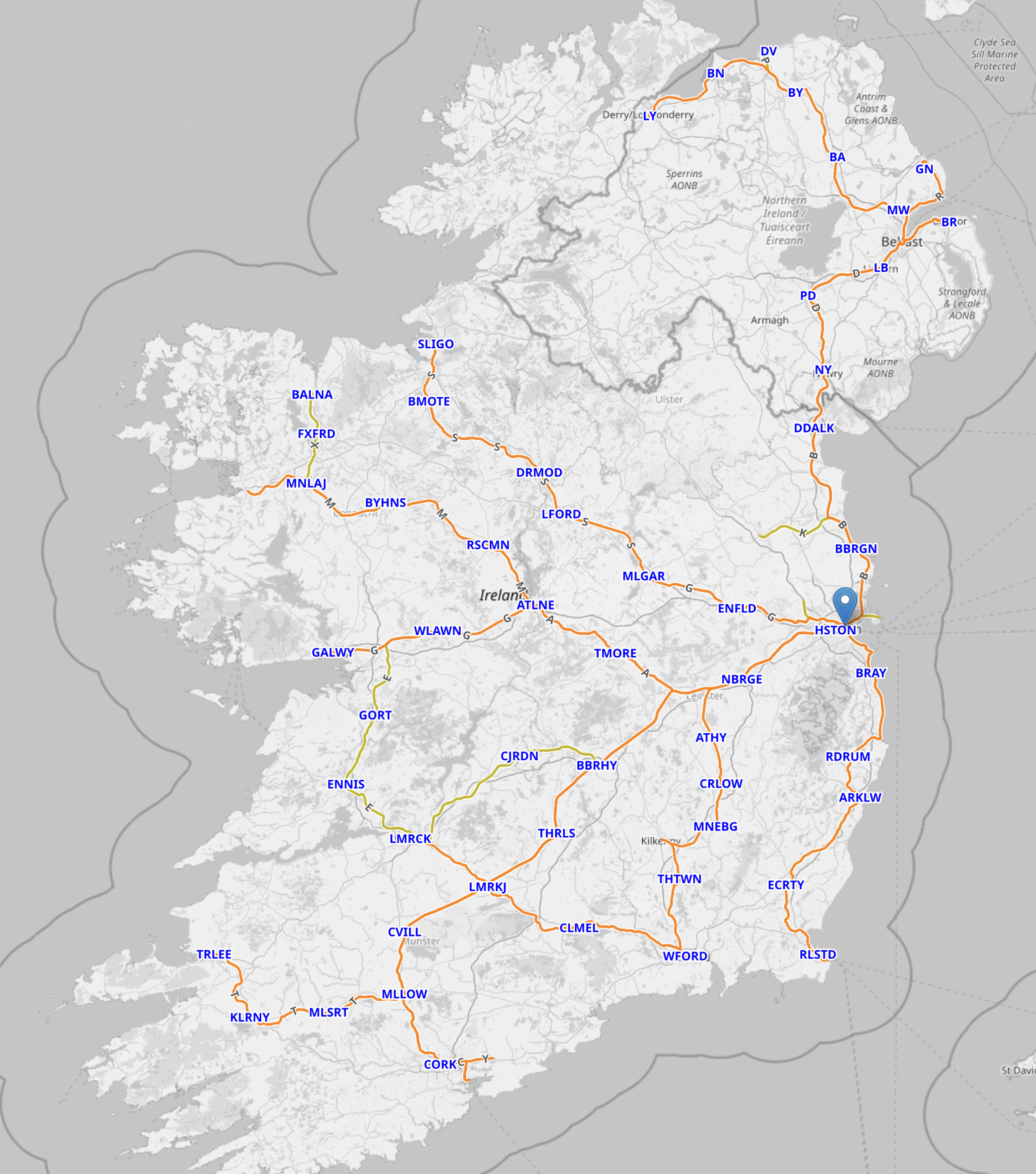
Note.
- All railways on the island of Ireland have an Irish gauge of 1.6 m.
- Only the DART in Dublin is electrified with 1,500 VDC overhead.
- There are 2,733 km. of track.
- New lines are still being added and old ones have been reopened in recent years.
- There will surely be pressure for the Irish to decarbonise their railways, both North and South of the Northern Irish border.
- There are no rail connections to another country, except for the link between Northern Ireland and the Republic of Ireland, which is between two similar systems.
- It is unlikely, that there will ever be a rail link between the Irish gauge railways on the island of Ireland and the standard gauge railways of Europe.
Effectively, the island of Ireland has an isolated network of tracks on which they could build a zero-carbon railway system.
- Signalling could be an off-the-shelf digital system.
- Zero-carbon traction power could be trains powered by either electricity and/or hydrogen.
- Both electricity and hydrogen would need substantial amounts of new rolling stock.
- Electricity would require electrification at €1,000,000 per single track kilometer, which could be around €5.5 billion for the electrification alone.
- Electrification would also need many bridges, stations and tunnels to be modified or rebuilt.
- Hydrogen would need a refuelling infrastructure and could go anywhere that diesel can.
- Hydrogen locomotives and trains, would be one-to-one replacements for diesel locomotives and trains.
It would appear that because of their geographic isolation, hydrogen could be an ideal zero-carbon fuel for the railways of Ireland.
In Do Cummins And Stadler Have a Cunning Plan?, I speculated that the electro-diesel Class 99 locomotive could be converted into an electro-hydrogen Class 99 locomotive, as Cummins are building diesel engines that can be converted into hydrogen ones.
Ireland with its unusual network could change to a zero-carbon railway in the following way.
- Purchase a fleet of diesel locomotives and trains that can run on Hydrotreated Vegetable Oil (HVO) and be convertible to hydrogen.
- A version of the Class 99 with or without the electrical gubbins would satisfy the locomotive replacement.
- A version of the tri-mode Stadler FLIRT like a Class 745 train, would satisfy the train replacement.
- All new trains and locomotives would replace the current stock and run on HVO.
- The hydrogen infrastructure would be built.
- The new trains and locomotives would be gradually converted to run on green hydrogen.
Within a few years, the island of Ireland would have a zero-carbon railway.
Advantages Of A Fully-Hydrogen Railway
These are a few advantages.
- One fuel for all trains.
- All trains and locomotives would be one manufacturer.
- No expensive electrification.
- Hydrogen trains and locomotives have a long range.
- No infrastructure modification for gauge clearance.
- Ireland has plenty of onshore and offshore wind for hydrogen.
- Standard fuelling systems are being developed.
- There would be no disruption as the trains changed to HVO and little disruption as they changed to hydrogen.
I believe that there would be a large increase in train usage both from locals and visitors, which can only be good for the Irish economy.
Managing The Project
This could be one of those rare projects that flows well.
- The changeover to hydrogen could involve very little rail infrastructure work.
- The hydrogen filling stations could be more-or-less independent of the rail infrastructure.
- Trains and locomotives could go into service, when they are accepted and the staff have been trained.
- Trains and locomotives would only be converted to hydrogen, as routes are made hydrogen-capable.
- There should be no gauging problems with the new trains and locomotives.
- There is only one train manufacturer.
Hopefully, it will all be delivered on time and on budget.
Centrica And European Energy Sign Agreement On Måde Green Hydrogen Facility
The title of this post, is the same as that of this press release from Centrica.
This is the sub-heading.
Centrica Energy and European Energy have signed a balancing and optimisation agreement for the Måde green hydrogen facility located at Port Esbjerg. Under the agreement, Centrica Energy will manage power production from co-located wind turbines, designating excess power production to green hydrogen production.
These two introductory paragraphs give more details.
Powering the 12MW green hydrogen facility are two wind turbines, part of the Måde Wind Turbine Test Center, developed by European Energy with a total installed capacity of 16MW. The turbines will provide renewable electricity, which is used to produce green hydrogen through electrolysis with demineralised water.
Expected to produce approximately 1,500 tonnes of green hydrogen every year, European Energy has secured an agreement with Port Esbjerg and a world-class industrial gases company for the offtake from the facility. As the production of hydrogen is a heat-intensive process, the excess heat from production will be fed into the local district heating network, demonstrating sector coupling across the electricity, fuel, and heating domains.
These are my thoughts,
Hydrogen Production
The hydrogen production uses a standard electrolysis method, but excess heat will be fed into the local district heating network.
AquaVentus And Denmark
I introduced AquaVentus in this post called AquaVentus.
This video shows the structure of AquaVentus.
I clipped this map from the video.
Note.
- The thick white line running North-West/South-East is the spine of AquaVentus, that delivers hydrogen to Germany.
- There is a link to Esbjerg in Denmark.
- There appears to be an undeveloped link to Norway.
- There appears to be an undeveloped link to Peterhead in Scotland.
- There appears to be a link to just North of the Humber in England.
- Just North of the Humber are the two massive gas storage sites of Aldbrough owned by SSE and Brough owned by Centrica.
- There appear to be small ships sailing up and down the East Coast of the UK. Are these small coastal tankers, that are distributing the hydrogen to where it is needed?
In the last century, the oil industry, built a substantial oil and gas network in the North Sea.
It appears now the Germans are leading the building of a substantial hydrogen network in the North Sea, that will bring the hydrogen they need to their country.
I also suspect that any spare hydrogen produced in Esbjerg can be added to the AquaVentus network.
- Hydrogen could be sent to Brough and Aldbrough in the UK for storage.
- Hydrogen could be sent to any country in the network that needs it.
Countries will pay for the hydrogen they use.
Optimising AquaVentus
AquaVentus is a complex network.
- Hydrogen could be produced offshore in British, Danish, Dutch, English, German, Norwegian, Orcadian, Scottish and Shetland waters.
- Hydrogen could be sent to Brough and Aldbrough in the UK for storage.
- Hydrogen can be sent to Belgium, Denmark, Germany, Norway, The Netherlands and the UK.
A company like Centrica has the expertise and the software to control the various hydrogen flows to the best advantage of hydrogen producers and users.
The MailOnline’s View Of Pumped Storage Hydroelectricity
The MailOnline gives their view on Pumped Storage Hydroelectricity on the front page of their web site today.
This is the bold title.
Scotland is littered with windfarms. Now the impact of billion-pound hydro projects to store energy they produce threatens our scenic landscapes… and led critics to brand the plans – The Loch Ness Monstrosity
To my mind, the site’s language leaves no doubt that they are not keen on either windfarms or the hydro projects to store energy.
Calling the plans the Loch Ness Monstrosity, is an insult to the engineers, who have devised the plans.
The journalist, who wrote the article has made the same mistake, that many do when they write about any form of energy storage – They only give the output of the battery and not the output and the storage capacity.
Thus Red John Pumped Hydro is described in the article like this.
The £550million Loch na Cathrach venture (formerly known as Red John, after a popular local lochan), is one of the biggest renewable energy projects in the North and was granted consent by the Scottish Government in June 2021 despite strong objections from campaigners and Highland Council but has yet to be built in the hills near Dores.
The 450MW project owned by Norwegian state firm Statkraft hopes to start construction next year and be operational by 2030.
Note.
- Red John is a 450 MW project with a storage capacity of 2,800 MWh, which is conventionally shown as a 450 MW/2,800 MWh battery.
- A battery of this size can supply 450 MW for 6.2 hours, which is more than a lithium-ion battery of the same cost could manage.
- 450 MW is about the average size of a gas-fired power station.
Where the geography is suitable, pumped storage hydroelectric stations may be able to replace gas-fired power stations.
- There would be no cooling towers.
- There would be no chimneys or associated pollution.
- The electrical gubbins to connect to the grid would be the same and could probably be refurbished.
The new lake could be used for water-based activities like fishing, sailing skiing and swimming.
Conclusion
Obviously, playing the Nimby-card sells newspapers.
 The Anonymous Widower