The Netherlands Chooses Site For World’s Largest Offshore Wind-to-Hydrogen Project
The title of this post, is the same as that of this article on offshoreWIND.biz.
This is the sub-heading.
The Dutch government has designated an area for what will become the world’s largest offshore hydrogen production project. That area is Ten noorden van de Waddeneilanden (the North of the Wadden Islands), identified earlier for offshore wind development and deemed most suitable for providing 500 MW of electrolysis capacity and for the transport of hydrogen to land.
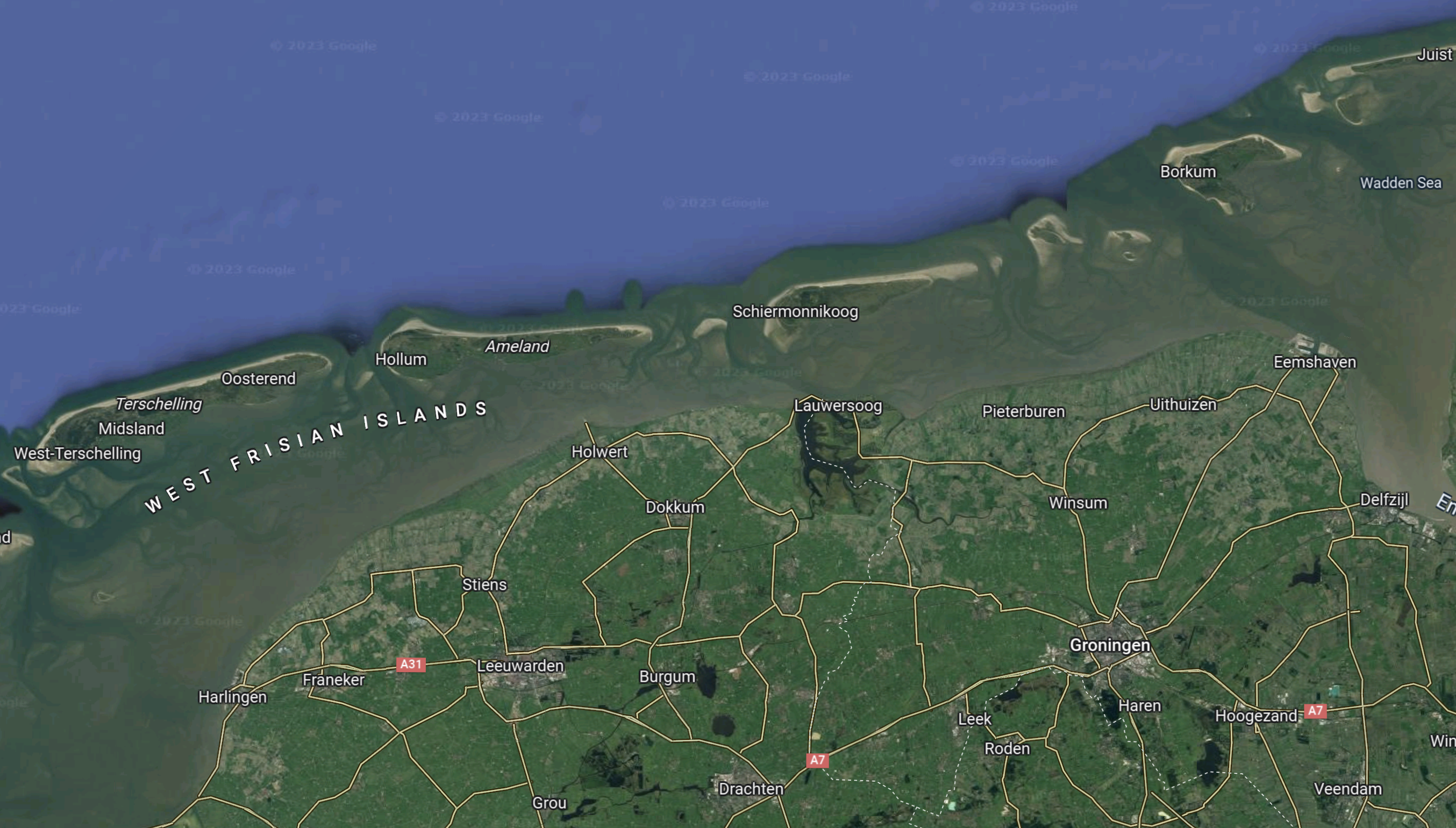
This Google Map shows the Wadden Islands.
Note.
- Groningen is in the South-East corner of the map.
- I wrote about Eemshaven, which is to the North-East of Groningen in The Train Station At The Northern End Of The Netherlands.
- The Wadden or Frisian Islands are along the coast.
The Wadden Islands of the Netherlands, Germany and Denmark are a World Heritage Site.
In Can The UK Have A Capacity To Create Five GW Of Green Hydrogen?, I said the following.
Ryze Hydrogen are building the Herne Bay electrolyser.
- It will consume 23 MW of solar and wind power.
- It will produce ten tonnes of hydrogen per day.
The electrolyser will consume 552 MWh to produce ten tonnes of hydrogen, so creating one tonne of hydrogen needs 55.2 MWh of electricity.
If the Dutch build a 500 MW electrolyser it will produce 217 tonnes of hydrogen per day.
The Dutch Plan For Hydrogen
This 500 MW electrolyser fits well with the The Dutch Plan For Hydrogen.
Lhyfe And Centrica To Develop Offshore Renewable Green Hydrogen In The UK
The title of his post is the same as that of this news item from Centrica.
These are the bullet points.
- Memorandum of Understanding will pave the way for green hydrogen pilot production site at sea
- Energy firms explore large scale partnership in drive to net zero
- Aim for UK to become a global leader in the hydrogen sector
This is the third paragraph, that outlines the objectives of the project.
The pilot will aim to combine Lhyfe’s expertise on green hydrogen production and Centrica’s experience of gas storage and infrastructure to ensure that the hydrogen produced can be safely stored and utilised in the UK. The end result would be proof that an end-to-end hydrogen production, storage, and distribution system is possible in the country.
I have a couple of thoughts.
Offshore Production Of Hydrogen
I remember from the 1960s, when I told friends and my mother, that I worked in a hydrogen factory, some of them asked if it was dangerous.
The Hindenburg and the R 101 had a lot to answer for even forty years later.
But does that fear of hydrogen still exist? If it does, surely building hydrogen electrolysers offshore could be a way of reducing that fear?
There are also other reasons to produce hydrogen offshore.
- The latest electrolysers will work with sea water, which means the water doesn’t need to be desalinated first.
- The hydrogen can be brought ashore and stored using redundant gas infrastructure.
- Using redundant gas infrastructure may be a more affordable way of bringing energy onshore.
- A severe hydrogen leak may be much less dangerous 50 km. offshore. It will quickly disperse and rise into the atmosphere.
The accountants will probably decide.
Do Centrica Have Big Ambitions For Hydrogen?
This is said about Centrica in the news item.
- Centrica is a leading international services and solutions company with ambitious plans across the business to reach net zero by 2045. Centrica have identified hydrogen as playing an essential part in company and UK targets to achieve net zero.
- Centrica Storage are a 100% owned subsidiary of Centrica and own and operate the Rough gas field storage facility, located off the coast of Humberside.
- Centrica has a long-term ambition to turn Rough into the world’s largest hydrogen storage facility in Europe.
Centrica appear to have big ambitions for hydrogen.
Ricardo – The Role Of Hydrogen In The Green Aviation Revolution
The title of this post, is the same as that of this article on Hydrogen Central.
This is the third paragraph.
The introduction of zero-emission aircraft will enable us to re-think our approach to regional connectivity and the way we currently fly. A recent report by Project NAPKIN stated that zero-carbon emission flight is entirely possible from the middle of this decade on sub-regional routes, on aircraft ranging in size from seven to 19 seats.
It makes a bold statement.
The article is a must read.
DHL Express Determinedly On Course To Achieve Net-Zero Emissions
The title if this post is the same as that of this article on The Lodestar.
This was the introductory paragraph.
DHL Express chief executive John Pearson came out with all guns firing when detailing the firm’s efforts to hit net-zero by 2050, during a press junket this week.
The rest of the article is basically in three sections.
The Use Of Sustainable Aviation Fuel (SAF)
Summed up by three sentences.
“When it comes to sustainable aviation fuel (SAF), we know this is expensive, but we have also put a big chunk of change into this,” he said.
By the end of the year, we want 2% of flights fuelled by SAF.
DHL has bought 15% of all globally available SAF
DHL seem to have a comprehensive policy on the use of SAF.
This reinforces my view that SAF will be important.
Alternative Approaches
This paragraph sums up some of the more alternative approaches DHL are looking at.
SAF use forms only one part of the migration to net-zero: fleet renewal; decarbonising ground handling; a fuel optimisation programme; and the use of electric aircraft, following the successful September trial over Seattle of the Alice e-cargo plane, are all critical.
I suspect there are other alternative approaches.
Fleet Renewal
The last two paragraphs talk about fleet renewal.
Fleet renewal comes after a particularly pronounced moment of growth for the company: it added 10 widebody and 70 small- and medium-body planes during the pandemic.
Described by Boeing as one of the most “fuel-efficient” aircraft on the market, thanks to its twin-engine design, the 777 freighter forms a central part of DHL Express’ renewal plans, said Mr Pearson, adding that 28 were on order.
With 28 777 freighters on order, DHL will need a lot of SAF.
A Last Thought
Given the size of DHL’s fleet, which in their Wikipedia entry is given as 197, seventy-three of which are narrow bodies, I am surprised that no dedicated zero-carbon small or medium-sized cargo aircraft, except for the Alice is under development.
Perhaps, in areas like Europe, this niche is being taken by rail or perhaps by Airbus’s proposed hydrogen-powered ZEROe Turbofan.
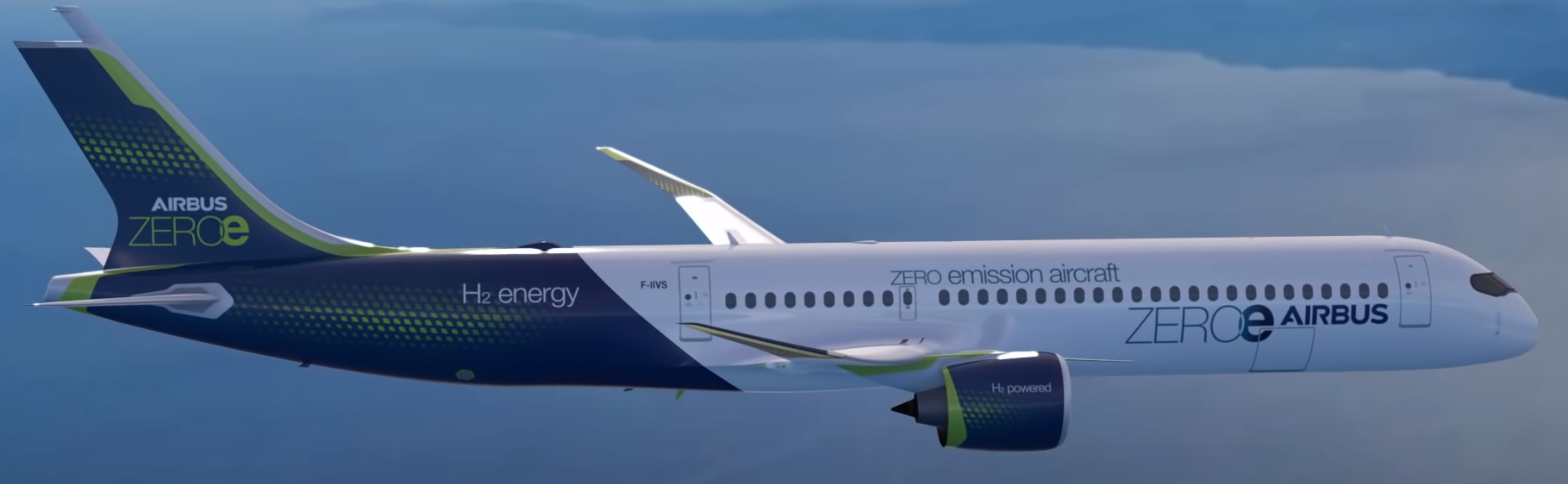
I wrote in detail about this hydrogen-powered aircraft in Could An A320 neo Be Rebuilt As A ZEROe Turbofan?.
Airbus say that the passenger version of the ZEROe Turbofan could handle up to 200 passengers, despite having a large hydrogen tank in the rear fuselage.
The cargo capacity of a ZEROe Turbofan would probably be a bit smaller than say the latest Airbus A321 or Boeing 737, but if the hydrogen-powered aircraft was built to accept a stretch, I wouldn’t be surprised to find it was a viable aircraft for DHL, with a fuselage stretch!
It would surely help passengers of future hydrogen-powered aircraft, overcome their fear of an aircraft fueled by hydrogen.
The ZEROe Turbofan is quoted as having a range in excess of two thousand nautical miles, so it would have Europe and North America fairly well covered.
I also wouldn’t rule out use of Airbus’s proposed hydrogen-powered ZEROe Turboprop for flying cargo.
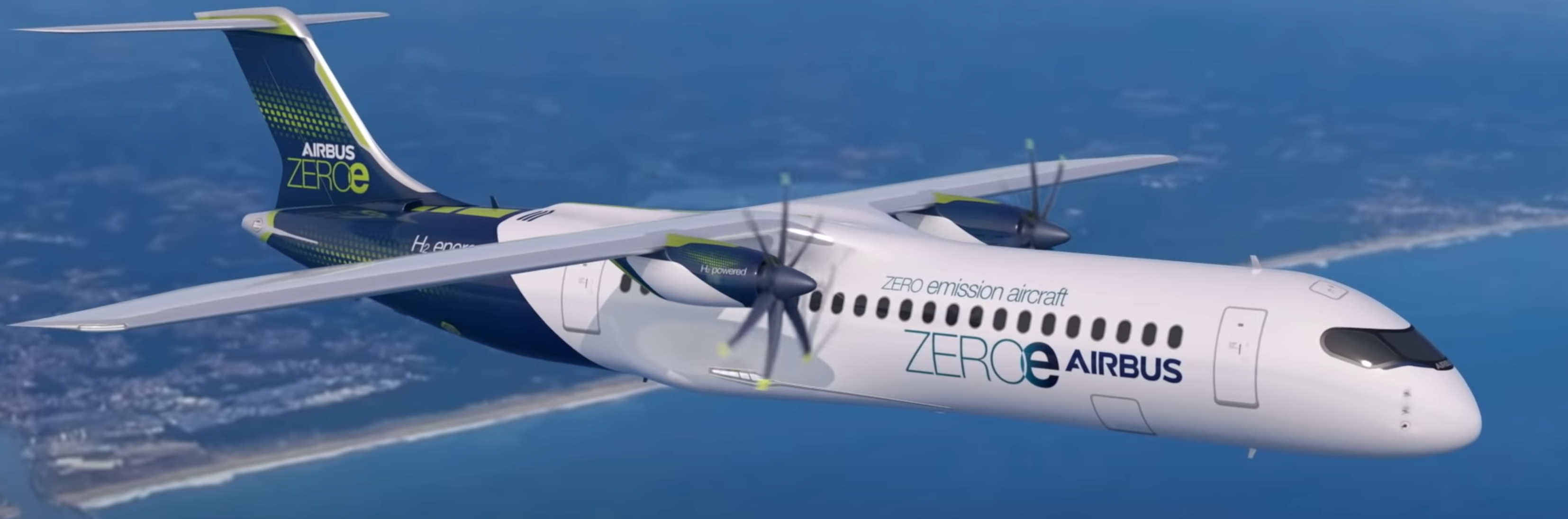
It would have a smaller capacity than the ZEROe Turbofan.
- It would have a useful range of over a thousand nautical miles.
- I feel that both ZEROe aircraft have the same fuselage cross-section, which could ease cargo handling, by using the same equipment for both aircraft.
- I also feel that both ZEROe aircraft will have the same cockpit, which should reduce crew costs.
I feel that smaller cargo aircraft will play a large part in the development of hydrogen-powered aircraft.
If the plans of some companies and individuals work out, hydrogen might be a better alternative financially to SAF.
Budweiser To Convert Second UK Brewery To Hydrogen
The title of this post, is the same as that of this article on The Engineer.
This is the sub-heading.
Samlesbury Brewery in Lancashire is set to be powered by green hydrogen from 2025, according to new plans announced by owner Budweiser Brewing Group.
This paragraph outlines what will be done at Salmesbury.
The Samlesbury Net Zero project will see the brewery paired with a new hydrogen production facility (HPF), delivered by UK hydrogen services company Protium. Situated adjacent to the brewery, the HPF will provide green hydrogen to meet the thermal demand of the brewing processes, as well as the building’s other heating requirements.
Note.
- A refuelling station for hydrogen-ready HGVs will also be developed as part of the project.
- Heat from the HPF will be recovered and used in Budweiser’s bottling process.
- This is the second project involving Budweiser and Protium, after one at Magor in South Wales.
- Beers produced at the facility include Budweiser, Stella Artois and Corona.
I may have had the odd bottle of Corona in the States, but I’ve generally drunk real ale only since, I started having halves of Adnams with my father at the age of thirteen.
Now, because I’m on Warfarin, I more or less exclusively drink zero-alcohol beers, most of which is Adnams, straight from the brewery.
I’ve yet to find any beer which is less than 0.5 % alcohol, has contained enough gluten to have an effect on my gut.
I have discussed this with experienced brewers and they are not surprised, as the brewing process for zero-alcohol beers doesn’t use much barley.
Conclusion
We need more integrated projects like this, that both decarbonise industrial processes and provide filling stations for hydrogen-powered vehicles.
Scottish Hydrogen Fuel Tank – SHyFT
The title of this post, is the same as that of this page on the Innovatus Technologies web site.
This is the sub-heading.
Advanced Flexible Form Factor and Lightweight Multi-Chamber Type IV & V Hydrogen Storage Vessel
These paragraphs outline the product.
SHyFT is a unique Type IV or V composite high-pressure vessel unlike conventional large, heavyweight cylindrical vessels. The unique multi-chamber composite design, aided by patented composite technology and recyclable materials, allows for SHyFT to conform to any form factor specific to our customers needs.
SHyFT’s largest model boasts the worlds highest Gravimetric Storage Density of 10%, allowing 5.4 KG of hydrogen storage. This is a significant 10% increase on current market leaders in composite storage of gaseous substances.
The core composite technology drives a 25%+ weight and 20%+ cost reduction, whilst providing superior quality and technical performance for a more efficient and economical product. With SHyFT, various market applications such as commercial, personal and industrial transport, Marine and UAV, can be easily dominated creating a higher value proposition for our customers.
As with other companies in the past, like Pilkingtons, Rolls-Royce and Skeleton Technologies, who have developed a unique product, I suspect that the key is a special purpose machine that makes the tanks. I have two friends in Cambridge, who specialise in making unusual manufacturing machines and they are very busy.
I first came across this company as they are named in the Wikipedia entry for Project Fresson, which is a part-Scottish project to create a hydrogen-powered Islander aircraft.

Innovatus Technologies are building the composite hydrogen fuel tanks. Two, which are coloured green, appear to be mounted below the wings and there could be others inside the fuselage.
This company could solve one the major problems with hydrogen applications – How to cram in enough of the gas to make the application possible!
Conclusion
I predict a big future for this company, unless the Chinese or other idea-stealers ruin the market.
This Hydrogen Combustion Engine Is The EV Alternative We’ve Been Waiting For – HotCars
The title of this post, is the same as that of this article on Hydrogen Central.
This must-read article is a reprint of an article in hotcars and it details the technology and thinking behind JCB’s new hydrogen engine.
As someone who believes, that hydrogen is the only way to go to power zero-emission vehicles in the future, I advise all hydrogen sceptics to read this article.
These two paragraphs, explain the thinking behind why JCB turned to hydrogen.
As they say, necessity is the mother of invention. JCB was struck with the problem of going zero emissions without sacrificing power and cost of purchase. In a previous Harry’s Garage episode, Lord Bamford, Chairman of JCB, mentioned that passenger cars, on average, run about 300 hours per year. In contrast, a regular heavy-duty backhoe would have running hours close to 10 times that amount. He adds that in countries like India, machines of this scale run for at least 5000 hours per year.
So, to have electricity run an industrial equipment for eight hours at the minimum requires significantly more batteries. Not only does it skyrocket the costs involved, but it will add a ton of complexity and increase the overall weight. Therefore, engineers had to think radically.
Many believe that Hydrogen engines will pump out loads of nitrogen oxides.
These two paragraphs outline JCB’s solution.
A known disadvantage of a hydrogen ICE is the production of Nitrogen oxides or NOX. The reason is high operating temperatures. JCB engineers, however, found a clever way to circumvent this by running the engine on a lean mixture of fuel. Hydrogen for a given mass has three times the energy density of its diesel equivalent.
This allowed the team to get the same torque figures without running the engine too rich. Another way to get rid of NOX is through selective catalytic reduction, a common practice in modern diesel engines.
It is my belief, that if a company or engineer solves the problem of making a small hydrogen internal combustion engine, they will make an absolute fortune, that will make Microsoft and Bill Gates look like paupers.
Engineering is the science of the possible, whereas politics is dreams of the impossible.
Hydrogen Truck Can Make Garbage Day A Much Quieter Event
The title of this post in the same as that of this article on Hydrogen Fuel News.
This is the first paragraph.
Hyzon Motors has announced that it will be rolling out a 27-ton Australian-made hydrogen truck to be used for vehicle towing as well as potentially for garbage collection this year.
Less noise, less pollution\2 What more can you want?
In London, we something rather important, a hydrogen policy, rather than a Mayor, who hopes the problem will fade away.
The writer of this article finds it interesting, that Hyson, who are an American company are making the trucks in Australia.
They say this.
Hyzon opened an Australian location three years ago in order to benefit from the substantial industry talent that became available there when Ford, Toyota and Holden closed their local operations. As the country also places a considerable focus on H2 production, it has opened several doors for moving forward with various types of hydrogen truck design.
So vehicle manufacturers beware! If you close an operation in a country, you may find competitors starting up!
No Shortcuts In Evia Aero’s Path To Being Europe’s First Green Regional Airline
The title of this post, is the same as that of this article on FutureFlight.
This is the first paragraph.
The closer you examine the task of establishing a green airline, the clearer it becomes that it does not begin and end with sourcing net zero carbon aircraft. Evia Aero is a case in point in that while the German start-up has made provisional commitments to a pair of electric aircraft developers, for now, it is more preoccupied with getting a somewhat daunting operational ecosystem in place.
The article is an interesting read and certainly follows this old joke about aviation.
If you want to make a small fortune in aviation, start with a large fortune.
The article is mainly drawn from an interview with the founder of Evia Aero; Florian Kruse and these are some of his thoughts.
On Sustainability
This paragraph talks about a truly sustainable aviation company.
First you have to be sure that you can operate as a truly sustainable aviation company,” Evia Aero founder Florian Kruse told FutureFlight. The Bremen-based venture plans to invest in photovoltaic (PV) solar energy plants at the airports it intends to serve to fulfill its commitment to being self-sufficient in green energy, which could include electricity and hydrogen fuel. The next step will be installing the required refueling and recharging facilities.
I’ll agree with that objective, but is it an affordable commitment?
On An Air Operator Certificate
This paragraph talks about an Air Operator Certificate.
Only when these tasks are well advanced, probably in 2024, will Evia Aero secure the air operator certificate it needs to launch commercial scheduled services in Europe. The company has yet to determine whether it will establish an operation from scratch or acquire an existing AOC holder.
Having seen a friend struggle to get an airline going, I wonder, if existing AOC holders will have an advantage in getting fully certified.
Why Not Start A Traditional Airline And Transition To A Green One?
This was Florian Kruse’s answer.
Some people ask us why we don’t just start operating normal [fossil-fuel-burning] aircraft today and then make a transition [to net zero],But we don’t think that works. The only way to be successful in this is to be green with everything from the start.
But by his choice of the Britten-Norman Islander, Florian is taking a conservative route with a proven small airliner, that has been flown into hundreds, if not thousands, of airfields all over Europe and the wider world.
I suspect too, that a lot of experienced Islander pilots from all over the world, will want to add these aircraft to their log book. So recruitment of top quality pilots will not be a problem!
Refuelling And Maintenance
This is said about refuelling and maintenance.
In this regard, Evia Aero’s strategy isn’t based purely on a sustainability agenda. It views the plans for refueling and maintenance as key parts of its revenue stream.
Does this mean, it will be supplying support services to other operators of zero-carbon aircraft?
It should be remembered that the business model of some companies is based heavily on a business aircraft. Will these companies change their philosophy or change the aircraft?
One company that used business jets to sell construction equipment in the past was JCB. Prospective customers would be flown to the UK for demonstrations at their test site near the factory. GEC also used to use their business jet creatively.
The Eviation Alice, which Evia Aero intend to fly, will also be available in a six-seat business configuration.
I can imagine many companies using zero-carbon business aircraft creatively and to send the right message to customers and green activists, who haven’t been friendly in the past.
Thinking about this, as I type, I think that zero-carbon business aircraft could be a significant sector of the zero-carbon aircraft market. It would also appeal to many politicians, royalty, innovative business me and women and the very rich.
In the case of King Charles, I suspect a six-seat Eviation Alice or similar based at Northolt Airport would cost less to run than the Royal Train.
Pricing
This is said on pricing.
It believes (passengers) will pay a premium to access airfields in locations across northern Europe that are not well served by road and rail links.
I’ll go with that, as many years ago, I needed to go to Stavanger for a day or so from Ipswich. So I flew Air Anglia from Norwich in a Bandeirante, rather than go from Heathrow with a change at Oslo.
Backing And Expertise
This is a paragraph from the FutureFlight article.
Evia Aero is not without expertise as it seeks to put these building blocks in place. One of its backers, Energiequelle, is involved in a business that owns and operates PV plants in Finland and Germany. Its leadership team also includes Gerd Weber, CEO of regional airline OLT, and the chair of its advisory board is Axel Trampnau, who previously ran the carrier Germania.
That seems reasonably strong.
If Energiequelle live up the mission statement on their web site, they could be particularly useful.
Hydrogen-Powered Islanders
This is said about their purchase of conversion kits for Islanders to be converted to hydrogen power.
Under current plans, the first aircraft in the Evia Aero flight will be nine-passenger Britten-Norman Islanders under a plan being advanced by Cranfield Aerospace Solutions (CAeS) to convert the piston-powered models to hydrogen propulsion. Evia Aero expects these aircraft to be ready to enter service in 2026 and has agreed to buy 15 of the conversion kits.
The Islander may have flown nearly sixty years ago, but nearly 1300 have been built and they are still being manufactured, so there should be plenty available from conversion and spare parts shouldn’t be a problem.
Cranfield Aerospace Solutions, is a spin-out of Cranfield University and the article says this about an ongoing project between CAeS and Evia Aero.
In 2022, the new airline signed a wider agreement with CAeS covering a provisional order for 10 hydrogen-powered 19-seat aircraft. The companies have not yet determined whether these would be conversions of existing aircraft or a clean-sheet design. Under the UK’s Project Fresson, CAeS is working on plans for new 19- and 75-seat zero-emissions regional airliners.
CAeS look like another serious contender in the zero-carbon airliner market.
Eviation Alice
This is said about the Eviation Alice.
Evia Aero has signed a memorandum of understanding covering provisional orders for 25 of Eviation’s nine-passenger, all-electric Alice aircraft. It expects to add the first of these to its fleet in 2028, a year after the U.S.-based manufacturer now says it aims to complete type certification, initially with the FAA.
Note.
- Alice is running two years behind the Islander.
- Certifying the Islander should be easier as it is an existing airliner.
I could see the earlier delivery and entry into service of the Islander, being used to develop the business.
Range And Routes
This is said about range and routes.
With either of these aircraft, Evia Aero will be launching its services with the equipment providing a modest payload and range. The Cranfield Islanders will be able to fly up to around 200 kilometers (109 nm), while Eviation last year reduced its range projections from 440 to 250 nm, citing the limitations of current battery technology.
Kruse accepts these limitations, while already laying plans to add subsequent 19-seat aircraft to his fleet. He showed FutureFlight route maps for both aircraft including planned destinations extending along the North Sea and Channel coasts from Denmark through Germany and the Benelux countries and into France and the UK.
- The range isn’t that long.
- It is 629 kilometres between Evia Aero’s base at Bremen and Southend.
- Schiphol is closer at 89 kilometres with Groningen at 147 kilometres.
But the interesting one is Heligoland at 139 kilometres.
Heligoland
This Google Map shows the archipelago.
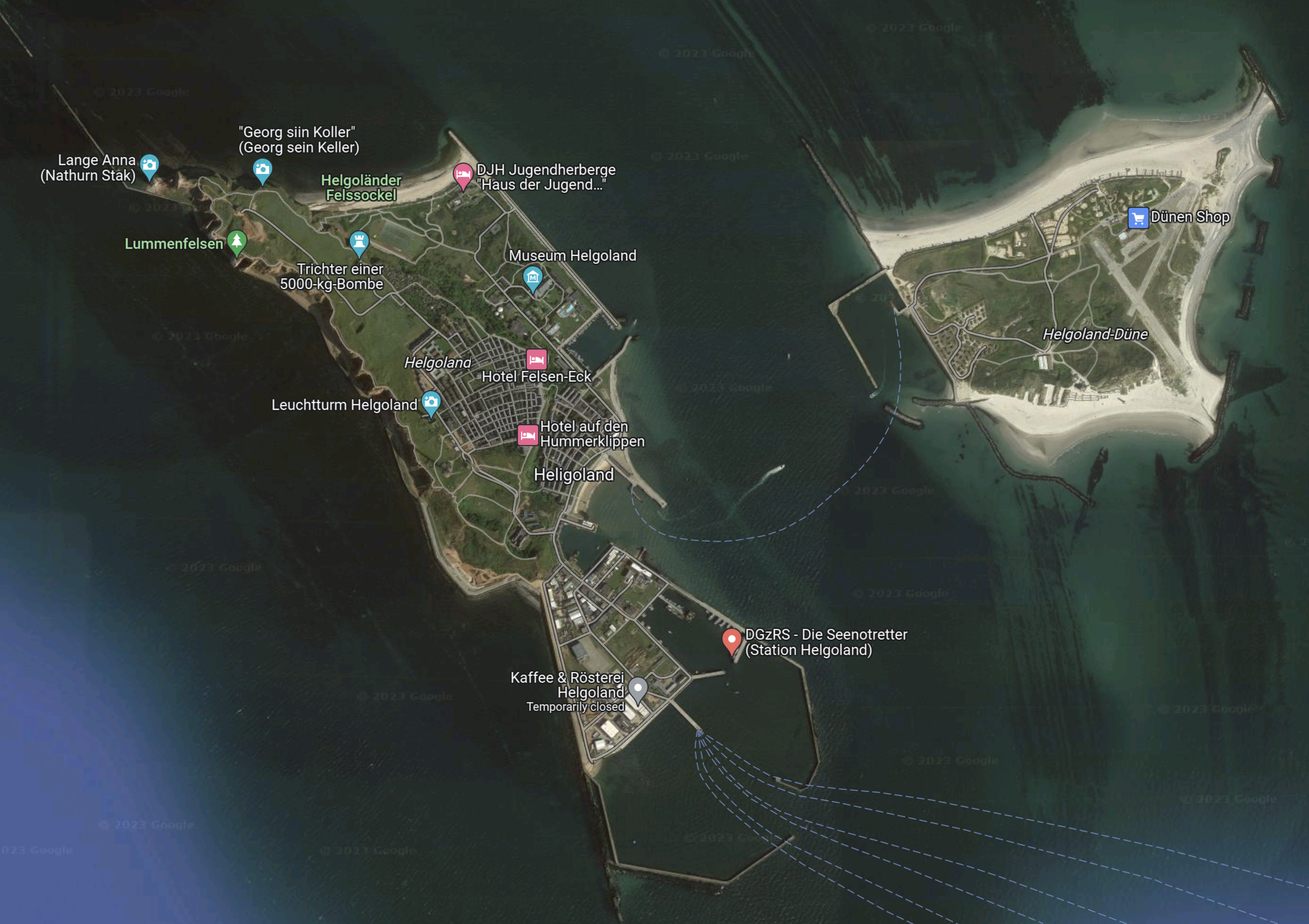
Note.
- Heligoland is the island in the West.
- Düne is the island in the East.
- You can just pick out the characteristic pattern of Heligoland Airport‘s three concrete runways.
Why would anybody want to go to a rock in the North Sea?
This article on the Guardian, which is entitled Heligoland: Germany’s Hidden Gem In The North Sea, gives lots of reasons, including.
- History.
- It is a regular day trip from the German coast by ship.
- It used to be British.
- It could be at the heart of offshore wind developments.
But for German day-trippers, it’s probably the attraction of the island being duty-free.
It could be a nice little earner for an airline based in Bremen and it would be within the range of the Islanders.
A Pattern Of German Islands
This Google Map shows the German corner of the North Sea.
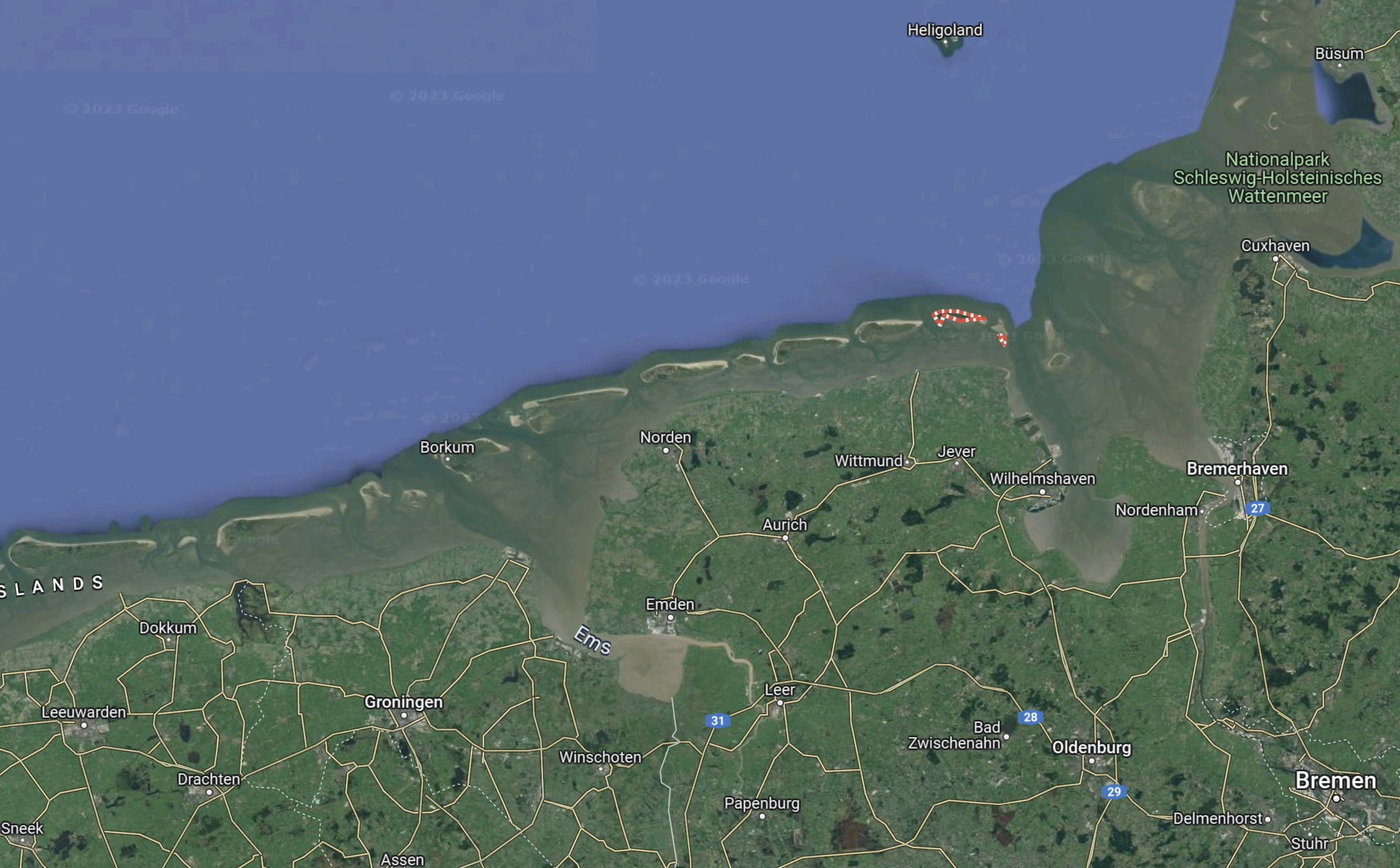
Note.
- The island of Heligoland at the top of the map.
- Bremen in the South-East corner of the map.
- The string of islands along the German and Dutch coasts.
- The red area marks out the most-Easterly island of Wangerooge.
This Google Map shows Wangerooge in detail.
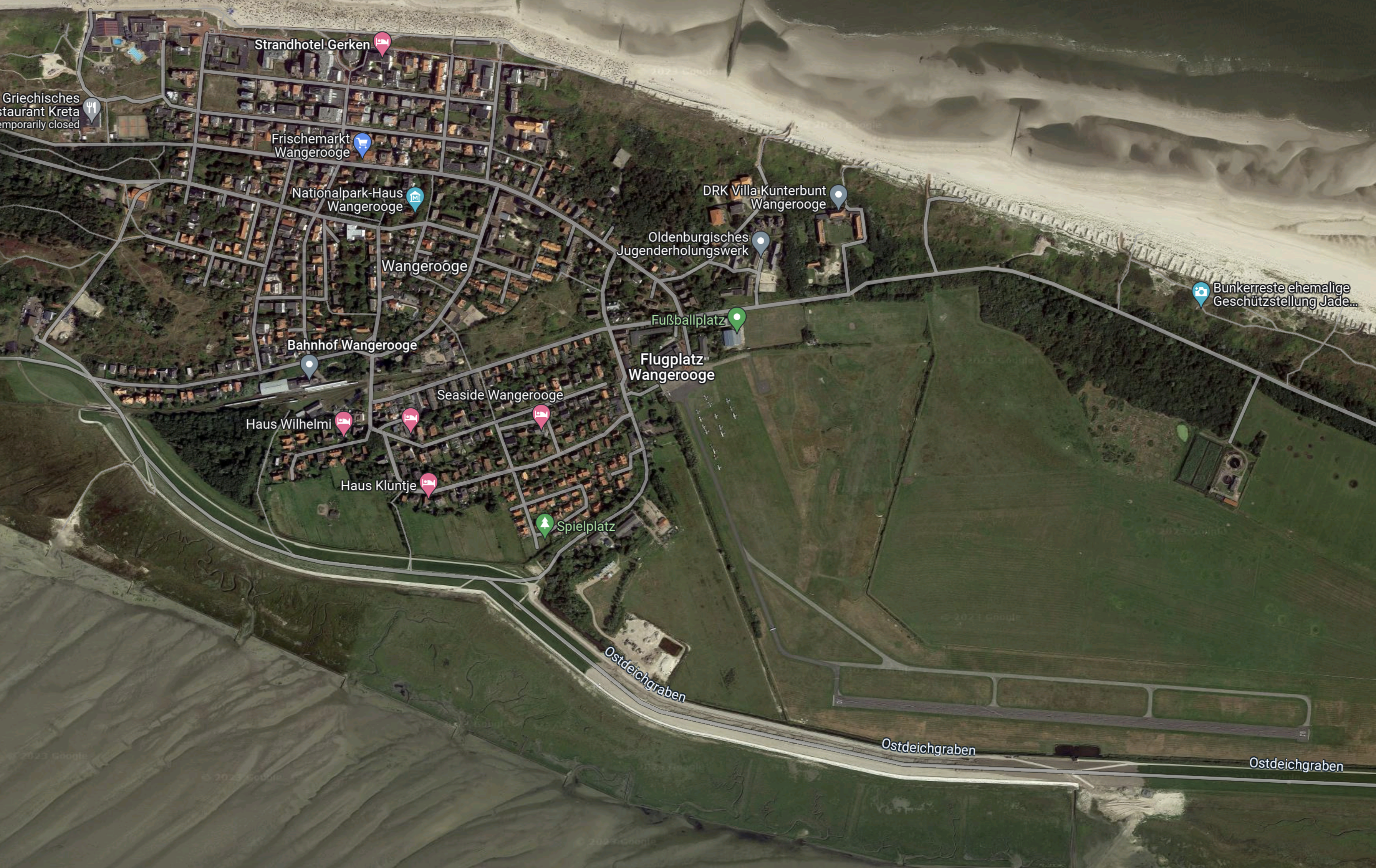
Flugplatz Wangerooge is in the South-East corner of the map.
- It has an 850 metre asphalt runway.
- The island appears to have a sizeable beach.
- The island has a population of around 1200.
The Wikipedia entry for Wangerooge says this about the character of the island.
In order to guarantee a relaxed atmosphere, cars are prohibited on the island. The island can be reached by ship from Harlesiel, or it can be reached by plane via its airfield, regular service being offered from Harlesiel, Bremen, or Hamburg. The ferries leave at different times every day according to the tide. As on most East Frisian Islands, a small narrow gauge railway line, the Wangerooge Island Railway, connects the harbor to the main village.
The Wikipedia entry, for the Wangerooge Island Railway gives a lot of detail about what looks to be a fascinating railway, including this opening paragraph.
The single track Wangerooge Island Railway (Wangerooger Inselbahn) is an unelectrified narrow gauge railway with a track gauge of 1,000 mm (3 ft 3+3⁄8 in) located on the East Frisian island of Wangerooge off the northwestern coast of Germany. It is the most important means of transport on the island and is the only narrow gauge railway operated today by the Deutsche Bahn.
I must visit next time, I go to Hamburg.
Working towards the West the next airfield, I can find is on Langeoog, which is shown in this Google Map.
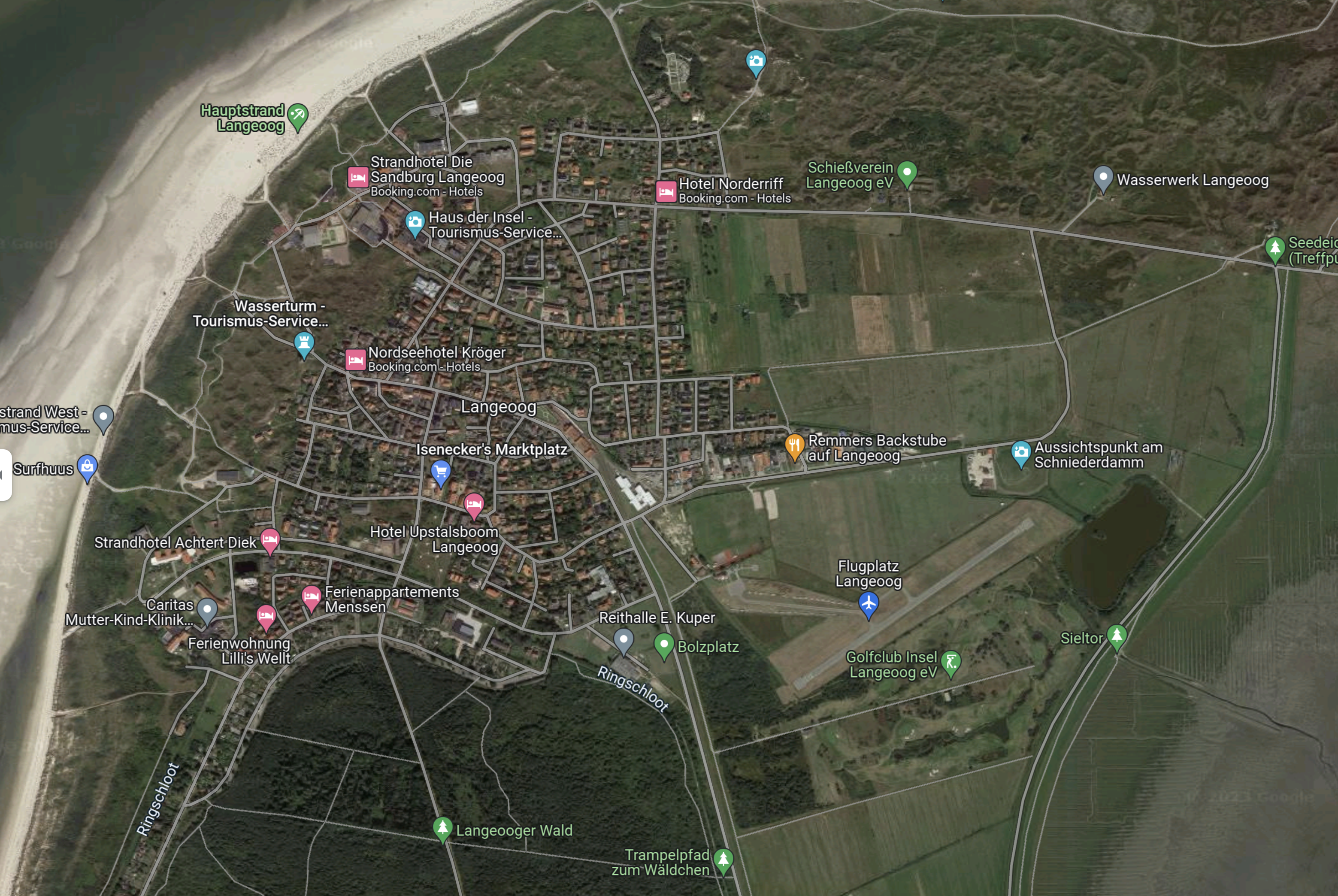
Flugplatz Langeoog is marked by the blue arrow towards the South-East corner of the map.
Working towards the West the next airfield, I can find is on Nordeney, which is shown on this Google Map.
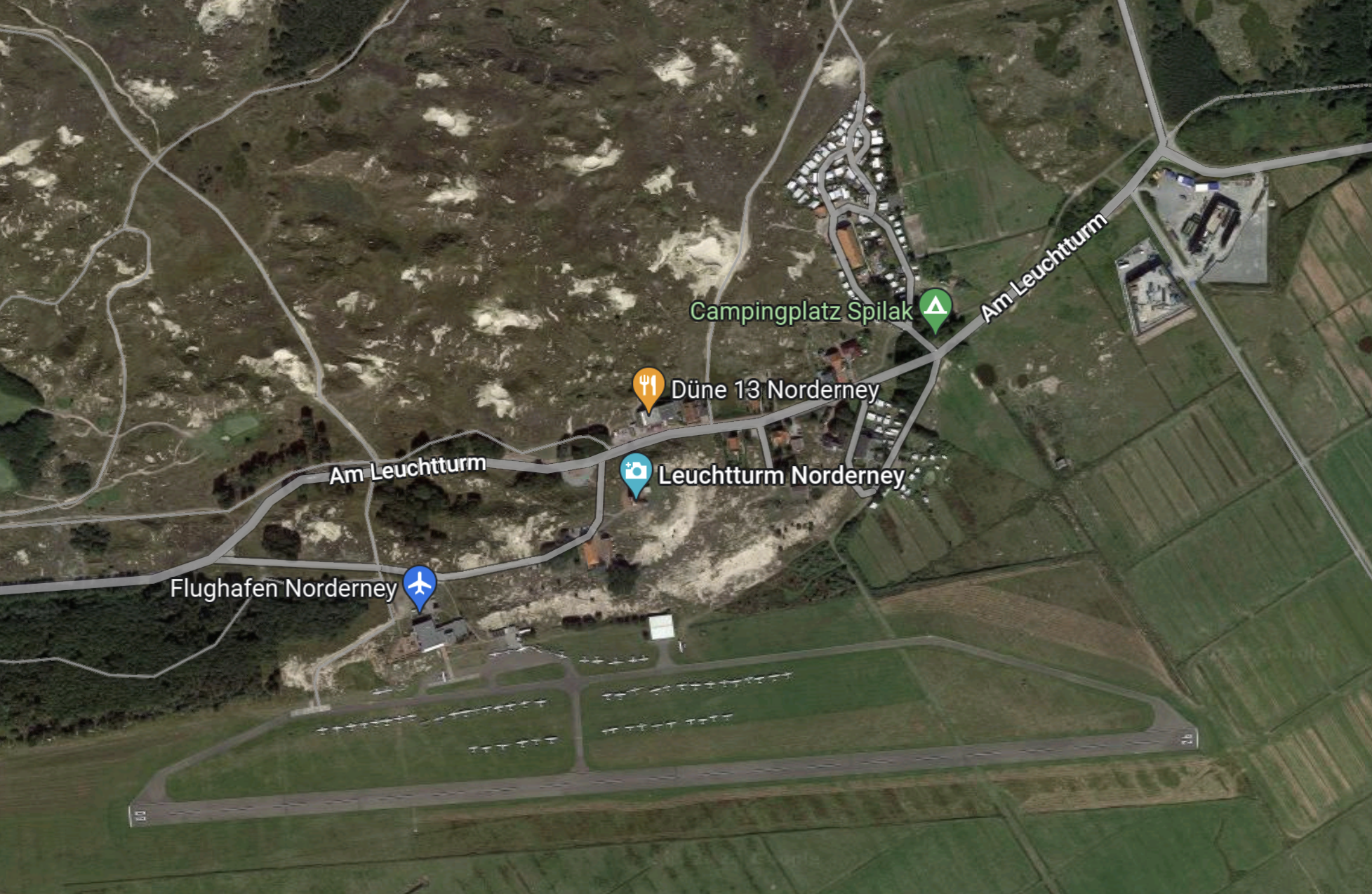
Flughaven Nordeney is at the bottom of the map.
It has a 1000 metre runway and judging by the planes on the map, it is very busy.
Continuing West brings me to the Eastern end of the island of Juist, which is shown on this Google Map.
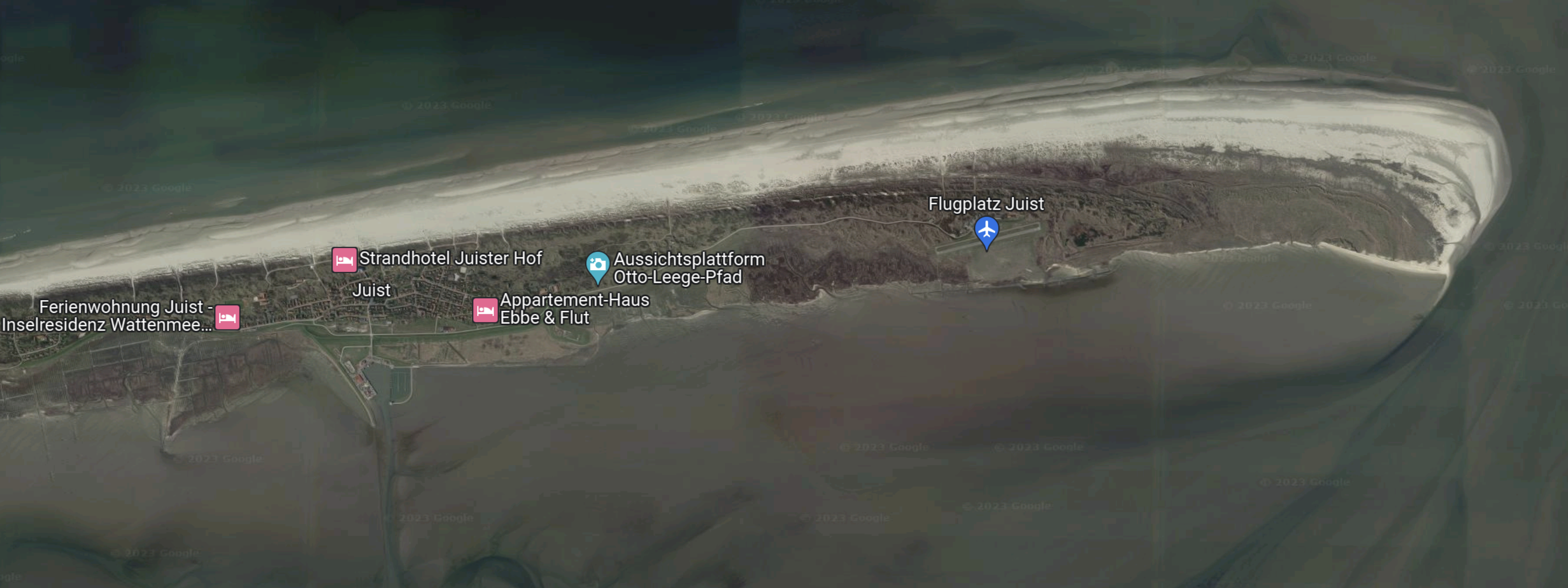
Flugplatz Juist is indicated the rightmost blue arrow. This extract from the Wikipedia entry, illustrates the importance of this airfield.
As of 2013, the airfield had up to 500 takeoffs and landings on weekends, the second most aircraft movements in the state of Lower Saxony, after Hannover Airport. The airfield is a critical piece of infrastructure for the island, due to ferry traffic being dependent on the tides.
The airfield was also the first on the East Frisian Islands to have a paved runway
Continuing West brings me to Borkum, which is shown on this Google Map.
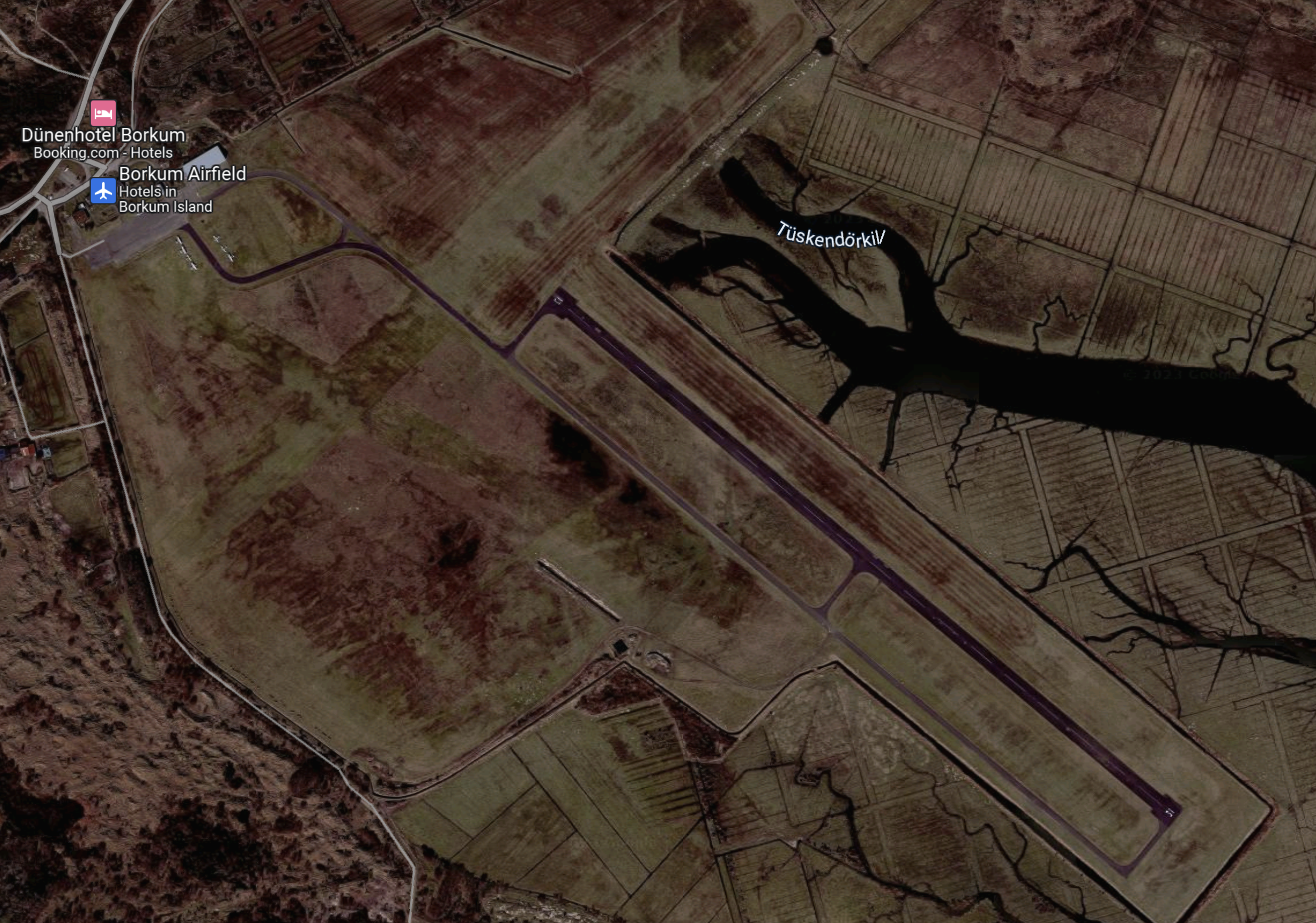
Note.
Borkum Airport is in the Eastern half of the map.
- It has a 1000 metre asphalt runway.
- Borkum has a population of around 5000.
On this brief exploration of the German East Frisian Islands, I have been surprised to find five airfields; Borkum, Juist, Langeoog, Nordeney and Wangerooge.
- All seem to have asphalt or concrete runways.
- Were these runways built as part of a plan to improve transport to the islands, as it appears the tides make the ferries a bit variable?
It also appears that the islands are totally or at least partially car-free.
On one island I noticed that the taxis are horse-drawn carriages.
So does this all fit well with the philosophy of Evia Aero of flying zero-carbon aircraft?
I suspect it does.
I also think, that Evia Aero’s thinking has been influenced by recent events in the area, which I talked about in From Groningen To Leer By Train.
- To put it simply, a freighter called the Emsmoon, demolished the Freisenbrücke, which carries the Groningen and Bremen railway over the River Ems.
- Zero-carbon aircraft flying between Groningen and Bremen would be a viable and quicker and more comfortable alternative to the bus I took.
I wonder if Evia Aero are planning a service between Groningen and Bremen.
- Groningen and Bremen is 147 kilometres.
- Islanders can cruise at 240 kph.
- The service could call at the five intermediate airports.
- I would reckon, that the service would take about an hour between Groningen and Bremen.
- The aircraft would be refuelled at Groningen and Bremen.
- I am fairly certain that two planes could run an hourly service.
I also suspect that the ticketing could be run by an app and if there were no passengers wanting to get on or off at an intermediate stop, then the plane would continue to the next stop, which would save fuel. If a passenger missed a plane, there would be only a wait of an hour until the next one.
Get this right and if it proves successful, then extra services could be added, to create a true Turn-Up-And-Go air service.
Landing And Take-Off Performance
This is a paragraph from the FutureFlight article.
Both the Islander and the Alice offer short takeoff and landing performance that will allow them to get in and out via limited runways in small communities. In the case of the Islander, which has been in service for several decades, it will even be able to operate from grass landing strips.
Every little helps.
Islanders can also use sand runways, as they do at Barra.
Refueling The Islanders
This image of the hydrogen-powered Islander was clipped from the Cranfield Aerospace Solutions’ home page.
Consider.
- Many years ago, I had fun with a farmer friend moving a lot of apples in boxes, that were destined for Aspall Cyder with his forklift. The machine was powered by gas in a cylinder strapped horizontally behind the driver.
- We ran out of gas halfway through and it was a simple matter of disconnecting the bottle and connecting another.
- Drop tanks have been used in military aircraft for almost a hundred years.
- Universal Hydrogen refuels its hydrogen-powered aircraft by changing a fuel capsule.
Look at the above picture and note the two green cylinders under the wings.
- Could they be two hydrogen tanks for the aircraft?
- They appear to have some aerodynamic features. Could this reduce drag, but increase lift?
- Could they be cylinders for the hydrogen fuel?
- If they are fuel cylinders, is it possible for one or two people and/or possibly a special truck to easily swap an empty one for a full one?
Fast refuelling would allow the aircraft to work hard.
Connecting To Major Hubs
My proposed East Frisian Islands service, only connects to Groningen and Bremen on the mainland.
- Schiphol and Groningen Airports are only 93 kilometres apart.
- Bremen and Hamburg Airports are only 103 kilometres apart.
After refuelling, flying on without a change of plane to a major hub would be possible.
Channel Hops
This is said about range.
With either of these aircraft, Evia Aero will be launching its services with the equipment providing a modest payload and range. The Cranfield Islanders will be able to fly up to around 200 kilometers (109 nm), while Eviation last year reduced its range projections from 440 to 250 nm, citing the limitations of current battery technology.
The only hops, I can find less than two hundred kilometres are.
- Calais and Manston – 61 kilometres
- Calais and Lydd – 71 kilometres
- Calais and Southend – 111 kilometres
- Le Touquet and Lydd – 69 kilometres
- Le Touquet and Manston – 94 kilometres
- Le Touquet and Southend – 134 kilometres
- Ostend and Manston – 107 kilometres
- Ostend and Lydd – 138 kilometres
- Ostend and Southend – 210 kilometres
- Cherbourg and Southampton – 147 kilometres
Note.
- Manston and Southend are probably the two best British airports, as they have or will have a rail connection.
- Only Le Touquet has a railway station close to the airport on the European side.
I do suspect, that Eurostar could kill channel-hopping, by adding extra services.
Possible Markets
The methodology developed at Bremen, could probably be applied to other services around Europe and the wider world.
This is a paragraph from the FutureFlight article.
Evia Aero, which Kruse said is already in talks with as many as 30 regional airports about possible air services, is also eyeing the Nordic countries, the UK’s islands, and parts of southern Germany as target markets. Norway with its mountainous coastline seems a promising early adopter for short flights in net zero aircraft, not least because the country’s government plans to ban conventional aircraft on domestic routes from 2030.
The low noise of the electric aircraft might make them acceptable, where other aircraft have been rejected in the past.
Conclusion
T think Evia Aero plans are sound, but I do wonder whether the freighter trashing the railway got Florian Kruse and his friends thinking.
Cummins Launches Accelera By Cummins To Advance The Transition To A Zero-Emissions Future
The title of this post, is the same as that of this press release from Cummins.
These paragraphs outline the creation of the new brand.
Global power and technology leader Cummins Inc. (NYSE: CMI) today announced the launch of Accelera by Cummins, a new brand for its New Power business unit. Accelera provides a diverse portfolio of zero-emissions solutions for many of the world’s most vital industries empowering customers to accelerate their transition to a sustainable future.
The launch of Accelera is a significant step forward in Cummins’ efforts to achieve its Destination Zero strategy, focused on evolving Cummins technologies to reach zero emissions across its product portfolio. Cummins’ Destination Zero strategy is rooted in the understanding that multiple solutions are required to achieve industry-wide decarbonization across the diverse applications the company powers. Over the past several years, Cummins has invested more than $1.5 billion in research and technology, capital and acquisitions to build Accelera’s leadership and technological capabilities. Accelera is now a global leader in zero-emissions technologies, providing battery electric and fuel cell electric solutions across commercial and industrial applications with hundreds of electrolyzers generating hydrogen around the world today.
The press release then gives details of the zero-carbon products, that are in Accelera’s portfolio.
The press release finishes by announcing some zero-carbon projects. These are ones, thaat are new to me.
- Accelera by Cummins will supply a 90-megawatt proton exchange membrane electrolyzer system for Varennes Carbon Recycling’s plant in Quebec, Canada.
- Accelera and Blue Bird aim to power a new fleet of 1,000 electric school buses across the United States over the next 12-18 months.
- Cummins’ breakthrough technologies have reduced the company’s product emissions by more than 90% over the past 25 years, and Accelera will continue to advance the company’s path toward a zero-emissions future.
- Increasing global electrolyzer manufacturing capacity with gigawatt-scalable plants in Fridley, Minnesota – its first in the United States – and in Spain (now under construction).
- Powering the world’s first hydrogen refueling station for ships, cars, trucks and industrial customers in Antwerp, Belgium
- Powering the world’s first megawatt-scale demonstration plant for storing wind energy in the natural gas grid in Windgas Falkenhagen, Germany
- Deploying four hydrogen-fuel-cell-powered class 8 heavy-duty trucks with several marquis fleet customers in the United States.
- Powering refuse trucks with FAUN across Europe.
Cummins has arrived and will be a big player, as we more towards a zero-carbon world.
Only two people are mentioned in the press release.
- Jennifer Rumsey, Cummins President and Chief Executive Officer.
- Amy Davis, who has led the New Power business unit since 2020, will serve as President of Accelera.
Cummins has changed itself! Is it changing the world?
 The Anonymous Widower