Toyota Unveils AE86 Hydrogen Car Concept
The title of this post, is the same as that of this article on Hydrogen Fuel News.
The article is all about Toyota showing off, what they can do with hydrogen internal combustion engines.
It is an article that is very much worth a read.
This paragraph explains the work Toyota did to run the car on hydrogen.
Toyota explained that to create its new H2 burning internal combustion engine vehicle involved changing only “fuel injectors, fuel pipes, and spark plugs,” to make it possible to burn cleanly.
The article also suggests that conversion kits may be made available for older cars.
Hydrogen power is not one technology, but several that all might end up with sizeable shares of the market.
Cromarty Firth And Forth To Host First Green Freeports
The title of this post, is the same as that, of this article on the BBC.
This is the sub-heading.
Sites at Cromarty Firth and the Forth have been selected to host Scotland’s first green freeports.
These three paragraphs outline the deal.
The winning bids were revealed in a joint announcement by the UK and Scottish governments.
The special economic zones north of the border are being created under a scheme agreed by the two governments.
The successful applicants will be able to offer tax incentives and lower tariffs in the zones.
At least it seems that Westminster and Holyrood are in agreement.
What Is A Green Freeport?
This article on the BBC, is entitled Freeports: What Are They And Will They Help The Economy?.
It is a good summary of freeports in the UK.
This press release from the UK Government is entitled Joint Cooperation To Deliver Two New Green Freeports In Firth Of Forth And Inverness And Cromarty Firth, contains this statement from Deputy Scottish First Minister; John Swinney.
This is a milestone achievement in the process to deliver Green Freeports for Scotland. Inverness and Cromarty Firth Green Freeport and Forth Green Freeport will support businesses to create high-quality, well-paid new jobs, promote growth and regeneration, and make a significant contribution to achieving our net zero ambitions.
A rigorous joint selection process has been followed. The successful applicants showed a strong determination to embed fair work practices, including payment of the Real Living Wage, and to enshrine net zero initiatives in their work.
We look forward to working closely with them to ensure they deliver maximum positive impact and become operational as soon as possible. We will also work with the unsuccessful bidders to consider how they can build on the plans set out in their bids to deliver jobs and growth in their regions outside the Green Freeports programme.
Scotland has a rich history of innovation, trade and manufacturing and as we look to seize the many opportunities achieving net zero offers, the creation of these internationally competitive clusters of excellence will help us to create new green jobs, deliver a just transition and support our economic transformation.
This statement may be a lot more about aspiration, than hard directions, but having in my lifetime seen Scotland rally round their newborn oil and gas industry, I am very hopeful that the concept of a green freeport will be successful.
Unless anyone can correct me, I do feel that Scotland’s two green freeports are a world first.
Forth Green Freeport
This is the home page of the Forth Green Freeport.
- It talks about being Central to Scotland’s green ambitions.
- Places shown on a map of the freeport are Burntisland, Edinburgh Airport, Grangemouth, Leith and Rosyth.
- The freeport has a long list of partners.
It appears to be a well-backed ambitious plan.
Cromarty Green Freeport
Opportunity Cromarty Firth are leading the development of the Cromarty Green Freeport and they have this web site.
This is the sub-heading on the home page.
Opportunity Cromarty Firth (OCF), is a consortium leading a bid in the current competition for Green Freeport status, which could “revolutionise” the Highland economy and stimulate major new manufacturing activity locally and elsewhere in Scotland and the UK.
It is following by these two paragraphs.
The consortium is backed by port owners Port of Cromarty Firth, Global Energy Group, Port of Inverness and The Highland Council alongside a dozen regional businesses, public sector organisations and academic bodies.
OCF believes the creation of such a zone on the Firth would maximise local and Scotland-wide benefits from a pipeline of renewable energy projects placing the Highlands at the heart of the drive towards net-zero and create tens of thousands of jobs.
There would appear to be a lot of aspiration and a good list of partners, but the plans for the freeport don’t seem to be as advanced as those for the Forth Green Freeport.
No Shortage Of Electricity
One thing, that will not be a problem for either freeport, is going to be a poor electricity supply, as both the Forth Estuary and Cromarty Form will be the home to several gigawatts of offshore wind.
In addition, it is likely that the wind farms in the Cromarty Firth will be backed by large amounts of pumped storage hydroelectricity in the Great Glen.
Wind Farms Close To The Cromarty Firth Green Freeport
These wind farms are currently close to the Cromarty Firth Green Freeport.
- Beatrice – 10 MW – Operational
- Beatrice Extension – 588 MW – Operational
- Moray East – 950 MW – Operational
- Moray West – 862 MW – Operational in 2025
- Caldeonia – 2000 MW – Operational in 2030
This is a grand total of 4410 MW. Hinckley Point C will be 3260 MW.
Wind Farms Close To The Forth Green Freeport
These wind farms are currently close to the Forth Green Freeport.
- Seagreen – 862 MW – Operational in 2023
- Inch Cape – 1080 MW – Operational in 2026/27
- Neart Na Gaoithe – 450 MW – Operational in 2024
- Forthwind – 12 MW – Operational in 2023/24
- Berwick Bank 4100 MW – Operational in 2030
This is a grand total of 6504 MW.
North of Scotland Hydrogen Programme
One plan that seems to be being developed by OCF is the North of Scotland Hydrogen Programme, which has this web page on the OCF web site.
These paragraphs outline the plan.
The North of Scotland Hydrogen Programme was established through Opportunity Cromarty Firth and brings together key partners who share ambitions for the region’s renewable, low carbon future. The programme aims to develop a state-of-the-art hub in the Cromarty Firth to produce, store and distribute green hydrogen at scale to the region, Scotland, other parts of the UK and Europe.
The Highlands will be at the centre of future large-scale production of green hydrogen if the Cromarty Firth wins Green Freeport status.
ScottishPower and Storegga have expressed their support for the Green Freeport bid by Opportunity Cromarty Firth (OCF), which could attract more than £1 billion investment to the area and create thousands of jobs and local supply chain opportunities during construction.The joint developers recently announced plans to develop one of the UK’s largest green hydrogen electrolyser plants on the Cromarty Firth. The project’s initial phase would see the facility produce up to 30 megawatts (MW) of green hydrogen to be used in heating processes in nearby whisky distilleries.
Achieving Green Freeport status would have the potential to bring forward significant investment in a larger-scale plant by up to 10 years and would place the Highlands firmly at the centre of future large-scale production of green hydrogen, because of the region’s enormous growth potential of offshore wind, which is critical to the industry’s development.
Note.
- The hydrogen from the first phase of the electrolyser will be used in the whisky industry.
- Gradually, hydrogen use will widen throughout the region.
- I suspect that as hydrogen production grows, it will be exported from the freeport.
This map from the web site shows all the energy flows.
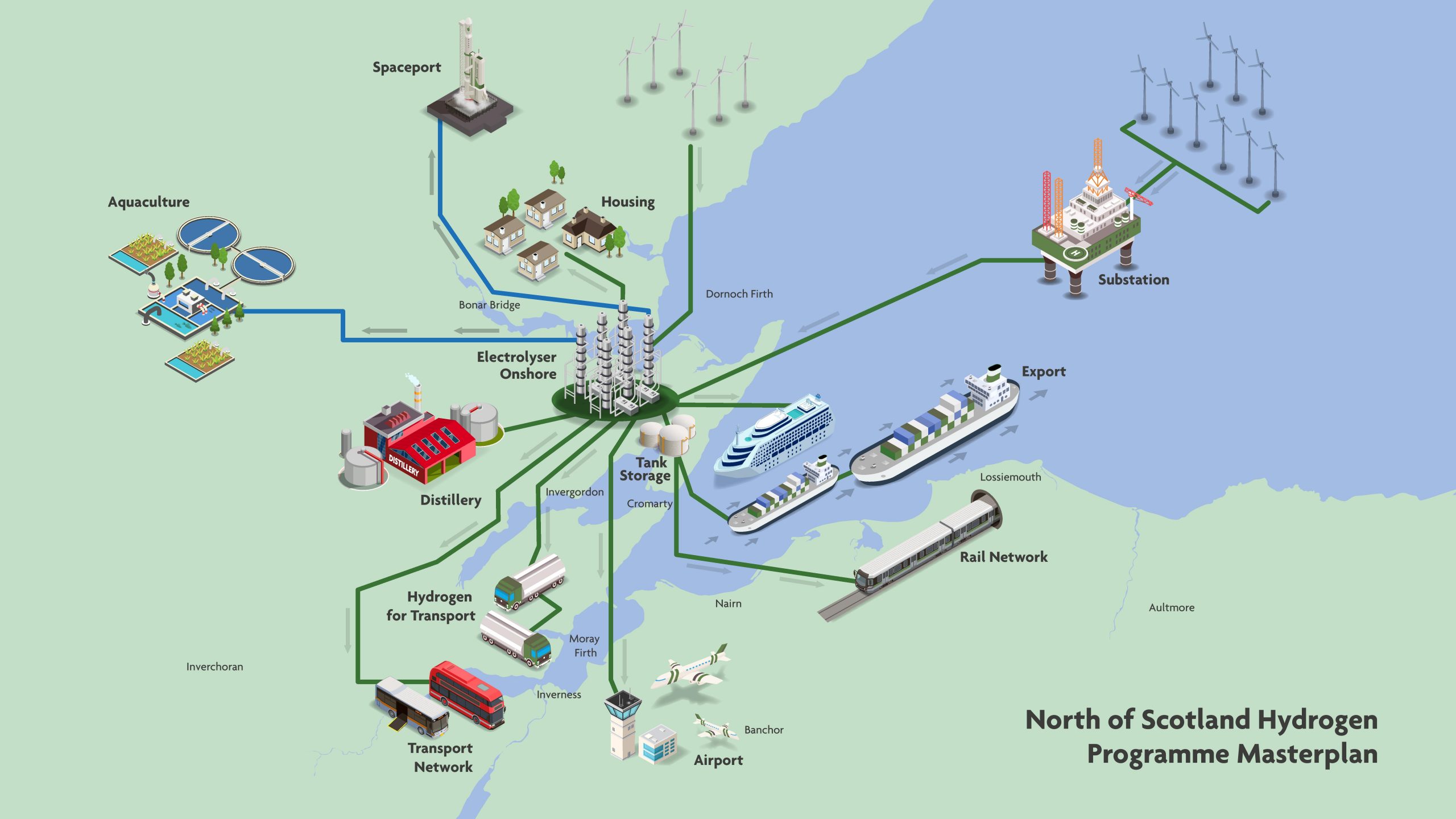
Note.
- Aquaculture is a use for the oxygen produced by the electrolyser.
- Everybody is promoting spaceports. Both hydrogen and oxygen can be used as rocket fuel.
- Hydrogen or electricity is shown powering all sorts of transport, including buses, a cruise ship, trains and trucks.
It certainly is a comprehensive plan.
Hydrogen At The Forth Green Freeport
Hydrogen is mentioned on the About page of the Forth Green Freeport web site in this general statement.
Investments will stimulate growth in trade, providing expanded logistics and trade capacity for existing and emerging industries including advanced modular systems, biofuels, hydrogen and carbon capture and storage, as well as support additional R&D capability and green incubator space to drive SME and start-up business growth.
But as INEOS are a partner, I would expect some hydrogen production from all that green offshore electricity.
National Grid Goes Carbon-Free With Hydrogen-Powered Substation Trial
The title of this post, is the same as that of this press release from National Grid.
These are the main bullet points.
- Hydrogen powered unit (HPU) quietly provided carbon-free electricity to National Grid’s Deeside Centre for Innovation
- Only emission is water
- HPUs could save an estimated 500,000 kg of carbon across all National Grid substation sites
I am an Electrical Engineer and I had never realised that all those electricity substations around the country need a backup electricity generator.
These four paragraphs describe the trial and the generator used.
A GeoPura 250kW hydrogen power unit (HPU) contained within a transportable shipping container measuring 7.2 m by 2.5 m was installed at DCI and produced the energy to power low-voltage equipment needed for National Grid’s innovation testing projects and site operations. The trial tested the capabilities and feasibility of HPUs as direct replacements for backup diesel generators across more than 250 National Grid substation sites, the data will now be analysed and shared later this year.
National Grid currently use diesel generators alongside batteries to provide backup power to a substation for key activities such as cooling fans, pumps, and lighting, enabling it to continue to perform its crucial role in the electricity transmission system.
These backup generators are rarely used and have less than a 1% chance of operating per year, however, on the rare occasion that backup power is required, changing from diesel to low-carbon emission alternatives have the potential to reduce carbon intensity by 90%* and save over 500,000 kg of carbon emissions.
The HPU at Deeside has power capabilities of up to 100 kW in continuous operation mode and up to 250 kW for 45 minutes and uses 100% green hydrogen. The unit is quieter and the hydrogen cannisters used to fuel the generators can be safely stored on site.
I have some thoughts.
Deeside Centre For Innovation
The Deeside Centre for Innovation (DCI), a state-of-the-art testing facility hosting a 400 kV modified substation, designed as a unique environment for development and trial of innovative technologies and practices.
I think there’s something rather cunning about the DCI, as it means that anybody with a good idea will probably approach National Grid for help with the testing.
Visit Deeside Centre for Innovation for more information.
GeoPura
GeoPura has a totally zero-emissions answer to how we’re going to generate, store and distribute the vast amount of energy required to decarbonise our global economies. Or so their web site says!
This page on GeoPura’s web site, gives several case studies of how they work.
They would appear to provide zero-carbon power in widespread locations for Winterwatch, Springwatch etc. for the BBC.
Tevva Starts First Mass Production Of Electric Lorries In UK
The title of this post, is the same as that of this article on Professional Engineering.
These are the first three paragraphs.
Tevva is building its 7.5 tonne vehicles at Tilbury in Essex after it received European Community Whole Vehicle Type Approval (ECWVTA), meaning it can start producing and selling in volume across the UK and Europe.
The start-up has already started delivering its first mass-produced lorries to customers including Travis Perkins and Royal Mail. It expects to sell up to 1,000 in 2023.
Described as “ideal” for last mile and urban delivery fleets, the electric truck offers up to 227km range from its 105kWh battery on a single charge. It will be followed later in 2023 by a 7.5 tonne hydrogen-electric alternative. The hydrogen range extender will reportedly increase the range up to 570km.
That seems like a good start to me; certification, orders for a thousand and generous ranges with or without a hydrogen extender.
In Equipmake Hybrid To Battery Powered LT11, I described Equipmake’s battery-electric New Routemaster bus.
Both the battery-electric Routemaster and the Tevva truck seem to have generous ranges, so has better battery technology been developed.
Hydrogen-Powered Vehicles And Trains In Tunnels
In writing about the Silvertown Tunnel, I started to wonder, if hydrogen vehicles will be allowed in the tunnel.
Consider.
- I don’t think diesel-powered trains are allowed in the Channel Tunnel and the tunnels of the link to London.
- Some tunnels don’t seem to allow hydrogen-powered vehicles.
- In a few years, hydrogen-powered buses, cars, locomotives, trains, trucks and vans will be more common, than they are today.
But help is at hand, with a co-operation between UK and EU agencies called HyTunnel-CS.
It is over fifty years now, since I worked as an instrument engineer in an ICI hydrogen factory at Runcorn. Truckloads of hydrogen were filled and despatched all over the UK. I may be wrong, but in all those intervening years, I can’t remember a hydrogen emergency on the UK’s roads.
I am confident, that we will achieve a safety regime, that allows hydrogen-powered vehicles and trains to be certified to pass through tunnels.
Gravitricity Makes Hydrogen Play With FlexiStore
The title of this post, is the same as that of this article on The Engineer.
This is the sub-heading.
Edinburgh-based energy storage firm Gravitricity is looking to green hydrogen, bringing a new underground storage solution to market.
The system is explained with a large graphic, showing an electrolyser, a FlexiStore and a hydrogen filling station, with this paragraph underneath.
Known as FlexiStore, the concept involves purpose-built, steel-lined shafts capable of holding up to 100 tonnes of compressed hydrogen at 220 bar – around 3.33GWh of energy, or enough to refuel over 1,000 HGVs, according to Gravitricity. Unlike naturally occurring underground storage like salt caverns, FlexiStores could be positioned anywhere, with the current plan to co-locate the storage as close as possible to renewable generation. Gravitricity says a single FlexiStore could serve a 460MW wind farm and that 1,000 units could meet the UK’s predicted hydrogen storage needs in 2050.
Note.
- The concept certainly solves the problem of storing hydrogen on a country-wide basis.
- I suspect, a machine could be designed and built to create the shafts.
- A 3.33 GWh store could supply 460 MW for nearly 33 hours. As a Control Engineer, that sounds a good balance for backing up a wind farm!
As ARUP has been involved in a feasibility study, I suspect there’s a fair chance that FlexiStores can be built.
Raven SR And Chart Industries To Work Together On Hydrogen And CO2 Capture
The title of this post, is the same as that of this article on the Carbon Herald.
These are the first two paragraphs.
Renewable fuels company Raven SR and Chart Industries announced they have signed a Memorandum of Understanding to work together on the liquefaction, storage, and transportation of hydrogen as well as pure CO2 produced from Raven SR’s non-combustion Steam/CO2 Reformation process that converts waste to renewable fuel.
Raven SR uses local waste as feedstock to produce transportation-grade H2 and synthetic fuels, including sustainable aviation fuel (SAF). The carbon dioxide, which is a byproduct of the process, when liquefied is used for food and beverage production, fertilizer production, and other consumer needs and as a feedstock for concrete or alternative fuels.
Note.
- It appears like I do, that the companies feel it is better to use carbon dioxide, rather than store it.
- It also looks like they have improved the steam reforming process for making hydrogen.
- An advantage of the process is that it doesn’t need pure water.
There is a video in the article, which I suggest you watch.
It may be one of those processes that dies a premature and messy death, but my knowledge of catalysts and strange ways to produce gases like hydrogen and acetylene from working at ICI in the early 1970s, tells me that someone will develop a viable route to create hydrogen, that is better than the methods used today,
Neptune Energy, Ørsted And Goal7 Explore Powering Integrated Energy Hubs With Offshore Wind
The title of this post, is the same as that of this press release from Neptune Energy.
These four paragraphs outline the agreement.
Neptune Energy today announced it has signed a Memorandum of Understanding with Ørsted and Goal7 to explore powering new integrated energy hubs in the UK North Sea with offshore wind-generated electricity.
Integrated energy hubs have the potential to combine multiple energy systems, including existing oil and gas production assets, carbon storage and hydrogen production facilities. They could extend the life of producing fields and support the economic case for electrification with renewable energy, to keep carbon emissions low.
The agreement will see the companies examine the potential to supply renewable electricity from Ørsted’s Hornsea offshore windfarm projects to power future Neptune-operated hubs in the UK North Sea.
Goal7 will provide project management support and technical input.
Note.
- Neptune Energy has three oil and gas fields in the UK North Sea; Cygnus (operational), Isabella (exploration) and Seagull (development)
- Gas from Cygnus comes ashore at the Bacton Gas Terminal.
- Ørsted owns the Hornsea wind farm, which when fully developed will have a capacity of around 6.5 GW.
- Cygnus and Hornsea could be not much further than 50 km apart.
- Seagull and Isabella are further to the North and East of Aberdeen.
- Ørsted has an interest in the Broadshore wind farm, which was numbered 8 in the ScotWind Leasing round.
These are my thoughts.
The Cygnus Gas Field And The Hornsea Wind Farm
This could be like one of those stories where boy meets the girl next door and they hit it off from the first day.
This page on the Neptune web site says this about the Cygnus gas field.
The biggest natural gas discovery in the southern North Sea in over 30 years is now the largest single producing gas field in the UK, typically exporting over 250 million standard cubic feet of gas daily. Cygnus contributes six per cent of UK gas demand, supplying energy to the equivalent of 1.5 million UK homes. It has a field life of over 20 years.
Two drilling centres target ten wells. Cygnus Alpha consists of three bridge-linked platforms: a wellhead drilling centre, a processing/utilities unit and living quarters/central control room. Cygnus Bravo, an unmanned satellite platform, is approximately seven kilometres northwest of Cygnus Alpha.
In 2022, we plan to drill two new production wells at Cygnus, with the first of these expected to come onstream in 4Q. The second well is due to be drilled in the fourth quarter and is expected onstream in the first quarter of 2023, with both wells helping to maintain production from the field and offset natural decline.
Gas is exported via a 55 km pipeline. Cygnus connects via the Esmond Transmission System (ETS) pipeline to the gas-treatment terminal at Bacton, Norfolk. Neptune Energy has a 25% minority interest in ETS.
Note.
- Cygnus with a twenty year life could be one of the ways that we bridge the gap until we have the two Cs (Hinckley Point and Sizewell) and a few tens of offshore wind gigawatts online.
- The two extra wells at Cygnus will help bridge the gap.
- The gas field has a pipeline to Bacton.
So what can the gas field and the wind farm, do for each other?
Hornsea Can Supply The Power Needs Of Cygnus
Typically, ten percent of the gas extracted from the wells connected to a gas platform, will be converted into electricity using one or more gas-turbine engines; which will then be used to power the platform.
So, if electricity from the Hornsea wind farm, is used to power the platform, there are two benefits.
- More gas will be sent through the pipeline to Bacton.
- Less carbon dioxide will be emitted in recovering the gas.
Effectively, electricity has been turned into gas.
Electricity Can Be Stored On The Sea-Bed
The Hornsea One wind farm has an area in the order of 150 square miles and it is only one wind farm of four, that make up the Hornsea wind farm.
I would argue that there is plenty of space between the turbines and the wells of the Cygnus gas field to install some form of zero-carbon underwater battery to store electricity.
But does this technology exist?
Not yet! But in UK Cleantech Consortium Awarded Funding For Energy Storage Technology Integrated With Floating Wind, I described a technique called Marine Pumped Hydro, which is being developed by the STORE Consortium.
- Energy is stored as pressurised water in 3D-printed hollow concrete spheres fitted with a hydraulic turbine and pump.
- The spheres sit on the sea-bed.
- This page on the STORE Consortium web site, describes the technology in detail.
- The technology is has all been used before, but not together.
I think it is excellent technology and the UK government has backed it with £150,000 of taxpayers’ money.
I also believe that Marine Pumped Hydro or something like it, could be the solution to the intermittency of wind farms.
Excess Electricity Can Be Converted Into Hydrogen
Any spare electricity from the wind farm can drive an electrolyser to convert it into hydrogen.
The electrolyser could be mounted on one of the Cygnus platforms, or it could even float.
The hydrogen produced would be blended with the gas and sent to Bacton.
Carbon Dioxide Can Be Stored In The Depleted Cygnus Gas Field
As the gas field empties of natural gas, the gas pipes to the Cygnus gas field can be reversed and used to bring carbon dioxide to the gas field to be stored.
The Cygnus gas field has gone full circle from providing gas to storing the same amount of carbon that the gas has produced in its use.
These are two paragraphs from the press release.
Neptune Energy’s Director of New Energy, Pierre Girard, said: “The development of integrated energy hubs is an important part of Neptune’s strategy to store more carbon than is emitted from our operations and the use of our sold products by 2030.
“Neptune has submitted three applications under the recent Carbon Dioxide Appraisal and Storage Licensing Round, and securing the licences would enable us to develop future proposals for integrated energy hubs in the UK North Sea.
I can envisage a large gas-fired power-station with carbon capture being built in Norfolk, which will do the following.
- Take a supply of natural gas from the Cygnus gas field via the Bacton gas terminal.
- Convert the hydrogen in the gas into electricity.
- Convert the carbon in the gas into carbon dioxide.
- Store the carbon dioxide in the Cygnus gas field via Bacton.
- I also suspect, that if a Norfolk farmer, manufacturer or entrepreneur has a use for thousands of tonnes of carbon dioxide, they would be welcomed with open arms.
Would the ultra-greens of this world, accept this power station as zero-carbon?
The Isabella And Seagull Gas Fields And The Broadshore Wind Farm
Could a similar set of projects be applied to the Isabella and Seagull gas fields, using the Broadshore wind farm?
I don’t see why not and they could work with the Peterhead power stations.
Gondan Shipyard Launches Another Hydrogen-Ready CSOV
The title of this post, is the same as that of this article on offshoreWIND.biz.
This is the sub-heading.
Gondan Shipyard has launched another commissioning service operation vessel (CSOV) it is building for the Norwegian shipowner Edda Wind at its yard in Figueras, Spain.
Increasingly smaller ships are being built hydrogen-ready, so they can be converted to zero-carbon, when the technology is developed.
Over the last couple of years companies like Cummins, JCB and Rolls-Royce mtu have developed diesel engines that can be converted to hydrogen engines.
Cummins talk of agnostic engines, which are identical from the cylinder head gasket down and what is above it, can make the engine, diesel, hydrogen on natural gas powered.
Scotland’s Renewable Energy Jackpot: Hydrogen Exports Alone Could Be worth £25 Billion A Year By 2045
The title of this post, is the same as that of this article on the Edinburgh News.
This is the sub-heading.
Scotland is a phenomenally energy rich country. For decades the largest oil-producing nation in the European Union, it is now set to trail-blaze as a leader in renewable energy.
The title and sub-heading say it all for Scotland.
But these words could equally well apply to Anglesey, Cornwall, Devon, East Anglia, Humberside, Liverpool and Morecambe Bays, the Severn Estuary and Pembrokeshire.
We also mustn’t forget the Dogger Bank!
 The Anonymous Widower