NI Green Hydrogen Projects Win Government Grants
The title of this post, is the same as that of this article on the BBC.
This is the sub-heading.
Two green hydrogen projects in Northern Ireland have won government grants in the first round of the UK Net Zero Hydrogen Fund.
These three paragraphs outline the projects.
Green hydrogen is made by using renewable electricity to separate water into oxygen and hydrogen – a process called electrolysis.
The grants will be used to help fund the construction of electrolysers.
One will be at the Mannok cement plant in Fermanagh, the other at Wrightbus in Ballymena.
I talked about the Wrightbus project in Ballymena: Wrightbus To Develop Hydrogen Production Facility.
Green Hydrogen to Flow From Denmark To Germany From 2028
The title of this post, is the same as that of this article on Hydrogen Central.
These are the two introductory paragraphs.
Green hydrogen to flow from Denmark to Germany from 2028.
The climate minister, Lars Aagaard, and the German economy and climate minister, Vice Chancellor Robert Habeck, signed an agreement in Copenhagen to build a land-based hydrogen pipeline from Denmark to Germany, which will commence operations in 2028.
The article also says this about the hydrogen infrastructure to Germany.
An underground hydrogen pipeline from western Jutland will probably be used to transfer the hydrogen to northern Germany. The capacity of the new pipeline was not confirmed.
I can see the UK having the means to export hydrogen to Europe.
ZeroAvia To Bring Zero-Emissions Flight To Sweden
The title of this post, is the same as that of this article on AviationSourceNews.
These three paragraphs outline the deal.
ZeroAvia has announced this week that it has struck a deal to bring zero-emissions flights to Sweden.
Such a deal has been struck to allow commercial routes from Skellefteå Airport using hydrogen-electric powertrains with Braathens Airlines.
Braathens Airlines operates a fleet of 14 ATR 72 aircraft, which will eventually have these powertrains utilized for flights across Sweden.
ZeroAvia are also targeting de Havilland Canada Dash 8 airliners for conversion to hydrogen.
Air Liquide Paves The Way For Ammonia Conversion Into Hydrogen With New Cracking Technology
The title of this post, is the same as that of this article on Hydrogen Central.
These two paragraphs outline the story.
Air Liquide announces the construction of an industrial scale ammonia (NH3) cracking pilot plant in the port of Antwerp, Belgium. When transformed into ammonia, hydrogen can be easily transported over long distances. Using innovative technology, this plant will make it possible to convert, with an optimized carbon footprint, ammonia into hydrogen (H2).
With this cracking technology, Air Liquide will further contribute to the development of hydrogen as a key enabler of the energy transition.
I think this could be very significant, in the development of hydrogen as an industrial fuel for heavy energy users.
Green Hydrogen Roundup: Statera Eyes ‘Critical’ 3GW Project In Scotland; UK Government Provides Support To Carlton Power And Octopus Hydrogen
The title of this post, is the same as that of this article on Current News.
This is the first heading.
Statera to develop ‘critical’ 3GW green hydrogen project in Scotland
These two paragraphs outline the project.
Energy generation and storage company Statera has released plans to develop a 3GW green hydrogen project in Scotland capable of supplying the UK with up to 30% of its 10GW by 2030 hydrogen target.
The major green hydrogen project is set to harness surplus Scottish wind power to power an electrolyser facility. The green hydrogen is expected to supply Statera’s power generating facilities and the UK’s carbon intensive industrial clusters via existing gas transmission pipelines.
This project will be built in Kintore.
This Google Map shows Kintore sub station.
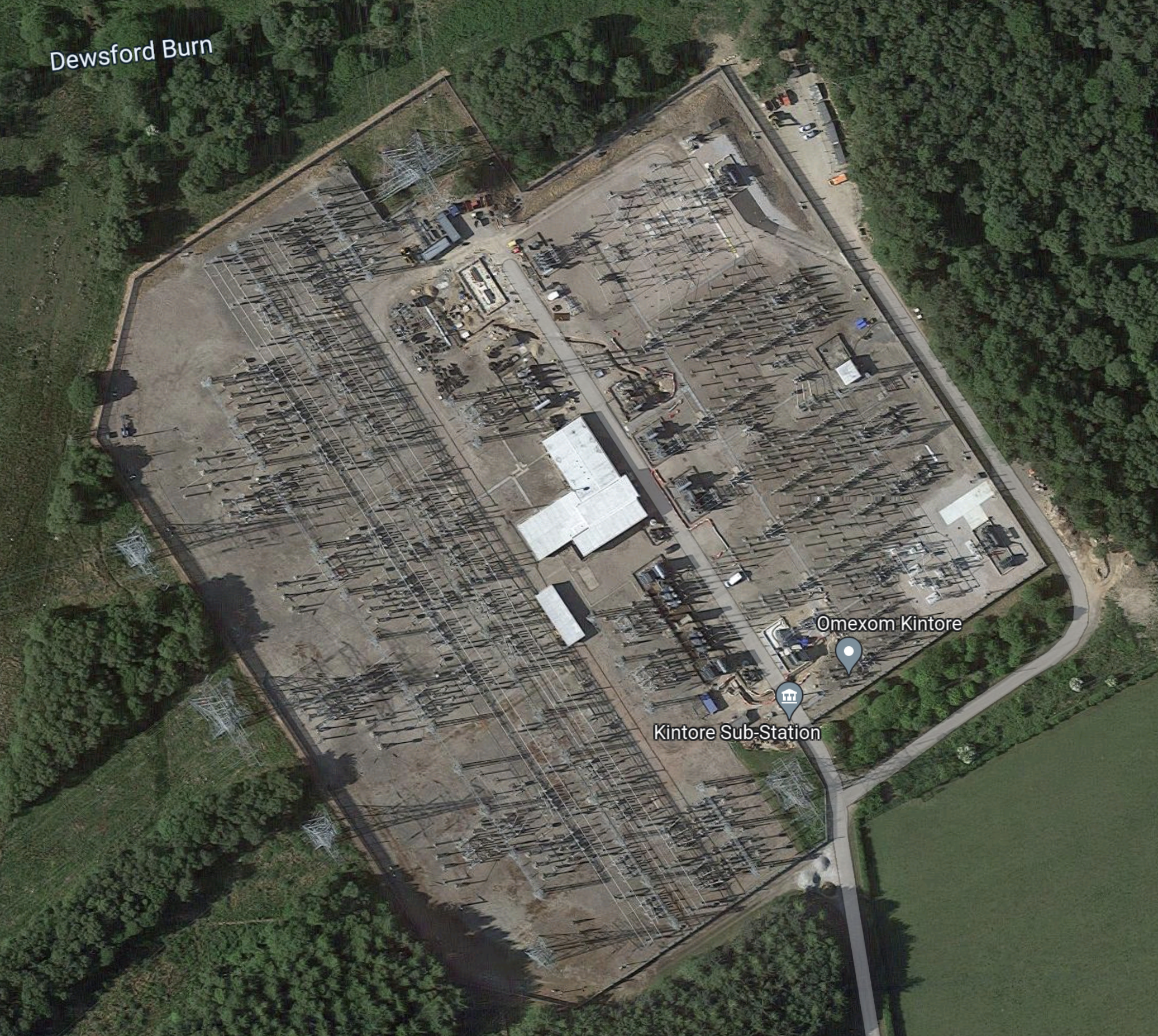
As this substation features on the home page of Kintore Hydrogen’s informative web site, I would assume, the electrolyser will be built nearby.
Statera’s web site is also informative.
This is the second heading.
Carlton Power receives UK government backing for three green hydrogen projects
These two paragraphs outline the projects.
Energy infrastructure development company Carlton Power has received UK government backing for three green hydrogen projects in Greater Manchester, Cumbria and Devon.
The backing has been received via the first round of the government’s Hydrogen Business Model (HBM)/Net Zero Hydrogen Fund process, which is worth up to £240 million. Around 15 projects in total will receive financial backing via this allocation.
The three projects will have a total capacity of 240 MW.
This article is very much one to read fully and thoroughly.
These are my thoughts.
Hydrogen Will Be Used To Bring Energy South From Scotland
This is part of a quote from Statera’s Managing Director.
The use of green hydrogen in the project has various perks. Firstly, it will utilise excess green energy that is generated from the vast Scottish wind sector and thus provide an additional basis to decarbonise sectors.
In doing so, Statera has said this will reduce the need for more costly transmission grid reinforcements to convey excess electricity in Scotland to other parts of the UK – in particular large industrial clusters.
Extracting Hydrogen From The Hydrogen/National Gas Blend
It’s all very well bringing the hydrogen South from Scotland blended with natural gas in the existing gas network, but how do you deliver pure hydrogen to those that need it?
In New Device Separates Hydrogen From Natural Gas When The Two Gases Are Blended In Pipelines, I wrote about such a device that has been developed by HyET Hydrogen in the Netherlands.
It is claimed to be silent and to create 99.9 % pure hydrogen.
Conclusion
This is an important milestone in cutting the UK’s carbon emissions.
BP Launches Plans For Low-Carbon Green Hydrogen Cluster In Spain’s Valencia Region
The title of this post is the same as that of this press release from BP.
These are the four bullet points.
- Aims to make Valencia region a leader in green hydrogen production
- Cluster to include world-scale green hydrogen production at bp’s Castellón refinery of up to 2GW of electrolysis capacity by 2030
- Supports transformation and decarbonization of the refinery, together with tripling biofuel production
- Transformation of Castellón could see bp invest up to €2 billion
This is the first paragraph.
bp today launched the green hydrogen cluster of the Valencia region (HyVal) at its Castellón refinery. Led by bp, this public-private collaborative initiative is intended to be based around the phased development of up to 2GW of electrolysis capacity by 2030 for producing green hydrogen at bp’s refinery.
It certainly is a big hydrogen-friendly project and is a roadmap of how to decarbonise an oil refinery.
This massive commitment to hydrogen makes me more certain, that bp’s offshore 50 MW wind farm twenty miles from Aberdeen, is designed to produce hydrogen for the granite city.
Are bp putting together a strategy to bring hydrogen to the world?
After all hydrogen is the only zero-carbon fuel, that can directly replace fuels like natural gas, diesel and many hydrocarbon fuels in a large number of applications.
New Fast Bus Service To Link London’s Outer Boroughs
The title of this post is the same as that of this article on the BBC.
This is the sub-heading.
A new fast service bus network has been announced for London’s outer boroughs.
These three paragraphs outline the concept.
Six new routes will be created and four incorporated into the ‘Superloop’ network, complete with distinct branding.
The plans propose a fast service to make more stops linking many of the peripheral boroughs.
The network is part of London Mayor Sadiq Khan’s effort to compensate for the impact of the ultra-low emission zone expansion, due to start in August.
This draft map from TfL illustrates the concept.
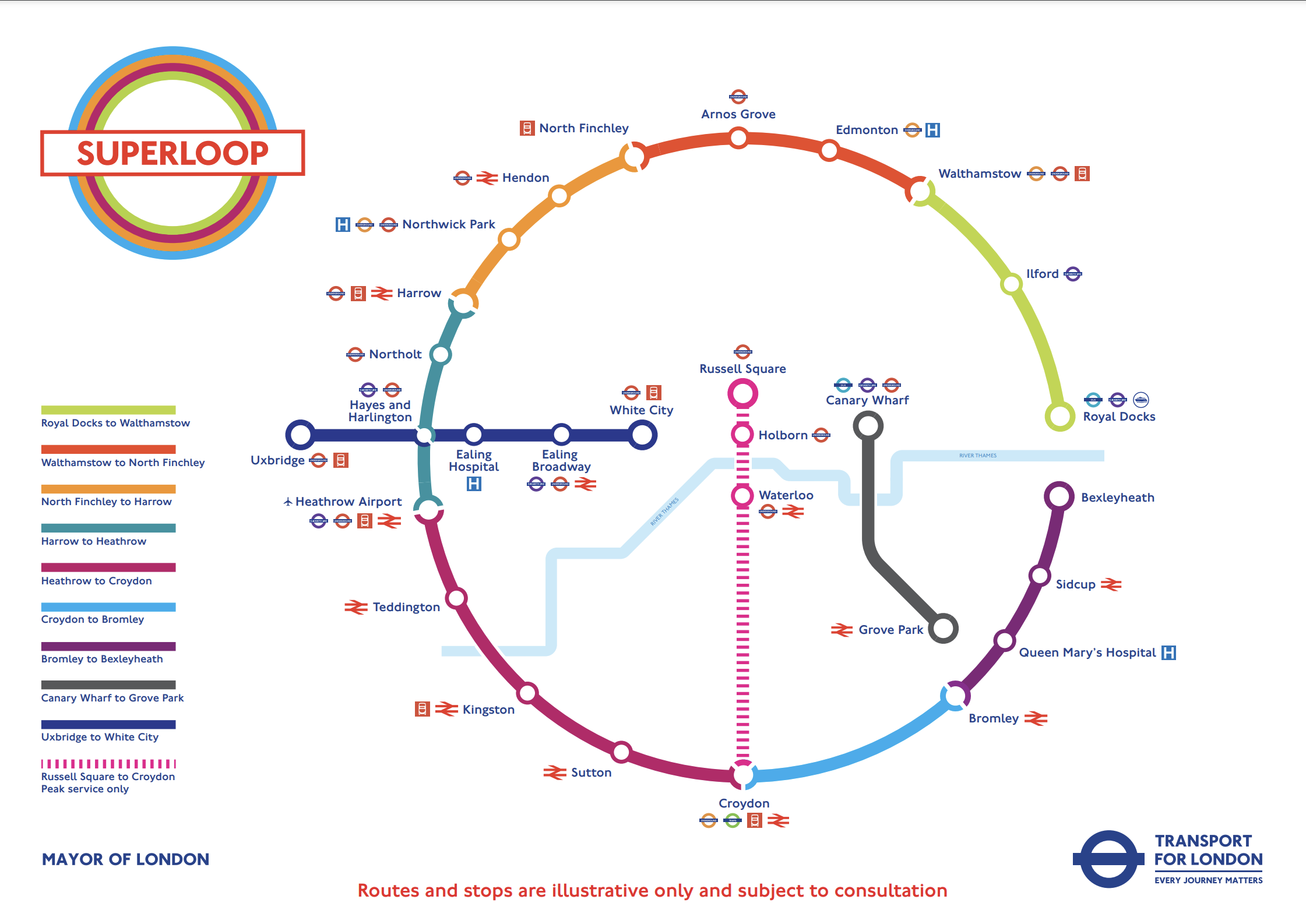
In the draft map, the following can be discerned.
- Arnos Grove station is in the North.
- West Croydon station is in the South.
- Royal Docks and Bexleyheath are in the East.
- Uxbridge and Hayes & Harlington stations are in the West.
- Elizabeth Line stations on the route include Ilford, Custom House, Heathrow Airport and Hayes & Harlington.
The plan may work well, as in the 1950s and 1960s, I used the 107 bus route very regularly, as it cut a circular path between Queensbury in the West and Enfield in the East.
I have some thoughts.
Royal Docks And Bexleyheath
This Google Map shows the Royal Docks.

Note.
- The dotted red line indicates the Royal Docks.
- The runway of the London City Airport can be seen.
- Custom House station on the Elizabeth Line is served by the Elizabeth Line and the Docklands Light Railway.
This second Google Map shows the Western end of the Royal Victoria Dock.

Note.
- Custom House station is in the North-East corner of the map.
- The Excel is on the East end of the map.
- London City Hall is at the Western end of the Royal Victoria Dock.
- The cable-car to Greenwich connects to the area.
I would suspect that the bus from Walthamstow will terminate close to City Hall and the cable-car.
This Google Map shows the Royal Docks and Bexleyheath.
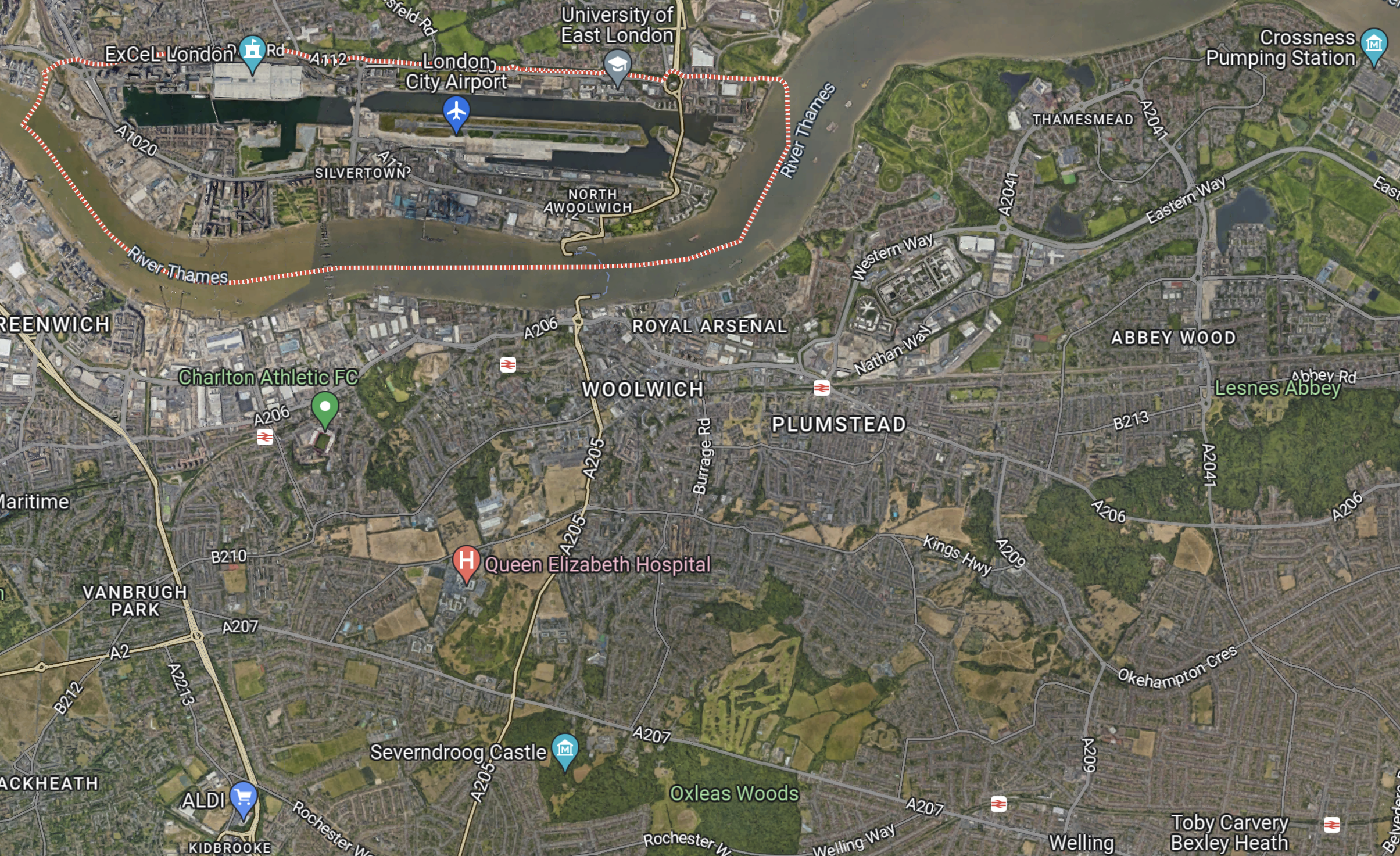
Note.
- The dotted red line indicates the Royal Docks.
- Bexleyheath station is in the South-East corner of the map.
I wouldn’t be surprised to see the Mayor organise a bus, through his new pet project; the Silvertown Tunnel.
Electric Or Hydrogen
Ideally, the buses will need to be zero-carbon; which means battery-electric or some form of hydrogen power.
Birmingham has a similar series of express routes, that run across the city, which I wrote about in Riding Birmingham’s New Hydrogen-Powered Buses.
I feel that long routes like some of these are should be run with hydrogen-powered buses, because of there longer range.
Further Thoughts On BP’s Successful INTOG Bid
I have been searching the web and I feel BP’s successful INTOG bid may be different.
In 13 Offshore Wind Projects Selected In World’s First Innovation And Targeted Oil & Gas Leasing Round, I decided that BP’s bid, which only was for 50 MW of offshore wind would generate hydrogen and send it to shore through the Forties Pipeline System, which is owned by INEOS.
My reasons for feeling that it would generate hydrogen were as follows.
- In the wider picture of wind in the North Sea, BP’s proposed 50 MW wind farm is a miniscule one. SSE Renewables’s Dogger Bank wind farm is over a hundred times as large.
- A cable to the shore and substation for just one 50 MW wind farm would surely be expensive.
- BP Alternative Energy Investments are also developing a 2.9 GW wind farm some sixty miles to the South.
- It would probably be bad financial planning to put large and small wind farms so close together.
I still believe for these and other reasons, that there is no reason to believe that the proposed 50 MW wind farm is a traditional wind farm and most likely it will be paired with an appropriately-sized electrolyser producing around twenty tonnes of hydrogen per day.
But instead of being sent ashore by using the Forties Pipeline System, could this hydrogen be sent directly to the coast near Aberdeen, in its own personal hydrogen pipeline?
- Using a variety of maps, I have estimated the distance at only around twenty miles.
- With all the experience from BP and their suppliers, there must be a solution for a relatively short hydrogen pipeline.
I also found this scientific paper on ScienceDirect, which is entitled Dedicated Large-Scale Floating Offshore Wind To Hydrogen: Assessing Design Variables In Proposed Typologies, which talks about three different layouts.
- Centralised Onshore Electrolysis
- Decentralised Offshore Electrolysis
- Centralised Offshore Electrolysis
All would appear to be feasible.
There is a lot of information in the scientific paper and it leads me to the conclusion, that hydrogen could be generated offshore and transferred by pipeline to storage on the shore.
The paper shows a design for a submarine hydrogen pipeline and schematics of how to design a system.
I believe that BP’s proposed system could deliver around twenty tonnes of hydrogen per day to the shore.
The system could be as simple as this.
- A few large floating wind turbines would be positioned offshore, perhaps twenty miles from shore.
- Perhaps 5 x 10 MW, 4 x 12 MW turbines or 3 x 16 MW could be used. Deciding would be one of those calculations, that combines accountancy, data, engineering and finance, which are great fun.
- The offshore distance would be carefully chosen, so that complaints about seeing them from the shore would be minimised.
- The generated electricity would be collected at a floating electrolyser, where hydrogen would be created.
- The hydrogen would be pumped to the shore.
- The floating electrolyser could also contain hydrogen storage.
I think there is large scope for innovation.
- I can imagine drones and helicopters delivering equipment and personnel to service the electrolyser.
- Underwater hydrogen storage could be developed.
- A standard system could be developed for rolling out anywhere.
- It could be placed in the sea, by a steelworks or other large hydrogen user.
In its own right the concept would develop new markets, which is one of the wind farm’s aims.
Could This Be The Route To Create Affordable Hydrogen For All?
BP would be failing their customers, employees and shareholders, if they weren’t developing a zero-carbon alternative to diesel and petrol.
Offshore hydrogen electrolysers strategically placed along the coastline, could provide a reliable hydrogen supply to a that sizeable proportion of the world’s population, who live near to the coast.
Could The Technology Be Adapted To Motorway And Large Service Stations?
This document on the UK Government web site, gives the mileage statistics of lorries (HGVs) and has this sub-heading.
In 2019 lorries travelled 17.4 billion vehicle miles, remaining broadly stable (increasing slightly by 0.3%) compared with 2018.
It breaks this figure down, by the class of road.
- Motorways – 8.0 – 46 %
- A Roads – 6.3 – 36 %
- Rural Minor Roads – 0.9 – 5 %
- Urban A Roads – 1.5 – 9 %
- Urban Minor Roads – 0.7 – 4 %
Note that 82 % of HGV mileage is on Motorways or A roads. Anybody, who has ever driven a truck bigger than a Ford Transit over a distance of upwards of fifty miles, knows that trucks and vans regularly need to be fuelled up on the road. And that applies to the drivers too, who also by law must take a break, away from the cab.
Charging an electric truck could be a lengthy business and would require service stations to be connected directly to the nation grid and be fitted with a substantial number of heavy duty chargers.
One thing, that would be difficult with an electric truck, would be a Splash-and-Dash, if a truck was nearing the destination and needed a small amount of charging to meet delivery schedules.
Because of the distances involved, the driving rules, the often tight schedules and the fast filling, I am convinced that there will be a large proportion of hydrogen-powered trucks and vans on the road and these will need a network of service stations where hydrogen is available.
Look at these overhead view of South Mimms Services, where the M25 and the A1(M) cross to the North of London.
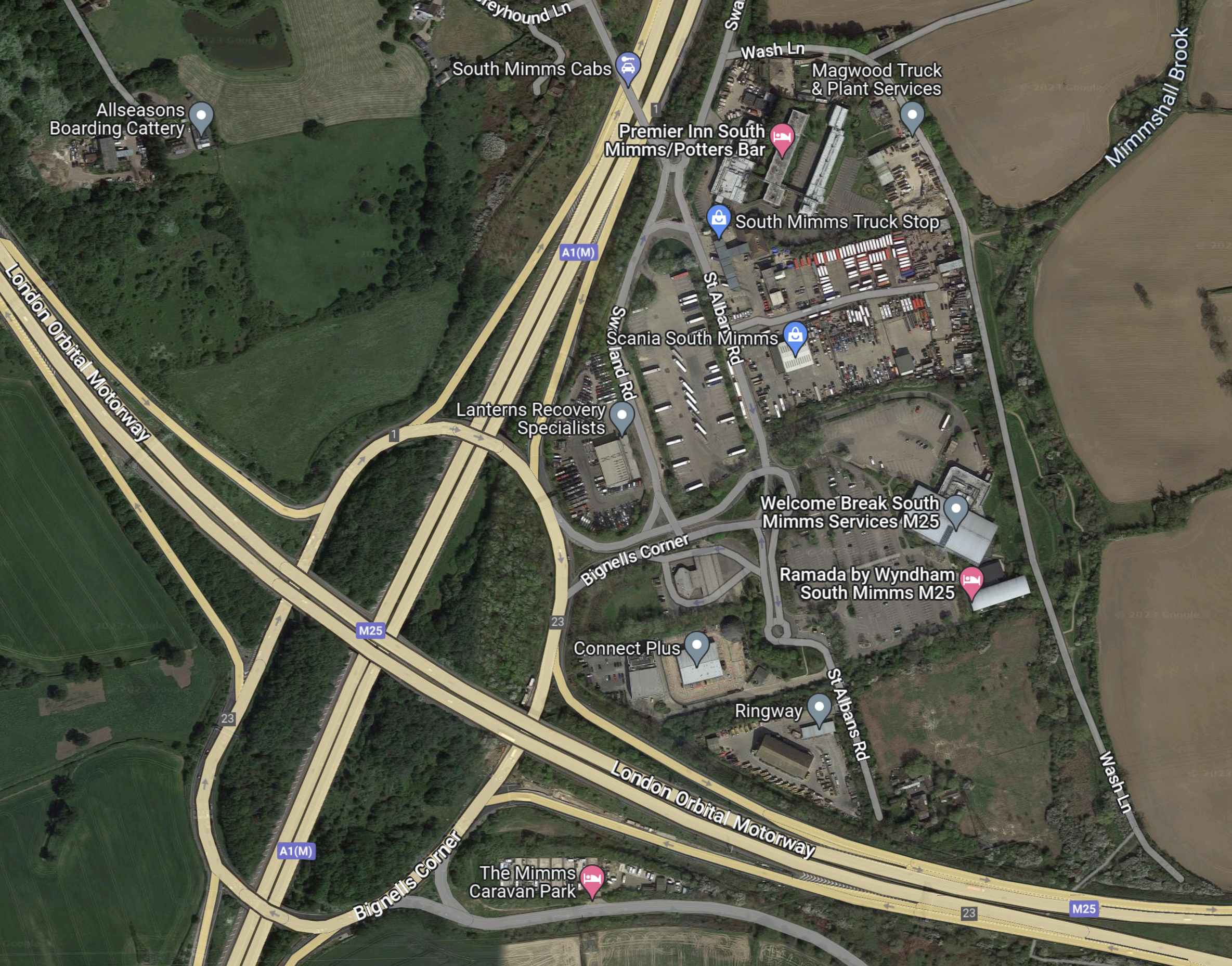
I would envisage that at least four 10 MW wind turbines, which have a rotor diameter of around 160-190 metres could be dotted around and inside the site including inside the roundabout.
- The electrolyser would be slightly smaller than that which would be used at Aberdeen.
- Perhaps fifteen tons per day of hydrogen could be generated.
- No hydrogen needed on the site would ever be brought in by truck.
- Wind-generated electricity could also power the hotels, restaurants and the service station.
- As the percentage of vehicles running on fossil fuels decreased, the air quality in the area of the service station, should increase.
- How many people, who lived locally would switch to a hydrogen-powered runabout and fill it up perhaps once a week, when they passed?
Much of the technology needed to add a hydrogen option to a typical large service station has already been developed and some would also be needed to build BP’s 50 MW offshore wind farm with an electrolyser.
Ricardo Supports Industry Leaders To Develop Innovative Dedicated Hydrogen Engine
The title of this post, is the same as that of this press release from Ricardo.
This is the sub-heading.
Ricardo, a global strategic, environmental, and engineering consulting company, has delivered a hydrogen-fuelled research engine to global engine specialist Cummins and automotive supplier BorgWarner, as part of Project BRUNEL part funded by the Advanced Propulsion Centre (APC)
These four paragraphs outline the project.
Cummins is a global specialist in diesel and alternative fuel engines and generators, and related components and technology. BorgWarner is an automotive tier 1 supplier and specialist in the design and manufacture of systems for electrified and conventional propulsion types, that includes injection equipment for conventional and renewable fuels. BorgWarner recently announced the intention to spin off its Fuel Systems segment. The intended company name is PHINIA Inc. PHINIA is expected to be a product leader in fuel systems, starters, alternators and aftermarket distribution.
The project aims to support internal combustion engine (ICE) sub-system suppliers to increase their use of hydrogen as an alternative zero-emissions fuel solution across the light commercial vehicle market.
The engine is specifically designed to burn only hydrogen – with no supporting fuels that could give rise to any carbonaceous, or excessive air quality emissions.
Experts in hydrogen technology and integration, Ricardo has provided an engine based upon its world-renowned series of single cylinder research units, which can help the research teams evaluate a wide variety of fuels. The engine is designed to help engineers evaluate a variety of injector types and will support increased fuel efficiency, reduced air quality emissions and the move towards carbon-free heavy-duty propulsion.
Reports of the death of the internal combustion engine are greatly exaggerated.
The Aims Of The Project
This talks about the light commercial market, which for Cummins means, that this engine could be a replacement for their B Series engine, which is described in Wikipedia like this.
In production since 1984, the B series engine family is intended for multiple applications on and off-highway, light-duty, and medium-duty. In the automotive industry, it is best known for its use in school buses, public service buses (most commonly the Dennis Dart and the Alexander Dennis Enviro400) in the United Kingdom, and Dodge/Ram pickup trucks.
A version is also used in London’s New Routemaster buses.
Speculation About A Hydrogen-Powered Dodge Ram Pickup
This article on Mopar Insiders is entitled Next-Gen Ram Heavy Duty Could Feature Cummins Hydrogen Powerplant!
It has this sub-heading.
Fast Refuel Times, Extended Range, & Zero-Emissions…
Sounds great for wide open spaces.
I’ve also read in an interview with a retiring Cummins Executive, who said that Dodge RAM trucks are being converted to hydrogen by enthusiasts.
Could New Routemasters Be Converted To Hydrogen?
In the Wikipedia entry for the Cummins B Series engine, this is said about the engine in a New Routemaster.
The 4.5L ISB is essentially a four-cylinder, two-thirds version of the 6.7L ISB rated at 185 hp (138 kW), used in the New Routemaster, a series hybrid diesel-electric doubledecker bus in London.
Having worked in the Cummins factory at Darlington, I know they are happy to produce specials for a particular application, so I wouldn’t be surprised to see a hydrogen-powered New Routemaster created by an engine and fuel system transplant.
Conclusion
The tie-up between Cummins, BorgWarner and Ricardo could be significant.
American power with a touch of Sussex finesse.
Electric Cars Are A Dead End!
When you introduce any product to the general population, you must think of all the consequences.
I found these statistics on the RAC Foundation web site.
There were 33.2 million cars (81.3 per cent), 4.63 million LGVs (11.3 per cent), 0.54 million HGVs (1.3 per cent), 1.46 million motorcycles (3.6 per cent), 0.15 million buses & coaches (0.4 per cent) and 0.84 million other vehicles (2 per cent) licensed at the end of September 2022.
Could anybody please tell me how the average guy or gal, who owns one of those 33.2 million cars is going to be able to afford to replace it, find a convenient place to park and charge it and go and visit their mum in say Scunthorpe from Plymouth?
We are going down a massive dead end!
The only sensible alternative is internal combustion engines running on hydrogen, many of which could be converted from existing diesel engines.
But only a few councils have a hydrogen policy, with the biggest disgrace being London, where the Mayor’s hydrogen policy, is to ignore it and hope it will go away.London has an air quality problem, which is not helped by large numbers of HGVs in the centre.
The technology exists to convert HGVs to hydrogen and it would be possible to insist that all vehicles over a certain weight were zero-carbon. But as London has no plans for hydrogen, it can’t happen.
Vote Hydrogen for Mayor in May 2024, to improve London’s air quality.
Notes.
- To replace 33.2 million cars with electric ones would cost 1660 billion pounds, assuming each electric car costs fifty grand.
- As most electric cars are not made in the UK, what would happen to our balance of payments?
- On average an electric car needs 63 kilos of lithium for its battery, so 33.2 million will need over two million tonnes of lithium.

