Zero-Carbon Emission Flights To Anywhere In The World Possible With Just One Stop
The title of this post, is the same as that of this press release from the Aerospace Technology Institute.
This is the first sentence of the press release.
Passengers could one day fly anywhere in the world with no carbon emissions and just one stop on board a concept aircraft unveiled by the Aerospace Technology Institute (ATI) today.
These three paragraphs describe the concept.
Up to 279 passengers could fly between London and San Francisco, USA direct or Auckland, New Zealand with just one stop with the same speed and comfort as today’s aircraft, revolutionising the future of air travel.
Developed by a team of aerospace and aviation experts from across the UK collaborating on the government backed FlyZero project, the concept demonstrates the huge potential of green liquid hydrogen for air travel not just regionally or in short haul flight but for global connectivity. Liquid hydrogen is a lightweight fuel, which has three times the energy of kerosene and sixty times the energy of batteries per kilogramme and emits no CO2 when burned.
Realising a larger, longer range aircraft also allows the concentration of new infrastructure to fewer international airports accelerating the rollout of a global network of zero-carbon emission flights and tackling emissions from long haul flights.
These are my thoughts.
The Airframe
This picture downloaded from the Aerospace Technology Institute web site is a visualisation of their Fly Anywhere Aircraft.
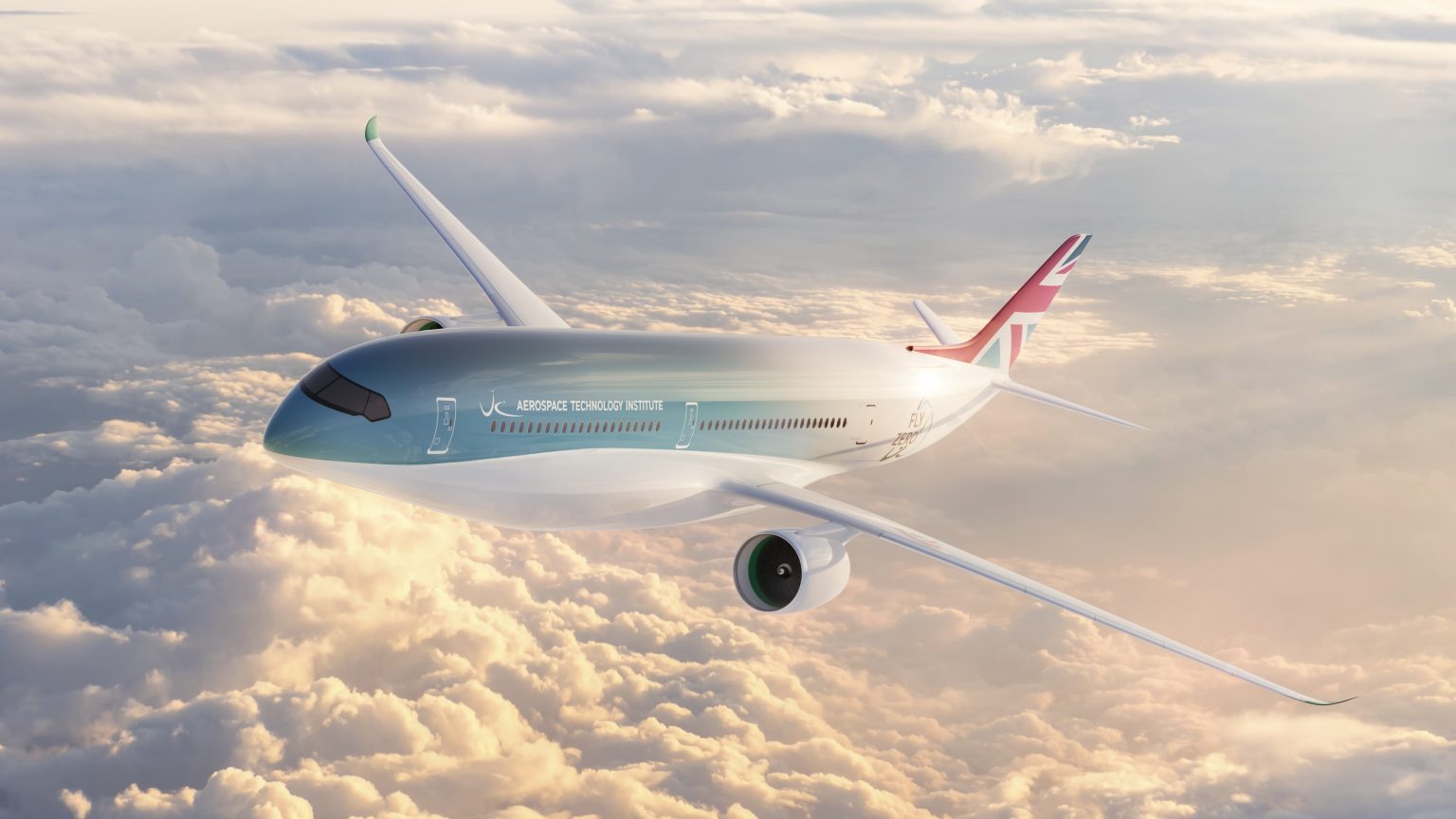
Some features stand out.
The wings are long, narrow and thin, almost like those of a sailplane. High aspect ratio wings like these offer more lift and stability at high altitude, so will the plane fly higher than the 41,000-43,000 feet of an Airbus A350?
I wouldn’t be surprised if it does, as the higher you go, the thinner the air and the less fuel you will burn to maintain speed and altitude.
The horizontal stabiliser is also small as this will reduce drag and better balance with the wing.
The tailfin also appears small for drag reduction.
The body is bloated compared to say an Airbus A 350 or a Boeing 777. Could this be to provide space for the liquid hydrogen, which can’t be stored in the thin wings?
The fuselage also appears to be a lifting body, with the wings blended into the fat body. I suspect that the hydrogen is carried in this part of the fuselage, which would be about the centre of lift of the aeroplane.
The design of the airframe appears to be all about the following.
- Low drag.
- high lift and stability.
- Large internal capacity to hold the liquid hydrogen.
It may just look fat, but it could be as radical as the first Boeing 747 was in 1969.
The Engines
I suspect the engines will be developments of current engines like the Rolls-Royce Trent XWB, which will be modified to run on hydrogen.
If they are modified Trent engines, it will be astonishing to think, that these engines can be traced in an unbroken line to the RB211, which was first run in 1969.
The Flight Controls
Most airliners these days and certainly all those built by Airbus have sophisticated computer control systems and this plane will take them to another level.
The Flight Profile
If you want to fly any aircraft a long distance, you generally climb to a high level fairly quickly and then fly straight and level, before timing the descent so you land at the destination with as small amount of fuel as is safe, to allow a diversion to another airport.
I once flew from Southend to Naples in a Cessna 340.
- I made sure that the tanks were filled to the brim with fuel.
- I climbed to a high altitude as I left Southend Airport.
- For the journey across France I asked for and was given a transit at Flight Level 195 (19,500 feet), which was all legal in France under visual flight rules.
- When the French handed me over to the Italians, legally I should have descended, but the Italians thought I’d been happy across France at FL195, so they didn’t bother to ask me to descend.
- I flew down the West Coast of Italy at the same height, with an airspeed of 185 knots (213 mph)
- I was then vectored into Naples Airport by radar.
I remember the flight of 981 miles took around six hours. That is an average of 163.5 mph.
I would expect the proposed aircraft would fly a similar profile, but the high level cruise would be somewhere above the 41,000-43,000 feet of an Airbus A 350. We must have a lot of data about flying higher as Concorde flew at 60,000 feet and some military aircraft fly at over 80,000 feet.
The press release talks about London to San Francisco, which is a distance of 5368 miles.
This aircraft wouldn’t sell unless it was able to beat current flight time of eleven hours and five minutes on that route.
Ground Handling
When the Boeing 747 started flying in the 1970s, size was a big problem and this aircraft with its long wing may need modifications to runways, taxiways and terminals.
Passenger Capacity
The press release states that the capacity of the aircraft will be 279 passengers, as against the 315 and 369 passengers of the two versions of the A 350.
So will there be more flights carrying less passengers?
Liquid Hydrogen Refuelling
NASA were doing this successfully in the 1960s for Saturn rockets and the Space Shuttle.
Conclusion
This aircraft is feasible.
Ryse Hydrogen Is Now Ryze Hydrogen
Jo Bamford’s company Ryse Hydrogen is now called Ryze Hydrogen.
I have changed this blog to use the new spelling as I suspect Ryse clashed with the name of a computer game.
Lhyfe’s Green Hydrogen To Power Deutsche Bahn Trains
The title of this post, is the same as that of this article on Renewables Now.
This is the first paragraph.
Deutsche Bahn AG has agreed to source about 30 tonnes of green hydrogen from French producer Lhyfe from 2024 onward to power its trains as the German railway operator seeks to reach climate neutrality by 2040.
The electrolyser will be built at Tuebingen.
In Can The UK Have A Capacity To Create Five GW Of Green Hydrogen?, I said the following.
Ryze Hydrogen are building the Herne Bay electrolyser.
- It will consume 23 MW of solar and wind power.
- It will produce ten tonnes of hydrogen per day.
The electrolyser will consume 552 MWh to produce ten tonnes of hydrogen, so creating one tonne of hydrogen needs 55.2 MWh of electricity.
I suspect that in my quote above from the article on Renewables Now, that the Tuebingen electrolyser will be producing thirty tonnes of hydrogen per day or just under 11,000 tonnes per year.
In that case it would be three times the size of the Herne Bay Electrolyser.
Australian Mining Giant Looks To Canada For Green Hydrogen Projects
The title of this post, is the same as that of this article on the Globe And Mail.
These are the first two paragraphs.
An Australian mining giant has signed agreements with three Canadian Indigenous nations to determine the viability of building green hydrogen projects as the company attempts to reinvent itself as a supplier of clean renewable energy.
Fortescue Future Industries (FFI) sees Canada as potentially one of the largest sources of renewable energy in the world and is hoping to develop multiple large-scale green energy projects here.
The article indicates quite a lot about the future direction of FFI.
I certainly think the company is going the right way.
Thoughts On The Cambo Oil Field
There is an article in The Times today which is entitled Sturgeon Faces Backlash After Shell Pulls Out Of North Sea Oilfield.
I have been following the technology of Carbon Capture and Use and some very good ideas have come forward in the last couple of years.
- Carbon dioxide is becoming increasingly important in the growing of flowers, salad vegetables, soft fruits and tomatoes in greenhouses.
- At COP26, Australian company, Mineral Carbonation International won an award for their process that turns carbon dioxide into building materials like blocks and plasterboard.
- A big investment was also made recently in an Italian company, who are using the properties of liquid and gaseous carbon dioxide to store energy.
- Carbon dioxide has for years made a good fire extinguisher, which can’t be said for some chemicals currently used.
- I suspect that some clever chemists are working on using carbon dioxide to create sustainable aviation fuel.
If the number of ideas for the use of carbon dioxide continues to increase, I can see gas-fired power stations being built, that are also used to produce much-needed high-quality carbon dioxide.
It should also be noted, that many like me, live in houses that are unsuitable for the fitting of heat pumps at an economical cost.
So we must wait for better technology or for hydrogen to be piped into our houses.
In the meantime, we will have to rely on gas. Or freeze!
I don’t know whether Cambo will produce any gas, but if it doesn’t, I can’t see much point in developing it.
Perhaps, Shell would prefer to develop a gas field.
Universal Hydrogen CEO Sees Jetmakers Backing New Fuel
The title of this post is the same as that of this article on Reuters.
It is mainly predictions by Paul Eremenko, who is Chief Executive of Universal Hydrogen, about the future of the single-aisle jet airliner market.
I wrote in detail about their technology in Could Universal Hydrogen’s Concept Create A Hydrogen-Powered Single-Aisle Airliner?.
I firmly believe they have a concept that will work and look forward to flying in a hydrogen-powered aircraft using Universal Hydrogen’s technology before the end of the decade.
Flybe Appears To Be On The Way Back
I was alerted to the relaunch of the Flybe airline being a serious proposition by this article on the Birmingham Mail, which is entitled Watch As First Of 32 New Flybe Planes Lands At Birmingham Airport.
These are the first two paragraphs.
The first of Flybe’s more eco-friendly planes has landed in Birmingham ready for the launch of the airline’s new city HQ.
Part of a planned 32-aircraft fleet, the De Havilland Canada Dash 8-400 turboprop touched down on the runway at Birmingham Airport on Friday.
The new Flybe will be based at Birmingham Airport and will have a fleet consisting of thirty-two De Havilland Canada Dash 8-400 aircraft.
The De Havilland Canada Dash 8-400
Note these facts about the aircraft.
- According to Wikipedia, 645 aircraft have been ordered, with 587 having been delivered.
- Different variants can handle between 40 and 80 passengers.
- All aircraft delivered since 1996 are dubbed Q-Series and have active noise and vibration suppression, which is designed to improve the cabin ambience.
- A Dash 8-400 is also called a Q400.
But the most interesting development of the Dash 8 aircraft, is that developments are underway, so that the aircraft will be able to be powered by hydrogen.
Universal Hydrogen And A Hydrogen-Powered Q400
This article on Future Flight is entitled Universal Assembles Hydrogen Aircraft Conversion Team In Washington State.
This is the first two paragraphs.
Universal Hydrogen and its hydrogen fuel cell partner Plug Power are joining forces with electric motor specialists MagniX and AeroTec to set up a Hydrogen Aviation Test and Service Center at Grant County International Airport in Moses Lake, Washington. The partners will use the new facility to convert a Dash 8 regional airliner to hydrogen propulsion in time to start commercial operations in 2025. Flight testing is due to begin in 2022.
The new hydrogen powertrain will consist of an electric propulsion unit (EPU) developed by MagniX and fuel cells provided by Plug Power, which has extensive experience converting trucks to hydrogen. Seattle-based AeroTec will take the lead on converting the Dash 8s to hydrogen propulsion, conducting flight tests, and arranging for certification under FAA supplemental type certificates. The system installation work will be conducted at the Moses Lake facility.
This paragraph gives details of the design.
The hydrogen-powered Dash 8 aircraft, which carry between 41 and 60 passengers, will be able to operate on routes of up to around 625 miles. Universal Hydrogen’s plan calls for the fuel to be delivered directly to aircraft in capsules that are installed in a compartment at the rear of the fuselage.
These are my thoughts on the design.
Power Required
Wikipedia says this about the engines of the Dash 8-400 (Q400).
The Series 400 uses Pratt & Whitney Canada PW150A engines rated at 4,850 shp (3,620 kW).
This means that the aircraft will need fuel cells capable of delivering over 7 MW.
This data sheet on the Plug Power web site, says that the company has fuel cells up to 125 KW, which weigh 350 Kg and need a cooling module, that weighs a further 103 Kg. Scaling up shows the power unit could weigh around 25.4 tonnes.
As the maximum take-off weight of a Q400 is around 30.5 tonnes, this wouldn’t leave much weight for the airframe, the two electric motors and propellers, the hydrogen and the passengers and their luggage.
It would appear that Plug Power must be using some form of lighter-weight fuel cell.
Or could they be using an appropriately-sized gas turbine generator from Pratt & Whitney Canada?
It should be noted that a Pratt & Whitney Canada PW150A engine, weighs under a tonne and generates over 3.5 MW.
Obviously, they wouldn’t be developing the plane, if they hadn’t figured out how to generate enough electricity to get it off the ground.
The Hydrogen Capsules
The Product page on the Universal Hydrogen web site is revealing.
This paragraph from the Product page describes how they would convert Regional Aircraft to Hydrogen.
Our first product is a conversion kit for existing regional aircraft, starting with the ATR72 and the De Havilland Canada Dash-8, to fly on hydrogen. This consists of a fuel cell electric powertrain that replaces the existing turboprop engines. It also accommodates, in the rear of the fuselage, our proprietary, lightweight, modular hydrogen capsules that are transported from green hydrogen production sites to the airport and loaded directly into the aircraft using the existing intermodal freight network and cargo handling equipment. By providing both an aircraft conversion solution for the existing fleet and a fuel services offering directly to regional airlines, we will be in passenger service with zero emissions by 2025 and in cargo service shortly thereafter.
Note.
- The cutaway on the Product page of a De Havilland Canada Dash-8, which has three capsules in the rear fuselage.
- The cutaway shows forty seats in the aircraft.
- If you scroll the pictures, you’ll see the design of the capsule.
- The product can be used to convert two regional airliners both of which are in production.
- Airports will need no new infrastructure to handle the hydrogen.
Universal Hydrogen has also signed a deal with Fortescue Future Industries to supply green hydrogen to fill the capsules.
Are A First Flight In 2022 And An in-Service Date Of 2025 Over Ambitious?
The article in Future Flight says this.
AeroTec will take the lead on converting the Dash 8s to hydrogen propulsion, conducting flight tests, and arranging for certification under FAA supplemental type certificates.
FAA Supplemental Type Certificates are outlined on this page on the FAA web site, where this introductory paragraph is given.
A supplemental type certificate (STC) is a type certificate (TC) issued when an applicant has received FAA approval to modify an aeronautical product from its original design. The STC, which incorporates by reference the related TC, approves not only the modification but also how that modification affects the original design.
They are a much-used and well-proven method to update aircraft for new purposes and new power units.
I suspect that going this route will enable Q400 and ATR 72 aircraft will be flying on hydrogen by 2025.
How Far Will A Range Of 625 Miles Take The Plane From Birmingham?
I have used the Air Miles Calculator to calculate distances in miles from Birmingham.
- Amsterdam Schiphol – 276
- Barcelona – 791
- Belfast City 225
- Berlin Schönefeld – 644
- Biarritz – 621
- Bilbao – 635
- Bordeaux – 529
- Cologne – 397
- Copenhagen – 624
- Cork – 290
- Dublin – 200
- Dusseldorf – 373
- Edinburgh – 251
- Frankfurt – 452
- Geneva – 556
- Glasgow – 260
- Hamburg – 495
- Inverness – 364
- Jersey – 225
- Kirkwall – 474
- Lerwick – 536
- Lyon – 558
- Munich – 660
- Newcastle – 179
- Newquay – 198
- Nice – 735
- Oslo – 726
- Paris-Charles de Gaulle – 303
- Paris-Orly – 315
- Rotterdam – 265
- Strasbourg – 494
Note.
- It might be possible to serve some routes without refuelling at the other end.
- Some routes could be paired for efficiency and still be well below 600 miles.
- The large intercontinental airports of Amsterdam Schiphol, Frankfurt and Paris-Charles de Gaulle should be reached easily.
- Amsterdam Schiphol Airport has a well-connected railway station.
- Paris-Charles de Gaulle Airport has a TGV station.
- Frankfurt Airport has a long distance railway station on the Cologne-Frankfurt high speed line.
- If you’re flying to the South of France or Switzerland, it looks like flying from London City Airport is about a hundred miles shorter.
It would appear that the range of 625 miles could be very useful, especially if you use a long distance train at both ends of the flight.
I can certainly understand why Flybe has chosen Birmingham as its main base.
Will Flybe Convert Their Aircraft To Hydrogen?
This is obviously up to the company, but if they don’t, someone else will and Flybe will lose their regional market in the UK.
Conclusion
I think those behind the new Flybe could be looking to create the UK’s first zero-carbon airline.
Alstom And Liebherr Sign A Collaboration Agreement, In Order To Optimise Hydrogen Fuel Cells
The title of this post, is the same as that of this press release from Alstom.
The press release starts with these points.
-
Liebherr is developing air management technology that is particularly well suited to hydrogen fuel cells.
-
Alstom’s hydrogen strategy is part of its ambition to innovate by pioneering smarter and greener mobility solutions for all.
This paragraph then gives the basic outline of the agreement.
Alstom has signed a collaboration agreement with Liebherr – Aerospace & Transportation SAS, a France-based company specialising in the manufacture of compressors for fuel cells. This agreement is aimed at optimising hydrogen systems, including improving the reliability and durability of fuel cells, increasing their power density and reducing the cost of such solutions.
The press release gives a lot more details about Alstom’s hydrogen collaborations with other companies
Alstom seem very serious about hydrogen-powered trains.
BP Plans To Turn Teesside Into First Green Hydrogen Hub
The title of this post, is the same as that of this article in The Times.
This is the first paragraph.
BP plans to build Britain’s biggest “green hydrogen” facility on Teesside to produce the clean fuel for use in new hydrogen-powered lorries and other transport.
Note.
The plans appear to be ambitious starting with a £100 million investment to build a 60 MW electrolyser by 2025, which would rise to as much as 500 MW by 2030.
The electrolyser will be paired with an upwards of a billion pound one gigawatt facility called H2Teesside, that will produce blue hydrogen.
I think there could be more to this than meets the eye.
Using The Carbon Dioxide Rather than Storing It!
I followed the carbon dioxide pipe from the CF fertiliser plant on Teesside using Google maps after seeing a film about it on the BBC. It goes to the Quorn factory and a massive greenhouse. I do wonder, if BP is talking to other companies, who also have a need for large quantities of good quality carbon dioxide.
One could be an Australian company, called Mineral Carbonation International, who have developed a process to convert carbon dioxide into building products like blocks and plasterboard. MCI won a prize at COP26, so could BP be looking at integrating one of these plants into their complex on Teesside?
The Electrolysers
Will BP be purchasing their electrolysers for green hydrogen from ITM Power in Sheffield?
This press release from ITM Power is entitled 12MW Electrolyser Sale.
The customer is not named, but could this be a starter kit for BP?
Alstom’s Hydrogen Aventras
In Alstom And Eversholt Rail Sign An Agreement For The UK’s First Ever Brand-New Hydrogen Train Fleet, I came to this conclusion.
This modern hydrogen train from Alstom is what is needed.
I also felt there could be three similar trains; electric, battery-electric and hydrogen, which would help operators hedge their bets on what type of traction to use.
Teesside must be one of the more likelier places where the Hydrogen Aventras will be carrying passengers.
I wrote about this possibility in Alstom Hydrogen Aventras And Teesside.
A deal between BP and Alstom would surely be in the interest of both companies.
- Alstom would get a local hydrogen supply.
- BP would get a first sale.
- BP would get excellent publicity and a local demonstration of the possibilities of hydrogen.
It might even be possible to supply the hydrogen by pipeline.
Singapore-Based Enterprize To Build $10bn Wind Farm Off Irish Coast
The title of this post, is the same as that of this article on the Irish Times.
This is the first paragraph.
A Singapore-based offshore wind developer has signed an agreement to build a huge $10 billion (€8.88 billion) wind farm off the coast of Ireland to power a green hydrogen facility.
This is certainly a large investment.
- The windfarm will have a capacity of 4 GW.
- Hydrogen will be produced for the Irish market and some will be converted to ammonia for export.
- The hydrogen will be produced at the Green Marlin hydrogen facility at Bantry Bay.
- I’ve not heard of Enterprize before, but the company is also developing a 3.4 gigawatt offshore wind farm in Vietnam and is looking at Brazil.
Enterprize Energy are obviously very ambitious.
This article on Fuel Cell Works, which is entitled Zenith Energy And EI-H2 Announce Joint Venture For Green Facility At Bantry Bay, gives more details of the Green Marlin project.
Conclusion
There are some big companies investing billions of pounds, dollars and euros in hydrogen.
 The Anonymous Widower