ITM Power’s 24MW Electrolyser Sale to Yara
The title of this post, is the similar to that of this press release from ITM Power. I just added a few words.
These are the first three paragraphs.
ITM Power (AIM: ITM), the energy storage and clean fuel company, is pleased to provide details of the sale of a 24MW electrolyser to Linde Engineering contained in the Company’s Half Year Report issued yesterday. The electrolyser is to be installed at a site operated by Yara Norge AS (“Yara”) located at Herøya outside Porsgrunn, about 140 km southwest of Oslo. The site covers an area of approximately 1.5 square kilometres and is the largest industrial site in Norway. The Porsgrunn site produces 3 million tons of fertiliser per year.
The hydrogen required for ammonia production is currently produced from SMR. Yara intends to start replacing this grey hydrogen with green hydrogen produced from renewable energy and electrolysis. The 24MW system supplying 10,368 kg/day of hydrogen will account for approximately 5% of the plant’s consumption and serve as a feasibility study for future upscaling. Yara has received a grant of up to NOK 283m (£23.6m,pending ESA approval) from Enova SF, a Government funding body, to invest in green solutions for hydrogen used for industrial purposes in Norway.
The electrolyser equipment is due to be ready for shipment from ITM Power in Q4 2022 with revenue realised in the Company’s 2022/2023 financial year.
These are my thoughts.
The Size Of The Electrolyser
A 24 MW electrolyser, that produces 10,368 Kg of hydrogen/day may sound a large device.
This is an extract from the press release.
In January 2021, the Company received an order for the world’s then largest PEM electrolyser of 24MW from Linde. In October 2021, the Company, with Linde, announced the deployment of a 100MW electrolyser at Shell’s Rhineland refinery, following the start-up of an initial 10MW facility at the site.
It appears that ITM Power have built one before and one four times the size has been ordered.
What Size Of Electrolyser Would Yara Need To Fully Decarbonise Ammonia Production?
According to the press release, a 24 MW electrolyser will produce five percent of the plant’s consumption, which means that a 480 MW electrolyser will be needed, if Yara use an ITM electrolyser to produce all their hydrogen.
Will manufacture of an electrolyser of this size be a problem for ITM Power?
The press release says this about electrolyser production.
ITM Power operates from the world’s largest electrolyser factory in Sheffield with a capacity of 1GW (1,000MW) per annum, with the announced intention to build a second UK Gigafactory in Sheffield with a capacity of 1.5GW expected to be fully operational by the end of 2023. The Group’s first international facility, expected to have a capacity of 2.5GW per annum, is intended to be operational by the end of 2024, bringing total Group capacity to 5GW per annum.
It also says that the company has raised £250m to accelerate expansion.
The Delivery Date
The delivery date of the electrolyser is stated as Q4 2022.
I find this rather quick, which makes me believe that one of the reasons for the success of ITM Power is their production process.
How Much Ammonia Is Produced Worldwide?
This is an extract from this publication from the Royal Society, which is entitled Ammonia: Zero-Carbon Fertiliser, Fuel And Energy Store.
Current global ammonia production is about 176 million tonnes per year and is predominantly achieved through the steam reforming of methane to produce hydrogen to feed into ammonia synthesis via the Haber Bosch process.
Ammonia production is a highly energy intensive process consuming around 1.8% of global energy output each year (steam methane reforming accounts for over 80% of the energy required) and producing as a result about 500 million tonnes of carbon dioxide (about 1.8% of global carbon dioxide emissions)2,3,4. Ammonia synthesis is significantly the largest carbon dioxide emitting chemical industry process. Along with cement, steel and ethylene production, it is one of the ‘big four’ industrial processes where a decarbonisation plan must be developed and implemented to meet the netzero carbon emissions target by 2050.
It looks like Linde and ITM Power have a fairly simple plan to decarbonise world ammonia production. And they have started with one of the easier targets; Yara in the very environmentally-correct Norway.
I estimate that to produce 176 million tonnes of green ammonia will need over 28 GW of electrolyser capacity.
Conclusion
If Linde and ITM Power can persuade the world, that their technology is the way to go, then they’ve got it made.
Green Hydrogen Companies Are Going Public To The Delight Of Investors
The title of this post, is the same as that of this article on Hydrogen Fuel News.
The article discusses the IPO of the ThyssenKrupp subsidiary; Nucera.
There is more in this article on Reuters, which is entitled Betting On Hydrogen Hype, Thyssenkrupp Eyes $687 mln In IPO Cash.
I have a feeling, that this would not be an investment for widows and orphans, but this widower may know enough to have a small punt at the right price.
Spanish Consortium Forms For $4.4 Billion Green Hydrogen Investment
The title of this post, is the same as that of this article on Hydrogen Fuel News.
This paragraph outlines the project.
A thirty-three company consortium, called the Spanish Hydrogen Network (Shyne) will be investing into a spectrum of green hydrogen technologies, including the installation of 500 megawatts of renewable H2 capacity by 2025. From there, the capacity will increase to 2 gigawatts by 2030. This represents half of the Spanish government’s goal for the entire country by that year, which is 4 gigawatts of capacity.
The article says this about the creation of hydrogen hubs.
The green hydrogen project’s goal is to “generate an ecosystem that connects” three H2 hubs.
The goal of the project is to develop an ecosystem in which three planned industrial H2 hubs in the Murcia, Catalonia and Basque regions will be connected. The project is also meant to support the development of two new innovation hubs in Castile-La Mancha and Madrid and will target the development of solid-oxide electrolyzers and photoelectrocatalysis.
Note that photoelectrocatalysis is the direct production of hydrogen from solar energy.
Deutsche Bahn Puts Passengers On Alstom Battery-Electric Trains
The title of this post, is the same as that of this article on electrive.com.
This is the introductory paragraph.
French manufacturer Alstom and Deutsche Bahn are now taking passengers onboard Alstom’s first fully approved electric train since this weekend in Baden-Württemberg. Further testing will start in Bavaria on 5 February and run throughout early May on all routes.
This paragraph describes where the train will be running.
On weekdays the battery-powered train will run in Baden-Württemberg on the Stuttgart – Horb line and Saturdays and Sundays, on the Pleinfeld – Gunzenhausen line in the Franconian Lake District. Alstom said this arrangement would maximise the train’s mileage while testing a variety of route profiles and battery charging scenarios. For example, while in Baden-Württemberg, charging occurs during the ongoing journey via overhead lines, in Bavaria, charging can only take place at stations, as the route in between is not electrified.
The article gives the impression that Alstom have ambitious plans for battery-electric and hydrogen trains in Germany.
This is confirmed by this press release on the Alstom web site, where this is a paragraph.
While Alstom’s hydrogen trains are optimised for longer routes, Alstom’s BEMUs are suitable for shorter routes or lines with non-electrified sections previously operated with diesel vehicles. Direct connections between electrified and non-electrified network sections are now possible and can be operated emission free, without the need of additional electrification – shortening the travel time between city and country.
It appears Alstom will be developing both types of trains.
Oman And BP Sign Renewable Hydrogen Partnership On Mega-Gigawatt Scale
The title of this post, is the same as that of this article on Hydrogen Fuel News.
This is the introductory paragraph.
Oman has announced that it has entered into an agreement with BP, in which the energy giant will support the country’s development of mega-gigawatts of renewable hydrogen and energy by 2030.
Wind and solar power will be developed on 8,000 square kilometres of land.
Fortescue’s Forrest Says German Hydrogen Deal Is Just The Start
The title of this post, is the same as that of this article on Reuters.
This is the opening paragraph.
Australian miner Fortescue Metals’ (FMG.AX) newly-announced deal to supply green hydrogen to Germany is just the start as the rest of the world will catch up with Europe’s lead, Fortescue’s chairman told a Berlin industry conference on Monday.
I very much agree with Andrew “Twiggy” Forrest, as if countries are serious about commitments to fight global warming, there will be a big rush for hydrogen, so that countries can decarbonise their chemical, steel and other industries.
Some countries like Australia, Canada, Denmark, Norway, Spain, Sweden, The Netherlands, the UK and the US will be fine, but others will struggle.
Germany seems to be taking action by buying up supplies from everywhere they can.
Penmaenmawr Quarry Rail Terminal Opens
The title of this post, is the same as that of this article on Railway Gazette.
These are the first two paragraphs.
Hanson has reopened its Penmaenmawr railhead in north Wales, as part of its strategy to reduce vehicle movements and associated CO2 emissions.
The quarrying company has spent £300 000 refurbishing the facility, including upgrades to the railhead conveyor which was last used in 2012. The first trial service was operated by GB Railfreight and transported stone to the Tuebrook depot near Liverpool to test the equipment and uncover any operational issues within the quarry and at the railhead.
The aim is to one one train per week between North Wales and North West England.
This Google Map shows the Penmaenmawr railhead.
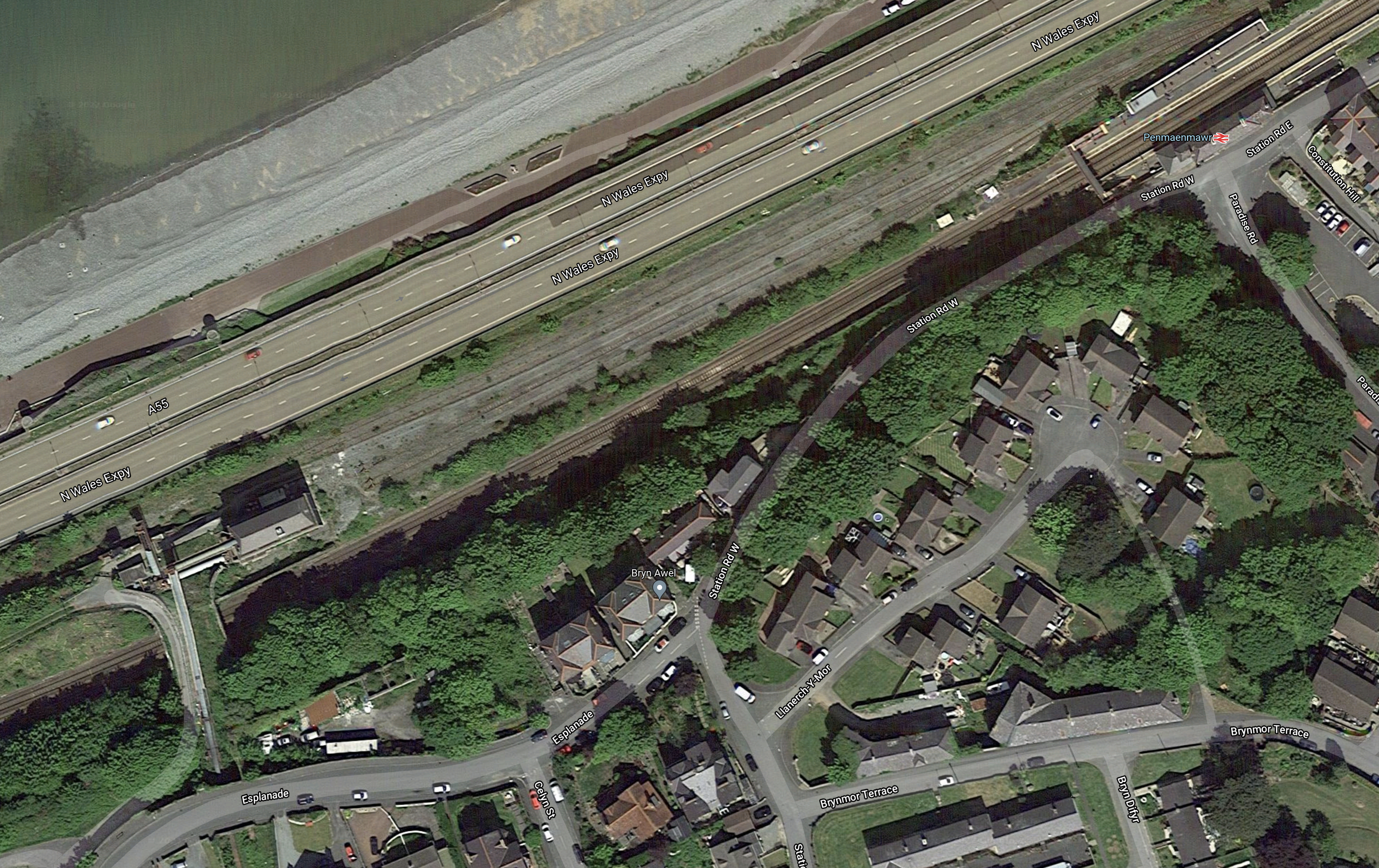
Note.
- Penmaenmawr station is in the top right corner of the map.
- The railhead is in the bottom-left corner of the map.
- The North Wales Expressway is between the railway and the beach.
There is a conveyor leading to the South and this second Google Map shows the vast quarry complex.
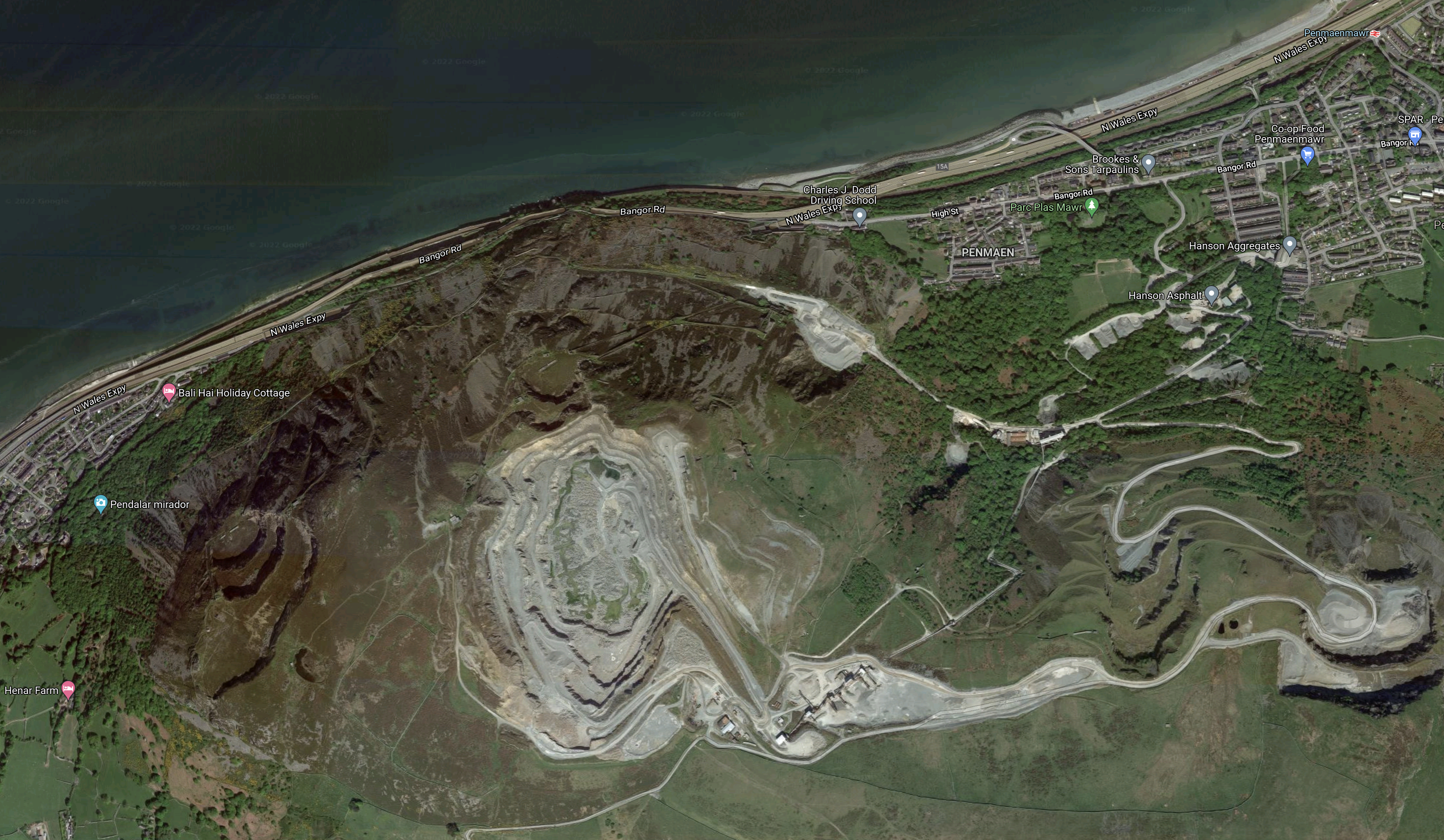
Penmaenmawr station is in the top right corner of the map.
It does appear to me, that this is a good move by Hanson.
- If the quarry can be worked economically, it is surely worthwhile exploiting.
- Opening new quarries, is generally not an easy process.
- Even using diesel locomotives on the aggregate trains, probably saves carbon compared to trucks.
- Closing the quarry would probably not be good for the area.
- They only want to run one train per week.
- I wonder, if the train goes through the Halton Curve that opened a couple of years ago.
- Penmaenmawr and Tuebrook Sidings are a route of about eighty miles.
But I think in the future it could be a very good move, as at least one of three things will happen.
- The North Wales Coast Line will be electrified.
- Someone will develop a hydrogen-electric freight locomotive.
- Wabtec will develop their battery-electric locomotive for the UK with a UK-sized FLXdrive battery.
All possibilities will help Hanson lower the carbon footprint of the route.
Given too, that Hanson will probably decarbonise their quarrying operations by using hydrogen-powered equipment, it should be possible to arrange a hydrogen supply at Penmaenmawr.
Hydrogen Hub Plans Moving Forward For Stratford And Warwick
The title of this post, is the same as that as this article on the Stratford-on-Avon Herald.
These are the introductory paragraphs.
An ambitious plan to create a futuristic hydrogen hub in the county moved a step closer this week.
The aim is to produce eco-friendly ‘green’ hydrogen that can be used as low-carbon fuel to power local buses and bin lorries.
These are further points from the article.
- It will have its own electrolyser.
- Energy could come from a nearby solar farm and a battery.
- It will be located near to junctions 13 and 14 of the M40 motorway.
This Google Map shows the area.
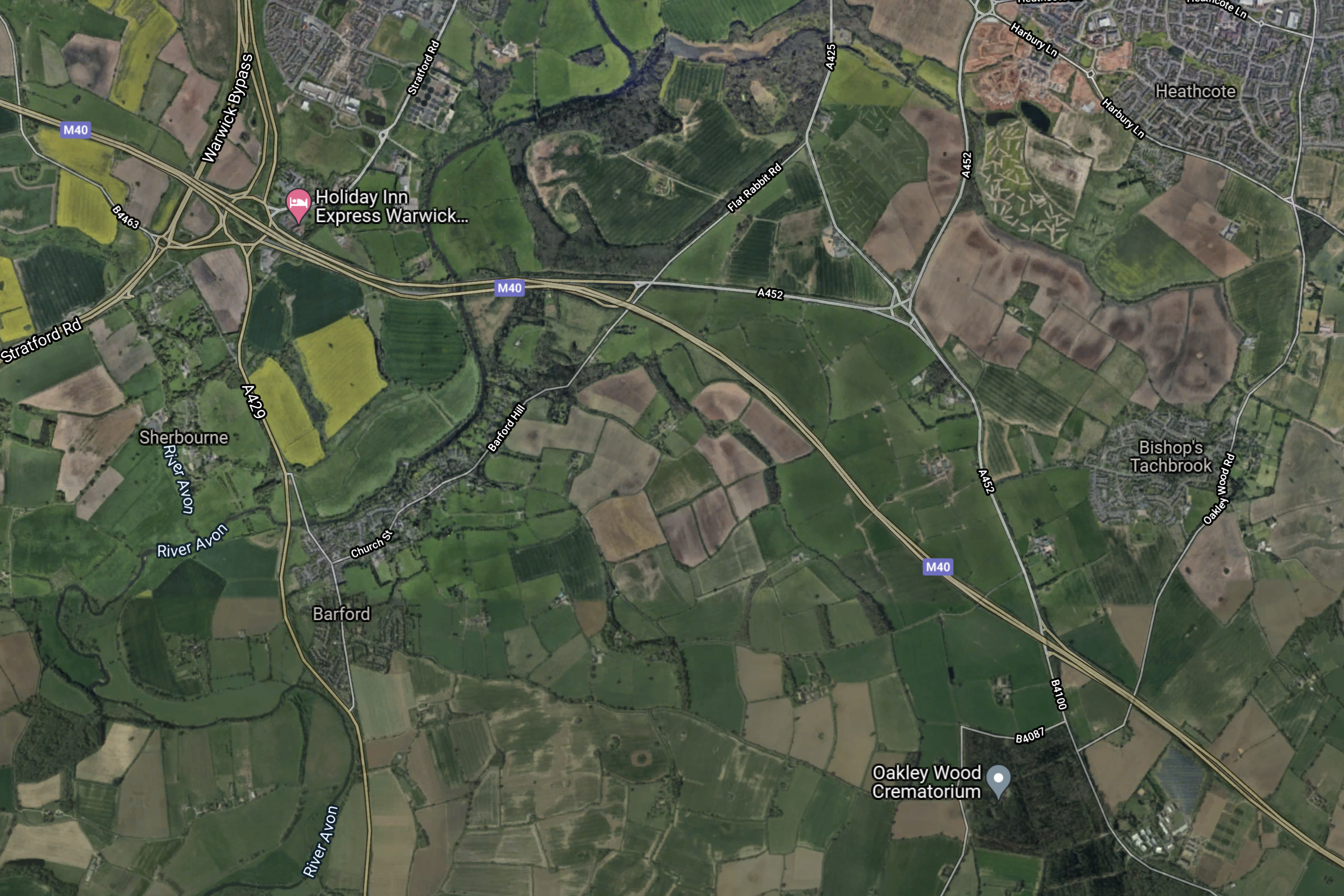
Junction 15 of the motorway is by the Holiday Inn and junctions 14 and 13 are towards the South-East.
It looks to be an excellent location for a hydrogen hub to serve bus, bin lorries and passing vehicles on the motorway.
Conclusion
I can see several other hydrogen hubs alongside major motorways an arterial roads.
Rolls-Royce Provide mtu Trigeneration Plant For Largest Data Centre In Romania
The title of this post, is the same as that of this press release on the Rolls Royce web site.
- mtu Series 4000 gas generator sets to provide electricity, heat and cooling for ClusterPower’s Technology Campus in Craiova
The completed campus will feature five data centers and provide a significant boost to the region’s global IT infrastructure competitiveness - Rolls-Royce, along with its distributor partner Knopf & Wallisch (K&W), has supplied three mtu customized and containerized combined cooling, heat and power plant (CCHP) trigeneration units to Romanian cloud service provider ClusterPower. They will be used for the efficient and sustainable energy supply at its new technology campus near the southern Romanian city of Craiova, where the IT company will open the largest data center in Romania.
The press release also says that trigeneration plants are hydrogen-ready.
The engines are gas engines, that can be converted to running on a mix of 25 % hydrogen and natural gas or eventually to pure hydrogen.
Conclusion
This would appear to be a neat way to sell the end customer an engine that can handle natural gas now and convert it over time to hydrogen.
H2goesRail
The title of this post, is the same as that of this page on the Deutsche Bahn web site.
These three paragraphs introduce the H2goesRail philosopher.
Deutsche Bahn is currently developing and implementing solutions that utilize hydrogen. One such endeavor is the H2goesRail project. In partnership with Siemens Mobility, we are breaking new ground and driving forward decarbonization of the transport sector for the good of the environment. Together we are developing an innovative hydrogen system for rail transport, which will comprise a refueling station, hydrogen train, and maintenance infrastructure.
We aim to replace diesel multiple units in regional service and thus further reduce carbon emissions in rail transport. To achieve this, with H2goesRail we are developing an innovative mobile refueling station whose smart control unit will allow fast refueling of hydrogen trains.
DB Energie GmbH will ensure the supply of hydrogen for the project, from production by means of renewable-powered electrolysis all the way through to storage and provision.
There is a lot of video.
 The Anonymous Widower