Sheffield Region Transport Plan 2019 – A New Station At Barnsley Dearne Valley
This station will be to the East of Barnsley in the vicinity of the village of Goldthorpe.
In Changes Signalled For HS2 Route In North, I used this map of the proposed High Speed Two and Northern Powerhoiuse routes in East Yorkshire.
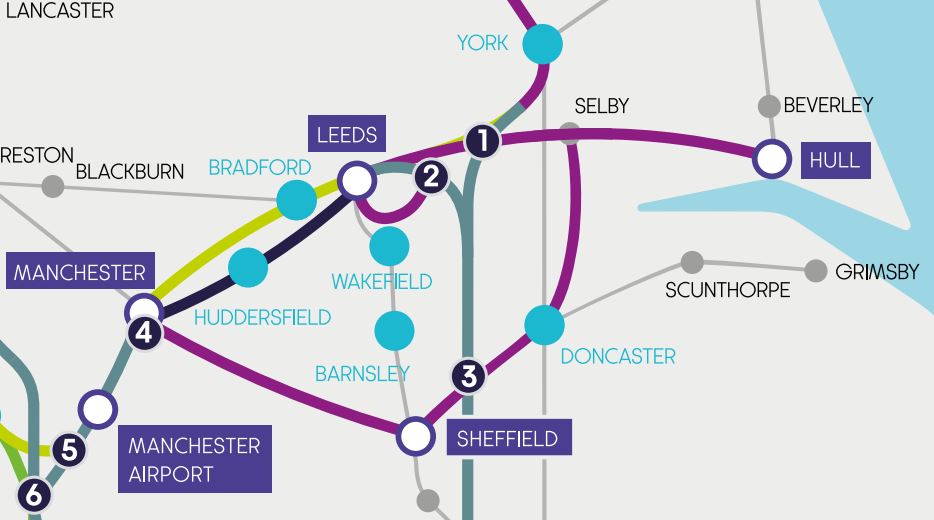
Note, these points about High Speed Two.
- It by-passes Sheffield and Barnsley and enters Leeds from the East, via Junction 2.
- It goes via Junction 1 to link up with the East Coast Main Line to York, Newcastle and Edinburgh.
- It links to the Leeds and Hull route at Junction 1.
- It has a Southern route via Chesterfield directly into Sheffield.
The current main route between Sheffield and Leeds is the Wakefield Line.
- It is thirty nine miles long.
- It is not electrified, except North of Wakefield Westgate station
- Trains stop at Meadowhall, Rotherhall Central, Swinton, Bolton-on-Dearne, Goldthorpe, Thurnscoe, Moorthorpe, Fitzwilliam, Sandal & Agbrigg, Wakefield Westgate and Outwood.
- Services take an hour and thirteen minutes
- The route is not very busy, with only, a total of around 4-6 trains per hour (tph) in both directions.
The Northern Powerhouse Rail improvements will see four tph between Sheffield and Leeds
- Journey times will be twenty-eight minutes.
- Some trains will extend past Sheffield to London St. Pancras.
- These fast services will probably stop less often.
- They will probably be backed up by stopping trains at perhaps two tph.
- I suspect the trains will be 125 mph bi-mode trains with batteries.
- I doubt there will be full electrification, as train developments will achieve the same objectives, in a more affordable manner.
- There will be full digital signalling to increase the capacity.
So where does the proposed Barnsley Dearne Valley station fit in?
- It will be on both the Wakefield Line and High Speed Two.
- It will have fast local trains between Leeds and Sheffield at four tph.
- It will have High Speed Two services between London and Leeds via East Midlands Hub at a frequency of at least two tph.
- It will have High Speed Two services between London and Newcastle via East Midlands Hub and York at a frequency of st least two tph.
- As I wouldn’t be surprised to see a Turn-Up-And-Go service on major legs of High Speed Two, will Barnsley Dearne Valley have four tph?
- Stopping trains to and from Sheffield could be at a frequency of four tph and be tram-trains.
The station would be a quality one, with ,lots of parking.
Barnsley would be welcomed to the Twenty-First Century.
I also believe, that the Wakefield Line could be improved, sooner rather than later.
I have flown my virtual helicopter along the route between Rohterham Central and Fitzwilliam stations.
- It is at least double-track all the way.
- It would appear to be fairly straight.
- There is plenty of room on either side, so third and possibly fourth tracks could be added.
- There are no level crossings and very few bridges.
- The stations are simple, but could be easily upgraded to full step-free access.
- Electrification could be a lot easier than some of the TransPennine routes.
So one way to give early benefits could be.
- Electrify between Sheffield and Fitzwilliam.
- Improve line speed to at least 100 mph and possibly 110-125 mph.
- Make all stations step-free.
- Build the Wakefield Line station at Barnsley Dearne Valley.
- East Midlands Railway could run two tph between Leeds and Sheffield using 125 mph bi-mode trains, with stops at Barnsley Dearne Valley, Swinton and Rotherham Central.
- Perhaps one tph could be between Leeds and London.
- Extend the Sheffield tram-train to Barnsley Dearne Valley.
I don’t think much of the engineering would be difficult and an opening date of 2023 would probably be possible.
The proposal would give these advantages.
- Twenty-eight minutes journeys between Leeds and Sheffield at a frequency of four tph.
- One or possible two tph between Leeds and London calling at Barnsley Dearne Valley and Rotherham Central.
- Extension of Leeds local electric trains to Barnsley Dearne Valley.
- A four tph tram-train service between Sheffield and Barnsley Dearne Valley.
- A direct service between Barnsley Dearne Valley and Doncaster is also a possibility.
The idea of a station at Barnsley Dearne Valley is a brilliant idea.
Do Tourists To The UK Get Bad Advice On How To Use The Trains?
I travelled out to Oxford with a Chinese family from Hong Kong.
- They were going to Oxford and home via Bicester Village.
- They had actually flown into Edinburgh and after spwnding a few days in the City, they had taken the train to London, where they were spending another few days.
- They were going to spend a day in Paris using Eurostar.
I think they had booked most of the tickets in Hong Kong before they left.
Knowing, what I know about ticketing, I would have organised things a bit differently.
Family And Friends Railcard
Purchase of a Family and Friends Railcard can give discounts for a one-off fee of £30.
To find out ticket orices with the Family and Friends Railcard web site.
Splitting A Journey
Most tickets other than Advance tickets allow the ticket holder to break a journey and then carry on later.
Because I am a coeliac and need gluten-free food, if I’m travelling a long distance, I may break the journey in say Birmingham, Glasgow, Leeds or Manchester, where I know I can get a quality gluten-free meal.
Tourists might want to break a journey between Edinburgh and London at York or Durham. This is possible on an Off Peak or Anytime ticket.
Tickets To Or From Stations Or Terminals
This ticket is a First Class Off Peak ticket between Manchester Stations and London Terminals, using Any Permitted Route.
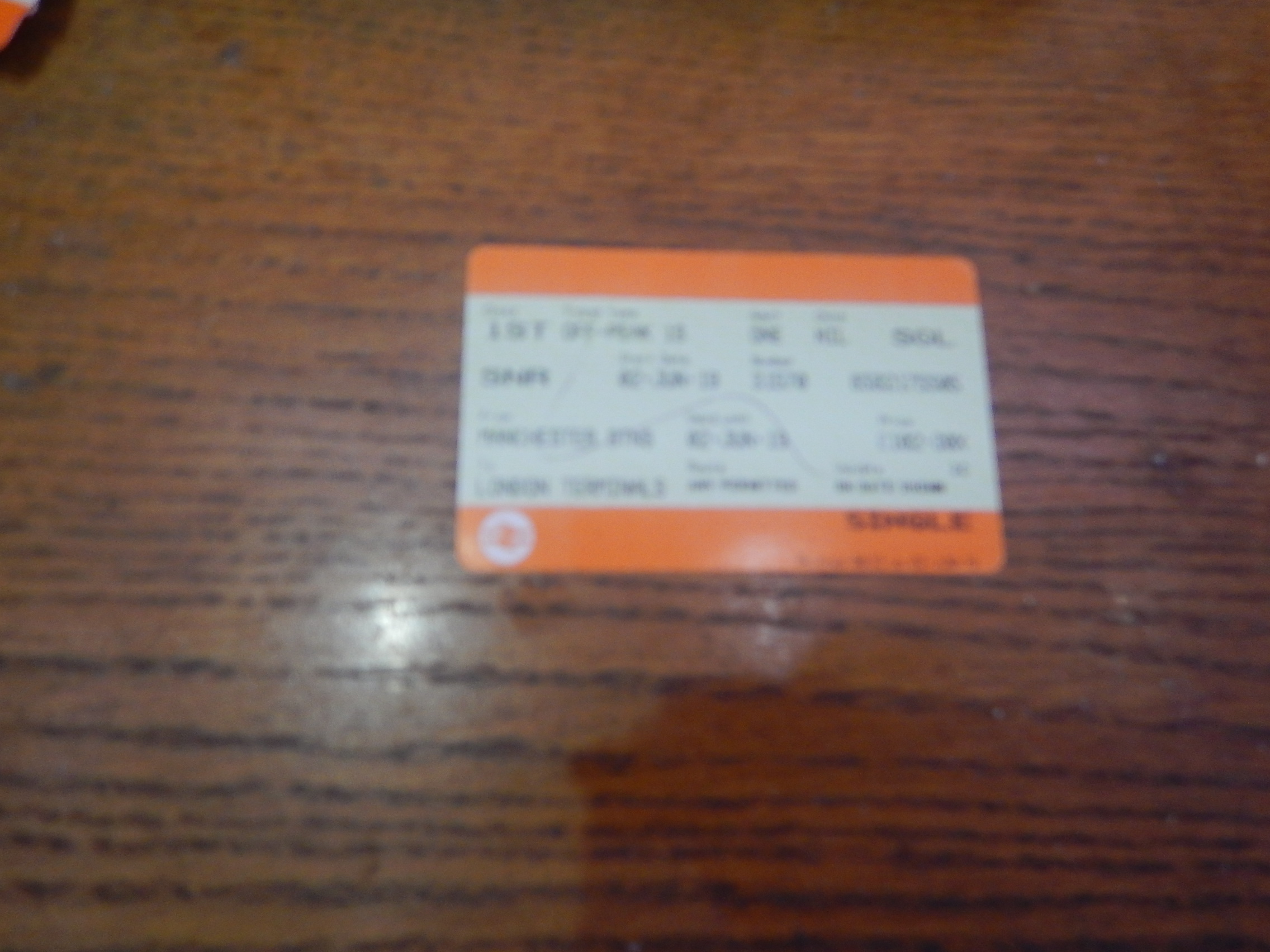
I actually used it between Manchester Piccadilly and London Euston stations, but I could have used the ticket to go via Birmingham and then take Chiltern Railways from Birmingham to London Marylebone.
I think the general rule is if your ticket is marked Any Permitted Route and you keep going in the same direction, most routes are possible.
I always ask first, as some companies have different rules.
Visiting Bicester Village, Oxford And Windsor In One Day
The Hong Kong family I met were visiting Oxford and Bicester Village.
The best way to do this is to make sure you have a Day Return ticket between London Terminals and Oxford, which is marked Any Permissible Route.
This will enable you to do the following three journeys.
- London Paddington to Oxford.
- Oxford to Bicester Village
- Bicester Village to London Marylebone.
With a Railcard, this ticket will cost £18.10.
If you want to visit Windsor, this can be done on the outward journey, by splitting the trip at Slough. There is a branch line to Windsor at Slough worked by a shuttle train, which costs £1.90 for a return trip with a Railcard.
Ranger And Rover Tickets
Check these tickets out, if you’re staying in a town or city for a few days, as they may be a cheaper option.
The various Rovers and Rangers are detailed on this web page.
London
The Oyster card in London is dying.
- But don’t worry, as the same prices are available by using a contactless bank card.
- Contctless bank cards have the same daily and weekly cap as Oyster.
- Contactless bank cards also work on the Underground, Overground, buses, Docklands Light Railway and the Emirates Air Line.
- You can now use contactless bank cards at London City, Gatwick, Heathrow and Luton Airports.
- If you want to use Gatwick and Heathrow Express services, these can be accessed using contactless ticketing too!
It appears there are very few complaints.
If you want to read a detailed analysis of London ticketing, read this page on the Finding The Universe web site.
Summing-Up
I shall be adding to this page, as it is only a rough general guide.
Use the Contact form to send any suggestions or questions.
An Outing To Oxford
I do a bit of research for a Californian lawyer, who helps small and medium-sized high-tech and other ventures setup in the UK.
He likes my opinion on the plans of start-ups and established businesses with respect to their location in the UK.
A couple of days ago, I received this e-mail.
John and his friends are funding a new venture being setup in Oxford.
The proposed CEO is a recently-widowed sixty-one year-old Canadian, who will be moving to London, where her daughter and family currently live.
Can you tell me, what it would be like commuting out from London to Oxford perhaps three days a week?
I should also say that at the moment, she is in need of having hip replacement surgery and proposes to have that in London, where she will be near to her family, during her stay.
She wouldn’t be able to walk a long distance.
This was my reply.
I can’t see much of a problem, as knowing John, the business could probably afford a few taxis and Crossrail will hopefully start running within the next eighteen months, making the London end straightforward.
Today, I went to Oxford leaving on the 09:50 train from Paddington and returning on the 13:01. Partly, to see if there were any pitfalls in the plan and also to have coffee and a snack with an old friend in the City, who helped me very much with the algorithms for Artemis.
These are my thoughts on the journey.
Trains
I travelled out in a comfortable nine-car Class 802 train. I’m not sure, whether it was the same on return or a shorter five-car train.
The outward journey was busier than the return journey, as I suspect that quite a few people live in London and work in Reading or Oxford.
But I did get a table both ways, so I was able to lay my copy of The Times flat and read it properly.
Cost
Off Peak Day Return tickets with a Senior Railcard, are £18.30 in Standard Class and £49.25 in First Class.
As I have a Freedom Pass, I bought a Standard Class Off Peak Day Return between the Zone 6 boundary and Oxford for just £13.05 with my Senior Railcard.
I consider my ticket to be good value for a pensioner’s day out!
Journey Times And Frequency
Both trains took about an hour.
There are also two fast trains per hour, many of which are nine-car trains, with the remainder being five-car trains.
,Coffee, Tea And Snacks
I was surprised to see a trolley on the train.

But I don’t think much business was being done.
Oxford Station And Oxford City Centre
There were plenty of taxis at Oxford station, but I walked the distance both ways in under twenty minutes.
A friend, who has had an NHS double hip replacement, reckons she could walk it easily.
The biggest problem would appear to be the traffic and the narrow pavements


Note, that there are a few maps and some decent cafes and restaurants.
Conclusion
Travelling from London to Oxford is a very feasible daily commute and there are many worse ways of spending an hour on a train.
Thoughts On eScooters!
Consider.
- This article on the BBC is entitled Emily Hartridge: TV Presenter And YouTube Star Dies In Crash. It is an extremely sad tale and it has led to the inevitable call to ban electric scooters.
- There is also this article on the BBC, which is entitled Iris Goldsmith: Teenage girl dies in ‘quad bike’ accident. This is another extremely sad tale and many are questioning, what a teenage girl was doing, riding a quadbike.
- And then there’s this article on the BBC, Which is entitled Govia Thameslink Fined £1m Over Gatwick Express Window Death.
Young people and some older ones too, often do stupid things.
Many also crave danger and go mountaineering, riding on the tops of trains or jumping into rivers from a great height.
Doing things out of the ordinary is a natural reaction and is one of the reason, why humans are the most successful species on this planet.
I think the problem is the way we bring up children.
- My parents let me do anything I wanted up to a point.
- They also taught me lots of skills.
- From about twelve, I used to cycle all over London.
- I spent endless hours in my father’s print works doing things that would be frowned upon now, because they are too dangerous.
A couple of months ago, I was interviewed by a sixth-form girl student, in the volunteering I do at Barts Hospital in giving experience to prospective doctors.
She had lived in an over-protective environment and hardly left home on her own.
It was almost child abuse. She didn’t say, but I suspect she’d even been driven to and from school.
When it came to our own children, C and myself were fairly liberal and it was strange how, two became very street-wise and had the occasional scrapes, whereas the other was generally well-behaved.
Perhaps, we didn’t get everything right, but I like to think, we gave them a good appreciation of risk!
And that is one of the mot important things to learn in life, as often, those that ca’t assess risk, come to unfortunate ends.
I do feel my youngest son’s unhealthy lifestyle was a factor in his getting pancreatic cancer, especially if he was coeliac like me! But then he wouldn’t get tested!
His daughter though, seems to have a good appreciation of risk, but then if your father dies, you probably do!
To return to the eScooter, which is where this post started.
They Look Fun!
They certainly look fun and I constantly want to have a go on one.
Remember, I have crashed a twin-engined aeroplae and ridden horses in the Masai Mara.
At seventeen, I also sat on the back of a motorcycle, the wrong way round and went through the Mersey Tunnel.
Was I wearing a helmet? Of course not!
Are They Dangerous?
The risk depends on where they are used and how competent the rider is!
Ask any A & E doctor, what sport causes the most injuries and they’ll say something like rugby or horse-riding!
When A & E doctors start complaining about eScooters that will be the time for action.
Would Training Help?
Training isn’t the important thing.
However experience, especially that gained in a safe environment is important.
But to legislate that training should be mandatory will only have the reverse affect.
Conclusion
It’s a difficult problem, but we must teach everybody to appreciate risk.
When I joined ICI in 1969, I went on a formal Health and Safety course.
It has proven to be invaluable all my life an I haven’t worked on a chemical plant since 1970.
Will We See A Phase Out Of Diesel-Mechanical And Diesel-Hydraulic Multiple Units?
After writing My First Ride In A Class 195 Train, I started to think about the future of diesel multiple units.
The Class 195 trains are powered by one MTU diesel engine, with a rating of 390 kW in each car, that drives the wheels through a ZF Ecolife transmission.
It is all very Twentieth Century!
- Power comes from one diesel engine per car.
- There is pollution and carbon-dioxide generated outside the train.
- Noise is generated outside and inside the train.
- Braking energy is not captured and used to power the train, or stored for reuse.
We can do so much better than this.
The MTU Hybrid PowerPack
MTU have now developed the MTU Hybrid PowerPack.
This page on the MTU web site, is a document, which describes the PowerPack.
It describes the PowerPack as the next generation of railcar drive.
It lists these benefits.
- Saving fuel through braking energy recovery
- Significantly reduced emissions through load point optimization
- Optimizing travel times with the Boost Mode
- Significant noise reduction
- Flexible vehicle deployment and simple retrofitting
In some ways the last point is the most significant.
This is said in the document about deployment and retrofitting.
Naturally, rail vehicles with hybrid drive can also be powered
exclusively by the diesel engine. This also means great flexibility
for the operator: The trains can be deployed on both electrified
and non-electrified rail routes. In addition, upgrading to a trimodal*
power system – with an additional pantograph – is easy because
the system is already equipped with an electric motor. This gives
the operator considerable freedom with regard to deployment of
the vehicles – it‘s a big plus when they can respond flexibly in the
future to every route requirement or tender invitation.
It sounds like MTU have really done their thinking.
If you want to read more, there is this document on the Rolls-Royce web-site, which is entitled Hybrid Train Trials.
Note that Rolls-Royce are MTU’s parent company.
A Simple Trimodal Example
I will give one simple example of where the trimodal technology pf the MTU Hybrid PowerPack, could be used, to great advantage.
Southern have two routes, where they have to use diesel Class 171 trains
- Eastbourne and Ashford International (42% electrified)
- London Bridge and Uckfield (45% electrified)
Porterbrook are planning to fit MTU Hybrid PowerPacks to Class 170 trains, as I wrote about in Rolls-Royce And Porterbrook Launch First Hybrid Rail Project In The UK With MTU Hybrid PowerPacks.
As the Class 171 train is very similar to the Class 170 train, I would suspect that Class 171 trains can be converted to diesel hybrids using MTU Hybrid PowerPacks.
It would be very useful, if they could be converted into tri-mode trains, by the addition of third-rail shoe gear.
This would mean, that the two routes run by the Class 171 trains, could be run on electricity for st least 40-45 percent of the route.
I would also think, that adding third-rail shoe gear to a diesel multiple unit, like a Class 171 train, could be easier than adding a pantograph.
When you consider that Southern have twenty Class 171 trains, with a total of fifty-six cars and conversion would therefore need fifty-six MTU Hybrid PowerPacks, this would not be a trivial order for MTU, that could bring substantial benefit to Southern.
I suspect new bi-mode or battery/electric trains would be less good value, than converting trains with MTU Hybrid PowerPacks, in many applications.
Other Technologies
Already other companies and research organisations are getting involved in developing affordable solutions to convert redundant diesel multiple units into more environmentally-friendly and energy efficient trains.
We have also seen train operating companies in a wider sense, buying trains that can easily be updated to zero-carbon trains.
Benefits Of Conversion To Diesel-Hybrid
I believe that conversion to diesel hybrid trains, using MTU Hybrid PowerPacks or similar technologies, could be advantageous in other ways, in addition to the obvious ones of less noise and pollution.
- Train operating companies would not need to greatly change their support infrastructure.
- Driver retraining would probably be a short conversion course.
- More partially-electrified routes would be possible with efficient modern trains.
I also feel, that if we can convert diesel-mechanical and diesel-hydraulic trains into trains with the ability to use either 25 KVAC overhead or 750 VDC third-rail electrification, this will open up possibilities to create new partially-electrified routes in places, where electrification is either too difficult, too expensive or is opposed by protests.
Trains That Could Be Converted
These trains are ones that can possibly be converted to diesel hybrid trains.
Turbostars
As I said earlier Porterbrook are already planning to convert some of their numerous Class 170 trains to diesel hybrid operation using MTU Hybrid PowerPacks.
Turbostars are a class of diesel trains.
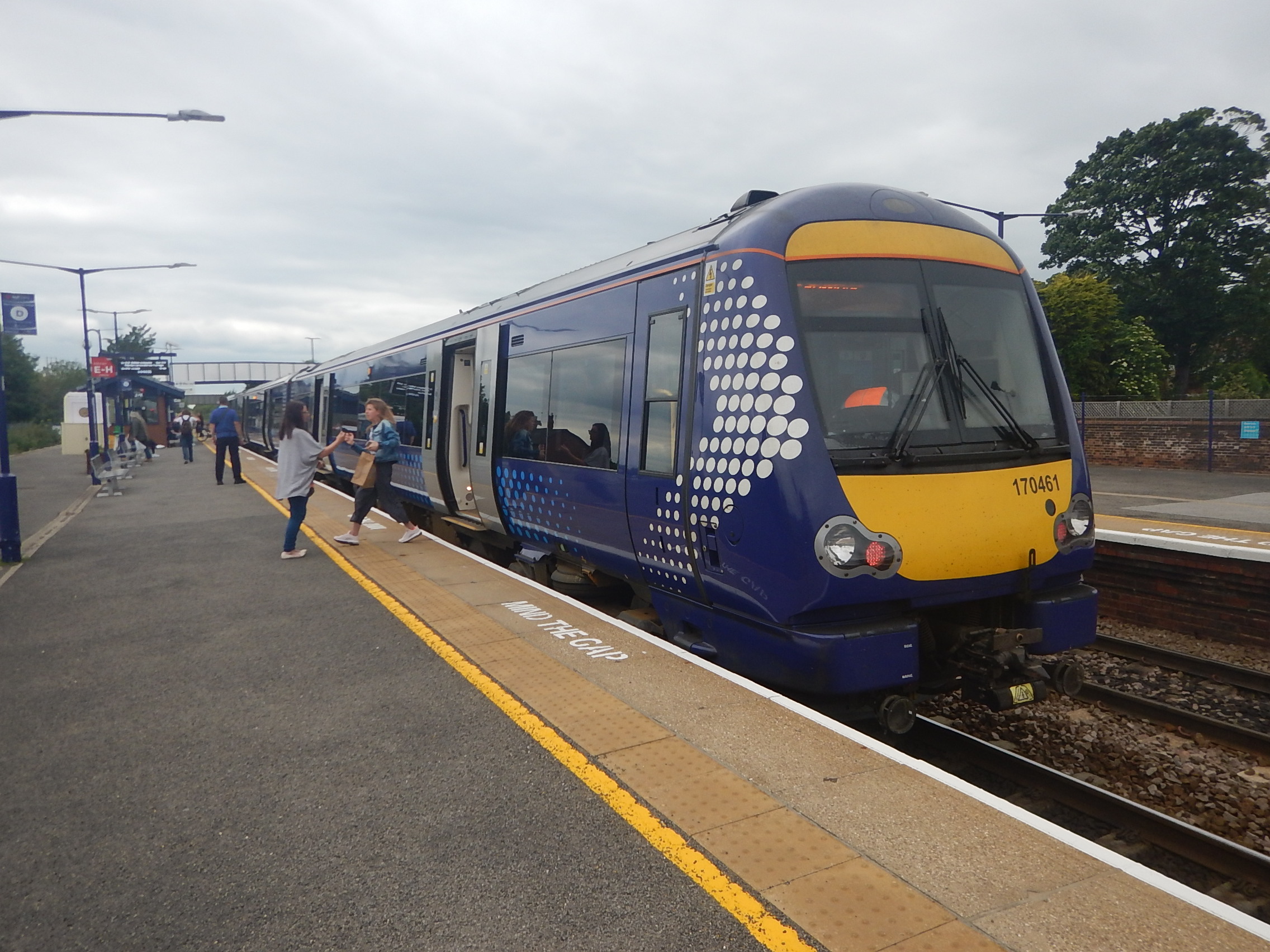
The picture shows a Class 170 train in ScotRail livery, at Brough station, working a service for Northern.
- They have a 100 mph top speed.
- They come in two, three or four car sets.
- They were built between 1996 and 2011.
- They have a comfortable interior and passengers only complain, when say a Class 170 train is replaced by a Class 156 or even older train.
- There are a total of 196 Turbostars in various classes.
This description from Wikip[edia, details their drive system.
Much of the design is derived from the Networker Turbo Class 165 and Class 166 trains built by British Rail Engineering Limited’s Holgate Road carriage works. Notable features shared are the aluminium alloy frame and two-speed Voith T211r hydrodynamic transmission system. The diesel engine has changed to an MTU 6R 183TD. A cardan shaft links the output of the gearbox to ZF final drives on the inner bogie of each vehicle. The engine and transmission are situated under the body; one bogie per car is powered, the other bogie unpowered.
It is simple system and well suited to replacement with the MTU Hybrid PowerPack.
As I said earlier, some Turbostars run over partially-electrified routes.
I also said that two of Southern’s routes are partially-electrified with the 750 VDC third-rail system, so could we see some examples making use of this to create a trimodal version.
On the other hand fitting a pantograph for 25 KVAC overhead electrification could be difficult. Although, all British Rail designs and their derivatives were usually designed, so they could work with every type of K electrification.
Class 165 And Class 166 Trains
The Class 165 and Class 166 trains are the predecessors of the Turbostars, and the later trains share a lot of their features.
As with all British Rail train designs, they have Japanese Knotweed in their DNA and engineers continuously find profitable ways of not sending them to the scrapyard. So they’ll be around for a few years yet!
The owner of these trains; Angel Trains has started a development project to create the Class 165 Hydrive train, which I wrote about in Class 165 Trains To Go Hybrid.
Will we see another hundred or so diesel hydraulic trains in good condition converted to more environmentally-friendly diesel hybrid trains?
Class 195 And Class 196 Trains
The Class 195 and Class 196 trains are still in the process of being built and judging by my first experience of Northern’s Class 195 train, that I wrote about in My First Ride In A Class 195 Train, they would benefit from the fitting of a quieter hybrid drive, like an MTU Hybrid PowerPack.
I suspect that any follow on orders for CAF’s diesel trains could well be built as diesel hybrids.
- The MTU Hybrid PowerPack could be used to replace the MTU engine and ZF Ecolife transmission.
- A battery-electric transmission, perhaps even using bogies and traction motors from the Class 331 train, could be developed.
Consider.
- Building the train around a hybrid transmission, will be probably no more difficult, than building one with a mechanical transmission.
- The train would create less noise and pollution.
- Hybrid trains would probably be more marketable to prospective purchasers. See Hybrid Selling.
As CAF are the only manufacturer of new diesel trains in the UK, I don’t think, they will be bothered.
Class 175 Trains
Transport for Wales have a fleet of eleven two-car and sixteen three-car Class 175 trains and they are scheduled to be replaced by a series of new trains starting in 2021.
I suspect the conversion to diesel hybrid will be possible, but even with a full interior refurbishment, will anybody have need for them, as there are already a lot of new 100 mph diesel trains on order, many of which could be delivered as diesel hybrids.
Class 180 Trains
There are fourteen five-car Class 180 trains.
They are 125 mph trains.
- Ten trains are used by Grand Central, who seem to have no announced plan to replace them.
- Four trains are used by Hull Trains and they will be replaced this year by new Class 802 trains.
The fact that Hull Trains are replacing their Class 180 trains with new Class 802 trains, probably says a lot about the limitations of Class 180 trains.
Conclusion
We will be seeing a lot of hybrid trains, made by updating diesel-mechanichal and diesel-hydraulic trains.
The High Speed Local Train
If Great Western Railway (GWR) are going to run a train service between Paddington and Bedwyn, they need an electric train which can power itself on the last thirteen miles between Newbury and Bedwyn, which is not electrified and is unlikely to be so in the next couple of decades.
The train must also be capable of cruising at 125 mph on the fast lines of the Great Western Main Line between Reading and Paddington.
GWR have no choice, but to run the service with a five-car Class 802 train.
When Hitachi were designing these 125 mph trains in Japan, I don’t suspect that running a service over a distance of 66.5 miles between London and a small village in Berkshire, was in the specification.
This morning, I took the 10:05 service from Paddington to Bedwyn, with the intention of returning on the 11:41 from Bedwyn to Paddington.
These are a few of the pictures that I took.
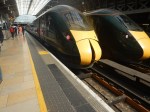
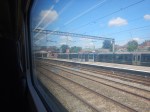
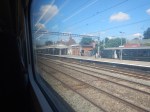
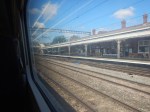
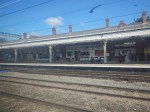
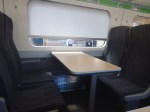
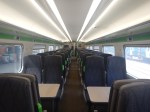

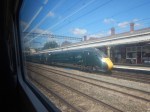

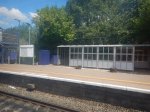
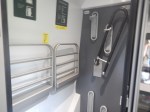
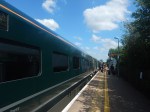

But things didn’t turn out as planned.
- Nothing serious and some animals got on the tracks between Reading and Swindon, meaning that we were some minutes late into Bedwyn, due to platform congestion at Reading.
- The return journey was consequently delayed.
These are a few observations.
Operating Speed
These were speeds on various parts of the journey.
- I timed the train at 115 mph through Southall and at 123 mph through Hayes & Harlington as the train accelerated out of Paddington.
- The train was doing just short of 125 mph for the major part of the route between London and Reading, until it had to stop because of the congestion.
- The train was doing around 100 mph on the electrified line between Reading and Newbury.
- Between Newbury and Bedwyn, speeds were between 80 and 90 mph.
Similar speeds were attained on the return journey.
Passenger Numbers
As the pictures show, there weren’t that many passengers who were travelling to Bedwyn, although there were more heading back to London.
Many more joined and left the service at the three larger stations of Reading, Newbury and Hungerford.
Now that the service is hourly between Reading and Bedwyn and half-hourly between Reading and Newbury in modern, comfortable trains, I can see passenger numbers growing.
Current Service
There are eleven trains per day, between Paddington and Bedwyn, at an hourly frequency, which take around three hours for a round trip.
So it would appear that three trains are needed for the service.
The service is also supplemented by an hourly stopping shuttle train between Reading and Newbury.
Two years ago, the service was just one three-car diesel train per hour between Paddington and Bedwyn with a few additional stops from long-distance trains.
Bedwyn Station Improvements
I got the impression, that Bedwyn station is probably at its limit for car parking with the current twenty-five spaces and cars all over the place.
This article on the Wiltshire Gazette and Herald, is entitled It’s A Rail Problem At Great Bedwyn and indicates that commuters and residents don’t see eye-to-eye with the car parking.
If the car parking were to be increased and usage at the station increased then I feel that a step-free bridge could be needed.
In Winner Announced In The Network Rail Footbridge Design Ideas Competition, I wrote how the competition was won by this bridge.
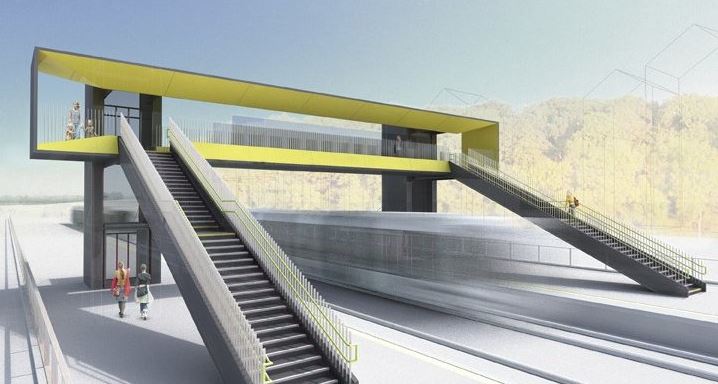
So could a factory-built bridge like this be installed at Bedwyn station?
The installation wouldn’t be difficult, but the politics could be.
Other Station Improvements
A quick look at other stations suggest these improvements.
- Hungerford station, which has a large car park, needs a step-free bridge.
- Kinbury station doesn’t have a bridge.
- Midgham station doesn’t have a bridge
- Theale station has improvements planned.
There are level crossings at Hungerford, Kintbury, Thatcham and Midgham.
Future Trains To Bedwyn
In Hitachi Plans To Run ScotRail Class 385 EMUs Beyond The Wires, I discussed how Hitachi were proposing to add battery power to Class 385 trains, which are in the same family as GWR’s Class 802 trains.
So surely, what is a power source for the goose is also a power source for the gander.
As it would only be a journey of thirteen miles both ways between Newbury and Bedwyn, this would surely be an ideal route for the use of battery power.
The other route, where battery power could be used would be between Didcot and Oxford, which is just over ten miles.
A Future Service To Marlborough
I covered this proposal in A Station For Marlborough.
Marlborough would be served by a single-track branch line on an old railway alignment, probably terminating near the large Tesco superstore in a single platform station.
The advantages of doing this would be.
- Marlborough, which is an important market town of 8,500 people would be connected to the rail network.
- Adequate car parking could be provided.
- Creating a station at Marlborough could be an alternative to expanding Bedwyn station, which could be problematical.
- It would improve the economics of the Paddington and Bedwyn service.
This is the sort of service, that should be developed.
Other Possible Services
The big advantage of this high speed local service for Great Western Railway, is that when it is on the Great Western Main Line, it becomes just another 125 mph service or once digital signalling is installed a possible 140 mph service.
These routes could have this type of high speed local services.
Great Western Main Line
Great Western Railway has several routes, where Class 800 and Class 802 trains break away from the Great Western Main Line to operate local services.
- Paddington and Bedwyn
- Paddington and Oxford
It could be argued that services to Cheltenham and Hereford are also high speed local services.
East Coast Main Line
In April 2018, I wrote Call For ETCS On King’s Lynn Route.
This post was based on an article in Rail Magazine, which talked about running 125 mph trains on the Kings Cross and Kings Lynn route.
This would make operation of the East Coast Main Line easier with herds of 125 mph trains steaming into and out of London.
I think, improvement would also extend to the Cambridge Line, in addition to the Fen Line.
- Operating speed up from 90 mph to 110 mph plus.
- Full digital signalling.
- Automatic Train Control.
Journey times and frequency to and from London Kings Cross would be improved significantly.
Siemens would probably need to uprate the Class 700 trains for faster running, as 100 mph trains are just too slow!
If you look at the East Coast Main Line between Doncaster and Edinburgh, large sections of the line are only double track.
It is the ambition of train operating companies to run more high speed expresses between London and the North of England and Scotland.
I can see a time, when all trains using the East Coast Main Line will have to confirm with a high minimum speed, otherwise the future plans cannot be fulfiled.
Midland Main Line
By the end of 2020, the Midland Main Line South of Market Harborough, will be a 125 mph electrified railway with a high speed branch to Corby, which will be served by a half-hourly twelve-car electric service.
From 2022, 125 mph bi-mode trains will be running services on the Midland Main Line.
I can see services between St. Pancras and Corby becoming another high speed local service.
- Half-hourly service.
- 125 mph running.
- Limited stop between Corby and London, with stops at Kettering, Luton And Luton Airport Parkway.
- The journey time could even be under an hour.
Selected trains could even use battery power to extend the service to Melton Mowbray.
West Coast Main Line
The West Coast Main Line will become increasingly crowded with fast 140 mph trains, especially after the opening of Phase 2a of High Speed Two to Crewe in 2027.
I believe that this will mean that all passenger services using the West Coast Main Line will need to be run using trains capable of at least 110 mph and possibly 125 mph.
The new operation of suburban services on the West Coast Main Line; West Midlands Trains are replacing their fleet with new Class 730 trains. Like the previous trains, they are 110 mph units, but are they capable of upgrading to 125 mph?
If they are upgradeable, they would ease timetabling problems between London and the West Midlands, as they could mix it with Virgin’s Class 390 trains.
Further North, Northern run services like these.
- Barrow and Manchester Airport.
- Blackpool and Manchester Airport
- Windermere and Manchester Airport
Currently, the operator is introducing new Class 195 and Class 331 trains, alongside the Class 319 trains.All of these trains are 100 mph capable, which is probably not fast enough, if they have to use the West Coast Main Line between Crewe and Lancaster, some of which is only double-track.
In Northern Considering Options For More New Trains, I wrote about Northern’s future rolling stock plans.
I suspect some 125 mph trains are in their plans for both the East and West Coast Main Lines.
Implications For Freight
There must surely be pressure for freight trains to go faster.
The 110 mph Class 93 locomotive is on its way, but with rail freight increasing we need to radically think how we run freight trains on a busy passenger line.
Conclusion
We will increasingly see upgrading of suburban services that use 125 mph line and not just around London.
Crossrail Rushes To Make Bond Street Ready For Testing
The title of this post is the same as that of this article on Rail Technology Magazine.
Mark Wild, who is Crossrail’s Chief Executive, is quoted as telling the London Assembly.
Our current focus is predominantly on key areas of risk such as ensuring that Bond Street station is at the required stage of completion to allow us to commence trial running early in 2020..
The more I read about this project, the more I believe, that the projects lateness is down to two things.
- Some very optimistic project management by contractors to get some of the enormous contracts on offer.
- A lack of resources in vital areas like some trades and the testing of trains.
But then what do I know about Project Management and computer software?
Could Bond Street also be the only really late station, as it is on a very cramped site in the centre of some of the most expensive real estate on the planet?
The 3D visualisation shows the area around the station.
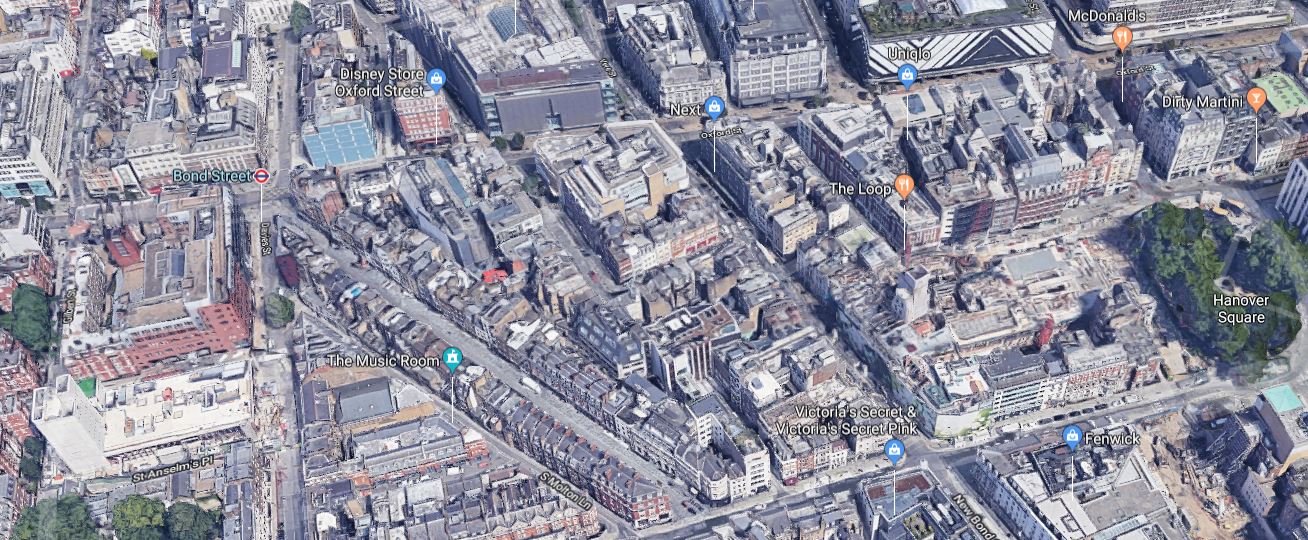
Note .
- The new Western entrance to Bond Street Crossrail station, which is the cleared site with the russet-coloured building behind.
- The new Eastern entrance, which is just to the West of Hanover Square.
- Bond Street running down from Next on Oxford Street to Fenwicks.
Surface access is not good to say the least.
The same access problem probably applies at Paddington, Tottenham Court Road, Farringdon, Moorgate and Liverpool Street stations, but at these five stations, there were buildings that could be demolished to give access for construction.
It should also be notes, that some of these stations have only a few local residents.
I’ll take a quick look at these five stations.
Paddington
This Google Map shows Paddington station.
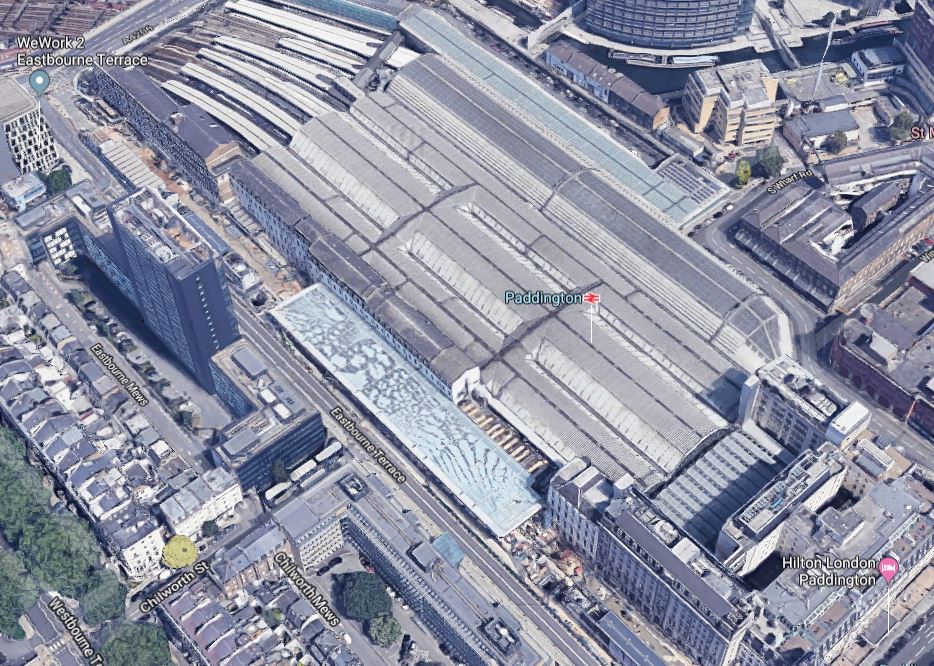
Note the Crossrail station, which has been squeezed into the old cab rank, alongside the station.
Tottenham Court Road
This Google Map shows Tottenham Court Road station.

Note the amount of cleared space around the station,
Farringdon
This Google Map shows Farringdon station.

The Crossrail station is to the West of the current station. It must have helped contractors, that the station had been redeveloped a couple of times for the construction and update of Thameslink.
Moorgate
This Google Map shows Moorgate station.
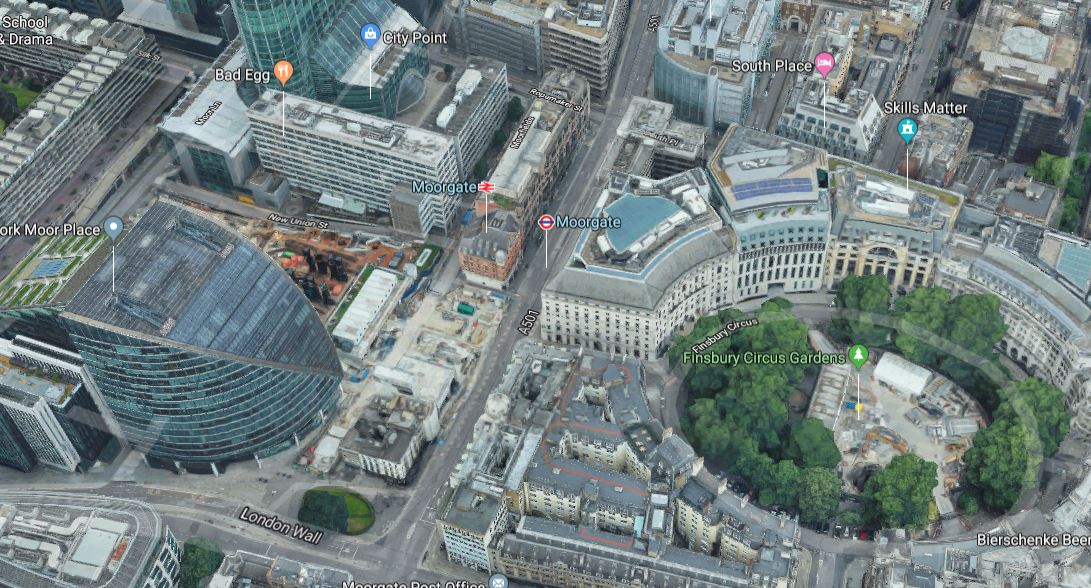
Moor House, which is the large office block behind Moorgate station, was built in 2004 and was designed to accept Crossrail in the basement.
Finsbury Circus, which is the green space in the East was used as a construction site.
Liverpool Street
This Google Map shows Liverpool Street station.
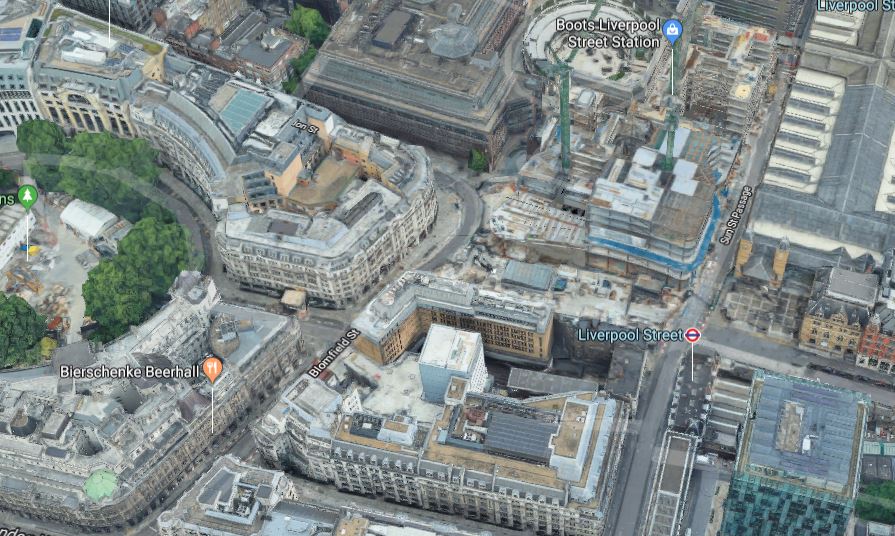
The main entrance to the Crossrail station will be in front of the Broadgate office complex, which is to the West of the station.
This section of Broadgate is also being redeveloped, which probably helps and hinders in equal measure.
Conclusion
I think lessons will be learned that can be applied to other cross-city rail projects.
- Future-planning as with Moor House should be increasingly used.
- Should stations be built in conjunction with other developments?
- Are stations in areas of high real-estate values a good idea?
- Could more innovative ways be used to bring in construction materials?
Will future projects be better?
Northern Considering Options For More New Trains
The title of this post is the same as that of this article on Rail Magazine.
This is a paragraph.
Senior Northern sources told RAIL on June 28 that the operator believes the new trains will entice more people onto its services, and that within two years – once all 101 new trains are in service – there could be overcrowding.
This sounds to me, like another case of London Overground Syndrome.
At least, Northern have identified it early and taken the only action that works – Acquire more trains.
The High Speed Train Problem
Several of Northern’s routes use 100 mph trains on the West Coast and East Coast Main Lines.
- Blackpool and York
- Chester and Leeds
- Hull and York
- Leeds and York
- Liverpool and Blackpool via Wigan
- Manchester and Crewe
- Manchester and Stoke
- Manchester Airport and Barrow
- Manchester Airport and Blackpool
- Manchester Airport and Windermere
Will Northern acquire some 110 mph or even 125 mph trains to ease the creation of timetables amongst so many high speed trains using the main lines?
Greater Anglia’s New Train Order
Greater Anglia have ordered thirty-eight Class 755 trains, which have a total of 138 cars.
These will replace twenty-six assorted trains, which have a total of 55 cars.
This is an increase of 46% in the number of trains and 150% in the number of cars.
Greater Anglia didn’t increase the fleet so that could sit in sidings, so I think we can expect some new services and higher frequencies.
Conclusion
Northern’s actions are in line with other operators.
Network Rail To Outline Business Case For Clapham Junction Redevelopment
The title of this post is the same as that of this article on Rail Technology Magazine.
This is the first two paragraphs.
Network Rail have timetabled their plans to publish a strategy outline business case (SOBC) for the redevelopment of Clapham Junction station.
The public body told delegates at a rail conference in London that it intends to lay out the strategy by the end of the year.
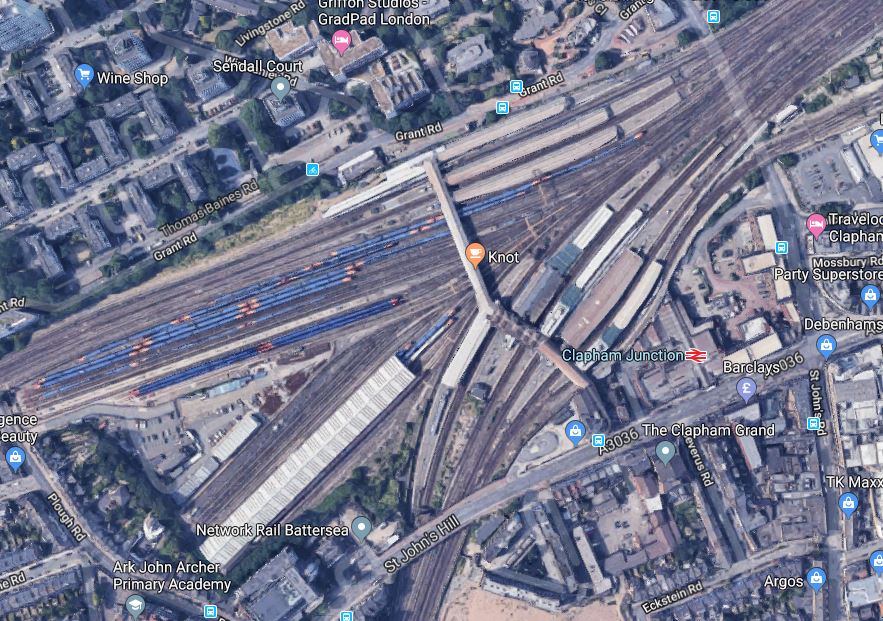
To get a better idea of Clapham Junction station, this Google Map shows the station.
And this map from carto.metro.free.fr shows the track layout.
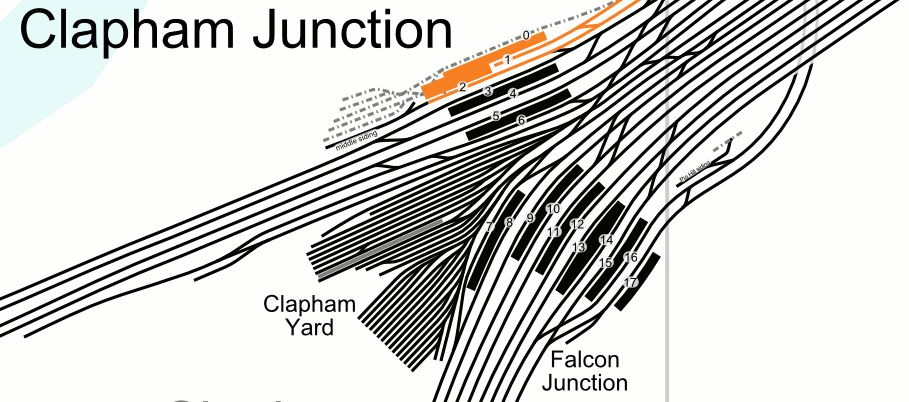
Note.
- The track layout is extremely complicated.
- A large amount of the area of the station is used for stabling of trains.
- The large number of platforms connected by a pedestrian bridge in the middle.
- There are a lot of stairs and lifts between the bridge and the platforms.
This description of the amount of traffic through the station is from Wikipedia.
Routes from London’s south and south-west termini, Victoria and Waterloo, funnel through the station, making it the busiest in Europe by number of trains using it: between 100 and 180 per hour except for the five hours after midnight. The station is also the busiest UK station for interchanges between services.
All of this adds up to a challenging problem, that if it can be solved, will fulfil these objectives.
- Greatly improve the passenger experience.
- Increase the train and passenger capacity of the station.
- Create more and longer platforms.
- Create or release lots of space for housing and other developments.
- Make the station ready for the Northern Line Extension from Battersea and Crossrail 2.
All of the development must be carried out with as little disruption to trains and passengers.
I’m no architect, but neither are Network Rail or were their predecessor British Rail, but they are good at creating well-thought out track layouts.
I suspect somewhere in a drawer or on a computer, is a British Rail plan for how the station could be laid out.
Such a plan probably existed for London Bridge station and with the design from good architects and structural engineers on top, one of the best terminal stations in the World has been built.
The Rail Technology Magazine article talks of decking over the whole station and putting two million square feet of development on top. But it also cautions, it would be very expensive.
- Could an imaginative architect create a unique development?
- Clapham Junction station, is the best-connected railway station in the South of London.
- Could the development be built with very little provision for car parking?
- Is the land strong enough for a cluster of high tower blocks?
- Could green space be provided?
I’ve lived in the Barbican with a young family and that estate works. But it should be remembered that the City of London had a completely cleared site at the Barbican, due to Nazi bombing.
So would decking over the station, be the way to create a cleared site to create a high-quality eco-friendly development for all?
I think it would and I think it could allow the development to be built at an affordable price.
I also feel that the important objective of building the development without disrupting trains and passengers can be met, by arranging construction in the right order.
Conclusion
Clapham Junction station is a unique site on which to build and like the Barbican, if we build it right, it will be admired fifty years later.
The East-West Rail Link Plans For Services Between Reading And East Anglia
This report on the East-West Rail web site is entitled Eastern Section Prospectus and gives full details of their proposals for the train services along the East-West Rail Link.
This post is particularly about services to Reading and the report says this about services between Reading and East Anglia.
Proposed Core Train Services
This is a sentence.
It has been assumed that, by this stage, a half hourly service will operate on the Central and Western sections between Oxford – Cambridge.
The report then goes on to add.
25 minutes are added to the Oxford journey time to represent the option of one service being extended to / from Reading with a Reading – Oxford non-stop.
So that looks like there will be a core hourly service between Reading and Cambridge, which will take 98 minutes.
The report then goes on to detail how various towns and cities in East Anglia will be connected to Reading.
Bury St. Edmunds
2h16 hourly with cross-platform changes at Cambridge and new A14 Parkway station.
Great Yarmouth
3h14 hourly direct
Ipswich
2h43 hourly with cross-platform changes at Cambridge and new A14 Parkway station.
Lowestoft
3h30 hourly with change at Norwich and cross platform change at Reedham.
Norwich
2h40 hourly direct
Trains For The Route
It looks like there will be two direct hourly train services.
- Reading and Great Yarmouth via Cambridge and Norwich, which will take three hours and fourteen minutes.
- Oxford and Ipswich via Cambridge and Bury St. Edmunds, which will take two hours and nineteen minutes.
The long term service pattern, envisages extending the Oxford and Ipswich service to Manningtree, which would add twenty-five minutes.
These are long services and given the overcrowding that happens on the current service between Norwich and Liverpool, I would think that the trains should be as follows.
- At least four or five cars.
- An on-board buffet.
- At least 100 mph operation.
I also think the trains should be bi-mode trains, able to use 25 KVAC overhead electrification or onboard power.
How Many Trains?
It looks like the Reading and Great Yarmouth service would be a seven-hour round trip, which would need seven trains.
The future Oxford and Manningtree service would be a six-hour round trip, which would need six trains.
So add in an allowance for maintenance and a spare, I suspect the fleet should be sixteen trains.
 The Anonymous Widower