Centrica And Ryze Agree To Develop Hydrogen Pathway
The title of this post, is the same as that of this press release from Centrica.
These are the first three paragraphs.
Centrica and Ryze Hydrogen are set to jointly build and operate hydrogen production facilities aimed at providing a reliable supply of hydrogen for industry and transportation.
Under the landmark agreement the firms will jointly develop hydrogen production projects on existing Centrica sites and work with third-parties to build production on their sites too.
A Memorandum of Understanding has been signed and will combine expertise in order to kickstart the development of the UK hydrogen economy, targeting the mobility, industrial and commercial markets.
There are also some other interesting statements in the press release.
- Centrica’s Head of Hydrogen, says that we should be bold in our thinking about hydrogen.
- The partnership will explore how the UK can work with international hydrogen production facilities.
- Jo Bamford, green entrepreneur and Executive Chairman of Ryze, believes that Centrica are very serious about hydrogen.
- Centrica and Ryse will convert some of the British Gas fleet to hydrogen.
I feel this could be a very significant deal for the decarbonisation of the UK.
Violence Against Women
The BBC is rightly having a campaign against domestic violence and violence against women in general.
It also appears to me, that women seem to get killed and attacked, a lot more than they did a couple of decades ago.
Is there too much violence against women in TV dramas, so men with small brains think it is acceptable? Surely, it is also wrong to have a TV drama called Killing Eve?
I have only watched a couple of TV dramas or films, in the last couple of years; Some Like It Hot and SAS Rogue Heroes.
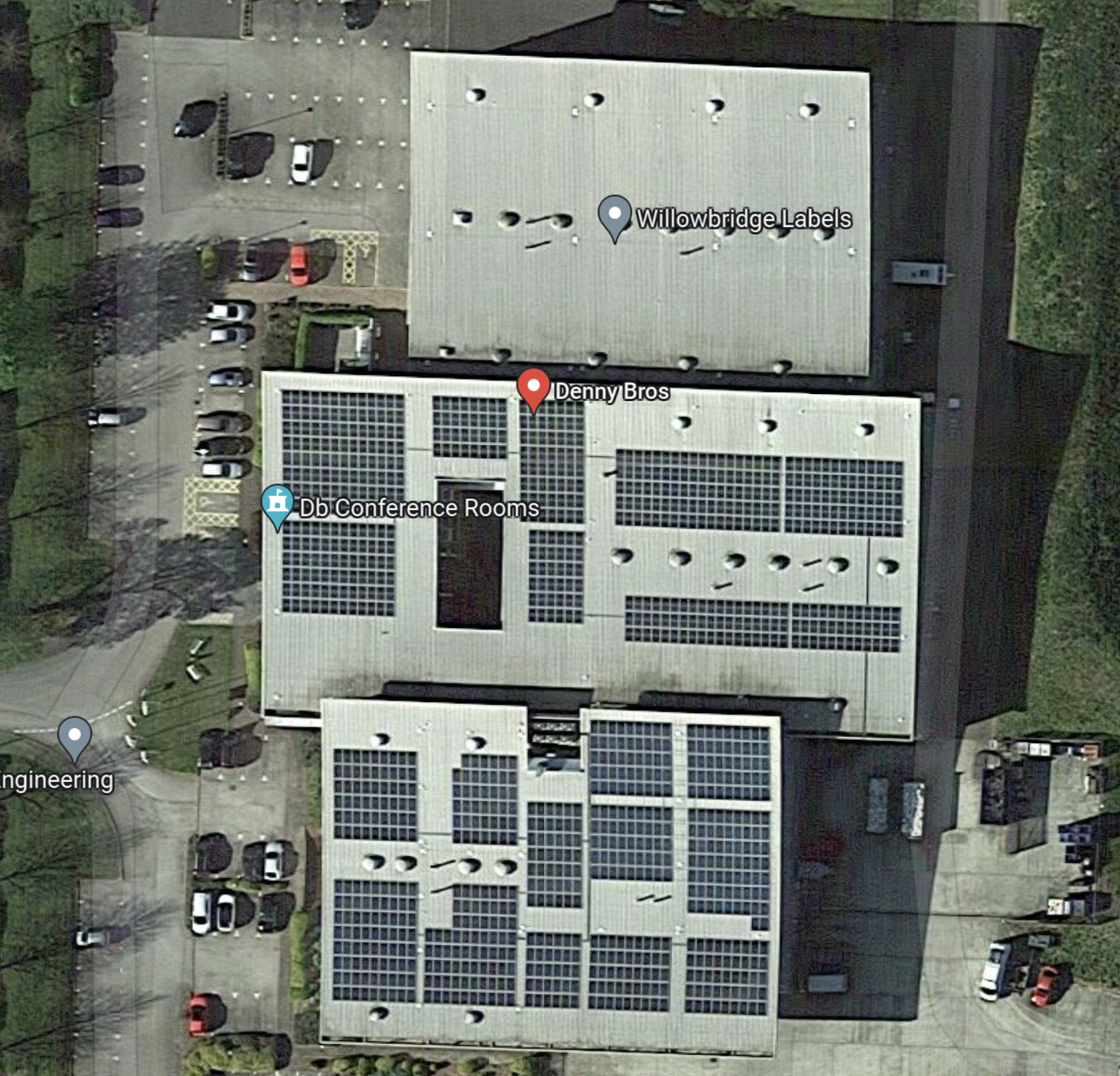
Denny Bros Completes Solar Scheme At Bury St Edmunds Factory
The title of this post, is the same as that of this article on the East Anglian Daily Times.
This is the sub-title.
An energy-hungry manufacturer has completed a huge £0.5m solar array across its roofs – which on a good day can power the whole operation and more.
This Google Map from a few months ago, shows the incomplete array.
A more recent picture in the article, shows the top building with solar panels on the roof.
According to another report in the East Anglian Daily Times, the company turns over about eight millions.
As Denny Brothers appears to be a well-run company, that is partly employee-owned, the numbers must add up.
Incidentally, the article was displayed with two adverts; one for a solar panel company and the other for the well-known employee-owned company; John Lewis.
I suppose that’s the way the cookie rumbles!
I certainly don’t regret installing solar panels on my flat roof!
What About A Couple Of Wind Turbines?
I ask this question, as some MPs want to allow more onshore wind, providing the natives don’t mind.
I wrote about onshore wind in Chancellor Confirms England Onshore Wind Planning Reform and I think that in the right place they are acceptable.
I know the Government has changed since September, but if you look at the Google Map above, I suspect a couple of turbines could be squeezed in and they probably would be in Germany.
The Secret Of The TwinHub
I was reading about the TwinHub, which is a pair of wind turbines, that are to be mounted on a single float.
There is an explanatory video on the TwinHub home page. Just scroll the page down and you’ll find a full page video, that is rather beautiful and slightly hypnotic.
But note how it stops and starts in the wind and turns itself into a position, so that it is generating the maximum amount of wind.
So how does it do that?
It is not by clever computers and a whole host of actuators, but by good old-fashioned aerodynamics.
Above the video, there is a picture of the sea, with these words underneath.
This demonstration project will be located at the Wave Hub site, and will consist of two floating platforms anchored to the seabed. Each floating platform will host two turbines with inclined towers. The total installed capacity will be between 30 to 40 MW.
Two words are the key to the design – inclined towers.
The wind will apply a force to each turbine and because the towers are inclined, this will apply a force, that will turn the turbines so they are facing the wind. This will maximise the power generated.
The design is elegant, efficient and enchanting.
I can see the TwinHub becoming an unusual tourist attraction in Cornwall.
Passengers Of Reduced Mobility And The Elizabeth Line
I took these pictures at Whitechapel station and they show the preferred wheelchair entry point to the Class 345 train and the central car of the train, which has four wheelchair spaces.











Note.
- The well-signed wheelchair entrance to the train.
- Thw four wheelchair spaces are in the middle car of the train.
- There is no step into the train.
- The roundels also have directions to other lines and the way out.
The car also has longitudinal seating and lots of vertical grab rails.
I do find it strange that London is very much alone in the UK in using this seating design.
Ukraine Tender Would Pair Hydroelectric Plants With Large-Scale Battery Storage
The title of this post, is the same as that of this article on Energy Storage News.
This is a must-read article, as it outlines the damage that Russia is doing to Ukraine’s energy generation.
It also reports how the World Bank is trying to help.
Is This Normal Behaviour Of Lizzie Line Passengers?
Suppose I’m using the Lizzie Line to go between Moorgate and Brentwood, I might get on the first train, if the one I need is not the first.
I will then change to the train I need at an intermediate station.
It’s just that the seats in the trains are more comfortable than those on the stations. My journey time will be the same, but my bottom will be pleased!
These are typical hard steel station seats.

And these are upholstered ones on a train.

In today’s weather the trains were also a bit warmer!
Do other passengers do this?
Hyperion XP-1 Hydrogen Car Unveiled With 1,000-mile Range
The title of this post, is the same as that of this article on Hydrogen Fuel News.
This is the specification of the hydrogen-powered Hyperion XP-1.
- 1,000 mile range.
- No batteries as it uses supercapacitors.
- Five minute refuelling time
- All-wheel drive
- 221 mph top speed
- 0-to-60 mph in 2.2 seconds
- Weighs just over a tonne
- Carbon-titanium monocoque
- Outrageous styling
Unbelievable!
Innovative Hydrogen Energy Storage Project Secures Over £7 million In Funding
The title of this post, is the same as that of this press release from the University of Bristol.
These two paragraphs outline the project.
A consortium, involving the University of Bristol, has been awarded £7.7m from the Net Zero Innovation Portfolio (NZIP) of UK Government’s Department for Business, Energy & Industrial Strategy (BEIS) to develop pioneering hydrogen storage.
The University, EDF UK, UKAEA and Urenco will together develop a hydrogen storage demonstrator, in which hydrogen is absorbed on a depleted uranium ‘bed’, which can then release the hydrogen when needed for use. When stored, the hydrogen is in a stable but reversible ‘metal hydride’ form. The depleted uranium material is available from recycling and has been used in other applications such as counterbalance weights on aircraft.
I particularly like this paragraph from Professor Tom Scott.
Professor Tom Scott from the University’s School of Physics and one of the architects of the HyDUStechnology, said: “This will be a world first technology demonstrator which is a beautiful and exciting translation of a well proven fusion-fuel hydrogen isotope storage technology that the UK Atomic Energy Authority has used for several decades at a small scale. The hydride compounds that we’re using can chemically store hydrogen at ambient pressure and temperature but remarkably they do this at twice the density of liquid hydrogen. The material can also quickly give-up the stored hydrogen simply by heating it, which makes it a wonderfully reversible hydrogen storage technology.”
It’s elegant and it certainly, is an unusual method of storing hydrogen.
I do see a problem in that depleted uranium is controversial because of its use in munitions; most notably in the Gulf War.
I also see its heavy weight being rather a disadvantage in storing hydrogen for mobile applications.
So, I will keep an open mind on this technology.
 The Anonymous Widower