Scotland’s Largest Offshore Wind Farm Entering Home Stretch
The title of this post, is the same as that of this article on offshoreWIND.biz.
Regulator Approves New Grand Union Train Service From Carmarthen To London Paddington
The title of this post, is the same as that of this press release from the Office of Rail and Road.
This is the sub-heading of the press release.
The Office of Rail and Road (ORR) has opened up the Great Western Main Line to competition and enabled a significant increase in rail services between London and South Wales.
These points are made in the press release.
- The rail regulator has approved the introduction of new train services between London, Cardiff and South West Wales from the end of 2024.
- The services will be operated by a new open access operator, Grand Union Trains, bringing competition to the Great Western route out of Paddington.
- Passengers travelling between London, Bristol Parkway, Severn Tunnel Junction, Newport, Cardiff, Gowerton, Llanelli and Carmarthen will benefit from an extra five daily return services and greater choice of operator.
- The decision opens up the Great Western Main Line to competition for the first time, with potential benefits in terms of lower fares, improved service quality and innovation for all passengers using the route.
- The application, submitted to ORR in June 2022, was disputed by Network Rail due to concerns about capacity on the network. But following careful consideration and analysis, ORR has directed Network Rail to enter into a contract with Grand Union.
- Grand Union has committed to significant investment in new trains.
- As an ‘open access’ train operator, however, it will not get paid subsidies from public funds, unlike current operators along the route.
ORR supports new open access where it delivers competition for the benefit of passengers. In making this decision, the regulator has weighed this up against the impact on Government funds and effect on other users of the railway, both passengers and freight customers.
These are my thoughts.
The Company
Grand Union Trains have certainly persevered to get this approval.
- The company was created by Ian Yeowart, who previously created open access operators; Alliance Rail Holdings and Grand Central before selling both to Arriva.
- After multiple negotiations with the Office of Road and Rail (ORR), Yeowart must know how to get an acceptable deal.
- Grand Union Trains have a similar application for a service between Euston and Stirling with the ORR.
Grand Union Trains also have a web site.
The home page has a mission statement of Railways To Our Core, with this statement underneath.
At Grand Union we are passionate about Britain’s railways. We are committed to the traditional values of providing a high-quality customer service and a comfortable journey experience at a fair price.
I’ll go with that.
The Financial Backing Of The Company
All the UK’s open access operators are well-financed either by Arriva or First Group.
The ORR would not receive any thanks, if they approved an operator, which duly went bust.
So what is the quality of the financing behind Grand Union Trains?
This article on Railway Gazette is entitled RENFE Looks At Entering UK Rail Market Through Open Access Partnership, which starts with this paragraph.
Open access passenger service developer Grand Union Trains is working with Spain’s national operator RENFE and private equity firm Serena Industrial Partners on a proposed service between London and Wales.
That is fairly clear and would surely help in the financing of Grand Union Trains.
The Route
Trains will run between Carmarthen and London Paddington, with stops at Llanelli, Gowerton, Cardiff, Newport, Severn Tunnel Junction and Bristol Parkway.
A new station at Felindre will replace Gowerton at some time in the future.
There will be five trains per day (tpd).
I have some thoughts and questions about the route
Felindre Station
Felindre station is named in Wikipedia as the West Wales Parkway station, where it is introduced like this.
West Wales Parkway is a proposed railway station north of Swansea, near to the boundaries of the neighbouring principal area of Carmarthenshire, and the villages of Felindre and Llangyfelach. The station is proposed to be situated at the former Felindre steelworks, near Junction 46 of the M4 and A48, and near Felindre Business Park and Penllergaer Business Park. The project is in the planning stages, as part of a wider Department for Transport proposal to re-open the Swansea District line to passenger traffic.
This Google Map shows where, it appears the Felindre station will be built.
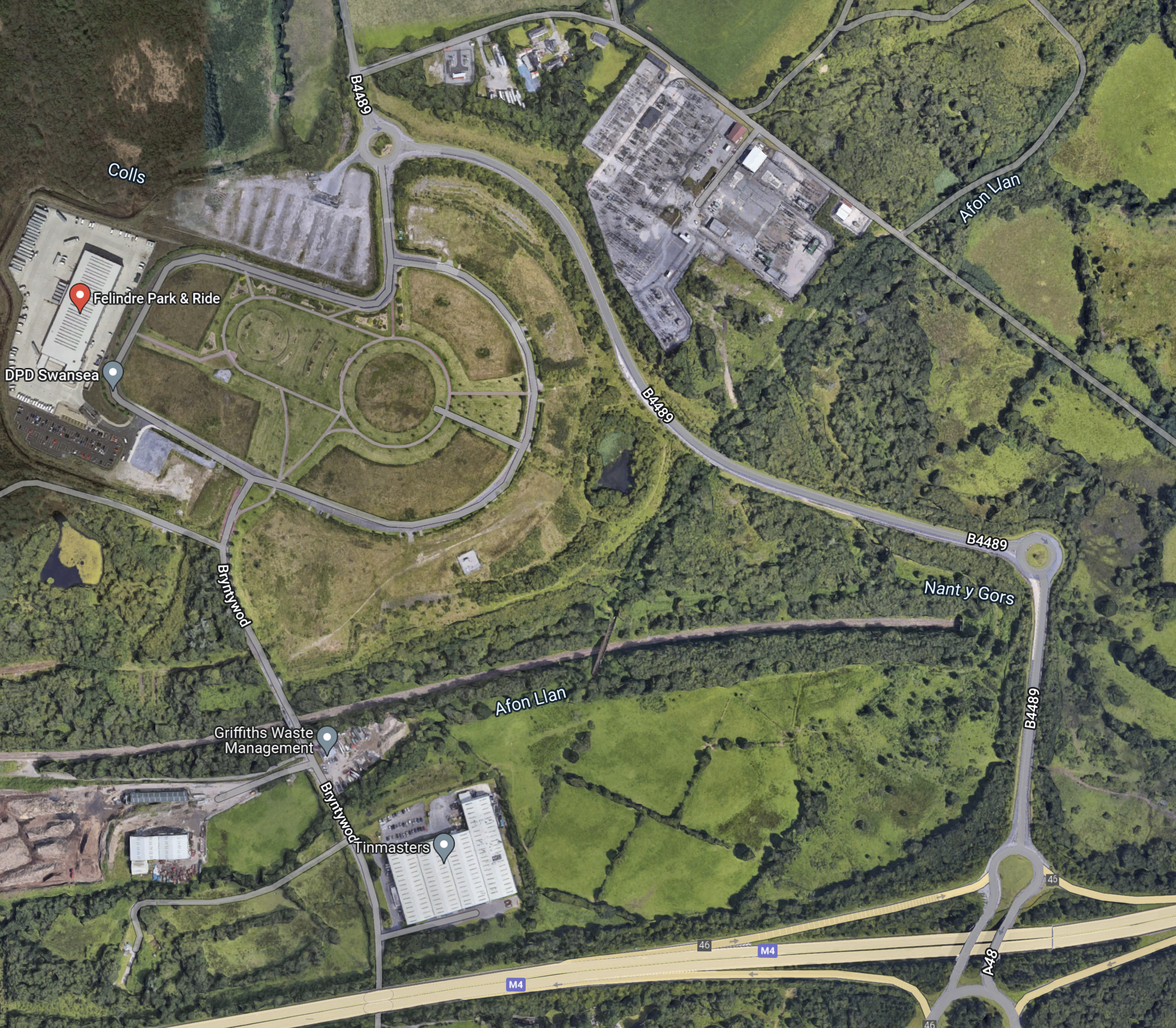
Note.
- The Felindre Business Park in the North-West corner of the map, with a Park-and-Ride.
- The M4 running across the bottom of the map.
- The Swansea District Line runs East-West between the motorway and the Business Park.
It looks that the new station could be located on the South side of the Business Park.
When High Speed Two Opens Will Trains Call At Old Oak Common?
When High Speed Two opens, all GWR trains will stop at Old Oak Common station for these connections.
- Chiltern for for Banbury, Bicester, High Wycombe and the West Midlands
- Elizabeth Line for Central and East London and the Thames Valley
- Heathrow Airport
- High Speed Two for Birmingham and the North
- Overground for Outer London
As Old Oak Common will be such an important interchange, I think they should.
Will The Platforms At Carmarthen Station Need Lengthening?
This Google Map shows Carmarthen station.
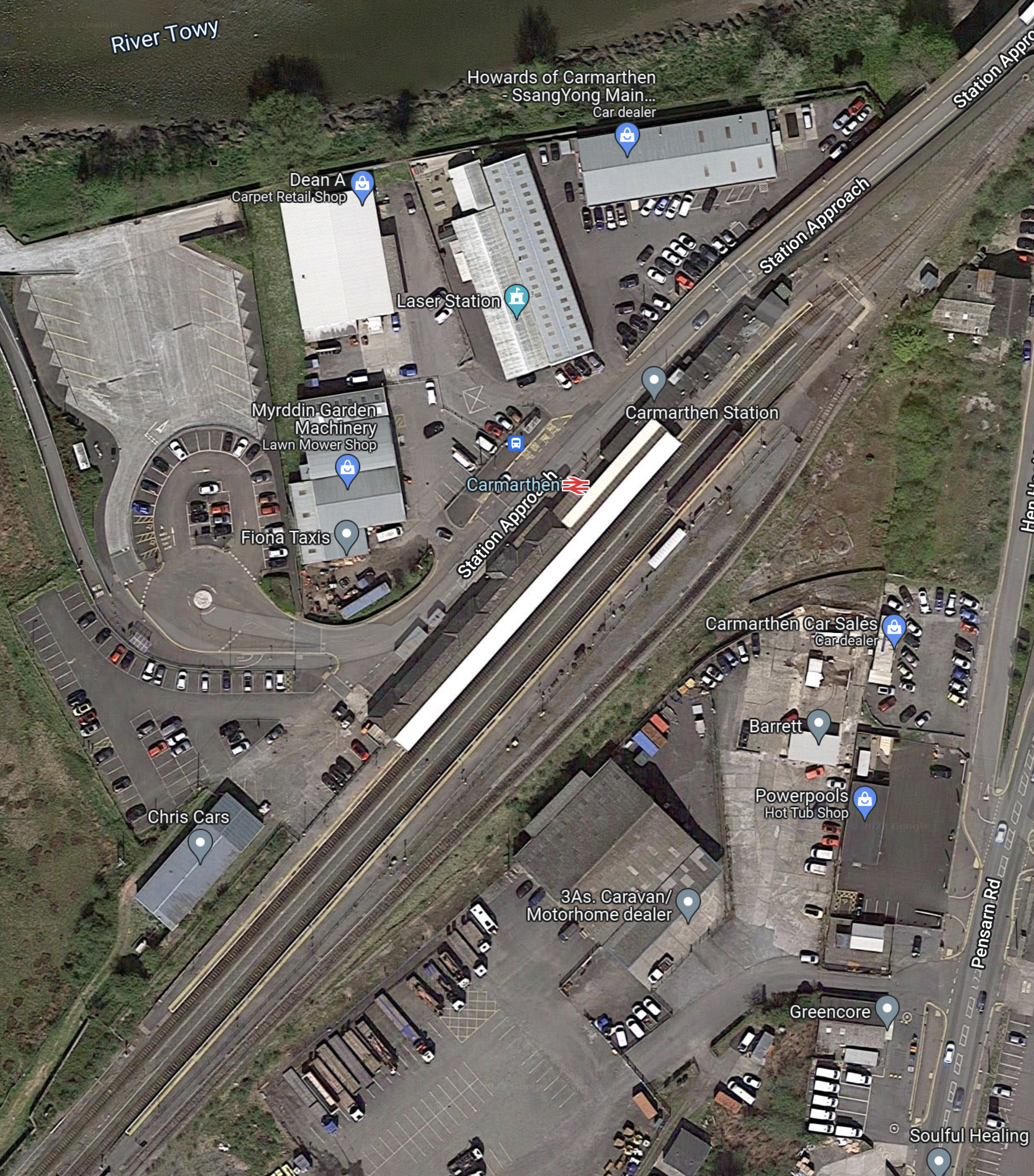
Note.
- The station has two platforms.
- There are certainly pictures of the station with an InterCity 125 in the station. There is a picture on the Wikipedia entry for Carmarthen station.
These pictures show the station.






I suspect that the station will be upgraded to accommodate Grand Union Trains.
The Trains
An article in the June 2022 Edition of Modern Railways, which is entitled Grand Union Bids For London To Carmarthen, gives these details of the trains.
- Three classes.
- 2023 start for the service.
- Cycle provision.
- Vanload freight will be carried.
- Electric trains could start between London and Cardiff by 2023.
- In 2025, trains could be nine-car bi-modes.
- South Wales-based operation and maintenance.
- 125 full-time jobs created.
It certainly seems to be a comprehensive and well-thought out plan.
I have a few thoughts on the trains.
What Make Of Trains Will Be Procured?
Consider.
- Lumo’s Class 803 trains were ordered from Hitachi in March 2019 and entered service in October 2021.
- So if they ordered their version of the Hitachi trains by the end of 2022, the trains could be in service by July/August 2025.
- It would probably be easier, if the only fast trains on the Great Western Main Line between London and South Wales were all Hitachi trains with identical performance.
But the Spanish backers of Grand Union Trains may prefer Spanish-designed trains assembled in South Wales. So would a bi-mode version of CAF’s Class 397 trains be suitable?
On the other hand, the Carmarthen and Cardiff section of the route without a reverse at Swansea is only seventy-five miles.
This Hitachi infographic shows the Hitachi Intercity Tri-Mode Battery Train.

Consider.
- Charging could be provided at Carmarthen using a short length of electrification or one of Furrer + Frey standard chargers.
- Charging would also use the electrification between London Paddington and Cardiff.
- A nine-car Class 800 or Class 802 train has five engines and a five-car train has three engines.
- The Intercity Tri-Mode Battery Train was announced in December 2022.
- In the intervening two years how far has the project progressed?
- For the last twelve months, Lumo have been running trains with an emergency battery-pack for hotel power. How are the batteries doing, whilst being ferried up and down, the East Coast Main Line?
Can Hitachi configure a train with more than one battery-pack and a number of diesel engines, that has a range of seventy-five miles? I suspect they can.
I suspect that CAF also have similar technology.
There is also a benefit to Great Western Railway (GWR).
If GWR were able to fit out their Class 802 trains in the same way, they would be able to run between Cardiff and Swansea on battery power.
- It is only 45.7 miles.
- Charging would need to be provided at Swansea.
- GWR could still run their one tpd service to Carmarthen.
It looks like both train operating companies could be able to do as Lumo does and advertise all electric services.
What Could Be The Maxmum Range Of A Hitachi Train On Batteries?
This Hitachi infographic shows the Hitachi Regional Battery Train.

Consider.
- It has a battery range of 90 km or 56 miles on the single battery.
- I would expect that by a regional train, Hitachi mean a five car Class 800 or 802 train, like those that go to Cheltenham, Lincoln or Middlesbrough.
- A five-car Hitachi Regional Battery Train would have a battery that could contain power equivalent to 280 car-miles.
- Five-car Class 800 or 802 trains have three engine positions.
- These Hitachi trains have a very sophisticated control system, which I wrote about in Do Class 800/801/802 Trains Use Batteries For Regenerative Braking?
I believe the engineers at Hyperdrive Innovation have designed the battery-packs that replace the diesel engines as simulations of the diesel engines, so they can be a direct replacement.
This would mean that battery-packs could be additive, so the following could apply to a five-car train.
- Two battery packs could have a range of 112 miles.
- Three battery packs could have a range of 168 miles.
GWR generally runs pairs of five-car trains to Swansea, which would be 90 miles without electrification.
If five-car trains with two battery packs, could be given a range of 112 miles, GWR could run an electric service to Swansea.
They could also run to Carmarthen, if Grand Union Trains would share the charger.
What ranges could be possible with nine-car trains, if one battery pack is good for 280 car-miles?
- One battery-pack, gives a range of 280/9 = 31 miles
- Two battery-packs, give a range of 2*280/9 = 62 miles
- Three battery-packs, give a range of 3*280/9 = 93 miles
- Four battery-packs, give a range of 4*280/9 = 124 miles
- Five battery-packs, give a range of 5*280/9 = 155 miles
- Six battery-packs, give a range of 6*280/9 = 187 miles
- Seven battery-packs, give a range of 7*280/9 = 218 miles
Note.
- I have rounded figures to the nearest mile.
- There are five cars with diesel engines in a nine-car train, which are in cars 2,3,5, 7 and 8.
- Diesel engines are also placed under the driver cars in five-car Class 810 trains.
- For the previous two reasons, I feel that the maximum numbers of diesel engines in a nine-car train could be a maximum of seven.
- I have therefor assumed a maximum of seven battery packs.
These distances seem sensational, but when you consider that Stradler’s Flirt Akku has demonstrated a battery range of 243 kilometres or 150 miles, I don’t think they are out of order.
But, if they are correct, then the ramifications are enormous.
- Large numbers of routes could become electric without any infrastructure works.
- Grand Union Trains would be able to run to Carmarthen and back without a charger at Carmarthen.
- GWR would be able to run to Swansea and back without a charger at Swansea.
Prudence may mean strategic chargers are installed.
Rrenewable Energy Developments In South West Wales
In Enter The Dragon, I talked about renewable energy developments in South West Wales.
I used information from this article on the Engineer, which is entitled Unlocking The Renewables Potential Of The Celtic Sea.
The article on the Engineer finishes with this conclusion.
For now, Wales may be lagging slightly behind its Celtic cousin to the north, but if the true potential of the Celtic Sea can be unleashed – FLOW, tidal stream, lagoon and wave – it looks set to play an even more prominent role in the net zero pursuit.
The Red Dragon is entering the battle to replace Vlad the Mad’s tainted energy.
South West Wales could see a massive renewable energy boom.
Grand Union Trains will increase the capacity to bring in more workers to support the developments from South Wales and Bristol.
Ricardo Supports Toyota To Develop Its First UK-Based Hydrogen Light Commercial Vehicle
The title of this post, is the same as that of this press release from Ricardo.
This is the first paragraph.
Ricardo, a global strategic, environmental, and engineering consulting company, is supporting Toyota, in partnership with the APC, on a significant, multi-year project to develop its first zero emission hydrogen powered light commercial vehicle in the UK.
Note.
- Ricardo is a long-established engineering consultancy, headquartered in Shoreham, that employs 3,000 people and has a turnover of around £350,000. It has a high reputation, especially in the design of diesel engines.
- Ricardo has already converted a diesel bus to hydrogen, which I wrote about in Ricardo Repowers Double Decker Diesel Bus With Hydrogen Fuel Cells.
- The zero emission hydrogen powered light commercial vehicle, will be based on the Toyota Hilux, of which nearly twenty million have been built.
- Toyota already produce the hydrogen-powered Mirai.
- The APC is the UK Government’s Advanced Propulsion Centre.
This looks like one of those collaborations in the 1960s between Ford and Lotus, that produced the iconic Lotus Cortina.
The press release says this about Ricardo’s role in the project.
The Toyota Hilux hydrogen variant will be the first of its kind, manufactured and assembled at Toyota’s Derby-based facility and is scheduled for prototype production in 2023. Ricardo has been chosen as a partner by Toyota due to its proven experience in applying advanced propulsion technologies and expertise in hydrogen fuel cell integration, including for the UK’s first hydrogen transport hub.
Ricardo’s role in the project is to integrate the complete hydrogen fuel cell, fuel storage system, and controls including design, analysis, and validation. The integration ensures efficient operation of all systems to give an excellent vehicle range and supports attributes for longevity and reliability. Working as part of the consortium, Ricardo will support the delivery of a complete turnkey solution, which will create greater agility for Toyota in the UK supply base and a quicker turnaround in the design of low volume manufacturing.
This certainly looks like a co-operation between equals.
I have a few thoughts on the fuel cells.
The Wikipedia entry for the Toyota Mirai says this about the fuel cells for that car.
The first generation of Toyota FC Stack achieved a maximum output of 114 kW (153 hp). Electricity generation efficiency was enhanced through the use of 3D fine mesh flow channels. These channels—a world first, according to Toyota—were arranged in a fine three-dimensional lattice structure to enhance the dispersion of air (oxygen), thereby enabling uniform generation of electricity on cell surfaces. This, in turn, provided a compact size and a high level of performance, including the stack’s world-leading power output density of 3.1 kW/L (2.2 times higher than that of the previous Toyota FCHV-adv limited-lease model), or 2.0 kW/kg. Each stack comprises 370 (single-line stacking) cells, with a cell thickness of 1.34 mm and weight of 102 g. The compact Mirai FC stack generates about 160 times more power than the residential fuel cells on sale in Japan.[40] The Mirai has a new compact (13-liter), high-efficiency, high-capacity converter developed to boost voltage generated in the Toyota FC Stack to 650 volts.
As a rudimentary search of the Internet says that an entry-level HiLux has a 148 hp diesel engine, it seems that Toyota’s own fuel cells could be in the right ball park.
This second press release from Ricardo is entitled Hyzon And Ricardo To Deliver Hydrogen Fuel Cell Systems For Commercial Vehicles.
These are the first two paragraphs.
Ricardo is a world-class environmental, engineering and strategic consulting company, is partnering with leading hydrogen vehicle supplier Hyzon Motors Inc. on developing and deploying commercial systems to support the decarbonisation of the global transport and energy sectors.
The companies announced today they will be working to combine Hyzon’s high-power-density fuel cell stack with Ricardo’s unrivaled software and controls, thermal management and proven track record advising customers on hydrogen fuel cell technology.
Note, that the press release dates from December 2021.
The last paragraph of the press release is probably the most significant.
The potential of the Hyzon-Ricardo engagement has already borne fruit with the debut of the Ricardo Vehicle Integrated Controls and Simulation (VICS) control system within the Hyzon fuel cell electric truck at the Advanced Clean Transportation conference in September. Moving forward, Ricardo will support Hyzon in a global capacity on the development and deployment of advanced energy management and propulsion systems to accelerate the realisation of net zero initiatives across all modes of transport.
Note.
- Have Ricardo used Hyzon fuel cells to create their hydrogen-powered bus? I wrote about this project in Ricardo Repowers Double Decker Diesel Bus With Hydrogen Fuel Cells.
- If Ricardo and Hyzon have been working together for a few years, the timescale would fit.
- As a Graduate Control Engineer, I know that with complex engineering systems of all kinds, good control is often hard to achieve. Perhaps, Ricardo have cracked it!
I can certainly see, Ricardo playing a similar role in the creation of Toyota’s Hydrogen HiLux.
Conclusion
It looks to me, that with their hydrogen deals with Toyota and Hyzon, Ricardo are converting themselves from a giant in the field of diesel engine technology to a significant player in the field of hydrogen power.
Better Fuel Technology
Better Fuel Technology is a Canadian company and has this web site.
They appear to use hydrogen to improve the fuel economy of vehicles in an unusual way.
This page on their web site is entitled Facts About HHO.
Under a heading of How Hydrogen Generators For Vehicles Work, this is said.
The greatest misconception about hydrogen is that we are making fuel from water. This is entirely incorrect and if it were true, would violate several laws of physics.
It is NOT possible to generate hydrogen at a rate fast enough to be used as the primary fuel.
Hydrogen powered cars do exist. They are designed to use Hydrogen as primary fuel. The hydrogen is created in advance. Just as every ordinary car requires a tank for gasoline, hydrogen is stored within cylinders on board the vehicle.
Our equipment is an inexpensive retrofit, compatible with any vehicle type and size.
Hydrogen assists the combustion process of the existing fuel. Although you will enjoy substantial fuel savings, you will still have to use the primary fuel.
Hydrogen generators use electricity from the battery of the vehicle to split the water (H2O) into its basic elements of oxygen and hydrogen. The generated hydrogen is then injected into the air stream of the vehicle to improve combustion efficiency and fuel economy.
In a standard engine, the combustion cycle is very fast: 0.007 seconds. Most of the fuel molecules are too large to burn completely in this extremely limited time.
The situation is made worse by the fact that the spark plug only ignites a small percentage of the fuel. The fire generated must cascade from one fuel molecule to the next as it propagates through the combustion chamber of the engine. This wastes precious time.
Hydrogen burns and travels through the combustion chamber 10X faster than a gasoline flame. Hydrogen fills the space between fuel molecules and has the effect of making them closer together. The flame travels faster and the fuel is exposed to flame sooner and for a longer period of time. The result is a cleaner, more complete burn.
You can think of hydrogen as a giant spark plug in your engine; igniting all the fuel instead of leaving much of it unburned.The science behind hydrogen injection has been well documented and understood. It has been known for over thirty years that the addition of hydrogen to fossil fuels, burned in internal combustion engines, will increase the efficiency of the engine.
This concept has been validated by a multitude of papers published by the Society of Automotive Engineers (SAE).
This is all very interesting.
Reading To Heathrow On The Lizzie Line
Last week, I took the Lizzie Line to Reading and came back with a diversion to Heathrow.
I took the train from Reading as far as Hayes and Harlington, where I crossed over the tracks on the footbridge to get the train to Heathrow.
There are two bridges at Hayes & Harlington station, as these pictures show.













Note.
- Only the Western bridge has lifts.
- The Western bridge will be at the very back of the train from Reading.
- It is a long walk from the front of the train to the lifts.
This map from Cartometro shows the tracks through Hayes and Harlington station.

Note.
- The Great Western fast lines, which are shown in black on the South side going through platforms 1 & 2.
- The Elizabeth Line and the Great Western slow lines, which are shown in black and purple on the North side going through platforms 3 & 4.
- The Reading and Heathrow branches are to the West.
- London Paddington is to the East.
- Elizabeth Line Trains from the Reading or Heathrow branches to Paddington use Platform 4.
- Elizabeth Line Trains from Paddington to the Reading or Heathrow branches use Platform 3.
It should also be noted that if you are travelling between Heathrow Airport and any of the Elizabeth Line stations between Hayes and Harlington and Reading stations, you have to cross from Platform 4 to Platform 3 at Hayes and Harlington station.
All passengers will be travelling in the same direction at Hayes and Harlington station.
I feel it is absolutely essential, if you are travelling between Reading and Heathrow Airport using the Elizabeth Line, that you travel in the last carriage of the train from both Heathrow Airport or Reading.
When travelling to Heathrow in Where Should You Travel On An Elizabeth Line Train?, I said these were the positions to travel on the train.
- Heathrow Central – Eastern end
- Heathrow Terminal 4 – Western end
- Heathrow Terminal 5 – Eastern end
It looks like there could be some walking to do if you’re travelling between Reading and Heathrow Central or Heathrow Terminal 5.
I feel that Hayes and Harlington station could possibly have been better designed.
Would it have been better if Platforms 3 and 4 had been designed as an island platform, so that passengers going between the Reading and Heathrow branches would just walk across to the other side of the platform?
- The tracks would have had to be realigned.
- There would have been less lifts needed.
- The Eastern bridge might not have been needed.
I suspect, it would have been the more expensive option.
EuroLink, Nautilus And Sea Link
EuroLink, Nautilus and Sea Link are three proposed interconnectors being developed by National Grid Ventures.
EuroLink
EuroLink has a web site, where this is said.
To support the UK’s growing energy needs, National Grid Ventures (NGV) is bringing forward proposals for a Multi-Purpose Interconnector (MPI) called EuroLink, which will deliver a new electricity link between Great Britain to the Netherlands.
EuroLink could supply up to 1.8 gigawatts (GW) of electricity, which will be enough to power approximately 1.8 million homes, as well as contribute to our national energy security and support the UK’s climate and energy goals. We’re holding a non-statutory public consultation to inform you about our EuroLink proposals, gather your feedback to help refine our plans and respond to your questions.
Note, that EuroLink is a Multi-Purpose Interconnector (MPI) and they are described on this page of the National Grid website.
In EuroLink’s case, this means it is basically an interconnector between the UK and The Netherlands, that also connects wind farms on the route to the shore.
- Coastal communities get less disruption, as the number of connecting cables coming ashore is reduced.
- Less space is needed onshore for substations.
- Electricity from the wind farms can be directed to where it is needed or can be stored.
As an Electrical and Control Engineer, I like the MPI approach.
The technology to implement the MPI approach is very much tried and tested.
There are many references to EuroLink terminating at Friston.
Nautilus
Nautilus has a web site, where this is said.
Nautilus could connect up to 1.4 gigawatts (GW) of offshore wind to each country through subsea electricity whilst connecting to offshore wind farm/s at sea. By combining offshore wind generation with interconnector capacity between the UK and Belgium, Nautilus would significantly reduce the amount of infrastructure and disruption required both onshore and offshore.
With this new technology, we hope to reduce the impact of infrastructure on local communities and the environment, as well as support the government’s net zero and energy security targets. We are already working closely with other developers in the area to coordinate activities and minimise impact on local communities. We believe that through improved coordination, the UK government can achieve and support the co-existence of renewable energy with coastal communities.
Nautilus is another MPI.
This is said on the web site.
Last year, National Grid Ventures ran a non-statutory consultation for Nautilus, which proposed a connection at Friston.
NGV holds a connection agreement on the Isle of Grain in Kent as part of its development portfolio and we are currently investigating if this could be a potential location for Nautilus. Until this is confirmed to be technically feasible, Nautilus will be included as part of our coordination work in East Suffolk.
So it looks like, Nautilus could connect to the UK grid at Friston or the Isle of Grain.
Sea Link
Sea Link has a web site, and is a proposed interconnector across the Thames Estuary between Suffolk and Kent.
This is said on the web site about the need for and design of Sea Link.
The UK electricity industry is evolving at pace to help lead the way in meeting the climate challenge, whilst also creating a secure energy supply based on renewable and low carbon technologies.
The demands on the electricity network are set to grow as other sectors of the economy diversify their energy consumption from using fossil fuels towards cleaner forms, the move towards electric vehicles being just one example.
Where we’re getting our power from is changing and we need to change too. The new sources of renewable and low-carbon energy are located along the coastline. We need to reinforce existing transmission network and build new electricity infrastructure in these areas in order to transport the power to where it’s needed. This is the case along the whole of the East Coast including Suffolk and Kent.
To allow this increase in energy generation, we need to reinforce the electricity transmission system. Sea Link helps to reinforce the electricity network across Suffolk and Kent.
Our proposals include building an offshore high voltage direct current (HVDC) link between Suffolk and Kent with onshore converter stations and connections back to the national electricity transmission system.
On the web site, in answer to a question of What Is Sea Link?, this is said.
Sea Link is an essential upgrade to Britain’s electricity network in East Anglia and Kent using subsea and underground cable. The proposal includes approximately 130km of subsea cables between Sizewell area in East Suffolk and Richborough in Kent. At landfall, the cables would go underground for up to 5 km to a converter station (one at each end). The converter station converts direct current used for the subsea section to alternating current, which our homes and businesses use. A connection is then made to the existing transmission network. In Suffolk, via the proposed Friston substation; in Kent via a direct connection to the overhead line between Richborough and Canterbury.
Note, that from Kent electricity can also be exported to the Continent.
All Cables Lead To Friston In Suffolk
It looks like EuroLink, Nautilus and Sea Link could all be connected to a new substation at Friston.
But these will not be the only cables to pass close to the village.
This Google Map shows the village.

Running South-West to North-East across the map can be seen the dual line of electricity pylons, that connect the nuclear power stations at Sizewell to the UK electricity grid.
Has Friston been chosen for the substation, so that, the various interconnectors can be connected to the power lines, that connect the Sizewell site to the UK electricity grid.
This would enable EuroLink, Nautilus and/or Sea Link to stand in for the Sizewell nuclear stations, if they are shut down for any reason?
It does appear from reports on the Internet that the Friston substation is not welcome.
Exploring Opportunities For Coordination
The title of this section is a heading in the EuroLink web site, where this is said.
In response to stakeholder feedback, NGV’s Eurolink and Nautilus projects and NGET’s Sea Link project are exploring potential opportunities to coordinate. Coordination could range from co-location of infrastructure from different projects on the same site, to coordinating construction activities to reduce potential impacts on local communities and the environment.
That sounds very sensible.
Project To Develop 20+ MW Floating Offshore Wind Technology Kicks Off
This is the introductory paragraph.
UK Govt Awards Almost GBP 33m To Innovative Energy Storage Projects
The title of this post is the same as that of this article on Renewables Now.
This is the first paragraph.
The UK government has awarded GBP 32.9 million (USD 39.7m/EUR 38.3m) in funding to five innovative energy storage projects under the second phase of its Longer Duration Energy Storage competition.
These are the projects.
StorTera
StorTera has secured GBP 5.02 million to create a prototype demonstrator of its single liquid flow battery (SLIQ) technology.
The company’s main product is the SLIQ Flow Battery, for which it gives the headline of Reliable, Economical Energy For 20 Years.
This is a description of the technology.
The revolutionary StorTera SLIQ single liquid flow battery offers a low cost, high performance energy storage system made with durable components and supported by our flexible and adaptable inverter and control system. The StorTera SLIQ battery brings the following benefits/advantages:
- Low levelised cost of storage and capital cost
- Long lifetime of up to 20 years (min. 7,500 cycles)
- Long duration energy with the energy and power capacity easily and independently scalable
- Safe with no cooling requirements and high flash point materials
- Fully recyclable at the end of lifetime
This is said about costs – Using low cost materials and manufacturing techniques, we predict capital costs of approximately £120/kW and £75/kWh by 2022.
I feel there could be something about this technology, but we’ll only know, when the demonstrator is fully working.
Sunamp
Sunamp will get GBP 9.25 million to test its thermal storage system in 100 homes across the UK.
On their home page, Sunamp has a banner of World Leading Thermal Technologies, with this description underneath.
Sunamp designs and manufactures space-saving thermal storage that makes UK homes, buildings and vehicles more energy-efficient and sustainable, while reducing carbon emissions and optimising renewables.
They do appear to have sold something, which is always a useful thing to do.
This page on their web site, describes their Thermino Thermal Storage For Domestic Hot Water, where this is said.
Thousands of Sunamp thermal batteries are already in homes across the UK storing heat from low-carbon energy sources and releasing it for mains-pressure hot water when needed.
Our Thermino batteries replace traditional hot water cylinders – direct (for grid electricity and solar PV) or indirect (for boilers and heat pumps).
They are up to four times smaller than the equivalent hot water tank because they are filled with our energy-dense phase change material, Plentigrade. This means that heat pump systems can be installed where otherwise they wouldn’t fit, for example.
The key seems to be this substance called Plentigrade!
This page on their web site describes Plentigrade.
Under a heading of Storing Energy As Heat And Releasing It When, And Where, It’s Needed, this is said.
Sunamp thermal batteries are energy-saving thermal stores containing Plentigrade: our high-performance phase change materials (PCMs) that deliver heating or cooling reliably, safely and efficiently.
Plentigrade, with its perpetual phase changing ability, is at the core of our products.
Our breakthrough technology was created in collaboration with the University of Edinburgh, ranked among the top 20 universities in the world, and the UK’s national synchrotron particle accelerator, Diamond Light Source. To find out more about the chemistry behind Plentigrade, read our blog.
Note.
- This product almost looks to be too good to be true.
- But I’ve checked and it doesn’t seem to have appeared on Watchdog.
- It’s yet another breakthrough, that has used the Diamond Light Source.
- How many other developments would happen with a Diamond 2 in the North, as I wrote about in Blackpool Needs A Diamond?
I have a feeling, that my house needs one of Sunamp’s thermal batteries.
University of Sheffield
The article says this about a grant to the University of Sheffield.
The University of Sheffield has been awarded GBP 2.6 million to develop a prototype modular thermal energy storage system designed to provide optimised, flexible storage of heat within homes.
There are several thermal batteries around for houses.
RheEnergise
The article says this about a grant to RheEnergise.
With a GBP-8.24-million grant, RheEnergise Ltd will build a demonstrator of its High-Density Hydro pumped energy storage system near Plymouth. The technology uses a fluid denser than water to generate electricity from gentle slopes.
I wrote about this in Plan For £8.25m Plymouth Energy Plant To Generate Power From Cream-Like Fluid.
EDF UK R&D
The article says this about a grant to EDF UK R&D.
The government is also backing with GBP 7.73 million an initiative of EDF UK R&D and its partners, the University of Bristol, Urenco and the UK Atomic Energy Authority (UKAEA), to develop a hydrogen storage demonstrator using depleted uranium at UKAEA’s Culham Science Centre in Abingdon, Oxfordshire.
I wrote about this in Innovative Hydrogen Energy Storage Project Secures Over £7 million In Funding.
Conclusion
They are a mixed bunch of ideas from around the UK, that I think will produce at least two good winners.
Toyota To Build Hydrogen Fuel Cell Trucks In UK
The title of this post, is the same as that of this article on The Times.
These are the first two paragraphs.
The UK’s first mainstream commercial vehicle to be powered by hydrogen fuel cells will be built at the Toyota plant in Derbyshire, holding out the prospect that the Japanese group will choose Britain as its European manufacturing centre for the next-generation zero-emission technology.
Toyota will announce today that it has chosen Burnaston to produce six prototype hydrogen versions of its popular Hilux pick-up trucks.
It may be only a few vehicles initially, but if Toyota choose Burnaston, as their European manufacturing centre for the next-generation zero-emission technology, this could be large.
Honda’s NSX Factory Is Shifting To Plug-In Hydrogen CR-V Production
The title of this post, is the same as that, of this article on Road and Track.
 The Anonymous Widower