Gravitricity And Arup Secure Funding To Develop Below Ground Hydrogen Storage
The title of this post, is the same as that of this article on Offshore Energy.
This is the first paragraph.
Edinburgh-based storage tech firm Gravitricity and British environment consultancy Arup have secured $372,073 (£300,000) from the UK government to study the feasibility of storing hydrogen in purpose-built underground shafts.
The biggest thing about this grant is that it has gone to Scottish start-up; Gravitricity and one of the UK’s most respected engineering consultancy companies; Arup, who have over 16,000 staff in their world-wide operation.
For Gravitricity, it is the sort of deal, that could make this small company.
It follows their link up with world-class Dutch winch specialist Huisman, who provide the winches they need.
If you judge a company, by their friends, Gravitricity now have two of the biggest and best.
This paragraph described the objectives of the study.
The parties will collaborate to deliver a complete system design and commercial feasibility report for the new idea, as well as identify a potential site for their underground hydrogen store. The design will also include integration with gravity energy storage and inter-seasonal heat.
This could turn out to be one of the most significant energy storage announcements of 2022.
Conclusion
I am not disappointed that I invested a small sum in Gravitricity through a crowd funding.
Call For Rail Sector To Mobilise To Get Ukrainian Agricultural Exports Moving
The title of this post, is the same as that of this article on Railway Gazette.
These are the first two paragraphs.
Rail has a central role in the European Commission’s plan to establish ‘Solidarity Lanes’ for the transport of Ukrainian agricultural exports which would normally use the Black Sea ports that are being blockaded by Russia.
Announcing its plan, the commission said the Russian blockade is threatening global food security, creating an urgent need for alternative transport routes. Ukraine is the largest exporter of sunflower oil (50% of world exports), the third largest of rapeseed (20%) and barley (18%), the fourth of maize (16%) and the fifth of wheat (12%).
It certainly is a big problem and not just for Ukraine, but for any country that habitually buys these agricultural products from Ukraine.
But it will probably require a lot of investment to solve.
These are points from the article.
- Trains handling 1,400 tonnes are possible.
- The average waiting time for wagons at the Ukrainian border is sixteen days.
- The capacity of existing freight corridors must be expanded and new ones must be created.
After reading the whole article, it does seem that an EU plan is being created.
I have my thoughts.
Gauge Change
Consider.
- There will be a gauge change between standard and Russian gauge.
- Spanish company; Talgo has developed the technology, so that trains can run on both gauges and even change between gauges at a slow speed.
- The technology is used on the Strizh train, which runs passenger services between Berlin and Moscow via Warsaw.
I feel it is likely, that Talgo could develop freight wagons to move the agricultural products between Ukraine and ports in Poland or Germany.
Talgo’s Plans
In A Spaniard In The Works!, I outlined Talgo’s plans, which included building a factory at Longannet in Scotland.
But their plans must have been disrupted, as the company did not secure the High Speed Two Classic-Compatible rolling stock contract.
On the other hand Longannet could be an ideal place to build trains for Eastern Europe. They could go on a ferry to Gdansk, Helsinki or other ports.
Hydrogen Water
This article on Hydrogen Fuel News is entitled Some Surprising Uses For Hydrogen.
This is said about hydrogen water.
Hydrogen water is a new health product that is proving exceptionally popular. But wait, doesn’t water already contain hydrogen? It certainly does but it is bonded with oxygen to make the water molecule H2O. Hydrogen water, on the other hand, contains pure hydrogen (the H2 molecule) suspended in “normal” water as gas. This has been said to have many health benefits, all revolving around the much smaller size of this molecule (hydrogen is one of the smallest molecules) and how this makes it easier to be absorbed into the bloodstream. Among the most useful benefits are more effective hydration, improved concentration, and a reduction in bodily inflammation.
Certainly, if you type “hydrogen water” into Google, you get a lot of hits.
Diss Station – 19th May 2022
I went to Diss station for the first time today on a train, although I have caught a train from the station a couple of times.











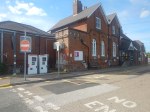




These are my thoughts.
Long Platforms
Consider.
- The platforms are long enough to take two full-length twelve-car Class 745 trains, which are nearly 240 metres long.
- I suspect the platforms can also accept a pair of five-car Class 720 trains, which would be 244 metres long.
If this is true at all Inter-City stations, this must mean that Greater Anglia can still run a full service, if they are short of Class 745 trains.
Car Parking
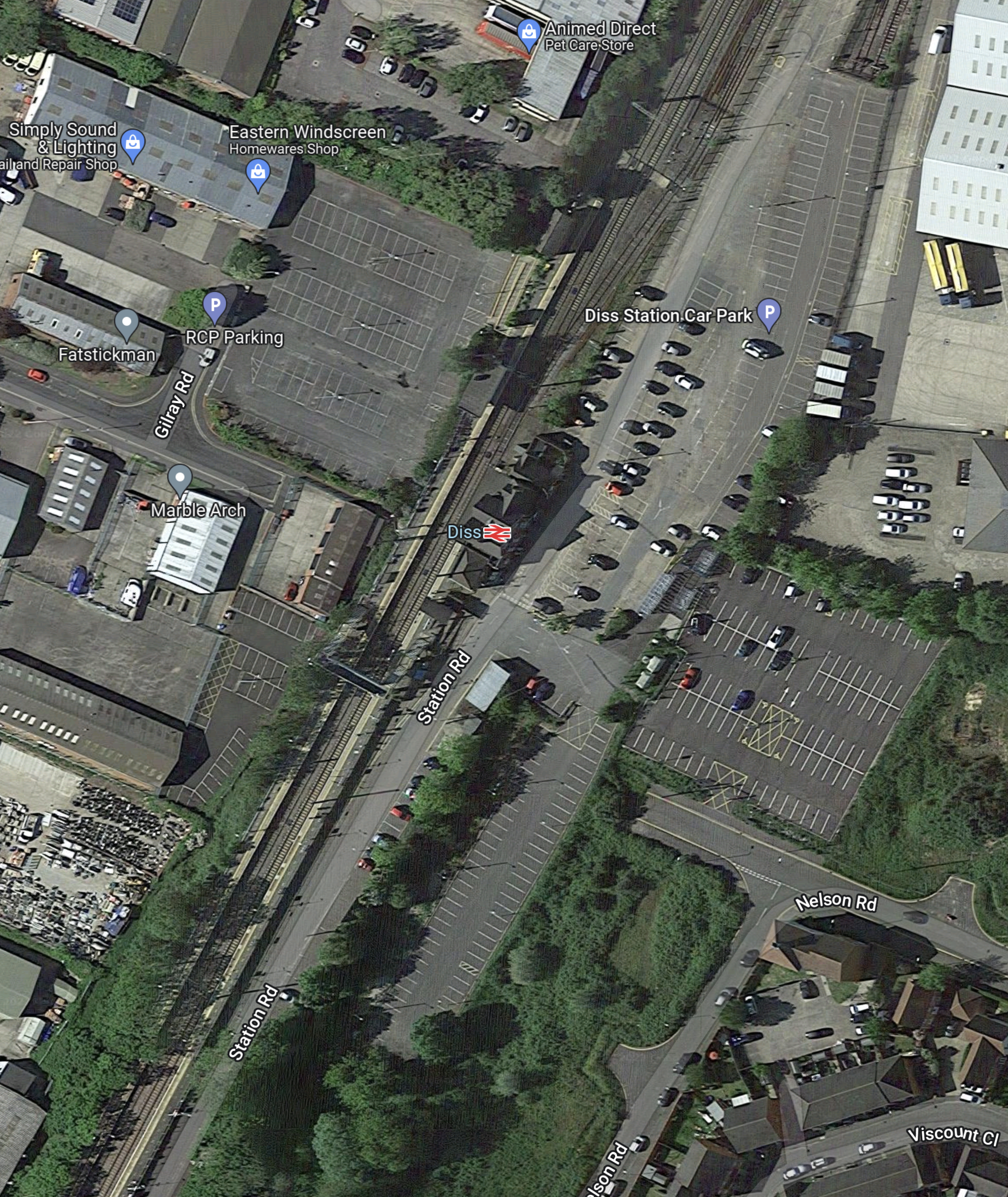
This Google Map shows the extensive car parking at Diss station.
Note.
- There are two tracks and two platforms, with the London-bound platform on the Eastern side.
- There is parking on both sides of the tracks.
- According to the National Rail web site, there appears to be 316 parking bays on the London-bound side.
- A sign in the tenth picture shows a £2.50 All-Day parking deal on the Norwich-bound platform.
- The Internet shows a lot of competitively-priced parking around the station.
Commuters to London, Ipswich or Norwich will have to cross the line in the morning or evening and there are no lifts to make that easy.
A Step-Free Bridge At Diss
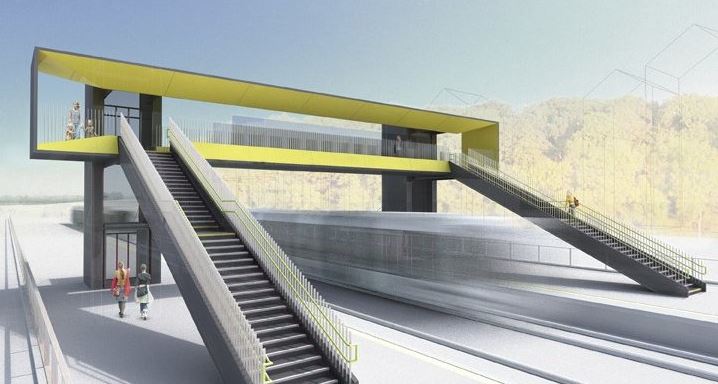
Network Rail had a competition a few years ago in conjunction with RIBA to design a stylish, affordable and easy-to-install footbridge and this was the winner.
This design is also under development.
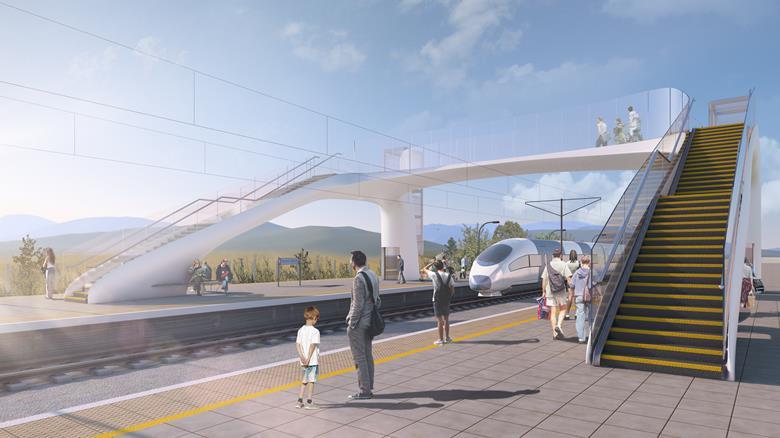
I think one of these bridges could possibly be installed at Diss station at the Northern end of the station.
- Both bridges would appear to have small footprints.
- They are designed to clear 25 KVAC overhead electrification.
- Both bridges appear to be able to be built to a flexible width. I suspect this might allow one end of the bridge could be in a car park and the other on the opposite platform.
- Both are fully step-free.
- The composite bridge might be better because of a lower weight.
- The first bridge appears to be enclosed, so would work better in Manchester.
- I suspect that both could be installed after creating an appropriately-sized concrete base on either side of the tracks, by lifting in the bridge by means of a rail-mounted crane.
It is now over three years since the first design won the Network Rail/RIBA competition. That is just too long to get a prototype bridge built and installed.
Toilets
The toilets at the station were of an excellent standard. But this is getting increasingly common these days.
Marks And Spencer’s Chicken Kiev Has Been Renamed Chicken Kyiv
I took this picture in Marks and Spencer at Liverpool Street tonight! Note the name!

I didn’t buy one as it isn’t gluten-free.
There have been lots of articles like this one on Birmingham Live, which is entitled Tesco, M&S, Aldi, Lidl, Morrisons, Sainsbury’s, Asda Under Pressure To Rename Chicken Kievs ‘Kyiv’.
So perhaps, pressure works.
Affordable Blue Hydrogen Production
The title of this post, is the same as that of this page on the Shell Catalysts & Technologies web site.
This is said at the top of the page.
Natural gas producers are at a crossroads. They face a shifting regulatory landscape emphasising emissions reduction and an economic environment where cash preservation is critical. Shell Catalysts & Technologies offers resource holders a phased approach to diversifying their portfolios towards clean hydrogen fuels by leveraging proven and affordable capture technologies and catalysts.
My knowledge of advanced chemical catalysts is small, but I did work in the early 1970s on a project with one of ICI’s experts in the field and he told me some basics and how he believed that in the future some new catalysts would revolutionise chemical process engineering.
Wikipedia’s definition of catalysis, or the action of catalysts is as follows.
Catalysis is the process of increasing the rate of a chemical reaction by adding a substance known as a catalyst.
When I heard that Velocys were going to develop a catalyst-based system to turn household waste into sustainable aviation fuel, I did make a small investment in the company, as I thought the project could have legs.
Shell’s process takes natural gas and converts one molecule of methane (CH4) into two molecules of hydrogen (H2) and one of carbon dioxide (CO2) using one molecule of oxygen (O2) from the air.
In the Shell Blue Hydrogen Process, does a clever catalyst extract the carbon atom from the methane and combine it with two oxygen atoms to create a molecule of carbon dioxide? If it does, then this would leave the four atoms of hydrogen to form two molecules of H2 and the catalyst to go and repeat its magic on another methane molecule.
The video on the Shell site claims to do the conversion 10-25 % cheaper than current carbon intensive methods like steam reforming.
For every two molecules of hydrogen produced, both the Shell Blue Hydrogen Process and steam reforming will produce one molecule of carbon dioxide.
If you look at steam reforming it is an endothermic process, which means heat has to be added. The classic endothermic process is dissolving ice cubes in a glass of water.
Shell don’t say, but does their process need less energy to be added, because their clever catalyst does a lot of the work?
I wouldn’t be surprised if the reaction takes place in a liquid, with hydrogen and carbon dioxide bubbling out.
- The two gases would be separated by using their different physical properties.
- Carbon dioxide is heavier for a start.
Whatever Shell have done, it is probably pretty impressive and has probably taken many years to develop.
If as I suspect, it produces pure carbon dioxide, that would be an added bonus, as some uses of carbon dioxide wouldn’t want impurities.
Uses of pure carbon dioxide include.
- Feeding it to soft fruits, flowers, salad vegetables and tomatoes growing in large greenhouses.
- Dry ice.
- Mineral Carbonation International can use carbon dioxide to make building products like blocks or plasterboard.
- It can be added to concrete.
The more of the carbon dioxide that can be used rather than stored the better.
Aussie Billionaire Aims To Mine $8bn US Fund For Coal-To-Hydrogen Industrial Conversion
The title of this post, is the same as that of this article on Recharge.
These are the first two paragraphs.
Twiggy Forrest-owned Fortescue’s project to tap renewable energy on Washington state grid – where surplus hydroelectric power usually exported to Canada and western seaboard – for clean hydrogen production at Centralia site.
Fortescue Future Industries (FFI), owned by Australian billionaire Andrew ‘Twiggy’ Forrest, is planning to convert a former coal mine in US state of Washington into a green hydrogen production facility, using funds it hopes to win from the federal government’s $8bn H2 hub fund, the company said on Friday.
These are some other points about FFI’s plans.
- A former coal mine will be converted into a green hydrogen production facility.
- The facility will be located at Industrial Park at TransAlta.
- It will use 300 MW of renewable electricity.
- Production of green hydrogen will be 110 tonnes per day or 40,000 tonnes per year.
Hopefully, they will have Federal Funds to support the development.
The article also details other hydrogen developments in the United States, with hydrogen hubs earmarked for New England, Midwest, West Virginia and Arkansas, Louisiana and Oklahoma.
It certainly looks that the United States is getting serious about hydrogen.
Drax Submits Application To Expand Iconic ‘Hollow Mountain’ Power Station
The title of this post, is the same as that of this press release from Drax.
The project is called Cruachan 2 and is described on this web site.
This is the introduction to the project.
We have kickstarted the planning process to build a new underground pumped hydro storage power station – more than doubling the electricity generating capacity at Cruachan.
The 600 megawatt (MW) power station will be located inside Ben Cruachan – Argyll’s highest mountain – and increase the site’s total capacity to 1 gigawatt (GW).
The new power station would be built within a new, hollowed-out cavern which would be large enough to fit Big Ben on its side, to the east of Drax’s existing 440MW pumped storage hydro station. More than a million tonnes of rock would be excavated to create the cavern and other parts of the power station. The existing upper reservoir, which can hold 2.4 billion gallons of water, has the capacity to serve both power stations.
Note.
- The generation capacity will be increased from 440 MW to 1040 MW, which is an increase of 36 %.
- Cruachan has a storage capacity of 7.1 GWh, which will not be increased.
- Cruachan opened in October 1965, so the generating equipment is nearly sixty years old.
I will assume that Drax and its various previous owners have kept the turbines, generators, dam and associated pipework in good condition, but as an Electrical Engineer, I do believe that the modern equipment, that will be used in Cruachan 2 will offer advantages.
- One of these advantages could be the ability to ramp up power faster, than the original equipment.
- I also suspect, it will have a sophisticated computer control system, that will allow the output of the power station to be precisely controlled.
These two features should mean that when a spike in power demand happens, that the combined Cruachan will step up to the plate.
So all those watching the Celtic and Rangers match on television, will still get their half-time cuppa.
I suspect that the combined Cruachan will be a power regulator of the highest quality.
Will The Storage Capacity Of Drax Be Increased?
Drax don’t appear to have any plans for increasing the size of the upper reservoir and I suspect that geography can’t deliver an affordable solution.
But.
- Loch Awe is an excellent lower reservoir for a pumped storage system.
- The building of Cruachan 2 may create substantial employment and economic benefits in the area.
- Cruachan 2 is not the only pumped storage scheme under development in the area.
- The UK needs as much pumped energy storage as can be created.
I wouldn’t be surprised to see, further development of Cruachan, if Cruachan 2 is an overwhelming success.
It’ll all be down to the geography and the economics.
Cutting Emissions – Cleaner, Greener Turbostars
The title of this post, is the same as that of this article on Rail Engineer.
It is a detailed technical description about how one of Chiltern Trains’s Class 168 trains has been converted to hybrid power.
This extract from the article gives the results of the conversion.
In July 2021, to celebrate Chiltern Railways’ 25th anniversary, the prototype was used to carry a number of invited guests to Bicester for a celebration lunch. The unit achieved speeds of up to 100mph during this demonstration run and operated with emission free battery power into/out of Marylebone and Bicester. The converted train is expected to reduce CO2 by up to 25%, nitrous oxide by up to 70%, particulates by up to 90% and fuel consumption by up to 25%. There was also an expectation that engine noise level will be reduced by 75%.
The article finishes by discussing how all 450 cars of the combined Class 168/170 fleet could be converted.
The article also hopes that the new Chiltern contract could lead to a full conversion of the fleet to hybrid operation.
It is an article well-worth a read.
Bank Station – 16th May 2022
The new Northern Line platforms at Bank station are now open and I went this morning to have a quick look.

























These are my thoughts.
The New Southbound Platform Is Wide
The new Southbound platform is wide and compares well with the wide platform at Angel station, that I wrote about in All Platforms Should Be Wide Like This.
This picture shows the Southbound platform at Angel., which dates from 1992.

And this the new Southbound platform at Bank.
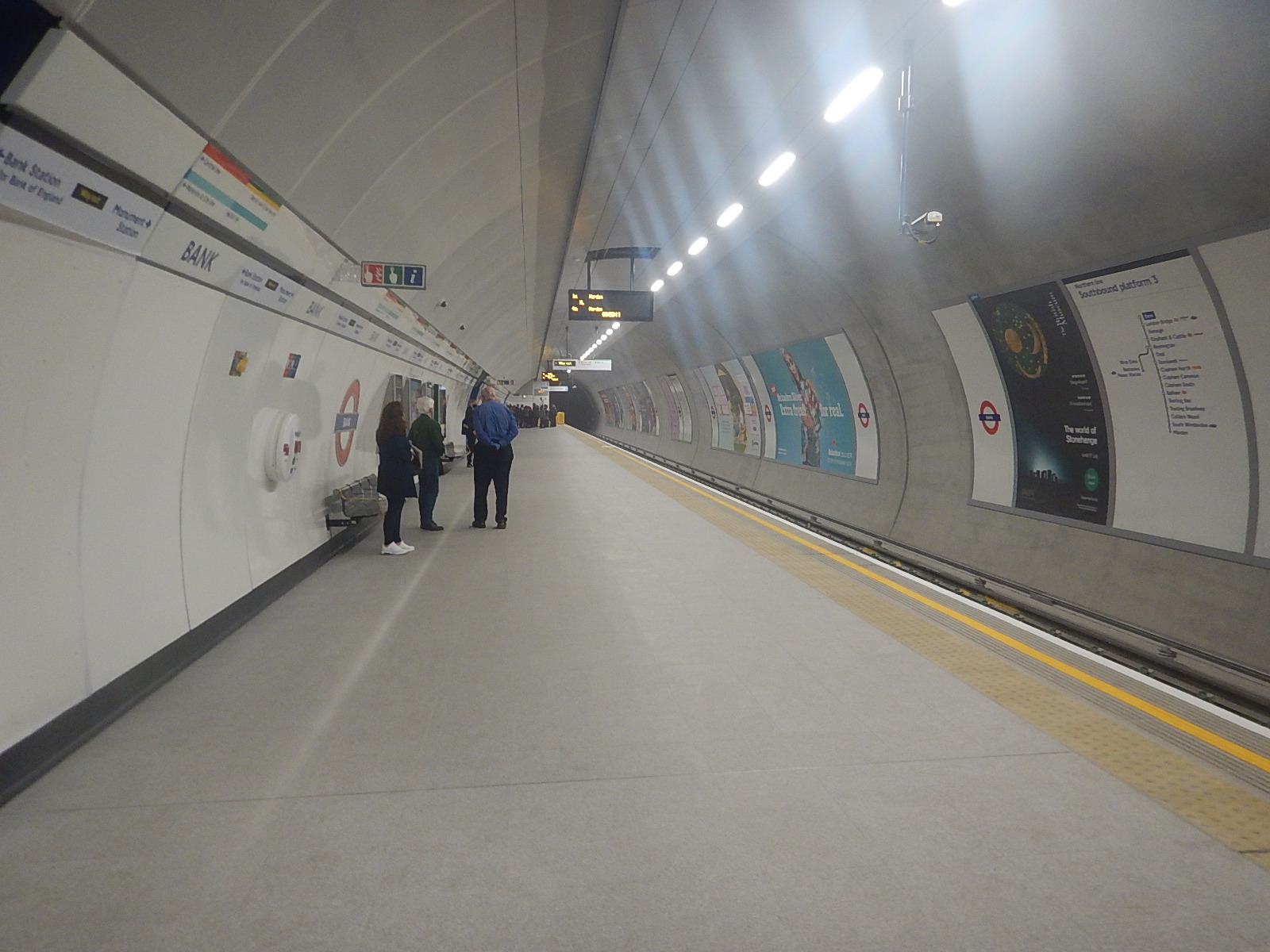
Two similar designs, but thirty years apart.
Simple Decor
The two pictures also illustrate the simple decor used in the rebuilt station.
The New Southbound Platform Is A Sprayed Concrete Tunnel
These pictures show the far wall of the new Southbound platform.





It looks from my untrained eye to be lined with sprayed concrete. I learned more about the use of sprayed concrete in tunnels, when I visited TUCA in Ilford, during Open House in 2012, which I wrote about in Open House – TUCA.
The Existing Northbound Platform Is Narrow
The Northbound platform is effectively as before, but with large and small holes in the wall to access a wide parallel pedestrian tunnel behind the wall.
There is a lot of circulation space.
The Parallel Pedestrian Tunnel
The old Southbound platform has been turned into a parallel pedestrian tunnel separated from the Northbound platform, by a wall that has four small and eight larger pedestrian-sized holes through it.
These pictures show a selections of the holes in the wall.







In addition.
- The tunnel has escalators at the Southern end connecting to Monument station.
- The tunnel has stairs at the Northern end to the Central Line.
- Further connections will be added.
- It also has seats along its length. These will be mainly for Northbound passengers, waiting for trains, who can see the trains through the large holes.
It is an unusual layout and I’ve never seen anything like it before anywhere in London, the UK, Europe or the world.
Wot No More Marble?
The Northbound Northern Line used to have a platform with marble facings.
Some of marble is still there as these pictures show.





Note that the old rat-run to the DLR is still there between the platforms.
The Wide Cross Tunnels
The wide cross tunnels link the two sides of the station together and to the escalators and moving walkways in the middle of the station.
This visualisation shows the station.
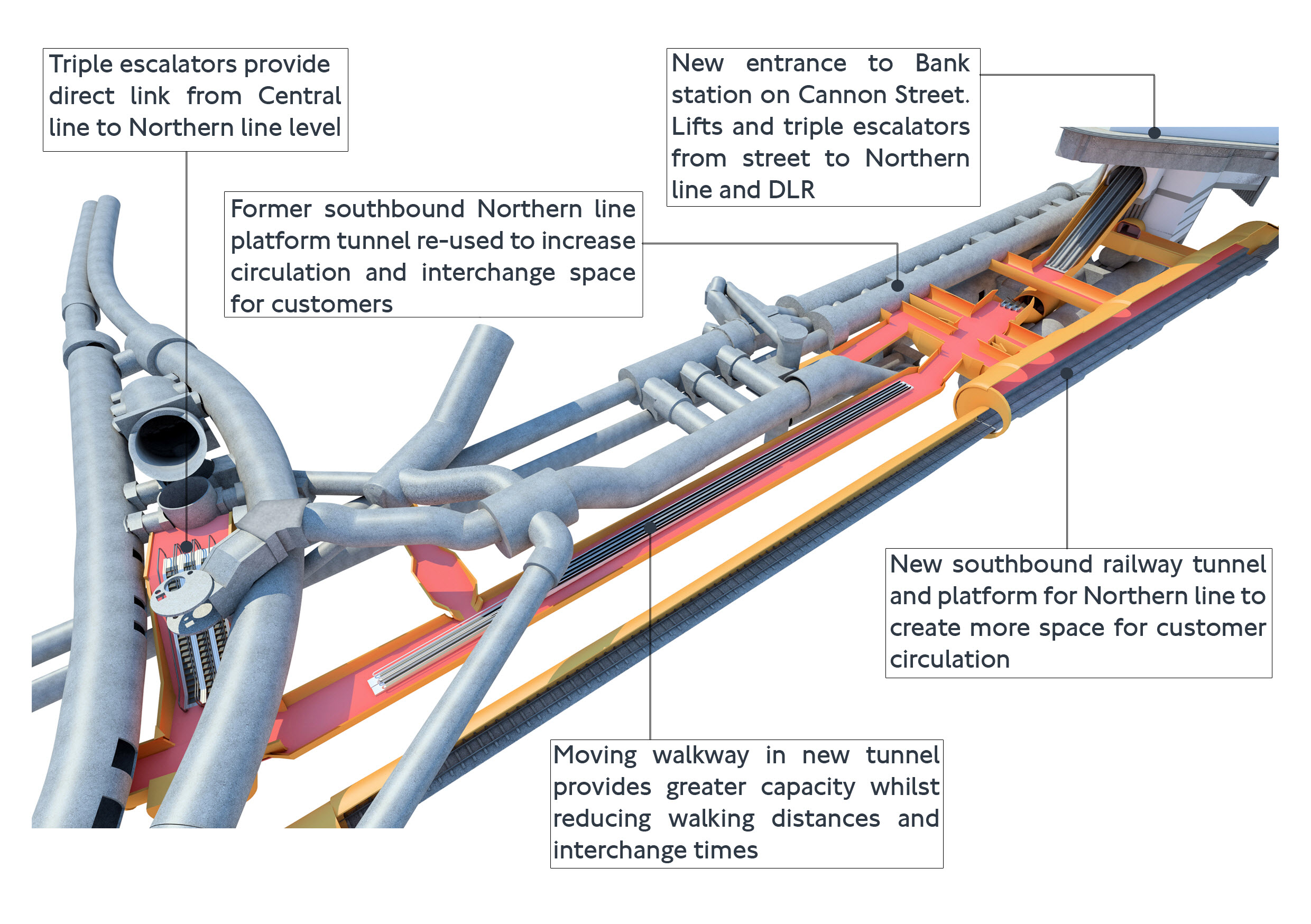
Note.
- The only more-or-less completed bits are the two Northern Line tunnels and platforms and parallel pedestrian tunnel.
- The four cross tunnels can be picked out towards the far end of the station.
- Three of the cross tunnels can now be used by passengers.
- The moving walkway can be accessed from the two cross tunnels nearest to the Central Line.
- The escalators from the yet-to-open Cannon Street entrance appear to lead directly into a cross tunnel and a parallel tunnel to the moving walkway.
This station has definitely been designed for rabbits.
Level Access To The Trains
This picture shows the level access on the new Southbound platform.

And this shows the step-up into the train on the old Northbound platform.

I wonder, if the platform can be raised to make the Northbound as good as the Southbound.
There Is Still A Lot To Do
At present the only sections of the project that are completed and visible to passengers are the following.
- The new wide Southbound platform.
- The refurbished Northbound platform, which is a similar width to before.
- The wide passenger tunnel behind the Northbound platform, that was converted from the old Southbound tunnel.
- The four new cross tunnels between the two platforms. Some still need finishing and there are spaces, where escalators will slot in.
It would appear that at least the following need to be done.
- Open up the new Cannon Street entrance
- Add the escalators and lifts.
- Put in the moving walkways between the Northern and Central Lines.
But it looks that everything left to do is small compared to the tunnel work that needed the closure from January.
This page on the TfL web site gives these dates.
- 16 May 2022: New southbound platform and concourse open
- Autumn 2022: DLR escalator and Central line link open
- Late 2022: Bank station capacity upgrade works due to be completed. New station with step-free access opens on Cannon Street.
It looks to me, that the project management has been done well and after hitting the first milestone, they appear to be on track.
 The Anonymous Widower