Mona, Morgan And Morven
The title of this post, may sound like a high-class firm of Welsh solicitors, but it is actually the names of three wind farms to be constructed by BP Alternative Energy Investments Ltd and Energie Baden-Württemberg AG.
Mona And Morgan
This EnBW-BP infographic describes the project.

Mona and Morgan do seem to have web page, which gives a simple map and a rather jargon-filled timeline.
Morven
This EnBW-BP infographic describes the project.

Morven does seem to have a web page, which gives a simple map and this statement.
The Morven wind farm is named after a mountain situated in the beautiful hills of Aberdeenshire, Scotland. The name derives from the Scottish Gaelic terms “Mhor” and “bheinn” meaning ‘big’ and ‘peak’, symbolic of the scale of opportunity represented by bp’s latest offshore wind project.
This article on Offshore Engineer is entitled ScotWind: BP, EnBW Win Bid to Build 2.9GW Morven Offshore Wind Farm.
This paragraph described the Morven wind farm.
The approximately 860km2 lease is located around 60km off the coast of Aberdeen. The E1 lease is in an advantaged area, allowing the partners to develop it as a fixed-bottom offshore wind project with a total generating capacity of around 2.9 gigawatts (GW), sufficient to power more than three million homes.
And this paragraph, described what BP will do with the energy.
“Along with the offshore wind development, these investments include significant expansion of electric vehicle charging infrastructure in Scotland and green hydrogen production. Together, these represent up to £10 billion of investment in support of offshore wind and Scotland’s energy transition,” BP added.
These are two large projects, but so far there is little else on the Internet, except for this press release.
Conclusion
Wind farms can be controversial and for this and other reasons, the general public need more information.
BP and EnBW can do much better.
Shell And ScottishPower Win Bids To Develop 5 GW Of Floating Wind Power In The UK
The title of this post, is the same as that of this press release from Shell.
This is three paragraphs from the press release.
Shell and ScottishPower have secured joint offers for seabed rights to develop large-scale floating wind farms as part of Crown Estate Scotland’s ScotWind leasing. The partners have won two sites representing a total of 5 gigawatts (GW) off the east and north-east coast of Scotland.
The new wind farms will be delivered through two joint ventures called MarramWind and CampionWind. They bring together ScottishPower’s and Shell’s decades of experience working offshore and significant presence in Scotland, as well as their strong innovation capabilities for delivering world-class offshore energy projects.
The development, construction and operation of ScotWind projects is set to bring new skilled jobs and manufacturing opportunities and boost local supply chains.
ScottishPower are actually involved in three large ScotWind projects; one by themselves and two in partnership with Shell.
MacHairWind
MachairWind is a project that Scottish Power is developing alone.
- It has its own page on the ScottishPower Renewables web site.
- It will be a 2 GW wind farm to the North-West of Islay.
- The turbines will be on fixed foundations.
I wrote about this project in MacHairWind Wind Farm.
MarramWind And CampionWind
These two wind farms are being developed in partnership with Shell.
They both have their own web sites.
MarramWind’s web site has this introduction.
ScottishPower and Shell have joined forces to develop the MarramWind offshore windfarm following success in the recent ScotWind auction process by Crown Estate Scotland.
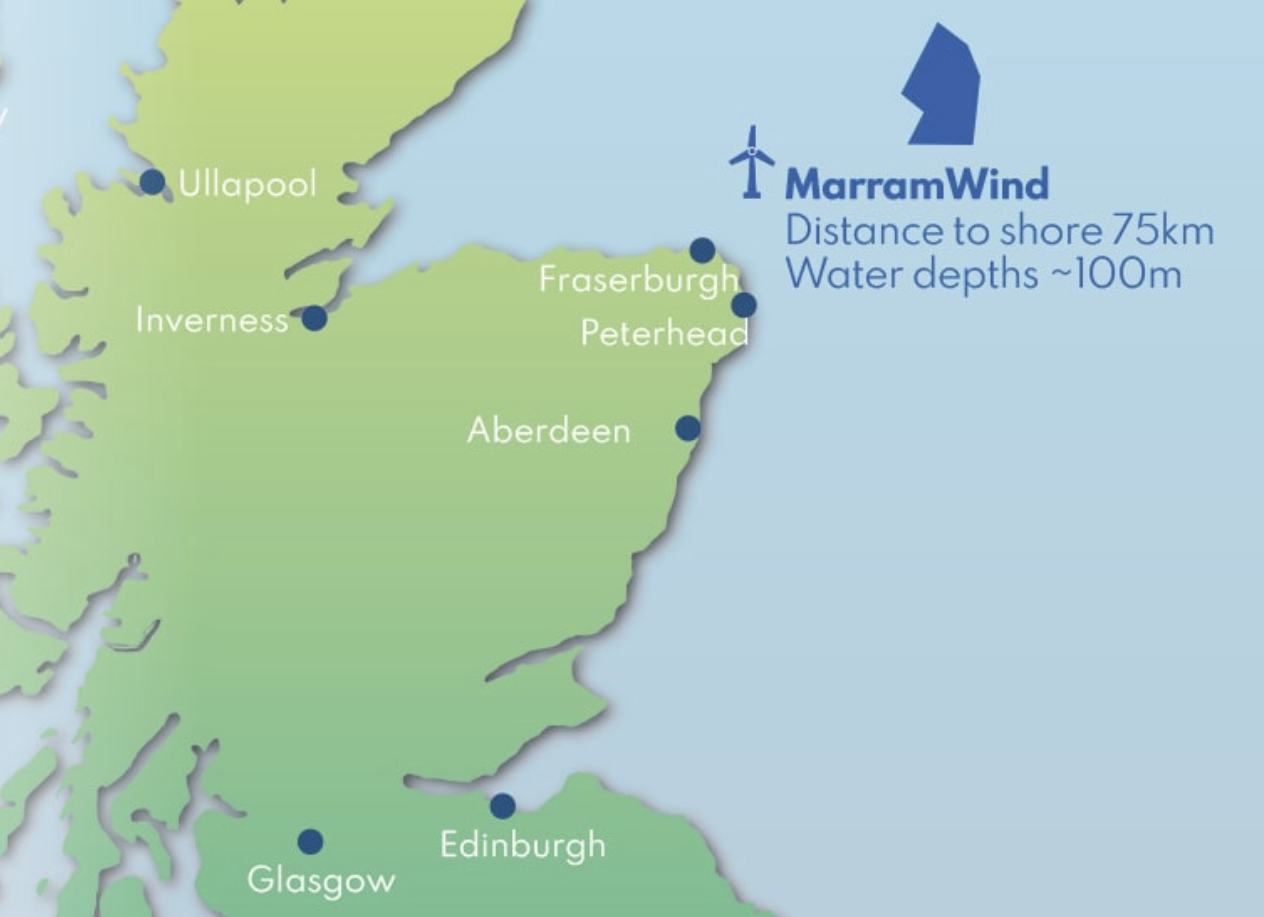
Located 75 kilometres off the North East coast of Scotland in water depths averaging 100 metres, the proposed MarramWind floating offshore windfarm could deliver up to 3 gigawatts (GW) of cleaner renewable energy.
This map clipped from the MarramWind web site, shows the location of the wind farm.
CampionWind’s web site has this introduction.
ScottishPower and Shell have joined forces to develop the CampionWind offshore windfarm following success in the recent ScotWind auction process by Crown Estate Scotland.
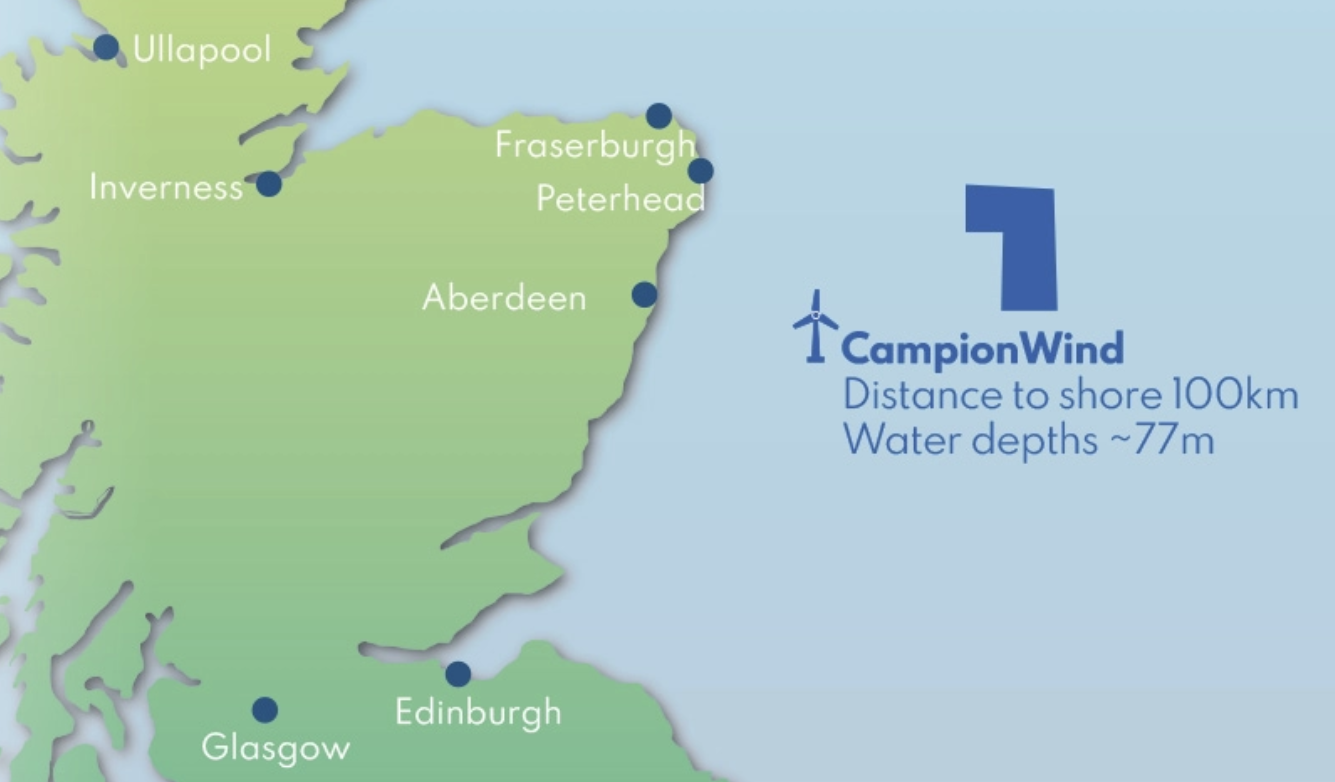
Located 100 kilometres from the east coast of Scotland, in water depths averaging 77 metres, the proposed CampionWind floating offshore windfarm could deliver up to 2 gigawatts (GW) of cleaner renewable energy.
This map clipped from the CampionWind web site, shows the location of the wind farm.
Note.
- The two wind farms will be within a few miles of each other.
- Both wind farms will use floating wind turbines.
- The water is a bit deeper at MarramWind, but this surely doesn’t bother a floating turbine.
- MarramWind and CampionWind will have a total capacity of 5 GW.
- Hywind Scotland is the world’s first commercial wind farm using floating wind turbines, situated 29 kilometres off Peterhead. This wind farm is only 30 MW, but in its first years of operation has achieved a capacity factor of over 50 %.
- The proposed turbines at Northern Horizons‘ 10 GW wind farm, which is 130 kilometres to the North-East of Shetland will be 20 MW giants and nearly as tall as The Shard in London.
So will Scottish Power and Shell design and build a combined field, similar in concept to Northern Horizons’ wind farm, using an armada of 250 floating wind turbines?
- The wind turbines might be moored around a fixed or floating mother platform or structure, that will collect the electricity and deliver it to the shore.
- Turbines could be serviced in situ or moved into port, as needed.
- Extending the wind farm could just be a matter of mooring the extra turbines in position and then connecting them to the mother platform.
- Is there a convenient disused oil or gas platform, that could be repurposed as the mother platform?
It certainly would appear to be a way of building large offshore fields in deep waters.
Where Would The Combined MarramWind And CampionWind Rank In Terms of UK Wind Farms?
Consider.
- MarramWind and CampionWind will have a total capacity of 5 GW.
- Phase one of the Hornsea Wind Farm is the largest offshore wind farm in the world, with a capacity of just over 1.2 GW and when complete it will have a capacity of 6 GW.
- Northern Horizons is planned to be 10 GW.
- The East Anglian Array could be as large as 7.2 GW.
- The Dogger Bank Wind Farm is planned to be as large as 4.8 MW.
- Norfolk Vanguard and Norfolk Boreas are a pair of 1.8 GW wind farms.
- MacHairWind will be a 2 GW wind farm.
Note.
- This is not a complete list of large wind farms in the development pipeline.
- BP have obtained leases, but have not published their plans.
- Most farms under development are at least one GW.
- These farms are a total of 38.6 GW.
The Combined MarramWind and CampionWind would be one of several large wind farms around 5 GW.
There Is A Desperate Need For Energy Storage
If we are generating upwards of 40 GW of wind and solar energy in the UK, there will be a desperate need for energy storage to cover for the times, when the wind doesn’t blow and the sun doesn’t shine.
Scotland should be OK, as there are various energy storage projects in development.
- The 1.5 GW/ 30 GWh Coire Glas project is according to SSE shovel-ready and has planning permission.
- The 450 MW/2.8 GWh Red John project is being constructed.
- Drax, ILI Group and SSE have several other projects under development.
So what would happen in the South?
The government appears to be on the case as I wrote in Ministerial Roundtable Seeks To Unlock Investment In UK Energy Storage.
But there is also the possibility of using hydrogen.
- Hydrogen could be created by a series of giant electrolysers.
- It could be blended with natural gas to eke out our natural gas and save carbon. According to HyDeploy, it appears that up to 20 % can be added, without needing to change boilers and appliances.
- It can be stored in depleted offshore gas fields.
- It can be used to power heavy transport like buses, trucks, trains and ships.
- It can be burned in gas-fired power stations to generate electricity.
Hydrogen can also be used as a feedstock or green energy source for the making of chemicals, concrete and steel.
Conclusion
We are approaching the end of the first phase of the development of renewable energy in the UK.
Massive floating wind farms using armadas of floating wind farms, a large expansion of pumped storage hydro and a huge expansion of the use of hydrogen will see us through to a carbon-free future.
MacHairWind Wind Farm
MachairWind wind farm has its own page on the ScottishPower Renewables web site.
These are the two introductory paragraphs.
The MacHairWind project off the coast of Islay, which could deliver 2GW of cleaner renewable energy, will make a significant contribution to tackling climate change and achieving Net Zero, with the potential to generate enough clean electricity to power over 2 million homes in Scotland.
It will also build on ScottishPower’s long-standing presence and positive track record of investing in and working with local communities and businesses across Argyll & Bute to realise the benefits of renewable energy developments.
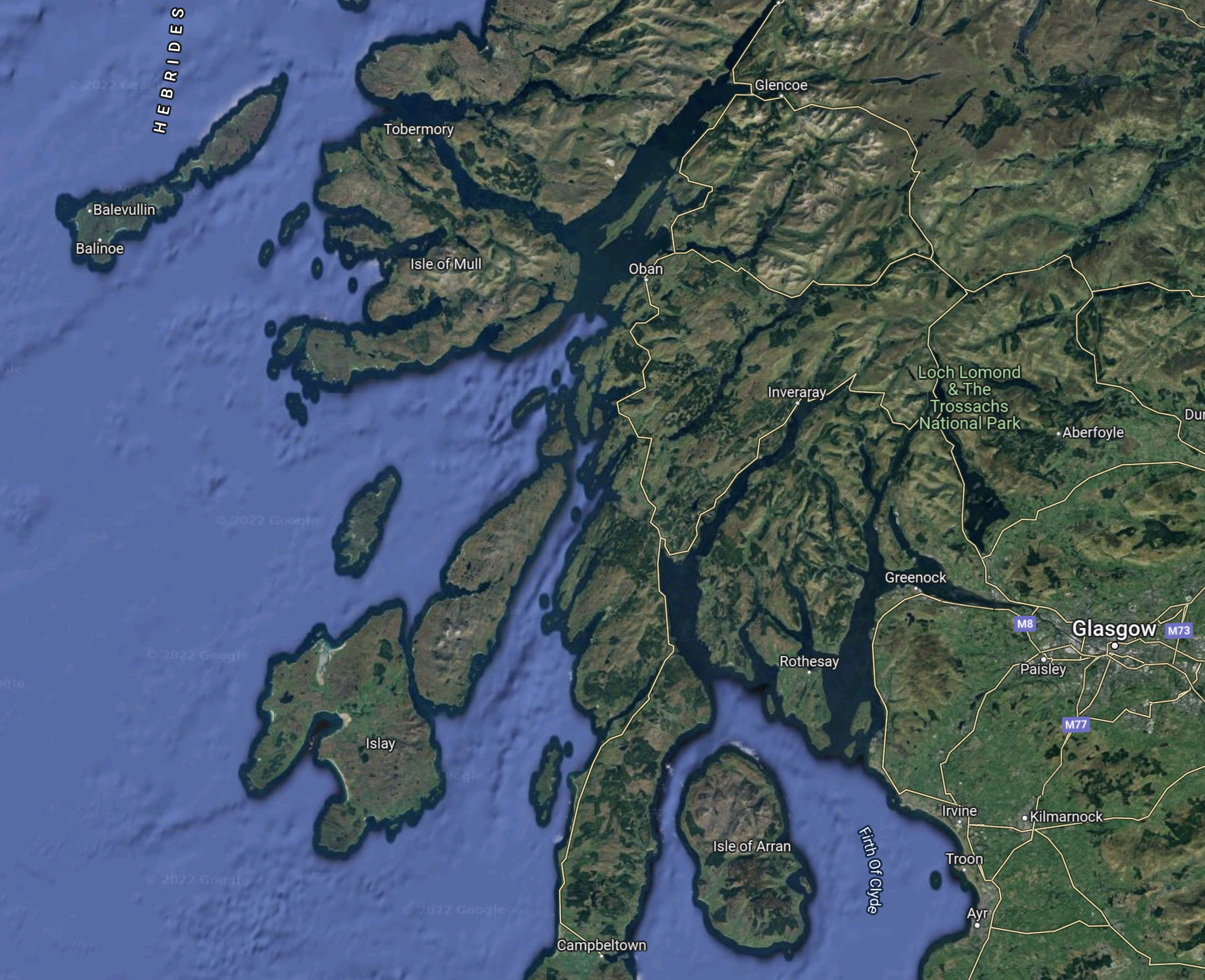
This Google Map shows the area of the wind farm, which is to the North West of the island of Islay.
Note.
- There certainly is a large space of empty sea to the North-West of Islay.
- Glasgow is not far away.
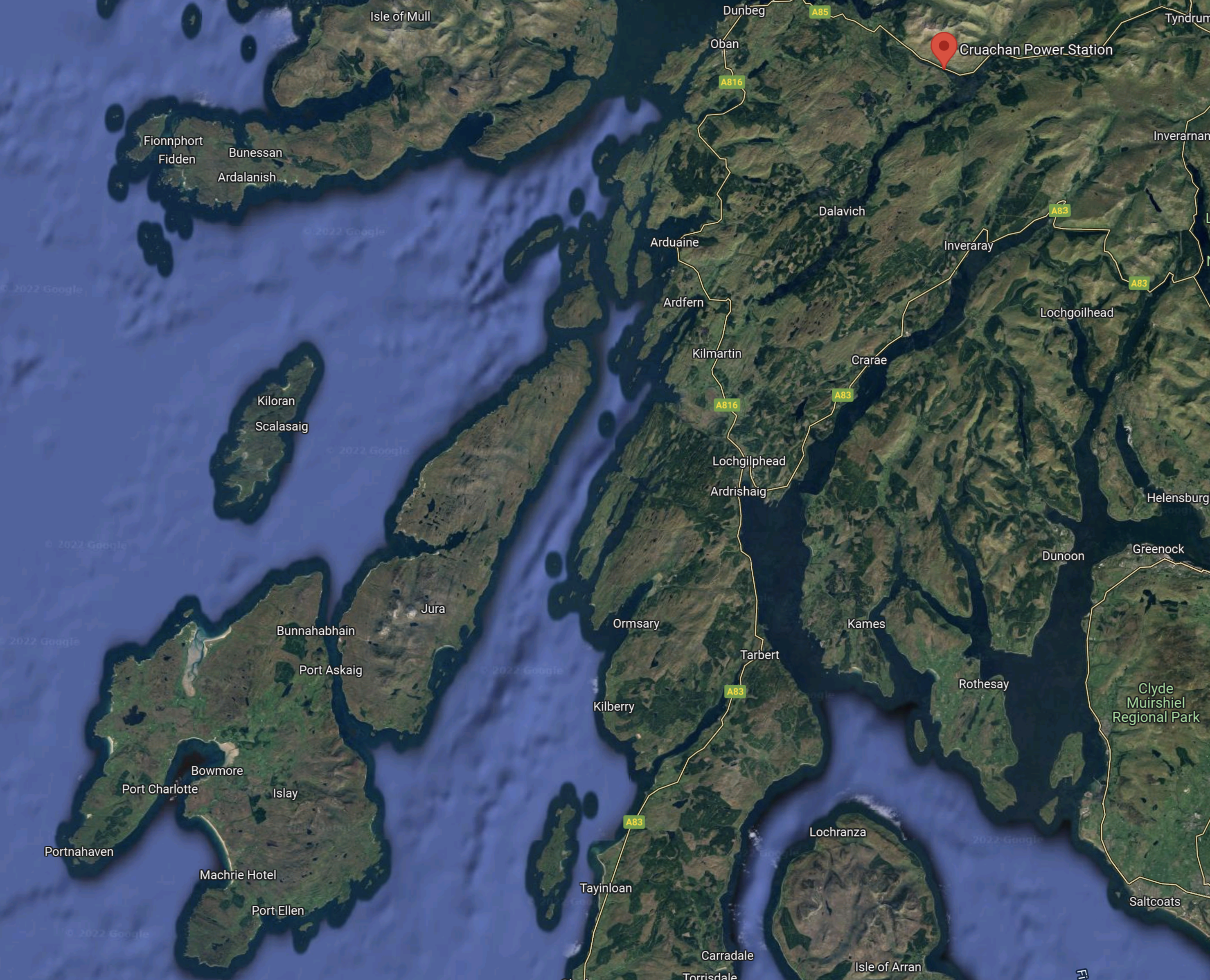
This second Google Map shows the area to the North-East of Islay.
Note.
- Islay is in the South-West corner of the map.
- Colonsay is the smaller island to the North.
- In the North-East corner of the map the red arrow indicate Cruachan pumped hydro power station.
- In the South-East corner of the map is the Clyde Estuary, where the two nuclear power stations at Hunterston were located.
- Hunterston is also the Northern end of Western HVDC Link to North Wales.
Wikipedia says this about the relationship of the Cruachan power station and Hunterston’s nuclear stations.
Construction began in 1959 to coincide with the Hunterston A nuclear power station in Ayrshire. Cruachan uses cheap off-peak electricity generated at night to pump water to the higher reservoir, which can then be released during the day to provide power as necessary.
Now that the two nuclear stations are being decommissioned, will the MacHairWind wind farm be used to pump water to Cruachan’s higher reservoir?
Conclusion
The MacHairWind wind farm seems a well-positioned wind farm.
- It is close to Glasgow.
- It can be used in tandem with the Cruachan pumped hydro power station.
- It will have access to the Western HVDC Link to send power to the North-West of England.
Is Scotland replacing the 1.2 GW Hunterston B nuclear power station with a 2 GW wind farm, with help from Cruachan and other proposed pumped storage hydro schemes to the North of Glasgow?
It also looks like increasing the power at Cruachan from the current 440 MW to a GW, by the building of Cruachan 2 would give the area even more energy security.
Is This The World’s Most Ambitious Green Energy Solution?
In the 1970s and 1980s, when I was developing Artemis, which was the first desk-sized project management system, we were heavily involved in North Sea Oil, with dozens of systems in Aberdeen. As Norway developed the oil business on the other side of the North Sea, the number of systems there grew to at least twenty.
Increasingly, I became aware of a Norwegian company called Kværner, which seemed to have large numbers of Artemis systems.
In 2002, Kværner merged with Aker Maritime and this eventually led to the formation of Aker Solutions in 2008, which is a company that is headquartered in Oslo and employs nearly 14,000.
According to Wikipedia, the Kværner name was dropped somewhere along the way, as non-Scandinavians have difficulty pronouncing Kværner.
Aker Solutions appears to be wholly Scandinavian-owned, with Aker ASA owning a third of the company.
They are a very respected company, when it comes to offshore engineering for oil and gas and wind projects.
Aker ASA also have a subsidiary called Aker Horizons, which has this web site, where they call themselves a planet-positive company.
This page on the Aker Horizons is entitled Northern Horizons: A Pathway for Scotland to Become a Clean Energy Exporter.
These first two paragraphs outline the project.
A vision to utilise Scottish offshore wind resources in the North Sea to make the country an exporter of clean energy has been unveiled at the COP 26 climate change conference in Glasgow.
The Northern Horizons Project has been unveiled by Aker Horizons’ portfolio companies Aker Offshore Wind and Aker Clean Hydrogen, who have the technical know-how and expertise to realise the project, and DNV, the independent energy expert and assurance provider.
Various targets and ambitions are listed.
- 10 GW of renewable energy in the North Sea.
- 5 GW of green hydrogen.
- Giant turbines nearly as tall as the London Shard on floating platforms more than 130km from Shetland.
- Enough liquid hydrogen will be produced to power 40 percent of the total mileage of local UK buses.
- Enough synthetic fuel to make 750 round trips from the UK to New York.
A completion date of 2030 for this project is mentioned.
This article on The Engineer is entitled Northern Horizons Plans Clean Energy Exports For Scotland.
The article is dated the 4th of November 2021 and starts with this sub-heading and an informative video.
Aker Horizons’ new initiative, Northern Horizons, aims to make Scotland a clean energy exporter by utilising offshore wind resources in the North Sea.
There is an explanatory graphic of the project which shows the following.
- Floating wind turbines.
- A floating DC substation.
- A floating hydrogen electrolyser.
- An onshore net-zero refinery to produce synthetic aviation fuel and diesel.
- A hydrogen pipeline to mainland Scotland.
- Zero-carbon energy for Shetland.
It is all very comprehensive.
These are some other thoughts.
Project Orion
Project Orion how has its own web site and the project that seems to have similar objectives to Northern Horizons.
The title on the home page is Building A World-Leading Clean Energy Island.
There is this statement on the home page.
Orion is a bold, ambitious project that aims to transform Shetland into the home of secure and affordable clean energy.
We will fuel a cleaner future and protect the environment by harnessing the islands’ renewables potential, using onshore and offshore wind, tidal and wave energy.
The graphic has similar features to that Northern Horizons in the article on The Engineer, with the addition of providing an oxygen feed to Skyrora for rocket fuel.
German Finance
I feel very much, that the Germans could be providing finance for developments around Shetland, as the area could be a major source of hydrogen to replace Vlad the Mad’s tainted gas.
In Do BP And The Germans Have A Cunning Plan For European Energy Domination?, I described how BP is working with German utilities and finance to give Germany the hydrogen it needs.
NorthConnect
The NorthConnect (also known as Scotland–Norway interconnector) is a proposed 650 km (400-mile) 1,400 MW HVDC interconnector over the floor of the North Sea.
- It will run between Peterhead in North-East Scotland and Norway.
This project appears to be stalled, but with the harvesting of more renewable energy on Shetland, I can see this link being progressed, so that surplus energy can be stored in Norway’s pumped storage hydro.
Icelink
Icelink is a proposed electricity interconnector between Iceland and Great Britain.
- It would be the longest undersea interconnector in the world, with a length of 620 to 750 miles.
- It would be a 800–1,200 MW high-voltage direct current (HVDC) link.
- National Grid is part of the consortium planning to build the link.
- Iceland has a surplus of renewable energy and the UK, is the only place close enough for a connection.
I believe that if Icelink were to be built in conjunction with energy developments on and around Shetland, a more powerful and efficient interconnector could emerge.
Conclusion
This ambitious project will transform the Shetlands and the energy industry in wider Scotland.
This project is to the North-East of Shetland, but the islands are surrounded by sea, so how many other Northern Horizons can be built in a ring around the islands?
Shetland’s Viking Wind Farm
I was listening to SSE’s Chief Executive; Alistair Phillips-Davies, on the radio this morning, when he mentioned the Viking wind farm on Shetland.
- The wind farm is being developed by Viking Energy, a partnership between Shetland Islands Council and SSE plc.
- It will have 103 turbines and a nameplate capacity of 370 MW.
- Construction started in September 2020 and should be complete by 2024.
- The wind farm will be connected to the National grid via the Shetland HVDC Connection.
- There’s more on the Viking Energy web site.
Note.
- According to Wikipedia, wind farms in the Shetlands can have capacity factors of over 50 %.
- Viking Energy hope that the Viking wind farm will become one of the most productive onshore wind farms in the world.
- Is it unusual, that the wind farm is developed by a partnership between a local authority and a large utility company?
It also appears that together the Viking wind farm and the Shetland HVDC Connection will allow the 66 MW diesel-powered Lerwick power station to be closed.
Does The Electricity System On Shetland Need Energy Storage?
As an Electrical Engineer, who specialised in Control Engineering, I am surprised that to ensure energy security, that there is no energy storage on Shetland.
In the Wikipedia entry for Lerwick power station, there is a section entitled Load Balancing, where this is said.
The growth of output from wind turbines in Shetland has increased instability in the local grid (which is not connected to the national grid on mainland Scotland). SSE installed a 1 MW sodium–sulfur battery in a nearby building to ameliorate the peak loads. However due to safety concerns, the sodium-sulfur battery was removed prior to commissioning and the energy storage building was reconfigured to accommodate 3MWh of advanced lead-acid batteries.
A combination of the new Shetland HVDC Connection and the lead-acid batteries must be enough to ensure energy security for the Shetlands.
Stadler Reports ‘Best Year’ Since IPO
The title of this post, is the same as that of this article on Railway Gazette.
This is the first paragraph.
Stadler has reported record orders and earnings before tax for the 2021 financial year.
And these are a few statistics.
- Orders were up by 28%.
- Revenue was up 18 %.
- Earnings before interest and tax (EBIT) was up 43 %.
- EBIT margin rose to 6·2%.
Overall group profits was slightly down on the previous year due to exchange rate losses.
There is a note of caution.
However, it cautions that it is unlikely to achieve its target EBIT margin of 8 to 9% in 2023 as previously forecast, predicting instead that this would be achieved by 2024-25.
Overall the company is doing well and certainly producing the best trains in Europe.
Germany Weighs Norway Hydrogen Pipeline To Avoid Russian Energy
The title of this post, is the same as that of this article on Hydrogen Central.
This the introductory paragraphs.
Germany and Norway are considering building a hydrogen pipeline linking the two nations to reduce Europe’s dependence on Russian energy supplies.
The countries plan to soon conduct a feasibility study on the project that would eventually transport green hydrogen from Norway to Germany, they said after a meeting between German Economy Minister Robert Habeck and Norwegian Prime Minister Jonas Gahr Store.
There is a joint statement that gives more details.
Developments like this and lots of wind power in the North Sea and around the UK, are the sort of actions, that could seriously reduce the size of Russia’s oil and gas industry and the money it pays to that group of war criminals like Vlad the Mad and his friends.
Loch Kemp Pumped Hydro
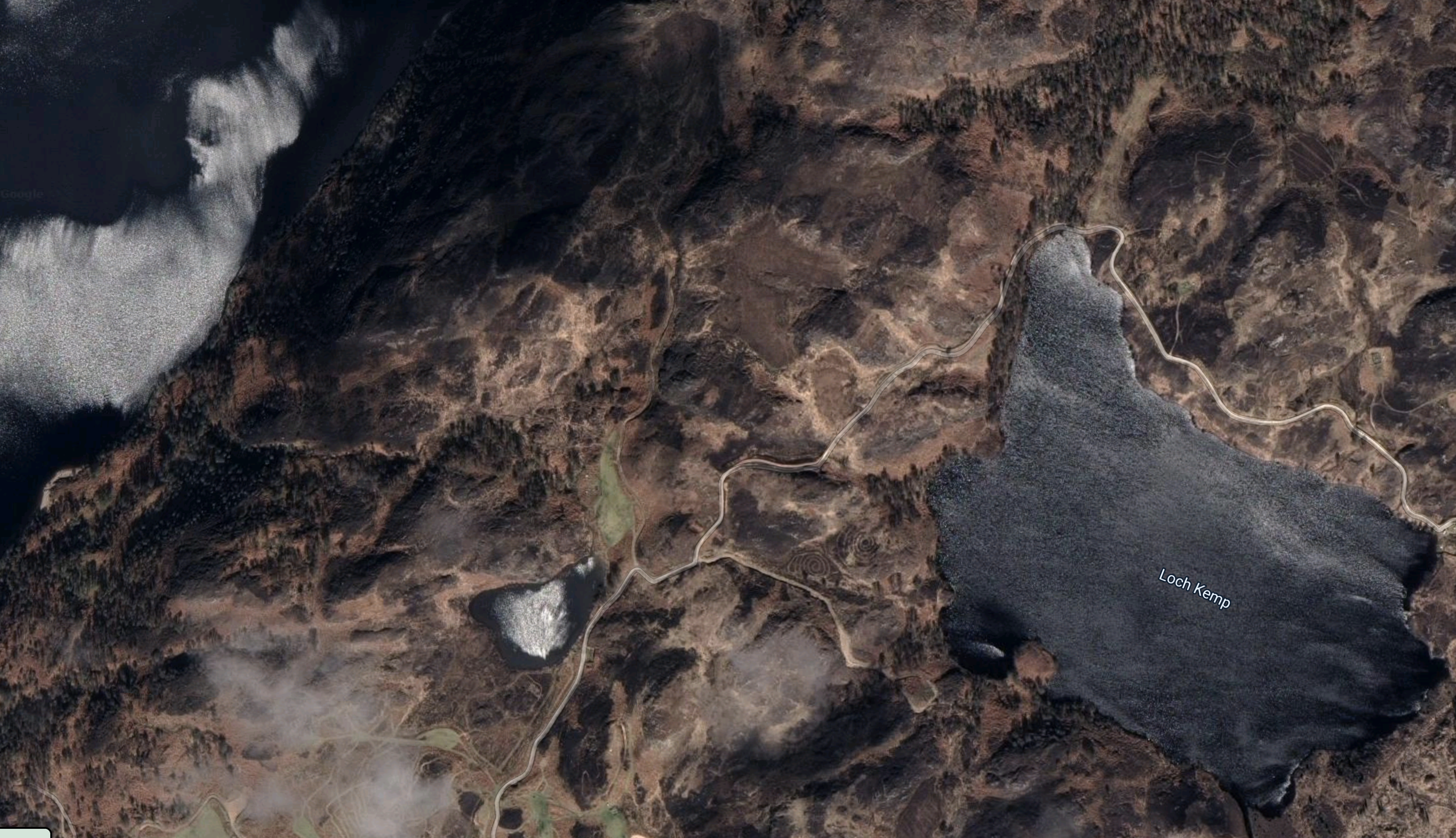
Loch Kemp Is a smaller loch just to the East of Loch Ness.
This Google Map shows Loch Kemp in relation to Loch Ness.
Note.
- Loch Ness is in the North West corner of the map, with partial cloud cover.
- Loch Kemp is in the South East corner of the map.
The proposed Loch Kemp pumped hydro scheme will have these characteristics.
- Loch Kemp will be the upper reservoir.
- Loch Ness will be the lower reservoir.
- The power station will be on the banks of Loch Ness.
- The power station will be designed to fit into the environment.
- Eight dams will be built to enlarge Loch Kemp.
- Trees will be planted.
- Output of the power station will be 300 MW
- Available storage could be 9 GWh.
The station will have almost as much storage capacity as Electric Mountain, but that power station has an output of 1.8 GW.
In Glendoe Hydro Power Station, I wrote about the Glendoe Hydro Scheme.
- It is a 100 MW hydroelectric power station
- It has the highest head at 600 metres of any power station in the UK.
- It opened in 2009, making it one of the newest hydroelectric power stations in the UK.
- The actual power station is in an underground cavern.
- The dam and power station have been designed to be hidden from view.
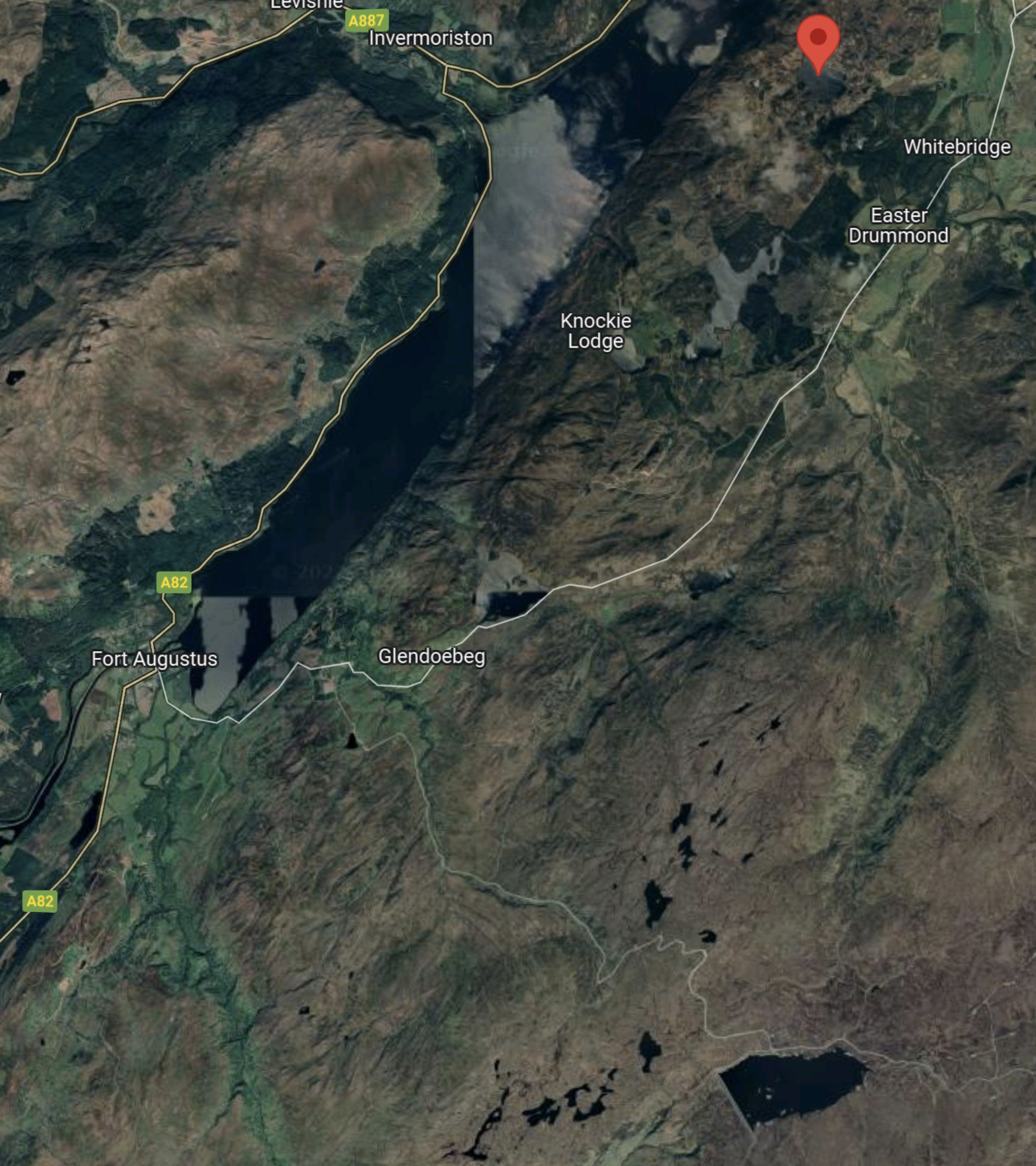
This Google Map shows the location of Glendoe power station to the South of Loch Kemp.
Note.
- The red arrow indicates Loch Kemp.
- The loch in the South East corner is the reservoir that feeds Glendoe power station.
- Fort Augustus is at the Southern end of Loch Ness.
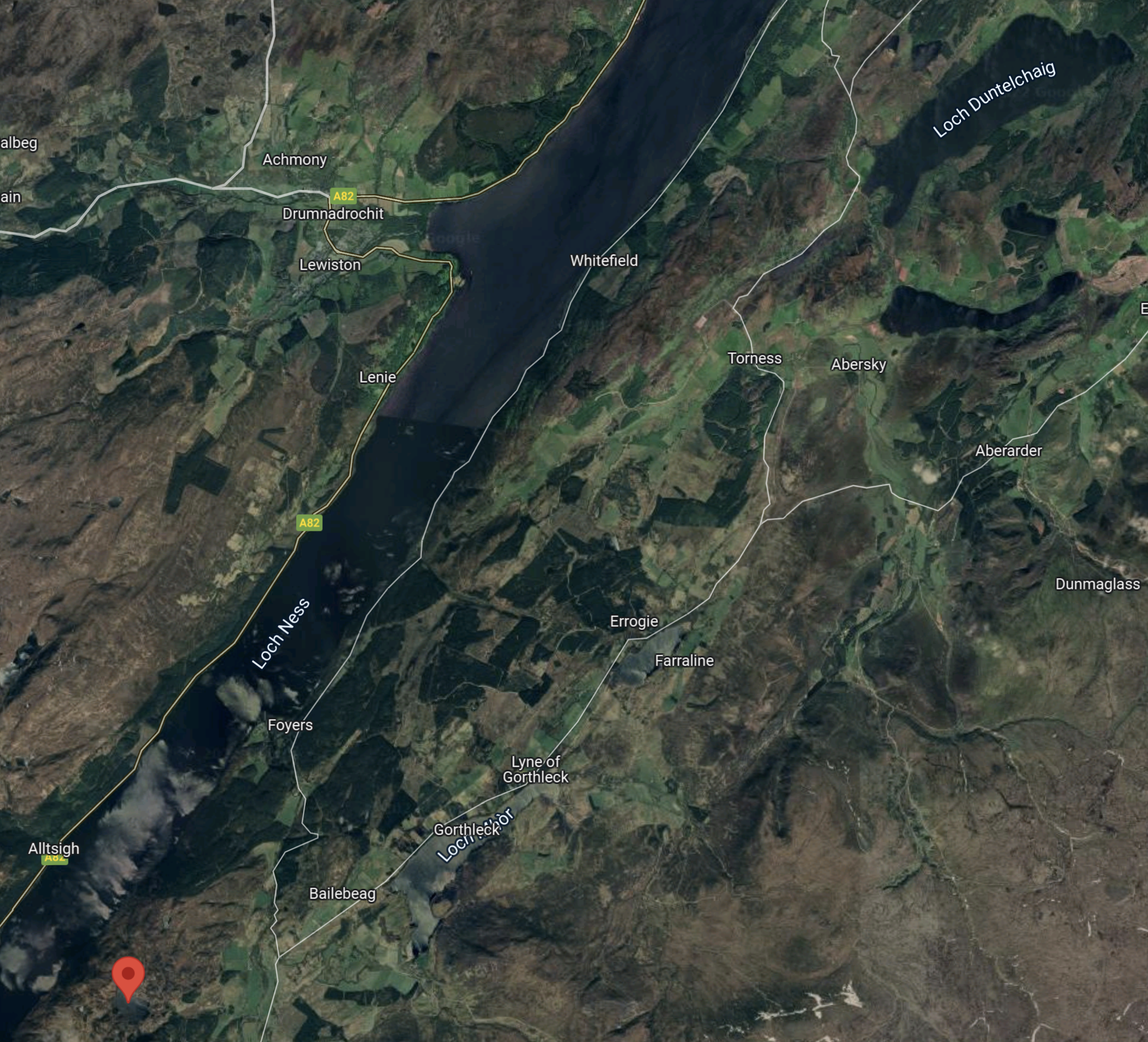
This Google Map shows the Northern end of Loch Ness.
Note.
- The red arrow indicates Loch Kemp.
- Foyers, which is a short distance to the North West, is the site of the Foyers pumped hydro scheme. I wrote about this scheme in The Development Of The Foyers Pumped Storage Scheme.
- Loch Duntelchaig, in the North-East corner of the map, is being used as the upper reservoir of the Red John pumped hydro scheme. I wrote about this project in Red John Pumped Storage Hydro Project.
On the East side of Loch Ness there seems to be four substantial hydro-electric schemes.
In order from South to North these schemes are.
Glendoe
Glendoe is a modern 100 MW hydroelectric power station, that opened in 2009.
In Glendoe Hydro Power Station, I felt it might be possible to expand Glendoe into a pumped hydro scheme, with upwards of 10 GWh of storage.
Loch Kemp
Loch Kemp is a proposed 300 MW/9 GWh pumped hydro storage station.
Foyers
Foyers is an existing 300 MW/10 GWh pumped hydro storage station.
Red John
Red John is a proposed 450 MW/2.8 GWh pumped hydro storage station, which has received planning permission.
These four power stations could be summarised as follows.
- Glendoe – 100 MW/10 GWh
- Loch Kemp – 300 MW/9 GWh
- Foyers – 300 MW/10 GWh
- Red John – 450 MW/2.8 GWh
Note.
- Totals are 1150 MW and 31.8 GWh
- Foyers was converted from a conventional hydroelectric power station, that was opened in 1895 to a pumped hydro storage station.
- If Foyers can be converted, why can’t Glendoe.
A very large pumped storage station of four separate units, can be built on the East side of Loch Ness.
Conclusion
This is only on the East side of Loch Ness, so if the West side can be similarly developed, Loch Ness could be developed into a real Loch Ness monster with over 60 GWh of pumped hydro storage.
Driver Hospitalized After Brightline Train Hits Pickup Truck In Hallandale Beach
The title of this post, is the same as that of this article on 850 WFTL.
The driver certainly didn’t have a full load in the front of his pickup.
This paragraph describes the incident.
Dashcam video provided by Brightline captured the moment the driver of the silver pickup drove around the gate arm and onto the track a split second before impact. The arm was down when the collision happened.
Perhaps, the driver was trying to get a Darwin Award.
Wagons Ordered For Growing Freight Traffic
The title of this post, is the same as that of this article on Railway Gazette.
This is the first paragraph.
GB Railfreight and leasing company Porterbrook have placed an order for Greenbrier Europe to supply 50 JNA 60 m3 capacity four-axle box wagons for transporting construction materials.
Other points from the article.
- The wagons will be built in Romania.
- They will be delivered in the Autumn.
- Porterbrook research is indicating a possible increase of 35 % in construction sector traffic between now and 2034.
Certainly, judging by the number of posts about freight, the sector seems to be innovating and running more trains.
 The Anonymous Widower