Housing Development Next To Planned Overground Station Gets Approved
The title of this post, is the same as that of this article on IanVisits.
This paragraph describes the development.
The development, New Bermondsey, will see a cluster of residential towers built around the Millwall football ground on former light industrial sites, and will provide some 3,500 homes, a new sports facility, auditorium with 800 seats, and it’s said some 1,250 jobs. The towers vary in height across the site from 13 – 44 storeys; most towers are around 29/30 storeys.
The Overground station is New Bermondsey station, which was originally to be called Surrey Canal Road station.
This Google Map shows the area.
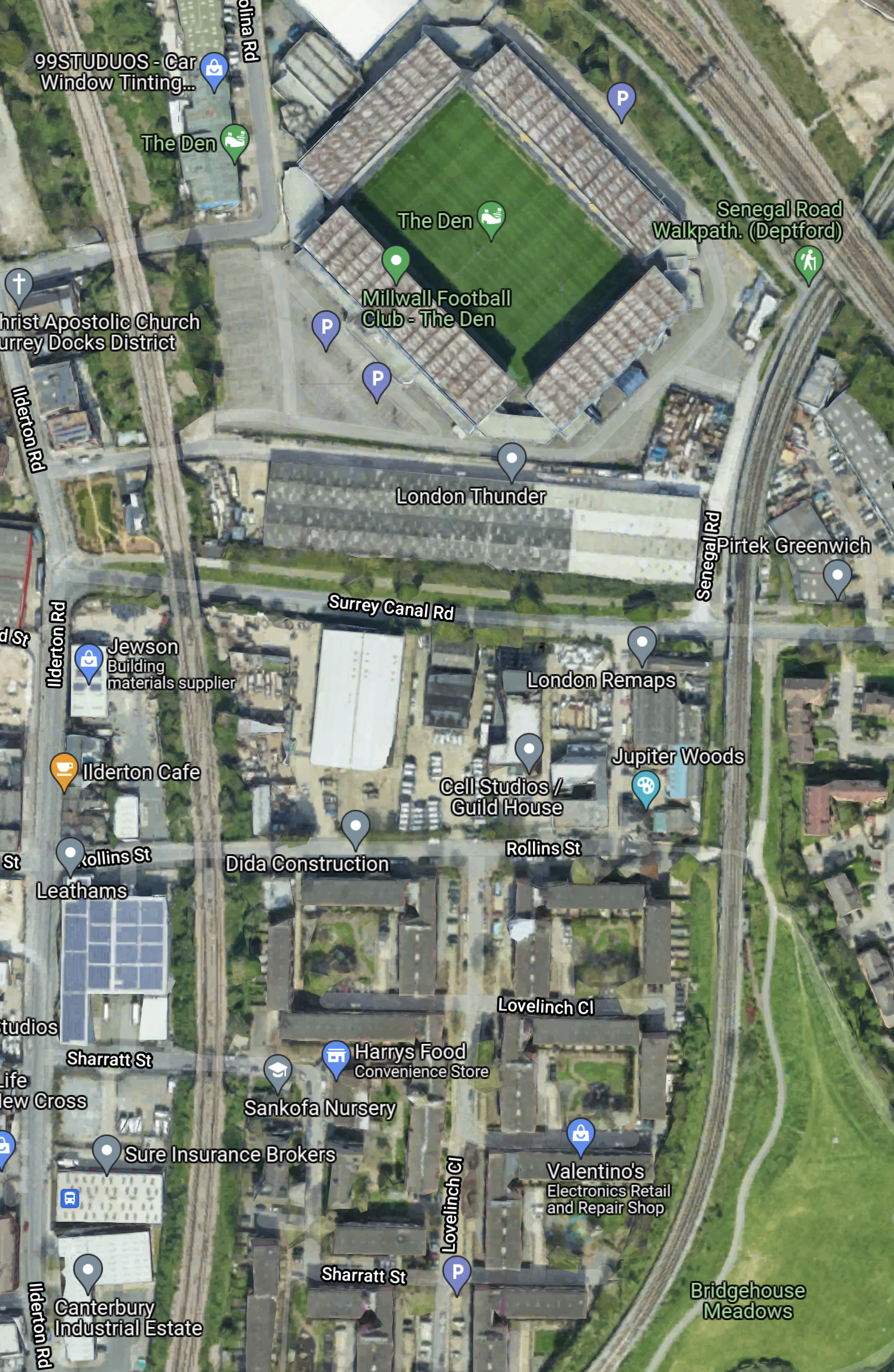
Note.
- The railway going down the East side of the map in the South London Line of the London Overground.
- The railway going round the West side of the map is the National Rail line going through South Bermondsey station to London Bridge.
- The two lines meet at Queens Road Peckham station to the South.
- Surrey Canal Road runs East-West across the map to the South of The Den.
- New Bermondsey station will be where Surrey Canal Road crosses under the London Overground.
- Most of the new housing will be clustered along this road and around the football ground.
The development will be convenient for Millwall supporters.
‘Biggest Breakthrough’ On Pancreatic Cancer Is On The Horizon As Scientists Hail Two-In-One Teatment That Could Even CURE The Disease
The title of this post, is the same as that of this article on the Daily Mail.
These three paragraphs give an introduction to the research.
Scientists are on the cusp of the ‘biggest ever’ breakthrough in the treatment of pancreatic cancer.
UK researchers have developed a two-in-one treatment that could dramatically improve survival and even cure the disease, which is one of the deadliest cancers.
Survival rates for pancreatic cancer have barely improved in the last 50 years and it has the worst prognosis of any common cancer.
It is a state, that you don’t want to go near.
This is the heart of the new two-in-one treatment.
One of the treatments is immunotherapy, whereby a drug fires up the immune system to fight the cancer.
The drug is a checkpoint inhibitor, which means it blocks proteins that stop the immune system from attacking cancer cells. It has had stunning results against some types of cancer.
But pancreatic cancer tumours have a thick outer layer which stops the drug in its tracks.
The second treatment, known as high intensity focused ultrasound (HIFU), involves blasting the tumour with pulses of sound waves.
This creates tiny bubbles in the cells, which bounce around with such force that they puncture holes in the protective barrier – allowing the immunotherapy drug to get to work.
I find it strange that I when I wrote Glencore & Strategic Partner Britishvolt Strengthen Relationship And Agree To Build Battery Recycling Ecosystem In The UK, I found that a similar technique is being investigated by the Faraday Institute in the recycling of lithium-ion batteries.
In this article on the BBC, which is entitled As The World looks To Electrify Vehicles And Store Renewable Power, One Giant Challenge Looms: What Will Happen To All The Old Lithium Batteries?, I found this paragraph.
The team has also found a way to achieve direct recycling of the anode and cathode using an ultrasonic probe, “like what the dentist uses to clean your teeth,” he explains. “It focuses ultrasound on a surface which creates tiny bubbles that implode and blast the coating off the surface.” This process avoids having to shred the battery parts, which can make recovering them exceedingly difficult.
Umpteen million tiny bubbles can’t be wrong! It sounds to me that engineers from the Faraday Institute and Medics from the Institute of Cancer Research have been imbibing pints of the thinking man’s liqueur; real ale in a serious meeting in a pub.
But if it works don’t knock it! Just use the technique on your project to remove an awkward coating.
My son, who died of pancreatic cancer was a coeliac like me, but he had never been tested and as he was a sound engineer in the music business, he lived on a diet of Subways, cigarettes and high strength cannabis.
I asked the Professor at Liverpool University’s Pancreatic Cancer Research Unit, if this had contributed to his death and he nodded.
But my son certainly, didn’t have my strong immune system, which is because I’m coeliac and have been gluten-free for nearly thirty years. I know it is strong, as it gave the first dose of the AstraZeneca vaccine a good kicking. But by the time I got the second dose, it had worked out it was a friend, so I got no reaction.
I have three questions.
What is the hard skin of the pancreatic cancer made from?
Do all cancers have hard skins?
When patients are given immunotherapy drugs, do they go gluten-free for a Tesco effect (Every little helps!)?
Talgo To Begin Fuel Cell Loco Trials
The title of this post, is the same as that of this article on Railway Gazette.
These are the first two paragraphs.
Trials are to begin shortly with the TPH2 fuel cell test locomotive developed by Talgo as part of its hydrogen traction programme. This forms part of a low-carbon research and development strategy which is being supported by a green hydrogen supply alliance and financing from the European Investment Bank.
The TPH2 loco has been produced by fitting fuel cells and traction batteries to the Travca L-9202 ‘Virgen del Buen Camino’ prototype multi-system and variable gauge locomotive which was built by Talgo in 2005.
This page on the Talgo web site describes the Travca locomotive like this.
Travca: Traction Without Borders
Travca is a locomotive that stops at nothing; not at different power supplies, track gauges nor signalling systems all of which makes Travca Talgo’s most advanced development in the field of traction.
This is the specification of the electric locomotive from the Talgo web site.
- Operating speed – Up to 250km/h (passenger version)
- Configuration – Bo-Bo
- Track gauge (mm) -1435-1668
- Length (m) – 19400
- Bodyshell width (mm) – 2950
- Unladen weight (tonnes) – 72 (passenger version)
- Number of axles – 4
- Power – 2,400 kW (25kV, 50Hz) / 2,000kW (3kV dc)
- Brakes – Regenerative, rheostatic and air brakes
Notes.
- It is a variable-gauge and variable-voltage locomotive.
- 1435 mm is standard gauge
- It is lighter and wider than a Class 90 locomotive.
It does seem to be the basis of a very useful locomotive.
This article on Railway News is entitled University Of Extremadura To Work With Talgo On Its Hydrogen Train, says this about the test train.
During the first stage of the hydrogen train project, Talgo is developing the necessary engineering for the assembly and commissioning of hydrogen traction in a test train. The train will comprise a Talgo Travca MS locomotive, which can change gauges and run under different electrification systems, and five Talgo hauled cars that will house the hydrogen fuel cell system. One of the cars will be a laboratory car.
This would appear to be an experimental train with the hydrogen power station in four of the coaches.
It also appears that Extremadura is developing a hydrogen infrastructure.
Applications In The UK
The obvious application in the UK, is as a Class 66 diesel locomotive replacement, for some of the light to medium duties.
The Class 66 locomotives have a power of 2400 kW, which could be within the range of the Talgo locomotive.
In LNER Seeks 10 More Bi-Modes, I speculated that Talgo, with all their experience of high speed trains might like to bid for the extra ten trains, that LNER requires.
They could be ideal to allow electric trains to run between London and Aberdeen and Inverness.
- The Travca locomotive running on electricity could certainly handle 140 mph between London and Edinburgh.
- The power requirements North of Edinburgh would be less, as speeds would be lower.
- Ranges on hydrogen would be under two hundred miles.
It would be a flagship service for both LNER and Talgo.
Guided Beam Treatment Is Extending Life For Patients With Pancreatic Cancer
The title of this post, is the same as that of this article in The Times.
This is the first two paragraphs.
The lives of patients with inoperable pancreatic cancer could be extended by years with a “game-changing” radiation treatment that uses MRI technology to accurately target tumours.
A study has found that MRI-guided radiotherapy almost doubles the median survival rate in cases of inoperable pancreatic cancer compared with conventional treatment that uses CT scans.
It looks like a case of the more accurately you target your weapon, the more effective it is.
A few years before she died of a much more serious but totally unrelated cancer, my wife suffered from breast cancer.
- The cancer wasn’t massive and it had probably been caused by a severe bruise, where she had been struck by an exploding air-bag in a car accident.
- She also had a top-class surgeon in Cambridge. Barristers always get the best, as local chambers always know those who are being sued for malpractice.
- To make sure, the cancer didn’t return she had targeted radiotherapy in Harley Street daily for four or five weeks.
- She even travelled up to London from Suffolk daily on the train, often fitting Court appearances around the appointments.
- A few weeks before she died, she was checked for breast cancer and pronounced clear.
The treatment had worked and it convinced me of the value of targeted radiotherapy.
I must say, it increases my optimism, that pancreatic cancer might be one cancer, where we can at least prolong life in many cases.
My optimism about pancreatic cancer probably started , after the results of the research to which I added funding in a small way were published. I wrote about them in There’s More To Liverpool Than Football And The Beatles!.
Black Mass One Of The Hottest Issues In Battery Recycling
The title of this post, is the same as that of this article on Recycling Magazine.
It gives a good description of black mass.
Glencore & Strategic Partner Britishvolt Strengthen Relationship And Agree To Build Battery Recycling Ecosystem In The UK
The title of this post is the same as that of this press release from Glencore.
These are the first two paragraphs.
Glencore is proud to have entered an industry-leading battery recycling joint venture with strategic partner and battery pioneer Britishvolt, the UK’s foremost investor in battery cell technologies and R&D.
The joint venture will develop a world-leading ecosystem for battery recycling in the UK. This ecosystem will be anchored at a new recycling plant located at the Britannia Refined Metals operation (BRM-located in Northfleet), a Glencore company. BRM will continue with its current production and trading operations.
These appear to be some of Glencore’s objectives for the project.
- They intend to recycle a minimum of 10,000 tonnes of lithium-ion batteries per year, including but not limited to valuable battery manufacturing scrap, portable electronics batteries and full EV packs.
- They intend to recycle Britishvolt’s scrap.
- They intend to be up and running by mid-2023.
- They intend to be 100 % powered by renewable energy in the longer term.
It all seems admirable.
These are my thoughts.
Britannia Refined Metals
This Google Map shows the Britannia Refined Metals site at Northfleet.
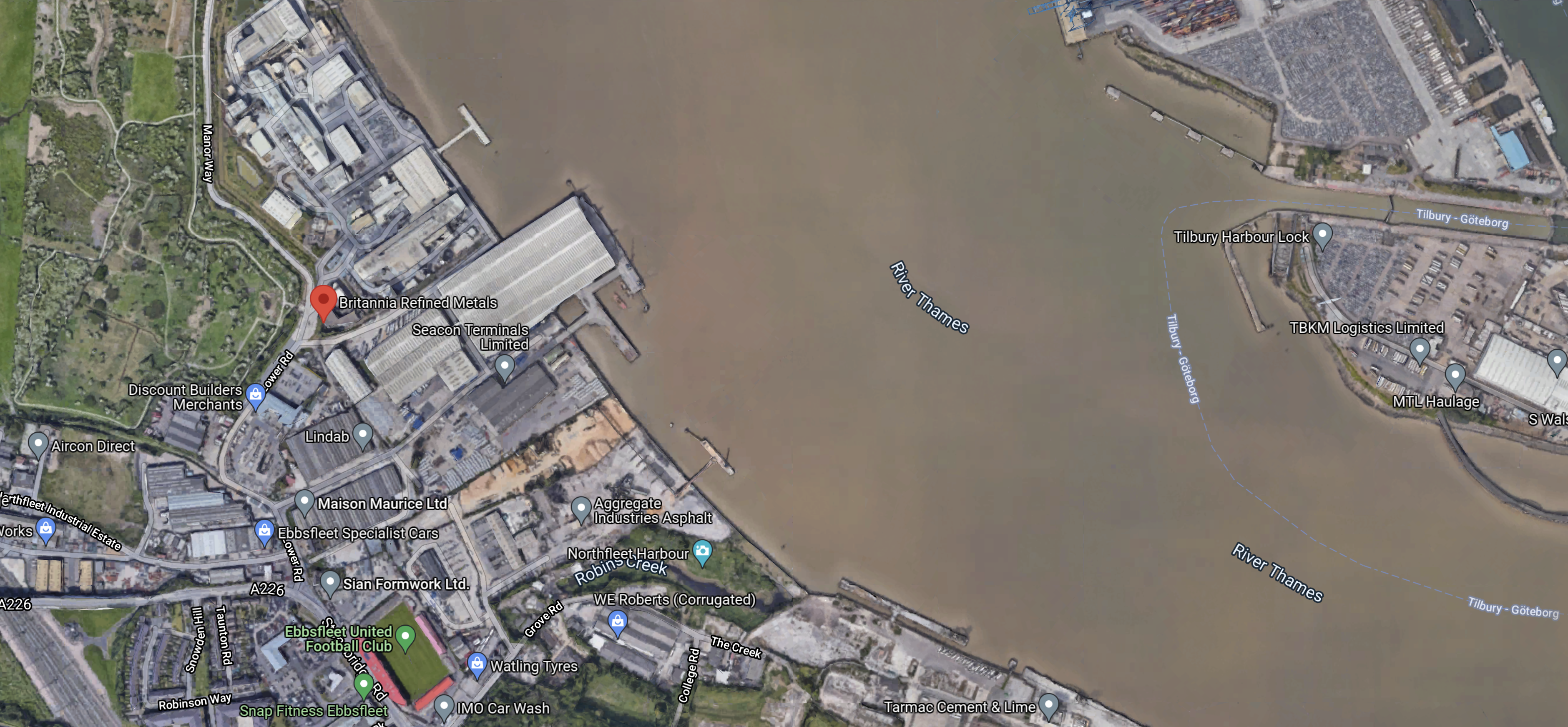
Note.
- Britannia Refined Metals is indicated by the red arrow.
- The Port of Tilbury is on the other side of the Thames.
This second Google Map shows the site in more detail.
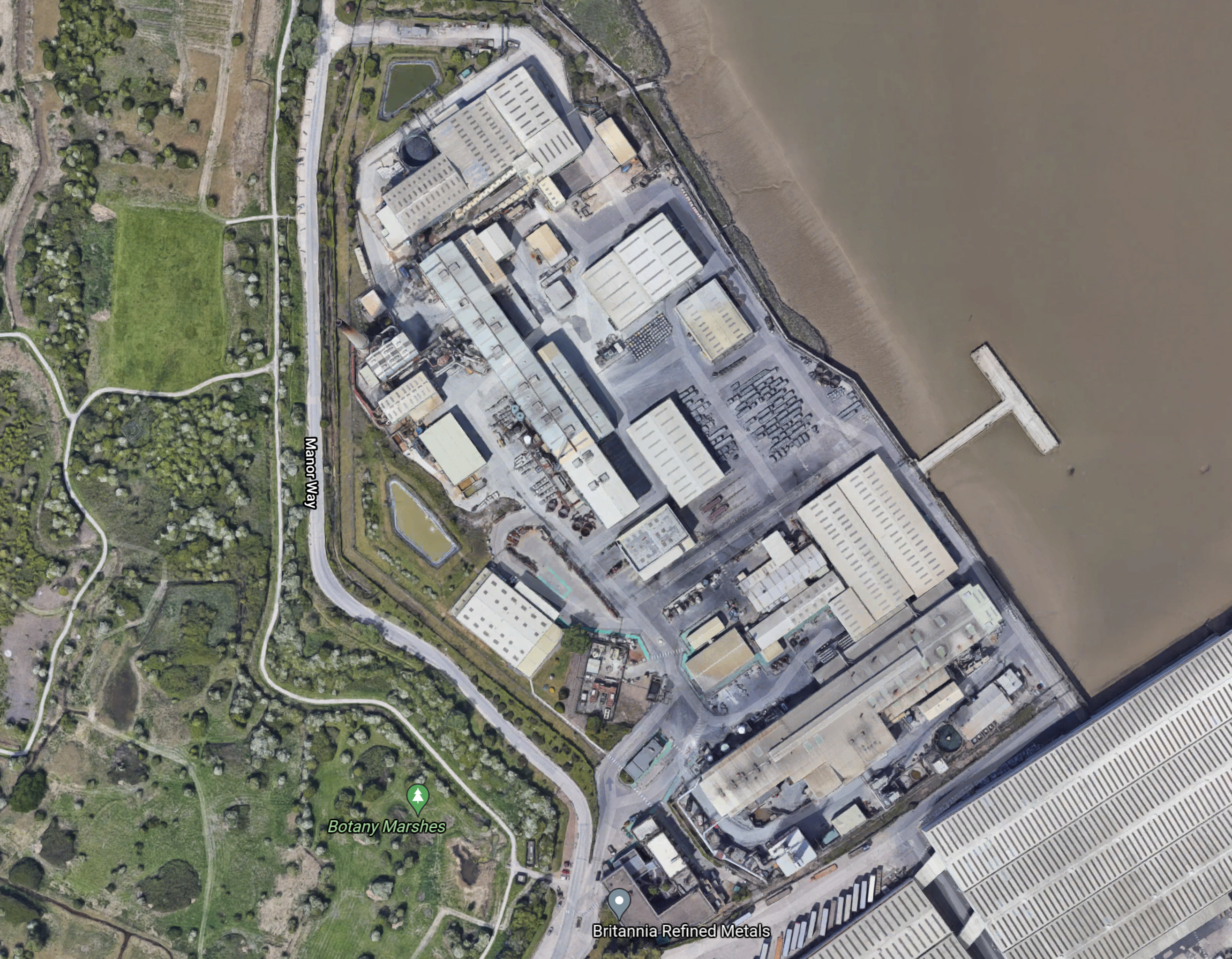
Note.
- It is not a very large site.
- There doesn’t appear to be much space for expansion.
- They appear to have a wharf on the river.
I’ve found this company video from the 1980s on the Internet.
They do seem to have developed a sophisticated process for recycling lead-acid batteries.
Renewable Energy
There are these offshore wind farms in the Thames Estuary.
- Gunfleet Sands – 172 MW
- Kentish Flats – 140 MW
- London Array – 630 MW
- Thanet – 300 MW
Two of these could be extended.
I am sure that there could be more space in the Thames Estuary for more wind power.
Recycling Batteries
I have found this article on the BBC, which is entitled As The World looks To Electrify Vehicles And Store Renewable Power, One Giant Challenge Looms: What Will Happen To All The Old Lithium Batteries?.
This is the third paragraph.
While this may sound like the ideal path to sustainable power and road travel, there’s one big problem. Currently, lithium (Li) ion batteries are those typically used in EVs and the megabatteries used to store energy from renewables, and Li batteries are hard to recycle.
The article talks about possible solutions.
- Don’t treat the batteries as disposable.
- Increasing the number of batteries recycled from the measly five percent.
- Automate the recycling process, which currently is labour intensive.
- Give the cathode, anode and other parts a second life in new batteries, by refurbishment.
- Batteries that degrade on command.
But the idea, I like is described in this paragraph from the article.
The next step for scientists pushing direct recycling of Li batteries forward is working with battery manufacturers and recycling plants to streamline the process from build to breakdown.
In context with the tie-up between Glencore and Britishvolt, you can imagine engineers from both companies, getting together to improve the design of the battery, so that manufacturing and recycling of batteries are two mutually efficient and complimentary processes.
I can also see some very sophisticated logistics systems being developed to return batteries to an approved recycler, who may be in another country.
But then we are dealing with something that could have a substantial value.
Deals Between Battery Manufacturers And Recyclers
I can see more deals like this between battery manufacturers and recyclers.
- It could reduce the cost of batteries.
- It could impress governments seeking to reduce the about of batteries going into landfill.
- It would reduce the amount of new metals to be mined.
It may even help, in the protection of intellectual property rights, that are concerned with battery manufacture and recycling.
A Second Similar Glencore Deal
There is also a second deal about battery recycling mentioned in a press release on the Glencore web site, which is entitled Glencore & Managem Set Up Partnership For Moroccan Production Of Cobalt From Recycled Battery Materials.
- The press release was issued only a few days before the one announcing the deal with Britishvolt.
- It is for 12,000 tonnes of recycling.
- The press release mentions renewable power.
I do wonder, if Glencore or one of their companies has developed a new process.
A Cool Move To Keep Emissions On Track
The title of this post is the same as that of this press release from Tesco.
This is the body of the release.
- Tesco and DRS partner on a new refrigerated rail freight service that will take 40 lorries off the road for every journey it makes
- Helping Tesco to deliver Christmas, the service will run seven days a week and replace 7.3 million road miles with greener distribution
- New service supports Tesco’s commitment to reach net zero emissions in its operations by 2035
Tesco and Direct Rail Services (DRS) have partnered to introduce a cool new service to Britain’s railways.
The new service will be the first time Tesco has used refrigerated rail freight in the UK, distributing chilled goods from Tilbury to Coatbridge by low CO2 rail twice a day, seven days a week. This means that rail freight will play an even bigger role in helping Tesco to deliver Christmas this year and over the next couple of weeks this new service will transport hundreds of different products, including festive favourites such as sprouts, parsnips, carrots, onions, oranges and lemons just in time for that all important Christmas dinner.
Using rail has significant environmental benefits. The 415-mile route will use DRS’s Class 88 bi-mode electric locomotives which can run on electricity and produce zero exhaust and greenhouse gas emissions. This service alone will take at least 17,000 containers off the road each year, saving Tesco 7.3 million road miles and nearly 9,000 tonnes of CO2e.
Note.
- This is Tesco’s first use of refrigerated rail freight.
- It starts from the new Tilbury 2 freight terminal.
- All services seem to be run using bi-mode Class 88 locomotives, running for most of the route using electricity.
Tesco seem to be following the rule, that every little helps when it comes to decarbonisation and climate change.
This Google Map shows Tilbury.
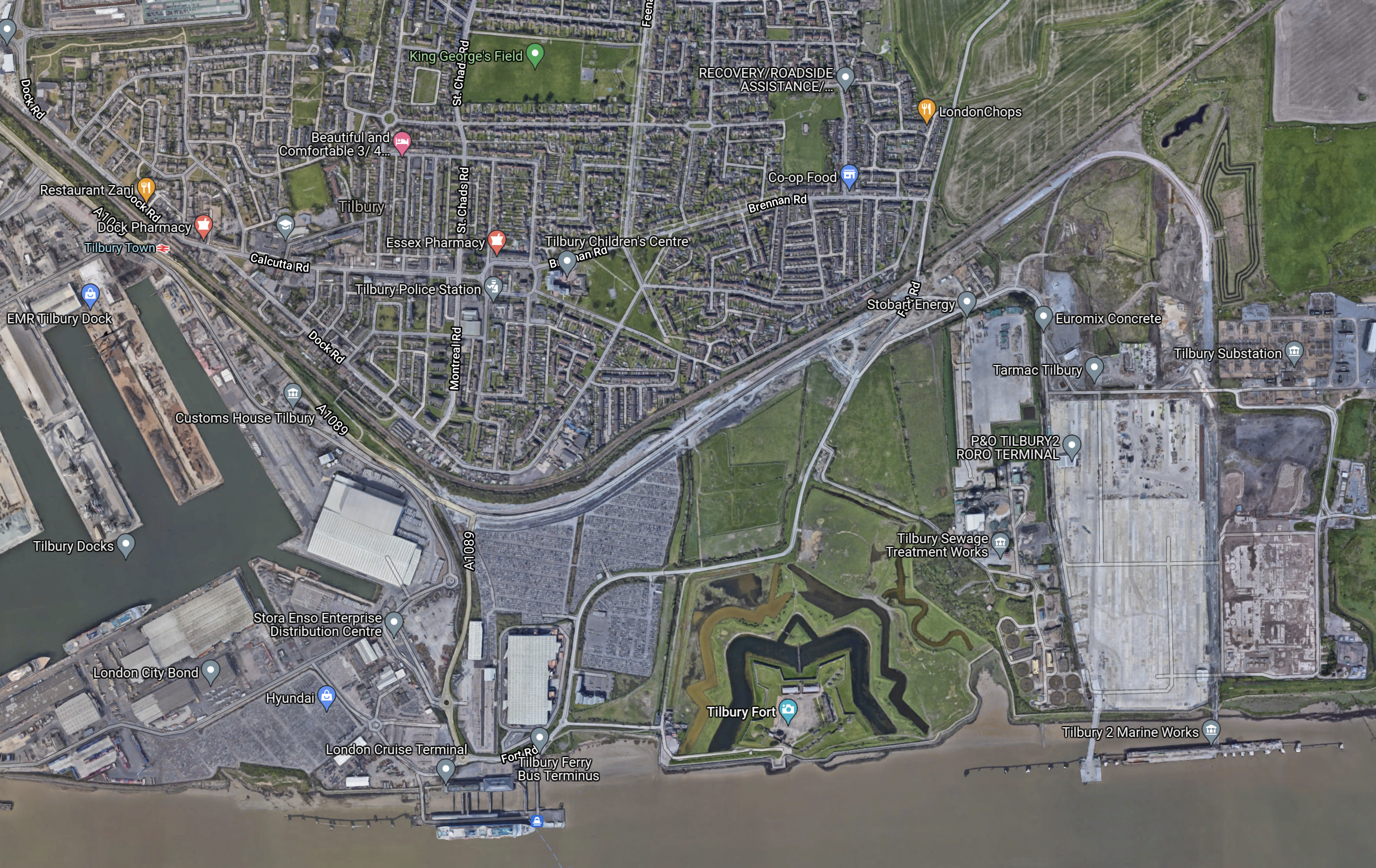
Note.
- The Port of Tilbury is in the West.
- Tilbury Town station on the Tilbury Loop Line is on the North side of the Port.
- There is a cruise ship at the London Cruise Terminal on the river.
- Next to the terminal is the Gravesend Tilbury Ferry. I can remember the car ferries on this route.
- Then there is Tilbury Fort.
- The Tilbury 2 Terminal is in the East.
I took these pictures in 2017.












I suspect it’s a bit different now!
The Mathematics Of Blending Twenty Percent Of Hydrogen Into The UK Gas Grid
HyDeploy is a project, that is investigating blending hydrogen into the UK’s natural gas supply to reduce the amount of carbon dioxide produced by the burning of natural gas in power stations, industrial processes and in our homes and other buildings.
To find out more about the project, visit the HyDeploy web site.
This is a paragraph from this page on the HyDeploy web site, which describes the current progress of the project.
HyDeploy is progressing well. The HSE gave the go ahead for a live demonstration, at Keele University, of blended hydrogen and natural gas which began in Autumn 2019 and completed in Spring 2021. The HSE are satisfied that the blend of gas will be as safe as the gas we all currently use. The hydrogen content will be up to 20% and has so far reached 15%.
Note that HSE is the Health and Safety Executive, who are closely involved.
HyDeploy has now moved on to Phase 2 in the North East.
For our North East demonstration, we have contacted everyone who will be involved in that demonstration – more than 650 homes – and arranged for our engineers to carry out Gas Safe checks on their gas appliances and gather information on the range of appliances in the demonstration area. The Gas Safe checks were free of charge. Almost 90% of those homes have engaged with us.
What would be the effects of 20 % of hydrogen blended into natural gas?
Will current boilers, cookers and other gas-powered devices work on a blend of hydrogen and natural gas?
This is one for the scientists and it is one of the objectives of the HyDeploy trial to understand how every use of gas performs if instead of natural gas, the fuel is a mixture of eighty percent natural gas and twenty percent hydrogen.
I will assume that these problems are solvable.
I am not just hoping, but I can remember in the early 1970s, when our elderly gas cooker was successfully converted from town gas, which was typically a mixture of hydrogen (50%), methane (35%),carbon monoxide (10 %) and ethylene (5%), to natural gas, as North Sea gas started to flow.
This document from the UK government is entitled Fuels: Natural Gas, which contains a section entitled Material Properties Relevant To Use, where this is said.
Natural gas is a combustible gas that is a mixture of simple hydrocarbon compounds. It contains primarily methane, along with small amounts of ethane, butane, pentane, and propane. Natural gas does not contain carbon monoxide. The by-products of burning natural gas are primarily carbon dioxide and water vapour. Natural gas is colourless, tasteless and odourless. Because it is odourless, an odorant (80% tertiarybutyl mercaptan, 20% dimethyl sulphide) is added to the gas, to give the gas a distinctive smell. Other beneficial properties of natural gas are a high ignition temperature and a
narrow flammability range, meaning natural gas will ignite at temperatures above 593°degrees and burn at a mix of 4 – 15% volume in air (St. Lawrence Gas, 2015)
As ethane (C2H6), butane (C4H10), pentane (C5H12) and propane (C3H8) are all similar simple hydrocarbons to methane, which burn to produce carbon dioxide and water, I will assume in this analysis, that natural gas is all methane (CH4).
It is reasonable to assume, that currently we use a fuel which is equivalent to 100 % methane and that in the future we could use 80 % methane and 20 % hydrogen. Also in the past, we used to use a fuel, that was 50 % hydrogen and 35 % methane. The carbon monoxide is a poison, so I’ll ignore it, but ethylene (C2H4) is another of those simple hydrocarbons, which burn to release just carbon dioxide and water.
So if we were able to go from town to natural gas fifty years ago, by just adjusting gas equipment, surely we can go partly the other way in the Twenty-First Century.
I can certainly see the UK gas supply containing twenty percent hydrogen, but wouldn’t be surprised to see a higher level of hydrogen in the future.
How Much Hydrogen Needs To Be Added?
This page on worldodometer says this about UK gas consumption.
The United Kingdom consumes 2,795,569 million cubic feet (MMcf) of natural gas per year as of the year 2017.
I will now calculate the weight of hydrogen needed to be added.
- 2,795,569 million cubic feet converts to 79161.69851 million cubic metres.
- I will round that to 79161.7 million cubic metres.
- Twenty percent is 15832.34 million cubic metres.
- A cubic metre of hydrogen weighs 0.082 Kg, which gives that in a year 1,298.25188 million kilograms will need to be added to the UK gas supply.
This is 1,298,251.88 tonnes per year, 3,556.85 tonnes per day or 148.2 tonnes per hour.
How Much Electricity Is Needed To Create This Amount Of Hydrogen?
In Can The UK Have A Capacity To Create Five GW Of Green Hydrogen?, I said the following.
Ryze Hydrogen are building the Herne Bay electrolyser.
- It will consume 23 MW of solar and wind power.
- It will produce ten tonnes of hydrogen per day.
The electrolyser will consume 552 MWh to produce ten tonnes of hydrogen, so creating one tonne of hydrogen needs 55.2 MWh of electricity.
To create 148.2 tonnes per hour of hydrogen would need 8,180.64 MW of electricity or just under 8.2 GW.
How Much Carbon Dioxide Would Be Saved?
This page on the Engineering Toolbox is entitled Combustion Of Fuels – Carbon Dioxide Emission and it gives a list of how much carbon dioxide is emitted, when a fuel is burned.
For each Kg of these fuels, the following Kg of carbon dioxide will be released on combustion.
- Methane – 2.75
- Gasoline – 3.30
- Kerosene – 3.00
- Diesel – 3.15
- Bituminous coal – 2.38
- Lignite 1.10
- Wood – 1.83
Engineering Toolbox seems a very useful web site.
I will now calculate how much carbon dioxide would be saved.
- In 2017, UK methane consumption was 79161.7 million cubic metres.
- One cubic metre of methane weighs 0.554 Kg.
- The total weight of methane used is 43,855,581.8 tonnes.
- Multiplying by 2.75 shows that 120,602,849.95 tonnes of carbon dioxide will be produced.
As twenty percent will be replaced by hydrogen, carbon dioxide emission savings will be 24,120,569.99 tonnes.
That seems a good saving, from a small country like the UK.
The UK would also reduce natural gas consumption by twenty percent or 15832.34 million cubic metres per year.
How many other countries with good renewable and zero-carbon electricity resources like Australia, Chile, Denmark, France, Iceland, Ireland, Jordan, Morocco, Norway, Sweden and the United States will take this route, as it seems a good way to save large amounts of carbon?
There is also the collateral benefit, that countries with a good supply of hydrogen can use hydrogen to decarbonise the heavy transport sectors of rail, road and sea freight transport.
The big winners would appear to be those companies like ITM Power, who manufacture electrolysers and those companies like Fortescue Future Industries, who are prospecting, developing and promoting the hydrogen resources of the planet.
The losers will be countries, who are reliant on importing large amounts of gas and other fossil fuels, who don’t have access to large amounts of renewable energy like geothermal, hydro, nuclear, solar and wind.
Germany’s energy policy of no nuclear, more coal and Russian gas seems to have been a mistake.
But I’m sure, if Olaf Sholz talked nicely to Boris, there is a deal to be made.
- German utilities have already arranged to fund BP’s move into wind farms in Morecambe Bay and the North Sea.
- Norfolk’s gas terminal at Bacton is less than three hundred miles from Germany’s new hydrogen terminal at Wilhelmshaven.
The biggest loser could be Vlad the Poisoner.
SSE Renewables Launches 1.5GW Coire Glas Construction Tender
The title of this post, is the same as that of this article on renews.biz.
These are the first two paragraphs.
Hydro construction companies have been invited to submit tenders for construction of SSE Renewables’ proposed 1500MW pumped hydro storage scheme at Coire Glas, in Scotland.
Coire Glas, on the shores of Loch Lochy near Invergarry, would be the first large-scale pumped hydro storage scheme to be built in the United Kingdom for more than 30 years.
There appears to be global interest and six shortlisted bidders.
- The ANDRITZ HYDRO and Voith Hydro partnership
- The Bechtel, Acciona Construcción and Webuild S.p.A consortium
- The BAM Nuttall, Eiffage Génie Civil and Marti Tunnel consortium
- The Dragados and BeMo Tunnelling UK consortium
- GE Hydro France
- STRABAG UK
Bidders like these probably wouldn’t bother to get involved unless they knew that funding of the project was in place and it was pretty certain that the project will be constructed.
In World’s Largest Wind Farm Attracts Huge Backing From Insurance Giant, I talk about how Aviva are funding the Hornsea wind farm.
I believe, that insurance and pension companies like abrdn, Aviva and L & G could find a way of financing a scheme like Coire Glas.
Conclusion
It looks to me, that it’s almost certain that Scotland will get a 1.5GW/30 GWh pumped-storage system at Coire Glas.
Coire Glas could supply slightly more power than Sizewell B nuclear power station for twenty hours.
Now that’s what I call backup!
Electrified Regional Air Mobility Will Be Disruptive & Mature Rapidly In Coming Years
The title of this post, is the same as that of this article on Clean Technica.
It is very much a must-read article, where the author analyses technology and how it will affect regional aviation.
He comes to the conclusion, that electric aircraft will develop much quicker than autonomous systems and full digital air traffic control.
He feels that we’ll see rapid development of electric aircraft flying traditionally with a pilot in charge, who talks to air traffic controllers.
Effectively, this is the system that was in operation, when I used to fly my Cessna 340 all round the UK and Western Europe thirty years ago.
Adding in electric aircraft to this system, is very similar to adding a car with a certified alternative power source to the traffic of the UK.
I think this means, that electric aircraft need to have a pilot on board to be certified, as any certification involving passenger will have to be as risk-free as possible.
The article mentions Electron Aviation. The author describes their operational model like this.
Electron Aviation, for example, sees that a 4-seater, one-pilot plane can become the workhorse of a regional short-haul leisure and business travel on-demand flight service in the second half of this decade, with planes coming to a small airport near customers, who are delivered by electric Ubers at either end. The economics work out with electric airplanes where they don’t with current internal combustion planes.
As Electron’s UK address is in Mildenhall in Suffolk, which is close to the UK horseracing centre of Newmarket, I know from my past experience that their model of four-seat air-taxis certainly works in the racing industry.
The specification for their aircraft looks impressive.
- Very aerodynamic with a high aspect ratio wing.
- Tricycle retractable undercarriage.
- Twin-pusher propellers.
- 186 mph cruise at 10,000 feet.
- 466 mile range.
- Low noise.
- Zero emissions.
Looking at the visualisation on the home page of their web site, I suspect that the battery is at the centre of lift in the middle of the plane to give excellent flying characteristics.
I also think, that their concept is scalable and that a larger aircraft could be built to a similar layout.
Conclusion
I am happy to agree with the author’s conclusion, that electric aircraft will revolutionise regional aviation in a short space of time.
 The Anonymous Widower