Could Norfolk And Suffolk Be Powered By Offshore Wind?
This week this article on the BBC was published, which had a title of Government Pledges £100m For Sizewell Nuclear Site.
These are the first three paragraphs.
The government is putting up £100m to support the planned Sizewell C nuclear plant in Suffolk, Business and Energy Secretary Kwasi Kwarteng has announced.
The investment marks the latest stage in efforts to build the £20bn reactor on the east coast of England.
However, it does not commit the government to approving the project, which is still subject to negotiations.
My view of the proposed Sizewell C nuclear plant is that of an engineer, who used to live within thirty minutes of the Sizewell site.
- Hinckley Point C power station, which is currently being constructed, will have a nameplate capacity of 3.26 GW.
- Sizewell C would probably be to a similar design and capacity to Hinckley Point C.
- Sizewell C would likely be completed between 2033-2036.
- Sizewell B is a 1250 MW station, which has a current closing date of 2035, that could be extended to 2055.
- East Anglia and particularly the mega Freeport East, that will develop to the South at the Ports of Felixstowe and Harwich will need more electricity.
- One of the needs of Freeport East will be a large supply of electricity to create hydrogen for the trains, trucks, ships and cargo handling equipment.
- Sizewell is a large site, with an excellent connection to the National Grid, that marches as a giant pair of overhead cables across the Suffolk countryside to Ipswich.
But.
- We still haven’t developed a comprehensive strategy for the management of nuclear waste in the UK. Like paying for the care of the elderly and road pricing, it is one of those problems, that successive governments have kept kicking down the road, as it is a big vote loser.
- I was involved writing project management software for forty years and the building of large nuclear power plants is littered with time and cost overruns.
- There wasn’t a labour problem with the building of Sizewell B, as engineers and workers were readily available. But with the development of Freeport East, I would be very surprised if Suffolk could provide enough labour for two mega-projects after Brexit.
- Nuclear power plants use a lot of steel and concrete. The production of these currently create a lot of carbon dioxide.
- There is also a large number of those objecting to the building of Sizewell C. It saddened me twenty-five years ago, that most of the most strident objectors, that I met, were second home owners, with no other connection to Suffolk.
The older I get, the more my experience says, that large nuclear power plants aren’t always a good idea.
Small Modular Nuclear Reactors
In Is Sizewell The Ideal Site For A Fleet Of Small Modular Nuclear Reactors?, I looked at building a fleet of small modular nuclear reactors at Sizewell, instead of Sizewell C.
I believe eight units would be needed in the fleet to produce the proposed 3.26 GW and advantages would include.
- Less land use.
- Less cost.
- Less need for scarce labour.
- Easier to finance.
- Manufacturing modules in a factory should improve quality.
- Electricity from the time of completion of unit 1.
But it would still be nuclear.
Wind In The Pipeline
Currently, these offshore wind farms around the East Anglian Coast are under construction, proposed or are in an exploratory phase.
- East Anglia One – 714 MW – 2021 – Finishing Construction
- East Anglia One North 800 MW – 2026 – Exploratory
- East Anglia Two – 900 MW – 2026 – Exploratory
- East Anglia Three – 1400 MW – 2026 – Exploratory
- Norfolk Vanguard – 1800 MW – Exploratory
- Norfolk Boreas – 1800 MW – Exploratory
- Sheringham Shoal/Dudgeon Extension – 719 MW – Exploratory
Note.
- The date is the possible final commissioning date.
- I have no commissioning dates for the last three wind farms.
- The East Anglia wind farms are all part of the East Anglia Array.
These total up to 8.13 GW, which is in excess of the combined capacity of Sizewell B and the proposed Sizewell C, which is only 4.51 GW.
As it is likely, that by 2033, which is the earliest date, that Sizewell C will be completed, that the East Anglia Array will be substantially completed, I suspect that East Anglia will not run out of electricity.
But I do feel that to be sure, EdF should try hard to get the twenty year extension to Sizewell B.
The East Anglia Hub
ScottishPower Renewables are developing the East Anglia Array and this page on their web site, describes the East Anglia Hub.
This is the opening paragraph.
ScottishPower Renewables is proposing to construct its future offshore windfarms, East Anglia THREE, East Anglia TWO and East Anglia ONE North, as a new ‘East Anglia Hub’.
Note.
- These three wind farms will have a total capacity of 3.1 GW.
- East Anglia ONE is already in operation.
- Power is brought ashore at Bawdsey between Felixstowe and Sizewell.
I would assume that East Anglia Hub and East Anglia ONE will use the same connection.
Norfolk Boreas and Norfolk Vanguard
These two wind farms will be to the East of Great Yarmouth.
This map from Vattenfall web site, shows the position of the two wind farms.
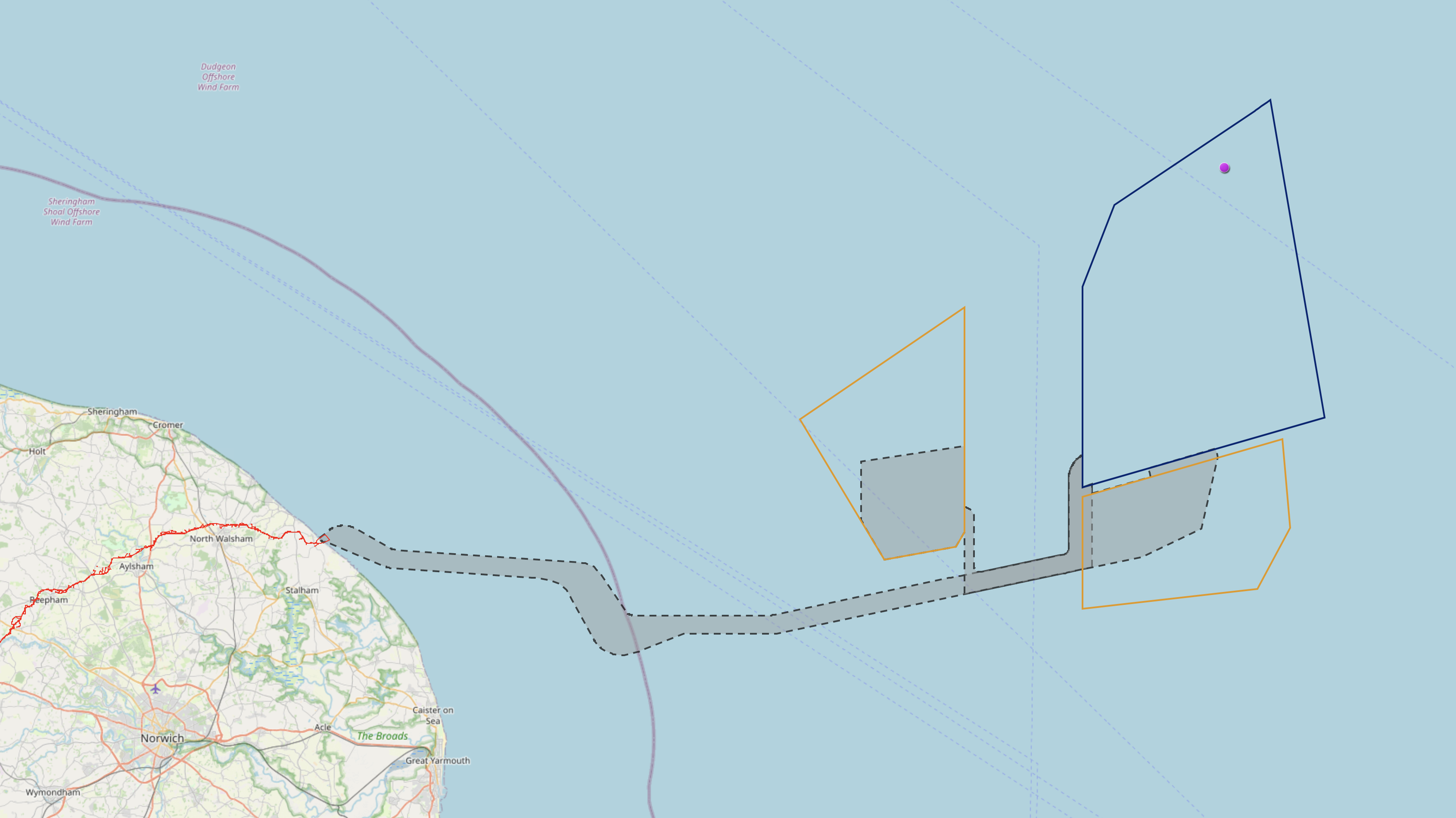
Note.
- Norfolk Boreas is outlined in blue.
- Norfolk Vanguard is outlined in orange.
- I assume the grey areas are where the cables will be laid.
- I estimate that the two farms are about fifty miles offshore.
This second map shows the landfall between Eccles-on-Sea and Happisburgh.
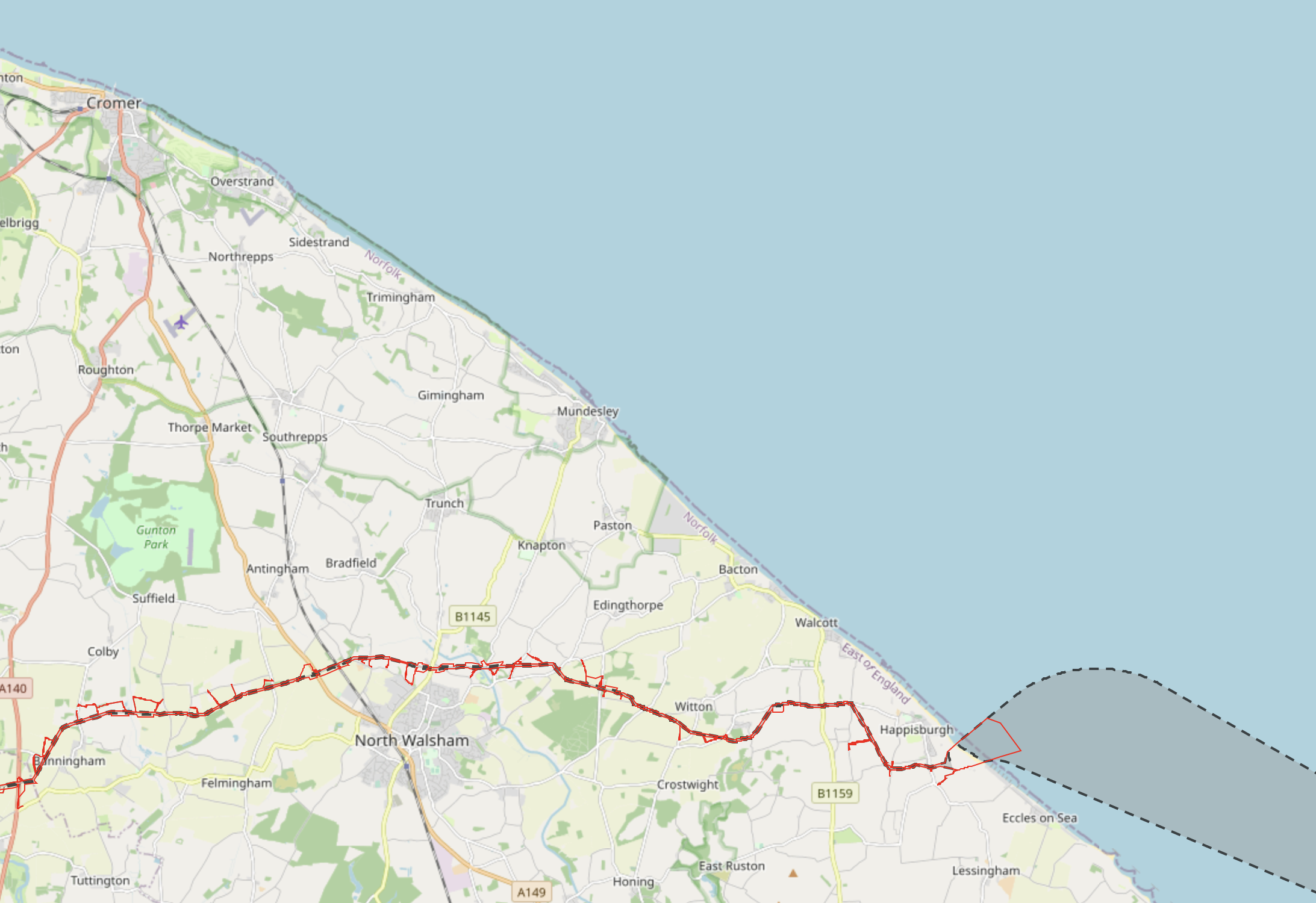
Note the underground cable goes half-way across Norfolk to Necton.
Electricity And Norfolk And Suffolk
This Google Map shows Norfolk and Suffolk.
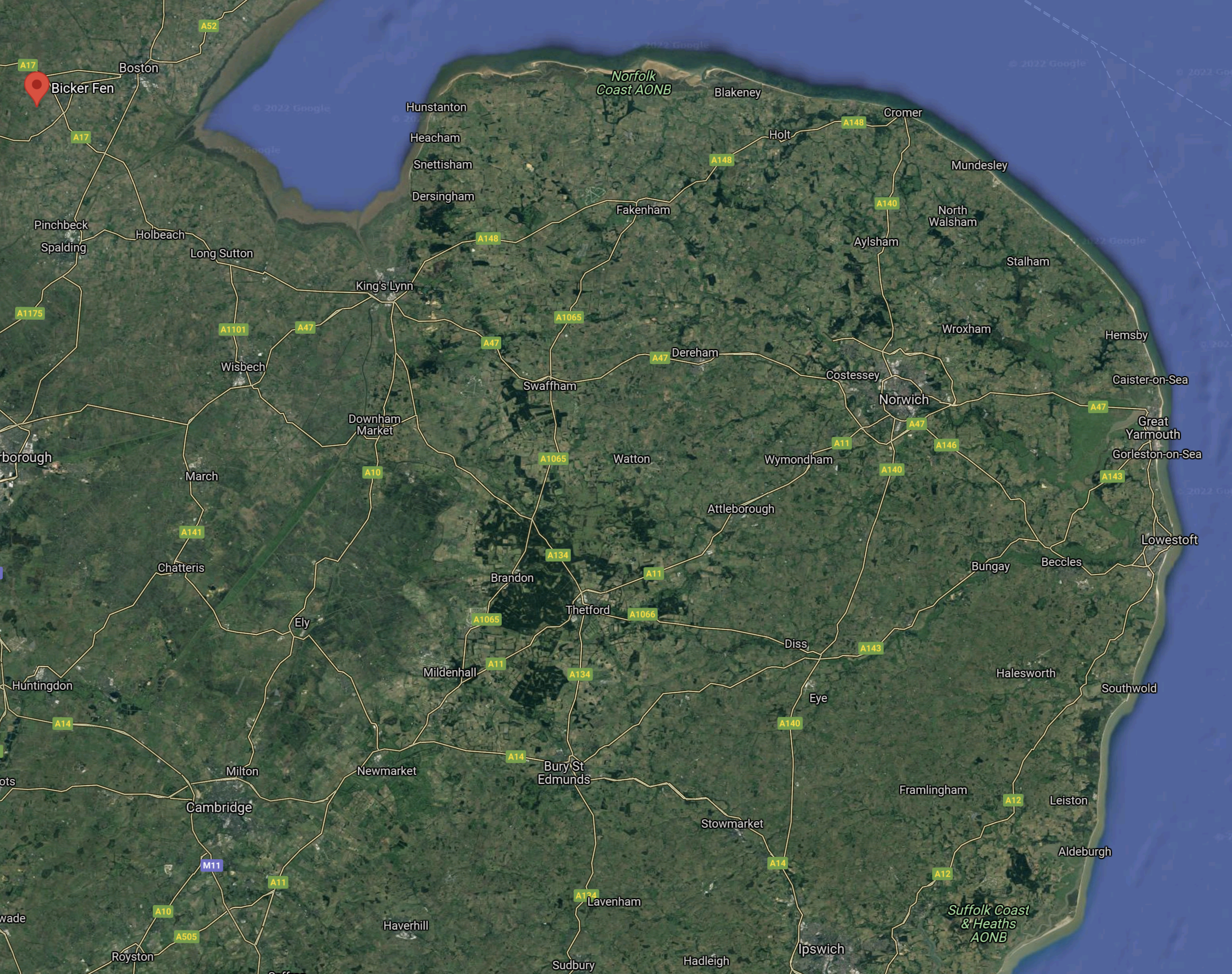
Note.
- The red arrow in the North-West corner marks the Bicker Fen substation that connects to the Viking Link to Denmark.
- The East Anglia Array connects to the grid at Bawdsey in the South-East corner of the map.
- Sizewell is South of Aldeburgh in the South-East corner of the map.
- The only ports are Lowestoft and Yarmouth in the East and Kings Lynn in the North-West.
There are few large towns or cities and little heavy industry.
- Electricity usage could be lower than the UK average.
- There are three small onshore wind farms in Norfolk and none in Suffolk.
- There is virtually no high ground suitable for pumped storage.
- There are lots of areas, where there are very few buildings to the square mile.
As I write this at around midday on a Saturday at the end of January, 49 % of electricity in Eastern England comes from wind, 20 % from nuclear and 8 % from solar. That last figure surprised me.
I believe that the wind developments I listed earlier could provide Norfolk and Suffolk with all the electricity they need.
The Use Of Batteries
Earlier, I talked of a maximum of over 7 GW of offshore wind around the cost of Norfolk and Suffolk, but there is still clear water in the sea to be filled between the existing and planned wind farms.
Batteries will become inevitable to smooth the gaps between the electricity produced and the electricity used.
Here are a few numbers.
- East Anglian Offshore Wind Capacity – 8 GW
- Off-Peak Hours – Midnight to 0700.
- Typical Capacity Factor Of A Windfarm – 20 % but improving.
- Overnight Electricity Produced at 20 % Capacity Factor – 11.2 GWh
- Sizewell B Output – 1.25 GW
- Proposed Sizewell C Output – 3.26 GW
- Largest Electrolyser – 24 MW
- World’s Largest Lithium-Ion Battery at Moss Landing – 3 GWh
- Storage at Electric Mountain – 9.1 GWh
- Storage at Cruachan Power Station – 7.1 GWh
Just putting these large numbers in a table tells me that some serious mathematical modelling will need to be performed to size the batteries that will probably be needed in East Anglia.
In the 1970s, I was involved in three calculations of a similar nature.
- In one, I sized the vessels for a proposed polypropylene plant for ICI.
- In another for ICI, I sized an effluent treatment system for a chemical plant, using an analogue computer.
- I also helped program an analysis of water resources in the South of England. So if you have a water shortage in your area caused by a wrong-sized reservoir, it could be my fault.
My rough estimate is that the East Anglian battery would need to be at least a few GWh and capable of supplying up to the output of Sizewell B.
It also doesn’t have to be a single battery. One solution would probably be to calculate what size battery is needed in the various towns and cities of East Anglia, to give everyone a stable and reliable power supply.
I could see a large battery built at Sizewell and smaller batteries all over Norfolk and Suffolk.
But why stop there? We probably need appropriately-sized batteries all over the UK, with very sophisticated control systems using artificial intelligent working out, where the electricity is best stored.
Note that in this post, by batteries, I’m using that in the loosest possible way. So the smaller ones could be lithium-ion and largest ones could be based on some of the more promising technologies that are under development.
- Highview Power have an order for a 50 MW/500 MWh battery for Chile, that I wrote about in The Power Of Solar With A Large Battery.
- East Anglia is an area, where digging deep holes is easy and some of Gravitricity’s ideas might suit.
- I also think that eventually someone will come up with a method of storing energy using sea cliffs.
All these developments don’t require large amounts of land.
East Anglia Needs More Heavy Consumers Of Electricity
I am certainly coming to this conclusion.
Probably, the biggest use of electricity in East Anglia is the Port of Felixstowe, which will be expanding as it becomes Freeport East in partnership with the Port of Harwich.
One other obvious use could be in large data centres.
But East Anglia has never been known for industries that use a lot of electricity, like aluminium smelting.
Conversion To Hydrogen
Although the largest current electrolyser is only 24 MW, the UK’s major electrolyser builder; ITM Power, is talking of a manufacturing capacity of 5 GW per year, so don’t rule out conversion of excess electricity into hydrogen.
Conclusion
Who needs Sizewell C?
Perhaps as a replacement for Sizewell B, but it would appear there is no pressing urgency.
Berwick’s Landmark Bridge Set For Major Repairs
The title of this post, is the same as that as this article on the BBC.
This Google Map shows the Royal Border Bridge.
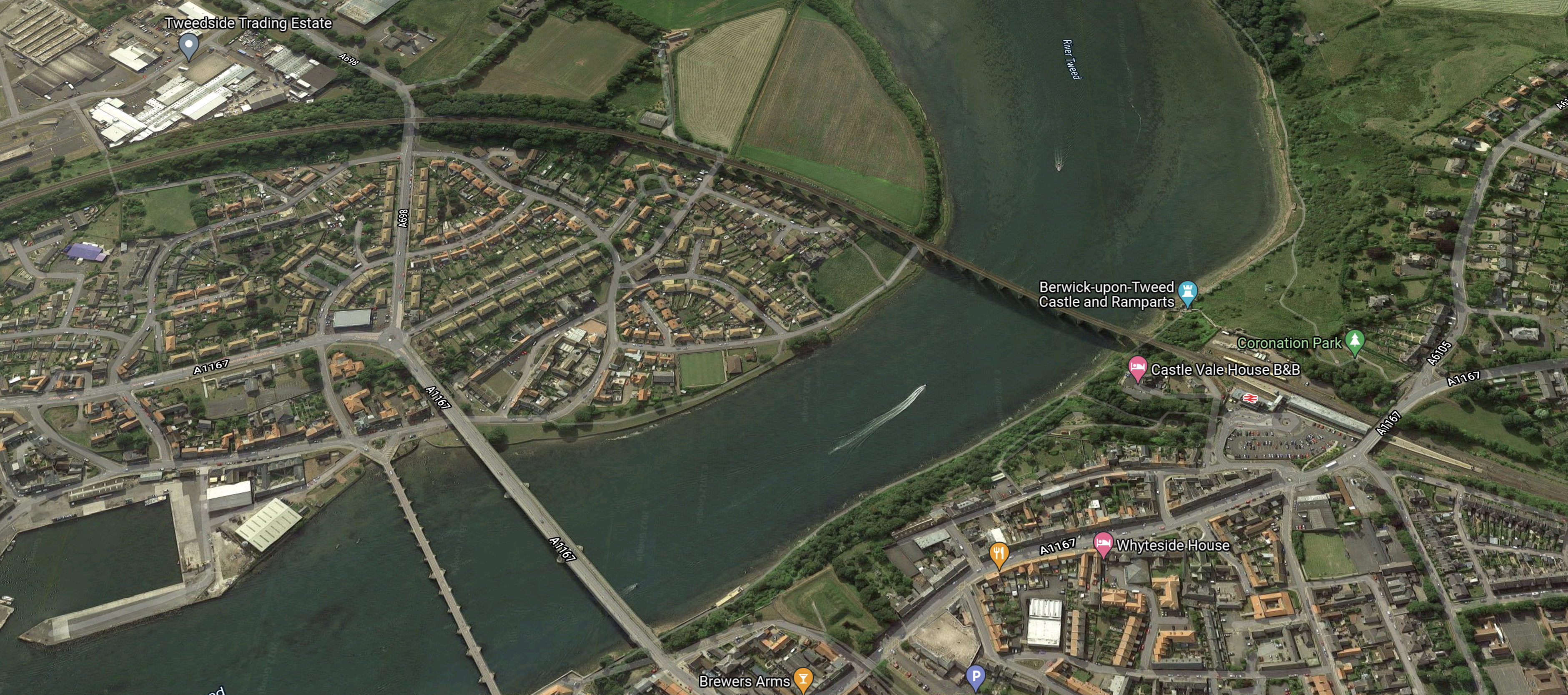
This extract from the article describes the works on the bridge.
During the work, which will last until November, engineers will repair all 28 arches of the Grade I-listed structure.
The East Coast Main Line will stay open and an online event for people to find out more is being held on 27 January.
I suspect that finding anybody to restore historic stone buildings will be difficult in the area, during 2022.
Union Pacific Railroad Makes Largest Investment In Wabtec’s FLXdrive Battery-Electric Locomotive
The title of this post, is the same as that of this press release from Union Pacific.
This is the first three paragraphs.
Union Pacific Railroad (NYSE: UNP) today announced the purchase of 10 FLXdrive battery-electric locomotives from Wabtec Corporation (NYSE: WAB). The order, which marks the largest investment in battery technology by a North American railroad, will upgrade Union Pacific’s rail yard infrastructure and support its commitment to significantly reduce greenhouse gas emissions.
“As an industry leader, Union Pacific is pioneering a major application of battery power in its rail yards,” said Rafael Santana, President and CEO for Wabtec. “Battery power is an ideal solution to reduce the environmental impact and costs of yard operations. Using the FLXdrive in the rail yard can significantly improve local air quality, as well as reduce noise by up to 70% for neighboring communities.”
The approximately 2.5-MWh locomotives are each powered solely by 7,000 battery cells, providing Union Pacific a zero-emission solution for its yard operations. The 10 FLXdrives will enable the railroad to eliminate 4,000 tons of carbon annually from its rail yards, the equivalent of removing 800 cars from the highway. The new locomotives will be manufactured in the United States with the first units being delivered to Union Pacific in late 2023.
It would appear that the major use will be in their rail yards.
There is also this second press release from Union Pacific, which is entitled Union Pacific Railroad To Assemble World’s Largest Carrier-Owned Battery-Electric Locomotive Fleet.
This is the first paragraph.
Union Pacific Railroad (NYSE: UNP) today announced plans to purchase 20 battery-electric locomotives for testing in yard operations. The combined purchases and upgrades to yard infrastructure are expected to exceed $100 million, representing the largest investment in battery-electric technology by a U.S. Class I railroad. The locomotives will be acquired from Progress Rail, a Caterpillar company, and Wabtec Corporation (NYSE:WAB), two companies at the forefront of locomotive innovation, and will be the world’s largest carrier-owned battery-electric locomotive fleet in freight service.
The press release also says that Union Pacific will be netzero by 2050.
Conclusion
All of this action in the United States and Australia with battery-electric locomotives, from two manufacturers; Progress Rail and Wabtec, leads me to the conclusion, that proposals to create battery-electric locomotives from Class 66 or Class 68 locomotives in the UK, will soon be being discussed by the owners of the locomotives and Wabtec and Stadler.
Novac Djokovic Is Screwed, Glued And Tattooed By The BBC
This article on the BBC is entitled Novak Djokovic: Doubts Over Timing Of Covid Test.
This is the introductory paragraph.
BBC research has cast doubt on the timing of the positive Covid test Novak Djokovic used to enter Australia to try to compete in the Australian Open.
The BBC have done some impeccable research on the tests and their dates.
Read it, as nothing they did was difficult, once they had details of all the tests.
As my old company accountant would say.
Novac Djokovic Is Screwed, Glued And Tattooed.
But then the accountant had ways of making money and numbers talk and perform!
In my life, I’ve had three accountants as friends and all have shown me simple ways to detect fraud.
One even showed me how to dress up a spreadsheet, so that a banker would believe it. As he had been Chief Accountant of one the most famous names in British industry, I always wrote my software to his rules.
Hydrogen Refuelling Station For Vehicles Lands At Teesside Airport
The title of this post, is the same as that of this article on the Northern Echo.
This is the introductory paragraph.
A refuelling station that will serve hydrogen-powered vehicles based in the Tees Valley is now up and running at Teesside Airport as part of a £2.5million region-wide trial.
A selection of vehicles and equipment is being trialled, including some for the emergency services.
The trial will be overseen by Teesside University.
The University also runs the Tees Valley Hydrogen Innovation Project, which is described on this page on the University web site.
Expansion Plan To Take World’s Biggest Battery Storage Project To 3GWh Capacity
The title of this post, is the same as that of this article on Energy Storage News.
These are the first two paragraphs.
Plans to nearly double the output and capacity of the world’s biggest battery energy storage system (BESS) project to date have been announced by its owner, Vistra Energy.
The Texas-headquartered integrated utility and power generation company said it wants to add another 350MW/1,400MWh BESS to the Moss Landing Energy Storage Facility in California’s Monterey Bay.
The project is based at the Moss Landing Power Plant, which was once the largest power plant in the state of California, with a generation capacity of 2560 MW.
There appear to be three phases.
- Phase 1 is 300MW/1,200MWh and went online at the end of 2020
- Phase 2 is 100MW/400MWh and went online in August 2021.
- Phase 3 will be 350MW/1,400MWh.
This gives a maximum power output of 750 MW and prospective total capacity of 3 GWh. At full power, the battery could supply 750 MW for four hours.
For comparison, the two Scottish batteries I talked about in Amp Wins Consent For 800MW Scots Battery Complex, have a combined output of 800 MW and a total capacity of 1600 MWh, which would give a full power run of two hours.
Could the difference be that Scotland has 9.3 GW of installed windpower, whereas the much larger California has only 6 GW?
Both Scotland and California also have some pumped storage power stations.
- Drax Group who own the 7.1 GWh Cruachan power station, plan to increase its generating capacity from 440MW to 1040MW.
- California has two larger stations at Castaic and Helms.
- After writing about the Western HVDC Link in Amp Wins Consent For 800MW Scots Battery Complex, I wonder if when the wind is blowing in Scotland and it isn’t in Wales, that electricity can be exported from Scotland to Wales for storage.
This all shows the complex integrated nature of electricity networks.
ITM Power’s 24MW Electrolyser Sale to Yara
The title of this post, is the similar to that of this press release from ITM Power. I just added a few words.
These are the first three paragraphs.
ITM Power (AIM: ITM), the energy storage and clean fuel company, is pleased to provide details of the sale of a 24MW electrolyser to Linde Engineering contained in the Company’s Half Year Report issued yesterday. The electrolyser is to be installed at a site operated by Yara Norge AS (“Yara”) located at Herøya outside Porsgrunn, about 140 km southwest of Oslo. The site covers an area of approximately 1.5 square kilometres and is the largest industrial site in Norway. The Porsgrunn site produces 3 million tons of fertiliser per year.
The hydrogen required for ammonia production is currently produced from SMR. Yara intends to start replacing this grey hydrogen with green hydrogen produced from renewable energy and electrolysis. The 24MW system supplying 10,368 kg/day of hydrogen will account for approximately 5% of the plant’s consumption and serve as a feasibility study for future upscaling. Yara has received a grant of up to NOK 283m (£23.6m,pending ESA approval) from Enova SF, a Government funding body, to invest in green solutions for hydrogen used for industrial purposes in Norway.
The electrolyser equipment is due to be ready for shipment from ITM Power in Q4 2022 with revenue realised in the Company’s 2022/2023 financial year.
These are my thoughts.
The Size Of The Electrolyser
A 24 MW electrolyser, that produces 10,368 Kg of hydrogen/day may sound a large device.
This is an extract from the press release.
In January 2021, the Company received an order for the world’s then largest PEM electrolyser of 24MW from Linde. In October 2021, the Company, with Linde, announced the deployment of a 100MW electrolyser at Shell’s Rhineland refinery, following the start-up of an initial 10MW facility at the site.
It appears that ITM Power have built one before and one four times the size has been ordered.
What Size Of Electrolyser Would Yara Need To Fully Decarbonise Ammonia Production?
According to the press release, a 24 MW electrolyser will produce five percent of the plant’s consumption, which means that a 480 MW electrolyser will be needed, if Yara use an ITM electrolyser to produce all their hydrogen.
Will manufacture of an electrolyser of this size be a problem for ITM Power?
The press release says this about electrolyser production.
ITM Power operates from the world’s largest electrolyser factory in Sheffield with a capacity of 1GW (1,000MW) per annum, with the announced intention to build a second UK Gigafactory in Sheffield with a capacity of 1.5GW expected to be fully operational by the end of 2023. The Group’s first international facility, expected to have a capacity of 2.5GW per annum, is intended to be operational by the end of 2024, bringing total Group capacity to 5GW per annum.
It also says that the company has raised £250m to accelerate expansion.
The Delivery Date
The delivery date of the electrolyser is stated as Q4 2022.
I find this rather quick, which makes me believe that one of the reasons for the success of ITM Power is their production process.
How Much Ammonia Is Produced Worldwide?
This is an extract from this publication from the Royal Society, which is entitled Ammonia: Zero-Carbon Fertiliser, Fuel And Energy Store.
Current global ammonia production is about 176 million tonnes per year and is predominantly achieved through the steam reforming of methane to produce hydrogen to feed into ammonia synthesis via the Haber Bosch process.
Ammonia production is a highly energy intensive process consuming around 1.8% of global energy output each year (steam methane reforming accounts for over 80% of the energy required) and producing as a result about 500 million tonnes of carbon dioxide (about 1.8% of global carbon dioxide emissions)2,3,4. Ammonia synthesis is significantly the largest carbon dioxide emitting chemical industry process. Along with cement, steel and ethylene production, it is one of the ‘big four’ industrial processes where a decarbonisation plan must be developed and implemented to meet the netzero carbon emissions target by 2050.
It looks like Linde and ITM Power have a fairly simple plan to decarbonise world ammonia production. And they have started with one of the easier targets; Yara in the very environmentally-correct Norway.
I estimate that to produce 176 million tonnes of green ammonia will need over 28 GW of electrolyser capacity.
Conclusion
If Linde and ITM Power can persuade the world, that their technology is the way to go, then they’ve got it made.
Green Hydrogen Companies Are Going Public To The Delight Of Investors
The title of this post, is the same as that of this article on Hydrogen Fuel News.
The article discusses the IPO of the ThyssenKrupp subsidiary; Nucera.
There is more in this article on Reuters, which is entitled Betting On Hydrogen Hype, Thyssenkrupp Eyes $687 mln In IPO Cash.
I have a feeling, that this would not be an investment for widows and orphans, but this widower may know enough to have a small punt at the right price.
Face Coverings Your Choice
In England from today, you don’t legally have to wear masks.
This notice was on the door of Marks and Spencer at The Angel.

These are the words at the bottom.
Face coverings are not legally required but the Government recommends them in indoor crowded areas. If you have any symptoms of COVID-19 please refrain from entering the store.
How sensible!
It will be interesting to analyse the takings of Marks & Spencer, Waitrose and Sainsburys as they are all close together on Liverpool Road.
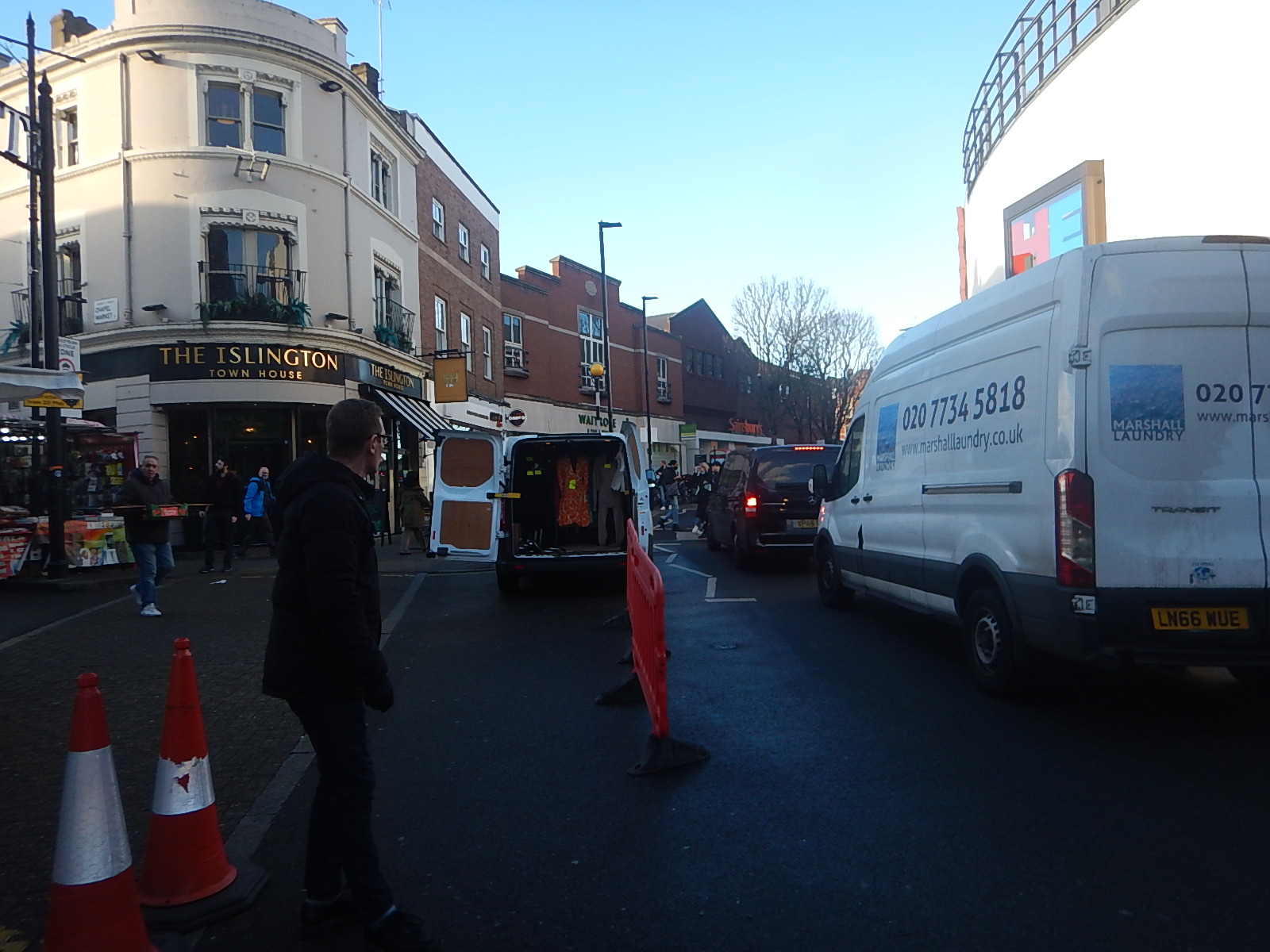
I was standing outside Marks & Spencer, when I took the picture.
A Tale Of Two Cataract Operations
I have now had two cataract operations.
There was a few weeks between the operations and in the interval they changed the machines.
- The first was a Leica and the second was a Zeiss.
There were no problems with either operation, but there were differences, particular in how I felt afterwards.
- With the first, I was slightly more uncomfortable and had a slight amount of pain in my left eye. But the pain was nothing that a few ginger biscuits couldn’t cure.
- With the second, I’ve had no pain at all and the eye looks less red. I was able to take the dressing off in the evening and go out the next day, which I couldn’t do after the first.
Now fifty-four hours after the operation, my eyes are back to normal. I can even type this without putting on my glasses.
Conclusion
I would suggest that before you have a cataract operation, you make sure the surgeon will be using the latest machines.
 The Anonymous Widower