Yesterday In Whitehall And The Battle Of Cable Street Compared
I asked Google AI “How many Tommy Robinson supporters were in Whitehall yesterday and received this answer.
London’s Metropolitan Police said the march, organised by anti-immigrant activist Tommy Robinson, drew an estimated 110,000 to 150,000 people, far surpassing expectations.
The Times has a similar figure.
Sky News says this about the counter protest.
An anti-racism counter-protest, attended by about 5,000 campaigners, also took place.
This is backed by other reports.
The Times also said this paragraph about the Police.
More than 1,600 officers were deployed to deal with the demonstrations as well as several football fixtures in the capital. At least 500 police had been drafted in from forces outside London, including the Merseyside, Humberside and Avon & Somerset forces.
So what was it like in the 1930s, when Oswald Mosley and his Blackshirts tried to march through the East End of London?
Google AI gives this account of the numbers.
At the Battle of Cable Street in 1936, there were approximately 3,000-5,000 fascists attempting to march, protected by 6,000-7,000 police officers, who were met by a larger, determined counter-protest of tens of thousands of locals, with estimates for the anti-fascist crowd ranging from over 100,000 to as many as 300,000 people.
My father, who was proud of his part-Jewish heritage and very much an anti-Fascist was there.
It looks like numbers were more the other way yesterday. I don’t think that’s a good thing.
US Interior Secretary: ‘No Future For Offshore Wind Under This Administration’
The title of this post, is the same as that of this article on offshoreWIND.biz.
This is the sub-heading.
US Interior Secretary Doug Burgum said at a press conference on 10 September that offshore wind has no future in the US under the Trump administration and that the government was reviewing five offshore wind projects that are now under construction.
There is also this quote from Burgum.
Offshore wind was too expensive and not reliable enough.
Many of those projects weren’t really about electricity, they were about tax subsidies
I think the fact that the subsidies have been either cut back or limited means that it is likely that there will not be future offshore wind built in America.
He also added that there were concerns that wind turbines interfered with whales and radar systems.
I asked Google AI a few questions.
Is Offshore Wind Extremely Expensive?
Google AI replied.
No, offshore wind is not considered extremely expensive when compared to other energy sources, particularly gas-fired power stations, and its costs are projected to fall further. While initially more expensive to construct than onshore wind due to the marine environment, the higher and more consistent wind speeds offshore generate more power, leading to a competitive or lower overall levelised cost of energy (LCOE) in many regions. Recent economic challenges like inflation and supply chain disruptions have increased costs temporarily, but the sector’s financial position is recovering, and cost reductions are expected to continue.
That looks pretty fair to me.
Is Offshore Wind Reliable?
Google AI replied.
Yes, offshore wind is a reliable energy source because it generates power more consistently than onshore wind due to higher, more dependable wind speeds at sea, and can be integrated with other renewables and energy storage to provide continuous power. Offshore wind turbines operate almost all the time, and the power can be backed up by grid-level storage to ensure a steady electricity supply, even when the wind isn’t blowing.
That looks pretty fair to me.
Are Subsididies And Tax Breaks Important For Offshore Wind?
Google AI replied.
Yes, subsidies and tax breaks are important for the offshore wind industry, which faces high upfront costs and inflationary pressures, to make it more cost-competitive with fossil fuels and secure financing for projects. These incentives help reduce costs for developers, de-risk investments, and ensure the technology can meet climate targets by fostering investment and ensuring long-term viability.
That looks pretty fair to me, but if you were in the oil and gas industry you might think differently.
On the other hand some countries like Norway and the UK, are encouraging the linking of offshore wind farms to offshore oil and gas production to decarbonise offshore operations.
Does Offshore Wind Kill Whales?
This article on the BBC is entitled Fact-Checking Donald Trump’s Claim That Wind Turbines Kill Whales.
It goes into detail about Trump’s claims about wind turbines and marine life.
These are four paragraphs.
“We know what the main threats are to humpback whales: it’s very much the impact from things like fishing and ship strikes,” says Rob Deaville from the Zoological Society of London’s Cetacean Strandings Investigation Programme.
“To talk about wind farms being a problem takes away discussion around the very real threats that are a problem for those species.”
Many other areas with high numbers of wind farms have not seen an increase in whale mortality.
For example, the UK is home to the world’s four largest wind farms, but no humpback whale strandings there have been conclusively linked to the impact of those farms.
That looks pretty fair to me.
But because of our massive portfolio of offshore wind farms and top universities, who research the marine environment, the UK is in a unique position to expose fake science, that was made up on the back of a used envelope.
Does Offshore Interfere With Radar?
Google AI replied.
Yes, offshore wind farms can interfere with radar by reflecting radar signals, causing “radar clutter” or false echoes that can obscure real targets, like aircraft or ships, or create phantom images on a radar display. This interference, also known as a “blade flash,” can negatively impact air defense, air traffic control, and maritime navigation, leading to reduced accuracy and potential safety risks.
That looks pretty fair to me.
Have Wind Turbines Caused Any Air Accidents?
Google AI replied.
Yes, wind farms have caused air accidents, though they are rare. These incidents primarily involve light aircraft colliding with wind turbines or experiencing loss of control due to turbulence from turbine wakes. Examples include a pilot crashing near a wind farm due to turbulence and another fatal crash involving an aircraft hitting a turbine blade.
That looks pretty fair to me.
I learned to fly light aircraft in the 1970s and I remember being told about wake turbulence from airliners, which has been strong enough in some cases to flip an aircraft like a Cessna 150 upside down or into a spin.
What Are The CAA’s Rules For Flying Near Wind Turbines?
Google AI replied.
The primary CAA rule for flying near wind turbines is related to their visibility and safety, focusing on lighting requirements and potential hazards like turbulence. Structures 150 meters or higher require medium-intensity red lights. Pilots must avoid dazzling lights with their own, and wind turbine developers must assess and mitigate risks such as turbulence, radar interference, and impact on Instrument Flight Procedures (IFPs).
That looks like what I would have expected.
Conclusion
I have tried not to be selective with my evidence, but if you are there are reasons that could be used to ban wind turbines.
I am also happy to add any other questions.
Cerulean Winds Submits 1 GW Aspen Offshore Wind Project In Scotland (UK)
The title of this post, is the same as that of this article on enerdata.
These first two paragraphs add more details.
Floating wind developer Cerulean Winds has submitted an offshore consent application for its 1 GW Aspen floating wind project to the local authorities in Scotland (UK). The application was submitted to the Scottish Marine Directorate Licensing Operations Team and is supported by an Environmental Impact Assessment (EIA) of the project. The Aspen project is comprised of 72 wind turbines to be installed 100 km off the coast in the Central North Sea to deliver 1 GW of renewable energy, expecting to start operations before 2030. The development is expected to attract a total investment of GBP11bn (€12.6bn) across a 50-year lifespan.
Cerulean Winds is partnering on the project’s delivery with NOV, Siemens Energy, Bilfinger and Ocean Installer. The company plans to develop three floating offshore wind projects in the Central North Sea (Aspen, Beech and Cedar), which are expected to be comprised of over 300 wind turbines in total.
This wind farm along with its sisters ; Beech and Cedar doesn’t appear to have been added to Wikipedia’s master list of offshore wind farms.
From a Cerulean infographic on this page, it appears that Aspen, Beech and Cedar are all 1008 MW wind farms, that are planned to be operational in 2028, starting in 2028 and starting in 2028. It would be good for the ambitions of Ed Miliband, if these three wind farms were fully operational by the end of 2030.
Farage Faces Questions Over Who Funded £885,000 Clacton Constituency Home
The title of this post, is the same as that as this article on the BBC.
This is the sub-heading.
Reform UK leader Nigel Farage faces pressure to account for how his partner paid for a £885,000 home after a BBC investigation raised further questions about his previous explanation.
These two introductory paragraphs, give more details.
The Clacton MP has denied avoiding more than £44,000 in additional stamp duty on the purchase of the constituency home by putting it in his partner Laure Ferrari’s name, saying that she bought it with her own funds.
He suggested that she was able to afford to buy the four-bedroom home, which was bought without a mortgage, because she comes from a wealthy French family.
The BBC appears to have fully investigated the deal and doubt the veracity of some of the tale, that Farage told.
I notice, that the house in question is in Frinton.
My late wife was a barrister and once acted for the Co-op to get an off-licence in the town.
- Up until this action the town had been dry.
- C told me, that the Co-op had appointed a charming Asian gentleman as a manager.
- She used all her legal charm to get the action through.
- She also joked afterwards about hate mail, but I don’t think it was serious.
It appears that you can still buy alcohol in Frinton.
Railway Station Opening Date Announced
The title of this post, is the same as that of this article on the BBC.
This is the sub-heading.
A date has been announced for the latest station to be completed on a new railway line.
These two introductory paragraphs add more details.
Blyth Bebside, on the Northumberland Line, will be opening on 19 October and only two stations remain before the line is fully operational.
The final stations at Bedlington and Northumberland Park are due to open in early 2026.
I shall be going for the opening of the new station, if I can get a Lumo both ways.
Hydrogen Coaches? Setra Begins Testing Of A Technology Carrier With Cellcentric Fuel Cell Module
The title of this post, is the same as that of this article on Sustainable Bus.
This paragraph introduces the article.
Daimler Buses has started test drives of its first Setra coach equipped with a hydrogen fuel cell drive, named the technology carrier “H2 Coach.” The 13.9-meter high-decker, model S 517 HD, combines two hydrogen tanks with a total capacity of 46 kilograms and a fuel cell module capable of as many as 300 kW, developed.
Dailmler have also said this about the interim approval for the H2 Coach.
This approval allows test drives both on Daimler Buses’ internal testing grounds and on public roads. The vehicle is intended to offer a zero-emission alternative to diesel-powered coaches, with lower noise, higher range, and shorter refueling times compared with battery-electric vehicles, contributing to improved air quality in cities and holiday regions.
I’ll go along with that.
As Wrightbus and others are developing hydrogen coaches, I believe this could be the first big hydrogen application in road transport.
Which Companies Are Developing Hydrogen-Powered Coaches?
Google AI gave me this answer.
Companies actively developing or deploying hydrogen-powered coaches include Wrightbus (UK), partnering with Symbio, and Temsa and Caetanobus (Turkey). Toyota is converting used coaches with fuel cell modules, while Daimler Buses is road-testing its H2 Coach precursor. Other companies in the broader hydrogen transport space with relevant technology are Hyundai, Volvo, and Tata Motors.
As Symbio’s Wikipedia entry is in French, I am fairly certain, that Symbio is a French company in Grenoble.
This press release from Symbio is entitled Symbio And Wrightbus Unveil TThe Successful Outcome Of Their UK Government-Funded Partnership At CENEX EXPO 2024: A 300 kW Hydrogen-Powered Demonstrator Coach.
This is the sub-heading.
A partnership to develop a 300 kW, zero-emission demonstrator fuel cell coach and future 75 kW city bus applications.
These two introductory paragraphs add more details.
Symbio and Wrightbus signed a partnership to develop and demonstrate a zero-emission, hydrogen fuel cell coach designed for on-road public transportation in the UK. The joint project started in January 2024 with the delivery by Symbio to Wrightbus of four 75 kW StackPack™ fuel cell systems, forming a 300-kW power unit that Wrightbus integrated and tested into one of its single-deckers. The tests enabled the innovation teams on both sides to adjust and define the optimal settings for the vehicle’s powertrain. Having successfully completed this objective, the demonstrator is displayed for the first time at the Cenex Expo, starting Sept. 4, and will be operational and hit the road shortly.
This successful project sets the basis for future development of hydrogen-powered city buses equipped with Symbio 75 kW StackPack™ fuel cell systems, specifically designed for bus applications.
Symbio’s approach is different.
- Many drivers of my generation had a Ford XR3i hatchback.
- This sporty car had an 80 kW engine, a top speed of 115 mph and an acceleration time of 0-60 mph, of under 9 seconds.
- It was also great fun!
I do wonder if one of Symbio’s 75 kW StackPack™ fuel cell systems could be developed and fitted into a small hatchback, to create an afffordable zero-carbon runabout.
Already the press release says that Wrightbus and Symbio are co-operating with each other on 75 kW city bus applications.
Lord Bamford’s company ; JCB found Hyperdrive Innovation to develop batteries for their diggers. These batteries are now used in Hitachi’s Battery Intercity Express Trains.
Now, it looks like his son’s company have found Symbio to develop the fuel-cells needed for their innovative buses and coaches. Would one or two 75kW fuel cells be idea for smaller tractors and diggers?
E-Bike Injuries Are A Massive Burden, Say Surgeons
The title of this post, is the same as that of this article on the BBC.
This is the sub-heading.
We’re in the morning meeting on the orthopaedics trauma ward on the 10th floor at the Royal London Hospital in Whitechapel.
These three introductory paragraphs add more detail.
Like every morning, the team are here to talk through the cases that will face them in the day ahead, and a familiar theme pops up.
From one side of the room a surgeon talks about his patient: “A 32-year-old, fit and well student… a couple of days ago he fell off an e-bike sustaining a closed left tibial plateau fracture.”
And a few moments later a voice next to us describes another case: “Six-year-old girl, she was hit by an electric bike, she has a closed tib/fib fracture.”
There is a lot more like this in the article.
The introduction of e-Bikes into London has been like the Wild West, with no suitable regulation and a powerless and afraid to act Police force.
Cycling and e-bikes in particular are going to be a big issue in the next London elections in May 2026.
I’ve Signed Up For A Heata
I’ve now got the new boiler, I said I was getting in I’m Getting A New Hydrogen-Ready Boiler.
But unfortunately, during the fitting, we found that my hot water system had a leak problem and the immersion heater wasn’t working.
So I decided to sign up for a heata, which I wrote about in British Gas Partners With heata On Trial To Reuse Waste Heat From Data Processing.
It was a painless process, but unfortunately, I can’t have one yet, as they told me this.
Thank you for registering interest in being part of the heata network, very much appreciated.
We’ll be in touch when there is an opportunity to be part of a pilot, eg testing our unvented heata unit, or to join the network as it expands.
The heata team.
That is very fair.
They didn’t request anything more than name, e-mail address, broadband speed and my hot water tank type.
They didn’t ask for full address, credit card or even, who was my energy supplier.
In the meantime, I can use the new boiler for hot water.
How Heata Works
This page on the heata web site, describes how the system works.
Reform ‘Would Scrap’ High-Speed Northern Rail Line
The title of this post, is the same as that of this article on the BBC.
This is the sub-heading.
A Reform UK government would scrap plans to build the Northern Powerhouse Rail (NPR) link, its deputy leader has said.
These two paragraphs add extra details.
In a report to the right-leaning Policy Exchange think tank, Richard Tice said companies considering bidding for contracts to build east-to-west high-speed rail links should “not bother”.
Greater Manchester Mayor Andy Burnham rejected Tice’s comments and suggested Reform UK wanted a “second-class railway” for the north of England.
As I showed in I’ve Just Glimpsed The Future Of Train Travel Across The North Of England And I Like It, much of Northern Powerhouse Rail is complete or under construction to the East of Manchester and the only section of Northern Powerhouse Rail to be announced, designed and constructed is between Liverpool Lime Street and Manchester via Manchester Airport. I discussed this section in Completing Northern Powerhouse Rail.
I also suspect that Reform UK, is the only party, that is against the building of Northern Powerhouse Rail.
Conclusion
How do you scrap a railway, that is half complete and only needs about twenty miles of new track for completion?
The Monster That Is AquaVentus Is Waking Up
I have written about AquaVentus for some time, but inh the last couple of days, ten references have been found to the project by my Google Alert.
What Is AquaVentus?
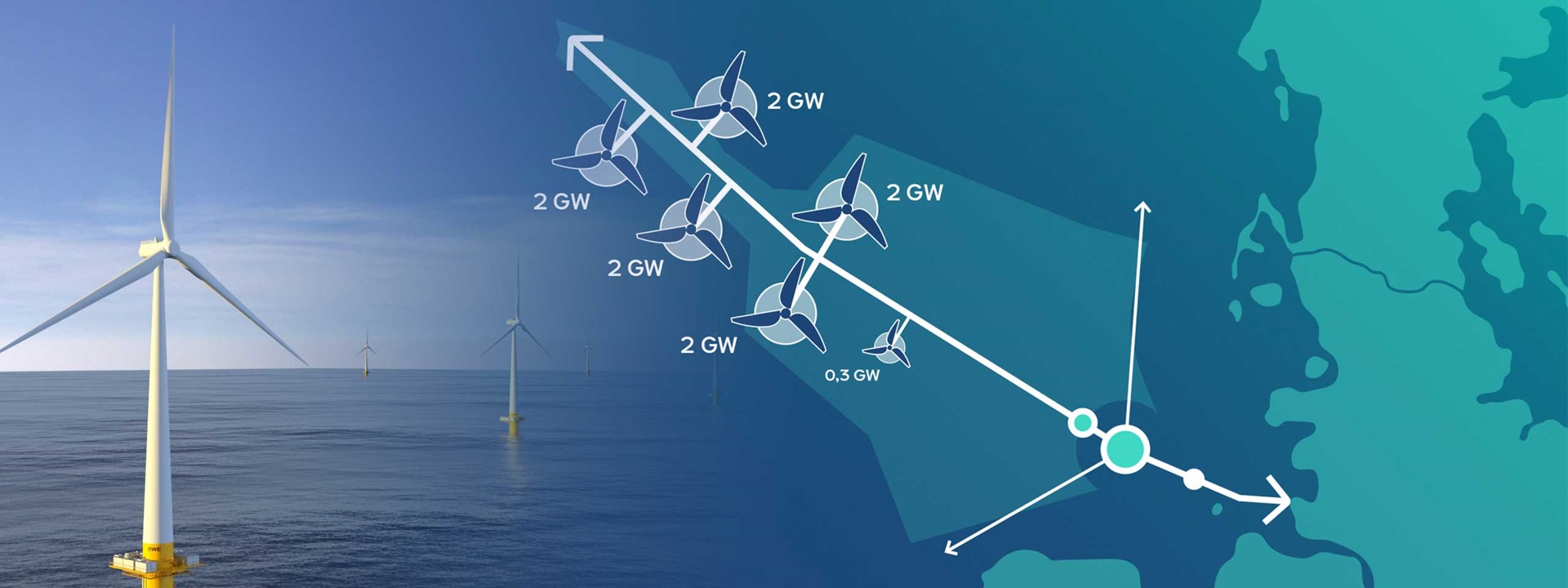
AquaVentus has a web page on the RWE web site, from where I clipped this image.
Note.
- The spine of AquaVentus is a pipeline called AquaDuctus to bring hydrogen to Germany.
- This image shows 10.3 GW of hydrogen will be generated and brought to near Wilhelmshaven in North-West Germany.
These two paragraphs introduce AquaVentus.
Hydrogen is considered the great hope of decarbonisation in all sectors that cannot be electrified, e.g. industrial manufacturing, aviation and shipping. Massive investments in the expansion of renewable energy are needed to enable carbon-neutral hydrogen production. After all, wind, solar and hydroelectric power form the basis of climate-friendly hydrogen.
In its quest for climate-friendly hydrogen production, the AquaVentus initiative has set its sights on one renewable energy generation technology: offshore wind. The initiative aims to use electricity from offshore wind farms to operate electrolysers also installed at sea on an industrial scale. Plans envisage setting up electrolysis units in the North Sea with a total capacity of 10 gigawatts, enough to produce 1 million metric tons of green hydrogen.
It is not an unambitious project.
North Sea Hydrogen Co-operation: AquaVentus And Hydrogen Scotland
The title of this section is the same as that of this page on the Hydrogen Scotland web site.
This is the introduction.
Hydrogen Scotland signed a comprehensive Memorandum of Understanding (MoU) with AquaVentus at Offshore Europe in Aberdeen. The partnership aims to unlock the North Sea’s vast potential for hydrogen production and establish Scotland as a key supplier to European markets through the development of shared infrastructure.
Both partners are committed to intensifying research activities and advocating for the rapid scale-up of a European hydrogen economy.
By joining forces, members of AquaVentus and Hydrogen Scotland can help advance the development and deployment of technologies along the entire value chain – from production through transport and storage to the use of hydrogen for decarbonising the energy system. In addition, both organisations intend to intensify their supporting activities and jointly advocate for the accelerated ramp-up of a European hydrogen economy.
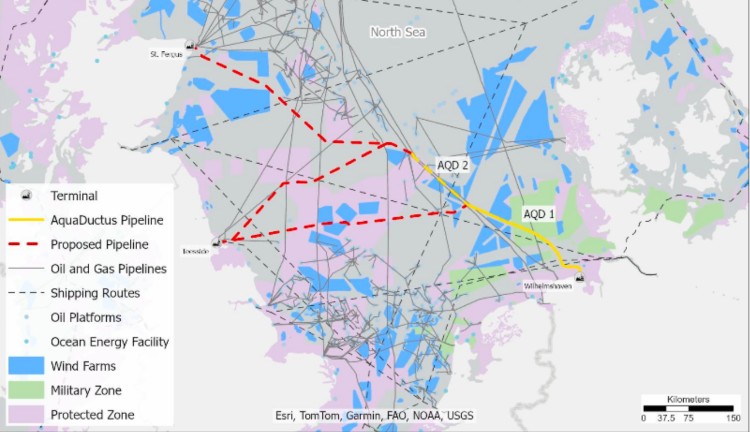
This map of the North Sea, which I downloaded from the Hydrogen Scotland web site, shows the co-operation.
Note.
- The yellow AquaDuctus pipeline connected to the German coast near Wilhelmshaven.
- There appear to be two AquaDuctus sections ; AQD 1 and AQD 2.
- There are appear to be three proposed pipelines, which are shown in a dotted red, that connect the UK to AquaDuctus.
- The Northern proposed pipeline appears to connect to the St. Fergus gas terminal on the North-East tip of Scotland.
- The two Southern proposed pipelines appear to connect to the Easington gas terminal in East Yorkshire.
- Easington gas terminal is within easy reach of the massive gas stores, which are being converted to hold hydrogen at Aldbrough and Rough.
- The blue areas are offshore wind farms.
- The blue area straddling the Southernmost proposed pipe line is the Dogger Bank wind farm, is the world’s largest offshore wind farm and could evebtually total over 6 GW.
- RWE are developing 7.2 GW of wind farms between Dogger Bank and Norfolk in UK waters, which could generate hydrogen for AquaDuctus.
This cooperation seems to be getting the hydrogen Germany needs to its industry.
These five paragraphs outline a position paper by AquaVentus.
This opportunity for German-British cooperation on hydrogen is highlighted in a position paper presented by AquaVentus alongside the signing of the MoU. This paper addresses how the requirements of German-British cooperation – as outlined, for example, in the July 2025 Kensington Treaty between the UK and Germany and the European Commission’s Common Understanding published in May 2025 – can be met.
The position paper highlights the significant potential of hydrogen production in Scotland, the necessity of imports for Germany, and references transport infrastructure already under planning. It thus lays the foundation for cross-border hydrogen trade between Germany and the United Kingdom, and for deeper European cooperation in the hydrogen sector, with three essential prerequisites:
Firstly, the networking of producers and consumers across national borders is critical for a successful market ramp-up
Secondly, beyond this synchronised production and transport infrastructure, regulatory frameworks must also be harmonised. Hybrid connection concepts (pipes & wires) that integrate both electricity and hydrogen networks provide the necessary flexibility for future energy needs, enable efficient use of renewable energy and ensure cost-effective grid expansion
Thirdly, the development from a national core network to a European Hydrogen Backbone is emphasised. Projects such as AquaDuctus can serve as a nucleus for building a pan-European hydrogen network that will shape Europe’s energy infrastructure in the long term. For the authors, strengthened cooperation with the United Kingdom is not only a sound energy policy and economic decision, but also a key contribution to European energy resilience.
Note.
 The Anonymous Widower