Reopening Milton Keynes And Market Harborough Via Northampton
This post was originally part of Shapps Supports Beeching Axe Reversals.
That post takes its name from an article with a similar name in Rail Magazine.
But I now feel it would be better if it became a standalone post.
This route has not been proposed as a Beeching Reversal, but seems to have surfaced from the MP and the local rail group.
I was digging around the Internet looking for the words “Beeching Reversal, I found when this article on the Harborough Mail, which is entitled Harborough Rail Group Says Plan To Reopen Historic Line Is A ‘Excellent Idea’.
This is the introductory paragraph.
Moves to reopen the historic Market Harborough-Northampton railway line are being backed by a local rail passengers’ chief.
The Market Harborough-Northampton Line was only finally closed in 1981.
- It used to connect the two stations with a double-track railway.
- It is about fourteen miles long.
- It is now partly a heritage railway and a walking and cycling route called the Brampton Valley Way.
I have flown my virtual helicopter along the route and can make these observations.
- There is space for a bay platform at Market Harborough station.
- Once clear of Market Harborough, the route appears to be across open countryside.
- The connection to the Northampton Loop Line wouldn’t be too difficult.
The only problem, I can see is that the route into Market Harborough station appears to be tricky.
These are a few of my thoughts.
What Passenger Service Would Be Provided?
Consider.
- The route could certainly handle an hourly shuttle, as does the nearby Marston Vale Line.
- Northampton station currently has three trains per hour (tph) to and from London.
- Timings between Northampton and Market Harborough stations would probably be around twenty minutes.
- Fast services between Northampton and Euston take about an hour.
- Four tph between Northampton and London would probably be desirable.
So could a fourth service to and from London, be extended to Market Harborough station? Or perhaps even Leicester, which already has a platform, where the trains could be turned back?
- I estimate that with a ten minute turnround at Market Harborough, a three hour round trip would be possible and very convenient.
- A single track between Northampton and Market Harborough station would be enough.
- The fourteen miles between the two stations could be handled by a battery-electric train, as there will be electrification at both ends of the route.
- Porterbrook are developing a battery-electric Class 350 train.
At a first glance, this looks to be a very sensible proposition.
This map clipped from Wikipedia, shows the rail line between Milton Keynes Central and Northampton stations.
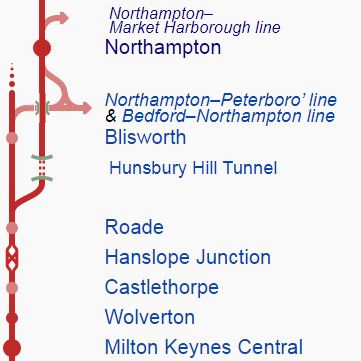
It is planned to introduce, a service between Marylebone and Milton Keynes Central using the tracks of the East West Rail Link.
- It could be run by East West Rail or Chiltern.
- It might be an easier service to operate as trains wouldn’t need to be turned back at Milton Keynes Central station.
- It might be a better financial option, if services were to be extended to Northampton and Market Harborough.
As the East West Rail Link is being built by a private company, do they have plans to create services between say Leicester and Oxford?
An Alternative Route To Leicester
A London Euston and Leicester service via Watford Junction, Milton Keynes, Northampton and Market Harborough could be run either as a regular service or when there are engineering works on the Midland Main Line.
Bringing Workers To Milton Keynes, Northampton and Leicester
When I moved back to Suffolk forty years ago, trains between Cambridge and Ipswich and Cambridge and Norwich were irregular hourly services using single or two-car trains. The good job prospects available in Cambridge, now mean that Greater Anglia now run four-car Class 755 trains on these routes to an hourly timetable.
Milton Keynes, Northampton and Leicester all need similar connections to stimulate employment.
Could Freight Trains Use The Northampton And Market Harborough Line?
Consider.
- A large rail freight interchange is being developed close to East Midlands Airport.
- The East West Rail Link will be a better route between Southampton Docks and the West Coast Main Line, than the current roundabout routes.
- Multimodal trains need to travel between the East Midlands and Sheffield and Southampton Docks.
- Stone trains need to travel between the North Midlands and West London.
If the Northampton and Market Harborough Line were to be reopened, it would provide a convenient freight route between the Midland Main Line and the West Coast Main Line.
Would the The Northampton And Market Harborough Line Be Electrified?
Consider.
- It joins the electrified Midland Main Line at Market Harborough station.
- It joins the electrified Northampton Loop Line at Northampton station.
- It is only fourteen miles long.
- Most trains should be able to bridge use the line on battery power.
- It will be a new well-surveyed railway, which is easier to electrify.
I suspect, whether the line is electrified will be more down to planning issues.
Would the The Northampton And Market Harborough Line Be Double Track?
The line was double-track when it closed and I think that only planning issues will stop it being reopened as a double track.
Is the Opening Of The Northampton And Market Harborough Line Being Driven By The East West Rail Link?
This is a paragraph from the Rail Magazine article.
Asked by Andrew Lewer (Con) at Transport Questions on October 24 whether he would elaborate on plans to open the proposed Market Harborough line as part of the Oxford to Cambridge expressway he said: “I understand that the reopening is at a formative stage, but I am very supportive of it. Indeed, I support the reopening of many of the smaller lines that were closed as a result of the Beeching cuts under a Labour Government, and I should like to see as many reopened as possible.”
Does that mean that The East West Rail Link is driving this project?
Conclusion
The reopening of Northampton and Market Harborough Line would appear to enable the following.
- Passenger trains between Marylebone and/or London Euston and Market Harborough and/or Leicester.
- Passenger trains between Oxford and Leicester via Milton Keynes, Northampton and Market Harborough.
- An increase to four tph between Northampton and Milton Keynes Central.
- A valuable freight route between Southampton Docks and the East Midlands and South Yorkshire.
It would also provide a connection between the West Coast Main Line and the Midland Main Line.
Reopening of the Northampton and Market Harborough Line could be a nice little earner for the East West Rail Link, if it hosted the following services.
- Freight trains between Southampton Docks and the East Midlands and South Yorkshire.
- Stone trains between the North Midlands and London.
- Passenger trains between Marylebone and/or London Euston and Market Harborough and/or Leicester.
- Passenger trains between Oxford and/or Reading and Market Harborough and/or Leicester.
These sections could also be electrified.
- Basingstoke and Reading
- Didcot Parkway and Oxford
- Oxford and Milton Keynes
- Northampton and Market Harborough
Much of the abandoned Electric Spine would have been created.
The only possible problem I see with this project is connecting the route to Market Harborough station.
Oxygen Supplies In Disaster Management
The title of this post is the same as this peer-reviewed paper on PubMed.
This is the Abstract.
Mass casualty events and disasters, both natural and human-generated, occur frequently around the world and can generate scores of injured or ill victims in need of resources. Of the available medical supplies, oxygen remains the critical consumable resource in disaster management. Strategic management of oxygen supplies in disaster scenarios remains a priority. Hospitals have large supplies of liquid oxygen and a supply of compressed gas oxygen cylinders that allow several days of reserve, but a large influx of patients from a disaster can strain these resources. Most backup liquid oxygen supplies are attached to the main liquid system and supply line. In the event of damage to the main system, the reserve supply is rendered useless. The Strategic National Stockpile supplies medications, medical supplies, and equipment to disaster areas, but it does not supply oxygen. Contracted vendors can deliver oxygen to alternate care facilities in disaster areas, in the form of concentrators, compressed gas cylinders, and liquid oxygen. Planning for oxygen needs following a disaster still presents a substantial challenge, but alternate care facilities have proven to be valuable in relieving pressure from the mass influx of patients into hospitals, especially for those on home oxygen who require only an electrical source to power their oxygen concentrator.
The Covid-19 situation in India, may be a total different type of disaster, but what is happening in the country is having the same outcome – A serious lack of medical oxygen!
It should not be forgotten, that we nearly had serious oxygen problems last year in the UK.
A Possible Solution
I feel we need to develop a reliable oxygen system that can supply large amounts of medical grade oxygen, which can be delivered quickly and easily to site.
Could The System Be Electrolyser-Based?
I feel that this could be an a possibility.
- Electrolysers need just a water and electricity supply.
- They produce both hydrogen and oxygen.
- If the hydrogen isn’t wanted it can be added to the gas main.
Electrolysers may offer size, safety, weight and other advantages in difficult environments.
The System Must Be Air-Transportable
This would be absolutely essential amd as the equipment might be flying into a serious disaster, surely it would be preferable if it could be fitted into a Hercules.
Conclusion
As I write this post, this article on the BBC has just been published, which is entitled UK Sends Supplies To India Amid Record Virus Surge.
This is an extract.
The assistance package includes 495 oxygen concentrators – which extract oxygen from the air to give to patients – as well as ventilators.
India is seeing thousands of deaths a day amid oxygen shortages.
Will that be enough?
We certainly must be as well-prepared as we can.
‘Super Train’ In Finland Sets New Record: The Equivalent Of 92 Trucks
The title of this post, is the same as that of this article on RailFreight.com.
This is the introductory paragraph.
The Finnish railway company VR Transpoint has introduced another heavy weight to the railways. Dubbed the Super Train, it carries a weight of 7,000 tonne, and 80 wagons. Moreover, it is about one kilometre long. According to the company, this sets a new record on Finnish railways.
These are a few points about the service.
- The service runs between Vainikkala and Hamina.
- The route appears to be electrified.
- The super train is hauled by two Vectron locomotives.
- Longer trains are more efficient.
- Long trains regularly run in Russia.
This map shows the border crossing at Vainikkala.

Note.
- The border running South-West and North-East across the map.
- The giant Finnish marshalling yard in the North-West.
- The large Russian marshalling yard in the South-East.
This Google Map shows the Finnish Marshalling yard at Vainikkala.
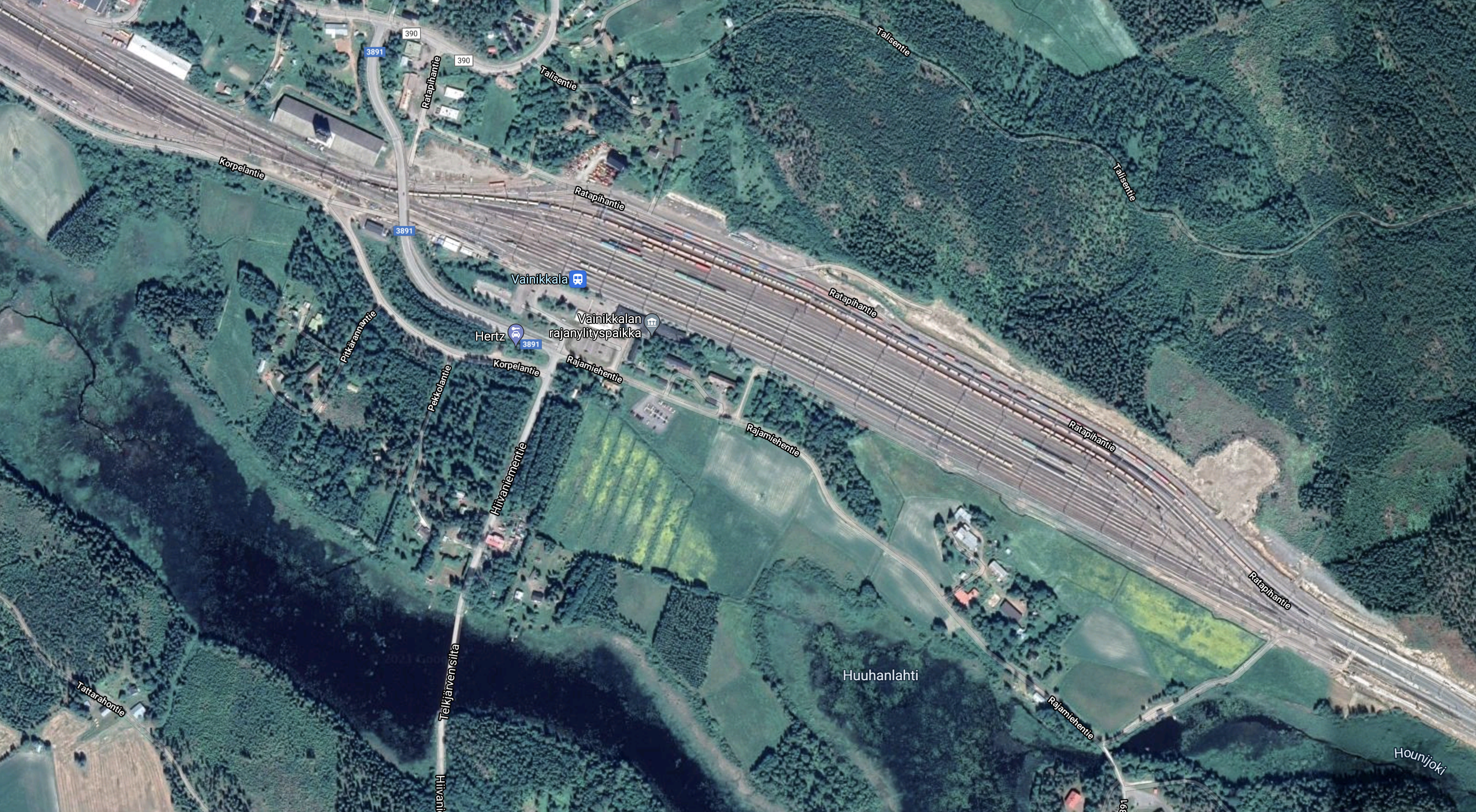
I estimate that the yard is over a kilometre in length.
Passenger Trains Between Helsinki And St. Petersburg
There is also a passenger service between Helsinki and St. Petersburg, that uses this route called Allegro, that usually runs thrice daily.
The trains are Alstom Pendolinos, specially designed for the route and are detailed in this section called Vehicles in the Allegro Wikipedia entry.
The journey time is just three and a half hours.
If you want to buy tickets, this page on The Man In Seat 61 gives all the details.
Conclusion
It looks like the Finns and the Russians have co-operated well to create a quality passenger and freight link between their two countries.
Gravitricity Celebrates Success Of 250kW Energy Storage Demonstrator
The title of this post, is the same as that of this article on the Solar Power Portal.
I have already posted about this success in Gravitricity Battery Generates First Power At Edinburgh Site.
But the news story has now been mentioned in several respected publications and web sites.
So this idea, based on traditional Scottish products of heavy weights and girders seems to be getting valuable publicity.
The demonstrator is only small and uses two 25 tonne weights and a fifteen metre tower.
This is only a storage capacity of only 2.04 kWh, but the company is talking of weights totalling up to a massive 12,000 tonnes.
With a fifteen metre tower, that would be 490 kWh.
Note.
- The shafts at Kellingley Colliery in Yorkshire are 800 metres deep.
- The TauTona mine in South Africa is 3.9 kilometres deep
- In this article in The Engineer, Gravitricity talk about weights of up to 12,000 tonnes.
These are typical storage capacities.
- Kellingley – 50 tonnes – 109 kWh
- Kellingley – 12,000 tonnes – 26.15 MWh
- TauTona – 50 tonnes – 531 kWh
- TuaqTona = 12,000 – 127.5 MWh
Accountants before they invest in a company look at the financial figures. As an engineer, I look at the numbers in the science behind their claims.
If the engineering can be made to work, these figures are to say the least; very promising.
They are also beautifully scalable.
If say your application needed a 2 MWh battery and you had a 400 metre shaft available, you can calculate the weight needed. It’s around 1836 tonnes.
The Solar Power Portal article finishes with these two paragraphs.
The company will now look to rollout the technology in a series of full-scale 4-8MW projects, with conversations already underway with mine owners in the UK, Scandinavia, Poland and the Czech Republic, it said. Additionally, in South Africa Gravitricity is working closely with mine operator United Mining Services as part of a programme funded by an Innovate UK Energy Catalyst programme to identify potential schemes.
“A key feature of our full-scale projects will be their long life” added Blair. “Once built, our system can last for over 25 years, with no loss in output or degradation over time. This makes gravity storage cost-effective. And unlike batteries, we have no reliance on rare metals such as cobalt and nickel which are becoming increasingly scarce in the global drive to electrification.”
Note.
- I assume that they are 4-8 MWh projects.
- Charlie Blair is the Managing Director of Gravitricity.
- A weight of 1836 tonnes would give 4 MWh in the 800 metre shaft at Kellingley.
I wouldn’t be surprised that those owning a deep empty hole in the ground will be starting conversations with Gravitricity!
Conclusion
I am not worried, that I bought a few shares in Gravitricity in the crowd-funding last year!
All this good publicity from the BBC, Good News Network, Science, The Engineer, The Times and other media sites won’t harm my investment.
Freshly Vacuumed Strawberries
I have been eating a few more boxes of Dyson’s strawberries.

They certainly seem clean and could have had a good vacuum before packing.
Unlike some Moroccan ones, which tasted like they’d been sprinkled with some sand from the Sahara.
Plump And Red
Dyson Farming’s strawberries do seem to be very plump and very red.
Is this because they have been grown, so that they will be easy for picking robots to identify in the future?
Rail Baltica Concept Trains Inspired By Sun, Sea And Sand
The title of this post, is the same as that of this article on Railway Gazette.
The article shows concept images and I suspect that any of Europe’s train makers could make trains like these.
Rail Baltica will have following route and specification.
- It will eventually run between Helsinki and Warsaw, via Estonia, Latvia and Lithuania.
- There will be a tunnel between Helsinki and Tallinn.
- It will carry both passengers and freight.
- Freight trains will have a maximum length of 1050 metres, as opposed to 775 metres in the UK.
- It will be mainly double-track.
- It will be a standard gauge track with right-hand running, as all countries in the area use right-hand running.
- There will be no level crossings.
- It will have 25 KVAC overhead electrification.
- There will be ERTMS signalling.
- Passenger trains will run at 249 kph (161 mph)
- It is intended to be completed in mid-2026
The specification is similar to High Speed Two, with these exceptions.
- High Speed Two is faster at 205 mph.
- High Speed Two runs on the left.
- High Speed Two will not carry freight.
Phases 1 and 2a of High Speed Two should complete in 2029-2033, with Phase 2b following in 2035.
The bidders to build High Speed Two’s rolling stock include.
- Alstom Transport
- Bombardier Transportation (acquired by Alstom Transport on 29 January 2021) and Hitachi Rail Europe consortium
- Construcciones y Auxiliar de Ferrocarriles
- Patentes Talgo
- Siemens Mobility
I wouldn’t be surprised to see a similar list of companies tendering to build the trains for Rail Baltica.
- Stadler, who have factories in Poland may be added to the list.
- As the trains are being designed at the same time as High Speed Two trains, I wouldn’t be surprised to be similarities.
- They would also have to be designed for both left and right hand running, if there was any chance of a service between Paris and Helsinki.
- Although, they will run under 25 KVAC electrification on Rail Baltica,they may need to be able to run on other voltages.
I very much feel that Rail Baltica will be offered a selection of excellent trains.
Where Will The Trains Be Built?
Consider
- This obviously depends, where winning bidder has factories.
- But there is also the problem of getting trains between the factory and the Baltic.
- This could be difficult for factories in Spain, as there would need to be a gauge change.
- It would be easier, if the route were standard gauge all the way, as it would be from France, Germany, Italy and the UK
- If a Spanish company got the contract, could it build the trains in the UK, as delivery could be easier.
- I puzzle, why Talgo are building a factory in Scotland without any UK orders. But it would be easier to deliver trains to Russia and Eastern Europe by sea from Longannet than Spain.
There are a lot of factors that will define where the trains will be built.
Volunteers Launch Conversion Of First Hydrogen Shunter
The title of this post, is the same as that of this article on Railnews.
This story is a good example of how universities, companies, heritage railways and volunteers can work together to deliver useful projects.
Some of the Beeching Reversal and other projects seem to be following a similar model and if it works well, this can only be a good thing to improve the railway.
H2 And NH3 – The Perfect Marriage In A Carbon-Free Society
The title of this post, is the same as that of this article on The Chemical Engineer.
It is an article, which explains in detail, how we can use hydrogen and ammonia in the future.
Could Current Airliners Be Fuelled With Ammonia?
The title of this post, surely falls into the category of tabloid stories, that you get on a slow news day, when the Science Editor has been drinking in a pub, with a fantasist, who claims he runs his Ford Cortina on carrots.
But read this article on the Ammonia Association web site, which is entitled Zero Emission Aircraft: Ammonia For Aviation.
This is a paragraph from the article.
The propulsion system was devised by Reaction Engines and investigated by a team at STFC’s Rutherford Appleton Laboratory … It would have the potential to efficiently crack the ammonia fuel using heat harvested from the jet engine through Reaction Engines’ ground-breaking heat exchangers to provide a zero-carbon fuel blend of ammonia and hydrogen that burns stably just like jet fuel. The density of liquid ammonia allows for conventional aircraft configurations to be used and it may be possible to retrofit into an existing engine, resulting in a zero-carbon jet that could start serving the short haul market well before the 2050 target currently set by the industry.
Note.
- The Rutherford Appleton Laboratory is based at Harwell.
- Reaction Engines Wikipedia entry is interesting.
Read the Ammonia Association article in full.
Conclusion
I believe that the answer to the question in the title of this post is Yes!
IAG To Operate 10 Per Cent Of Flights With Sustainable Aviation Fuel By 2030
The title of this post, is the same as that of this article on Business Traveller.
These are the first two paragraphs.
International Airlines Group has announced a commitment to operate 10 per cent of its flights with sustainable aviation fuel (SAF) by 2030.
The owner of Aer Lingus, British Airways, Iberia and Vueling says it will purchase one million tonnes of sustainable jet fuel per year, enabling it to cut its annual emissions by two million tonnes by 2030.
It is a welcome development.
My feeling is that although a lot of greens, think that sustainable aviation fuel (SAF) is a cop-out, it is the only way we have to cut aviation’s carbon emissions in the short-term.
- It would not need any expensive modifications to aircraft.
- SAF can also be delivered to airports using existing infrastructure like pipelines or rail tankers.
- SAF can be made from household and industrial waste, disposable nappies and other materials like scrap wood and unwanted clothes, most of which will otherwise end up in landfill.
I also think that SAF could be a way to decarbonise existing rail locomotives by replacing the diesel engines with gas turbines.
So will IAG commitment give a boost to the production of SAF? I certainly hope it does, as we’ll all benefit.
Hydrogen-Powered Aircraft
This infographic from Airbus shows three of their proposed designs for hydrogen-powered aircraft.

Discover the three zero-emission concept aircraft known as ZEROe in this infographic. These turbofan, turboprop, and blended-wing-body configurations are all hydrogen hybrid aircraft.
Two of the designs; the ZEROe Turboprop and ZEROe Turbofan appear to have been designed by re-engineering current technology and designs.
The one I like is the Turbofan, which I feel is based on the airframe of the current A 320 neo.
- Much of the wing, cockpit and fuselage appear very similar to that of the A 320 neo
- There is a hydrogen tank in the rear fuselage.
- The engines are probably modern turbofans, adjusted to run on hydrogen.
- Range and passenger capacity are very similar to the current aircraft.
- The ZEROe Turbofan would fit current airport infrastructure like tugs and terminals.
- Aircrew would need little retraining between current A 320s and ZEROe Turbofans.
There might even be the possibility of being able to convert an A 320 neo into a ZEROe Turbofan!
But there is a flaw in my reasoning.
IAG have placed a large order for Boeing 737 MAX aircraft. Wikipedia says this in the entry for IAG.
In June 2019, IAG signed a letter of intent to purchase 200 Boeing 737 MAX aircraft even though at the time of the signing the 737 MAX was still grounded worldwide following the two fatal crashes likely caused by the design of the MCAS system. Aviation analysts have questioned IAG’s leadership in making such an order when the 737 MAX design is still being rectified. IAG CEO Willie Walsh, shrugged off the plane’s uncertain future. “We’re partnering with the Boeing brand”, he said. “That’s the brand that I’m doing business with. That’s the brand that I’ve worked with for years. And it’s a brand that I trust”
Could Boeing have offered a 737 MAX, that can be converted to hydrogen?
I certainly feel that both a 737 MAX and an A 320 neo can be converted to hydrogen.
- The visualisations from Airbus of the A 320 neo and the ZEROe Turbofan are remarkably similar.
- The 737 MAX is a traditional aluminium aircraft, so may be easier to convert.
- As Boeing probably need a winner more urgently than Airbus, perhaps they can deliver a hydrogen-powered aircraft around the middle of the decade.
- Both aircraft are a bit like Lego and can be shortened or lengthened as required.
- Perhaps one or other of the planemakers have come up with a technique for storing environmentally-friendly liquid ammonia in the wings.
- See Could Current Airliners Be Fuelled With Ammonia?
As my mother used to say. “It’ll all come out in the wash!”
But I do feel by 2030, we’ll be seeing zero-carbon airlines on short-haul routes. So IAG’s aim of getting ten percent of planes powered by SAF by 2030, is probably a stop-gap that will continue with older planes for some years.
 The Anonymous Widower