Gravity, The Ultimate In Energy Storage
This is a must read article on explica.co.
It talks about three methods of storing energy using gravity.
Gravitricity
Gravitricity is under development in Edinburgh
Energy Vault
An image explaining the principle of Energy Vault is also shown.
The Energy Vault web site has some impressive video.
They could be a company to watch. Especially, when they have a battery working, where it can be viewed in action, as it will look like a gigantic many-armed robotic child, playing with thirty-five tonne concrete bricks.
Vázquez Figueroa
This writer from the Canaries has come up with an interesting idea, which combines an energy storage system with water desalination. This is his website. Unfortunately for me, it’s in Spanish only.
This is explica.co’s description of the idea.
Figueroa’s idea is conceptually very simple. Pumping water from the sea to an elevated reservoir, using renewable energy for the process when it is not in demand. Then, in a total win-win, the writer proposes to release that water into a vacuum (as in a traditional hydroelectric power station) which would move a turbine generating electricity. But also, and here’s the genius, that salty water could fall on a semi-permeable membrane, so that it desalinated. Clean electricity and fresh water for the same price. Who gives more?
It certainly sounds feasible.
It sounds to me, though it could be paired with another idea, I read about a couple of years ago.
- A reservoir would be built on a high place close to the sea.
- Pumps driven by the waves would pump seawater into the reservoir.
- When electricity is needed, water is released from the reservoir through turbines.
- There would be no reason, why the water discharged from the turbines couldn’t be desalinated.
Never underestimate the power of innovation. Especially, when it is fuelled by convivial company and appropriate beers!
Innovation In Action
I once broke an expensive allow wheel and tyre on one of Suffolk’s many potholes many years ago.
But now it appears those clever people from JCB have developed a quick fix!
|Except that it’s no bodged job.
Let’s all drink to innovation!
As that will get us out of the hole, that the covids have dug for us!
Would A Mutant Many-Parent Child Help To Solve London’s Transport Problems?
London needs to increase the capacity of its public transport system, as the City continues to get larger and larger.
Current Major Projects
There are only three major rail projects ongoing in London at the present time.
The Bank Station Upgrade
The Bank Station Upgrade appears to be progressing well, albeit perhaps it’s a bit late due to the pandemic.
It is a complex project and from what I have heard and observed, it has been well designed and planned.
The Barking Riverside Extension
As with the Bank Station Upgrade the Overground extension to the new Barking Riverside station, appears to be going reasonably well.
But compared to that project, it is a relatively simple project, built mainly in the open air, with no tunneling.
Crossrail
Crossrail is in trouble, after what many believe was a very good tunnelling phase of the project.
But then tunnels under London usually seem to go well. I can remember the Victoria Line tunnelling and many other under London since the 1960s and all of these tunnels seem to have been dug without trouble. As I write, there don’t seem to be any tunneling problems with the Thames Tideway Tunnel.
Crossrail now has been reduced to a series of station builds and rebuilds, some of which are as large as the Bank Station Upgrade, with other ongoing projects like the testing of trains and systems.
So why are some of these stations running late in their delivery?
If you walk along the route of Crossrail in the City of London and through Clerkenwell and the West End, it is one massive building side as developers raise massive clusters of new developments around and above the Crossrail stations.
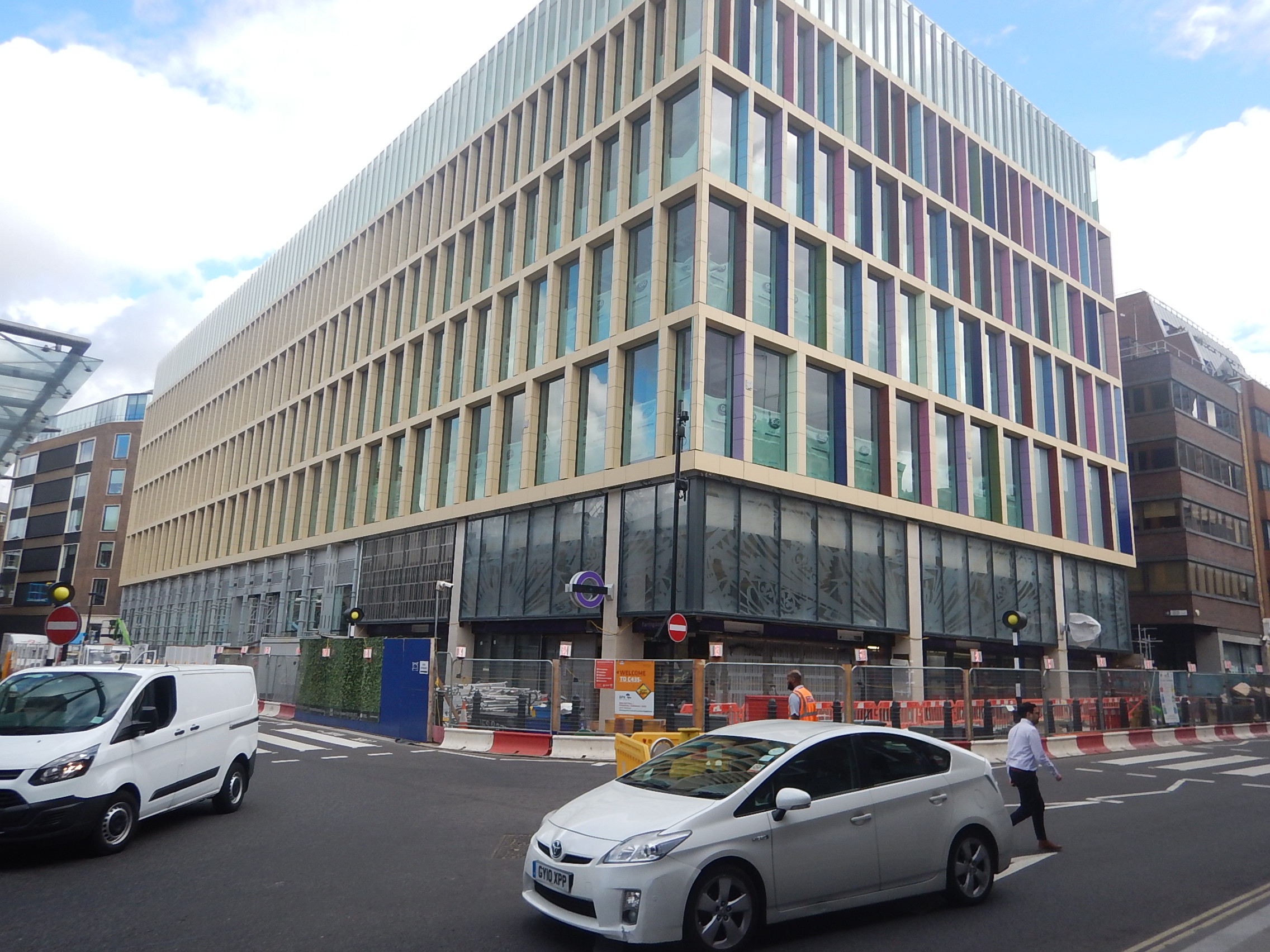
The picture shows Farrington station’s Eastern entrance, with a new development on top.
This one wasn’t a big one, but it went up in record time.
These buildings are often funded by Sovereign Wealth Funds, who want their buildings finished ASAP and as they have bottomless pockets, they are prepared to pay more to get the builders and tradesmen they need.
And where did they get the workers from? Other projects, including Crossrail.
This problem happened in Aberdeen at the height of the oil boom in the last century.
I also think that Brexit worsened the problem, as workers from mainland EU moved to large projects closer to home, like Stuttgart 21 and the new Berlin Brandenburg airport, that were both very much in trouble and could have been offering premium salaries as well!
The solution would have been to phase developments so that the limited pool of workers was not exhausted.
But that probably wouldn’t have suited the developers and politicians for all sorts of reasons.
- An uncompleted building doesn’t bring in money and jobs.
- Early completion must improve chances of letting the building.
- Delaying the building would probably have meant fewer holidays for politicians in exotic locations.
Hopefully, a comprehensive enquiry into the lateness of Crossrail will provide answers.
High Speed Two
High Speed Two is to my mind a London local project. But only in a secondary way!
- Rebuilding Euston station will improve Underground connections and interchange at Euston and Euston Square stations.
- It is claimed by High Speed Two, that the rebuilt Euston station will create 16000 jobs and 2200 homes.
- High Speed Two will enable massive development at Old Oak Common, with tens of thousands of homes and jobs.
- Old Oak Common station will be a very important rail hub in North-West London.
With seventeen trains per hour (tph) between Euston and Old Oak Common will High Speed Two attract local traffic?
- I suspect High Speed Two between Manchester Airport and Manchester Piccadilly and between Birmingham Interchange and Birmingham Curzon Street will also attract local traffic.
- I’ve used TGVs between Nice and Antibes.
- Tourists might visit, just like they did and still do at the Olympic Park.
- Many Londoners will join High Speed Two at Old Oak Common.
Some wag will suggest putting it on the Tube Map. But is it such a stupid idea?
Where Does London Need More Rail Services?
Having lived in London on and off for over seventy years, I feel the worst areas for rail links are probably.
- North West London
- South East London
- South Central London between Wimbledon and Croydon.
- South West London
Note.
- Over the years, there is no doubt that East and North London have improved considerably, with the development of the East London, North London and Gospel Oak to Barking Lines.
- Thameslink has been improved in North London and now it is being supported with improvements to the Northern City Line. Both routes now have new Siemens trains, which give a whole new dimension to using ironing-boards as seats.
- Crossrail will produce major improvements in West, East and South East London.
- Building of a new Penge Interchange station, which I wrote about in Penge Interchange could improve routes to and from South East London.
- Hopefully the work in recent years at Waterloo will improve suburban services out of Waterloo. In An Analysis Of Waterloo Suburban Services Proposed To Move To Crossrail 2, I showed that four tph could be run to Chessington South, Epsom, Hampton Court and Shepperton stations.
It looks like North West and South Central London are missing out.
How Can Services Be Improved In North West London?
There are radial routes from the centre of London to the suburbs.
Starting from the North and going to the West, there are the following lines.
- The High Barnet branch of the Northern Line
- The Mill Hill East branch of the Northern Line
- The Midland Main Line to St. Albans, Luton, Bedford and the East Midlands.
- The Edgware branch of the Northern Line
- The Jubilee Line to Stanmore
- The West Coast Main Line to Watford, Milton Keynes, the West Midlands, the North West of England and West Scotland.
- The Bakerloo Line to Harrow & Wealdstone.
- The Watford DC Line of the London Overground
- The Amersham, Chesham and Watford branches of the Metropolitan Line
- The Chiltern Route to Aylesbury.
- The Chiltern Main Line to High Wycombe, Banbury, Bicester, Birmingham and Oxford.
- The West Ruislip branch of the Central Line.
- The Uxbridge branch of the Metropolitan and Piccadilly Lines
When I used to live at Cockfosters as a child, to visit my many cousins in North West London, there was no alternative but to use a bus and take well over an hour each way.
There are now some circular rail routes in London but nothing in the North West of the capital.
The Dudding Hill Line And The West London Orbital Railway
But there is the little-used freight route called Dudding Hill Line.
- It runs between Cricklewood on the Midland Main Line and Acton Central on the North London Line.
- It is four miles of double-track railway.
This YouTube video shows a cab ride from Acton to Cricklewood.
Plans exist to turn it into the West London Orbital Railway, which will run two services.
- West Hampstead and Hounslow via Cricklewood, Neasden, Harlesden, Old Oak Common Lane, Acton Central, South Acton, Lionel Road, Brentford, Syon Lane and Isleworth
- Hendon and Kew Bridge via Brent Cross West, Neasden, Harlesden, Old Oak Common Lane, Acton Central, South Acton
Note.
- The proposed frequency of both services is four tph.
- There would be some stations to be built, but the track exists.
- There would be no new tunnels.
- The route is technically feasible.
- The route would connect West London to High Speed Two.
- There would be little disruption whilst it was built.
- The services could be run by dual-voltage battery-electric trains charged on the electrification at both ends of the route.
- The scheme represents a high value for money, with a benefit-cost ratio (BCR) of 2.2.
On the other hand, the scheme has two serious problems, as far as the current London Mayor is concerned.
- Transport for London has no money, partly because of London’s Fare Freeze.
- The project is not in South London.
This important and value-for-money project will not be built, whilst Sadiq Khan is still Mayor of London.
Harlesden Interchange
I believe that if we get the interchanges right on the West London Orbital Railway correct we can do things like.
- Increase the benefit cost ratio.
- Link the route to South London to make the Mayor a bit happier about the North London Scheme.
This Google Map shows Harlesden station.
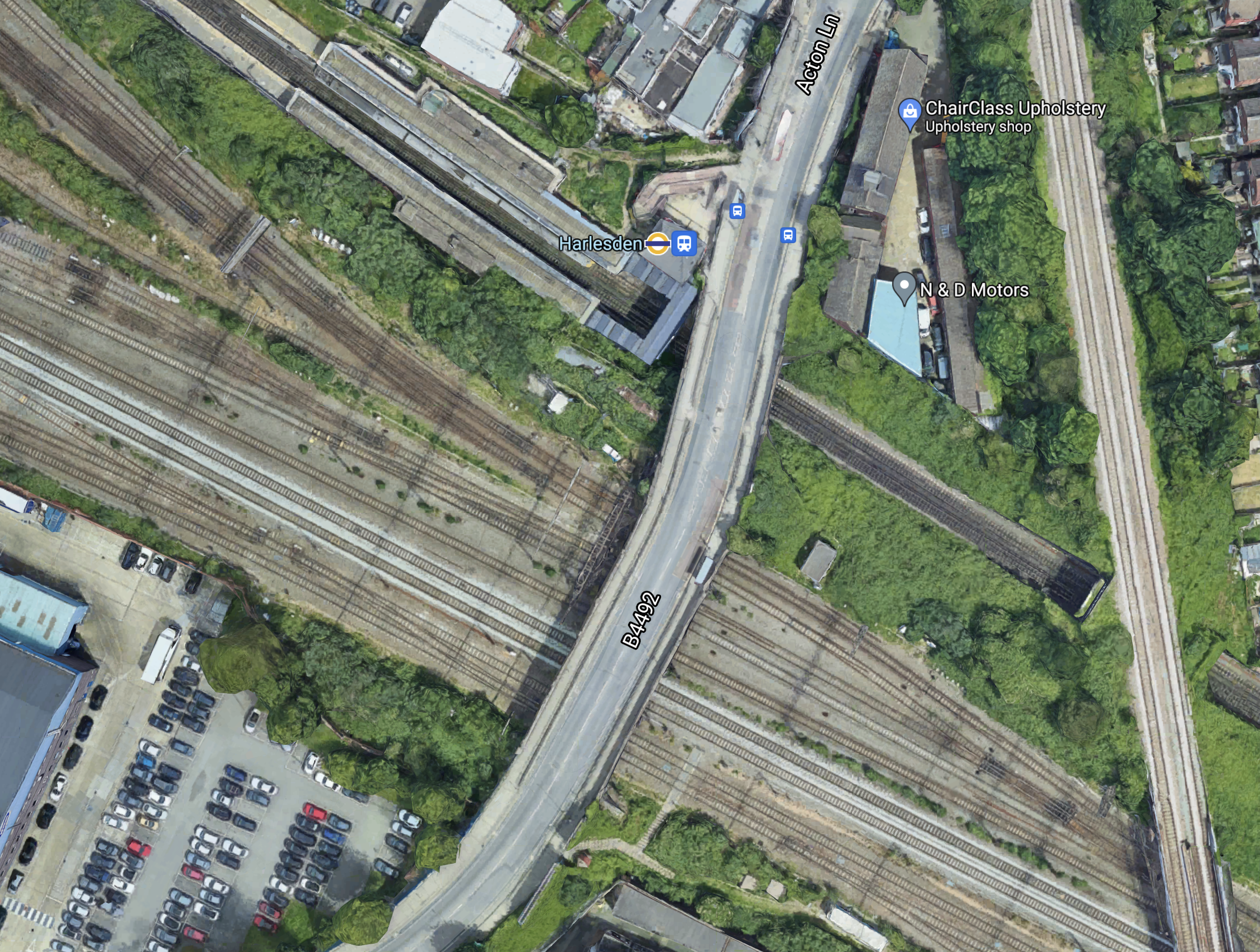
Note.
- The Bakerloo Line/Watford DC Line running North-West/South-East through Harlesden station.
- The West Coast Main Line in the Southern section of the map.
- The Dudding Hill Line running North-South across the map.
Platforms will be built on the Dudding Hill Line to connect that would probably be new or extended platforms in the current Harlesden station to enable interchange between the West London Orbital and the Watford DC Lines.
I also think there is a possibility that platforms could be added to the slow tracks of the West Coast Main Line, so that suburban services into London Euston can also connect to the West London Orbital Line.
It would also enable a connection between Southern’s Clapham Junction and Milton Keynes service and the West London Orbital Railway.
Looking at this from various angles, I think that an architect good at designing three-dimensional structures could develop a quality Harlesden Interchange station.
Neasden Interchange
Like Harlesden, Neasden is another possibility for a comprehensive interchange.
This Google Map shows Neasden station.
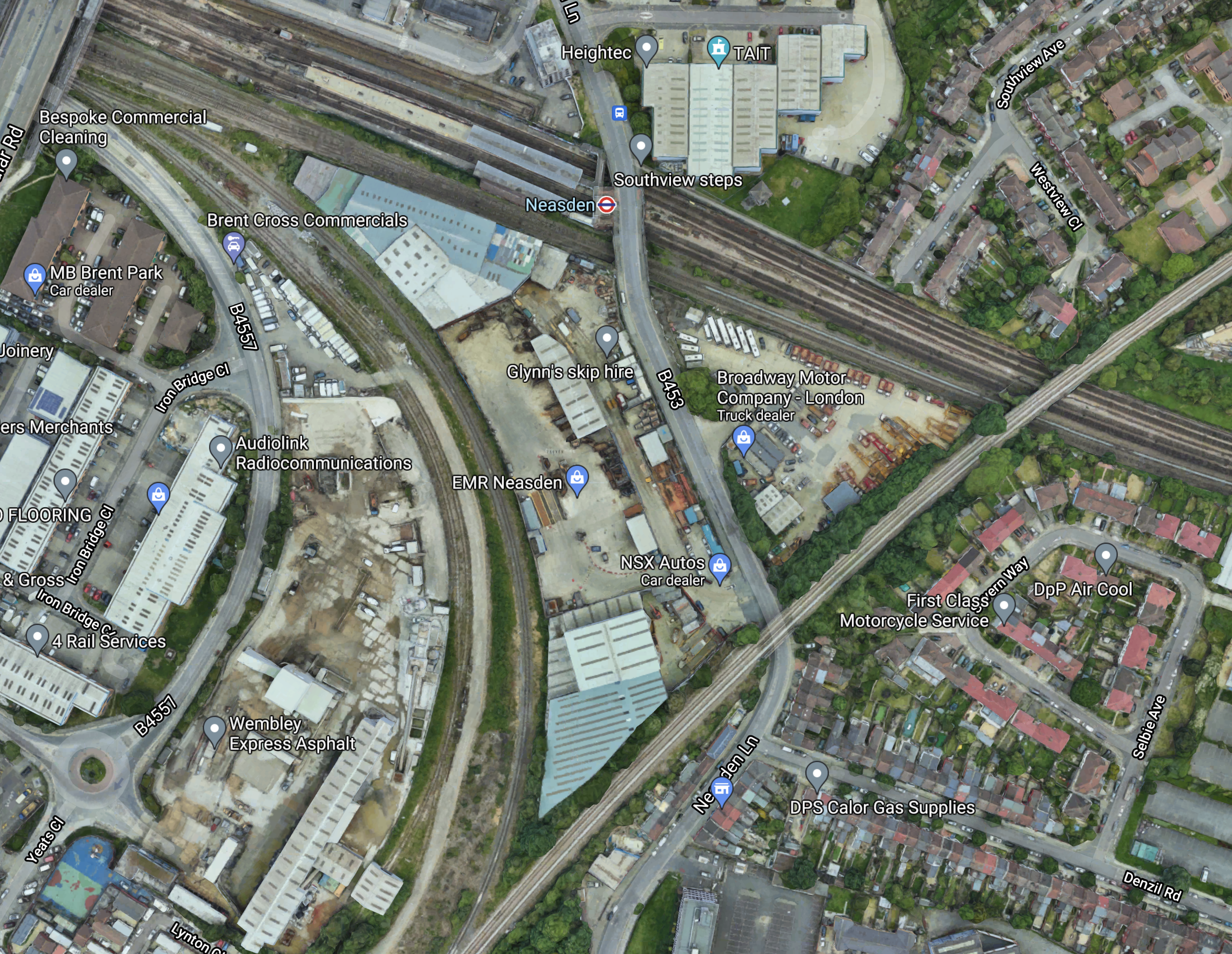
Note.
- There are a lot of lines going through Neasden station.
- The Dudding Hill Line goes across the South-East corner of the map.
- There is plenty of space in the area.
This map from cartometro.com shows the lines in the area.
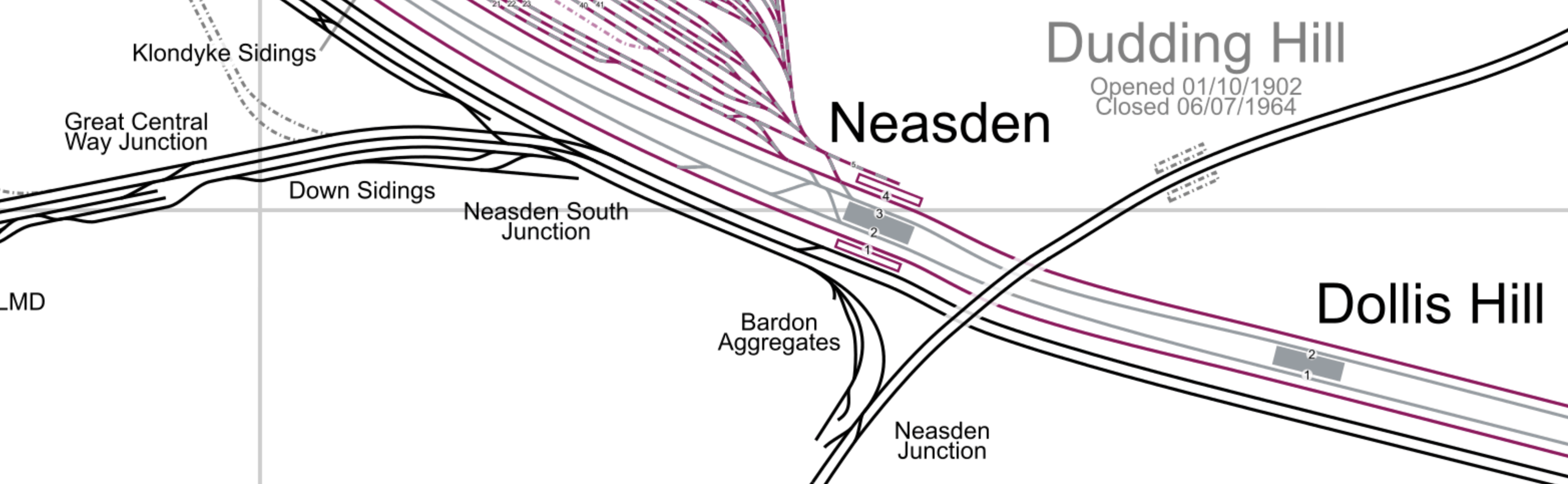
Note.
- The Dudding Hill Line is indicated by the former Dudding Hill station.
- The red tracks are Metropolitan Line tracks.
- The silver tracks are Jubilee Line tracks.
- The Southerly pair of lines through Neasden and Dollis Hill stations are Chiltern’s lines into Marylebone.
- The Chiltern tracks divide to the West of Neasden station, with the Aylesbury line following the other tracks and the Chiltern Main Line diverging to the West.
- London’s largest Underground Depot at Neasden, lies to the North-West in an area of London noted for few merits with the North Circular Road passing through.
I wonder, if the station and the depot offers a unique opportunity to offer large scale additions to London’s housing stock over the top of a rebuilt station and depot.
This Google Map shows the wider area.
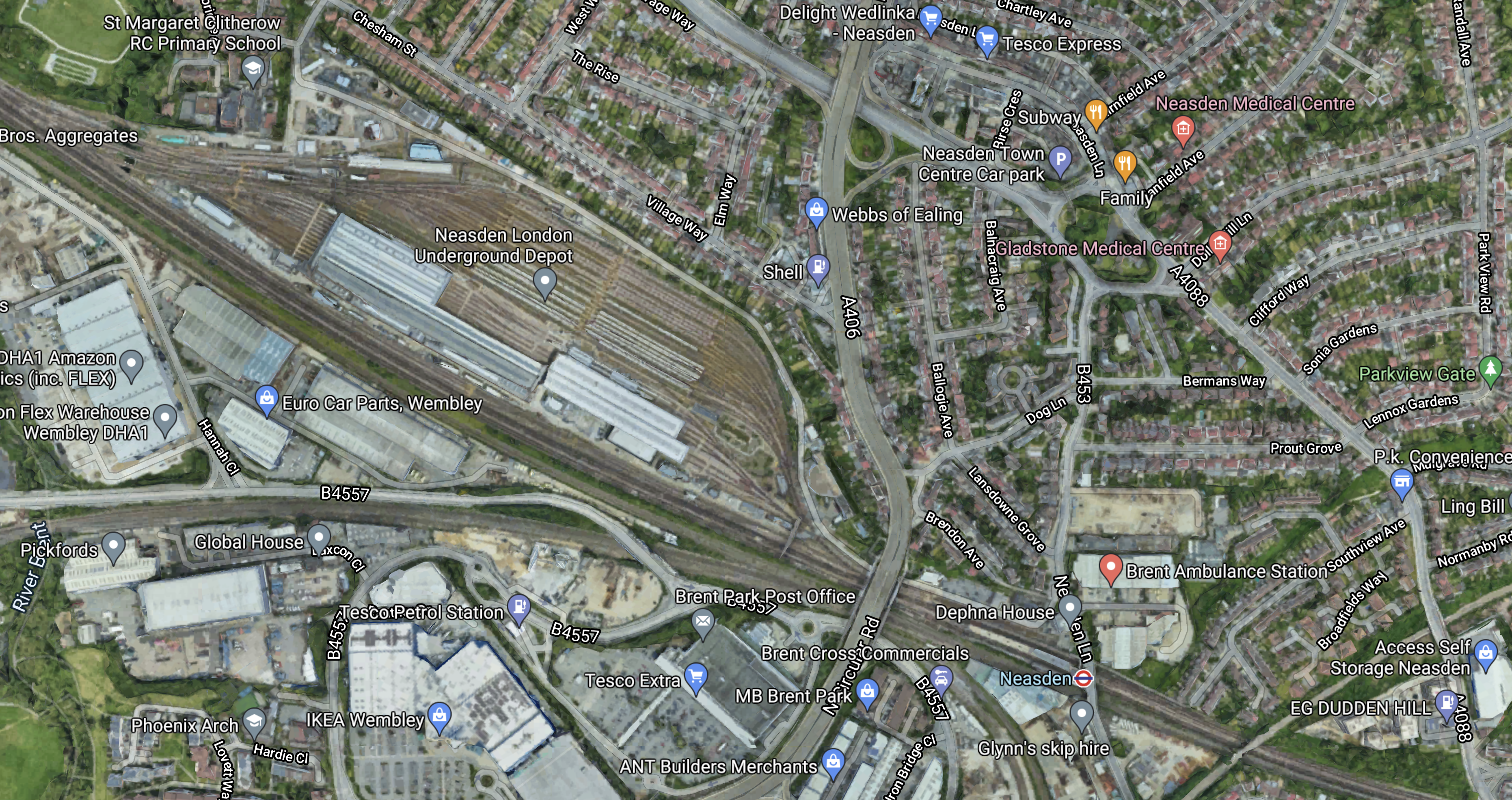
Note.
- Much of the depot appears to be open-air stabling for trains.
- The North Circular Road passes North-South between the depot and Neasden station.
- The Dudding Hill Line cuts across the South-East corner of the map.
- This corner of the map is labelled as Dudden Hill.
- According to Wikipedia, Dudding Hill is considered a more genteel spelling of Dudden Hill and could be as old as 1544.
It looks as if it would be relatively easy to develop over the top of the depot to create housing, industrial or commercial properties.
But why stop there and cover both the North Circular Road and the six tracks through Neasden station?
Neasden station could be rebuilt into a station with platforms on the following lines.
- Metropolitan Line
- Jubilee Line
- Chiltern Lines
- Dudding Hill Lines
Note.
- I estimate that Chiltern has a train about every six minutes, so some could stop.
- There might be space for a bay platform for Chiltern.
Neasden could be a major housing and transport hub.
- There could be large amounts of parking.
- Road access would be good.
- It would have good rail connections.
- It could have a bus interchange.
- London needs housing.
It might even be an alternative to Chiltern’s plan for a West Hampstead Interchange.
The Mayor of London, Transport for London and the Borough of Brent need to be bold!
Improvements To Chiltern’s Routes
Chiltern Railways have some plans that could improve services in North West London.
Using The Acton-Northolt Line
Wikipedia says this about using the Acton-Northolt Line to access new platforms at Old Oak Common station.
Upgrading the Acton–Northolt line (formerly the “New North Main Line”) to new platforms at Old Oak Common. This upgrade will also extend to London Paddington to increase capacity on the Chiltern Main Line as there is no room to expand the station at Marylebone.
This scheme has merit.
- The platforms would be connected to the Chiltern Main Line along the route of a partly-disused railway.
- The route could be double-tracked.
- There must be space for at least two new platforms.
- The new platforms could easily handle four tph.
- There may be a case for some new stations.
The scheme could add valuable extra capacity for Chiltern.
A Chiltern Metro
Wikipedia says this about a proposed metro service between Marylebone and West Ruislip stations.
- The Metro would have a frequency of four tph.
- It would call at Wembley Stadium, Sudbury & Harrow Road, Sudbury Hill Harrow, Northolt Park and South Ruislip.
- The service would require a reversing facility at West Ruislip.
- There would need to be passing loops at Sudbury Hill Harrow, and Wembley Stadium.
Given that the Chiltern Metro was first proposed over a decade ago, perhaps the concept could be increased in scope.
- Housing and other developments along the route may suggest that a station further out like High Wycombe might be a better terminal.
- ERTMS in-cab digital signalling is likely to be installed at some time, which would decrease headways between trains and allow more services.
- Electrification is likely in some form before 2040 and this will improve train performance.
- If Neasden station were to be rebuilt, as a comprehensive transport and residential development, I believe that this Metro service should also call at Neasden, as it would complement the West London Orbital Railway.
I believe that a review of the Chiltern Metro may mean, that an improved version is worth building.
Improvements To The Milton Keynes And Clapham Junction Service
I feel that this service could be key in improving services between North London and South London via the West London Line and High Speed Two’s station at Old Oak Common.
Currently, this service is as follows.
- It runs between Milton Keynes and Clapham Junction stations.
- It has a frequency of one tph.
- It calls at Bletchley, Leighton Buzzard, Tring, Berkhamsted, Hemel Hempstead, Watford Junction, Harrow & Wealdstone, Wembley Central, Shepherd’s Bush, Kensington (Olympia), West Brompton and Imperial Wharf stations.
- The service used to extend to South Croydon via Wandsworth Common, Balham, Streatham Common, Norbury, Thornton Heath, Selhurst and East Croydon.
- It uses Class 377 trains.
- It shares parts of the route with the London Overground.
I also think it has various issues and questions with respect to the future.
- The Class 377 trains are only 100 mph units, whereas the outer suburban trains on the West Coast Main Line are 110 mph Class 350 trains, which will soon be replaced by 110 mph Class 730 trains. Do the slower trains cause timetabling problems?
- Is one tph enough?
- The route doesn’t serve High Speed Two at Old Oak Common station.
- Is the service run by the right operator?
- What is the ideal Southern terminal?
These are my thoughts on the various issues.
The Service As A North-South Link
A friend, who lives in South London has told me, that if you go to an event at Wembley stadium the route is busy.
On the other hand, I’ve used it at midday on a Tuesday and found the trains empty.
But developed properly it could connect the following.
- Milton Keynes Central
- Bletchley for the East West Rail Link
- Watford for the West Coast Main Line to the North
- Wembley Central for Wembley Stadium and other entertainments
- Willesden Junction for the North London Line
- Hythe Road for High Speed Two, Crossrail and the Great Western Railway
- Shepherd’s Bush for the shopping.
- Clapham Junction for most of South London and the South of England
It would be a very useful cross-London route to complement Thameslink and the East London Line.
The Frequency
The current Milton Keynes and Clapham Junction has a frequency of one tph.
This may be enough for some parts of the route, as other services also provide services.
But many would argue, that perhaps South of Watford Junction, the service needs to be increased to connect the area to Old Oak Common and Clapham Junction.
I feel that High Speed Two, Crossrail and the Great Western Railway give so much connectivity, that between Clapham Junction and Willesden Junction needs a frequency of at least eight tph.
As the North London Line and the Watford DC Line are working at a frequency of four tph, this could indicate that a four tph direct service Watford Junction and Clapham Junction be ideal. Perhaps, it could continue North to Milton Keynes with a frequency of two tph.
The Trains
I am absolutely certain, that the full service needs to be operated by dual voltage trains, that are capable of running at 110 mph.
The Class 350/1 trains of West Midlands Trains would probably be ideal for the full service.
- They are dual voltage trains.
- They are 110 mph trains.
- They have a long distance interior.
They are being replaced with new Class 730 trains, so would be available.
If some services were running only as far North as Watford Junction, these could be either Class 378 or Class 710 trains of the London Overground.
The Connection To The West London Line And High Speed Two
This map from Wikipedia by Cnbrb shows the latest iteration of the lines at Old Oak Common station.
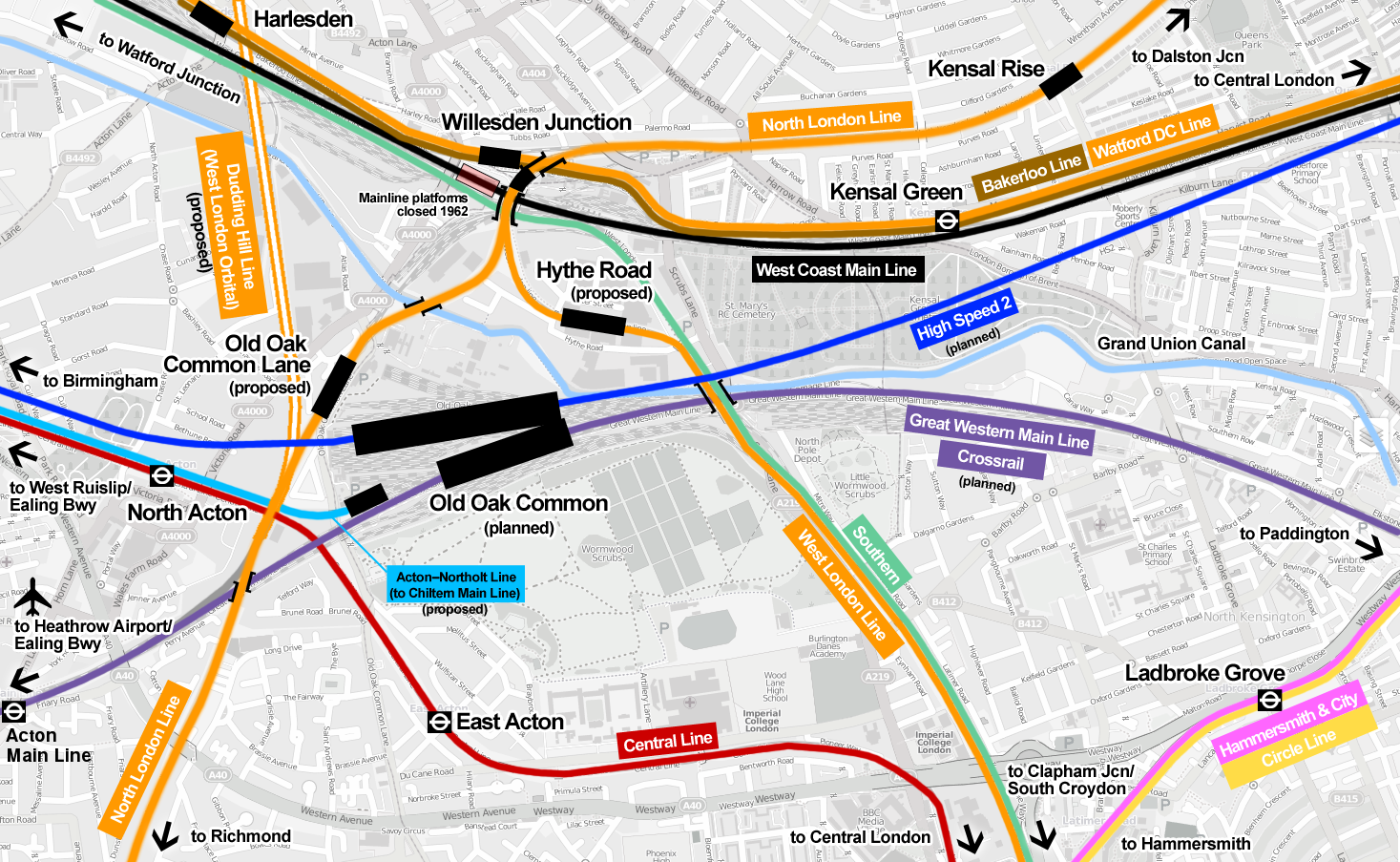
Note.
- The green route is taken by the Milton Keynes and Clapham Junction trains.
- The bright blue is High Speed Two.
- The purple is Crossrail.
- The orange is the Overground
- Hythe Road station is proposed for the West London Line to connect to Old Oak Common station for High Speed Two.
- Hythe Road station will have a bay platform to turn trains from the South.
- Old Oak Common Lane station is proposed for the North London Line to connect to Old Oak Common station for High Speed Two.
But where is the connection between the Milton Keynes and Clapham Junction service and Old Oak Common station for High Speed Two?
- Access from the South is not a problem as the Overground can be used to Hythe Road station.
- Extra services from the South can be run to and from the bay platform at Hythe Road station.
- Access from the East is not a problem as the Overground can be used to Hythe Road station.
- How do passengers go between say Wembley Central and Heathrow?
In addition for access from the West is the Overground can be used to Old Oak Common Lane station.
But as things stand at the moment the Milton Keynes and Clapham Junction service bypasses Hythe Road station and the only ways to go from Milton Keynes to Old Oak Common station for either High Speed Two, Crossrail or the Great Western is to do one of the following.
- Change to the Watford DC Line at Watford Junction, Harrow & Wealdstone or Wembley Central and then change to the Overground at Willesden Junction for either Old Oak Common Lane or Hythe Road station.
- Continue South to Shepherd’s Bush station, cross over to the other platform and then come back to Hythe Road station.
- Go via Euston station. OK for High Speed Two, but not for Crossrail or the Great Western.
They cannot be serious!
I hope that there is a cunning plan to enable the Milton Keynes and Clapham Junction service to connect.
Whilst on the subject of connections at Old Oak Common, where is the promised connection of Crossrail to the West Coast Main Line?
Were all these connections just kicked into the long grass and quietly forgotten, as they were deemed too difficult and/or expensive?
I think serious questions need to be asked about the design of Crossrail and High Speed Two at Old Oak Common.
Why weren’t Crossrail and High Speed Two designed to connect directly to the London Overground at Willesden Junction station perhaps by the use of a North South people mover serving the following lines?
- Bakerloo, Watford DC, West Coast Main and West London Orbital Lines at a rebuilt Harlesden station.
- London Overground at the high-level Willesden Junction station.
- High Speed Two
- Crossrail and the Great Western Railway
- The new Chiltern platforms.
- Central Line at East Acton station.
Note.
- Hythe Road and Old Oak Common stations would not be needed.
- The Milton Keynes and Clapham Junction service would call additionally at the rebuilt Harlesden station.
The current design of Old Oak Common stinks like a horse designed by a committee!
The Northern Terminal
I suggested earlier that some trains use Watford Junction and others use Milton Keynes Central.
Both stations have the capacity and the connectivity.
The Southern Terminal
In the last ten years, South Croydon, East Croydon and Clapham Junction have been used as the Southern terminal.
Thameslink seems to have chosen its various terminals to satisfaction of the travelling public, so perhaps the same method or personnel should be used.
The Operator
The Gibb Report said that this service should be transferred to the London Overground and I wrote about this proposal in Gibb Report – East Croydon – Milton Keynes Route Should Be Transferred To London Overground.
This is one suggestion, but I do wonder, if it should be transferred to West Midlands Trains and run in conjunction with their West Coast Main Line services.
- The service needs 110 mph trains.
- Timetabling and operation should be easier.
- London Overground trains don’t have a long-distance interior.
On the other hand, trains running between Watford Junction and Clapham Junction would probably be better if they were London Overground trains.
Conclusion
I believe that by using the current network and some modern trains and signalling, the passenger services to the West of the capital can be substantially improved.
Bring Africa Out Of The Dark
The title of this post, is the same as that of this article on the Zimbabwean.
The article has been written by Humphrey Kariuki, who is a Kenyan businessman, who is on a mission to bring electricity to Africa.
He has teamed up with Highview Power to do it using batteries.
Read the article.
Alternative Energy Storage Technologies To Challenge Electrochemistry
The title of this post, is the same as that of this article on Battery and Energy Storage Magazine.
It gives a good summary of two energy storage system; Highview Power and Gravitricity, that I rate highly promising.
It also gives details of a Danish system called Stiesdal Storage Technologies, which is developing a hot rocks energy storage system.
The article says this about the system.
The pumped-heat ESS uses pea-sized crushed basalt, rock in insulated steel tanks with the stored energy released by turbine.
SST CEO Peder Riis Nickelsen said: “The cost of crushed stone is at a totally different level per unit of energy than practically any other material for energy storage. Our charging and discharging system can utilise well-known technologies that have been applied for a century within other industries and are well-suited for mass production.”
The cost of materials is estimated to be €10 ($12) per kWh.
The first demonstration project, a 1-2MW, 24h capacity unit, will be installed at a power plant in Denmark next year, and will operate commercially.
This page on the Striesdal web site, explains the technology.
It sounds like the system uses very similar principles to Siemens Gamesa ETES, with a different heat storage medium.
Conclusion
At my last count, there now appears to be upwards of half-a-dozen viable alternatives to chemical batteries and traditional pumped storage. Some of the technologies are also backed, by large companies, organisations and countries, who can afford to take a long-term view.
I hope those, who claim that renewables will never power the world, have at least got the recipe for the cooking of humble pie ready.
Gigawatt-Scale Compressed Air: World’s Largest Non-Hydro Energy-Storage Projects Announced
The title of this post, is the same as that of this article on Recharge.
This is the opening paragraph.
The two 500MW/5GWh ‘advanced’ compressed-air projects in California would each be bigger than the current record holder.
They are certainly not small. On the Electric Mountain scale of energy storage, they are both 55 %.
Both appear to be from Canadian company; Hydrostor and will be built in California.
This explanatory video is from the company.
It appears to be a rather elegant solution.
Like Highview Power, the system appears to be based on proven process technology, is zero-carbon, can be built almost anywhere and doesn’t require large amounts of land.
Hydrostor is definitely one to watch.
My only worry about both Hydrostor and Highview systems, is that countries, who don’t recognise patents and design copyrights could develop other systems based on similar physical principles.
Wizz Air Plans Cheaper Fares As Capacity Grows
The title of this post, is the same as that of this article on The Times.
This is the introductory paragraph.
One of Europe’s leading budget airlines is forecasting a sharp drop in the price of fares as it expects to increase the number of flights this summer to as much as 80 per cent of normal capacity.
That sounds fair to me, as it’s just supply and demand.
I’ve only ever flown Wizz Air once and that was from Liverpool to Gdansk, where I had a memorable couple of days, before taking the train home to London.
I would certainly rate them better than Ryanair.
The article intrigued me.
It said that Wizz Air had made a large loss but had raised a sum to more than cover it on the bond market.
So I looked up their fleet on Wikipedia.
- A 320-200 – 66
- A 320 neo – 6
- A 321-200 – 41
- A 321 neo – 23 – Deliveries until 2026
- A 321 XLR – 20 – Deliveries from 2023 to 2026
In 2026, Wizz Air will end up with forty-nine neo aircraft and how many of the 107 older ones, they want to keep.
Under Environmental Protection on the Wikipedia entry for Wizz Air, this is said.
One year later, in November 2020, among the European airlines, Wizz Air was able to show the lowest CO2 emissions per passenger / kilometre and underlined their commitment to further reducing their environmental footprint. As part of their strategy, all fuel-saving flight phases of take-off and landing are continuously monitored for maximum environmental optimization, which has a significant impact on further continuous reductions in CO2 emissions.
I would assume, that this means, they take carbon emissions seriously.
When I saw these fleet sizes and put them together with Wizz Air, I wondered if Airbus have offered the airline a route to decarbonisation by converting the neo aircraft to hydrogen. I believe this is possible and said so in Could An A320 neo Be Rebuilt As A ZEROe Turbofan?
These fleet sizes don’t rule it out and if there was a way to remanufacture later A 320s to hydrogen aircraft, it would be a good way to continue to sell aircraft.
Does Harlow Need An Improved Train Service?
I ask this question, because I am increasingly seeing articles like this one on My London, which is entitled The Large Town Just Outside London Desperate For A London Underground Station.
The town is Harlow.
This Google Map shows the West Anglia Main Line, as it runs through the North of the town.
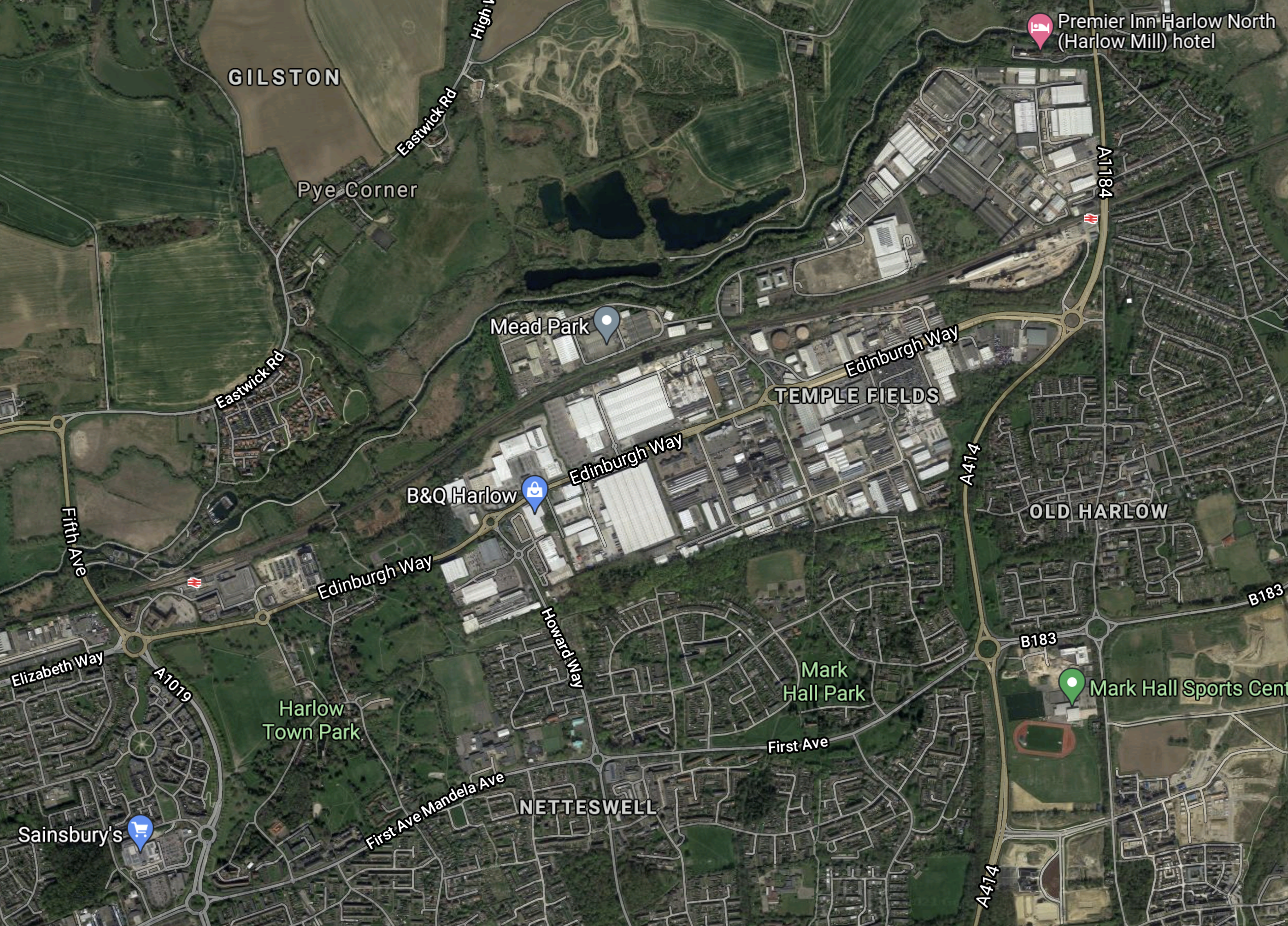
Note.
- Harlow Town station towards the South West of the map.
- Harlow Mill station towards the North East of the map.
- The West Anglia Main Line running between the two stations.
On the face of it the town seems well-served by the trains.
Harlow Town Station
This Google Map shows Harlow Town station to a larger scale.
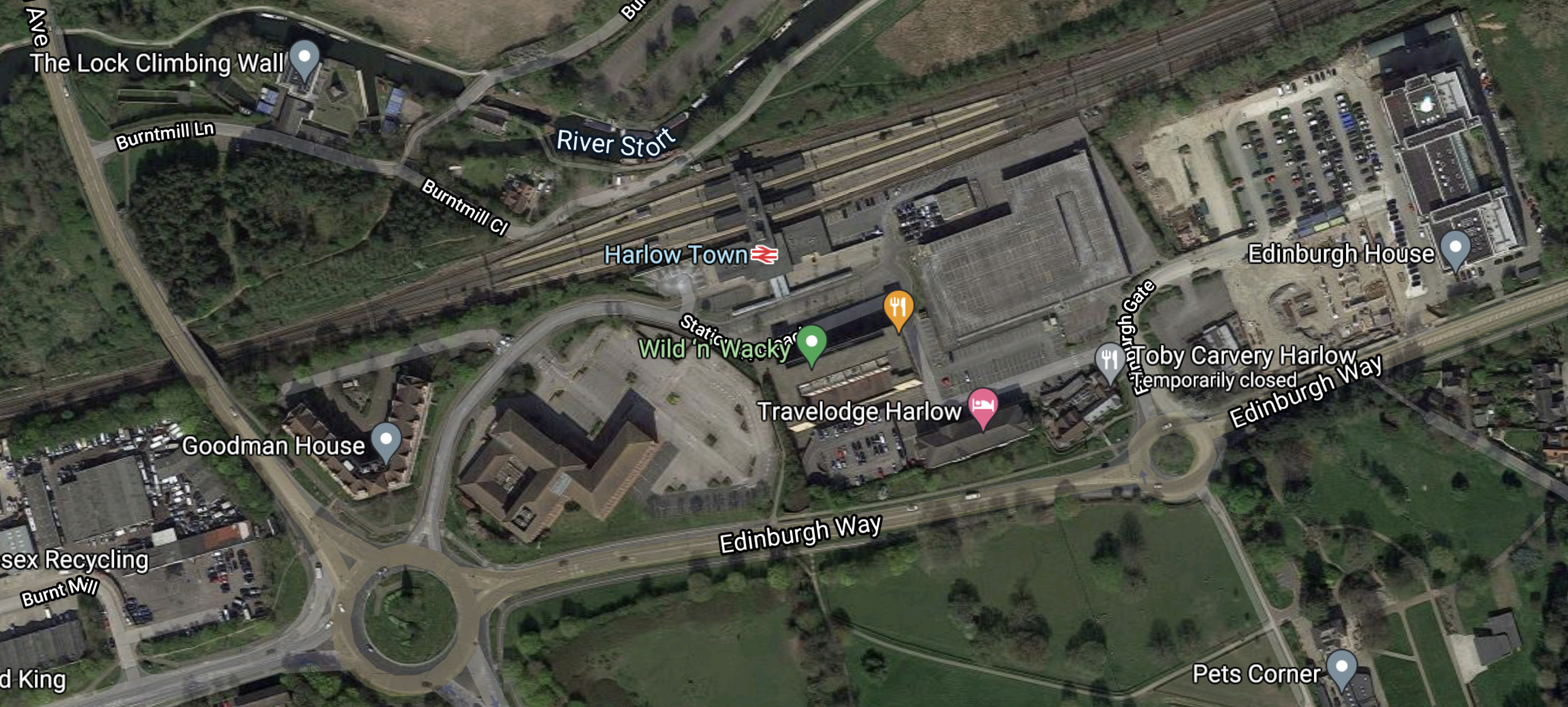
Note.
- The station has four platforms.
- The station has full step-free access.
- The station has 697 parking spaces with 18 fully accessible spaces.
The station was built in the 1950s and is a Grade II Listed building.
Train services at the station are as follows.
- Stratford and Bishops Stortford – 2 tph – via Lea Bridge, Tottenham Hale, Waltham Cross, Cheshunt, Broxbourne and Sawbridgeworth
- London Liverpool Street and Cambridge North – 1 tph – via Tottenham Hale, Cheshunt, Broxbourne, Bishop’s Stortford, Audley End, Whittlesford Parkway and Cambridge
- London Liverpool Street and Cambridge North – 1 tph – via Tottenham Hale, Cheshunt, Broxbourne, Roydon, Sawbridgeworth, Bishop’s Stortford, Stansted Mountfitchet, Elsenham, Newport, Audley End, Great Chesterford, Whittlesford Parkway, Shelford and Cambridge
- London Liverpool Street and Stansted Airport – 1 tph – via Tottenham Hale
- London Liverpool Street and Stansted Airport – 1 tph – via Tottenham Hale and Stansted Mountfitchet
Note.
- tph is trains per hour
- The Stansted services are fast services and take 29 minutes between London Liverpool Street and Harlow Town.
- The other services seem to take a few minutes longer.
- London Liverpool Street or Stratford and Tottenham Hale both get six tph.
- Bishop’s Stortford gets a four tph service from Harlow Town.
- The two Cambridge stations only get two tph.
Harlow Town station has a fairly good service, but it could probably be improved.
Harlow Mill Station
This Google Map shows Harlow Mill station to a larger scale.
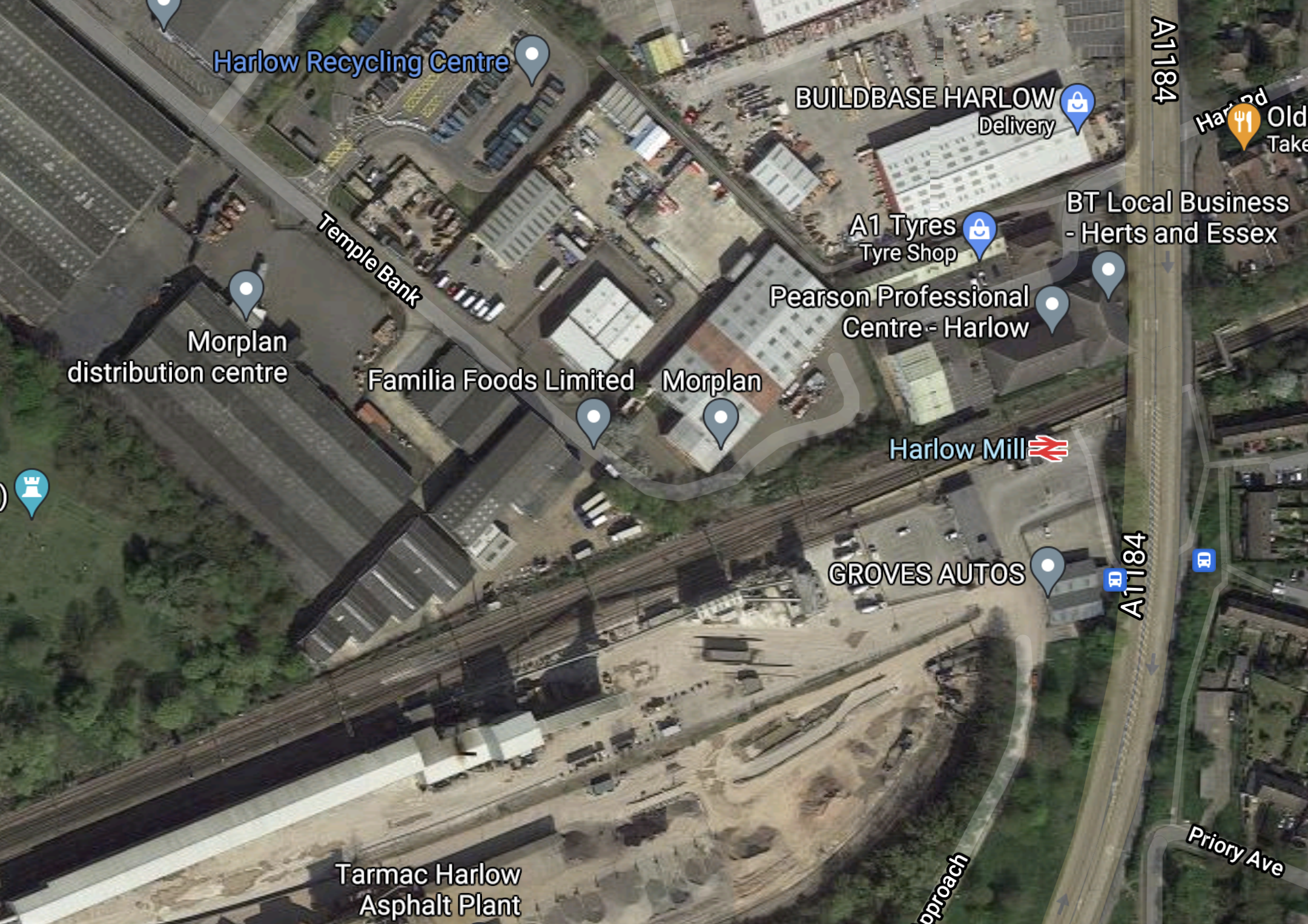
Note.
- The station has two platforms.
- The station has step-free access to the London-bound platform only.
- The station has 29 parking spaces with 1 fully accessible space.
The station was built in the 1840s and gets about 13 % of the passengers compared to Harlow Town station.
Train services at the station are as follows.
- Stratford and Bishops Stortford – 1 tph – via Lea Bridge, Tottenham Hale, Waltham Cross, Cheshunt, Broxbourne and Sawbridgeworth
- London Liverpool Street and Cambridge North – 1 tph – via Tottenham Hale, Cheshunt, Broxbourne, Roydon, Sawbridgeworth, Bishop’s Stortford, Stansted Mountfitchet, Elsenham, Newport, Audley End, Great Chesterford, Whittlesford Parkway, Shelford and Cambridge
Note.
- tph is trains per hour
- London Liverpool Street or Stratford and Tottenham Hale both get only two tph.
- Bishop’s Stortford gets two tph service from Harlow Mill.
- The two Cambridge stations only get one tph.
Unless you lived or worked nearby, I doubt you would be likely to use Harlow Mill station.
Recent And Planned Improvements
These improvements are planned and it is very unlikely they won’t happen.
Class 710 Trains
London Overground now runs new four-car Class 710 trains between London Liverpool Street and Cheshunt.
- Each has 189 seats and can accept 489 standing passengers.
- Busy services to Cheshunt will probably are pair of trains.
- There are four tph between Cheshunt and London.
- Will the trains shave a few minutes from journey times?
This massive increase in capacity and train quality must attract some passengers to change to and from the London Overground at Cheshunt.
Class 720 Trains
Greater Anglia has 133 new five-car Class 720 trains on order.
- Each has 540 seats and can accept 145 standing passengers.
- They are 100 mph trains.
- Busy services through Harlow will probably be a pair of these trains.
These new trains will be a massive increase in capacity and should attract more passengers to the route.
Class 745 Trains
Greater Anglia has recently introduced ten new twelve-car Class 745 trains on Stansted Express services.
- Each has 767 seats.
- They are 100 mph trains.
- They run a two tph service between Harlow Town and London Liverpool Street station and Stansted Airport.
These new trains should attract more passengers to the route.
Crossrail
Services through Harlow will connect to Crossrail at both London Liverpool Street and Stratford.
Will this mean that some passengers will switch from the Victoria Line to Crossrail for their onward journeys?
- Crossrail will have more capacity than the Victoria Line.
- Bond Street, Canary Wharf, Heathrow, Paddington and West London will be easier by Crossrail.
- Victoria and Waterloo will probably be easier by the Victoria Line.
- London Liverpool Street station’s new connection to the Northern Line will give easier access to parts of South London.
- London Liverpool Street station will have much improved step-free connections to all London Underground lines.
Crossrail will certainly change the way many people travel between Harlow and London.
Four Lines Modernisation
This page on the Transport for London web site explains the Four Lines Modernisation. This is the first paragraph.
We’re transforming the Circle, District, Hammersmith & City and Metropolitan lines. When the work is done we’ll be able to run trains more frequently and reliably to make journeys faster and more comfortable.
The project should increase Peak Hour capacity by 33 %.
This will benefit those who change trains at London Liverpool Street between the West Anglia Main Line and the Circle and Metropolitan Lines.
Possible Improvements
These are possible improvements that may happen.
Crossrail 2
It is unlikely, that a start will be made on Crossrail 2 in the near future.
Victoria Line Improvements
The Victoria Line will continue to do, what it has done reliability for over fifty years.
But there could be improvements.
- Walthamstow Central station will have an additional step-free entrance.
- Highbury and Islington station will become a full step-free station.
- Oxford Circus station will be expanded and become a full step-free station.
I also suspect that engineers will find a way to increase the frequency to forty tph.
Four Tracks On The West Anglia Main Line
There are two reasons for four-tracking sections of the West Anglia Main Line.
- To separate Crossrail 2 trains from fast expresses to Stansted and Cambridge.
- To speed up services to and from Stansted Airport.
However four-tracking the route between Tottenham Hale and Broxbourne stations would probably be very beneficial.
- Stansted Airport and Cambridge services could be speeded up.
- Extra services could be run on the West Anglia Main Line.
- It could make it easier to extend the Overground from Cheshunt.
Four-tracking will be needed for Crossrail 2, so there is surely the possibility, that it could be done earlier to bring benefits to those living along the Lea Valley.
ERTMS Signalling On The West Anglia Main Line
ERTMS Signalling could speed up services and increase their number on the West Anglia Main Line.
It might also enable four-tracking, which would be very disruptive to both train services and road traffic to be delayed.
Station Improvements On The West Anglia Main Line
The stations between London Liverpool Street and Cambridge are a poor bunch with only Tottenham Hale, Northumberland Park, Meridian Water, Waltham Cross, Broxbourne, Harlow Town, Bishop’s Stortford and Audley End having full step-free access.
Some of the other stations need refurbishment and step-free access.
As step-free access will be needed for Crossrail 2, why not setup a rolling program of station improvements.
Level Crossings On The West Anglia Main Line
There are four level crossings on the route to the South of Broxbourne, including three at Cheshunt, Enfield Lock and Brimsdown stations.
They all need to be removed for safety reasons.
New Trains And Capacity
The new trains being rolled out by Greater Anglia and the London Overground will certainly have effects on the services on the West Anglia Main Line.
- The better performance could speed up services by a few minutes.
- The capacity increase on the new trains should be welcome.
- The trains will be of better quality than those they replace.
I also wonder, if the better quality of the trains and their facilities will surely attract more passengers. I suspect the train companies hope so!
Extending The London Overground
This map from cartometro.com shows Cheshunt station and Cheshunt Junction just to the South.
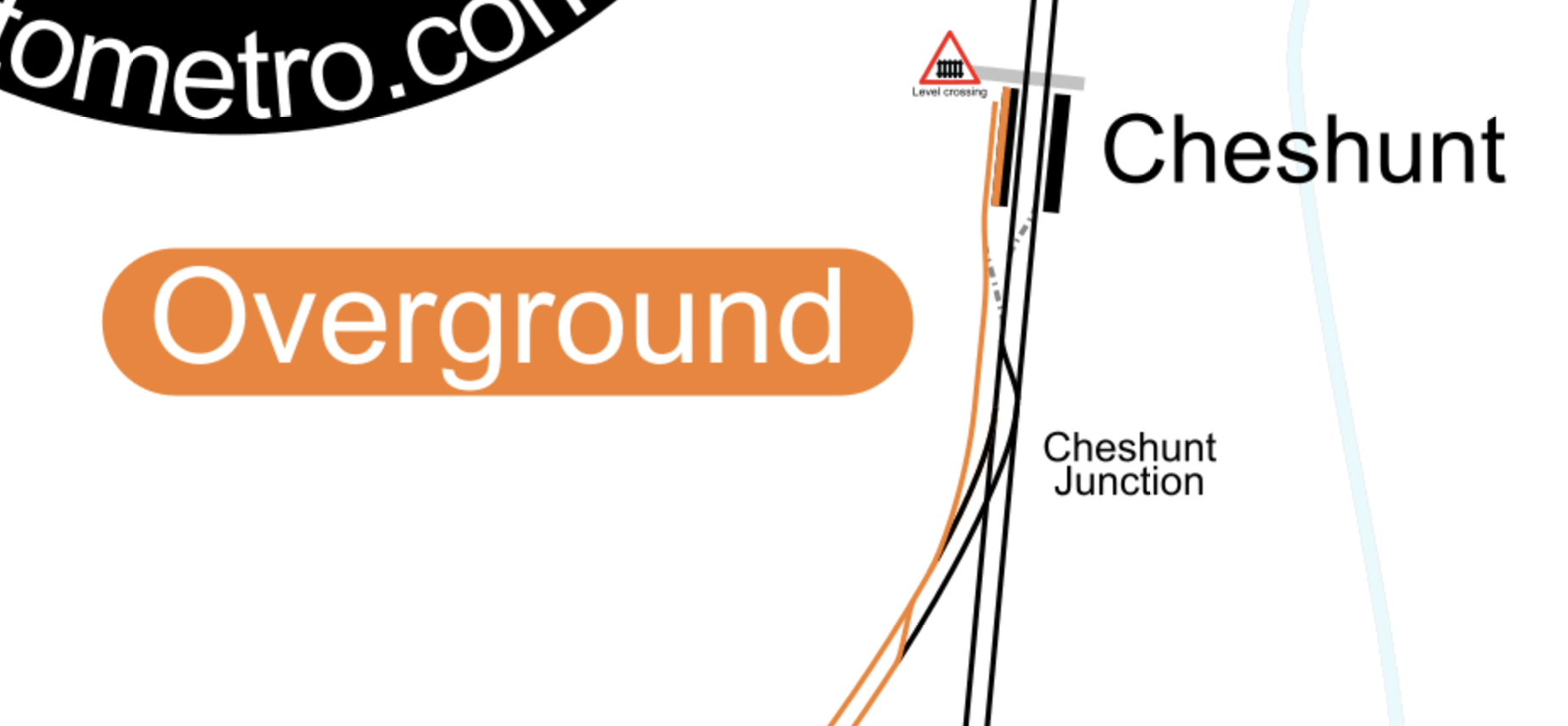
Note.
- The two platforms on the West Anglia Main Line and the single bay platform for the London Overground.
- The level crossing to the North of Cheshunt station.
- The comprehensive Cheshunt Junction which trains to go between the Southbury Loop and the West Anglia Main Line.
Cheshunt Junction is occasionally used by Greater Anglia trains to access the Southbury Loop.
It certainly seems to me, that the Overground could connect to the West Anglia Main Line.
- All trains from London going to the North of Cheshunt could use Platform 2.
- All trains to London coming from the North of Cheshunt could use Platform 1.
- The bay Platform 3 would still be available to turn local trains on the Southbury Loop.
- An extra crossover could probably be inserted to allow trains from London on the West Anglia Main Line to use Platform 3.
London Overground trains could run to a terminal further North.
Trains Between Cheshunt And London
It is worth looking at the number of trains between Cheshunt and London.
- Greater Anglia -2 tph – London Liverpool Street and Hertford East via West Anglia Main Line
- Greater Anglia – 2 tph – Stratford and Bishop’s Stortford via West Anglia Main Line
- Greater Anglia – 2 tph – London Liverpool Street and Cambridge North via West Anglia Main Line
- Greater Anglia – 4 tph – London Liverpool Street and Stansted Airport via West Anglia Main Line
- London Overground – 4 tph – London Liverpool Street and Cheshunt via the Southbury Loop
This means that the West Anglia Main Line has 10 tph and the Southbury Loop has 4 tph.
This suggests possibilities.
- Move some services from the West Anglia Main Line to the Southbury Loop.
- Extend some or all of the London Overground trains to the North of Cheshunt.
- Stations like Bishop’s Stortford, Broxbourne, Harlow, Hertford East and Ware could get extra services to London.
- The new services would connect to extra stations without changing trains.
Very little new infrastructure would be required.
Bishop’s Stortford Station As A London Overground Destination
Bishop’s Stortford station has these trains to and from London.
- Greater Anglia – 2 tph – Stratford and Bishop’s Stortford
- Greater Anglia – 2 tph – London Liverpool Street and Cambridge North
- Greater Anglia – 2 tph – London Liverpool Street and Stansted Airport
Consider.
- Bishop’s Stortford station could probably easily handle up to an extra two tph.
- London Overground’s Class 710 trains only have an operating speed of only 75 mph.
- The trains may need a speed upgrade to serve Bishop’s Stortford, as their speed could slow the Cambridge and Stansted Airport expresses.
If the London Overground services ran to Bishop’s Stortford station, all the smaller stations South of Bishop’s Stortford, could travel to and from Stansted Airport with a single change.
Bishop’s Stortford station may be a possibility, as a destination of two tph on the London Overground route to London.
Broxbourne Station As A London Overground Destination
Broxbourne station has these trains to and from London.
- Greater Anglia -2 tph – London Liverpool Street and Hertford East
- Greater Anglia – 2 tph – Stratford and Bishop’s Stortford
- Greater Anglia – 2 tph – London Liverpool Street and Cambridge North
Consider.
- Broxbourne station could probably easily handle up to an extra two tph.
- As Broxbourne is only 3.2 miles and six minutes to the North of Cheshunt, the 75 mph speed of the London Overground’s Class 710 trains may not be a problem.
Broxbourne station may be a possibility, as a destination of up to two tph on the London Overground route to London.
Harlow Town Station As A London Overground Destination
Harlow Town station has these trains to and from London.
- Greater Anglia – 2 tph – Stratford and Bishop’s Stortford
- Greater Anglia – 2 tph – London Liverpool Street and Cambridge North
- Greater Anglia – 2 tph – London Liverpool Street and Stansted Airport
Consider.
- Harlow Town station could probably easilyhandle up to an extra four tph.
- If one is needed there would appear to be space for a turnback facility or an extra platform.
- As Harlow Town is only 5.4 miles and eight minutes to the North of Cheshunt, the 75 mph speed of the London Overground’s Class 710 trains may not be a problem.
If the London Overground services ran to Harlow Town station, all the smaller stations South of Harlow Town, could travel to and from Stansted Airport with a single change.
Harlow Town station may be a possibility, as a destination of up to four tph on the London Overground route to London.
Hertford East Station As A London Overground Destination
Hertford East station has these trains to and from London.
- Greater Anglia -2 tph – London Liverpool Street and Hertford East
- There is an extra tph in the Peak.
Consider.
- Hertford East station has platforms long enough for eight-car trains and may need modification to accommodate a pair of Greater Anglia’s Class 720 trains.
- Ware station would need to be remodelled to increase frequency above three tph.
- As the route from Broxbourne is on a branch line, the 75 mph speed of the London Overground’s Class 710 trains may not be a problem.
Hertford East station may be a possibility, as a destination of up to two tph on the London Overground route to London.
Conclusion
I think the best two destinations of the London Overground service to the North of Cheshunt would be Harlow and Hertford East.
- Trains could terminate at Harlow Town station to connect with Stansted Express and Cambridge trains.
- It appears that the slightly shorter Class 710 trains may have advantages when using the short platforms at Hertford East station.
Perhaps each destination should receive two tph.
- Harlow Town would be connected to the Overground.
- Passengers using stations between Hackney Downs and Cheshunt on the Southbury Loop would change at Harlow Town to and from Cambridge and Stansted Airport.
- But the biggest benefit would be that two paths on the West Anglia Main Line would be released, as the two tph to Hertford East would be using the Southbury Loop.
I feel there are possibilities to increase the number of trains on the West Anglia Main Line without adding expensive extra tracks.
Form Energy Discloses A Small Amount
Form Energy has been a bit mysterious, but this article on Energy Storage News, which is entitled Renewables As Baseload Energy: Form Energy’s Multi-Day |Storage Seeks To Replace Gas And Coal.
Form Energy certainly have large ambitions, backing from organisations like Bill Gates’ Breakthrough Energy Ventures and an order for a 1 MW/150 MWh pilot for Great River Energy in Minnesota, and I suspect this is probably enough to ensure success in the mid-size market sector, which they share with the UK’s Highview Power, who are building their first grid-scale 50 MW/ 250 MWh at Carrington to the South of Manchester.
The article is certainly an interesting insight into one of the new energy storage ventures.
A Tasteful Lift Installation In A Listed Tube Station
These pictures show Cockfosters station a couple of years ago and recently.







Note.
- There are two similar entrances on either side of the busy Cockfosters Road.
- Both have wide staircases down to the platform level.
- There is a subway between the two entrances.
- There is also a level light-controlled crossing across Cockfosters Road for those who need to cross the road.
- The station was designed by Charles Holden.
- The station opened in 1933.
The station is a Grade II Listed Building, which could have made designing a lift system tricky.
This Google Map shows the station layout.
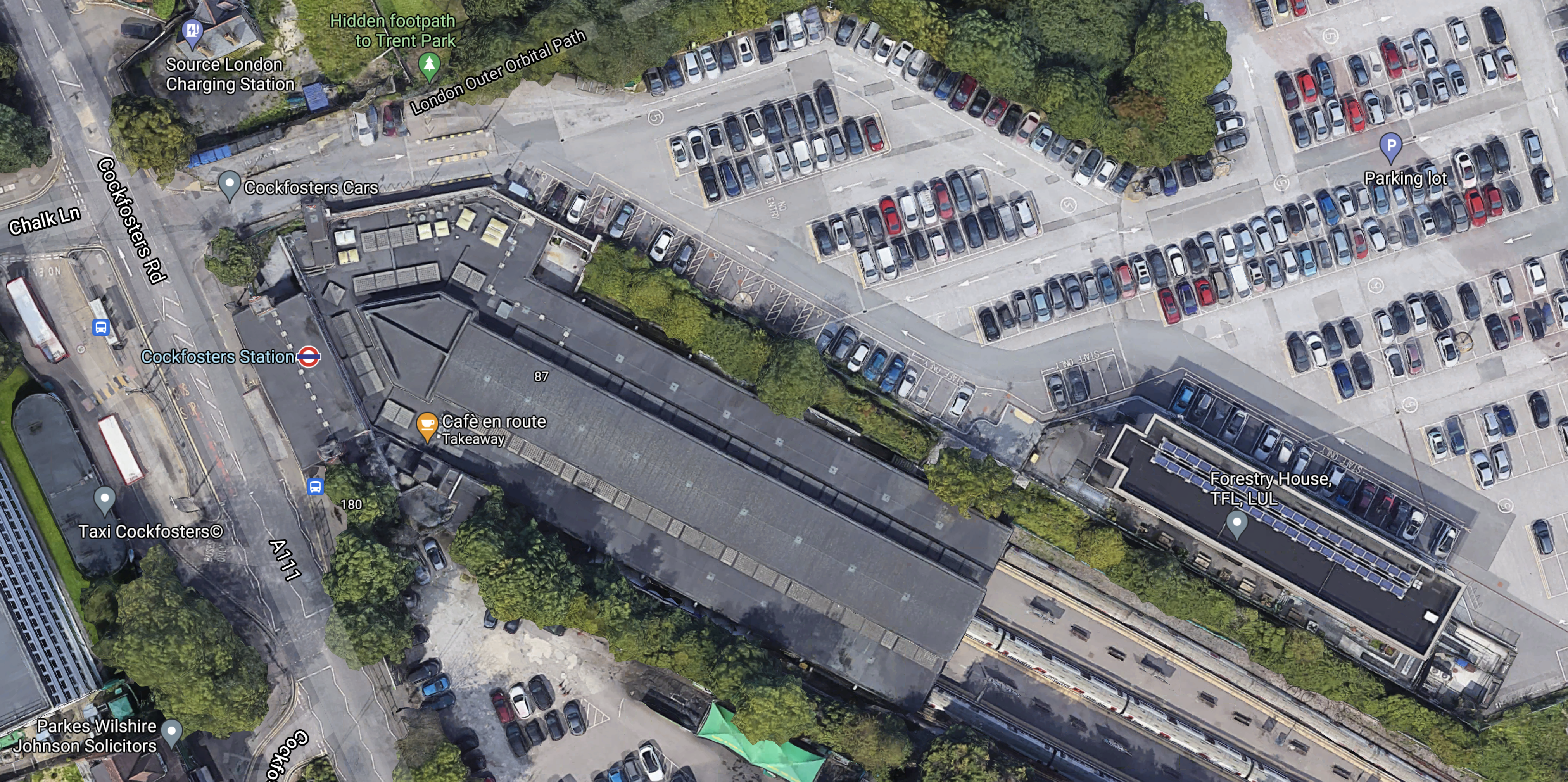
Note.
- Cockfosters Road at the West of the map.
- The white roofs of the buses, indicate, that there is a small bus station at the Western entrance to the station.
- The London Transport roundel indicates the Eastern entrance to the station.
- There are two trains in the four platforms of the station.
- There is a large level car park.
- Transport for London have a small office block in the car park.
- The London Orbital Path and a hidden path to Trent Park can be accessed from the entrance to the station car park.
It is a well-equipped terminal station.
Transport for London could have opted for a double lift installation with one lift on either side of the road.
But they have opted for a single lift at the Eastern side of the station.
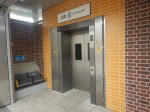
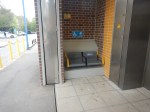
I took these pictures of the new lift.


Note.
- The first picture shows the lift in the corner of the station ticket hall and lobby.
- From the lift to the trains is a level walk or push.
- The second picture shows the surface installation in the car park.
- The lift is positioned by the two walking routes and conveniently for anybody being dropped off or picked up by car.
- The light-controlled crossing is perhaps fifty metres away to give access to both sides of Cockfosters Road.
- The third picture shows a close-up of the lift.
- The fourth picture shows a seat, for those who need to wait.
It is a very simple and well-thought out installation.
 The Anonymous Widower