High-Speed Low-Carbon Transport Between Great Britain And Ireland
Consider.
- According to Statista, there were 13,160,000 passengers between the United Kingdom and the Irish Republic in 2019.
- In 2019, Dublin Airport handled 32,907,673 passengers.
- The six busiest routes from Dublin were Heathrow, Stansted, Amsterdam, Manchester, Birmingham and Stansted.
- In 2018, Belfast International Airport handled 6,269,025 passengers.
- The four busiest routes from Belfast International Airport were Stansted, Gatwick. Liverpool and Manchester, with the busiest route to Europe to Alicante.
- In 2018, Belfast City Airport handled 2,445,529 passengers.
- The four busiest routes from Belfast City Airport were Heathrow, Manchester, Birmingham and London City.
Note.
- The busiest routes at each airport are shown in descending order.
- There is a lot of air passengers between the two islands.
- Much of the traffic is geared towards London’s four main airports.
- Manchester and Liverpool get their fair share.
Decarbonisation of the air routes between the two islands will not be a trivial operation.
But technology is on the side of decarbonisation.
Class 805 Trains
Avanti West Coast have ordered thirteen bi-mode Class 805 trains, which will replace the diesel Class 221 trains currently working between London Euston and Holyhead.
- They will run at 125 mph between Euston and Crewe using electric power.
- If full in-cab digital signalling were to be installed on the electrified portion of the route, they may be able to run at 140 mph in places under the wires.
- They will use diesel power on the North Wales Coast Line to reach Holyhead.
- According to an article in Modern Railways, the Class 805 trains could be fitted with batteries.
I wouldn’t be surprised that when they are delivered, they are a version of the Hitachi’s Intercity Tri-Mode Battery Train, the specification of which is shown in this Hitachi infographic.

Note.
- I suspect that the batteries will be used to handle regenerative braking on lines without electrification, which will save diesel fuel and carbon emissions.
- The trains accelerate faster, than those they replace.
- The claimed fuel and carbon saving is twenty percent.
It is intended that these trains will be introduced next year.
I believe that, these trains will speed up services between London Euston and Holyhead.
- Currently, services take just over three-and-a-half hours.
- There should be time savings on the electrification between London Euston and Crewe.
- The operating speed on the North Wales Coast Line is 90 mph. This might be increased in sections.
- Some extra electrification could be added, between say Crewe and Chester and possibly through Llandudno Junction.
- I estimate that on the full journey, the trains could reduce emissions by up to sixty percent compared to the current diesel trains.
I think that a time of three hours could be achievable with the Class 805 trains.
New trains and a three hour journey time should attract more passengers to the route.
Holyhead
In Holyhead Hydrogen Hub Planned For Wales, I wrote about how the Port of Holyhead was becoming a hydrogen hub, in common with several other ports around the UK including Felixstowe, Harwich, Liverpool and Portsmouth.
Holyhead and the others could host zero-carbon hydrogen-powered ferries.
But this extract from the Wikipedia hints at work needed to be done to create a fast interchange between trains and ferries.
There is access to the port via a building shared with Holyhead railway station, which is served by the North Wales Coast Line to Chester and London Euston. The walk between trains and ferry check in is less than two minutes, but longer from the remote platform 1, used by Avanti West Coast services.
This Google Map shows the Port of Holyhead.

I think there is a lot of potential to create an excellent interchange.
HSC Francisco
I am using the high-speed craft Francisco as an example of the way these ships are progressing.
- Power comes from two gas-turbine engines, that run on liquified natural gas.
- It can carry 1024 passengers and 150 cars.
- It has a top speed of 58 knots or 67 mph. Not bad for a ship with a tonnage of over 7000.
This ship is in service between Buenos Aires and Montevideo.
Note.
- A craft like this could be designed to run on zero-carbon liquid hydrogen or liquid ammonia.
- A high speed craft already runs between Dublin and Holyhead taking one hour and forty-nine minutes for the sixty-seven miles.
Other routes for a specially designed high speed craft might be.
- Barrow and Belfast – 113 miles
- Heysham and Belfast – 127 miles
- Holyhead and Belfast – 103 miles
- Liverpool and Belfast – 145 miles
- Stranraer and Larne – 31 miles
Belfast looks a bit far from England, but Holyhead and Belfast could be a possibility.
London And Dublin Via Holyhead
I believe this route is definitely a possibility.
- In a few years, with a few improvements on the route, I suspect that London Euston and Holyhead could be fairly close to three hours.
- With faster bi-mode trains, Manchester Airport and Holyhead would be under three hours.
- I would estimate, that a high speed craft built for the route could be under two hours between Holyhead and Dublin.
It certainly looks like London Euston and Dublin and Manchester Airport and Dublin would be under five hours.
In A Glimpse Of 2035, I imagined what it would be like to be on the first train between London and Dublin via the proposed fixed link between Scotland and Northern Ireland.
- I felt that five-and-a-half hours was achievable for that journey.
- The journey would have used High Speed Two to Wigan North Western.
- I also stated that with improvements, London and Belfast could be three hours and Dublin would be an hour more.
So five hours between London Euston and Dublin using current technology without massive improvements and new lines could be small change well spent.
London And Belfast Via Holyhead
At 103 miles the ferry leg may be too long for even the fastest of the high speed craft, but if say the craft could do Holyhead and Belfast in two-and-a-half hours, it might just be a viable route.
- It might also be possible to run the ferries to a harbour like Warrenpoint, which would be eighty-six miles.
- An estimate based on the current high speed craft to Dublin, indicates a time of around two hours and twenty minutes.
It could be viable, if there was a fast connection between Warrenpoint and Belfast.
Conclusion
Once the new trains are running between London Euston and Holyhead, I would expect that an Irish entrepreneur will be looking to develop a fast train and ferry service between England and Wales, and the island of Ireland.
It could be sold, as the Greenest Way To Ireland.
Class 807 Trains
Avanti West Coast have ordered ten electric Class 807 trains, which will replace some of the diesel Class 221 trains.
- They will run at 125 mph between Euston and Liverpool on the fully-electrified route.
- If full in-cab digital signalling were to be installed on the route, they may be able to run at 140 mph in places.
- These trains appear to be the first of the second generation of Hitachi trains and they seem to be built for speed and a sparking performance,
- These trains will run at a frequency of two trains per hour (tph) between London and Liverpool Lime Street.
- Alternate trains will stop at Liverpool South Parkway station.
In Will Avanti West Coast’s New Trains Be Able To Achieve London Euston and Liverpool Lime Street In Two Hours?, I came to the conclusion, that a two-hour journey time was possible, when the new Class 807 trains have entered service.
London And Belfast Via Liverpool And A Ferry
Consider.
- An hour on the train to and from London will be saved compared to Holyhead.
- The ferry terminal is in Birkenhead on the other side of the Mersey and change between Lime Street station and the ferry could take much longer than at Holyhead.
- Birkenhead and Belfast is twice the distance of Holyhead and Dublin, so even a high speed craft would take three hours.
This Google Map shows the Ferry Terminal and the Birkenhead waterfront.
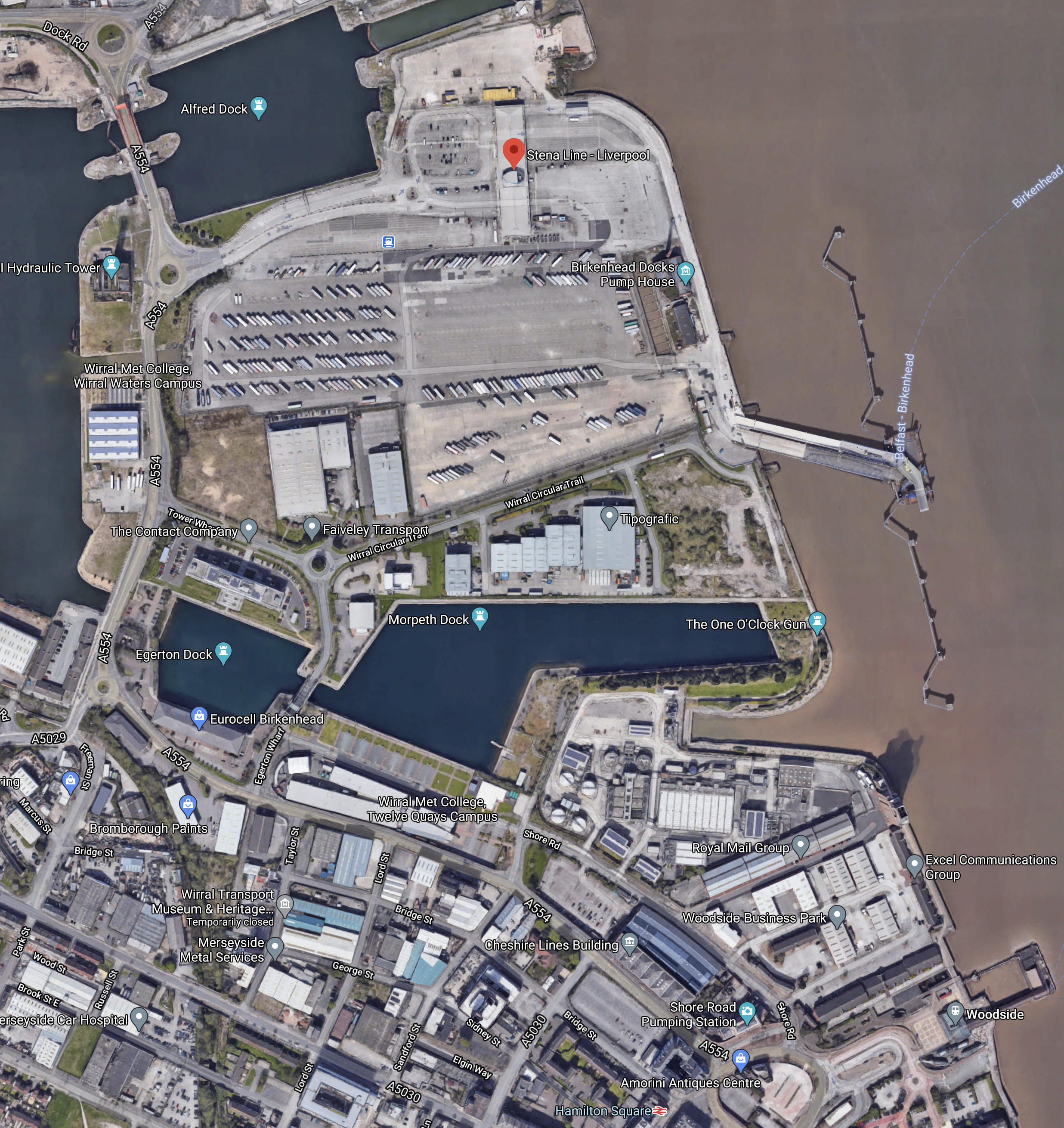
Note.
- The Ferry Terminal is indicated by the red arrow at the top of the map.
- There are rows of trucks waiting for the ferries.
- In the South East corner of the map, the terminal of the Mersey Ferry sticks out into the River
- Hamilton Square station is in-line with the Mersey Ferry at the bottom of the map and indicated with the usual red symbol.
- There is a courtesy bus from Hamilton Square station to the Ferry Terminal for Ireland.
There is a fourteen tph service between Hamilton Square and Liverpool Lime Street station.
This route may be possible, but the interchange could be slow and the ferry leg is challenging.
I don’t think the route would be viable unless a much faster ferry is developed. Does the military have some high speed craft under development?
Conclusion
London and Belfast via Liverpool and a ferry is probably a trip for enthusiasts or those needing to spend a day in Liverpool en route.
Other Ferry Routes
There are other ferry routes.
Heysham And Barrow-in-Furness
,These two ports might be possible, but neither has a good rail connection to London and the South of England.
They are both rail connected, but not to the standard of the connections at Holyhead and Liverpool.
Cairnryan
The Cairnryan route could probably be improved to be an excellent low-carbon route to Glasgow and Central Scotland.
Low-Carbon Flight Between The Islands Of Great Britain And Ireland
I think we’ll gradually see a progression to zero-carbon flight over the next few years.
Sustainable Aviation Fuel
Obviously zero-carbon would be better, but until zero-carbon aircraft are developed, there is always sustainable aviation fuel.
This can be produced from various carbon sources like biowaste or even household rubbish and disposable nappies.
British Airways are involved in a project called Altalto.
- Altalto are building a plant at Immingham to turn household rubbish into sustainable aviation fuel.
- This fuel can be used in jet airliners with very little modification of the aircraft.
I wrote about Altalto in Grant Shapps Announcement On Friday.
Smaller Low-Carbon Airliners
The first low- and zero-carbon airliners to be developed will be smaller with less range, than Boeing 737s and Airbus A 320s. These three are examples of four under development.
- Aura Aero Era – 19 passengers – 500 miles
- Eviation Alice – 9 passengers – 620 miles
- Faradair Aerospace BEHA – 19 passengers – 1150 miles
- Heart Aerospace ES-19 – 19 passengers – 400 km.
I feel that a nineteen seater aircraft with a range of 500 miles will be the first specially designed low- or zero-carbon airliner to be developed.
I believe these aircraft will offer advantages.
- Some routes will only need refuelling at one end.
- Lower noise and pollution.
- Some will have the ability to work from short runways.
- Some will be hybrid electric running on sustainable aviation fuel.
They may enable passenger services to some smaller airports.
Air Routes Between The Islands Of Great Britain And Ireland
These are distances from Belfast City Airport.
- Aberdeen – 228 miles
- Amsterdam – 557 miles
- Birmingham – 226 miles
- Blackpool – 128 miles
- Cardiff – 246 miles
- Edinburgh – 135 miles
- Gatwick – 337 miles
- Glasgow – 103 miles
- Heathrow – 312 miles
- Jersey – 406 miles
- Kirkwall – 320 miles
- Leeds – 177 miles
- Liverpool – 151 miles
- London City – 326 miles
- Manchester – 170 miles
- Newcastle – 168 miles
- Southampton – 315 miles
- Southend – 344 miles
- Stansted – 292 miles
- Sumburgh – 401 miles
Note.
- Some airports on this list do not currently have flights from Belfast City Airport.
- I have included Amsterdam for comparison.
- Distances to Belfast International Airport, which is a few miles to the West of Belfast City Airport are within a few miles of these distances.
It would appear that much of Great Britain is within 500 miles of Belfast City Airport.
These are distances from Dublin Airport.
- Aberdeen – 305 miles
- Amsterdam – 465 miles
- Birmingham – 199 miles
- Blackpool – 133 miles
- Cardiff – 185 miles
- Edinburgh – 208 miles
- Gatwick – 300 miles
- Heathrow – 278 miles
- Jersey – 339 miles
- Kirkwall – 402 miles
- Leeds – 190 miles
- Liverpool – 140 miles
- London City – 296 miles
- Manchester – 163 miles
- Newcastle – 214 miles
- Southampton – 268 miles
- Southend – 319 miles
- Stansted – 315 miles
- Sumburgh – 483 miles
Note.
- Some airports on this list do not currently have flights from Dublin Airport.
- I have included Amsterdam for comparison.
It would appear that much of Great Britain is within 500 miles of Dublin Airport.
I will add a few long routes, that someone might want to fly.
- Cork and Aberdeen – 447 miles
- Derry and Manston – 435 miles
- Manston and Glasgow – 392 miles
- Newquay and Aberdeen – 480 miles
- Norwich and Stornaway – 486 miles.
I doubt there are many possible air services in the UK and Ireland that are longer than 500 miles.
I have a few general thoughts about low- and zero-carbon air services in and around the islands of Great Britain and Ireland.
- The likely five hundred mile range of the first generation of low- and zero-carbon airliners fits the size of the these islands well.
- These aircraft seem to have a cruising speed of between 200 and 250 mph, so flight times will not be unduly long.
- Airports would need to have extra facilities to refuel or recharge these airliners.
- Because of their size, there will need to be more flights on busy routes.
- Routes which are less heavily used may well be developed, as low- or zero-carbon could be good for marketing the route.
I suspect they could be ideal for the development of new routes and even new eco-friendly airports.
Conclusion
I have come to the conclusion, that smaller low- or zero-carbon are a good fit for the islands of Great Britain and Ireland.
But then Flybe and Loganair have shown that you can make money flying smaller planes around these islands with the right planes, airports, strategy and management.
Hydrogen-Powered Planes From Airbus
Hydrogen-powered zero-carbon aircraft could be the future and Airbus have put down a marker as to the way they are thinking.
Airbus have proposed three different ZEROe designs, which are shown in this infographic.

The turboprop and the turbofan will be the type of designs, that could be used around Great Britain and Ireland.
The ZEROe Turboprop
This is Airbus’s summary of the design for the ZEROe Turboprop.
Two hybrid hydrogen turboprop engines, which drive the six bladed propellers, provide thrust. The liquid hydrogen storage and distribution system is located behind the rear pressure bulkhead.
This screen capture taken from the video, shows the plane.
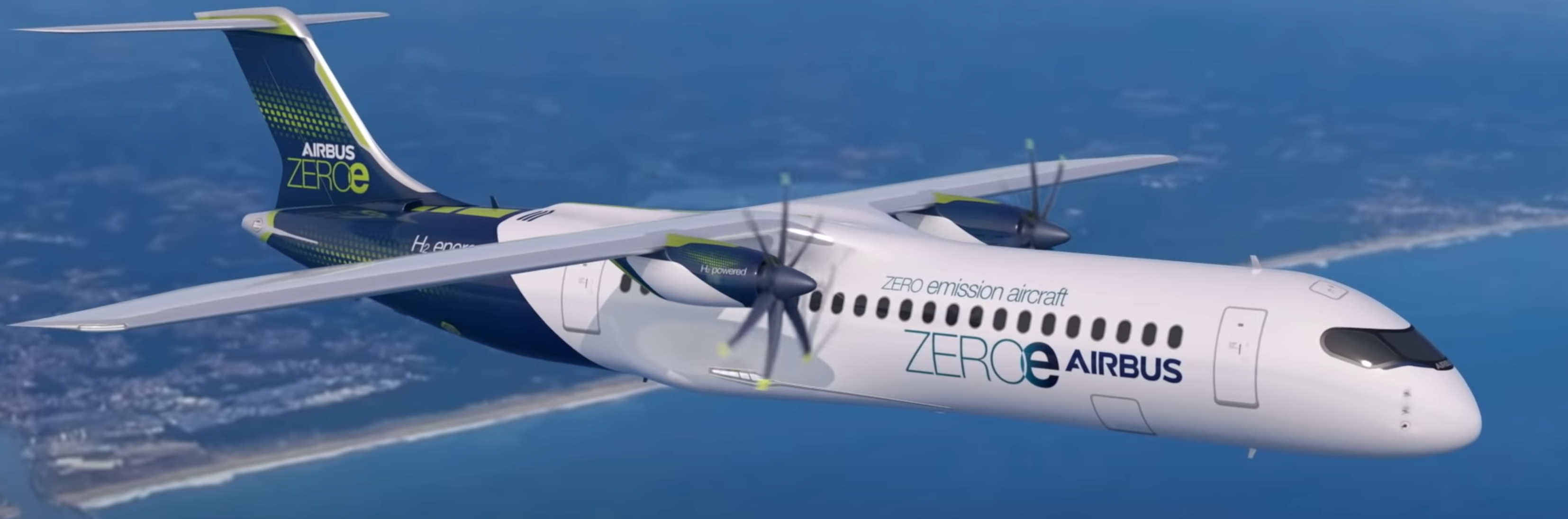
It certainly is a layout that has been used successfully, by many conventionally-powered aircraft in the past. The De Havilland Canada Dash 8 and ATR 72 are still in production.
I don’t think the turboprop engines, that run on hydrogen will be a problem.
If you look at the Lockheed-Martin C 130J Super Hercules, you will see it is powered by four Rolls-Royce AE 2100D3 turboprop engines, that drive 6-bladed Dowty R391 composite constant-speed fully-feathering reversible-pitch propellers.
These Rolls-Royce engines are a development of an Allison design, but they also form the heart of Rolls-Royce’s 2.5 MW Generator, that I wrote about in Our Sustainability Journey. The generator was developed for use in Airbus’s electric flight research program.
I wouldn’t be surprised to find the following.
- , The propulsion system for this aircraft is under test with hydrogen at Derby and Toulouse.
- Dowty are testing propellers suitable for the aircraft.
- Serious research is ongoing to store enough liquid hydrogen in a small tank that fits the design.
Why develop something new, when Rolls-Royce, Dowty and Lockheed have done all the basic design and testing?
This screen capture taken from the video, shows the front view of the plane.

From clues in the picture, I estimate that the fuselage diameter is around four metres. Which is not surprising, as the Airbus A320 has a height of 4.14 metres and a with of 3.95 metres. But it’s certainly larger than the fuselage of an ATR-72.
So is the ZEROe Turboprop based on a shortened Airbus A 320 fuselage?
- The ATR 72 has a capacity of 70 passengers.
- The ZEROe Turboprop has a capacity of less than a hundred passengers.
- An Airbus A320 has six-abreast seating.
- Could the ZEROe Turboprop have sixteen rows of seats, as there are sixteen windows in front of the wing?
- With the seat pitch of an Airbus A 320, which is 81 centimetres, this means just under thirteen metres for the passengers.
- There could be space for a sizeable hydrogen tank in the rear part of the fuselage.
- The plane might even be able to use the latest A 320 cockpit.
It looks to me, that Airbus have designed a larger ATR 72 based on an A 320 fuselage.
I don’t feel there are any great technical challenges in building this aircraft.
- The engines appear to be conventional and could even have been more-or-less fully developed.
- The fuselage could be a development of an existing design.
- The wings and tail-plane are not large and given the company’s experience with large composite structures, they shouldn’t be too challenging.
- The hydrogen storage and distributing system will have to be designed, but as hydrogen is being used in increasing numbers of applications, I doubt the expertise will be difficult to find.
- The avionics and other important systems could probably be borrowed from other Airbus products.
Given that the much larger and more complicated Airbus A380 was launched in 2000 and first flew in 2005, I think that a prototype of this aircraft could fly around the middle of this decade.
It may seem small at less than a hundred seats, but it does have a range of greater than a 1000 nautical miles or 1150 miles.
Consider.
- It compares closely in passenger capacity, speed and range, with the De Havilland Canada Dash 8/400 and the ATR 72/600.
- The ATR 72 is part-produced by Airbus.
- The aircraft is forty percent slower than an Airbus A 320.
- It looks like it could be designed to have a Short-Takeoff-And Landing (STOL) capability.
I can see the aircraft replacing Dash 8s, ATR 72s and similar aircraft all over the world. There are between 2000 and 3000 operational airliners in this segment.
The ZEROe Turbofan
This is Airbus’s summary of the design.
Two hybrid hydrogen turbofan engines provide thrust. The liquid hydrogen storage and distribution system is located behind the rear pressure bulkhead.
This screen capture taken from the video, shows the plane.
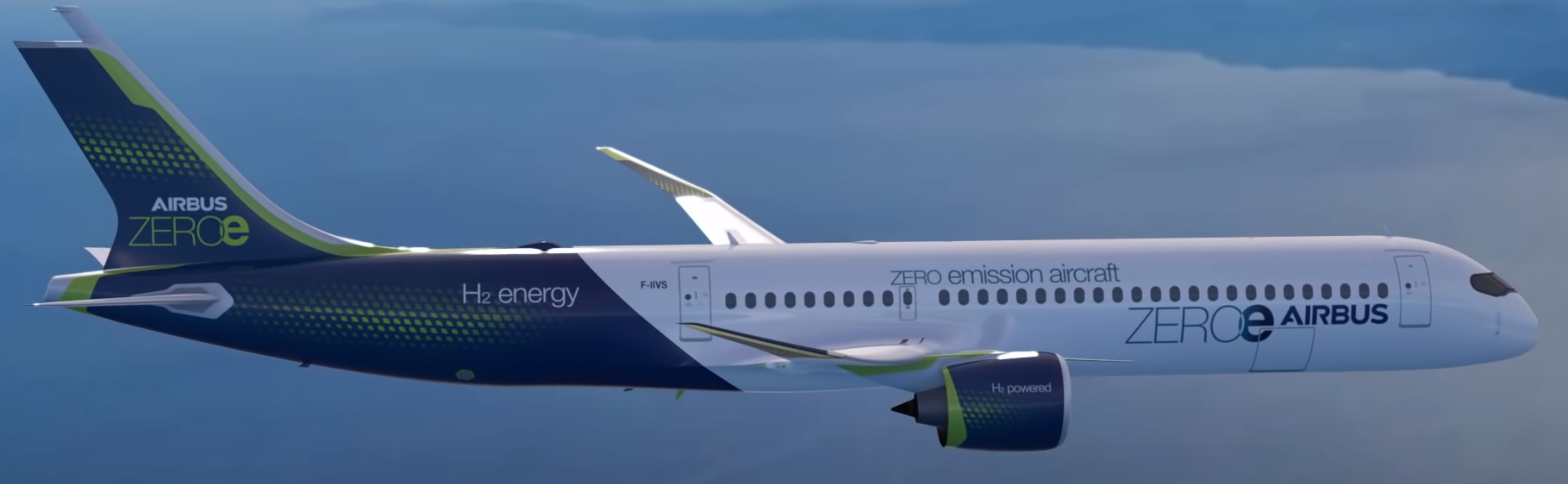
This screen capture taken from the video, shows the front view of the plane.

The aircraft doesn’t look very different different to an Airbus A320 and appears to be fairly conventional. It does appear to have the characteristic tall winglets of the A 320 neo.
I don’t think the turbofan engines, that run on hydrogen will be a problem.
These could be standard turbofan engines modified to run on hydrogen, fuelled from a liquid hydrogen tank behind the rear pressure bulkhead of the fuselage.
If you want to learn more about gas turbine engines and hydrogen, read this article on the General Electric web site, which is entitled The Hydrogen Generation: These Gas Turbines Can Run On The Most Abundant Element In the Universe,
These are my thoughts of the marketing objectives of the ZEROe Turbofan.
- The cruising speed and the number of passengers are surprisingly close, so has this aircraft been designed as an A 320 or Boeing 737 replacement?
- I suspect too, that it has been designed to be used at any airport, that could handle an Airbus A 320 or Boeing 737.
- It would be able to fly point-to-point flights between most pairs of European or North American cities.
It would certainly fit the zero-carbon shorter range airliner market!
In fact it would more than fit the market, it would define it!
I very much believe that Airbus’s proposed zero-carbon hydrogen-powered designs and others like them will start to define aviation on routes of up to perhaps 3000 miles, from perhaps 2035.
- The A 320 neo was launched in December 2010 and entered service in January 2016. That was just five years and a month.
- I suspect that a lot of components like the fuselage sections, cockpit, avionics, wings, landing gear, tailplane and cabin interior could be the same in a A 320 neo and a ZEROe Turbofan.
- Flying surfaces and aerodynamics could be very similar in an A 320 neo and a ZEROe Turbofan
- There could even be commonality between the ZEROe Turboprop and the ZEROe Turbofan, with respect to fuselage sections, cockpit, avionics and cabin interior.
There also must be the possibility, that if a ZEROe Turbofan is a hydrogen-powered A 320 neo, that this would enable the certification process to be simplified.
It might even be possible to remanufacture a A 320 neo into a ZEROe Turbofan. This would surely open up all sorts of marketing strategies.
My project management, flying and engineering knowledge says that if they launched the ZEROe Turbofan this year, it could be in service by the end of the decade on selected routes.
Conclusion
Both the ZEROe Turboprop and ZEROe Turbofan are genuine zero-carbon aircraft, which fit into two well-defined market segments.
I believe that these two aircraft and others like them from perhaps Boeing and Bombardier could be the future of aviation between say 500 and 3000 miles.
With the exception of the provision of hydrogen refuelling at airports, there will be no need for any airport infrastructure.
I also wouldn’t be surprised that the thinking Airbus appear to have applied to creating the ZEROe Turbofan from the successful A 320 neo, could be applied to perhaps create a hydrogen-powered A 350.
I feel that Airbus haven’t fulling disclosed their thinking. But then no company would, when it reinvents itself.
T also think that short-haul air routes will increasing come under pressure.
The green lobby would like airlines to decarbonise.
Governments will legislate that airlines must decarbonise.
The rail industry will increasingly look to attract customers away from the airlines, by providing more competitive times and emphasising their green credentials.
Aircraft manufacturers will come under pressure to deliver zero-carbon airliners as soon as they can.
I wouldn’t be surprised to see a prototype ZEROe Turbofan or Boeing’s equivalent fly as early as 2024.
Short Term Solutions
As I said earlier, one solution is to use existing aircraft with Sustainable Aviation Fuel.
But many believe this is greenwash and rather a cop out.
So we must do better!
I don’t believe that the smaller zero- and low-carbon aircraft with a range of up to 500 miles and a capacity of around 19 seats, will be able to handle all the passengers needing to fly between and around the islands of Great Britain and Ireland.
- A Boeing 737 or Airbus A 320 has a capacity of around two hundred passengers, which would require ten times the number of flights, aircraft and pilots.
- Airports would need expansion on the airside and the terminals to handle the extra planes.
- Air Traffic Control would need to be expanded to handle the extra planes.
But the smaller planes would be ideal for the thinner secondary routes.
So I tend to think, that the greens will have to lump it, as Sustainable Aviation Fuel will increasingly be the only viable solution.
This will increase the need for Airbus or Boeing to develop a viable A 320 or 737-sized aircraft as soon as possible.
Air Bridges
I said earlier, that I believe using ferries between Ireland and Holyhead and new bi-mode Class 805 trains between London Euston and Holyhead could be a competitor to airlines.
- The ferries would be high speed craft capable of Holyhead and Ireland in around 90-100 minutes.
- The ferries would be zero-carbon.
- The trains would have a sixty percent reduction in carbon emissions compared to current trains on the route.
If we can skim across the water in a zero-carbon high speed craft, are there any reasons we can’t cross the water in a low- or zero-carbon aircraft.
In the next few sub-sections, I’ll suggest a few air bridges.
Glasgow
Glasgow Airport could be an ideal airport for a low or zero-carbon air bridge to Northern Ireland.
- A rail link could eventually be built.
- There is a reasonable amount of traffic.
- The distance to Belfast City Airport is only 103 miles.
As the airport serves islands and other places that could be ideal low- and zero-carbon routes, I could see Glasgow becoming a hub for battery and hydrogen-powered aircraft.
Heathrow
Heathrow must prepare itself for an uncertain future.
It will be some years before a third runway is both needed and will have been constructed.
I believe the following will happen.
- Smaller up to nineteen seat low- or zero-carbon airliners will be in service by 2025.
- From around 2024, Heathrow will get requests to refuel or charge low- or zero-carbon airliners.
- Low- or-zero- carbon A 320-size airliners will be in service by 2030.
- Most ground equipment at Heathrow like tugs and fuel bowsers will be zero-carbon.
If I were Boris or Prime Minister, I would say that Heathrow could have its third runway with the following conditions.
- All aircraft using the third runway must be zero-carbon
- All air-side vehicles must be zero-carbon.
- All vehicles bringing passengers on the last mile to the airport must be zero-carbon.
- All aircraft using the airport that are not zero-carbon must use sustainable aviation fuel.
I suspect that the conditions would be met by a large margin.
When an airport knows it is effectively going to be closed, it will make sure it survives.
Liverpool
Liverpool Airport could be an ideal airport for a low or zero-carbon air bridge to the island of Ireland.
- There is a nearby Liverpool South Parkway station, with frequent services to both the local area and places further away.
- An improved London train service starts in 2022 or 2023.
- There would need to be a people mover between the station and the airport.
- The airport can probably have piped hydrogen from across the Mersey.
- There is already significant traffic to and from the island of Ireland.
- Flight times Between Liverpool and Dublin and Belfast would be under an hour.
I also feel that Liverpool could develop lots of other low- and zero-carbon routes to perhaps Cardiff, Edinburgh, Glasgow, Norwich, Southampton and the Isle of Man.
I could even see Liverpool having a Turn-Up-And-Go shuttle service to Dublin and Belfast, with small zero-carbon planes running every fifteen minutes or so.
Manston
I wouldn’t rule out Manston as a low- and zero-carbon airport for flights to the Benelux countries and Northern France and parts of Germany.
These are a few distances from Manston Airport.
- Amsterdam – 160 miles
- Brussels – 134 miles
- Cologne – 253 miles
- Dusseldorf – 234 miles
- Frankfurt – 328 miles
- Geneva – 414 miles
- Hamburg – 396 miles
- Le Touquet – 59 miles
- Lille – 49 miles
- Luxembourg – 243 miles
- Ostend – 66 miles
- Strasbourg – 339 miles
Manston’s position on the tip of Kent gives it an advantage and I think low- and zero-carbon services could reach Cologne, Frankfurt, Geneva, Hamburg and Strasbourg.
The airport also has other advantages.
- A big electrolyser to produce hydrogen is being built at Herne Bay.
- The area is rich in wind and solar energy.
- I suspect the airspace to the East of the airport isn’t very busy and short hops to the Continent could be easy to slot in.
There is a new station being built at Thanet Parkway, which is on the Ashford and Ramsgate Line, which has regular services to London, including some services on High Speed One.
This Google Map shows the location of the airport and the station.
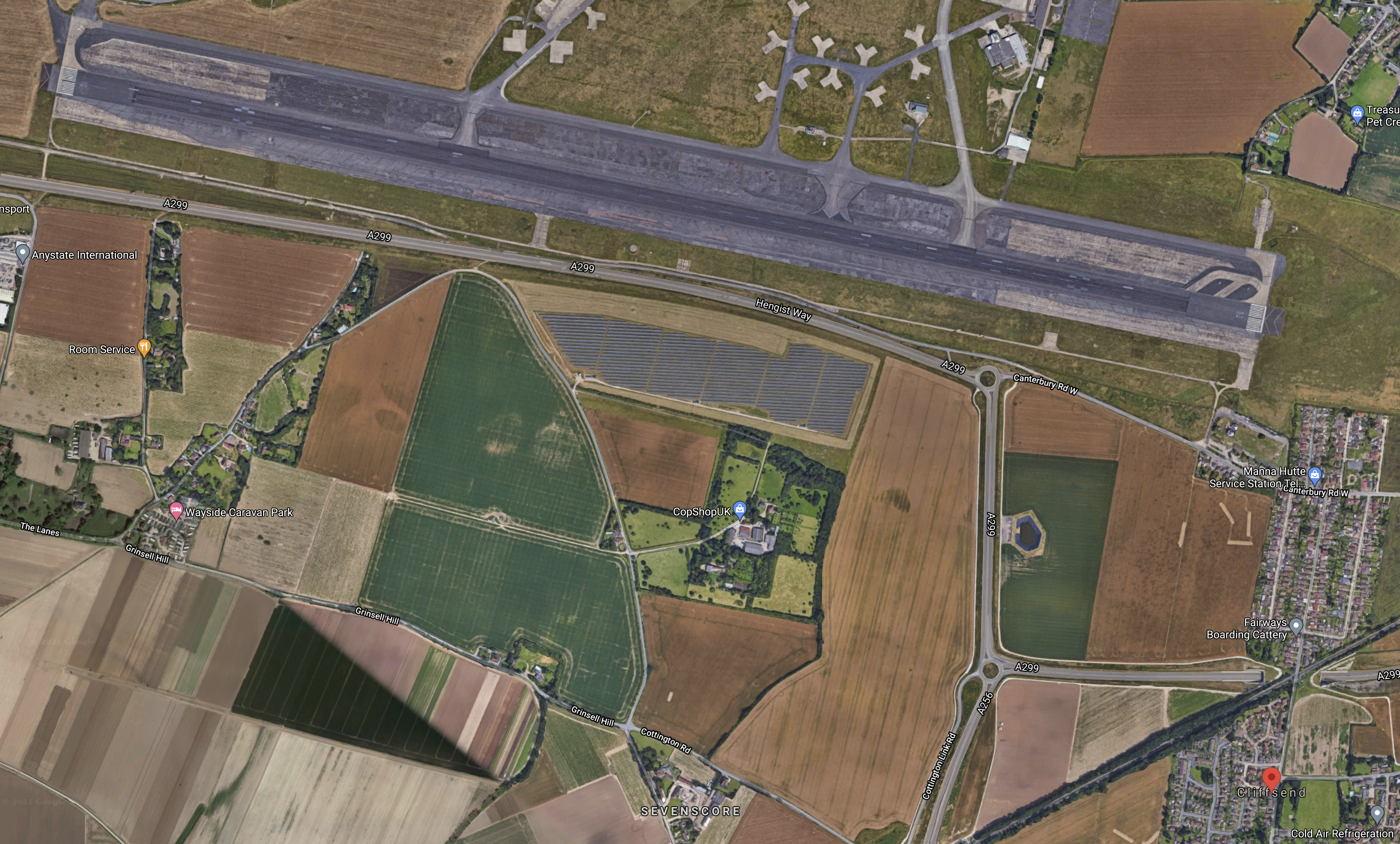
Note.
- The runway of Manston Airport.
- The Ashford and Ramsgate Line running across the South-East corner of the map.
- The station could be built to the West of the village of Cliffsend, which is indicated by the red arrow.
- I’m sure, a people mover or a zero-carbon bus could be built to connect the station and the airport.
There would need to be improvements in the frequency of services to and from London, but I’m sure Manston Airport could become an ideal airport for low- and zero-carbon aircraft serving the near Continent.
Southampton
Southampton Airport could be the ideal design for an airport to serve an air bridge.
- The Southampton Airport Parkway station is connected to the terminal.
- The station has numerous rail services, including a fast service to and from London.
- The airport is expanding and could make sure all works are compatible with a low- and zero-carbon future.
Southampton is not ideally placed for services to Ireland, but with low- and zero-carbon aircraft it could be ideal for running services to the Channel Islands and Western France.
Other Airports
I suspect other airports will go the low- and zero-carbon route.
Conclusion
I started this post, with the intention of writing about writing about low- and zero-carbon transport between the islands of Great Britain and Ireland.
But it has grown.
I have now come to the conclusion that there are several low- and zero-carbon routes that could be developed.
The most promising would appear to be.
- London Euston and Belfast by new Class 805 train to Holyhead and then zero-carbon high speed ferry.
- London Euston and Dublin by new Class 805 train to Holyhead and then zero-carbon high speed ferry.
- Glasgow and Belfast by train to Cairnryan and then zero-carbon high speed ferry.
- Point-to-point air routes using new small nineteen seat low- or zero-carbon airliners with a range of 500 miles.
- London Euston and Belfast by new Class 807 train to Liverpool Airport and then smaller low- or zero-carbon airliner.
- London Euston and Dublin by new Class 807 train to Liverpool Airport and then and then smaller low- or zero-carbon airliner.
- Other air bridges will develop.
But I am fairly certain by the end of the decade, there will be A320-size airlines powered by hydrogen taking us to Ireland and Western Europe.
I believe that the survival and ultimate prospering of Airbus and Boeing depends on the development of a range of zero-carbon airliners.
For this reason alone, they will succeed.
MAN Energy Partners With Highview Power On Liquid-Air Energy-Storage Project
The title of this post, is the same as that of this article on Renewable Energy Magazine.
This is the introductory paragraph.
Highview Power, a leader in long duration energy storage solutions, has selected MAN Energy Solutions to provide its LAES turbomachinery solution to Highview Power for its CRYOBattery™ facility, a 50 MW liquid-air, energy-storage facility – with a minimum of 250MWh – located in Carrington Village, Greater Manchester , U.K.
The article is almost a word-for-word copy of this press release from MAN Energy Solutions, which has a similar title to this post and the Renewable Energy Magazine article.
As an Electrical Engineer who has done a lot of work in Project Management, I find these two paragraphs significant.
Construction will proceed in two phases. Phase 1 will involve the installation of a ‘stability island’, to provide near-instantaneous energy grid stabilisation. This will be achieved using a generator and flywheel, among other components. Enabling short-term stabilisation will provide the basis for Phase 2 and the completion of the more complex liquid air energy storage system that includes various compressors, air expanders and cryogenic equipment.
Phase 2 will represent the integration of stability services with a full-scale long-duration energy storage system, and in doing so promote the full integration of renewable energy. The Carrington project will offer a blueprint for future projects and cement the partnership between MAN Energy Solutions and Highview Power.
I first became acquainted with the use of flywheels to stabilise energy, when I was working in Enfield Rolling Mills as a vacation job at sixteen.
The centerpiece of their factory was a rolling mill, which took heated copper wirebars about two metres long amd ten centimetres square and rolled them into thick copper wire just a few millimetres in diameter. The mill was driven by a powerful electric motor, to which it was connected with a 97 tonne flywheel perhaps four metres in diameter in between. The flywheel spun at probably 3000 revolutions per minute.
The wirebar used to meander through the rolling mill several times and at each turn, the head would be caught by a man with a pair of tongs and turned back through the mill.
Each time the wire-bar went through a new pair of rolls the energy needed increased, as there was more rolling to do. So this extra energy was taken from the flywheel!
The rolling mill incidentally had been built by Krupp before the First World War. It still had the Krupp trademark of three interlocked railway tyres all over it. It had ended up in Enfield as reparations after the First World War. Enfield Rolling Mills added a fourth ring to create their own trademark.
It would appear that the kinetic energy of that flywheel could be as high as 1.6 MWh. Flywheels also react very fast.
Flywheel energy storage would appear to be a feasible intermediate energy store for this type of application.
I always remember Shimatovitch, who was the Chief Engineer of the company had jokingly once said that if the flywheel came off its bearings, it would have ended up a couple of miles away and would have demolished all the houses in its path. But he was a man with a dark sense of humour, who had spent most of the Second World War in a Nazi concentration camp.
Could it be that Phase 1 is the installation of a similar system to that I saw working in the 1960s, but upgraded with modern electronics, which exchanges power with the grid to create the stability island referred to in the press release.
In Phase 2 electricity can be passed to and from the CRYOBattery.
Looking at the MAN Energy Solutions web site, I suspect that they don’t care what sort of energy store they connect to the grid.
They would appear to be an excellent choice of engineering partner for Highview Power.
I also wonder how many other applications and customers, they will bring into the partnership.
Conclusion
This looks like a very sensible and low-risk strategy to connect the CRYOBattery to the grid.
Gravitricity Battery Generates First Power At Edinburgh Site
The title of this post, is the same as that of this article on the BBC.
This is the first paragraph.
A project to create electricity from gravity has generated its first power at a demonstrator site in Edinburgh.
This is only a demo to prove the technology, but all great oaks start as acorns.
I have great hopes for Gravitricity and I should declare an interest, as I bought a few shares in a crowdfunding.
Could Trains From The North Connect To High Speed One At St. Pancras?
I was casually flying my virtual helicopter over the throat of St. Pancras International station, when I took a few pictures.
This Google Map shows the Northern ends of the platforms and the tracks leading in.
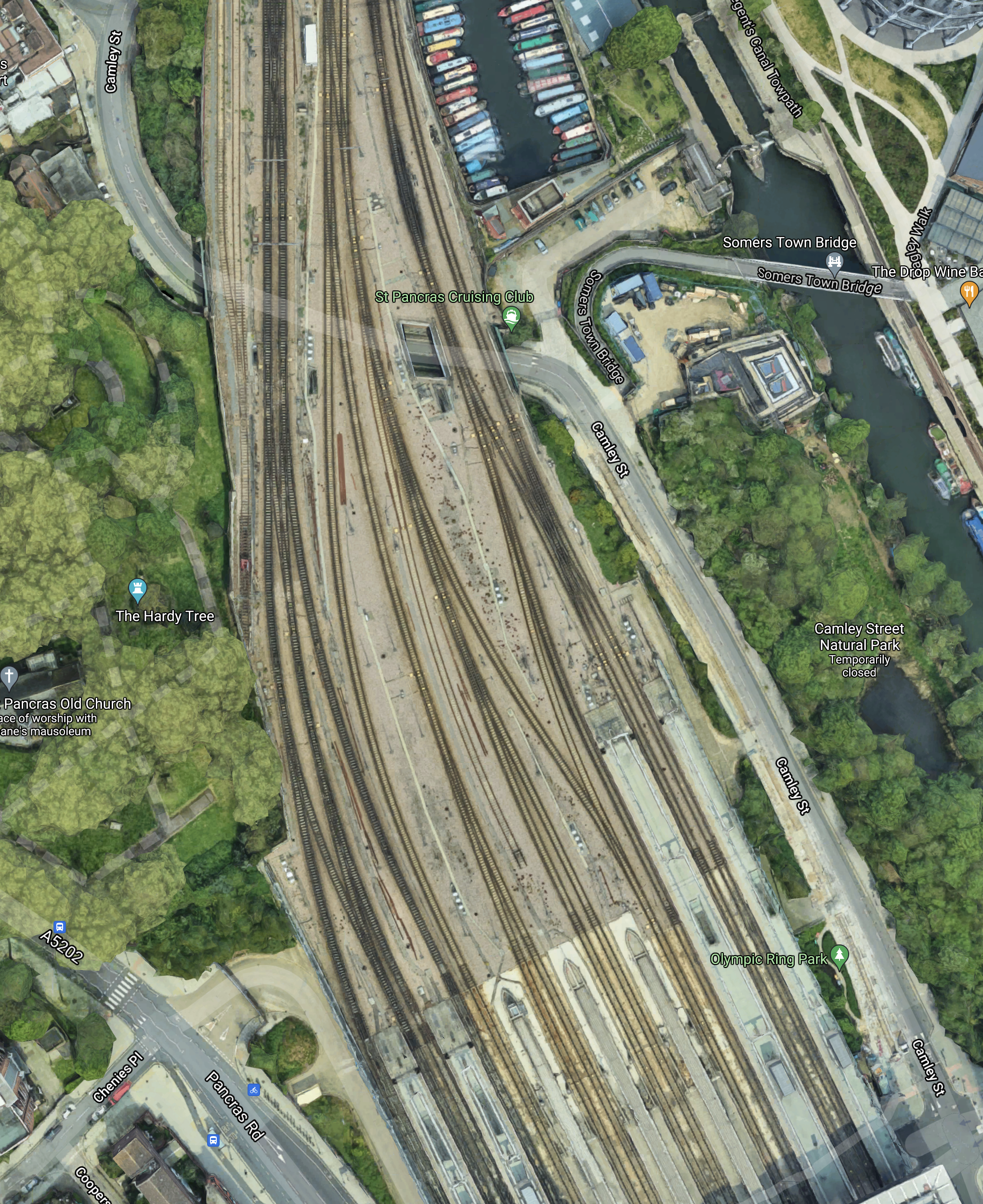
Note.
- Platforms 1-4 to the West with darker tracks handle the East Midlands Railway services.
- Platforms 5-10 in the centre with lighter tracks formed of three shorter islands handle the Eurostar services.
- Platforms 11-13 to the East with longer platforms handle the Southeastern HighSpeed services.
This Google Map shows the East Midlands Railway platforms.
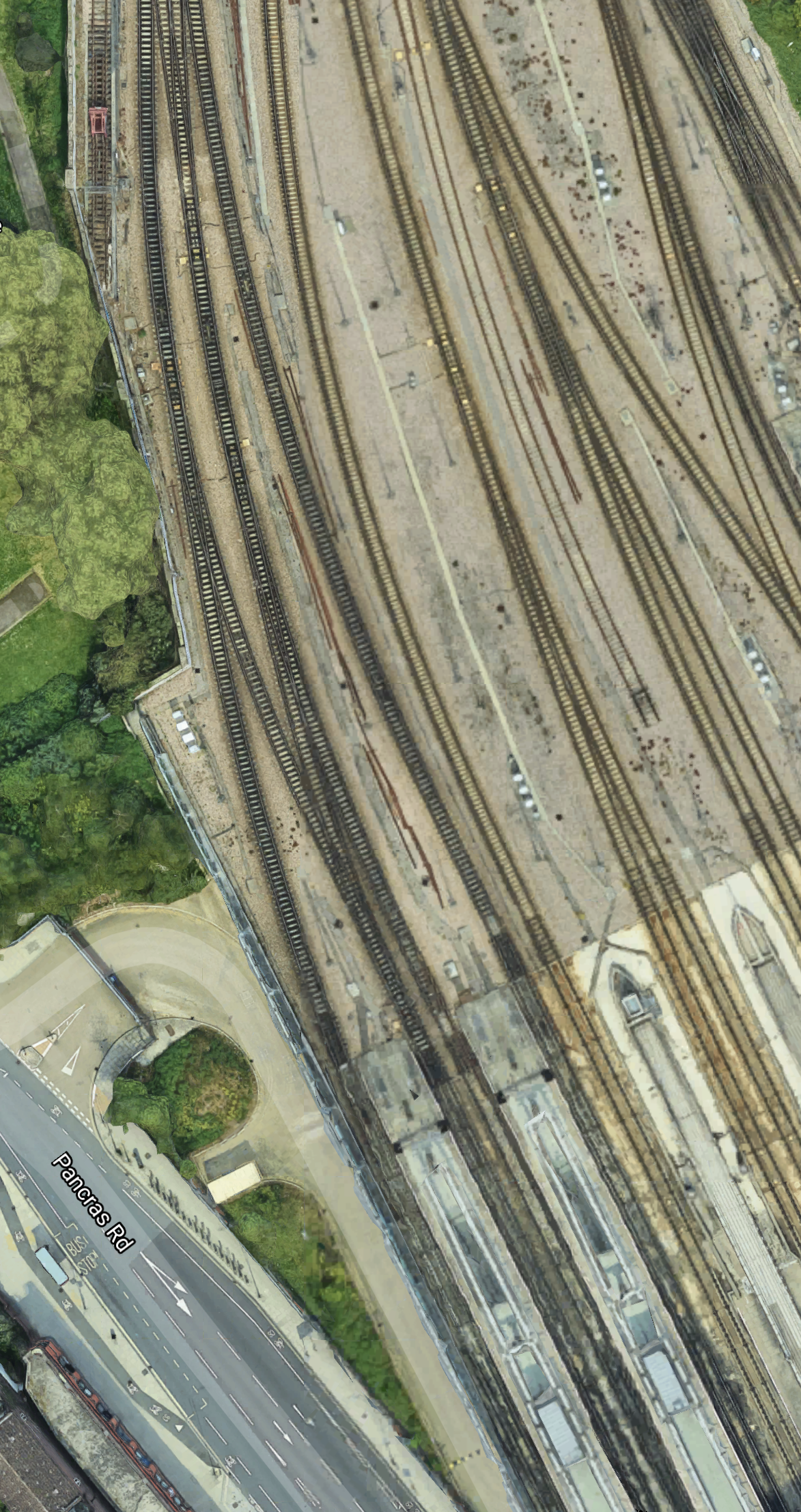
Note.
- There are two island platforms; 1-2 and 3-4.
- The four platforms are served by two tracks, that connect to the fast lines of the Midland Main Line.
- The platforms will be able to handle a pair of Class 810 trains, which will be 240 metres long.
- Will the two trains per hour (tph) using Class 360 trains between London and Corby always use the same platform at St. Prancras station?
This Google Map shows the Eurostar platforms.
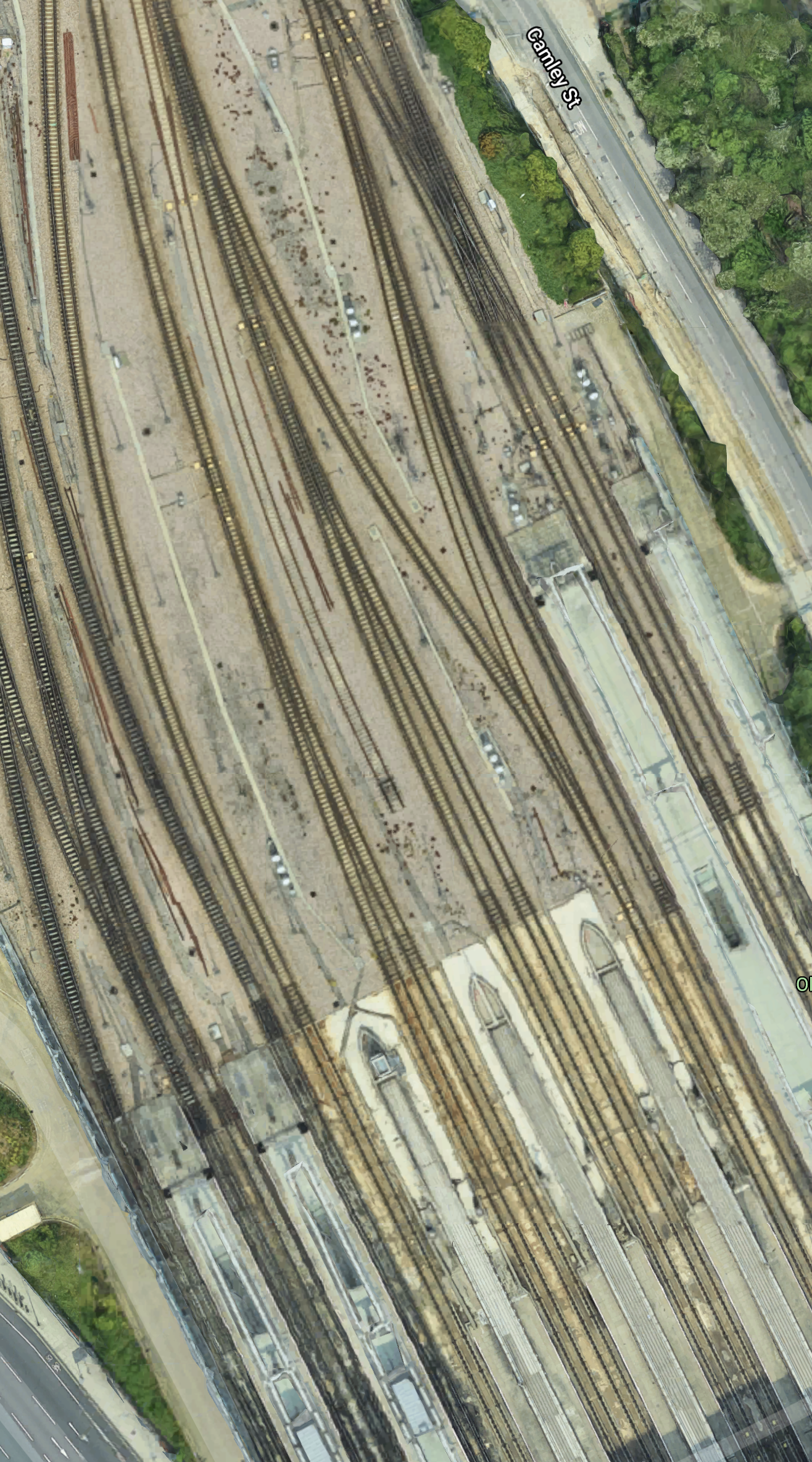
Note.
There are three island platforms; 5-6, 7-8 and 9-10.
The two island platforms in the West are for East Midlands Railway services.
The two longer island platforms in the East are for Southeastern HighSpeed services.
The six platforms connect to two fast lines, that are shared with the Southeastern services.
This Google Map shows the lines proceeding to the North.
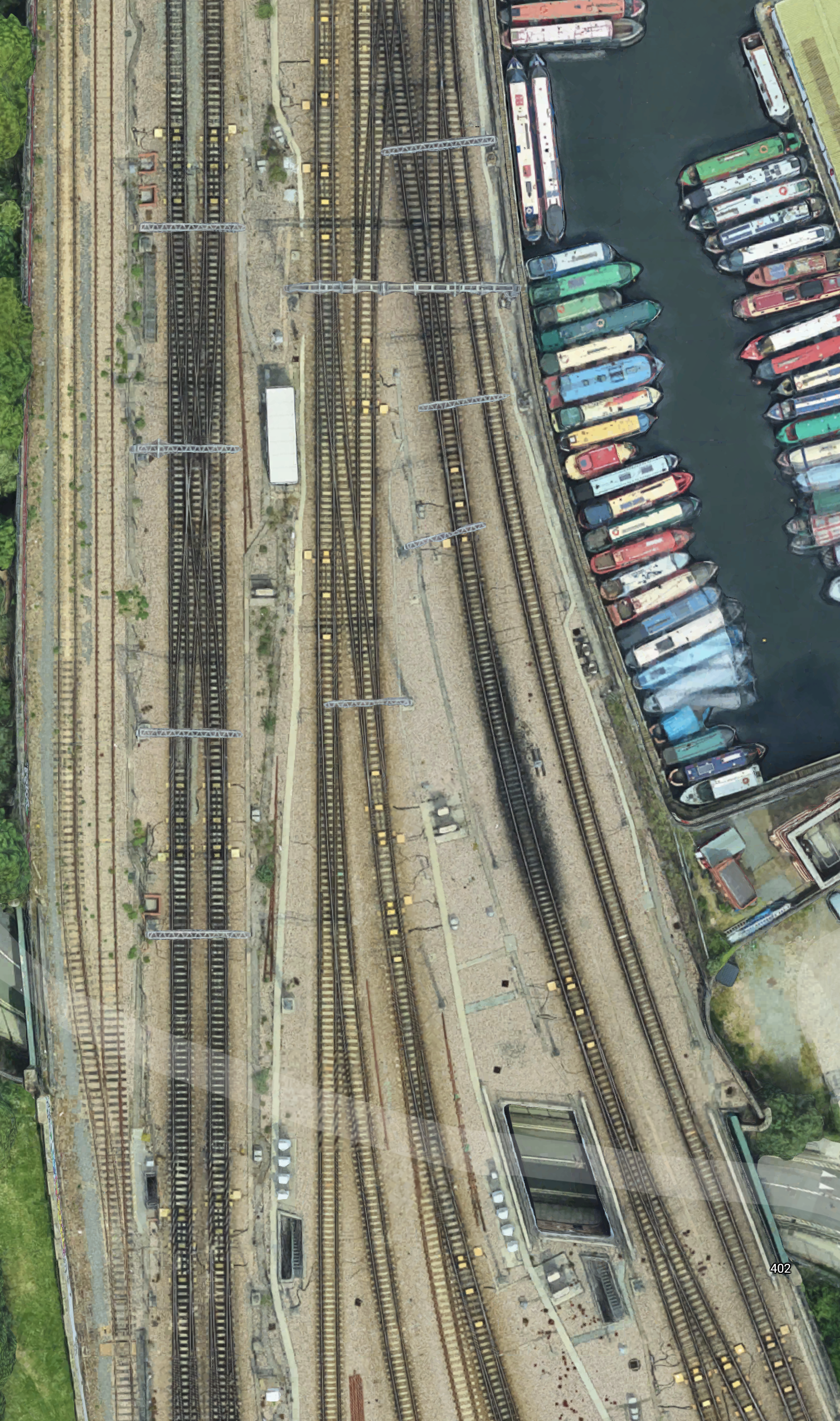
Note.
- There are four sets of tracks.
- The two light-coloured tracks on the left are for Thameslink or sidings.
- The next two dark-coloured tracks are the two tracks of the Midland Main Line.
- The next set of tracks are those connecting to the six Eurostar platforms.
- The two tracks on the right are those connecting to the Southeastern Highspeed platforms.
- There are crossovers between the Eurostar and Southeastern Highspeed tracks to allow efficient operation of the trains going to and from the twin tracks of High Speed One.
This Google Map shows where the Midland Main Line and High Speed One divide.
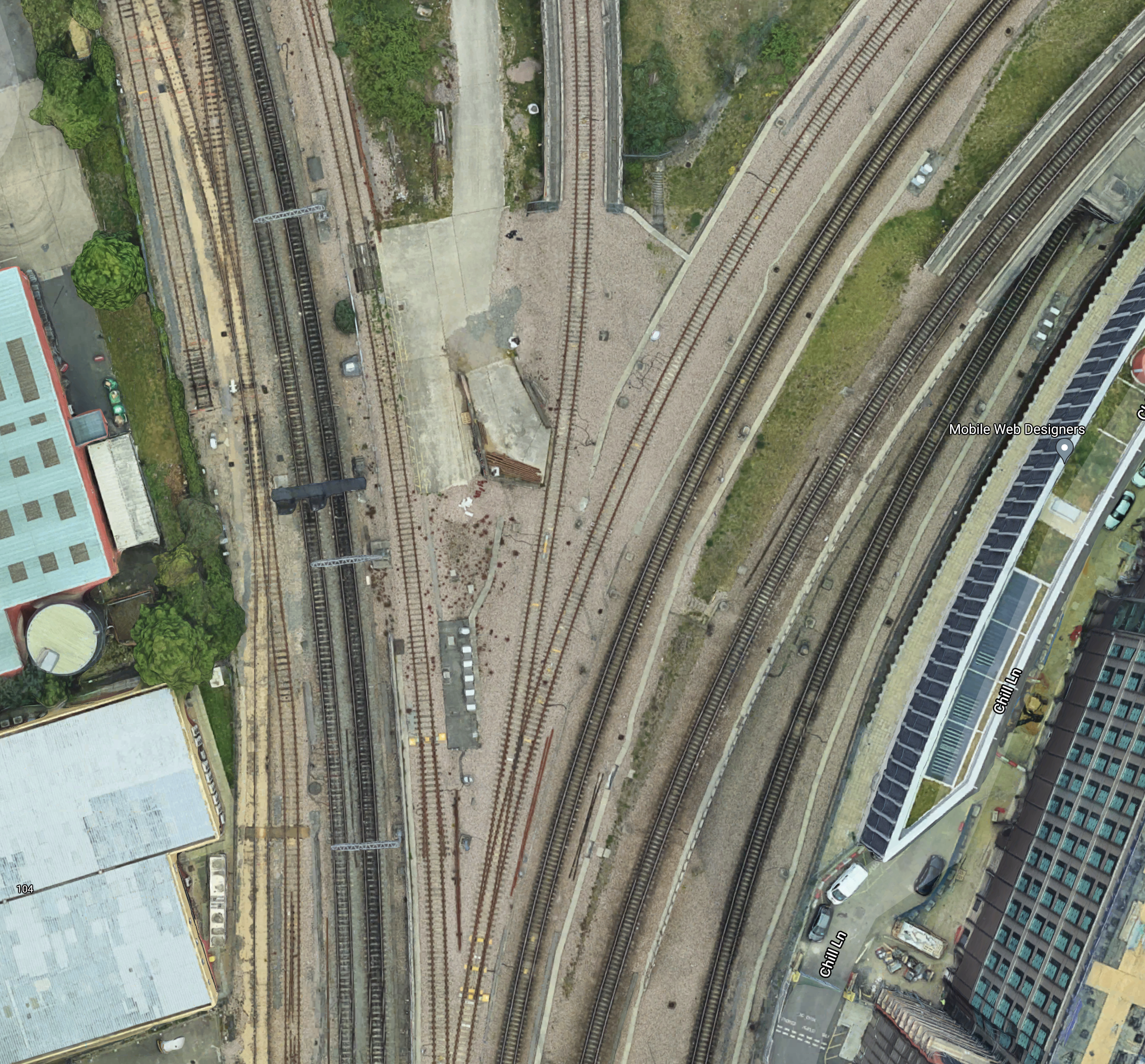
Note.
The two dark-coloured tracks of the Midland Main Line running North.
There appear to be four tracks running North East towards High Speed One.
Between the two sets of tracks two further tracks lead to the North.
The track closest to the Midland Main Line joins to the slow lines of the Midland Main Line.
The other one connects to the North London Line.
This Google Map shows the connecting lines to the High Speed One tunnel.
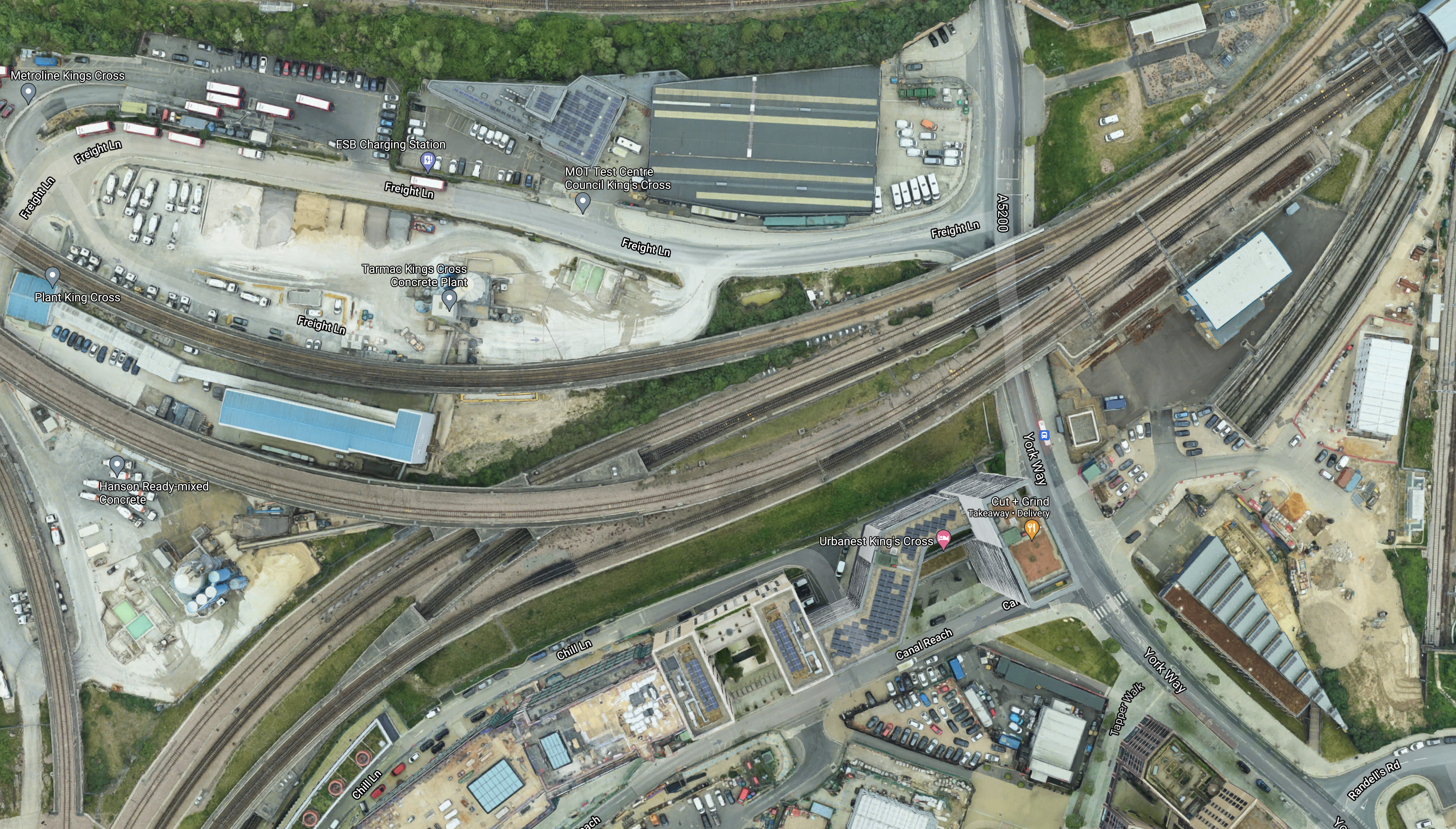
Note the tunnel portal is in the North-East corner of the map.
- It looks to me that the following connections are possible.
- St. Pancras station Eurostar platforms and Midland Main Line.
- St. Pancras station Eurostar platforms and North London Line to the West.
- High Speed One and North London Line to the West.
These connections are in addition to those connections needed to run scheduled services.
They would enable trains to take the following routes.
- St. Pancras station Eurostar platforms and Midland Main Line.
- St. Pancras station Eurostar platforms and the West Coast Main Line via North London Line
- High Speed One and the West Coast Main Line via North London Line
- St. Pancras station Eurostar platforms and the Great Western Main Line via North London Line
- High Speed One and the Great Western Main Line via North London Line
I suspect most of the times, that these routes are used it is for engineering purposes or behaps dragging a failed train out of St. Pancras.
But the track layout would seem to allow the following.
Direct electric freight and passenger services between High Speed One and Birmingham, Cardiff, Glasgow, Liverpool and Manchester.
Direct electric passenger services between High Speed One and Sheffield and Leeds, with a reverse at St. Pancras, after the Midland Main Line were to be fully electrified.
Was this by design for Eurostar or was it just what Network Rail ended up with?
A Modern Regional Eurostar Service
These are my thoughts on a modern Regional Eurostar service.
Rolling Stock
High Speed Two is coming and this year, the company will order some of the rolling stock.
There will be fifty-four trains
The trains will be Classic-Compatible for running on the West Coast Main Line.
They will be 200 metres long and be able to run in pairs.
They will be able to operate at 225 mph.
The operating speed of High Speed One is 186 mph.
I can see no reason why trains of this type, couldn’t run between St. Pancras and many destinations in Europe.
North Of England And The Continent
Could this be the service pattern?
- One train could start in the North West and another in the North East.
- Both trains would proceed to St. Pancras picking up passengers en route.
- At St. Pancras the two trains would join together.
- The driver could then position themselves in the front cab and take High Speed One, through the Channel Tunnel.
The train could even split at Calais to serve two different Continental destinations.
Going North, the spitting and joining would be reversed.
What Infrastructure Would Be Needed?
I suspect the following will be needed.
- The West Coast Main Line and the Midland Main Line would need in-cab digital ERTMS signalling.
- Full electrification of the Midland Main Line would probably be necessary, as I don’t think the tunnel allows diesel trains to pass through.
- Some platform lengthening might be needed.
It would not be an expensive scheme.
What Timings Would Be Possible?
Using current timings you get the following times.
- Leeds and Paris – Five hours
- Leeds and Brussels – Four hours forty minutes
- Manchester and Paris – Five hours
- Manchester and Brussels – For hours forty minutes
- Newcastle and Paris – Six hours
- Newcastle and Brussels – Five hours thirty minutes
Note, that the times are best estimates and include a long stop of several minutes at St. Pancras.
Could Sleeper Service Be Run?
I don’t see why not!
Conclusion
It looks like it may be possible to run regional services to Europe, where pairs of train split and join at St. Pancras.
St
Green Hydrogen Searches For Industrial Outlets
The title of this post, is the same as that of this article on E & T Magazine.
It is a detailed look at the uses for green hydrogen.
A few points from the article.
- Like fossil fuel hydrogen can store energy for months.
- Less that 10 % of green hydrogen will be used for energy storage.
- Hydrogen has a poor round trip efficiency, if you create it with an electrolyser and then convert it back to electricity using appropriate technology.
- Heavy transport may account for 25 % of the use of hydrogen.
- Industrial and home heating applications could account for the use of another third.
- One of the biggest uses today of hydrogen is in oil-refining to make low sulphur fuels.
- Steelmaking could be a big user, but there are many different methods and some have problems.
- Cement making could be a good use of green hydrogen.
The article is a must-read and it makes you think.
Australian Coal Mine To Transform Into Pumped Hydro Facility
The title of this post, is the same as that of this article on PV Magazine.
This is the introductory paragraph.
Australian utility AGL is transforming its operations in a number of ways, from restructuring the company itself, to building energy storage facilities for flexible distribution of renewable energy into the future. The company is also planning to build a pumped-hydro facility at a disused open-cut coal mining site in eastern Australia.
It is an interesting proposition to say the least to reuse an opencast coal mine for something useful.
It would appear to be able to supple 250 MW for eight hours, which would make it a 2 GWh facility.
But then Australia is a country, that needs a lot of energy storage as they transform their economy to zero carbon.
‘Sleeper Trains’ London To Berlin And Prague A New Possibility
The title of this post, is the same as the title of this article on Rail Technology Magazine.
This is the introductory paragraph.
For those who have grown a travel bug during lockdown, the truth is that flying looks like it won’t be a viable option as a global pandemic persists. However, for those who dream to travel again, there might be some hope. With growing new interest, there are ambitious plans to take overnight ‘Sleeper trains’ services through the channel tunnel from London to cities around Europe .
I regularly use sleeper trains to Scotland, as they deliver me North of the Border for an early start or are ideal for coming back ;ate after a busy day.
As I can sleep with no trouble on a train and generally book a few days in advance, it generally works out that the cost of the sleeper one way is good value, as it avoids paying for a hotel.
Certainly, in the UK, if you use sleeper trains properly and have a rail-card, I find them convenient and good value. A couple of times, there’s also been a party in the lounge car.
It appears that the first sleeper trains will start from Brussels.
- NightJet already run a service between Brussels and Vienna.
- A route of Brussels and Prague via Amsterdam, Berlin and Dresden is suggested.
- These routes could be extended to London, at some time in the future.
But if they were timed appropriately, you could take an afternoon or evening Eurostar to Brussels and have supper before you get the sleeper, either on Eurostar or in Brussels.
With sleeper trains popping up in several places in Europe and becoming more fashionable with better rolling stock, I’m sure that this sleeper train would work.
Brussels and Berlin is currently seven hours with a change, so a sleeper train without a change could probably take you to Berlin for eight in the morning, if it left Brussels at about yen at night.
Call For Major Investment In Hydrogen Hub To Help Sector Thrive In Northern Ireland
The title of this post, is the same as that of this article on the Belfast Telegraph.
This is the introductory paragraph.
Northern Ireland is ready to become a global leader in a future hydrogen economy but needs investment of at least £15m from government, politicians have said.
The article makes points about Northern Ireland and hydrogen.
- Hydrogen-powered buses are built in Ballymena.
- There is plenty of wind and water to create the hydrogen.
- Hydrogen could improve export potential and create skilled jobs.
The proposals certainly have good political support.
Remodelled Station Opens In Canfranc Ahead Of Reopening Of Cross-Border Link
The title of this post, is the same as that of this article on Railway Gazette.
This is the introductory paragraph.
On April 15, a RENFE DMU carrying invited guests from Zaragoza became the first train to arrive at the remodelled and relocated station in Canfranc, marking a further step in the long-running plan to reinstate the railway through the Pyrénées mountains linking Pau with Huesca.
I have an ambition to visit Canfranc station, where the Spanish and French railways meet at one of the largest stations in Europe.
- On the French side the Pau-Canfranc Railway is gradually being reopened.
- On the Spanish side there is a railway to Zaragoza, from where there are high speed trains to Barcelona and Madrid.
Both routes appear to be mainly single-track
There would appear to be pressure for reopening the full route In a Section entitled Renovation and Reopening, Wikipedia says this.
In present economic development, the transport route beneath the Aspe peak via the Gave d’Aspe valley is changing from a relatively unknown into a major transport channel. This is not only due to the regional pressure between Bordeaux and Zaragoza (which on the Spanish side alone has a regional population of 1 million people), but also the importance of the international route between Paris and Valencia. These economic pressures – in part driven by the General Motors plant located in Zaragoza – have in recent years resulted in heavy truck and car traffic on the roads of the upper Gave d’Aspe valley, and an increased number of accidents.
Sounds like this indicates a powerful case.
Madrid And London By The Scenic Rail Route
The route would be as follows.
- Madrid and Zaragoza by High Speed Train.
- Zaragoza and Canfranc by local train through the mountains.
- Canfranc and Pau by local train through the mountains.
- Pau and Paris by TGV
- Paris and London via Eurostar.
Note.
- According to the Railway Gazette, a luxury hotel is being built at Canfranc.
- Bordeaux is a good city for an overnight stop.
- Prior to the covids, Eurostar were hoping to run a direct London and Bordeaux service.
I hope to do this trip in the next couple of years.
Uniper To Make Wilhelmshaven German Hub For Green Hydrogen; Green Ammonia Import Terminal
The title of this post, is the same as that of this article on Green Car Congress.
This is the first two paragraphs.
Under the name “Green Wilhelmshaven,” Germany-based international energy company Uniper plans to establish a German national hub for hydrogen in Wilhelmshaven and is working on a corresponding feasibility study.
Plans include an import terminal for green ammonia. The terminal will be equipped with an ammonia cracker for producing green hydrogen and will also be connected to the planned hydrogen network. A 410-megawatt electrolysis plant is also planned, which—in combination with the import terminal—would be capable of supplying around 295,000 metric tons or 10% of the demand expected for the whole of Germany in 2030.
I can’t help feeling that there is some bad thinking here.
The Wikipedia entry for ammonia, says this about green ammonia.
Even though ammonia production currently creates 1.8% of global CO2 emissions, a 2020 Royal Society report claims that “green” ammonia can be produced by using low-carbon hydrogen (blue hydrogen and green hydrogen). Total decarbonization of ammonia production and the accomplishment of net-zero targets are possible by 2050.
So why is green ammonia imported rather than green hydrogen, which may have been used to manufacture the ammonia?
Green ammonia would appear to have two main uses in its own right.
- As a feedstock to make fertiliser and other chemicals.
- As a possible fuel for large ships, which could also be powered by hydrogen.
The only thing, I can think of, is that as liquid hydrogen boils at -253 ° C and liquid ammonia at -33 ° C, ammonia may be easier to transport by ship.
It may make a better fuel for large ships for the same reason.
This policy briefing from The Royal Society is entitled Ammonia: Zero-Carbon Fertiliser, Fuel And Energy Store.
This is the introductory paragraph.
This policy briefing considers the opportunities and challenges associated with the manufacture and future use of zero-carbon or green ammonia.
It is an excellent explanation of green ammonia and a must read.
Hydrogen for Wilhelmshaven
On the other hand, Wilhelmshaven, which is situated on Germany’s North West Coast would be in a good position to be a terminal for a hydrogen pipeline or electrical interconnector from the Dogger Bank, where both the Netherlands and the UK have plans for some of the largest windfarms in the world.
The UK’s Dogger Bank Wind Farm, which is being developed by SSE, looks to have an initial capacity of 4.8 MW, whereas the North Sea Wind Power Hub, being developed by the Danes, Dutch and Germans on their side of the Dogger Bank could be rated at up to 110 GW.
Wikipedia says this about how the two huge projects could be connected.
The power hub would interconnect the three national power grids with each other and with the Dogger Bank Wind Farm.
We could be seeing a 200 GW power station in an area of the sea, generally only known to those who listen to the shipping forecasts and fans like Marti Caine.
Under a section in the Wikipedia entry for the North Sea Wind Power Hub, which is entitled the North Sea Wind Power Hub Consortium, these points are made.
- It is hoped that Norway, the United Kingdom, and Belgium will join the consortium.
- Dutch gas-grid operator Gasunie has joined the consortium, suggesting converting wind power to gas and using near offshore gas infrastructure for storage and transport.
- The Port of Rotterdam became the fifth member of the consortium.
This looks like a party, where some of our North Sea gas fields and infrastructure, lying in the triangle of the Humber, Teesside and the Dogger Bank could add a lot of value.
We could even see hydrogen generated in the European Eastern part of the Dogger Bank, stored in a worked-out gas field in the UK sector of the North Sea and then when needed, it could be pumped to Germany.
A 410 Megawatt Electrolyser
Ryze Hydrogen are building the Herne Bay electrolyser.
- It will consume 23 MW of solar and wind power.
- It will produce ten tonnes of hydrogen per day.
This would produce just 5.6 percent of the hydrogen of the Wilhelmshaven electrolyser
In H2 Green Steel Plans 800 MW Hydrogen Plant In Sweden, I wrote about a 800 MW electrolyser, that would produce 380 tonnes of hydrogen per day.
It looks like the Wilhelmshaven electrolyser is very much a middle-sized one and would produce around 65,000 tonnes per year.
Conclusion
It looks like the Germans will be importing lots of green ammonia and green hydrogen from the North Sea.
 The Anonymous Widower