Up From The Depths At Moorgate Station
Moorgate station must have been built for rabbits, as it is a bit of a warren.
On arriving on the Northern Line platforms at the station a few days ago, I took the rat-up-the-drainpipe route to the surface.



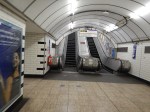
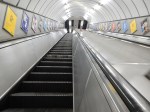
This is the route I took.
- Up the escalator to the Northern City Line platforms.
- Straight up the Northern City Line escalators to the surface.
- Through the barrier and then up to street level on one of two flights of steps, which are on opposite sides of Moorgate.
It is quicker and has less steps.
Crossrail
How will axxess change, when Crossrail opens.
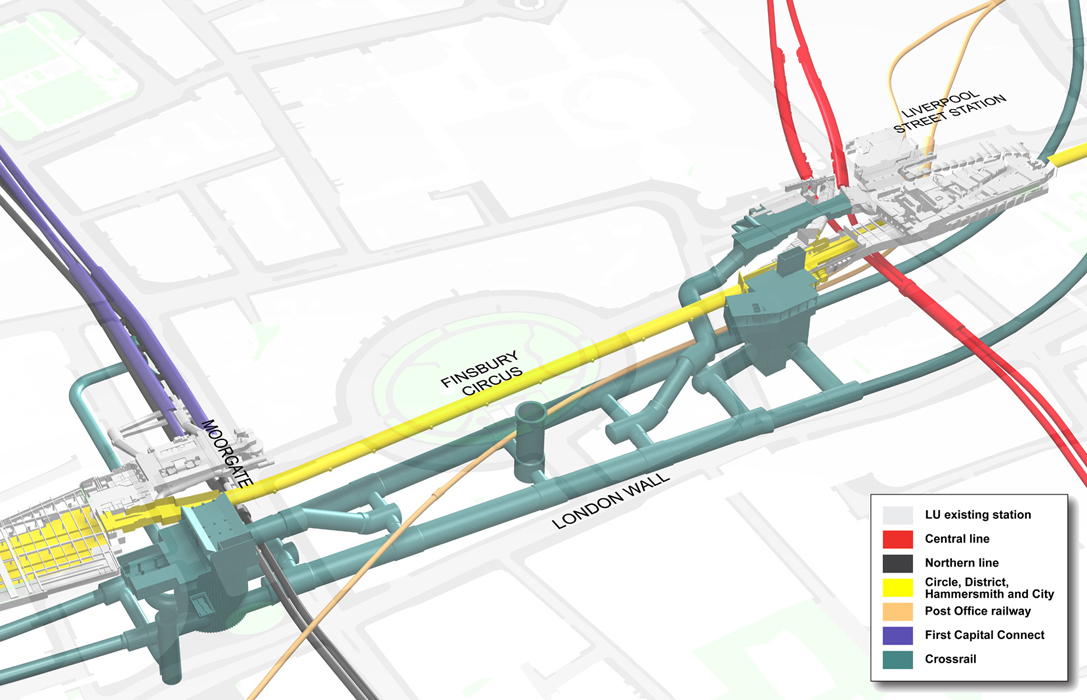
Look at this image, I’ve clipped from this large visualisation of the massive Liverpool Street-Moorgate Crossrail Station.
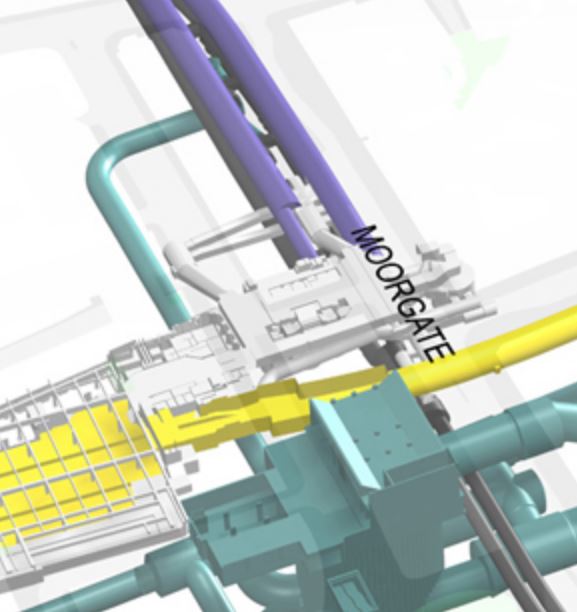
The image shows the Northern City Line coming into Moorgate station.
Colours are as follows.
- Blue – Northern City Line
- Yellow – Circle and Hammersmith & City Lines
- Black – Northern
- Turquoise – Crossrail
Details to note.
Existing Northern City Escalators
The escalator shaft to the existing ticket hall is shown in white by the letter M of Moorgate.
Existing Northern Line Escalators
The double tunnels from the stairs leading to the platforms to the escalators are shown in white underneath the Northern City Line.
The escalators to the existing ticket hall are clearly shown. Both are in white.
Circle And Hammersmith & City Lines
When Crossrail opens, passengers would seem to still do, as they do now to interchange between Northern/Northern City and the Sub-Surface Lines.
But there is also a turquoise tunnel with a right-angle bend in the middle, that appears to do the following.
- Link to the Northern and Northern City Lines at its Northern end.
- Run under the sub-surface Lines.
Finally the tunnel connects to the big turquoise block, which I take to be the new Crossrail ticket hall.
There appear to be lifts on both sides of the Sub-Surface Lines.





Note.
- The lift on the North side of the Sub-Surface Lines, appears to be in a room with a window. Perhaps, the wall will be removed?
- The lift on the South side of the Sub-Surface Lines, appears to be in a lobby, set back from the tracks, but accessible from all three platforms on that side.
- I suspect they connect to the connecting tunnel below the platforms.
There does appear to be quite a bit of work to do.
The New Crossrail Station
The big turquoise block is the new Crossrail station and Ticket Hall.
Crossrail would appear to connect to the Northern and Northern City Lines, using the new subway, but it doesn’t seem that obvious how passengers will walk between the Sub-Surface Lines and the Crossrail Ticket Hall.
It
Holyhead Hydrogen Hub Planned For Wales
The title of this post is the same as that of this article on H2 View.
This is the introductory paragraph.
Plans for a new hydrogen production plant, refuelling and distribution hub have been unveiled for Holyhead, North Wales.
Some other points from the article.
- Unsurprisingly, it will be called the Holyhead Hydrogen Hub.
- Holyhead is the second largest roll-on, roll-off port in the UK.
- There is plenty of potential for renewable energy in the area.
- It will support the port and large scale movements of HGVs.
- There is plenty of potential for renewable energy in the area.
- The hydrogen in future could support trains, ships, public transport and other uses.
In the last year, I’ve read about hydrogen hubs in ports, including Portsmouth and Antwerp, so Holyhead is just following a trend.
Buses Should Have Flat Floors
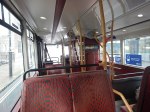
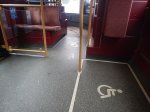
These pictures were taken inside the lower-deck of one of London’s New Routemaster buses.



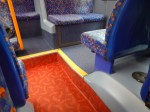
Now compare them with pictures taken on the lower deck of one of London’s other hybrid buses, similar to those you see all around the UK.




Note.
- The floor of the New Routemaster is continuous and flat. The only steps are the stairs and up into the sets of four seats.
- The floor of the hybrid bus, which was built on a standard Volvo chassis has several steps.
Recently, when carrying a full bag of shopping down the stairs on the hybrid bus, the driver accelerated away and I fell and banged my knee. Because of the flat floor, it is less likely, I’d have a similar problem on the New Routemaster.
Why Does The Routemaster Have A Flat Floor?
When Wrightbus designed the Routemaster, they had a clean sheet of paper and weren’t constrained to use a proprietary chassis.
- The 18 kWh traction battery is under the front stairs.
- The traction motor is under the floor, in the middle of the bus.
- The small diesel generator is mounted halfway up the back stairs.
- The bus has full regenerative braking to the battery.
Using a standard Volvo chassis might be cheaper, but there can’t be a flat floor.
Will The Wrightbus Hydrogen Bus Have A Flat Floor?
The Wrightbus StreetDeck FCEV is the Wrightbus hydrogen bus and it has entered service in Aberdeen.
It looks to be about half flat floor, but not as good as the Routemaster.
Hopefully, I’ll ride in one soon.
Velocys Signs Agreement For Commercial-Scale Biomass-To-Jet Fuel In Japan
The title of this post, is the same as that of this article on the Chemical Engineer.
I am very hopeful about Velocys, who are a UK public company, that were spun out of Oxford University and do clever things in the area of chemical catalysts.
Velocys’ Fischer-Tropsch technology does seem to be a good way of creating sustainable aviation fuel from household rubbish and biomass.
Are Hydrogen-Fuelled Vehicles A Waste Of Our Time And Energy?
The title of this post, is the same as that of this article on Engineering & Technology, which is the magazine of the Institution of Engineering and Technology. So it should be authoritative.
This is the concluding paragraph.
Cars account for 61 per cent of surface transport emissions, HGVs only 17 per cent, buses 3 per cent, and rail 2 per cent (CCC, December 2020) so for cost/benefit it cannot be worthwhile switching to hydrogen fuel cell buses and trains. Through any impartial lens of engineering science, hydrogen fuel cell cars do not appear to be a transport winner and the Government should revisit decisions it has made about related funding. But then there is political virtue signalling.
It is a must-read contribution to the debate, as to whether hydrogen or battery power, is best for surface transport.
I don’t believe there is a simple answer, because for some applications, battery electric power is not feasible because of reasons of power or range.
- Would a battery-electric truck, be able to haul a forty-four tonne load between the Channel Tunnel and Scotland?
- Would a battery-electric locomotive be able to haul a thousand tonne aggregate or stone train for anything but a few tens of miles?
- Is it possible to design a a battery-electric double-deck bus, that can carry seventy passengers?
I believe there are applications, where battery-electric is not a feasible alternative to the current diesel traction.
It is worth noting, that truck-maker; Daimler is planning to have both battery and hydrogen heavy trucks in its product line.
Users will choose, what is the best zero-carbon transport for their needs.
The Black Cab Driver’s Answer
It is always said, that, if you want to know the answer to a difficult question, you ask the opinion of a black cab driver.
So as the new electric black taxis, are the most common electric vehicle, that the average Londoner uses, what do the guys up-front say about their expensive vehicles.
- Regularly, cab drivers complain to me about the range and having to use the diesel engine to charge the battery or power the car.
- Some suggest to me, that hydrogen might be a better way to make the vehicles zero-carbon.
I think they may have a point about hydrogen being a better method of powering a black taxi, when you look at the pattern of journeys and the battery size and charging limitations of the vehicle.
These limitations may reduce in the future, as the technology gets better, with higher density batteries and faster charging.
We could even see a design and sales war between battery and hydrogen black cabs.
It always pays to follow the money!
Sale To Linde Of World’s Largest PEM Electrolyser
The title of this post, is the same as that of this press release on the ITM Power web site.
This is the first paragraph.
ITM Power, the energy storage and clean fuel company, is pleased to announce the sale to Linde of a 24MW electrolyser to be installed at the Leuna Chemical Complex in Germany.
Note.
- Leuna is a few miles to the West of Leipzig.
- As it’s green hydrogen, I would hope it’s not powered with electricity from coal.
I bet they’re pleased.
I said a similar thing, when they got funding for an 8 MW monster, that I wrote about in Funding Award to Supply An 8MW Electrolyser.
The press release says this about the electrolyser.
This new 24 megawatt electrolyzer will produce green hydrogen to supply Linde’s industrial customers through the company’s existing pipeline network. In addition, Linde will distribute liquefied green hydrogen to refueling stations and other industrial customers in the region. The total green hydrogen being produced can fuel approximately six hundred fuel cell buses driving 40 million kilometers and saving up to 40,000 tons of carbon dioxide tailpipe emissions per year.
In Can The UK Have A Capacity To Create Five GW Of Green Hydrogen?, I said the following.
Ryze Hydrogen are building the Herne Bay electrolyser.
- It will consume 23 MW of solar and wind power.
- It will produce ten tonnes of hydrogen per day.
The electrolyser will consume 552 MWh to produce ten tonnes of hydrogen, so creating one tonne of hydrogen needs 55.2 MWh of electricity.
This would mean that the Leuna electrolyser could be producing nearly four thousand tonnes of hydrogen per year.
Does this mean that every tonne of hydrogen saves ten tonnes of carbon dioxide tailpipe emissions?
Tottenham Court Road Station – 15th February 2021
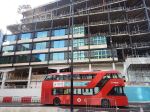
These pictures show the latest exterior views of Tottenham Court Road station.



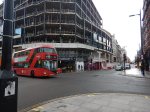



Note.
- The development on top of the station will be seven floors.
- There is a reflection of Centre Point in the glass.
It has now been handed over to Transport for London.
The London Tube Map Gets A New Line
This picture shows the latest London tube map, which now shows the Thameslink network.
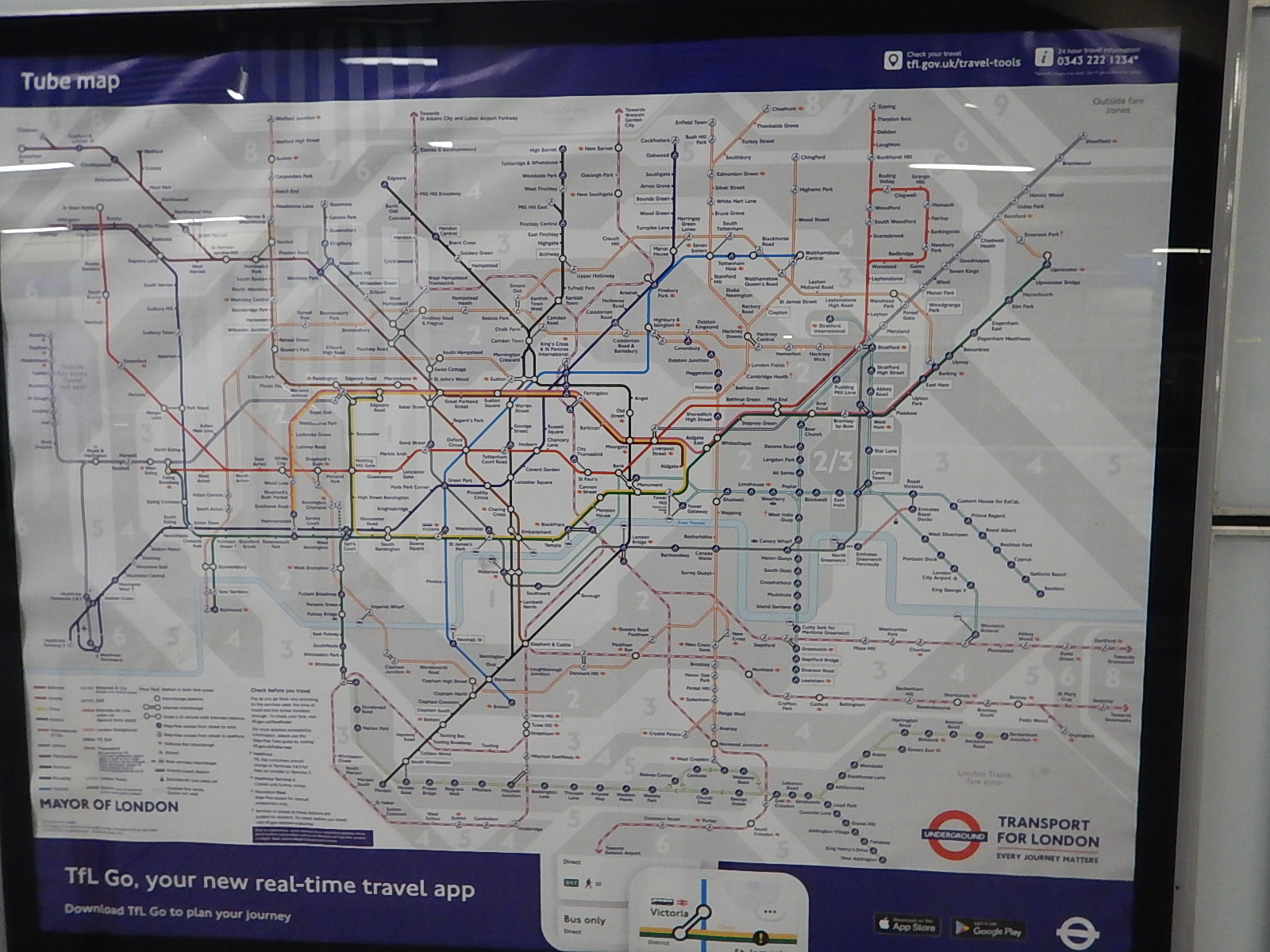
Note.
- There is a lot of new pink or red-and-white lines everywhere.
- The lines are numerous in the South-East corner of the map.
- Crossrail is not shown.
These pictures show areas in greater detail.





I am surprised that the whole of the Thameslink network has been added.
AW-Energy Oy Brings Wave Energy Technology To Green Hydrogen
The title of this post, is the same as that of this article on Hydrogen Fuel News.
This is a sub-title.
The company is introducing a new process combining its WaveRoller and HydrogenHub.
It would appear that by combining the two products, AW-Energy can create green hydrogen from wave power.
This page on the AW-Energy web site describes the WaveRoller.
This sentence describes what it does.
The WaveRoller is a device that converts ocean wave energy to electricity.
This page on the AW-Energy web site describes the company’s hydrogen expertise.
It looks to be an interesting combination.
Covid-19: World’s First Human Trials Given Green Light In UK
The title of this post, is the same as that of this article on the BBC.
This is the first two paragraphs.
Healthy, young volunteers will be infected with coronavirus to test vaccines and treatments in the world’s first Covid-19 “human challenge” study, which will take place in the UK.
The study, which has received ethics approval, will start in the next few weeks and recruit 90 people aged 18-30.
I am 73, but I wish I was in the age range.
I am coeliac and on a long-term gluten-free diet.
For purely selfish reasons, I have been investigating how people like me are faring in the pandemic.
Circumstantial evidence from WHO and government data, personal experiences and a peer-reviewed paper from the University of Padua in Italy certainly indicate, that we don’t suffer worse than the average. But we might be doing much better!
I would certainly like to find out the truth. So if I were younger, I would certainly sign up.
But it would surely be interesting if a handful of the volunteers were coeliacs on a long-term gluten-free diet.
 The Anonymous Widower