Did I Have A Close Brush With Covid-19?
In January, this year, I wrote a post called Mule Trains Between Liverpool And Norwich, where I went between Liverpool and Sheffield on a train formed of of several Class 153 trains.
I didn’t think of it, at the time, I wrote the post, but at Manchester Piccadilly station, the train filled up with a large number of Chinese students returning to University.
The students were happy and laughing, but you wouldn’t have complained about them, but there must have been twenty taking most of the available seats in my carriage. I shared a table with three!
At the time, Covid-19 had hardly started to invade the UK, with most cases starting in March.
But, after hearing someone’s story on the radio yesterday, I wonder about the health of those students.
I certainly, didn’t catch the covids seriously after that train journey and haven’t had the virus since, to my knowledge. But thinking back I may have felt unwell the next day.
But after reading the scientific paper from the University of Padua, that I wrote about in Risk of COVID-19 In Celiac Disease Patients, perhaps I was protected by a natural immunity provided by being a coeliac on a long-term gluten-free diet.
As my father said, I was born lucky!
Risk Of COVID-19 In Celiac Disease Patients
The title of this post, is the same as that of this paper on the US National Library of Medicine, which is from the University of Padua in Italy.
This is an extract from the paper.
Among the 171 patients included in our registry and on gluten free diet from at least six months, we contacted 138 CeD subjects (80.7%), aged 41.3 years old (SD 14.9), 73.9% were females on a gluten-free diet from a mean of 6.6 years (SD 6.0). Two patients had a diagnosis of refractory celiac disease type one and one of refractory celiac disease type 2. Among them, none reported to have been diagnosed with COVID-19, whereas 19 CeD patients experienced flu-like symptoms with 1 of them having undergone a negative naso-pharyngeal swab.
This is another sentence, summing up the study.
In this analysis we report a real life “snapshot” of a cohort of CeD patients during the SARS-CoV-2 outbreak in Italy, all followed in one tertiary centre in a red area of Northern Italy. Our data show, in accordance with Emmi et al., the absolute absence of COVID-19 diagnosis in our population, although 18 subjects experienced flu-like symptoms with only one having undergone naso-pharyngeal swab.
That is very firm and the report finishes with this sentence.
We only evaluated patients on a gluten free diet, so far no data on the risk at the time of diagnosis can be extrapolated from this study. Long-term clinical and epidemiological studies in celiac disease will be of great utility in the field but these preliminary data seem to suggest that CeD patients are not at higher risk of COVID-19.
Note.
- SARS-CoV-2 causes Covid-19.
- All their patients were suffering from coeliac disease and were on a gluten-free diet for more than six months.
I’m no medic, but I’m a seventy-three-year-old man with coeliac disease on a gluten-free diet.
I shall be sticking to my diet, in addition to social distancing.
The Hitachi Intercity Tri-Mode Battery Train Between Paddington And Bedwyn
This is probably one of the easiest services for GWR to run using a Hitachi Intercity Tri-Mode Battery Train.
This Hitachi infographic shows the specification.

Consider.
- The route is fully electrified between London Paddington and Newbury.
- It is 13.3 miles between Bedwyn and Newbury, with two intermediate stations.
- There is under thirty miles without electrification in a round trip between Paddington and Bedwyn.
- There is a turnback siding at Bedwyn, that could be fitted with a charger if required.
- Current trains take 17 minutes for between Bedwyn and Newbury, which is an average speed of 47 mph.
- The trains would run at up to 125 mph between Paddington and Reading.
- If the Great Western Main Line gets full in-cab digital ERTMS digital signalling, they will be able to take advantage and run at up to 140 mph between Reading and Paddington.
If it could be shown to be able to run the route reliably, I feel that a Hitachi Intercity Tri-Mode Battery Train with a mix of diesel engines and battery packs might be the ideal train.
- Large amounts of power would not be needed to maintain an average speed of 47 mph between Newbury and Bedwyn, which from my helicopter appears to be a fairly level railway by the side of the Kennett and Avon Canal.
- Except in emergencies, I doubt that diesel running would be needed.
On my list of possible services for these trains, they would also be able to work GWR services between Paddington and Oxford or any other station with a less than thirty mile round trip away from the electrification
Station Stop Performance Of The Intercity Tri-Mode Battery Train
Hitachi have stated that the their Intercity Tri-Mode Battery Trains will not use their diesel engines in stations and to leave the station.
The first Intercity Tri-Mode Battery Trains will be conversions of Class 802 trains.
This page on the Eversholt Rail web site, has a data sheet for a Class 802 train.
The data sheet shows the following for a five-car Class 802 train.
- It can accelerate to 120 kph/75 mph in 100 seconds in electric mode.
- It can accelerate to 160 kph/100 mph in 160 seconds in electric mode.
- It can accelerate to 120 kph/75 mph in 140 seconds in diesel mode.
- It can decelerate from 120 kph/75 mph in 50 seconds in electric mode.
Note.
- 75 mph is the operating speed of the Cornish Main Line and possibly the Highland Main Line.
- 100 mph is the operating speed for a lot of routes in the UK.
- It would appear that trains accelerate to 75 mph forty second faster in electric mode, compared to diesel mode.
- In diesel mode acceleration slows markedly once 100 kph is attained.
Can we assume that performance in battery mode, will be the same as in electric mode?
I am always being told by drivers of electric cars, trains and buses, that they have sparkling performance and my experience of riding in battery electric trains, indicates to me, that if the battery packs are well-engineered, then it is likely that performance in battery mode could be similar to electric mode, although acceleration and operating speed my be reduced to enable a longer range.
If this is the case, then the following times for a station call with a 75 mph operating speed are possible.
- Electric mode – 50 + 60 + 100 = 210 seconds
- Diesel mode – 50 + 60 + 140 = 250 seconds
- Battery mode – 50 + 60 + 100 = 210 seconds
Note.
- The three figures for each mode are deceleration time, station dwell time and acceleration time.
- Times are measured from the start of deceleration from 75 mph, until the train accelerates back to 75 mph.
- I have assumed the train is in the station for one minute.
I suspect with a stop from 100 mph, that there are greater savings to be made than the forty seconds at 75 mph, due to the reduced acceleration in diesel mode past 100 kph.
Savings Between London Paddington And Penzance
There are fifteen stops between London Paddington and Penzance, which could mean over ten minutes could be saved on the journey.
This may not seem that significant, but it should be born in mind, that the fastest journey times between London and Penzance are between five hours and eight minutes and five hours and fourteen minutes.
So these small savings could bring a London Paddington and Penzance journey much closer to five hours.
Savings Between London Kings Cross And Inverness
There are probably not as great savings to be made on this route.
- The electrification runs as far as Stirling.
- There are only five intermediate stops between Stirling and Inverness
- Stirling and Inverness are 151 miles apart.
On the other hand, the route has a lot of gradients, which may give opportunities to use the batteries to boost power on climbs and save fuel and emissions.
Conclusion
Replacing one or more of the diesel engines on a Class 800, 802, 805 or 810 train, on a route, where the full complement of diesel engines is not required, may well result in time savings on the journey, simply by reducing the time taken to accelerate back to operating speed.
I have indicated two routes, where savings can be made, but there may be other routes, where savings are possible.
A London Mongrel Gets Ready For Christmas
I constantly, refer to myself as a London Mongrel, as my father did.
This extract from a previous post, explains why I do.
On the other hand, I’m a London Mongrel of German Jewish and French Huguenot roots, with quarters of stubborn Devonian and solid Northants yeoman stock thrown in. A large proportion of my ancestors are also real East Enders and of course my father was a genuine Cockney.
The older I get, the more I think, the Devonian genes of my Dalston-born maternal grandmother are asserting themselves.
I was going to my son’s house for Christmas Dinner, but we felt last night, that it was best to call it off, as although, what we had planned would have been within the rules, it would be better not to take any chances.
Yesterday, there was an article in The Times about how Michelin-starred chefs were doing Christmas meals in a box for home warming through!
So last night, I bought one for sixty-one pounds from Roasted by Jack and Scott.
I’ve already got the beer in, as this picture shows.
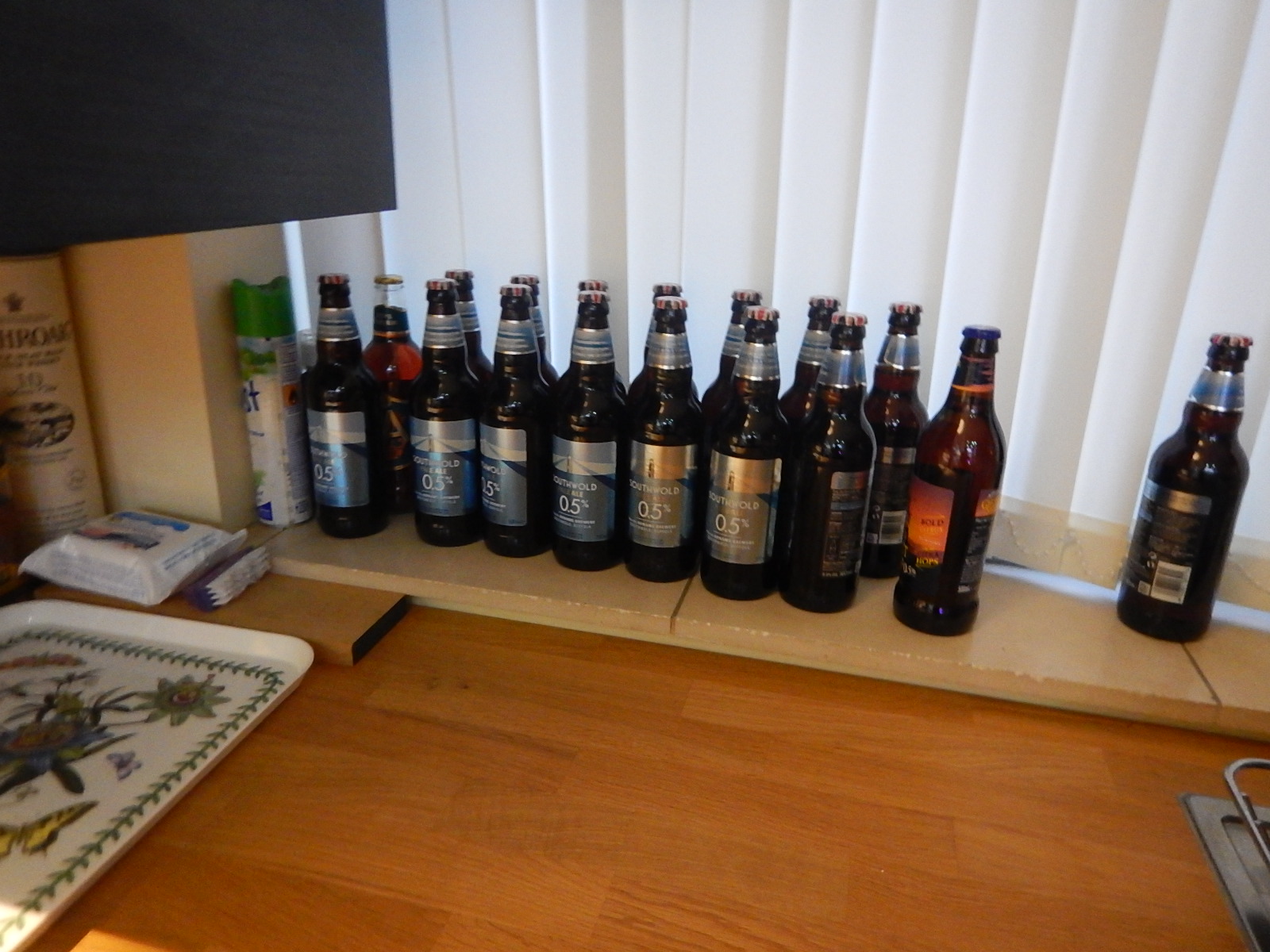
But then it’s all gluten-free, low-alcohol beer from Adnams, that tastes just like the halves from the same brewery, that my father used to buy for me sixty years ago.
My father didn’t want me to be the alcoholic his father was, so he introduced me to beer in social settings at an early age and now at seventy-three, I can honestly say, that, there are few times in my past, where I’ve got really drunk. So thank you, Dad!
But then my father was unconventional and didn’t follow the rules.
A year or so ago, I was reminded of a story about my father by someone I was at school with at Minchenden.
My father had ordered a new Vanden Plas Princess 1100 from a garage near the school. So one morning over breakfast, he asked the seventeen-year-old me, if I wouldn’t mind picking up the car after school and bring it home.
So after school, I picked up the car and took it home.
I can’t remember, if I gave any of my school-mates a lift. But I may have done!
Football
The one problem, I have is not being able to watch Premier League football on television, except on Match of the Day.
The Premier League have sold the Christmas rights to Amazon, which is a company, I don’t do business with!
Anyway, as the pictures come by broadband, I doubt I’d be able to watch it, as my broadband is crap.
BT told my MP, it’s because I’m too close to the exchange!
Conclusion
I’ll be OK. But then like my father, my sons and my granddaughter, we all seem happy in our own company.
I am also lucky in being coeliac on a gluten-free diet!
The more I research my health, the more I’m convinced that my genes have given me a strong immune system and that is protecting me from the covids.
But then, self-isolating by habit is not a bad trait in these terrible times.
New Form Of Solar Energy To Enter US Market
The title of this post, is the same as that of this article on abc News.
This is the first few paragraphs.
Organic energy is getting a jolt with the launch of GO-OPV’s ORENgE system in North America.
Organic energy uses a thin film panel to capture the sun’s rays and converts it to power, similar to traditional solar power.
The panels could be used for windows or trucks, phone or computer chargers, or it can be a building-integrated photovoltaics in glass.
This sounds good to me!
My South-facing windows make air-conditioning a must in my house.
But my air-conditioning broke in 2018 and no-one has been able to fix it!
This technology would sort it out in a trice!
Conclusion
This is technology to watch.
Report Reveals The Environmental Benefits HS2 Will Deliver
The title of this post, is the same as that of this article on Rail Technology Magazine.
This is the introductory paragraph.
A significant report from the High-Speed Rail Group has been published today and details how the environmental team working on HS2 are delivering connected, climate-resilient habitats at a new scale, raising ambition for future infrastructure projects.
The report also suggests that High Speed Two will bring forward other projects.
The Borders Railway
The article says this about the Borders Railway.
Besides providing capacity, an extended high-speed rail network could catalyse wider public transport upgrades, such as improving the case for reopening the Borders Railway to Carlisle.
It appears to me, that to go South, from towns like Galashiels, Hawick, Peebles and Selkirk will be quicker if you change at Carlisle to High Speed Two.
Battery Electric Trains On The Borders Railway
The Borders Railway could also be one, that is ideal for battery electric operation.
- It is already electrified at the Edinburgh end of the route.
- Newcraighall station, where the current wires end, is only thirty miles or so from the current end of the line at Tweedbank.
- Tweedbank and Hawick are about 15 miles.
- At the Southern end of the route it joins the West Coast Main Line to the North of Carlisle.
- Hawick and the West Coast Main are about 35 miles.
- The West Coast Main Line is fully electrified.
This Hitachi infographic gives the specification of their Regional Battery Train

As Hitachi and others are talking of trains with a range of over fifty miles on batteries, I can see a sensible plan evolving to run battery electric trains between Edinburgh and Carlisle.
- At both ends trains would join the Borders Railway with full batteries.
- It might be sensible to extend the electrification at both ends for perhaps five to ten miles.
- From the South trains could certainly reach Hawick and might possibly be able to reach Tweedbank.
- From the North trains could certainly reach Tweedbank and might possibly be able to reach Hawick.
I feel that by using the best of modern battery technology and with charging during extended stops at Hawick and Tweedbank, battery electric trains could work between Carlisle and Edinburgh.
Faradair’s BEHA Hybrid Aircraft Boosted By Partnerships
The title of this post, is the same as that of this article on AINonline.
This is the introductory paragraph.
Faradair, the UK company developing a hybrid-electric short takeoff and landing aircraft for applications including regional airline service, on Thursday announced four new risk-sharing partners. Honeywell, MagniX, Cambridge Consultants, and Nova Systems, have all signed up to contribute to the development of the Bio Electric Hybrid Aircraft (BEHA), which is expected to enter service in 2026.
Some points from the article.
- The aircraft is bio-electric as it is powered by a small gas-turbine generator, which drives a contra-rotating ducted fan, through a pair of electric-motors.
- It has a quick-change interior, that can handle 18 passengers or five tonnes of cargo.
- Range is given as 1,150 miles, with a service ceiling of 14,000 feet and a speed of up to 230 mph.
The Faradair web site gives other useful data.
- Wingspan is 57 ft.
- Length is 48 ft. 2 in.
The article also discloses an innovative way of marketing the aircraft, which looks to me, like a modern update to how the company I helped found; Metier Management Systems, leased Artemis project management computer systems, several decades ago.
Comparison With Eviation Alice
I must compare the Faradair BEMHA with the Eviation Alice.
The Alice can carry nine passengers.
- It cruises at 276 mph.
- Range is 620 miles
- Service ceiling is 12,500 ft.
- Wingspan is 52 ft. 11 in.
- Length is 43.3 ft.
The Alice would appear to be slightly smaller, with a shorter range.
- If you look at the pictures of the two aircraft on the Faradair and Eviation Alice web sites, you will see that they are radical designs.
- The Eviation Alice is fully electric, whereas the Faradair BEHA has a hybrid engine based on a small gas turbine running on aviation biofuel.
- Both aircraft use MagniX electric motors.
- Both aircraft fit into defined segments of the aviation market.
I very much believe that we’ll be seeing more unusual zero-carbon and carbon-neutral aircraft designs in the next few years.
A few thoughts.
Battery-Electric or Gas Turbine?
The Eviation Alice is solely powered by a battery, whereas the Faradair BMHA uses a hybrid engine based on a small gas turbine running on aviation biofuel.
Airbus built an experimental aircraft called the Airbus E-Fan X. This aircraft was to have used a gas-turbine and a battery. The aircraft was cancelled because of the Covid-19 pandemic.
So Faradair seem to be going a similar route to Airbus.
The AINonline article says this about Honeywell’s involvement.
Honeywell will support Faradair in producing a turbogenerator based on its gas turbine and generator technologies that is able to run on sustainable aviation fuel. The U.S. aerospace group will also contribute to other systems for BEHA, including avionics and flight controls.
According to Wikipedia, Honeywell certainly have lots of experience of small gas-turbine engines. They also make large numbers of auxiliary power units for aircraft.
The big disadvantage of the battery approach, is surely the weight of the battery, which needs to be large to have enough energy for the flight.
- But electric power also restricts the aircraft to airports with recharging facilities. This must reduce the flexibility of the aircraft.
- And also what happens after a diversion caused by weather, a passenger becoming unwell or some other circumstance, where the aircraft ends up at an airport with no handling for electric aircraft?
But with an aircraft that only needs sustainable aviation fuel, it can be filled up from a bowser used for small airliners and business jets, that are running on that fuel, as many will be.
If you want to be zero-carbon perhaps it would be better to fuel the gas-turbine with hydrogen.
Airbus seem to have come to that conclusion with their future plans, that I wrote about in ZEROe – Towards The World’s First Zero-Emission Commercial Aircraft.
I have a feeling that both Airbus and Faradair have shown, that to get enough range and for convenience, sustainable aviation fuel or hydrogen is better.
Nine Or Eighteen Seat?
Regulation has made nine- and nineteen-seats into niche markets and each developer is concentrating on a particular market.
- An airline that uses small airliners like Loganair, actually has aircraft in both groups.
- I suspect other airlines have similar mixed fleets.
- Cape Air, who are the lead customer for the Alice, only fly nine-seat aircraft.
The customer has a choice depending on the size of aircraft he needs.
Short Take-Off And Landing Capability
I have flown as a passenger several times in small airliners with a capacity of up to nineteen seats.
- Usually, they have been in a Cessna Caravan or Britten Normand Islander.
- In a couple of cases, the trip has involved a take-off or landing on a short or grass runway.
- Additionally, I have over a thousand hours in command of a Cessna 340, where I used on a lot of short runways.
I would feel that as a lot of small airports have short runways, that a short take-off and landing capability would be usefull or even a necessity for a small airliner.
Versatility
This Faradair press release is dated December 17th, 2020.
This paragraph details the aircrafts versatility.
The ambition is to deliver an initial portfolio of 300 Faradair®-owned BEHAs between 2026-2030, in the largest proof of concept air mobility programme ever created. Of these, 150 aircraft will be built in firefighting configuration, 75 as quick change (QC, passenger to cargo) aircraft, deployed at general aviation airfields globally, and 50 as pure freighters. The final 25 aircraft will be demonstrated in non-civilian government roles, including logistics, border and fisheries patrol, and drug interdiction.
Note.
I particularly like the quick-change variant.
As 125 aircraft can be used for freighters, has one of the large parcel carriers expressed an interest?
I must admit, I’m surprised that 150 aircraft will be needed in a firefighting configuration. Have they got a possible client?
To be continued…
New Device Separates Hydrogen From Natural Gas When The Two Gases Are Blended In Pipelines
The title of this post, is the same as that of on this article on Hydrogen Fuel News.
This is the introductory paragraph.
With clean hydrogen gaining recognition worldwide as the carbon-free fuel capable of making a significant contribution to addressing climate change, Southern California Gas Co. (SoCalGas) today announced it will field test a new technology that can simultaneously separate and compress hydrogen from a blend of hydrogen and natural gas.
It may sound rather mundane, but it means, you can convert surplus electricity into hydrogen and blend it with natural gas and distribute it in the local natural gas grid.
- As natural gas grids can contain a proportion of hydrogen, this shouldn’t be a problem.
- Any user, who needs hydrogen connects one of these clever devices to the grid and it separates out the hydrogen, for your use.
- All very simple and efficient, as you don’t need a second gas grid for hydrogen.
I very much like this idea, which was developed by a Dutch company called HyET Hydrogen.
There is also an explanatory video.
This invention could change the world!
 The Anonymous Widower