Two More Life-Saving Covid Drugs Discovered
The title of this post, is the same as this article on the BBC.
With all the reporting of the shenanigans going on with Trump in the United States, this important story seems to have been buried in the news.
This is the first two paragraph of the BBC articles.
Two more life-saving drugs have been found that can cut deaths by a quarter in patients who are sickest with Covid.
The anti-inflammatory medications, given via a drip, save an extra life for every 12 treated, say researchers who have carried out a trial in NHS intensive care units.
The drugs are tocilizumab and sarilumab, which appear to be readily available.
So what was that sore-loser Trump doing?
Certainly nothing to fight the most dangerous pandemic to hit the world for a hundred years.
If he had got to grips with the pandemic in the United States, his name would have gone down in history for all the wrong reasons.
Instead, he’ll be remembered for two words beginning with I; idiot and infamy.
Is There A Link Between Tocilizumab And Coeliac Disease?
I always check new drugs proposed for the covids against coeliac disease, ever since I found that Dexamethazone could be used to treat coeliacs, who couldn’t stick to a gluten-free diet.
I found nothing for sarilumab, but I did find this article for tocilizumab (Actemra), which is entitled Will You Have Celiac Disease With Actemra?.
This is the summary.
Celiac disease is found among people who take Actemra, especially for people who are female, 50-59 old, have been taking the drug for 1 – 6 months.
The phase IV clinical study is created by eHealthMe based on reports of 55,370 people who have side effects when taking Actemra from the FDA, and is updated regularly.
Strange! Like the incorrect American spelling!
Ecotricity Seals 10-year Agreement To Take Geothermal Power From Cornish Plant
The title of this post, is the same as that of this article on Energy Live News.
This is the first two paragraphs
British utility Ecotricity has sealed a power purchase agreement (PPA) to buy geothermal electricity from Geothermal Engineering Limited.
The ten-year PPA will see a minimum of 3MWh of baseload electricity produced by the United Downs demonstration project in Cornwall being distributed to power the equivalent of 10,000 homes every year.
The article also says that this is the first time geothermal electricity has been produced and sold in the UK.
The remarkable thing, is that the same site will be used by Cornish Lithium for a pilot plant to extract lithium.
It does look like the Cornish will both have their cake and eat it!
As rum is also going to be matured using more of the energy, as I wrote about in And Now Geothermal Rum From Cornwall!, they’ll also be able to drink it as well!
High Speed Rail Group Calls For Cross-Irish Sea Rail Tunnel
The title of this post, is the same as that of this article on Infrastructure Intelligence.
This is the first paragraph.
The High Speed Rail Group (HSRG) has called for a cross-Irish Sea rail tunnel to be built as part of seven key transport improvements to “strengthen the union between the four nations of the UK”.
The Irish Sea tunnel is only one of the projects proposed.
The full list of improvements is as follows.
- Glasgow/ Edinburgh – London
- Birmingham/ Manchester – Glasgow/ Edinburgh
- Cardiff – Birmingham – Newcastle – Edinburgh
- Cardiff – Liverpool/Manchester
- Galashiels/Hawick – Carlisle
- Manchester Airport – Chester – Bangor – Holyhead
- Edinburgh/Glasgow and London – Belfast
I think these extensions are logical and in Could High Speed Two Be A One-Nation Project?, I proposed that High Speed Two be extended into a railway that link the whole of Great Britain and Ireland together.
Lockdown Scepticism Is Part Of The Brexit Divide
The title of this post, is the same as that of an article on the London School of Economics web site.
It is a must-read article about the views of the British on lock-down.
This is a paragraph.
Additionally, there are indications that lockdown scepticism is becoming increasingly entwined with the Leave/Remain divide that dominates most aspects of British politics. Many pro-Brexit Tory MPs are increasingly critical of the high costs of lockdown on individual freedoms and the economy and have been pushing, both publicly and privately, for easing of the restrictions.
If this view is reflected in the general population, will it increase your chance of Brexiteers getting the Covids, simply because they may be more tempted to break the rules?
Northern Line Extension ‘On Track’ For 2021 Opening
The title of this post, is the same as that of this article on Transport Network.
I’m looking forward to using the line in the Autumn.
This map from cartometro.com, shows the track layout of the extension.

Note.
- The extension starts from the existing Kennington Loop at Kenning station.
- There is an intermediate station at Nine Elms.
- As with many two-platform stations, there is a cross-over in the approach. It is shown in a picture in the article.
Hopefully, the extension will eventually be extended to Clapham Junction.
Step-Free Interchange At Kennington Station
I have been worried about this and from the comment of others like Melvyn, I am not alone.
This map from cartometro.com, shows the track layout at Kennington station.
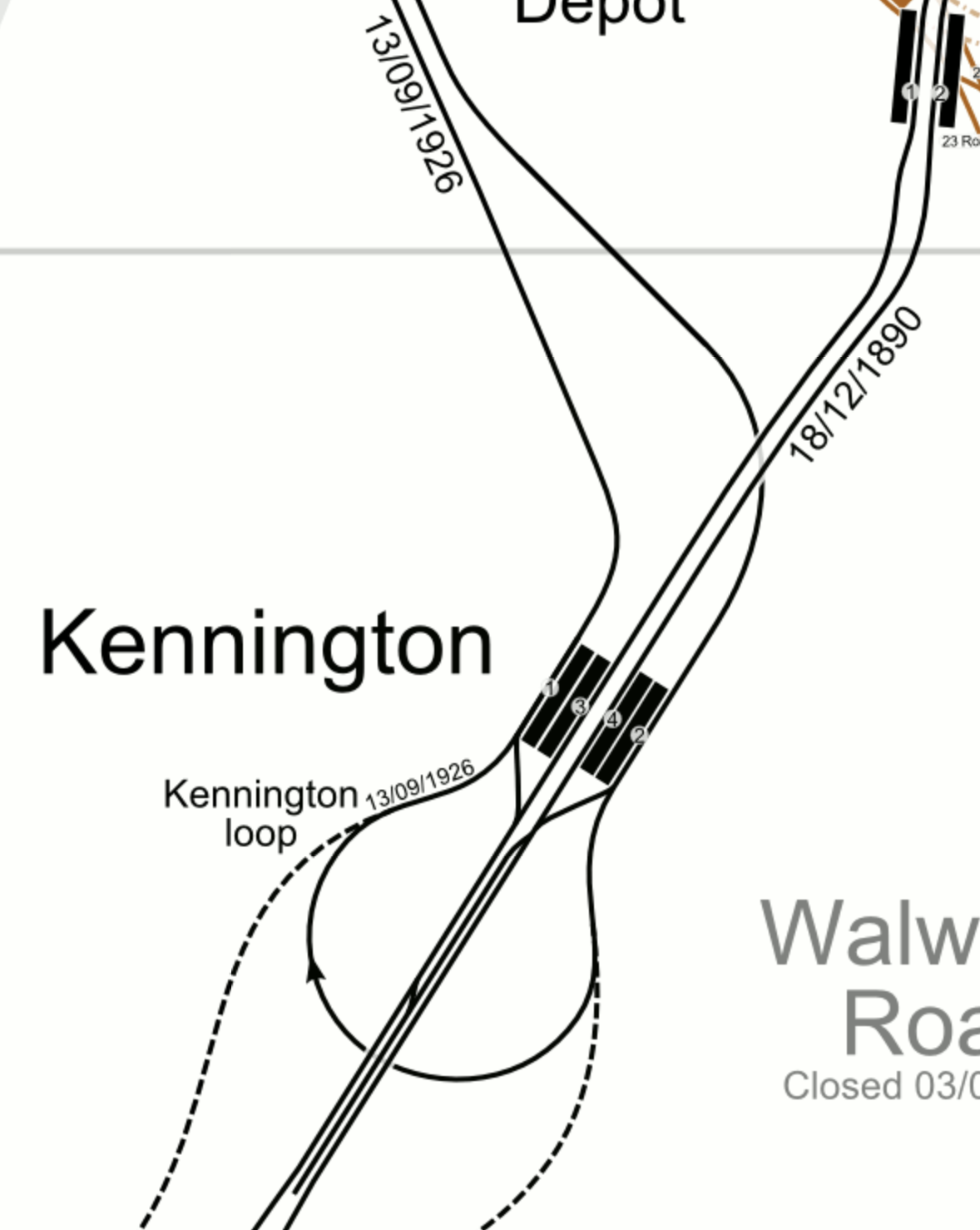
Note.
- Elephant and Castle station is at the North-East corner of the map and is on the Bank branch of the Northern Line.
- The pair of tracks going North-West are the Charing Cross branch of the Northern Line.
- The pair of tracks going South-West are the Morden branch of the Northern Line.
- Trains going South to Morden can use either Platform 2 or 4, depending, whether they have come Charing Cross or Bank.
- Trains going North from Morden can use either Platform 1 or 3, depending, whether they are going to Charing Cross or Bank.
- The Kennington Loop allows trains from Charing Cross that arrive in Platform 2 to go direct to Platform 1 to return to the North.
- There appears to be a revering siding, which can also reverse trains from either Platform 2 or 4 and send them North from Platform 1 or 3.
- Chords South of the platforms allow trains to and from Charing Cross to access the tracks to Morder and the reversing siding.
- The Battersea Power Station branch, is shown in dotted lines and connects to the Kennington Loop.
I took these pictures at Kennington station today.











Note.
The platforms are in two pairs, which are connected by walk-through passages, with Platforms 2 and 4 for Southbound trains and Platforms 1 and 3 for Northbound trains.
- Each platform has a proper clock.
- The only access to the pair of platforms is by steep long stairs.
- The stairs need to be rebuilt with proper handrails on both sides.
- The last picture shows the handrails at Moorgate station.
Currently, the system allows journeys between the North and Morden, either directly or with a walk-across change at Kennington station.
- Going South to Morden, if you get a train, that reverses at Kennington, you would wait for a train to turn up on either Platform 2 or 4, that is going the whole way.
- Going North from Morden, if you get a train going to the wrong Northern destination, you would get off at Kennington and wait for a train to turn up on either Platform 1 or 3, that is going to the destination you desire.
What is needed on all platforms, is more comprehensive information displays.
- Displays on Platforms 2 and 4, would show details of all Southbound trains. whether they terminated at Kennington or went to Morden, or in future went to Battersea Power Station station.
- Displays on Platforms 1 and 3, would show details of all Northbound trains.
Displays would indicate destination and time as now, but with the addition of platform, where you catch the train.
If there is one problem it is taking a train between Battersea Power Station and Morden stations.
This public domain drawing from the Internet shows the station, after the Kennington Loop had been built in the 1920s and 1930s.
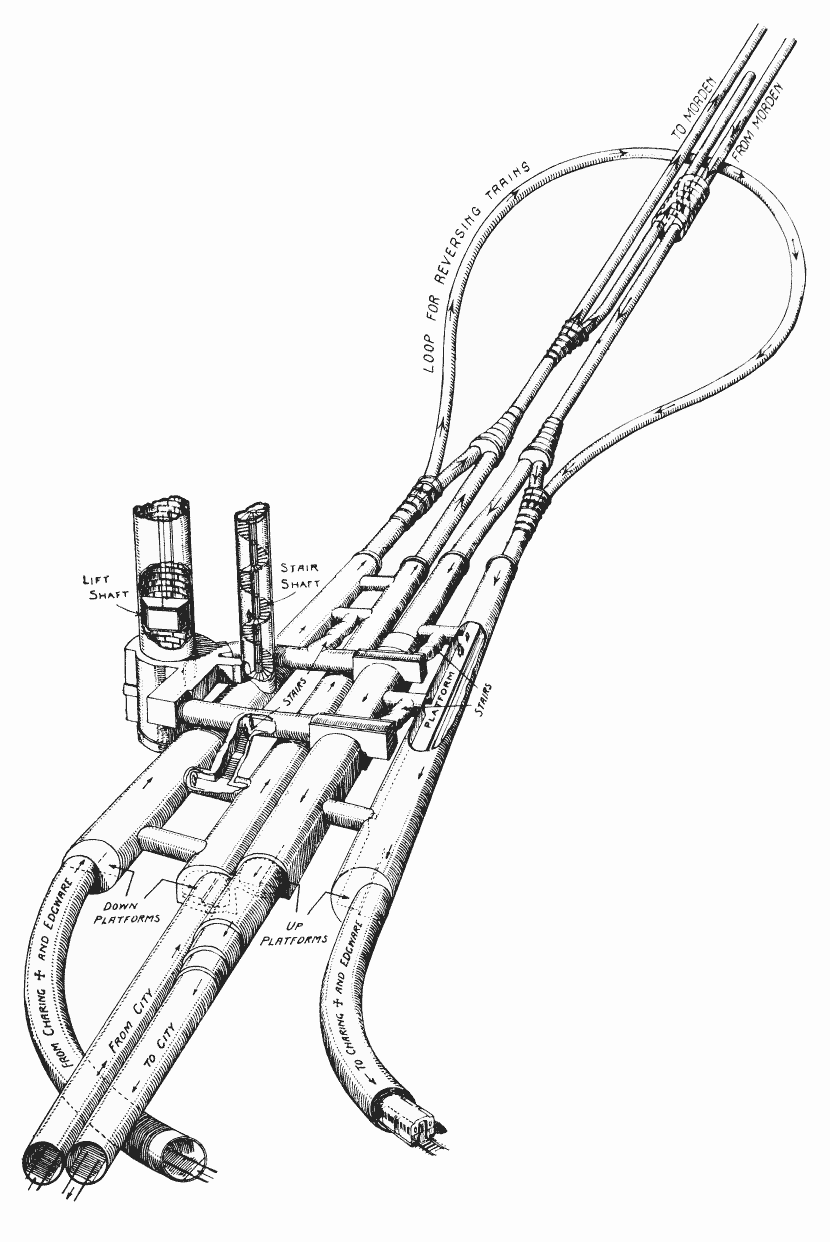
Note.
- We are looking from the North.
- The Kennington Loop at the far end of the station.
- The four platforms of the station numbered 2, 4, 3 and 1 from left to right.
- The stairs between the two pairs of platforms, leading to overbridges.
- The lift tower and a spiral staircase leading to and from the surface.
I can now sum up the step-free status of the station.
- Passengers entering or leaving the station, must walk up or down a staircase like that shown in the first picture.
- Passengers needing to change to another train going in the same direction, just walk across to the other platform in the pair.
- Passengers needing to change to another train going in the opposite direction, as they would going between Battersea Power Station and Morden stations, will need to climb one set of stairs and descend another.
It does appear that in an ideal world lifts will need to be added.
Thoughts On Future Step-Free Access At Kennington Station
In the future, it is planned that the Northern Line will be split into two lines.
- Battersea Power Station and Edgware
- Morden and High Barnet
Will this increase the number of passengers, who need to do the opposite direction change, as there will just be more trains running on all branches?
Alternative Step-Free Access
But, there may be another way to go between Battersea Power Station and Morden stations.
- Take a train from Battersea Power Station to Waterloo.
- Walk across the platform at Waterloo to the Southbound platform.
- Take a train from Waterloo back to Kennington.
- Walk across from Platform 2 at Kennington to Platform 4.
- Take the first train from Platform 4 to Morden.
The reverse journey between Morden and Battersea Power Station stations would be.
- Take a train from Morden to Kennington.
- Walk across from Platform 3 at Kennington to Platform 1
- Take a train from Platform 1 to Waterloo.
- Walk across the platform at Waterloo to the Southbound platform.
- Take the first train from Waterloo to Battersea Power Station.
Note,
- Both routes have two changes; one at Kennington and one at Waterloo,
- All changes are step-free.
- All changes are very simple
It should also be noted that Battersea Power Station, Nine Elms and Waterloo are all or will be fully step-free stations.
The two routes I have outlined have one big advantage. They already exist and the only costs would be training of staff and indicating the routes to passengers.
Likelihood Of Dying From A Positive Test For The Covids
Bob, one of my mentors on making sense of data always suggested looking at ratios, when you wanted to investigate a database.
These ratios are the chance of dying after a positive test for Covid-19 in various places in the UK, based on Government statistics.
At the moment, the ratios are mainly from England, but I may expand them with time.
Countries
- England – 2.8 %
- Northern Ireland – 1.7 %
- Scotland – 3.3 %
- Wales – 2.3 %
Regions
- London – 2.0 %
London Boroughs
- Barking and Dagenham – 1.9 %
- Barnet 2.4 %
- Bexley – 2,0 %
- Brent – 3.0 %
- Bromley – 2.0 %
- Camden – 1.7 %
- Croydon – 2.8 %
- Ealing – 2.1 %
- Enfield – 10.1 %
- Greenwich – 1.8 %
- Hackney – 1.7 %
- Hammersmith and Fulham – 1.8 %
- Haringey – 1.8 %
- Harrow – 2.9 %
- Havering – 2.8 %
- Hillingdon – 2.1 %
- Hounslow – 2.1 %
- Islington – 1.5 %
- Kensington and Chelsea – 2.1 %
- Kingston upon Thames – 2.2 %
- Lewisham – 2.3 %
- Merton – 2.5 %
- Newham – 1.7 %
- Redbridge – 2.1 %
- Richmond upon Thames – 2.3 %
- Southwark – 1.4 %
- Sutton – 2.2 %
- Tower Hamlets – 1.1 %
- Waltham Forest – 1.9 %
- Wandsworth – 1.9 %
- Westminster – 2.0 %
Big Cities
- Belfast – 1.9 %
- Birmingham 2.8 %
- Bradford – 2.3 %
- Bristol – 1.3 %
- Cardiff – 2.5 %
- Coventry – 2.3 %
- Derby – 3.3 %
- Edinburgh – 3.4 %
- Glasgow – 3.0 %
- Hull – 3.1 %
- Leeds – 2.1 %
- Leicester – 1.9 %
- Liverpool – 2.6 %
- Manchester – 1.9 %
- Newcastle – 1.8 %
- Nottingham – 1.9 %
- Sheffield 2.6 %
Medium-Sized Towns and Cities
- Blackpool – 4.6 %
- Bolton – 3.0 %
- Bournemouth, Christchurch and Poole – 2.4 %
- Brighton and Hove – 1.9 %
- Luton – 2.6 %
- Middlesbrough – 2.8 %
- Milton Keynes – 2.0 %
- Peterborough – 2.2 %
- Plymouth – 2.2 %
- Portsmouth – 1.8 %
- Reading – 3.0 %
- Rotherham – 4.0 %
- Salford – 2.9 %
- Southampton 2.1 %
- Southend-on-Sea – 3.0 %
- Stoke-on-Trent 3.5 %
- Stockport – 3.2 %
- Sunderland – 3.8 %
- Wakefield – 3.1 %
- Warrington – 2.8 %
- Wigan – 3.8 %
- Wolverhampton – 2.9 %
- York 2.0 %
English Countryside
- Bath and North East Somerset – 1.6 %
- Bedford – 3.7 %
- Buckinghamshire – 2.3 %
- Cambridgeshire – 2.6 %
- Central Bedfordshire – 3.7 %
- Cheshire – 4.0 %
- County Durham – 3.5 %
- Cumbria – 4.1 %
- Derbyshire – 3.6 %
- Devon – 3.0 %
- Dorset – 3.4 %
- East Riding of Yorkshire – 4.0 %
- Essex – 2.7 %
- Gloucestershire – 4.6 %
- Hampshire – 3.3 %
- Herefordshire – 7.8 %
- Hertfordshire – 8.3 %
- Isle of Wight – 3.4 %
- Kent – 2.9 %
- Lancashire – 3.1 %
- Leicestershire – 2.9 %
- Lincolnshire – 3.9 %
- Medway – 2.6 %
- Norfolk – 3.2 %
- North Yorkshire – 3.1 %
- Northamptonshire – 3.7 %
- Northumberland – 3.6 %
- Nottinghamshire – 3.0 %
- Oxfordshire – 2.0 %
- Redcar and Cleveland – 3.2 %
- Rutland – 3.3 %
- Shropshire – 4.0 %
- Staffordshire – 4.0 %
- Sussex – 3.0 %
- Suffolk – 4.9 %
- Surrey – 2.8 %
- Torbay – 4.0 %
- Warwickshire – 3.6 %
- Windsor and Maidenhead – 2.6 %
- Worcestershire – 4.0 %
Miscellaneous
- Cornwall and Isles of Scilly – 2.8 %
- Highland – 2.7 %
- Isle of Wight – 3.4 %
- Orkney Islands – 5.1 %
- Scottish Borders – 3.8 %
- Shetland Islands – 4.7 %
Note that all values are rounded to one decimal place.
Conclusions
Can I draw any conclusions from the data.
The Four Countries
The mean for the whole of the UK, is 2.8 %, which is the same as England.
- Given that England is the largest country, this is not surprising.
- But why is Scotland at 3.3 % higher than England and Northern Ireland and Wales substantially better than England?
Is this a result of devolution? Or a result of national character?
Town Or Country
Looking at English cities and larger towns, their values seem to be lower than the countryside.
I wonder why this is?
To be continued…
Hydrogen Fuel ‘In Time For COP26’ For Glasgow
The title of this post, is the same as that of this article on Brinkwire.
This is the introductory paragraph.
The companies behind the plans for a new £ 45 million hydrogen production facility in central Scotland have announced the site of the facility, which is planned to be partially operational prior to the delayed COP26 conference in Glasgow next year.
The article gives a lot of useful information including.
- The plant is at Lesmahagow as I reported in Plans For £45m Scottish Green Hydrogen Production Plant Revealed.
- It will initially have a 9 MW electrolyser, which could be upgraded to 20 MW.
- When fully-developed is could create a thousand tonnes of hydrogen per year.The hydrogen will be used to power buses in Aberdeen and Glasgow.
Construction could start this year.
Foresight Partners With CNG Fuels To Deliver Carbon-Neutral UK Transport Network As Demand For Clean Fuels Grows
The title of this post is the same as that of this press release from the Foresight Group.
These four bullet points introduce the document.
- Two Foresight investment funds have partnered with CNG Fuels to acquire and grow a strategic network of biomethane HGV refuelling stations across the UK
- CNG Fuels is the UK’s dominant supplier of renewable biomethane compressed natural gas for the UK’s truck sector
- Transport sector emissions accounted for 34% of UK emissions in 2019
- Biomethane-refuelling technologies reduce carbon emissions by 80+% and lower operating costs and improve air quality.
This web page is the home page of the CNG Fuels web site.
Judging by the picture on the CNG Fuels have Waitrose as a customer.
It looks to me, that Foresight Group and CNG Fuels are companies to watch, as biomethane or renewable natural gas, produced from food waste could be a valuable alternative fuel to decarbonise trucks.
Fuel Cell Enabling Technologies, Inc. Announces First Major Customer, Signs Memorandum of Understanding Regarding Purchase of Fuel Cells for Locomotives
The title of this post, is the same as that of this article on Cision.
This is the introductory paragraph.
Fuel Cell Enabling Technologies, Inc. (FCET), a start-up energy technology company that has developed a novel, low-cost solid oxide fuel cell (SOFC) system, has announced a memorandum of understanding (MOU) with NextGenPropulsion, LLC (NGP) indicating NGP’s intent to purchase FCET fuel cells for NGP light-rail trains and freight locomotives. In addition to fuel cell orders, this would mean engineering collaboration between the two firms, each bringing its specific and considerable expertise to these projects.
I have been saying that hydrogen freight locomotives are certain to be ordered in a few years.
Hydrogen-powered freight locomotives, are in my opinion, the logical way of decarbonising rail freight.
A Thought On Covid-19
I am a Control Engineer, Mathematical Modeller and Statistician and have been following the data since the pandemic started.
Consider.
- Systems like the pandemic want to get to an equilibrium. And preferably one where they are in control. The virus tries to infect more people, so they can pass it on.
- But anybody, who is immune to the virus acts as a moderator does in a nuclear reactor, to slow the reaction down. So the more, who are immune in the population the better.
- As of today, 2,713,563 have tested positive for the virus and sadly 75,431 have died. That means at least 2.6 million have had the virus and survived. Are these people now immune to the virus? If they are, can they be added to those who are vaccinated?
- Also, how many people have had the virus and were not tested, but treated it like they might a cold? Are these safe from the virus, a second time around?
- What about children, who seem to have lower susceptibility to the virus?
- We can add in by the end of this week over a million, who have received the vaccine.
- We are at the present time having about 350,000 positive tests in a week. If these people with positive tests isolate as they should, that will be breaking the transmission of a lot of carriers.
- And then if the vaccine makers deliver two million a week and they are all used, that takes a lot of people out of the mix.
- How many people are shielding or working from home and never giving the virus a chance to infect them? It must be a couple of million.
These are all big numbers, but most of them are on our side and not that of the virus.
I watched BBC News at six and Emma Vardy said that in Northern Ireland, the vaccine might be having a positive effect. I wouldn’t have expected that this early!
I am more optimistic, than I was before I started to write this post.
Could the combination of lockdown and increasing numbers of vaccinations cut the rate of transmission of the virus?
 The Anonymous Widower