Amazon Backs Reopening Rail Line To Passengers
The title of this post, is the same as that of this article on Derbyshire Live.
This is the introductory paragraph.
A campaign to reopen a railway line to passengers between Burton and Leicester has been backed by businesses such as Amazon in a major step forward.
This sounds positive.
Thoughts On The Design Of Hitachi’s Battery Electric Trains
If you look at a Class 800 or Class 802 train, they have underfloor diesel engines. Their powertrain is described like this in its own section in Wikipedia.
Despite being underfloor, the generator units (GU) have diesel engines of V12 formation. The Class 801 has one GU for a five to nine-car set. These provide emergency power for limited traction and auxiliaries if the power supply from the overhead line fails. The Class 800 and Class 802 bi-mode has three GU per five-car set and five GU per nine-car set. A five-car set has a GU situated under vehicles 2/3/4 and a nine-car set has a GU situated under vehicles 2/3/5/7/8.
There have been rumours of overheating.
Hitachi’s Regional Battery Train
Hitachi have teamed up with Hyperdrive Innovation to create a Regional Battery Train. There is this Press Release on the Hyperdrive Information web site, which is entitled Hitachi Rail And Hyperdrive Agreement P[ens Way For Battery Trains Across Britain.
This Hitachi infographic gives the specification.

Note, that this is a 100 mph train, with a range of 56 miles.
Typical routes would include a route like Norwich and Stansted Airport via Cambridge.
- It is 93 miles.
- There are thirty-nine miles of electrification at the Stansted Airport end.
- Norwich station is fully-electrified.
- There is just 53 miles between the Trowse swing-bridge and Ely station, that is not electrified.
Trains would charge the batteries at both ends of the route and use battery power, where no electrification exists.
There are many similar routes like this in the UK.
Hitachi have also produced this video.
My thoughts lead me to a few questions.
Are The Battery Modules Simulated Diesel Engines?
At the age of sixteen, for a vacation job, I worked in the Electronics Laboratory at Enfield Rolling Mills.
It was the early sixties and one of their tasks was at the time replacing electronic valve-based automation systems with new transistor-based systems.
The new equipment had to be compatible to that which it replaced, but as some were installed in dozens of places around the works, they had to be able to be plug-compatible, so that they could be quickly changed. Occasionally, the new ones suffered infant-mortality and the old equipment could just be plugged back in, if there wasn’t a spare of the new equipment.
Stadler have three very similar trains, that are destined for the UK.
- Class 755 trains for Greater Anglia are already in service.
- Class 231 trains for Transport for Wales are on order.
- Class 756 trains for Transport for Wales are on order.
All share the same PowerPack-in-the-Middle design, which is shown in this picture.

There are four slots in the PowerPack, with two on either side and they can all hold, either a diesel engine or a battery. Only, the Class 756 trains, are planned to have batteries at present, to make the trains tri-mode and capable of being powered by overhead electric, on-board batteries or a diesel generator.
If I was designing the battery modules to slot into the PowerPack, I and many other engineers would make the battery module deliver similar characteristics and plug compatibility to the diesel module.
The train’s control computer, would be simpler to program and debug and would use modules appropriately to drive the train according to the driver’s instructions.
This interchangeability would also give the operator lots of flexibility, in how they configured and used the trains.
So will Hyperdrive Innovation use an approach for Hitachi, where the battery module has similar characteristics and plug compatibility to the current diesel module?
I wouldn’t be surprised if they did, as it allows modules to be quickly swapped as operational needs change and the train’s computer sorts out the train’s formation and acts accordingly.
On An Hitachi Regional Battery Train Will All Diesel Engines Be Replaced With Battery Modules?
If the computer is well-programmed, it should handle any combination of diesel engines and battery modules.
Perhaps for various routes different combinations might apply.
- For maximum battery range, all modules would be batteries.
- For maximum power, all modules would be diesel engines.
- To handle some out and back routes, there might be three battery modules and a diesel engine to charge the batteries before return.
- Could perhaps one or two battery modules be fitted to avoid using the diesel engines in stations and in sensitive areas?
On some routes all diesel engines will be replaced with batteries on Battery Regional Trains, but on others there could be a mixture of both battery and diesel engines.
It should be noted that Stadler achieve the same flexibility with their PowerPack-in-the-Middle design.
Operators will like this flexibility.
What Is The Capacity Of A Battery Module?
In How Much Power Is Needed To Run A Train At 125 mph?, I calculated that an all-electric Class 801 train uses 3.42 kWh per vehicle mile.
I can do a simple estimate based on this figure.
When running on batteries the train will need less energy due to less air resistance, because it is going at 100 mph, rather than 125 mph.
- If the energy use is proportional to the speed, then at 100 mph, the energy use will be 2.73 kWh per vehicle mile.
- But if the energy use is proportional to the square of the speed, the energy use will be 2.19 kWh per vehicle mile.
I will compromise and use 2.5 kWh per vehicle mile.
Total energy needed to move a five-car train 56 miles would be 5 x 56 x 2.5 or 700 kWh, which could be three batteries of 233 kWh.
These are not outrageous sizes and the batteries could probably be of a comparable weight to the current diesel engines. So replacement wouldn’t affect the handling of the train.
In addition, the batteries would need to be large enough to hold all the regenerated by braking during a stop.
- The weight of a Class 800 train is 243 tonnes.
- It can carry 326 passengers, who probably weigh 80 Kg with baggage, bikes and buggies.
- This gives a total train weight of 269 tonnes.
- Using Omni’s Kinetic Energy Calculator, the kinetic energy at 100 mph is just 75 kWh.
- For completeness, at 125 mph, the kinetic energy is 117 kWh and at 140 mph, the kinetic energy is 146 kWh.
All these figures are small compared to the battery size needed for traction.
Will East Coast Train’s Class 803 trains Use The Same Technology?
On East Coast Trains‘s Class 803 trains, batteries will be fitted to maintain onboard services, in case of a power failure.
Have these batteries been designed by Hyperdrive Innovation, with perhaps less capacity?
As East Coast Trains’s route between London Kings Cross and Edinburgh is fully electrified, the trains probably won’t need any auxiliary traction power.
But would increasing the battery size make this possible?
Where Do Avanti West Coast Class 807 Trains Fit In?
Avanti West Coast‘s Class 807 trains are also members of the same Hitachi A-Train family.
In the January 2020 Edition of Modern Railways, there is an article, which is entitled Hitachi Trains For Avanti.
This is said about the ten all-electric AT-300 trains for Birmingham, Blackpool and Liverpool services, which have now been numbered as Class 807 trains.
The electric trains will be fully reliant on the overhead wire, with no diesel auxiliary engines or batteries.
It may go against Hitachi’s original design philosophy, but not carrying excess weight around, must improve train performance, because of better acceleration.
It may also have the wiring for a diesel engine or a battery module, should operational experience indicate one is needed.
Will All Cars Be Wired Ready For A Diesel Or Battery Module?
A five-car Class 802 train currently has a diesel engine in cars 2, 3 and 4.
The Hitachi infographic says that a Regional Battery Train has a range of 56 miles on batteries.
Let’s assume that this range applies to a Class 802 train, that has been fitted with three battery modules.
If we take Hull Trains as an example, their Class 802 trains do the following sections using their diesel engines
- Temple Hirst Junction and Beverley – 44.34 miles or 87 miles round trip
- Temple Hirst Junction and Hull – 36 miles or 72 miles round trip
These distances mean that with a 56 mile range, there needs to be some form of changing at Hull and/or Beverley.
But supposing all cars are wired to accept batteries or diesel engines. This could mean the following.
- A train with three batteries and a range of 56 miles, could fit a standard diesel engine as a range extender, which could also be used to charge the batteries at Hull or Beverley.
- A train with four batteries, could have a range of 75 miles, which with regenerative braking and precise energy-saving driving could be able to go between Temple Hirst Junction and Hull and back on battery power.
- A train with four batteries and a diesel engine,, could have a range of 75 miles on battery power. The diesel energy could be used as a range extender or to charge the batteries at Hull and/or Beverley.
- Could a train with five batteries, which could have a range of 90 miles, be able to reach Beverley and return to Temple Hirst Junction?
Note.
- I have assumed that battery range is proportional to the number of batteries.
- There must also be scope for running slower to cut the amount of energy used.
In addition, all Hull Trains schedules seem to spend fifteen minutes or more in Hull station. This would be enough time to recharge the batteries.
I’m fairly certain, that if all cars were wired for batteries or diesel engines, it would give the operators a lot of flexibility.
Running With Batteries And A Range Extender Diesel Engine
The LEVC TX taxi is described as a plug-in hybrid range extender electric vehicle, where a small petrol engine, can also be used to generate electricity to power the vehicle.
Suppose a Class 802 train was fitted with two battery modules and a diesel engine. Could the diesel act as a range extender, in the same way as the petrol engine does on the LEVC TX?
The diesel engines fitted to a Class 802 train are 700 kW, so if I’m right about the train having total battery capacity of 700 kWh, one engine would take an hour to charge the batteries.
Returning to my Hull Trains example, drivers could probably ensure that the train didn’t get stranded by judicial use of the a single diesel engine to charge the batteries, whilst running in rural areas along the route.
As there would only be one diesel engine rather than three, the noise would be much lower.
I suspect too, that a simple charger in Hull station could charge a train, as it passes through, to make sure it doesn’t get stranded in the countryside.
I suspect that a mix of batteries and diesel engines could be part of an elegant solution on some routes.
- Edinburgh and Aberdeen
- Edinburgh and Inverness
- London Kings Cross and Hull
- London Paddington and Swansea
- London St. Pancras and Sheffield.
- London St. Pancras and Nottingham
It might also be a useful configuration on some TransPennine routes.
Charging Battery Trains
Having a charger in a terminal station would open up a lot of routes to Hitachi’s battery electric trains.
At stations like Hull and Scarborough, this charger could be as simple as perhaps forty metres of 25 KVAC overhead electrification.
- The train would stop in the station at the appropriate place.
- The driver would raise the pantograph.
- Charging would start.
- When the battery is fully-charged, the driver would lower the pantograph.
This procedure could be easily automated and the overhead wire could be made electrically dead, if no train is connected.
It should be noted that Hitachi have recently acquired ABB’s power grid business, as announced in this Hitachi press release which is entitled Hitachi Completes Acquisition of ABB’s Power Grids Business; Hitachi ABB Power Grids Begins Operation.
Rail is not mentioned, but mobility is. So will this move by Hitachi, strengthen their offering to customers, by also providing the systems in stations and sidings to charge the trains.
This Google Map shows Hull station, with its large roof.
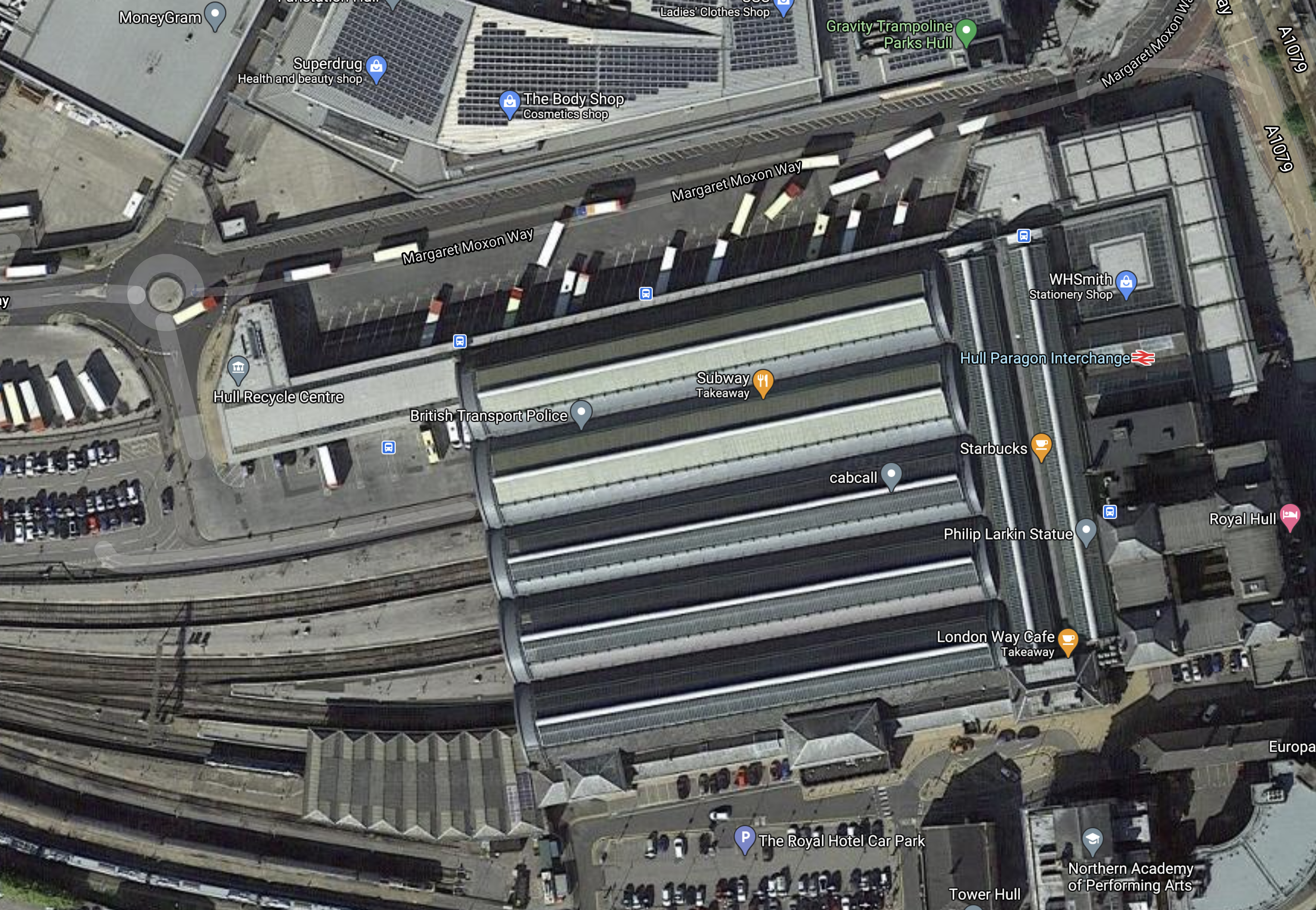
Could an integrated solution involving solar panels over the station be used to power electrification to charge the trains and dome electric buses next door?
Integrated solutions powered by renewable energy would appeal to a lot of municipalities seeking to improve their carbon profile.
Conclusion
These trains will transform a lot of rail services in the UK and abroad.
Why The Covids Are Worse In The North
Dr. Chris Smith is BBC Radio 5’s tame virologist and he talks more sense than most on the Covids.
Asked by Adrian Chiles, why the Covids are worse in the North, he made following points.
- The Covids are following a similar pattern to flu.
- Flu tends to like colder climate, so is more prevalent in the North.
- He also indicated, that because London had a bad dose of the Covids earlier in the year, London may be closer to some form of herd immunity.
If you can catch-up with what he said, it’s probably worth a listen.
Greater Anglia Amends Class 720 Order From Bombardier To Increase Flexibility
The title of this post is the same as that of this article on Rail Advent.
Greater Anglia is changing its order for Class 720 trains from a mixed fleet of 22 x ten-car and 89 x five-car to one of 133 x five-car.
The order is still 665 carriages in total.
In Why Do Some Train Operators Still Buy Half-Trains?, I tried to answer the question in the title of the post.
There have also been articles in railway magazines, questioning the practice of buying short trains and doubling them up.
In the UK, the following companies are running new trains in pairs.
- Great Western Railway – Class 800 and Class 802
- LNER – Class 800
- London Overground – Class 710
The only creditable explanation I have heard was from a driver, who said that if one train in a pair fails, you can still run a short train.
Abd now Greater Anglia say it’s for increased flexibility!
Another Product From Hyperdrive Innovation
My Google Alert for Hyperdrive Innovation has picked up this article on Yahoo, which is entitled RBW EV Roadster Is An Electric Take On The Classic MGB.
This is a paragraph from the article.
Managing Director Peter Swain said: “Our patented system places the electric motor at the rear of the car and Hyperdrive Innovation’s lithium-ion battery technology under the bonnet, which gives perfectly balanced weight distribution. Not only does this give the driver much better handling of the car, retaining that sports car feel, but it also affords maximum battery volume to be housed.
As Hyperdrive Innovation are a partner in Hitachi’s Regional Battery Train, does the MGB go like an electric train?
If I still drove a car, I would buy one.
Having driven a few classic roadsters in my time, what is said about the handling of the car is probably true and I could envisage a small manufacturer building a roaster to that design from scratch.
I used to work with a former Engineering Director of Lotus Cars. After his stories about the great Colin Chapman, I’m sure that fertile brain would now be designing an electric roaster to fit the niche of the classic Lotus Seven and Lotus Elan.
- Simple, but strong, steel or aluminium chassis.
- Fibreglass body
- Battery in the front.
- If the battery was well-forward, it would improve crashworthiness in a head on crash.
- Rear wheel drive.
We are uniquely positioned in the UK, with our motor racing heritage to design and build such a car in the UK.
Birmingham Announces Hydrogen Bus Pilot
The title of this post, is the same as that of this article on SmartCitiesWorld.
This is the introductory paragraph.
The city council has bought 20 new hydrogen double-decker buses as part of its Clean Air Hydrogen Bus Pilot to kick-start the hydrogen market as a viable zero-emission fuel.
The buses will be built by Wrightbus.
Waste-to-Hydrogen Project Set For California
The title of this post, is the same as that of this article on Power Magazine.
This is the introductory paragraph.
A California company that produces renewable hydrogen has joined with a Louisiana construction group on a project to build a modular waste-to-hydrogen production facility.
These are some further points.
- The Californian company; Ways2H, also has a project in Japan.
- They aim to setup a pipeline of projects in 2021.
- The California Energy Commission has said the state is short of green hydrogen.
- The process can use paper and plastic waste or municipal solid waste.
- They can also handle medicinal waste.
- The systems appear to be transportable.
This paragraph is from the article.
Kindler said his company could produce “white hydrogen,” because the company’s process, which uses very high temperatures to turn waste plastics, wood, rubber and other biomass into gas and a carbon solid, can be used to sequester carbon dioxide and store it underground.
It looks to me, that if they make this system work, they will have found an alternative way to make hydrogen, by a zero-carbon method.
Conclusion
Could we see one of these plants in every local authority in the world to process all their waste into hydrogen?
I suspect in Ways2H’s plan for world domination, this is one of their objectives.
The Changing Face Of Silicon Roundabout – 7th October 2020
I took these pictures, as I walked round Silicon Roundabout this morning.























The area is certainly changing.
This map from Transport for London shows the future layout.
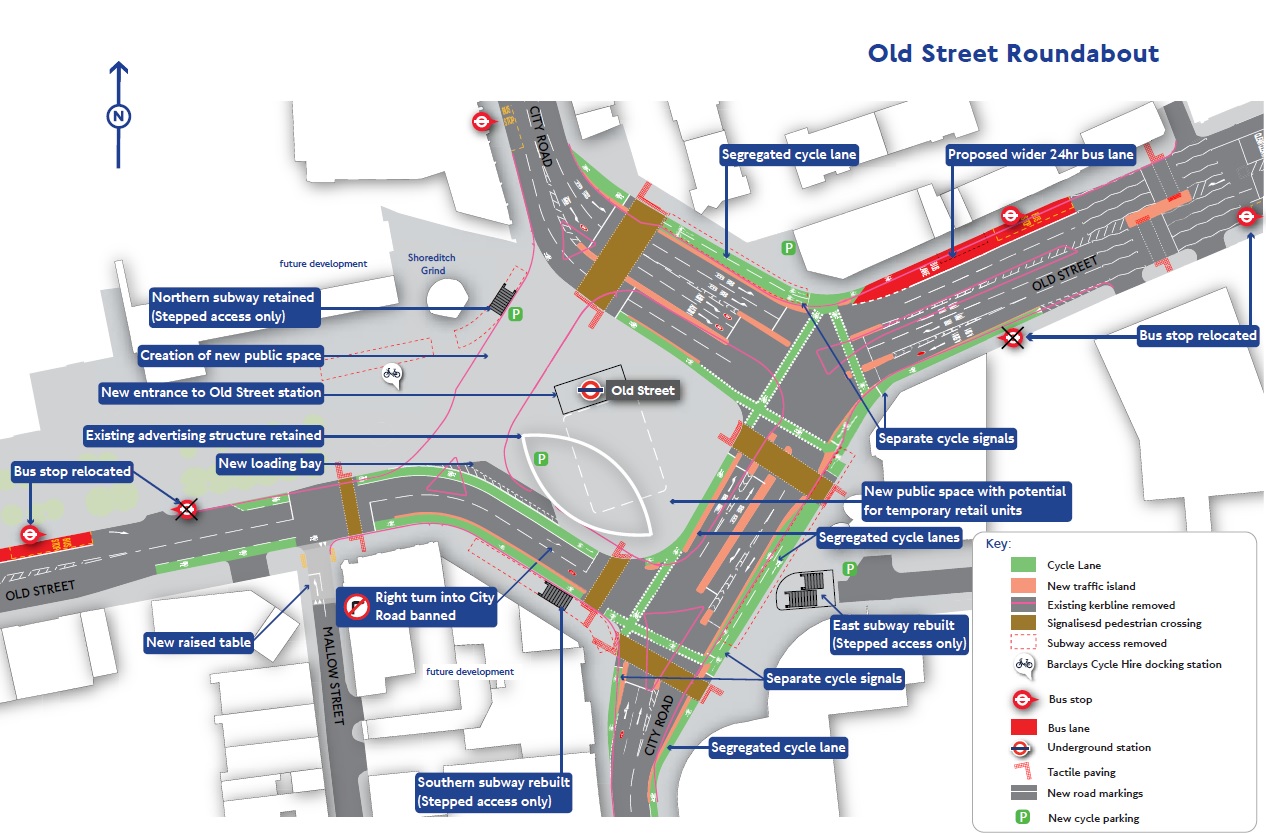
The current status of the four sides of the roundabout are.
- North-East – In Use – Two-way
- North-West – In Use – Two-way
- South-West – In Use – Two-way
- South-East – Closed
It was originally planned to be finished in 2022.
Covid Humour
I have yet to hear any good humour about the covids.
Although an incident this morning at my local station was thought funny by those present at the time.
- The large lifts at the station are now limited to six passengers at a time.
- A couple of other passengers and myself, were waiting to descend, when an enormously pregnant lady appeared at the lift doors.
- She smiled and asked! “Have you got room for another two?”
- A guy in the lift, pointed to everyone and did a quick count on his fingers.
- He then said. ‘Not if you’re expecting triplets, Madam!”
We were all laughing and smiling, as we walked to the trains.
Is The NHS The Cause Of The Rise In The Covids?
I was lying in my morning bath thinking this morning and I had the heretic thought, which is the title of this post.
How many prominent people in the UK have died from an attack of the covids? There have been some at an advanced age, but generally they were suffering from something else as well!
The highest profile person to be hospitalised by the covids, has been Boris. But despite his weight and obesity, he came through it unscathed, due to excellent care in an NHS hospital!
I’m 73 now, but if I look back to my twenties and thirties, I see an optimistic, fit, slim guy, who felt he was immune from health problems. I can also only remember one of my peers at Liverpool University in the 1960s going into hospital and it was so memorable, I can’t remember what he had.
The youth of the UK, don’t think the covids will happen to them and growing up in an NHS, which has looked after their every need, when they look around them, they feel it will get them through, if they catch the virus.
So the fact that the NHS is there and got the fat Boris, through it, means that they think, they’ll be alright in the end.
Conclusion
The success of the NHS could be a factor in the rise of lab-confirmed cases of the covids.
Are other countries with good health systems, that coped with the first wave, xperiencing a second one?
 The Anonymous Widower