Alstom And DB To Kick Off Test Operations With Battery Electric Train
The title of this post, is the same as that of this article on RailTech.com.
This is the introductory paragraph.
Alstom and Deutsche Bahn (DB) are set to enter into service Alstom’s Battery Electric Multiple Unit (BEMU) for trial runs. The test operations will commence on January 24 in the state of Baden-Württemberg, followed by passenger services in neighbouring Bavaria from February 5th onwards. The tests will conclude in May 2022.
It does finally appear that battery electric multiple units (BEMUs) are being seen on the railway.
When Will Energy Storage Funds Take The Leap To New Technology?
This article on the Motley Fool is entitled 3 UK Dividend Shares To Buy Yielding 6%.
This is a paragraph from the article.
The first company on my list is the Gore Street Energy Storage Fund (LSE: GSF). With a dividend yield of just over 6%, at the time of writing, I think this company looks incredibly attractive as an income investment. It is also an excellent way for me to build exposure to the green energy industry.
Just as everybody has a fridge in their house to stop food being wasted, electricity networks with a lot of intermittent resources like wind and solar, needs a device to store electricity, so that it isn’t wasted.
Gore Street Energy Storage Fund is being very safe and conservative at the current time, often using batteries from one of Elon Musk’s companies.
You can’t fault that, but they are only barely making a dent in the amount of batteries that will be needed.
If we are generating tens of GW of wind energy, then we need batteries at the GWh level, whereas at the moment a typical battery in Gore Street’s portfolio has only an output of a few megawatts. They don’t state the capacity in MWh.
There is this statement on their web site, about the technology they use.
Although the projects comprising the Seed Portfolio utilise lithium-ion batteries and much of the pipeline of investments identified by the Company are also expected to utilise lithium-ion batteries, the Company is generally agnostic about which technology it utilises in its energy storage projects. The Company does not presently see any energy storage technology which is a viable alternative to lithium-ion batteries. However, there are a number of technologies which are being researched which if successfully commercialised, could prove over time more favourable and the Company will closely monitor such developing technologies.
They say they are agnostic about technology and are looking around, but they are sticking with lithium-ion technology.
That technology works, is safe and gives a good return.
But they are at least thinking about moving to new technology.
In the rail industry, it is common for rail leasing companies to get together with train manufacturers or remanufacturers to develop new trains.
As an example, Eversholt Rail and Alstom formed a partnership to develop a hydrogen-powered train for the UK, which I wrote about in Alstom And Eversholt Rail Sign An Agreement For The UK’s First Ever Brand-New Hydrogen Train Fleet.
Worldwide, there are probably upwards of a dozen very promising energy storage technologies, so I am very surprised that energy storage funds, like Gore Street and Gresham House have not announced any development deals.
Conclusion
Energy storage funds could benefit from using some of the financing methods used by rolling stock leasing companies.
Alstom And Liebherr Sign A Collaboration Agreement, In Order To Optimise Hydrogen Fuel Cells
The title of this post, is the same as that of this press release from Alstom.
The press release starts with these points.
-
Liebherr is developing air management technology that is particularly well suited to hydrogen fuel cells.
-
Alstom’s hydrogen strategy is part of its ambition to innovate by pioneering smarter and greener mobility solutions for all.
This paragraph then gives the basic outline of the agreement.
Alstom has signed a collaboration agreement with Liebherr – Aerospace & Transportation SAS, a France-based company specialising in the manufacture of compressors for fuel cells. This agreement is aimed at optimising hydrogen systems, including improving the reliability and durability of fuel cells, increasing their power density and reducing the cost of such solutions.
The press release gives a lot more details about Alstom’s hydrogen collaborations with other companies
Alstom seem very serious about hydrogen-powered trains.
BP Plans To Turn Teesside Into First Green Hydrogen Hub
The title of this post, is the same as that of this article in The Times.
This is the first paragraph.
BP plans to build Britain’s biggest “green hydrogen” facility on Teesside to produce the clean fuel for use in new hydrogen-powered lorries and other transport.
Note.
The plans appear to be ambitious starting with a £100 million investment to build a 60 MW electrolyser by 2025, which would rise to as much as 500 MW by 2030.
The electrolyser will be paired with an upwards of a billion pound one gigawatt facility called H2Teesside, that will produce blue hydrogen.
I think there could be more to this than meets the eye.
Using The Carbon Dioxide Rather than Storing It!
I followed the carbon dioxide pipe from the CF fertiliser plant on Teesside using Google maps after seeing a film about it on the BBC. It goes to the Quorn factory and a massive greenhouse. I do wonder, if BP is talking to other companies, who also have a need for large quantities of good quality carbon dioxide.
One could be an Australian company, called Mineral Carbonation International, who have developed a process to convert carbon dioxide into building products like blocks and plasterboard. MCI won a prize at COP26, so could BP be looking at integrating one of these plants into their complex on Teesside?
The Electrolysers
Will BP be purchasing their electrolysers for green hydrogen from ITM Power in Sheffield?
This press release from ITM Power is entitled 12MW Electrolyser Sale.
The customer is not named, but could this be a starter kit for BP?
Alstom’s Hydrogen Aventras
In Alstom And Eversholt Rail Sign An Agreement For The UK’s First Ever Brand-New Hydrogen Train Fleet, I came to this conclusion.
This modern hydrogen train from Alstom is what is needed.
I also felt there could be three similar trains; electric, battery-electric and hydrogen, which would help operators hedge their bets on what type of traction to use.
Teesside must be one of the more likelier places where the Hydrogen Aventras will be carrying passengers.
I wrote about this possibility in Alstom Hydrogen Aventras And Teesside.
A deal between BP and Alstom would surely be in the interest of both companies.
- Alstom would get a local hydrogen supply.
- BP would get a first sale.
- BP would get excellent publicity and a local demonstration of the possibilities of hydrogen.
It might even be possible to supply the hydrogen by pipeline.
Is The Alstom Hydrogen Train Powered By A Fuel Cell?
In Alstom And Eversholt Rail Sign An Agreement For The UK’s First Ever Brand-New Hydrogen Train Fleet, I mentioned that Alstom’s Hydrogen Aventra could be powered by either a small gas turbine or a fuel cell or cells, but I didn’t plump for one or the other. I said this.
If you look at the proportions of the Alstom hydrogen train and the pictures of Class 710 trains, I feel that the Alstom train could have the longer twenty-four metre cars.
It may be a tight fit compared to creating the Alstom Coradia iLint hydrogen train, but I would feel it is possible to install a fuel cell or cells, the required cooling and the hydrogen tanks, having seen cutaway drawings of hydrogen-powered double-deck buses on the Wrightbus web site.
Interestingly, the Alstom press release doesn’t mention fuel cells, so could the train be powered by a small gas turbine?
I think it is unlikely, but it is technically feasible.
I had forgotten one important factor. Both the Aventra factory and Rolls-Royce are in Derby and I know from talking to a retired British Rail engineer, that there is a lot of contact between the two companies at an informal level.
Rolls-Royce have published this picture of their beer keg-sized generator.
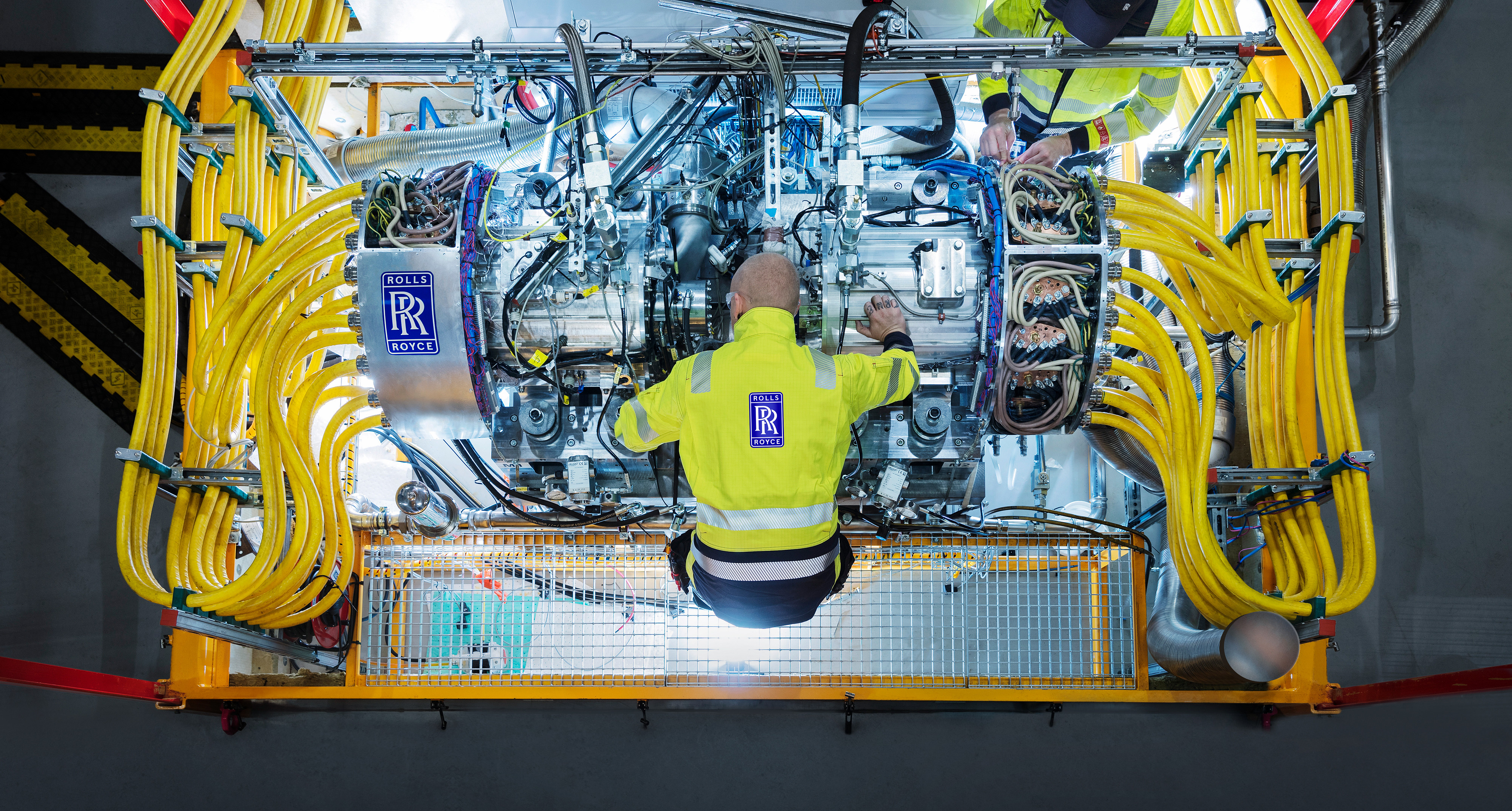
Would it need the cooling system, which appears to be needed with a fuel-cell?
The Rolls-Royce Advantage
There would surely be advantages in using a Rolls-Royce gas turbine to power the train.
- Having a Rolls-Royce power unit must help sales of your plane or train.
- There is the Derby connection.
- Alstom already deal with Rolls-Royce subsidiary; MTU for diesel engines for freight locomotives.
Could we be seeing a hydrogen multiple unit powered by a gas turbine?
Hydrogen Train Refuelling Standard To Be Developed
The title of this post, is the same as that of this article on Railway Gazette.
This is the first paragraph.
A agreement to optimise hydrogen refuelling equipment for passenger trains and define an international standard has been signed by Alstom and the Hynamics hydrogen subsidiary of French energy group EDF.
This can only be a good thing.
Alstom Hydrogen Aventras And Teesside
In Alstom And Eversholt Rail Sign An Agreement For The UK’s First Ever Brand-New Hydrogen Train Fleet, I give my thoughts on Alstom’s new hydrogen train, which I have called the Alstom Hydrogen Aventra.
Would this train be suitable for the local railways around Teesside?
Fuelling The Change On Teesside Rails is a post based on an interview with Tees Valley Mayor; Ben Houchen in Rail Magazine.
Teesside is getting ready for hydrogen.
- They have identified a site for a specialist depot for hydrogen-powered trains.
- There is plenty of hydrogen available from chemical works in the area.
All they need is some trains and I think the Alston Hydrogen Aventras would fill the need admirably.
I also believe that with its history of heavy industry, steel and chemicals, the residents of Teesside and the Tees Valley would take to hydrogen trains.
I wrote Fuelling The Change On Teesside Rails in January 2020 and since then the Department of Transport has funded a study to examine the extension of the Tees Valley Line past Bishop Auckland, which I wrote about in Reopening The Darlington – Weardale Line To Passenger Services.
On the subject of rolling stock for the Weardale Line, I said this in the Weardale Line post.
There is no point in extending the line in these days of global warming without providing zero-carbon trains.
The Tees Valley Combined Authority is keen on hydrogen and there are good reasons.
-
- There is hydrogen available from chemical plants on Teesside.
- Hydrogen will give the trains a long range.
- The trains would probably only need refuelling once a day.
- In addition, Alstom are looking for an order for their Class 600 train, which is a conversion of a Class 321 train.
But I have my doubts about Alstom’s trains and Hitachi have doubts about hydrogen.
Consider.
-
- Do you really want to run hydrogen trains on a line where steam trains run?
- Darlington station is fully-electrified and it is also to be remodelled for more capacity and High Speed Two.
- Bishop Auckland and Darlington is just twelve miles.
- Darlington and Saltburn is just thirty miles.
With charging systems at Bishop Auckland, Saltburn and Stanhope, I am fairly sure Hitachi could develop an electric train for Teesside’s railways.
When I wrote the Weardale Line post, I was veering towards the Hitachi battery-electric trains, but the launch of the Alstom Hydrogen Aventra may have changed that.
Conclusion
The new trains for Teesside could become a fight between Hitachi with their battery-electric trains and Alstom with their Hydrogen Aventras.
If there is a fight of the technologies, who wins on Teesside could be important in deciding the future of world-wide rail transport.
Is it slightly ironic, that this battle could be happening close to the birthplace of railways?
Alstom Hydrogen Aventras And The Reopened Northumberland Line
In Alstom And Eversholt Rail Sign An Agreement For The UK’s First Ever Brand-New Hydrogen Train Fleet, I give my thoughts on Alstom’s new hydrogen train, which I have called the Alstom Hydrogen Aventra.
Would this train be suitable for the Northumberland Line?
This is a caption to a picture in this article on the BBC, which is entitled Northumberland Line: Railway ‘Could Create Economic Powerhouse’.
The Northumberland Line could connect Blyth and Newcastle with half hourly services and journey times of under 25 minutes.
This timetable would mean that between two and four trains would be needed to provide the service.
In my posts on the Northumberland Line, I show a strong preference for battery-electric trains and in particular those proposed by Hitachi, which would be built in their factory at Newton Aycliffe, which is a dozen miles to the South. These trains would have batteries produced by Hyperdrive Innovation in Sunderland.
I dismissed hydrogen trains, as until this week no viable new hydrogen train for the UK rail network had been proposed.
But this week, Alstom announced their hydrogen-powered Aventra.
I suspect a small fleet of these trains could work the Northumberland Line.
My only reservation would be that their operating speed was in line with the speed needed on the short sections of the East Coast Main Line used by the Northumberland Line service.
 The Anonymous Widower