Could The Settle And Carlisle Be Used As A More Formal Route?
In June 2021, I wrote Through Settle And Carlisle Service Under Consideration, which starts like this.
The title of this post, is the same as that of an article in the June 2021 Edition of Modern Railways.
This is the first paragraph.
Plans for a new Leeds to Glasgow through service via the Settle and Carlisle line are being developed, with CrossCountry and the Department for Transport starting to look at the possible scheme.
It sounds like a sensible idea to me.
The article also suggests the following.
- CrossCountry is a possible operator.
- CrossCountry are keen to improve services between Leeds and Glasgow
- The trains could be InterCity 125s, freed up, by a the arrival of Class 221 trains from Avanti West Coast, when they receive their new Class 805 trains.
- Maintenance of the trains wouldn’t be a problem, as this could be done at Neville Hill in Leeds or Craigentinny in Edinburgh.
- Services could start in December 2023.
But nothing more has been heard.
However some things have happened.
The Settle And Carlisle Has Become A Popular Charter Route
Google AI gave me this paragraph.
The Settle and Carlisle line is an extremely popular, premier route for heritage rail charters, steam excursions, and luxury rail tours in the UK, often operating at full capacity. Renowned for its scenic 72-mile journey through the Yorkshire Dales and Pennines, it features iconic structures like the Ribblehead Viaduct.
I have also written these posts about charters on the Settle and Carlisle Line.
Scheduled Steam-Hauled Services For the Settle And Carlisle Railway
Rail Operator Crosses Line For First Time In Years
‘Staycation Express’ To Return Along Full Length of S & C
It doesn’t appear that the numbers of charter trains are showing any sign of decrease.
LNER Has Ordered Class 897 Trains
When LNER took over the East Coast Main Line services, they had six main classes of trains.
- Five-car Class 800/1 bi-mode trains
- Nine-car Class 800/2 bi-mode trains
- Five-car Class 801/1 electric trains
- Nine-car Class 801/2 electric trains
- Seven-car InterCity225 trains
- Nine-car InterCity225 trains
Note.
- The five-car trains can run in pairs as ten-car trains.
- The Class 800 and Class 801 trains can run to destinations, that lack full electrification using diesel power where needed.
- Hitachi are developing battery-power for rail routes without electrification.
In 2023 to replace the InterCity225 trains ten ten-car Class 897 tri-mode trains were ordered from CAF, which will soon be in service, over all LNER’s network.
LNER Has Fully Electrified And Unelectrified Destinations
LNER’s current destinations, that are fully electrified to King’s Cross include.
- Bradford Forster Square
- Berwick on Tweed
- Darlington
- Doncaster
- Durham
- Edinburgh Haymarket
- Edinburgh Waverley
- Grantham
- Keithley
- Leeds
- Newark Northgate
- Newcastle
- Peterborough
- Retford
- Shipley
- Skipton
- Stevenage
- Wakefield Westgate
- York
Whilst those are not fully electrified include.
- Aberdeen
- Cleethorpes
- Dundee
- Grimsby Town
- Harrogate
- Huddersfield
- Horsforth
- Hull
- Inverness
- Lincoln
- Middlesbrough
- Sheffield
- Sunderland
- Thornaby
- Worksop
Note.
- Other destinations can be added as required.
- I suspect, that Class 897 trains will be able to approach many stations without electrification on battery power alone.
- Staff and Passengers would probably like underground stations like Sunderland to be worked on batteries alone.
The Class 800 bi-mode, the Class 801 electric and the Class 897 tri-mode trains will give LNER a very flexible fleet.
Onward To Skipton, Carlisle and Glasgow Central And Edinburgh From Bradford Forster Square
I wonder is someone has realised that the Class 897 trains could use their tri-mode capabilities to invade Scotland?
This OpenRailwayMap shows the railways between the Scottish Lowlands and northern England.
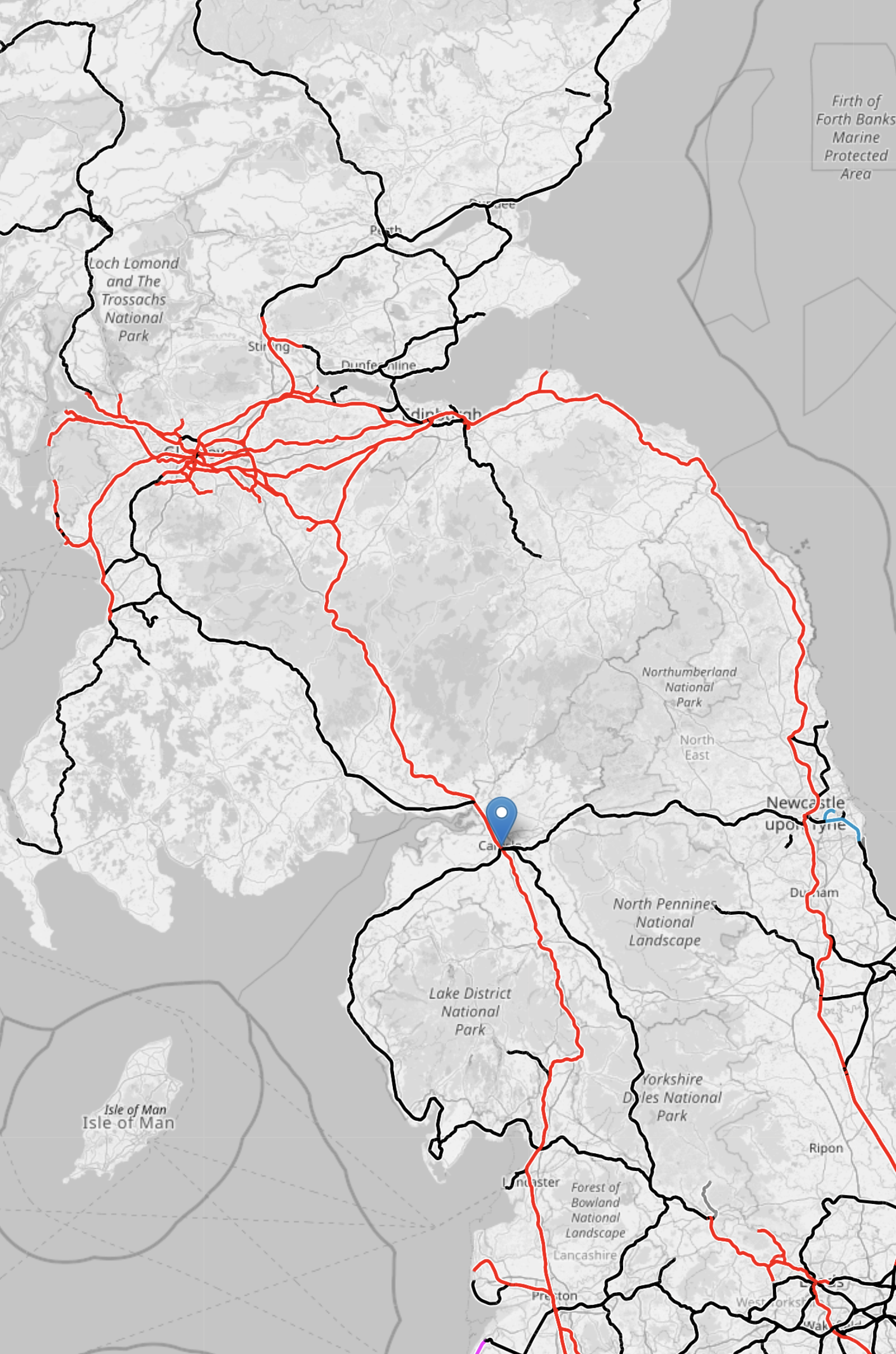
Note.
- Red tracks are electrified.
- Black tracks are not.
- The blue arrow in the middle of the map indicates Carlisle.
- The red track going North-South through Carlisle is the West Coast Main Line.
- The black track going South from Carlisle is the Settle and Carlisle Line.
- Where it turns red is at Skipton station and the electrification can power the train to Bradford Foster Square, Doncaster, Leeds or Sheffield stations.
- The West Coast Main Line splits North of Carlisle and electrified trains can reach either Glasgow Central in the West or Edinburgh Haymarket or Waverley in the East.
- The black track going North-South between Carlisle and Glasgow via Dumfries is the Glasgow South Western Line, which can be used as a diversionary route by some trains with a self-powered capability.
The Settle and Carlisle Line certainly makes Anglo-Scottish routes more robust and flexible when there is bad weather, engineering works or overhead wire or signalling failures.
Will Class 897 Trains Be Able To Run On The Settle And Carlisle Line?
I asked Google AI this question and it gave this answer.
Yes LNER’s new Class 897 tri-mode trains (scheduled for introduction from 2027) will be able to run on the Settle and Carlisle line. As tri-mode electro-diesel multiple units, these 10-car trains are designed to operate across the entire LNER network, utilizing electric, diesel, or battery power to manage non-electrified routes like this, providing a modern alternative to older, diesel-only fleets.
Key details regarding Class 897 on the Settle and Carlisle Line:
Tri-mode Capability: These trains can run on electric, diesel, or battery power, making them highly versatile for non-electrified, scenic, or challenging routes.
Operating Strategy: The trains are designed for flexibility and can be used across the LNER network, which includes routes connecting to Scotland via the West Coast Main Line (WCML) or through services from Leeds.Upgrading Service: They will replace the 40-year-old InterCity 225 fleet, offering a more environmentally friendly, modern alternative to current diesel bi-modes, such as the Class 800/802.
The route is a major, yet challenging, rail line featuring 20 viaducts and 14 tunnels, making it suitable for modern, versatile train sets.
I also believe that running Class 897 trains between Yorkshire and Glasgow offers opportunities to run new services, that will appeal to both travellers and rail operators.
Does The UK Need More Passenger Rail Capacity Between Yorkshire And Glasgow?
I asked Google AI this question and it gave this answer.
Yes, the UK requires more passenger rail capacity between Yorkshire and Glasgow due to severe overcrowding and forecasted demand growth. Major routes like the East Coast Main Line (ECML) and West Coast Main Line (WCML) are, or will soon be, at maximum capacity. Key constraints include infrastructure limitations and the need for better Scotland-England connectivity.
Key insights on this need:
Capacity Constraints: The WCML, particularly at its southern end, is already effectively full, with limited capacity for additional, longer trains. Similarly, the ECML is experiencing significant overcrowding.
Growing Demand: Passenger demand for long-distance rail travel continues to rise, with significant increases noted in journeys between Scotland and other regions.
Infrastructure Issues: Constraints include steep inclines, tight curves, and the need to mix passenger and freight traffic, particularly on the West Coast route.
Proposed Solutions: While some improvements are planned, such as Lumo extending services to Glasgow, the Integrated Rail Plan (IRP) focuses on capacity enhancements in the North/Midlands.
Strategic Need: Enhanced, high-speed connections are considered essential for long-term economic integration and to prevent increased air travel/emissions.
The great advantage of the route, is that is already in place.
Can The Settle And Carlisle Line Handle Planned Diversions?
Can The Settle And Carlisle Line Handle The Caledonian Sleeper?
I asked Google AI this question and it gave this answer.
The Settle-Carlisle line is not a standard route for the Caledonian Sleeper, which typically travels via the West Coast Main Line (WCML) to Edinburgh, Glasgow, and beyond. While the line is a scenic, double-track route with significant infrastructure, it is generally used for local services and freight, not long-distance, heavy sleeper trains.
Key Considerations:
Route: The Caledonian Sleeper operates on the West Coast Main Line, serving destinations like Edinburgh, Glasgow, Aberdeen, Inverness, and Fort William.
Capacity & Infrastructure: While the Settle-Carlisle line has major structures like the Ribblehead Viaduct, it is not the primary route for high-speed or overnight sleeper services.
Operational Normal: The sleeper service splits into portions at Edinburgh, and does not regularly operate via the Settle-Carlisle line.
In short, the Settle-Carlisle line is not designed for or used by the Caledonian Sleeper, which operates via the West Coast Main Line.
But it does appear, that in the past some sleeper trains have used it.
How Many Freight Trains Use the Settle And Carlisle Line In A Typical Day?
This article on the BBC is entitled Settle To Carlisle line: Shortage of trains ‘Hampering Growth’, says this about the number of trains.
From only two trains a day in the 1980s the Settle and Carlisle line now sees 14 passenger and 18 freight services a day.
That is progress!
Do Hitachi Battery Electric InterCity Trains Have Problems?
I asked Google the question in the title of this post and got this answer.
While Hitachi’s battery-powered intercity trains have shown promising results in trials, particularly regarding fuel savings and emissions reduction, there are some potential challenges and considerations. These include safety concerns related to lithium battery fires, especially in the event of a crash or derailment, as well as range limitations for longer journeys. However, the technology is continuously evolving, and Hitachi is actively working to address these issues.
That seems fairly positive.
There is also this article on the BBC, which everybody should read, which is entitled Will New Battery-Powered Trains Replace Diesel, And Are They Safe?.
In The Data Sheet For Hitachi Battery Electric Trains, I look at the data sheet, that Hitachi published in late 2023.
These were my conclusions about the data sheet.
These are my conclusions about Hitachi’s battery packs for Class 80x trains, which were written in November 2023.
- The battery pack has a capacity of 750 kWh.
- A five-car train needs three battery-packs to travel 100 miles.
- A nine-car train needs five battery-packs to travel 100 miles.
- The maximum range of a five-car train with three batteries is 117 miles.
- The maximum range of a nine-car train with five batteries is 121 miles.
As battery technology gets better, these distances will increase.
Hitachi have seen my figures.
They also told me, that they were in line with their figures, but new and better batteries would increase range.
125 mph trains with a 120 mile range on batteries, would revolutionise UK train travel.
LNER’s Class 897 Trains
In the Wikipedia entry for LNER, this is said about LNER’s new ten CAF tri-mode trains.
In November 2023, LNER placed an order for 10 ten-car tri-mode (electric, diesel and battery power) Civity trains from CAF. In August 2024, it was announced that the units will be designated Class 897 under TOPS.
According to their Wikipedia entry, it appears the Class 897 trains will be delivered from 2027.
Can I Build A Schedule For The Introduction Of New Trains, Services and Batteries?
I think that I can from the information that is out there.
- East Coast Main Line – December 2025 – Introduction of Lumo between London King’s Cross and Glasgow
- West Coast Main Line – Spring 2026 – Introduction of Lumo between London Euston and Stirling
- Midland Main Line – 2026-2027 – Introduction of EMR Class 810 trains between London St. Pancras and Leicester, Derby, Nottingham and Sheffield.
- East Coast Main Line – From 2027 – Introduction of LNER Class 897 trains between London King’s Cross and Yorkshire.
Note.
- The two Lumo services use trains already in service.
- The Class 810 trains for EMR are being debugged and introduced at the present time.
- The only new trains are the Class 897 trains for LNER.
- The introduction of the Class 897 trains will allow LNER to withdraw some trains for refurbishment and fitting of batteries.
This would mean that before the next general election, almost the full timetable between London and the North of England and Scotland would have been implemented using diesel-electric technology.
Is it a low-risk start to the full electrification of services to the North?
The second-phase would see battery-electric trains introduced.
I believe that Grand Central’s new trains would be brought into service first.
- The new trains are scheduled to be introduced in 2028.
- Grand Central will still have the diesel trains for backup.
- Their new trains would be similar to the other Hitachi trains.
- It looks like they could be doing some splitting and joining.
After the Grand Central trains had been introduced successfully, the trains for the other Hitachi operators would have batteries fitted.
I suspect short routes like Lincoln would be electrified with battery-electric trains first.
There would also need to be short lengths of electrification erected, so that trains could be charged to send them on their way.
Other routes could also be electrified in the same way.
- Basingstoke and Exeter
- Birmingham and Aberystwyth
- Bristol and Penzance
- Cardiff and Swansea
- Crewe and Holyhead
- Edinburgh and Aberdeen
- Edinburgh and Inverness
- Reading and Taunton
- Swindon and Gloucester
If this technique could work for main lines, surely a scaled down version with smaller trains would work for branch lines.
Conclusion
Consider.
- It looks to me, that someone has planned this thoroughly.
- It all fits together extremely well.
It could be the first phase of a cunning plan to use battery-electric trains to electrify the UK’s railways.
Passengers will also see benefits, from when Lumo runs its first train into Glasgow Queen Street station.
I don’t think Hitachi’s trains have any problems, but there is enough float in this plan to make sure, it can be implemented on time and on budget.
Train Lengths Between King’s Cross and Edinburgh
If you ask Google, what is the platform length at King’s Cross station, you get the following answers.
- Platform 0 – 305 metres
- Platform 1 – 304 metres
- Platform 2 – 285 metres
- Platform 3 – 289 metres
- Platform 4 – 290 metres
- Platform 5 – 270 metres
- Platform 6 – 288 metres
- Platform 7 – 288 metres
- Platform 8 – 289 metres
- Platform 9 – 276 metres
- Platform 10 – 276 metres
This OpenRailwayMap shows the tracks linking to the eleven platforms at King’s Cross.
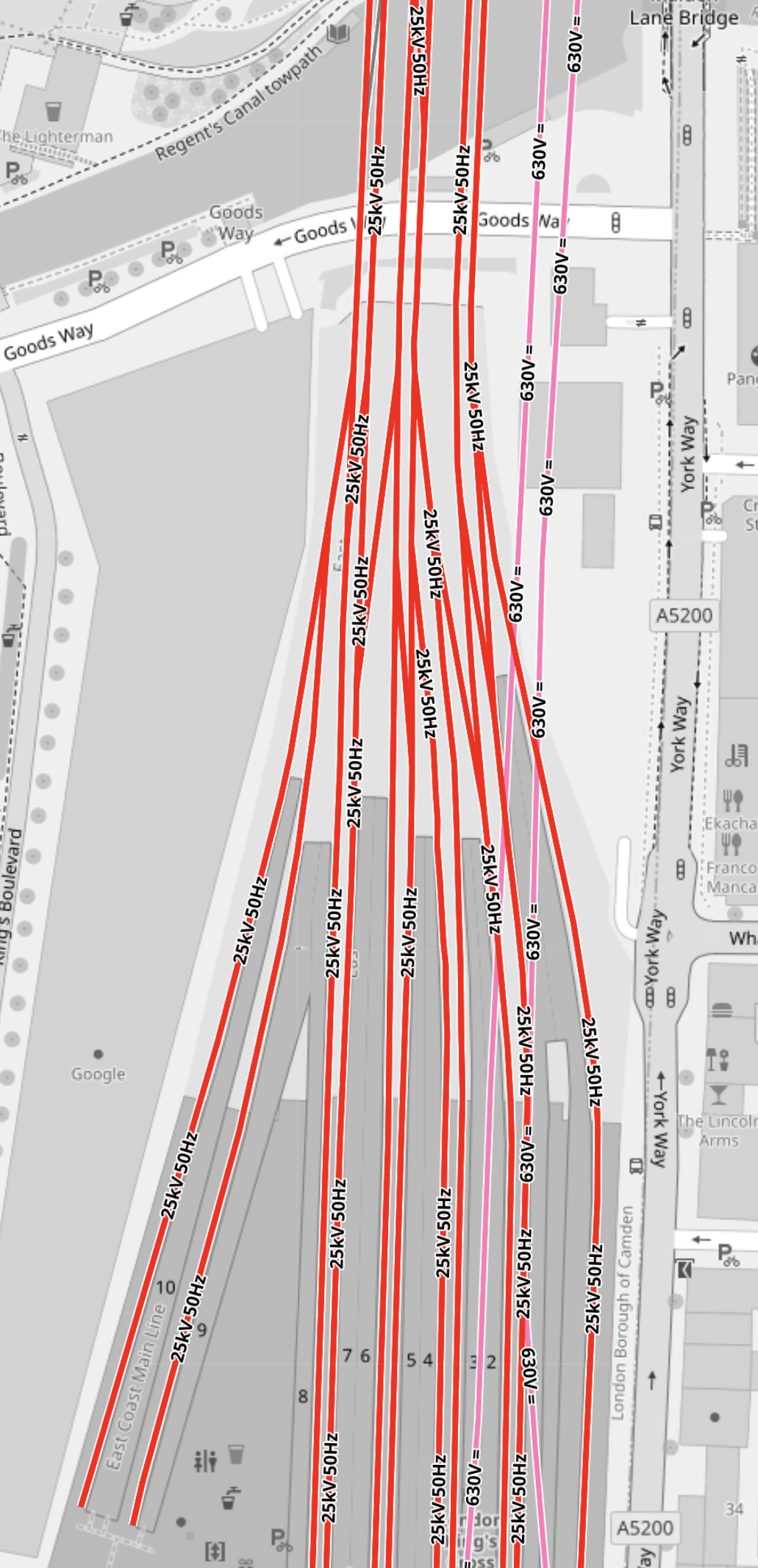
Note.
- The red tracks are the electrified platforms in King’s Cross.
- The two pink tracks are the Piccadilly Line underneath the station.
- Platform 0 is on the right and Platform 10 is on the left.
- The platform number is shown alongside the track.
Platform 0 is the newest platform, which opened in 2010 and also the longest at 305 metres.
Many of the trains using the station are Hitachi Class 800, 801, 802 and 803 trains, which have cars of the following lengths.
- Driving car – 25.85 metres
- Intermediate car – 26 metres
These lengths mean that individual trains have the following lengths.
- Five-car – 129.7 metres
- Nine-car – 233.7 metres
- Ten-car – Pair of five-cars – 259.4 metres
Note.
- It would appear that nine- and ten-car trains can use all platforms 0-8 in the main station.
- Platform 5 may be short at 270 metres, but Real Time Trains shows it can handle nine- and ten-car trains.
Real Time Trains doesn’t seem to show any nine- and ten-car trains using Platforms 9 and 10. Is the approach just a bit tight?
These are some further thoughts.
LNER’s New Class 897 Trains
I asked Google how long will be LNER’s new ten-car Class 897 trains. This is the answer I received.
The Class 897 train will be 218.7 meters (717 ft 6 in) long, according to Wikipedia. These trains will be ten-car units.
Have these trains been designed, so they can fit in Platforms 9 and 10 at King’s Cross and other shorter platforms, that LNER serve?
Other train classes, that could use Platforms 9 and 10 at King’s Cross include.
- Five-car Class 800, 801, 802 and 803 trains – 129.7 metres
- Five-car Class 180 trains – 116.52 metres
- Five-car Class 222 trains – 116.16 metres
- Six-car Class 717 trains – 121.7 metres
- Eight-car Class 379/387 trains – 163.12 metres
- Eight-car Class 700/0 trains – 162 metres
- Twelve-car Class 700/1 trains – 242.6 metres
Real Time Trains or my eyes have observed all these trains, except for the twelve-car Class 700 trains in Platforms 9 and 10 at King’s Cross.
It does appear that the shorter ten-car Class 897 trains improve utilisation of the platforms at King’s Cross station.
Could Twelve-Car Class 800, 801, 802 and 803 Trains Run Into King’s Cross?
Consider.
- LNER and Lumo have both said, they want to win passengers from the airlines on Anglo-Scottish routes.
- Extra paths on the East Coast Main Line are at a premium and hard to come by.
In Do Class 800/801/802 Trains Use Batteries For Regenerative Braking?, I found this extract in a Hitachi document on their web site.
To simplify the rearrangement and management of train configurations, functions are provided for identifying the train (Class 800/801), for automatically determining the cars in the trainset and its total length, and for coupling and uncoupling up to 12 cars in
normal and 24 cars in rescue or emergency mode.
So if say LNER or Lumo wanted a twelve-car train, it would be possible. It also looks like one twelve-car train can rescue another.
Train lengths would be as follows.
- Five-car Class 800, 801, 802 and 803 trains – 129.7 metres
- Six-car Class 800, 801, 802 and 803 trains – 155.7 metres
- Nine-car Class 800, 801, 802 and 803 trains – 233.7 metres
- Twelve-car Class 800, 801, 802 and 803 trains – 311.7 metres
- Twelve-car – Pair of six-car Class 800, 801, 802 and 803 trains – 311.4 metres
As Platform 0 is 305 metres and Platform 1 is 304 metres, I suspect that King’s Cross station could accept twelve-car formations of Hitachi Class 800, 801, 802 or 803 trains, with fairly minor modifications.
But what about other stations?
Berwick-on-Tweed
Both platforms are around 233/234 metres, so twelve-car trains couldn’t call, unless the platforms were lengthened.
Bradford Forster Square
From the pictures, that I took in Bradford Forster Square Station – 20th May 2025, of a pair of LNER five-car trains, I suspect that the new Platform 0 and the extended Platform 1 will accept twelve-car trains, or could easily be modified.
Darlington
Both platforms, where LNER call are over 350 metres long, so Darlington can handle twelve-car trains.
Doncaster
Doncaster has four long platforms and I am fairly sure, the station could be easily modified to handle twelve-car trains.
Durham
Both platforms are over 260 metres, so twelve-car trains couldn’t call, unless the platforms were substantially lengthened.
Edinburgh Waverley
Platform 5 and 6 at Edinburgh Waverley station were both lengthened to 275 metres to accept ten-car LNER trains in 2016. I suspect more lengthening will be needed.
Leeds
Platforms 8 and 11 at Leeds station are both over 320 metres, so should be long enough to accept twelve car LNER trains.
Newark Northgate
Platforms 1 and 2 at Newark Northgate station are only 133 metres. Some platform lengthening would be needed for twelve-car trains to be able to call.
Newcastle
Platforms 2, 3 and 4 at Newcastle station are 362, 304 and 268 metres respectively. I believe with small improvements, that the station could be easily modified to handle twelve-car trains.
Northallerton
Both platforms are around 261/270 metres, so twelve-car trains couldn’t call, unless the platforms were lengthened.
Peterborough
Platforms 3, 4 and 5 at Peterborough station are only 265 metres. Some platform lengthening would be needed for twelve-car trains to be able to stop.
Wakefield Westgate
Both platforms at Wakefield Westgate station are only 255 metres. Some platform lengthening would be needed for twelve-car trains to be able to stop.
York
Four platforms at York station are over 315 metres.
Could A Twelve-Car Class 800, 801, 802 and 803 Trains Run Between King’s Cross And Edinburgh?
This would surely be the ultimate competition for the airlines.
Consider.
- It would use a single twelve-car Hitachi train or a pair of six-car trains.
- It could be fitted with batteries, so it could use the Great Northern and Great Eastern Joint Line diversion, through Lincoln, when there is engineering works or overhead wiring troubles.
- It would use either Platform 0 or Platform 1 at King’s Cross.
- It would use a lengthened platform at Edinburgh.
- Peterborough, Doncaster, York, Darlington and Newcastle could be possible stops.
- I estimate an LNER layout would carry 696 Standard Class and 86 First Class passengers.
- I estimate that a Lumo layout would carry 965 Standard Class passengers.
Note that an Airbus A321neo single-aislr airliner can carry 244 passengers.
 The Anonymous Widower