Midlands Rail Hub
On the Midlands Connect web site, they have a page, which is entitled Midlands Rail Hub.
This is the introductory paragraph.
The Midlands Rail Hub – our flagship project – is the biggest upgrade of our rail network for a generation.
The page contains this helpful map.

There is also a table of journeys and the improvements to be made.
- Birmingham – Nottingham – +1 tph – 72 minutes – 59 minutes
- Birmingham – Leicester – +2 tph – 66 minutes – 42 minutes
- Birmingham – Hereford – +1 tph – 85 minutes – 65 minutes
- Bitmingham – Worcester – +1 tph – 40 minutes – 35 minutes
- Birmingham – Derby – +2 tph – 38 minutes – 38 minutes
- Coventry – Leicester – +2 tph – 57 minutes – 38 minutes
- Coventry – Nottingham -+2 tph – 99 minutes – 63 minutes
- Birmingham – Bristol – +1 tph – 85 minutes – 80 minutes
- Birmingham – Cardiff – +1 tph – 117 minutes – 112 minutes
- Birmingham – Kings Norton – +2 tph – 18 minutes – 14 minutes
Note that the data by each route is the increase in frequency in trains per hour (tph), the current journey time and the future journey time.
I’ll now look at each route in more detail.
Birmingham And Bristol
Consider.
- Birmingham New Street and Bristol Temple Meads stations are 90 miles apart.
- Current service is two tph, which is provided by CrossCountry and goes via Worcestershire Parkway, Cheltenham Spa and Bristol Parkway.
- There is to be an increase of one tph.
- Current journey time is 85 minutes
- Future journey time is 80 minutes
As CrossCrountry’s Birmingham and Bristol service goes through to Edinburgh, Glasgow or Manchester Piccadilly, would it not be convenient, if the service could use High Speed Two to the North of Birmingham?
Birmingham And Cardiff
Consider.
- Birmingham New Street and Cardiff Central stations are 108 miles apart.
- Current service is two tph, which is provided by CrossCountry and goes via Worcestershire Parkway, Cheltenham Spa. Gloucester and Newport.
- There is to be an increase of one tph.
- Current journey time is 85 minutes
- Future journey time is 80 minutes
As CrossCrountry’s Birmingham and Cardiff service goes through to Nottingham, would it not be convenient, if the service could use High Speed Two between Birmingham and Nottingham?
It would appear that both Bristol and Cardiff services could benefit from a High Speed Two connection.
This map from High Speed Two shows the line’s route through the Water Orton area.
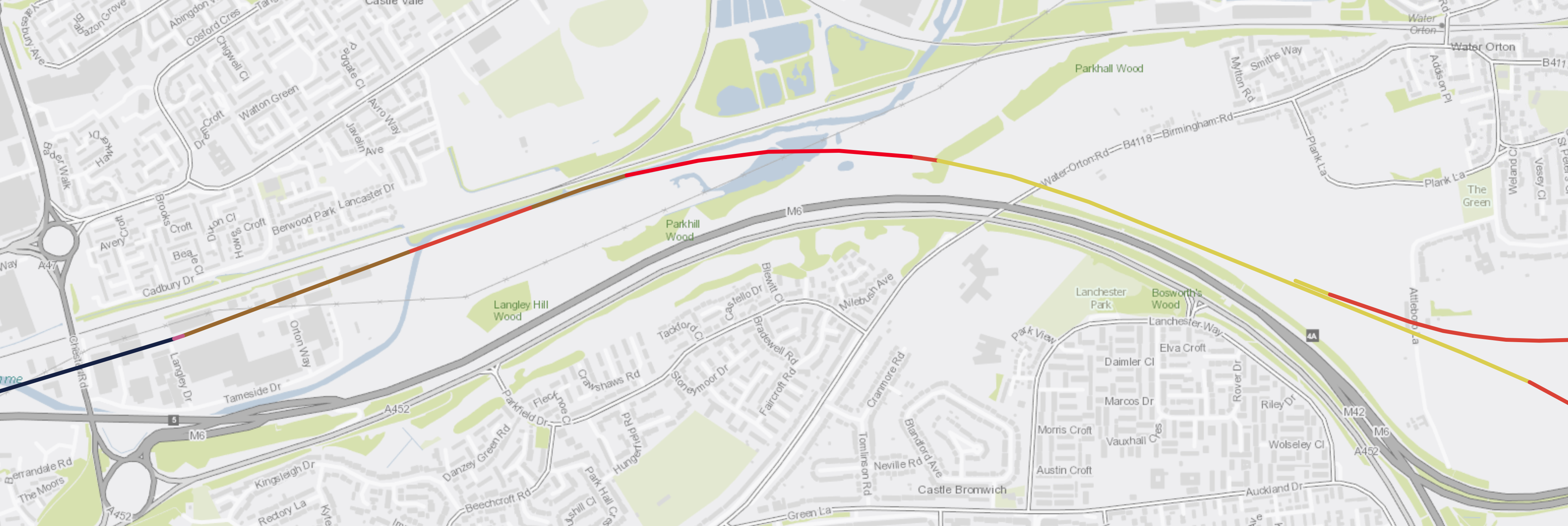
Note.
- High Speed Two is shown in various colours.
- High Speed Two splits at the Eastern edge of the map, with the Northern link going to Northern destinations and the Southern link going to Birmingham Interchange and London.
- Curving across the map beneath it, is the M6 motorway, with Spaghetti Junction off the map to the West.
- Water Orton station is in the North East corner of the map.
- The Birmingham and Peterborough Line, which connects Leicester and Birmingham New Street stations via Water Orton runs just tom the North of the route of High Speed Two shown on the map.
This Google Map shows the area.
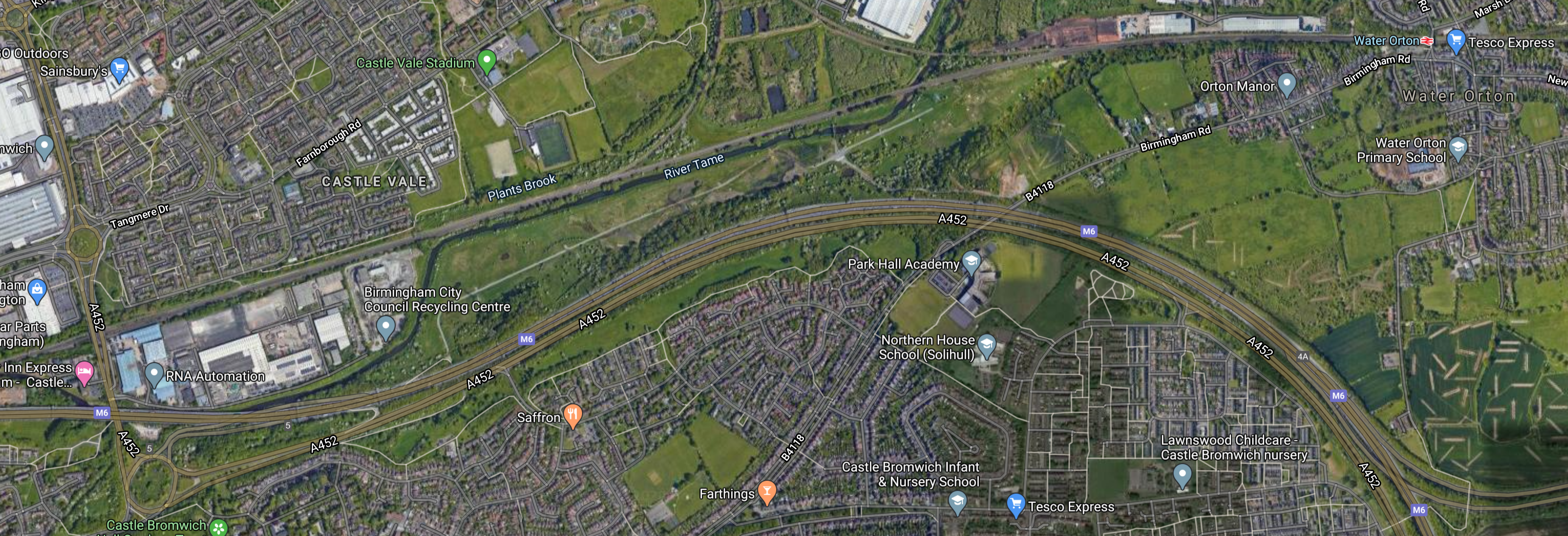
I wonder if it would be possible to provide links so that the following would be possible.
- Trains running East from New Street station could join High Speed Two to run to East Midlands Hub, Edinburgh, Glasgow, Leeds, Liverpool, Manchester, Newcastle, Sheffield and York.
- Trains from the North could run into New Street station and then continue to Bristol, Cardiff and Cheltenham.
The trains would have to be classic-compatible High Speed Two trains. These would fit into New Street station, as they are shorter than Class 390 trains and will have a aimilar height and width.
Time savings could be as follows.
- Bristol/Cardiff and Edinburgh – 110 minutes
- Bristol/Cardiff and Manchester Piccadilly- 50 minutes
- Bristol/Cardiff and Newcastle – 80 minutes
- Bristol/Cardiff and Nottingham – 45 minutes
All trains would be direct.
Birmingham And Derby
Consider.
- Birmingham New Street and Derby stations are 41 miles apart.
- Current service is two tph, which is provided by CrossCountry and goes via Wilnecote, Tamworth and Burton-on-Trent
- There is to be an increase of two tph.
- Current journey time is 38 minutes
- Future journey time is 38 minutes
- High Speed Two will run three tph between Birmingham Curzon Street and East Midlands Hub station in 20 minutes.
- Midlands Connect will run one tph between Birmingham Curzon Street and Nottingham Station in 30 minutes. See Classic-Compatible High Speed Two Trains At East Midlands Hub Station
Will passengers between Birmingham and Derby use High Speed Two services, which will be four tph or the current ones?
Birmingham And Hereford Via Worcester
Consider.
- Birmingham New Street and Hereford stations are 55 miles apart.
- Current service is one tph, which is provided by West Midlands Trains, and goes via Bromsgrove, Malvern Link and Great Malvern.
- There is to be an increase of one tph.
- Current journey time is 85 minutes
- Future journey time is 65 minutes
- The track between Bromsgrove and Birmingham is electrified.
- Hereford and Bromsgrove are 41 miles apart.
- Worcester and Bromsgrove are 13 miles apart.
With charging facilities at Worcester, this route would be an ideal one for battery electric trains.
Birmingham And Leicester
Consider.
- Birmingham New Street and Leicester stations are 40 miles apart.
- Current service is two tph, which is provided by CrossCountry and goes via Water Orton, Coleshill Parkway, Nuneaton, Hinckley and Narborough.
- There is to be an increase of two tph.
- Current journey time is 66 minutes
- Future journey time is 42 minutes
Birmingham – Nottingham
Consider.
- Birmingham New Street and Nottingham stations are 57 miles apart.
- Current service is two tph, which is provided by CrossCountry and goes via Tamworth, Burton-on-Trent and Derby.
- There is to be an increase of one tph.
- Current journey time is 72 minutes
- Future journey time is 59 minutes
- High Speed Two will run three tph between Birmingham Curzon Street and East Midlands Hub station in 20 minutes.
- Midlands Connect will run one tph between Birmingham Curzon Street and Nottingham Station in 30 minutes. See Classic-Compatible High Speed Two Trains At East Midlands Hub Station
Will passengers between Birmingham and Nottingham use High Speed Two services, which will be four tph or the current ones?
Coventry And Leicester
Consider.
- Coventry and Leicester are 28 miles apart.
- There is currently no direct train and a change is needed at Nuneaton
- There is to be an increase of two tph.
- Current journey time is 57 minutes
- Future journey time is 38 minutes
I suspect that a direct Coventry and Leicester service is being provided that does one of the following.
- Reverses in Nuneaton station.
- Takes a new flyover to cross the West Coast Main Line.
Would the Southern terminus of the route be Coventry, Leamington Spa or Stratford-on-Avon?
Coventry And Nottingham
Consider.
- Coventry and Nottingham are 55 miles apart.
- There is currently no direct train and a change is needed at Birmingham New Street or at both Nuneaton and Leicester.
- There is to be an increase of two tph.
- Current journey time is 99 minutes
- Future journey time is 63 minutes
Would this service be an extension of the Coventry and Leicester service?
As Leicester and Nottingham takes around thirty minutes, this could be the case.
Birmingham And Kings Norton Via The Camp Hill Line
The Midlands Rail Hub page, says this about the Bordesley Chords, which will connect Birmingham Moor Street station to the Camp Hill Line.
Construction of the Bordesley Chords, two viaducts creating new paths to the East Midlands and South West from Birmingham Moor Street Station.
This Google Map shows where they will be built.
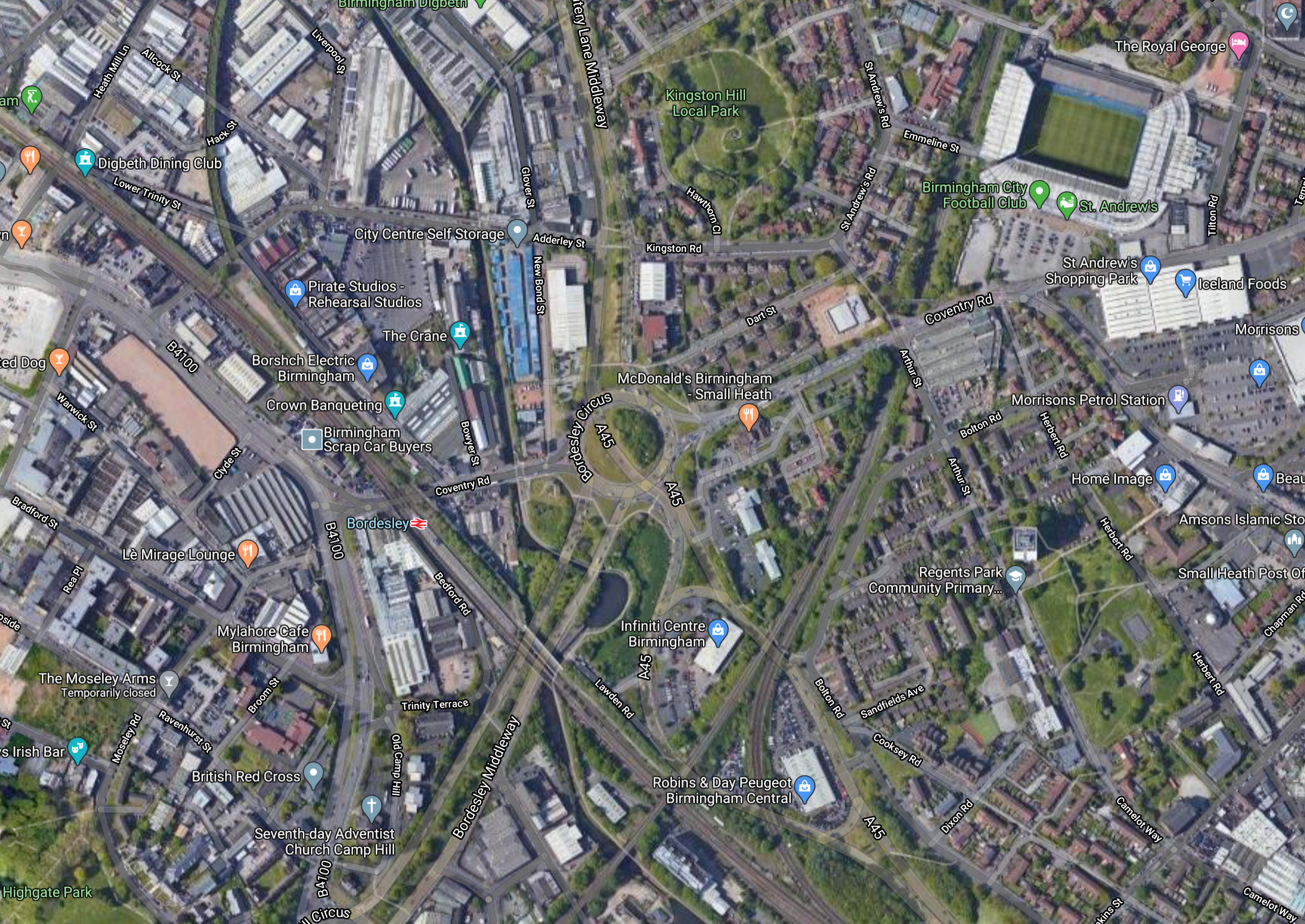
Note.
- The Football ground in the North-East corner of the map is St. Andrew’s, which is Birmingham City’s home ground.
- The rail line going North South across the map and passing to the West side of the ground is the Camp Hill Line, which leads to Water Orton station in the North and Kings Norton station in the South.
- The station in the middle of the map is Bordesley station.
- The rail line going NW-SE across the map through the station is the Chiltern Main Line into Birmingham Moor Street station, which is a couple of miles to the North-West.
The two Bordesley chords will be double-track chords linking the following routes.
- Moor Street station to the Camp Hill Line going South to Kings Norton via new stations at Moseley, Kings Heath and Hazelwell.
- Moor Street station to the Camp Hill Line going North to Water Orton station.
The initial service would appear to be two tph between Moor Street and Kings Norton stations.
CrossCountry Trains and Moor Street Station
Consider.
- Birmingham New Street station is very busy.
- Some CrossCountry trains take a Water Orton-Birmingham New Street-Kings Norton route across the city.
Could these trains go between Water Orton and Kings Norton, with a reverse in Moor Street station?
- Plymouth and Edinburgh Waverley
- Cardiff Central and Nottingham
And could these services terminate at Moor Street station?
- Birmingham New Street and Nottingham
- Birmingham New Street and Stansted Airport via Leicester
- Birmingham New Street and Leicester
It would seem there must be scope improve the operation of New Street station, by using Moor Street station and the Bordesley chords.
If all these trains used Moor Street station it would be a very busy station.
In an hour it would handle these trains via the Bordesley chords.
- CrossCountry – 1 tph – Cardiff Central
- CrossCountry – 1 tph – Edinburgh Waverley
- West Midlands Railway – 2 tph – Kings Norton
- CrossCountry – 2 tph – Leicester
- CrossCountry – 2 tph – Nottingham
- CrossCountry – 1 tph – Plymouth
- CrossCountry – 1 tph – Stansted Airport
That is a balanced five tph to the North and five tph to the South.
There would also be the existing services.
- Chiltern Trains – 2 tph – London Marylebone and Birmingham
- West Midlands Railway – 6 tph – Dorridge/Stratford-upon-Avon/Whittocks End and Stourbridge Junction
There would also be the proposed Moor Street and Oxford service.
Battery Electric Trains
If we assume that a battery electric train has a battery range equal to or longer than Hitachi’s quoted figure of 56 miles, these routes are possibilities for battery electric trains.
- Birmingham and Leicester with either electrification or charging at Leicester.
- Birmingham and Hereford with charging at Hereford
- Birmingham and Kings Norton
- Birmingham and Oxford with charging at Oxford and Banbury
- Coventry and Leicester
If the Midland Main Line is electrified in the Nottingham Area, then all services to Nottingham could be added.
CrossCountry And High Speed Two
Consider.
- There are up to half-a-dozen spare hourly paths on both the Northern legs of High Speed Two.
- Using High Speed Two tracks to the North of Birmingham can speed up services considerably.
- CrossCountry needs a new fleet of trains.
- Services could be run using classic-compatible High Speed Two trains.
- The trains might be shorter and would certainly have independent power sources.
It could be a large improvement in quality and journey times, with all current destinations served.
The only extra infrastructure needed would be a connecting junction near Water Orton station. A junction there would work, whether services used Moor Street or New Street station in Birmingham.
Cnnclusion
The concept of a Midlands Rail Hub is very sound.
Birmingham Airport Connectivity
On the Midlands Connect web site, they have a page, which is entitled Birmingham Airport Connectivity.
This is the introductory paragraph.
By using capacity released by HS2 and investing in new track south of Birmingham Airport, we can improve connections from the south of England, East Midlands, Yorkshire and the North East.
The page contains this helpful map.
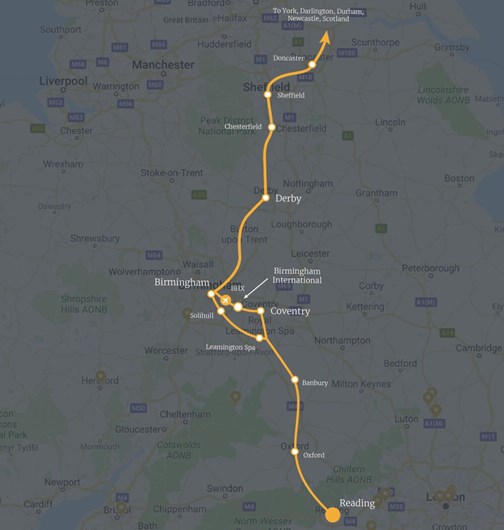
It looks like Midlands Connect are thinking about improving the Reading and Newcastle service.
Points made on the page and related articles, like this one on Rail News include.
- Birmingham Airport has plans to increase passenger numbers to 18 million by 2033.
- Coventry and Leamington Spa via Kenilworth will be double-tracked.
- High Speed Two will release capacity in the area.
- It will open up rail capacity between Birmingham and Solihull.
- There will be a new service between Birmingham Moor Street and Oxford via Solihull and Warwick Parkway.
- It will improve local connections to Birmingham Airport.
- Birmingham and Reading services will be increased to two trains per hour (tph)
- The Government is being asked to chip in £20 million.
These are my thoughts.
Birmingham Airport
Birmingham Airport can become a true Heart of England Airport.
I feel that the future of aviation will be very different to the past.
- COVID-19 and the future pandemics, that we will endure from the East and the Americas, will mean that flying will be a very different experience with hygiene and social distancing to the fore.
- Smaller aircraft, for flights up to 500 miles, will be odd-looking zero-carbon machines with exotic power systems.
- Larger aircraft will be energy efficient planes powered by aviation biofuels produced from household and industrial waste, and biomass.
- Boeing 747s and Airbus A380s will only be talked about in tales from older people to the young.
- Airports will be important rail hubs to more than just the local area.
Wikipedia also says this about expansion of Birmingham Airport.
Plans for a second runway (a third when demand requires) on the other side of the M42 and a new terminal complex and business park have been published, and they could help to create around 250,000 jobs. It has been estimated that if these plans went ahead, the airport could handle around 70,000,000 passengers annually, and around 500,000 aircraft movements.
This Google Map shows the Airport.
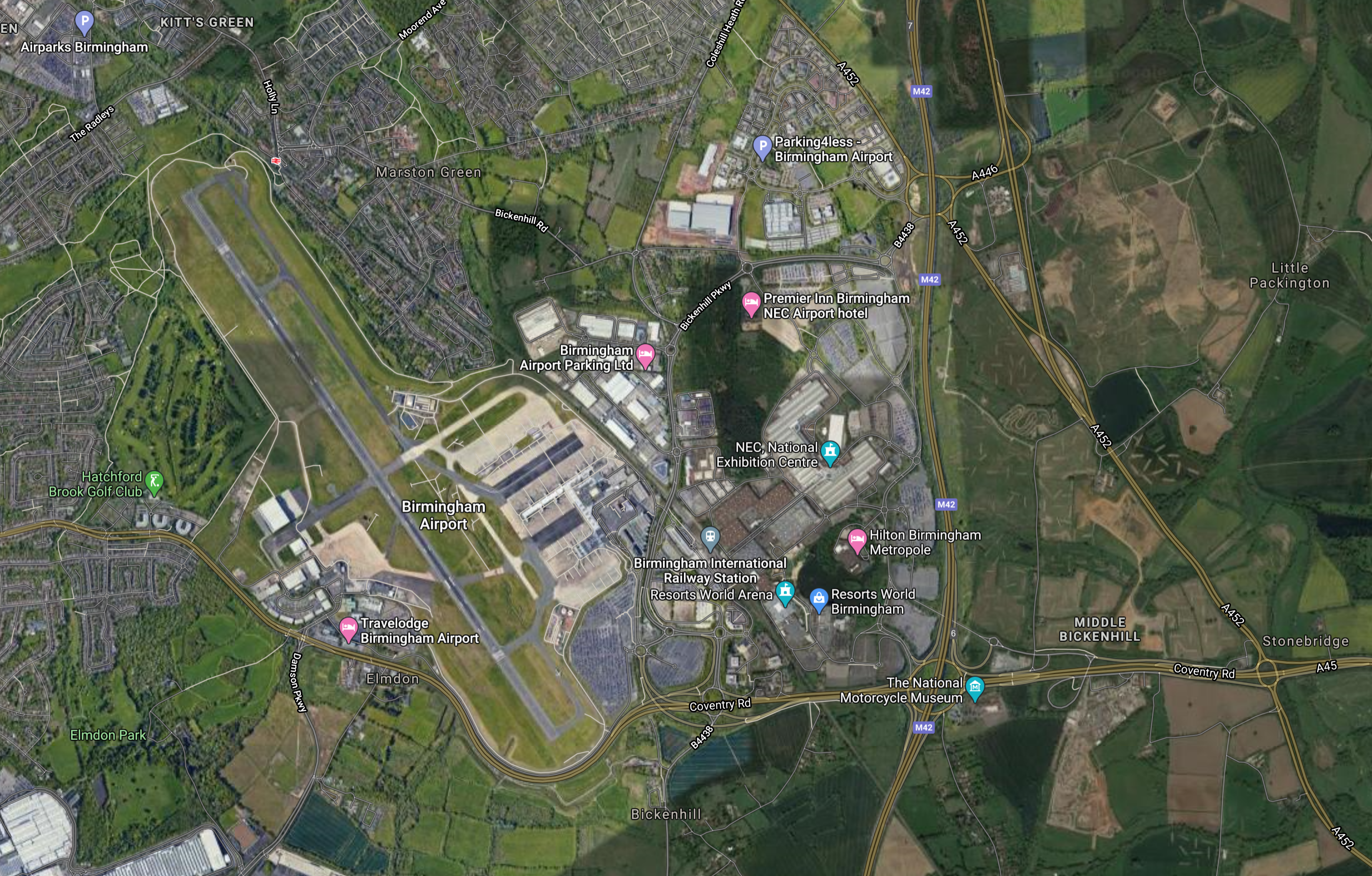
Note the M42 motorway passing North-South to the East of the Airport.
Could Birmingham Airport develop towards Birmingham Interchange and High Speed Two?
It is worth looking at the distance to other airports.
- Aberdeen – 328 miles
- Amsterdam – 280 miles
- Dublin – 199 miles
- Frankfurt – 478 miles
- Geneva – 558 miles
- Paris – 304 miles
All could be within range of an electric aircraft like the under-development Eviation Alice.
I believe that large airports will develop low-noise zero-carbon secondary runways.
Birmingham Airport is well-situated to take advantage.
Adding A Second Track Between Leamington Spa And Coventry
This section of track is about ten miles long, with probably under half only single-track.
This Google Map shows the single-track through the new Kenilworth station.

And these are pictures I took soon after the station opened.



It is certainly one of the best of the current crop of new small stations.
I don’t think that adding a second track will be the most challenging of projects.
It should be noted that the Leamington Spa and Nuneaton service could be a candidate for a battery electric train.
- The route is twenty miles long
- Nuneaton and Coventry stations are fully electrified.
- There might be possibilities to extend this service at either or both ends.
- Nuneaton and Leicester are nineteen miles apart and a new Nuneaton Parkway station is proposed for the route. I wrote about this station in New Railway Station Between Hinckley And Nuneaton Receives Backing.
- Leamington Spa and Stratford-upon-Avon are fifteen miles apart and would need a reverse at Leamington Spa.
A battery electric train might give a faster and more passenger-friendly service, if the passenger numbers and forecasts would support an extended service.
A Birmingham Moor Street And Oxford Service
This Google Map shows Birmingham Moor Street station.
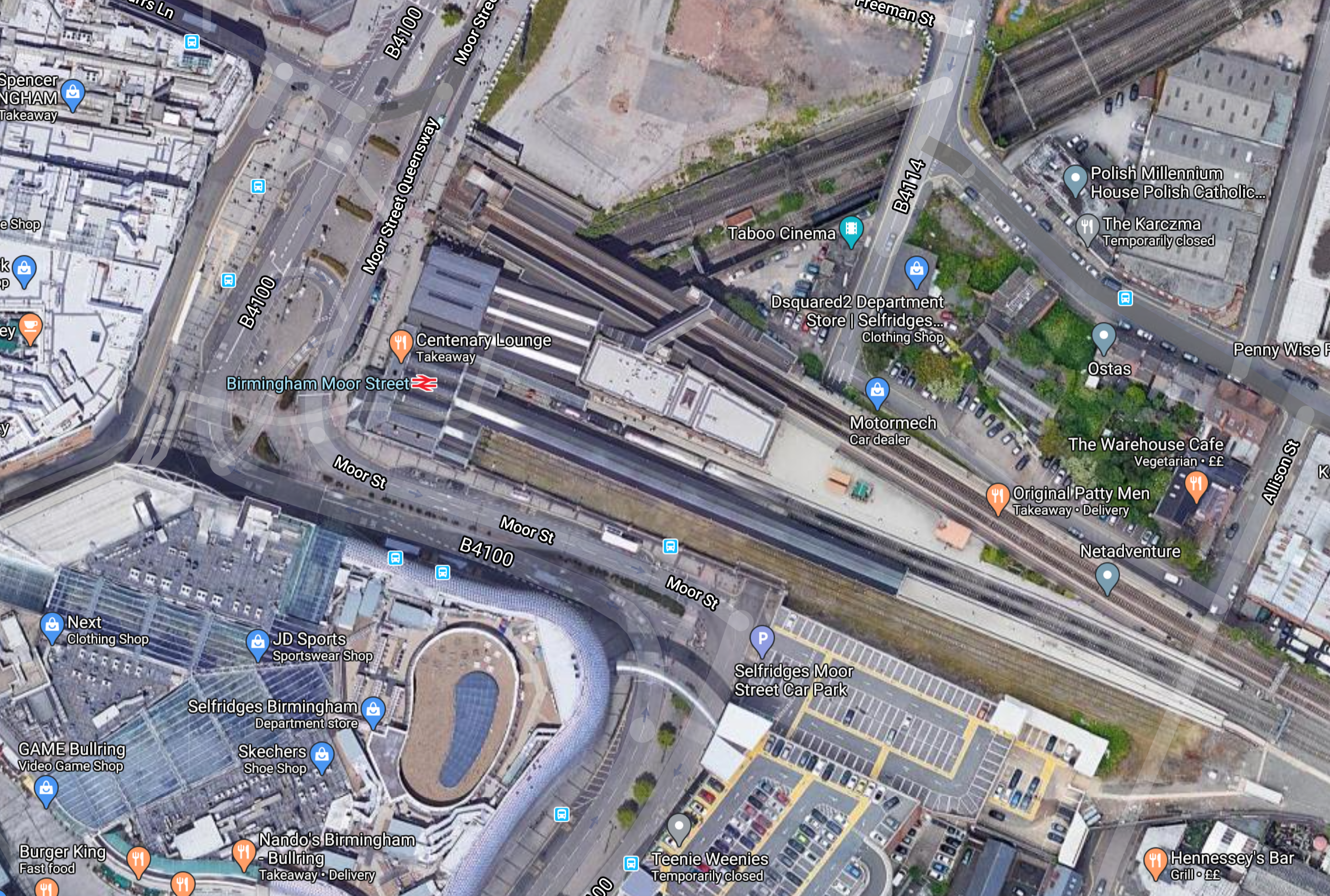
Note.
- The two Northern through platforms on the Snow Hill Lines, that continue under Birmingham to Birmingham Snow Hill station.
- At least two, but possibly three bay platforms, that can take Chiltern Railway’s longest trains.
- There is more space for possibly another two bay platforms to be reinstated or built.
Birmingham Moor Street station will also be a short walk from High Speed Two’s Birmingham Curzon Street station.
This Google Map shows Oxford station.
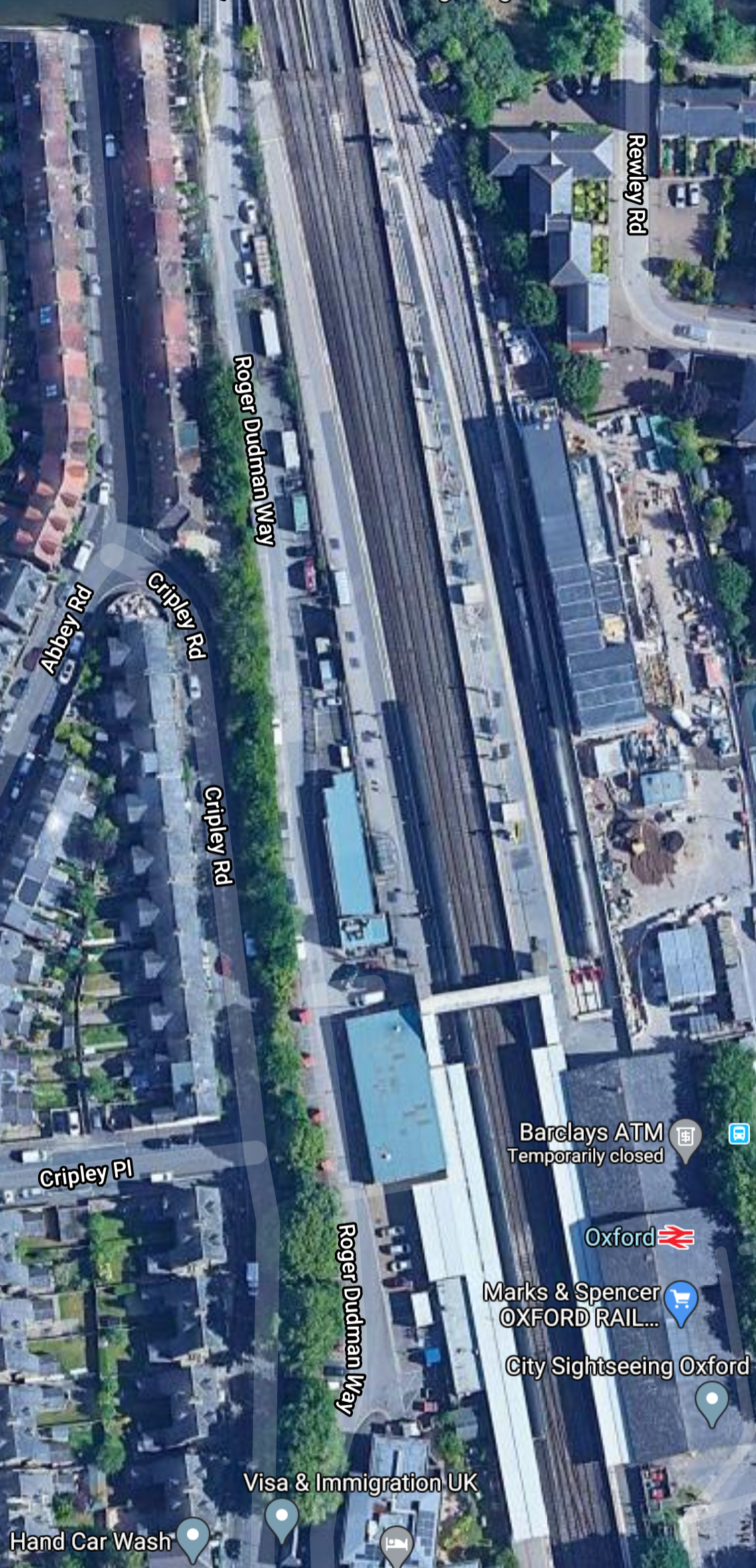
Note.
- Birmingham Moor Street station is to the North via Banbury and Warwick Parkway stations.
- The two long through platforms capable of taking a nine-car train.
- There are two bay platforms to the East of the two through platforms, at the Northern end of the station.
- The bay platforms handle Chiltern’s services from London Marylebone and could also handle the proposed service to Birmingham Moor Street.
Consider this about the proposed Birmingham Moor Street and Oxford service.
- The service could stop at Solihull, Warwick Parkway, Warwick, Leamington Spar and Banbury, as was thought necessary.
- I estimate that Birmingham Moor Street and Oxford are 66 miles apart and that a 100 mph train would take around 66 minutes.
- Birmingham Moor Street and Banbury are 43 miles apart.
- Oxford and Banbury are 23 miles apart.
With these timings and a few minutes to reverse at each end of the route, I would estimate that a 2.5 hour round trip would be possible.
But, I also think, that with charging facilities or short lengths of electrification at Birmingham Moor Street, Banbury and Oxford stations, this service could be run by battery electric trains.
- A three hour round trip should be possible.
- Three trains would be needed to provide an hourly service.
- Oxford, Banbury, Leamington Spa and Warwick would have a direct connection to High Speed Two.
It should also be noted
- Birmingham Moor Street and Stratford-upon-Avon stations are only 25 miles apart and the journey rakes 46 minutes
- Banbury and Stratford-upon-Avon are 35 miles apart. and the journey takes 57 minutes.
- Leamington Spa and Nuneaton are 20 miles apart and the journey takes 36 minutes.
There would appear to be tremendous potential for battery electric services between Birmingham and Oxford.
How many tourists would a Birmingham and Oxford service via Stratford-upon-Avon attract?
Improving The Reading And Newcastle Service
Currently, this is a one tph service between Reading and Newcastle stations.
- It is run by CrossCountry.
- Intermediate stops include Oxford, Banbury, Leamington Spa, Birmingham New Street, Derby, Sheffield, Doncaster, York, Darlington and Durham.
- It appears that the full journey takes four-and-a-half hours.
It looks like to run a two tph service would need as many as twenty trains.
There is an alternative route after High Speed Two opens.
- High Speed Two – Newcastle and Birmingham Curzon Street – 118 minutes
- Walk – Curzon Street and New Street – 10 minutes
- CrossCountry – Birmingham New Street and Reading – 90 minutes
This saves about forty-five minutes.
You could even do a double change.
- High Speed Two – Newcastle and East Midlands Hub – 96 minutes
- High Speed Two – East Midlands Hub and Birmingham Interchange – 17 minutes
- Walk – Birmingham Interchange and Birmingham International – 10 minutes
- CrossCountry – Birmingham International and Reading – 78 minutes
This gives a time of around three hours and twenty minutes.
High Speed Two certainly saves time.
But look at this map clipped from the High Speed Two web site.
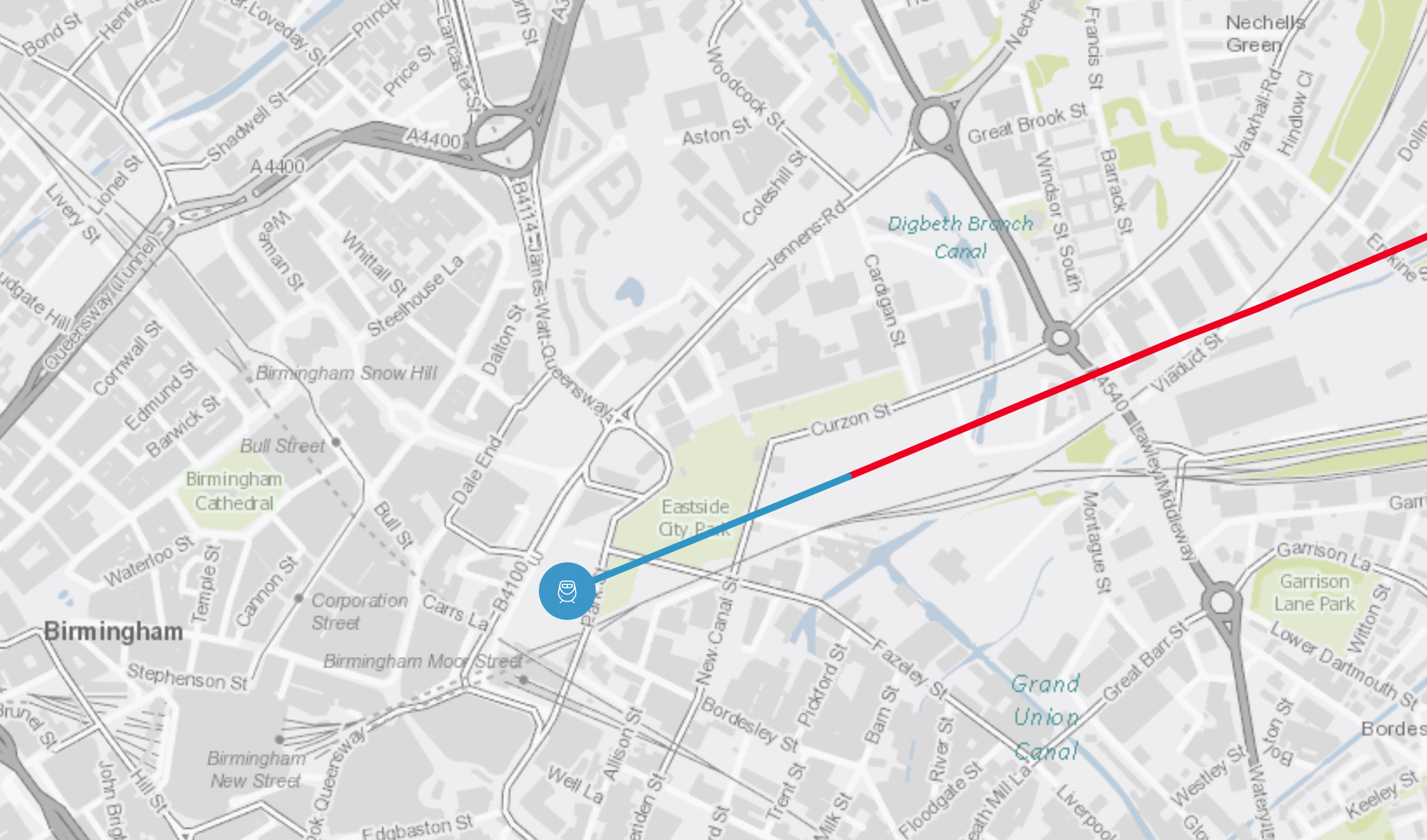
Note.
- The blue dot shows the location of Curzon Street station.
The West Coast Main Line running into New Street station, is just to the South of Curzon Street station.
New Street station can be picked out to the West of Curzon Street station.
This Google Map shows a close-up of the current Curzon Street station site.
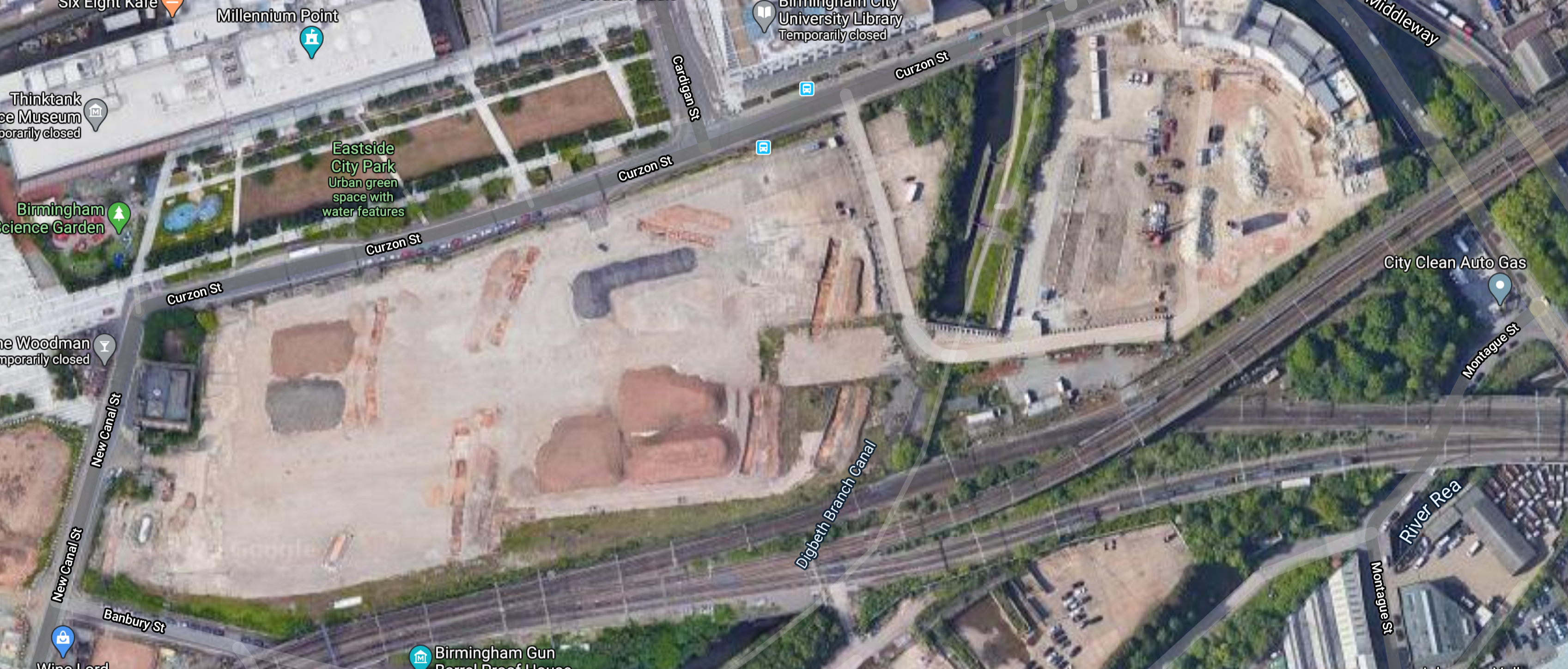
The same pattern of rail lines going past the Curzon Street site into New Street station can be picked out.
Surely, a connection could be made to allow trains from a couple of platforms in Curzon Street station to terminate trains from the West Coast Main Line.
To improve services between Newcastle and Reading, trains would do the following.
- Run on the current East Coast Main Line infrastructure between Newcastle and York. Station stops could be Durham, Darlington and York.
- Switch to new High Speed Two infrastructure South of York.
- Run on High Speed Two infrastructure to Birmingham Curzon Street station. Station stops could be Sheffield, Chesterfield and East Midlands Hub.
- The train would reverse at Birmingham Curzon Street station.
- Switch to the West Coast Main Line outside Birmingham Curzon Street station.
- Run on the West Coast Main Line to Birmingham International station.
- Take the route currently used by CrossCountry between Birmingham International and Reading. Station stops could be Leamington Spa, Warwick Parkway, Banbury and Oxford stations.
Timings would be as follows.
- Newcastle and Birmingham Curzon Street – 118 minutes – From High Speed Two web site.
- Birmingham Curzon Street and Reading – 90 minutes – Current CrossCountry timing.
Note.
- This saves about an hour over the current CrossCountry timings.
- It could use classic-compatible High Speed Two trains.
- Between Birmingham Curzon Street and Newcastle, it follows the same route as one of the current proposed High Speed Two services.
- The service could be extended to Edinburgh from Newcastle.
- The service could be extended to Southampton from Reading
- As there are only twelve tph planned to be running on the Eastern leg of High Speed Two, against a total capacity of eighteen tph, it should be possible to accommodate the extra service or services.
This would surely be a very useful High Speed Two service.
Conclusion
It is a comprehensive package of measures, some of which could have a high cost benefit ratio.
Macclesfield Station And High Speed Two
Today, I went to Macclesfield station.
In the latest iteration of High Speed Two, two new destinations were added to the High Speed Two Network; Macclesfield and Lancaster.
These pictures show Macclesfield station.

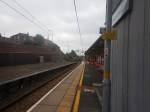
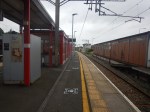
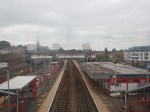
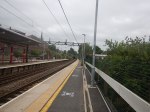
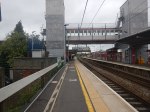
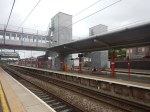
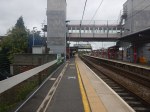
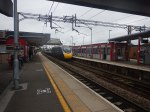
It is a modern station, with three through platforms, two bridges and some Modernist architecture from the 1970s, that could be improved.
This Google Map shows the layout of the station.
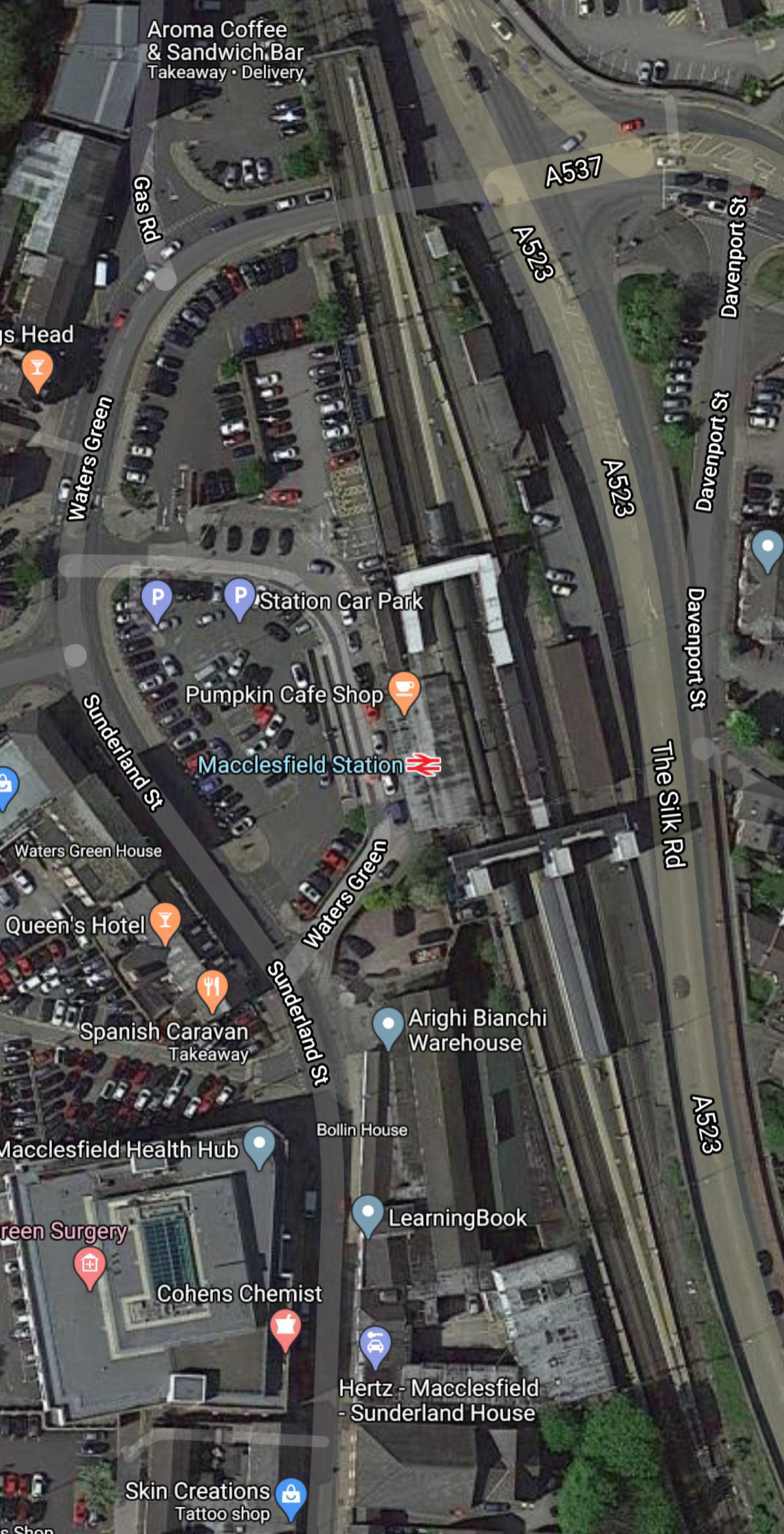
Note.
- Platform 1 is in the West and is used by trains to Stockport and Manchester Piccadilly.
- Platform 2 is in the middle and is used by trains going to Stoke, London and the South.
- Platform 3 is in the East and appears to be used a couple of times per day.
- It also appears there might have been a fourth platform.
All platforms appear capable of handling an eleven-car Class 390 train, which are over two hundred and sixty metres in length.
Is the plan to use Macclesfield as a High Speed Two terminal feasible?
Which Trains Will High Speed Two Use On Macclesfield Services?
It appears that High Speed Two will have two types of trains.
- Trains built to the European loading gauge, that will only be able to work on high lines like High Speed One and High Speed Two. Examples would be Eurostar’s Class 373 and Class 374 trains.
- Trains built to the UK loading gauge, that could also work on existing UK 125 mph routes like the East Coast, Great Western, Midland and West Coast Main Lines. Examples would be Class 800. Class 801, Class 802, Class 390 and Class 745 trains.
The second type, which are referred to, as class-compatible trains will be used to Macclesfield, as these services will share track with Class 390 and other trains, that have been or will be built to the smaller UK loading gauge.
Will Classic-Compatible High Speed Two Trains Fit Into Macclesfield Station?
Currently, every hour, one eleven-car Class 390 train calls in Macclesfield station in both directions, as they provide one of Avanti \west Coast’s three trains per hour (tph) between London Euston and Manchester Piccadilly stations.
The current trains are sixty metres longer than the proposed classic-compatible High Speed Two trains, that could be terminating in Macclesfield station.
How Would Passengers Who Started And Finished Their Journeys In Macclesfield, Connect to Manchester?
Currently, these hourly services connect Manchester Piccadilly and Stoke stations.
- Avanti West Cost – Manchester Piccadilly and London Euston.
- CrossCountry – Manchester Piccadilly and Bournemouth
- CrossCountry – Manchester Piccadilly and Bristol
- Northern – Manchester Piccadilly and Stoke, which stops at all stations.
The characteristics would be common to all these four trains.
- Services call at Stockport, Macclesfield and Stoke stations.
- As services share tracks with a High Speed Two service, they must be reasonably fast.
- All except the Northern service are 125 mph trains.
- The Northern service is run by a 90 mph Class 323 electric train.
- As Manchester Piccadilly and Stoke via Stockport is a fully-electrified route, the trains should probably be able to take advantage.
In an ideal world should the frequency be six tph or one train every ten minutes in each direction?
Which Platforms Would Be Used To Terminate High Speed Two Services?
Trains built to the UK loading gauge could probably terminate in any of the three platforms.
But it might be advantageous to terminate all services in the same platform.
Platform 3 would be the obvious choice.
- It shares an island platform with classic services going South between Manchester Piccadilly and Stoke.
- Passengers starting their journeys in Manchester Piccadilly or Stockport could just walk across from their connecting train to the High Speed Two train.
It must surely be a possibility to make Platform 2 able to operate bi-directionally, so that all trains between Manchester Piccadilly and Stoke stations in both directions, stop in Platform 2, alongside the High Speed Two train for London and the South, that is waiting in Platform 3. The combined frequency would be eight tph. All passengers would just walk across the island platform to change trains.
Could A North-Facing Bay Platform Be Fitted Into The Northern End Of The Island Platform 2/3?
If you are going to provide a High Speed Two service to and from Macclesfield station, it needs to have superb and comprehensive connections to as many places as possible.
The station currently has four tph to Manchester Piccadilly, Stockport and Stoke, but would a North-facing bay platform with level access to the High Speed Two platform make any of the following feasible?
- Run a second local stopping service between Manchester Piccadilly and Macclesfield to give all intermediate stations two tph to High Speed Two.
- Run hourly services to places that don’t have good connections to high speed services to London and the South.
- The Stockport and Stalybridge Line could be used to connect Stalybridge and Huddersfield to High Speed Two.
- There might even be a way of creating a link between Macclesfield and Manchester Airport.
Note.
- Looking at the platform layout at Macclesfield station, fitting in a bay platform would appear to be feasible.
- The important Stockport station, which seems to have been forgotten by High Speed Two would probably have at least six tph to High Speed Two at Macclesfield station.
- The local train could be timed to arrive at Macclesfield station, a convenient time before the High Speed Two train is scheduled to depart.
The bay platform could even be part of Platform 3, if it was decided that trains stopping in Platform 3, never used the platform as a through platform. It would be Macclesfield’s version of the Clapham Kiss.
I suspect more space could be found, by moving the signal box at the end of the station.
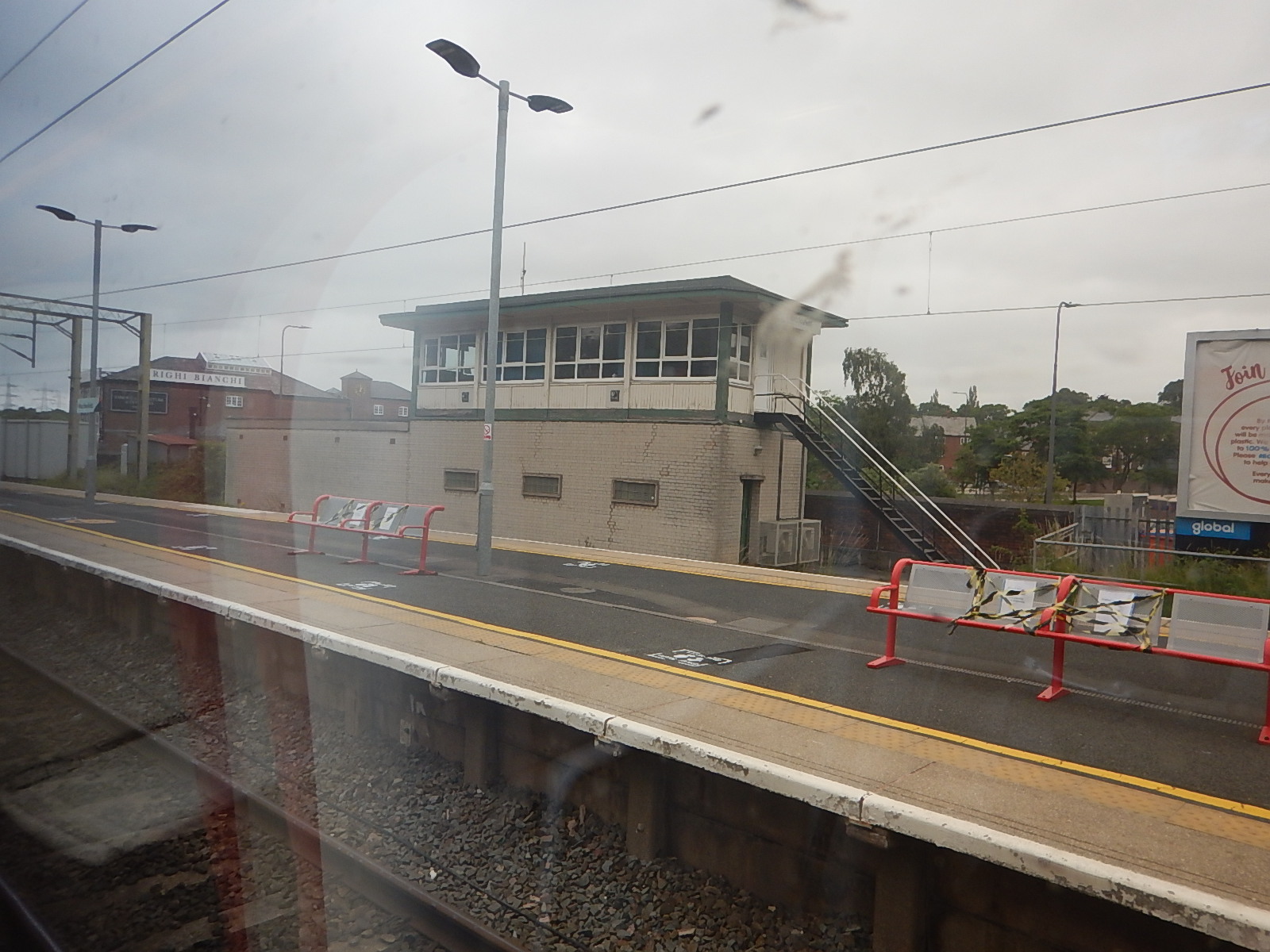
\remember that these days most signalling is controlled from centralised Rail Operation Centres.
Could High Speed Two Trains Run Between Macclesfield And Manchester Piccadilly?
As I said earlier, High Speed Two’s classic-compatible trains will be the same cross-section and shorter, than an eleven-car Class 390 train.
So the answer to my question must be yes!
- This would enable a stop at Stockport station.
- No platform lengthening would be required at Manchester Piccadilly and Stockport stations.
High Speed Two must have good reasons for using Macclesfield as a terminal.
- There are capacity issues between Macclesfield and Manchester Piccadilly stations.
- Macclesfield offers opportunities to connect to places, that are difficult to reach from Manchester Piccadilly station.
But these problems could probably be overcome by digital signalling or extension of the Manchester Metrolink.
Could More High Speed Two Services Run Between Macclesfield Station and The South?
Consider.
- I believe that Macclesfield station could handle more than an hourly High Speed Two train.
- It is a general principle, that on a metro like the London Overground or Merseyrail, that a single platform can handle up to four or even six tph.
- Four tph would surely be too high, but Macclesfield could easily handle a second classic-compatible train to and from Birmingham Curzon Street via Stoke and Stafford.
- During the inevitable works at Manchester Piccadilly station to sccomodate High Speed Two, Macclesfield could offer an alternative route, between London and Manchester.
Using Macclesfield station, as an alternative terminal for Manchester Piccadilly, builds in extra capacity for the future and offers a valuable alternative route during construction and upgrade works.
Rationalisation Between Cross Country And High Speed Two
Consider.
- In a lot of locations North of Birmingham, CrossCountry and High Speed Two seem to provide similar services between the same stations.
- Using currently proposed connections between High Speed Two and the classic network, CrossCountry’s services could run faster.
- CrossCountry’s new fleet of trains will probably be multi-mode trains, that will be very similar to the classic-compatible High Speed Two trains.
- Some of the routes used by CrossCountry’s services will have a substantial upgrade to allow higher speeds and more trains, to speed up High Speed Two services.
There must be a case for rationalisation of services.
Conclusion
The more I look at High Speed Two terminating at Macclesfield station, the more I like it.
I can see these services running from the station in the future.
- High Speed Two – Macclesfield and London Euston – One tph – This service would additionally call at Birmingham Interchange to link up with CrossCountry to the South.
- High Speed Two – Macclesfield and Birmingham Curzon Street – One tph
- CrossCountry – Macclesfield and Bournemouth, Plymouth or Reading – One tph.
- Northern and others – Macclesfield and Manchester Piccadilly via Stockport – Four-six tph
- Northern – Macclesfield and Huddersfield via Stockport and Stalybridge – Two tph
- Northern – Macclesfield and Manchester Airport – Two tph.
Obviously, this is all speculation, but Macclesfield will develop into an important rail hub to the South-East of Manchester.
EWR Targets Short-Term Fleet Ahead Of Possible Electrification
The title of this post is the same as that of this article on Rail Magazine.
This is the introductory paragraph.
Electrification could yet be on the agenda for East West Rail, after Government ministers confirmed that the decision not to wire the reopened railway could be reversed.
East West Railway (EWR) also announced last week, that it was looking for second-hand diesel multiple units to start services.
- The lease will be for four years, with a possible extension of two years.
- The deal is worth £40million and will include maintenance.
- The deal will end on May the 10th 2028.
- 12 to 14 three-car trains are required.
- Services will start at the end of 2024.
It looks to me, that this deal has interim written all over it.
Could Class 170 Trains Be Used For East West Railway?
Class 170 trains come in two- and three-cars and by 2024 many could be being replaced by trains with a smaller carbon-footprint.
If you look at the three-car Class 170 trains, they are the following numbers of trains with various companies.
- Class 170/1 – CrossCountry – 10
- Class 170/2 – Transport for Wales – 8
- Class 170/3 – Abellio ScotRail – 26
- Class 170/3 – CrossCountry – 2
- Class 170/4 – Abellio ScotRail – 13
- Class 170/4 – Northern Trains – 16
There are also some Class 170/5 and Class 170/6 trains, that it appears will be consolidated into ten three-car trains for CrossCountry.
Could CrossCountry Provide The Trains For East West Railway?
I think one likely scenario would be for the trains for East West Rail to come from CrossCountry‘s mixed fleet of Class 170 trains.
Consider.
- CrossCountry need a bit of a fleet change as they still ten High Speed Trains, that will need to be replaced with more modern rolling stock.
- CrossCountry have been criticised for a lack of capacity.
- Several of CrossCountry’s services are run by diesel trains on electrified tracks.
Perhaps, if they replaced the fleet with a customised variant of Hitachi’s Class 800 trains, they might offer a better service to their customers.
- Each train would be five cars long.
- Trains would be able to work in pairs.
- Trains might have electric, battery and diesel capabilities.
- Some would be dual-voltage trains and able to work on both 25 KVAC overhead and 750 VDC third rail electrification.
I’m sure those clever people at Rock Rail are working on an appropriate specification, just as they did for Avanti West Coast with their customised variant of Hitachi’sClass 800 trains.
Looking at the delivery schedules for various fleets of Hitachi trains, we find.
- East Midlands Railway will be receiving 33 x five-car Class 810 bi-mode trains in 2020-2022.
- Avanti West Coast will be receiving 13 x five-car AT-300 bi-mode trains in 2020-2022.
- Avanti West Coast will be receiving 10 x seven-car AT-300 electric trains in 2020-2022.
Could the CrossCountry fleet be delivered in 2022-2024 to allow the Class 170 trains to be released?
Could Class 185 Trains Be Used For East West Railway?
TransPennine Express have a fleet of 51 three-car Class 185 trains.
The future of these trains is uncertain, as TransPennine Express is renewing their fleet.
- They are all fully-compliant with the latest regulations.
- They are 100 mph trains,
- They are the right length.
- They can work in pairs to increase capacity.
These trains would be easy to freshen up for East West Railway.
Could Bombardier Voyagers Provide The Trains For East West Railway?
There are four fleets of Bombardier Voyagers, that by the end of 2024 could be looking for a new home.
- Thirty-four Class 220 trains could be released by 2024 by CrossCountry, if they replace their fleet with new trains.
- Twenty-four Class 221 trains could be released by 2024 by CrossCountry, if they replace their fleet with new trains.
- Twenty Class 221 trains will be released by 2022 by Avanti West Coast, when they replace their fleet with new AT-300 trains.
- Twenty-seven Class 222 trains will be released by 2022 by East Midlands Railway, when they replace their fleet with new Class 810 trains.
These fleets could be updated for the East West Railway.
- They are all fully-compliant with the latest regulations.
- They are 125 mph trains.
- Bombardier have been working on various schemes to fit batteries to these trains, to reduce running on diesel.
They could also be rebuilt to any required length.
Fast Forward To May 2028
By 2028, the following will have happened.
- High Speed Two will have been substantially completed and electrified at Calvert, where it crosses the East West Railway.
- East West Railway will be connected to the electrified West Coast Main Line at Bletchley.
- East West Railway will be connected to the electrified Midland Main Line at Bedford.
- New Hitachi Class 810 trains will be running through Bedford.
- Future connections to the electrified East Coast Main Line at Sandy and the electrified West Anglia Main Line at Cambridge South will have been designed, if not well underway or even completed.
East of Calvert, there will be plenty of electricity to power any electrification.
The article also quotes a Government minister as saying there will be passive provision for electrification. This is sensible, as the clearances required for 25 KVAC overhead electrification are not that much higher, than those needed for the largest freight containers.
So the two major requirements for 25 KVAC overhead electrification; electricity supply and gauge-clearance, appear to be met in the basic design of the East West Railway.
The East West Railway will also have one characteristic, that has been lacked, by most of the railways we have electrified in the last few years.
It will be a substantially new railway, although quite a few miles will have been rebuilt on an existing track bed.
It is my view after looking at several electrification schemes in the last ten years, that when we have electrified a substantially new railway, we have made a much better fist of it, in terms of both cost and timescale.
Could this be, that if the track-bed has just been created or relaid, it is well surveyed and the engineers and workers, who laid it, can be asked their opinion, so fewer costly mistakes are made?
It should also be said, that the route of the East West Railway goes through fairly flat country, which probably doesn’t have the sewers and mine-shafts, that have plagued the erection of electrification in recent years.
I wonder, if having looked in detail at the costs, the builders of East West Railway have found that perhaps around 2023, after a detailed survey of the route, they can build the railway at a cost, which includes electrification, that still offers benefits.
What Would Be The Benefits Of Electrification Of The East West Railway?
The benefits of electrification are generally as follows.
- Faster passenger and freight trains because of higher cruising speed and greater acceleration.
- Lower carbon emissions.
Faster trains would lead to more trains running over the railway.
Will The Electrification Be Full Or Partial?
I believe that Hitachi and other ,manufacturers will produce passenger trains with the following abilities.
- To use either 25 KVAC overhead or 750 VDC third-rail electrification.
- To use onboard energy storage for running a number of miles.
- To charge onboard energy storage, whilst dynamically connected to electrification.
- To charge onboard energy storage, whilst stationary in a station or siding.
- To swap between electrification and energy storage modes at operating speed.
These trains will be able to run on partially-electrified lines, by using energy storage to bridge gaps in the electrification.
In Sparking A Revolution, I gave this specification for a Hitachi battery-electric train.
- Range – 55-65 miles
- Performance – 90-100 mph
- Recharge – 10 minutes when static
- Routes – Suburban near electrified lines
- Battery Life – 8-10 years
It looks like a route run by Hitachi battery-electric trains could have approximately sixty mile gaps in the electrification.
The trouble with gaps, is that they would mean that electric freight locomotives could not be used on the route.
One possibility could be the new tri-mode Class 93 locomotive, which has the following power sources.
- 1.3 MW on diesel
- 4.055 MW on electric
- A power boost on battery
Hopefully, it can switch seamlessly between the various modes at line speed.
Until we see these locomotives in operation, we will not know if they can haul a maximum weight freight train all the way from Felixstowe to Ipswich and on to London, Cambridge or Peterborough.
Freight Trains Through Cambridge And Onto The East West Railway
In Roaming Around East Anglia – Freight Trains Through Newmarket, I said this.
The East West Rail Consortium plan to change the route of freight trains to and from Haven Ports; Felixstowe, Harwich and Ipswich to the West of Kennett station.
In this document on the East-West Rail Consortium web site, this is said.
Note that doubling of Warren Hill Tunnel at Newmarket and
redoubling between Coldham Lane Junction and Chippenham Junction is included
in the infrastructure requirements. It is assumed that most freight would operate
via Newmarket, with a new north chord at Coldham Lane Junction, rather than
pursuing further doubling of the route via Soham.
How would these changes affect Newmarket and the horse-racing industry in the town?
I believe that many freight trains would go straight through Cambridge and Cambridge South stations and onto the East West Railway.
One point to note, is that all of the route between Felixstowe and Cambridge South station has been gauge-cleared for the largest container trains and electrification.
This would surely make it reasonably easy to electrify all the way between Felixstowe and Cambridge South station.
Conclusion
I am coming to the conclusion, that given the importance of the rail freight route between Felixstowe and the Midlands, that something like the following will happen.
- 2024 – Diesel passenger trains start running between Reading and Bedford via Didcot, Oxford and Bletchley
- 2026 – Opening of Cambridge South station.
- 2028 – Partial or full electrification is erected between Reading and Bedford
- 2028 – Battery-electric passenger trains replace the diesel passenger trains.
- 2030 – Opening of the full route between Reading and Cambridge.
- 2935 – Opening of a fully-developed route though Newmarket to allow freight trains to go between Felixstowe and the East West Railway.
It appears to me, that by using diesel trains for an interim period, they can open the Reading and Bedford service early, whilst they complete the East West Railway.
Silent Hydrogen Trains On The Cards For New Line Linking Burton And Leicester
The title of this post is the same as that on this article on Derbyshire Live.
The idea of using hydrogen power came about after some people worried about the noise of trains, if the full route were to reopen.
The Proposed Route
The proposed route that would be reopened is the Leicester and Burton-on-Trent Line.
- The route is double-track.
- It is around forty miles long.
- It is still used by freight trains, so the track must be in serviceable condition.
- There are no stations.
Sadly, when the route was closed to passengers in 1964, British Rail simplified Knighton Junction at the Leicester end of the line. Wikipedia says this.
At the Leicester end of the line, Knighton North Junction has been dismantled and the former course of the line to the junction has been sold and turned into an industrial estate. The line’s remaining connection with the Midland Main Line is Knighton South Junction, which faces southwards, away from Leicester station. Trains between Leicester and the line therefore have to reverse direction at the junction.
This Google Map shows, what’s left of the junction.
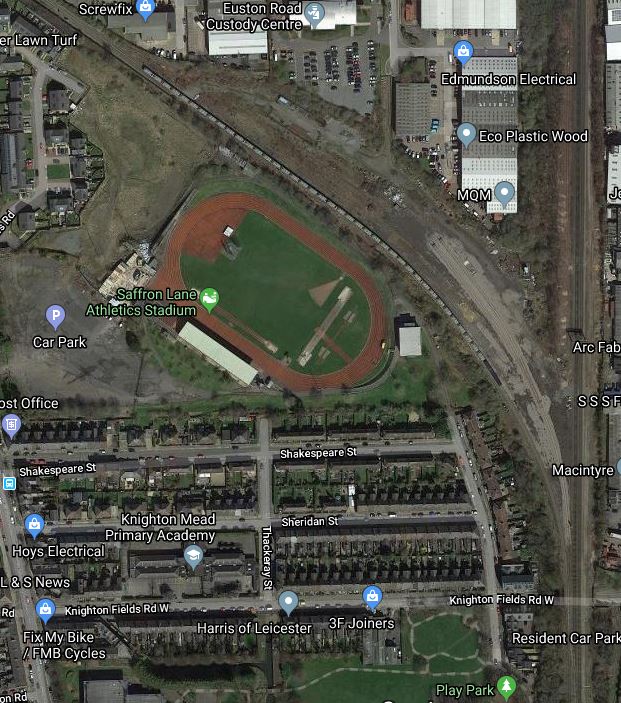
Note.
- Leicester is to the North
- Burton is to the North-West.
- Melton Mowbray and London are to the South.
It looks to me, that someone at British Rail made it absolutely certain, that the rail line could not be reopened to provide a passenger service between Leicester and Burton.
For a train to go between Leicester and Burton, it would either need to reverse as Wikipedia indicated, or the curve would have to be very tight.
There is only one class of passenger train, that can go round tight curves and that is a Class 399 tram-train!
So to enable trains to go direct around the corner, the option is either expensive disruptive demolition or use something like tram-train technology or a specially designed bendy train.
The Ivanhoe Line
The route was originally planned to be the second part of the Ivanhoe Line, but this was discontinued after rail privatisation.
Services on this line is an hourly service between Leicester and Lincoln Central stations.
- Intermediate stations are Syston, Sileby, Barrow-upon-Soar, Loughborough, East Midlands Parkway, Beeston, Nottingham, Newark Castle, Collingham, Swinderby and Hykeham.
- Services can get overcrowded, as the service is run by two-car trains.
- Platforms would need to be lengthened for longer trains.
Extending this service to Burton station would surely be good for connectivity at and through Leicester.
The Association Of Train Operating Companies Plan For The Line
This is taken from the Wikipedia entry for the line.
In 2009 the Association of Train Operating Companies published a £49 million proposal (Connecting Communities: Expanding Access to the Rail Network) to restore passenger services to the line that would include reopening stations at Kirby Muxloe, Bagworth and Ellistown, Coalville Town, Ashby de la Zouch, Moira, and Gresley (for Swadlincote). There is also some support in the Leicester area for the line to have new stations to serve Leicester City F.C.’s stadium and the suburb of Braunstone.
Wikipedia also says, it could be developed as a no-frills line.
Possible New Stations In Leicester
I have mentioned new stations in Leicester, so here’s a few more thoughts.
Leicester Reversal Station
A friend said that to reverse the trains between Leicester and Burton, a station has been proposed to be built, south of Knighton Junction.
This Google Map shows the junction and the line to the South.
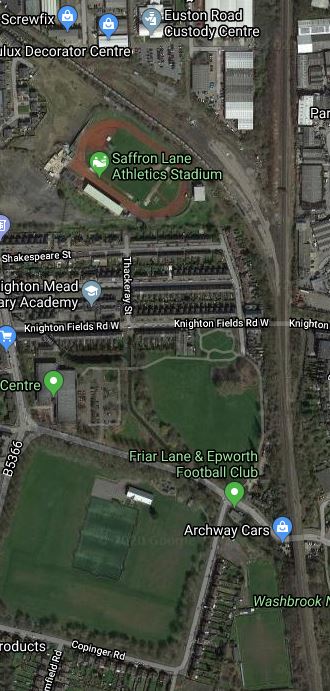
Only a single-platform station would be needed and it would be a simple and affordable solution to British Rail’s lack of vision of the future.
Leicester City Stadium
This Google Map shows the stadium.
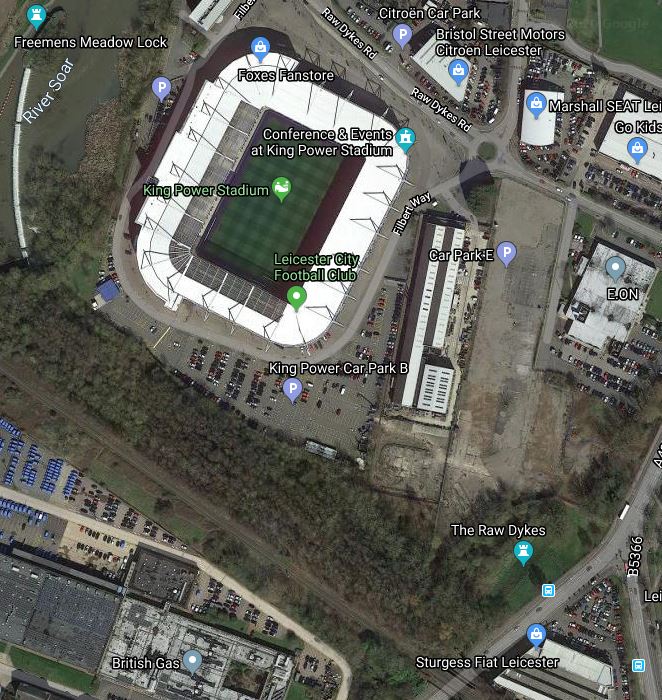
Note the rail line passing to the South of the station.
It would appear that building a new station would not be the most difficult of projects.
But after the experience of Coventry City, who were relegated twice after Coventry Arena station opened, would eicester City want a station?
Braunstone Station
This Google Map shows the rail line running through Braunstone.
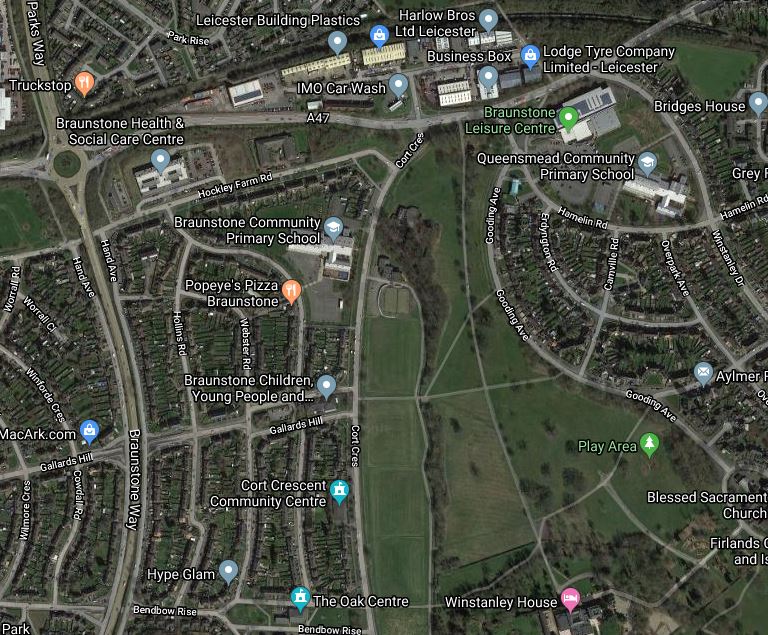
The rail line is at the top of the map.
Leicester Forest East Station
I wrote about this possible station in A Station At Leicester Forest East.
Burton Station
Intriguingly, Burton station is run by East Midlands Railway, who run no services to the town.
Services are provided by CrossCountry using a variety of long distance services.
The South Staffordshire Line connects Burton and Birmingham.
Part of this line is being converted to become an extension of the West Midlands Metro and Staffordshire County Council have looked at converting the whole route to tram-train operation to bring trams to Burton to promote tourism.
Hydrogen Power
I estimate that the distance between Lincoln and Burton is about a hundred miles.
Alstom are predicting a range of several hundred miles for their hydrogen trains for their Breeze train, which should mean a round trip to Lincoln from Burton will surely be in range.
Refuelling could be at a suitable place on the route.
In Delivering Hydrogen For Vehicles, I talk about how iTM Power are building hydrogen refuelling stations for road vehicles.
As the company is already building stand-alone hydrogen fuelling stations for fleets of buses in Birmingham and Pau, I’m sure that one for a fleet of trains is not a problem.
All their filling stations need is a small amount of space, a supply of tap water and a connection to the electricity grid.
It should be noted that Central Rivers Depot is four miles South of Burton.
Possibilities
There are a lot of possibilities to extend the Ivanhoe Line to Burton and even beyond using the South Staffordshire Line.
- Battery or hydrogen trains can be used.
- Stations can be added as required.
- The route will connect to Eat Midlands Airport.
- A solution for Knighton Junction can surely be devised.
Amazon are reported to be interested in the project, as they have a big depot at Coalville.
Worcestershire Parkway Station Is Now On The Map
This article on the BBC is entitled Worcester’s New Railway Station’s Set To Open In December.
This Google Map showsWorcestershire Parkway station, at the place, where the Cotswold and Cross Country lines cross.
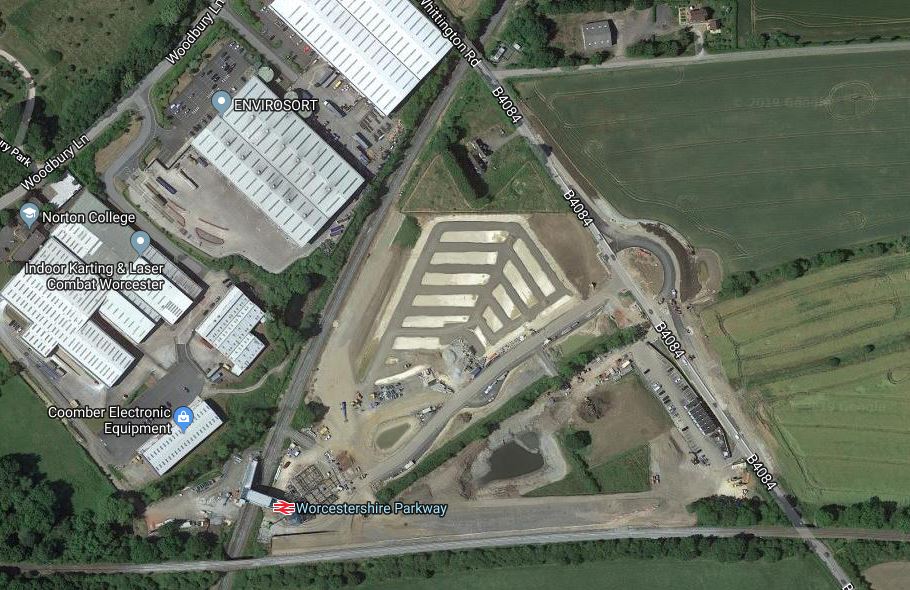
Services will probably start to call at the timetable change of December 15th, 2019
Judging by the bands of car parking shown in this map, they are expecting a sizeable number of passengers.
I just tried to book a ticket to the station and it is not in the on-line ticketing system yet as a destination, although it does show up as a stop on these journeys.
- CrossCountry – Nottingham and Cardiff – Hourly
- GWR – Paddington and Worcestor, Great Malvern and Hereford.- Hourly
Two other hourly CrossCountry services also pass through.
Irish Rail And Porterbrook Order MTU Hybrid PowerPacks
The title of this post is the same as that of this this article on the International Rail Jotnal..
This is the first paragraph.
Irish Rail (IE) and British rolling stock leasing company Porterbrook have signed contracts with Rolls-Royce for the supply of 13 MTU Hybrid PowerPacks, the first firm orders for the hybrid rail drives.
Other points are made in the article.
- IE has ordered nine PowerPacks for Class 22000 trains. If the technology works they intend to convert all 63 trainsets, which will need 234 PowerPacks, as each car has a diesel engine.
- Porterbrook has ordered four for Class 168 and Class 170 trains.
- The PowerPacks will be delivered between mid-2020 and 2021.
- The MTU engines are built to EU Stage 5 emission regulations.
- The PowerPacks can switch to battery power in stations and sensitive areas.
- Under battery power, noise is reduced by 75 % and CO2 emissions by up to 25 %
- Operating costs are significantly reduced.
- The PowerPacks have regenerative braking, thus they reduce brake pad wear.
- Due to electric power, the trains have been acceleration, which may reduce journey times.
It seems that passengers, train operating companies, train leasing companies and those that live by the railway are all winners.
If the concept works reliably and meets its objectives, I can see MTU selling a lot of Hybrid PowerPacks.
Which Operators Will Be Used For Trials?
This is a valid question to ask and I’ll put my thoughts together.
Irish Rail Class 22000 Train
These trains only run in Ireland with one operator;Irish Rail, so they will be used for trials.
As each car has one MTU diesel engine and Irish rail are stated in Wikipedia as wanting to run three-car and six-car sets, could they be converting one train of each length?
British Rail Class 168 Train
All the nineteen Class 168 trains of various lengths are in Chiltern Railway’s fleet, they will be the trial operator.
Chiltern also have nine two-car trains, which could be ideal for trial purposes as they will need two Hybrid PowerPacks.
British Rail Class 170 Train
Porterbrook own upwards of thirty two-Car Class 170 trains with CrossCountry, Greater Anglia and West Midlands Trains.
As Greater Anglia and West Midlands Trains are replacing their Class 170 trains, this means that CrossCountry will soon be the only user of two-car units.
The four two-car trains from Greater Anglia, will be going to Trains for Wales (TfW).
TfW currently has thirty two-car Pacers in its fleet, which must be replaced by the end of 2019.
TfW is bringing in the following trains.
- Nine four-car Class 769 trains from Porterbrook.
- Eight three-car Class 17 trains from Greater Anglia
- Four two-car Class 17 trains from Greater Anglia
This is a total of sixty-eight cars.
So TfW are replacing a load of scrapyard specials with quality, more powerful trains, with approximately 13 % more capacity.
TfW are proposing to use the Class 170 trains on the following routes.
- Heart of Wales line (from 2022)
- Regional services between South and West Wales
- South Wales metro lines – Ebbw Vale/Maesteg (until 2022)
- Crewe-Shrewsbury local services (from 2022)
There is a mixture of routes here and it would be a good trial,
Other Trains
If the MTU PowerPack proves successful and leads to widespread conversion of the Class 168 and Class 170 fleets, will we see the twenty Class 171 trains and thirty-nine Class 172 trains converted to hybrid power?
Conclusion
It looks like a good solid project to me!
Routes For Bombardier’s 125 Mph Bi-Mode Aventra
This article in Rail Magazine, is entitled Bombardier Bi-Mode Aventra To Feature Battery Power.
A few points from the article.
- Development has already started.
- Battery power could be used for Last-Mile applications.
- The bi-mode would have a maximum speed of 125 mph under both electric and diesel power.
- The trains will be built at Derby.
- Bombardier’s spokesman said that the ambience will be better, than other bi-modes.
- Export of trains is a possibility.
Bombardier’s spokesman also said, that they have offered the train to three new franchises. East Midlands, West Coast Partnership and CrossCountry.
These are my thoughts on these franchises.
Bi-Mode And Pure Electric
I’m pretty certain that if you want to create a 125 mph bi-mode train, you start with a 125 mph electric train, if you want a high degree of commonality between the two trains.
Hitachi have a whole family of Class 800 trains, each of which has a different specification for the diesel power. Even the pure-electric Class 801 trains, has one diesel engine for emergencies.
An electric train with batteries could be very efficient, if the batteries were used to handle regenerative braking and boost the trains, where more power is required.
East Midlands
It is no surprise that Bombardier are talking to the groups, that are bidding to become the new franchise holder for the East Nidlands, when it is awarded in April 2019.
They wouldn’t want to see another company’s product roaring past the factory.
The proposed bi-mode Aventra will probably have been designed very much with the Midland Main Line in mind.
- The Midland Main Line will be electrified from St. Pancras to Kettering and Corby.
- Will the fast lines be electrified to Glendon Junction, where the Corby Branch joins the Midland Main Line?
- The route between St. Pancras and Glendon Junction is being upgraded to four tracks, with as much 125 mph running as possible.
- The non-stop nature of Midland Main Line services South of Kettering could be significant.
- North of Kettering, there is currently no electrification.
- The development of Toton station for HS2 is being accelerated and there could be an island of electrification here, by the mid-2020s.
- If HS2 shares the Midland Main Line corridor between Toton and Sheffield, this section could be electrified by the late-2020s.
Over the next decade, there will be more electrification and a greater proportion of the route, where 125 mph running will be possible.
There has been a bit of controversy, that the number of stops the franchise will make at Bedford and Luton is being reduced after May this year.
The reason given is that it will enable faster services to Derby, Nottingham and Sheffield.
North To Derby, Nottingham and Sheffield
Consider a bi-mode train with batteries going North.
- Between St. Pancras and Kettering, it will be at 125 mph for as long as possible.
- The train will also ensure that at Kettering, it has the batteries brim full, sfter charging from the electrification.
- After a stop at Kettering station, if the electrification reached to Glendon Junction, the acceleration would all be electrically-powered.
- Whether it stopped at Kettering or not, the train would pass Glendon Junction at line speed with full batteries.
It’s almost as if the electrification is being used as a catapult to speed the train North.
South From Derby, Nottingham and Sheffield
Being as electrically efficient coming South would be a lot more difficult.
- I suspect that train batteries will be charged at Derby, Nottingham and Sheffield, so they start their journey South with full batteries.
- Using a full battery and assistance from the onboard generator, trains would be accelerated away from the terminii.
- The trains computer would select automatically, whether to use battery or onboard generator power and would harvest all the power from regenerative braking.
- At each stop on the journey, energy would be lost, as regenerative braking systems do not are only between seventy and ninety percent efficient.
- Once at Glendon Junction, the train would raise the pantograph and switch to getting power from the overhead wires.
It’s all about a well-programmed computer on the train, which knows the route, the timetable and battery state so it can switch power sources appropriately.
Electrification
On the other hand, electrification around Toton could make everything easier and more efficient.
With electrification, every little helps.
- Modern trains can raise and lower pantographs, quickly and automatically.
- Faster journeys.
- Lower carbon emissions.
- Less noise and vibration from diesel generators.
Everyone’s a winner.
Oakham To Kettering
The Oakham-Kettering Line to Corby station is being electrified, double-tracked and I suspect speed limits will be raised.
Speed limits are also being raised and track improvements are being done, South of Glendon Junction.
Currently, services take seventy minutes. With the 125 mph Aventras on the route, they will not need to use the onboard generator, but surely the journey time could be reduced to under an hour, which would attract passengers and need less trains to run a two trains per hour (tph) service.
The Oakham Problem
Oakham station is in the middle of the town, as this Google Map shows.

The Department for transport would like to see more services to the town and the next station of Melton Mowbray.
But the line through the station is busy with freight trains and there is a level crossing in the middle of the town.
125 mph bi-mode trains, won’t help with the problem of Oakham.
Joining And Splitting Of Trains
There is also the possibility of joining and splitting trains.
Hitachi’s Class 800 trains can do this and I’m sure bi-mode Aventras will be able to do this automatically.
There is only four platforms available for trains on the Midland Main Line at St. Pancras and regularly two trains occupy one platform.
The ability to run a pair of bi-mode trains, that joined and split could be a great asset.
Liverpool To Norwich
This long route is an important one for those, who live near its stations. It is usually served by one or two Class 158 trains, which are often very crowded.
The route is partially electrified.
- Liverpool to Hunts Cross
- Manchester Oxford Road to Stockport
- Grantham to Peterborough
- Around Ely
- Around Norwich
So there should be plenty of places to raise the pantograph and charge the batteries.
It is a typical long-distance route for the UK and I’m sure it would benefit from 125 mph bi-mode Aventras.
West Coast Partnership
Bids for the West Coast Partnership, which will run services on the West Coast Main Line and HS2, will be submitted by July 2018. The winning bidder will be announced in May 2019 and take over services two months later.
A modern 125 mph bi-mode would be an ideal replacement for the current twenty Class 221 trains, that work on the West Coast Main Line.
These Class 221 trains are.
- Diesel powered.
- Five-cars long.
- Built in 2001-2002 by Bombardier.
- 125 mph capable.
- Some services are run by splitting and joining trains.
But most importantly, most services are run substantially under wires.
New 125 mph bi-mode trains would certainly improve services.
- Several of the current services operated by Class 221 trains, would become electric ones.
- How much faster would they be able to run a service between London Euston and Holyhead?
- They would also be able to run new services to places like Barrow. Blackburn and Huddersfield.
- Five cars could be a convenient train size for the operator.
But above all, they would offer a better passenger experience, with less noise and vibration from the diesel engines.
The longest section of running using onboard power of a bi-mode Aventra will be along the North Wales Coast Line to Holyhead.
- The line has an 90 mph operating speed.
- The line is 85 miles long.
- The gradients won’t be too challenging, as the line runs along the coast.
- Services stop up to half-a-dozen times on the route.
- From London to Crewe is electrified.
- The section between Crewe and Chester may be electrified.
It looks to be an ideal route for a 125 mph bi-mode Aventra.
As the route appears to not be as challenging as the Midland Main Line, could this route, be the ideal test route for a hydrogen fuel-cell powered Aventra.
West Coast Partnership may well have plans to use 125 mph bi-mode trains as feeder services for HS2’s hubs at Birmingham and Crewe.
I could certainly see West Coast Partnership ordering a mixed fleet of 125 mph Aventras, some of which would be bi-modes and some pure electric.
CrossCountry
CrossCountry has a diverse portfolio of routes, which have every characteristic possible.
- Some are lines with a 125 mph operating speed.
- Some are electrified with 25 KVAC overhead wires.
- Some are electrified with 750 VDC third-rail.
- Some are not electrified.
A bi-mode train with these characteristics would fit well.
- 125 mph capability on both electric and diesel power.
- Battery power for short branch lines.
- Modern passenger facilities.
- Five-cars.
- Ability to work in pairs.
They could actually go for a homogeneous fleet, if they felt so inclined.
That would be a substantial fleet of upwards of fifty five-car trains.
The new CrossCountry franchise will be awarded in August 2019 and start in December 2019.
Other Routes
If the 125 bi-mode Aventra with batteries is built, there could be other routes.
Borders Railway
Why would you run a 125 mph bi-mode Aventra on the 90 mph Borders Railway?
- The Borders Railway will be extended to Carlisle, which will mean, that both ends will be electrified for a few miles.
- This will mean that bi-mode trains with batteries could charge their batteries at both ends of the line.
- If traffic increases, extra cars can be added.
- The trains would be able to use the West Coast Main Line to link the Lake District to Edinburgh.
- They could be given a tourism-friendly interior, to go with the large windows common to all Aventras.
The trains would help to develop tourism in the South of Scotland and the North of England.
East West Rail
The East West Rail between Oxford and Cambridge is going to built without electrification.
- But that doesn’t mean that it should be built with an operating speed in the region of 90 mph!
- The legendary InterCity 125s have been running on lines without electrification at 125 mph since the late 1970s, so it isn’t an unknown practice.
So if the line were to be built for high speed across some of the flattest parts of England, why not unleash the 125 mph bi-mode Aventras?
They could serve Ipswich, Norwich and Yarmouth in the East using their onboard generators.
They could serve Bournemouth, Bristol, Reading and Southampton, if the trains had a dual-voltage capability.
They could use electrification at Bedford, Bletchley, Cambridge and Reading to charge the batteries.
Settle-Carlisle Line
Surely, if the 125 mph bi-mode Aventras are suitable for the Borders Railway, then it should be able to work the Settle-Carlisle Line.
- Both ends of the line are electrified, so batteries could be charged.
- The line needs more and better services.
But the main reason, is that there will be a high-class scenic route between Edinburgh and Leeds.
I estimate that a London to Edinburgh service via Leeds, Settle, Carlisle and the Borders Railway would take six and a half hours, using a 125 mph bi-mode Aventra.
Some tourists love that sort of trip.
Waterloo To Exeter
The West of England Line has the following characteristics.
- It runs between Basingstoke and Exeter.
- It is a hundred and twenty miles long.
- It has a 90 mph operating speed.
- The line is not electrified.
- It is connected to the electrified South Western Main Line to Waterloo.
- The route is electrified between Waterloo and Basingstoke.
- Direct trains take three hours twenty-three minutes between Waterloo and Exeter, with fourteen stops between Basingstoke and Exeter.
- The trains used on the route are twenty-five year-old Class 159 trains.
Would a 125 mph bi-mode Aventra improve the passenger service between Waterloo and Exeter?
- The Aventras are built for fast dwell times at stations, so there could be time saving with all those stops.
- The Aventras could use the third-rail electrification between Waterloo and Basingstoke.
- There may be places, where the operating speed can be increased and the faster Aventras would take advantage.
- The trains could have a passenger-friendly interior and features designed for the route.
The real benefits for South Western Railway and their passengers would come, if the trains could do Waterloo to Exeter in three hours.
Routes For A Pure-Electric Version
There are several routes in the UK, where the following apply.
- Some long-distance trains are run by 125 mph trains.
- The route is fully- or substantially-electrified.
- A proportion of the route allows 125 mph running.
- Sections of the route is only double-track.
Routes satisfying the criteria include.
- The West Coast Main Line
- The East Coast Main Line
- The Great Western Main Line
- The Midland Main Line
On these routes, I believe it would be advantageous, if all passenger trains were capable of operating at 125 mph.
This is cause if all trains were running at 125 mph, they could be more closely spaced, thus increasing capacity.
Digital signalling would probably be needed.
There are several train services,, that use the electrified 125 mph sections of these routes.
Birmingham/Liverpool/Manchester To Edinburgh/Glasgow
TransPennine Express, are replacing their current Siemens 110 mph Class 350 trains on this service, with new CAF 125 mph Class 397 trains.
Euston To The West Midlands, Liverpool And Preston
West Midland Trains are replacing some of their current Siemens 110 mph Class 350 trains with new Aventras.
Information is scarce at the moment, but could some of these new Aventras be 125 mph units for working on the West Coast Main Line?
Leeds/York To Edinbugh
TransPennine Express run trains on this route.
St. Panvras To Corby
The Corby Branch is being upgraded.
- Double-track
- 125 mph running
- Electrification
The section of the Midland Main Line between St. Pancras and Glendon Junction is also being upgraded to allow as much 125 mph running as possible.
If 125 mph bi-mode trains are to be used from St. Pancras to Derby, Nottingham and Sheffield, then surely, it would be logical to use a pure-electric version of the train between St. Pancras and Corby?
Various documents and web pages say, that the St. Pancras to Corby services are going to be worked by 110 mph Class 387 trains. Surely, faster 125 mph trains, which had been designed for the route would be better for passengers and the train operating company.
From my experience of scheduling, the section of the Midland Main Line between St. Pancras and Bedford, must be a nightmare to timetable successfully.
- There are two train operating companies using the route, who go a hundred miles in different directions.
- The Class 700 trains used by Thameslink are only 100 mph trains, so probably can’t use the fast lines too often, as if they do, they’ll delay the expresses..
- Regular passengers object to any change in stopping patterns or journey times.
- Passengers liked to get on express services at Bedford, but they now don’t stop.
- Passengers don’t like the Class 700 trains.
- Luton Airport wants more services.
My experience, says that something radical must be done.
Consider.
- Plans are for two tph between St. Pancras and Corby.
- How many passengers would complain if they ended up in the St. Pancras Thameslink platforms, rather than the high-level ones? They’re both equally badly connected to the Underground, buses and taxis.
- There will be four tph between Bedford and London all day on Thameslink, with an extra four tph in the Peak.
- Some or all of these services will call at both Luton and Gatwick Airports.
- Looking at the two semi-fast services. which both run at tw trph, they seem to stop virtually everywhere.
I think it would be possible for the two tph St. Pancras to Corby services to become express services between Corby, Gatwick Airport and Brighton.
- The services would only stop at Kettering, Bedford, Luton, Luton Airport Parkway, St. Albans, West Hampstead Thameslink, St. Pancras Thameslink, Farringdon, City Thameslink, Blackfriars, London Bridge and East Croydon.
- The services would use the 125 mph fast lines North of St. Pancras, as much as possible.
- Corby services would always call at St. Pancras Thameslink.
- The trains would be designed for both Airport services and long-distance commuting.
- The trains would be maximum length.
Obviously, this is my rough idea, but something like it might satisfy the stakeholders, more than what is proposed.
I think there are also other services, which are fully electrified, which could be upgraded, so that they would be suitable for or need 125 mph electric trains.
Kings Cross To King’s Lynn
I wrote about this route in Call For ETCS On King’s Lynn Route.
Portsmouth Direct Line
Under Topography Of The Line in the Wikipedia enter for the Portsmouth Direct Line, this is said.
The central part of the route, from Guildford to Havant, runs through relatively thinly populated country. The line was designed on the “undulating principle”; that is, successive relatively steep gradients were accepted to reduce construction cost. In the days of steam operation this made the route difficult for enginemen.
But with.
- A second man in the cab, in the shape of the train’s computer, juggling the power.
- Regenerative braking to the batteries saving energy for reuse when needed.
- Bags of grunt from the traction motors.
The pure electric version of the 125 mph Aventra might just have the beating of the topography.
South Western Railway plan to introduce an older train from Litchurch Lane in Derby on this route, in the shape of the last of the Mark 3s, the Class 442 train or the Wessex Electrics, which were built in the 1980s.
It will be interesting to see how a 125 mph pure electric Aventra compares to something made in the same works, thirty years earlier.
Waterloo To Southampton, Bournemouth and Weymouth
The South Western Main Line goes to Southampton Central, Bournemouth and Weymouth.
- It is a 100 mph line
- It is fully-electrified.
Would a 125 mph pure-electric Aventra be able to put the hammer down?
I’m sure Network Rail can improve the line to a maximum safe line-speed.
Conclusion
If Bombardier build a 125 mph bi-mode Aventra with batteries, there is a large market. Especially, if there is a sibling, which is pure electric.
Bombardier Bi-Mode Aventra To Feature Battery Power
The title of this post is the same as this article in Rail Magazine.
A few points from the article.
- Development has already started.
- Battery power could be used for Last-Mile applications.
- The bi-mode would have a maximum speed of 125 mph under both electric and diesel power.
- The trains will be built at Derby.
- Bombardier’s spokesman said that the ambience will be better, than other bi-modes.
- Export of trains is a possibility.
Bombardier’s spokesman also said, that they have offered the train to three new franchises. East Midlands, West Coast Partnership and CrossCountry.
In some ways, I am not surprised about what is said in this article.
Another article on Christian Wolmar’s web site, is entitled Bombardier’s Survival Was The Right Kind Of Politics.
This is said.
Bombardier is not resting on its laurels. Interestingly, the company has been watching the problems over electrification and the fact that more of Hitachi’s new trains will now be bi-mode because the wires have not been put up in time. McKeon has a team looking at whether Bombardier will go into the bi-mode market: ‘The Hitachi bi-mode trains can only go 110 mph when using diesel. Based on Aventra designs, we could build one that went 125 mph. This would help Network Rail as it would not have to electrify everywhere.’ He cites East Midlands, CrossCountry and Wales as potential users of this technology.
The article was published in February 2017 and mentions, 125 mph on diesel and two of the companies in the recent article.
The Design Of The Trains
My thoughts are as follows.
The Starting Point
I’m pretty certain that if you wanmt to create a 125 mph bi-mode train, you start with a 125 mph electric train, if you want a high degree of commonality between the two trains.
Bombardier haven’t yet built any of their Aventras for West Midland Trains, but as they will use the West Coast Main Line extensively, will they be 125 mph trains and not 110 mph trains, as is said in Wikipedia?
Aventras And Battery Power
I will believe until Bombardier say I’m wrong, that Crossrail’s Class 345 trains, which are Aventras, use batteries for the following purposes.
- To handle regenerative braking.
- To limp the train out of the tunnel or to the next station or safe exit point, if there should be a catastrophic power failure.
- To lessen the amount of electricity fed to the trains in the tunnels.
- To allow features like remote wake-up, which need a train to have some form of power at all times.
- To move trains in sidings and depots without having live electrification.
- To run passenger features, when the power fails.
Effectively, the Class 345 trains have electricity as a main power source and batteries for energy storage and a secondary or emergency power source.
I talked to one of their staff, who was training drivers on Crossrail’s Aventras. The conversation went something like this.
- Me: “What happens, when the Russians hack the power supply?”
- Driver-Trainer: “We switch the train to emergency power!”
- Me: “You mean batteries?”
- Driver-Trainer: (Pause, then something like) “Might be!”
Can anybody think of another way to have emergency power on the train?
Electric Traction, Regenerative Braking and Batteries
Bi-mode trains and Alstom’s hydrogen-powered Coradia iLint are electrically powered at all times.
This means that under electric, diesel or hydrogen power, the traction motors can generate electricity to brake the train.
On an electric train, this electricity is returned through the overhead wire or third rail to power other nearby trains. This electricity could also be stored in an onboard battery, just as it is in a hybrid or battery-electric vehicle.
Driving A Bi-Mode Train With Batteries
The bi-mode Aventra could have electricity from one of four power sources.
- 25 KVAC overhead electrification.
- 750 VDC third-rail electrification.
- An onboard electricity generator powered by diesel fuel or hydrogen.
- Batteries
So will the driver need to keep switching power sources?
I am a Control Engineer by training and optimising the best power to use is a typical problem for someone with my training and experience.
The train’s computer would take all the information about the route, timetable, signal settings, battery charge level, train loading, weather and other factors and drive the train automatically, with the driver monitoring everything thoroughly.
Aircraft have been flown in a similar fashion for decades.
I look in detail, at the mathematics of a bi-mode Aventra with batteries in Mathematics Of A Bi-Mode Aventra With Batteries.
I came to the following conclusions.
I am rapidly coming to the conclusion, that a 125 mph bi-mode train is a practical proposition.
- It would need a controllable hydrogen or diesel power-pack, that could deliver up to 200 kW
- Only one power-pack would be needed for a five-car train.
- For a five-car train a battery capacity of 300 kWh would probably be sufficent.
From my past professional experience, I know that a computer model can be built, that would show the best onboard generator and battery sizes, and possibly a better operating strategy, for both individual routes and train operating companies.
Obviously, Bombardier have better data and more sophisticated calculations than I do.
Note, that everything I proposed, is well within the scope of modern engineering, so other companies like CAF and Stadler, who are actively involved in rail application of battery technology, could join the party.
This picture is a visualisation of a Stadler Class 755 train, which they are building for Greater Anglia.
Note the smaller third car, which contains the diesel engine of this hybrid train. Is there room for batteries as well?
I can’t find any information on the web about the power train of the Class 755 train, but this article in the Railway Gazette, describes another Stadler bi-mode Flirt, that Stadler are building for Italy.
This is said.
The units will be rated at 2 600 kW with a maximum speed of 160 km/h when operating from 3 kV DC electrification, and 700 kW with a maximum speed of 140 km/h when powered by the two Stage IIIB compliant Deutz TCD 16.0 V8 diesel engines.
There is provision to add up to two more cars if required to meet an increase in ridership. Two more engines could be added, or the diesel module removed if only electric operation is needed.
Note.
- The Deutz diesel engines are rated at 520 kW.
- As 700 kW is the power of the train, I suspect each engine generator creates 350 kW of power.
- 160 km/h would be ideal for the Great Eastern Main Line
- 140 km/h would be more than adequate for roaming around East Anglia
I suspect that if batteries were used on this train, that the engines would be smaller.
We will see in May 2019, when the trains enter service.
Diesel Or Hydrogen Generator
Electricity generation using a diesel generator and electricity generator from a hydrogen fuel cell, each have their own advantages.
- Diesel fuel has a higher energy density than hydrogen
- Diesel engines create a lot of noise and vibration and emit carbon dioxide, noxious gases and particulates.
- Hydrogen fuel cells can be silent and only emit water and steam.
- Ballard who are a Canadian company and a leading manufacturer of hydrogen fuel-cells, manufacture one for use in rail applications which has an output of 100 kW, that weighs 385 Kg.
- MTU make the diesel engine for a Class 800 train, which has an output of over 600 kW, that weighs 5000 Kg.
- Hydrogen storage is probably heavier and more complicated than diesel storage.
- Both generators can be fitted into convenient rectangular power packs.
I would envisage that in the future, hydrogen electricity generators will get more efficient, lighter in weight and smaller in size for a given power output.
I don’t think it is unreasonable to believe, that within a reasonable number of years, hydrogen generators and their hydrogen storage tank, will be comparable in weight and size to current diesel generators and fuel tanks.
Accelerating A Bi-Mode Train With Batteries
The major use of electricity on a 125 mph train, will be in accelerating the train up to line speed. The energy needed will be.
- Proportional to the mass of the train. This is why your car accelerates better, when it’s just you in the car and you don’t have your overweight mother-in-law in the back.
- Proportional to the square of the velocity.
I have calculated that a five-car bi-mode Aventra, carrying 430 passengers and travelling at 125 mph, will have a kinetic energy of 91.9 kWh.
Obviously, using electricity from electrification is the best way to accelerate a train.
- Electricity from electrification is probably cheaper and more convenient, than that from an onboard electricity generator.
- If diesel is not used to power the train, there is no noise and vibration from an onboard diesel generator.
- A route with a lot of running on onboard fuel, means more fuel has to be carried.
Using electricity stored in batteries on the train, is also a good way to accelerate a train, but the batteries must have enough charge.
The onboard electricity generator will be used, when there is no electrification and the power stored in the batteries is approaching a low level.
|When Bombardier’s spokesman says, that the ambience will be good, control of the train’s power sources has a lot to do with it.
Could he have been hinting at hydrogen, as hydrogen fuel cells do not have high noise and vibration levels?
Cruising A Bi-Mode Train With Batteries
Newton’s First Law states.
Every body continues in its state of rest or uniform motion in a straight line, unless impressed forces act on it.
If you have a train on a railway track moving at a constant speed, the following forces are acting to slow the train.
- Aerodynamic forces, particularly on the front of the train.
- Rolling friction of the steel wheel on a steel rail.
- Bends and gradients in the track.
- Speed limits and signals.
So the driver and his control system will have to feed in power to maintain the vrequired spreed.
I have sat on the platform at Stratford, whilst an Aventra has gone past at speed. I wrote about it in Class 345 Trains Really Are Quiet!
This was my conclusion.
Bombardier have applied world class aviation aerodynamics to these trains. Particularly in the areas of body shape, door design, car-to-car interfaces, bogies and pantographs.
Remember too, that low noise means less wasted energy and greater energy efficiency.
In addition steel wheel on steel rails is a very efficient way of moving heavy weights. Bombardier have a reputation for good running gear.
Once a train has reached its cruising speed, appropriate amounts of power will be fed to the train to maintain speed.
But compared to the power needed to accelerate the train, they could be quite small.
For small amounts of power away from electrification, the control system will use battery power if it is available and can be used.
The onboard electricity generator would only be switched in, when larger amounts of power are needed or the battery power is low.
Slowing A Bi-Mode Train With Batteries
The regenerative braking will always be used, with the energy being stored in the batteries, if there is free capacity.
Imagine the following.
- A bi-mode making a stop at Leicester station on the Midland Main Line.
- It is doing 100 mph before the stop on the main line.
- It will be doing 100 mph after the stop on the main line.
The energy of the train after Leicester will be roughly the same as before, unless the mass of the train has changed, by perhaps a large number of passengers leaving or joining the train.
Let’s assume that the energy at 100 mph in the train is X kWh
- When the train brakes for Leicester this energy will be transferred to the train’s batteries, if there is capacity.
- On accelerating the train, it will need to acquire X kWh. It couldn’t get all of this from the batteries, as for various reasons the overall efficiency of this sort of system is about seventy to ninety percent.
- The onboard electricity generator will have to supply a proportion of the energy to get the train back up to 100 mph.
But in a diesel train it will have to supply all the energy to get back to 100 mph.
Where Would I Put The Batteries?
Aventras seem to have a lot of powered-bogies, so to keep cable runs short to minimise losses and maximise the efficiency of the regenerative braking, I would put a battery in each car of the train.
This would also distribute the weight evenly.
Where Would I Put The Electricity Generators?
Diesel engines always seem to be noisy, when they are installed under the floor of a train. I’ve travelled a lot in Bombardier’s Turbostars and although they are better than the previous generation, they are still not perfect.
I’ve also travelled in the cab of a Class 43 locomotive, with a 2,250 hp diesel engine close behind me. It was very well insulated and not very noisy.
As I said earlier, the most intensive use of the onboard generators will come in accelerating a train to operating speed, where no electrification or battery power is available. There is only so much you can do with insulation!
Stadler, who are building the Class 755 train for Greater Anglia, have opted to put a short diesel generator car in the middle of the train.
This was an earlier train, where Stadler used the technique.
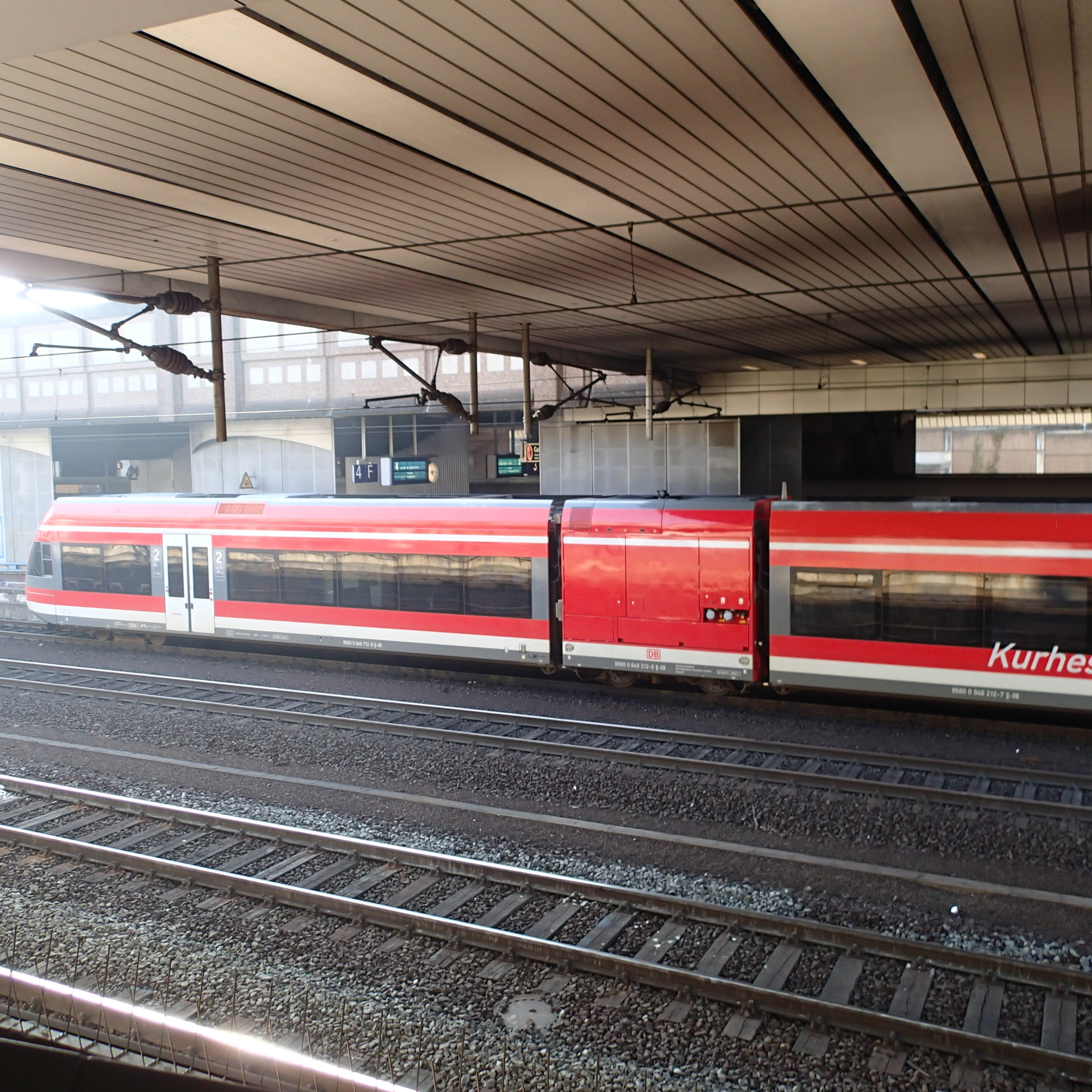
There are reports in Wikipedia, that the ride wasn’t good, but I’m sure Stadler has cracked it for their new 100 mph bi-mode trains.
Creating a bi-mode by adding an extra motor car into the middle of an electric train could be a serious way to go.
- The dynamics are probably better understood now
- A powerful diesel engine could be fitted.
- Batteries could be added.
- Insulating passengers and staff from the noise and vibration would surely be easier.
- There could be a passage through the car, to allow passengers and staff to circulate.
In an ideal world, a four-car electric train could be changed into a five-car bi-mode train, by adding the motor car and updating the train software.
In Mathematics Of A Bi-Mode Aventra With Batteries, I came to the conclusion, that if the batteries are used in conjunction with the power-pack, that a single power-pack of about 200 kW could be sufficient to power the train. This would be smaller and lighter in weight, which would probably mean it could be tucked away under the floor and well-insulated to keep noise and vibration from passengers and staff.
In this article in Global Rail News from 2011, which is entitled Bombardier’s AVENTRA – A new era in train performance, gives some details of the Aventra’s electrical systems. This is said.
AVENTRA can run on both 25kV AC and 750V DC power – the high-efficiency transformers being another area where a heavier component was chosen because, in the long term, it’s cheaper to run. Pairs of cars will run off a common power bus with a converter on one car powering both. The other car can be fitted with power storage devices such as super-capacitors or Lithium-ion batteries if required.
This was published six years ago, so I suspect Bombardier have refined the concept.
So could it be that Bombardier have designed a secondary power car, that can be fitted with a battery and a diesel engine of appropriate size?
- Using a diesel engine with batteries means that a smaller engine can be used.
- The diesel engine could also be replaced with a 200 kW hydrogen fuel cell.
I won’t speculate, but Bombardier have a very serious idea. And it’s all down to the mathematics.
What Would Be The Length Of A 125 Mph Bi-Mode Aventra?
Long distance Aventras, like those for Greater Anglia and West Midlands Trains, seem to be five and ten car trains.
This would fit well with the offerngs from other companies, so I suspect five- and ten-cars will be the standard lengths.
Could There Be A Bi-Mode Aventra for Commuter Routes?
The London Overground has ordered a fleet of four-car Class 710 trains.
The Gospel Oak to Barking Line is being extended to a new Barking Riverside station.
In an article in the October 2017 Edition of Modern Railways, which is entitled Celling England By The Pound, Ian Walmsley says this in relation to trains running on the Uckfield Branch, which probably has a terrain not much different to the lines to London.
A modern EMU needs between 3 and 5 kWh per vehicle mile for this sort of service.
The new extension is about a mile, so this would need 20 kWh each way.
This could easily be done with a battery, but supposing a small diesel engine was also fitted under the floor. Would anybody notice the same 138 kW Cummins ISBe diesel engine that is used in a New Routemaster hybrid bus?
I doubt it.
It is a revealing to calculate the kinetic energy of a fully-loaded Class 710 train. I estimate that it under 50 kWh, if it was travelling at 90 mph, which would rarely be achieved on the Gospel Oak to Barking Line.
Could Bombardier Be Serious About Exporting Bi-Mode Aventras?
In my opinion, the Aventra is a good train an it seems to sell well in its electric form to train operating companies in the UK.
But would it sell well in overseas markets like the United States and Canada, India and Australia?
They obviously know better than I do, so we should take their statements at face value.
The Prospective Customers
The Rail Magazine article mentions three prospective customers.
I deal with them and other possiblilities in Routes For Bombardier’s 125 Mph Bi-Mode Aventra.
This was my conclusion.
If Bombardier build a 125 mph bi-mode Aventra with batteries, there is a large market.
It looks like the company has done a lot of research.
Conclusion
Bombardier are designing a serious train.
 The Anonymous Widower