TransPennine Express Explores Further Fleet And Capacity Expansion Options
The title of this post, is the same as that of this article on Railway Gazette.
This is the first paragraph.
First TransPennine Express is hopeful that it will be able to issue a call for expressions of interest in the provision of additional bi-mode trains before the end of March. This follows ‘a healthy level of interest’ in its existing call for expressions of interest in the supply of bi-mode locomotives to replace the Class 68s which work with its MkVa coaches.
I wrote about the expressions of interest to replace the Class 68 locomotives with new bi-mode locomotives in Suppliers Sought For New Bi-Mode Locomotives For TransPennine Express And Great Western Railway.
This was my conclusion in the related post.
When I saw First Group’s proposals, I thought that they were over ambitious.
But after doing a few simple calculations, I think they can decarbonise some, but not all of the TransPennine Express services and the Night Riviera.
So do First Group want to complete the decarbonisation of TransPennine Express services?
These are my thoughts.
The Train Fleet Specification
The Railway Gazette article makes these points about the new bi-mode trains.
- The trains could be existing or new bi-modes.
- It would be desirable for the trains to have a long-term electric-only option.
- Options for this would include removing the diesel engines or converting the trains to battery-electric operation.
- Hydrogen is not mentioned.
- A fleet size of twenty-five trains is mentioned.
- The possibility of electric-only trains in the future is mentioned..
- Five-cars, with the ability to lengthen to six- or seven-cars.
- 200 km/h operation.
There is nothing unusual in the specification.
Will They Be Existing Or New Trains?
I doubt that there are any existing 200 km/h bi-modes in the UK, that are not wanted by their current operators.
I am very certain they will be new trains.
Could The Trains Be Hitachi Class 802 Trains?
The trains sound very much like Hitachi Class 802 trains, that are in service with TransPennine Express, Great Western Railway and Hull Trains, all of whom are First Group companies.
- Long-term, the diesel engines can be removed or replaced with batteries.
- The battery option is under development and should be on test this year.
- The trains can be lengthened to as long as twelve cars, so six- and seven-car trains would be possible.
Hitachi will obviously show interest in this possible order.
Will These Trains Replace the Class 185 Trains?
Consider.
- TransPennine Express have 51 three-car Class 185 trains.
- This is a total of 153 cars.
- On some routes they work singly and on others they work in pairs.
- A three-car Class 185 train has 167 Standard Class and 15 First Class seats or 60.7 seats per car.
- A pair of Class 185 trains have 334 Standard Class and 30 First Class seats.
- A five-car TransPennine Express Class 802 train has 318 Standard Class and 24 First Class seats or 68.4 seats per car.
- It would appear that a Class 802 train is not that far short of the capacity of a pair of Class 185 trains.
- Some of the TransPennine services are very crowded.
I suspect that twenty-five five-car trains be able to handle the the workload of the Class 185 trains.
If a small amount of extra capacity were needed, some of the new trains could be six-cars.
In this section, I have assumed the new trains will be Class 802 trains, but any train manufacturer pitching for this order would adjust the capacity to the needs of TransPennine Express.
The Railway Gazette article says this.
TPE continues to explore opportunities for new services in the north of England, and the move could also feed into government plans for the removal of older and more costly to operate diesel trains elsewhere on the network, should any rolling stock become surplus to requirements at TPE.
So where could the Class 185 trains be used in the future?
Recently, MTU Hybrid PowerPacks have replaced the transmission on a Class 168 train, which reduces carbon emissions and fuel consumption and makes the train quieter and more passenger-friendly, as it doesn’t use diesel in stations.
The Class 185 trains are only fifteen years old and I suspect that MTU have designed the Hybrid PowerPack, so that it can replace the Cummins engine in trains like these.
The conversion could be done as a rolling program, so that any future operator would start with diesel and go hybrid a train at a time.
There has been speculation, that the trains may end up on the East West Railway and I wrote about this in East West Railway Company To Start Second Phase Of Rolling Stock Procurement.
But the East West Railway may prefer to use zero-carbon trains on a route, where there is electrification in places on the route.
Alternatively, South Western Railway run 10 two-car Class 158 trains and 30 three-car Class 159 trains between London Waterloo and Exeter.
- South Western Railway is another First Group company.
- The Class 185 trains could provide a capacity increase.
- The Class 185 trains are 100 mph trains, whereas the Class 158/159 trains are only capable of 90 mph.
The London Waterloo and Exeter Route could be electrified in the future and I am pretty sure, that the Class 185 trains with a hybrid transmission could be a good stand-in until this happens.
Other Train Manufacturers
I believe that Hitachi are in pole position for this order, just because they are an established supplier to both TransPennine Express and First Group.
But twenty-five five-car trains would be a very worthwhile order, so I suspect that companies like Alstom, CAF, Siemens, Stadler and Talgo will also express interest.
Conclusion
Buying extra bi-mode trains will take TransPennine Express further along the route to full decarbonisation.
My First Encounter With A Robot
Whilst in Bletchley, I saw this robot going about their business.












Note.
- The robot was from robotdelivery.co.uk.
- It was fascinating to see it cross the roads on the zebra crossings.
This idea might take off, as it is surely more environmentally friendly than a guy speeding up and down on a scooter.
Highland Council Forges Green Hydrogen Pact
The title of this post, is the same as that of this article on renews.biz.
These are the first two paragraphs.
Getech subsidiary H2 Green has signed a memorandum of understanding (MoU) with the Highland Council in Scotland aimed at creating a regional network of green hydrogen hubs across the Scottish Highlands.
Under the terms of the MoU, H2 Green and the Highland Council will produce a regional plan to develop a network of green hydrogen hubs at optimal locations across the region.
The first hub appears to be in Inverness, as I wrote in Hydrogen Hub Plan Will Cut Transport Sector Emissions In The Highlands.
But that is only the start.
- Green hydrogen will be used in transport in the Highlands.
- By-products like oxygen and heat will be distributed.
- Delivery of Highland decarbonisation will be planned.
- SGN Commercial Services will service large-volume customers.
- Agreements are in place for Eversholt Rail to deploy their hydrogen-powered trains on the Far North and West Highland Lines of Scotland.
This statement from Jonathan Copus of Getech, sums up the objectives of the hydrogen project.
These activities combined with the Highland Council initiative are set to establish the Highlands as the leading UK-centre for decarbonisation and innovation; they will also support job creation, deliver energy security and provide a sustainable path for the region’s net zero transition.
I believe that a similar approach could be taken in other parts of the UK. Cornwall, East Anglia, Lincolnshire, much of Wales and the Borderlands between England and Scotland come to mind.
Each region will probably, decarbonise slightly differently and each will develop more and more innovative ways to use the hydrogen.
Conclusion
Hydrogen will play a large part in the decarbonisation of the UK.
Earth Friendly Concrete
I was alerted to this product by this article on New Civil Engineer, which is entitled Keltbray Saves Carbon And Money With Earth Friendly Concrete On East London Job.
The article gave enough clues to find the Earth Friendly Concrete home page.
This is the introduction on the page.
We want to have a positive impact on the environment and supply our customers with an excellent product, that is why we created Earth Friendly Concrete ® by Wagners. It is a concrete that uses no ordinary Portland cement, instead using a geopolymer binder system made from the chemical activation of two industrial waste by-products – blast furnace slag (waste from iron production) and fly ash (waste from coal fired power generation). Our product has ZERO Portland cement and it has a much lower embodied energy compared to ordinary concrete, saving 250kg of CO2 for every cubic metre poured. Importantly, the engineering and construction properties of this environmentally friendly concrete is, in some areas, better than normal concrete. EFC has some significant performance advantages over normal Portland cement concrete, including improved durability, lower shrinkage, earlier strength gain, higher flexural tensile strength and increased fire resistance.
On this page, which is entitled About EFC, this said about the products Environmental Excellence.
EFC is a new class of concrete that contains NO ordinary Cement. Globally, the production of 1 tonne of Portland Cement produces 1 tonne of CO₂ emissions and is responsible for 5 to 8% of manmade greenhouse gas emissions. Instead of cement, EFC has a geopolymer binder that is made from the chemical activation of two recycled industrial wastes, flyash and slag. This recycled binder reduces the CO₂ emissions associated with Portland cement by 80 to 90%.
Every m3 of 40 MPa EFC saves 220kg CO₂ emissions.
Wagners, the company behind the development, are based in Queensland. Australia.
So it’s a case of Well Done The Aussies!
They have appointed Capital Concrete, to deliver Earth Friendly Concrete in the London area.
Conclusion
Does High Speed Two and other large projects that will need large amounts of concrete, know about this development?
Aberdeen Unveils UK’s First Green Hydrogen Waste Truck
The title of this post, is the same as that of this article on renews.biz.
These are the first three paragraphs.
The UK’s first green hydrogen-fuelled waste collection vehicle has been unveiled in Aberdeen.
While typical waste trucks are powered by diesel and petrol, the new vehicle will use green hydrogen from existing refuelling infrastructure in Aberdeen.
The truck will start collecting waste and recycling around the city from early March and will be the first hydrogen-powered waste truck to become operational in the UK.
I feel, that this is one of the obvious applications for hydrogen trucks.
- They return to the same depot at the end of the day and if the hydrogen refuelling station is nearby or at the depot, refuelling would be no more hassle than with diesel.
- The trucks are probably too large for battery power.
- They tend to work a lot in areas, where there are a lot of people about, like residential streets and shopping centres.
- Workers will be exposed to less pollution, as they bring bins to the trucks.
Aberdeen Council have provided this video.
I can see lots of Councils at least thinking of following Aberdeen’s example, when they renew their refuse trucks.
Incidentally, I may be only 74, but I can still remember the horse-drawn waste carts that Wood Green Council used to use in the 1950s. They were used around Wood Green town centre, where trailers were parked to receive rubbish from shops and businesses. Horses were used to move them about and to the depot. In the end they horses were replaced by Scammel Mechanical Horses.
Norfolk Wind Farms Offer ‘Significant Benefit’ For Local Economy
The title of this post, is the same as that of this article on the BBC.
This is a comprehensive article, which looks at the benefits of the huge Norfolk Boreas and Norfolk Vanguard wind farms will have to the economy of Norfolk.
The last section is devoted to Norfolk Nimby; Raymond Pearce.
This is the section.
Following the re-approval of the decision by the government, Mr Pearce says he is considering a new appeal over what he calls “a very poor decision”.
He is also sceptical of claims the two new wind farms will bring the economic gains promised by Vattenfall.
“It’s renewable energy at any cost and the cost here is to the environment in Norfolk,” he says.
“I don’t blame them for being positive about it, it’s their industry but they’re not looking at it holistically.”
He says he is not against renewable energy but thinks a better plan is needed to connect the offshore windfarms and minimise the number of cables and substations onshore.
It’s his money if he appeals, but we do need more wind, solar and other zero-carbon energy to combat global warming and its effects like the encroachment of the sea around Norfolk.
I believe, that building wind farms off the coast of Essex, Suffolk and Norfolk is a good move, as in the future, if we have spare electricity, it will be easy to export energy to Europe, through existing interconnectors.
But I do agree with him, that a better plan is needed to connect the offshore windfarms and minimise the number of cables and substations onshore.
A Norfolk Powerhouse
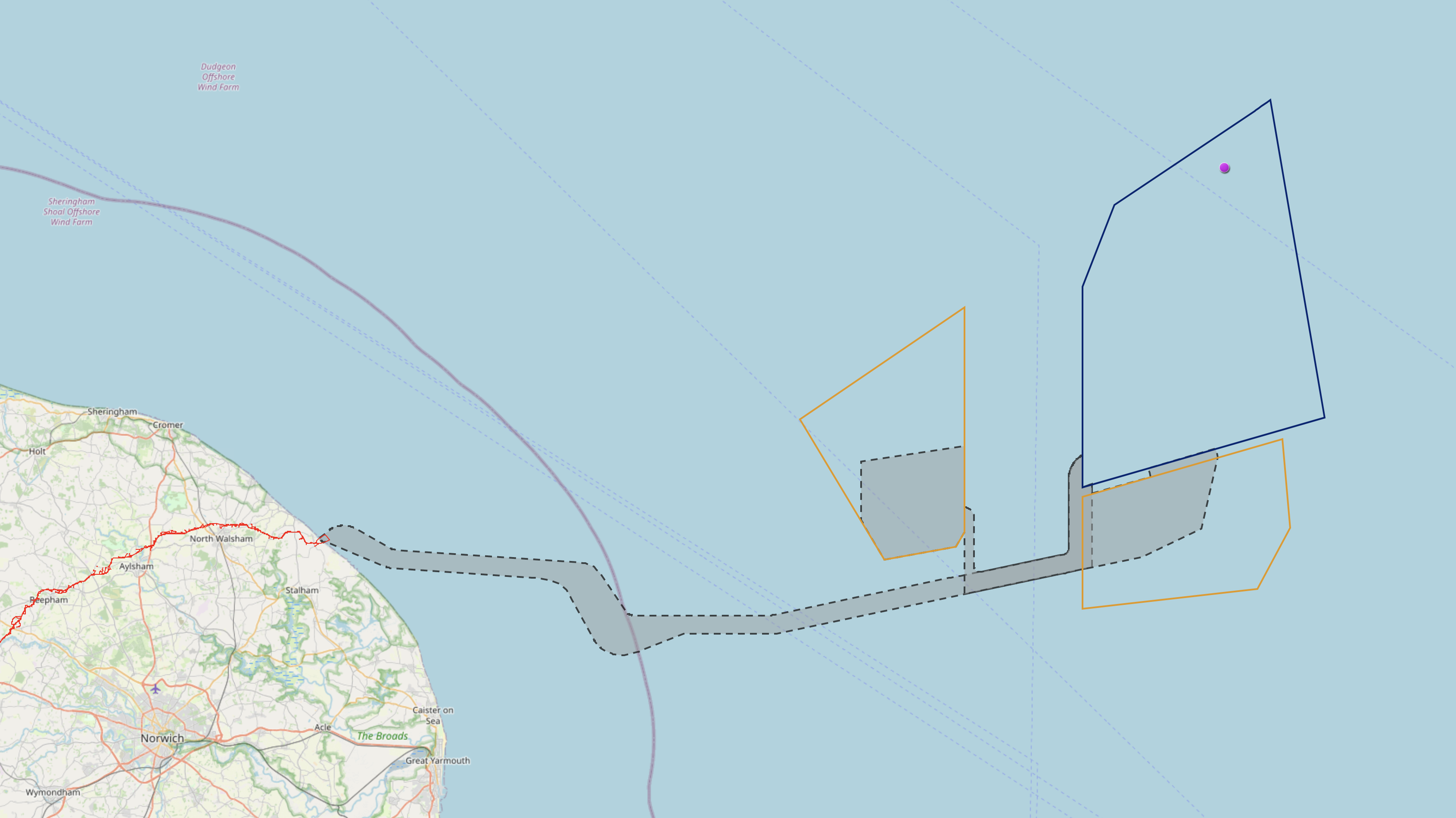
This map from Vattenfall, the developer of the two wind farms, shows the position of the farms and the route of the cable to the shore.
Note.
- The purple line appears to be the UK’s ten mile limit.
- Norfolk Boreas is outlined in blue.
- Norfolk Vanguard is outlined in orange.
- Cables will be run in the grey areas.
- Both wind farms are planned to have a capacity of 1.8 GW
Landfall will be just a few miles to the South of the Bacton gas terminal.
Bacton Gas Terminal
Bacton gas terminal is much more than a simple gas terminal.
- It is a complex of six gas terminals on four sites.
- There is a National Grid terminal, that odourises and blends the gas before distributing it into the National Transmission System via five outgoing 36-inch feeders to much of Southern England.
- There is a gas interconnector to Belgium.
- There is a gas interconnector to The Netherlands.
- There is coastal erosion in the area.
With the need to decarbonise, I can’t help feeling that the Bacton gas terminal is very much on the decline and the site will need to be repurposed in the next few years.
Blending Hydrogen With Natural Gas
If you blend a proportion of hydrogen into natural gas, this has two beneficial effects.
- Gas used in domestic and industrial situations will emit less carbon dioxide.
- In the near future we will be replacing imported natural gas with hydrogen.
The hydrogen could be produced by a giant electrolyser at Bacton powered by the electricity from the two Norfolk wind farms.
At the present time, a research project call HyDeploy is underway, which is investigating the blending of hydrogen into the natural gas supply.
- Partners include Cadent, Northern Gas Networks, the Health and Safety Executive, Keele University and ITM Power and Progessive Energy.
- A first trial at Keele University has been hailed as a success.
- It showed up to twenty percent of hydrogen by volume can be added to the gas network without the need to change any appliances or boilers.
Larger trials are now underway.
A Giant Electrolyser At Bacton
If hydrogen were to be produced at Bacton by a giant electrolyser, it could be used or distributed in one of the following ways.
- Blended with natural gas for gas customers in Southern England.
- Stored in a depleted gas field off the coast at Bacton. Both Baird and Deborah gas fields have been or are being converted to gas storage facilities, connected to Bacton.
- Distributed by truck to hydrogen filling stations and bus and truck garages.
- Greater Anglia might like a hydrogen feed to convert their Class 755 trains to hydrogen power.
- Sent by a short pipeline to the Port of Great Yarmouth and possibly the Port of Lowestoft.
- Exported to Europe, through one of the interconnectors.
Note.
- If the electrolyser were to be able to handle the 3.6 GW of the two wind farms, it would be the largest in the world.
- The size of the electrolyser could be increased over a few years to match the output of the wind farms as more turbines are installed offshore.
- There is no reason, why the electrical connection between Bacton and the landfall of the wind farm cable couldn’t be offshore.
If ITM Power were to supply the electrolyser, it would be built in the largest electrolyser factory in the World, which is in Sheffield in Yorkshire.
A Rail Connection To The Bacton Gas Terminal
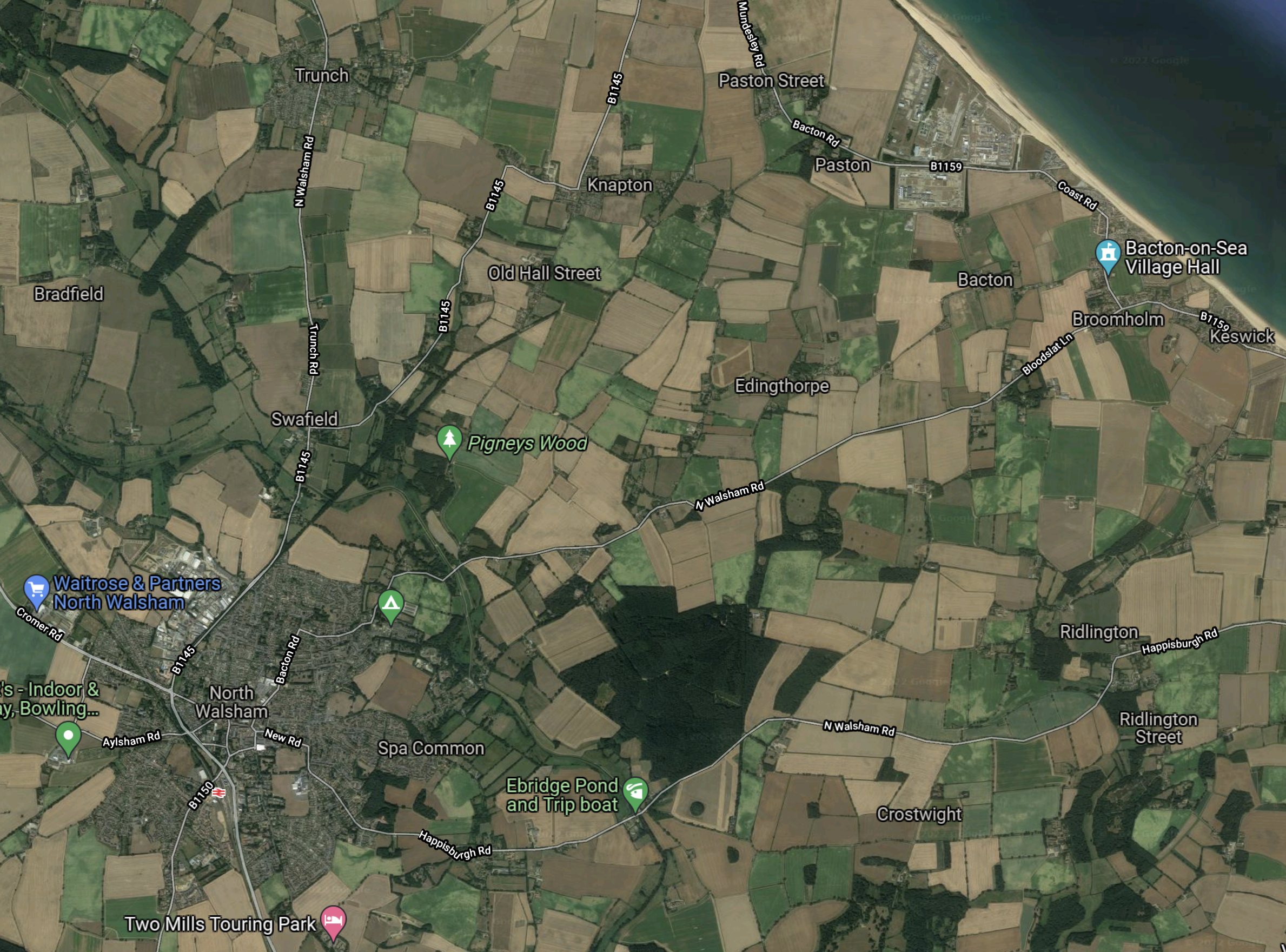
This Google Map shows the area between North Walsham and the coast.
Note.
- North Walsham is in the South-Western corner of the map.
- North Walsham station on the Bittern Line is indicated by the red icon.
- The Bacton gas terminal is the trapezoidal-shaped area on the coast, at the top of the map.
I believe it would be possible to build a small rail terminal in the area with a short pipeline connection to Bacton, so that hydrogen could be distributed by train.
How Much Hydrogen Could Be Created By The Norfolk Wind Farms?
In The Mathematics Of Blending Twenty Percent Of Hydrogen Into The UK Gas Grid, I said the following.
Ryze Hydrogen are building the Herne Bay electrolyser.
- It will consume 23 MW of solar and wind power.
- It will produce ten tonnes of hydrogen per day.
The electrolyser will consume 552 MWh to produce ten tonnes of hydrogen, so creating one tonne of hydrogen needs 55.2 MWh of electricity.
Each of the Norfolk wind farms, if they were working flat out would produce 43.2 GWh of electricity in a day.
Dividing the two figures gives a daily production rate of 782.6 tonnes of hydrogen per day.
But what happens if the wind doesn’t blow?
This is where the gas storage in the Baird, Deborah and other depleted gas fields comes in.In times of maximum wind, hydrogen is stored for use when the wind doesn’t blow.
Conclusion
I believe a plan like this, would be much better for Norfolk, the UK and the whole planet.
Using the existing gas network to carry the energy away from Norfolk, could mean that the electricity connection across Norfolk could be scaled back.
Does London Need High Capacity Bus Routes To Extend Crossrail?
If Crossrail has a major problem, it is that some areas of the capital will find it difficult to access the new line.
Up to the age of sixteen, I used to live half-way between Oakwood and Cockfosters stations on the Piccadilly Line.
There are a large number of people who live along the Northern reaches of the Piccadilly Line, who might want to use Crossrail to perhaps go to Heathrow or places in East London.
But the journey will need a double change as there is no interchange between the Piccadilly Line and Crossrail.
I suspect that many will link to Crossrail by taking the Piccadilly Line to Wood Green, Turnpike Lane or Manor House and then get a 141 bus to Moorgate. It is a route, I use if I want to go to Southgate or Cockfosters from my house, which has a 141 stop opposite.
But then as a child to go to Harringay, where my father had an uncle, my mother would use a 641 trolley bus from Wood Green or Turnpike Lane.
Do people follow the public transport habits of their parents?
I know I do!
My father never went on a deep tube. As he several times mentioned the terrible Bank station bombing in the Blitz, which killed 56 people, I always thought that was his problem. But now living as I do along the Northern and Northern City Lines, I suspect it was more to do with air quality, as we were or are both bad breathers.
I suspect that when Crossrail opens, the 141 bus will be heavily used by travellers going between the Northern reaches of the Piccadilly Line and Crossrail at Moorgate.
The 141 bus goes between London Bridge station and Palmers Green and it has a route length of about nine miles.
Currently, buses run every fifteen minutes or so, but I doubt it will be enough in future as Transport for London are rerouting the closely-related 21 bus.
I suspect any route seen as an extension of Crossrail needs to have the following characteristics.
- High frequency of perhaps a bus every ten minutes.
- Interior finish on a par with the Class 345 trains.
- Wi-fi and phone charging.
I would also hope the buses were carbon-free. Given that some of these routes could be quite long, I would suspect hydrogen with its longer range could be better.
Other Routes
According to me, the 141 bus route needs improvement!
But how many other routes could need similar improvement?
A Cool Move To Keep Emissions On Track
The title of this post is the same as that of this press release from Tesco.
This is the body of the release.
- Tesco and DRS partner on a new refrigerated rail freight service that will take 40 lorries off the road for every journey it makes
- Helping Tesco to deliver Christmas, the service will run seven days a week and replace 7.3 million road miles with greener distribution
- New service supports Tesco’s commitment to reach net zero emissions in its operations by 2035
Tesco and Direct Rail Services (DRS) have partnered to introduce a cool new service to Britain’s railways.
The new service will be the first time Tesco has used refrigerated rail freight in the UK, distributing chilled goods from Tilbury to Coatbridge by low CO2 rail twice a day, seven days a week. This means that rail freight will play an even bigger role in helping Tesco to deliver Christmas this year and over the next couple of weeks this new service will transport hundreds of different products, including festive favourites such as sprouts, parsnips, carrots, onions, oranges and lemons just in time for that all important Christmas dinner.
Using rail has significant environmental benefits. The 415-mile route will use DRS’s Class 88 bi-mode electric locomotives which can run on electricity and produce zero exhaust and greenhouse gas emissions. This service alone will take at least 17,000 containers off the road each year, saving Tesco 7.3 million road miles and nearly 9,000 tonnes of CO2e.
Note.
- This is Tesco’s first use of refrigerated rail freight.
- It starts from the new Tilbury 2 freight terminal.
- All services seem to be run using bi-mode Class 88 locomotives, running for most of the route using electricity.
Tesco seem to be following the rule, that every little helps when it comes to decarbonisation and climate change.
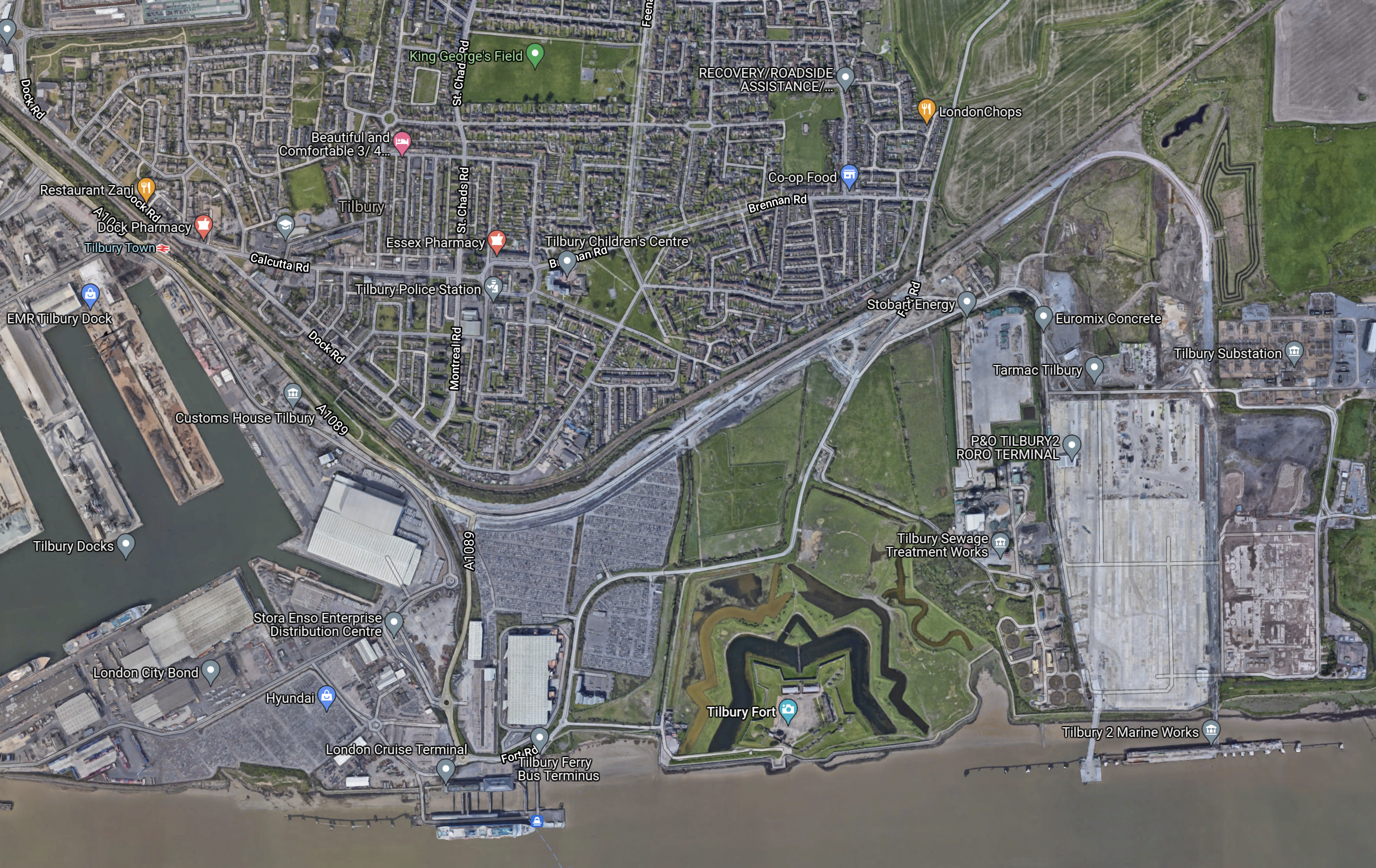
This Google Map shows Tilbury.
Note.
- The Port of Tilbury is in the West.
- Tilbury Town station on the Tilbury Loop Line is on the North side of the Port.
- There is a cruise ship at the London Cruise Terminal on the river.
- Next to the terminal is the Gravesend Tilbury Ferry. I can remember the car ferries on this route.
- Then there is Tilbury Fort.
- The Tilbury 2 Terminal is in the East.
I took these pictures in 2017.











I suspect it’s a bit different now!
BP Snaps Up 30 Per Cent Stake In Green Biofuels Ltd
The title of this post, is the same as that of this article on Business Green.
So why would BP take a stake in Green Biofuels?
This paragraph in the Wikipedia entry for BP, outlines the company’s future philosophy.
From 1988 to 2015, BP was responsible for 1.53% of global industrial greenhouse gas emissions. BP has set a goal to cut its greenhouse gas emissions to net-zero by 2050. BP plans to increase its investments in renewables 10 times and reduce oil production by 40% from current levels by 2030.
BP is doing things like developing wind and solar farms to achieve these aims.
BP also seems to be investing in both blue and green hydrogen.
But possibly, the two hardest products to decarbonise are diesel for heavy transport and aviation fuel.
Looking at Green Biofuels web site, the Wikipedia entry for Hydrotreated Vegetable Oil (HVO) and other sources, Green Biofuels product; GD+ seems to make a good fist of reducing carbon emissions and pollution, if it replaces diesel.
DB Cargo UK and HVO
DB Cargo UK have a fleet of nearly two hundred large diesel locomotives in the UK.
DB Cargo UK have been experimenting with HVO, as I wrote about in Powered By HVO.
The company has issued a press release on these trials of HVO, from which this is an extract.
DB Cargo UK’s Head of Asset Management and Maintenance Steve Wilkinson said the company was collaborating with one of the UK’s leading suppliers of HVO fuel which already worked with high-profile brands like Caterpillar, John Deere, Volvo and Mercedes-Benz.
“We are very pleased with the initial performance of the HVO fuel which we could use instead of or alongside traditional red diesel. The fact it is compatible with our existing diesel means investment in new storage and fuelling facilities would also be kept to a minimum,” he added.
“On top of that, it performs well at low temperatures, has a longer lifespan and is biodegradable,” he added.
DB Cargo UK currently operates 228 diesel and electric locomotives that transport in the region of 37 million tonnes of freight each year across the UK and into Europe.
It uses approximately 45 million litres of red diesel a year.
Was one of the UK’s leading suppliers of HVO fuel, a company called Green Biofuels?
Note that DB Cargo UK’s spokesman makes these points about the fuel.
- They are very pleased with initial performance.
- It is a straight swap for red diesel and it appears locomotives can run on either. He doesn’t say it but can it run on one fuel contaminated with the other? I suspect it’s a possibility.
- Current storage can be used for HVO.
- I get the impression that swapping from red diesel to HVO wouldn’t be the most challenging of operations.
- It performs well at low temperatures. One train-driver told me, that one of the worse parts of the job, is picking up a train from a depot high in the Pennines on a cold day in the winter. That must apply to locomotives.
- It has a longer lifespan.
- It is biodegradable. I haven’t walked through an engine shed, since I used to bunk them as a child to get engine numbers, but they were filthy places, with oil and diesel all over the floor.
That sounds to me, like DB Cargo UK have decided that HVO is an excellent fuel and for them to swap to HVO, would be no more difficult than to swap between red diesel from BP to red diesel from Shell.
This is an extract from the Business Green article.
Founded in 2013, Green Biofuels is the UK’s largest provider of HVO, having delivered over 55 million litres of HVO products to the UK market over the past two years.
If DB Cargo UK wanted to swap from red diesel to HVO, they would need nearly all of Green Biofuels current production.
So have Green Biofuels run to BP and said can you help us out?
Red Diesel Replacement
This document on the Government web site is entitled Reform Of Red Diesel And Other Rebated Fuels Entitlement.
There is a section, which is entitled Policy Objective, where this is said.
In June 2019, the UK became the first major economy in the world to pass laws guaranteeing an end to its contribution to global warming by 2050. The target will require the UK to bring all greenhouse gas emissions to net zero by 2050, compared with the previous target of at least an 80% reduction from 1990 levels. The government also launched in 2019 an ambitious new strategy to clean up the air and save lives, given air pollution is one of the biggest continuing threats to public health in the UK.
Red diesel is diesel used mainly for off-road purposes, such as to power bulldozers and cranes used in the construction industry, or to power drills for oil extraction. It accounts for around 15% of all the diesel used in the UK and is responsible for the production of nearly 14 million tonnes of carbon dioxide a year. Red diesel used in the construction and infrastructure building sectors was also estimated to have caused 7% of nitrogen oxide emissions and 8% of PM10 emissions (a type of particulate matter) in London in 2018.
At Budget 2020, the government therefore announced that it would remove the entitlement to use red diesel and rebated biodiesel from most sectors from April 2022 to help meet its climate change and air quality targets. The tax changes will ensure that most users of red diesel use fuel taxed at the standard rate for diesel from April 2022, like motorists, which more fairly reflects the harmful impact of the emissions they produce. Removing most red diesel entitlements will also help to ensure that the tax system incentivises users of polluting fuels like diesel to improve the energy efficiency of their vehicles and machinery, invest in cleaner alternatives, or just use less fuel.
It doesn’t say, but I have found references to the fact that HVO pays the same tax rate as diesel, despite the evidence, that it appears to be more environmentally friendly.
If I was the Chancellor, I would certainly adjust the tax system, so that red diesel users who changed to HVO and other fuels, paid tax in proportion to the emissions and pollution they caused.
So have BP decided that Green Biofuels is the best interim solution to reduce emissions from diesel fuel and taking a stake, is the best way to get the required access to the product?
Could BP be thinking about replacing red diesel with a better green diesel?
- Red diesel and GD+ could be acceptable to all diesel vehicles and equipment. So farmers for rxample, could run tractors and combines on the same fuel as their truck or Range Rover.
- Businesses, like farmers, who often have tanks for both red diesel and normal diesel, would only need one tank.
- Businesses with a green profile, would surely like it for their vehicles.
- Organic farmers would like it for their tractors.
- The availability of a green diesel would enable red diesel users to change to hydrogen or battery operation, at the optimal time.
I can see Prince Charles handing out green stars all round.
HS2 To Trial New Building Method Which Could Provide Carbon-Free Energy
The title of this post, is the same as that of this article on Rail Technology Magazine.
This is the first three paragraphs.
Part of HS2’s Innovation programme, an HS2 building site in London is to become a test bed for a new building method which could ultimately provide carbon-free energy to stations on the new high speed route.
The new approach will be trialled by contractors Mace Dragados at the project’s Euston station site in London and will draw ground heat up through the foundations of a newly-built construction site office.
Developed by Keltbray, the innovative new technology is estimated to harness enough energy to supply 80% of the building’s heating and hot water needs.
It’s an incredibly simple, but extremely powerful idea, that revolutionises heating, cooling and hot water in buildings.
Read the article and then read the brochure on the Keltbray web site.

