Grand Central Trains And CAF’s Tri-Mode Trains
In First Tri-Mode Long Distance Trains For The East Coast Main Line, I wrote about LNER’s purchase of a new fleet of ten CAF tri-mode trains to work services between London and Yorkshire.
In this press release from LNER, which is entitled First Tri-Mode Long Distance Trains For The East Coast Main Line, this is a paragraph.
This new fleet of trains will keep LNER on track to reduce its emissions by 67 per cent by 2035 and be net zero by 2045. LNER has already reduced carbon emissions by 50 per cent compared with 2018/19. Per mile, LNER trains produce 15 times less carbon emissions than a domestic flight.
I believe that as they compete over similar routes with LNER, that Grand Central Trains will have to implement a similar decarbonisation strategy or their business will suffer.
The new trains for Grand Central Trains, will need to have the following conditions.
Train Length
Consider.
- The train must be able to fit all the platforms it will use.
- Ten-cars may be too long for some of the platforms.
- Train length should also be long enough to capture as much of the market as possible.
But as adjusting the length of trains is an easy process, I suspect all manufacturers will be happy to supply extra carriages.
Distances Without Electrification
These are the distances on Grand Central Trains’s services without electrification.
- Doncaster and Bradford Interchange – 52.1 miles
- Northallerton and Sunderland – 47.4 miles
A battery-electric train with a battery range of 110 miles would probably be able to reach Sunderland and return, after charging on the main line.
But a CAF tri-mode train, which ran on diesel or a suitable sustainable fuel like biodiesel or HVO wouldn’t give the driver, operator or passengers any worries.
Possible Time Savings To Bradford
Digital signalling is being installed on the East Coast Main Line between Woolmer Green and Dalton-on-Tees, which will allow running on the line up to 140 mph.
- Woolmer Green is 132.1 miles South of Doncaster.
- A typical train time by Grand Central Trains is 75 minutes.
- This is an average speed of 110 mph.
- Trains take typically three hours and eight minutes between London and Bradford Interchange.
I can build a table of timings and savings at various average speeds.
- 120 mph – 66 minutes – 9 minutes
- 125 mph – 63 minutes – 12 minutes
- 130 mph – 61 minutes – 14 minutes
- 140 mph – 57 minutes – 18 minutes
Several times, I have timed an Hitachi train running at 125 mph on routes like the East Coast Main Line, Great Western Main Line, Midland Main Line and West Coast Main Line, so I have no doubt, that London and Bradford Interchange services can be less than three hours.
These journey time savings will be available to any train able to use the digital electrified railway to the South of Doncaster.
Possible Time Savings To Sunderland
Dalton-on-Tees, where the first phase of the digitally signalling will end, is North of Northallerton, so once the Sunderland train is on the East Coast Main Line, it will be a digital electrified railway all the way to Woolmer Green.
- Woolmer Green is 194.6 miles South of Northallerton.
- A typical train time by Grand Central Trains is 151 minutes.
- This is an average speed of 77.3 mph.
- Trains take typically three hours and twenty-eight minutes between London and Sunderland.
I can build a table of timings and savings at various average speeds.
- 120 mph – 97 minutes – 54 minutes
- 125 mph – 93 minutes – 58 minutes
- 130 mph – 89 minutes – 62 minutes
- 140 mph – 83 minutes – 68 minutes
It looks like times of two hours and thirty minutes will be possible between between London and Sunderland.
Will The Trains Need A 140 mph Capability?
Trains will need to average 125 mph on the digital electrified East Coast Main Line to get under three hours for Bradford Interchange and 2½ hours for Sunderland, so I feel a 140 mph capability is required between Northallerton and London.
Could The Trains Split And Join At Doncaster?
High speed paths on the digitally signalled and electrified East Coast Main Line might be at a premium, so running pairs of five-car trains to two destinations could be commonplace working.
- It could be a way of increasing frequency to Bradford Interchange and Sunderland, by perhaps running pairs of five-car trains that split at Doncaster.
- Grand Union Trains have proposed in the past to use splitting and joining to run services to Cleethorpes.
As Hitachi trains can split and join, I suspect that the CAF tri-mode trains will be at least able to be retrofitted with the ability.
Conclusion
These are my conclusions.
- The digital signalling certainly gives good time saving to Yorkshire and the North-East
- New trains for Grand Union Trains would give them faster services on their existing routes.
- Trains with a 140 mph capability would be needed.
- CAF tri-mode trains wouldn’t need any new infrastructure, but battery-electric trains may need chargers at the destinations.
- Because of the lower infrastructure requirements, I think the CAF trains will get the nod.
First Tri-Mode Long Distance Trains For The East Coast Main Line
The title of this post, is the same as that of this press release from LNER.
This is the sub-heading.
London North Eastern Railway (LNER) is pleased to confirm that CAF has been named as the successful bidder to deliver a fleet of 10 new tri-mode trains for LNER. Porterbrook has been chosen as the financier of the new fleet. The trains will be able to operate in electric, battery or diesel mode.
These are the first two paragraphs.
Benefits of tri-mode trains range from a reduction in emissions, particulates, noise and vibration pollution, lower maintenance and operating costs and upgradeable technology, with an expected increase in range and performance as technology develops further. Battery power reduces the need to use diesel traction in areas where overhead powerlines are not available.
Complementing the modern Azuma fleet of 65 trains, the new ten-coach trains will help LNER achieve its vision of becoming the most loved, progressive and trusted train operator in the UK, delivering an exceptional service for the customers and communities served along its 956-mile network.
I have a few thoughts.
Will The Trains Have Rolls-Royce mtu Diesel Engines?
Consider.
- CAF’s Class 195, 196 and 197 Civity trains for the UK all have Rolls-Royce mtu diesel engines.
- Porterbrook are headquartered in Derby.
- Rolls-Royce are headquartered in Derby.
- In Rolls-Royce And Porterbrook Agreement Will Drive Rail Decarbonisation, I talked about how the two companies were planning to decarbonise trains using techniques like mtu Hybrid PowerPacks and hydrogen fuel cells.
I would think it very likely that the new trains will have Rolls-Royce mtu engines.
Will The Trains Have Rolls-Royce mtu Hybrid PowerPacks?
It was in 2018, that I first wrote about mtu Hybrid PowerPacks in Rolls-Royce And Porterbrook Launch First Hybrid Rail Project In The UK With MTU Hybrid PowerPacks.
- Examples of these power packs are now running in Germany, Ireland and the UK.
- The mtu Hybrid PowerPack how has its own web site.
- There is also this YouTube video.
- If CAF use off-the-shelf mtu Hybrid PowerPacks in their Civity trains, there is one big massive plus – They don’t have to develop the complicated control software to get a combination of diesel engines and batteries to perform as immaculately as Busby Berkeley’s dancers or a Brigade of Guards.
- The mtu Hybrid PowerPacks also have a big plus for operators – The batteries don’t need separate charging infrastructure.
- In Rolls-Royce Releases mtu Rail Engines For Sustainable Fuels, I talk about how mtu engines can run on sustainable fuels, such as biodiesel or HVO.
I think it is extremely likely that CAF’s new trains for LNER will be powered by mtu Hybrid PowerPacks.
Class 800 And Class 397 Trains Compared
The Class 800 train is LNER’s workhorse to Scotland from London.
The Class 397 train used by TransPennine Express, is a 125 mph Civity train.
Differences include.
- The Class 800 train can run at 140 mph, where the signalling allows, but is the Class 397 train only capable of 125 mph?
- The Class 397 train accelerate at 0.92 m/s², whereas the Class 800 train can only manage 0.7 m/s².
- The Hitachi train has 14 % more seats, 36 First and 290 Standard as opposed to 22 First and 264 Standard in five-car trains.
I will add to this list.
Will The New Trains Be Capable Of 140 mph Running?
As the East Coast Main Line is being fully digitally signalled to allow 140 mph running of the numerous Hitachi expresses on the route, I wouldn’t be surprised to see, that the new CAF trains will be capable of 140 mph.
In this article on Modern Railways, which is entitled LNER Orders CAF Tri-mode Sets, this is said.
The new fleet will be equipped with CAF Signalling’s European Rail Traffic Management System digital signalling. This will align with the East Coast Digital Programme, which aims to introduce European Train Control System (ETCS) on the southern stretch of the East Coast main line from King’s Cross to Stoke Tunnel by 2029.
Later in the article this is said.
LNER has retained 12 ‘91s’ hauling eight rakes of Mk 4s, and the rollout of ETCS is another reason the operator has sought to order the replacement fleet. LNER’s passenger numbers have rebounded more quickly than other operators post-Covid, which has helped make the case for confirming the order.
This does seem sensible.
What Will Be The Range Of The CAF Trains Without Electrification?
The longest LNER route without electrification is the Northern section of the Inverness service between Inverness and Dunblane, which is 146.1 miles. There are also eight stops and some hills.
In Edinburgh to Inverness in the Cab of an HST, there’s a video of the route.
I’m sure that even, if they don’t normally run the new trains to Inverness, being able to do so, could be useful at some point.
It should be noted that the Guinness World Record for battery-electric trains is 139 miles, which is held by a Stadler Akku.
I am left with the conclusion that London and Inverness needs a tri-mode train or lots of electrification. Did this rule out Hitachi?
The Number Of Trains Ordered
The Modern Railways article says this about the number of trains.
The contract includes an eight-year maintenance services agreement with an option to extend; CAF says the order value, including maintenance, exceeds €500 million. When the tender was published the intention was to include an option for five additional sets; LNER confirmed to Modern Railways there is an option to purchase additional sets on top of the base order of 10.
Can we assume this means that other trains will be ordered, if the trains are a success?
Can These New CAF Trains Be Made Net Zero?
This is a paragraph, in the LNER press release.
This new fleet of trains will keep LNER on track to reduce its emissions by 67 per cent by 2035 and be net zero by 2045. LNER has already reduced carbon emissions by 50 per cent compared with 2018/19. Per mile, LNER trains produce 15 times less carbon emissions than a domestic flight.
As the new CAF trains will probably have a service life of at least forty years, there must be some way, that these new trains can be made net zero.
Consider.
- I am absolutely certain, that the new CAF trains will have Rolls-Royce mtu diesel engines.
- LNER’s existing Class 800 and 801 trains have Rolls-Royce mtu diesel engines.
Rolls-Royce mtu according to some of Rolls-Royce’s press releases appear to be developing net zero solutions based on hydrogen or net zero fuels.
This press release from Rolls-Royce is entitled Rolls-Royce Successfully Tests mtu Engines With Pure Hydrogen, suggests that Rolls-Royce mtu are working on a solution.
Routes They Will Serve
The Modern Railways article says this about the routes to be served.
Modern Railways understands the new fleet will be maintained at Neville Hill depot in Leeds and, like the ‘225’ sets, will be used predominantly on services between London and Yorkshire, although unlike the ‘225s’ the tri-modes, with their self-power capability, will be able to serve destinations away from the electrified network such as Harrogate and Hull.
Note.
- This surprised me, as I’d always expected the Yorkshire routes will be served by Hitachi battery-electric trains.
- But it does look that both Harrogate and Hull stations, have long enough platforms to hold a ten-car train.
- With their tri-mode technology, it also looks like the CAF trains won’t be needed to be charged before returning to London.
The last point would enable them to try out new routes.
These are distances from the electrification of the East Coast Main Line of the destinations that LNER served, where there is not full electrification.
- Aberdeen via Ladybank – 91.4 miles
- Carlisle via Skipton – 86.8 miles
- Cleethorpes via Newark and Lincoln – 63.9 miles
- Harrogate via Leeds – 18.3 miles
- Huddersfield via Leeds – 17.2 miles
- Hull via Temple Hirst junction – 36.1 miles
- Inverness via Dunblane – 146.1 miles
- Lincoln via Newark – 16.7 miles
- Middlesbrough via Northallerton – 22.2 miles
- Scarborough via York – 42.1 miles
- Sunderland via Northallerton – 47.4 miles
Note.
- The first place after the ‘via’ is where the electrification ends.
- Carlisle could be a possibility during High Speed Two upgrading of the West Coast Main Line or for an enthusiasts’ special or tourist train.
- Cleethorpes is a possible new service for LNER. I wrote about this in LNER To Serve Cleethorpes.
- Scarborough must be a possible new service for LNER.
- All stations can take ten-car trains, with the possible exception of Middlesbrough, which is currently being upgraded.
- Huddersfield and Leeds is being electrified under the TransPennine Upgrade.
This would appear to show that LNER need enough bi-mode or tri-mode trains to run services to Aberdeen, Cleethorpes, Harrogate, Hull, Inverness, Lincoln, Middlesbrough and Sunderland.
But.
- It would appear that the initial batch of trains, will not be serving the North of Scotland.
- Aberdeen and Inverness could be served, when there is enough electrification at the Southern end.
I am also fairly sure, that no significant infrastructure is required.
Do Hitachi Have A Problem?
I am starting to wonder, if Hitachi are having trouble with the designing and building of their battery packs.
- It’s not like Hitachi to allow someone to run off with a €500 million contract from under their nose.
- Are they short of capacity to build the trains at Newton Aycliffe?
But then they’re probably up to their elbows in work on the High Speed Two Classic-Compatible trains.
Are There Any Other Routes, Where The New CAF Trains Could Be Employed?
The trains would certainly be suitable for these routes.
- Chiltern – InterCity services.
- CrossCountry Trains – Fleet replacement
- Grand Central Trains – Fleet replacement
- Grand Union Trains – For Carmarthen and Stirling open access services.
- Great Western Railway – Replacing Castles in the South West.
- ScotRail – Replacing Inter7City trains.
- South Western Railway – Basingstoke and Exeter St. Davids and other routes.
Note.
- CAF could sell a lot of trains.
- I estimate that fleet replacement for Grand Central Trans would cost around €350 million
- The specification would vary according to the route.
Could CAF have got the LNER order, because they have the capacity in the Newport factory?
Conclusion
It looks like CAF have done a good job in designing the trains.
I’m also fairly sure that CAF are using Rolls-Royce mtu PowerPacks.
Seratech’s Technology Explained
I first wrote about Seratech in Carbon-Neutral Concrete Prototype Wins €100k Architecture Prize For UK Scientists, after reading about this carbon-neutral concrete in the Architect’s Journal.
I have just received Seratech’s October 2023 Newsletter, which contains two must-read articles.
Olivine In The Age Of Climate Crisis
I’d never heard of olivine until I read about the architecture prize, that was won by Seratech.
This is the Wikipedia entry for olivine.
These are the first three paragraphs of Seratech’s article.
On the west coast of Norway, a few kilometres from the village of Åheim, is an open excavation pit – home to the largest commercial olivine deposit in the world.
This seaside quarry, run by Belgian industrial minerals company, Sibelco, works to extract olivine from the earth’s crust by drilling, blasting and crushing. A single blast (used to break up the rocks) removes up to 40,000 tonnes of olivine.
The site is predominantly powered by hydroelectricity and boasts a 4km conveyor system for transport which limits the need for heavy vehicle or double-handling of materials in a bid to reduce emissions.
This is Sibelco’s video of their impressive mining process.
Note.
The mining operation is fully-integrated with its own ort.
- The video does the mining operation justice.
- Sibelco aim to make the mining of olivine carbon-neutral.
Olivine has this Wikipedia entry, which gives more information.
This Google Map shows the port complex at Åheim.
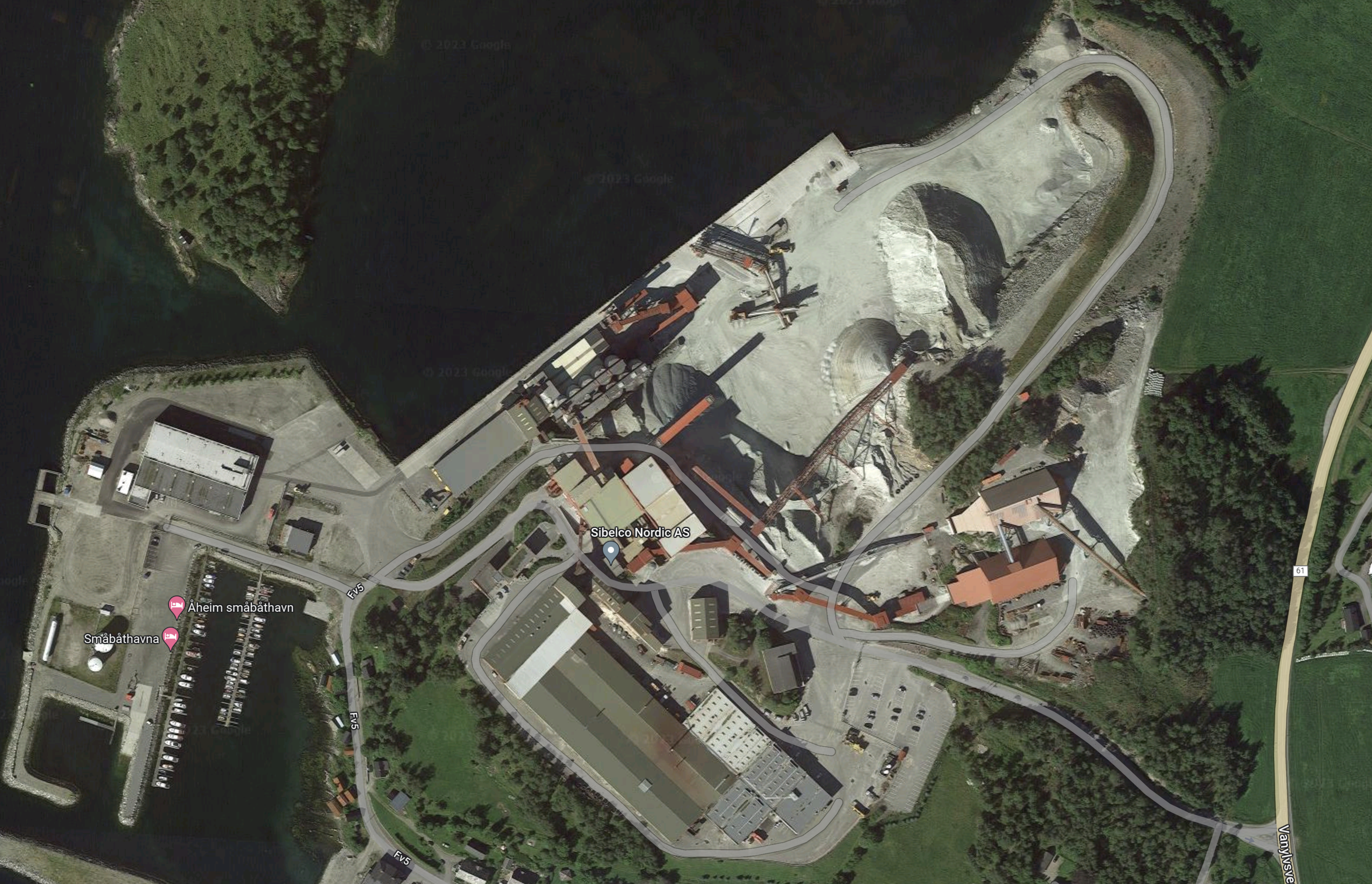
It looks like mine, processing and port all on one site.
The Big Interview With Mike Eberlin
This is the sub-heading.
Former Managing Director of Tarmac Cement & Lime and chair of MPA Cement, Mike Eberlin, became Seratech’s business advisor in June this year. He was intrigued by the novel technology Sam Draper and Barney Shanks had uncovered
These paragraphs are a summary of what Mike Eberlin said.
As we begin to talk, Mike is quick to point out there are two big advantages to Seratech: “They are using magnesium silicate as a starting material which produces silica as a cement replacement and magnesium oxide which can then absorb CO2”.
The CO2 absorption is what fascinates Mike as the type of magnesium carbonate Seratech produces is a “slightly unstable” version which when cured, becomes stable and reverts to the rock-like substance you would find in nature. “This came as a surprise because the chemistry wouldn’t indicate that was possible,” he explains.
Following this discovery, and as Seratech’s research progressed, it soon became apparent that the magnesium carbonate lends itself well as a binder and can be used in applications like building blocks and plasterboard: “It’s effectively carbon capture and use, not carbon capture and storage because you are mineralising the CO2 into a product.
“We end up in this clever situation whereby it’s not that we don’t emit the CO2, it’s better than that, we absorb CO2 and create two binders that replace cement”.
That’s what I call an endorsement.
Conclusion
I have this feeling that Seratech will be a very significant company in a couple of years.
Global First For Formula 1: CEVA Logistics Transports Ferrari Equipment By Rail
The title of this post is the same as that of this article on Container News.
This is the sub-heading.
CEVA Logistics, CMA CGM-owned third-party logistics provider, recently designed an innovative rail transport solution for Scuderia Ferrari’s F1 racing team in North America
These paragraphs outline the transport.
In a global first for Formula 1, Ferrari equipment is being transported by rail between three North American F1 grand prix races as part of the two companies’ efforts to cut carbon emissions.
Since the start of their cooperation in 2022, CEVA has been altering the Scuderia Ferrari logistics programme. As CEVA guarantees that the equipment reaches each of the 23 Grand Prix racing venues on schedule, the flow of the six different 45-ton equipment kits that travel the world has shifted away from air freight and toward a primary combination of ocean and road freight.
Carbon savings were 90 % compared to flying and 32 % compared to an all-road route.
But as the containers appeared to have travelled 4,000 miles between Montreal to Las Vegas via Austin, probably hauled by a diesel locomotive, how much extra carbon savings could have been achieved if a hydrogen-powered locomotive had been used?
UK Rail Operations Group Gets The Keys To Their Tri-Mode Locomotive
The title of this post, is the same as that of this article on RailFreight.com.
This is the sub-heading.
A Green Milestone, in every sense. Delivered in an eye-catching livery reminiscent of British Racing Green, Rail Operations Group may well have called the delivery of their first Class 93 tri-mode locomotive, a leap forward in reshaping the future of operations. It is certainly an environmental first strike on behalf of the rail industry in the race to a net-zero carbon economy.
Note.
- There are thirty on order.
- It can haul both freight and passenger trains.
- It has a maximum speed of 110 mph.
- The development history in the Wikipedia entry is a good read.
It certainly looks an impressive locomotive and the livery will get it noticed. But then you don’t hide your best light under a bushel!
Operations
This section in the Wiki9pedia entry is entitled Proposed Use, where this is said.
ROG intends to pair the locomotive with a new generation of freight wagons that would run at a maximum speed of 100 mph (160 km/h), comparable to that of contemporary passenger trains. Trains formed of such wagons would be easier to insert into timetables around and between existing passenger trains, increasing flexibility and potentially creating capacity for more freight trains on the national network.
In addition to freight, the Class 93 has also been designed to accommodate the haulage of passenger stock, including a variable-height Dellner coupling and a three-step Westcode brake in addition to its conventional two-pipe air brake.
The Class 93 locomotives will surely be very impressive hauling freight heavy trains to and from Felixstowe, on the electrified Great Eastern Main Line sandwiched between the 100 mph express passenger trains.
- What weight and length of train, these locomotives can haul in and out of Felixstowe?
- What destinations will they be able to reach using the electrification from Ipswich?
- Will they be able to take shorter trains to the Midlands via Ely and Leicester?
It will be interesting to see where these locomotives operate.
Hydrogen Bus Fleet Project Gains Momentum
The title of this post, is the same as that of this article from Energy Live News.
This is the sub-heading.
Luxfer Gas Cylinders and Ricardo have formed a partnership to advance a project that aims to deploy 150 hydrogen-powered buses on UK routes by 2024
I first came across this project in June 2022 and wrote Ricardo Repowers Double Decker Diesel Bus With Hydrogen Fuel Cells, where I said this.
The title of this post, is the same as that of this press release from Ricardo.
Ricardo, a global strategic, environmental, and engineering consulting company, in partnership with Stagecoach North East, has repowered a diesel, double decker bus with a hydrogen fuel cell propulsion system. Delivering zero tailpipe emissions, Ricardo is now seeking to secure customers to invest in the production of a fleet of passenger vehicles fit for the future of sustainable shared mobility.
The project, part funded by the Department of Transport, through its Hydrogen Transport Hub Demonstration competition, saw Ricardo, working with Stagecoach North East to retro-fitted hydrogen fuel cell technology into an existing double decker bus. It created a zero emissions demonstrator that is now undergoing a ten-week test and demonstration programme around the Tees Valley and Brighton and Hove. Feedback and data from the trials will support the team to explore future market opportunities and applications with bus operators and other partners across the UK and beyond.
Given that there are around 38,000 existing buses in the UK, many of which still have a few years of life left, this surely must be an affordable way of creating more zero-carbon hydrogen buses.
It appears that Ricardo are aiming to have an initial batch of 150 buses in service from late 2024.
It looks to me, that this project is certainly gaining momentum.
Trucks On Moorgate
I took these pictures of trucks on Moorgate this morning in one twenty minute period.
















Note.
- All of the large trucks were diesel-powered.
- Some smaller vans might have been electric.
- Six of the trucks were concrete mixer trucks.
- One of the concrete mixer trucks was advertising ECOPact The Green Concrete.
Surely, if large heavy good vehicles, like these were hydrogen-powered, it would cut carbon footprints and reduce pollution.
I doubt we’ll see many hydrogen trucks in London, until we have a Mayor, who has a hydrogen policy that isn’t to ignore hydrogen and hope it goes away.
Lumo Carbon Data Shows Its Trains Are 22 Times Greener Than Flying
The title of this post, is the same as that of this article on Rail Advent.
These paragraphs detail how the figures were obtained.
To mark the second anniversary of its branding as ‘Lumo’, the operator commissioned consultancy firm Arup to provide an independent report about all direct emissions from its operations; emissions from the grid-supplied energy it uses; and other emissions in its supply chain.
Scope 1: Direct emissions from operations that are owned and controlled by Lumo;
Scope 2: Emissions from the use of grid-supplied electricity, heat, steam and/or cooling by Lumo;
Scope 3: All other emissions that occur in the value chain of Lumo.In the last two years, Lumo has carried over two million passengers. The figures reveal that, per passenger, emissions from a London-to-Edinburgh journey are twenty-two times the level for flying (149 kgCO2e) than for using Lumo (6.8kgCO2e).
I have a few thoughts.
Carbon Savings With LNER
LNER’s Class 801 trains are similar to Lumo’s Class 803 trains.
The main difference, is that the LNER have emergency diesel engines, whereas Lumo have emergency batteries to run the trains systems, if the catenary goes down.
So LNER on balance will generate a bit more carbon than Lumo.
But the difference will be marginal.
Carbon Savings With Avanti West Coast
Avanti’s Class 390 trains to Scotland, are all-electric, so there will be a carbon-saving.
Probably about the same as with LNER.
Avanti West Coast’s New Class 807 Trains
If the Class 807 trains were cars, they would be Lotuses.
- They are electric only and have no heavy diesel engines or traction batteries.
- They don’t even have emergency batteries for when the catenary fails.
- They have a redesigned nose. Is it more aerodynamic?
- The heavy tilt mechanism is history.
- As with all the other Hitachi high speed trains, they are capable of 125 mph, or 140 mph if the signalling permits.
These trains will undoubtedly have faster acceleration and deceleration and could probably knock minutes off the timings at all the stops.
Tucked away beside the Grand Union Sets Out Stirling Ambitions article in the December 2022 Edition of Modern Railways is a report on Avanti West Coast’s application for a second service between Euston and Liverpool.
This is said.
Avanti West Coast has applied for access rights for its second hourly Euston to Liverpool service, starting from December 2023, although a phased introduction of the new service is likely. This would make use of Avanti’s new fleet of 10×7-car Class 807 Hitachi EMUs, which are expected to enter service from Autumn 2023. The ‘807s’ would be deployed on the current hourly Liverpool service, on which a call at Liverpool South Parkway would be added. (provision is made for this in the December 2022 timetable.).
Pendolinos would then operate the second service each hour, calling at Lichfield Trent Valley and Tamworth.
A linespeed project is in progress to raise the permissible speed for non-tilting trains on the West Coast Main Line, and Avanti’s new Hitachi trains will take advantage of this.
I can’t wait to go to Liverpool in one of these trains.
Their carbon emissions should be in line with Lumo.
Avanti West Coast’s New Class 805 Trains
These are equivalent to the Class 802 trains, but with probably Class 807 train interiors and looks.
I wonder how long these trains will keep their diesel engines before battery power is the most affordable option.
Once they go battery-electric, their carbon emissions should be in line with Lumo.
Conclusion
I can’t see any other mantra than.
Electric good, diesel bad
Especially, if like most computers, it’s just plug and play.
Positive Traction Launches 08e – “The Future Of Sustainable Depot Operations”
The title of this post is the same as this article on Rail UK.
This is the first two paragraphs.
Positive Traction has launched the UK’s first re-engineered battery powered shunting locomotive – the 08e.
Free from carbon, NOx and particulate emissions the 08e can fulfil day-to-day operating needs as well as meet the demanding ESG requirement of shareholders, customers, employees and neighbouring communities.
Note.
- 996 Class 08 locomotives were originally produced between 1952 and 1962.
- Around a hundred are still in use on the UK rail network.
- This page on the Positive Traction web site, gives more details.
This could be a sensible use of technology, that carves itself a profitable niche market.
Low-Carbon Concrete: Separating Greenwash From Reality
The title of this post is the same as that of this article from Construction Management.
This is the sub-heading.
Tales of low-carbon concrete abound, but what exactly does that mean? Kristina Smith looks at what’s in the mix.
This is a paragraph, which shows the scale of the problem.
The oft-quoted statistic is that cement contributes to 7% of the world’s carbon emissions. However, MPA says that in the UK concrete and cement account for just 1.5% of emissions. “From 1990 we have reduced our absolute emissions by 53%, which is faster than the overall economy, mainly by improving energy efficiency at the plants,” says Khosravi.
Noushin Khosravi, is sustainable construction manager at the Concrete Centre, which is part of Mineral Products Association (MPA).
Companies mentioned include.
- Capital Concrete with their Earth Friendly Concrete.
- CarbonCure Technologies, which I wrote about in Mote – World’s First Carbon Removal Plant Converting Wood Waste To Hydrogen.
- Seratech, which I wrote about in Carbon-Neutral Concrete Prototype Wins €100k Architecture Prize For UK Scientists.
I find the Seratech process amazing as it takes carbon dioxide straight from flues to make the cement.
Could we fit a Seratech cement process on the back of a gas-fired power station?
The article is a must-read summary of where the technology is with respect to low-carbon concrete.
 The Anonymous Widower