Could Norfolk And Suffolk Be Powered By Offshore Wind?
This week this article on the BBC was published, which had a title of Government Pledges £100m For Sizewell Nuclear Site.
These are the first three paragraphs.
The government is putting up £100m to support the planned Sizewell C nuclear plant in Suffolk, Business and Energy Secretary Kwasi Kwarteng has announced.
The investment marks the latest stage in efforts to build the £20bn reactor on the east coast of England.
However, it does not commit the government to approving the project, which is still subject to negotiations.
My view of the proposed Sizewell C nuclear plant is that of an engineer, who used to live within thirty minutes of the Sizewell site.
- Hinckley Point C power station, which is currently being constructed, will have a nameplate capacity of 3.26 GW.
- Sizewell C would probably be to a similar design and capacity to Hinckley Point C.
- Sizewell C would likely be completed between 2033-2036.
- Sizewell B is a 1250 MW station, which has a current closing date of 2035, that could be extended to 2055.
- East Anglia and particularly the mega Freeport East, that will develop to the South at the Ports of Felixstowe and Harwich will need more electricity.
- One of the needs of Freeport East will be a large supply of electricity to create hydrogen for the trains, trucks, ships and cargo handling equipment.
- Sizewell is a large site, with an excellent connection to the National Grid, that marches as a giant pair of overhead cables across the Suffolk countryside to Ipswich.
But.
- We still haven’t developed a comprehensive strategy for the management of nuclear waste in the UK. Like paying for the care of the elderly and road pricing, it is one of those problems, that successive governments have kept kicking down the road, as it is a big vote loser.
- I was involved writing project management software for forty years and the building of large nuclear power plants is littered with time and cost overruns.
- There wasn’t a labour problem with the building of Sizewell B, as engineers and workers were readily available. But with the development of Freeport East, I would be very surprised if Suffolk could provide enough labour for two mega-projects after Brexit.
- Nuclear power plants use a lot of steel and concrete. The production of these currently create a lot of carbon dioxide.
- There is also a large number of those objecting to the building of Sizewell C. It saddened me twenty-five years ago, that most of the most strident objectors, that I met, were second home owners, with no other connection to Suffolk.
The older I get, the more my experience says, that large nuclear power plants aren’t always a good idea.
Small Modular Nuclear Reactors
In Is Sizewell The Ideal Site For A Fleet Of Small Modular Nuclear Reactors?, I looked at building a fleet of small modular nuclear reactors at Sizewell, instead of Sizewell C.
I believe eight units would be needed in the fleet to produce the proposed 3.26 GW and advantages would include.
- Less land use.
- Less cost.
- Less need for scarce labour.
- Easier to finance.
- Manufacturing modules in a factory should improve quality.
- Electricity from the time of completion of unit 1.
But it would still be nuclear.
Wind In The Pipeline
Currently, these offshore wind farms around the East Anglian Coast are under construction, proposed or are in an exploratory phase.
- East Anglia One – 714 MW – 2021 – Finishing Construction
- East Anglia One North 800 MW – 2026 – Exploratory
- East Anglia Two – 900 MW – 2026 – Exploratory
- East Anglia Three – 1400 MW – 2026 – Exploratory
- Norfolk Vanguard – 1800 MW – Exploratory
- Norfolk Boreas – 1800 MW – Exploratory
- Sheringham Shoal/Dudgeon Extension – 719 MW – Exploratory
Note.
- The date is the possible final commissioning date.
- I have no commissioning dates for the last three wind farms.
- The East Anglia wind farms are all part of the East Anglia Array.
These total up to 8.13 GW, which is in excess of the combined capacity of Sizewell B and the proposed Sizewell C, which is only 4.51 GW.
As it is likely, that by 2033, which is the earliest date, that Sizewell C will be completed, that the East Anglia Array will be substantially completed, I suspect that East Anglia will not run out of electricity.
But I do feel that to be sure, EdF should try hard to get the twenty year extension to Sizewell B.
The East Anglia Hub
ScottishPower Renewables are developing the East Anglia Array and this page on their web site, describes the East Anglia Hub.
This is the opening paragraph.
ScottishPower Renewables is proposing to construct its future offshore windfarms, East Anglia THREE, East Anglia TWO and East Anglia ONE North, as a new ‘East Anglia Hub’.
Note.
- These three wind farms will have a total capacity of 3.1 GW.
- East Anglia ONE is already in operation.
- Power is brought ashore at Bawdsey between Felixstowe and Sizewell.
I would assume that East Anglia Hub and East Anglia ONE will use the same connection.
Norfolk Boreas and Norfolk Vanguard
These two wind farms will be to the East of Great Yarmouth.
This map from Vattenfall web site, shows the position of the two wind farms.
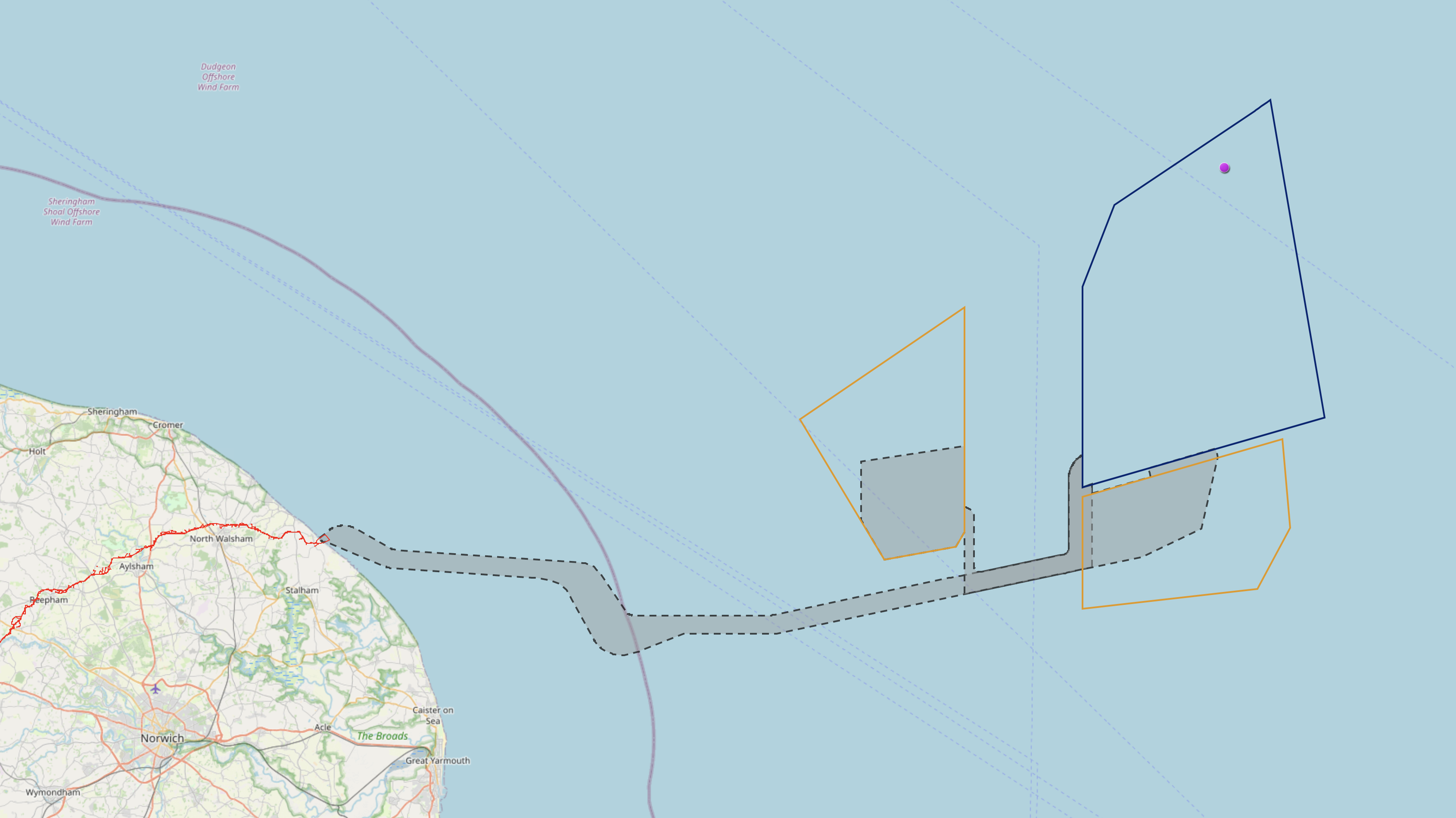
Note.
- Norfolk Boreas is outlined in blue.
- Norfolk Vanguard is outlined in orange.
- I assume the grey areas are where the cables will be laid.
- I estimate that the two farms are about fifty miles offshore.
This second map shows the landfall between Eccles-on-Sea and Happisburgh.
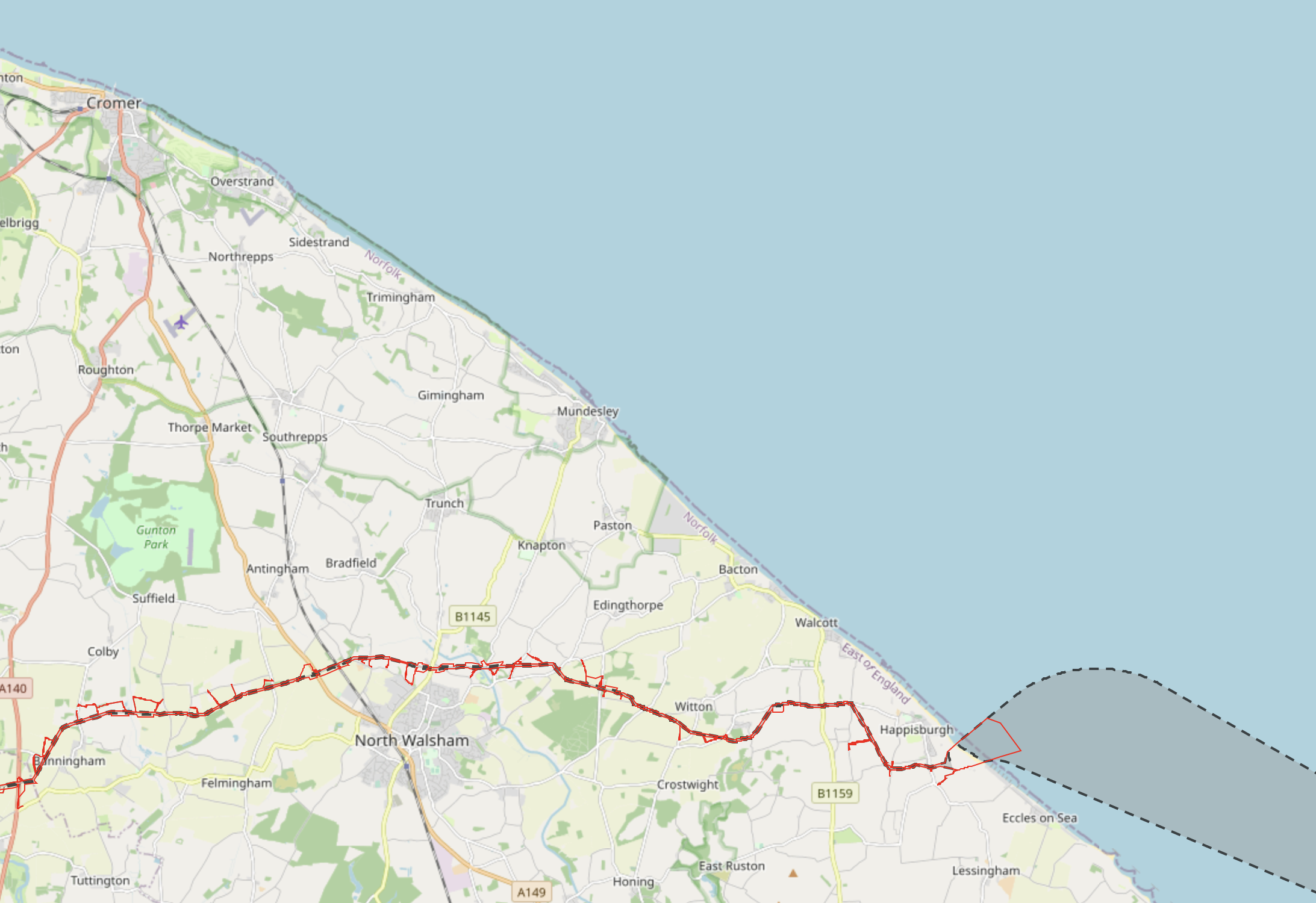
Note the underground cable goes half-way across Norfolk to Necton.
Electricity And Norfolk And Suffolk
This Google Map shows Norfolk and Suffolk.
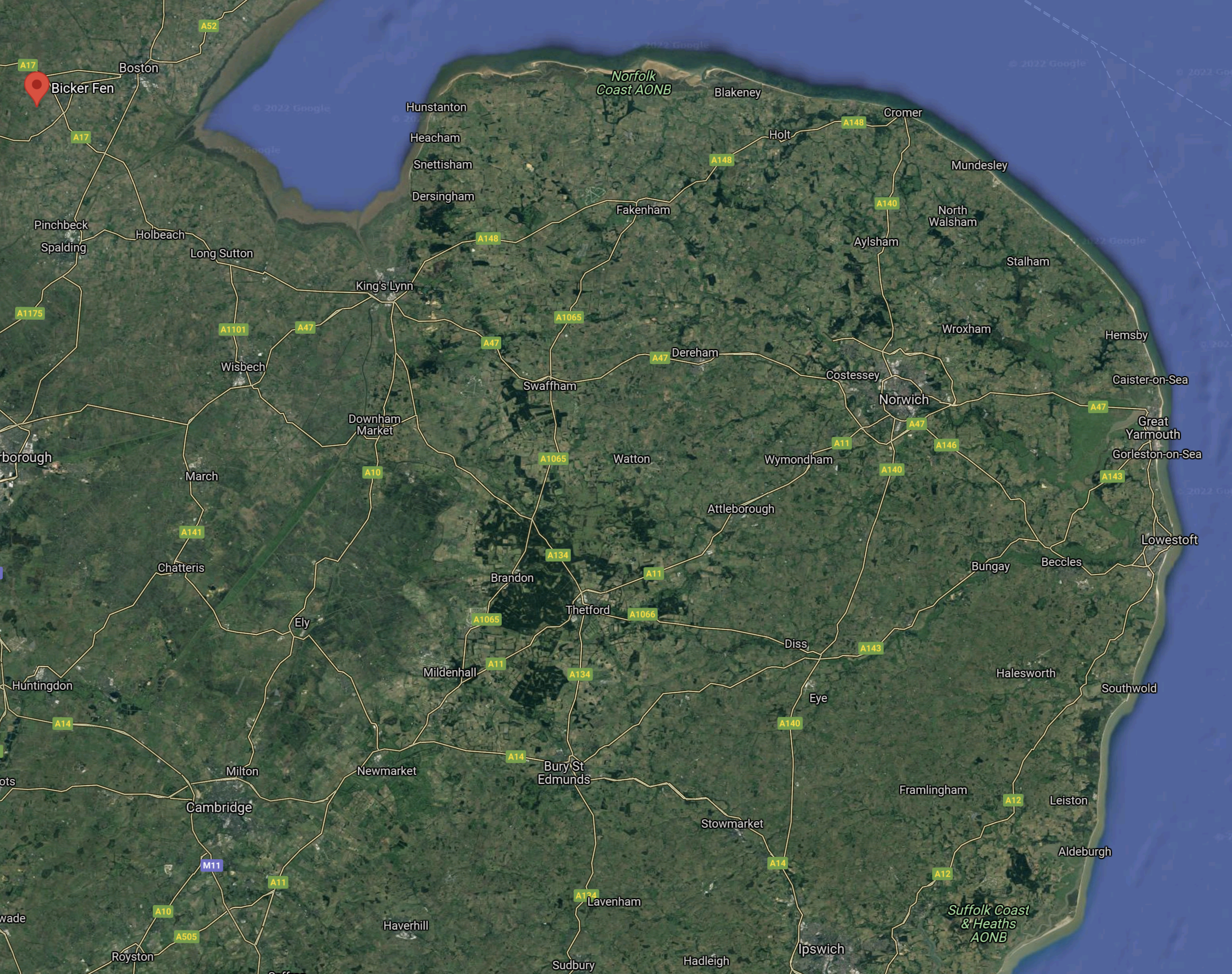
Note.
- The red arrow in the North-West corner marks the Bicker Fen substation that connects to the Viking Link to Denmark.
- The East Anglia Array connects to the grid at Bawdsey in the South-East corner of the map.
- Sizewell is South of Aldeburgh in the South-East corner of the map.
- The only ports are Lowestoft and Yarmouth in the East and Kings Lynn in the North-West.
There are few large towns or cities and little heavy industry.
- Electricity usage could be lower than the UK average.
- There are three small onshore wind farms in Norfolk and none in Suffolk.
- There is virtually no high ground suitable for pumped storage.
- There are lots of areas, where there are very few buildings to the square mile.
As I write this at around midday on a Saturday at the end of January, 49 % of electricity in Eastern England comes from wind, 20 % from nuclear and 8 % from solar. That last figure surprised me.
I believe that the wind developments I listed earlier could provide Norfolk and Suffolk with all the electricity they need.
The Use Of Batteries
Earlier, I talked of a maximum of over 7 GW of offshore wind around the cost of Norfolk and Suffolk, but there is still clear water in the sea to be filled between the existing and planned wind farms.
Batteries will become inevitable to smooth the gaps between the electricity produced and the electricity used.
Here are a few numbers.
- East Anglian Offshore Wind Capacity – 8 GW
- Off-Peak Hours – Midnight to 0700.
- Typical Capacity Factor Of A Windfarm – 20 % but improving.
- Overnight Electricity Produced at 20 % Capacity Factor – 11.2 GWh
- Sizewell B Output – 1.25 GW
- Proposed Sizewell C Output – 3.26 GW
- Largest Electrolyser – 24 MW
- World’s Largest Lithium-Ion Battery at Moss Landing – 3 GWh
- Storage at Electric Mountain – 9.1 GWh
- Storage at Cruachan Power Station – 7.1 GWh
Just putting these large numbers in a table tells me that some serious mathematical modelling will need to be performed to size the batteries that will probably be needed in East Anglia.
In the 1970s, I was involved in three calculations of a similar nature.
- In one, I sized the vessels for a proposed polypropylene plant for ICI.
- In another for ICI, I sized an effluent treatment system for a chemical plant, using an analogue computer.
- I also helped program an analysis of water resources in the South of England. So if you have a water shortage in your area caused by a wrong-sized reservoir, it could be my fault.
My rough estimate is that the East Anglian battery would need to be at least a few GWh and capable of supplying up to the output of Sizewell B.
It also doesn’t have to be a single battery. One solution would probably be to calculate what size battery is needed in the various towns and cities of East Anglia, to give everyone a stable and reliable power supply.
I could see a large battery built at Sizewell and smaller batteries all over Norfolk and Suffolk.
But why stop there? We probably need appropriately-sized batteries all over the UK, with very sophisticated control systems using artificial intelligent working out, where the electricity is best stored.
Note that in this post, by batteries, I’m using that in the loosest possible way. So the smaller ones could be lithium-ion and largest ones could be based on some of the more promising technologies that are under development.
- Highview Power have an order for a 50 MW/500 MWh battery for Chile, that I wrote about in The Power Of Solar With A Large Battery.
- East Anglia is an area, where digging deep holes is easy and some of Gravitricity’s ideas might suit.
- I also think that eventually someone will come up with a method of storing energy using sea cliffs.
All these developments don’t require large amounts of land.
East Anglia Needs More Heavy Consumers Of Electricity
I am certainly coming to this conclusion.
Probably, the biggest use of electricity in East Anglia is the Port of Felixstowe, which will be expanding as it becomes Freeport East in partnership with the Port of Harwich.
One other obvious use could be in large data centres.
But East Anglia has never been known for industries that use a lot of electricity, like aluminium smelting.
Conversion To Hydrogen
Although the largest current electrolyser is only 24 MW, the UK’s major electrolyser builder; ITM Power, is talking of a manufacturing capacity of 5 GW per year, so don’t rule out conversion of excess electricity into hydrogen.
Conclusion
Who needs Sizewell C?
Perhaps as a replacement for Sizewell B, but it would appear there is no pressing urgency.
Expansion Plan To Take World’s Biggest Battery Storage Project To 3GWh Capacity
The title of this post, is the same as that of this article on Energy Storage News.
These are the first two paragraphs.
Plans to nearly double the output and capacity of the world’s biggest battery energy storage system (BESS) project to date have been announced by its owner, Vistra Energy.
The Texas-headquartered integrated utility and power generation company said it wants to add another 350MW/1,400MWh BESS to the Moss Landing Energy Storage Facility in California’s Monterey Bay.
The project is based at the Moss Landing Power Plant, which was once the largest power plant in the state of California, with a generation capacity of 2560 MW.
There appear to be three phases.
- Phase 1 is 300MW/1,200MWh and went online at the end of 2020
- Phase 2 is 100MW/400MWh and went online in August 2021.
- Phase 3 will be 350MW/1,400MWh.
This gives a maximum power output of 750 MW and prospective total capacity of 3 GWh. At full power, the battery could supply 750 MW for four hours.
For comparison, the two Scottish batteries I talked about in Amp Wins Consent For 800MW Scots Battery Complex, have a combined output of 800 MW and a total capacity of 1600 MWh, which would give a full power run of two hours.
Could the difference be that Scotland has 9.3 GW of installed windpower, whereas the much larger California has only 6 GW?
Both Scotland and California also have some pumped storage power stations.
- Drax Group who own the 7.1 GWh Cruachan power station, plan to increase its generating capacity from 440MW to 1040MW.
- California has two larger stations at Castaic and Helms.
- After writing about the Western HVDC Link in Amp Wins Consent For 800MW Scots Battery Complex, I wonder if when the wind is blowing in Scotland and it isn’t in Wales, that electricity can be exported from Scotland to Wales for storage.
This all shows the complex integrated nature of electricity networks.
What Happens When The Wind Doesn’t Blow?
In Future Offshore Wind Power Capacity In The UK, I analysed future offshore wind power development in the waters around the UK and came to this conclusion.
It looks like we’ll be able to reap the wind. And possibly 50 GW of it!
The unpredictable nature of wind and solar power means that it needs to be backed up with storage or some other method.
In The Power Of Solar With A Large Battery, I describe how a Highview Power CRYObattery with a capacity of 500 MWh is used to back up a large solar power station in the Atacama desert in Chile.
But to backup 50 GW is going to need a lot of energy storage.
The largest energy storage system in the UK is Electric Mountain or Dinorwig power station in Wales.
- It has an output of 1.8 GW, which means that we’d need up to nearly thirty Electric Mountains to replace the 50 GW.
- It has a storage capacity of 9.1 GWh, so at 1.8 GW, it can provide that output for five hours.
- To make matters worse, Electric Mountain cost £425 million in 1974, which would be over £4 billion today, if you could fine a place to build one.
But it is not as bad as it looks.
- Battery technology is improving all the time and so is the modelling of power networks.
- We are now seeing large numbers of lithium-ion batteries being added to the UK power network to improve the quality of the network.
- The first Highview Power CRYObattery with an output of 50 MW and a capacity of 250 MWh is being built at Carrington in Manchester.
- If this full size trial is successful, I could see dozens of CRYOBatteries being installed at weak points in the UK power network.
- Other battery technology is being developed, that might be suitable for application in the UK.
Put this all together and I suspect that it will be possible to cover on days where the wind doesn’t blow.
But it certainly will need a lot of energy storage.
Gas-Fired Power Stations As A Back Up To Renewable Power
Last summer when the wind didn’t blow, gas-fired power stations were started up to fill the gap in the electricity needed.
Gas-fired power-stations normally use gas turbines similar to those used in airliners, which have a very fast startup response, so power can be increased quickly.
If you look at the specification of proposed gas-fired power stations like Keadby2, they have two features not found in current stations.
- The ability to be fitted in the future with carbon-capture technology.
- The ability to be fuelled by hydrogen.
Both features would allow a gas-fired power-station to generate power in a zero-carbon mode.
Carbon Capture And Storage
I am not in favour of Carbon Capture And Storage, as I believe Carbon Capture and Use is much better and increasingly engineers, researchers and technologists are finding ways of using carbon-dioxide.
- Feeding to tomatoes, salad vegetables, soft fruits and flowers in greenhouses.
- Producing meat substitutes like Quorn.
- Producing sustainable aviation fuel.
- An Australian company called Mineral Decarbonation International can convert carbon dioxide into building products like blocks and plasterboard.
This list will grow.
Using or storing the carbon-dioxide produced from a gas-fired power station running on natural gas, will allow the fuel to be used, as a backup, when the wind isn’t blowing.
Use Of Hydrogen
Hydrogen will have the following core uses in the future.
- Steelmaking
- Smelting of metal ores like copper and zinc
- As a chemical feedstock
- Natural gas replacement in the mains.
- Transport
Note that the first four uses could need large quantities of hydrogen, so they would probably need an extensive storage system, so that all users had good access to the hydrogen.
If we assume that the hydrogen is green and probably produced by electrolysis, the obvious place to store it would be in a redundant gas field that is convenient. Hence my belief of placing the electrolyser offshore on perhaps a redundant gas platform.
If there is high hydrogen availability, then using a gas-fired power-station running on hydrogen, is an ideal way to make up the shortfall in power caused by the low wind.
Conclusion
Batteries and gas-fired power stations can handle the shortfall in power.
Cheesecake Energy Secures £1M Seed Investment
The title of this post, is the same as that of this Press Release from Cheesecake Energy.
This is the first paragraph.
Cheesecake Energy Ltd (CEL), a Nottingham, UK-based energy storage startup today announced it has raised £1M in Seed funding to fuel the development of its manufacturing capabilities and support product development of its eTanker storage system. The round was led by Imperial College Innovation Fund alongside prominent investors including Perivoli Innovations, former Jaguar Chairman, Sir John Egan and other angel investors.
And the third and fourth paragraphs describe the technology.
The company’s unique technology, dubbed eTanker, takes established compressed air energy storage concepts and revolutionises them by storing two-thirds of the electricity in the form of heat which can be stored at far lower cost. To store the energy, electric motors are used to drive compressors, which deliver high pressure air & heat into storage units. When the electricity is required, the high-pressure air and heat is passed back through the same compressor (but now working as a turbine), which turns a generator to produce electricity. The company believes its system will cut the cost of storing energy by 30-40% and offers a solution that can be used in several sectors including electric vehicle (EV) charging, heavy industry and renewable energy generation.
The startup has filed 10 patents for stationary, medium-long-duration, long-lifetime energy storage technology. It is based on innovative design work by CEL, a spin-out from over a decade of research at University of Nottingham. Employing circular economy principles, truck engines are converted into zero-emission electrical power-conversion machines for putting energy into and out of storage. Its technology brings together the low cost of thermal storage, the turnaround efficiencies of compressed air energy storage, together with the long life and robustness of a mechanical system, making a game-changing technology in a modular containerised package.
It all sounds feasible to me and if I’d have been asked, I’d have chipped in some of my pension.
The system in some ways can almost be considered a hybrid system that merges some of the principles of Highview Power’s CRYOBattery and Siemens Gamesa’s ETES system of heating large quantity of rock. Although, Cheesecake’s main storage medium is comptressed air, as opposed to the liquid air of the CRYOBattery.
One market they are targeting is the charging of fleets of electric vehicles like buses and from tales I have heard about operators of large numbers of electric buses, this could be a valuable market.
I also noted that the Press Release mentions a National Grid report, that says we will need 23 GW of energy storage by 2030. Assuming we will need to store enough electricity to provide 23 GW for five hours, that will be 115 GWh of energy storage.
At present, pumped storage is the only proven way of storing tens of GWh of energy. In 1984, after ten years of construction, Dinorwig power station (Electric Mountain) opened to provide 9.1 GWh of storage with an output of 1.8 GW.
So ideally we will need another thirteen Electric Mountains. But we don’t have the geography for conventional pumped storage! And as Electric Mountain showed, pumped storage systems are like Rome and can’t be built in a day.
Energy storage funds, like Gresham House and Gore Street are adding a large number of lithium-ion batteries to the grid, but they will only be scratching the surface of the massive amount of storage needed.
Note that at the end of 2020, Gresham House Energy Storage Fund had a fleet of 380 MWh of batteries under management, which was an increase of 200 MWh on 2019. At this rate of growth, this one fund will add 2GWh of storage by 2030. But I estimate we need 115 GWh based on National Grid’s figures.
So I can see a small number of GWh provided by the likes of Gresham House, Gore Street and other City funds going the same route.
But what these energy storage funds have proved, is that you have reliable energy storage technology, you can attract serious investment for those with millions in the piggy-bank.
I believe the outlook for energy storage will change, when a technology or engineering company proves they have a battery with a capacity of upwards of 250 MWh, with an output of 50 MW, that works reliably twenty-four hours per day and seven days per week.
I believe that if these systems are as reliable as lithium-ion, I can see no reason why City and savvy private investors money will not fund these new technology batteries, as the returns will be better than putting the money in a deposit account, with even the most reputable of banks.
At the present time, I would rate Highview Power’s CRYOBattery and Siemens Gamesa’s ETES system as the only two battery systems anywhere near to a reliable investment, that is as safe as lithium-ion batteries.
- Both score high on being environmentally-friendly.
- Both rely on techniques, proven over many years.
- Both don’t need massive sites.
- Both systems can probably be maintained and serviced in nearly all places in the world.
- Highview Power have sold nearly a dozen systems.
- Highview Power are building a 50 MW/250 MWh plant in Manchester.
- Siemens Gamesa are one of the leaders in renewable energy.
- Siemens Gamesa have what I estimate is a 130 MWh pilot plant working in Hamburg, which I wrote about in Siemens Gamesa Begins Operation Of Its Innovative Electrothermal Energy Storage System.
Other companies are also targeting this market between lithium-ion and pumped storage. Cheesecake Energy is one of them.
I believe they could be one of the winners, as they have designed a system, that stores both compressed air and the heat generated in compressing it. Simple but efficient.
I estimate that of the 115 GWh of energy storage we need before 2030, that up to 5 GWh could be provided by lithium-ion, based on the growth of installations over the last few years.
So we will need another 110 GWh of storage.
Based on 50 MW/250 MWh systems, that means we will need around 440 storage batteries of this size.
This picture from a Google Map shows Siemens Gamesa’s pilot plant in Hamburg.
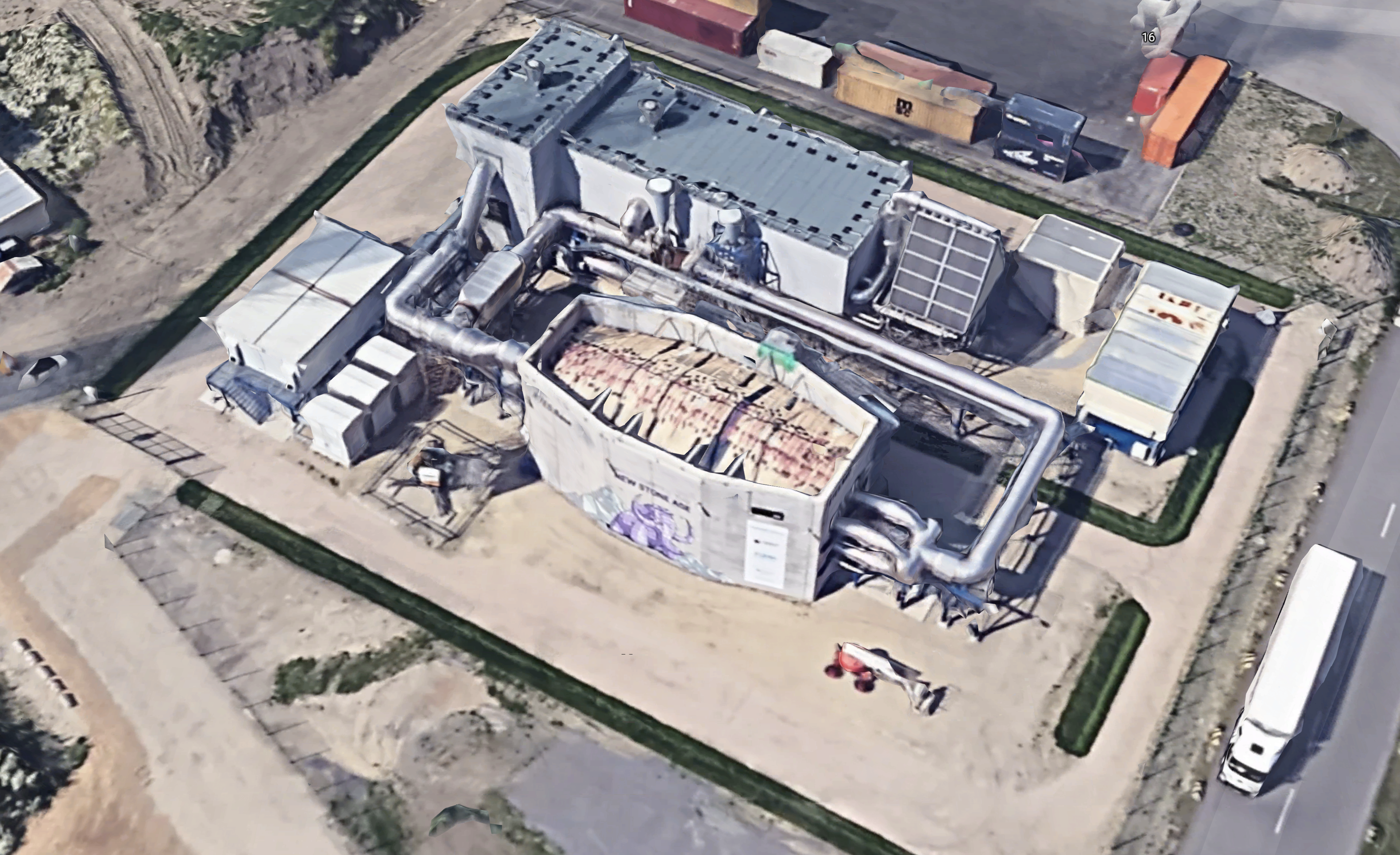
I estimate that this plant is around 130 MWh of storage and occupies a site of about a football pitch, which is one hectare.
I know farmers in Suffolk, who own more land to grow wheat, than would be needed to accommodate all the batteries required.
Conclusion
I believe that National Grid will get their 23 GW of energy storage.
Developer 8minute Says More Than 24GWh Of Batteries Included In Its US Solar-Plus-Storage Pipeline
The title of this post, is the same as that of this article on Energy Storage News.
What caught my eye was the 24 GWh!
When you consider that the biggest battery in the UK is Electric Mountain, which has a capacity of 9 GWh, 24 GWh of batteries is a large number!
It will need a lot of solar panels to keep that amount of batteries brim-full.
This is a sentence from the article.
The company’s projects include the Eland Solar & Storage Center, which will comprise 400MWac of PV and 300MW / 1,200MWh of battery energy storage, currently under construction in California’s Mojave Desert.
Those are big numbers against the UK’s largest solar park at Shotwick in Wales, which is just 72.2 MW.
The New Generation Of Pumped Storage Systems
This excellent article on GreenTechMedia is entitled The 5 Most Promising Long-Duration Storage Technologies Left Standing.
One of the technologies the article discusses is pumped storage, which in the UK is used at the massive Electric Mountain in Snowdonia, which can hold 9.1 GWh of electricity and supply up to 1,800 MW of electricity when needed. That’s not bad for 1970s engineering!
The GreenTechMedia article introduces pumped storage like this.
Midcentury modern design is hot again, so why not midcentury storage technology? This gravity-based concept physically moves water from a low to a high reservoir, from which the water descends, when needed, to generate electricity. This dates from way before lithium-ion’s heyday and still provides some 95 percent of U.S. grid storage, according to the U.S. Department of Energy.
The largest pumped storage system in the US is Bath County Pumped Storage Station, which is described as the biggest battery in the world. With a storage capacity of 24 GWh of electricity and a generating capacity of 3,003 MW, it dwarfs Electric Mountain. But then the Americans have bigger mountains.
Pumped storage is a good partner for intermittent renewables like wind and solar, but in a country like the UK, the US and other countries with strong planning laws getting permission to build a large pumped storage system is not easy. We tried to build one on Exmoor, but that was abandoned.
Note that the country building the most new pumped storage systems is China, where they have mountains and planning laws, that would not be acceptable anywhere else.
But engineers have come up with a new design, described in this paragraph from the GreenTechMedia article.
The new school of pumped hydro focuses on isolated reservoirs that don’t disrupt river ecosystems; this simplifies permitting, but projects still face a decade-long development timeline and billion-dollar price tags.
It then gives two examples of proposed systems.
Gordon Butte Pumped Storage Project
The operation of the Gordon Butte Pumped Storage Project is described like this in Wikipedia.
Gordon Butte will be located on a 177 acres (0.72 km2) site, and will have access to water from Cottonwood Creek, a tributary of the Musselshell River. The facility will operate as a closed system, without actively drawing or discharging water into the watershed. It will have a 4,000 acre-foot capacity reservoir, located 1,000 feet (300 m) above the base, with a power generation capacity of about 400 MW
The smaller size must make it easier to get it built.
How much energy will Gordon Butte hold in GWh?
- A 4,000 acre-foot reservoir has a capacity of 4,933,927.42128 cubic metres.
- As a cubic metre of water weighs a tonne, the reservoir can hold 4,933,927.42128 tonnes of water at an altitude of 300 metres.
- Using Omni’s Potential Energy Calculator, this gives a potential energy of 4,032,108 KWh.
This is just over 4 GWh.
Ths facility could supply 400 MW for ten hours or 4 MW for a thousand hours!
It should be noted that Electric Mountain has an efficiency of 74-76%.
Eagle Mountain Pumped Storage Facility
Eagle Mountain Pumped Storage Facility is introduced like this on its web site.
The pumped storage hydropower project at Eagle Mountain, CA will transform a scarred brownfield site into a 1,300 Megawatt generator of green electricity that can light one million homes. The site is in a remote part of the Mojave Desert, more than 50 miles from the nearest city, Blythe, CA, and more than 60 miles from Palm Springs and the Coachella Valley. The construction of the project will create thousands of jobs and add millions of dollars to the local economy while adhering to the most rigorous environmental standards.
Note that it is turning an eyesore of the worst kind into a pumped storage facility. It’s surely better than using it for landfill!
Conclusion
Systems like these may have applications in the UK!
Could some of those massive quarries in the Peak District be converted into pumped storage systems, using the technology of my two examples?
This Google Map shows the quarries surrounding the town of Buxton.
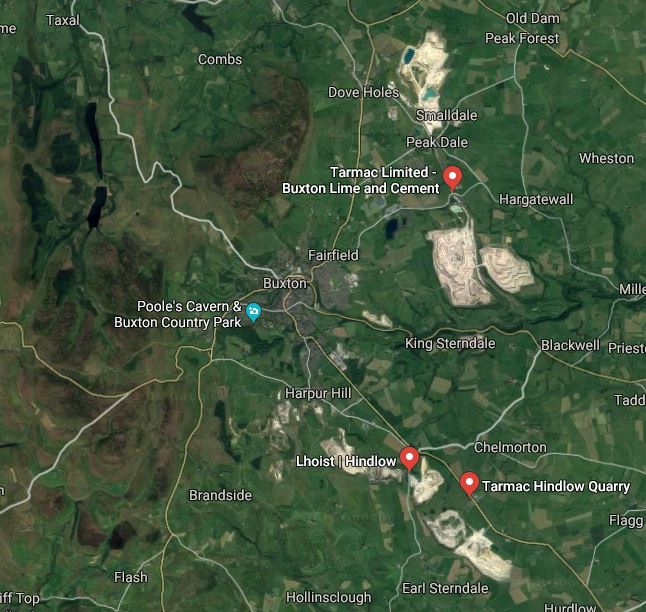
Note.
- The white areas looking almost like clouds are quarries.
- Buxton has an altitude of three hundred metres, which is the altitude of the Gordon Butte Storage Project.
- The vast Tunstead Quarry, which is four kilometres East of Buxton has an area of over one square mile.
- Tunstead Quarry has a red arrow above it marked Buxton Lime and Cement.
Could we not extract as much limestone as is possible from Tunstead and then convert it into a pumped storage system like Gordon Butte? It could have an area of 2.5 square kilometres and an altitude of nearly a thousand feet. A rough estimate, based on Gordon Butte, indicates it could store over 10 GWh.
Hopefully, better hydro-electric power engineers than myself, are looking at the quarries in the Peak District, with eyes flashing like cash registers.
There is one pumped storage project under development in the UK at the present time; Snowdonia Pumped Hydro, which obtained planning permission in 2017.
These are some characteristics.
- Situated in Snowdonia in old slate quarries at Glyn Rhonwy.
- 99.9 MW of power
- 700 MWh of storage capacity.
- 2 reversible turbines
- Start to full power in 12 seconds
- Cycle efficiency of around 81%
- Project lifespan of 125 years
- Estimated carbon saving of 50,000 tonnes per year
It is under a tenth the size to Electric Mountain, but every little helps.
I would also feel that with a 125 year life, it could be the sort of investment, that would appeal to a Pension Fund.
The 5 Most Promising Long-Duration Storage Technologies Left Standing
The title of this post is the same as that of this article on GreenTechMedia.
This is the sub-title of the article.
Low-carbon grids need longer-duration storage, but few technologies have succeeded at scale. Here’s the current roster of best bets.
I won’t steal their thunder, by saying too much more.
- Pumped storage, like Electric Mountain, is making a comeback.
- My favourite; Highview Power is on the list!
- One great thing about their Famous Five, is that perhaps only one uses an exotic material.
- I also think, that all five could be funded by a Pension Fund to give a return to pay pensions.
But you should read the article!
We’re not going to run out of energy!
The Power Of Battery Storage
This article on Fastmarkets is entitled Neoen To Expand Li-ion Battery Capacity at Hornsdale Plant.
This is the introductory paragraph.
Australia’s Hornsdale Power Reserve, the world’s biggest lithium-ion battery plant, is set to expand capacity by 50% to 150 megawatts, according to Neoen SA, the French power producer that owns and operates the site.
If you read the article and the Wikipedia entry for Hornsdale Power Reserve (HPR), you’ll see why it is being expanded.
This paragraph is from Wikipedia.
After six months of operation, the Hornsdale Power Reserve was responsible for 55% of frequency control and ancillary services in South Australia.[11] By the end of 2018, it was estimated that the Power Reserved had saved A$40 million in costs, most in eliminating the need for a 35 MW Frequency Control Ancillary Service.
Somewhat surprisingly, the power is mainly generated by the associated Hornsdale Wind Farm.
These are some statistics and facts of the installation at Hornsale.
- There are 99 wind turbines with a total generation capacity of 315 megawatts.
- HPR is promoted as the largest lithium-ion battery in the world.
- HPR can store 129 MWh of electricity.
- HPR can discharge 100 MW into the grid.
- The main use of HPR is to provide stability to the grid.
HPR also has a nice little earner, in storing energy, when the spot price is low and selling it when it is higher.
It certainly explains why investors are putting their money in energy storage.
Wikipedia lists four energy storage projects using batteries in the UK, mainly of an experimental nature in Lilroot, Kirkwall, Leighton Buzzard and six related sites in Northern |England. One site of the six has a capacity of 5 MWh, making it one of the largest in Europe.
But then we have the massive Dinorwig power station or Electric Mountain, which can supply ,1,728-MW and has a total storage capacity of 9.1 GWh
Consider.
- Electric Mountain has seventy times the capacity of Hornsdale Power Reserve.
- Electric Mountain cost £425 million in 1984, which would be a cost of £13.5 billion today.
- Another Electric Mountain would cost about £1.6 billion per GWh of energy storage.
- Hornsdale Power Reserve cost $ 50 million or about £26 million.
- Hornsdale Power Reserve would cost about £0.2 billion per GWh of energy storage.
So it would appear that large batteries are better value for money than large pumped storage systems like Electric Mountain.
But it’s not as simple as that!
- There aren’t many places, as suitable as North Wales for large pumped storage systems.
- Omce built, it appears pumped storage system can have a long life. Electric Mountain is thirty-five years old and with updating, I wouldsn’t be surprised to see Electric Mountain in operation at the end of this century.
- Battery sites can be relatively small, so can be placed perhaps in corners of industrial premises or housing developments.
- Battery sites can be built close to where power is needed, but pumped storage can only be built where geography allows.
- Pumped strage systems can need long and expensive connections to the grid.
- I think that the UK will not build another Electric Mountain, but will build several gigawatt-sized energy storage facilities.
- Is there enough lithium and other elements for all these batteries?
- Electric Mountain is well-placed in Snowdonia for some wind farms, but many are in the North Sea on the other side of the country.
In my view what is needed is a series of half-gigawatt storage facilities, spread all over the country.
Highview Power looks to be promising and I wrote about it in British Start-Up Beats World To Holy Grail Of Cheap Energy Storage For Wind And Solar.
But there will be lots of other good ideas!
British Start-Up Beats World To Holy Grail Of Cheap Energy Storage For Wind And Solar
The title of this post is the same as that of this article on the Daily Telegraph.
If you think it sounds too good to be true, then watch this video from the company behind the technology; Highview Power.
The basic principle is very simple.
- Electricity is used to turn air into liquefied air using refrigeration technology, that has been around for donkeys years.
- This is stored in tanks under pressure.
- To retrieve the energy, the liquid air is allowed to evaporate and creates electricity through a turbine and generator.
These engineers have taken several pieces of readily available industrial equipment, put it together in a novel way. to create an energy storage system.
I believe that this could be the Holy Grail of energy storage!
Why?
In World’s Largest Wind Farm Attracts Huge Backing From Insurance Giant, I discussed how Aviva have invested a billion pounds in wind farms, as it gives them the sort of long-term return they need to provide pensions and pay out insurance claims.
But if you own a Gigawatt-sized wind farm in the North Sea, one thing is missing; the ability to store that energy in an affordable way.
So by investing in this type of energy storage and coupling it with their own wind farms, Aviva can control the output of the wind farms to what the National Grid needs.
All it needs is some more money, that needs a home. And Aviva have lots of that!
It’s also an investment with an ethical and green profile.
- No polluting technology.
- Proven technology.
- Zero-carbon technology.
- Non-toxic technology.
- No use of exotic and scant resources.
- No expensive or dangerous fuel
- Affordable technology
Systems can also be distributed to where they are needed or where there is surplus electricity.
If you want to know more, watch the video and then look at other videos for Highview Power.
How Much Energy Can Highview Power’s Systems Store?
The biggest energy storage system in the UK is Electric Mountain, which has a power output of 1,728 MW and an energy storage capacity of 9.1 GWh.
That is some battery and it was built in the 1970s for a cost of £425 million, which would be £1.3billion today.
In a video it is claimed that Highview Power are designing a storage system, which has a power output of 200 MW and an energy storage capacity of 1.2 GWh.
You would only need to build nine and you’ve got another Electric Mountain!
Perhaps to maximise security of supply and obtain a fast response, the systems could be placed in Cumbria, Essex, Humberside, Kent, Merseyside, Norfolk, Suffolk, Thurso and Yorkshire.
Would We Need Nuclear Power?
Probably not!
For the same amount of money as a large nuclear power station, you’d get an awful lot of offshore wind farms and the storage thrown in.
Conclusion
This technology could solve the world’s energy problems.
I
Thoughts On Last Week’s Major Power Outage
This article on the BBC is entitled Major Power Failure Affects Homes And Transport.
This is the first two paragraphs.
Nearly a million people have been affected by a major power cut across large areas of England and Wales, affecting homes and transport networks.
National Grid said it was caused by issues with two power generators but the problem was now resolved.
This second article on the BBC is entitled UK power cut: Why it caused so much disruption, and gives these details.
It started with a routine blip – the gas-fired power station at Little Barford in Bedfordshire shut down at 16:58 BST due to a technical issue.
Then, a second power station, the new Hornsea offshore wind farm, also “lost load” – meaning the turbines were still moving, but power was not reaching the grid.
These are my thoughts on the incident.
Power Stations Do Fail
Any complex electro-mechanical system like Little Barford gas-fired power station or Hornsea offshore wind farm can fail.
- Little Barford gas-fired power station was built in 1994 and is a 746 MW gas-fired power station.
- Hornsea offshore wind farm obtained planning permission in 2014 and is being built in phases. It will eventually have a maximum capacity of 8 GW or 8,000 MW.
Compare these figures with the iconic coal-fired Battersea power station, which had a maximum output of 503 MW in 1955.
I will not speculate as to what wet wrong except to say that as the Hornsea wind-farm is relatively new, it could be what engineers call an infant mortality problem. Complex systems or even components seem to fail in the first few months of operation.
Why Do We Have Gas-Fired Stations?
According to this page on Wikipedia, there are around forty natural gas fired power stations in England.
Most gas-fired stations are what are known as CCGT (Combined Cycle Gas Turbine), where a Jumbo-sized gas-turbine engine is paired with a steam turbine powered by the heat of the exhaust from the engine.
This form of power generation does produce some carbon dioxide, but to obtain a given amount of electricity, it produces a lot less than using coal or ioil.
By combining the gas turbine with a steam turbine, the power station becomes more efficient and less carbon dioxide is produced.
Power stations of this type have three various advantages.
- They have a very fast start-up time, so are ideal power stations to respond to sudden increases in electricity demand.
- As they are a gas-turbine engine with extra gubbins, they are very controllable, just like their cousins on aircraft.
- They are relatively quick, easy and affordable to build. The Wikipedia entry for a CCGT says this. “The capital costs of combined cycle power is relatively low, at around $1000/kW, making it one of the cheapest types of generation to install.”
- They don’t need a complicated and expensive transport infrastructure to bring in coal or nuclear fuel.
- They can also be powered by biogas from agricultural or forestry waste, although I don’t think that is a comm practice in the UK.
The carbon dioxide produced is the only major problem.
Gas-Fired Power Stations In The Future
If you read the Wikipedia entry for combined cycle power plants, there is a lot of information on CCGTs, much of which is on various ways of improving their efficiency.
I believe that one particular method of increasing efficiency could be very applicable in the UK.
Under Boosting Efficiency in the Wikipedia entry, the following is said.
The efficiency of CCGT and GT can be boosted by pre-cooling combustion air. This is practised in hot climates and also has the effect of increasing power output. This is achieved by evaporative cooling of water using a moist matrix placed in front of the turbine, or by using Ice storage air conditioning. The latter has the advantage of greater improvements due to the lower temperatures available. Furthermore, ice storage can be used as a means of load control or load shifting since ice can be made during periods of low power demand and, potentially in the future the anticipated high availability of other resources such as renewables during certain periods.
The UK is the world’s largest generator of power using offshore wind and as we are surrounded with sea and wind, the UK is only going to produce more of the power it needs in this or other way.
This method could be used to store the wind energy produced when the demand is low and recover it, when it is needed.
Could The UK Develop A Chain Of Carbon-Neutral Gas-Fired Power Stations?
In parts of the UK, there is a unique mix of resources.
- A plentiful supply of natural gas, either from offshore fields or interconnectors to Norway.
- Large amounts of electricity generated by offshore wind, which will only get larger.
- Worked out gas-fields still connected to the shore, through redundant platforms and pipes.
- Closeness to agricultural areas.
Technologies under development or already working include.
- Offshore creation of hydrogen using electricity generated by offshore wind and then using the redundant gas pipes to bring the hydrogen to the shore.
- Using a hydrogen-fired CCGT power station without producing any carbon-dioxide.
- Feeding carbon dioxide to plants like salad and fruit to make them grow better.
- Using excess electricity from renewable sources to cool the air and improve the efficiency of CCGT power stations.
I can see all these technologies and development coming together in the next few years and a chain of carbon-neutral gas-fired power stations will be created
- Hydrogen produced offshore on redundant gas platforms, using electricity from nearby wind farms, will be turned back into electricity, where it is needed by onshore hydrogen-fired power stations.
- Redundant gas platforms will be refurbished and reused, rather than demolished at great expense.
- Some natural gas will still be used for power generation
- I’m not quite sure, but I think there could be dual-furled CCGTs, that could run on either hydrogen or natural gas.
- Any carbon dioxide generated will be stored in the worked out gas fields or fed to the crops.
- Gas storage onshore will ensure that the gas-fired power station can respond quickly.
I also believe that there is no technological and engineering challenges, that are too difficult to solve.
This strategy would have the following advantages.
- It should be carbon-neutral.
- Because there could have as many as two hundred individual power stations, the system would be very reliable and responsive to the loss of say a cluster of five stations, due to a tsunami, a volcanic eruption or a major eathquake.
- If power from renewable sources like offshore wind is low, extra stations can be quickly switched in.
- It is not dependent on fuel from dodgy dictators!
- It would probably be more affordable than developing nuclear power stations.
There is also the possibility of bringing more hydrogen onshore to be used in the decarbonisation of the gas-grid.
Conclusion
A chain of carbon-neutral gas-fired power stations, linked to hydrogen created offshore by wind farms is very feasible.
Last week, after the double failure, extra stations would have immediately been switched in.
Energy Storage
The fastest response system is energy storage, where a giant battery holds several gigawatt-hours of eklectricity.
Electric Mountain
The biggest energy storage facility in the UK is Dinorwig Power Station.
This is the introduction to its Wikipedia entry.
The Dinorwig Power Station , known locally as Electric Mountain, is a pumped-storage hydroelectric scheme, near Dinorwig, Llanberisin Snowdonia national park in Gwynedd, northern Wales. The scheme can supply a maximum power of 1,728-megawatt (2,317,000 hp) and has a storage capacity of around 9.1-gigawatt-hour (33 TJ)
It is large and has a rapid response, when more electricity is needed.
We probably need another three or four Electric Mountains, but our geography means we have few suitable sites for pumped-storage, especially in areas, where large quantities of electricity are needed.
There are one other pumped-storage system in Wales and two in Scotland, all of which are around 350 MW or a fifth the size of Electric Mountain.
In the Wikipedia entry entitled List Of Power Stations In Scotland, this is said.
SSE have proposed building two new pumped storage schemes in the Great Glen; 600 MW at Balmacaan above Loch Ness, and 600 MW at Coire Glas above Loch Lochy, at £800m. Scotland has a potential for around 500 GWh of pumped storage
I’m sure the Scots will find some way to fill this storage.
If all else fails, there’s always Icelink. This is the description from Wikipedia.
Icelink is a proposed electricity interconnector between Iceland and Great Britain. As of 2017, the project is still at the feasibility stage. According to current plans, IceLink may become operational in 2027.
At 1000–1200 km, the 1000 MW HVDC link would be the longest sub-sea power interconnector in the world.
The project partners are National Grid plc in the UK, and Landsvirkjun, the state-owned generator in Iceland, and Landsnet, the Icelandic Transmission System Operator (TSO)
Plugging it in to Scotland, rather than London, probably saves a bit of money!
Conclusion
Increasing our pumped-storage energy capacity is feasible and would help us to survive major power failures.
Batteries In Buildings
Tesla have a product called a Powerwall, which puts energy storage into a home or other building.
This was the first product of its kind and there will be many imitators.
The Powerwall 2 has a capacity of 13.5 kWh, which is puny compared to the 9.1 GWh or 9,100,000 kWh of Electric Mountain.
But only 674,074 batteries would need to be fitted in the UK to be able to store the same amount of electricity as Electric Mountain.
The big benefit of batteries in buildings is that they shift usage from the Peak times to overnight
So they will reduce domestic demand in the Peak.
Conclusion
Government should give incentives for people to add batteries to their houses and other buildings.
Could Hydrogen Work As Energy Storage?
Suppose you had a hydrogen-fired 500 MW hydrogen-fired CCGT with a hydrogen tank that was large enough to run it at full power for an hour.
That would be a 0.5 GWh storage battery with a discharge rate of 500 MW.
In an hour it would supply 500MWh or 500,000 kWh of electricity at full power.
In Hydrogen Economy on Wikipedia, this is said, about producing hydrogen by electroysis of water.
However, current best processes for water electrolysis have an effective electrical efficiency of 70-80%, so that producing 1 kg of hydrogen (which has a specific energy of 143 MJ/kg or about 40 kWh/kg) requires 50–55 kWh of electricity.
If I take the 40 KWh/Kg figure that means that to provide maximum power for an hour needs 12,500 Kg or 12.5 tonnes of hydrogen.
Under a pressure of 700 bar, hydrogen has a density of 42 Kg/cu. m., so 12.5 tonnes of hydrogen will occupy just under 300 cubic metres.
If I’ve got the figures right that could be a manageable amount of hydrogen.
Remember, I used to work in a hydrogen factory and I had the detailed guided tour. Technology may change in fifty years, but the properties of hydrogen haven’t!
Gas-Fired Versus Coal-Fired Power Stations
Consider.
- The problem of the carbon dioxide is easier with a gas-fired power station, than a coal-fired power station of the same generating capacity, as it will generate only about forty percent of carbon dioxide.
- Gas-fired power stations can be started up very quickly, whereas starting a coal-fired power station probably takes all day.
- Coal is much more difficult to handle than gas.
Using hydrogen is even better than using natural gas, as it’s zero-carbpn.
Conclusion
I believe we can use our unique geographic position and proven technology to increase the resilience of our power networks.
We need both more power stations and energy storage.
 The Anonymous Widower