Could The Silvertown Tunnel Handle More Buses?
In A Return Journey Through The Silvertown Tunnel On A 129 Bus, I took these pictures inside the Silvertown Tunnel when the bus was coming North.
















Note.
- The left lane is marked Bus Lane.
- Only one car is visible in the right lane.
- The tunnel seems well-lit.
I have some thoughts
Where’s The Traffic?
It does appear that two apparently empty lanes in each direction, don’t carry a large number of vehicles.
- Have the tolls and arguments frightened traffic away?
- Are the tolls too high?
- From the full set of pictures in the linked post, it would appear more vehicles were using the Blackwall Tunnel.
- Could it be that drivers are frightened of getting a speeding ticket?
- Are drivers frightened of sharing the tunnel with buses and heavy trucks?
Both bores of the Silvertown Tunnel seem to have similar traffic levels.
What’s The Capacity Of A Bus Lane?
In the Wikipedia entry for bus lane, this is said.
The busiest bus lane in the United States is the Lincoln Tunnel XBL (exclusive bus lane) along the Lincoln Tunnel Approach and Helix in Hudson County, New Jersey, which carries approximately 700 buses per hour during morning peak times an average of one bus every 5.1 seconds.[ In contrast, the Cross-Harbour Tunnel in Hong Kong carries 14,500 buses per day, or an average of about 605 an hour all day (not just peak times), but the bus lane must give way to all the other road users resulting in long queues of buses.
Perhaps a more realistic example of tunnel capacity from the UK, would be the Victoria Line, which handles thirty-six * eight-car trains per hour (tph) in both directions in two tunnels.
I would certainly expect that if Dear Old Vicky can manage 36 x 8-car trains per hour, then the Silvertown tunnel could handle thirty-six buses per hour.
Especially, if the buses had a distance keeping capability, as many trains do.
How Many Buses Per Hour Are Planned to Use The Silvertown And Blackwall Tunnels?
This handy map from Transport for London, shows the three bus routes passing through the Silvertown and Blackwall Tunnels.
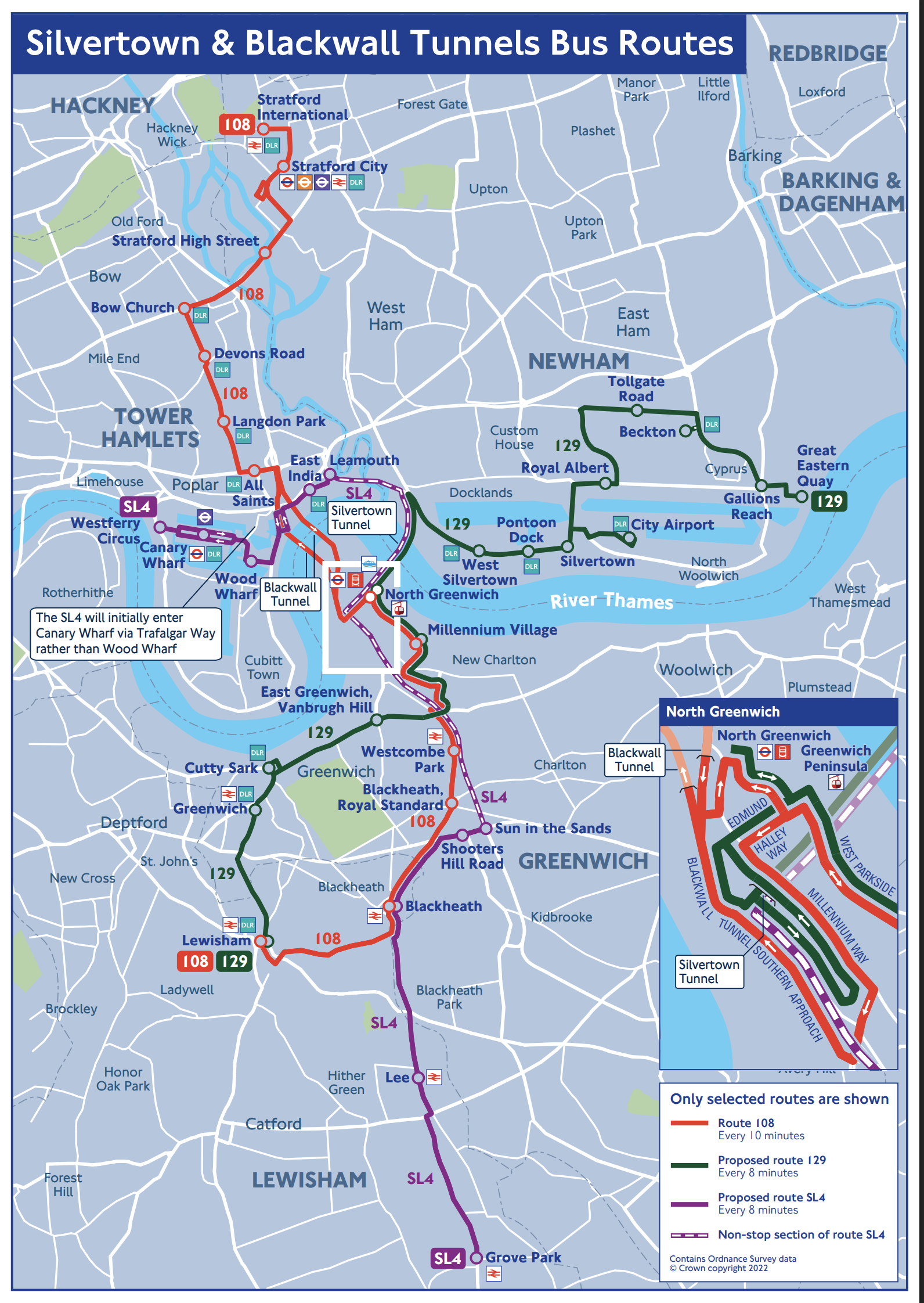
Click the map to show it to a larger scale.
The map gives these frequencies for the three bus routes using the tunnels.
Bus Route SL4
Operates once every 8 minutes or at seven buses per hour.
Bus Route 108
Operates once every 10 minutes or at six buses per hour.
Bus Route 129
Operates once every 8 minutes or at seven buses per hour.
Silvertown Tunnel Bicycle Shuttle
Google AI says this.
The Silvertown Tunnel cycle shuttle bus runs approximately every 12 minutes, operating daily from 6:30 am to 9:30 pm, except for Christmas Day, offering a safe and quick way for cyclists to cross the Thames.
This operates at five buses per hour.
Number Of Buses Through The Tunnels
There will be around nineteen buses per hour, through the Silvertown Tunnel and six through the Blackwall.
The Silvertown Tunnel looks like it has been designed to accept more buses.
One thing this means, is that if the Blackwall gets shut, then the 108 can use some of the spare capacity in the Silvertown Tunnel.
Could A Coach Station For Europe Use Some Of The Spare Capacity?
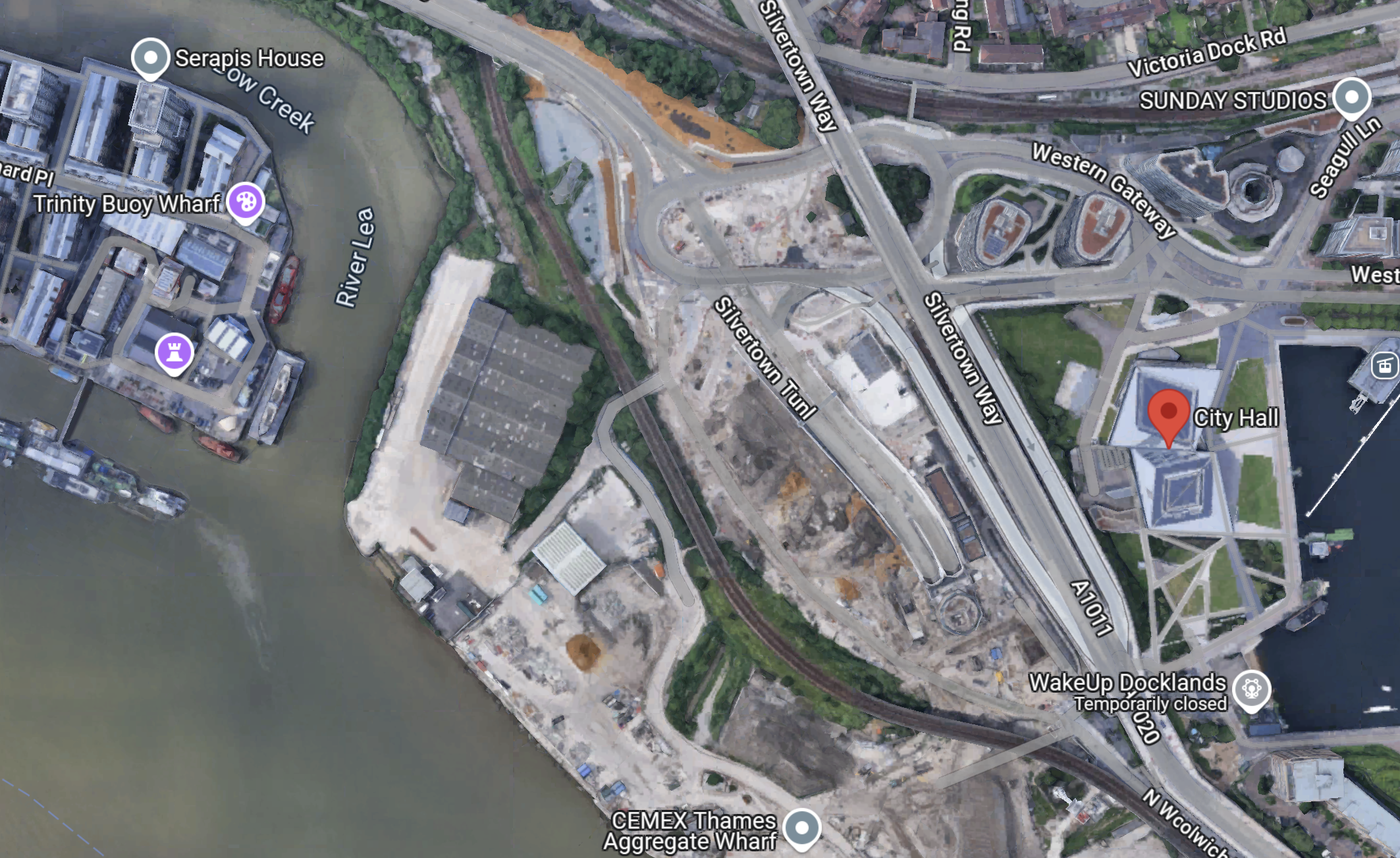
In Development To The West Of The North Entrance Of The Silvertown Tunnel, I displayed this.
This Google Map shows the site to the West of the North entrance of the Silvertown Tunnel.
Note.
- The red arrow indicates City Hall.
- There is a large site between the DLR and the river.
- The Docklands Light Railway separates the site from the North entrance of the Silvertown Tunnel.
- The CEMEX Thames Aggregate Wharf seems to occupy part of the site.
This picture shows the North entrance of the Silvertown Tunnel from the cable-car.
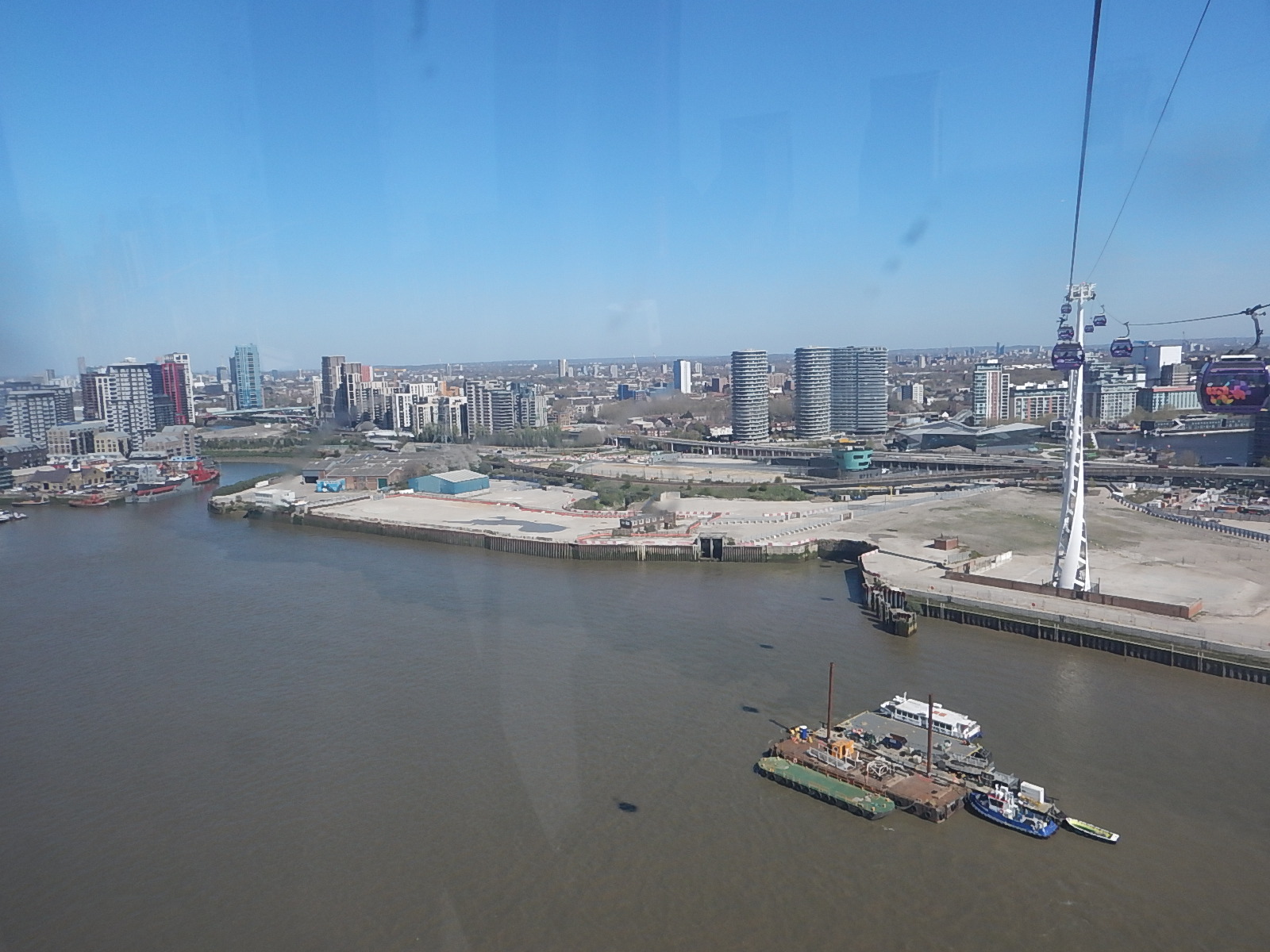
It is surely a site with development potential, as Roy Brooks would say.
It will probably be used for more tower blocks along the Thames.
But could it be used for a coach station to handle the increasing number of coaches between London and the Continent?
- A Docklands Light Railway station could be built to serve the site.
- Thames Clippers could also serve the site.
- Coaches could use the Silvertown Tunnel to start their journey out of the capital.
It is certainly a possibility.
Could The Silvertown Tunnel Be Used For Route-Proving For The Docklands Light Railway?
In TfL Considering Extending DLR As Far As Abbey Wood, I discussed extending the Docklands Light Railway to Thamesmead or Abbey Wood.
This map from Ian Visits shows the area.
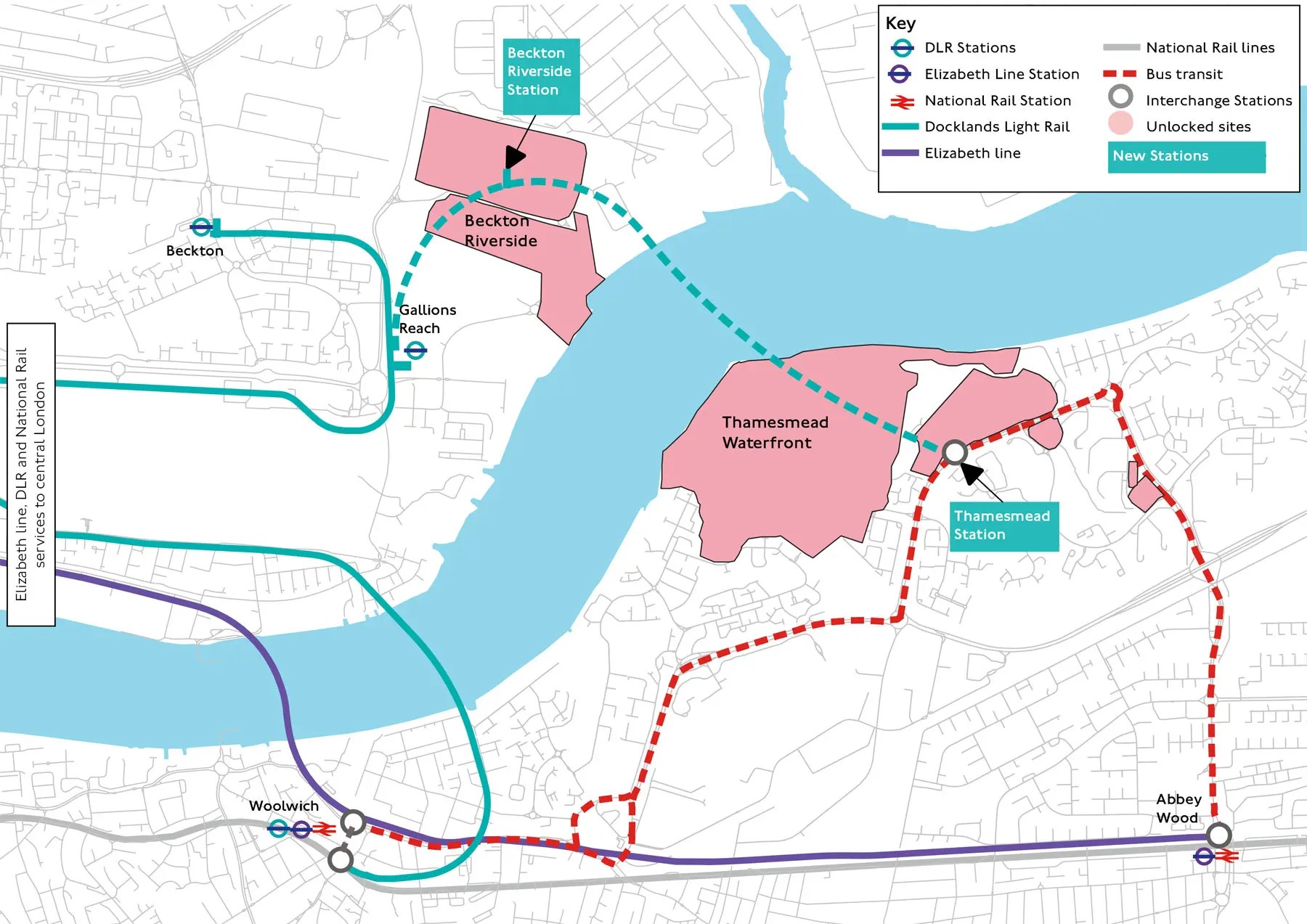
Running a four buses per hour service through the Silvertown Tunnel, would be an ideal way of proving what is the best route.
Extending The Docklands Light Railway To The West
No matter how the Docklands Railway is extended to the East, either by physical means like extra branches or by virtual means like connecting to bus routes, this will mean that there will need to be more terminal capacity in the West, to take the pressure off Bank and Tower Gateway stations.
In A Connection Between City Thameslink Station And The Docklands Light Railway, I described a proposal to extend the Docklands Light Railway to Euston, St. Pancras and Victoria.
In the Wikipedia entry for the Docklands Light Railway, there is a section describing a proposed Euston/St. Pancras Extension.
This is said.
In 2011, strategy documents proposed a DLR extension to Euston and St Pancras. Transport for London have considered driving a line from City Thameslink via Holborn north to the rail termini. The main benefit of such an extension would be to broaden the available direct transport links to the Canary Wharf site. It would create a new artery in central London and help relieve the Northern and Circle lines and provide another metro line to serve the High Speed line into Euston.
This map from Transport for London, shows the possible Western extension of the DLR.
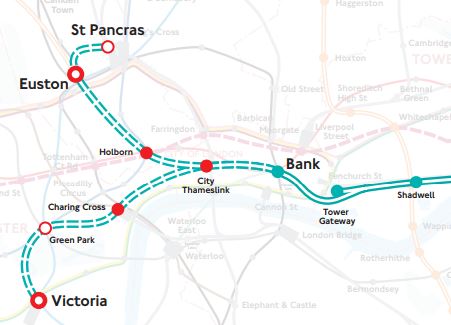
With all the problems of the funding of Crossrail 2, that I wrote about in Crossrail 2 Review Prompts Fresh Delays, could this extension of the DLR, be a good idea?
Consider.
- Victoria, Euston and St. Pancras are prosposed Crossrail 2 stations.
- It would link Canary Wharf and the City of London to Eurostar, Northern and Scottish services and High Speed Two.
- It would give all of the Docklands Light Railway network access to Thameslink.
- A pair of well-designed termini at Euston and St. Pancras would probably increase frequency and capacity on the Bank branch of the system.
- The DLR is getting new higher capacity trains.
- Bank station is being upgraded with forty percent more passenger capacity.
- Holborn station is being upgraded and hopefully will be future-proofed for this extension.
- One big advantage at City Thameslink, is that Thameslink and the proposed DLR extension will cross at right-angles, thus probably making designing a good step-free interchange easier.
- The Bank Branch of the DLR currently handles 15 tph, but could probably handle more, if they went on to two terminal stations at St Pancras and Victoria..
- Waterloo and City Line can run at twenty-four tph.
Cinderella she may be, but then she always delivers, when there is a desperate need, just as she did magnificently at the 2012 Olympics.
Something is needed to handle the extra passengers at Euston, that will be brought to London by High Speed Two. Cinderella is the only way to deliver a connection in a reasonable time.
The only problem with this extension of the DLR, is that compared to the rest of the system, the views will be terrible.
For myself and all the others living along the East London Line, with a step-free change at Shadwell, we would get excellent access to Euston, St. Pancras and Victoria.
But could the line still be called the Docklands Light Railway, as it spreads its tentacles further?
Level Boarding Included In Rail Innovation Funding Competition
The title of this post, is the same as that of this article in Railway Gazette.
This is the introductory paragraph.
Innovate UK has opened the latest calls for grant funding proposals under the First of a Kind programme, which supports the demonstration of innovative technologies to give them a better chance at being deployed by railway companies.
What annoys me about boarding trains (and some buses for that matter!), is how variable it is.
- Trains in East Anglia, Merseyside and Switzerland are particularly good, but then they have the common Stadler factor.
- Will the Newcastle Metro and the Glasgow Subway be as good?
- Some European countries, including Germany, could do much better!
- Once at Leipzig, I helped four hefty Germans lift a guy and his wheel-chair out of the bottom-deck of a double-deck train.
- In London, the Docklands Light Railway, the Elizabeth Line and some parts of the Overground are acceptable, but there is need for improvement.
- Southeastern, including the HighSpeed is particularly dodgy and I need help at some stations like Clapham Junction and Lewisham.
- Bank has a notorious platform on the Central Line.
- Perhaps the worst in London are some stations on theBakerloo Line, where it shares with the Watford DC Line.
All passengers on buses and trains deserve the best access that designers and bus and train manufacturers can devise.
In one incident, a slight, elderly Indian lady in a sari, was having difficulty getting down from an Overground train on the Watford DC Line at Willesden Junction station.
I was the only person on the platform, so I called out. “Can You Jump?”
Which she did and landed safely on her feet! I caught her and it was smiles all round!
I suspect she’d done that before.
So is one idea to give all passengers, lessons in jumping on and off buses and trains?
Seriously though, could Lego devise a large-scale engineering version of their product, that could be used to create steps and humps, which could be glued together for strength.
Alternatively, 3D printing could be used to create gap-fillers.
I think this challenge from Innovate UK will bring forward some good solutions.
Now That’s What I Call A Station!
Newsham station on the Northumberland Line opens on Monday and I was alerted to the design of the station, by this page on the Northumberland Chronicle.
I clipped this drone view of the station from the page.
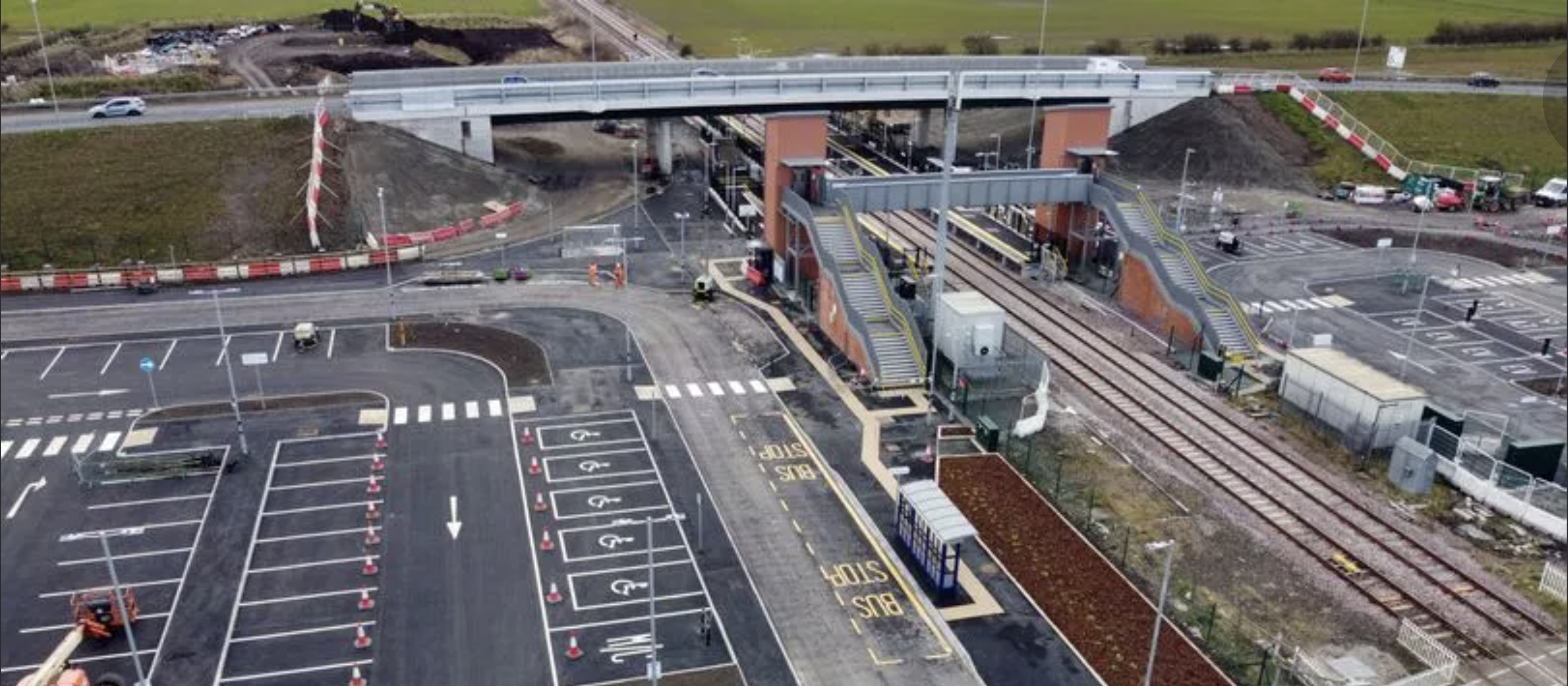
Note.
- It almost looks like two stations, one for the Northbound line and one for the Southbound.
- There appears to be a by-pass for those not wanting to visit the station.
- There is a traditional step-free bridge with lifts.
- Each half-station appears to have bus stops, car parking, disabled car-parking and a drop-off lane.
- There is a well-marked walking route to bring travellers to the station.
This Google map shows the layout of the station.

To say it’s different is an understatement. But I like it and I can’t wait to jump on a Lumo to go and see it, in all its new reality.
I hope all those connected with the design and architecture have got evening wear, as given the awards they’re going to win, they’ll need them.
A Small Station Entrance With Almost Everything
The pictures show the second entrance to Hackney Central station, which was built a few years ago.








Note.
- There is a light controlled-crossing outside the station.
- There are two ticket machines, where National Rail tickets can be bought and collected.
- There is a coffee hut.
- Stairs lead all the way up to the Westbound platform.
- The Eastbound platform is over a step-free bridge.
- The best M & S Food store in East London is within a hundred metres of both platforms.
- 38, 242 and 277 buses pass the the new entrance.
It is a well-appointed entrance to a station.
Width And Height Of A Stadler Regio Shuttle RS1 Compared To UK Multiple Units
I am building this table, so that I can get a feel for where Stadler RS ZERO trains can go on the UK network.
Height Of The Regio Shuttle RS1
This is given as 3.70 metres in Wikipedia.
Other figures given in Wikipedia are.
- Class 150 – 3.774 metres
- Class 156 – 3.805 metres
- Class 158 – 3.73 metres
- Class 165 – 3.79 metres
- Class 185 – 3.71 metres
- Class 195 – 3.85 metres
- Class 378 – 3.774 metres
- Class 345 – 3.760 metres
- Class 399 – 3.720 metres
- Class 710 – 3.760 metres
- Class 745 – 3.915 metres
- Class 755 – 3.915 metres
Surprisingly, the Regio Shuttle RS1 is the shortest train!
But this means, that if the Regio Shuttle RS1 can get under all the bridges on a route, then all the other trains can.
Width Of The Regio Shuttle RS1
This is given as 2.90 metres in Wikipedia.
Other figures given in Wikipedia are.
- Class 150 – 2.816 metres
- Class 156 – 2.730 metres
- Class 158 – 2.700 metres
- Class 165 – 2.810 metres
- Class 185 – 2.673 metres
- Class 195 – 2.772 metres
- Class 378 – 2.800 metres
- Class 345 – 2.772 metres
- Class 399 – 2.650 metres
- Class 710 – 2.772 metres
- Class 745 – 3.720 metres
- Class 755 – 3.720 metres
Surprisingly, the Regio Shuttle RS1 is the widest train!
But this means, that if the Regio Shuttle RS1 can squeeze between the narrowest infrastructure on a route, then all the other trains can.
Conclusion
Does this mean, that once a Regio Shuttle RS1 can run on a route, lots of other trains can?
Itb looks to me, like a clever example of cunning Swiss engineering.
Spotlight On The IVECO E-WAY H2: Less Weight, 15% More Passenger Capacity
The title of this post, is the same as that of this article on Sustainable Bus.
This is the sub-heading.
Up to seven time less batteries than a BEV bus (one module instead of 7), with 15% more passengers. These are the specifications mostly stressed by IVECO BUS when outlining the features of IVECO BUS E-WAY H2, presented at Busworld 2023 in Brussels. The bus model derives directly from the E-WAY BEV bus model
Note.
- The hydrogen fuel cell technology is from Hyundai.
- The bus is designed to be lighter in weight, which increases passenger capacity from 93 to 111 and gives an enhanced range.
- The driveline is from Accelera by Cummins, with a Siemens electric motor.
- IVECO provide the front axle and ZF the rear.
- Surprisingly, the bus is assembled from stainless steel panels, onto a steel floor.
It strikes me, that if the late great Colin Chapman had designed a bus, it would follow some of IVECO’s design.
Conclusion
This bus could set the standard for hydrogen-powered buses.
I particularly liked the saving in lithium compared to an electric bus.
UK Company Unveils Mooring Solution For Floating Offshore Wind
The title of this post, is the same as that of this article on offshoreWIND.biz.
This is the sub-heading.
UK-based Blackfish Engineering has unveiled a mooring system, called C-Dart, which eliminates the direct handling of heavy mooring lines by operational personnel. The system is designed to rapidly connect various floating structures and assets, including wave and tidal energy converters, offshore wind, floating solar platforms, aquaculture, and more, according to the company.
These three paragraphs give a few details.
By utilising the principles of gravity, buoyancy, and rope tension, the C-Dart system facilitates a contact-free, automated connection process that secures equipment securely and swiftly, Blackfish said.
The system’s rapid connect and disconnect capability is said to cut down the time typically required for offshore operations which is vital in reducing the overall operational costs and downtime, particularly in the high-stakes environment of renewable energy projects.
Constructed from high-tensile, corrosion-resistant materials, the C-Dart system could withstand harsh oceanic environments, extending its service life while minimising maintenance requirements.
There is also this excellent video.
These are my thoughts.
The Companies Involved
The companies, organisations involved are listed on the C-Dart product page.
Skua Marine Ltd, Morek Ltd, Flowave, Underwater Trials Centre, Offshore Simulation Centre, National Decommissioning Centre, Bureau Veritas, Queen Mary University, The Waves Group, KML, Alex Alliston, Arnbjorn Joensen
Note.
- Blackfish Engineering are in Bristol.
- Bureau Veritas is a French company specialized in testing, inspection and certification founded in 1828.
- Queen Mary University is in London.
- The Underwater Trials Centre is in Fort William.
- The National Decommissioning Centre is in Aberdeen.
- The Offshore Simulation Centre, is in Norway.
Funding came from the Scottish Government.
Good Design And Improved Safety
It does look in this product that good design and improved safety go together.
Conclusion
This peoduct could be a real winner.
Are Goldman Sachs Stitching Together A Large Deal On Energy Storage?
In UK Infrastructure Bank, Centrica & Partners Invest £300M in Highview Power Clean Energy Storage Programme To Boost UK’s Energy Security, I talked about a deal to invest £300 million into energy storage company; Highview Power.
These three paragraphs are from the Highview Power news item, on which I based my post.
Highview Power has secured the backing of the UK Infrastructure Bank and the energy industry leader Centrica with a £300 million investment for the first commercial-scale liquid air energy storage (LAES) plant in the UK.
The £300 million funding round was led by the UK Infrastructure Bank (UKIB) and the British multinational energy and services company Centrica, alongside a syndicate of investors including Rio Tinto, Goldman Sachs, KIRKBI and Mosaic Capital.
The investment will enable the construction of one of the world’s largest long duration energy storage (LDES) facilities in Carrington, Manchester, using Highview Power’s proprietary LAES technology. Once complete, it will have a storage capacity of 300 MWh and an output power of 50 MWs per hour for six hours. Construction will begin on the site immediately, with the facility operational in early 2026, supporting over 700 jobs in construction and the supply chain.
Note.
- The UK Infrastructure Bank is a is a British state-owned development bank.
- Centrica plc is an international energy and services company.
- Rio Tinto is a leading global mining group that focuses on finding, mining and processing the Earth’s mineral resources.
- The Goldman Sachs Group, Inc. is a leading global investment banking, securities and investment management firm.
- KIRKBI is the Kirk Kristiansen family’s private holding and investment company founded to build a sustainable future for the family ownership of the LEGO Group.
- Mosaic Capital are an American investment firm.
With six partners, that is just £50 million per partner.
As that sum is very much small change for the likes of these guys and the question of taking an equity stake is not mentioned in Highview Power’s news item, it looks like this deal could be a try-before-you-buy deal with some of the partners or a simple investment with others.
Consider.
- Gresham House, Gore Street and others have proven that investing in lithium-ion batteries give a good return on investment.
- The Carrington long duration energy storage facility will be located near to the 884 MW gas-fired Carrington power station. I suspect that Centrica and Rio Tinto will be interested to see how the hybrid power-station performs.
- Could the Lego Group owners be looking at using solar power, wind power and a LDES to reduce the carbon footprint of their stores?
I would assume, that all the investors would get full details on the performance of the batteries.
Someone To Build The LDES
In Bilfinger Drives Highview Power’s Innovative Storage Project, Accelerating The Energy Transition, I describe how German company will build the Carrington LDES.
The Advantages Of An LDES over a BESS
This is only a short list, of the advantages I see.
- An LDES is easily recyclable.
- The LDES has less exotic materials.
- An LDES can be built from zero-carbon steel.
- Highview are claiming a 40-year life for their LDES.
- Highview is already talking about 200MW/2.5GWh LDES systems.
- Two 200MW/2.5GWh systems working together with a wind or solar farm, can replace a 400 MW gas- or coal-fired station.
- I suspect one of Highview’s LDES systems could be placed offshore, if needed.
I also believe that Highview’s LDES systems could be incorporated into complex chemical plants to increase the efficiency.
Are Goldman Sachs Stitching Together A Large Deal On Energy Storage?
Everything now seems to be in place to build these LDES one after the other, to accelerate the energy transition.
With a good supply of orders and enough money to build each system, I cab see no reason, why several systems a month cannot be built and installed.
I have worked with companies like Goldman Sachs in the past, and I wouldn’t be surprised to find, that they have created the consortium, so that all members get the returns and recognition, they disserve.
Adding Lego Group To The Consortium Could Be A Masterstroke
The Lego Group has lots of stores and theme parks worldwide and a reputation for good design and environmental standards.
Last year, I wrote Bedford Depot’s Massive Solar Roof Helps Thameslink On Way To Net Zero. This was putting a solar roof on a rail depot, but surely buildings like this would be suitable for a Highview LDES.
UK Energy Grid Needs £60bn Upgrade To Hit Green Target, Plan Says
The title of this post, is the same as that of this article on the BBC.
This is the sub-heading.
The UK’s electricity network needs almost a further £60bn of upgrades to hit government decarbonisation targets by 2035, according to a new plan.
These five paragraphs explain the plan.
About 4,000 miles of undersea cables and 1,000 miles of onshore power lines are needed, said the National Grid’s Electricity Systems Operator (ESO).
The investment would add between £20 to £30 a year to customer bills, it said.
The government said the ESO’s plans were preliminary and yet to pass a “robust planning process”.
The plans were written up by the ESO, the organisation which runs the electricity network and would run the updated system it is calling for too. It is currently owned by National Grid but will transfer into government ownership later this year.
Its latest £58bn estimate is for work needed between 2030 and 2035 and comes on top of a previous £54bn estimate for work taking place between now and 2030.
These are my thoughts.
The Amount Of Undersea Cable
Edinburgh and London are roughly 400 miles apart as the train runs, so it looks like there could be the equivalent of ten underwater cables between the North of Scotland and England.
In Contracts Signed For Eastern Green Link 2 Cable And Converter Stations, I talked about the proposed 2 GW link between Peterhead in Scotland and Drax in England, which will be a double cable. So there’s the first two of these long cables.
It looks to me, that National Grid are proposing to use underwater cables wherever they can, so they avoid large expensive planning rows stirred up by Nimbies.
Monitoring The Undersea Cables
Last week Ofgem gave National Grid a £400,000 grant to develop new innovative technologies, which I wrote about in £400k For National Grid Innovation Projects As Part Of Ofgem Fund To Help Shape Britain’s Net Zero Transition.
One of the project is called HIRE – Hybrid-Network Improvement & Reliability Enhancement and will be used to check all these cables are performing as they should.
My electrical engineering experience tells me, that there must be some cunning way, that will detect that something is happening to the cable. The involvement of a technology company called Monitra in the project is a bit of a giveaway.
How Much Will It Cost Me?
Currently, UK consumers pay about £30 per year to have electricity delivered, so this will rise to between £50 and £60 per year.
That is just over a pound a week. I would pay about the same for a resident’s parking permit outside my house for an electric car and probably three times more for a petrol or diesel car.
Do We Have Enough Cable?
Two undersea cable factories are under development in Scotland and I suspect the 4,000 miles of undersea cables will be delivered on schedule and covered in saltires.
What About T-Pylons?
The latest onshore electricity transmission line between Hinckley Point C and Bristol, doesn’t use traditional pylons.
It uses T-pylons like these to connect the 3.26 GW nuclear power station.
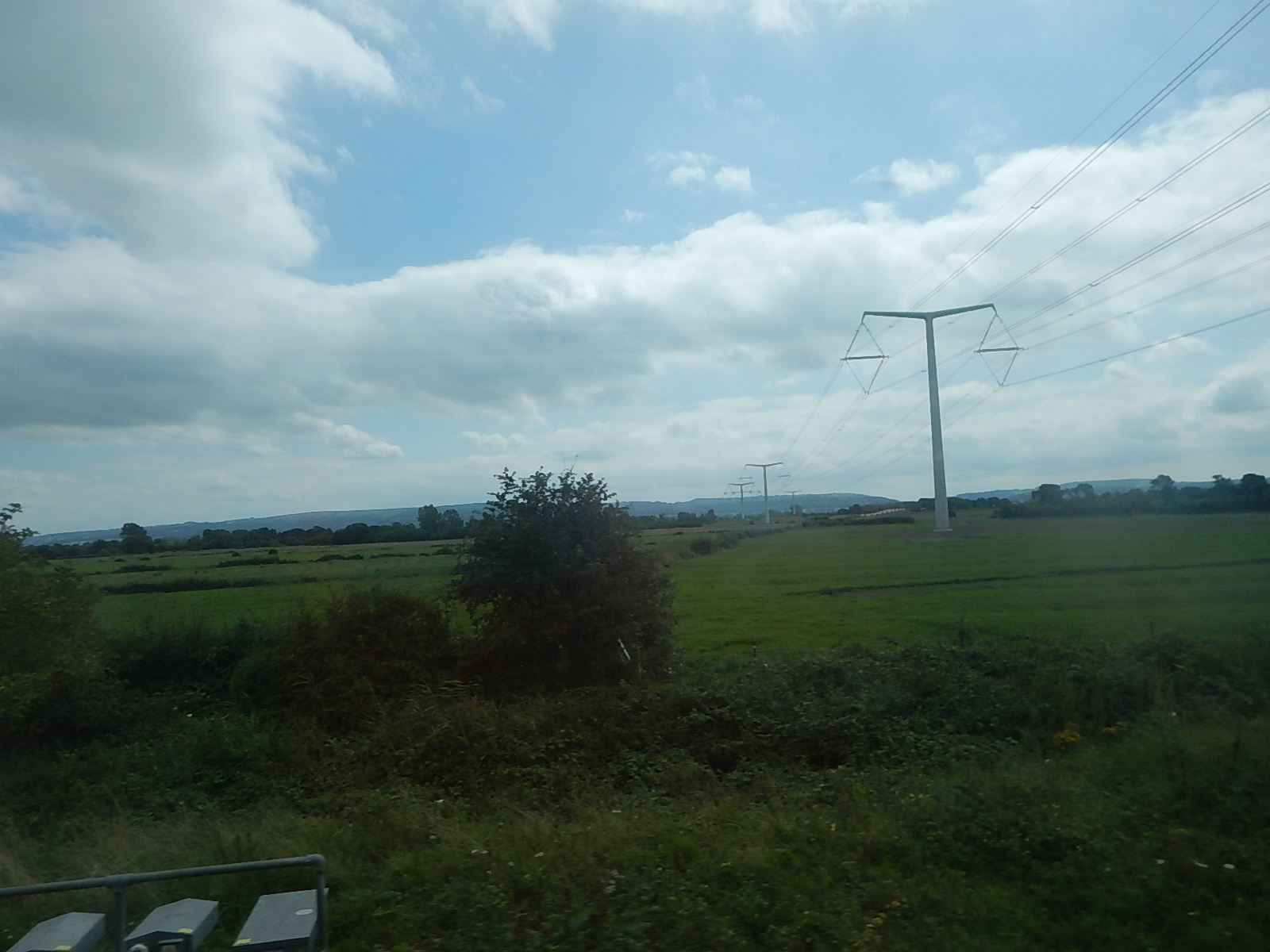
Note that they are shorter, designed to be less intrusive, have a smaller footprint and are made from only ten parts.
I suspect they will cost less to install and maintain.
There is more on T-pylons in National Grid Energise World’s First T-Pylons.
I wouldn’t be surprised that some of the oldest traditional pylons will be replaced by T-pylons.
I am surprised that T-pylons are not mentioned in the BBC article.
I like T-pylons. How do you feel about them?
Eastern Green Link 2
This press release from National Grid, describes Eastern Green Link 2 like this.
Eastern Green Link 2 (EGL2) is a 525kV, 2GW high voltage direct current (HVDC) subsea transmission cable from Peterhead in Scotland to Drax in England delivered as a joint venture by National Grid and SSEN Transmission.
This map from National Grid, shows the route of the Eastern Green Link 2.

The Northern landfall is at Sandford Bay and the Southern landfall is at Wilsthorpe Beach.
This Google Map shows Sandford Bay and Peterhead power station.
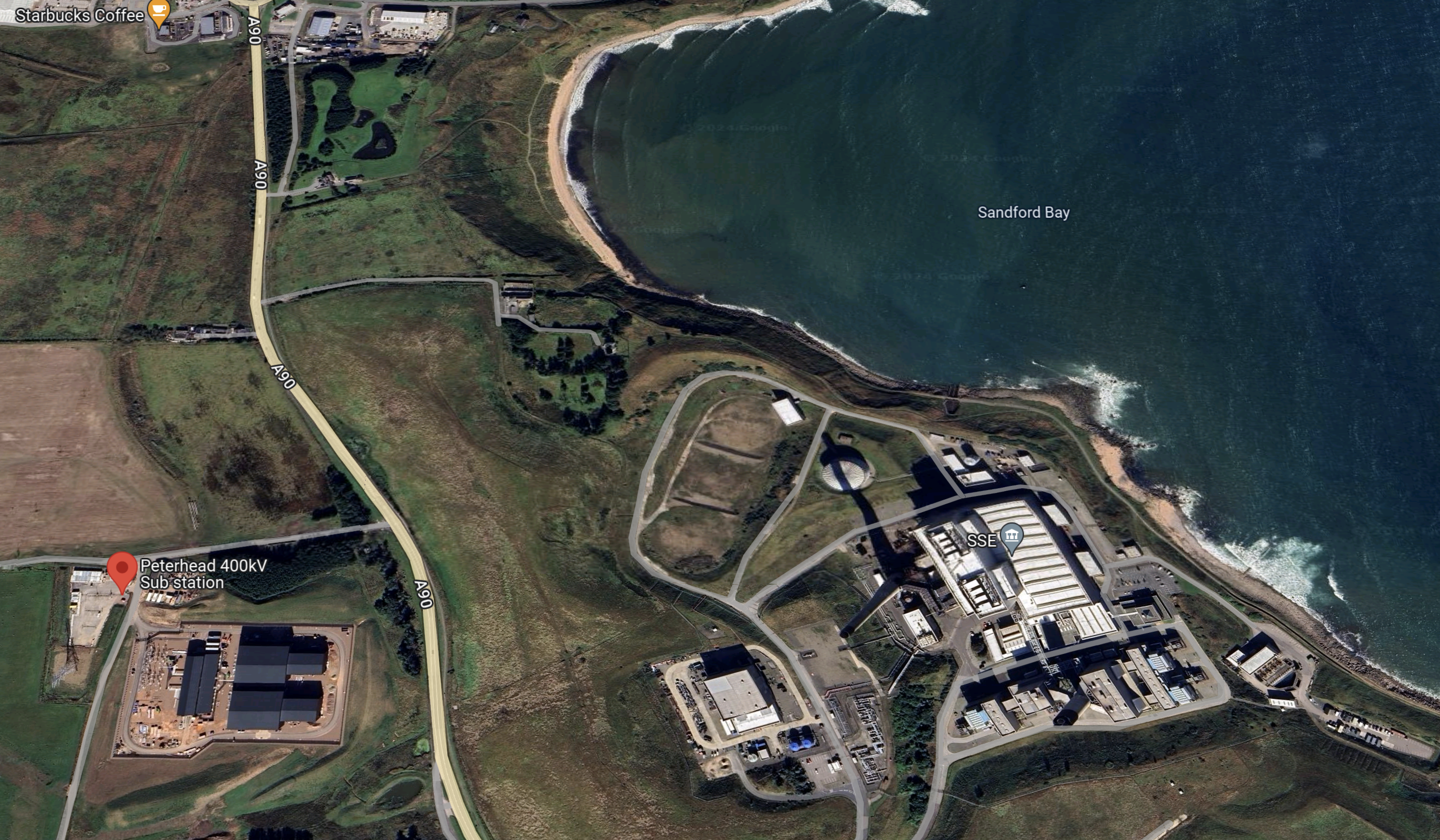
Note.
- Sandford Bay occupies the North-East corner of the map.
- The red arrow indicates the main 400kV sub-station at Peterhead.
- The 2177 MW gas-fired Peterhead power station is to the East of the sub-station marked as SSE.
This second Google Map shows the onshore route of the cable from Wilsthorpe to Drax.

Note.
- Flamborough Head is in the North-East corner of the map.
- Wilsthorpe Beach is at Bridlington a couple of miles South of Flamborough Head.
- The red arrow indicates Drax Power station.
- An onshore underground cable will be installed from landfall in Wilsthorpe to a new onshore converter station built in Drax.
The EGL2 HVDC cable connection from Scotland to England consists of 436km of submarine cable and 69km of onshore cable.
Both converter stations will be on existing power station sites and the major onshore works will be the underground cable between Wilsthorpe and Drax.
Where Does Drax Go From Here?
Currently, Drax power station is a 2595 MW biomass-fired power station.
There are now other large power sources that could replace some or all of the output of Drax power station.
- 2GW of Scottish wind power coming to Drax on Eastern Green Link 2.
- 6 GW of offshore wind is being developed at the Hornsea wind farms.
- 8 GW of offshore wind is being developed at the Dogger Bank wind farms.
- 2.5 GW from the three gas-fired power stations at Keadby, two of which are likely to be fitted with carbon capture.
- 1.8 GW from the proposed hydrogen-fired Keadby Hydrogen power station.
Given the bad feelings many have about Drax burning biomass, with 20.3 GW of electricity, you might think that shutting down Drax would be a simple solution.
But, according to Drax’s Wikipedia entry, it has a unique property.
Despite this intent for baseload operation, it was designed with a reasonable ability for load-following, being able to ramp up or down by 5% of full power per minute within the range of 50–100% of full power.
So Drax could be very useful in balancing the grid, by ramping up and down to fill the gap between production and need.
In addition, there is good biomass. This is from the Wikipedia entry.
A 100,000 tonne pa capacity straw pelletization facility was constructed at Capitol Park, Goole in 2008.
Drax are also promoting BECCS or Bioenergy carbon-capture and storage.
There is a Wikipedia entry for Bioenergy With Carbon Capture And Storage, of which this is the first couple of sentences.
Bioenergy with carbon capture and storage (BECCS) is the process of extracting bioenergy from biomass and capturing and storing the carbon, thereby removing it from the atmosphere. BECCS can theoretically be a “negative emissions technology” (NET).
I do feel that carbon capture and storage is a bit like sweeping the dust under the carpet, when you sweep the floor around it.
But carbon capture and use could be another matter.
This Google Map shows the Drax site.

Note how it is surrounded by agricultural land.
Could the power station be the source of pure carbon dioxide to be fed in greenhouses to flowers, herbs, salad vegetables, tomatoes and other plants?
I suspect there’s productive life left in Drax power station yet!
LionLink
LionLink, that is being developed by National Grid is a new type of interconnector, called a multi-purpose interconnector, that will connect Suffolk and The Netherlands via any convenient wind farms on the way. This means that the electricity generated can go where it is needed most.
I wrote about LionLink in World’s Largest-Of-Its-Kind Power Line To Deliver Clean Power To 1.8m UK Homes And Boost Energy Security.
Other Multi-Purpose Interconnectors
I can see other multi-purpose interconnectors like LionLink being built around the UK.
- There could be one across the Dogger Bank to link out 8 GW of Dogger Bank wind farms with those of the Dutch, Danes and Germans on their section of the bank.
- NorthConnect could be built between Scotland and Norway via some of the wind farms being developed to the North-East of Scotland.
- Could wind farms to the North of Ireland use a multi-purpose interconnector between Scotland and Northern Ireland.
- I can also see one or possibly two, being built across the Celtic Sea to link Devon, South Wales and Southern Ireland via the wind farms being developed in the area.
- Will we also see a Channel multi-purpose interconnector to transfer electricity along the South Coast of England?
Some of these multi-purpose interconnectors could be key to creating a revenue stream, by exporting electricity, to countries in Europe, that have a pressing need for it.
Conclusion
National Grid’s excellent plan will lead to the end of the practice of shutting down wind turbines. The spare electricity will be exported to Europe, which will surely create a good cash-flow for the UK. This in turn will encourage developers to create more wind farms in the seas around the UK’s coasts.
France’s First And Only Operational Floating Wind Turbine Gets Lifetime Extension
The title of this post, is the same as that of this article on offshoreWIND.biz.
This is the sub-heading.
Floatgen, the demonstration floating wind turbine installed at the SEM-REV offshore test site in France, has completed its planned five-year run but will operate for another five years as the demo project was decided to get a lifetime extension.
These are the first three paragraphs.
The floater, which consists of a 2 MW Vestas V80 wind turbine mounted on BW Ideol’s Damping Pool foundation, reached electricity production milestones several times since going into full operation in September 2018.
According to BW Ideol, Floatgen’s cumulated production has now surpassed 30 GWh, which the company ascribes to “the hydrodynamic properties and excellent sea-keeping capabilities” of its floating foundation.
Floatgen’s availability averaged 92.18 per cent between January 2021 and January 2024, with December 2023 standing out with a monthly production record of 922.026 MWh and a 61.96 per cent capacity factor, BW Ideol says.
Note.
- A three-year availability average of 92.18 % is surely very good.
- A 61.96 % capacity factor is better than most other floating wind farms, which are generally in the fifties.
With those figures, I suspect BW Ideol will be expecting, some orders soon.
This video shows a Floatgen being constructed.
 The Anonymous Widower