Condor Celebrates Inaugural Flight Of New Frankfurt–London Gatwick Route
The title of this post is the same as that of this press release from Condor.
This is the sub-heading.
Condor today launched its new city connection between Frankfurt am Main (FRA) and London Gatwick (LGW). With the inaugural flight, the British capital is now officially part of Condor’s city network. The route will be operated three times daily with a schedule designed to appeal equally to business travellers and city tourists. Flights are operated using Condor’s Airbus A320 aircraft, offering capacity for 180 passengers in a two-class configuration, including Business Class and Economy Class with the standard 3-3 seating layout. In addition, Condor cooperates with partner airlines on this route.
These three paragraphs add more details.
With this new connection, Condor is expanding its city network to include one of Europe’s most important metropolitan hubs, thereby strategically strengthening its presence in the European market. To mark the inaugural flight from London Gatwick, departing passengers on the fully booked service were welcomed with a small reception and gifts before the flight departed punctually for Frankfurt am Main.
David Carlisle, Director Network and Partnerships at Condor, said: “Today’s inaugural flight to London Gatwick marks another important milestone in the expansion of our European route network. London is one of Europe’s most sought-after destinations, both for business travellers and short city breaks. We are delighted to offer our guests up to three daily frequencies, providing maximum flexibility as well as convenient access to our long-haul network to Africa and Asia.”
Jonny Macneal, Head of Aviation Development at London Gatwick, added: “We are delighted to welcome Condor to London Gatwick and to offer our passengers even greater choice with this new, frequently operated service to Frankfurt. Whether travelling for business, leisure or to visit friends and family, the route provides excellent flexibility and connectivity. Condor’s arrival marks another important milestone during a period of significant growth for the airport.”
The press release also has these two last paragraphs, which give more information about the airline.
London is one of Europe’s leading economic and financial centres and also one of the most popular destinations for city travel. The new connection offers business travellers excellent access to the Greater London area as well as flexible options for day trips. Leisure travellers benefit from convenient flight times for weekend getaways.
In addition to the launch of London Gatwick, Condor continues to expand its network. From May, Barcelona, Budapest and Venice will be added as new destinations, bringing the total number of city destinations in the Condor network to 13. With these additions, Condor is further strengthening its presence in high growth markets and continuing to expand its European route network. Flights can be booked online at http://www.condor.com, via telephone or through travel agencies.
It is certainly one of the best-written and information-rich press releases, that I have seen.
If the attention to detail is as good in the way the airline is run is half as good, Condor will be worth giving a try.
This page is their TripAdvisor reviews.
Gatwick Airport Is Expanding
I picked up the news of Condor Airlines new service from one of my Google Alerts about Gatwick Airport’s proposed new runway.
These were the titles of the news articles in the alert.
- Simple Flying – Unbelievable! The UK’s 2nd-Busiest Airport Welcomes 5th New Airline In 11 Days
- MSN – London Gatwick confirms 9th new airline in massive 2026 shakeup
- Aviation A2Z – Condor Begins First UK Route with 3 New Daily Flights to This Airport
- Yahoo News UK – Airline launches first-ever UK route from Gatwick Airport to popular European city
- AviationSource News – Condor Launches New Frankfurt to London Gatwick Route
- Aviation24.be – Condor launches Frankfurt–London Gatwick route with three daily flights, marking UK debut
- Travel Wires – Condor launches first UK route with Gatwick–Frankfurt service
- Travel And Tour World – Frankfurt & London: New Condor Flights Spark Hope and Joy at London Gatwick Airport, UK
There is also this headline about Air France.
- Aviation24.be – Air France returns to London Gatwick with new twice-daily Paris CDG service
Gatwick seems to be doing well to be welcoming nine new airlines in 2026 and five in the last eleven days.
Perhaps, some honest accounting have convinced those nine airlines, that Gatwick’s new runway, won’t raise charges as much as Heathrow’s.
Travelling Between Heathrow Airport And Staines Station
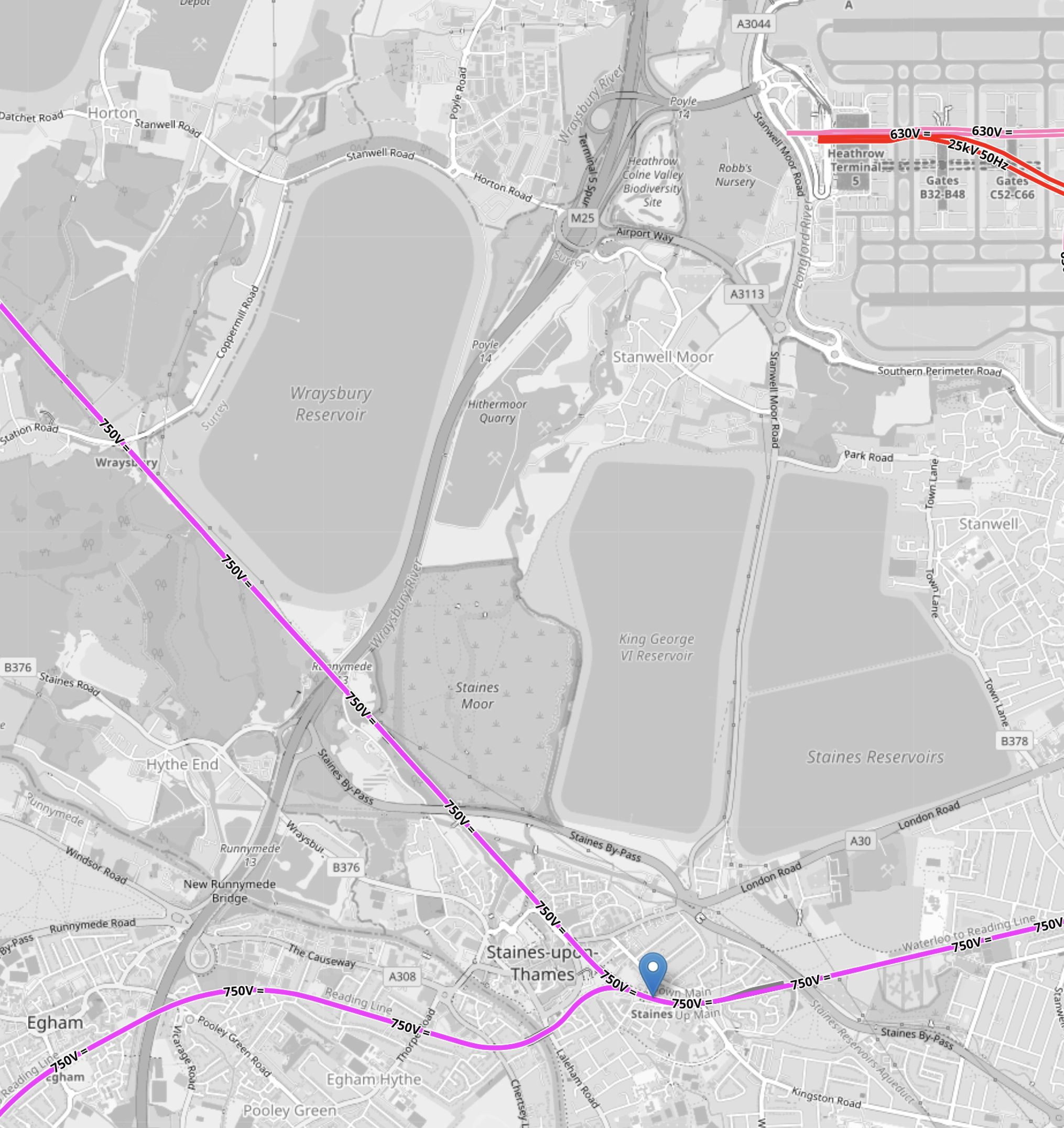
Staines Station and Heathrow Airport are not far apart, as this OpenRailwayMap shows.
Note.
- The mauve lines in the bottom half of the map are South West Trains services out of Waterloo.
- Waterloo via Feltham, Twickenham and Richmond to name but three stations , is to the East.
- Reading is to the South-West
- Windsor is to the North-West.
- The blue arrow indicates Staines station.
- Heathrow Terminal 5 is in the North-East corner of the map.
- The pink tracks are the Piccadilly Lines
- The red tracks are for the Elizabeth Line and Heathrow Express.
- This OpenRailwayMap shows Terminal 5 to a larger scale.

Note.
- The pink tracks are the Piccadilly Line.
- The red tracks are for the Elizabeth Line and Heathrow Express.
- In front of the red tracks is what looks like a circular walkway or emergency exit, with a rectangular block to its West.
- The rectangular block is the lift tower to get from the railway station to the Departures and Arrivals floors of Terminal 5.
I asked Google AI if it would it be possible in the future to extend the Elizabeth Line to the West out of the Western end of Terminal 5 and received this reply.
Extending the Elizabeth line west from Terminal 5 is technically possible and has been proposed, notably as part of a potential westward rail link to Staines or to support airport expansion, but it is not currently funded. Terminal 5 was designed with future expansion in mind, potentially allowing a connection to Staines to create a “southern rail link” for better connections.
Perhaps there are two tunnels under the lift shafts?
How many trains per hour (tph) terminate in those two platforms?
- 4 tph – Heathrow Express
- 2 tph – Elizabeth Line to Shenfield.
Note.
- Only six trains in two platforms is easily managed.
- Because, Heathrow Express services appear to use both platforms, when I visited yesterday, the system seems to confuse passengers.
- The services surely need to be evened up, so that there are four tph of each service, with each service having a dedicated platform.
- But terminating eight trains in two platforms could be troublesome.
- Platforms are numbered 1 to 6 from the South.
- Platforms 1 and 2 have not been built yet.
Although four tph for Heathrow Express in one platform, should be easy with digital signalling, as you see it every day in London, it may be difficult on two platforms, at the same time.
In Is More Capacity Between Heathrow Airport And Central London, Needed On The Elizabeth Line?, I said this.
Currently, the Elizabeth line provides up to 12 trains per hour (including Elizabeth line and Heathrow Express) on the relief lines, making it nearly at capacity.
Note.
- When I use the Elizabeth Line, I deliberately avoid trains going to and from Heathrow, unless I’m going that way, as they are too crowded with passengers and their oversized cases.
- High Speed Two, the West London Orbital Railway and the North London Line will bring passengers for Heathrow Airport to Old Oak Common station.
- Surely, as Heathrow Airport gets bigger and increases its passenger numbers. the Elizabeth Line will need to be increased in capacity.
I believe Elizabeth Line capacity needs to be increased soon.
The only feasible plan I’ve seen is Heathrow Southern Railways plan, which included.
- Construction of a bay platform 0 at Staines alongside the Staines to Windsor line.
- A step-free bridge across the tracks.
- Construction of a single-track railway with 25 KVAC overhead electrification and a passing looop, between the new platform 0 at Staines and Platform 3 at Heathrow Terminal 5 station.
- Run four trains per hour in both directions between Heathrow Terminal 5 and Staines stations.
- This plan would would add two trains per hour through the Central Tunnel.
Various Journeys Would Be As Follows
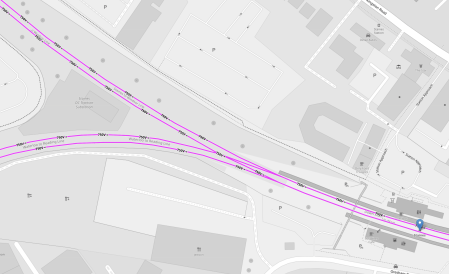
This OpenRailwayMap shows Staines junction and the positions of the three platforms.
Note.
- The Windsor Line goes North-West.
- The Reading Line goes West.
- The Waterloo Line Goes East.
- Platform 1 is on the North side of the tracks.
- Platform 2 is on the South side of the tracks.
- The bay platform, which I’ve numbered 0, will be on the North side of the tracks towards Windsor.
- I suspect the step-free bridge will be over the tracks and replace the current rickety structure.
- The bridge would be a short walk from all three platforms.
Interchanges would be as follows.
- Windsor to Heathrow – Walk between Platforms 1 and 0.
- Reading to Heathrow – Walk between Platforms 1 and 0.
- Heathrow to Windsor – Cross the bridge between Platforms 0 and 2.
- Heathrow to Reading – Cross the bridge between Platforms 0 and 2.
- Waterloo to Heathrow – Cross the bridge between Platforms 2 and 0.
- Heathrow to Waterloo – Walk between Platforms 0 and 1.
Note.
- All trains to or from Heathrow use Platform 0.
- All trains to Waterloo use Platform 1.
- All trains going away from Waterloo use Platform 2.
- Reading and Heathrow gain a step-free route at 2 tph.
- All interchanges at Staines station would be step-free.
- A train like London Crosslink, which used to go between Feltham and Woking, would use Platform 1 going towards Feltham and Platform 2 going towards Woking.
Staines station would gain step-free access to all Heathrow terminals, all Elizabeth Line and High Speed Two stations.
Could Anglia Railways’ London Crosslink Be Recreated As Part Of The London Overground?
I like the idea of the London Crosslink service, that ran for a few years between East Anglia and Hampshire via the North London Line and Staines.
My arguments for its restoration are described in Could Anglia Railways’ London Crosslink Be Recreated As Part Of The London Overground?
At various times in my life, it would have been very useful.
Today, as I live about fifteen minutes from Highbury and Islington station, I could use London Crosslink for the following reasons.
- Visiting friends and family in Hampshire.
- Going to Heathrow Airport, especially Terminal 5.
- Visiting friends in East Anglia.
- Going to football at Ipswich.
- Exploring new parts of England.
- I would wait at home and time my departure to catch a booked train at a fully step-free station.
Conclusions
Extending the Elizabeth Line to Staines gives these advantages.
- Staff at Heathrow, who live in the Staines area get easy access to the airport.
- Buses and coaches between Heathrow and the local area may be reviewed.
- Less cars will be used to get to and from the airport.
- Reading and Heathrow gain a step-free route at 2 tph.
- A lot of stations would gain a step-free route to all terminals at Heathrow, and all Elizabeth Line and High Speed Two stations.
There may well be other advantages.
Would Extending The Elizabeth Line To Staines Offer Any Advantages?
I asked Google AI, the title of this post and received this answer.
Extending the Elizabeth line to Staines offers significant advantages, including improved direct access to Heathrow Airport from Surrey/south-west London, reduced road traffic congestion, and enhanced connectivity for commuters. Proposed as part of the Heathrow Southern Railway project, it would provide a “game-changer” link and support economic growth around Heathrow.
Key Advantages of Extending the Elizabeth Line to Staines:
Improved Airport Access: The extension would provide a direct, sustainable, zero-emission rail link to Heathrow for commuters and travelers from Staines, Virginia Water, and surrounding areas.
Reduced Congestion & Environmental Impact: The project is estimated to reduce road traffic by approximately 3 million journeys annually, significantly lowering emissions.
Faster Commutes & Connectivity: It would create a new, faster route from Surrey and Hampshire (via Staines) to key locations like Heathrow, Old Oak Common (for HS2), and central London.
Relieving Existing Lines: The extension would help relieve overcrowding on the South Western Main Line into London Waterloo.
Utilizing Existing Infrastructure: The project would likely use the underground space already created at Terminal 5 to facilitate a southward extension.
Challenges and Considerations:
Funding and Cost: The project requires significant upfront investment, requiring collaboration between private sectors, Transport for London, and the Department for Transport.
Capacity Constraints: The existing Elizabeth line is already high-demand, and integrating a new, long branch would require careful capacity management.
This extension is closely tied to proposals for a Southern Rail Access to Heathrow, intended to support the expansion of the airport and the economic development of the surrounding region.
Is There Enough Staff Car Parking At Heathrow Airport?
I asked Google AI, the title of this post and received this answer.
While Heathrow Airport provides designated staff parking areas—including N1, N2, and N5 near Terminal 5—finding space can be difficult due to high demand, and recent substantial fee increases have caused tension. Dedicated staff, including those for car-sharing, have access to, and must display, valid permits in, secured, monitored areas.
Key Details on Staff Parking:
Locations: Staff parking is generally located on the Northern Perimeter Road, particularly serving Terminal 5.
Costs: MoneySavingExpert Forum indicates that parking costs may be paid for by employers like British Airways, or directly by the employee.
Rising Costs: In 2024, monthly staff parking charges were increased significantly, leading to complaints from unions regarding the cost for workers.
Capacity Issues: With thousands of staff, parking can be limited, though special areas are allocated for car-sharing to encourage efficiency.
For most employees, options include using the designated, secure staff car parks, or utilizing the airport’s Sustainable Travel Guide options, which provide, alternative, more sustainable transport solutions.
Staff parking certainly seem a problem and it can only get worse, as more staff are recruited.
Is More Capacity Between Heathrow Airport And Central London, Needed On The Elizabeth Line?
I asked Google AI, the title of this post and received this answer.
Yes, additional capacity on the Elizabeth line between Heathrow Airport and Central London is needed to manage high demand, despite it being a major upgrade. While the line has greatly improved connectivity, studies suggest that rising passenger demand, particularly from potential airport expansion, may require increasing services from 6 to 8 trains per hour to prevent future overcrowding.
Key Considerations Regarding Capacity:
High Demand: Passenger demand grew by ~40% between June 2022 and October 2023, with further growth expected.
Infrastructure Constraints: Increasing services beyond 6 trains per hour is challenging due to the need for signaling upgrades and potential platform length limitations.
Alternative Solutions: Experts suggest the Western Rail Link to Heathrow could relieve pressure by allowing direct access from the west, rather than requiring travel into central London first.
Future Upgrades: Further improvements, including enhanced signalling on the Piccadilly line and other rail links, are seen as necessary to handle future passenger surges.
Currently, the Elizabeth line provides up to 12 trains per hour (including Elizabeth line and Heathrow Express) on the relief lines, making it nearly at capacity.
Note.
- When I use the Elizabeth Line, I deliberately avoid trains going to and from Heathrow, unless I’m going that way, as they are too crowded with passengers and oversized cases.
- High Speed Two, the West London Orbital Railway and the North London Line will bring passengers for Heathrow Airport to Old Oak Common station.
- Surely, as Heathrow gets bigger and increases its passenger numbers. the Elizabeth Line will need to be increased in capacity.
I believe Elizabeth Line capacity needs to be increased soon.
I Want To Go By Train Between Heathrow Airport And Central London, What is Best Train; Lizzie, Piccadilly, Or Heathrow Express?
I asked Google AI, the title of this post and received this answer.
The Elizabeth Line is generally the best balance of speed, cost, and convenience for most travelers (approx. 30–40 mins to central London,£13). The Heathrow Express is fastest (15 mins,£25) to Paddington only, while the Piccadilly Line is cheapest (hr,£6) but slowest.
Detailed Breakdown:
Elizabeth Line (Recommended): Offers direct, modern, air-conditioned trains to central hubs like Bond Street, Tottenham Court Road, and Liverpool Street without needing to change at Paddington. It is much cheaper than the Express and only slightly slower.
Heathrow Express: The fastest option, but only goes to London Paddington. It is expensive unless booked far in advance. Best if you are staying right next to Paddington station.
Piccadilly Line: The cheapest option, ideal for budget travelers, and serves all terminals. However, it is a traditional Tube train, which can be crowded and uncomfortable with heavy luggage.
Note: Fares mentioned are approximate and based on standard off-peak, single-journey, tap-on/tap-off usage.
Ask virtually anybody in London and they’ll probably give you a similar answer.
Even Larry the cat would know, as he’s probably heard the question asked thousands of times.
A Brand New Railway Line Is Set To Directly Link South West London With The UK’s Biggest Airport – And It Could Be Up And Running By The Early 2030s
The title of this post, is the same as that of this article on Secret London.
This is the sub-heading.
A shiny new railway line could provide a seamless link between south-west London and the capital city’s busiest airport.
These two paragraphs add some details.
As a south-west Londoner who can fairly frequently be found at Heathrow Airport (or at least dreaming about being there), I can confirm that a speedy service, directly linking the almighty aviation hub with the south west of the city is something that’s been perched at the very top of my wish list for quite some time now. And it seems as though my prayers may finally have been answered in the form of the Heathrow Southern Railway.
London Heathrow Airport is currently in the early stages of a rather hefty expansion. Over the next ten years, the airport (which just so happens to be the biggest and busiest in the country) is set to receive a third runway. And when said runway is up and running, Heathrow is expecting to welcome approximately 66 million more passengers a year. So now is probably a pretty good time to start thinking about how they’re all going to get there.
I have written extensively about Heathrow Southern Railway in the past.
Start by reading Why I Like The Heathrow Southern Railway Proposal, which I wrote in November 2016 and ended with this conclusion.
It is definitely one of those projects, where by creating something a bit out of the ordinary, leads to lots of other worthwhile things.
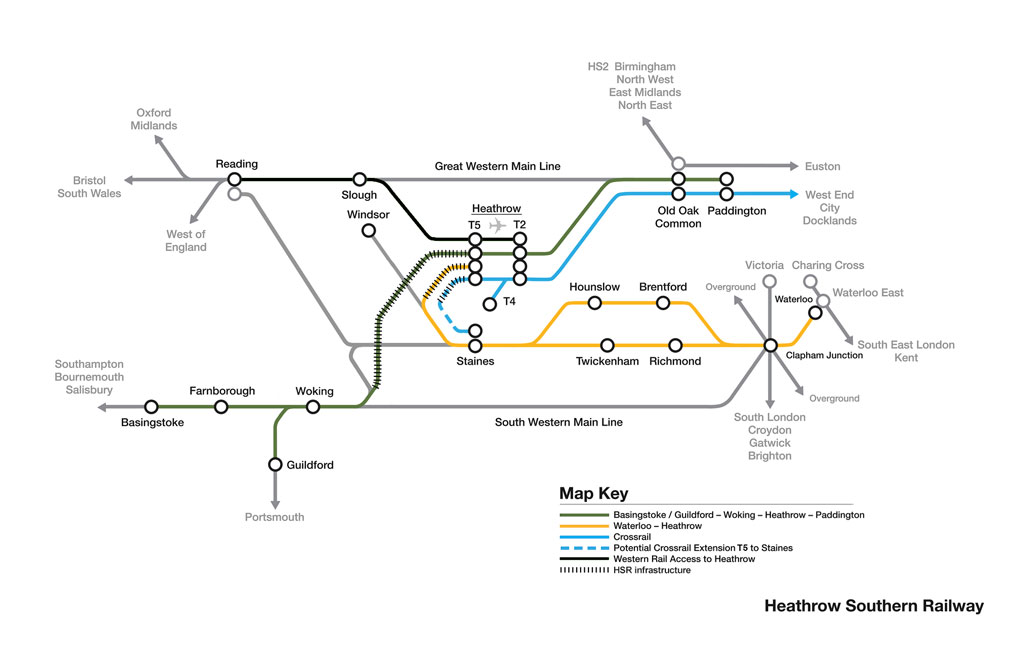
I still like it and we now have more information, which includes this map.
Note.
- The blue line is the Elizabeth Line.
- The yellow line is a direct link from Waterloo to Heathrow.
- The station in a six pointed star is Clapham Junction.
On the Heathrow Southern Railway web site there is a section called Service Opportunities.
It details two routes.
- Heathrow and Waterloo via Staines and Clapham Junction
- Basingstoke/Guildford and Paddington via Woking and Heathrow
These are a few random thoughts.
A ULEZ Avoiding Line
If the Elizabeth Line is extended to Staines, then Heathrow Southern Railway provides a ULEZ avoiding route for Heathrow employees to help get the Mayor out of a hole. A station guy at Staines told me a lot of Heathrow staff take buses to the airport from Staines station.
West London Orbital Railway
I believe that the West London Orbital Railway would make sense to give lots of other routes for Heathrow staff and passengers.
The Proposed Lionel Road Station On the West London Orbital Railway
Starting with Lionel Road station may seem a strange place to start, but this important station for supporters of Brentford FC, may in the end define how the new line is designed and built.
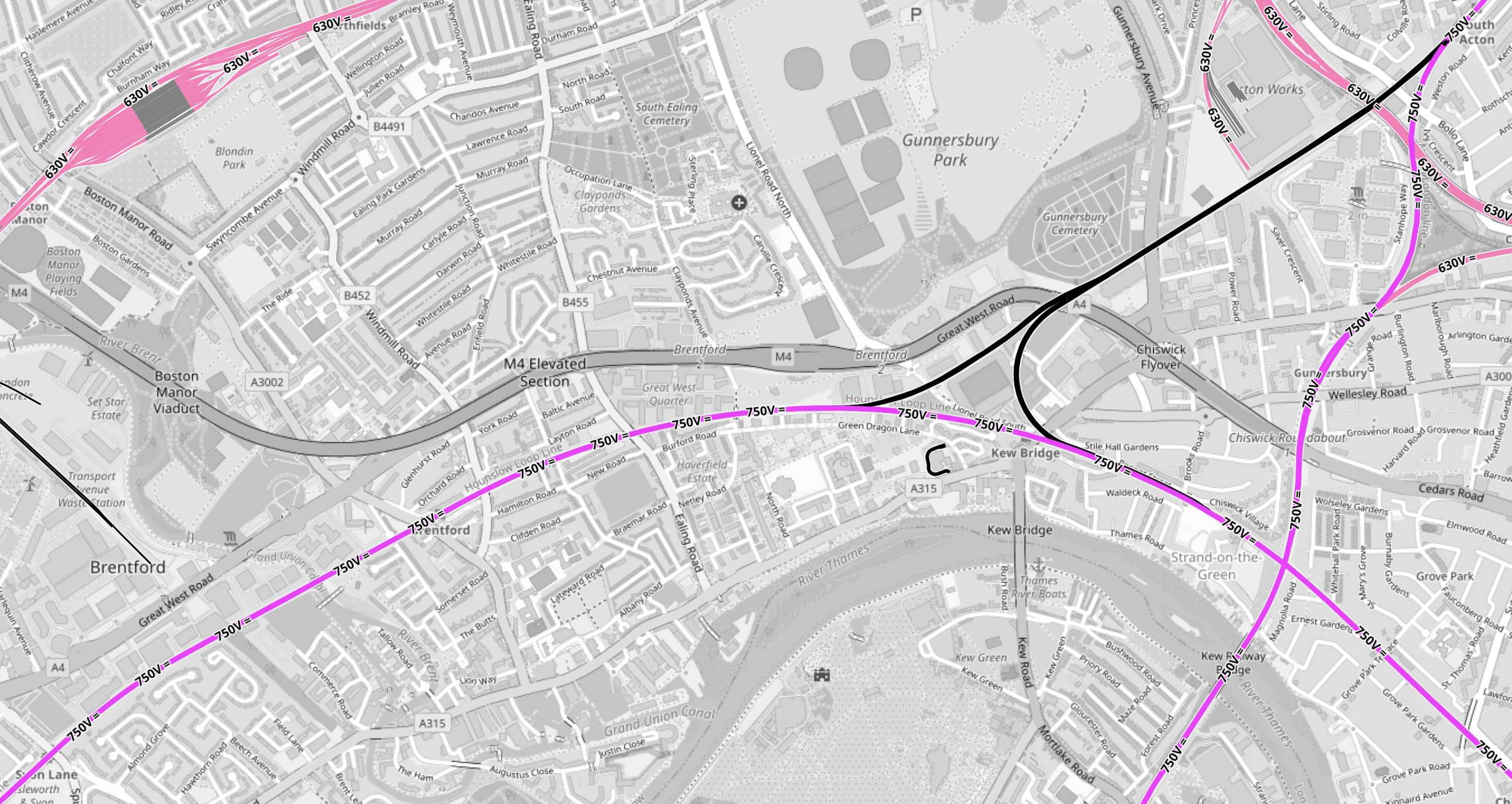
This OpenRailwayMap shows the tracks around the stadium, that has been built for the Premier League football club, which is now called the Gtech Community Stadium.
Note.
- In the North-West corner of the map is the Piccadilly Line branch to Heathrow Airport.
- Northfields Depot is prominent, with the station of the same name to its East.
- South Acton station is in the North-East corner of the map.
- Syon Lane station is in the South-West corner of the map.
- The West London Orbital Railway runs between these two stations.
- Lilac sections are electrified and black sections have none.
- South Acton station is also on the North London Line, which runs North-South to Richmond station off the bottom of the map.
- Syon Lane Station is also on the Hounslow Loop Line, which curves across the bottom half of the map to the South-East corner.
- Click the map to show it to a larger scale.
This second OpenRailwayMap shows triangular junction in the middle of the first map to a larger scale.
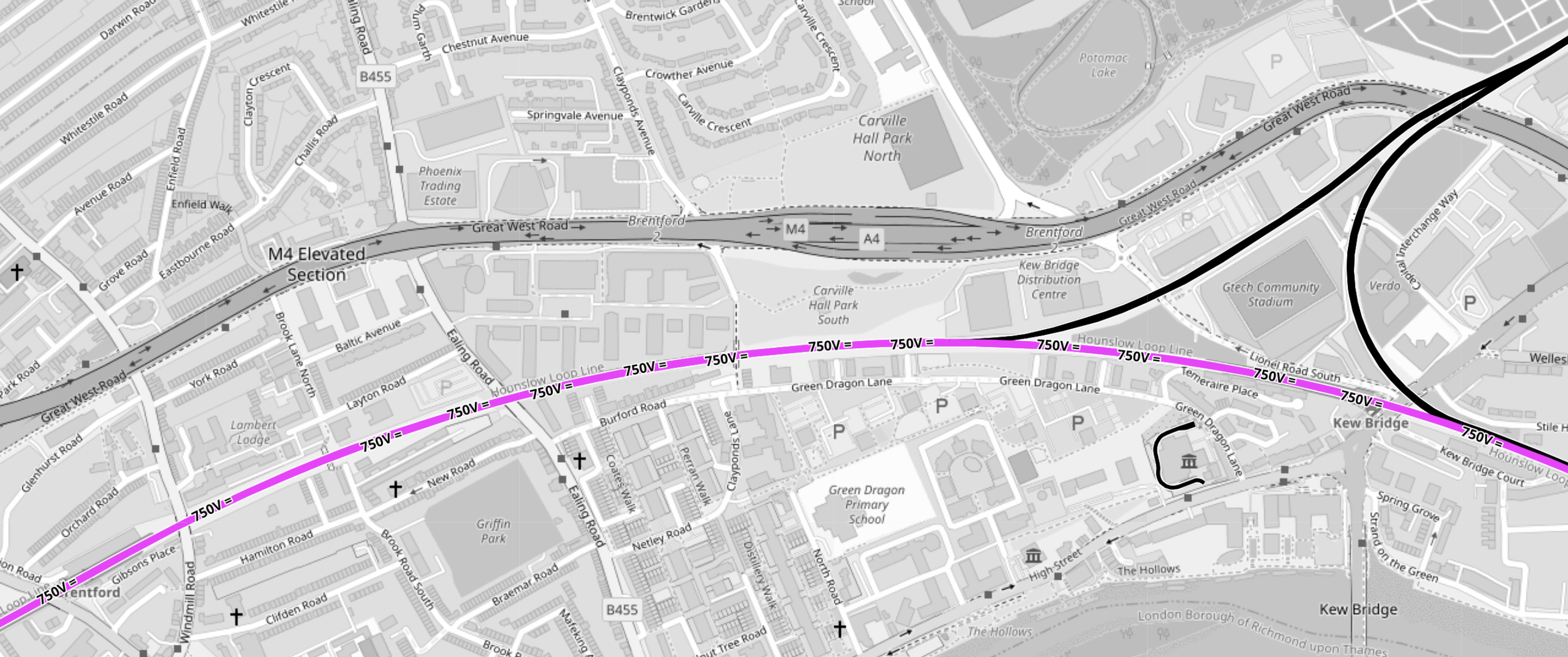
Note.
- The Gtech Community Stadium sits in the middle of the triangular junction.
- Provision has been made in the layout of the stadium for the station to be on the North-West leg of the triangular junction.
- Kew East Junction is in the North-East corner of the map.
- Old Kew Junction is in the South-West corner of the triangular junction.
- New Kew Junction is in the South-East corner of the triangular junction.
- The lilac track crossing the map is the electrified Hounslow Loop Line.
- The M4/A4 runs across the map
- Only the Southern leg of the triangular junction is electrified.
- Click the map to show it to a larger scale.
These are some of my thoughts.
Lionel Road Station Will Be Unlikely To Be Electrified
Consider
- It will be extremely unlikely that between South Acton station and Old Kew junction will be electrified with third-rail electrification because of safety issues.
- There is a very long chance, that it might be decided to create a 25 KVAC overhead electrified route across London, by means of the North London Line.
- I believe hydrogen trains will be developed for freight services.
- The station will have large numbers of passengers on match-days, so safety may determine an electrification-free station.
- The electrification gap is only 1.4 miles, which is well within range of a battery-electric train.
I think it is more likely that hybrid trains will use what is available.
Will Lionel Road Station Be Step-Free?
Sixty years ago, I used Manchester United station to see a match.
This Google Map shows the station.
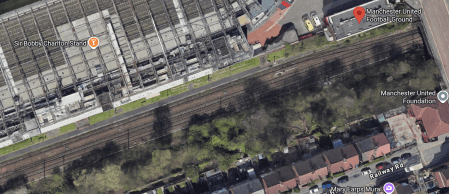
Note.
- The station is a single platform tucked in behind the South stand.
- The station entrance is indicated by a red arrow.
- When I went in the 1960s, the train was a steam-hauled shuttle from the city centre.
- This Wikipedia entry gives more details.
I suspect a similar space-saving design could be used at Lionel Road station.
There will be a need for a bridge if the station is used on more than match days.
Will Lionel Road And Kew Bridge Stations Be An Out Of Station Interchange?
This OpenRailwayMap shows the triangular junction, with the GTech Community Stadium in the middle.
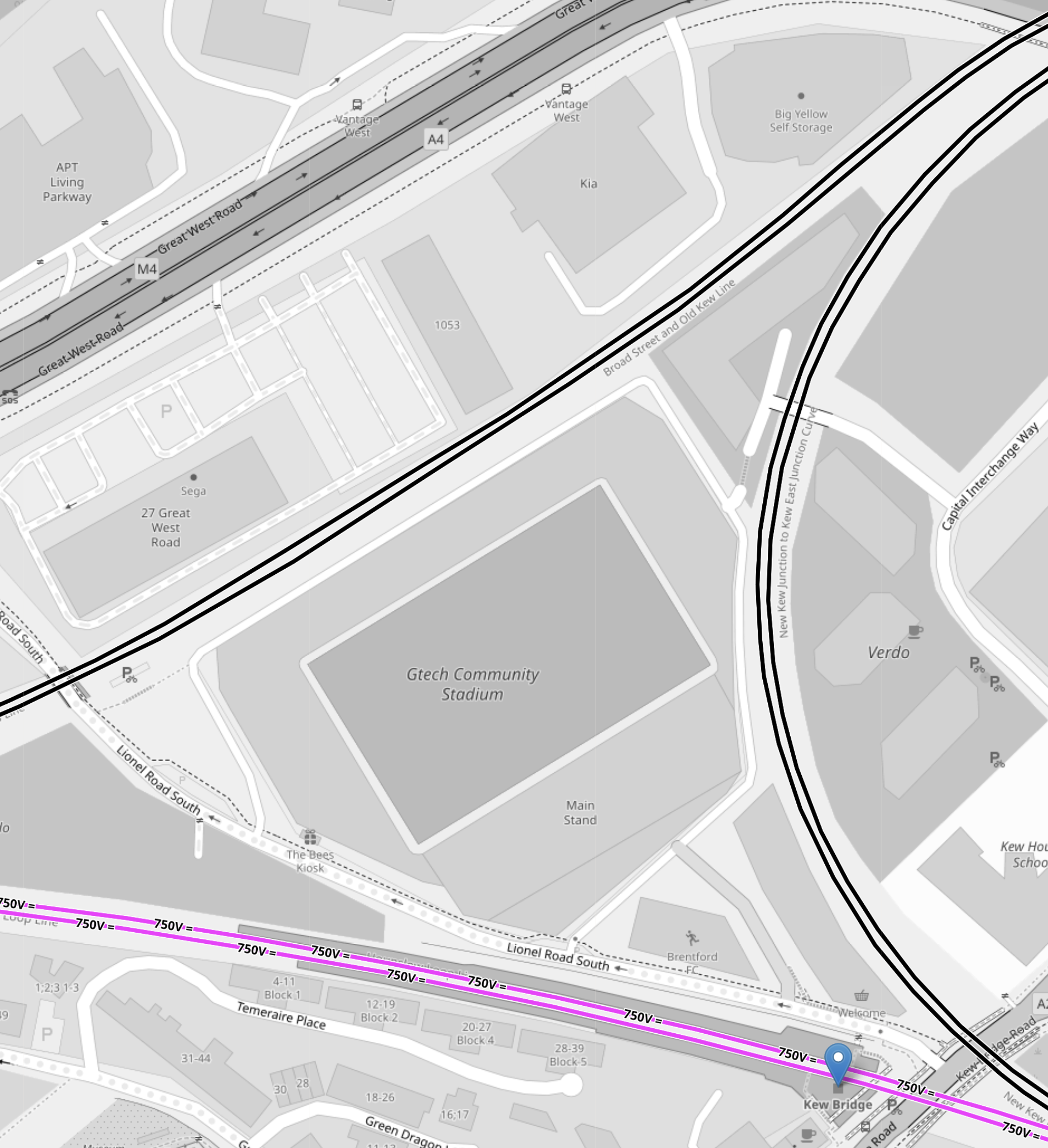
Note.
- Lionel Road station will be on the North-West side of the station.
- Kew Bridge station is marked by a blue arrow.
- There appear to be walking routes all over the plot on which the stadium sits.
- All sides of the junction are double track.
I think an Out-Of-Station Interchange would be useful, especially for those who don’t know the area.
How Easy Will It Be To Get To Lionel Road Station From Major London Stations?
These are my best estimates at a degree of difficulty.
- Bank – 1 Change – Take Central Line with a change at Old Oak Common Lane to Lionel Road.
- Blackfriars – 1 Change – Take Thameslink with a change at Brent Cross West to Lionel Road.
- Bond Street- 1 Change – Take Elizabeth Line with a change at Old Oak Common Lane to Lionel Road.
- Cannon Street – 2 Changes – Get out at London Bridge – Take Thameslink with a change at Brent Cross West to Lionel Road.
- Charing Cross – 1 Change – Take Bakerloo Line with a change at Harlesden to Lionel Road.
- City Thameslink – 1 Change – Take Thameslink with a change at Brent Cross West to Lionel Road.
- Euston – 1 Change – Take Watford DC Line with a change at Harlesden to Lionel Road.
- Farringdon – 1 Change – Take Thameslink with a change at Brent Cross West to Lionel Road.
- King’s Cross – 1 Change – Take Thameslink with a change at Brent Cross West to Lionel Road.
- Liverpool Street – 2 Changes – Get out at Stratford – Take the Overground with a change at South Acton to Lionel Road.
- Liverpool Street – 1 Change – Take Elizabeth Line with a change at Old Oak Common Lane to Lionel Road.
- London Bridge – 1 Change – Take Thameslink with a change at Brent Cross West to Lionel Road.
- Marylebone – 1 Change – Take Bakerloo Line with a change at Harlesden to Lionel Road.
- Moorgate – 1 Change – Take Elizabeth Line with a change at Old Oak Common Lane to Lionel Road.
- Old Street – 2 Changes – Go to Moorgate – Take Elizabeth Line with a change at Old Oak Common Lane to Lionel Road.
- Oxford Circus – 1 Change – Take Bakerloo Line with a change at Harlesden to Lionel Road.
- Paddington – 1 Change – Take Elizabeth Line with a change at Old Oak Common Lane to Lionel Road.
- Piccadilly Circus – 1 Change – Take Bakerloo Line with a change at Harlesden to Lionel Road.
- St. Pancras – 1 Change – Take Thameslink with a change at Brent Cross West to Lionel Road.
- St. Paul’s – 1 Change – Take Central Line with a change at Old Oak Common Lane to Lionel Road.
- Tottenham Court Road – 1 Change – Take Elizabeth Line with a change at Old Oak Common Lane to Lionel Road.
- Vauxhall – 2 Changes – Go to Oxford Circus – Take Bakerloo Line with a change at Harlesden to Lionel Road.
- Victoria – 2 Changes – Go to Oxford Circus – Take Bakerloo Line with a change at Harlesden to Lionel Road.
- Waterloo – Direct – Direct train to Kew Bridge.
- Waterloo – 1 Change – Take Bakerloo Line with a change at Harlesden to Lionel Road
Note.
- It does appear that the connections in stations like Brent Cross West, Harlesden and Old Oak Common Lane, will make a lot of difficult cross-London journeys easier.
- But not many journeys to the GTech Community Stadium, finish at Kew Bridge station.
- Most journeys pick up the West London Orbital at Brent Cross West, Harlesden or Old Oak Common Lane, which probably means these three stations should be step-free.
- As I’ve been writing this, I do wonder if now is the time to create a pedestrian connection between City Thameslink and St. Paul’s stations, that I wrote about in A Pedestrian Connection Between City Thameslink Station And St. Paul’s Tube Station.
I do believe though that there are places on the Central Line, where small projects can give a high return on expenditure.
Conclusion
Surprisingly, this is a lot more than just a station for a Premier League football club.
Legal Challenge Against Gatwick Airport’s Second Runway To Begin
The title of this post is the same as that of this article on ITVX.
These four paragraphs add more details.
Plans to challenge a second runway at Gatwick Airport will be heard in the High Court next week.
The campaign and environmental group Communities Against Gatwick Noise Emissions (CAGNE) opposes Transport Secretary Heidi Alexander’s decision to grant development consent for the project.
In the hearing, which will run from 20 to 23 January 2026, CAGNE’s argues that the climate change impacts of the extra runway have not been properly assessed.
The planned expansion would see the repurposing of Gatwick Airport’s emergency runway for use as a second operational runway. The extra capacity is expected to lead to more than 100,000 more flights per year.
These two paragraphs give CAGNE’s case.
CAGNE says that this decision was flawed, arguing that there are numerous gaps in the environmental assessment of the airport expansion. These include a failure to adequately assess inbound flight emissions, the climate impact of non-carbon dioxide emissions, the handling of additional sewage, and noise pollution.
The group also argues that the second runway plans rely too heavily on the UK’s Jet Zero Strategy (JZS), which assumes ambitious improvements in the aviation industry in areas such as fuel efficiency.
My feelings are as follows.
- We need more runway capacity.
- Eventually all aircraft will be powered by electricity, hydrogen or sustainable aviation fuel (SAF).
- Because of the need for large amounts of renewable electricity to make hydrogen and SAF, the runway will need to be near offshore wind farms.
Only Doncaster Sheffield, Gatwick, Liverpool, Stansted and some Scottish airports are near the sea or could be connected to the coast by an easy-to-build cable or pipeline.
CAGNE may well win their case, but I fell Nimbys will also stop Heathrow getting a third runway.
Could Anglia Railways’ London Crosslink Be Recreated As Part Of The London Overground?
This is the first paragraph of the Wikipedia entry for the original London Crosslink.
London Crosslink was a passenger train service operated by Anglia Railways between Norwich and Basingstoke, using the North London Line to bypass central London. Class 170 Turbostar diesel multiple units were used, and the service operated between 22 May 2000 and 28 September 2002, supported by funding from the Strategic Rail Authority through its Rail Passenger Partnership fund.
Note.
- The service called at Diss, Stowmarket, Ipswich, Colchester, Whitham, Chelmsford, Ingatestone, Romford, Stratford, Highbury & Islington, Camden Road, Willesden Junction, West Hampstead Thameslink, Brentford, Feltham, Staines, Woking, and Farnborough (Main)
- It ran six times on Monday to Friday and five times on Sunday.
- Feltham and Woking stations have a coach link to Heathrow.
- Journeys took around 3 hours and 44 minutes.
Over the years, attractions and other rail lines and stations served by the route have changed. improved and been added.
- In 2006, the Arsenal’s Emirates Stadium opened within walking distance of Highbury & Islington station.
- In 2012, the Olympic Stadium opened at Stratford and is now used by West Ham United.
- In 2020, Brentford Stadium opened within walking distance of Brentford station.
- There are long-term plans for a station at Brentford stadium.
- In 2022, Romford and Stratford stations were connected to the Elizabeth Line.
- In 2025, Beaulieu Park station was added to the Greater Anglia Main Line.
- In 2026, both ends of the route came under the control of Great British Railways.
At some point in the future, Old Oak Common Lane station will open to link the route to High Speed Two, the Great Western Main Line and the Elizabeth Line.
In Can The Signalling Of The London Overground Be Improved?, I looked in detail at the signalling of the London Overground and if it could handle more trains.
My conclusion was that on the East and North London Lines, another three trains per hour (tph) could probably be accommodated, which over an average day was probably around sixty trains.
As a restored London Crosslink would need just six paths per day, I would suspect the service could be restored, if it were thought to be a good idea.
I certainly feel that capacity would not be a problem.
These are a few other thoughts.
Will There Be Political Problems?
Providing the London Mayor approves, I can’s see any problem with Labour and I can’t see other parties objecting if passengers like it.
Would It Be Sensible To Use Lumo Branding And Trains?
Consider.
- Lumo is trusted branding.
- A five-car Lumo Class 803 train is 132 metres long and a pair of four-car London Overground Class 710 trains is 166 metres long, so I suspect platform length problems will be minimal.
- I doubt there will be problems on the Greater Anglia network.
- Stratford and Norwich is mainly a 100 mph network.
- Not all parts of the route have 25 KVAC overhead electrification, but batteries can be fitted to the Class 803 trains, that will cover any gaps.
- My calculations show that the modern trains will be twenty-two minutes quicker, than Anglia Railways Class 170 diesel trains.
- At one point Anglia Railways was owned by First Group, so FirstGroup may have knowledge of the problems of the route.
I believe it would be sensible to use Lumo branding and trains.
Could The Route Be Extended?
Consider.
- It could probably be extended to Winchester, Southampton and Bournemouth in the South.
- If offshore hydrogen takes off at Great Yarmouth, it might be worth extending with a reverse to Yarmouth in the North.
- Yarmouth has had a direct service from London in the past.
The service could also develop days out by the sea.
 The Anonymous Widower