Is The Truth Getting Through To The Man Or Woman On The Moscow Tram?
I ask this question, as it appears that Russian TV is parroting, the Kremlin’s lies.
In the late 1960s and early 1970s, I used to work for ICI.
A couple of times, I came across fellow engineers, who had worked on the Polyspinners project.
In this Wikipedia entry for September 1964, this is said about Polyspinners.
Edward du Cann of the British Board of Trade announced the signing of the largest trade deal in the history of British relations with the Soviet Union, with the Soviet purchasing agency Techmashimport and the British conglomerate Polyspinners, Ltd. agreeing for the supply of British textile machinery to a polyester fiber plant being constructed in Krasnoyarsk in Siberia. In all, the United Kingdom agreed to advanced $67 million of credit over a 15-year period.
It was a large project and ICI did well out of it.
My colleagues at ICI generally spoke well of the project and friends they had made in Russia and in those pre-mobile phone and internet days, they regularly sent each other cards and letters.
That was nearly sixty years ago, but human beings generally want to be friends with each other, so how many links are there between people living in Western Europe, North America, Australia and other countries and those living in Russia, which started as family, business or historic links or even casual meetings on say a holiday in the Mediterranean?
I should say that two of my best British friends in the UK, I met on holiday in St. Kitts and Moscow.
There must be millions of these links and they will surely allow the truth to get through to the man or woman on the Moscow tram.
Battery Train And Fast Charger To Be Tested In London
The title of this post is the same as that of this article on Railway Gazette.
This is the first paragraph.
Great Western Railway has signed an agreement to test Vivarail’s Class 230 battery multiple-unit and fast charging technology under real-world conditions on the 4 km non-electrified branch between West Ealing and Greenford in West London.
As an engineer, who started designing control systems for rolling mills in the mid-1960s and went on to get a Degree in Control and Electrical Engineering from Liverpool University, before working for ICI applying computers to a variety of problems, I can’t look at a railway line like the Greenford Branch without wanting to automate it.
I had one amateurish attempt in An Automated Shuttle Train On The Greenford Branch Line. I was trying to get four trains per hour (tph) on the branch and I don’t think that is possible, with the Class 230 trains.
Now we know the train we are dealing with, I could plan an automated system, that would drive the train.
- Each journey on the branch takes around 11-12 minutes.
- Two tph would take between 44 and 48 minutes shuttling between the two stations in an hour.
- The article states that recharging takes ten minutes.
- If the train charged the batteries once per hour, that would leave between two and six minutes for the other three stops.
- Any freight train using the branch seems to take about six minutes, so they could sneak through, when the shuttle is having a fast charge.
- I would also use a similar system to that originally used on the Victoria Line. After the driver has closed the doors and ascertained that there were no problems, they would press a button to move the train to the next station and then automatically open the doors.
From this rough calculation to run a two tph service, I suspect that the train needs to be able to go between West Ealing and Greenford stations in ten minutes. Assuming one ten minute Fast Charge per hour, this would give three minutes and twenty seconds to turn the train, at the three terminal station stops.
I certainly feel, that an automatic shuttle would be possible.
Carlton Power, Stag Pool Knowledge For UK Energy Storage, Green H2
The title of this post, is the same as that of this article on Renewables Now.
This is the introductory paragraph.
British energy infrastructure developers Carlton Power and Stag Energy are merging their operations with plans to develop projects that will help improve energy storage, grid stability and green hydrogen production in the UK.
The article says this about Carlton Power.
Yorkshire-based Carlton has delivered more than 6 GW of thermal and renewables generation in the past 30 years. It is the lead developer of the Trafford Energy Park in Manchester, which foresees a 50-MW/250 -MWh liquid air energy storage plant to be built in partnership with Highview Power, a 200-MW hydrogen electrolyser and commercial hydrogen hub for use in transport and heating as well as a 250-MWe battery energy storage facility. Carlton also plans to expand its Langage Energy Park near Plymouth with the addition of energy storage and electrolyser facilities.
They certainly seem to have a history, that will be worth extending into the future, with energy storage and hydrogen production.
The article says this about Stag Energy.
Edinburgh-headquartered Stag Energy, for its part, has previously developed open-cycle gas-turbine (OCGT) plants in England and Wales and has a joint venture with Lundin to build the Gateway offshore underground gas storage facility in the Irish Sea using salt caverns. Stag Energy is also part of the National Grid’s Pathfinder process to uncover ways to improve electricity system stability.
This article on Hydrocarbons Technology is entitled Gateway Gas Storage Facility and starts with these two paragraphs.
The Gateway Gas Storage Company (Gateway) is developing an underground natural gas storage facility, Gateway Gas Storage Facility (GGSF), 25km offshore south-west Barrow-in-Furness, UK, in the East Irish Sea.
The GGSF plant has a strong locational advantage for developing offshore salt cavern gas storage facilities, according to the British Geological Survey.
In my time at ICI in Runcorn, I learned a lot about salt caverns and once had a memorable trip into their salt mine under Winsford, which was large enough to accommodate Salisbury cathedral. A couple of years later, I worked with a lady, who arranged for ICI’s historic documents to be stored in the dry air of the mine.
Natural Gas Storage In Salt Caverns
This section in Wikipedia describes how caverns in salt formations are used to store natural gas.
In the 1960s, ICI used to create boreholes into the vast amount of salt, that lay below the surface and then by pumping in hot water, they were able to bring up a brine, which they then electrolysed to obtain chlorine, hydrogen, sodium hydroxide and sodium metal.
When they had taken as much salt out of a borehole, as they dared, they would move on.
Provided the salt stayed dry, it didn’t cause any problems.
It sounds like the Gateway Gas Storage Facility will use new caverns carefully created under the Irish Sea.
This document from the Department of Energy and Climate Change is an environmental impact assessment of the project.
It has a full description of the project.
The proposed gas storage facility will be located southwest of Barrow-in-Furness, approximately 24 km. offshore from Fylde, North West England. It will comprise 20 gas storage caverns created in the sub-seabed salt strata. A single well will be drilled at each cavern location, and the salt will be removed using seawater pumped down the well. The dissolved salt, or brine, will then be discharged directly to the sea. The size and shape of the caverns will be controlled using an established technique known as Solution Mining Under Gas (SMUG). At each well location, a monopod tower facility will be installed, to house the solution mining equipment required during the construction phase, and the gas injection and extraction wellhead equipment that will be required for the storage operations. It is proposed that the monopod towers will be drilled into position, although there is a contingency for them to be piled into place if drilling is not feasible.
A short pipeline and methanol feeder pipe will connect each wellhead facility to an 8 km. ‘ring main’ linking all the caverns. The ‘ring main’ will consist of a single 36″ diameter gas pipeline with a ‘piggy-backed’ 4″ methanol feeder line. Two 36″ diameter carbon steel pipelines will connect the ‘ring main’ to the onshore gas compressor station at Barrow. A 4″ methanol feeder line will be ‘piggy-backed’ on one of these pipelines. Power for the offshore facilities will be provided via a single cable laid alongside the more southerly of the two pipelines, with individual connections to each monopod tower. The offshore sections of the pipeline and cable systems up to the point of connection with the ‘ring main’ will be approximately 19 km. in length. The pipeline and cable systems will be trenched, and the trenches allowed to backfill naturally. Where necessary this will be supported by imported backfill. The trenches for the two 36″ pipelines will be approximately 20 metres apart, and the trench for the power cable will be approximately 10 m from the more southerly of the two pipelines. The two pipelines will cross the Barrow Offshore Windfarm power cable and the ‘ring main’ will cross the Rivers Field export pipeline and the Isle of Man power cables. All crossings will be suitably protected.
Note.
- The multiple cavern structure would surely allow different gases to be stored. Natural Gas! Hydrogen? Methanol? Carbon Dioxide?
- On this page of the Stag Energy web site, they state that forty caverns could be created, with each having the capability of storing around 75 million cubic metres of working gas.
- Converting that amount of natural gas to gigawatt-hours (GWh) gives a figure of around 800 GWh per cavern.
- This page on the Statista web site, shows that we used 811446 GWh of gas in 2020, so we will need around a thousand of these caverns to store our gas needs for a year.
It sounds just like the sort of gas storage project we need for a harsh winter.
In Do BP And The Germans Have A Cunning Plan For European Energy Domination?, I talked about BP’s plans for wind farms in the Irish Sea and speculated that they would create hydrogen offshore for feeding into the UK gas network.
The Gateway Gas Storage Facility would be ideal for holding the hydrogen created by electrolysis offshore.
Conclusion
The deal does seem to be one between equals, who have an enormous amount of practical knowledge of the energy industry.
I also think, that it will see full development of the Gateway Gas Storage Facility.
To Middlesbrough By LNER
Today, I took the new LNER service to Middlesbrough.
It left at 15:25 and should have arrived in just under three hours. But it was eighteen minutes late.
I took these pictures of our arrival in Middlesbrough.








Note.
- The train wasn’t full at Middlesbrough.
- Quite a few passengers left and joined at York.
- There were also a good number of leavers at Thornaby.
- The train was five cars.
As it is only the third day of the new service, passenger numbers seem to me to be on-line with what I’ve seen for other new services.
I have a few thoughts.
Is A London and Middlesbrough Service Needed?
In the 1970s, when I worked at ICI, I would regularly travel to Middlesbrough from London for a day’s work at their Wilton site.
In those days there was no direct train and you had to change at Darlington.
Since then I’ve also travelled to Middlesbrough to see football matches and visit the local countryside.
I suspect I’ve done well over fifty trips between the town and London, but today’s trip was my first one that was direct.
Will More Services Be Added?
If you look at LNER’s service patterns to Harrogate and Lincoln, they started with a single service and have quietly grown to between five and seven trains per day (tpd) in both directions.
I suspect that an early and a late train are essential to allow a full day in London or Middlesbrough.
Could This Route Be Run By A Nine-Car Train?
I suspect normally, a five-car train would be sufficient, but suppose one of the big London football clubs was playing Middlesbrough in an FA Cup quarter final, LNER might like to add capacity for the match.
King’s Cross and York stations regularly handle nine-car Azuma trains and from my pictures, it looks like Middlesbrough can too! The only other stop is Thornaby station, which is shown in this Google Map.
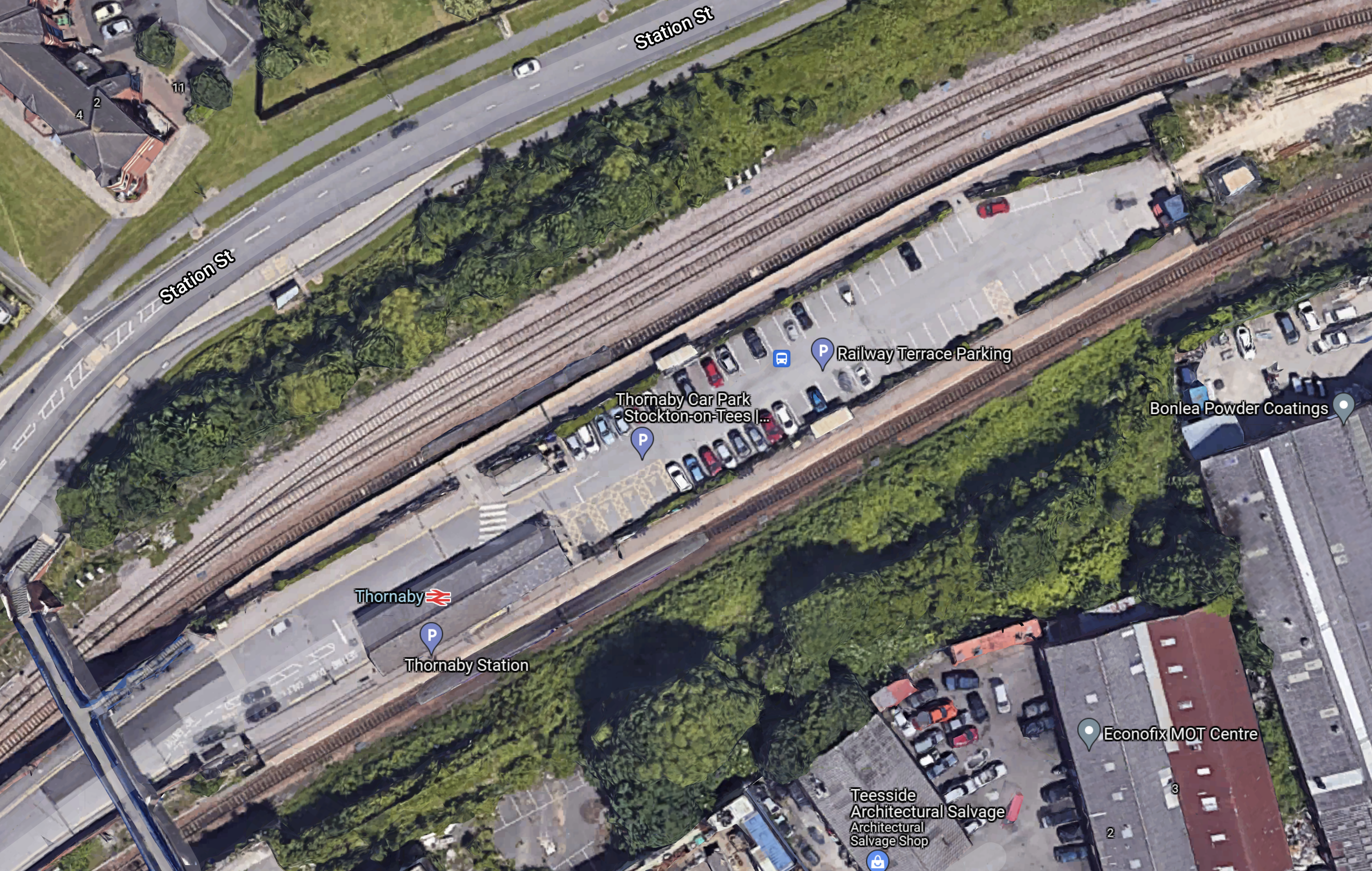
I suspect that it might just be possible, if Thornaby passengers were told to get in the first six cars.
Could This Route Be Run By A Battery-Electric Train?
Consider.
- The trains run on diesel power North of Longlands junction, where they leave and join the East Coast Main Line.
- It is a distance of only 22.2 miles.
With some form of charging at Middlesbrough, I think that within a few years, this could be an all-electric service.
It would be very handy for Hitachi, as any possible customers for battery-electric trains could be given a demo to or from London.
I Think The Stop At York Is A Good Idea
It could be argued that LNER’s King’s Cross and Middlesbrough service is two services in one.
- A direct service between London King’s Cross and Thornaby and Middlesbrough.
- A fast non-stop service between London King’s Cross and York, that takes several minutes under two hours.
Hence my view, that the York stop is a good idea.
Could The Middlesbrough Service Split And Join With Another Service At York?
The Middlesbrough service takes five minutes for the stop at York, but other services only take three minutes.
Has the longer stop been inserted into the timetable, so that the Middlesbrough timetable can be split to serve two separate destinations?
- Secondary destinations would have to be North of York or York station itself.
- These could include Bishops Auckland, Edinburgh, Newcastle, Scarborough and Sunderland.
- Given the arguments, there have been over the new timetable not calling at smaller stations, could these be served by a train to Newcastle?
There are quite a few sensible possibilities.
An alternative could be to split and join at Thornaby to serve both Middlesbrough and Sunderland.
Fortescue Making Plans To Test ‘Green’ Locomotives At Rail Operations In 2022
The title of this post, is the same as that of this article on International Mining.
This is the first two paragraphs.
The decarbonisation of Fortescue Metals Group’s (Fortescue) locomotive fleet is ramping up with the arrival of two additional locomotives at Fortescue Future Industries’ (FFI) research and development facility in Perth, Western Australia.
The two four-stroke locomotives will undergo further testing on the new fuel system, joining the first two-stroke locomotive which underwent testing earlier this year.
FFI aim to test the locomotives in 2022.
Reading the International Mining article reveals an interesting philosophy for decarbonisation.
FFI have set up a Green Team and it appears that they have a free rein to stick their noses into any decarbonisation issue in Fortescue Metals Group’s business.
I know it is a technique that works from personal experience.
When I worked for ICI Plastics Division in the early 1970s, I was in their Computer Techniques Section. The section had been setup by the Divisional Board to see if these new-fangled computers had a use in the running and development of the business outside of the company’s billing and accountancy.
We had a right to stick our noses anywhere.
It certainly gave me a wonderful apprenticeship into how to apply computers to diverse and difficult problems.
Ineos In Runcorn Is Key To UK Move To Hydrogen Energy
The title of this post, is the same as that of this article on Runcorn and Widnes World.
These are the first two paragraphs.
Thousands of buses and HGVs in the UK could soon be running on hydrogen – made in Runcorn.
The town, which already produces enough clean hydrogen to fuel 1,000 buses or 2,000 HGVs every day, is ramping up production to help reduce the amount of harmful CO₂ emissions on Britain’s roads.
The INOVYN site used to be owned by ICI in the 1960s and I used to work on the Castner-Kellner plant that electrolysed brine to produce sodium hydroxide, chlorine and hydrogen.
How To Build A Liverpool-Style Optical Bench
When I worked at ICI in Runcorn, one of the guys had developed a very accurate instrument for measuring trace chemicals in a dirty process stream. I remember one of these instruments was used to measure water in parts per million in methyl methaculate, which is the misnomer or base chemical for Perspex.
All the optical components needed to be mounted on a firm base, so a metre length of nine-inch C-section steel beam was chosen. The surface was then machined flat to a high accuracy.
In the end they found that instead of using new beams, old ones decades-old from the depths of a scrap yard gave better accuracy as the steel had all crystallised out. Machined and spray-painted no-one knew their history.
But they were superb instruments and ICI even sold them abroad.
Chemistry Nobel Awarded For Mirror-Image Molecules
The title of this post, is the same as that of this article on the BBC.
This is the introductory paragraph.
Two scientists have been awarded the 2021 Nobel Prize in Chemistry for their work on building molecules that are mirror images of one another.
Strangely, I was involved in a project, when I worked at ICI, where I was trying to sort out how a reaction could be persuaded to only produce one form of a chemical. So I do understand, something about what the two scientists were trying to achieve.
The involvement in that project has left me with a belief that chemical catalysts could be one of the routes to a greener and better world.
I have invested in one company, that is developing new catalysts.
Crossrail: Report Finds Not Enough Money To Finish Project
The title of this post, is the same as that of this article on the BBC.
These are the first two paragraphs.
The cost of completing Crossrail exceeds available funding, the government spending watchdog has found.
The National Audit Office (NAO) estimates the cost of the new rail link will be between £30m and £218m above the current funding.
After such a good start with the tunneling and surface line going well, how did we get here?
My main business for nearly forty years was writing project management software and that gave me a deep insight into the dynamics and mathematics of large projects.
The software, I created in the 1970s; Artemis was deeply involved in the most important project of the time; North Sea Oil.
But then more by luck, than any judgement on my part, it was well suited to solving the management problems of North Sea Oil.
The software ran on a small Hewlett-Packard mini-computer with an attached display and a printer, whose footprint, gave Artemis an advantage over competitors who needed a mainframe, for which there was no office space in Aberdeen.
I had first got involved in scheduling resources at ICI about five years earlier and because from previous experience I knew resources would be critical, I gave the program extensive resource aggregation and scheduling capabilities.
I have been told that the latter proved invaluable in successfully developing North Sea Oil. People may have been flattering me, but I do know that Shell used to ensure that all their suppliers used Artemis, so they could check easily if they were being told the truth.
I suspect that Shell and others used the aggregation capability to see that they weren’t overloading the pool of available labour.
Artemis definitely proved itself capable of handling the various projects in the North Sea.
We have now moved on forty years, but has project management moved on to cope with the advances in technology of the modern world?
As with North Sea Oil in Aberdeen, in the 1970s, Crossrail and other large projects like Berlin’s new Brandenburg Airport will always have a need for large numbers of resources, be they men, materiel or machines.
I have some questions.
- Do all contractors working on Crossrail use the same software?
- Does Crossrail have the right to inspect the contractors project management systems?
- Is the upward reporting what it needs to be?
- Does the software the contractors use, have an aggregation capability?
- Do Crossrail track and predict the resources needed?
Someone I respect told me, that a lot of modern project management software doesn’t even have an aggregation capability- Enough said!
I must admit, aggregation and scheduling software is difficult to write, so it might be easier to cut it out and let your clients muddle through!
But The Tunnels Were Built On Time And On Budget!
It all started so well, with the first part of the project, which was the boring of the tunnels being completed on time and on budget.
Observing the project, as I did and picking up information from engineers working on the tunnels and various magazines and television programs, I have to come to the conclusion, that the credit for the on time and budget completion must be down to excellent planning.
- I don’t remember any delays or problems reported in the tunneling. Was that good planning and surveying or luck?
- There were few if any articles on the BBC or in the Standard complaining about the problems the tunneling was inflicting on Londoners.
- The planners realised there could be a shortage of workers qualified to work underground, so they built the Tunnelling and Underground Construction Academy at Ilford, which I wrote about in Open House – TUCA.
Certainly, St Barbara, who is the patron saint of tunnellers looked after the project and its builders.
Worsening The Resource Problem
Crossrail, the Greater London Authority and the Boroughs should have been monitoring this growing resource problem, but I doubt they were in anything other than a perfunctory way!
Instead the politicians were giving planning permission to anybody with money, who wanted to build a shiny new development close to a station.
These projects would need more men, materiel or machines.
As many of these new developments are backed by companies or funds with bottomless pockets to get their developments finished they were prepared to pay more for their labour.
So labour has been deserting Crossrail in droves, thus further delaying the project.
Senior politicians in the Greater London Authority and the boroughs should accept some responsibility for Crossrail’s delay.
They didn’t need to withhold the planning permission, just say that construction of the other projects couldn’t commence until an appropriate phase of Crossrail was open.
In some parts of the world, brown envelopes will have changed hands, but it would be nice to know how many mayors and senior politicians have had holidays in places, they would not normally visit.
Senior project managers tell me, that they would not be surprised if developments along Crossrail had delayed the project.
The Covid Problem
No-one saw Covid coming, except possibly the Chinese.
But good project management is all about negotiating the slings and arrows of outrageous fortune.
There is the story of the miniMetro production line.
The first body shells coming out of the automated welder were crooked and it turned out that the machine had hit a motorway bridge in Germany. But by good project management using Artemis, British Leyland engineers were able to get the second line working correctly before the first and the car was launched on time.
With Covid, the Mayor shut construction, and it was some months before it restarted again.
I am certain, that with good project management we could have done better.
Covid is also a good excuse for lateness.
On the other hand good project management got the vaccines developed, manufactured and delivered into arms.
Covid also blew a big hole in Transport for London’s finances.
But then so did Sadiq Khan’s Fare Freeze, that brought him to office.
Could Crossrail Have Part-Opened Earlier?
I often ponder this and others ask me if it would be possible.
The Victoria Line was built with crossovers and it was able to open in phases.
Crossrail has crossovers in the following places.
- Either side of Custom House station
- To the West of Whitechapel station
- Between Farringdon and Tottenham Court Road stations
Note.
- It doesn’t appear to have been built for part opening.
- From media reports, it appears Whitechapel station is the basket case in the East.
The answer is probably that Crossrail can’t be part-opened, but there are good reasons, why it should be opened earlier.
- To generate a small amount of revenue.
- To give travellers and Londoners in general a lift.
The only practical service would be a few trains turning at Farringdon.
Conclusion
I blame politicians for Crossrail being late and over budget.
Piney Point: Emergency Crews Try To Plug Florida Toxic Wastewater Leak
The title of this post, is the same as that of this article on the BBC.
This is the introductory paragraph.
Emergency crews in Florida have been working to prevent a “catastrophic” flood after a leak was found in a large reservoir of toxic wastewater.
This Google Map shows the location.
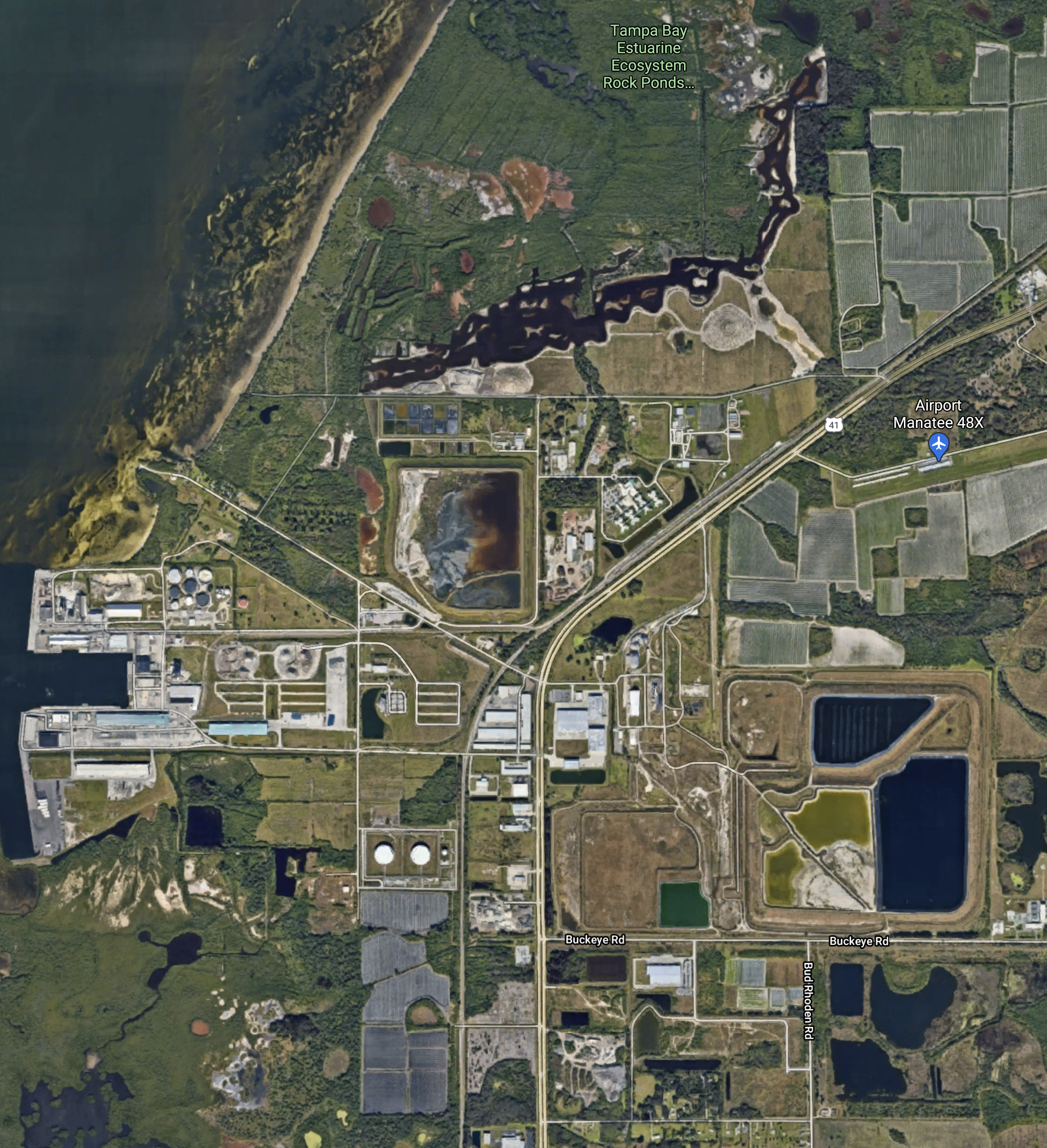
Note.
- At the top of the map is an area called Tampa Bay Estuarine Ecosystem Rock Ponds.
- The reservoir appears to be in the South East corner of the map.
- There appear to be several chemical works to the West of the highway.
This second Google Map shows the reservoir at a larger scale.
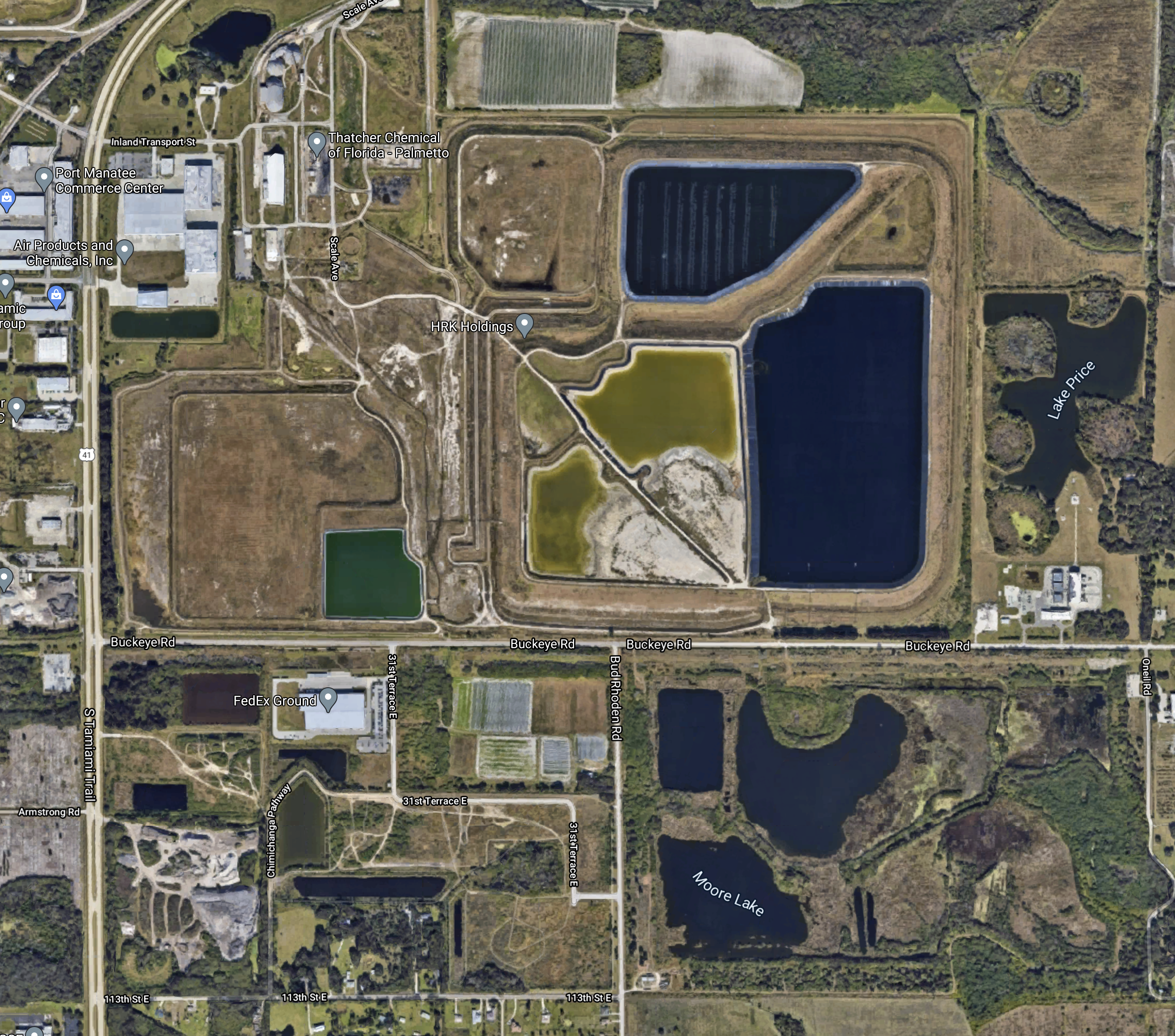
Note.
- The picture in the BBC article was taken from the North West.
- The problem reservoir is right and above of centre.
- To its right is Lake Price, which appears to be the sort of lake to sail a boat and perhaps do a bit of fishing and swimming.
- Moore Lake to the South appears similar to Lake Price.
It looks to me that it is not the place to have an environmental incident.
This article in The Times says this.
Engineers are furiously pumping the phosphate-rich water into the sea to avoid an uncontrolled spill at Piney Point, whose failure could unleash a 20ft-high wall of toxic effluent.
Pumping it into the sea? Surely not?
I suspect there could have been a mixture of sloppy management and loose regulation, with minimal enforcement and I’ll be interested to see what recommendations are put forward by the inevitable investigation.
In my varied past, I was once indirectly involved, in the toxic waste that comes out of chemical plants. At the time, I was working for ICI in Runcorn and my main job was building designing and building instruments for the various chemical plants in and around Runcorn.
As they had hired me because of my programming skills, they asked me if I could do a few small jobs on their Ferranti Argus 500, which could be plugged in to both their Varian NMR machine and their AEI mass spectrometer.
With the former, to get better accuracy in analysis of chemicals, I would take successive scans of a sample and aggregate them together. The accuracy of the results would be proportion to the square root of the number of scans.
The second to my mind was more difficult and much more interesting.
This explanation of mass spectroscopy is from Wikipedia.
Mass spectrometry (MS) is an analytical technique that is used to measure the mass-to-charge ratio of ions. The results are typically presented as a mass spectrum, a plot of intensity as a function of the mass-to-charge ratio. Mass spectrometry is used in many different fields and is applied to pure samples as well as complex mixtures.
ICI at Runcorn had a lot of complex mixtures and the aim of my project, was to take a mass spectrum and automatically decide what chemicals were present in the mixture.
The mass spectra were presented as a long graph on a roll of thermal paper. I noticed that operators would pick out distinctive patterns on the graph, which they told me were distinctive patterns of chlorine ions.
Chlorine has an unusual atomic weight of 35.5 because it is a mixture of two stable isotypes Chlorine-35 and Chlorine-37, which produced these distinctive patterns on the spectra.
I was able to identify these patterns to determine the number of chlorine atoms in a compound. By giving the algorithm a clue in stating how many carbon, oxygen and hydrogen atoms could be involved, it was able to successfully identify what was in a complex mixture.
All this was programmed on computer with just 64K words of memory and a half-megabyte hard disc.
ICI must have been pleased, as I got a bonus.
One of the jobs the software was used for was to identify what chemicals were present in the lagoons alongside the River Weaver, which are shown today in this Google Map.
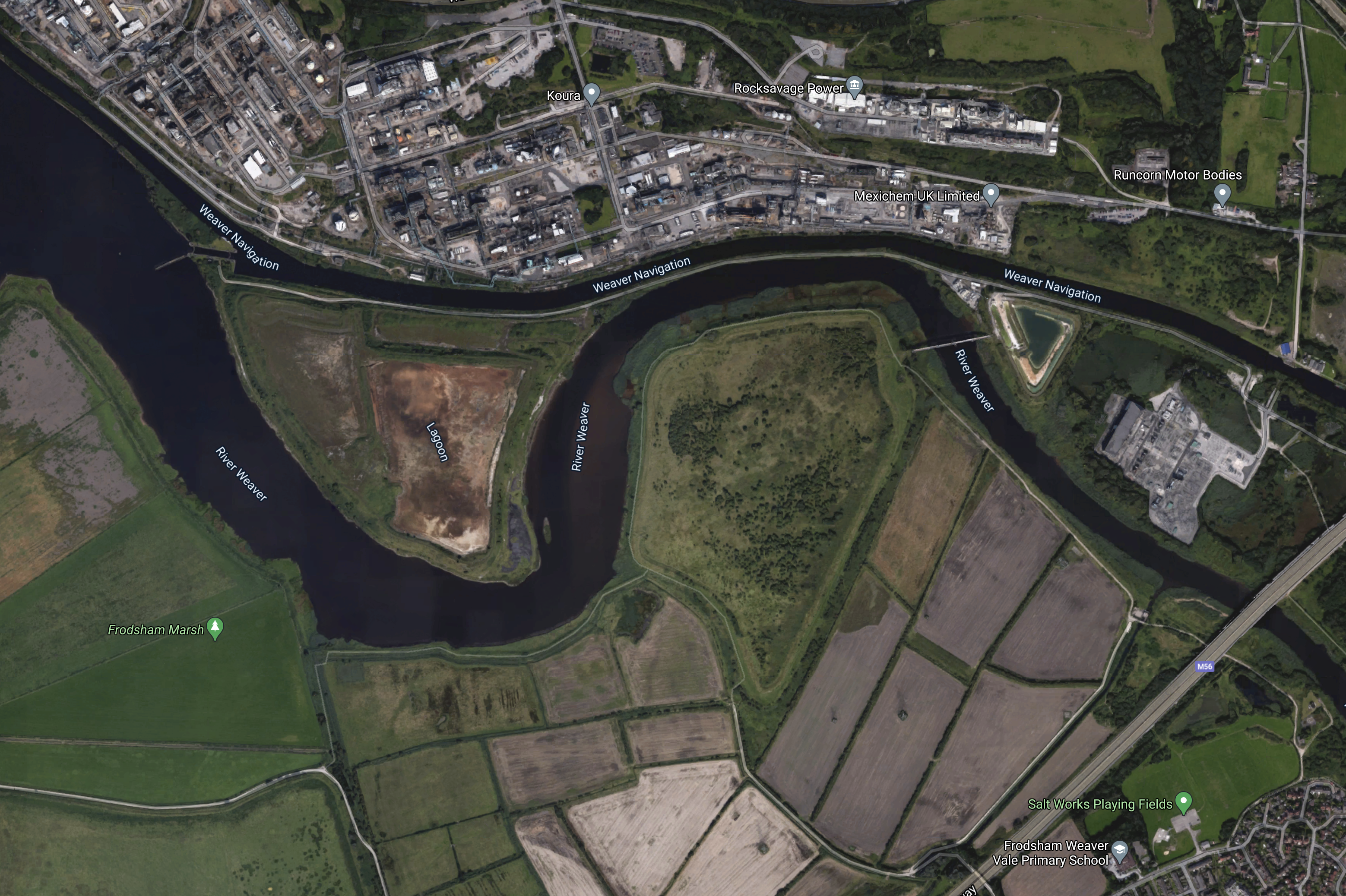
Note.
- The chemical works, which were part of ICI in the 1960s, to the North of the Weaver Navigation Canal.
- The two former lagoons between the canal and the River Weaver, which seem to have been cleaned out and partially restored.
- Was that a third large lagoon to the South of the River Weaver?
- There also appears to be a fourth smaller triangular lagoon between the canal and the river.
There certainly seems to have been a better clear-up in Runcorn, than in Florida.
I moved on from Runcorn soon after, I’d finished that software and have no idea how or if it developed and was used.
But the techniques I used stayed in my brain and were used at least four times in the future.
- In the design of a Space Allocation Program for ICI Plastics Division.
- In the design of two Project Management systems for Time Sharing Ltd.
And of course, they were also used in designing the scheduler in Artemis for Metier.
I

