First Of A Kind 2022 Winners Announced
The title of this post, is the same as that of this news item from Innovate UK.
This paragraph explains the competition.
The Department for Transport and Innovate UK are delighted to announce the first set of winners for the First of Kind (FOAK) 2022 competition. Winners will receive funding to help develop novel technology which improves rail freight services and lowers carbon emissions from trains.
I shall cover some of the winning ideas in future posts, which I will link to this post.
10039629 – Decarbonising Auxiliary Load In Freight Today
10037240 – Levelling Up Freight
10038447 – Transforming High-Speed Rail Logistics
10039606 – “Freight Skate” A Self-Powered Freight Bogie And Platform
10039559 – A Rapidly Deployable Rail Stress Sensor For Next Generation Freight Monitoring
10037294 – EventGo – Intelligent Rail Service Demand Forecasting for Event-Based Travel
10037862 – NextGen Data-Driven Timetable Performance Optimisation Tool
10039201- Protection and Resilience for OLE using ComputerVision Techniques (PROLECT)
10038989 – FEIDS – FOAS Enabled Intruder Detection System
10038342 – Rail Flood Defender
10039258 – Optimal Prediction of Sand For Adhesion
10038790 – Unauthorised Cable Removal And Fault Triage
10036632 – Trains With Brains(R)
10038228 – SBRI: FOAK 2022 Optimising Railway Possessions
10037542 – Portable Track Geometry Measurement System
10038973 – State Of The Railway Compiler Data Solution (SORClite): Open Access Real-Time Signalling Data
10036245 – ECML Net Zero Traction Decarbonisation
10039100 – UBER – Ultra-High Power Battery For Low Emission Rail
10037562 – ZERRCI – Zero Emissions Repowering Of Railway Construction Infrastructure
10038683 – Axle Mounted Motor For Retrofit To DMU’s To Enable Zero Emissions In Stations
10038972 – Zero Emission Powering of Auxiliary Loads In Stations
10038627 – ERiCS – Emissions Reductions in Closed Stations
10037158 – 25kV Battery Train Charging Station Demonstration
UK Group Plans First Large-Scale Liquid Air Energy Storage Plant
The title of this post, is the same as that of this article on the FT.
This is the first paragraph.
Highview Power is attempting to raise £400mn to fund project with capacity to supply 600,000 homes.
Note.
- This battery will have an output of 30 MW and a storage capacity of 300 MWh.
- The battery will be built at Carrington, near Manchester.
- Highview Power hope it will be opened by the end of 2024.
- It appears that the £400 million will also be used to start the engineering for another four batteries.
The article gives a detailed history of the company.
Ocergy Floaters Selected For 100 MW Project Off Scotland
The title of this post, is the same as that of this article on Splash247.com.
These two paragraphs outline Ocergy’s OCG-Wind foundation technology.
The Salamander floating offshore wind project, a joint venture between Simply Blue Group, Ørsted and Subsea 7, has awarded the pre-FEED (front-end engineering design) deal to Ocergy for its OCG-Wind foundation technology.
The US-based Ocergy has developed a novel semisub floater called OCG-Wind, to support turbines larger than 10 MW, designed for the development of large-scale wind farms. It is targeting a levelised cost of energy (LCOE) that can start to drive reductions in floating offshore wind farms to eventually be competitive with fixed offshore wind farms.
Note.
- There is a picture showing two turbines on OCG-Wind floats.
- Salamander is intended to be an INTOG project of 100 MW.
- The floaters are expected to be fabricated at Global Energy Group’s Port of Nigg.
- ERM’s Dolphyn electrolysis, desalination and hydrogen production concept is also planned for the project.
The Salamander project is certainly going for a lot of innovation.
RWE Looking for Innovators To Boost UK’s Offshore Wind Supply Chain
The title of this post, is the same as that of this article on offshoreWIND.biz.
RWE appear to be looking for innovators in three areas.
- Autonomous solutions and the best way to integrate them into wind farm site investigations, construction, and operations and maintenance (O&M) is the first challenge for which RWE is looking for responses.
- The second challenge is about solutions to measure and reduce the environmental impacts of offshore wind farm construction and operations on birds.
- The last challenge focuses on ideas and innovations in cable monitoring and protection, aiming to secure a reduction in offshore wind farm cable failures.
As sums of around £25,000 are talked about in the article, it could be worth applying, if you have a relevant idea.
Is it slightly flattering to the UK’s skills, that a German company is backing British innovation?
But then I was involved in a British invention, which was also backed by the Germans and made me a reasonable amount of money.
CIP Picks Stiesdal Floater For 100MW Scottish Offshore Wind Farm
The title of this post, is the same as that of this article on Offshore Engineering.
These two paragraphs introduce the project.
Copenhagen Infrastructure Partners (CIP) has selected Stiesdal Offshore’s TetraSub floating foundation structure for the 100MW Pentland Floating Offshore Wind Farm project, to be located off the coast of Dounreay, Caithness, Scotland.
The technology has been said to offer a lightweight and cost-effective floating solution, based on factory-made modules which are then assembled domestically in port to form a complete foundation.
Note.
- The TetraSub seems to have been designed for ease of manufacture.
- One if the aims appears to be to build a strong local supply chain.
- The TetraSub was designed with the help of Edinburgh University.
- The TetraSpar Demonstrator is in operation off the coast of Norway.
- This page on Mission Innovation describes the TetraSpar in detail.
- The TetraSpar foundation, owned by Shell, TEPCO RP, RWE, and Stiesdal.
- It can be deployed in water with a depth of up to 200 metres.
- Currently, they carry a 3.6 MW turbine.
- At that size, they’d need 27 or 28 turbines to create a 100 MW wind farm.
The home page of the Pentland Offshore Wind Farm gives more details.
This article on offshoreWIND.biz is entitled CIP And Hexicon To Halve Pentland Floating Wind Project Area.
- The project area has been halved.
- The number of turbines has been reduced from ten to seven.
- Compact turbines will be used.
- The project will be built in two phases, one turbine in 2025 and six in 2026.
- Effectively, the first turbine will help to fund the second phase, which eases cash flow.
The changes show how the wind farm has changed during development due to local pressures and improved technology.
Conclusion
It does seem that the competition is growing in the field of floating wind turbines.
Given the quality of the research and backing for these floats and the fact they now have an order, I wouldn’t be surprised to see this technology be a success.
Carbon-Neutral Concrete Prototype Wins €100k Architecture Prize For UK Scientists
The title of this post, is the same as that of this article on the Architect’s Journal.
Under a picture of two white-coated scientists with their protective boots on concrete samples, the story and their invention is outlined.
A pair of PhD students at Imperial College London have won a global architecture prize for devising a groundbreaking method of creating carbon-neutral concrete
Material scientists Sam Draper and Barney Shanks landed the €100,000 2022 Obel Award with their ‘simple way’ to capture carbon from industrial production processes and create an end product that can eliminate the CO₂ footprint of concrete.
The prototype technology, dubbed Seratech, takes industrial CO₂ emissions directly from flues and produces a carbon-negative cement replacement material (silica). According to the scientists, when this is used in combination with Portland cement, the carbon capture associated with producing the silica means the concrete products can be zero carbon.
One of the products, we will need in the world is concrete and if we can make it in a carbon-neutral manner, then that will surely reduce worldwide carbon emissions.
The Technology Explained
This page on the Seratech website is entitled Our Technology.
It gives this description of the technology.
Seratech has developed a process that consumes olivine and waste CO₂ from flue gases and produces two products which both have significant value in construction.
Silica is produced which can be used as a supplementary cementitious material (SCM) in concrete meaning the amount of Portland cement in the concrete can be reduced by up to 40%. As the silica comes from a process that captures CO₂ it is “carbon negative” and the concrete can become carbon neutral.
Magnesium carbonate is produced that can be used to make a range of zero carbon construction materials and consumer products, including alternatives to building blocks and plasterboard.
The aim is for humanity to be able to continue building robust cities and infrastructure, but without the climate cost of traditional cement mixes and with the Seratech technology this goal is achievable!
Note that olivine in Europe is generally mined in Norway.
Replacement Of Steel By Concrete
Could we also replace steel in some applications with concrete?
In UK Cleantech Consortium Awarded Funding For Energy Storage Technology Integrated With Floating Wind, I talked about some of ground-breaking methods used by a company called RCAM Technologies to create infrastructure using 3D printing of concrete.
If Imperial’s concrete, which is called Seratech can be 3D printed, I can see lots of applications for the technology.
So you could kill two sources of large carbon emissions with one technology.
Conclusion
I have said on this blog before, that we will have to keep or even build more gas-fired power stations, as they can be an efficient source of pure carbon dioxide, that will be needed as a feedstock to create an increasing number of agricultural and building products.
Is This The World’s Best Renewable Energy Video?
This is a promotional video from Minesto about their Deep Green technology.
Is it a serious proposition or is it just kite-flying?
After reading their web site in detail, I think they are serious.
Here’s why!
The Company Is A Well-Backed Spin-Out from Swedish Aerospace Company SAAB
These two paragraphs are from the About Us page.
Minesto is a marine energy technology developer, founded in 2007 as a spin-off from Swedish aerospace manufacturer Saab. Since then, Minesto has successfully developed its unique Deep Green technology.
The company has operations in Sweden, Wales, Northern Ireland and Taiwan, with headquarters in Gothenburg, Sweden. Main owners are BGA Invest and Midroc New Technology. The Minesto share is listed on the Nasdaq First North Growth Market in Stockholm.
A company rarely succeeds without appropriate and sufficient financial backing.
One Of Their Target Markets Is Powering Remote Islands
This page from World Atlas is entitled Which Countries Have The Most Islands?
These are the top five countries.
- Sweden – 267,570
- Norway – 239,057
- Finland – 178,947
- Canada – 52,455
- United States – 18,617
Note.
- That’s a lot of islands.
- The United Kingdom is 26th with a thousand islands.
- Scandinavia has 685574 islands or 686993 if you include Denmark.
Sweden has a thousand inhabited islands, so that means that in Scandinavia alone, there are about 2,500 inhabited islands. How many need a reliable decarbonised power supply?
In the UK, we are developing Remote Island Wind to serve similar locations, which I wrote about in The Concept Of Remote Island Wind.
The UK and Minesto are both looking at the supply of power to remote islands.
One of Minesto’s projects is in the Faroe Islands and it is described in this page on the Minesto web site, which has a title of Faroe Islands – Tidal Energy To Reach 100% Renewable By 2030.
These are the first two paragraphs.
In the Faroe Islands, Minesto is part of one of the world’s most ambitious energy transition schemes.
Collaborating with the electric utility company SEV, Minesto is working to pave the way for tidal energy to become a core part of the Faroese energy mix, allowing them to reach 100% renewable energy by 2030.
Onshore wind and tidal could be an ideal combination, if they worked together.
At the bottom of the Faroe Islands page, the web site talks about The Deep Green Island Mode Project, where this is said.
In June 2019, Minesto was awarded a €2.5 million grant from the European Commission’s SME Instrument programme. The awarded funding will support the installation of Minesto’s technology in the Faroe Islands together with the utility company SEV. The aim of the project, called Deep Green Island Mode (DGIM), is to install Minesto’s first two commercially viable microgrid units in a production and customer environment.
Successful demonstration of DGIM will act as a first step to developing commercial ties with utilities across Europe, both for smaller-scale microgrid systems and as a catalyst for the market up take of larger utility-scale Deep Green systems.
This is also said about the number of installations in Europe.
15 million Europeans live on Europe’s 2,400 inhabited islands, at an average of approximately 1,500 households per island. As recognised by the European Commission, island energy is expensive, polluting, inefficient and dependent on external supply, with significant negative impacts on emissions, the competitiveness of businesses, and the economy.
It appears to me, that Minesto have researched their market well.
Minesto Can Provide Baseload Power
Another of Minesto’s projects is in Taiwan and it is described in this page on the Minesto web site, which has a title of Taiwan – Replacing Nuclear With Renewable Baseload.
These are the first two paragraphs.
In Taiwan, Minesto is carrying out site development with the purpose to establish the first tidal energy arrays with Minesto’s technology in Asia – and to demonstrate renewable baseload generation from the continuously-flowing Kuroshio current.
The conditions for extracting marine energy in Taiwan are very good due to access to both tidal streams and continuous ocean currents. Taiwan aims to produces 20% of electricity from renewable sources by 2025 and has decided to scrap its nuclear power capacity within the same timeframe. Today, 97.5 percent of the country’s total energy use comes from imported fossil fuels.
Taiwan has a well-developed industrial infrastructure and a number of stakeholders in the private and public sectors are active in marine energy.
Decarbonising Taiwan and removing nuclear is a tough ask!
Conclusion
Minesto may be kite-flying in an unusual way, but they appear to be a very serious Swedish company.
What Is INTOG?
This page on the Crown Estate Scotland web site outlines INTOG.
This is the introduction at the top of the page.
Innovation and Targeted Oil & Gas (INTOG) is a leasing round for offshore wind projects that will directly reduce emissions from oil & gas production and boost further innovation.
Developers can apply for seabed rights to build two types of offshore wind project:
IN – Small scale, innovative projects, of less than 100MW
TOG – Projects connected directly to oil and gas infrastructure, to provide electricity and reduce the carbon emissions associated with production
INTOG is designed, in response to demand from government and industry, to help achieve the targets of the North Sea Transition Sector Deal, which is a sector deal between government and the offshore oil and gas industry.
I have a few thoughts and have also found some news stories.
Isolated Communities
This document from the Department of Business, Industry and Industrial Strategy lists all the Contracts for Difference Allocation Round 4 results for the supply of zero-carbon electricity that were announced yesterday.
The document introduces the concept of Remote Island Wind, which I wrote about in The Concept Of Remote Island Wind.
I don’t know of one, but there might be isolated communities, with perhaps a dodgy power supply, who might like to improve this, by means of a small offshore wind farm, meeting perhaps these criteria.
- Less than 100 MW.
- Agreement of the locals.
- A community fund.
- An important use for the electricity.
Locations and applications could be.
- A small fishing port, where winds regularly bring the grid cable down in winter.
- A village with a rail station to perhaps charge battery-electric trains.
- A deep loch, where floating wind turbines are erected.
- To provide hydrogen for transport.
We shall see what ideas are put forward.
Floating Power Stations
Floating wind farms are generally made up of individual turbines on floats.
- Turbines can be up to the largest used onshore or on fixed foundations.
- The Kincardine floating offshore wind farm in Scotland uses 9.5 MW turbines.
- The floats are anchored to the sea bed.
- There is a power cable connecting the turbines appropriately to each other, the shore or an offshore substation.
But we are talking innovation here, so we might see some first-of-a-kind ideas.
Single Floating Turbines
A large floating wind farm, is effectively a large number of floating wind turbines anchored in the same area of sea, and connected to the same floating or fixed substation.
I can’t see any reason, why a single floating wind turbine couldn’t be anchored by itself to provide local power.
It might even be connected to an onshore or subsea energy store, so that it provided a more constant output.
Surely, a single turbine perhaps ten miles offshore wouldn’t be a very large blot on the seascape?
I grew up in Felixstowe and got used to seeing HM Fort Roughs on the horizon from the beach. That is seven miles offshore and some people, I know have windsurfed around it from the beach.
TwinHub
I talked about TwinHub in Hexicon Wins UK’s First Ever CfD Auction For Floating Offshore Wind.
TwinHub mounts two turbines on one float and this is a visualisation of a TwinHub being towed into place.
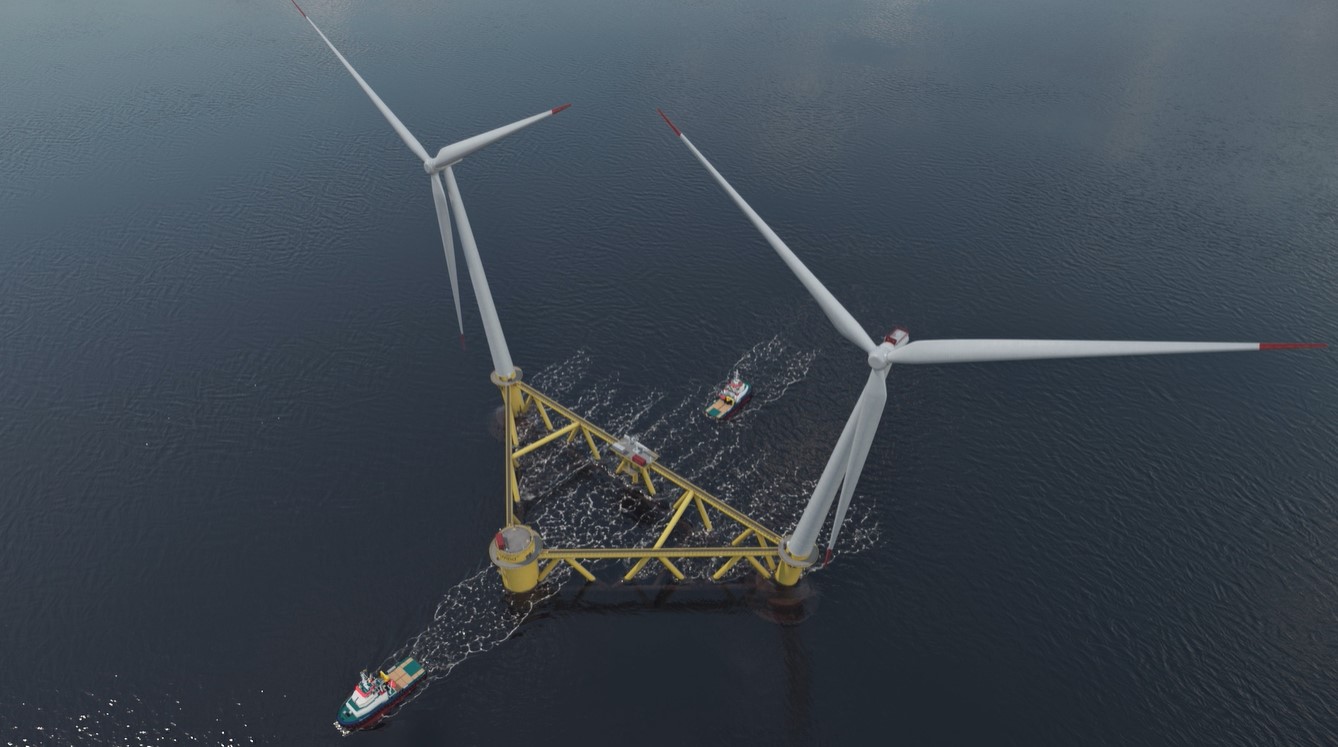
Note.
- The design turns into the wind automatically, so that the maximum amount of electricity is generated.
- A Contract for Difference for a 32 MW TwinHub has been awarded, at a strike price of £87.30/MWh, that will be installed near Hayle in Cornwall.
- With a capacity factor of 50 %, that will produce just over 140,160 MWh per year or over £12 million per year.
This article on the BBC, which is entitled Funding Secured For Floating Wind Farm Off Cornwall, gives more details of the Hayle TwinHub.
The possibility of a floating wind farm off the coast of Cornwall has moved a step closer after securing government funding, project bosses have said.
Swedish company Hexicon plans to install its TwinHub system, with the hope it could begin operating in 2025.
It would be deployed about 10 miles (16km) off Hayle.
Project supporters said it could be a boost to the local economy and help establish Cornwall in the growing renewable energy sector.
Figures have not been released, but it is understood the government funding has effectively secured a fixed price for the power TwinHub would produce for 15 years, making it economically viable.
The article says that this 32 MW system could develop enough electricity for 45,000 homes.
This could be a very suitable size for many applications.
- As at Hayle, one could be floated just off the coast to power a remote part of the country. As Cornwall has a few old mine shafts, it might even be backed up by a Gravitricity system on shore or another suitable non-lithium battery.
- Could one float alongside an oil or gas platform and be tethered to it, to provide the power?
Scotland’s hydroelectric power stations, prove that not all power stations have to be large to be successful.
Vårgrønn and Flotation Energy’s Joint Bid
This article on offshoreWIND.biz is entitled Vårgrønn And Flotation Energy To Jointly Bid in INTOG Leasing Round, gives a few details about their joint bid.
But there is nothing substantial about ideas and locations.
I can see several joint ventures with a suitable system, bidding for various projects around the Scottish coast.
Cerulean
Cerulean sounds like it could be a sea monster, but it is a shade of blue.
This article on offshoreWind.biz is entitled Cerulean Reveals 6 GW Floating Offshore Wind Bid Under INTOG Leasing Round.
These are the two introductory paragraphs.
Green energy infrastructure developer Cerulean Winds has revealed it will bid for four seabed lease sites with a combined capacity of 6 GW of floating wind to decarbonise the UK’s oil and gas sector under Crown Estate Scotland’s Innovation and Targeted Oil and Gas (INTOG) leasing round.
This scale will remove more emissions quickly, keep costs lower for platform operators and provide the anchor for large-scale North-South offshore transmission, Cerulean Winds said.
Note.
- It is privately-funded project, that needs no government subsidy and will cost £30 billion.
- It looks like each site will be a hundred turbines.
- If they’re the same, they could be 1.5 GW each.
- Each site will need £7.5 billion of investment. So it looks like Cerulean have access to a similar magic money tree as Kwasi Kwarteng.
Effectively, they’re building four 1.5 GW power stations in the seas around us to power a large proportion of the oil and gas rigs.
For more on Cerulean Winds’ massive project see Cerulean Winds Is A Different Type Of Wind Energy Company.
Will There Be An Offshore Wind Supermarket?
I can see the big turbine, float and electrical gubbins manufacturers establishing a one-stop shop for developers, who want to install small wind farms, that meet the INTOG criteria.
So suppose, the archetypal Scottish laird in his castle on his own island wanted a 6 MW turbine to go green, he would just go to the B & Q Offshore web site and order what he needed. It would then be towed into place and connected to his local grid.
I can see modular systems being developed, that fit both local infrastructure and oil and gas platforms.
Conclusion
I can see scores of projects being submitted.
I even know the son of a Scottish laird, whose father owns a castle on an island, who could be taking interest in INTOG. They might also apply under Remote Island Wind in another leasing round.
But we will have to wait until the end of March 2023, to find out who have been successful.
Boson Energy To Use Nonrecyclable Trash To Make Carbon-Negative Hydrogen
The title of this post, is the same as that of this article on Hydrogen Fuel News.
This is the first paragraph.
Boson Energy, an Israeli-Swedish-Polish startup is preparing to move ahead with a form of carbon-negative hydrogen production using nonrecyclable garbage.
It is worth reading the Boson Energy web site.
Nestlé Unveils New Double-Stacking Rail Logistics Plan To Reduce Carbon Footprint
The title of this post, is the same as that of this press release from Nestlé.
These paragraphs explain the concept.
Nestlé UK & Ireland has unveiled plans to increase freight capacity on trains to allow the double-stacking of products, an important step towards reducing its carbon footprint.
The new curtain-sided rail container with a raising roof, designed to transport double-stacked palletised products by rail, was displayed at the Multimodal Exhibition in Birmingham this week.
The design of the container overcomes an important barrier as the height of road trailers differs from rail containers due to the height constraints of the rail network, meaning transport by rail had not been a winning option for Nestlé until now.
Utilising a hydraulic raising roof mechanism, the unit allows the business to double-stack its food and drink products. The roof is then lowered to just above the height of the stock, making it compliant with the height requirements of rail transport, while being able to get more products on board.
It is currently under test between the Midlands and London.
The press release also mentions, that it could be used to deliver to Tesco, who are extensive users of rail freight and have been for some years.
 The Anonymous Widower