The Mathematics Of Fast-Charging Battery Trains Using Third-Rail Electrification
In Vivarail Unveils Fast Charging System For Class 230 Battery Trains, I talked about how Vivarail are proposing to fast-charge their Class 230 trains.
- The trains are fitted with special high-capacity third rail shoes.
- Third-rail electrification is laid in stations.
- The third rail is powered by a bank of bstteries, that are trickle-charged from the mains or perhaps even solar power.
- When the train connects to the rail, the rail is made live and a fast transfer takes place between third-rail and train.
So how much electricity could be passed to a train during a stop?
The most powerful locomotive in the UK, that can use 750 VDC third-rail electrification is a Class 92 locomotive.
According to Wikipedia, it can produce a power output of 4 MW or 4,000 kW, when working on third-rail electrification.
This means, that in an hour, four thousand kWh will be transferred to the train using conventional third-rail electrification.
Or in a minute 66.7 kWh can be transferred.
In Vivarail’s system, because they are transferring energy between batteries, enormous currents can be passed.
To illustrate how batteries can can deliver enormous currents here’s a video of a guy using two car batteries to weld things together.
These currents are possible because batteries have a low impedance and when the battery on the train is connected to the battery bank on the station, the two batteries will equalise their power.
If we take the example of the Class 92 locomotive and conventional electrification, this would be able to transfer 200 kWh in three minutes or 400 kWh in six minutes.
But I believe that battery-to-battery transfers could be at a much higher current
Thus in a typical one or two minute stop in a station, upwards of 200 kWh could be transferred to the train.
On this page of their web-site, Vivarail say this.
Due to the high currents required for the train Vivarail uses a carbon ceramic shoe able to withstand the heat generated in the process – without this shoe the charge time would make operational running unfeasible.
The devil is always in the details! From what I’ve seen and heard about the company, that would fit!
Class 710 Train Roofs At Blackhorse Road Station
I took these pictures at Blackhorse Road station.


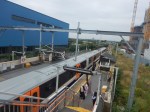


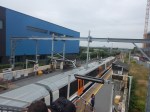

I couldn’t spot any resistor banks on the roofs, that could be used to burn off excess energy, that is generated by regenerative braking.
Consider.
- The roofs do have a rather clean aerodynamic look.
- I’ve never seen resistor banks placed anywhere other than on the roof of a train.
- Regenerative braking must either return the energy through the electrification or store in in some form of onboard energy storage.
It looks to me, that Bombardier have designed a very efficient train.
Carbon Capture From Cement Manufacturing Nears Market Readiness
The title of this post, is the same as that of this article on The Fifth Estate.
In Climate Change: The Massive CO2 Emitter You May Not Know About, I talked about the carbon dioxide that is released, by the manufacture of cement, mainly referring to this article on the BBC.
This is the first three paragraphs of the BBC article.
Concrete is the most widely used man-made material in existence. It is second only to water as the most-consumed resource on the planet.
But, while cement – the key ingredient in concrete – has shaped much of our built environment, it also has a massive carbon footprint.
Cement is the source of about 8% of the world’s carbon dioxide (CO2) emissions, according to think tank Chatham House.
However, the article on The Fifth Estate, raises hopes that new processes for making cement may reduce the carbon footprint of this important material.
This is the first paragraph of tThe Fifth Estate article.
A consortium led by Australian firm Calix is now well on the way to completing a pilot plant for its breakthrough technology that will capture carbon emissions from the manufacture of lime cement. Other projects with similar aims to reduce the global warming impact of construction with concrete are also racing to the marketplace.
It certainly looks like the Australians are doing something concrete about climate change!
Engie Partners Innovate UK For £4 Million Energy Transition Competition
The title of this post is the same as this article on Current News.
- This is an interesting link-up between the UK Government Agency; Innovate UK and the French energy giant; Engie.
- Wikipedia defines energy transition as a long-term structural change in energy systems.
- It is the first time Innovate UK has secured overseas private funding.
- It aims to fund the very best of \british innovation in clean growth innovation.
- Grants of between £100,000 and £1.2 million will be awarded.
- There appears to be no mention of Brexit!
It looks to me, like a very strong endorsement of British innovation and the British energy industry by the French.
I also think, that if there is one industry where the British and the French should be linked, it is energy.
The UK has the following energy sources and resources.
- Offshore and onshore oil and gas.
- Redundant gas fields for carbon capture and storage.
- Offshore and onshore wind.
- Large areas of sea for offshore wind.
- We have 8,183 MW of installed offshore wind capacity, which is the largest in the world.
- The possibilities of tidal and wave power from a long Western coast.
- Vast experience in building off-shore structures in some of the worst weather on the planet.
- Interconnectors to Norway and Iceland to import their surplus geothermal and hydroelectric energy.
Could we become a renewable-energy powerhouse?
The French have the following.
- Nuclear power, some of which will need replacing.
- Only 500 MW of offshore wind.
- More solar power than we have.
- Easy connection to North Africa for solar power.
But in some ways, most important is the several interconnectors between the UK and France, with more planned.
Conclusion
Between the UK and France, with help from Ireland, Spain and Portugal, can develop a massive Western European renewable energy powerhouse, backed by the following, non-renewable or external sources.
- French nuclear power.
- North African solar.
- Icelandic geothermal power
- Icelandic hydro-electric power
- Norwegian hydro-electric power
It should be noted that in a few years, the UK will have joined Iceland, Norway and North Africa outside of the European Union.
I believe that Sovereign Wealth Funds, Hedge Funds, Pension Funds, Insurance Companies and other individuals, groups and organisations will increasingly see renewable energy as good places for long-term investment of their funds.
The two big problems are as follows.
- What happens when all these renewable energy sources are producing more energy than we can use?
- What happens when there is an energy deficit?
Energy storage is the solution, but the amount needed is massive.
In Airport Plans World’s Biggest Car Parks For 50,000 Cars, I looked at the mathematics in using car parks for electric cars for energy storage.
These are a few figures.
- Electric Mountain is the UK’s largest electricity storage scheme with a capacity of 9.1 GWh.
- The largest battery in the world is the Bath County Pumped Storage Station with a capacity of 24 GWh, which works on similar principles to Electric Mountain.
- Building another Electric Mountain would cost £1350 million, if we could find somewhere to put it.
But supposing half the 35.5 million cars and light goods vehicles in the UK were replaced by new electric vehicles containing a battery of around 20 kWh, that would be a total storage of 355 GWh or nearly forty Electric Mountains.
Conclusion
Harnessing all of these batteries will be an enormous challenge, but it will be ideas like this, that will enable the world to go carbon neutral by 2050.
But I don’t think we’ll ever see Trump or Xi Jinping in an electric limousine..
Green Mini-Trains To Reverse Beeching’s Cuts
The title of this post is the same as an article in Saturday’s copy of The Times.
This is a paragraph.
The government is funding trials of an “ultra-light”, environmentally friendly train powered by gas from organic waste in place of a conventional diesel engine.
Members of the consortium developing the concept include Birmingham City University and Parry People Movers.
I wrote about the Parry People Mover in Stourbridge And The Parry People Mover.

It did the shuttling of people between Stourbridge Junction and Stourbridge Town stations in a professional manner and it can’t have done much wrong, as it still is.
The technology that drives the train is based on a flywheel and is innovative to say the least. This section in the Wikipedia entry for Parry People Movers is called Technology.
This is the first two paragraphs of the section.
PPMs utilise a rotating flywheel as a store of kinetic energy which is then used to power the vehicle. A typical PPM flywheel is made from steel laminates, approximately 1 m (39 in) in diameter and 500 kg (1,100 lb) in mass, designed to rotate at a maximum speed of 2,500 rpm.[8] The flywheel is mounted horizontally at the centre of the unit, beneath the seating area. The flywheel is driven by an internal combustion engine or an electric motor. The flywheel is connected to the rail wheels via a hydrostatic variable transmission system.
The flywheel allows the direct capture of brake energy (when slowing down or descending gradients) and its re-use for acceleration (called regenerative braking). When the vehicle brakes, the hydrostatic transmission feeds the energy back into the flywheel. Since the short-term power demand for acceleration is provided by the energy stored in the flywheel, there is no need for a large engine. A variety of small engine types can be used including LPG, diesel or electric traction.
I have done a calculation of the kinetic energy in the flywheel and it is surprisingly low at 0.6 kWh if it is a disc and 1.2 kWh if it is a ring.
A capacitor of the same mass would hold about the same amount of energy, but would probably need a more complicated transmission.
Leaves On The line? AI Signals End To Commuters’ Train Pain
The title of this article is the same as that of an article, that was on the front page of yesterday’s copy of The Times.
It talks about a system being developed by Hack Partners, that uses a camera to record lineside trees and then a computer using AI directs tree cutting gangs to the right places.
This is one of several systems that are to be funded by the Government. This paragraph summarised the grants.
The DfT and Innovate UK, the government’s technology agency, will announce today that up to £7.8 million is being invested in 24 trials of projects to boost performance on the railway. Each will receive between £250,000 and £350,000.
I particularly like a system from a Dutch company called 4Silence, which is designed to cut the noise of trains, which is described like this.
other schemes being funded include a noise barrier only 1m high topped by a steel grid, developed by the Dutch company 4Silence, which can deflect the sound of passing trains, improving the quality of life for residents near by.
I wonder what percentage of these trials will be winners.
I hope those who judge the success of these schemes, except that not all innovation succeeds.
Is There Nothing A Class 319 Train Can’t Do?
If a train every goes into orbit round the world, it will be highly-likely that it will be a Class 319 train!
Electric Trains In North-West England
The fleet of eighty-six trains entered service in 1987 on Thameslink and now twenty-seven are plying their trade on the electrified routes around the North-West of England.
- You don’t hear many complaints about them being called London’s cast-offs.
- Passengers fill them up in Blackpool, Liverpool, Manchester and Preston.
- They still do 100 mph where possible.
- They seem to be reliable.
- They are not the most attractive of trains.
But handsome is as handsome does!
Drivers have told me, that although the suspension may be a bit soft for the bumpy route across Chat Moss, the trains do have superb brakes.
Bi-Mode Class 769 Trains
Nearly thirty of the trains are being converted into bi-mode Class 769 trains for working partially-electrifired routes and although these are running late, they should be in service this year.
Rail Operations Group
Two Class 769 trains have been ordered to be fast logistics trains by Rail Operations Group.
Wikipedia says the trains will be used to transport mail.
But if you read the history of the Rail Operations Group, they make the assets sweat and I’ve read the trains will still have seats, so they might do some other rail operations.
The Hydrogen-Powered Class 799 Train
And now comes the Class 799 train!
This is a demonstrator to prove the concept of conversion to hydrogen power.
The fact that the train now has it’s own number must be of some significance.
Alstom are converting Class 321 trains into Class 321 Breeze trains.
- The conversion will reduce passenger capacity, due to the large hydrogen tank
- It will have a 1,000 km range.
- It will have regenerative breaking.
- It will have a new AC traction package
- It will probably have the interior of a Class 321 Renatus train.
The conversion will obviously build on Alstom’s experience with the Alstom Coradia iLint train and Eversholt’s experience with the Renatus.
When it comes to the Class 799 train, the following will apply.
- Porterbrook have all the experience of creating the bi-mode and dual-voltage Class 769 train.
- Birmingham University’s Birmingham Centre For Railway Research And Education (BCRRE) are providing the expertise to design and convert the Class 319 train to hydrogen power.
- I also wouldn’t be surprised to find out, that the BCRRE has applied some very extensive mathematical modelling to find out the performance of a hydrogen-powered Class 319 train or HydroFLEX train.
- The conversion could be based closely on Class 769 experience and sub-systems,
Could the main purpose be to demonstrate the technology and ascertain the views of train operators and passengers on hydrogen power?
The most important question, is whether the Class 799 train, will have the same passenger capacity as the original Class 319 train?
If it does, then BCRRE must have found a way to store the hydrogen in the roof or under the floor.
It should be noted, that it was only in September 2018, that the contract to develop the Class 799 train was signed and yet less than a year later BCRRE and Porterbrook will be demonstrating the train at a trade show.
This short development time, must mean that there is not enough time to modify the structure of the train to fit a large hydrphen tank inside, as Alstom are proposing.
A smaller hydrogen tank could be placed in one of three places.
- Underneath the train.
- On the roof.
- Inside the train, if it is small enough to fit through the train’s doors.
Note.
- I doubt that anybody would put the tank inside the train for perceived safety reasons from passengers.
- On the roof, would require substantial structural modifications. Is there enough time?
So how do you reduce the size of the hydrogen tank and still store enough hydrogen in it to give the train a useful range?
In Better Storage Might Give Hydrogen The Edge As Renewable Car Fuel, I indicated technology from Lancaster University, that could store four times as much hydrogen in a given size of tank.
This reduced tank size would make the following possible.
- The hydrogen tank, the fuel cell and the batteries could be located underneath the four-cars of the Class 319 train.
- The seating capacity of the Class 799 train could be the same as that of a Class 319 train.
Clever electronics would link everything together.
If BCRRE succeed in their development and produce a working hydrogen-powered Class 799 train, how would the technology be used?
Personally, I don’t think we’ll see too many hydrogen-powered Class 799 trains, running passengers on the UK network.
- The trains are based on a thirty-year-old train.
- The interiors are rather utilitarian and would need a lot of improvement, to satisfy what passengers expect.
- Their market can probably be filled in the short-term by more Class 769 trains.
But I do believe that the technology could be applied to more modern trains.
A Hydrogen-Powered Electrostar
Porterbrook own at least twenty four-car Electrostar trains, which have been built in recent years.
Six Class 387 trains, currently used by c2c, may come off lease in the next few years.
Could these trains be converted into a train with the following specification?
- Modern train interior, with lots of tables and everything passengers want.
- No reduction in passenger capacity.
- 110 mph operating speed using electrification.
- Useful speed and range on hydrogen power.
- ERTMS capability, which Porterbrook are fitting to the Class 387 trains to be used by Heathrow Express.
It should be born in mind, that a closely-related Class 379 train proved the concept of a UK battery train.
- The train was converted by Bombardier.
- It ran successfully for three months between Manningtree and Harwich.
- The interior of the train was untouched.
But what was impressive was that the train was converted to battery operation and back to normal operation in a very short time.
This leads me to think, that adding new power sources to an Electrostar, is not a complicated rebuild of the train’s electrical system.
If the smaller hydrogen tank, fuel cell and batteries can be fitted under a Class 319 train, I suspect that fitting them under an Electrostar will be no more difficult.
I believe that once the technology is proven with the Class 799 train, then there is no reason, why later Electrostars couldn’t be converted to hydrogen power.
- Class 387 trains from c2c, Great Northern and Great Western Railway.
- Class 379 trains, that will be released from Greater Anglia by new Class 745 trains.
- Class 377 trains from Southeastern could be released by the new franchise holder.
In addition, some Class 378 trains on the London Overground could be converted for service on the proposed West London Orbital Railway.
A Hydrogen-Powered Aventra
If the Electrostar can be converted, I don’t see why an Aventra couldn’t be fitted with a similar system.
Conclusion
A smaller hydrogen tank, holding hydrogen at a high-density would enable trains to be converted without major structural modifications or reducing the passenger capacity.
The development of a more efficient method of hydrogen storage, would open up the possibilities for the conversion of trains to electric-hydrogen hybrid trains.
42 Technology To Showcase Adaptable Carriage On Innovation Hub Train
The title of this post is the same as that of this article on Cambridge Network,
This page on the 42 Technology web site, is the original press release.
These are the first two paragraphs.
42 Technology has installed its innovative Adaptable Carriage seating system into a real train carriage for the first time as part of its Innovate UK ‘First of a Kind’ project.
The system has been installed on Porterbrook’s Innovation Hub which will be launched next week at Rail Live 2019 (19-20 June) at Quinton Rail Technology Centre, the dedicated rail testing and trialling site near Stratford-upon-Avon.
Porterbrook’s Innovation Hub is a Class 319 train, that is made available for innovators.
Like 42 Technology, an innovator might have ideas for how to design the inside of a train, or someone might want to run an innovative freight service and wants to design the containers.
At the lowest level, the Innovation Hub, gives innovators, the chance to see inside a real train.
This article on the BBC is entitled Pacer trains ‘could be used as village halls’.
Surely, the leasing companies, who own these trains should park one at a convenient site and allow interested parties and the wider public to look at it.
Who knows what will happen? There are some crazy people with even crazier ideas out there! But successful innovation is liberally sprinkled with people, who were three-quarters of the way to the funny farm.

