Cleethorpes Station – 28th June 2023
I took these pictures at Cleethorpes station yesterday.
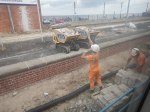
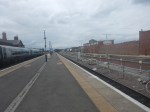
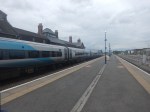
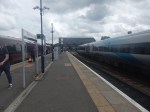
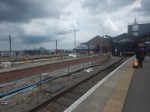
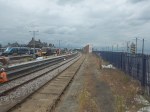
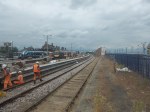
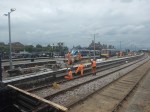
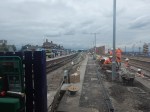
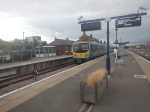
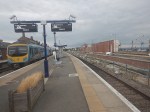
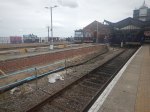
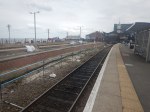
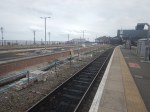
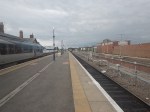
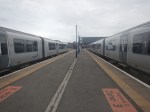
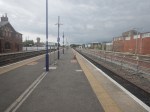
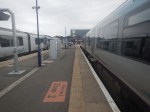
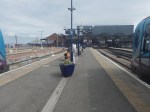
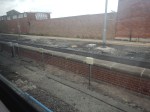
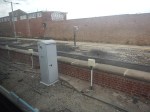
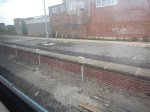
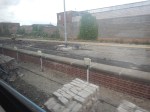
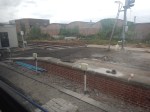
Compare them with this one taken three years ago.
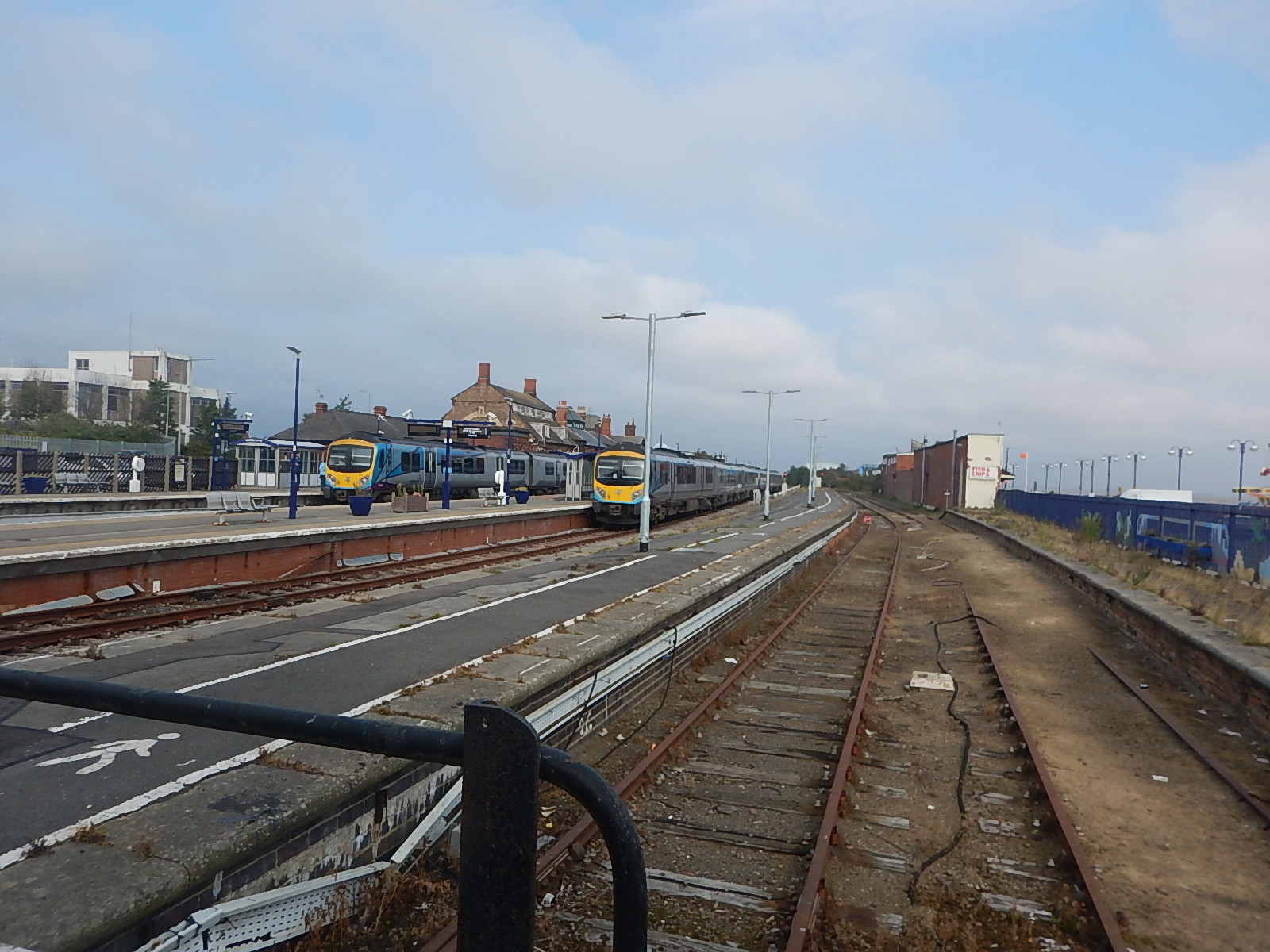
Note.
- It appears a Platform 4 has been created on the seaward side of the station.
- The track in Platform 4 in yesterday’s pictures appears to be newly-ballasted, whereas three years ago it had an air of dereliction.
- There is now a smart blue wooden fence separating the tracks from the station concourse.
- Strangely, the lighting between Platforms 3 and 4 had been installed three years ago.
- There are different types of lighting on the two islands. Could this be because Network Rail are looking for the lights that perform best in a seaside environment?
This Google Map shows Cleethorpes station.
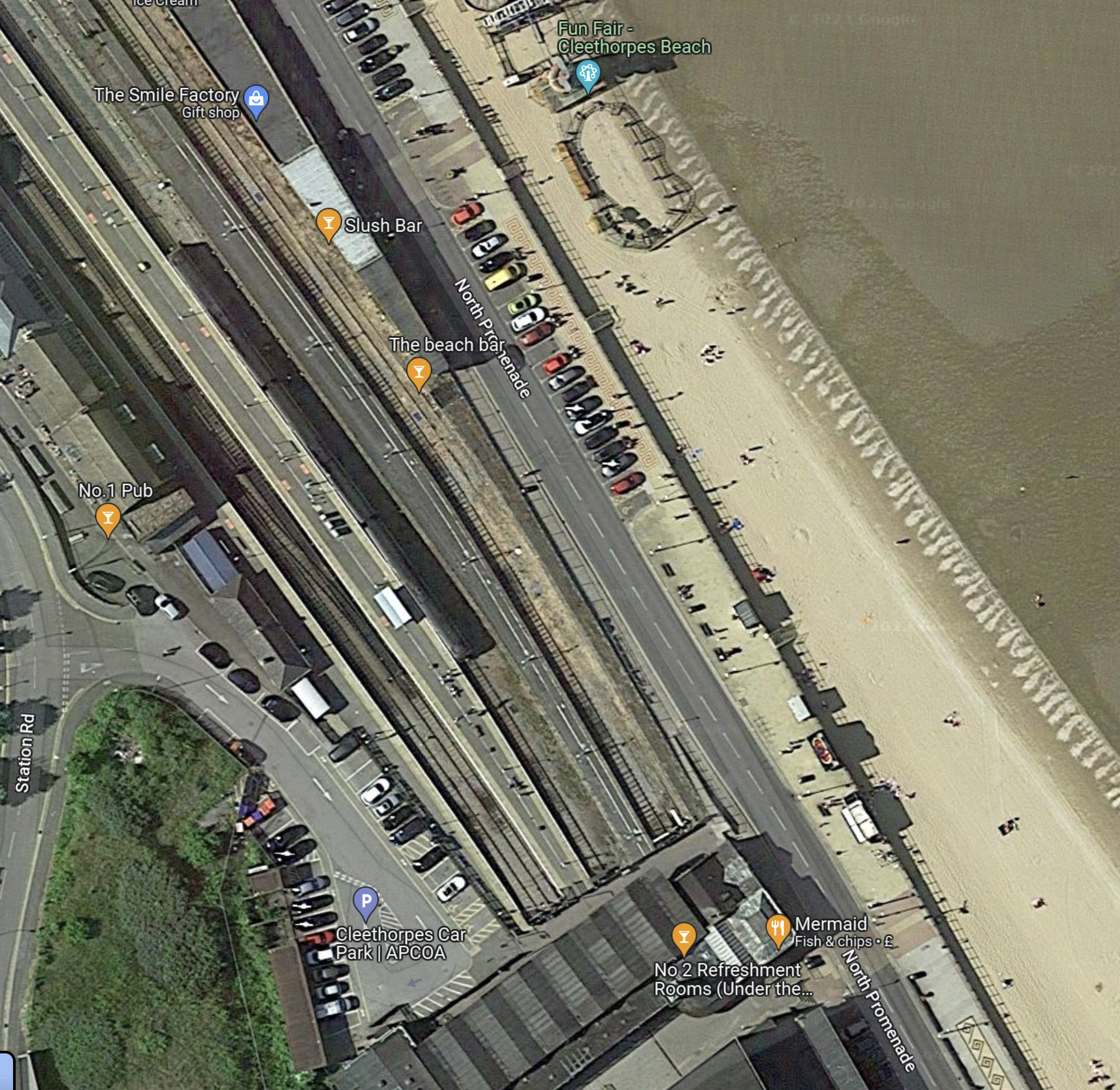
Note.
- The track in Platform 4 appears to be complete.
- The station is very handy for the beach.
In Azuma Test Train Takes To The Tracks As LNER Trials Possible New Route, I said this.
It looks like three platforms 2, 3 and 4 at Cleethorpes station were checked.
I think it is possible to say, that once Network Rail’s brickies and paviours have tidied up, that Cleethorpes station will be LNER-ready and could accept a service from London via Lincoln, Market Rasen, Barnetby and Grimsby Town.
What Will Be The Initial Service Of The London and Cleethorpes Service?
The Wikipedia entry for Cleethorpes station, says this about the London service.
In the 1970s Cleethorpes had a twice daily return service to London King’s Cross, typically hauled by a Class 55 Deltic.
Three people, I spoke to about the possible service, mentioned that two trains per day would be the frequency.
I certainly think, that this frequency, could be a sensible initial frequency.
If it worked in the 1970s, I can see why it might work in the 2020s.
- Kids still like to go to the seaside and the station is close.
- This area of North-East Lincolnshire, is getting increasingly important as an energy and hydrogen powerhouse.
- Cleethorpes station has the space to handle more train services.
- Cleethorpes station has a small depot nearby, which could ease train operations, by stabling a train overnight for an early start in the morning.
But there is one factor that could attract passengers to use the train between King’s Cross and Cleethorpes. I believe that the soon-to-be-announced Hitachi battery-electric Class 800 trains could be able to handle the route without using a drop of fossil fuel.
Running Battery-Electric Class 800 trains Between King’s Cross And Cleethorpes
Consider.
- Cleethorpes and Lincoln is 47.2 miles with three stops.
- Lincoln and Newark Northgate, where the electrification starts is 16.7 files.
- Cleethorpes and Newark Northgate is 63.9 miles, with an out-and-back trip being 127.8 miles.
- Battery-electric trains would do most of their charging between King’s Cross and Newark Northgate.
- Full or partial charging should be possible at both Cleethorpes and Lincoln.
- Battery-electric trains could give help, in cases of catenary failure on the East Coast Main Line.
- In What Will Be The Range Of A Hitachi Class 800 Battery Train?, I said that I believed a Class 800 battery train would eventually have a battery range in excess of the Stadler FLIRT Akku’s 139 miles, as no-one likes being second.
I believe these strategies are possible.
Charge A Round Trip At Cleethorpes
Consider.
- This is a range of just 63.9 miles.
- The service would use Platform 4 at Cleethorpes station.
- Charging at Cleethorpes could be by a short length of overhead electrification in Cleethorpes station or a specialist charger in the small depot.
- Charge time would be around 15 minutes.
- If charging were in the station, there would be no shunting of trains around.
This could be a simple and efficient way to run the service.
A Battery Round Trip To Cleethorpes
- This is a range of 127.8 miles.
- The service would use Platform 4 at Cleethorpes station.
- I believe that this service would need a simple charger at Cleethorpes station, as trains do get delayed and these delays on a battery-electric train, may increase the need for charging.
- Also what would happen in Grimsby Town were at home to a London club in the FA Cup?
This could be a reliable way to run the service, but I believe drivers need a charging facility at Cleethorpes as a fail-safe backup.
Electrification Between Grimsby Town And Cleethorpes
In Between Lincoln And Cleethorpes – 28th June 2023, I said this.
3.3 miles between Grimsby Town and Cleethorpes took just ten minutes.
All trains terminating at Cleethorpes would get at least twenty minutes of charging, every time, they turned round at the station.
Much of the route between Grimsby Town and Cleethorpes is only single-track, so this could be a very affordable option.
I don’t think there would be many objectors to electrifying between Grimsby Town and Cleethorpes.
An hourly train would use twenty minutes in ever hour between Grimsby Town and Cleethorpes, it looks like the limit would be three trains per hour terminating at Cleethorpes.
So could the three trains be the following?
- One train to Liverpool Lime Street.
- One train to Lincoln, with alternate trains continuing to Nottingham, Loughborough and Leicester and some trains to Kings Cross.
- One train to Barton-on-Humber.
Note.
- The Liverpool Lime Street train, would use batteries between Grimsby Town and Hazel Grove, which is 101.4 miles.
- A London King’s Cross train, would use batteries between Grimsby Town and Newark Northgate, which is 60.6 miles.
- A Leicester train, could use batteries between Grimsby Town and Leicester, which is 105.3 miles. Nottingham and Grimsby Town is 77.8 miles.
- Leicester and Nottingham services would need electrification at the Western end.
- King;s Cross, Leicester and Nottingham services would be arranged so Lincoln and Cleethorpes was an hourly service.
- A Barton-on-Humber train, would use batteries between Grimsby Town and Barton-on-Humber , which is 19.6 miles or 39.2 miles for a round trip.
Cleethorpes station could be at the centre of its own battery-electric train network, with all trains powered by just 3.3 miles of single-track electrification.
Between Lincoln And Cleethorpes – 28th June 2023
I arrived at Lincoln at 1200 and had expected, there would be a train to Grimsby and Cleethorpes in a few minutes.
Wrong!
I had to wait until 13:32 for a train to Grimsby, where I changed for Cleethorpes.
The 43.9 miles between Lincoln and Grimsby Town took 53 minutes.
The 3.3 miles between Grimsby Town and Cleethorpes took just ten minutes.
Note.
The Grimsby Town and Lincoln train only stops at Market Rasen, Barnetby and Habrough.
The Cleethorpes-bound change at Grimsby Town station includes a climb over a bridge without lifts.
The Lincoln-bound change is at least a walk-though to an adjacent platform.
There is a friendly cafe on the Cleethorpes-bound platform.
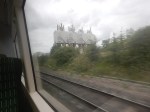
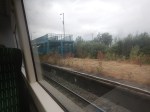
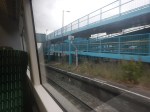
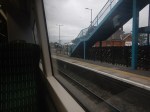
I took these pictures on the trip to Cleethorpes.


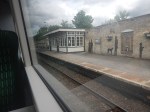
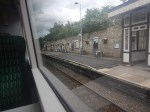
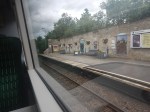



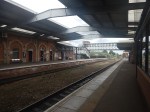
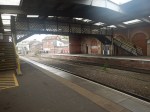
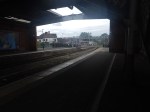
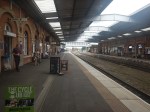
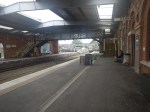
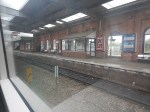
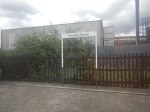
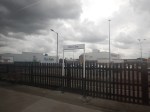
And these were taken on the way back.



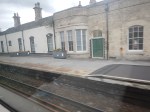
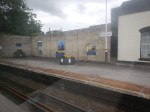
Note.
- There are around forty level crossings on the route.
- The three stations that will be used by LNER; Market Rasen, Barnetby and Grimsby Town, all appear to be in reasonable condition.
- Market Rasen has Harrington Humps.
- Barnetby station has zone markers and an amazing step-free bridge.
- The maximum speed of the line appears to be 75 mph.
The track appeared to be in good condition and the Class 170 train was rolling along at a good speed.
These are my thoughts on improving the route.
More Trains Between Lincoln And Cleethorpes
Speaking to an East Midlands Railway conductor, it was obvious she felt more trains were needed between Lincoln and Cleethorpes.
As Skegness gets an hourly train from Nottingham, I would feel, that it is not unreasonable that Cleethorpes had an hourly train from Lincoln and perhaps one train per two hours (tp2h) from Leicester, Loughborough and Nottingham.
The Leicester, Loughborough and Nottingham service is already at 1 tp2h level with a change at Grimsby Town.
A Blue Peter-Style Repair To A Train Window
My train between Lincoln and Peterborough was delayed by a broken window.
These pictures show how it was repaired.

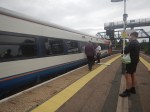
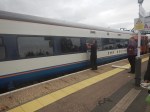
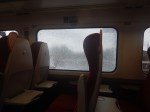
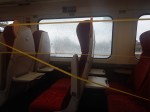
Obviously someone spent their childhood watching Blue Peter.
It’s amazing what you can do with sticky-back plastic and yellow tape.
Azuma Test Train Takes To The Tracks As LNER Trials Possible New Route
The title of this post, is the same as that of this article on Rail Technology Magazine.
This is the first paragraph.
London North Eastern Railway (LNER) completed a test run from Cleethorpes in Lincolnshire and London King’s Cross, with the view to operating a direct service in the future.
These two paragraphs describe how the tests were carried out.
A first test train travelled from Doncaster on 26 June which called at Grimsby Town, Cleethorpes, Barnetby and Market Rasen. At each station, a series of platform and train validations were performed to ensure that a service could be compatible in the future.
On the journey itself, a specialist team travelled onboard, carried out a number of checks and assessments which is required for any potential new route or extension. A detailed assessment was undertaken. The findings will now be reviewed by the stakeholders.
The test run was in four sections.
- 5Q80 – Departed Doncaster Carr Lane Depot at 0817 and arrived Cleethorpes Platform 4 at 1000.
- 5Q81 – Departed Cleethorpes Platform 3 at 1054 and arrived Lincoln Central Platform 5 at 1219.
- 5Q82 – Departed Lincoln Central Platform 5 at 1226 and arrived Cleethorpes Platform 2 at 1355.
- 5Q83 – Departed Cleethorpes Platform 2 at 1528 and arrived Doncaster Carr Lane Depot at 1654.
Note.
- These details came from Real Time Trains.
- It looks like three platforms 2, 3 and 4 at Cleethorpes station were checked.
- The route between Cleethorpes and Lincoln Central was checked both ways.
- The route between Doncaster Carr Lane Depot and Cleethorpes was checked both ways.
- Typically, each station stop took around 10-12 minutes, which probably gave adequate time for the specialist team to make their checks and assessments.
- Class 800 trains run six times a day between Lincoln Central and King’s Cross, so I must assume that section is well-checked and has the correct clearances.
- Lincoln Central station is 16.7 miles from the electrified East Coast Main Line at Newark Northgate station.
- Cleethorpes station is 52.1 miles from the electrified East Coast Main Line at Doncaster station.
- The distance between Lincoln Central and Cleethorpes stations is 47.2 miles.
- The timing between Lincoln Central and Cleethorpes appears to be just under one hour and thirty minutes.
It looks like a thorough test has been performed.
I have a few thoughts.
Platforms At Cleethorpes Station
According to the Wikipedia entry for Cleethorpes station, the station has three platforms, which are numbered 1, 2 and 3.
These three pictures show Cleethorpes station in 2020.

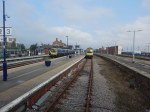
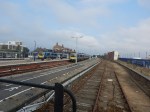
Note.
- The two trains are Class 185 trains of TransPennine Express.
- The train in the left is in Platform 1.
- Platform 2 appears to be empty.
- The train on the right is Platform 3.
I would assume Platform 4 could be the derelict platform shown in the third picture at the right. Or it might be a typo!
But if it is felt that LNER will need their own platform, it would surely be a good idea to do all testing at the same time.
Initial Service Pattern
I would expect that the initial service pattern would follow that used for many new services.
- There will be an early morning train up to London.
- There will be a late afternoon or early evening return train.
Journey time could be around three hours and twenty minutes.
Once the demand is proven, extra trains to and from London might be added in the middle of the day.
Could This Service Be Served By Battery-Electric Class 800 Trains?
From a picture on this article on the BBC, the test run appears to have been carried out by a bi-mode Class 800 train.
The full route from Doncaster to King’s Cross has four sections.
- Doncaster and Cleethorpes – 52.1 miles – Unelectrified
- Cleethorpes and Lincoln Central – 47.2 miles – Unelectrified
- Lincoln Central and Newark Northgate – 16.7 miles – Unelectrified
- Newark Northgate and King’s Cross – 120.1 – Electrified
To go between King’s Cross and Doncaster via Cleethorpes would need a battery-electric train with a range of 116 miles.
In What Will Be The Range Of A Hitachi Class 800 Battery Train?, I came to this conclusion about the battery range of a Class 800 train.
The first version of the battery-electric train will have a range of around a hundred miles, so that they can handle the Great Northern and Great Eastern Joint Line diversion on battery power.
But fairly soon after introduction into service, I will be very surprised if they don’t claim the Guinness world record by running farther than the Stadler FLIRT Akku’s 139 miles.
Note.
- Trains would be charged using the existing electrification of the East Coast Main Line.
- No new infrastructure would be required.
But for service recovery reasons, it could be prudent to add electrification to Platform 4 at Cleethorpes station.
Could TransPennine’s Service Between Doncaster and Cleethorpes Be Served By Battery-Electric Class 802 Trains?
As it is only a round trip of 104.2 miles, I don’t see why this couldn’t be done by say 2028.
Could LNER’s Service Between King’s Cross and Lincoln Be Served By Battery-Electric Class 800 Trains?
As it is only a round trip of only 33.4 miles, this is the easy trip to decarbonise.
Could Greater Anglia Run A Comprehensive Service For East Anglia?
Consider.
- In the last fifty years, there have been direct trains between London Liverpool Street and Lowestoft stations.
- In the last forty years, there have been direct trains between London Liverpool Street and Peterborough stations.
- Greater Anglia currently run an hourly train between London Liverpool Street and Ipswich stations, with stops at Stratford, Shenfield, Chelmsford, Hatfield Peverel, Witham, Kelvedon, Marks Tey, Colchester and Manningtree
- Frequencies on both routes were not high and less than four trains per day (tpd), but they must have been a demand for these services.
- Greater Anglia promised to run a Lowestoft service, when they successfully reapplied for the franchise.
- Greater Anglia have 38 Class 755 trains, of which 14 are three-cars and 24 are four-cars.
- Class 755 trains can run in twoses and possibly threeses. (Suffolk dialect for twins and triplets!)
Could these elements be assembled to provide a comprehensive East Anglia service?
- A pair of Class 755 trains would leave Liverpool Street for Ipswich.
- They would takeover some of the paths of the hourly Liverpool Street and Ipswich service and run possibly about four or five tpd, according to demand.
- Between Liverpool Street and Ipswich the trains could stop at Stratford, Shenfield, Chelmsford, Hatfield Peverel, Witham, Kelvedon, Marks Tey, Colchester and Manningtree
- The services would splitgoing North and join going South at Ipswich
- One train would go to Peterborough with stops at Needham Market, Stowmarket, Elmswell, Thurston, Bury St. Edmunds, Soham, Ely, Manea, March and Whittlesea.
- The other would go to Lowestoft with stops at Woodbridge, Melton, Wickham Market, Saxmundham, Darsham, Halesworth, Brampton, Beccles and Oulton Broad South.
Note.
- The Class 755 trains would use electricity, where electrification exists.
- They would use diesel on lines without electrification.
- They would be able to hold 100 mph, so wouldn’t delay other trains.
- Seventeen towns would get new direct services to and from London.
- A Class 745 train is 236.6 metres long, whereas a pair of four-car Class 755 trains is only 161.4 metres.
- A three-train formation of Class 755 trains is only 5.5 metres longer than a single Class 745 train.
I am fairly sure no new substantial infrastructure would be required.
I have some further thoughts.
Example Timings
These timings to and from London are based on current timings of the Class 745 and 755 trains.
- Ipswich – 60 mins
- Stowmarket -70 mins
- Bury St. Edmunds – 88 mins
- Soham – 108 mins
- Ely – 117 mins
- March – 136 mins
- Peterborough – 158 mins
- Woodbridge – 75 mins
- Melton – 80 mins
- Wickham Market – 86 mins
- Saxmundham – 97 mins
- Darsham – 104 mins
- Halesworth – 113 mins
- Brampton – 119 mins
- Beccles – 128 mins
- Oulton Broad South – 138 mins
- Lowestoft – 146 mins
Notes.
- Times to and from Ipswich are based on typical services at the current time.
- I have assumed that there are no stops South of Ipswich.
- Saxmundham is the closest station to Sizewell and could be important in bringing in construction workers for Sizewell C.
I think some of the times like those to and from Bury St. Edmunds, Ipswich, Lowestoft, Saxmundham and Woodbridge could create popular routes.
Battery-Electric Trains
Consider.
- I wrote about Stadler’s expertise with battery-electric trains in Stadler FLIRT Akku Battery Train Demonstrates 185km Range.
- 185 km. is 115 miles.
- The Class 756 trains for Transport for Wales are similar trains to the Class 755 trains fitted with batteries.
- In Battery Power Lined Up For ‘755s’, I wrote about plans to put batteries in the Class 755 trains.
These sections of lines are not electrified on the routes I have talked about.
- Haughley Junction and Ely – 38 miles
- Ely and Peterborough – 30.5 miles
- Westerfield and Lowestoft – 38 miles
As there is electrification at Ely, Haughley, Peterborough and Westerfield and South to London, I am fairly certain the route could be run by battery-electric trains.
Electrification To Sizewell C
In the January 2023 Edition of Modern Railways, there is an article, which is entitled Rail Set To Support Sizewell C Construction.
It details how sidings will be built to support the construction, with up to four trains per day (tpd), but the electrification word is not mentioned.
This is surprising to me, as increasingly, big construction projects are being managed to emit as small an amount of carbon as possible. High Speed Two is being built this way and I suspect Rolls-Royce’s SMR design will minimise carbon emissions during manufacture and construction. It will be very surprising if Sizewell C doesn’t follow High Speed Two’s example. After all, it may be an isolated site, but in Sizewell B, it’s got one of the UK’s biggest carbon-free electricity generators a couple of hundred metres away.
The writer of the Modern Railways article, thinks an opportunity is being missed.
I feel the following should be done.
- Improve and electrify the East Suffolk Line between Ipswich and Saxmundham Junction.
- Electrify the Aldeburgh Branch Line and the sidings to support the construction or agree to use battery-electric or hydrogen zero-carbon locomotives.
One of the collateral benefits of electrifying from Ipswich to Saxmundham Junction, is that it will make it easier for battery-electric Class 755 trains to work Ipswich and Lowestoft services.
- If the trains were to leave Saxmundham Junction going North with a full battery, they should be able to travel to Lowestoft and return.
- Battery-electric Class 755 trains could bring in workers from Ipswich or Lowestoft and further afield.
- It could even leave behind a zero-carbon branch line to Sizewell, Leiston and Aldeburgh, with two tph to Ipswich.
Sizewell C could be a superb demonstration project for low-carbon construction!
The Lowestoft-Great Yarmouth Conurbation
The Wikipedia entry for Lowestoft says this about the town.
The estimated population in the built-up area exceeds 70,000. Its development grew with the fishing industry and as a seaside resort with wide sandy beaches. As fishing declined, oil and gas exploitation in the North Sea in the 1960s took over. While these too have declined, Lowestoft is becoming a regional centre of the renewable energy industry.
Whilst the Wikipedia entry for Great Yarmouth says this about the town.
Great Yarmouth, often called Yarmouth, is a seaside town and unparished area in, and the main administrative centre of, the Borough of Great Yarmouth in Norfolk, England; it straddles the River Yare and is located 20 miles (30 km) east of Norwich. A population of 38,693 in the 2011 Census made it Norfolk’s third most populous. Its fishing industry, mainly for herring, shrank after the mid-20th century and has all but ended.[3] North Sea oil from the 1960s supplied an oil-rig industry that services offshore natural gas rigs; more recently, offshore wind power and other renewable energy industries have ensued.
Wikipedia also said this about the population of the wider Great Yarmouth.
The wider Great Yarmouth borough had a population of around 92,500, which increased to 97,277 at the 2011 census.
Taken together they are one of the largest conurbations in East Anglia.
The main means of transport between the two towns is by road.
Surely, two towns of over 70,000 people, who are only a few miles apart need a rail connection.
Onward From Lowestoft To Great Yarmouth
If the comprehensive East Anglia service, I’m discussing is to be truly comprehensive, it must serve the Norfolk Broads and Great Yarmouth.
This would also improve the connectivity between two of the largest coastal towns in East Anglia, that I indicated in the last section.
This OpenRailwayMap shows a cunning plan proposed by Network Rail to connect Lowestoft and Great Yarmouth.
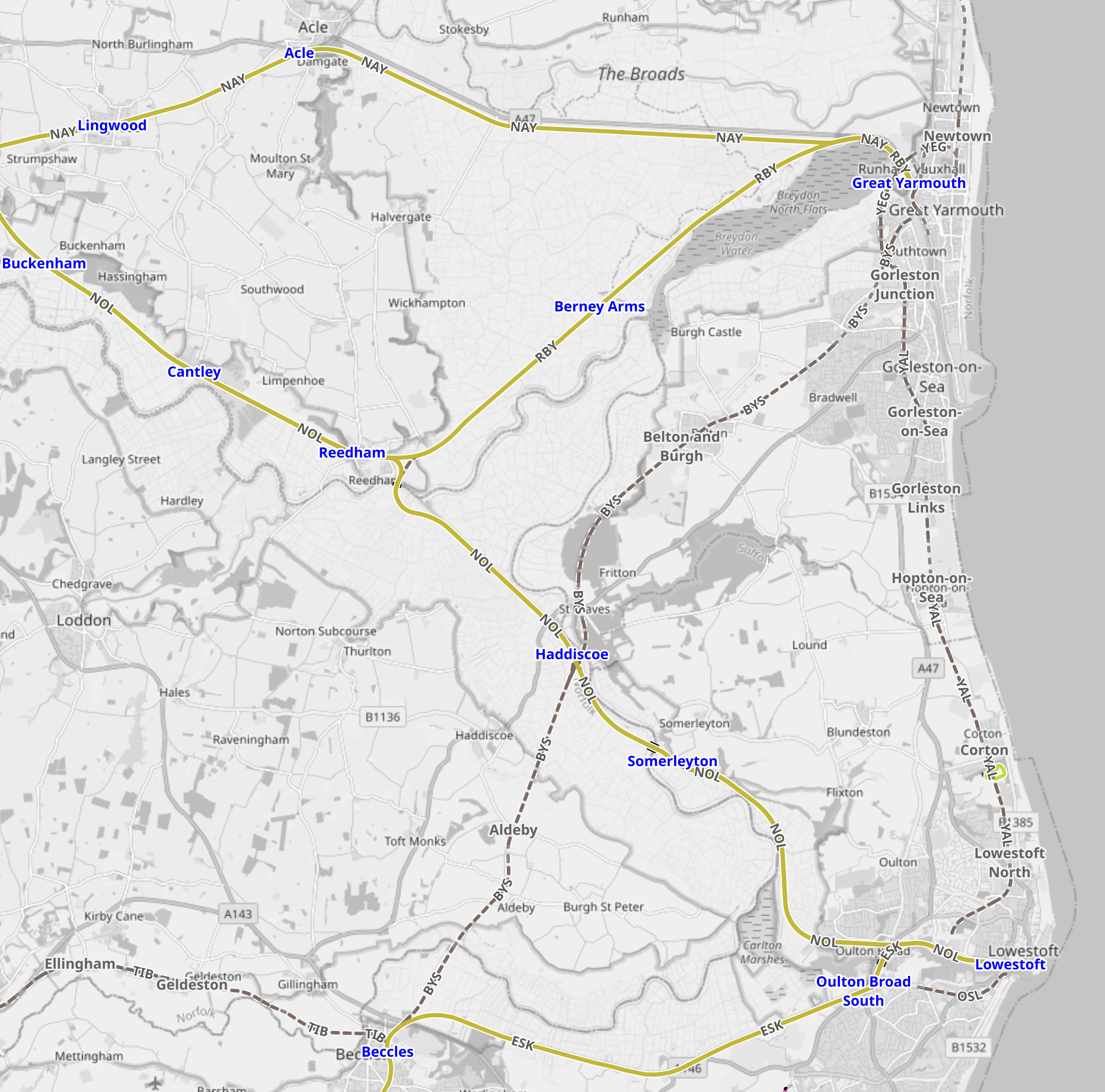
Note.
- Great Yarmouth is in the North East corner of the map.
- Two lines lead West from Great Yarmouth station, with the more Northerly route going direct to Norwich and the more Southerly one going to Norwich via Berney Arms and Reedham.
- Lowestoft is in the South East corner of the map.
- Two lines lead West from Lowestoft station, with the Northern route going to Norwich via Reedham and the Southern one going to Ipswich via Oulton Broad South.
- The route of a coastal railway connecting the two towns is also shown.
Network Rail’s cunning plan is indicated on this second nap from OpenRailwayMap.
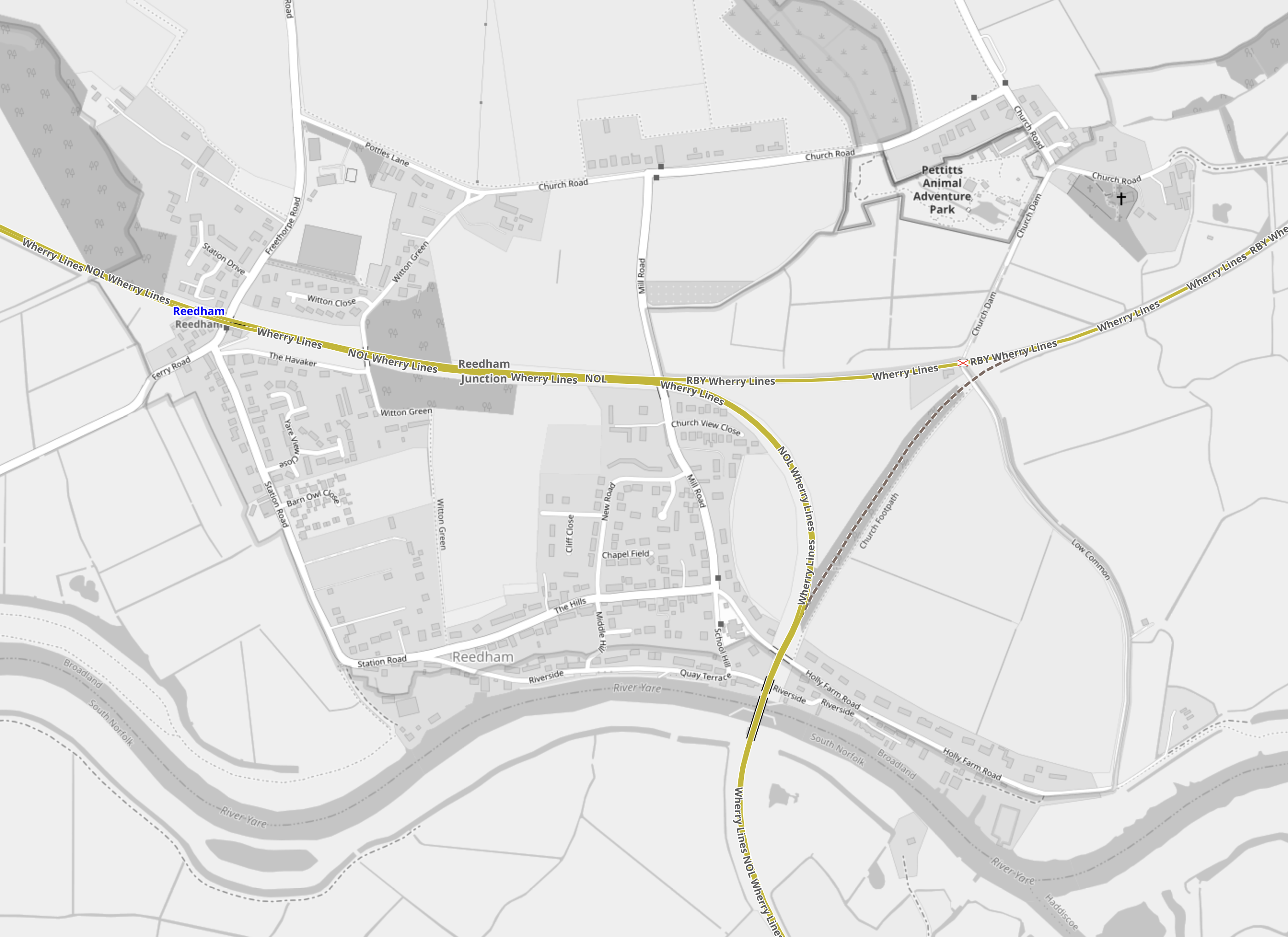
Note.
- Reedham station is in the North-West corner of the map on the line to Norwich.
- To the East of the station is a triangular junction.
- The track from the North-East corner of the junction is the line to Great Yarmouth.
- The track from the Southern corner of the junction is the line to Lowestoft.
- Unfortunately, the South-Eastern leg of the junction was removed in 1880.
In Norfolk Rail Line To Remain Closed As £68m Upgrade Project Overruns, I said this.
Network Rail are talking about reinstating the Reedham Chord to create a more direct route between East Anglia’s largest North-Eastern towns. This is said about the Reedham Chord in Direct Yarmouth Services in the Wikipedia entry for Lowestoft station.
In January 2015, a Network Rail study proposed the reintroduction of direct services between Lowestoft and Yarmouth by reinstating a spur at Reedham. Services could once again travel between two East Coast towns, with an estimated journey time of 33 minutes, via a reconstructed 34-chain (680 m) north-to-south arm of the former triangular junction at Reedham, which had been removed in c. 1880. The plans also involve relocating Reedham station nearer the junction, an idea which attracted criticism.
This sounds a good plan to me.
- It would allow direct services between Lowestoft and Great Yarmouth.
- It would allow direct services between Ipswich and Great Yarmouth with a reverse at Lowestoft in about two hours.
- With possible charging at Lowestoft and/or Great Yarmouth, a scenic route could be created between Ipswich and Norwich for battery-electric Class 755 trains. If that doesn’t get people out of their cars then nothing will!
- Various leisure, tourism and work-related opportunities would be created.
Never in the field of railway engineering would such a small chord have given so much.
Sizewell C Issues
Sizewell C will be a massive project and I also suspect that like High Speed Two, it will be built in a manner that will be zero-carbon where possible.
We already know from the Modern Railways article, that four tpd will shuttle material to a number of sidings close to the site. This is a good start.
Since Sizewell A opened, trains have regularly served the Sizewell site to bring in and take out nuclear material. These occasional trains go via Ipswich and in the last couple of years have generally been hauled by Class 88 electro-diesel locomotives.
It would be reasonable to assume that the Sizewell C sidings will be served in the same manner.
But the route between Westerfield Junction and Ipswich station is becoming increasingly busy with the following services.
- Greater Anglia’s London and Norwich services
- Greater Anglia’s Ipswich and Cambridge services
- Greater Anglia’s Ipswich and Felixstowe services
- Greater Anglia’s Ipswich and Lowestoft services
- Greater Anglia’s Ipswich and Peterborough services
- Freight services serving the Port of Felixstowe, which are expected to increase significantly in forthcoming years.
But the Modern Railways article says this about Saxmundham junction.
Saxmundham junction, where the branch meets the main line, will be relaid on a slightly revised alignment, retaining the existing layout but with full signalling giving three routes from the junction protecting signal on the Down East Suffolk line and two in the Down direction on the bidirectional Up East Suffolk line. Trap points will be installed on the branch to protect the main line, with the exit signal having routes to both running lines.
Does the comprehensive signalling mean that a freight train can enter or leave the Sizewell sidings to or from either the busy Ipswich or the quieter Lowestoft direction in a very safe manner?
I’m no expert on signalling, but I think it does.
- A train coming from the Lowestoft direction needing to enter the sidings would go past Saxmundham junction on the Up line. Once clear of the junction, it would stop and reverse into the branch.
- A train coming from the Ipswich direction needing to enter the sidings would approach in the wrong direction on the Up line and go straight into the branch.
- A train leaving the sidings in the Lowestoft direction would exit from the branch and take the Up line until it became single track. The train would then stop and reverse on to the Down line and take this all the way to Lowestoft.
- A train leaving the sidings in the Ipswich direction would exit from the branch and take the Up line all the way to Ipswich.
There would need to be ability to move the locomotive from one end to the other inside the Sizewell site or perhaps these trains could be run with a locomotive on both ends.
The advantage of being able to run freight trains between Sizewell and Lowestoft becomes obvious, when you look at this Google Map, which shows the Port of Lowestoft.
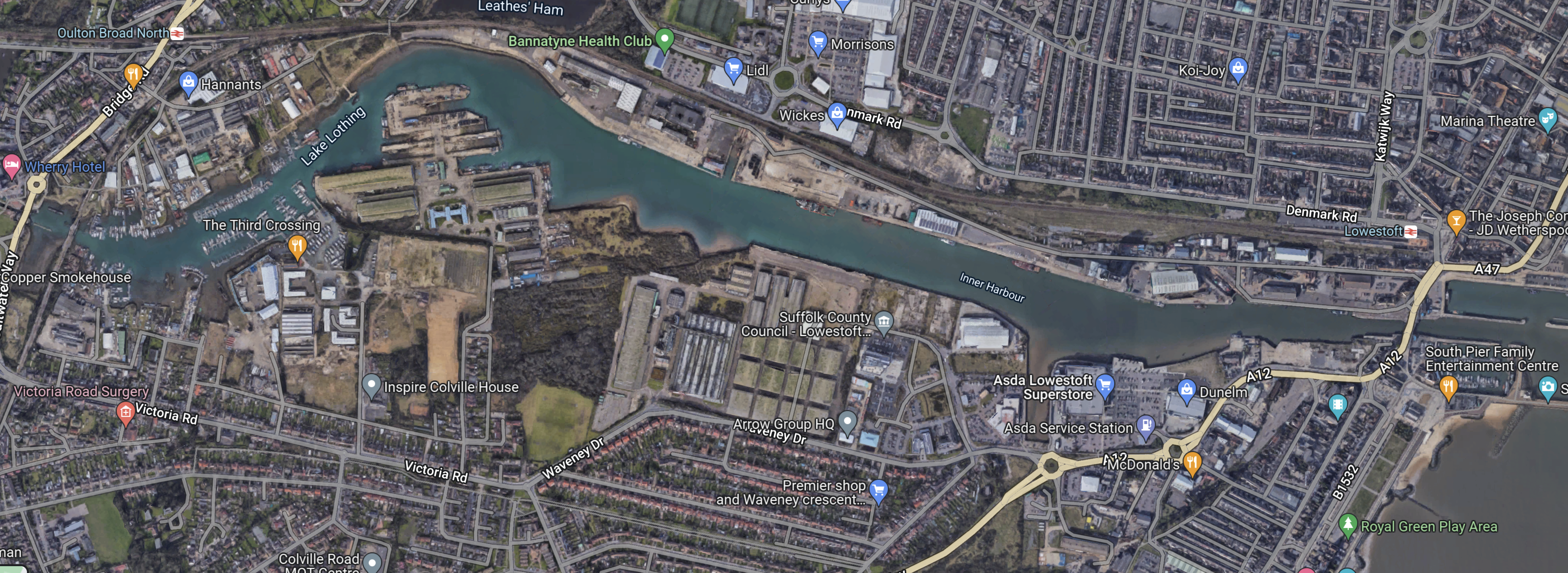
Note.
- The Inner Harbour of the Port of Lowestoft.
- The East Suffolk Line running East-West to the North of the Inner Harbour.
- Lowestoft station at the East side of the map.
I doubt it would be the most difficult or expensive of projects to build a small freight terminal on the North side of the Inner Harbour.
I suspect that the easiest way to bring the material needed to build the power station to Sizewell would be to do the following.
- Deliver it to the Port of Lowestoft by ship.
- Tranship to a suitable shuttle train for the journey to the Sizewell sidings.
- I estimate that the distance is only about 25 miles and a battery or hydrogen locomotive will surely be available in the UK in the next few years, that will be able to provide the motive power for the return journey.
In The TruckTrain, I wrote about a revolutionary freight concept, that could be ideal for the Sizewell freight shuttle.
Great Yarmouth Racecourse
Great Yarmouth Racecourse is one of my favourite racecourses and I believe it is one of the attractions in Great Yarmouth, that would benefit from an improved rail service between Lowestoft and Great Yarmouth, as it would almost double those with efficient public transport access to the racecourse.
The walking distance between Great Yarmouth station and the racecourse is walkable for many and I remember doing it since C died.
With the train connection to Lowestoft and perhaps a courtesy bus from the station, I wouldn’t be surprised to see that a Lowestoft-Yarmouth rail connection being very good for the racecourse. Especially as road traffic between the two towns can be not the best.
Finishing At Norwich
There are operational reasons to carry on to Norwich, where Crown Point, is the home base for the Class 755 trains.
But it would also link a lot of places that are dependant on tourism and are also heavily involved in East Anglia’s energy industry.
Onward From Peterborough To Lincoln
If the Lowestoft service can extend to Great Yarmouth, an extension of the Peterborough service to Lincoln via Spalding and Sleaford might be possible.
But with LNER also serving Lincoln from Kings Cross, I doubt the route would carry many passengers to and from London.
Conclusion
A service from London, that splits into two trains at Ipswich for Lowestoft and Peterborough has possibilities.
Avanti West Coast Looks To Recover
The title of this post is the same as an article in the March 2022 Edition of Modern Railways.
These are some points from the article.
Passengers Numbers Are Recovering
This is a paragraph.
Mr. Wittingham says the recovery has been strongest on the Anglo-Scottish and Liverpool corridors, while Manchester have begun to bounce back. Slowest to recover is the London to West Midlands market; ‘there’s several operators here and we were the main carrier of business passengers, and that sector has been recovering more slowly than leisure’ says Mr. Whittingham.
Phil Whittingham is MD of Avanti West Coast.
Train Numbers Are Recovering
Avanti are building up train numbers from Euston after the pandemic.
Frequencies are as follows in trains per hour (tph)
- Pre-Covid – 9
- During the pandemic – 4
- From December 2021 – 7
- Omicron – 4
- From February 2022 – 6
- From May 2022 – 6+
Avanti have reacted to demand.
Three Classes Of Travel
This is a paragraph.
Avanti’s business has historically been driven by leisure travel – before Covid this accounted for broadly 60 % of passengers, with most of the rest travelling for business plus a smaller number of commuters. ‘The demand is there, and we think by next year we’ll be on the way to full recovery’ says Mr. Whittingham. ‘Leisure has been strong, especially at weekends, but the missing bit is the corporate market.’
Avanti have been running a marketing campaign and it appears to have been successful.
This paragraph describes Avanti’s new Standard Premium class.
Last year, Avanti West Coast launched a new class of travel – Standard Premium. This was first introduced in May on an upgrade-only basis before going fully live in September with the option to book online in advance. The new class sits between Standard and First, giving passengers larger seats and greater space but without some of the extras that come with First Class Travel such as complimentary refreshments and lounge access.
These are Mr. Whittingham’s comments on the three classes.
The current split of passengers is 84% Standard, 12 % First and 4 % Standard Premium, but given the latter has been in place for less than a year there is clearly scope for growth. ‘Our research shows people have been upgrading to Standard Premium rather than downgrading from First’.
I have yet to try Standard Premium, but I will next time I use Avanti.
Refreshments
Avanti have decided to serve different refreshments in Standard Premium and First classes.
- In Standard Premium, they are now offering At Seat Orders.
- In First, they have updated the menu.
Both seem to have been well-received.
I like this statement from Mr. Whittingham.
We’ve tried to make it a more personalised service with a less rigid structure, so we give customers what they want, when they want it, rather than when we want to give it to them.
A Consistent Offer
This is a paragraph.
Mr. Whittingham says Avanti has not yet confirmed whether t will offer three classes of travel on the new Hitachi trains it has ordered, but says the aim is to provide a more consistent offer. Assisting this will be changes in the ongoing Pendolino refurbishment, where 11-car sets are having Coach G converted from First to Standard accommodation, meaning all Pendolinos, whether nine-car or 11-car, will have three coaches for First and Standard Premium passengers.
My instinct says that the four trains will be something like.
- Class 390 train – Pendolino – Nine-car – three First/Standard Premium cars – six Standard cars
- Class 390 train – Pendolino – Eleven-car – three First/Standard Premium cars – eight Standard cars
- Class 805 train – Hitachi – Five-car – one First/Standard Premium car – four Standard cars
- Class 807 train – Hitachi – Seven-car – two First/Standard Premium car – five Standard cars
Note.
- The Class 805 and Class 807 Hitachi trains are very much plug-and-play and can be lengthened or shortened as required.
- A regular passenger between London and Liverpool, who regularly upgrades from Standard to Standard Premium in a Class 390 train could be a bit miffed if he couldn’t, because the service was being run by a Class 807 train.
- Hitachi would probably be very happy to add extra cars to the Class 805 and Class 807 trains.
As the Class 390 Pendolino trains are being refurbished, I do wonder if they will be receiving some fittings from the Hitachi trains to make sure the trains are consistent to both on-board staff and passengers.
Pendolino Investment
The Pendolino refurbishment is comprehensive.
- It is one of the largest such programmes ever undertaken in the UK.
- Leasing company; Angel Trains are funding the work.
- Alstom are doing the work at Widnes.
- There appears to be a smooth plan to refurbish all trains.
- Coach G will be converted from First to Standard accommodation in eleven-car trains.
- Mr. Whittingham says that all trains will come out looking like a new train.
The eleven-car trains are being converted first, as the conversion of Coach G gives a capacity benefit of around thirty seats.
The awful seats in Standard Class will be replaced with Lumo-style seats and laptop-friendly fold-down tables.

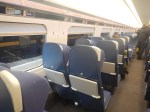
These seats will be a big improvement!
New Trains Coming
This paragraph introduces the new trains.
The second major fleet investment from Avanti is the £350 million for new trains from Hitachi, financed by Rock Rail. These comprise 13×5-car Class 805 bi-modes, ordered for destinations off the electrified route including North Wales and Shrewsbury and 10×7-car Class 807 electrics. Deployment plans for the latter are still being worked through but are likely to include services to Birmingham and Liverpool, and potentially to Blackpool.
What is not said in this paragraph, is that all trains have a redesigned front end, which I suspect is more aerodynamic.
The all-electric Class 807 trains have no diesel engines or batteries, so have they been put on a diet, to improve the acceleration?
In Will Avanti West Coast’s New Trains Be Able To Achieve London Euston and Liverpool Lime Street In Two Hours?, I came to these conclusions.
- A two hour service between London Euston and Liverpool Lime Street will be possible with Avanti West Coast’s new Class 807 trains.
- The current Class 390 trains could go a bit faster and if they cut out a couple of stops could probably break two hours.
I also calculated that a two tph service between London and Liverpool in two hours would need nine trains.
Timetable Changes
This paragraph introduces the article’s section on timetable changes.
The project in turn feeds into a major timetable change planned by Avanti and other West Coast main line operators. This will be the first significant change to West Coast main line schedules since 2008; ‘the world has changed, and we need to think about how we best serve our markets’ says Mr Whittingham.
This paragraph sums up the major changes.
Of note are the planned changes to the pattern of London to West Midlands services; the pre-Covid 20-minute interval would be amended to offer faster journey times and greater connectivity. Also featuring in the new timetable aspirations would be additional Trent Valley calls in some Liverpool and Manchester services; Mr Whittingham cites as one benefit of this the potential for improved journey times between the North West and the East Midlands via a change of train at Nuneaton. The Hitachi trains, with their better acceleration, will be particularly useful on services with more frequent stops.
The next three sections will look at some timetable changes in a bit more detail.
London And West Midlands Services
Replacement of twenty diesel Class 221 trains with thirteen bi-mode Class 805 trains will mean a major reorganisation of services to the West Midlands.
- Some current diesel services will now be electric.
- All services between Birmingham New Street and Euston will now be electric.
- No services will run on diesel under live electrification.
- Avanti have promised to serve Walsall.
- There will be extra services to Shrewsbury and other places.
The electric services will also speed up some services to the West Midlands.
North West And East Midlands Services
I will look at train times for services between the North West (Liverpool Lime Street and Manchester Piccadilly) and the East Midlands (Leicester, Nottingham and Lincoln), where passengers change at Nuneaton.
These are the current fastest possible times according to the National Rail journey planner.
- Liverpool Lime Street and Leicester -2:24 with changes at Crewe and Nuneaton,
- Manchester Piccadilly and Leicester – 2:11 with change at Sheffield
- Liverpool Lime Street and Nottingham – 2:42 with no changes
- Manchester Piccadilly and Nottingham – 1:51 with no changes
- Liverpool Lime Street and Lincoln- 3:42 with changes at Sheffield and Doncaster
- Manchester Piccadilly and Lincoln – 2:38 with change at Sheffield
Note that times are in hours:minutes.
These are all current times for the various legs if the route is via Nuneaton.
- Avanti West Coast – Liverpool Lime Street and Nuneaton – 1:18
- Avanti West Coast – Manchester Piccadilly and Nuneaton – 1:13
- CrossCountry – Nuneaton and Leicester – 0:27
- East Midlands Railway – Leicester and Nottingham – 0:48 – Time from Leicester and Lincoln service.
- East Midlands Railway – Leicester and Nottingham – 0:20 – Time from St. Pancras and Nottingham service.
- East Midlands Railway – Leicester and Lincoln -1:42 – Time from Leicester and Lincoln service.
- East Midlands Railway – Nottingham and Lincoln -0:52 – Time from Leicester and Lincoln service.
Note that the two Avanti West Coast times have been estimated by taking the time from Real Time Trains and adding three minutes for the acceleration or deceleration at Nuneaton.
These would be possible times between the North West and the East Midlands via Nuneaton.
- Liverpool Lime Street and Leicester – 1:47
- Manchester Piccadilly and Leicester – 1:42
- Liverpool Lime Street and Nottingham – 2:37
- Manchester Piccadilly and Nottingham – 2:32
- Liverpool Lime Street and Lincoln- 3:31
- Manchester Piccadilly and Lincoln – 3:26
Note that I am assuming changes at Nuneaton and Leicester are cross-platform or same platform changes that take two minutes.
But there is another level of improvement possible.
Suppose that East Midlands Railway’s Lincoln and Leicester service were to be extended to Nuneaton and run by a train with this specification.
- 125 mph operating speed.
- Battery-electric power.
- 100 mph operating speed on battery power.
- Range of 56 miles on battery
- Ability to use the Midland Main Line electrification, when it is erected.
Charging stations would be needed at Nuneaton and Lincoln.
These would be possible times between the North West and the East Midlands via Nuneaton with the one change at Nuneaton.
- Liverpool Lime Street and Leicester – 1:45
- Manchester Piccadilly and Leicester – 1:40
- Liverpool Lime Street and Nottingham – 2:05
- Manchester Piccadilly and Nottingham – 2:00
- Liverpool Lime Street and Lincoln- 2:57
- Manchester Piccadilly and Lincoln – 2:52
Note.
I am assuming that the timings for the Nuneaton and Leicester and the Nottingham and Lincoln legs are as for the current trains.
I am assuming the change at Nuneaton is a cross-platform or same platform change that takes two minutes.
Trains run on battery where tracks are not electrified.
I can build a table of current times, times via Nuneaton and savings.
- Liverpool Lime Street and Leicester -2:24 – 1:45 – 0:39
- Manchester Piccadilly and Leicester – 2:11 – 1:40 – 0.31
- Liverpool Lime Street and Nottingham – 2:42 – 2:05 – 0:37
- Manchester Piccadilly and Nottingham – 1:51 – 2:00 – 0.09 slower
- Liverpool Lime Street and Lincoln- 3:42 – 2:57 – 0.45
- Manchester Piccadilly and Lincoln – 2:38 – 2:52 – 0:14 slower
It does appear that by using the 125 mph speed of the West Coast Main Line has a positive effect on some times from the North West to the East Midlands.
But times could be reduced further.
- Installing full digital signalling, that would enable 140 mph running between Crewe and Nuneaton, could save ten minutes.
- Improving the Nuneaton and Leicester and the Nottingham and Lincoln legs could allow faster running.
The more I look at changing at Nuneaton, I feel it is a good idea.
- It improves the connections between East Midlands Parkway and Loughborough and the North West.
- It improves the connections between Cambridge, Peterborough and Stansted Airport and the North West, if the change at Nuneaton is to CrossCountry’s Stansted Airport and Birmingham New Street service.
- It improves the connections between Coventry and Leamington Spa and the North West.
Avanti have come up with a cunning plan, worthy of Baldrick at his best.
A Second Hourly Service Between London And Liverpool
A paragraph talks about the second hourly service between London and Liverpool.
Avanti still has ambitions to introduce a second hourly service between Euston and Liverpool, but when this will come in will depend on demand recovery.
Consider.
- If would be desirable if some or all trains running on the route could achieve a timing of two hours between London and Liverpool.
- It is felt that the second service should stop at Liverpool South Parkway station, where the platforms are too short for eleven-car Class 390 trains.
- Avanti have stated they would like more stops in the Trent Valley, especially at Nuneaton, where they would connect to services to the East Midlands.
- Nuneaton is almost exactly halfway between London and Liverpool.
- Running two tph with Class 807 trains would need nine trains and Avanti have only ordered ten in total.
I believe that a practical timetable like this could work.
- Class 390 train – one tph – Non-stop or perhaps a single stop in the Midlands – Under two hours
- Class 807 train – one tph – Stopping at Nuneaton, Stafford, Crewe, Runcorn and Liverpool South Parkway – Current time or better
An hourly service between London and Liverpool in under two hours would surely be a passenger magnet.
Should The Great Northern And Great Eastern Joint Line Be Electrified?
The Great Northern And Great Eastern Joint Line was created in the Nineteenth Century by the Great Northern Railway and the Great Eastern Railway.
- The main purpose was to move freight like coal, agricultural products and manufactured goods between Yorkshire and Eastern England.
- It originally ran between Doncaster and Huntington via Gainsborough, Lincoln, Sleaford, Spalding and March.
- It had a full length of almost 123 miles.
- There was a large marshalling yard at Whitemoor near March.
Over the years the line has been pruned a bit and now effectively runs between Doncaster and Peterborough.
- Trains between Lincoln and March are now routed via Peterborough.
- It carries upwards of twenty freight trains per day in both directions through Lincoln Central station.
- Many of the freight trains are going to and from the East Coast ports.
- The distance between Doncaster and Peterborough is 93.7 miles, as opposed to the 79.6 miles on the East Coast Main Line.
- The line is not electrified, but it connects to the electrified East Coast Main Line at both ends.
There have been some important developments in recent years.
2015 Freight Upgrade
Wikipedia says this about the major 2015 freight upgrade.
In 2015 a £280 million upgrade of the Joint Line by Network Rail was substantially complete, enabling two freight trains per hour to be diverted from the congested East Coast Main Line; gauge enhancements to enable the passage of 9 ft 6 in (2.90 m) containers were included in the work.
The Sleaford avoiding line had been substantially downgraded since the 1980s and was reinstated to double track as part of the 2015 scheme. Resignalling and modernisation of level crossings was included.
This means that freight trains have an alternative route, that avoids the East Coast Main Line.
Doncaster iPort
Over the last few years the Doncaster iPort has been developed, which is an intermodal rail terminal.
- It has a size of around 800 acres.
- The site opened in early 2018.
- There is a daily train to the Port of Southampton and two daily trains to both Teesport and Felixstowe.
- The Felixstowe trains would appear to use the Joint Line.
I feel that as the site develops, the Doncaster iPort will generate more traffic on the Joint Line.
This Google Map shows the Doncaster iPort.

There would appear to be plenty of space for expansion.
The Werrington Dive Under
The Werrington Dive Under has been built at a cost of £ 200 million, to remove a bottleneck at the Southern end of the Joint Line, where it connects to the East Coast Main Line.
The Werrington Dive Under was built, so that it could be electrified in the future.
LNER To Lincolnshire
LNER appear to have made a success of a one train per two hours (tp2h) service between London King’s Cross and Lincoln station.
- LNER have stated, that they want to serve Grimsby and Cleethorpes in the North of the county.
- North Lincolnshire is becoming important in supporting the wind energy industry in the North Sea.
- Lincoln is becoming an important university city.
- Several towns in Lincolnshire probably need a service to Peterborough and London.
- In 2019, the Port of Grimsby & Immingham was the largest port in the United Kingdom by tonnage.
I can see an expanded Lincolnshire service from LNER.
Full Digital Signalling Of The East Coast Main Line To The South Of Doncaster
This is happening now and it will have a collateral benefits for the Joint Line.
Most passenger and freight trains will also use the East Coast Main Line, if only for a few miles, which will mean they will need to be fitted for the digital signalling.
This could mean that extending full digital signalling to Lincolnshire will not be a challenging project.
Arguments For Electrification
These are possible arguments for electrification.
Electric Freight Trains To And From The North
It would be another stretch of line, that could accommodate electric freight trains.
An Electrified Diversion Route For East Coast Main Line Expresses
Currently, when there is engineering blockades between Doncaster and Peterborough on the East Coast Main Line, the Hitachi Class 800 and Class 802 trains of Hull Trains and LNER are able to divert using their diesel power.
But the electric trains of LNER and Lumo have to be cancelled.
An electrified diversion route would be welcomed by passengers and train companies.
It would also mean that any trains running from King’s Cross to electrified destinations would not to have any diesel engines.
An Electrified Spine Through Lincolnshire
If there was an electrified spine between Doncaster and Peterborough via Gainsborough, Lincoln, Sleaford and Spalding, these stations would be these distances from the spine.
- Boston – 16.8 miles
- Cleethorpes – 47.2 miles
- Grimsby Town – 43.9 miles
- Market Rasen – 14.8 miles
- Skegness – 40.7 miles
Note.
- These distances are all possible with battery-electric trains.
- Charging would be on the electrified spine and at Skegness and Cleethorpes stations.
All of South Lincolnshire and services to Doncaster would use electric trains.
London Services
London services would be via Spalding and join the East Coast Main Line at Werrington.
- Boston and Skegness would be served from Sleaford, where the train would reverse.
- Market Rasen, Grimsby Town and Cleethorpes would be served from Lincoln, where the train would reverse.
This would enable Cleethorpes and Skegness to have at least four trains per day to and from London King’s Cross.
North Lincolnshire Services
There are two train services in North Lincolnshire.
Cleethorpes and Barton-on-Humber.
Cleethorpes and Manchester Airport via Grimsby Town, Scunthorpe, Doncaster, Sheffield and Manchester Piccadilly.
Note.
- Cleethorpes would need to have a charger or a few miles of electrification, to charge a train from London.
- Doncaster, which is fully electrified is 52.1 miles from Cleethorpes.
- Barton-on-Humber is 22.8 miles from Cleethorpes.
Battery-electric trains should be able to handle both services.
Arguments Against Electrification
The only possible arguments against electrification are the disruption that the installation might cause and the unsightly nature of overhead gantries.
Conclusion
The Great Northern and Great Eastern Joint Line should be electrified.
Rail Minister Officially Opens Werrington Tunnel
The title of this post, is the same as that of this article on Rail Technology Magazine.
This is the first two paragraphs.
Werrington Tunnel, an underground freight tunnel running beneath the East Coast Main Line near Peterborough, has been formally opened by Rail Minister Chris Heaton-Harris.
A key step in the £1.2bn East Coast upgrade, the opening of the tunnel allows for freight services to be ran underneath the main rail artery, significantly improving passenger service reliability on the East Coast Main Line.
I also think, that the tunnel will be used creatively by passenger and freight operators.
Electrification
There is a possibility that the Great Northern and Great Eastern Joint Line (GNGE) between Werrington and Doncaster via Lincoln could be electrified.
- It would allow the many freight trains using the route to be hauled by electric locomotives.
- It would create a by-pass for the East Coast Main Line during engineering works, that could be used as a diversion route by electric trains.
- Werrington and Lincoln are just over fifty miles and might be handled by battery-electric trains, if the GNGE were to be partially electrified.
According to one report, the Werrington Tunnel has been readied for electrification, should that be decided.
An Improved Peterborough And Lincoln Service
In the past, I have travelled between London and Lincoln with a change at Peterborough. In one case, I just missed my connection, as it was a long crowded walk between the two platforms.
The Werrington Tunnel will enable trains to and from Lincoln to use platforms on the West side of Peterborough station.
Train times and platform allocations could be arranged to make connections at Peterborough easier.
A London And Lincoln Service Via Spalding And Sleaford
There are two possible routes between London King’s Cross and Lincoln
- The current LNER service leaves the East Coast Main Line at Newark.
- An alternative route would leave the East Coast Main Line at Peterborough and be routed via the Werrington Tunnel, Spalding and Sleaford.
These notes apply to the alternative route.
- The Lincoln service wouldn’t call at Grantham and Newark.
- Some services could also call at other stations.
- The current hourly Peterborough and Lincoln service via Spalding is run by a Class 153 train , which stops four times and takes fourteen minutes longer than LNER’s service via Newark.
- An easy connection to and from Skegness could be arranged at Spalding,
LNER also plans to extend some Lincoln services to Grimsby Town and Cleethorpes. Timings will dictate which will be the better route.
The Werrington Tunnel would add a large degree of flexibility in routing services between London King’s Cross and Lincoln and Lincolnshire.
Splitting And Joining At Peterborough
If the Werrington Tunnel makes Lincoln timings via Spalding and Sleaford viable, I wonder if it would be possible for trains to split and join at Peterborough.
- One train would go to Lincoln via the Werrington Tunnel, Spalding and Sleaford.
- The other might go North to Bradford, Hull, Middlesbrough, Scarborough or York.
The Werrington Tunnel again adds flexibility.
A Round-The-Wash Service Between Doncaster And Ipswich/Norwich
In Is There A Case For A Round-The-Wash Service Between Doncaster And Ipswich/Norwich?, I suggested this service, which would be an hourly Doncaster and Cambridge service via Scunthorpe, Grimsby Town Cleethorpes, Lincoln, Sleaford, Spalding, Werrington Tunnel and Peterborough that would alternatively extend to Ipswich or Norwich.
The Werrington Tunnel again opens up possibilities.
Conclusion
I’m sure that the Werrington Tunnel and the technology that built it will be imitated elsewhere.
A Special Weekend Timetable Has Been Put In Place For Lincoln Christmas Market
The title of this post, is the same as that of this article on Rail Advent.
This is the first paragraph.
The timetable has been put in place for Lincoln Christmas Market with direct services from Leeds, Newcastle, Edinburgh, Aberdeen and Inverness.
It looks to be a clever piece of planning, whilst work is carried out on the East Coast Main Line between Doncaster and Peterborough.
- Services will be diverted onto the Great Northern and Great Eastern Joint Line though Spalding, Sleaford and Lincoln.
- Will the trains be using the new tracks at the Werrington dive-under.
- Nine-car Class 800 bi-mode trains will be used.
- On the Saturday, there will be two trains per hour (tph) in both directions.
- Of these trains, five trains per day (tpd) in both directions will stop at Lincoln Central station.
It does appear that LNER are making the best of a difficult situation.
Passengers going to Lincoln for the Christmas Market will not be disappointed.
Grand Central Trains
Grand Central Trains are also using the diversion route.
Hull Trains
Hull Trains are also using the diversion route.
On the Saturday, there will be five tpd in both directions.
These can be doubled up to ten-car trains if the demand is there.
Lumo Trains
Lumo trains don’t appear to be running.
Conclusion
Network Rail seem to have done a cunning piece of timetabling.
There’ll be trainspotters galore in the centre of Lincoln.
Middlesbrough To London LNER Trains To Run From 13 December
The title of this post, is the same as that of this article on the BBC.
The title is clear and these paragraphs give details of the train service.
The daily weekday service in each direction will also connect nearby Thornaby with London King’s Cross.
The services will depart Middlesbrough at 07:08 and Thornaby at 07:15, arriving at King’s Cross at 10:22.
Northbound from London will leave at 15:25, stopping at York, to Thornaby at 18:08 and Middlesbrough at 18:18.
This is obviously not a complete service.
- It will be impossible to use direct trains to spend a day on Teesside from London, as I have done many times over the years, usually with a change at Darlington station.
- It needs to run seven days a week.
But as the article says, more work needs to be done at Middlesbrough to turn the trains.
Currently, LNER run one train per two hours (1tp2h) to York, which alternates with a service to Lincoln at the same frequency.
LNER have said, that the Middlesbrough service will be an extension of the York service.
- As York trains can be nine-car trains, this could explain the need for works at Middlesbrough station.
- As York and Middlesbrough are 51 miles and an hour apart, it looks to me, that once Middlesbrough station has been updated, LNER can extend services to Middlesbrough according to passenger demand.
I suspect that eventually, the London and Middlesbrough service will have a similar frequency as the Harrogate and Lincoln services of five trains per day (tpd).
What Real Time Trains Says About The Service
Although it’s exactly four months before the service starts, it has already been entered into Real Time Trains.
The following information is given about the services.
- One seven-minute stop at York going South and a five-minute stop going North.
- Changeover between diesel and electric at Longlands junction, where the Teesside trains leave and join the East Coast Main Line.
- Services do not appear to pass through Northallerton station.
Train times are as given by the BBC.
Splitting And Joining At Newark
I think it would be possible to combine the Lincoln, Middlesbrough and York services into one service.
- A pair of five-car Azumas would run between Kings Cross and Newark North Gate, with stops at Stevenage, Peterborough and Grantham.
- They would split at Newark North Gate station.
- The front train would continue Northwards to Middlesbrough, with stops at Retford, Doncaster, York and Thornaby.
- The rear train would continue Eastwards to Lincoln, with a possible extension to Grimsby Town and Cleethorpes.
Returning South the trains would join at Newark North Gate.
Note.
- As TransPennine Express services to and from Middlesbrough, call at Northallerton, LNER services could do the same.
- As with splitting and joining at Newark, only a five-car train runs to and from Middlesbrough, this could be used before the new platform at Middlesbrough is constructed.
- if this service ran at a frequency of 1tp2h, there would be space in the timetable for a new 1tp2h service to perhaps Newcastle and Edinburgh.
There are a lot of possibilities.
Battery-Electric Trains Between London And Middlesbrough
Only the twenty miles between Northallerton and Middlesbrough on the route are without electrification.
Hitachi have announced the Hitachi Intercity Tri-Mode Battery Train, which is described in this Hitachi infographic.

I believe that a version of this train could be given sufficient battery range to be able to achieve a round trip to Middlesbrough station from the electrification of the East Coast Main Line, without any need for charging at Middlesbrough.
It could be one of the first InterCity services in the world, run by battery-electric trains.
 The Anonymous Widower