Climate Emission Killer: Construction Begins On World’s Biggest Liquid Air Battery
The title of this post, is the same at that of this article in the Guardian.
This is the introductory paragraph.
Construction is beginning on the world’s largest liquid air battery, which will store renewable electricity and reduce carbon emissions from fossil-fuel power plants.
These are a few points from the Guardian and other articles on other web sites, including Wikipedia.
- The size of the battery is 250 MWh.
- It can delivery up to 50 MW of power. which translates to five hours at full power, if the battery is full.
- If it was already working, it would be the ninth biggest battery of all types, except for pumped storage, in the world.
- It will be built at Trafford Energy Park near to Carrington power station.
- It will be double the size of the largest chemical battery, which was built by Tesla in South Australia.
- It is being built by a company call Carlton Highview Storage, which is a joint venture between Carlton Power and Highview Power.
- It should start commercial operation in 2022.
- The installation of the battery is an £85million project.
- The Government have chipped in with a £10million grant.
Some reports say, this could be one of four of Highview Power’s 250 MWh CRYObatteries to be developed by the joint venture.
I will add some observations of my own.
Carrington Power Station
This Google Map shows the site of Carrington Power station.
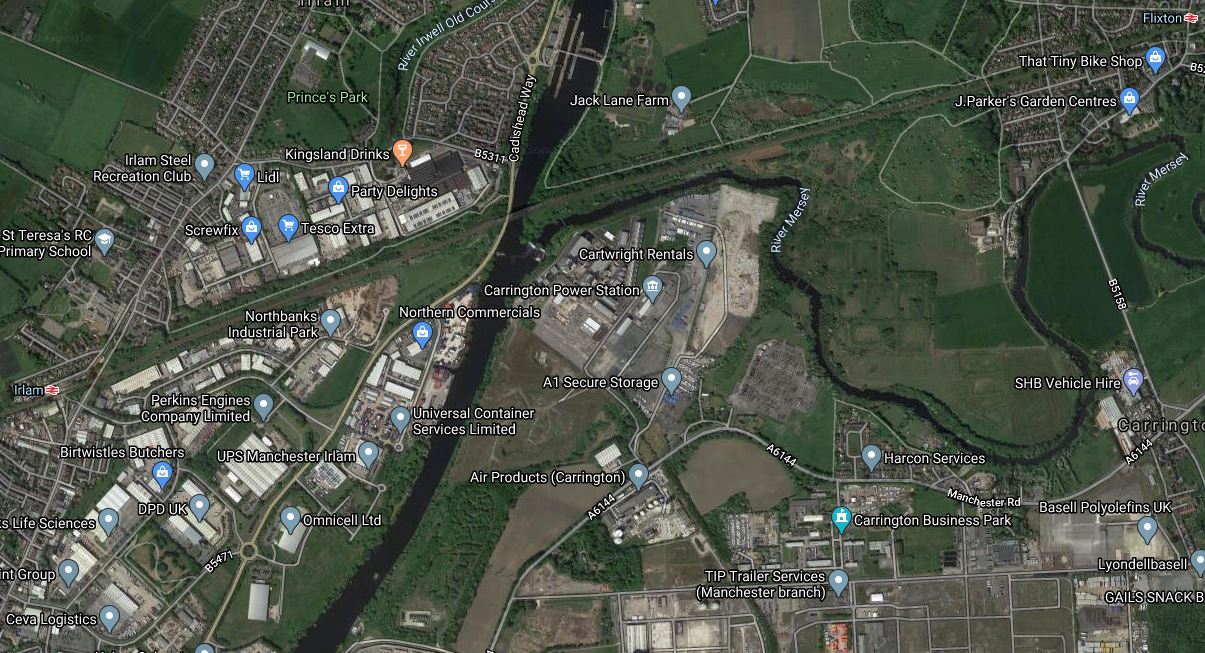
Note.
- Flixton station is in the North-East corner of the map.
- Irlam station is on the Western edge of the map.
- South of the railway between the two stations, there is a large industrial site, that sits in a bend in the River Mersey.
This second Google Map shows an enlargement of the site.
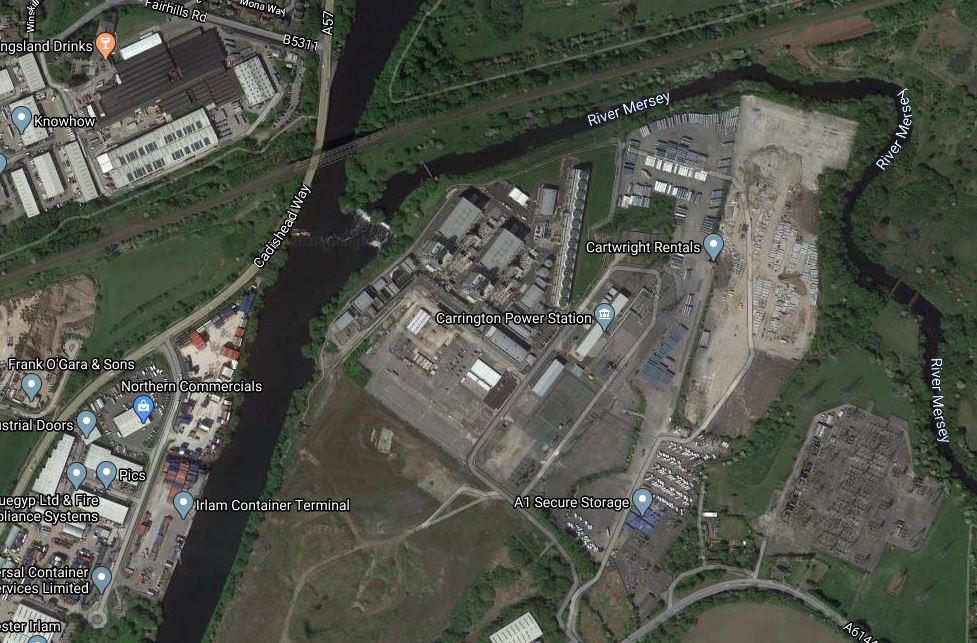
Note.
- Carrington power station in the middle of the site.
- Large amounts of brownfield land.
- The Manchester Ship Canal passing to the West of the site.
Wikipedia says this about the design of Carrington power station.
The station is a Combined-Cycle Power Plant (CCPP), using natural gas to generate 884MW of electricity. The CCPP uses both a gas and a steam turbine together, to produce up to 50 percent more electricity from the same fuel than a traditional simple-cycle plant. The waste heat from the gas turbine is routed to the nearby steam turbine, which generates additional power. Carrington consists of two CCPP KA26-1 units. At operating design conditions, each CCPP unit generates 442.3 MW net output. The station generates enough power to meet the electricity needs of one million homes in the UK and began commercial operation on 18 September 2016.
Wikipedia also says the following.
- The plant has an efficiency of 58%. Is that good for this type of gas-fired Combined Cycle Gas Turbine power station? 64% seems to be about the best but Carrington is better than the about 50% possible with a conventional gas turbine plant.
- Much of the heavy equipment for the power station was brought by barge along the Manchester Ship Canal.
- The station is also a combined heat and power plant, capable of providing nearby businesses with steam, if they require a supply. This could be useful to a Highview Power CRYObattery, as a low-grade heat-source is needed to recovery the stored energy by warming the liquid air.
Given the following.
- There is space available near to the power station.
- A 250 MWh CRYObattery would probably fit in a size smaller than two football pitches.
- Carlton have permission to build another CCGT at the site.
- Carrington has a very good electrical connection to the grid, as nearly all power stations do.
- Heavy components can be brought in by barge on the canal.
, it would appear that the area would be a good place to site the first gr-scale CRYObattery.
Conclusion
I think siting the first grid-scale CRYObattery close to Carrington power station at the Trafford Energy Park, fits together well and I could see more CRYObatteries being installed in the following types of location.
- At existing power stations.
- On the sites of demolished power stations, that still have good grid connections.
- Where interconnectors and power from offshore wind connects to the grid.
I wouldn’t be surprised to see Drax Group install a system at one of their sites, as a CRYObattery could help cut their carbon-emissions.
Greater Manchester Illegal Raves: Man Dies, Woman Raped And Three Stabbed
The title of this post, is the same as that of this article on the BBC.
This is the introductory paragraph.
A 20-year-old man has died, a woman has been raped and three people have been stabbed during two illegal “quarantine raves” that attracted 6,000 people.
What the hell was going on?
There have been some exuberant parties in Hackney Marshes, but they didn’t appear to be the on the scale of the Mancunian troubles.
Last night on Stephen Nolan’s program, there was some very heated debate on what went on in Manchester. Some, who had been present, should have been arrested, if what they alleged they’d done was true.
If you look at total COVID-19 cases in London and the North West on June 15th, they are as follows.
- London 27, 330 – 306.8
- North-West 26,759 – 367
The second figure is a rate per 100,000 of the population. Although the Government data doesn’t give the legend on the chart! Poor presentation again from the Government statisticians!
I have been on public transport a lot in London and the behaviour of passengers seems to follow the rules. Especially, on the Overground, which seems to be busier than the buses and the Underground. Today on a trip out, everybody I saw on public transport was masked!
A Hydrogen Mobility Roadmap For North-West England
In the last few days, the North West Hydrogen Alliance has published a document entitled A Hydrogen Mobility Roadmap.
Some information from a well-written and very informative document.
Vehicle Types Covered In The Roadmap
A composite picture at the start of the document shows the following hydrogen-powered vehicles.
- A double-deck bus.
- A heavy goods vehicle.
- A passenger car.
- A passenger train.
Other vehicles, which exist or are under development, could have been added.
- A refuse truck.
- A high capacity fork lift or dump truck.
- A freight locomotive.
- The availability of hydrogen fuel in an area, must encourage the use of hydrogen-powered vehicles.
Comparison Of Electric And Hydrogen
The document gives a comparison between electric and hydrogen power.
Speed Of Refuelling
- Electric – The current long duration of battery recharges rules out many forms of transport
- Hydrogen – Hydrogen refuelling speed is largely similar to current petrol and diesel fuelling
Distance On Single Charge/Tank
- Electric – At the present time, cars will travel 150-250 miles per charge, but current battery weight means they are unsuitable for HGVs
- Hydrogen – Vehicles can travel 500+ miles on a single tank of hydrogen, which can be scaled up to suit vehicle size
Availability Of Fuel
- Electric – Growing network of charge points, but this is creating problems for power networks
- Hydrogen – Only 12 refuelling stations in the UK
Availability Of Vehicles
- Electric – Various cars to choose from, buses and trains readily available, with HGVs and ships in development
- Hydrogen – Cars, buses and trains largely available. HGVs and ships in development
Note.
- The speed of refuelling and the range for hydrogen.
- The need for more hydrogen refuelling stations.
- Both battery and hydrogen ships are in development.
I think their points are fair.
Road, Rail And Marine
The document discusses the various modes of transport and how hydrogen can help, with respect to both carbon-emissions and pollution.
The Alstom Breeze Trains
This picture is a visualisation of the Alston Breeze.
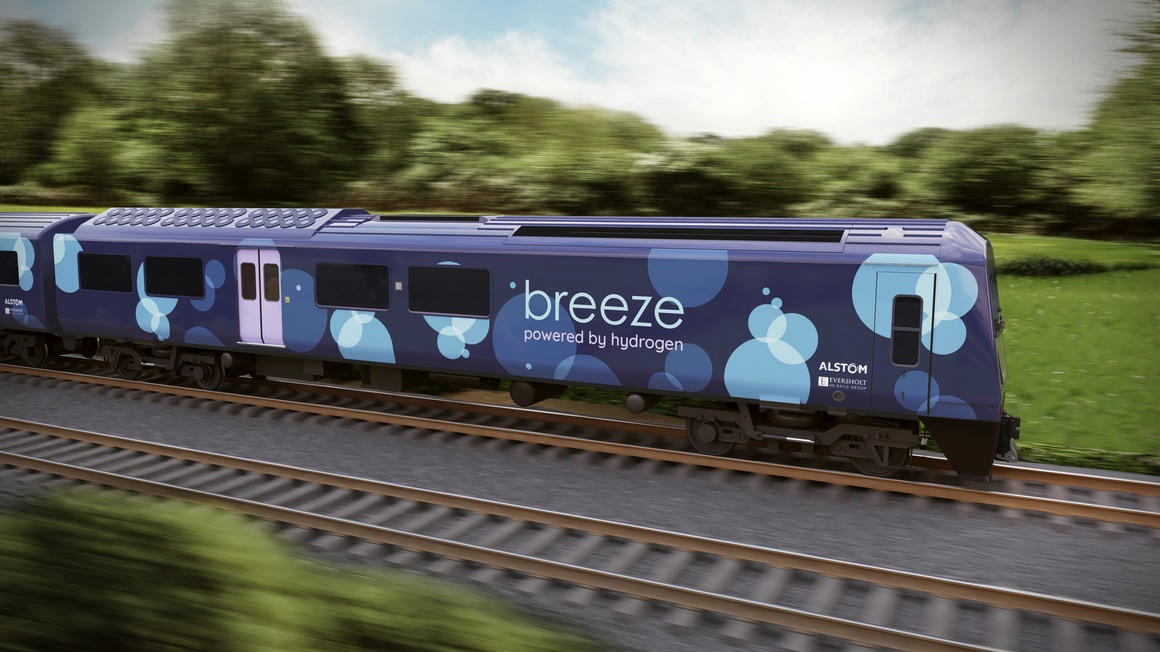
This is said about the Alstom Breeze trains.
Alstom in Widnes is ready to deploy its new Breeze trains and is working with Northern Rail to identify routes that are suitable for conversion to hydrogen.
A map also shows hydrogen train symbols on the Liverpool and Manchester Line, that goes via Widnes and Warrington and conveniently passes the Alstom factory at Widnes.
I wonder, if we’ll see an acceleration of this project?
Consider.
- Northern Rail is now directly controlled by the Government.
- Some Class 321 trains for conversion, will surely be available this summer.
- The updating of the trains, except for the hydrogen system has been developed in the Renatus project.
- Alstom have the experience of the successful hydrogen-powered Alstom Coradia iLint from Germany.
- Supplying the Alstom factory with hydrogen, shouldn’t be too difficult.
- I doubt any extra infrastructure is needed to run the trains.
- Alstom have sold two or three fleets of iLints on the back of a successful introduction into service of two prototype trains.
I don’t think, Alstom and all the various partners and stakeholders would object if the project were to be accelerated.
What’s Already Happening In The North West?
These hydrogen-powered projects are mentioned.
- Twenty double-deck buses for Liverpool City Centre.
- Alstom Breeze trains.
- storengy refuse trucks for Cheshire.
- ULEMCo are converting trucks and ferries.
- Port of Liverpool air quality.
It does seem to be that if you give an area a hydrogen network, possible users will find ways to use it to their advantage.
Rising To The Challenge
This section answers these questions.
Where Will The Hydrogen Come From?
Initially from INEOS at Runcorn, where I used to work around 1970 and BOC at St. Helens.
How Will It Be Transported?
Mainly by innovative use of new and existing pipelines.
How Do We Get To Critical Mass?
It looks like they’ll start slowly with hydrogen from Runcorn and St. Helens and build from there.
I would add a further question.
Will They Be Adding Hydrogen Filling Stations To The Network?
The North West needs them!
Hydrogen Storage
This is said about storing hydrogen.
Geologically, Cheshire is one of the few places in the UK where major underground gas storage in salt caverns has been delivered, paving the way for potential hydrogen storage, which is already done at scale elsewhere.
When I worked at ICI, I was given a tour of one of salt caverns. One is rumoured to be large enough to enable a full-size replica of Salisbury cathedral to be built inside.
Research
This is said about research.
Esteemed universities, and a wealth of innovative research companies, mean the region can deliver new hydrogen technologies. With academia working side-by-side with industry, the North West’s institutions can equip the next generation of skilled workers to support the hydrogen economy.
As a graduatev of one of those esteemed universities, how can I disagree?
Carbon Capture And Storage
This is said about carbon capture and storage.
Offshore reservoirs in the East Irish Sea can store carbon dioxide (CO2) produced from hydrogen production. Carbon Capture Utilisation and Storage (CCUS) is essential technology to help the UK in its fight against climate change. CCUS can capture up to 95% of the CO2 emissions associated with producing hydrogen from natural gas.
Whether you want to produce hydrogen this way is another matter. But the oil refineries and chemical plants along the Mersey are surely prime candidates for CCUS.
An Alliance
Not for nothing is the project called the North West Hydrogen Alliance!
Sixteen partners are mentioned at the end of the document.
Northern Cities And COVID-19
If you look at the official Government statistics for the total number of cases of COVID-19, as of May 3rd, the number of cases in the two major cities in the North West as follows.
- Leeds – 1463 out of a city population of 789,194 (0.18%) and a metro population of 2,638,127 (0.05%)
- Liverpool – 1454 out of a city population of 494,814 (0.29%) and a metro population of 2,241,000 (0.06%)
- Manchester – 1154 out of a city population of 547,627 (0.21%) and a metro population of 3,748,274 (0.03%)
- Newcastle – 939 out of a city population of 300,196 (0.31%) and a metro population of 1,650,000 (0.06%)
- Nottingham – 537 out of a city population of 321,500 (0.17%) and a metro population of 1,610,000 (0.03%)
- Sheffield – 2191 out of a city population of 582,506 (0.38%) and a metro population of 1,569,000 (0.14%)
Note.
- All populations come from Wikipedia.
- Why is Liverpool 40% worse than Manchester?
- Why is Sheffield the worst?
I will add a few smaller towns andcities.
- Blackpool – 465 out of an urban population of 139,720 (0.33%)
- Caldervale – 252 out of an urban population of 200,100 (0.13%)
- Hull – 469 out of a city population of 260,645 (0.18%)
- Middlesbrough – 566 out of an urban population of 174,700 (0.32%)
- Stoke-on-Trent – 509 out of a city population of 255,833 (0.20%)
- York – 315 out of a city population of 209,893 (0.15%)
I’d like to see full statistics plotted on a map or a scatter diagram.
The latter is a very powerful way to plot data and often they highlight data points that lie outside the underlying pattern of the data.
Greater Manchester Police Warning After 660 Parties Shut Down
The title of this post, is the same as that of this article on the BBC.
This is the introductory paragraph.
Greater Manchester Police has warned people not to breach lockdown rules over Easter after it had to break up 660 parties last weekend.
This was also reported.
- There were 1,132 coronavirus-related breaches reported between Saturday and Tuesday.
- Some of the 494 house parties had DJs, fireworks and bouncy castles.
- There were also 166 street parties.
- One woman in Bury was arrested.
The force also had to deal with 122 different groups gathering to play sports, 173 more gatherings in parks and 112 incidents of anti-social behaviour and public disorder.
There have been some similar reports in London, but not on this scale.
So why is it, that Manchester disobeyed the rules so much?
Is it because the BBC is in Manchester and it’s easy to report?
Connecting The North West Of England’s Three Powerhouses
It could reasonably be argued that the three most important economic centres of the North West of England are.
- The City of Liverpool and Merseyside
- Manchester Airport
- The City of Manchester and Greater Manchester
I’ll take a quick look at each, with particular reference to public transport links.
The City of Liverpool and Merseyside
Liverpool is introduced by this paragraph in Wikipedia.
Liverpool is a city and metropolitan borough in Merseyside, England. As of 2018, the population is approximately 494,814. Liverpool is the ninth-largest English district by population, and the largest in Merseyside and the Liverpool City Region. It lies within the United Kingdom’s sixth-most populous urban area. Liverpool’s metropolitan area is the fifth-largest in the United Kingdom, with a population of 2.24 million.
Knowing Liverpool with affection as I do, I find the City difficult to describe in an unbiased manner, but in my experience few people go for a visit to Liverpool and don’t come back enchanted in some way. It is a many-faceted city!
One of Liverpool’s strengths is the local rail system; Merseyrail, which connects the suburbs to the centre, just like the Underground does in London. As with London, Merseyrail is backed up by a comprehensive bus network. And like London, Liverpool is introducing hydrogen-powered double-deck buses.
Merseyrail is also in a strong expansionist phase.
- New trains are being delivered to replace some of the oldest trains on the national network in the UK.
- New stations are being added to the core Merseyrail network.
- Stations are being improved with refurbishment and step-free access.
- Merseyrail have ambitions to expand their network to Liverpool Airport, Preston, Skelmersdale, Warrington and Wrexham.
The City of Liverpool and Merseyside in general are getting ready to expand their economy.
Manchester Airport
This Google Map shows Manchester Airport.

Note.
- The two runways.
- The railway station in the middle of the Airport.
- The M56 motorway passing across the North-West of the Airport.
Manchester Airport is the third-busiest airport in the UK in terms of passenger numbers.
- It is a two-runway airport like Heathrow, which helps a lot in operational efficiency.
- In 2018, it handled 61% of the number of passengers as Gatwick, but 71% of the aircraft movements.
- The airport has three terminals.
- The airport has rail connections to Crewe, Manchester, Northern England, the Central Belt of Scotland and Wales.
- The airport is connected to the trams of the Manchester Metrolink.
I’ve never flown from the airport as a passenger, so I can’t comment.
Wikipedia has a section on the Future of Manchester Airport, which says.
- Terminal 2 will be expanded with fifteen more covered stands,
- The airport will expand to handle more freight.
Airport City Manchester is an £800million expansion to create an airport city on the lines of those at Barcelona and Frankfurt, alongside the airport.
Manchester Airport is certainly building for a future expansion.
Reading about rail links to the airport, you get the impression that some places like Bradford, Derby and Nottingham would like direct links to Manchester Airport.
The City of Manchester and Greater Manchester
Manchester is introduced like this in Wikipedia.
Manchester is a city and metropolitan borough in Greater Manchester, England, with a population of 547,627 as of 2018 (making it the fifth most populous English district). It lies within the United Kingdom’s second-most populous urban area, with a population of 2.5 million and second most populous metropolitan area, with a population of 3.3 million. It is fringed by the Cheshire Plain to the south, the Pennines to the north and east, and an arc of towns with which it forms a continuous conurbation.
I don’t know Manchester as well as I know Liverpool and most of my visits to the City are usually with limited objectives and a possible overnight stay.
Like Liverpool, Manchester has an extensive public transport network based on the trams of the Metrolink and some local railway lines, backed up by lots of buses.
Transport for Greater Manchester is developing the transport network, with a new Metrolink line to the Trafford Centre opening soon.
Note that if Manchester’s rail system has a problem, it is congestion in the Castlefield Corridor through Manchester Piccadilly, Manchester Oxford Road and Deangate stations and on to Manchester Victoria and Salford Crescent stations. A permanent long-term solution is needed.
The City of Manchester and Greater Manchester are getting putting in the necessary transport links to expand their economy.
Connecting The Three Powerhouses
In Changes Signalled For HS2 Route In North, I wrote the following, which I am now repeating in an updated form.
This clip of a map from this Transport for the North report , which is entitled At A Glance – Northern Powerhouse Rail, shows a schematic of the current and possible rail links in the triangle between Crewe, Liverpool and Manchester.

High Speed Two, which is shown in dark green, would appear to come North and split into two routes.
- One continues North to join the existing West Coast Main Line just South of Wigan.
- Another goes through Crewe station.
North of Crewe, the two routes join and then split into three at the Junction labelled 6.
- To Warrington and Liverpool
- To Wigan, Preston and Scotland
- To Manchester Airport and Manchester.
A second Junction labelled 5, allows Northern Powerhouse Rail trains to run Liverpool-Warrington-Manchester Airport-Manchester.
This is a new layout and has the following advantages.
- I estimate that trains could save 7-8 minutes on services running between Crewe and Wigan because of the longer running at High Speed Two operating speeds at 225 mph.
- ,If they don’t stop at Crewe and Runcorn, further minutes could be saved.
- Trains between London and Preston and London and Glasgow could skip the stop at Warrington to save further minutes.
- There could be an advantageous reorganisation of stopping patterns.
- London and Liverpool services and Liverpool and Manchester services could stop at Warrington, which would give Warrington very good connections.
- The Liverpool-Manchester and Liverpool-Crewe Lines could be built to High Speed Two standards, which could allow 225 mph running.
I also think the track layout can be run alongside or underneath the various motorways in the area for a lot of the route between Liverpool, Crewe, Warrington and Manchester Airport.
It would appear to be a very good solution to a complex problem and overall, I suspect it gives better connectivity, at a more affordable cost, whilst creating a railway that can be built with less disruption and will ultimately produce less noise.
The Transport for the North report, also says the following.
- There could be a new Warrington South Parkway station.
- Six tph between Liverpool and Manchester via Warrington are planned.
- Journey times will be 26 minutes.
The Twenty-first Century will finally get a modern and fast Liverpool and Manchester Railway.
- Trains would stop at Manchester Airport, a new Warrington South Parkway and possibly Liverpool South Parkway.
- Trains would run every ten minutes.
- Trains would take 26 minutes between Liverpool and Manchester.
These are a few other thoughts on the route.
The Liverpool Terminus
The Transport for the North report proposes a new High Speed station in Liverpool.
- It would possibly be alongside Liverpool Lime Street station.
- It would handle both High Speed Two and Northern Powerhouse Rail services.
- The station would need at least four platforms.
- The station could be connected to Liverpool Lime Street station’s Wirral Line platform.
I believe that a well-designed station could be squeezed in, on the edge of Liverpool City Centre.
Should Trains Stop At Liverpool South Parkway?
I think this could be important, especially, if the station gets a link to Liverpool Airport.
Between Manchester Airport And Manchester City Centre
Most current trains between Manchester Piccadilly and Manchester Airport stations take between 15-18 minutes.
I don’t believe that these times are compatible with a 26 minute time between Liverpool and Manchester.
So I am fairly certain that to achieve the planned time in the Transport for the North report, that an almost direct tunnel between Manchester Airport and Manchester City Centre is necessary.
The Manchester City Centre Station
Could the tunnel pass through underground platforms at Manchester Piccadilly station, which run across the station and then surface to connect with the chosen route to Leeds?
In an earlier plan, referenced under Manchester City Centre (Phase 2b) in the Wikipedia entry for High Speed Two,, this is said.
The route will continue from the airport into Manchester city centre via a 7.5-mile (12.1 km) twin bore branch tunnel under the dense urban districts of south Manchester before surfacing at Ardwick.
Under the earlier plan, trains would have gone into a rebuilt Manchester Piccadilly station.
I also wonder, if the solution would be to bore a tunnel under Manchester City Centre with stations under Manchester Piccadilly station, Piccadilly Gardens and Manchester Victoria.
- It might be just one set of platforms with travellators, escalators and lifts all over Manchester City Centre.
- It should be noted that two High Speed Two trains, running as a pair would be four hundred metres long.
One of the advantages of a train connection between Manchester Piccadilly and Manchester Victoria station, would be that the Castlefield Corridor would be by-passed.
- TransPennine Express services between Manchester Airport and the North-East would be replaced by Northern Powerhouse Rail services between Liverpool and the North-East via Manchester Airport.
- The Castlefield Corridor would probably be reserved for local services.
- Passengers needing Manchester Oxford Road or Deansgate stations would use the current Manchester Airport station.
There are probably other advantages.
Building The High Speed Liverpool And Manchester Line
I believe that this line can be built without too much disruption to existing services, because Crossrail’s construction didn’t disrupt London.
Conclusion
My overall conclusion is that it is feasible to build a Liverpool and Manchester High Speed Line, as an early part of Northern Powerhouse Rail, that will also be used by High Speed Two, when that is extended to Liverpool and Manchester.
Castlefield Corridor Trade-Off Plan For Fewer Trains
The title of this post is the same as that of this article on Rail Magazine.
The article says that to solve the problems through the Castlefield Corridor, the number of trains will be reduced from 15 trains per hour (tph) to thirteen tph.
This arrangement applied until May 2018 and meant that two tph between Manchester Airport and East of the Pennines reversed in Manchester Piccadilly station to go East, rather than using the Castlefield Corridor through Deansgate and Manchester Victoria stations.
The arrangement worked well before May 2018 and I doubt there’s no reason, why it won’t work in the short-term.
The long-term solution is Northern Powerhouse Rail and/or High Speed Two, which looks like will be in tunnel between the Airport and Manchester City Centre and could carry as many as six tph between Manchester and Liverpool via the Airport.
Perhaps, this should be the first piece of High Speed Two to be built in the North.
- It connects the three most important economic areas in the North West of England; Liverpool, Manchester and Manchester Airport.
- It would greatly increase capacity.
- It would probably have good connections to Crewe, Warrington, Wigan and the West Coast Main Line.
- Liverpool has an extensive local rail network, which is being expanded.
- Manchester is expanding the Metrolink network.
Some of the Castlefield Corridor services would have been replaced by better and faster services.
Rescued By Timpsons
Putting my boots back to go to the Football at around five, one of the laces gave up the ghost.
Timpsons? Surely, they could help.
But I would have to hurry, as it shut at six o’clock. I suppose the good peoiple of Manchester have to get up early to work in the satanic mills, so shops close early.
I eventually found a Timpsons in the Arndale Centre and for a few pounds, I got some new laces.
As the price included fitting, that must be three cheers for Timpsons!
As I left the Arndale Centre, many shops were closing.
Could the decline in High Street sales be partly because opening hours no longer fit the times, when the public now want to shop?
I regularly shop for everyday needs in the evening, if the television is rubbish and will go out for a snack supper to say a Leon or Carluccio’s and then perhaps pop-in to a Marks and Spencer to get food for a few days or perhaps some clothes from Eastfield. Usually shops in Inner London close at nine or ten.
My local M & S foodhall in Dalston, which is shutting at ten tonight, is just two bus stops away.
Perhaps, more people need to live in City Centres to revive them?
Fresh Calls For ‘Missing Link’ Buxton To Matlock Railway Line To Be Reopened
The title of this post is the same as that of an article in the Buxton Advertiser.
I wrote in full about this route in Connecting The Powerhouses, after an article was published in the June 2017 Edition of Modern Railways.
This was my conclusion.
It’s very difficult to find a reason not to reopen the Peak Main Line.
I think in the last two years the case for reopening the Peak Main Line between Buxton and Matlock may have become even stronger.
MEMRAP
A group called the Manchester and East Midlands Rail Action Partnership or MEMRAP has been setup to promote the case for reopening.
A web site has been created.
New Lower-Carbon And Quieter Passenger Trains
Rolling stock has improved and trains like tri-mode Class 755 trains and possible battery electric trains, should be able to handle the route in a more environmentally-friendly way.
Transport Of Building Materials
This is a paragraph from the Buxton Advertiser article.
Funding for the project, according to Mr Greenwood, would come from working in partnership with local quarries which are supplying materials for the new Heathrow Airport runway and are involved with the HS2 project.
Network Rail has already have spent a lot of money to improve freight access to the quarries, as I reported in £14m Peak District Rail Freight Extension Unveiled. So the demand for building materials must be there and going via Matlock would remove some heavy freight trains from the Hope Valley Line.
Heavy freight trains might not be welcomed by all stakeholders.
Possible High Speed Two Cutbacks
As I wrote in Rumours Grow Over Future Of HS2, The Eastern leg of High Speed Two might be axed.
This may or may not change the case for reopening the Peak Main Line.
There Will Be Opposition
This is two paragraphs from the Buxton Advertiser article.
Peak Rail has long campaigned to re-open the line for heritage trains to run between Buxton and Matlock. However, director Paul Tomlinson said he was not in favour of the new plans.
He said: “I’m all in favour raising the profile of the line to get it re-opened but we can’t support this new idea.
Others will also object.
Conclusion
There will be various opposing pressures on both sides of reopening the Peak MNain Line.
In favour will be.
- The quarries.
- Cities like Derby and Nottingham and passengers wanting better links to and from Manchester and its Airport.
- Transport for the North, as opening could increase capacity on the Hope Valley Line between Manchester and Sheffield.
Local interests will want to maintain the status quo.
Network Rail Reveals Detailed £2.9bn Upgrade Plans For TransPennine Route
The title of this post is the same as that of this article on Rail Technology Magazine.
It is planned to be a comprehensive upgrade to the Huddersfield Line that includes.
- Improvement between Huddersfield and Westtown
- Grade separation or a tunnel at Ravensthorpe
- Rebuilding and electrification of eight miles of track.
- Possible doubling the number of tracks from two to four.
- Improved stations at Huddersfield, Deighton, Mirfield and Ravensthorpe.
This project should be a major improvement to the Huddersfield Line.
Here are my thoughts on the upgrade.
Where Is Westtown?
Westtown is a difficult place to find on Google Maps.
This Google Map is the best I can do.
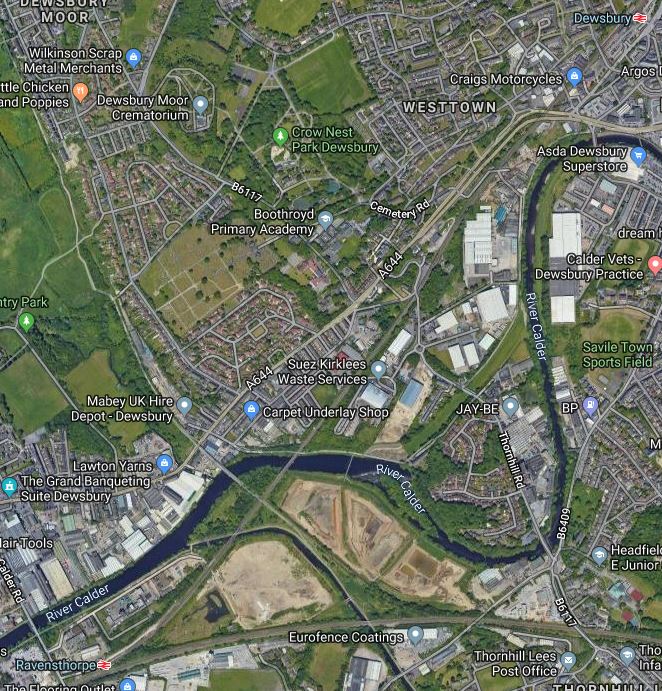
Note that Dewsbury station is at the North-East of the map and Ravensthorpe station is in the South-West corner, with the Huddersfield Line going through both stations.
- To the South-West the line goes to Mirfield, Deighton and Huddersfield.
- To the North-East the line goes to Batley, Morley, Cottingley and Leeds.
Westtown can be seen indicated to the West of the Huddersfield Line, North of the River Calder.
Railways Between Dewsbury And Huddersfield
This map clipped from the Wikipedia entry for the Huddersfield Line, shows the route between Dewsbury and Huddersfield stations.
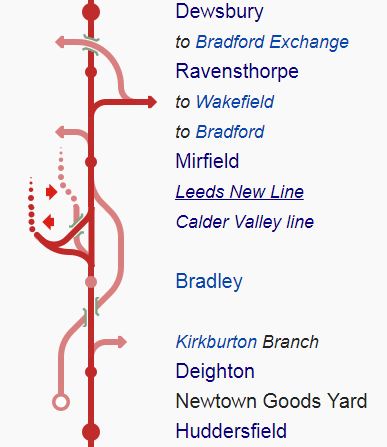
Note the Leeds New Line, which was built by the London and North Eastern Railway and opened in 1900.
It appears to have been closed between 1960 and 1990.
Everybody blames Beeching for the closure of railways, but this closure started before he reported.
But it does seem, that LNER decided that four tracks were needed between Leeds and Huddersfield and that British Railways felt that two was enough.
It now appears that part of the solution to increasing capacity is to create a four-track section of the Huddersfield Line between Huddersfield and Westtown.
We often blame the state of our railways on poor Victorian planning and engineering, but it does appear that they got it right here and British Rail got it wrong, in the 1960s.
A Very Busy Line
If you look at the traffic through Dewsbury station, it is a busy train-spotters paradise, with five scheduled trains per hour (tph) typically stopping at the station and several more passing through.
Four-Tracking Between Huddersfield And Westtown
This is Network Rail’s preferred solution to providing more capacity between Huddersfield and Desbury.
It is not going to be simple engineering all the way.
This Google Map shows the Huddersfield Line crossing the River Calder and the Calder and Hebble Navigation Canal South of Dewsbury station and to the North of Ravensthorpe station.
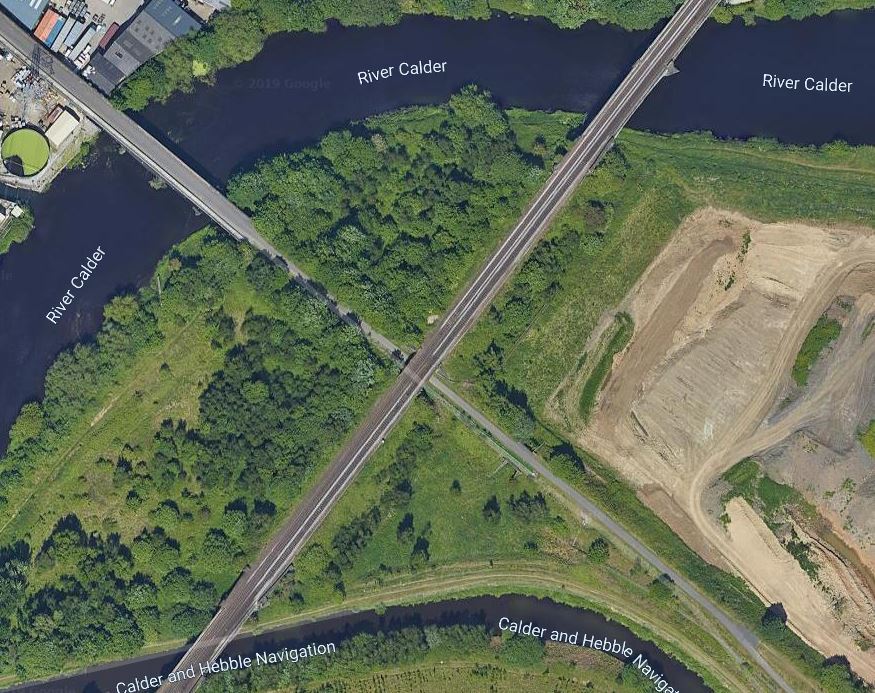
Note the two double-track bridges over the waterways.
This page on Georgraph has a picture of the bridge over the River Calder. It looks an excellent example of a Victorian wrought iron bridge.
Depending on their condition, these might need to be replaced, but they will certainly need to be upgraded to four tracks.
This Google Map shows Ravensthorpe station and the rail lines in the area in more detail.
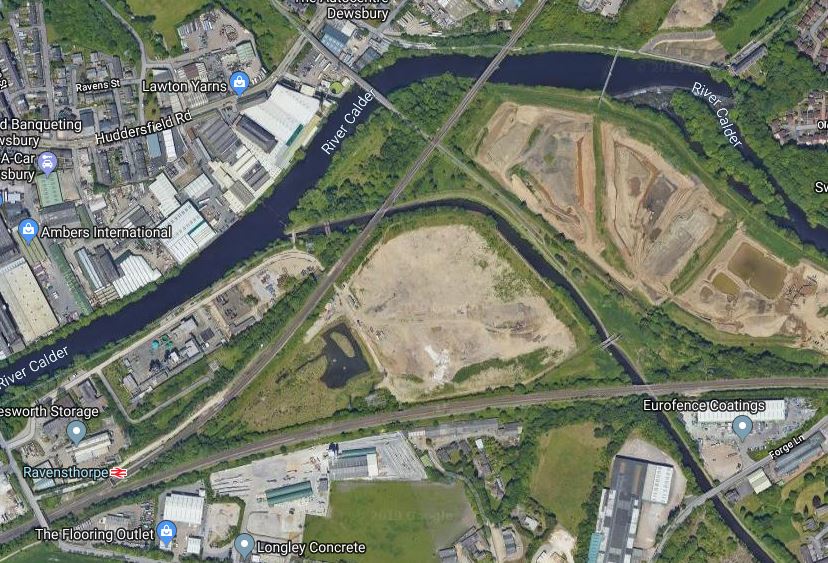
The line going East from Ravensthorpe goes to Wakefield Kirkgate station, although there are no platforms at Ravensthorpe.
The Wikipedia entry for Ravensthorpe station says this.
Ravensthorpe station is adjacent to Thornhill LNW (London North Western) Junction, where a line branches to Wakefield Kirkgate. There are plans to extend the station by building new platforms on this line, which was built by the former Manchester and Leeds Railway.
It looks to me that there are possibilities to rebuild Ravensthorpe station and the lines in the area to meet the following objectives.
- Two fast lines and two slow lines through the station.
- Platforms for Dewbury and Leeds services.
- Platforms for Wakefield Kirkgate services.
- Four tracks to as close to Dewsbury station as possible.
It must help that a lot of the land North of the line to Wakefield Kirkgate, appears to be devoid of buildings.
The engineering would not be difficult, but probably extensive and expensive.
It should be noted that the Werrington Diver Under near Peterborough, which is a similar scale of project, was costed at £200 million.
West of Ravensthorpe station, there appears to be plenty of space to fit in two extra tracks alongside the current pair.
This Google Map shows Ravensthorpe station and the tracks to the West.
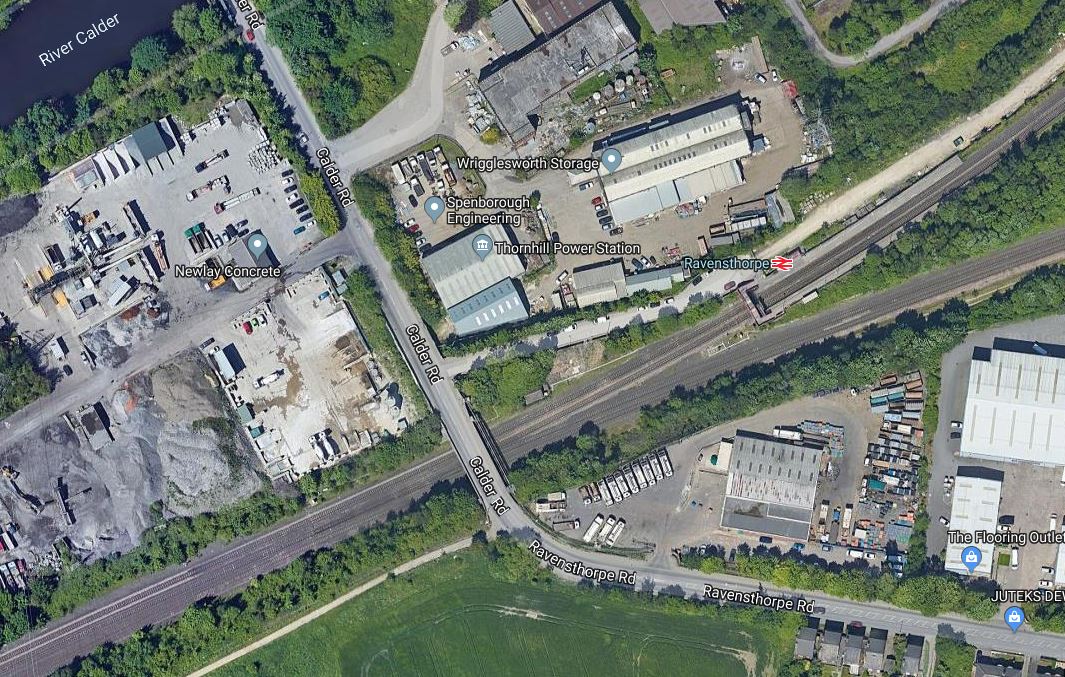
Note that there is space on both sides of the current tracks and a bridge.
But between Ravensthorpe and Mirfield stations, there are at least three more bridges.
This Google Map shows Mirfield station and the tracks to the West.
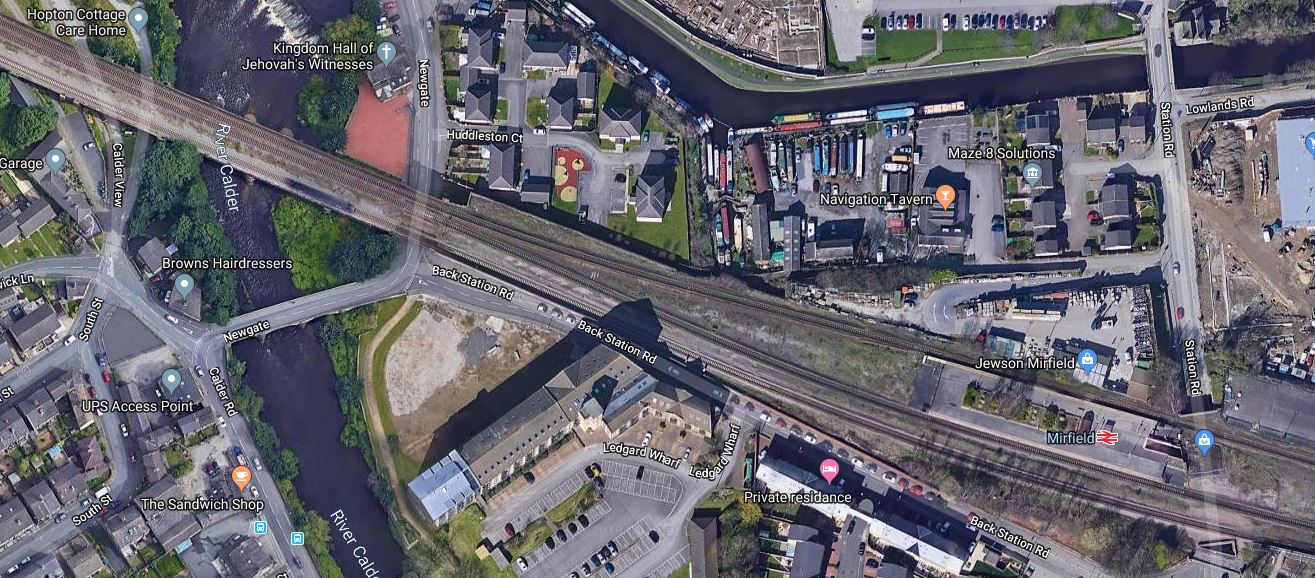
There could be problems adding extra tracks here.
- The track and platform layout is unusual.
- There may be a lack of space at the station.
But the biggest problem will probably be four-tracking the bridge over the River Calder.
This Google Map shows the bridge in more detail.
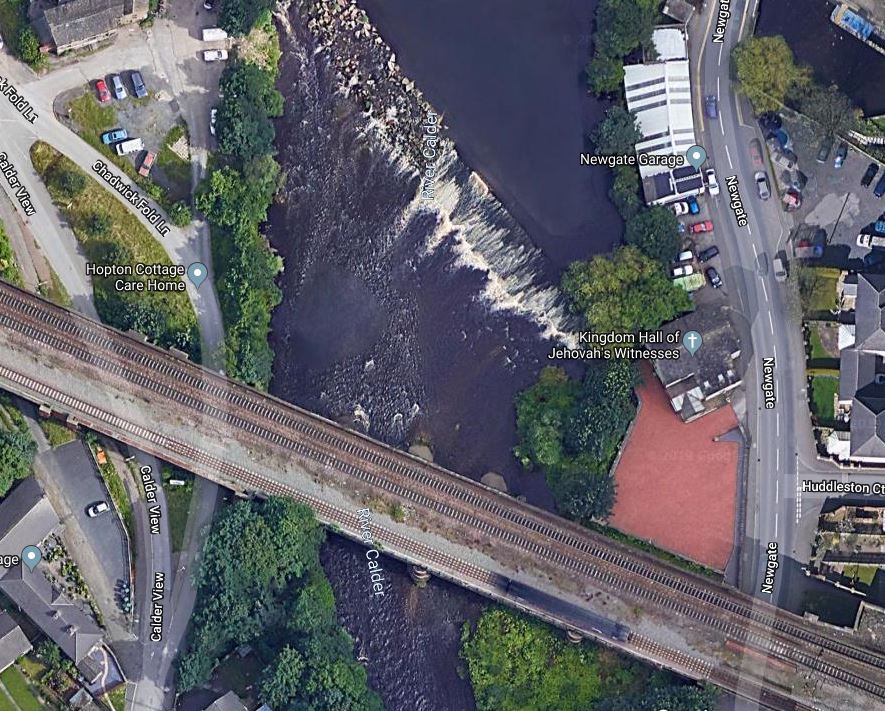
It does appear that the bridge currently has three tracks and might have at some time had four tracks.
If the two extra tracks could be added to this bridge, it would probably be heroic engineering at a high cost, given the difficulty of the site.
But I think engineers have replaced similar bridges on UK railways in recent years.
After Mirfield, the tracks take a wide loop to the North to go to Deighton station.
The tracks were probably built to follow the contours above the River Calder, so hopefully despite the terrain, they could be fairly level.
This Google Map shows the tracks through Deighton station.
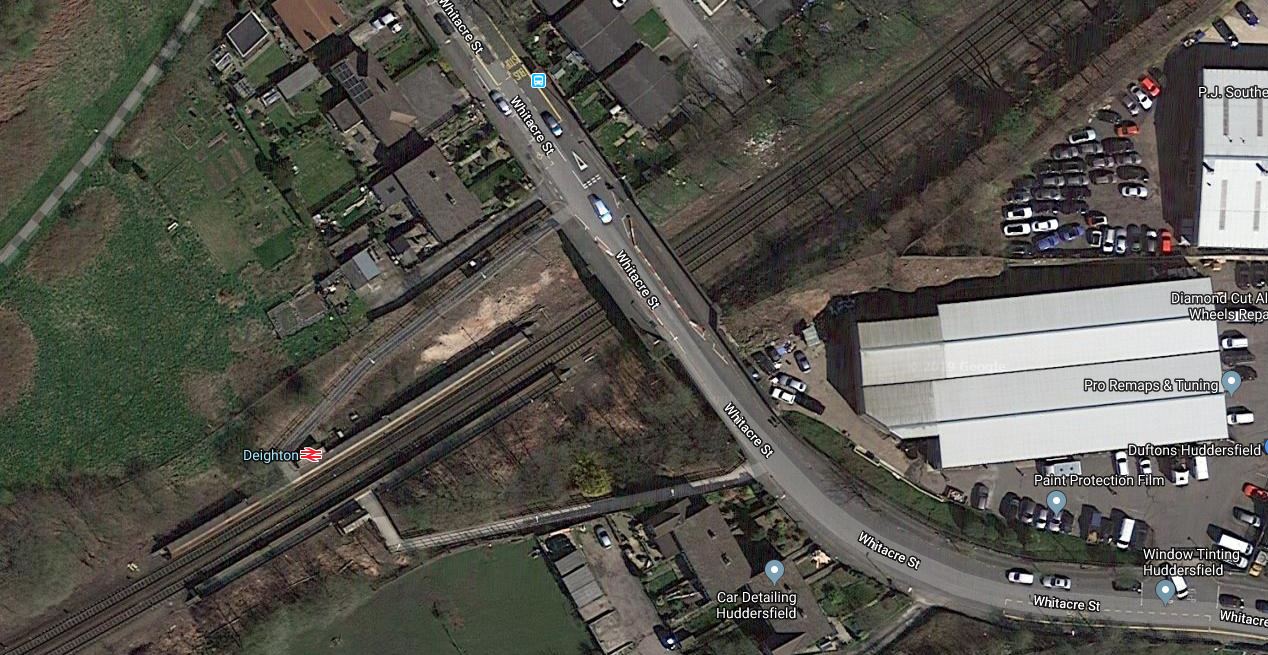
It certainly looks that there should be room for two extra tracks.
Between Deighton and Huddersfield stations, it would appear that four-tracking would be as easy as any part of the route.
Looking at the stations from the air from my helicopter (i.e. Google Maps), I suspect that one way to four-track the line would be to proceed in something like this way.
- Rebuild and four-track the bridge over the River Calder at Mirfield station.
- Build the junction and the bridges to the North-East of Ravensthorpe station.
- Create a pair of fast lines on the South side of the current tracks.
- Move all traffic onto these new fast lines.
- Rebuild the existing railway and the stations.
There may be a need for replacement buses, whilst the stations are rebuilt, but hopefully through services could continue.
Electrification
The Rail Technology Magazine opens with this paragraph.
Major station upgrades and plans to rebuild and electrify an 8-mile stretch of track have been put forward by Network Rail as part of a public consultation on a major upgrade to the TransPennine route.
As it is eight miles between Huddersfield and Dewsbury stations, it would seem likely that the electrification will stretch between the two stations.
This would enable TransPennine Express’s Class 802 trains to switch between electric and diesel power in the stations, if this is preferred by the operator.
Line Speed
The eight miles section of track will never have a particularly high speed, given the not very straight route and the terrain.
Currently, trains that stop at both Huddersfield and Dewsbury stations take eight minutes for the trip. Even trains going at speed through both stations seem no faster.
Four-tracking will surely allow fast expresses to pass local services and freight trains, but will the improvement save much time?
If trains could average 100 mph between Huddersfield and Dewsbury, just over three minutes could be saved.
Station Upgrades
The three stations between Huddersfield and Dewbury will all be upgraded, as will Hudderfield station.
The three smaller stations will probably be rebuilt as four platform stations or two platform stations with two through lines for fast services.
In Huddersfield And High Speed Two, I showed several pictures of Huddersfield station.
- It will not be easy to upgrade to a full four-track station.
- There are three through tracks and some bay platforms.
The two main through platforms are on the South side of the station, so if the two fast lines were on the South side of the route between Huddersfield and Ravensthorpe, this could enable an efficient station at Huddersfield.
I also think, there could be a problem at Huddersfield station, with trains to Sheffield on the Penistone Line, if more and faster trains were going through the station.
A New Timetable
I suspect that, if and when the upgrade is finished, that a new timetable will be brought in.
A possibility could be. that TransPennine Express trains run non-stop between Huddersfield and Leeds.
Now that Northern are getting new trains, perhaps these could run a Turn-Up-And-Go service of a train every fifteen minutes between Huddersfield and Leeds.
Heritage Issues
Huddersfield station is a Grade I Listed building and I suspect that the three bridges I have noted are lListed as well.
Will the Heritage lobby object to electrification in these sensitive areas?
Onward To Manchester
I have flown my helicopter between Huddersfield and Stalybridge and if the proposed improvement is successful, I suspect that the route to the West can be improved as far as Stalybridge.
- The route is at least double track.
- It looks like in places, it once had more tracks.
- The trackside margins are fairly generous.
- There doesn’t seem to be too many bridges.
- Electrification will soon be as far as Stalybridge from Manchester.
After my quick look, I don’t think that electrifying between Huddersfield and Manchester would be too challenging, except for possibly, the Standedge Tunnel.
Onward To Leeds
The route between Dewsbury and Leeds is double track, with the only complication of the Morley Tunnel.
Conclusion
It looks to me, that all the difficult bits to creation of an electrified route between Manchester and Leeds via the Huddersfield Line, are in the stretch between Huddersfield and Dewsbury.
So perhaps it makes sense to sort out the difficult bits first, with this £2.9billion project.

