Edinburgh Waverley Masterplan
The title of this post, is the same as that of this page on the Network Rail web site.
This is the sub-title.
Creating A Vision For The Future Of Waverley Station.
Edinburgh Waverley station has improved it, in the near forty years, I’ve used it, but future growth in traffic will mean more capacity and further improvements will be needed.
The page on the Network Rail web site links to a pdf file, which lays out current thinking, which will go forward for consultation and creation of the final design.
If this results in stations as good as London Bridge and Kings Cross in London, Edinburgh will have the gateway station, that it needs.
Special Train Offers A Strong Case For Reopening Fawley Line
The title of this post is the same as that of an article in Issue 911 of Rail Magazine.
This is the opening paragraph.
On July 28, a South Western Railway train ran along the Fawley Branch Line. to make the case for reopening to passenger services after a 54-year gap.
On board were the Rail Minister; Chris Heaton-Harris, Network Rail Chairman; Sir Peter Hendy, Managing Director of South Western Railway; Mark Hopwood and Lord Montagu of Beulieu.
The article reports the trip and fills in more of the details, that make more sense of my sketchy post called Reintroduction Of Passenger Rail Services On The Waterside Line.
These are some points from the article.
The Infrastructure Needs Updating
This is a quote from the article.
The route has a line speed of 30 mph, with lower speed restrictions at level crossings, some of which are still hand-operated. Semaphore signals operated from by mechanical levers from Marchwood remain in use. A token is given to the driver to allow the train to run towards Fawley. All this would require updating.
Elsewhere the article says there are ten level crossings.
Housing Is The Game Changer
This is another quote from the article.
The big change is urban sprawl. In the half century since passenger services ended, housing estates for thousands of people have been built alongside the line. mostly for commuters into Southampton and the surrounding conurbation.
Up to 5,000 further new homes are planned, including an all-new small town on the site of the former Fawley power station on the southern tip of Southampton Water. Planning permission for at least 1,300 homes was granted the very evening before the Fawley train ran.
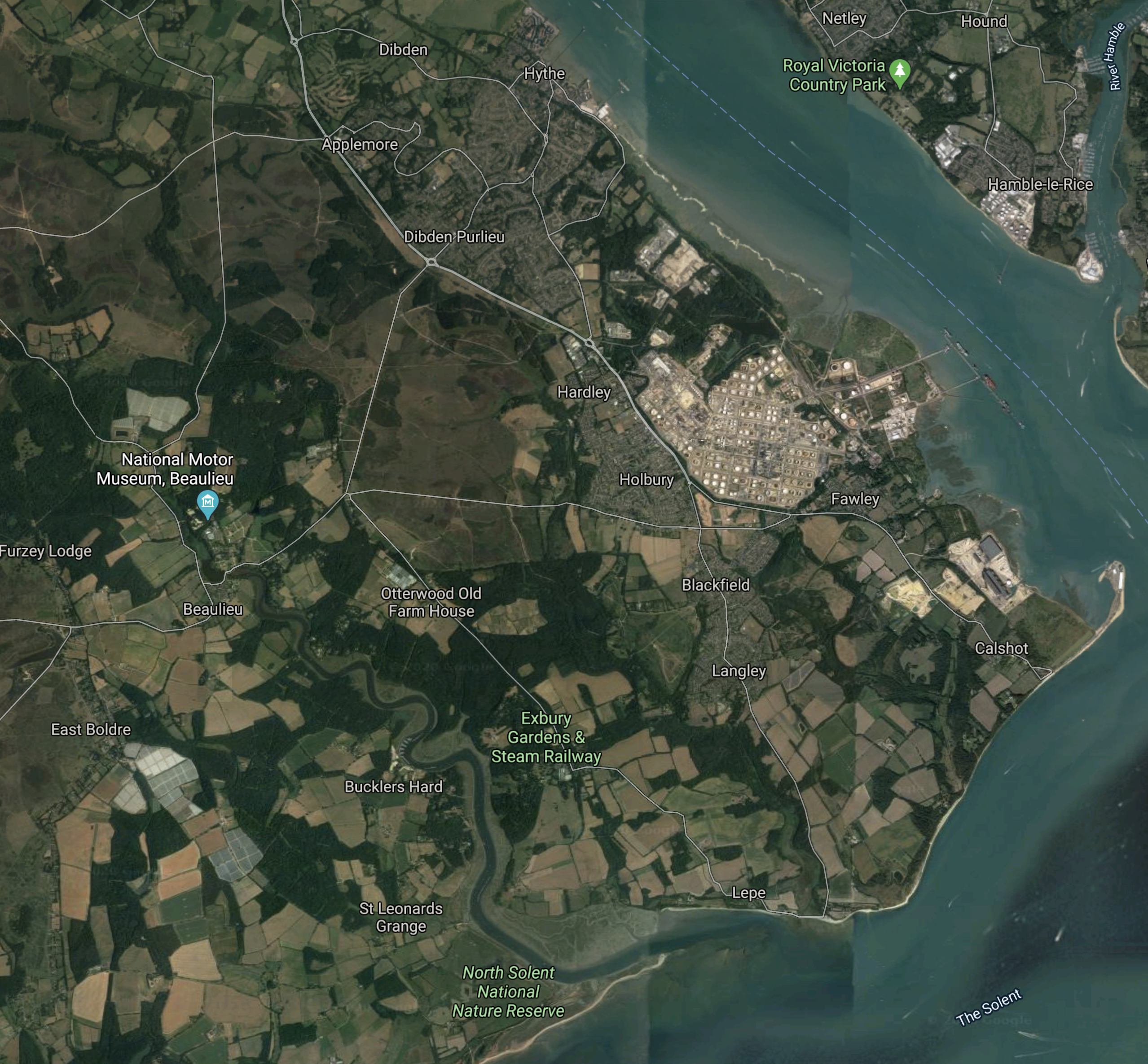
This Google Map shows the the town of Hythe and the giant Fawley Refinery.
Note.
- Hythe is towards the top of the map on Southampton Water.
- The refinery is the large beige blob in the middle on Southampton Water.
- The Fawley Branch runs close to the water and finishes inside the secure fence of the refinery.
- There will be stations at Marchwood, Hythe Town and Hythe & Fawley Parkway.
- The parkway station will be to the North of the refinery.
- The major housing site is on the former Fawley power station site, which is the Southernmost beige blob.
- The blue dot towards the West indicates the National Motor Museum at Beaulieu.
It looks to me, that an electric shuttle bus between Hythe & Fawley Parkway, Beaulieu and the various housing sites would be a good idea.
The Cost Of The Scheme
This is another quote from the article.
The campaign to open the line has been spearheaded by the Three Rivers Community Rail Partnership.
Chairman Nick Farthing says:
“For £45m, you get the track, signalling and level crossings sorted. You get a 60 mph railway with three stations = upgrading Marchwood, a new station for Hythe, and Fawley park-and-ride (just beyond Holbury, where Hardley Halt used to be).
“Three Rivers commissioned a level crossing study from Network Rail, so we know what has to be done. We’ve used a rail-approved contractor to work out how much the three stations will cost.
Three Rivers have also identified some affordable diesel rolling stock.
South Western Railway’s Innovative Train Plan
This is another quote from the Rail Magazine article.
However, SWR’s Mark Hopwood favours a much bolder plan. “We’d have to take a decision, once we knew the line was going ahead. But my personal belief is that we should be looking for a modern environmentally-friendly train that can use third-rail electricity between Southampton and Totton and maybe operate on batteries down the branch line.”
Pressed on whether that would mean Vivarail-converted former-London Underground stock, Hopwood adds. “It could be. Or it could be a conversion of our own Class 456, which will be replaced by new rolling stock very shortly. But I don’t think this is the time to use old diesels.
Converting Class 456 Trains Into Two-Car Battery Electric Trains discusses this conversion in detail.
Conclusion
This plan seems to be coming together strongly.
All the partners like Three Rivers Community Rail Partnership, Network Rail, South Western Railway and other local interests seem to be acting together and very professionally.
New Measurement Train – 30th July 2020
Whilst I was at Westbury station today, the New Measurement Train arrived.
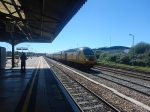
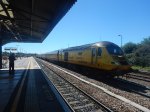
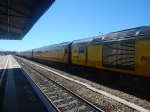
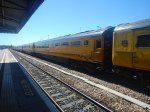
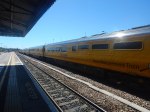

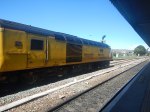
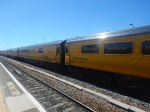


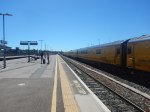
It is the first time, that I’ve been up close enough to take pictures.
With all the spare InterCity 125 trains at present, will Network Rail create a second train?
An Untidy Railway
I took these pictures as I returned from Eridge.
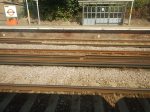


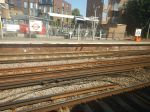
You see it all over the railways and not just in the UK; general untidiness!
When I joined ICI in 1968, I went on a thorough and excellent induction course.
One very experienced engineer, gave a Health and Safety Lecture and one thing he said, was that a neat and tidy chemical plant was less likely to have silly accidents.
Some years later, I went to the United States to see some of Metier’s clients, of whom some were nuclear power stations. This must have been just after the Three Mile Island accident, which is described like this in Wikipedia.
The Three Mile Island accident was a partial meltdown of reactor number 2 of Three Mile Island Nuclear Generating Station (TMI-2) in Dauphin County, Pennsylvania, near Harrisburg, and subsequent radiation leak that occurred on March 28, 1979. It is the most significant accident in U.S. commercial nuclear power plant history.
Artemis was involved in maintenance at the nuclear stations I visited. I can remember at AEP Donald C Cook nuclear station being shown a database of work to do and many of the actions were referred to as TMIs and checking them had been mandated by the US regulatory authorities.
I should say, the site on the shores of Lake Michigan impressed me, but another I visited later didn’t. I won’t name it, as it is now closed and it was the most untidy industrial plant of any type I have visited.
As we left, I gave my opinion to our support engineer and he told me they had a very large number of TMIs to process. I wasn’t surprised!
So why are railways generally so untidy?
Steventon Listed Railway Bridge Saved From Demolition
The title of this post, is the same as that of this article on the BBC.
On the face of it it looks like victory for the Nimbys, who have saved a rather ordinary and possibly decrepit bridge from demolition.
But I believe there is more to this story than meets the eye.
The Bridge
The bridge at the centre of the argument may be Grade 2 Listed, but there are lots of similar bridges on UK railways in better condition with similar heritage, that don’t have a listing.
Type “steventon bridge electrification” into a search engine and you’ll find lots of images of the bridge.
- One picture shows, the bridge with the railway flooded, which puts an interesting slant on the debate. What are the foundations like?
- Notice, that the bridge seemed to suffer a rather botched repair at the hands of British Rail’s finest engineers.
- Having read a lot about this story, I suspect that the locals’ main reason for objecting, is that they don’t want the disruption, whilst it is rebuilt.
- Incidentally, I suspect Great Western Railway don’t want the bridge rebuilt either, as closure will be a long disruption to all services.
I have been involved in the refurbishment of several buildings of around the same age or even older than the bridge. This is the sort of construction, that will have to be replaced at some time. If it’s not replaced, some of the novel techniques that are now available to Network Rail will have to be applied.
Network Rail
The article says this about Network Rail’s solution to the problem.
But following what the company described as ‘extensive and breakthrough testing’ using computer simulations it found a speed reduction to 110mph through the village meant wires could pass underneath the existing bridge.
I do think, that 110 mph is rather convenient. if you look at the maximum operating speeds of trains and locomotives that will pass through.
- Class 801 train with digital signalling -140 mph
- Class 801 with conventional signalling – 125 mph
- Class 800/802 train on diesel power – 100 mph
- Class 80x train on battery power – 100 mph
- Class 387 train – 110 mph
- Class 90 locomotive – 110 mph
- Class 91 locomotive – 125 mph
- Class 93 locomotive – 110 mph
- High Speed Train – 125 mph
Very few trains will have to slow down.
Any train that used onboard power, like a High Speed Train or a Class 80x with batteries, could theoretically go through at the maximum speed, track, signalling and train taken together would allow.
Hitachi
In Issue 898 of Rail Magazine, there is an article, which is entitled Sparking A Revolution, which describes Hitachi’s work and plans on battery-powered trains. This is an extract.
Battery power can be used as part of electrification schemes, allowing trains to bridge the gaps in overhead wires where the costs of altering the infrastructure are high – in tunnels or bridges, for example. This would also have the immediate benefit of reducing noise and emissions in stations or built-up areas.
Elsewhere in the article, it is said that Hitachi trains will be able to do 100 mph on battery power for up to 60 miles.
But would they be able to do 125 mph on battery power for perhaps five miles? I can’t see why not!
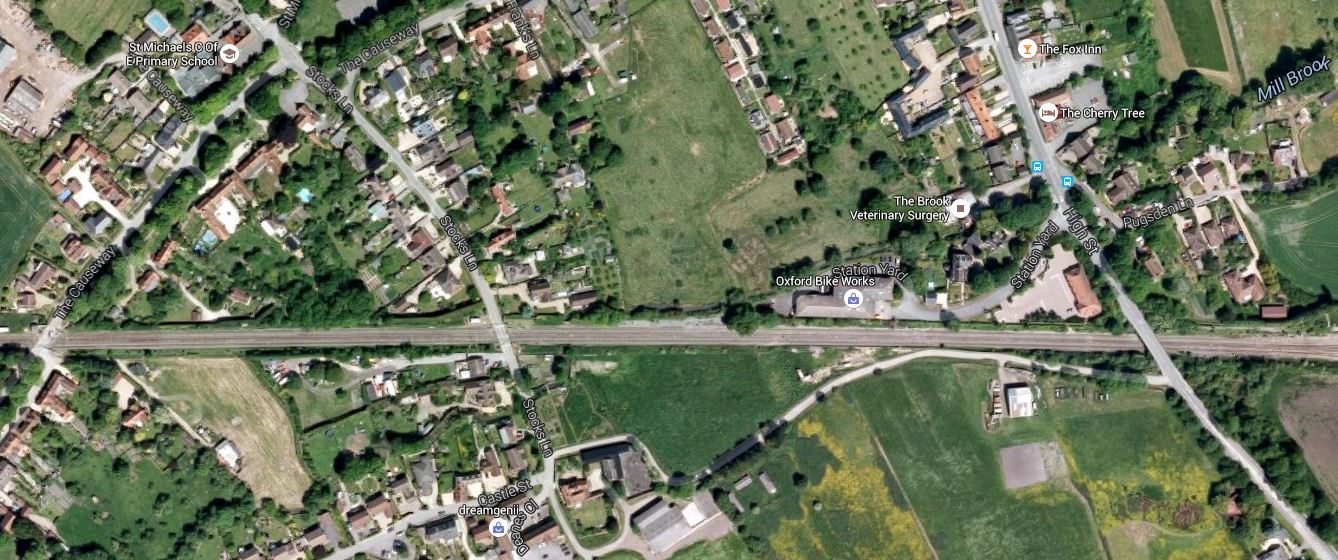
The Google Map shows the track through Steventon.
Note.
- The bridge in question is at the East.
- There are also a couple of level crossings in this stretch of track, where the height of wires is also regulated.
Perhaps, the pantograph should be dropped before going through section and raised afterwards, with power in the section taken from a battery.
Avoiding obstacles like this, may be an economic alternative, but it does require that all electric trains using the section are able to use battery power.
I have a feeling, I’ve read somewhere that a Class 88 locomotive can do a similar trick using the onboard diesel engine.
As a Control Engineer, who trained in the 1960s, I would expect that all pantographs can now be raised or lowered with all the precision and repeatability of an Olympic gold-medal gymnast!
I do wonder, if the Great Western Electrification Project had been designed around discontinuous electrification and battery-electric trains, the project would have gone better.
For instance, the Severn Tunnel is 7,000 metres long and trains take under four minutes to pass through. The Wikipedia entry for the tunnel has a section on Electrification, which details the complicated design and the trouble that there has been with corrosion.
Given that battery-electric trains have other advantages, design by hindsight, says that a tunnel without electrification and battery trains may have been a better solution.
Conclusion
Network Rail and Hitachi will get the speed of trains through Steventon up to 125 or even 140 mph, possibly by using battery power.
But whatever happens, I’m certain that the bridge will have to be rebuilt! It has the air of a derelict house, that will suck up all your money.
The Innovation Must Go On
This is a snippet I found on this news round-up on Rail Business UK.
Network Rail has issued a request for information on innovative techniques for undertaking tunnel renewals and enlargement while minimising blockades. NR said it manages 693 tunnels that are typically 150 years old; these require different and increasing levels of maintenance and renewal, but the growth of traffic means there is less access for maintenance.
Someone in Network Rail has got the engineering envelopes out again and is doing their thinking at home under lockdown, rather than in a real ale hostelry.
Companies and other organisations, should use COVID-19 as an opportunity to innovate.
Imagine the unthinkable and the downright bonkers, so long as it’s legal!
Think loony! You know it makes sense!
Manchester Piccadilly Through Platforms Become ‘A Station Within A Station’
The title of this post, is the same as that of this article on Railway Gazette.
This was the introductory paragraph.
Following what Network Rail describes as ‘a major rethink’, the two through platforms at Manchester Piccadilly which handle up to 14 trains/h are to be managed independently from the rest of the station.
Measures to be taken include.
-
- A dedicated Customer Service team.
- Better customer information screens.
- An improved satellite lounge with lots of facilities.
- Platforms will be fitted with windbreaks.
- Improved train stopping procedures to cut train dwell times.
Network Rail is also going to run a design contest to see if anybody has any other ideas.
I shall be interested to see how this works out.
Ready To Charge
The title of this post is the same as that of this article in Issue 898 of Rail Magazine.
This is the sub-title of the article.
Vivarail could be about to revolutionise rail traction with its latest innovation
The article details their plans to bring zero-carbon trains to the UK.
These are a few important more general points.
- The diesel gensets in the trains can be eco-fenced to avoid unning on diesel in built-up areas.
- The Transport for Wales trains could be the last Vivarail diesel trains.
- A 100 kWh battery pack is the same size as a diesel generator. I would assume they are almost interchangeable.
- Various routes are proposed.
- In future battery trains will be Vivarail’s focus.
- At the end of 2020, a battery demonstration train will be dispatched to the United States.
- Two-car trains will have a forty-mile range with three-cars managing sixty.
- Trains could be delivered in nine to twelve months.
The company also sees Brexit as an opportunity and New Zealand as a possible market.
Modifying Other Trains
The article also states that Vivarail are looking at off-lease electric multiple units for conversion to battery operation.
Vivarail do not say, which trains are involved.
Vivarail’s Unique Selling Point
This is the last two paragraphs of the article.
“Our unique selling point is our Fast Charge system. It’s a really compelling offer.” Alice Gillman of Vivarail says.
Vivarail has come a long way in the past five years and with this innobvative system it is poised to bring about a revolution in rail traction in the 2020s.
Conclusion
Could the train, that Vivarail refused to name be the Class 379 trains?
- There are thirty trainsets of four-cars.
- They are 100 mph trains.
- They are under ten years old.
- They meet all the Persons of Reduced Mobility regulations.
- They currently work Stansted Airport and Cambridge services for Greater Anglia.
- They are owned by Macquarie European Rail.
I rode in one yesterday and they are comfortable with everything passengers could want.

The train shown was used for the BEMU Trial conducted by Bombardier, Network Rail and Greater Anglia.
The only things missing, for these trains to run a large number of suitable routes under battery power are.
- A suitable fast charging system.
- Third rail equipment that would allow the train to run on lines with third-rail electrification.
- Third rail equipment would also connect to Vivarail’s Fast Charge system
As I have looked in detail at Vivarail’s engineering and talked to their engineers, I feel that with the right advice and assistance, they should be able to play a large part in the conversion of the Class 379 fleet to battery operation.
These trains would be ideal for the Uckfield Branch and the Marshlink Line.
If not the Class 379 trains, perhaps some Class 377 trains, that are already leased to Southern, could be converted.
I could see a nice little earner developing for Vivarail, where train operating companies and their respective leasing companies employ them to create battery sub-fleets to improve and extend their networks.
An Open Letter To Jamie Burles Of Greater Anglia
I will open by saying that this letter is not a complaint about your company, as you, like all your passengers and staff are just suffering collateral damage from the overwhelming incompetence of the real culprit.
I have been supporting Ipswich Town, off and on, since my parents retired to Felixstowe around 1960, when the next door neighbour used to take me to Portman Road.
In 2007, after living together in Suffolk for nearly forty years, my wife died of a squamous cell carcinoma of the heart, followed in 2010, by our son, who died at just thirty-seven of pancreatic cancer. I am coeliac and because of all this grief, I neglected my health, which caused me to have a serious stroke. Luckily, the only lasting problem, I suffered was a partial loss of vision, which meant I was unable to drive.
So I sold up in Suffolk and moved back to London, where I had been born in 1947.
For a couple of years, things went well coming out to Ipswich for matches by train. Typically, on a match day I would have a gluten-free lunch in London and catch the reliable 12:30 Norwich express and just arrive in my seat a few minutes before kick-off.
I should note, that there is only one reliable place for a coeliac like myself, who needs gluten-free food to eat in Ipswich and that is Pizza Express. But you can only eat so much pizza! I can get gluten-free sandwiches in Marks and Spencer, but as with the pizza, it means walking to the centre of town and at seventy-two now, that is not such an easy proposition, as it once was.
Over the last six years, the journey has got worse. The much longer journey time on replacement buses, means I can’t eat properly or do any of the other things , I need to do in life on an average Saturday.
Consider.
- Football may be important to me, but it is not that important.
- I should say, that sometimes, I go via Cambridge, when replacement buses are in operation for a change, as I can have a meal in the city with friends or buy sandwiches in the Marks & Spencer in the station.
- In all these years of disruption, it always seems that if Ipswich are at home on the Saturday, there would be a busification of the service, whereas on other Saturdays a full service operated.
When I first started coming out from London to see matches, there were quite a few supporters on the trains from London, including one guy in a wheel-chair. Over the years many seem to have fallen by the wayside, because of the constant disruption.
I had hoped that this season, Network Rail’s deplorable project management of the Great Eastern Main line, which often results in surprise closures, would have been consigned to history.
But if ever, there have been more closures this season and the latest batch of nine closures starting on Saturday, are the last straw as far as I am concerned.
Saturday’s closure was particularly inconvenient, as Kings Cross was closed and the West Anglia Main Line was running a reduced service, so in the end, I had a late breakfast at St. Pancras and took Southeastern Highspeed to Ebbsfleet where a friend and fellow Ipswich season ticket holder, who lives nearby, gave me a lift to the match. The home-to-home round trip , was actually almost as long, as that on the previous Saturday’s trip to Tranmere.
Looking at the next few Saturday Ipswich home games, I see the following.
- Peterborough – 1st February – Normal service (?)
- Burton Albion – 15th February – Buses
- Oxford United – 22nd February – Buses
- Coventry – 7th March – Buses
- Portsmouth- 21th March – Buses
- Rochdale – 18th April – Buses
I probably speak with more authority, than most, as the company I started in Ipswich; Metier Management Systems, is recognised as one of the companies, that changed project management completely, in the last three decades of the twentieth century. At times, half the major projects in the world were being planned and managed by software I wrote in a Suffolk attic.
I rate, Network Rail’s performance over the last few years in the wider UK, as one of the worst project management disasters I have known, alongside Berlin’s Brandenburg Airport, the legendary hospital built the wrong way round, and the Boeing 737 MAX.
Hitachi Trains For Avanti
The title of this post is the same as that of an article in the January 2020 Edition of Modern Railways.
The Bi-Mode Trains
Some more details of the thirteen bi-mode and ten electric Hitachi AT 300 trains are given.
Engine Size and Batteries
This is an extract from the article.
Hitachi told Modern Railways it was unable to confirm the rating of the diesel engines on the bi-modes, but said these would be replaceable by batteries in future if specified.
I do wonder if my speculation in Will Future Hitachi AT-300 Trains Have MTU Hybrid PowerPacks? is possible.
After all, why do all the hard work to develop a hybrid drive system, when your engine supplier has done it for you?
Would Avanti West Coast need a train that will do 125 mph on diesel?
- The North Wales Coast Line has a maximum line speed of just 90 mph.
- Wikipedia is uncertain of the maximum speed of the Chester and Shrewbury Line, but it is extremely unlikely to be more than 80-90 mph.
The only place, they will be able to run at 125 mph or even higher will be on the West Coast Main Line, where they will be running under electric power from the pantograph.
If I were designing a bi-mode for 90 mph on diesel and 125 mph on electric, I would have batteries on the train for the following purposes.
- Handle regenerative braking.
- Provide hotel power in stations or when stationery.
- Provide an acceleration boost, if required, when running on diesel.
- Provide emergency power, if the wires go down in electric mode.
I’m sure MTU could work out a suitable size of diesel engine and batteries in an MTU PowerPack, that would meet the required performance.
Or maybe a smaller diesel could be used. An LNER Class 800 train has 1680 kW of installed power to maintain 125 mph. But the Great Western Railway versions have 2100 kW or twenty-five percent more, as their routes are more challenging with steeper gradients.
For the less challenging routes at a maximum of 90 mph between Crewe, Chester, Shrewsbury and North Wales, I wonder what level of power is needed.
A very rough estimate based on the speed required could put the power requirement as low as 1200-1500 kW.
As the diesel engines are only electrical generators, it would not effect the ability of the train to do 125 mph between Crewe and London.
There looks to be a virtuous circle at work here.
- Lower maximum speed on diesel means smaller diesel engines.
- Smaller diesel engines means lighter diesel engines and less fuel to carry.
- Less weight to accelerate needs less installed power.
- Less power probably means a more affordable train, that uses less diesel.
It looks to me, that Hitachi have designed a train, that will work Avanti West Coast’s routes efficiently.
The Asymmetric Bi-Mode Train
It looks to me that the bi-mode train that Avanti West Coast are buying has very different performance depending on the power source and signalling
- 90 mph or perhaps up to 100 mph on diesel.
- 125 mph on electric power.with current signalling.
- Up to 140 mph on electric power with in-cab digital signalling.
This compares with the current Class 221 trains, which can do 125 mph on all tracks, with a high enough operating speed.
The new trains’ different performance on diesel and electric power means they could be called asymmetric bi-modes.
Surely, creating an asymmetric bi-mode train, with on-board power; battery, diesel or hydrogen, sized to the route, means less weight, greater efficiency, less cost and in the case of diesel, higher carbon efficiency.
Carbon Emissions
Does the improvement in powertrain efficiency with smaller engines running the train at slower speeds help to explain this statement from the Modern Railways article?
Significant emissions reduction are promised from the elimination of diesel operation on electrified sections as currently seen with the Voyagers, with an expected reduction in CO2 emissions across the franchise of around two-thirds.
That is a large reduction, which is why I feel, that efficiency and batteries must play a part.
Battery-Electric Conversion
In my quote earlier from the Modern Railways article, I said this.
These (the diesel engines) would be replaceable by batteries in future if specified.
In Thoughts On The Next Generation Of Hitachi High Speed Trains, I looked at routes that could be run by a battery-electric version of Hitachi AT-300 trains.
I first estimated how far an AT-300 train could go on batteries.
How far will an AT-300 train go on battery power?
- I don’t think it is unreasonable to be able to have 150 kWh of batteries per car, especially if the train only has one diesel engine, rather than the current three in a five-car train.
- I feel with better aerodynamics and other improvements based on experience with the current trains, that an energy consumption of 2.5 kWh per vehicle mile is possible, as compared to the 3.5 kWh per vehicle mile of the current trains.
Doing the calculation gives a range of sixty miles for an AT-300 train with batteries.
As train efficiency improves and batteries are able to store more energy for a given volume, this range can only get better.
I then said this about routes that will be part of Avanti West Coast’s network.
With a range of sixty miles on batteries, the following is possible.
- Chester, Gobowen, Shrewsbury And Wrexham Central stations could be reached on battery power from the nearest electrification.
- Charging would only be needed at Shrewsbury to ensure a return to Crewe.
Gobowen is probably at the limit of battery range, so was it chosen as a destination for this reason.
The original post was based on trains running faster than the 90 mph that is the maximum possible on the lines without electrification, so my sixty mile battery range could be an underestimate.
These distances should be noted.
- Crewe and Chester – 21 miles
- Chester and Shrewsbury – 42 miles
- Chester and Llandudno – 47 miles
- Chester and Holyhead – 84 miles
Could electrification between Crewe and Chester make it possible for Avanti West Coast’s new trains to go all the way between Chester and Holyhead on battery power in a few years?
I feel that trains with a sixty mile battery range would make operations easier for Avanti West Coast.
Eighty miles would almost get them all the way to Holyhead, where they could recharge!
Rlectrification Between Chester And Crewe
I feel that this twenty-odd miles of electrification could be key to enabling battery-electric trains for the routes to the West of Chester to Shrewsbury, Llandudno and Holyhead.
How difficult would it be to electrify between Chester and Crewe?
- It is not a long distance to electrify.
- There doesn’t appear to be difficult viaducts or cuttings.
- It is electrified at Crewe, so power is not a problem.
- There are no intermediate stations.
But there does seem to be a very large number of bridges. I counted forty-four overbridges and six underbridges. At least some of the bridges are new and appear to have been built with the correct clearance.
Perhaps it would be simpler to develop fast charging for the trains and install it at Chester station.
Conclusion On The Bi-Mode Trains
It appears to me that Avanti West Coast, Hitachi and Rock Rail, who are financing the trains have done a very good job in devising the specification for a fleet of trains that will offer a good service and gradually move towards being able to deliver that service in a carbon-free manner.
- The initial bi-mode trains will give a big improvement in performance and reduction in emission on the current Voyagers, as they will be able to make use of the existing electrification between Crewe and London.
- The trains could be designed for 125 mph on electric power and only 90-100 mph on diesel, as no route requires over 100 mph on diesel. This must save operating costs and reduce carbon emissions.
- They could use MTU Hybrid PowerPacks instead of conventional diesel engines to further reduce emissions and save energy
- It also appears that Hitachi might be able to convert the trains to battery operation in a few years.
- The only new infrastructure would be a few charging stations for the batteries and possible electrification between Chester and Crewe.
I don’t think Avanti West Coast’s ambition of a two-thirds reduction in CO2 is unreasonable and feel it could even be exceeded.
Other Routes For Asymetric Bi-Mode Trains
I like the concept of an asymetric bi-mode train, where the train has the following performance.
- Up to 100 mph on battery, diesel or hydrogen.
- Up to 100 mph on electrified slower-speed lines.
- 125 mph on electrified high-speed lines, with current signalling.
- Up to 140 mph on electrified high-speed lines, with in-cab digital signalling.
I am very sure that Hitachi can now tailor an AT-300 train to a particular company’s needs. Certainly, in the case of Avanti West Coast, this seems to have happened, when Avanti West Coast, Hitachi, Network Rail and Rock Rail had some serious negotiation.
LNER At Leeds
As an example consider the rumoured splitting and joining of trains at Leeds to provide direct services between London and Bradford, Harrogate, Huddersfield, Ilkley, Skipton and other places, that I wrote about in Dancing Azumas At Leeds.
In the related post, I gave some possible destinations.
- Bradford – 13 miles – 25 minutes – Electrified
- Harrogate – 18 miles – 30 minutes
- Huddersfield – 17 miles – 35 minutes
- Hull – 20 miles – 60 minutes
- Ilkley – 16 miles – 26 minutes – Electrified
- Skipton – 26 miles – 43 minutes – Electrified
- York – 25 miles – 30 minutes
Note, that the extended services would have the following characteristics.
They would be run by one five-car train.
- Services to Bradford, Ilkley and Skipton would be electric
- Electrification is planned from Leeds to Huddersfield and York, so these services could be electric in a few years.
- All other services would need independent power; battery, diesel or hydrogen to and from Leeds.
- Two trains would join at Leeds and run fast to London on the electrified line.
- Services would probably have a frequency of six trains per day, which works out at a around a train every two hours and makes London and back very possible in a day.
- They would stop at most intermediate stations to boost services to and from Leeds and give a direct service to and from London.
As there are thirty trains per day between London and Leeds in each direction, there are a lot of possible services that could be provided.
Currently, LNER are only serving Harrogate via Leeds.
- LNER are using either a nine-car train or a pair of five-car trains.
- The trains reverse in Platforms 6 or 8 at Leeds, both of which can handle full-length trains.
- LNER allow for a generous time for the reverse, which would allow the required splitting and joining.
- All trains going to Harrogate are Class 800 bi-mode trains.
Note that the Class 800 trains are capable of 125 mph on diesel, whereas the average speed between Harrogate and Leeds is just 35 mph. Obviously, some of this slow speed is due to the route, but surely a train with a maximum speed of 90-100 mph, with an appropriate total amount of diesel power, would be the following.
- Lighter in weight.
- More efficient.
- Emit less pollution.
- Still capable of high speed on electrified lines.
- Bi-mode and electric versions could run in pairs between Leeds and London.
LNER would probably save on track access charges and diesel fuel.
LNER To Other Places
Could LNER split and join in a similar way to other places?
- Doncaster for Hull and Sheffield
- Edinburgh for Aberdeen and Inverness
- Newark for Lincoln and Nottingham
- York for Middlesbrough and Scarborough.
It should be noted that many of the extended routes are quite short, so I suspect some train diagrams will be arranged, so that trains are only filled up with diesel overnight,
GWR
Great Western Railway are another First Group company and I’m sure some of their routes could benefit, from similar planning to that of Avanti West Coast.
Splitting and joining might take place at Reading, Swindon, Bristol and Swansea.
South Western Railway
South Western Railway will need to replace the three-car Class 159 trains to Exeter, that generally work in pairs with a total number of around 400 seats, in the next few years.
These could be replaced with a fleet of third-rail Hitachi trains of appropriate length.
- Seven cars sating 420 passengers?
- They would remove diesel trains from Waterloo station.
- All South Western Railway Trains running between Waterloo and Basingstoke would be 100 mph trains.
I wonder, if in-cab digital signalling on the route, would increase the capacity? It is sorely needed!
Southeastern
Southeastern need bi-mode trains to run the promised service to Hastings.
- Trains would need a third-rail capability.
- Trains need to be capable of 140 mph for High Speed One.
- Trains need to be able to travel the 25 miles between Ashford International and Ore stations.
- Trains would preferably be battery-electric for working into St. Pancras International station.
Would the trains be made up from six twenty-metre cars, like the Class 395 trains?
The Simple All-Electric Train
The Modern Railways article, also says this about the ten all-electric AT-300 trains for Birmingham, Blackpool and Liverpool services.
The electric trains will be fully reliant on the overhead wire, with no diesel auxiliary engines or batteries.
It strikes me as strange, that Hitachi are throwing out one of their design criteria, which is the ability of the train to rescue itself, when the overhead wires fail.
In Do Class 800/801/802 Trains Use Batteries For Regenerative Braking?, I published this extract from this document on the Hitachi Rail web site.
The system can select the appropriate power source from either the main transformer or the GUs. Also, the size and weight of the system were minimized by designing the power supply converter to be able to work with both power sources. To ensure that the Class 800 and 801 are able to adapt to future changes in operating practices, they both have the same traction system and the rolling stock can be operated as either class by simply adding or removing GUs. On the Class 800, which is intended to run on both electrified and non-electrified track, each traction system has its own GU. On the other hand, the Class 801 is designed only for electrified lines and has one or two GUs depending on the length of the trainset (one GU for trainsets of five to nine cars, two GUs for trainsets of 10 to 12 cars). These GUs supply emergency traction power and auxiliary power in the event of a power outage on the catenary, and as an auxiliary power supply on non-electrified lines where the Class 801 is in service and pulled by a locomotive. This allows the Class 801 to operate on lines it would otherwise not be able to use and provides a backup in the event of a catenary power outage or other problem on the ground systems as well as non-electrified routes in loco-hauled mode.
This is a very comprehensive power system, with a backup in case of power or catenary failure.
So why does it look like Hitachi are throwing that capability out on the trains for Avanti West Coast.
There are several possibilities.
- The reliability of the trains and the overhead wire is such, that the ability of a train to rescue itself is not needed.
- The auxiliary generator has never been used for rescuing the train.
- The West Coast Main Line is well-provided with Thunderbird locomotives for rescuing Pendelinos, as these trains have no auxiliary generator or batteries.
- Removal of the excess weight of the auxiliary engine and batteries, enables the Hitachi AT-300 trains to match the performance of the Pendelinos, when they are using tilt.
Obviously, Hitachi have a lot of train performance statistics, from the what must be around a hundred trains in service.
It looks like Hitachi are creating a lightweight all-electric train, that has the performance or better of a Pendelino, that it achieves without using tilt.
- No tilt means less weight and more interior space.
- No auxiliary generator or batteries means less weight.
- Wikipedia indicates, that Hitachi coaches are around 41 tonnes and Pendelino coaches are perhaps up to ten tonnes heavier.
- Less weight means fast acceleration and deceleration.
- Less weight means less electricity generated under regenerative braking.
- Pendelinos use regenerative braking, through the catenary.
- Will the new Hitachi trains do the same instead of the complex system they now use?
If the train fails and needs to be rescued, it uses the same Thunderbird system, that the Pendelinos use when they fail.
Will The New Hitachi Trains Be Less Costly To Run?
These trains will be lighter in weight than the Pendelinos and will not require the track to allow tilting.
Does this mean, that Avanti West Coast will pay lower track access charges for their new trains?
They should also pay less on a particular trip for the electricity, as the lighter trains will need less electricity to accelerate them to line speed.
Are Avanti West Coast Going To Keep The Fleets Apart?
Under a heading of Only South Of Preston, the Modern Railways article says this.
Unlike the current West Coast fleet, the Hitachi trains will not be able to tilt. Bid Director Caroline Donaldson told Modern Railways this will be compensated for by their improved acceleration and deceleration characteristics and that the operator is also working with Network Rail to look at opportunities to improve the linespeed for non-tilting trains.
The routes on which the Hitachi trains will operate have been chosen with the lack of tilt capability in mind, with this having the greatest impact north of Preston, where only Class 390 Pendelinos, which continue to make use of their tilting capability will be used.
Avanti West Coast have said that the Hitachi trains will run from London to Birmingham, Blackpool and Liverpool.
All of these places are on fully-electrified branches running West from the West Coast Main Line, so it looks like there will be separation.
Will The New Hitachi Trains Be Faster To Birmingham, Blackpool And Liverpool?
Using data from Real Time Trains, I find the following data about the current services.
- Birmingham and Coventry is 19 miles and takes 20 minutes at an average speed of 57 mph
- Blackpool and Preston is 16.5 miles and takes 21 minutes at an average speed of 47 mph
- Liverpool and Runcorn is 3.15 miles and takes 15 minutes at an average speed of 52 mph
All the final legs when approaching the terminus seem to be at similar speeds, so I doubt there are much savings to be made away from the West Coast Main Line.
Most savings will be on the West Coast Main Line, where hopefully modern in-cab digital signalling will allow faster running at up to the design speed of both the Hitachi and Pendelino trains of 140 mph.
As an illustration of what might be possible, London to Liverpool takes two hours and thirteen minutes.
The distance is 203 miles, which means that including stops the average speed is 91.6 mph.
If the average speed could be raised to 100 mph, this would mean a journey time of two hours and two minutes.
As much of the journey between London and Liverpool is spent at 125 mph, which is the limit set by the signalling, raising that to 135 mph could bring substantial benefits.
To achieve the journey in two hours would require an overall average speed of 101.5 mph.
As the proportion of track on which faster speeds, than the current 125 mph increase over the next few years, I can see Hitachi’s lightweight all-electric expresses breaking the two hour barrier between London and Liverpool.
What About The Pendelinos And Digital Signalling?
The January 2020 Edition of Modern Railways also has an article entitled Pendolino Refurb Planned.
These improvements are mentioned.
- Better standard class seats! (Hallelujah!)
- Refreshed First Class.
- Revamped shop.
Nothing is mentioned about any preparation for the installation of the equipment to enable faster running using digital in-cab signalling, when it is installed on the West Coast Main Line.
Surely, the trains will be updated to be ready to use digital signalling, as soon as they can.
Just as the new Hitachi trains will be able to take advantage of the digital signalling, when it is installed, the Pendellinos will be able to as well.
Looking at London and Glasgow, the distance is 400 miles and it takes four hours and thirty minutes.
This is an average speed of 89 mph, which compares well with the 91.6 mph between London and Liverpool.
Raise the average speed to 100 mph with the installation of digital in-cab signalling on the route, that will allow running at over 125 mph for long sections and the journey time will be around four hours.
This is a table of average speeds and journey times.
- 100 mph – four hours
- 105 mph – three hours and forty-eight minutes
- 110 mph – three hours and thirty-eight minutes
- 115 mph – three hours and twenty-eight minutes
- 120 mph – three hours and twenty minutes
- 125 mph – three hours and twelve minutes
- 130 mph – three hours and four minutes
I think that I’m still young enough at 72 to be able to see Pendelinos running regularly between London and Glasgow in three hours twenty minutes.
The paragraph is from the Wikipedia entry for the Advanced Passenger Train.
The APT is acknowledged as a milestone in the development of the current generation of tilting high speed trains. 25 years later on an upgraded infrastructure the Class 390 Pendolinos now match the APT’s scheduled timings. The London to Glasgow route by APT (1980/81 timetable) was 4hrs 10min, the same time as the fastest Pendolino timing (December 2008 timetable). In 2006, on a one off non-stop run for charity, a Pendolino completed the Glasgow to London journey in 3hrs 55min, whereas the APT completed the opposite London to Glasgow journey in 3hrs 52min in 1984.
I think it’s a case of give the Pendelinos the modern digital in-cab signalling they need and let them see what they can do.
It is also possible to give an estimate for a possible time to and from Manchester.
An average speed of 120 mph on the route would deliver a time of under one hour and forty minutes.
Is it possible? I suspect someone is working on it!
Conclusion
I certainly think, that Avanti West Coast, Hitachi and Network Rail, have been seriously thinking how to maximise capacity and speed on the West Coast Main Line.
I also think, that they have an ultimate objective to make Avanti West Coast an operator, that only uses diesel fuel in an emergency.
 The Anonymous Widower